

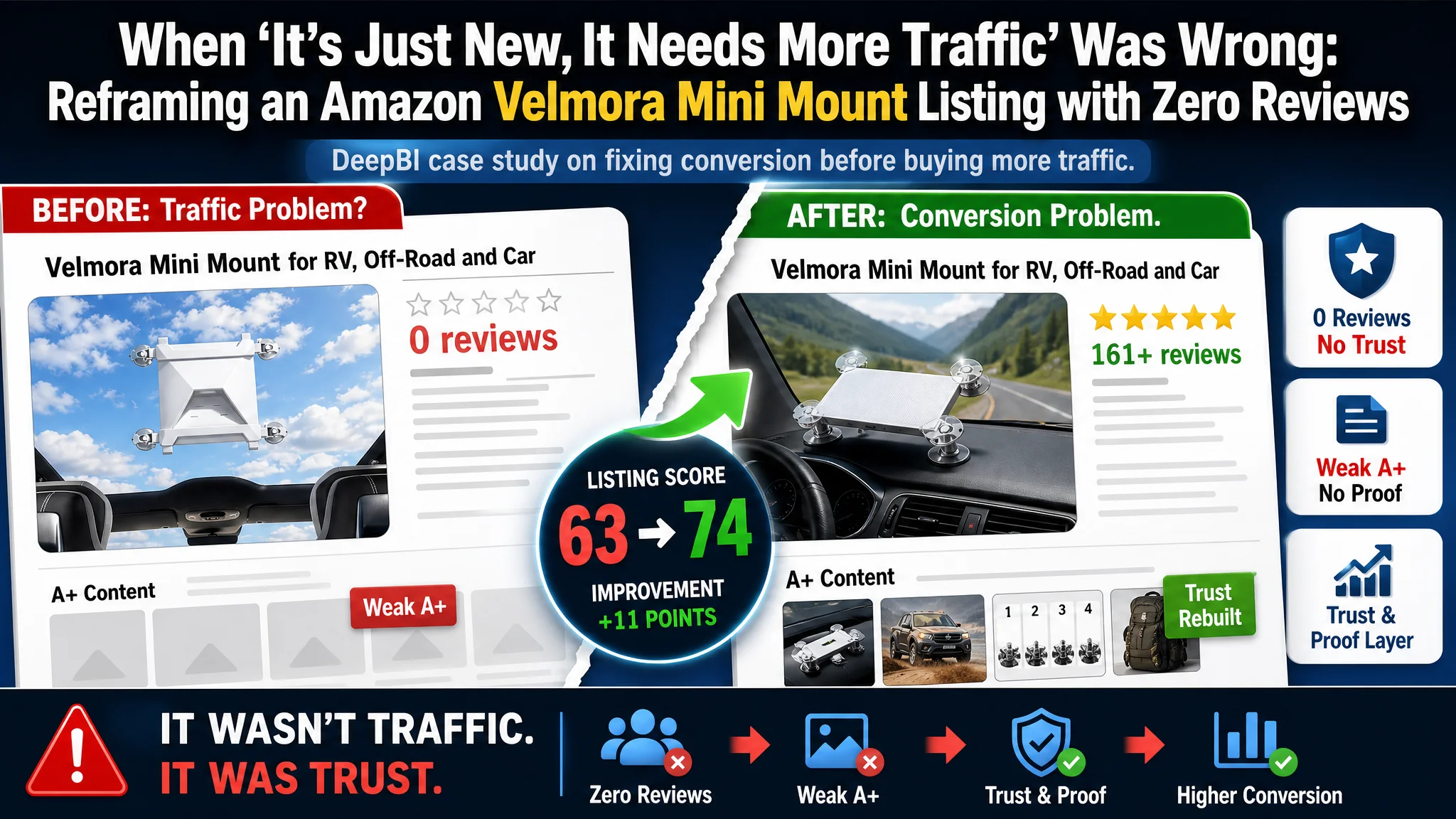
This Amazon seller launched a Starlink Mini mount for RVs and off-road vehicles on the US marketplace and quickly ran into a familiar wall: traffic was limited, ads were hard to scale, and the Listing had no reviews. Internally, the team framed it as a “new product traffic problem” and focused on pushing more exposure, assuming that once advertising picked up, orders and reviews would naturally follow.
DeepBI’s Listing diagnosis told a different story. Against a strong Starlink Mini car-mount competitor, the Listing scored 63 vs. 74 out of 100. Title and main image were not the real weaknesses; the true gap was in trust and decision support on the Amazon product page itself—especially A+ content and the completely missing review layer. In other words, this was not an ad or keyword issue; it was a conversion-capacity issue.
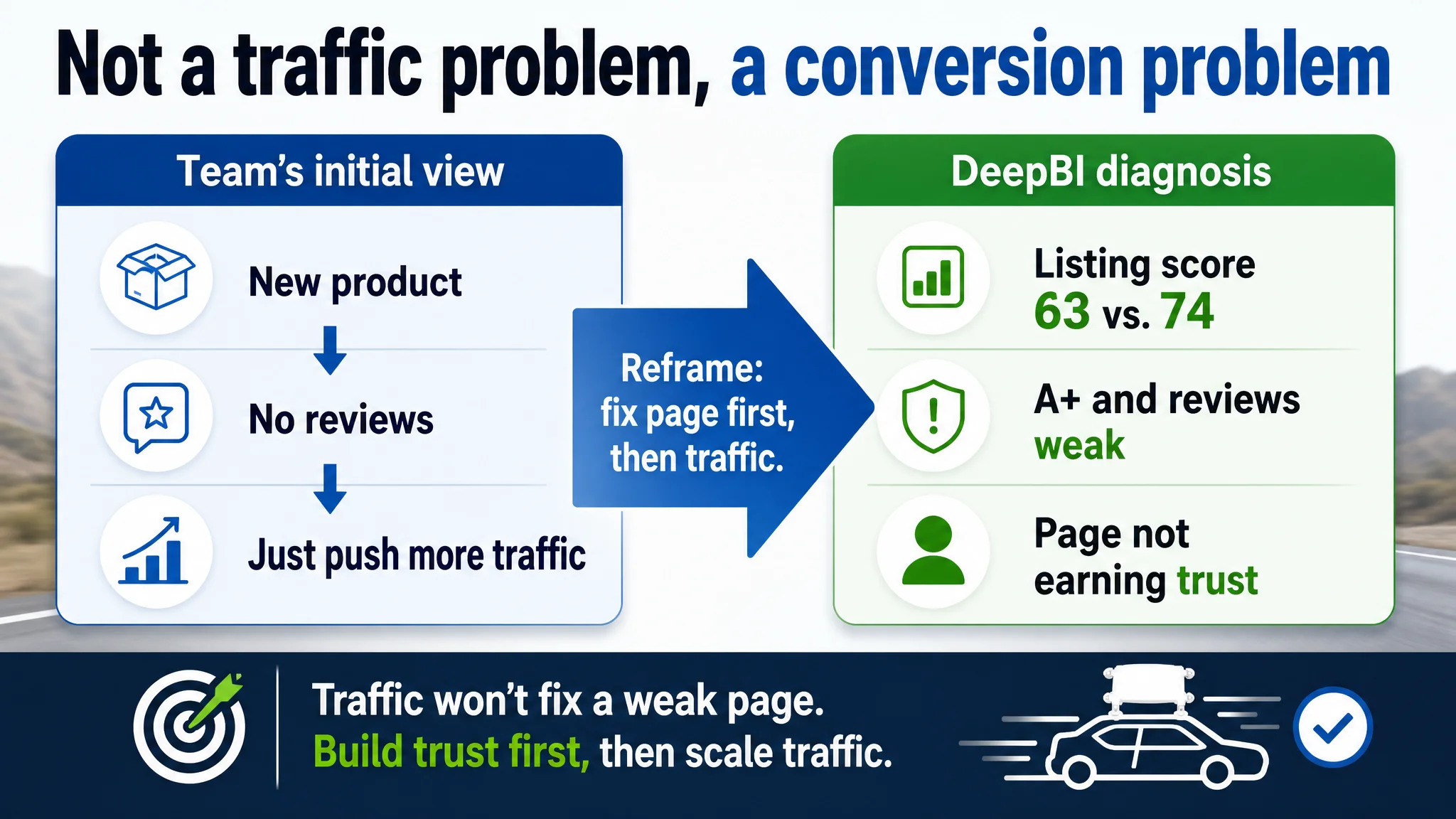
Once the seller accepted that, the optimization direction changed. Instead of trying to “buy their way out” with more Amazon ads, the focus shifted to rebuilding the sales logic of the page: refocusing visuals on real in-car usage, making extreme road stability and material reliability visible, and structuring A+ content and bullet points around real buyer doubts. For other Amazon sellers, this case is a reminder: when a Listing has zero reviews and incomplete trust proof, pushing more traffic into it often just amplifies the leak. The foundation is to make the page deserve the traffic first.
What the Seller Saw: A New Starlink Mini Mount That “Just Needs Traffic”
The product is a suction-cup mount for Starlink Mini, targeted at RV owners, off-road drivers, and remote workers who need stable satellite internet on the move.
From the seller’s perspective:
- The title looked solid and keyword-rich.
- The main image clearly showed the product with a sky background.
- Bullet points were written around “strong suction,” “easy installation,” and “flexible angles.”
- A+ already had multiple modules and multi-scenario visuals.
The biggest visible problem was simple: no reviews at all. The competing Amazon Listing, in contrast, had:
- 4.2 stars
- 161 total reviews
So the internal reasoning was straightforward: “The Listing is basically good; conversion is low only because there are no reviews. We need more traffic and time.”
DeepBI’s job was to verify whether this was really just a review-age issue—or whether the page itself was structurally consuming the traffic.
The Real Constraint Was Not Ads. It Was Page Conversion Capacity.
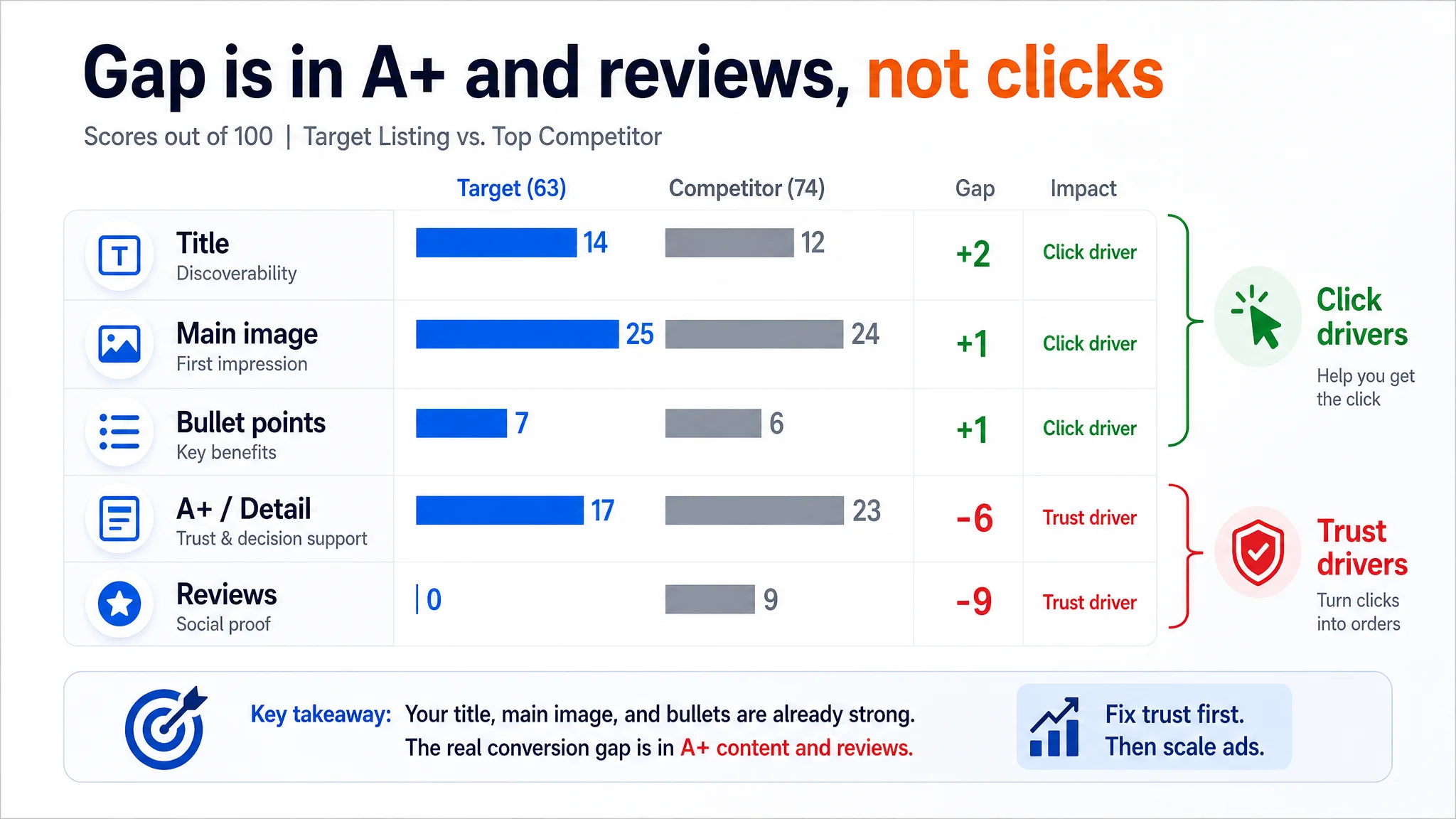
After scoring the Listing against a high-performing competitor, the picture became much clearer:
- Overall Listing score
- Target Listing: 63 / 100
- Competitor: 74 / 100
- Gap: -11 points
- By dimension
- Title: 14 vs. 12 (no real problem here; even stronger than competitor)
- Main image: 25 vs. 24 (nearly on par)
- Bullet points: 7 vs. 6 (slight advantage)
- A+ / detail: 17 vs. 23 (-6 gap)
- Reviews: 0 vs. 9 (-9 gap)
The conclusion:
This Listing did not lack clickability. It lacked trust and detailed proof once users arrived.
The title, main image, and bullet points were not the bottleneck. The core weakness was:
- A+ modules that looked “rich” but did not actually answer critical purchase doubts, and
- A complete absence of review evidence to back up any of the claims.
If ads were aggressively scaled at this stage, they would simply send more buyers into a page that fails to convincingly answer:
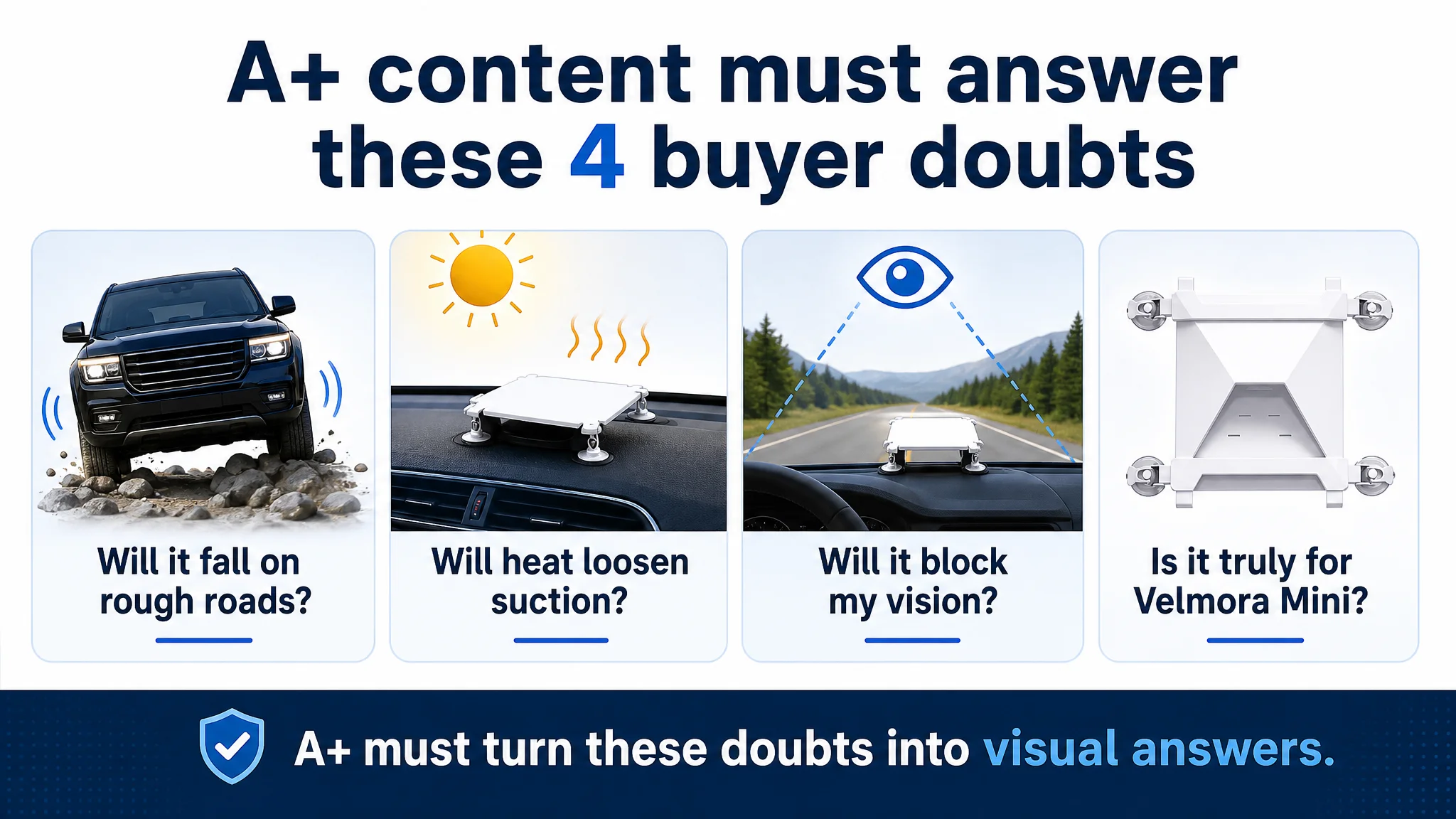
- Will the suction cup really hold on bumpy off-road tracks?
- Will it survive summer heat on the dashboard?
- Will it block my driving view?
- Is it actually specifically built for Starlink Mini, or is it a generic mount?
Until those were addressed visually and structurally, Amazon ads could not be the first lever.
Why Traditional Amazon Optimization Logic Misread This Listing
The seller’s default thinking followed a common pattern:
1. New product → no reviews → low conversion
2. Conversion issue is “age-related” → push more traffic, wait for reviews
3. If ads underperform, tweak keywords and bids again
But DeepBI’s comparison with the benchmark showed a different kind of gap:
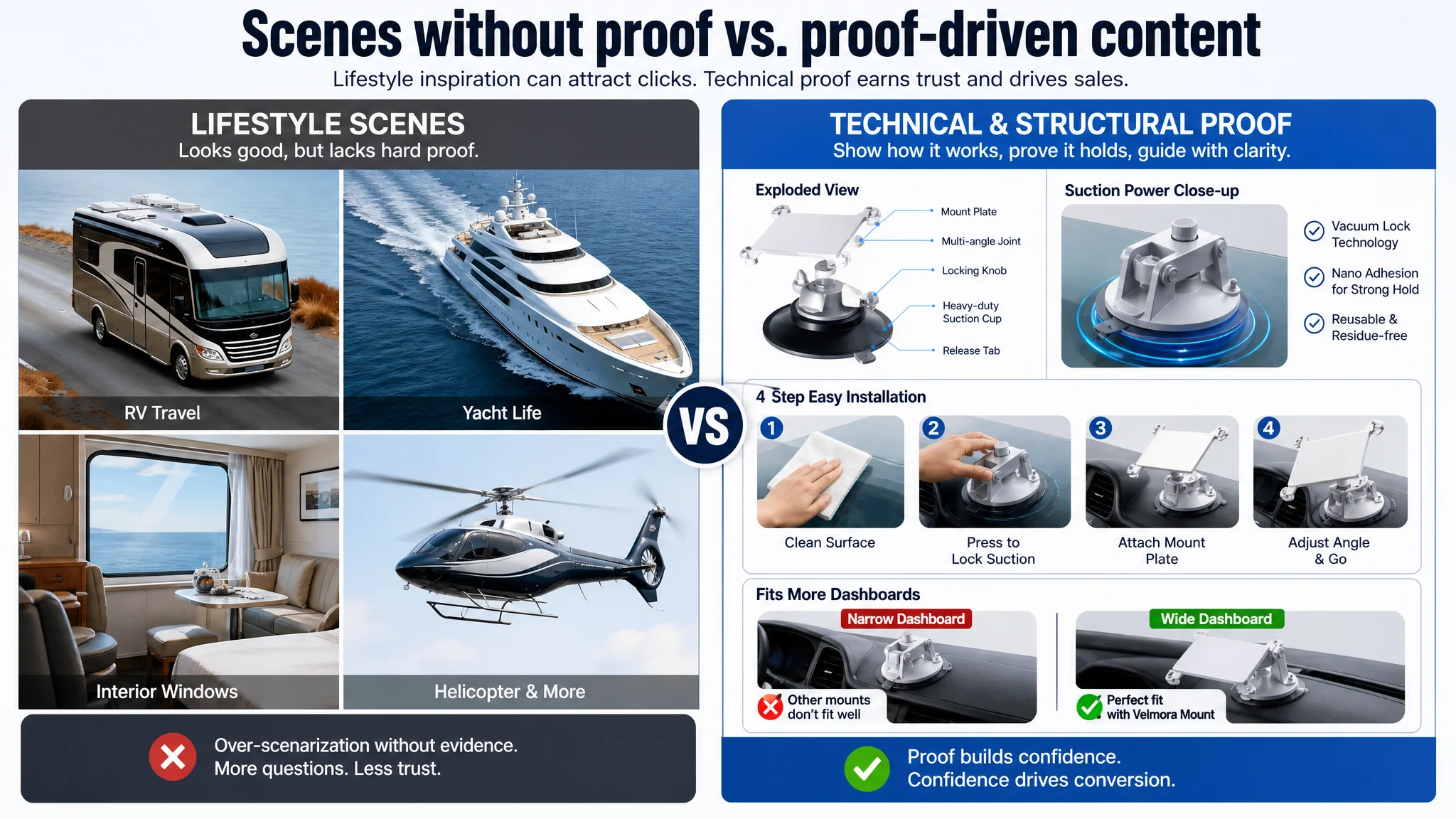
- The competitor was not winning by being prettier. It was winning because its page:
- Broke down the product structure visually.
- Demonstrated real-world stability in extreme driving.
- Explicitly showed how to install on different dashboards and windshields.
- Offered simple, visual installation steps.
- The target Listing, by contrast, was:
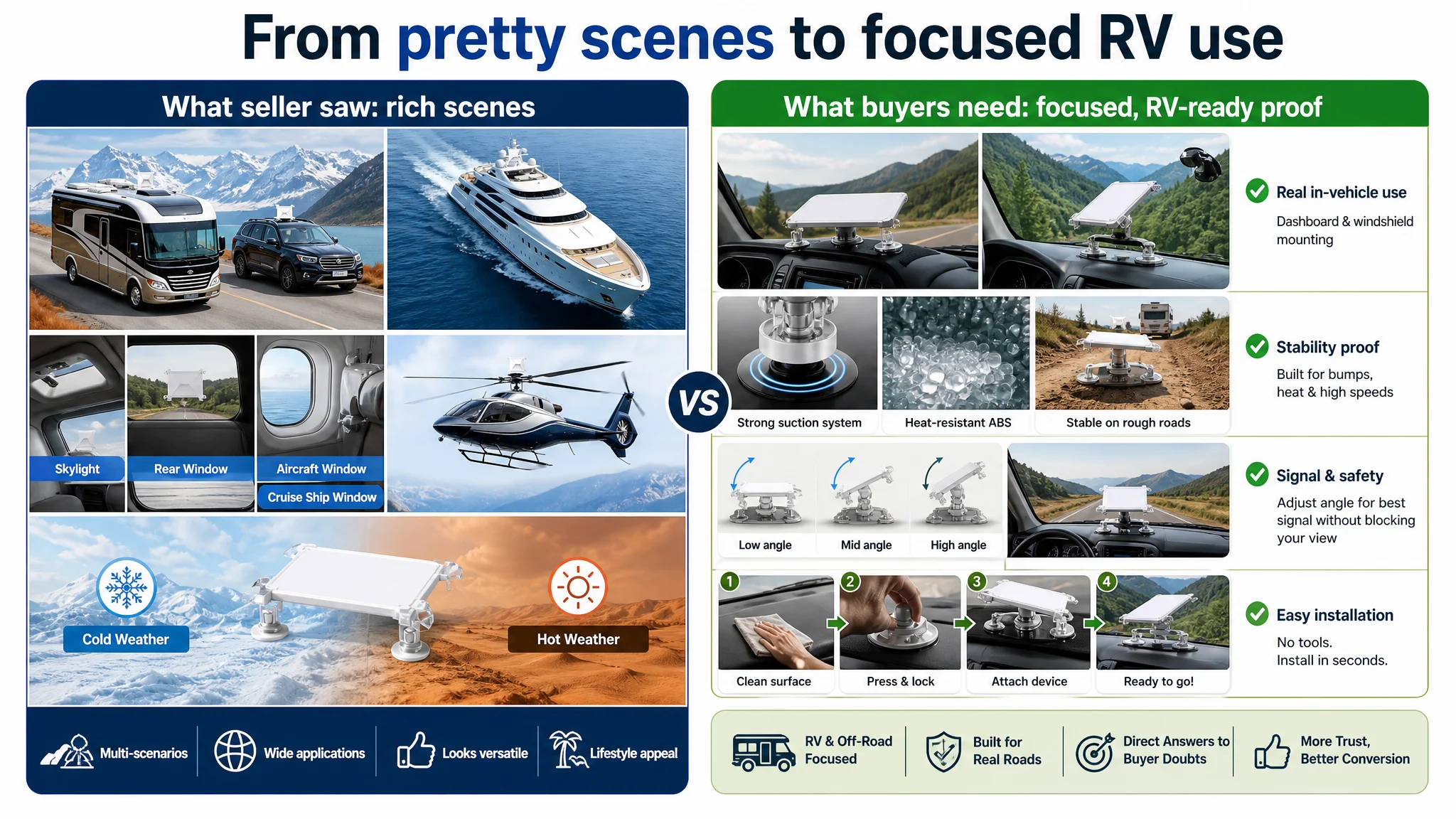
- Heavy on “nice RV/off-road lifestyle scenes.”
- Light on hard evidence of suction power, material durability, and real in-vehicle adaptation.
- Over-extended into non-core scenes like helicopters and cruise ships, diluting credibility.
This is the key misdiagnosis:
The team believed “we just need reviews and more traffic,” while the deeper problem was “the page has not yet earned trust for high-risk use cases.”
In categories like mounts that must survive heat, speed, and vibration, buyers are extremely cautious. Without visual proof that the mount will not drop a Starlink Mini dish at 70 mph on rough roads, even heavy traffic and good keywords cannot rescue conversion.
On Paper the Listing Looked Fine. In A Real Buying Journey It Did Not.
Title: Not the Problem
DeepBI’s assessment: the title was actually well-structured and even stronger than the competitor’s.
- Core structure:
“Starlink Mini Mount for RV, Off-Road and Car, Strong Suction Cup Holder for Dashboard & Windshield, Secure Mounting Kit for Stable Satellite Signal, Durable ABS Accessories”
- Covers:
- Product: Starlink Mini mount / suction cup holder
- Core scenarios: RV, off-road, car
- Install positions: dashboard, windshield
- Outcome: stable satellite signal
- Material: durable ABS
From an Amazon A9 and buyer-readability standpoint, the title was not the conversion brake.
Main Image: Visually Acceptable, But Weak on Decision Logic
The main image dimension score was almost the same as the competitor’s. But the role of the main image in this category is specific:
- It must immediately shout: “This is a Starlink Mini car mount, inside your vehicle, holding your dish in place.”
The existing main image:
- Used a sky background through a sunroof to suggest “clear sky signal.”
- Showed the product on glass, but not in a recognizable, everyday car context.
- Felt more like a promotional render than a tool clearly mounted in a real cabin.
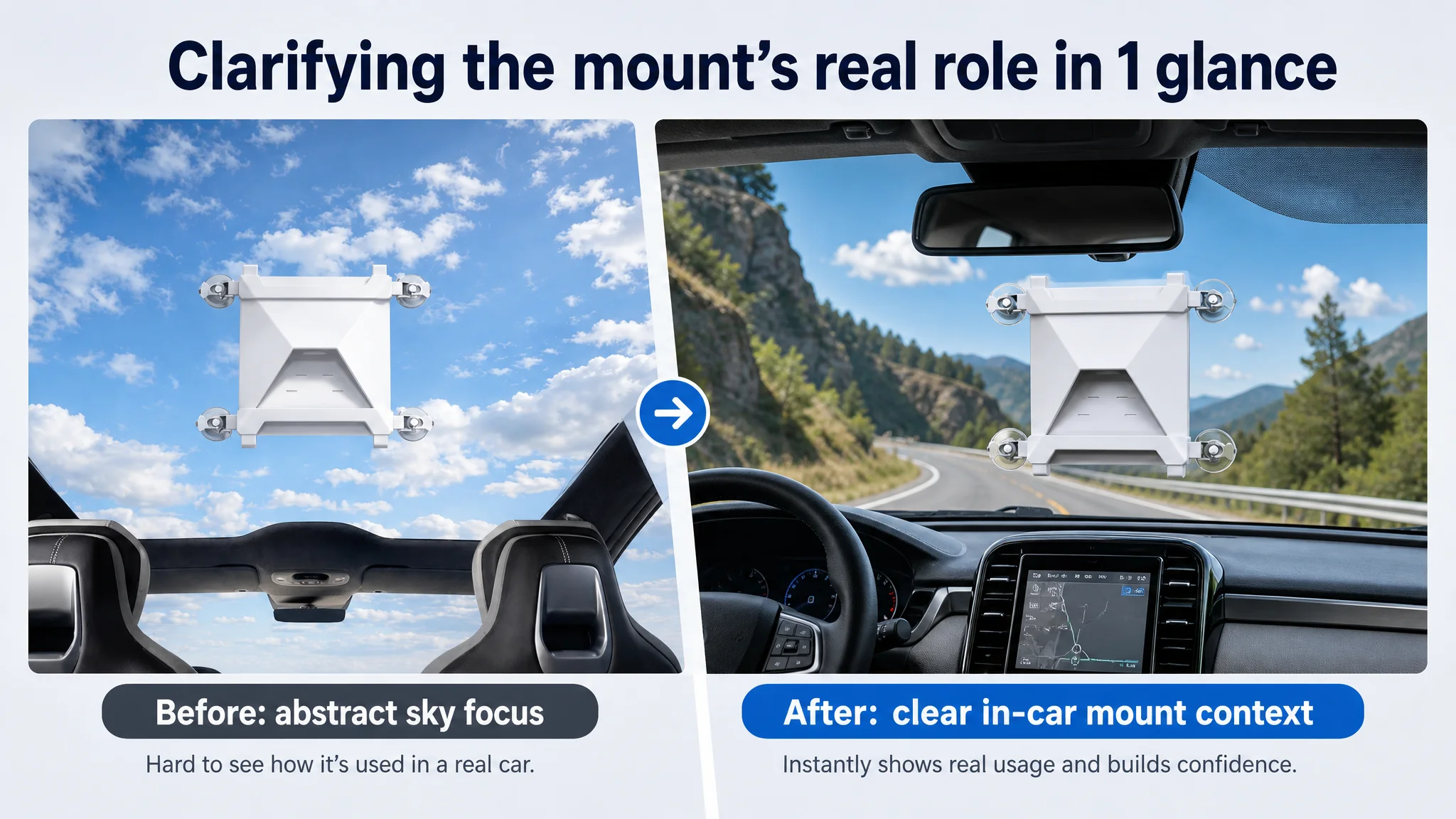
Meanwhile, the competitor’s first image did one thing extremely well: at a glance, it locked a mental image of “Starlink Mini mounted inside a car, on dashboard/windshield, ready to drive.”
That subtle difference matters:
Clicks do not come from artistic backgrounds. They come from immediate clarity about what problem the product solves.
DeepBI’s judgment was not “your main image is ugly.” It was: “You are not using the main image to establish the correct tool role fast enough.”
Where the Page Actually Lost Conversion: A+ and Visual Trust
The A+ / detail section is where this Listing’s biggest gap lay: 17 vs. 23 points.
The Page Did Not Lack Scenes. It Lacked Proof.
The target Listing’s modules:
- Core selling-point image
- Multi-scenario usage
- Environment adaptation
- Installation flexibility
The competitor’s modules:
- Clean brand/headline image
- Structural & functional breakdown
- Stability proof in real driving
- Compatibility and “problem vs. solution” comparisons
- Clear 4-step installation guide
- User-value scenario visual
The difference in approach:
1. Competitor: “Function breakdown + technical proof”
- Visualized suction mechanism (e.g., heavy-duty vacuum lock, nano-glue).
- Showed material qualities and heat resistance.
- Illustrated installation on narrow dashboards vs. normal dashboards.
- Turned buyer doubts into visual answers.
1. Target Listing: “Big-scene lifestyle + generic claims”
- Highlighted RV, off-road, even helicopter and cruise ship.
- Talked about strong suction and weather resistance at a claim level.
- Rarely zoomed in on actual components, installation steps, or real car constraints.
Result: buyers scrolling through the Amazon product page saw a lot of scenery and few hard facts.
In a category where one failure means an expensive device hits the floor, this is fatal.
Why DeepBI Would Not Recommend “Just Increase Ads” at This Stage
Given:
- Review score: 0 vs. competitor’s 161 reviews / 4.2 stars
- A+ score gap: -6 points at the detail page level
- A visual narrative that oversells broad scenarios but underserves real in-vehicle use cases
Scaling ads would have created three risks:
1. Amplifying a page that cannot yet convert high-risk buyers
More impressions and clicks would not solve the trust gap; they would amplify it.
1. Driving ad ACOS up without building organic strength
With weak conversion and no reviews, ad-driven sales would be expensive and fragile.
1. Failing to build a stable long-term keyword position
If the product fails to convert well on search-page and detail-page traffic, Amazon’s algorithm has no reason to reward it with sustainable rankings—even if ad spend is high.
DeepBI’s judgment: before traffic scaling, the Listing needed to be rebuilt as a convincing technical tool page, not just a scenic presentation.
Rebuilding the Sales Logic: From “Nice Scenes” to “Hard Proof”
DeepBI reframed the page’s job and then prioritized changes that directly support conversion, in this order:
1. Clarify the product’s core battlefield: RV and off-road
- Remove helicopters, cruise ships, and generic home windows from visuals.
- Lock the story on RVs, off-road vehicles, and cars.
1. Turn claims into evidence on the Amazon product page
- Main image:
- Switch to a real in-car shot showing the Starlink Mini mounted on dashboard, windshield, or sunroof.
- Make the mount clearly the “tool” holding the dish in motion.
- Supporting images:
- Show real driving scenarios: bumpy roads, speed bumps, off-road tracks.
- Pair visuals with clear text: “Solves the common worry of devices falling at high speed or on rough trails.”
- Compatibility / mis-buy prevention:
- Add a visual model compatibility chart that says: “Only for Starlink Mini; not for other Starlink models.”
1. Restructure A+ modules around a conversion journey
DeepBI’s logic was to reorder content into:
- Trust setup
- First module: clean visual of mount installed on dash/windshield in a real car cabin.
- Text: clearly states it is a Starlink Mini mount for RVs and cars, with strong suction and multi-position flexibility.
- Technical validation
- Close-up breakdown of:
- High-strength, UV- and heat-resistant ABS.
- Heavy-duty vacuum suction.
- Visuals showing material icons and component diagrams.
- Purpose: directly answer “Will it melt, crack, or fall?”
- Driving-safety and signal-angle balance
- POV (driver’s-eye) shots:
- Showing adjustable angles to aim at clear sky.
- Confirming that the mount does not block road vision.
- Purpose: address both connectivity and safety.
- Installation ease
- A 4-step, numbered visual guide:
- No tools.
- No drilling permanent holes.
- Seconds to install/remove.
- Directly lowers hesitation to act.
- Extreme stability
- Dynamic comparisons:
- Highway, rough off-road, speed bumps.
- Before/after or competitor vs. “rock-solid suction” concepts.
- Goal: show that bouncing and vibration do not break suction.
- Portable, travel-ready kit
- Visual of mount disassembled and packed into a backpack or storage bin.
- Text confirming it as a compact, travel-ready Starlink Mini accessory for remote work and camping.
“The real problem was not that ads failed to bring traffic. It was that the page did not build enough proof to convert that traffic.”
Bullet Points: From Listing Decoration to Decision Support
Although the bullet-point score was slightly higher than the competitor’s, DeepBI still tightened them to align with conversion logic and high-intent keywords.
Key shifts:
1. Bullet 1: Explicit compatibility + suction strength
- Make “EXCLUSIVELY FOR STARLINK MINI” prominent.
- Emphasize custom-engineered fit and heavy-duty suction that secures the device during high-speed driving and bumpy off-road trails.
- Clarify “Not compatible with other Starlink models.”
1. Bullet 2: Multi-surface, multi-vehicle positioning
- Clearly cover dashboard, windshield, roof, sunroof.
- Highlight tool-free installation in seconds, no drilling.
1. Bullet 3: Balancing signal angle with driving vision
- “Multi-angle adjustable for clearer sky + low-profile design to preserve driving view.”
- Directly answers safety concerns.
1. Bullet 4: Durability under extreme weather
- Stress high-strength, UV- and heat-resistant ABS.
- Position it as reliable under intense sun and cold, emphasizing stability and signal integrity.
1. Bullet 5: Travel-ready + “What you get” clarity
- Confirm lightweight, detachable design for remote work and camping.
- List box contents so buyers know exactly what they’re buying.
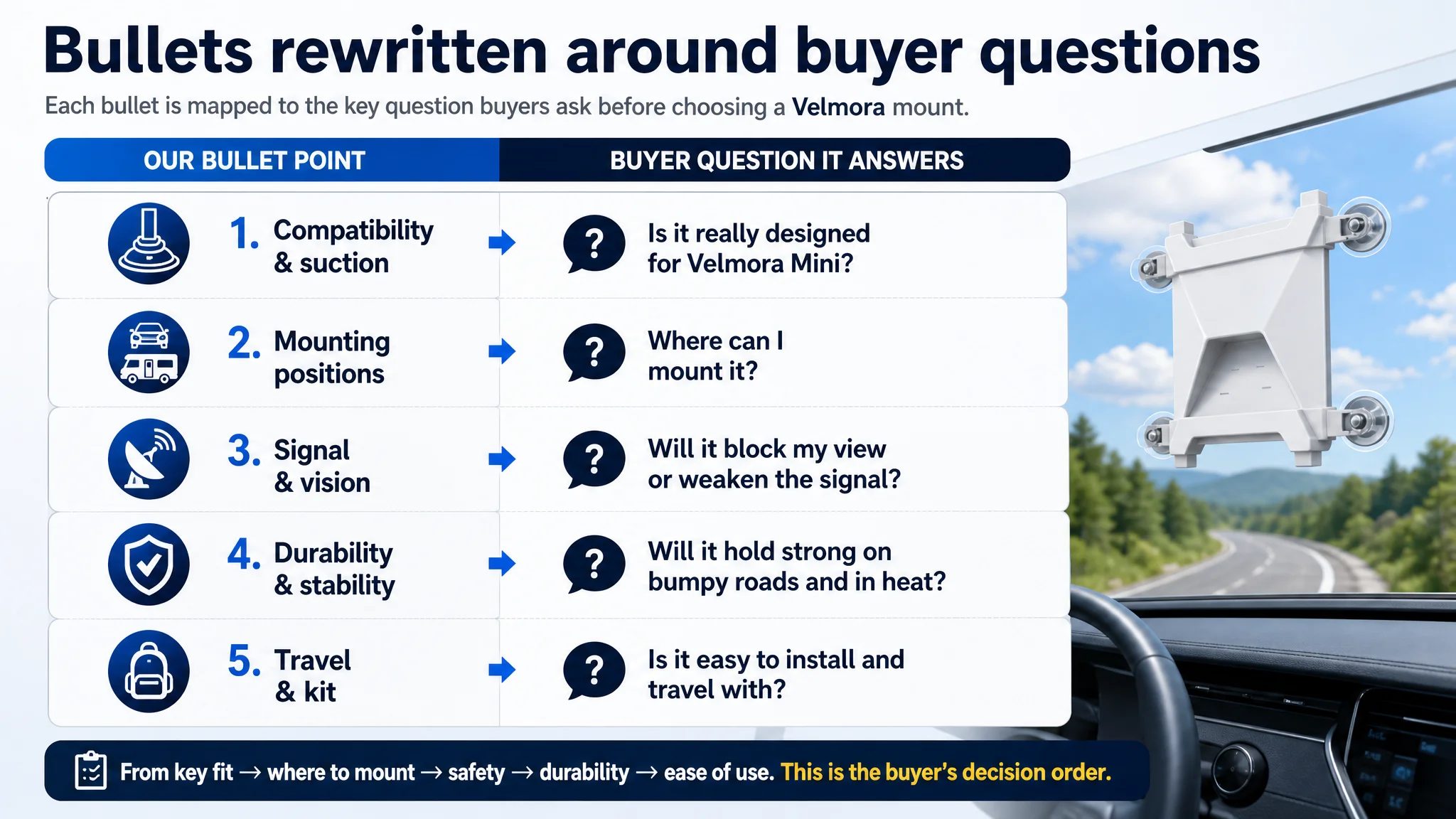
This is not “copy beautification.” It’s aligning the bullet points with the exact questions that cautious buyers will ask before adding to cart.
Main Images: Re-anchoring Visuals in Real Vehicle Use
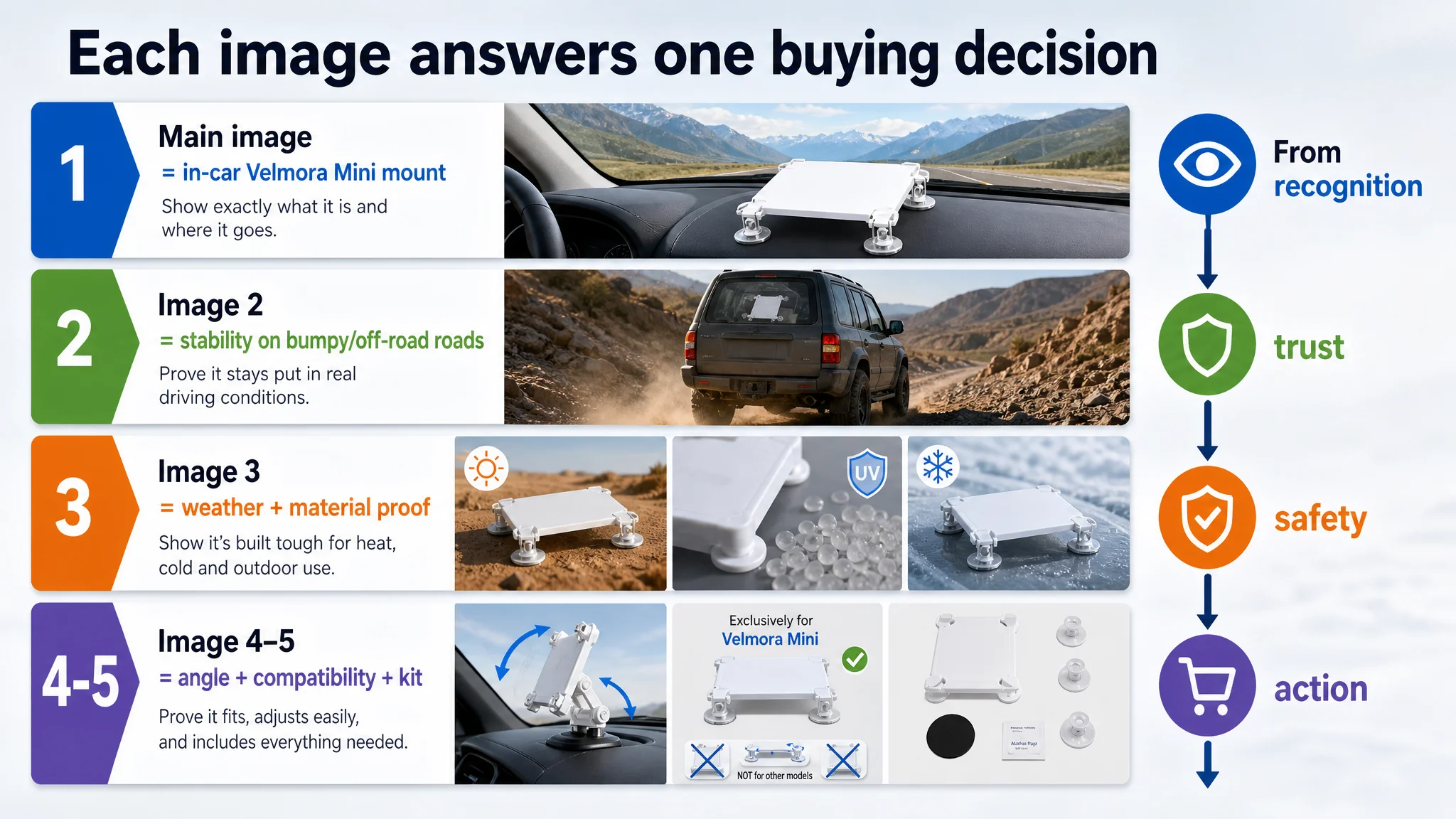
DeepBI’s image-level interpretation focused on using each image slot to answer one concrete decision:
Main Image
- Replace sky-only abstract background with:
- Real vehicle interior (dashboard/windshield/sunroof).
- Clearly mounted Starlink Mini dish.
- Immediate message: “This is the mount that keeps your Starlink Mini stable inside your car/RV.”
Image 2: Stability Under Motion
- Keep rear-window view as a supporting visual if needed, but:
- Add context: bumpy roads, off-road tracks, speed bump.
- Make text highlight: “Solves the common worry of devices falling during high-speed or rough off-road driving.”
Image 3: Weather and Road-Condition Adaptation
- Remove or minimize non-core scenes (helicopter, cruise ship).
- Use:
- Weather icons (sun, rain, snow).
- Road-condition visuals (gravel, mountain roads).
- Tie messaging to:
- “Rock-solid suction power”
- “Weather-resistant ABS build”
Image 4: Multi-angle Flexibility
- Focus on:
- Different windshield angles.
- How the mount can be tilted to find clear sky while avoiding blocking vision.
- Explain visually: “Multi-angle adjustable design for flexible sky pointing.”
Image 5: Packaging, kit, and “fast setup” clarity
- Instead of another multi-scenario collage:
- Show the mount components, packed kit, and dimensions.
- Emphasize:
- “Fast setup for RV life”
- “Compact and travel ready”
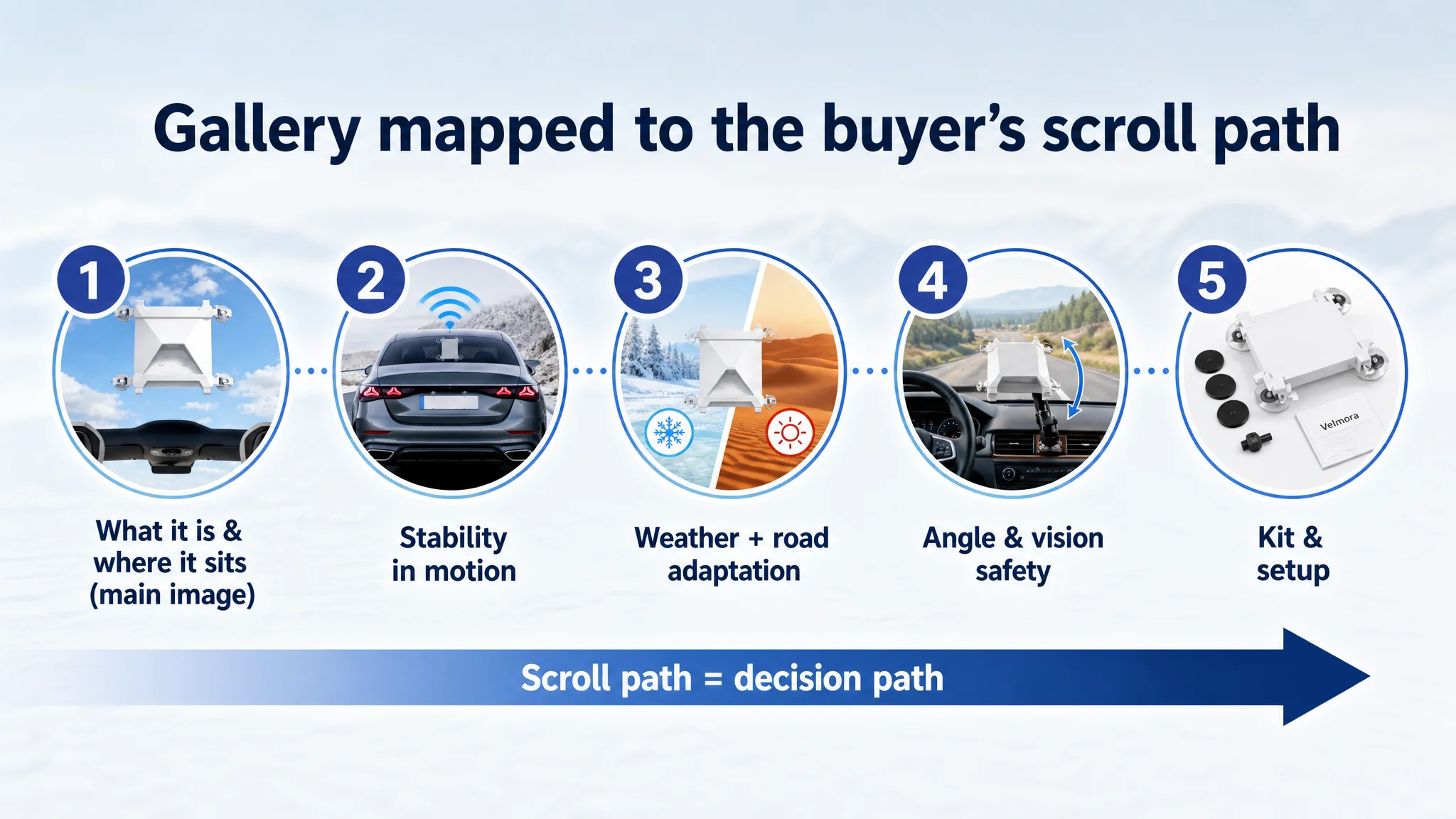
By doing this, each image becomes a specific answer to a buyer question, rather than a generic “nice content” filler.
Reviews: The Trust Layer That Cannot Be Ignored
In this case, the review dimension gap was absolute:
- Target Listing: 0 reviews, 0 stars
- Competitor: 4.2 stars, 161 reviews
DeepBI’s judgment here is simple but critical:
- Review-building is non-negotiable.
- But you cannot build reviews efficiently if the page does not already convert a reasonable amount of traffic.
In practice, this means:
- Starting with controlled ad spend once the Listing’s sales logic is fixed:
- To generate the first wave of customers.
- Monitoring:
- CVR once the new images, A+ structure, and copy are in place.
- Only after conversion behavior stabilizes:
- Increasing advertising to accelerate review accumulation.
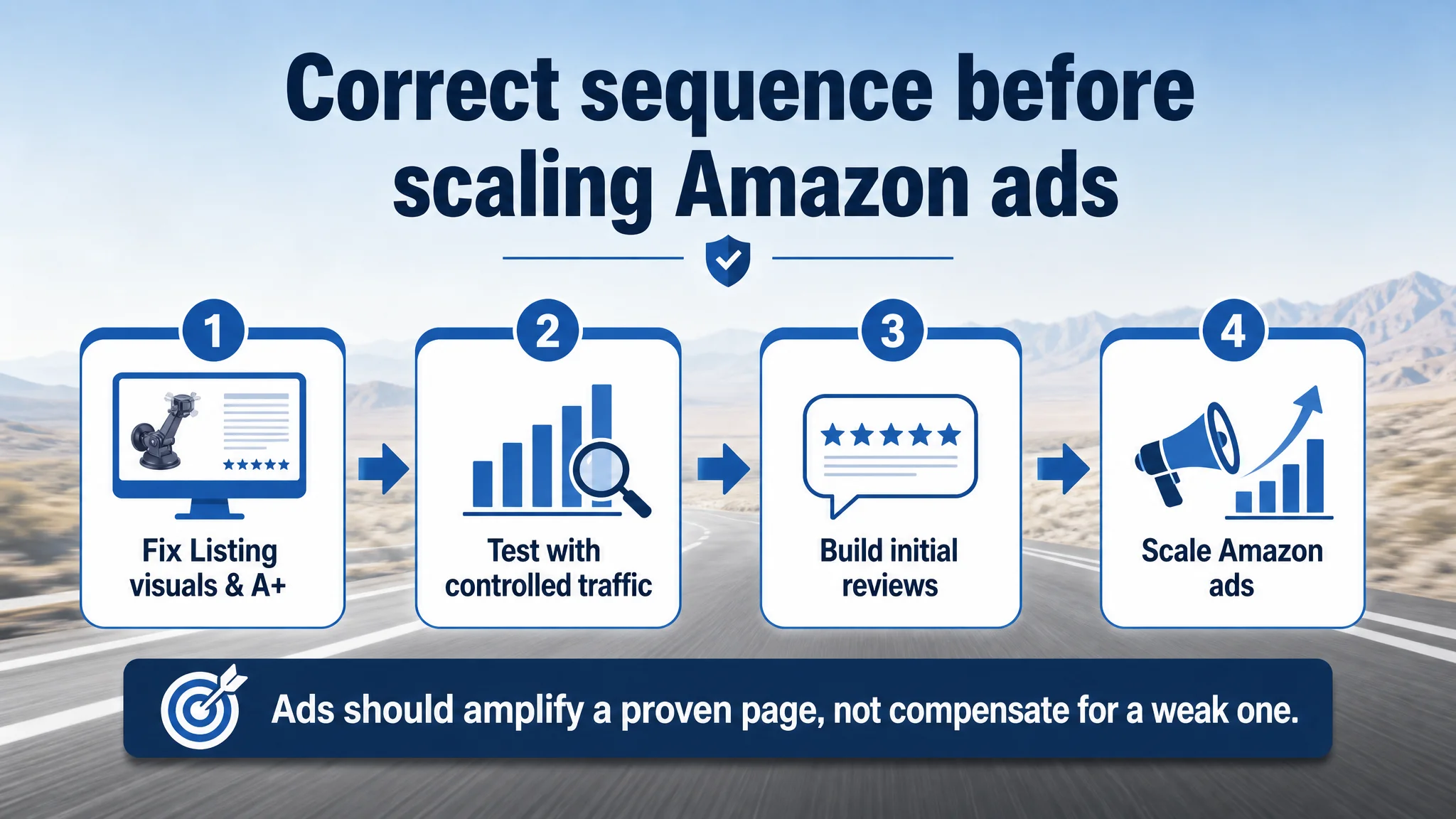
The sequence is:
1. Fix page conversion logic →
2. Drive initial, controlled traffic →
3. Generate and manage early reviews →
4. Scale ads once the Listing can hold its own against benchmark CVR.
How Ads Become Useful Again Once the Page Is Fixed
Once the Listing is rebuilt to:
- Show clear in-car usage in the main image.
- Demonstrate suction strength and material durability with visual proof.
- Resolve driving-vision and signal-angle concerns through POV scenes.
- Provide a clear, visual installation guide and travel-ready story.
- Start accumulating reviews on top of this improved structure.
Then Amazon ads play an entirely different role:
- CTR benefits from clearer thumbnails that immediately say “Starlink Mini car/RV mount, installed inside, stable.”
- CVR improves because:
- Doubts about falling, heat, and visibility are pre-answered.
- The review layer slowly comes in to validate the claims.
- ACOS and TACOS become more manageable, because:
- Each paid click has a higher chance of turning into a sale.
- Organic rankings gain support from more efficient conversion metrics.
At that point, tuning keywords and bids finally makes sense—because ads are no longer trying to compensate for a structurally weak page.
What Other Amazon Sellers Can Take Away
Several lessons from this Starlink Mini mount case are widely applicable:
1. Do not mislabel every conversion problem as an “ad problem” or “new product problem.”
If your title and main image are reasonably competitive but A+ and reviews lag, your core issue is often page conversion, not bids.
1. Beware of over-scenarization without evidence.
Beautiful, diverse scenes that do not directly resolve key doubts (safety, durability, fit) can actually weaken trust.
1. Structure the Amazon product page around buyer questions, not around what you want to show.
In this case: Will it fall? Will it melt? Will it block my view? Is it really made for my device?
1. Advertising amplifies what already exists on the page.
If the Listing cannot convert cautious traffic, ads will amplify wasted spend, not sales.
1. Listing quality is the foundation of ad efficiency.
Before scaling traffic, ask: “Does my page already look and read like the benchmark that is winning in my category?”
DeepBI’s value in this case was not in generating more images or longer copy. It was in reframing the seller’s judgment: from “we just need more traffic and reviews” to “our Listing needs to prove it is a trustworthy technical tool first, then ads will start working for us instead of against us.”