

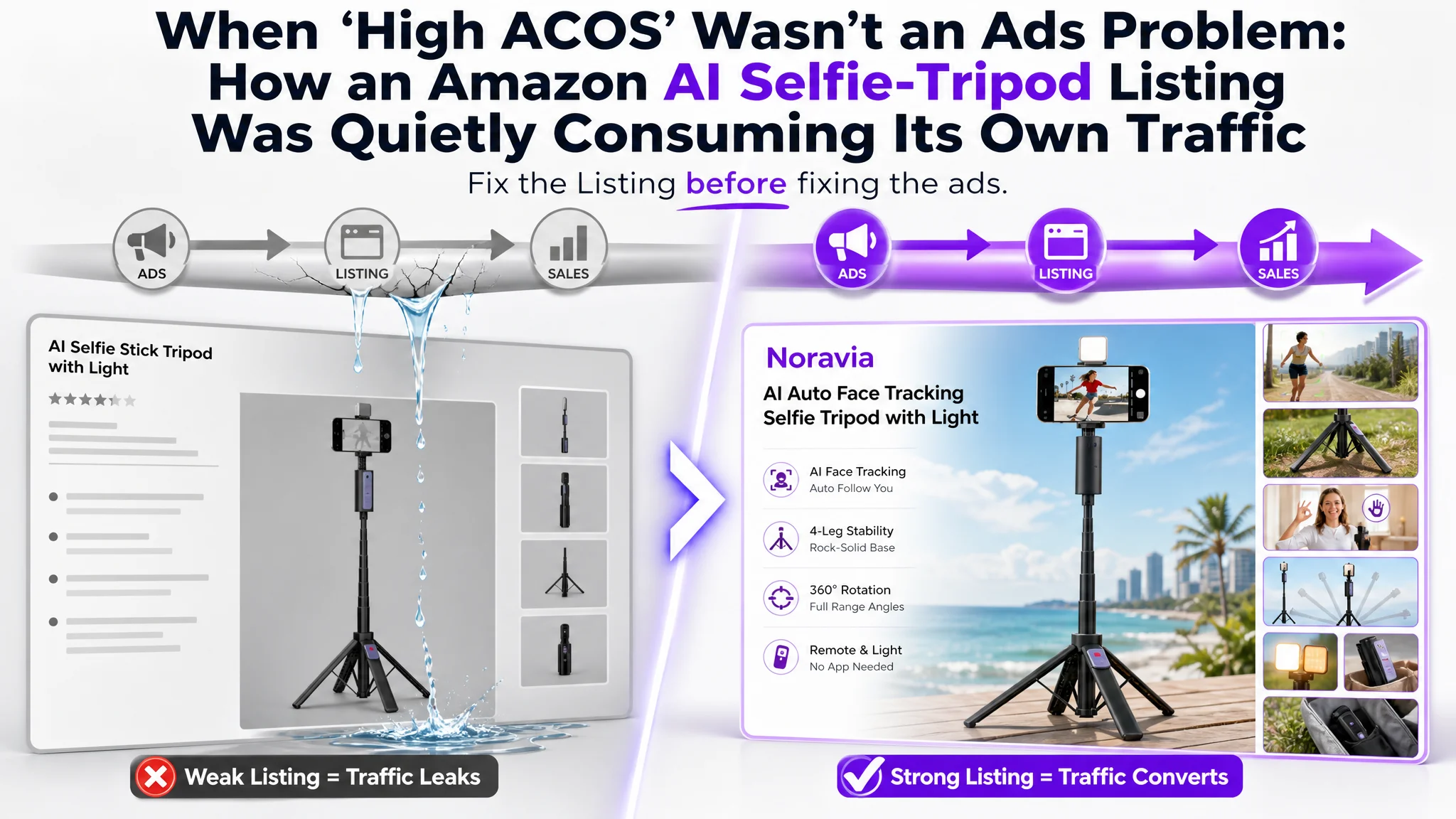
This case comes from an Amazon seller in the US marketplace, operating an AI face-tracking selfie stick tripod with fill light. On the surface, the numbers looked familiar: rising Amazon ad spend, unstable ACOS, and a category competitor that always seemed to “convert just a bit better.” The team’s instinct was to keep tuning Amazon ads—keywords, bids, campaign structure—assuming the main problem was traffic and cost, not the product page itself.
When DeepBI stepped in, the diagnostics told a different story. The ads were bringing traffic; the Amazon Listing was leaking it. Compared to a benchmark competitor, the seller’s product page scored slightly lower overall (78 vs. 83), but the real gaps sat in the title logic and A+ detail storytelling—exactly where trust and purchase decisions are formed. The main image set was visually acceptable, yet it failed to make AI tracking and four-leg stability “visibly obvious” at the search-page level.
The later optimization did not start with another round of bid changes. It started with reconstructing the Amazon product page: reordering the title around “Auto Face Tracking Selfie Stick Tripod,” reframing bullet points from bare specs to usage outcomes, and rebuilding A+ visuals to show AI tracking, four-leg stability, and “open-box completeness” as a coherent story. For other Amazon sellers, this case is a reminder: when ad optimization keeps stalling, it may not be your ads that are failing. It may be your Listing’s ability to convert the traffic you’re already paying for.
Amazon Ads Were Not Failing. The Page Was Consuming the Traffic.
The seller’s pressure started where most Amazon operators feel it today: ads were getting more expensive, yet the listing did not consistently win orders against a key competitor in the same AI selfie-tripod segment.
They saw:
- A comparable star rating (4.3 vs. competitor’s 4.1), but fewer total reviews.
- Ongoing ad optimizations with unstable ACOS and no structural improvement in orders.
- A perception that “creative is not pretty enough” and “maybe we just need more reviews.”
The working assumption inside the team was clear: “We have a traffic and review problem. If we just improve ads and push more reviews, the rest will follow.”
So they focused on:
- Iterating Amazon ads: changing bids, broad vs. phrase vs. exact, splitting campaigns.
- Watching ACOS closely and trimming “underperforming” keywords.
- Considering more aggressive discounting to fuel review growth.
What they did not question was the Listing’s own conversion capacity—whether the product page itself was structuring a clear buying logic around AI tracking, stability, and completeness of the kit.
“The real problem was not that ads failed to bring traffic. It was that the page could not convert the traffic.”
The Real Constraint Was Listing Conversion Capacity
DeepBI’s first step was to remove subjectivity and score the Listing against a benchmark competitor in the same niche on Amazon US.
What the scoring showed
Total score:
- Target Listing: 78 / 100
- Benchmark Listing: 83 / 100
- Gap: -5 points
Breakdown:
- Title: 14 vs. 16 (–2)
- Main Image set: 25 vs. 24 (+1)
- Bullet Points: 7 vs. 8 (–1)
- Detail / A+ content: 21 vs. 24 (–3)
- Reviews: 11 vs. 11 (0)
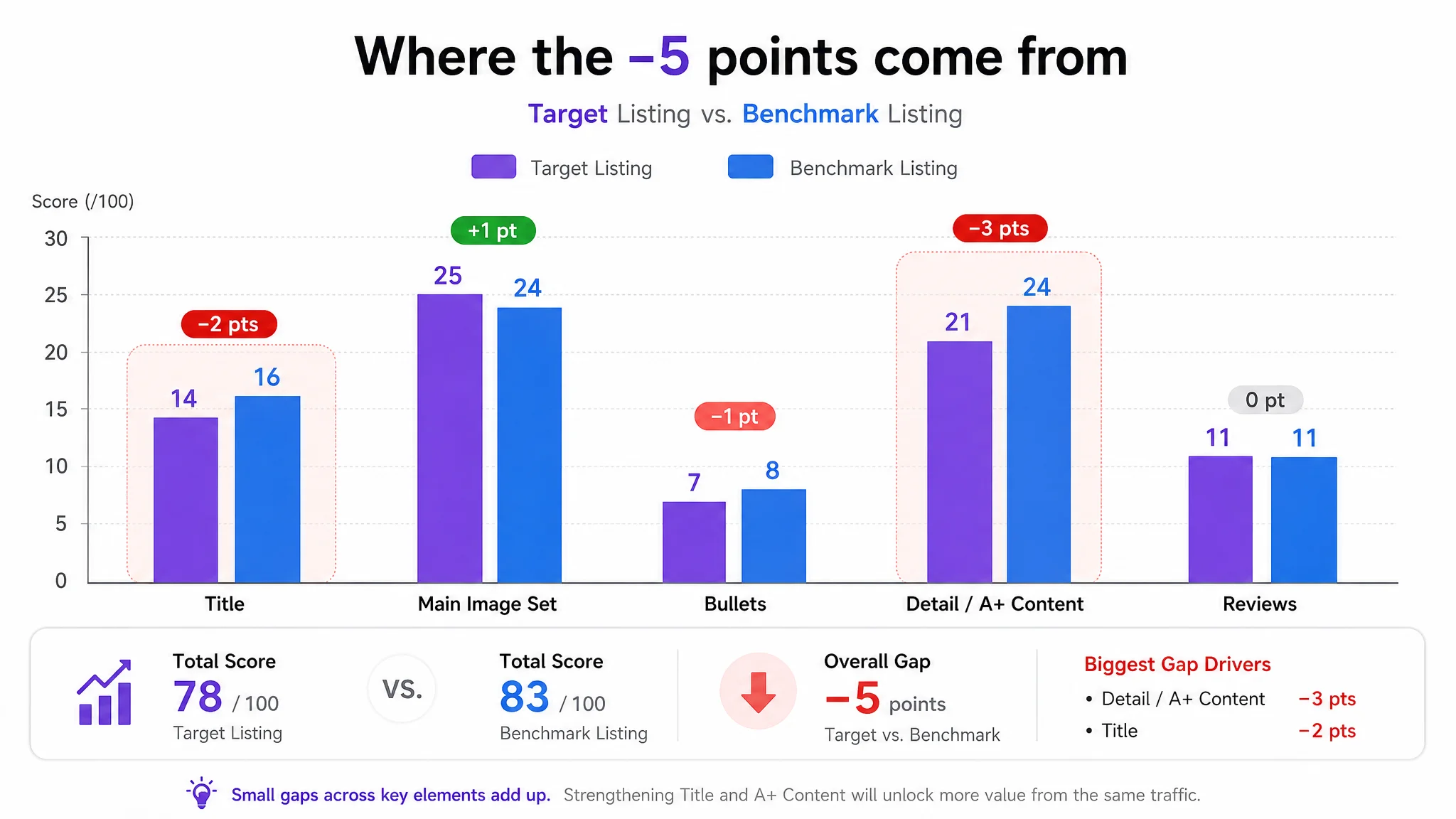
This is not a story of a catastrophic Listing. It’s a story of multiple “small” gaps in the decision path that, together, weaken conversion:
- Title: Under-optimized search weight and value communication.
- Bullets: Heavily physical-attribute oriented, thin on outcome and scenario.
- Detail/A+: Less technical visualization, weaker trust journey, incomplete “open-box” clarity.
The main images performed reasonably: slightly stronger than the competitor on pure scoring. But visual narrative was misaligned with how category buyers decide.
DeepBI’s judgment: The core bottleneck was not ad traffic quantity. It was the Listing’s ability to convert both organic and paid traffic into orders.
Why Traditional Ad Optimization Kept Failing
The seller’s ad team was not doing obviously “wrong” things. They were applying standard Amazon ads playbooks:
- Broad + phrase + exact keyword structures around “selfie stick,” “tripod,” “phone tripod with light”
- Bid adjustments by ROAS / ACOS
- Negative keywords based on search term reports
Yet performance remained fragile. Why?
Because ads were feeding a page that did not fully answer the buyer’s key questions for this category:
- “Will this AI tracking actually follow me smoothly while I move?”
- “Is this four-leg base truly more stable than common three-leg tripods?”
- “Is everything I need (remote, light, charging) already in the box?”
- “Is it complicated (requires app) or can I just pick it up and use it?”
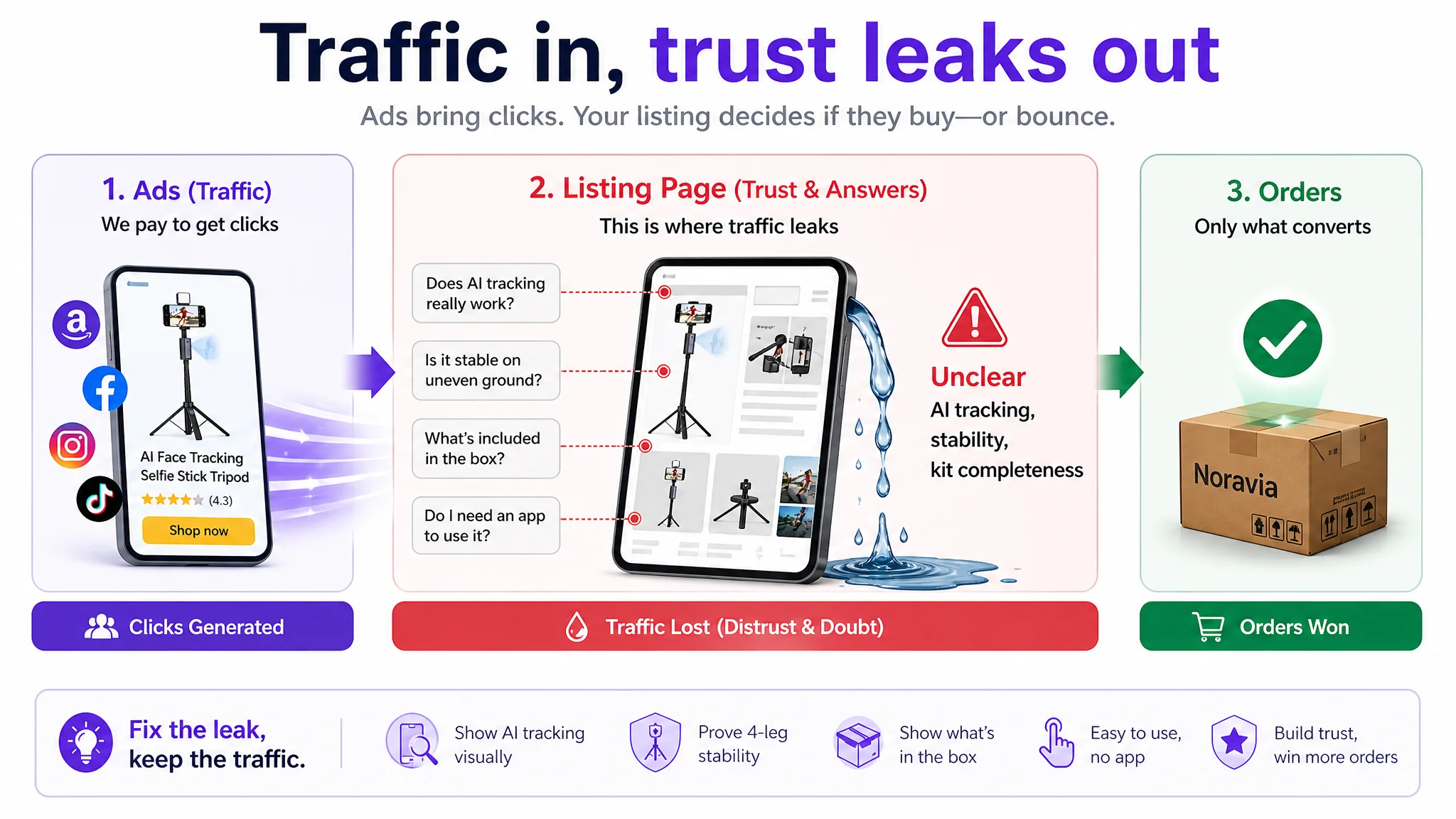
Advertising was doing its job: creating exposure and clicks. But those clicks landed on a page that:
- Emphasized specs and physical attributes more than results and scenarios.
- Lacked strong visualized contrasts (e.g., wobbling vs. stable, three-leg vs. four-leg).
- Did not clearly visualize AI tracking logic or no-app / gesture simplicity.
- Under-communicated package completeness and after-sales assurance.
Result: Ad spend amplified a page-level trust gap, so ad optimization felt like pushing harder on a system that had no room to convert better.
“Advertising does not only amplify advantages. It can also amplify a page’s existing defects.”
This Product Page Did Not Lack Traffic. It Lacked Trust.
The title did not lead with what buyers actually search and decide on
The original title pushed the brand name to the front and delayed the core function:
- Brand name first
- Then “Selfie Stick”
- Then scattered descriptors
- Height shown as “59''” while the competitor emphasized “70.9''”
Key issues:
- Core query terms like “Auto Face Tracking Selfie Stick Tripod” were not front-loaded.
- The phrase “Camera Tripod Stand” was less tightly integrated.
- Some phrases like “Cell Phone Holder” diluted the core scenario.
- Color (“-Black”) was appended while core value had not yet been fully established.
Against that:
- The competitor’s title immediately led with “Auto Face Tracking Selfie Stick Tripod.”
- It used a precise and higher-looking height (“70.9''”), reinforcing perceived capability.
- It stacked tightly coupled keywords (“Camera Tripod Stand”) in a compact way.
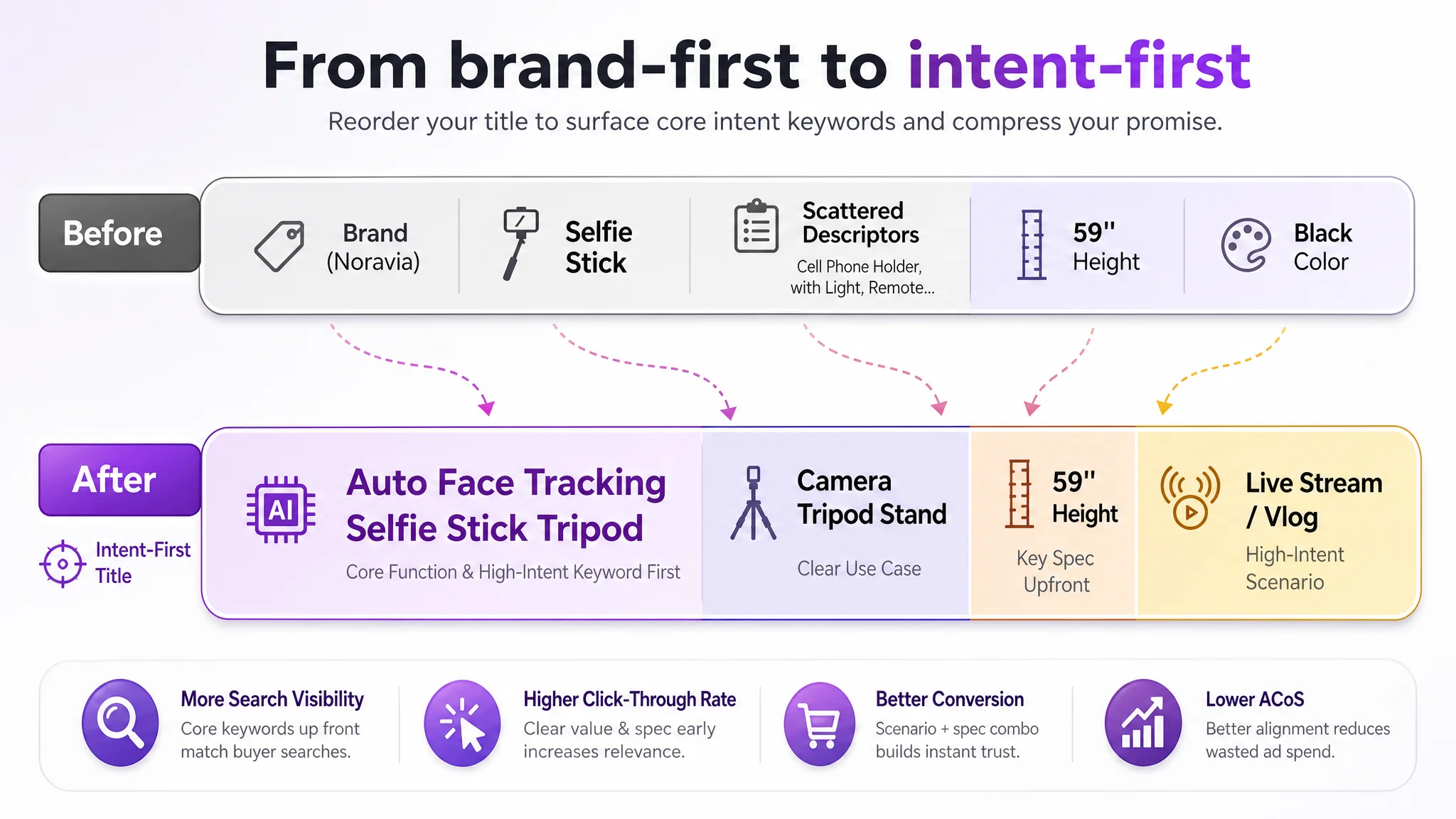
DeepBI’s view: On Amazon, the title is not just for indexing. It’s also a compressed promise. Here, the promise was blurred.
The bullet points had information, but not a buying logic
The seller’s bullet structure:
1. Smart tracking function
2. Portable design
3. Quick setup and stability
4. Multi-angle shooting
5. Fill light + compatibility + accessories
The competitor’s structure:
1. Upgraded AI tracking
2. Multi-function conversion
3. Full-range rotation
4. Four-leg stability
5. Modular remote control
Two main differences:
- The competitor opens with “upgrade” and a clear functional promise (“ensure you’re always in frame”), framing value, not just a feature label.
- It builds a closed loop: AI tracking → multi-form factor → rotation → stability → modular remote, all ending in a clear sense of control and completeness.
The seller’s bullets stayed too long at the “what it is” level and too short at the “what it does for you” level.
The A+ content told “what,” but not enough “why this one”
On the seller’s page, modules included:
- Core selling point image
- Pain-point solution module
- Functional comparison
- Gesture control explanation
- Bluetooth remote
- Size/weight
- Multi-angle shooting
- Compatibility
- Scenario usage (makeup, cooking, beach)
The benchmark competitor went further:
- “4-in-1” main visual
- AI technology visualized (light beams, internal structure, etc.)
- Gesture recognition triptych
- No-app adaptation clarified
- Height adjustment visuals
- Structural close-ups (material, four-leg detail)
- 360° rotation details
- Compatibility breakdown
- Clear package content
- Multi-scene real-life shoots (camping, jumping rope, surfing, yacht, selfie)
- Fill-light breakdown
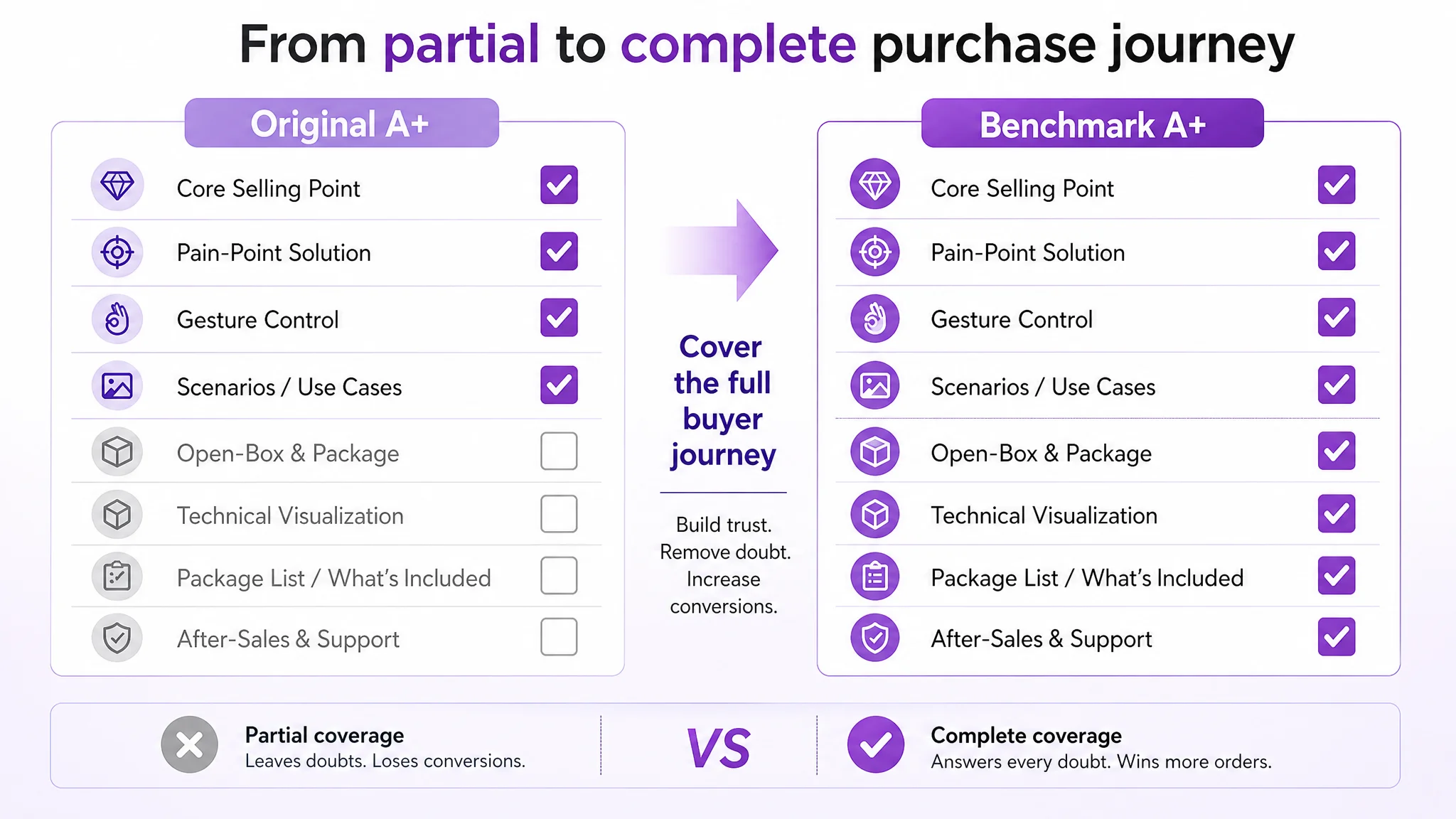
The gap:
- No technical visualization: The seller listed AI tracking, but didn’t show it as a visible mechanism.
- No full journey: Open-box, installation, usage, maintenance, and after-sales trust were not fully covered.
- Low use of visual contrast: Competitor used “wobbling vs. stable” and “3-leg vs. 4-leg” visuals; the seller relied on text.
For buyers, this translated into residual doubt—not enough to reject the product outright, but enough to delay or choose the competitor if prices were similar.
How DeepBI Isolated the Root Cause
DeepBI’s diagnosis did not start with creative taste. It started with a structured comparison of the Listing’s five core dimensions against the benchmark:
1. Title – search weight and value clarity
2. Main images – click drivers and visual hooks
3. Bullets – decision logic and outcome framing
4. Detail / A+ – trust-building and doubt resolution
5. Reviews – social proof volume and sentiment
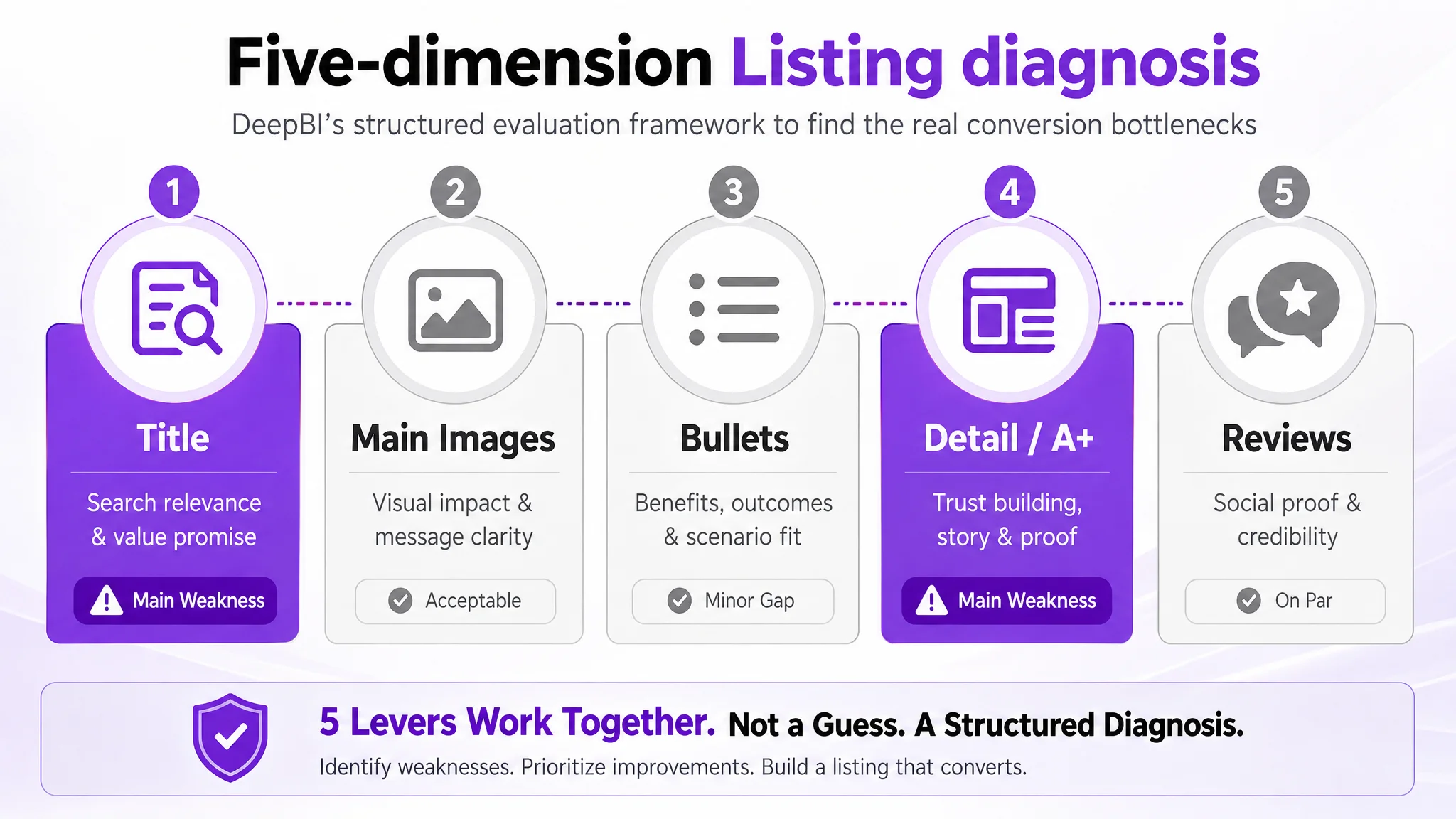
Key judgments:
- Reviews were not the primary weakness: star rating was higher, even if volume was lower.
- Main image score was slightly higher than the competitor’s, but the visual story (AI tracking, stability, multi-scene use) was under-leveraged.
- The largest gap relative to maximum points was in detail / A+ content (–3 points vs. competitor), closely coupled with bullets and title.
From a business perspective:
- If the Listing cannot convincingly demonstrate AI tracking and stability, ads will keep paying to keep proving the same doubts.
- Without clarifying package contents and support, buyers will continue to ask: “Does it include the light? Remote? Charging cable?” which suppresses conversion.
DeepBI’s conclusion:
- The bottleneck was page-level conversion, especially in title logic and A+ trust storytelling.
- Optimizing ad campaigns further—without repairing this—would only multiply wasted traffic.
Why DeepBI Did Not Keep Tuning the Ads First
At this stage, the seller had a choice:
- Option A: Continue refining ads and bids, hoping to “buy” better results.
- Option B: Stabilize Listing conversion capacity first, then let ads scale into a page that actually deserves more traffic.
DeepBI argued for Option B, based on three risk judgments:
1. Ad risk:
Pushing more spend into a page with structural trust gaps raises TACOS without improving CVR.
1. Traffic-structure risk:
Over-reliance on paid traffic when the organic conversion base is weak leads to fragile rankings and constant pressure to “feed the machine.”
1. Decision risk:
Without a repaired Listing, ad results are hard to interpret—you can’t tell whether a keyword is truly weak or if the page simply fails to convert that segment.
So the priority became:
- Repair the Listing:
Title → main-image narrative → bullet logic → A+ modules.
- Then let ads test again:
Same or similar keywords, but now landing on a stronger conversion surface.
How the Page’s Sales Logic Was Rebuilt
DeepBI’s optimization plan did not change the product. It changed how the product was presented on Amazon.
Reframing the title around real buyer intent
Proposed title:
[Brand] Auto Face Tracking Selfie Stick Tripod for iPhone with Light, 59'' Camera Tripod Stand with Remote, 360° Rotation Follows Your Movement for Content Creator, Vlog, Live Stream, Video Recording
Key shifts:
- Front-loaded “Auto Face Tracking Selfie Stick Tripod”, aligning with core search and buyer intent.
- Integrated “Camera Tripod Stand” and “Live Stream,” explicitly targeting content creators and vloggers.
- Kept height (“59''”) clear and readable, balanced against mobile display constraints.
- Used “360°” as a visual anchor rather than spelled-out text.
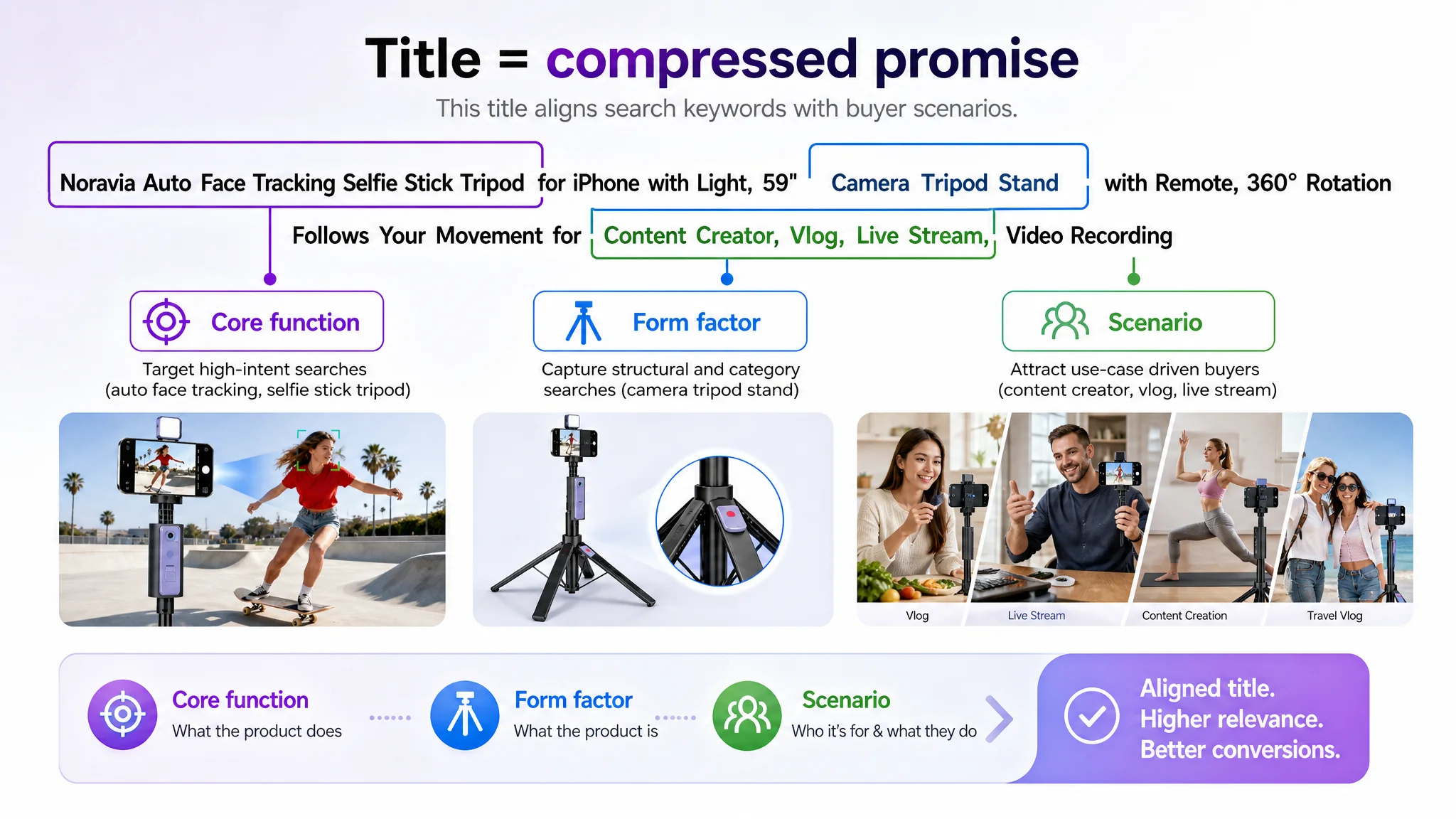
Resulting logic: Amazon’s A9 gets cleaner signals, and human buyers see what this is and what it does within the first line.
Turning bullet points into a persuasive path
Each bullet was reoriented around results, scenarios, and trust:
1. Upgraded AI tracking & gesture control
2. All-in-one 5-in-1 portable design
3. One-click open & anti-pinch stability
4. Full-range creative angles & height
5. Professional magnetic LED fill light
6. Detachable remote & wide compatibility
7. Flexible 1/4" interface for expansion
8. Complete content creation kit
Together, these bullets:
- Answered “What do I get?”, “Will it fit my phone?”, “Can I use it alone?”, and “Is this future-proof?”
- Rebuilt the pain → solution → proof flow that the competitor had but the seller lacked.
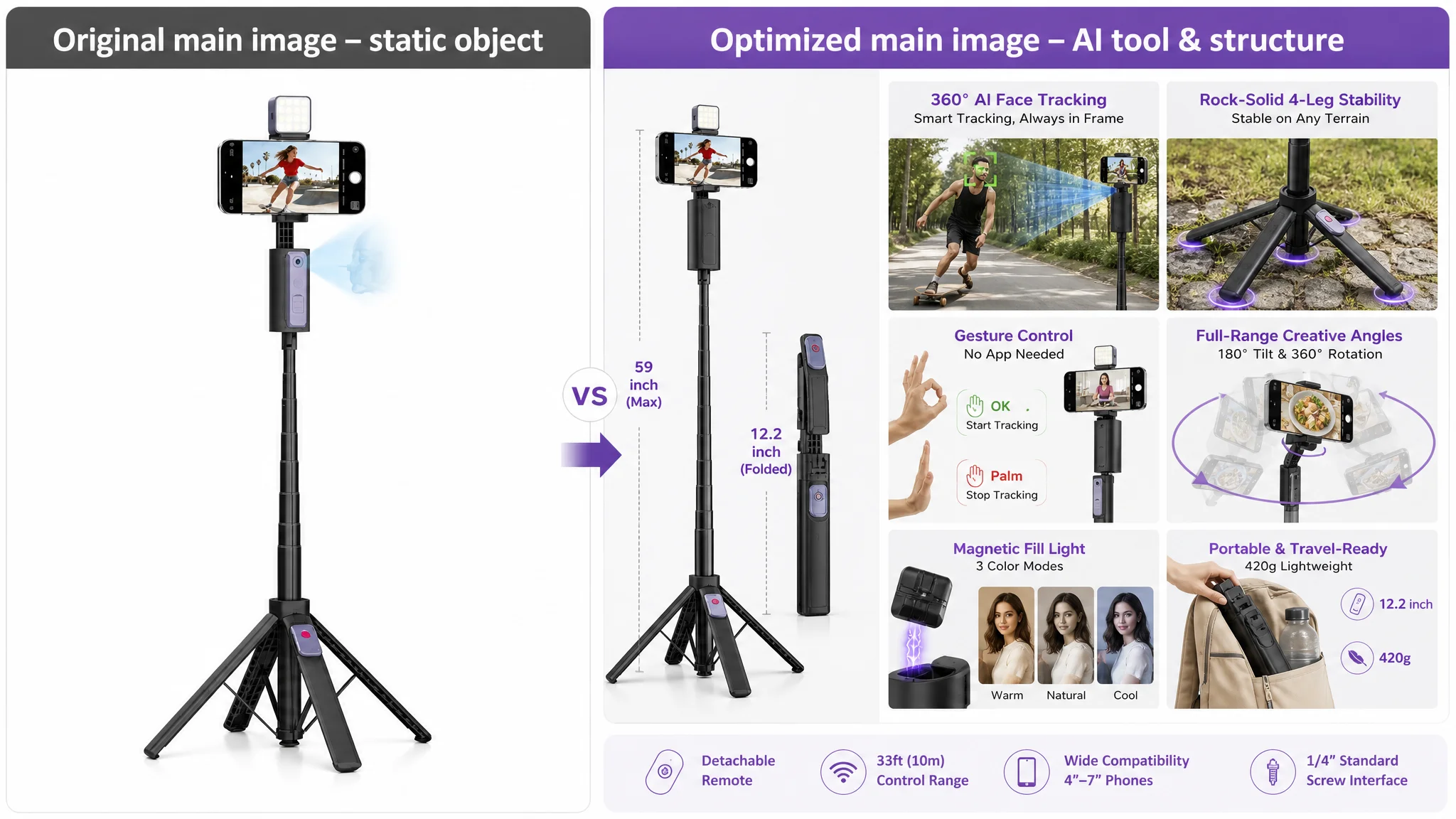
Changing the main-image story from “static object” to “AI tool”
Despite having a slightly higher main-image score, the seller’s images lacked:
- Strong AI tracking visualization
- Obvious stability story in outdoor or uneven terrain
- Multi-scene coverage in a structured format
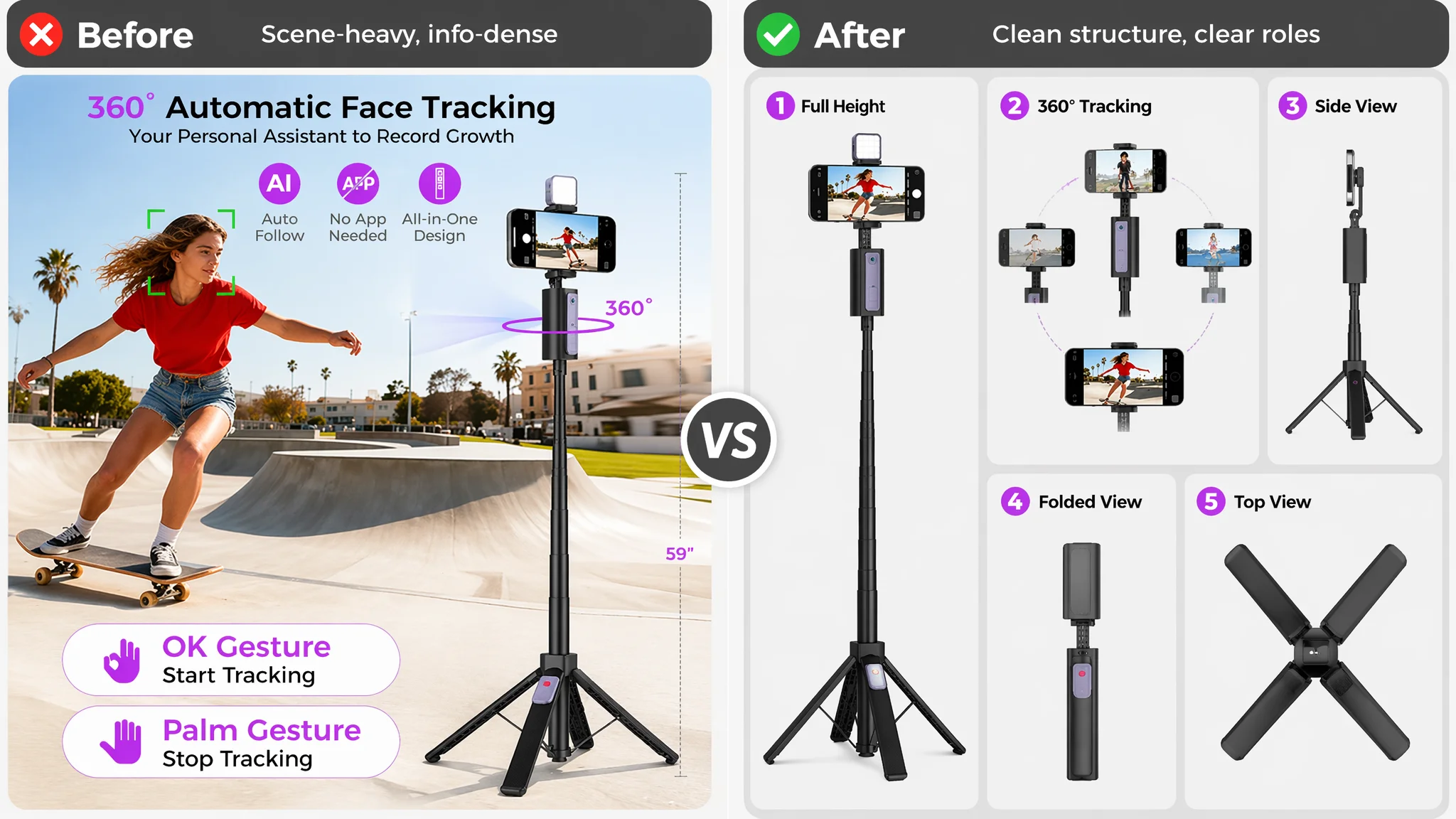
DeepBI’s instructions redefined each key image:
1. Hero/thumbnail image
2. AI tracking in motion
3. 360° tracking story
4. Stability proof on uneven ground
5. Four-scene grid
These changes aimed to raise CTR by turning abstract features into visible behavior, particularly on the search results page where buyers decide whether to click.
Rebuilding A+ content as a full journey
DeepBI’s guidance for A+ modules:
- Hero section
- AI tracking module
- Stability module
- Gesture control
- Multi-angle shooting
- Magnetic fill light
- Portability & packing
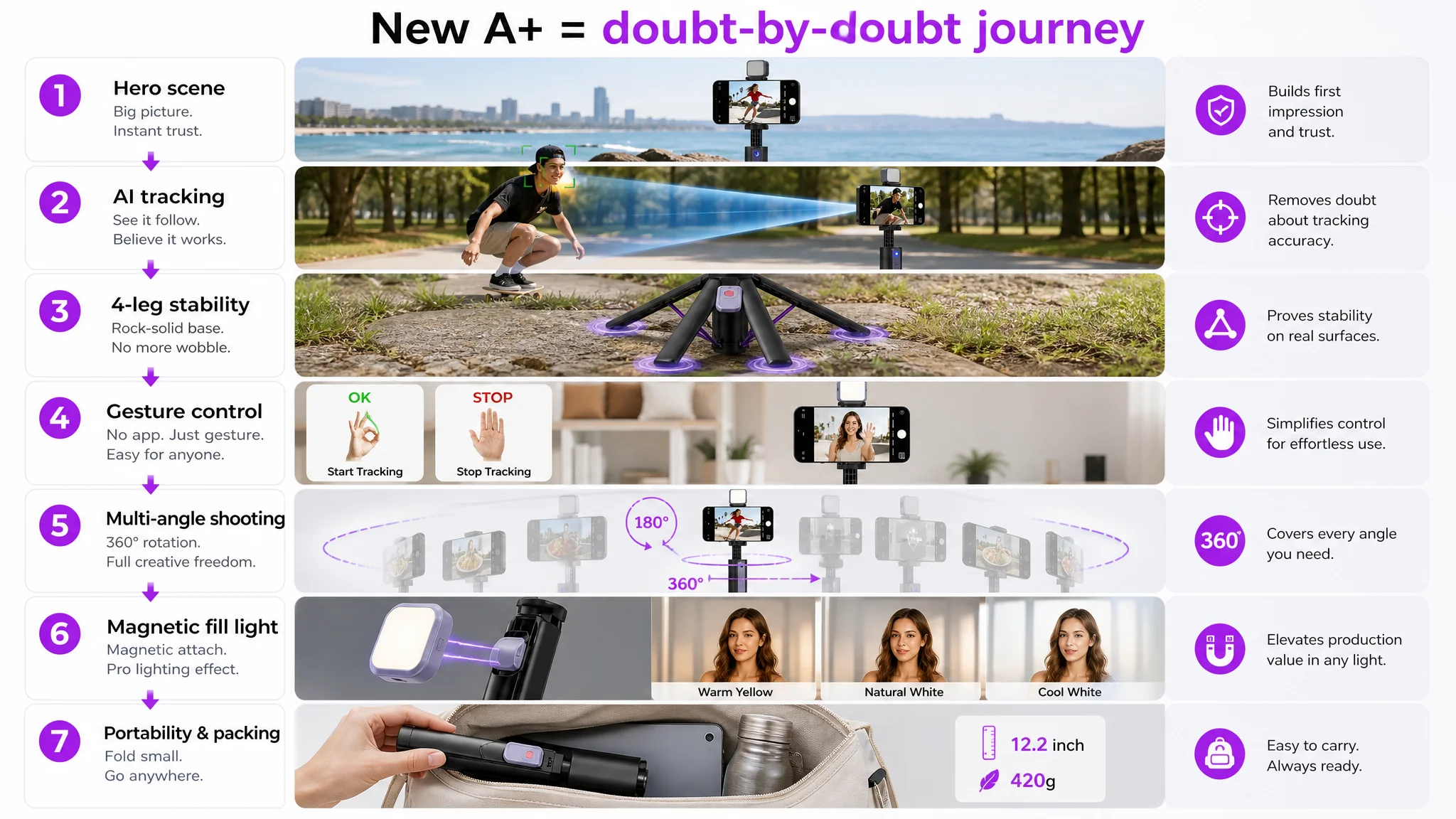
Objective: turn each buyer doubt into a dedicated visual answer, not just a line of text.
How Ad Traffic Became Useful Again
Once the Listing’s decision path was repaired, the same ad traffic started landing on a more coherent, more trustworthy page.
Even without inventing numbers, we can trace the operational changes:
- Click behavior
- Search-page thumbnails now showed AI tracking and stability more clearly, which helps CTR, especially on mobile.
- Conversion path
- Buyers landing on the page faced fewer unanswered questions:
- They saw AI tracking and gesture control working.
- They saw the four-leg structure in real terrain.
- They saw exactly what was in the box.
- This naturally supports CVR recovery and reduces the share of wasted clicks.
- Ads as amplifiers of strengths, not weaknesses
- As the Listing’s conversion improved, ad optimization regained meaning:
- High-intent keywords had a fair chance to prove their value.
- ACOS could start moving down not because bids were cut but because more clicks converted.
- Traffic structure
- With a stronger page, organic performance has more room to grow, reducing the need to “buy” every unit of volume.
The key shift: Ads moved from “feeding a leaky page” to “fueling a page that can actually sell.”
What Changed in the Seller’s Understanding
Before this project, the seller broadly believed:
- “High ACOS = ads problem.”
- “We probably just need more reviews and prettier images.”
- “Bullet points are for listing specs; buyers will figure out the rest.”
After working through DeepBI’s diagnosis and Listing rebuild, their internal view shifted:
- Amazon ads cannot fix every conversion problem.
When the Listing itself cannot answer core doubts, more traffic only increases the cost of proving that weakness.
- Listing quality is the foundation of ad efficiency.
Title, main image, bullets, and A+ content must work together as a single decision engine, not separate decoration.
- Reviews are not a substitute for structured trust.
They already had better star rating than the competitor; conversion still lagged because page logic was weaker.
- Before scaling ads, ask: “Does this page deserve more traffic?”
If the answer is “not yet,” the priority is Listing conversion, not bid changes.
For other Amazon sellers, especially in technical or semi-technical categories like AI gadgets, tripods, and content-creation tools, this case highlights a simple but often overlooked reality:
When ad optimization hits a ceiling, it is often the Amazon product page—not the campaigns—that has reached its limit.
DeepBI’s value in this case was not in pushing more knobs inside ad consoles. It was in judging that the real bottleneck sat inside the Listing, reconstructing the page’s sales logic, and only then letting ads do their job.