

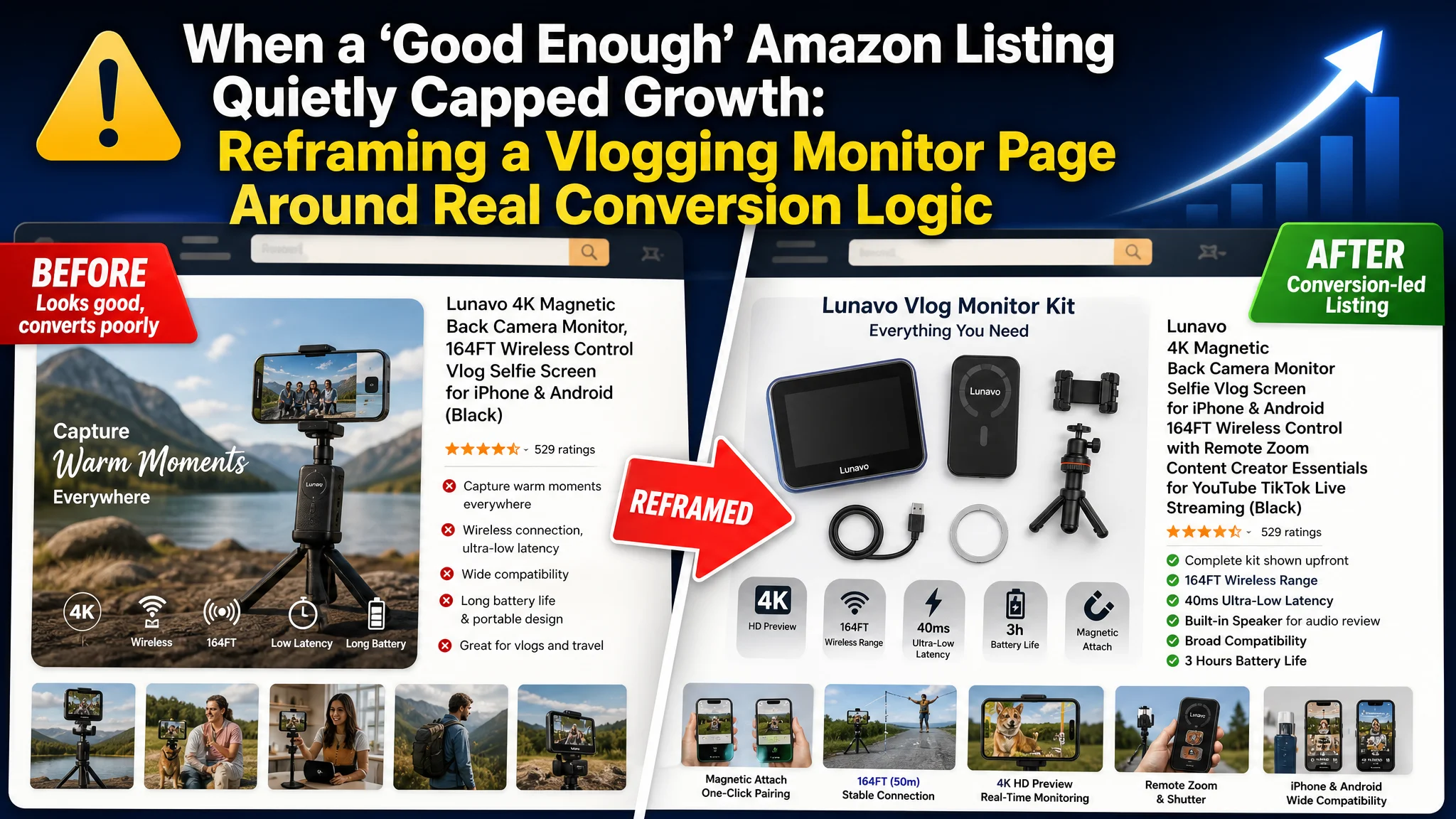
This case comes from an Amazon seller in the mobile content-creation accessories category, selling a magnetic back-camera vlog monitor screen for iPhone and Android. On paper, their Amazon Listing looked solid: overall score 82/100 vs. a benchmark competitor’s 83/100, 4.4 stars with over 500 reviews, and a richer A+ story than most peers. Yet under growing Amazon ads pressure, they found that traffic—both paid and organic—was not turning into orders as expected, and ACOS was becoming harder to keep in a safe band.
The seller’s first reaction was to treat this as a classic Amazon ads problem: refine keyword structure, adjust bids, test more creatives. But even as click volume moved, conversion did not follow. What DeepBI’s Listing diagnosis ultimately surfaced was not “bad ads”, but an under-optimized conversion path on the Amazon product page itself: a main-image set that failed to confirm what buyers actually get, a title that buried the core search term behind the brand, and bullet points that leaned on emotion instead of a tight “pain point → solution → proof” logic.
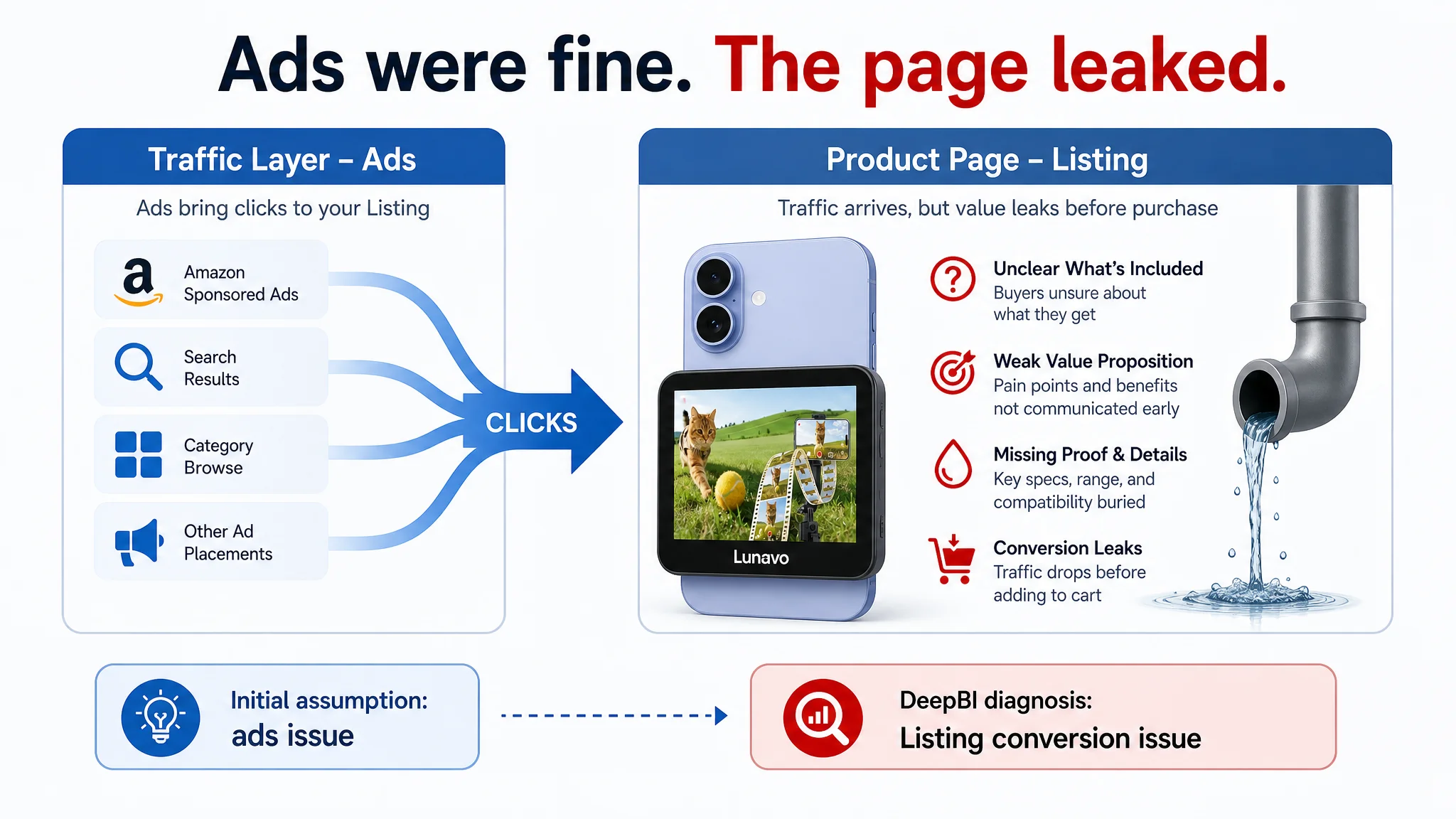
Once the problem was reframed from “ads are inefficient” to “the Listing is wasting the traffic ads bring”, the optimization sequence changed completely. DeepBI advised the team to first re-architect the title, main image sequence, bullet points, and A+ module order around a single conversion story: why a creator should switch from their front camera to a back-camera plus monitor setup, what technical certainty they get (range, latency, compatibility), and how this product removes concrete shooting risks. Only after the page’s sales logic was rebuilt did ads start to work as intended again.
For other Amazon sellers, this case shows how dangerous “almost as good as the benchmark” can be. A one‑point gap in Listing score hid a much more fundamental issue: the competitor organized its Amazon product page around decision logic; this seller organized around feature listing. Without fixing that, no amount of bid tweaking could sustainably improve ACOS or CVR.
Amazon Ads Were Not Failing. The Page Was Consuming the Traffic.
From the seller’s perspective, the pressure was straightforward: Amazon ads costs were climbing, click prices in their category were rising, and despite steady traffic, orders were not scaling in proportion.
They saw:
- Strong review volume (500+ reviews vs. the benchmark’s ~60), similar star rating, and lower negative-review ratio.
- An A+ section that felt richer and more polished than most competitors.
- A total Listing score only one point behind a top benchmark (82 vs. 83).
So the intuitive conclusion was:
“Our Listing is already above average. The real problem must be in ads—keywords, bids, or creatives.”
Over several weeks, the team cycled through standard Amazon ads optimizations:
- Rebalancing keyword portfolios around “vlog monitor”, “selfie screen”, “back camera monitor”.
- Testing different campaign structures and bid strategies.
- Refreshing ad creatives while leaving the underlying Listing largely untouched.
The result: exposure moved, CTR fluctuated, but conversion rate stubbornly resisted improvement. ACOS remained heavy, and the TACOS trend did not ease.
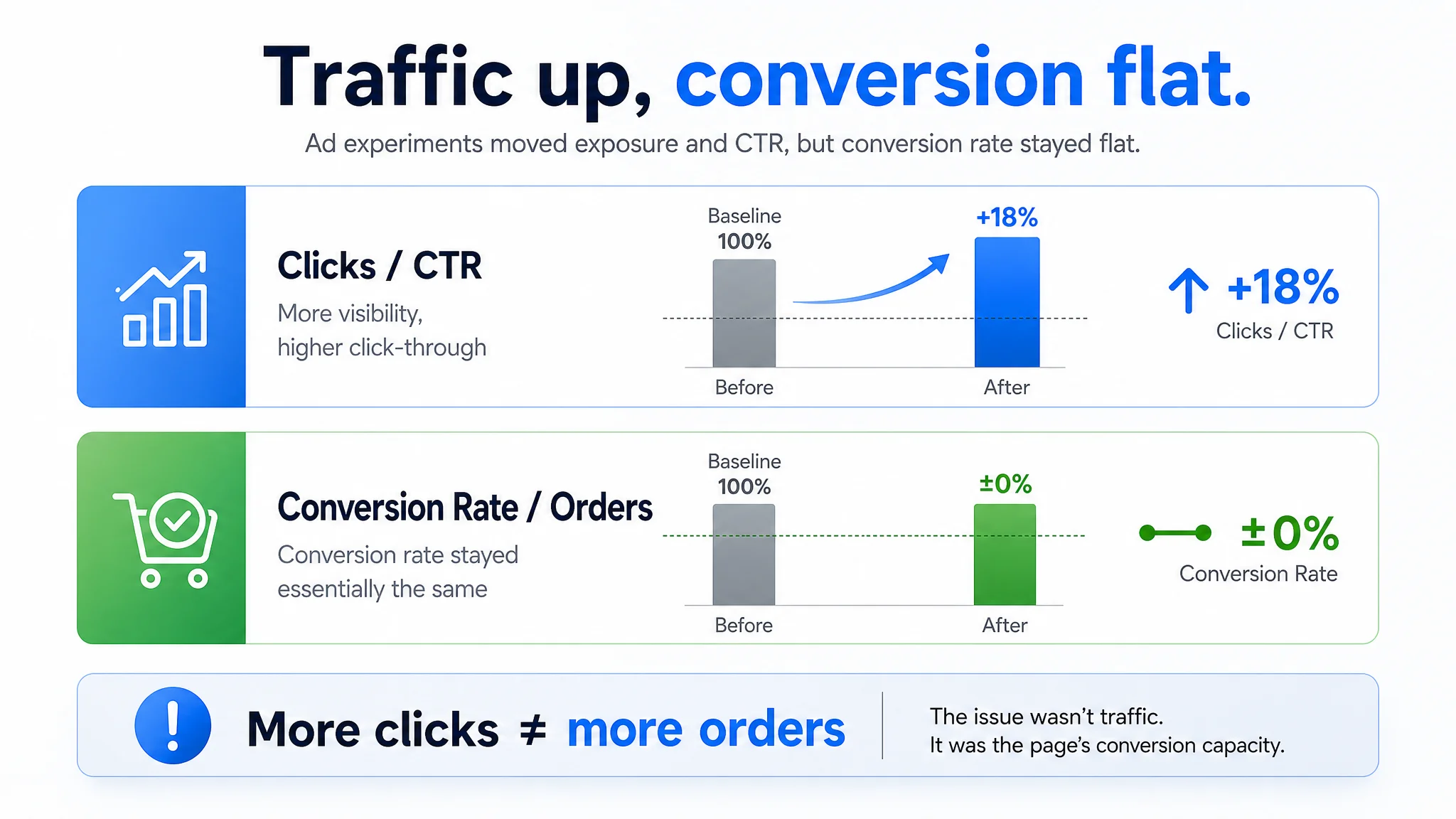
This is exactly the trap many mature Amazon sellers fall into: when a Listing looks “decent” and reviews are strong, they treat conversion issues as an advertising problem by default.
The Real Constraint Was Listing Conversion Capacity
DeepBI’s first step was not to look at ads, but to benchmark the Listing itself against the strongest comparable product in the same Amazon subcategory.
On headline numbers, the two seemed almost equal:
- Total score: 82 vs. 83.
- Title: 15 vs. 17.
- Main images: 25 vs. 26.
- Bullet points: 7 vs. 8.
- Detail/A+ content: 22 vs. 20 (the seller was actually ahead here).
- Reviews: 13 vs. 12 (again, an advantage in trust volume and lower negative rate).
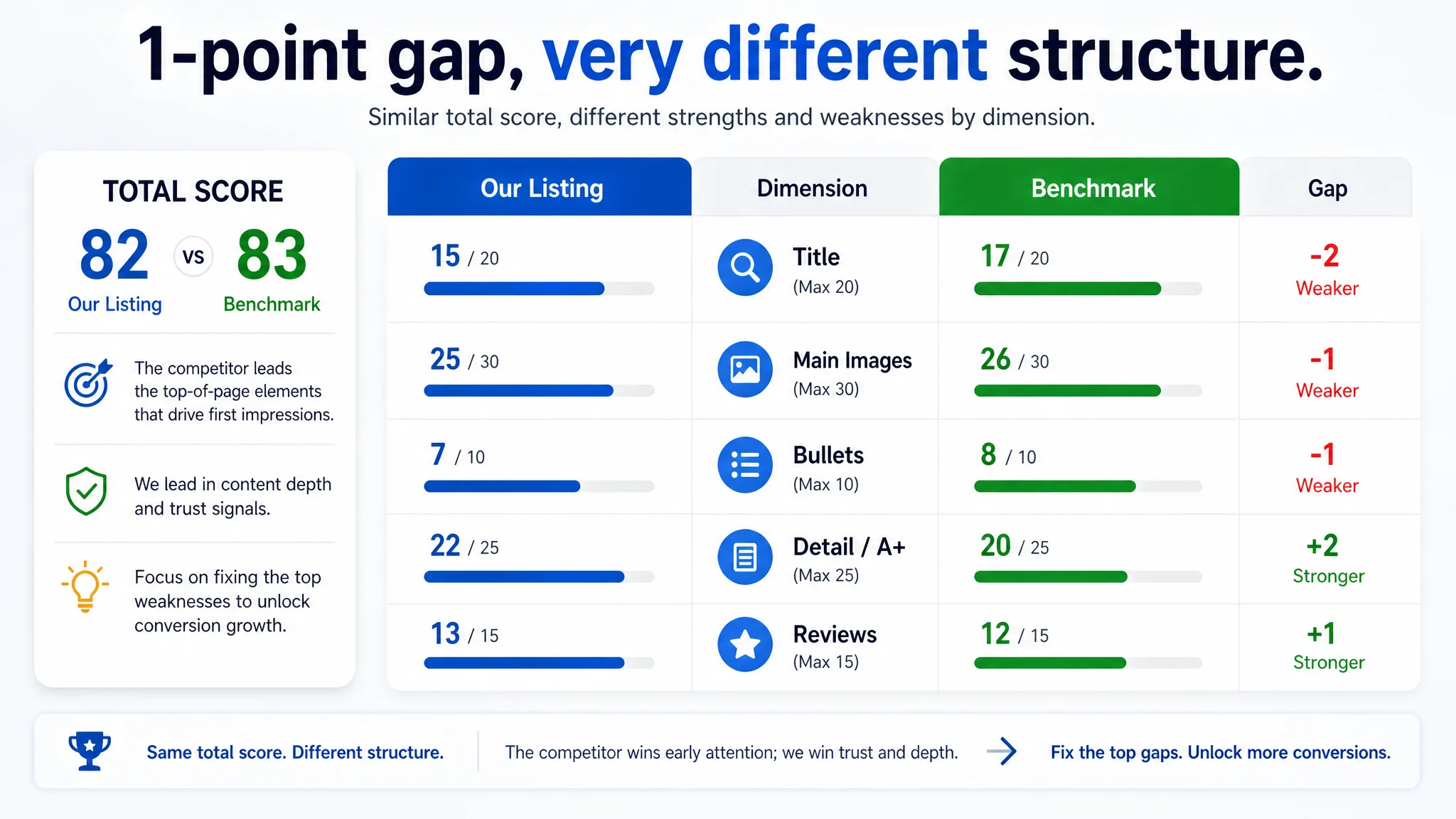
But score proximity hid a structural difference: the benchmark’s Amazon product page was tightly organized around the creator’s decision logic; this seller’s page was structured around feature enumeration.
DeepBI’s judgment was that the bottleneck was not traffic volume, but the Listing’s ability to convert the right traffic once it arrived.
“The real problem was not that ads failed to bring traffic. It was that the page could not convert the traffic.”
At this stage, continuing to prioritize ads would have meant spending more to amplify a weak conversion funnel.
Where the Misdiagnosis Started: “Our Page Is Already Strong”
With A+ modules that outperformed the benchmark on richness and storytelling, and reviews far ahead in volume and quality, the seller had good reason to believe:
- “Our visuals are already more professional.”
- “Our trust signals (reviews, A+) are stronger.”
- “If orders are lagging, the leak must be in how we buy traffic.”
In other words, they treated the Amazon product page as “fixed infrastructure” and looked for solutions entirely in the ads layer.
DeepBI’s Listing analysis challenged that assumption by asking a different question:
- Not: “Is this page good?”
- But: “Is this page more persuasive than the best competitor at each decision step a buyer goes through?”
That shift—from absolute to comparative, from internal satisfaction to external benchmark—exposed where seemingly minor gaps were actually critical.
This Product Page Did Not Lack Traffic. It Lacked a Clear Buying Story.
DeepBI’s cross-comparison with the benchmark revealed a pattern:
1. Title: Search Logic and Target User Were Under-Emphasized
The benchmark title led with the core search intent:
- “Magnetic Vlog Selfie Monitor Screen for iPhone & Android, 4K Wireless Video Recording with Remote Zoom & Shoot, Content Creator Essentials…”
The seller’s title started with the brand name, then moved into functional descriptors like “164FT Wireless Control” and “4K Magnetic Back Camera Monitor”, closing with “Black”.
Key issues:
- The primary keyword (“Magnetic Vlog Selfie Monitor Screen”) was not front-loaded.
- The title leaned on functional phrases instead of directly calling out who the product is for (“content creators”) and which scenarios it fits (“vlogging YouTube TikTok”).
- Long-tail scenario keywords (YouTube, TikTok, vlogging) were missing or pushed out, limiting both search coverage and immediate user identification.
In Amazon search results, this meant:
- Slightly weaker keyword relevance signals.
- Less instant recognizability for creators scanning thumbnails at speed.
- Reduced intent alignment at the title level, even before a click happens.
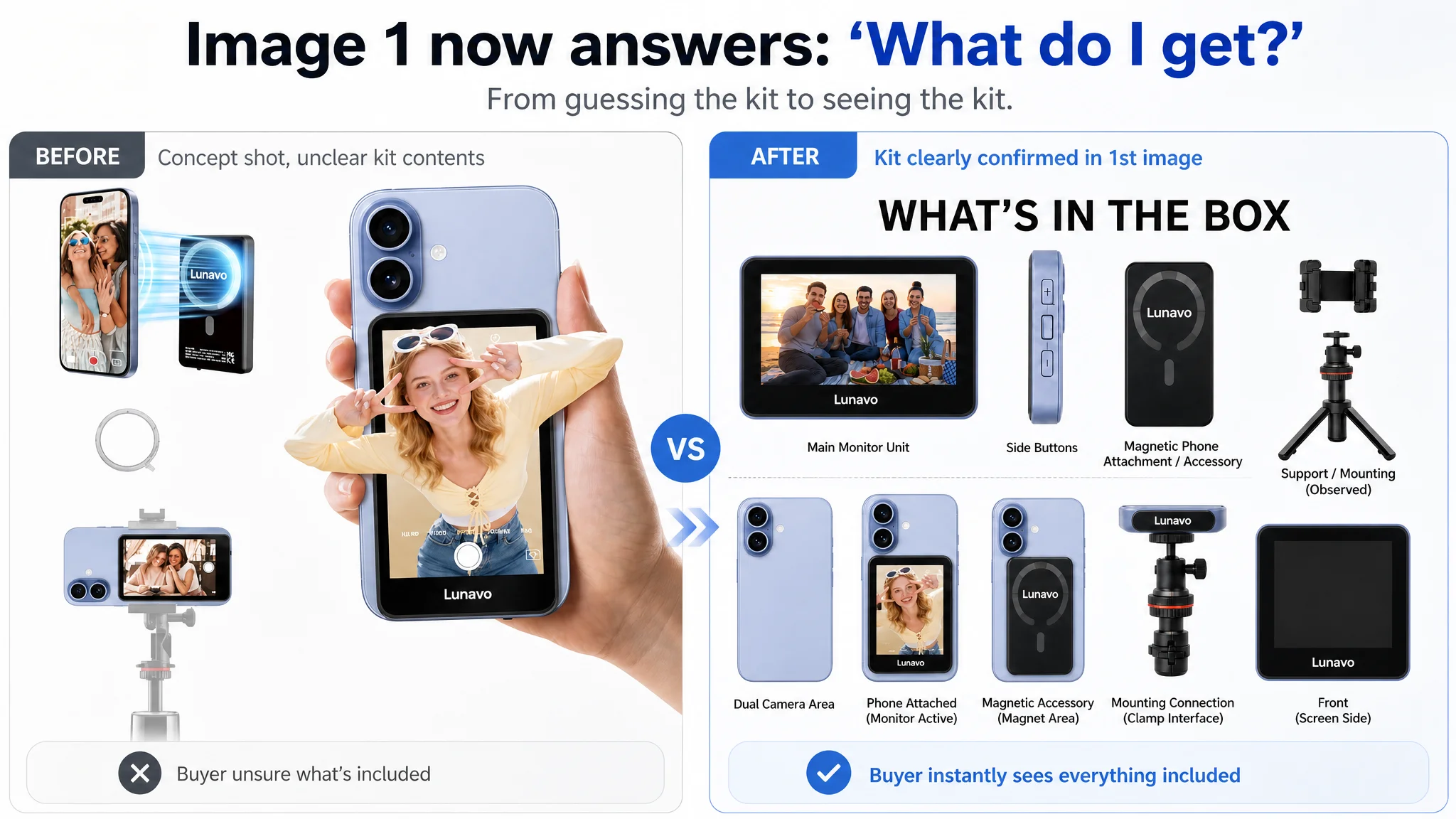
2. Main Images: No Immediate “What Am I Buying?” Confirmation
The first main image for the seller was a conceptual overview: monitor on phone, mounted to a tripod. It looked clean, but:
- It did not clearly confirm what is included in the kit—monitor, magnetic ring, charging cable, remote, etc.
- It left a gap in buyers’ minds about whether accessories were included or needed to be purchased separately.
- The “bundle confirmation” function that the benchmark handled in image 1 was missing.
Subsequent images had similar misalignment:
- Advanced scenarios (pet vlogging, creator lifestyle scenes) were introduced too early, before essential objections like ease of setup, compatibility, and range certainty were resolved.
- A strong front-vs-back-camera quality comparison image—arguably the core pain point story—was buried as image 6, where many buyers might never scroll.
DeepBI’s diagnosis:
“The main image gallery was visually rich, but mis-ordered for persuasion. It did not answer basic questions fast enough: What do I get? How do I set it up? What problem does it solve better than my current front camera?”
3. Bullet Points: Emotion Without a Complete “Pain → Solution → Proof” Loop
The seller’s bullet points leaned heavily on:
- Emotional framing (“capture warm moments”).
- Scene descriptions (family, travel, vlogs).
The benchmark, by contrast:
- Led with explicit pain points (“blurry images and awkward angles”).
- Closed each bullet by showing concrete outcomes and often adding a parameter or result.
- Included a “tips” bullet to manage expectations and reduce returns (e.g., sound limitations, 4K app advice, non-touch screen warning).
The net effect:
- The seller’s bullets created resonance but not enough certainty.
- Some key differentiators—like built‑in speakers for instant audio review, ultra-low latency, and extended wireless range—were not framed as standalone selling points.
- No explicit “Pro Tips” section existed to pre‑answer operational questions and manage post-purchase expectations.
On an Amazon product page, that matters because:
- Bullet points are often skimmed as the buyer’s “contract” with the product.
- Missing “usage tips” pushes risk downstream into customer service and returns instead of upstream into conversion confidence.
Detail Page: Strong, but Not Anchored Early Enough in Quantitative Proof
Ironically, the seller’s A+ (detail) content was stronger than the benchmark in many ways:
- Clear “problem → solution” modules (e.g., wireless latency pain → Blackmagic app solution).
- Emotional, real-world scenes (pets, makeup, vlogs) that made the use cases feel tangible.
- Before/after comparisons and competitor pain point visuals (Wi-Fi dependency, weak audio).
- A consistent brand language (“Smart Framing, Real Preview”, “Live Sync Clarity”) reinforcing a high-end positioning.
Yet DeepBI still identified a structural issue: the strongest modules were not placed where they could do maximum conversion work.
Examples:
- A powerful front vs. back camera comparison module, which directly answers “Why not just use my front camera?”, was not elevated to the top of the A+ flow.
- Quantitative advantages—distance (164FT / 50m), latency (40ms), battery duration—were described, but not summarized early as a single “hard proof” section.
- Compatibility clarity, especially around MagSafe vs. non-MagSafe phones and Google Pixel incompatibility, was pushed deep instead of being simplified and surfaced earlier.
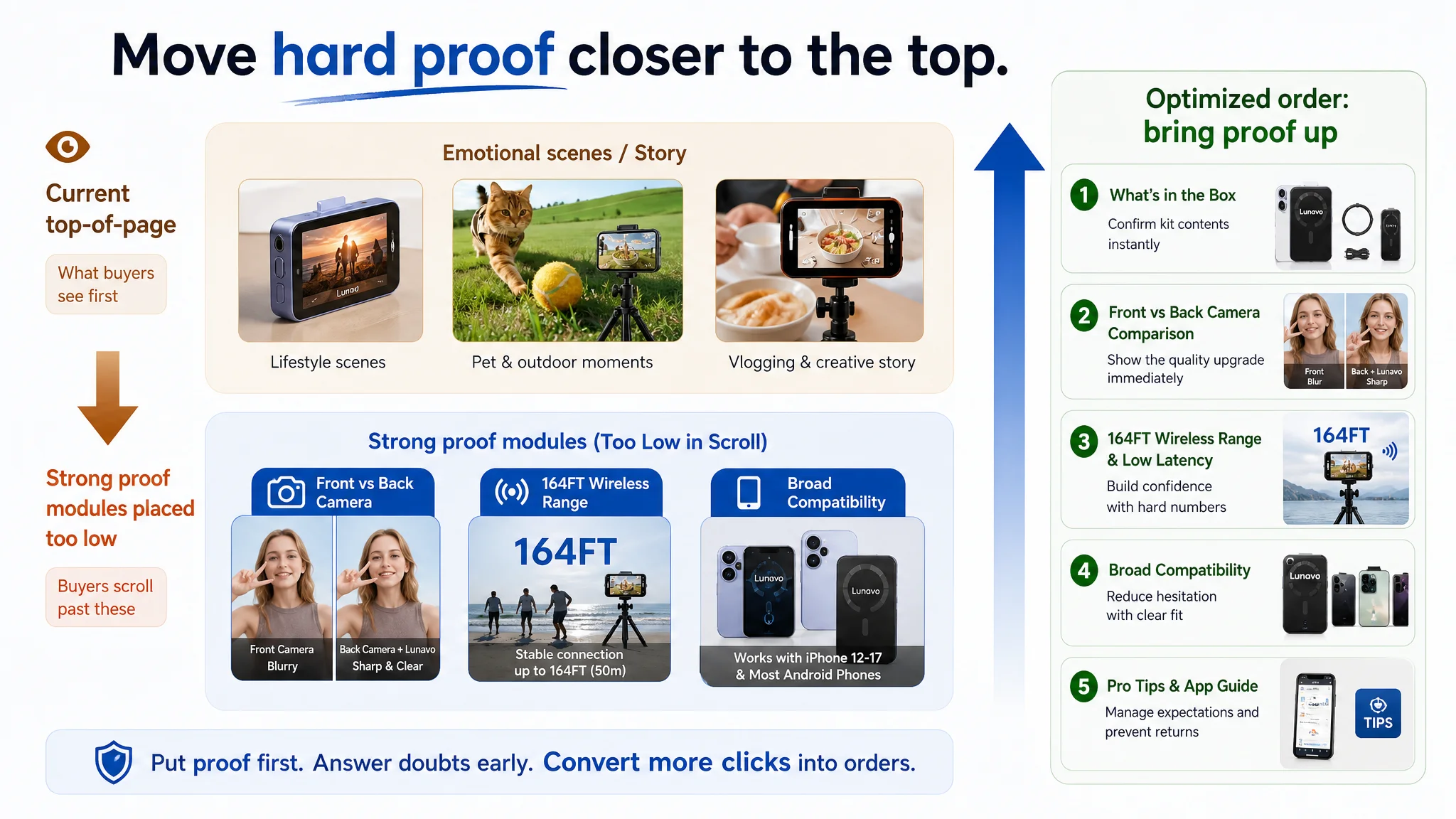
DeepBI’s conclusion:
“This A+ does not lack content. It lacks an order that matches how buyers de-risk their decision.”
Why DeepBI Did Not Keep Tuning the Ads First
With this diagnosis, DeepBI had to make a judgment call: whether to keep refining advertising (bids, targets, creatives) or to treat the Amazon Listing itself as the primary constraint.
The key business risks were:
- Ad spend amplifying Listing defects: More clicks into a page that doesn’t quickly confirm kit contents, core pain-point relief, and compatibility simply increases wasted spend.
- Organic ranking instability: A page with weak conversion efficiency struggles to defend or improve organic positions, making the store increasingly dependent on paid traffic.
- Operational volatility: Continuous ads adjustments without a stable converting page makes ACOS trends unpredictable and hard to control.
Given that:
- The Listing score gaps were concentrated in title (+2 to benchmark), main image (+1), and bullet points (+1).
- The detail/A+ score was already slightly ahead.
- Review trust was superior (more reviews, lower negative ratio).
DeepBI judged that fixing Listing conversion capacity would have more structural impact than further ad-tuning at this stage.
In other words:
- Step 1: Rebuild the sales logic on the product page—title, main images, bullets, and A+ order—so that each incoming click has a higher probability of converting.
- Step 2: Once conversion stabilizes upward, revisit ads scaling, knowing that each incremental click has a healthier expected return.
How the Listing’s Sales Logic Was Reconstructed
DeepBI’s recommendations centered on a single question:
“If a creator scrolls through this Amazon product page once, do they clearly understand why this setup is better than their current front camera, and what risks are removed?”
Title: From Brand-Led to Intent-Led
Proposed title structure:
“[Brand] 4K Magnetic Back Camera Monitor, Selfie Vlog Screen for iPhone & Android, 164FT Wireless Control with Remote Zoom, Content Creator Essentials for YouTube TikTok Live Streaming (Black)”
Key shifts:
- Core keyword immediately after brand: “4K Magnetic Back Camera Monitor” moved closer to the front to strengthen Amazon search relevance.
- Audience and scenario explicitly named: “Content Creator Essentials” and “YouTube TikTok Live Streaming” to lock onto creator intent and long-tail traffic.
- Differentiating spec preserved: “164FT Wireless Control” kept as a clear technical advantage, but integrated into a smoother reading rhythm.
Effect on conversion logic:
- Buyers scanning results see immediately: what it is, who it’s for, and in which scenarios it shines.
- The title now supports both CTR (clear value in SERP) and CVR (clarity before even entering the page).
Main Images: Reordering Around Decision Barriers
DeepBI recommended re-sequencing the gallery to:
1. Image 1 – Bundle confirmation: A clean “family shot” showing all components included, reducing uncertainty about what arrives in the box.
2. Image 2 – Performance confirmation: Visualizing remote zoom/shoot actions with clear stats (4K, 40ms latency, 164FT range).
3. Image 3 – Setup and range reassurance: Simple 3-step connection guide plus a visual range confirmation for 50m usage, addressing ease-of-use and reliability fears.
4. Image 4 – Front vs. back camera comparison: Elevating the strongest before/after comparison (currently buried as image 6) to directly attack the selfie-quality pain point.
5. Image 5 – Functional certainty & scenarios: Mapping remote functions (mirror, rotation, zoom) to specific content scenarios (cooking tutorials, live makeup, group vlogs).
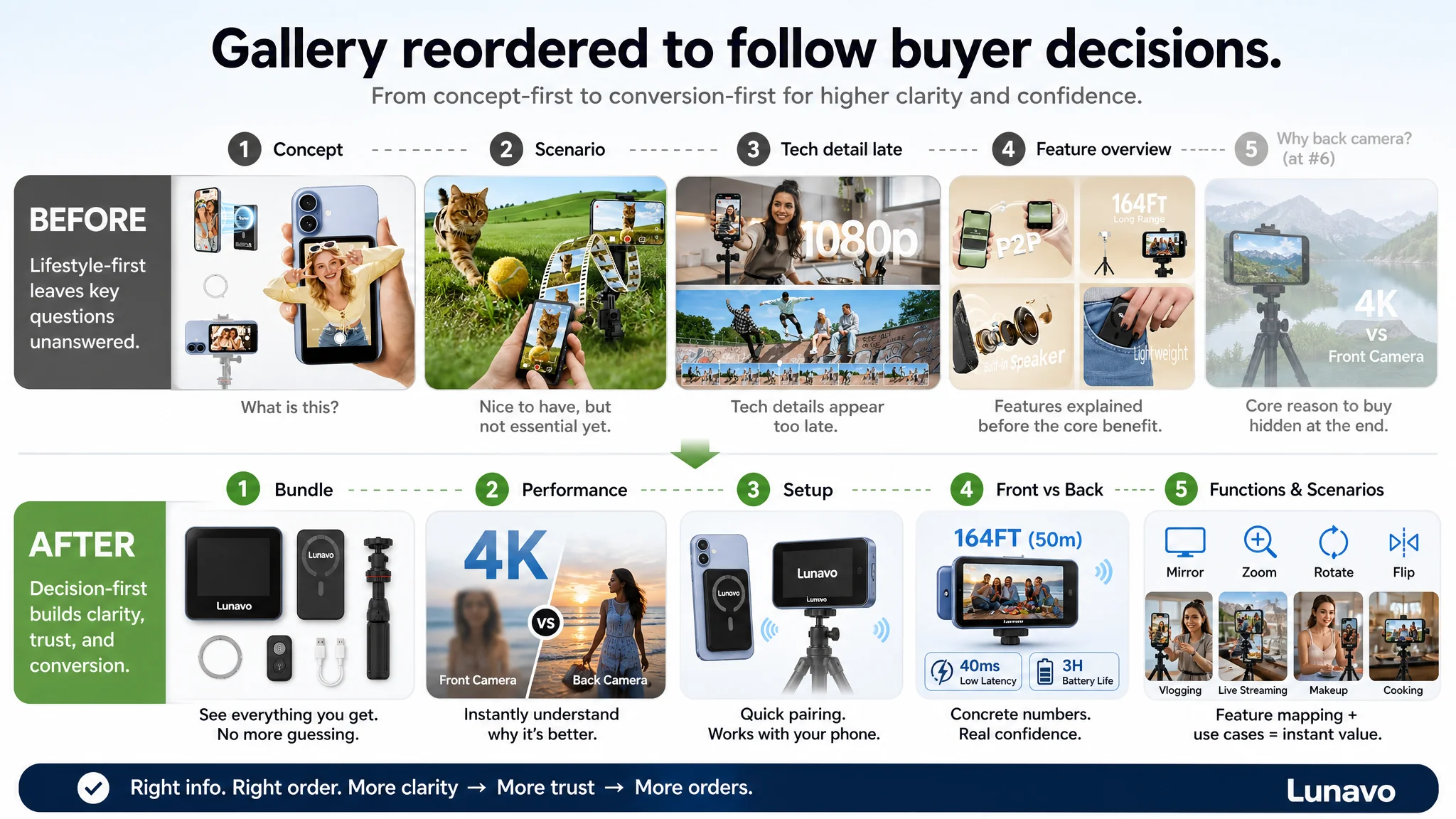
By doing this, the gallery moves from “nice lifestyle” to:
- “I know what I’m buying.”
- “I know it will work for my phone and distance.”
- “I see clearly how it improves my content.”
Bullet Points: Turning Hidden Advantages into Explicit Selling Points
DeepBI proposed a new bullet structure centered on:
1. Real-time HD monitoring & back camera selfie
Emphasizing P2P wireless mirroring, real-time preview, and the core benefit: using the stronger rear camera while still seeing yourself.
1. Unique built-in speakers for instant review
Making audio playback a standalone differentiator, especially versus competitors that explicitly lack sound.
1. Strong magnetic attachment & wide compatibility
Clear MagSafe support, adhesive plate for other devices, and explicit Pixel exclusion to avoid post-purchase regret.
1. 164FT wireless range & 40ms ultra-low latency
Quantifying distance and latency, tied to scenarios (group shots, solo filming, cooking tutorials).
1. 3 hours of creative freedom & compact design
Combining battery life and portability into a freedom-of-use promise, with reassurance around not blocking lenses or gimbals.
1. Pro tips for best performance
A dedicated “tips” bullet to:
- Recommend the Blackmagic Camera app for 4K.
- Clarify non-touchscreen behavior.
- Explain how to review recorded video on the phone.
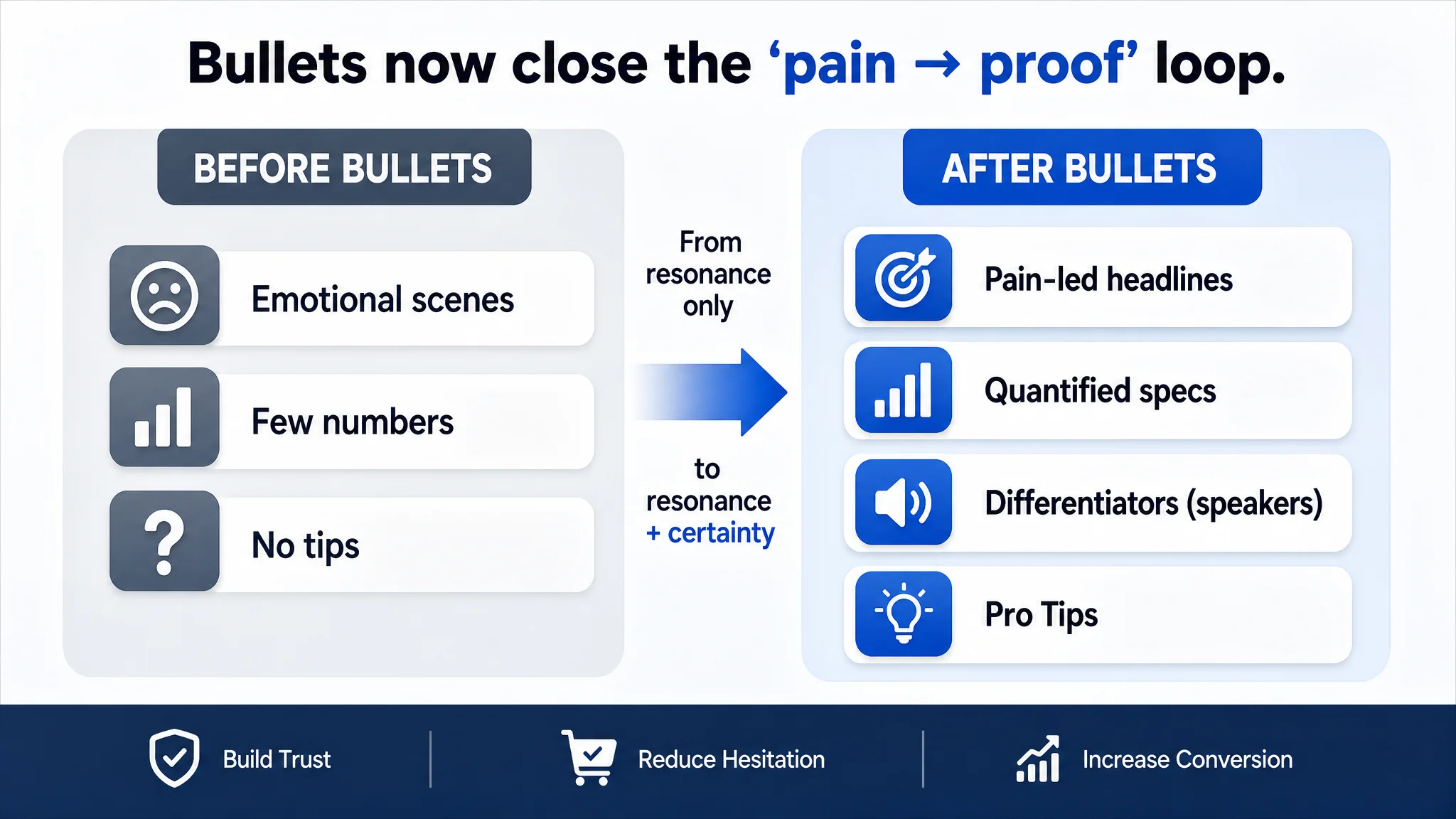
This restructuring turns scattered advantages into a coherent argument, reduces purchase risk, and preempts many of the questions that would otherwise show up as friction in reviews or returns.
Detail Page: Reordering Around Quantitative Proof and Trust
DeepBI’s A+ recommendations focused on:
- Leading with a consolidated vlogging-benefit module: A single overview that combines:
- Back-camera clarity advantage.
- 164FT range and 40ms latency.
- 3‑hour battery and compact design.
- Elevating the “back vs front camera” module to position 2: Making the quality upgrade story unmissable.
- Strengthening performance proof: Adding clearer visual evidence (distance lines, scenario-validated use at 50m) and connecting technical specs back to visible user outcomes.
- Simplifying compatibility logic upfront: Showing:
- Which iPhone generations are magnetically compatible.
- How Android users can use the adhesive metal plate.
- Explicitly stating non-support for Pixel devices.
- Adding a clearer “what’s included” and attachment guide module: Visual confirmation of every accessory and how to attach them, reducing surprises.
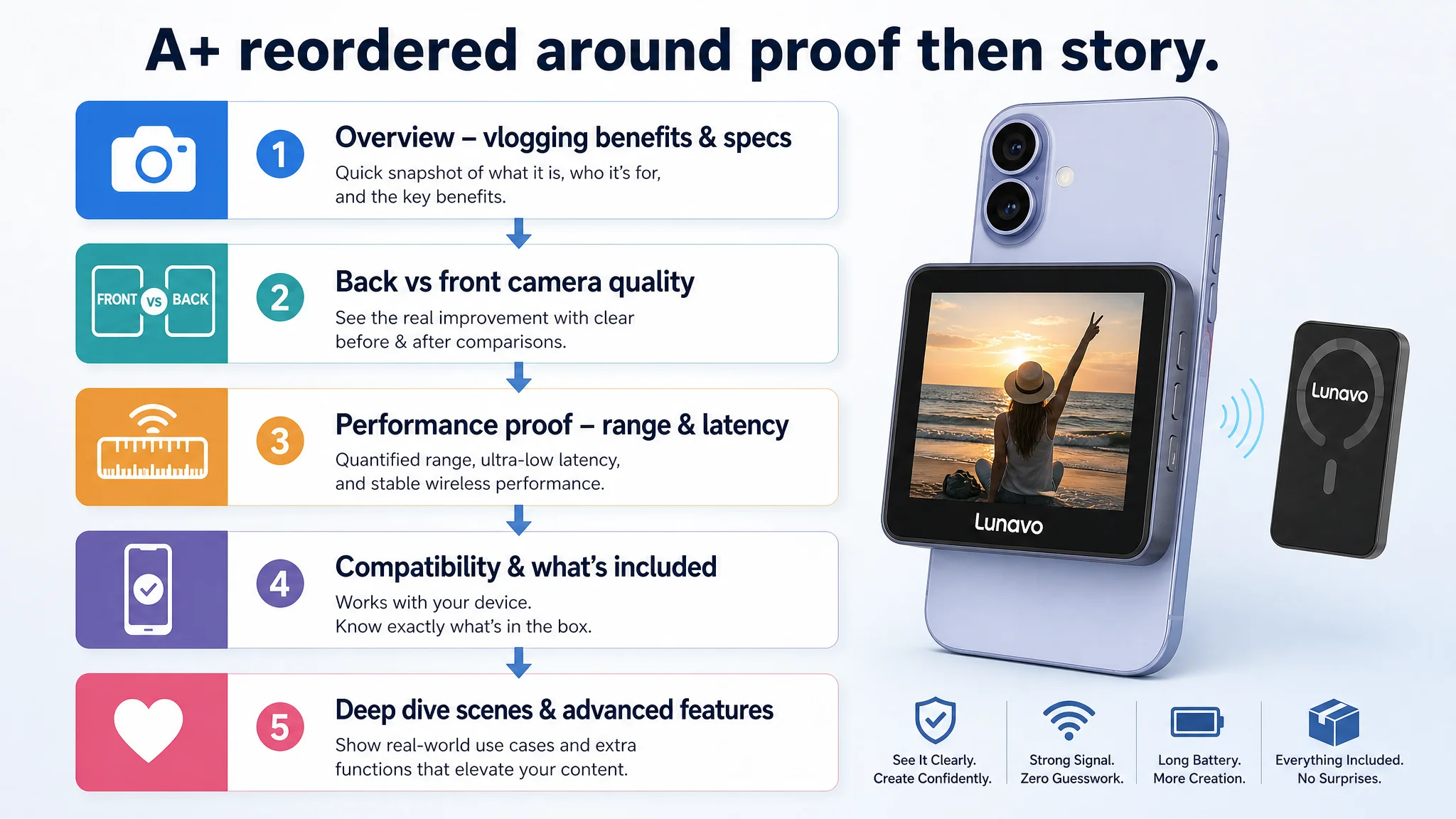
By reordering the modules, the page becomes less about “everything we can say” and more about “what a cautious buyer needs to see first.”
After the Page Started to Convert, Ads Became Useful Again
While this case does not rely on specific numeric post-optimization results, several shifts in operating state were evident:
- Listing conversion capacity improved: The page better aligned title, main images, bullets, and A+ around a single sales logic, making each click more likely to convert.
- Ad traffic stopped amplifying page weaknesses: With core objections handled early (kit contents, quality upgrade, range, compatibility), clicks from Amazon ads had a healthier path to purchase.
- Traffic structure risk decreased: A more convincing page reduced dependence on aggressive bids and heavy spend just to maintain volume.
- Operational control increased: The seller could now interpret ACOS and CVR changes in the context of a stable Listing, rather than guessing whether every metric move was due to hidden page-level issues.
Perhaps most importantly, the seller’s understanding changed:
“We used to believe ads were the primary lever. This case showed us that Listing conversion is the foundation. Ads only scale what the page can already convert.”
What Other Amazon Sellers Can Take from This Case
Several lessons from this vlogging monitor case are widely applicable across Amazon categories:
1. A high score and strong reviews do not guarantee you have no Listing problem.
A one‑point gap vs. a benchmark can hide structural differences in how you guide buyers through their decision.
1. Ads cannot permanently cover for a weak product-page story.
If your Amazon product page does not quickly answer “what am I buying”, “what problem does it solve better than my current setup”, and “will it work with my device”, ads will mostly amplify your leakage.
1. Title, main image, bullets, and A+ must form one continuous argument.
In this case, the A+ was strong, but its best modules came too late, and the top-of-page elements (title, main images, bullet points) did not carry enough of the decision load.
1. Quantitative proof and usage tips are not optional extras.
Distance, latency, battery hours, compatibility constraints, and app recommendations turned from buried details into front-line trust builders.
1. Before scaling ads, ask: ‘Does this page deserve more traffic?’
DeepBI’s value in this case was not a feature list, but a judgment call: the biggest business risk was continuing to fund traffic into a mis-structured sales page.
For Amazon sellers under similar pressure—rising ad costs, flat conversion, and “good but not great” Listings—this case shows that the most impactful optimization may not be another round of bid adjustments, but a hard look at whether your Amazon product page truly converts the traffic you already have.