

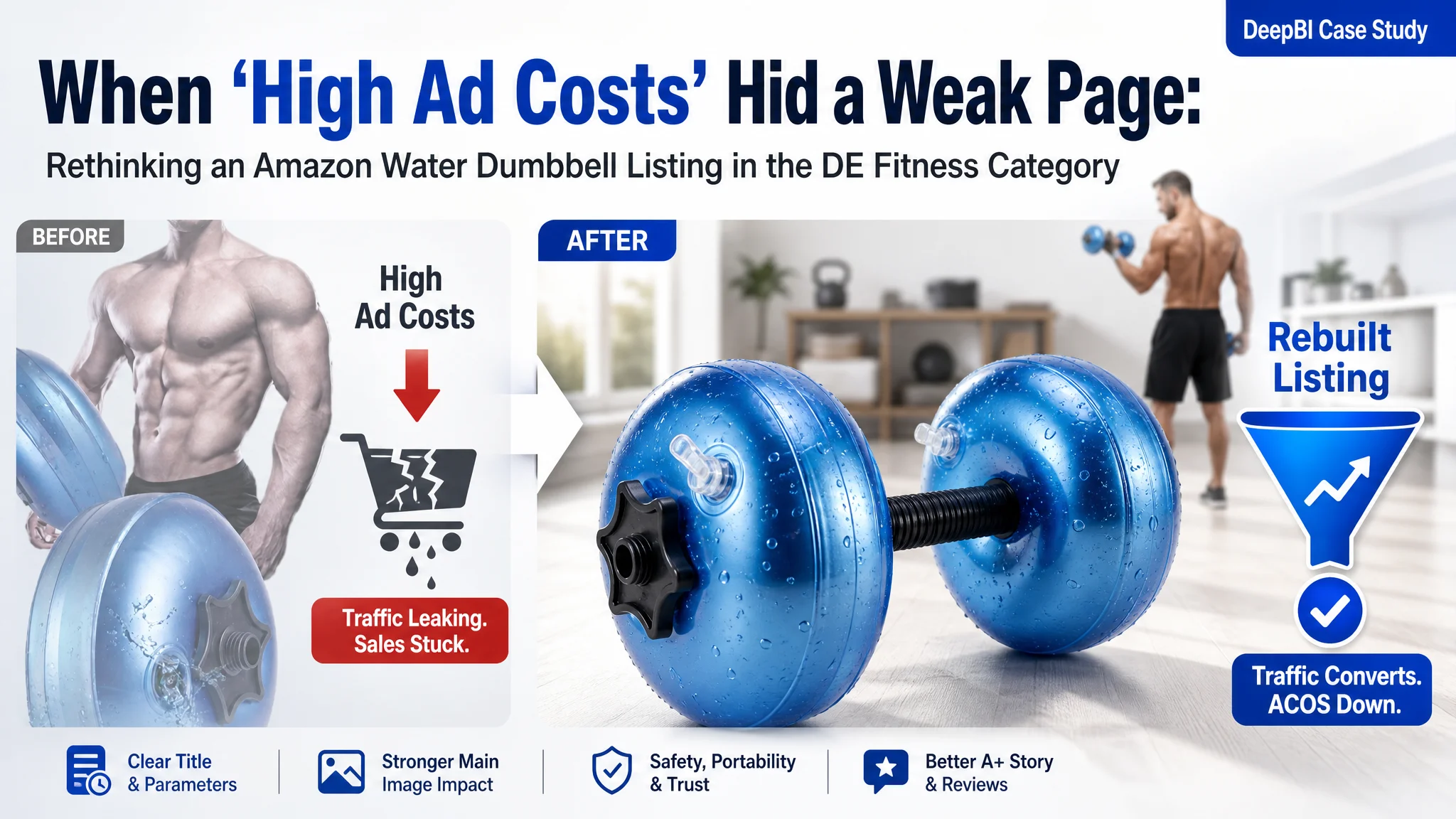
This case comes from an Amazon seller in Germany operating a water-filled dumbbell set. On the surface, the problem looked like a classic ads issue: rising ACOS, traffic not converting, and a sense that “our creatives just aren’t attractive enough.” The team kept rotating ad assets and tweaking campaigns, but orders did not follow the traffic curve.
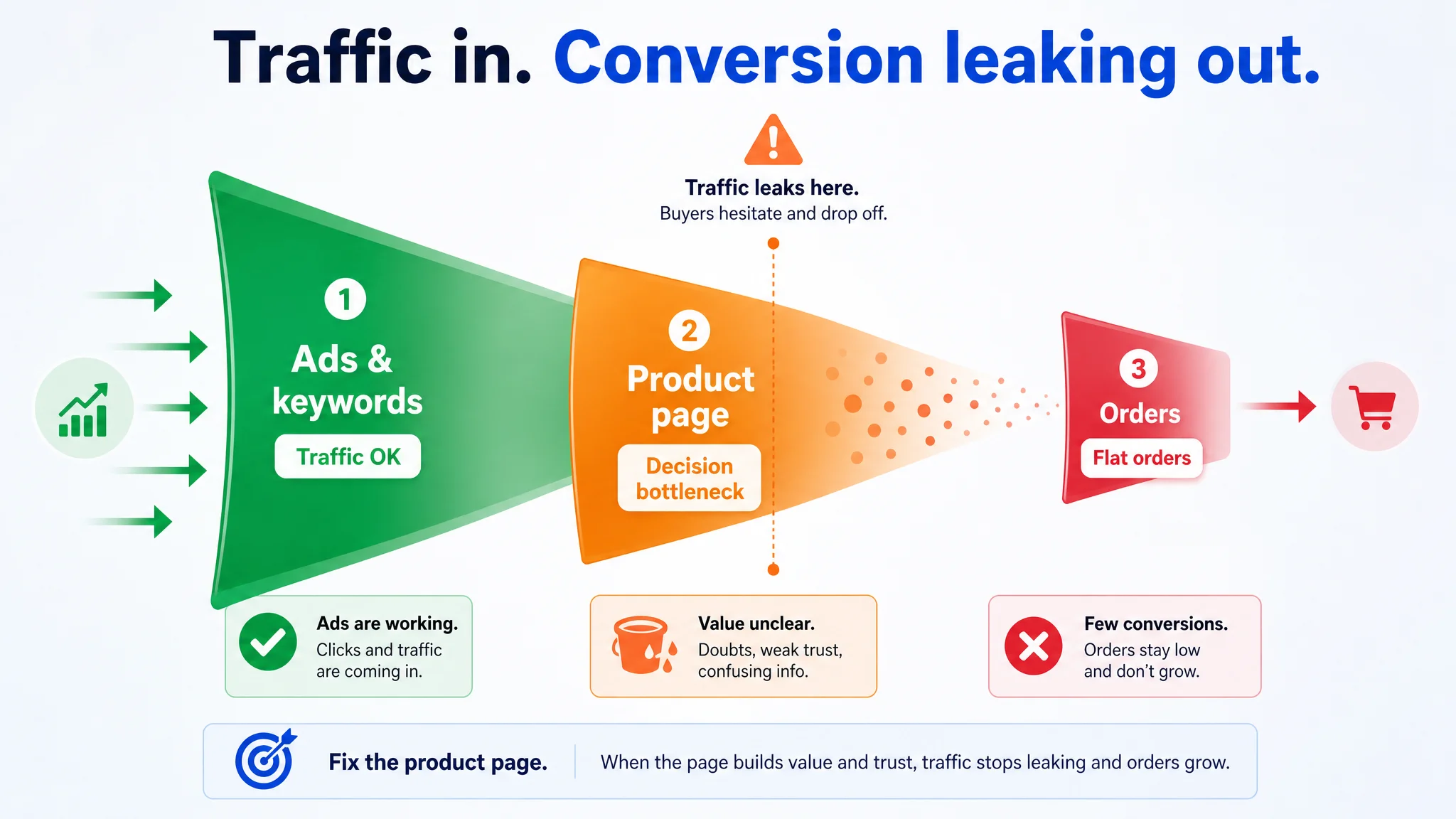
Once DeepBI entered, the focus shifted away from ad controls and toward the Amazon product page itself. Benchmarking against a strong competing Listing showed an 18‑point gap in page quality, centered not on traffic volume but on how the page supported a buying decision: unclear title logic, visually weak main images, fragmented bullet-point logic, incomplete A+ storytelling, and a fragile review profile. Ads were not failing; they were amplifying a low-conversion Listing.
The optimization path therefore moved from “tune the ads” to “rebuild the Listing’s decision logic.” Title and bullets were reshaped around concrete weight parameters and portable-use scenarios, the visual system was rebuilt around “foldable & safe” water weights with modern home-fitness imagery, and A+ content was redesigned to tell a coherent story for home, travel, and family users. For other Amazon sellers, the lesson is direct: if your product page cannot clearly express value, trust, and use cases, no amount of bid and keyword work will fix ACOS. Listing conversion capacity is the foundation ads sit on.
Amazon Ads Were Not Failing. The Page Was Consuming the Traffic.
When this fitness brand came to DeepBI, their operational pressure sounded familiar to many Amazon sellers:
- Amazon ads spend was climbing.
- ACOS was hard to pull down.
- Traffic volume looked “okay”, but orders stayed flat.
- The team believed the solution was better creatives and more refined campaigns.
In internal discussions, the dominant narrative was: “Our images look cheap; our ads need better visuals.” As a result, most of the effort went into advertising-side adjustments—new ad creatives, different placements, bid changes, and keyword experimentation.
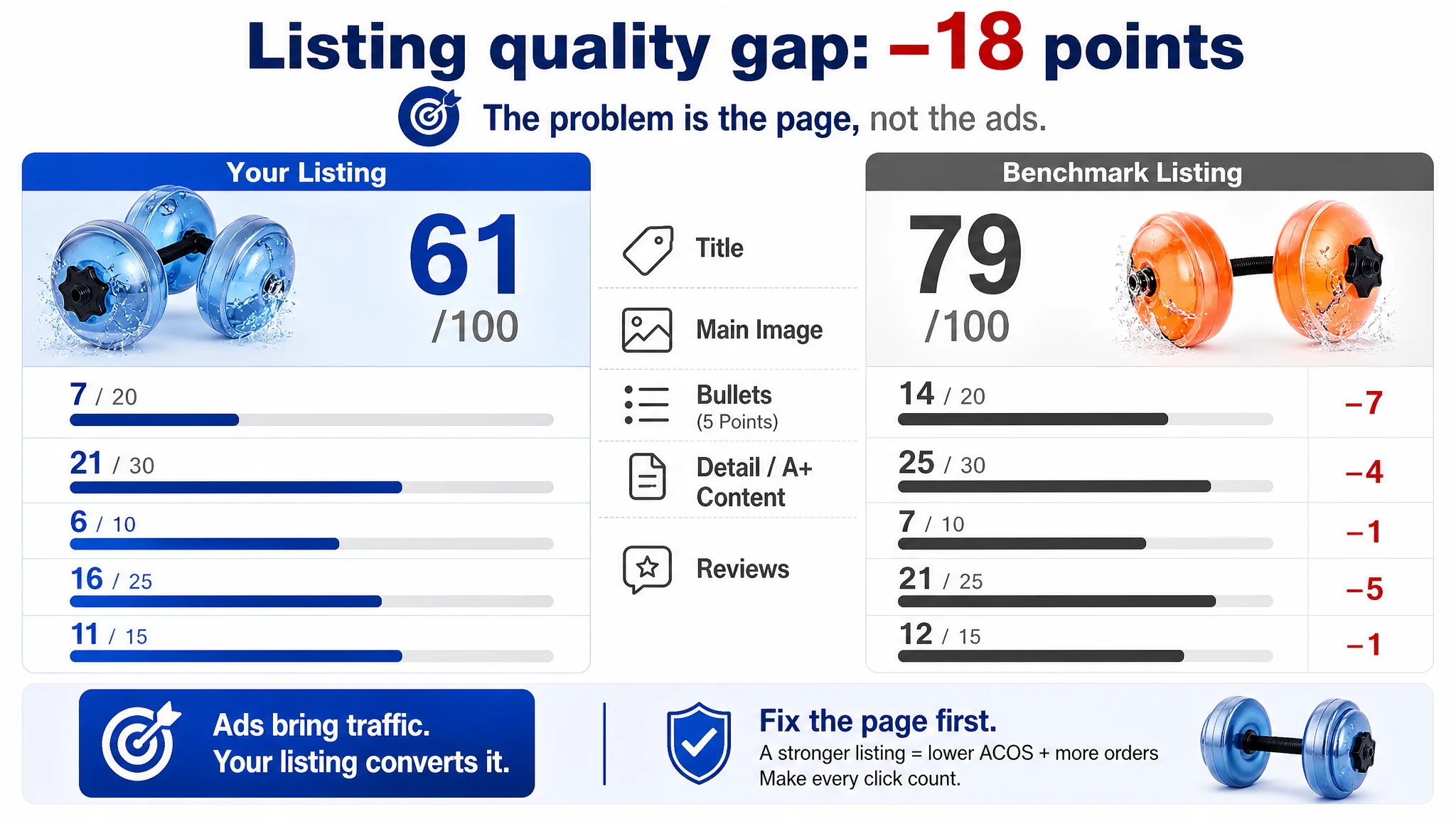
But their Amazon Listing for the DE marketplace told a different story once measured against a strong competitor. DeepBI’s Listing scoring showed:
- Seller Listing total score: 61 / 100
- Benchmark competitor Listing: 79 / 100
- Gap: −18 points
Breaking that down:
- Title: 7 vs 14 (out of 20)
- Main image: 21 vs 25 (out of 30)
- Bullets: 6 vs 7 (out of 10)
- Detail/A+ content: 16 vs 21 (out of 25)
- Reviews: 11 vs 12 (out of 15)
The gap was not just aesthetics; it was functional. The page did not make it easy for a buyer to understand what they were getting, why it was better, and why they should trust it.
“The real problem was not that ads failed to bring traffic. It was that the page could not convert the traffic.”
Until this gap was closed, any extra ad spend would simply be poured into a leaky bucket.
The Core Constraint: Weak Listing Conversion Capacity
Among all the issues, one stood out as the true bottleneck:
The Amazon Listing lacked a clear, trustworthy decision path for buyers.
DeepBI judged this by looking at how the target Listing performed against a single, well-chosen benchmark within the same water dumbbell niche:
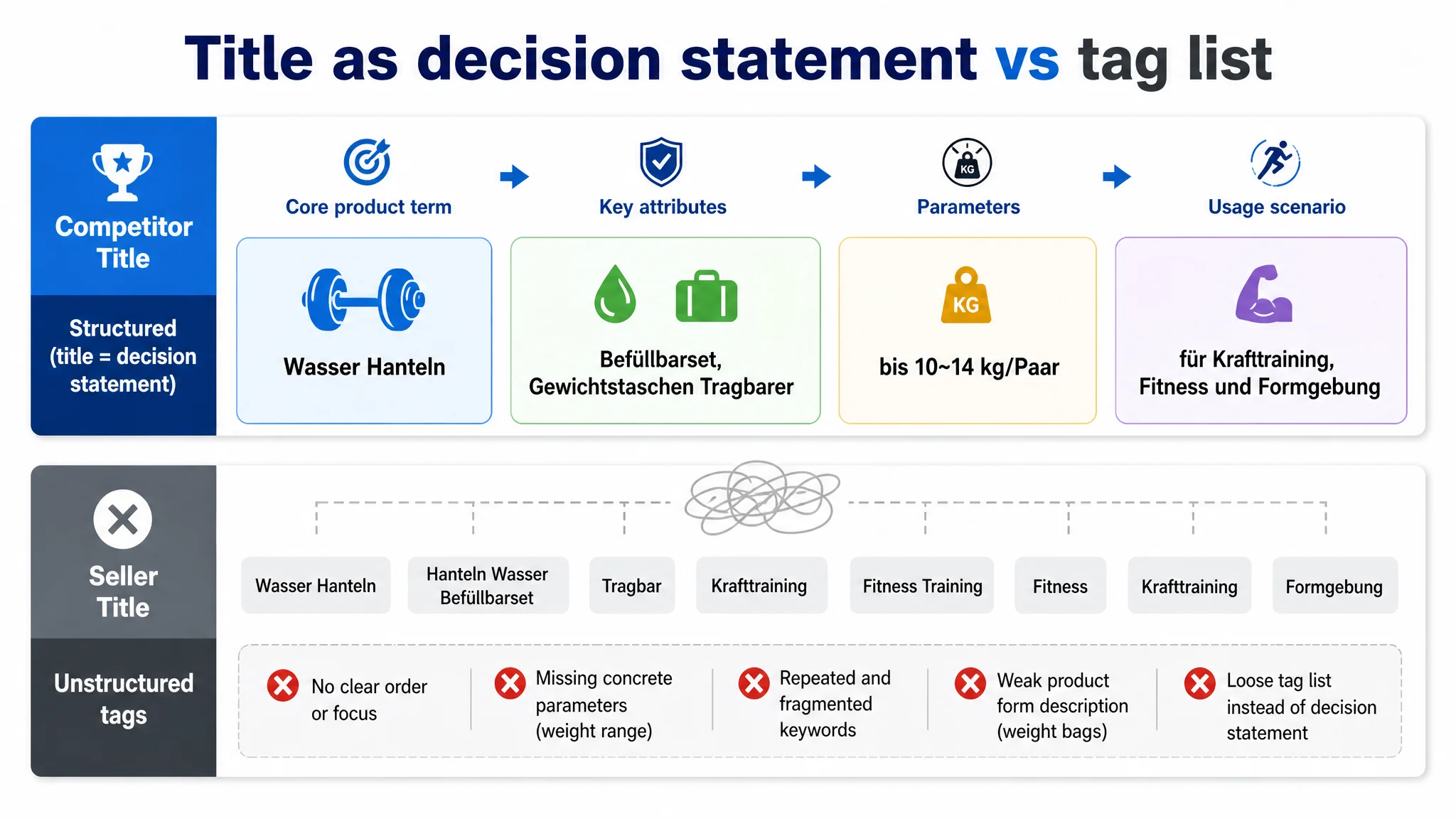
- The competitor followed a mature Amazon title structure:
Core product term → Key attributes → Concrete parameters → Usage scenario.
- The seller’s title was closer to a loose collection of function words, with repeated and fragmented scene descriptors.
On the visual side, the competitor’s main images and A+ modules:
- Quantified critical parameters (e.g., per-pair weight range).
- Showed real usage scenes—home workouts, travel scenarios, family-friendly setups.
- Visualized technical trust points (thickened handle, widened injection port, anti-leak features).
By contrast, the seller’s page:
- Showed more “how to fill water” steps than actual user scenarios.
- Offered few quantified specifications (weight range, colors, materials).
- Paid little visual attention to foldability, storage, or safety—key motivations for choosing water dumbbells over traditional iron weights.
In parallel, the review dimension signaled a trust problem:
- Seller: 3.5 stars, 386 total reviews, 38% negative.
- Competitor: 4.0 stars, 34 reviews, around 6% negative.
The seller had volume but not trust. Their first page of reviews was heavy in one language and heavily negative—buyers were seeing a wall of risk signals before they even reached the A+ content.
This was not a “minor optimization” issue. It was a structural conversion risk.
The Seller’s Original Misdiagnosis: “We Just Need Better Images and Ads”
Prior to DeepBI, the seller had formed a simple narrative:
- ACOS is high → Ads must be inefficient.
- Ads inefficient → Creatives must be ugly / not attractive enough.
- Solution → Build new creatives, rotate them into campaigns, keep tuning bids.
This misdiagnosis had three blind spots:
1. Title-level decision logic was weak.
Shoppers scanning the search results saw competing titles that clearly stated: water dumbbells, fillable, portable weight bags, and specific weight ranges per pair. The seller’s title lacked that parameter clarity and structured hierarchy. Even before clicking, the Listing was losing relevance and trust.
1. Main images lacked a strong visual hook and trust layer.
The competitor’s bright orange product on a clean white background, with clear technical callouts, had a predicted CTR advantage of about 5–8% for this category (based on A/B test benchmarks). The seller’s images, with visible cutout artifacts, darker scenes, and weaker composition, did not command the thumbnail.
1. A+ content did not carry buyers from “interested” to “convinced.”
The seller over-focused on operational sequences (water filling steps) and under-focused on scenarios, specifications, and lifestyle. Buyers couldn’t quickly see:
- How heavy can these get?
- How small do they fold?
- How safe are they for floors and families?
As a result, ad adjustments improved nothing fundamental: traffic arrived, but conversion confidence wasn’t built.
Listing Data Abnormalities DeepBI Flagged
DeepBI’s scoring and benchmark comparison surfaced several clear abnormalities across the Listing:
1. The Title Did Not Communicate the Outcome
- Competitor titles emphasized:
- Water dumbbells.
- Fillable, portable weight bags.
- Specific weight range per pair (10–14 kg).
- Use cases: strength training, fitness, body shaping.
- The seller’s title:
- Repeated scene descriptors such as “Krafttraining - Fitness Training” with weak structure.
- Lacked concrete buying parameters like total weight capacity.
- Used generic adjectives like “portable” without specifying actual form (“weight bags”) or range.
In search results, the competitor’s title was a compact decision statement. The seller’s title looked like a list of tags.
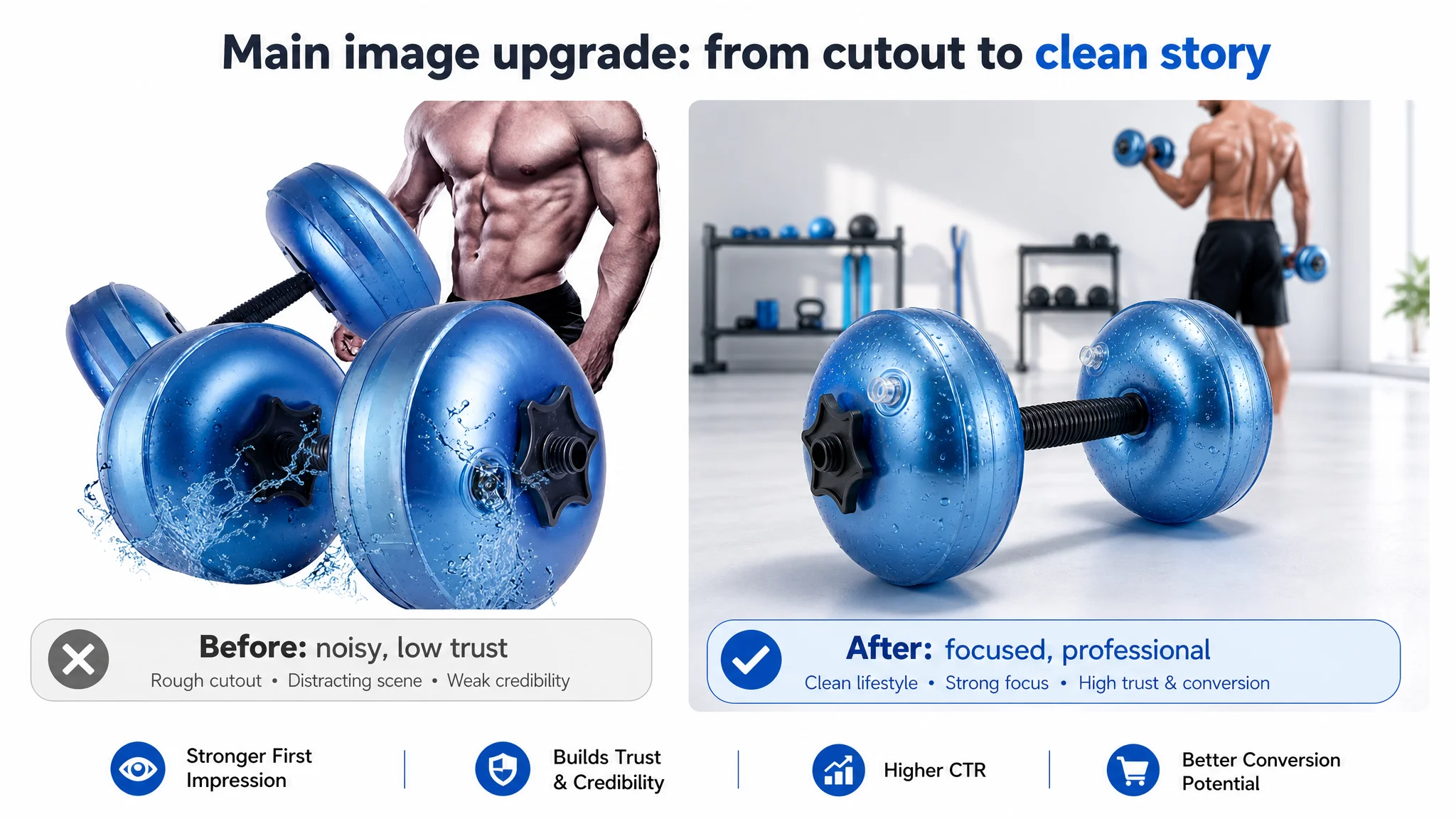
2. Main Images Under-Utilized Visual Decision Hooks
The scoring gap in main images (21 vs 25 out of 30) was rooted in:
- First-glance impact.
Competitor: high-saturation color, clear contours on a clean background, strong product silhouette. Seller: lower contrast, obvious cutout traces, busy or dark scenes.
- Technical trust visualization.
Competitor: macro shots with captions like “Thickened handle” and “Widened injection port”, visually proving engineering thoughtfulness. Seller: technical images existed (e.g., water inlet close-ups), but lacked units, annotations, and explanation of advantages.
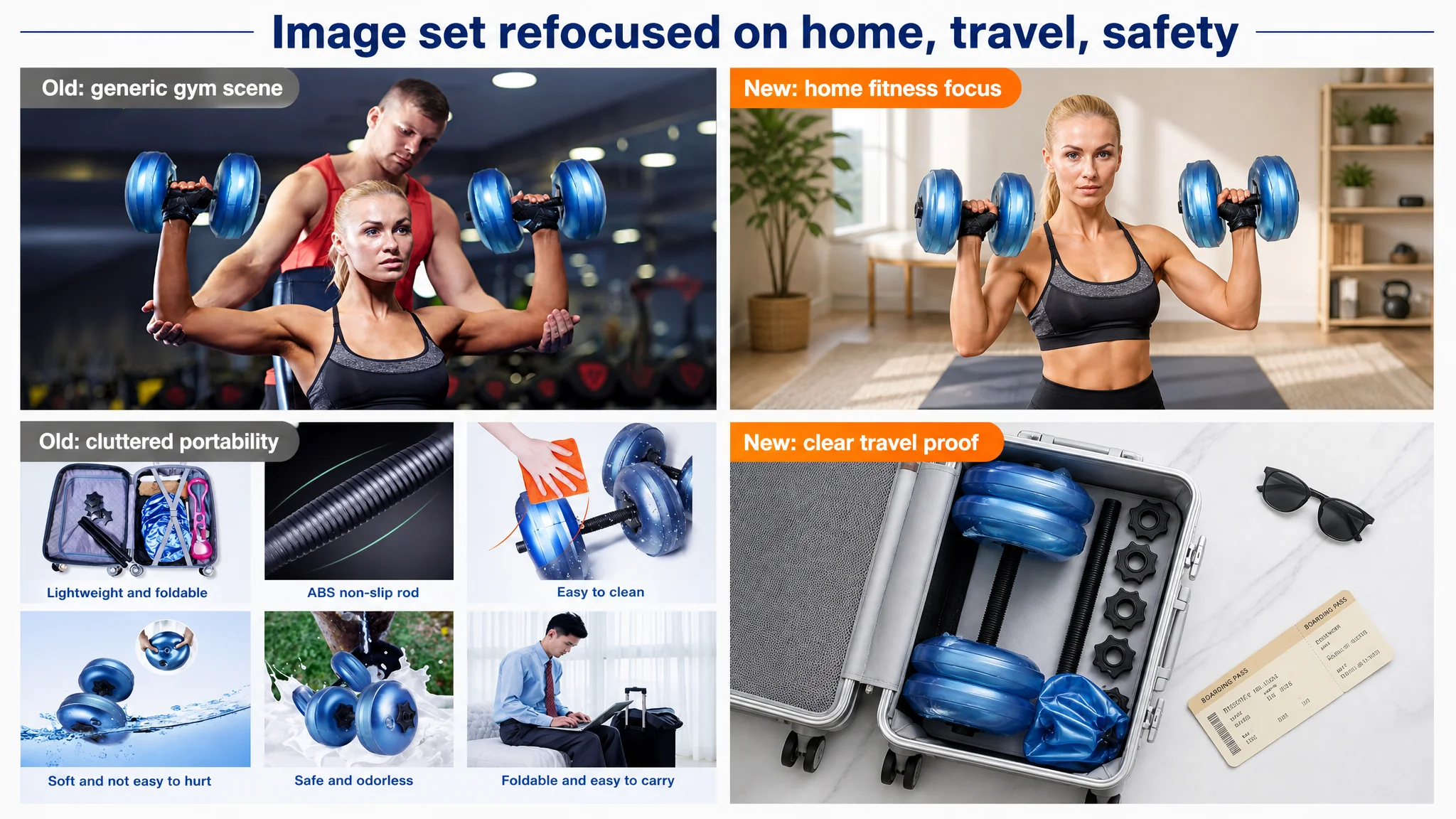
- Portable-use storytelling.
Competitor: clear travel scenario – product inside a suitcase, highlighted as a “business travel” fitness solution. Seller: only a static illustration, with much weaker context and emotional hook for high-value traveling users.
“Advertising does not only amplify advantages. It can also amplify a page’s existing defects.”
DeepBI interpreted the low technical-detail clarity and weak scenario usage as a direct hit to CVR, especially for higher-intent buyers.
3. Bullet Points with Information, but Not a Buying Logic
On paper, the seller’s bullets covered many aspects: safety, materials, user groups, and usage scenarios. However:
- The first bullet did not immediately frame the core value: “no need for bulky iron weights” and space savings, as the competitor did.
- Weight adjustability was mentioned, but not clearly quantified in a way that matched how buyers think about “per-ball” weight and total pair weight.
- Safety and material advantages were there, but buried inside general text instead of being structured as a clear benefit → proof → use-case logic.
The competitor, by contrast, structured bullets like a funnel:
1. Core value: no heavy iron, easy to carry, full-body training anywhere.
2. Adjustable weight: clear numbers (5 kg per side, 10 kg per pair).
3. Portable emphasis.
4. Durability and design.
5. Inclusivity and aspiration: “start your journey to a stronger, healthier body.”
The difference was not the amount of text; it was how strongly the bullets guided a decision.
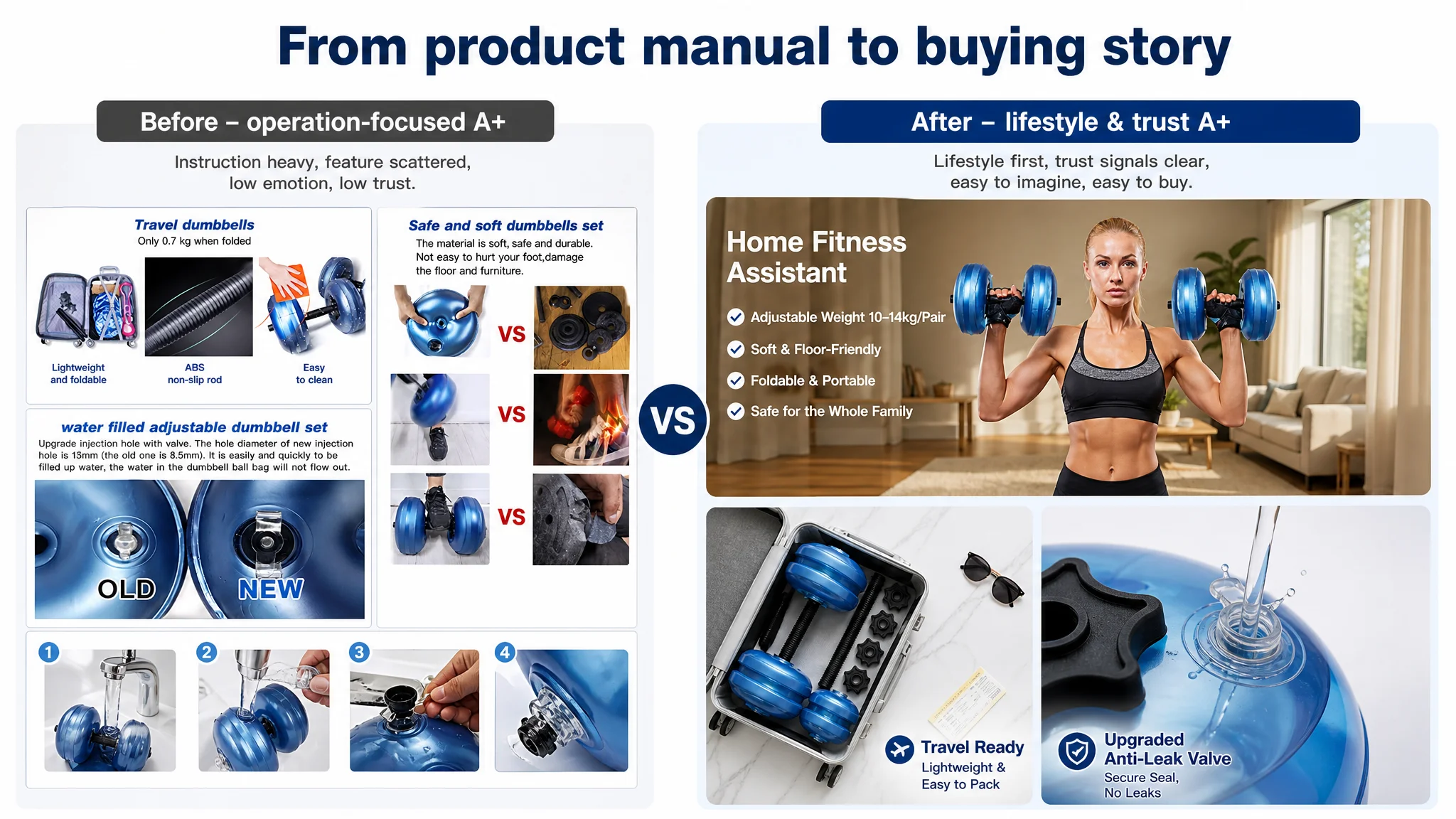
4. A+ Detail Page: Missing Story, Missing Trust
In A+ content:
- The seller mainly used:
- Brand header.
- Core product scene.
- Old vs new structure comparison.
- Several water-filling step images.
- A couple of black/white dumbbell comparison visuals.
- One female user photo.
- The competitor used:
- Brand header with positioning.
- Duo workout scenes.
- Multi-color & multi-weight product lineup.
- Multiple hardware close-ups (transparent window, inlet, handle, folded state).
- Weight marking diagrams.
- Brand story modules and soft trust.
DeepBI highlighted three critical gaps:
1. Scene and emotion.
The seller’s A+ was dominated by operations; competitor A+ made home fitness and “anytime, anywhere” training feel real.
1. Information completeness.
Key purchase drivers—weight range, color options, foldability, safety features—were not clearly visualized on the seller’s page.
1. Commercial maturity.
The competitor brought in:
- Brand trust (years of experience).
- Aggregated reviews and multi-weight / multi-color options.
- Upsell and cross-sell cues.
The seller’s A+ content looked like a product manual. The competitor’s looked like a lifestyle proposition that also answered technical questions.
5. Review and Trust Signals: Volume Without Control
On the review front:
- The seller had more than ten times the total review volume, but:
- A lower average rating (3.5 vs 4.0).
- A much higher negative review ratio (38% vs 6%).
- Homepage reviews dominated by one language, limiting international resonance.
- The competitor:
- Fewer total reviews, but higher average rating.
- More diverse language distribution.
- A first page dominated by 5-star trust signals.
DeepBI saw this as a trust bottleneck: visitors were being primed to expect issues, before even reaching the detail text.
Why DeepBI Did Not Recommend “Keep Tuning the Ads First”
From a business-risk perspective, DeepBI’s judgment was clear:
- Continuing to push ads into this Listing would only increase wasted spend.
- The primary risk was not lack of exposure, but poor conversion and trust-building capacity on the page itself.
The decision logic was:
1. Ads were already delivering traffic.
There was no evidence of catastrophic traffic shortage. The issue manifested further down the funnel.
1. CTR and CVR were constrained by Listing quality.
Main image and title weaknesses suppressed CTR. A+ and reviews suppressed CVR.
1. Every extra euro in ads would be partially burned by the page’s inability to convince.
Fixing bids would not fix:
- Lack of clear max-weight parameters in the title.
- Weak visualization of foldability and travel convenience.
- Poor safety communication for floors and families.
- Trust deficits in reviews.
So DeepBI prioritized:
- Listing conversion repair first, then aggressive ad scaling.
- Protecting the seller’s budget from being used to “pay to show flaws.”
How the Optimization Focus Shifted: From Campaign Slider to Page Logic
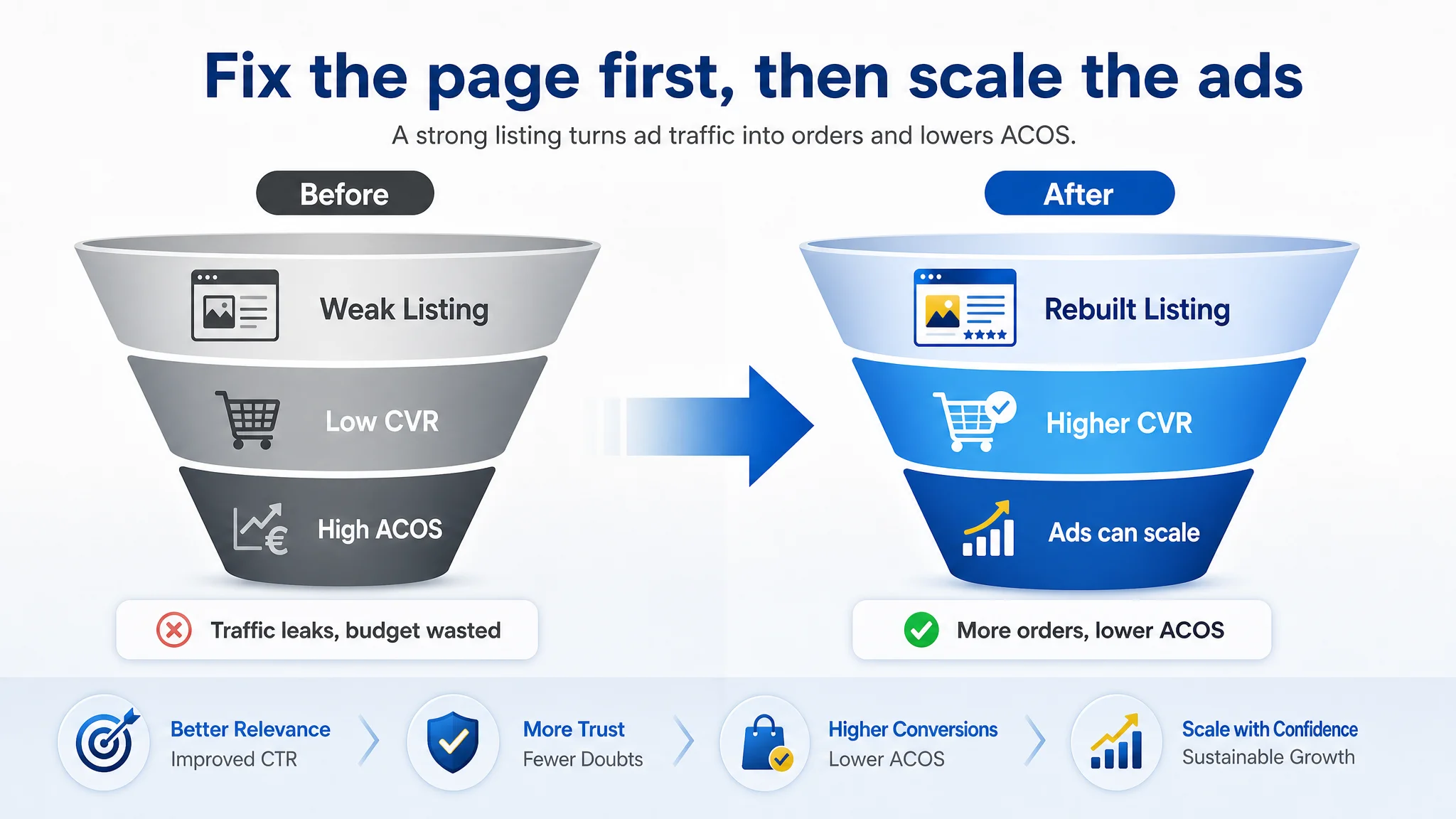
Once the core constraint was identified, the optimization path changed from “campaign tuning” to “page reconstruction.” The guiding principle was:
Before ads can work again, the page has to convert.
1. Title: From Tag List to Structured Decision Statement
DeepBI recommended a title structure like:
“Wasser Hanteln Set Befüllbar, 10–14kg Justierbare Reise Hanteln, Tragbare Gewichtstaschen für Krafttraining & Fitness, Wassergewichte für Männer und Frauen, Home-Gym Formgebung Training”
Key shifts:
- Introduced concrete weight ranges to align with category norms and buyer expectations.
- Reduced mechanical repetition of “Hanteln”, replacing it with “Wasser Hanteln Set” and synonyms like “Gewichtstaschen.”
- Strengthened use-case descriptors: travel, home gym, shaping.
The goal was to match the benchmark’s logic while staying truthful to the product’s real parameters.
2. Bullet Points: Building a Clear “Pain → Solution → Scenario” Logic
Each bullet was reoriented to anchor a decision:
- BP1 – Space-saving & ultralight alternative.
Highlighting:
- Foldable, water-filled dumbbells as a replacement for bulky iron weights.
- Own weight of just 0.6 kg for travel readiness.
- Usage scenarios: vacation, business trips, garden, gym.
- BP2 – Individually adjustable weight.
Clarifying:
- Each ball can be adjusted up to 2 kg through water volume.
- Customized intensity per exercise and muscle group.
- BP3 – Maximum safety & protection.
Emphasizing:
- Soft, water-filled design with strong damping.
- Protection for floors and bodies in case of accidental drops.
- Suitability for yoga, seniors, and families with children.
- BP4 – High-quality, break-resistant material.
Translating “high quality” into:
- Odorless ABS.
- Long-term shape stability.
- Anti-break, anti-leak promise under intensive use.
- BP5 – Versatile fitness tool for all.
Broadening:
- For beginners to advanced users, men and women.
- For strength, yoga, gentle fitness, and even rehabilitation scenarios.
Instead of just listing features, the bullets now formed a narrative: why this product fits limited spaces, travel-heavy lifestyles, safety-conscious homes, and different fitness levels.
Main Image System: From Cheap Cutout to Modern Home-Fitness Story
DeepBI did not stop at “make the pictures nicer.” The new main-image plan aligned each slot with a specific conversion function.
Primary image: Product as the hero
- Product centered, ~70% of the frame.
- 45-degree top-side angle with soft white fill light.
- Light grey, modern home gym background.
- Water droplets on the surface to suggest use and waterproof quality.
- Slightly blurred male figure training in the mid-background to inject context without distracting from the product.
This image targets CTR: clear, modern, and trustworthy at thumbnail size.
Secondary image: Real home scene with a user
- Female user holding the dumbbells in a bright living room.
- Natural window light, warm tones, clean decor.
- Overlay text like “Home Fitness Assistant.”
This connects the product with a comfortable, everyday home fitness lifestyle.
Travel-focused image: Portable and foldable proof
- Flat lay composition with a folded dumbbell placed in a silver suitcase corner.
- Product taking only ~20% of the suitcase area.
- Accessories like sunglasses and a boarding pass to cue travel.
This directly visualizes the “pack it, travel with it” promise that water dumbbells are supposed to fulfill.
Safety comparison image: Floor protection made visible
- Split frame: water dumbbells vs rusty iron dumbbells.
- Simple green check vs red cross icons.
- Clean light wood floor, caption like “Floor Protection.”
This addresses the core fear: damaged floors and injuries from heavy metal weights.
Technical detail image: Anti-leak valve macro
- 60% of frame devoted to the water inlet.
- 30-degree macro angle capturing the seal ring and water flow.
- Clean, white background.
This builds technical trust: the product looks engineered, not improvised.
A+ Content: Six Modules to Restore Buying Confidence
DeepBI restructured A+ around six logical modules:
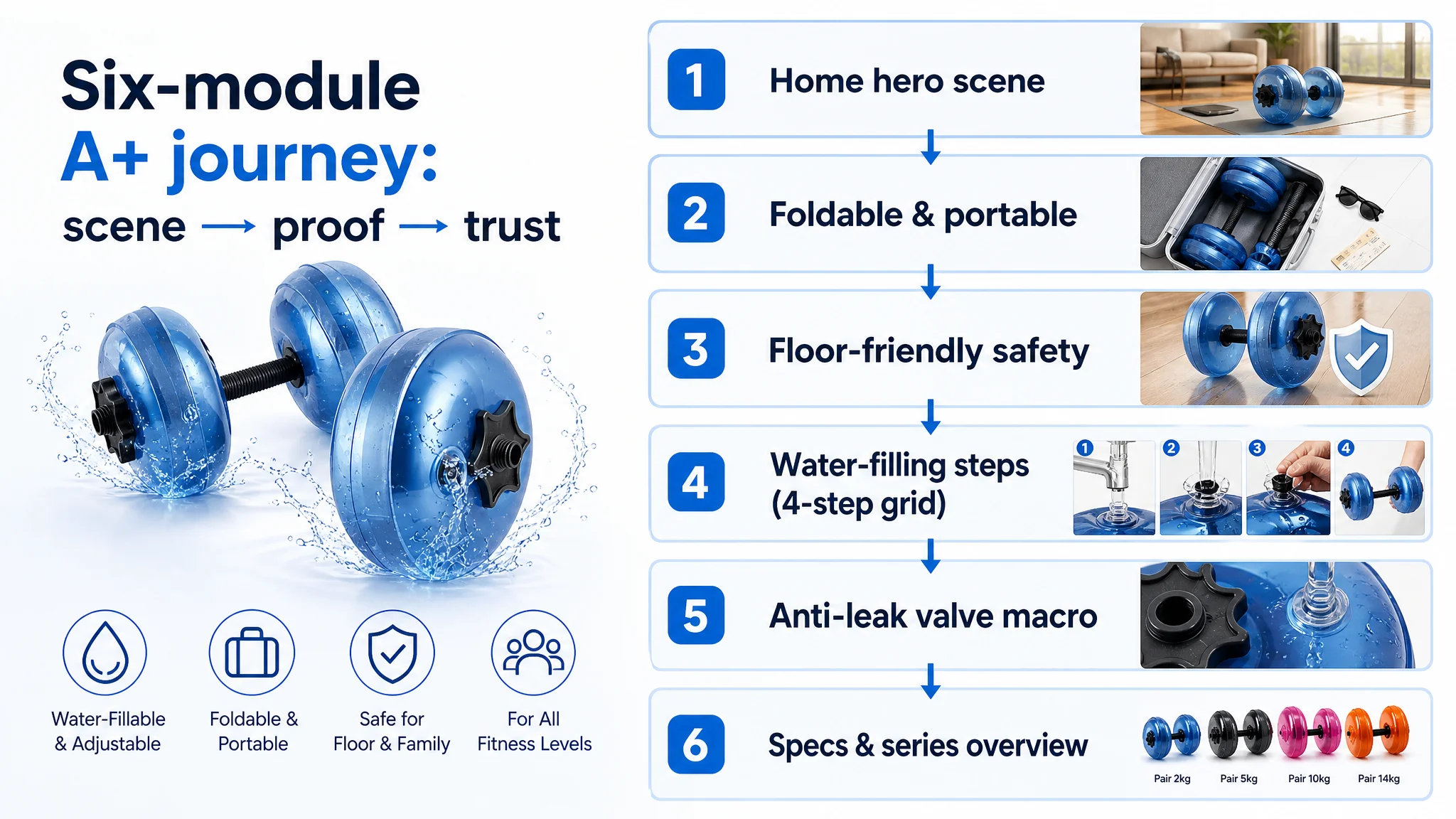
1. Opening scene: Interactive home strength training.
- Wide hero banner: woman training with blue water dumbbells in a bright living room.
- Clean typography: “Interactive Strength Training at Home.”
1. Core selling point: Foldable & portable.
- Before/after visuals: full water vs folded-flat.
- Suitcase scene showing actual space saved.
1. Pain point solution: Floor-friendly & safe.
- Image of the dumbbell falling onto a light-colored tile floor.
- Central overlay text like “Floor-Friendly & Safe.”
1. Professionalized water-filling process.
- 2x2 grid showing four steps:
1. Align with faucet.
2. Water flow filling.
3. Valve operation close-up.
4. Finished product being carried.
1. Core technical advantage: Upgraded anti-leak valve.
- Macro shot with caption “Upgraded Anti-Leak Valve.”
1. Trust & choice module: Specs and series overview.
- Family shot of multiple colors (blue, pink, black, orange).
- Weight ranges indicated per pair (e.g., 2 kg / 5 kg / 10 kg).
- Brand logo and slogan to close with a professional tone.
Taken together, these modules turn the page from a manual into a conversion-driven story: why water dumbbells, why this specific product, why now.
How Ad Traffic Became Useful Again
After the Listing was reframed, the seller’s advertising problem looked different:
- Ad campaigns now had a clearer “destination.”
Clicks landed on a page that:
- Explained weight capacity up front.
- Visually proved portability, safety, and foldability.
- Reduced uncertainty about materials and durability.
- Used a more inclusive, aspirational tone.
- CTR had a foundation.
The main image and title became more competitive in the search-results environment, reducing the need to rely purely on aggressive bids to win impressions.
- CVR could begin to recover.
While the review score remained a medium-term challenge (3.5 stars do not disappear overnight), buyers now encountered more professional visuals and clearer value articulation before making a decision.
This did not instantly transform the product into a bestseller; DeepBI did not invent data or overnight miracles. But the risk profile changed:
- Ads were no longer pushing traffic into an under-explained, visually weak page.
- The Listing began to regain organic conversion capacity, rather than depending solely on paid traffic.
- The seller gained a more controllable traffic structure: they could scale ads knowing that the page was at least structurally sound.
What This Case Changes in the Seller’s Understanding
By the end of this process, the seller team’s mental model shifted in several ways:
- Ads and Listing are not separate problems.
High ACOS on Amazon is often a symptom of page-level conversion issues, not just bid or keyword issues.
- Listing quality is the foundation of ad efficiency.
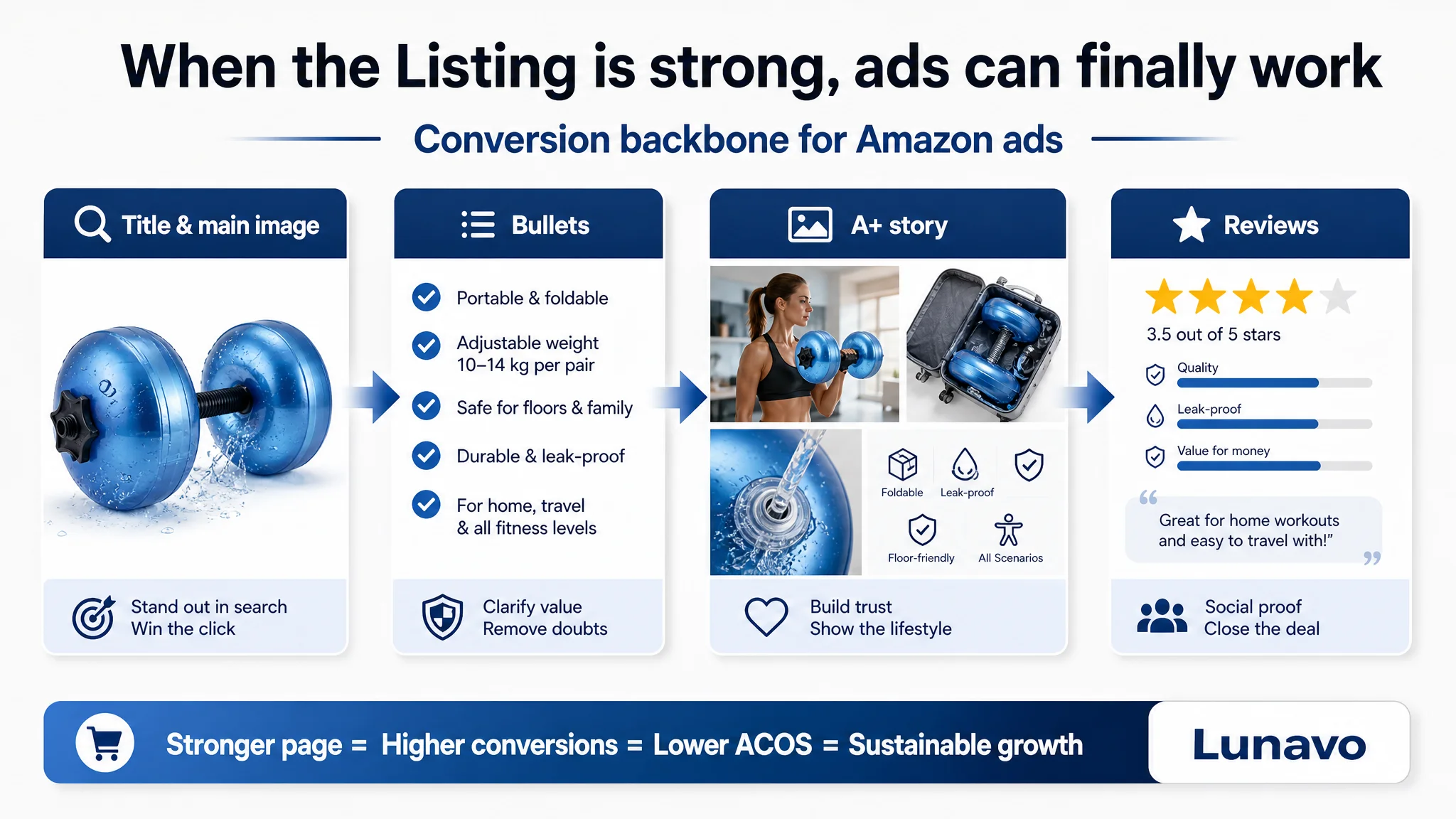
Title, main image, bullets, and A+ must work as a logical sequence:
- Attract the click.
- Clarify the value.
- Remove doubts.
- Build trust.
- Traffic should not be scaled unless the page deserves it.
The team now evaluates:
- Does our main image stand up against benchmark competitors?
- Is our title structured around clear parameters and outcomes?
- Are our bullets and A+ telling a coherent, buyer-focused story?
- Are reviews under control, or do we need to address product/service issues?
In other words, DeepBI’s value in this case was not about listing features or pushing another tool. It was about improving business judgment:
- Seeing that the real bottleneck was page conversion, not ad set-up.
- Understanding that advertising can amplify defects as easily as it amplifies strengths.
- Prioritizing Listing repair before pouring more budget into campaigns.
For Amazon sellers facing similar pressures—rising ad costs, flat orders, and a vague sense that “our ads just don’t work anymore”—this case offers a simple but demanding question:
Is the problem really in your campaigns, or is your Amazon product page quietly consuming the traffic you’re already paying for?