

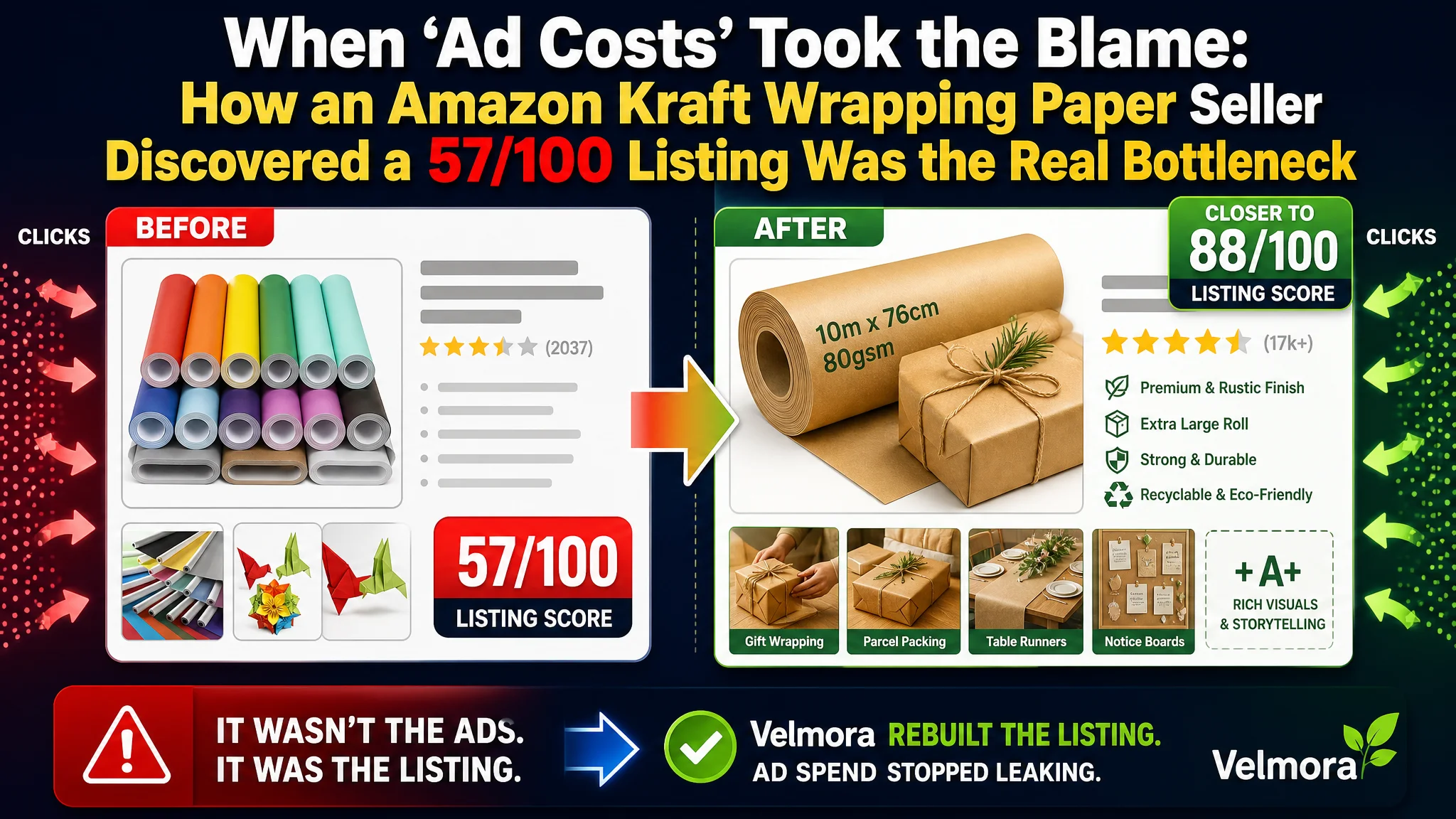
An Amazon UK seller in the kraft wrapping paper category came to DeepBI with a familiar story: ad costs felt harder to control, ACOS was stubborn, and the team suspected that “ads weren’t optimized enough” or that “we just need more reviews.” Yet the data from DeepBI’s Listing scoring told a different story—this was not primarily an advertising problem, but a product-page conversion problem.
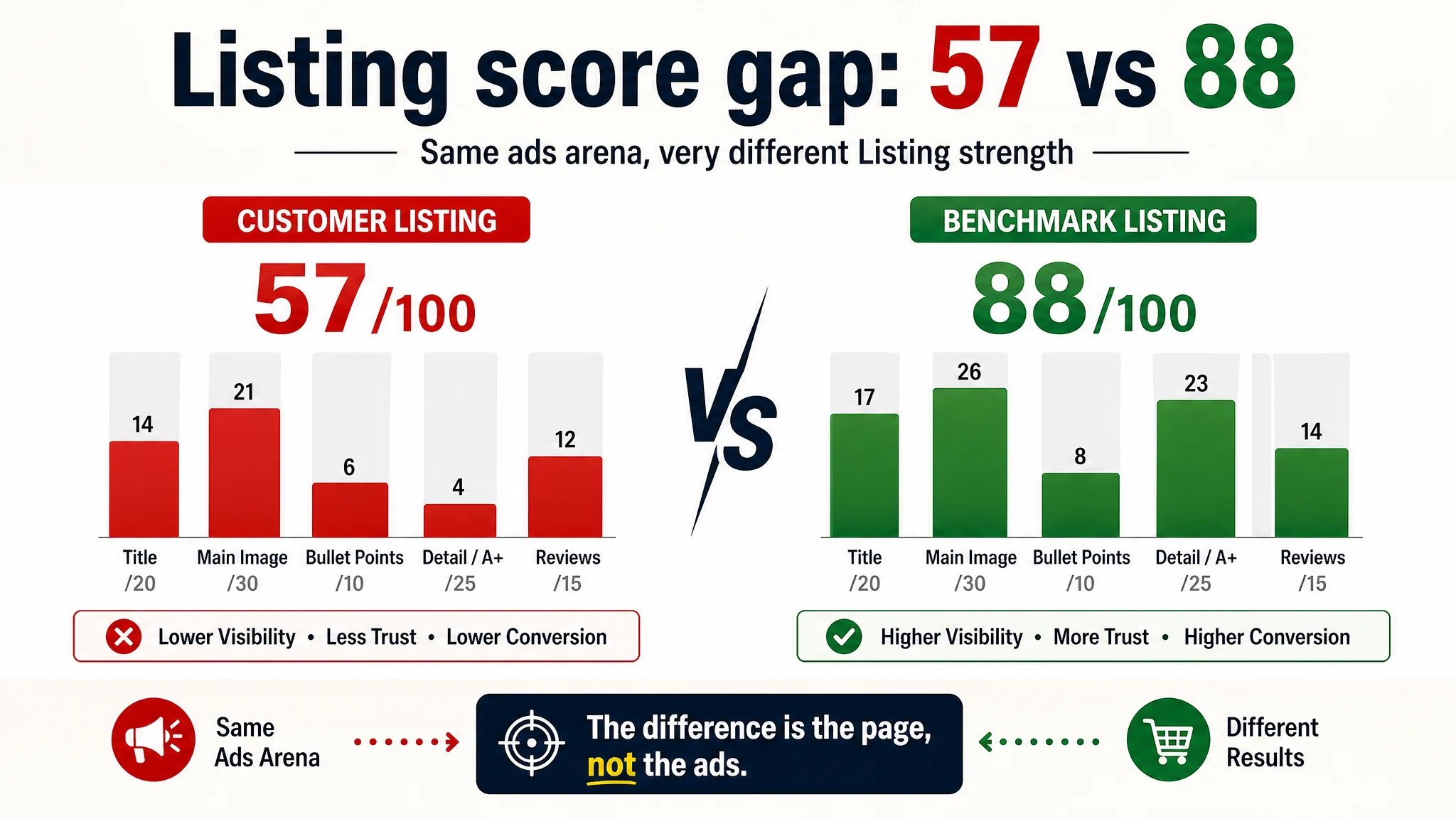
In the same category, a benchmark competitor’s Amazon Listing scored 88/100, while this seller’s Listing scored just 57/100. The largest gap—19 points—came from the detail page (A+ content), supported by visible weaknesses in titles, main images, bullet points, and trust signals. The seller had been turning the ad dials on a page that was structurally weaker than the category leader.
DeepBI reframed the problem: stop treating ads as the main lever, and first restore the Listing’s conversion capacity—starting with main-image logic, title structure, bullet-point persuasion, and A+ storytelling around multi-use, gifting, and eco-conscious value. Only once the page could convincingly convert traffic did it make sense to push more spend. For other Amazon sellers, this case is a reminder: when ACOS feels “unmanageable,” the real constraint may be the page, not the campaign.
Amazon Ads Were Not Failing. The Page Was Consuming the Traffic.
When this Amazon seller looked at their UK kraft wrapping paper Listing, the immediate pressure came from rising advertising costs and a sense that “our ads aren’t pulling their weight.”
Clicks were coming in, but:
- Orders were not growing in proportion to traffic.
- The ad team was under pressure to “keep testing keywords and bids.”
- Internally, the explanation had settled on “our creatives just aren’t attractive enough” and “we need more ratings like the top competitor.”
DeepBI’s first step was not to rework the campaigns, but to measure the Listing against its closest benchmark in the same Amazon category.
The result was a hard reset of the narrative:
- Customer Listing total score: 57/100
- Benchmark Listing total score: 88/100
- Gap: -31 points
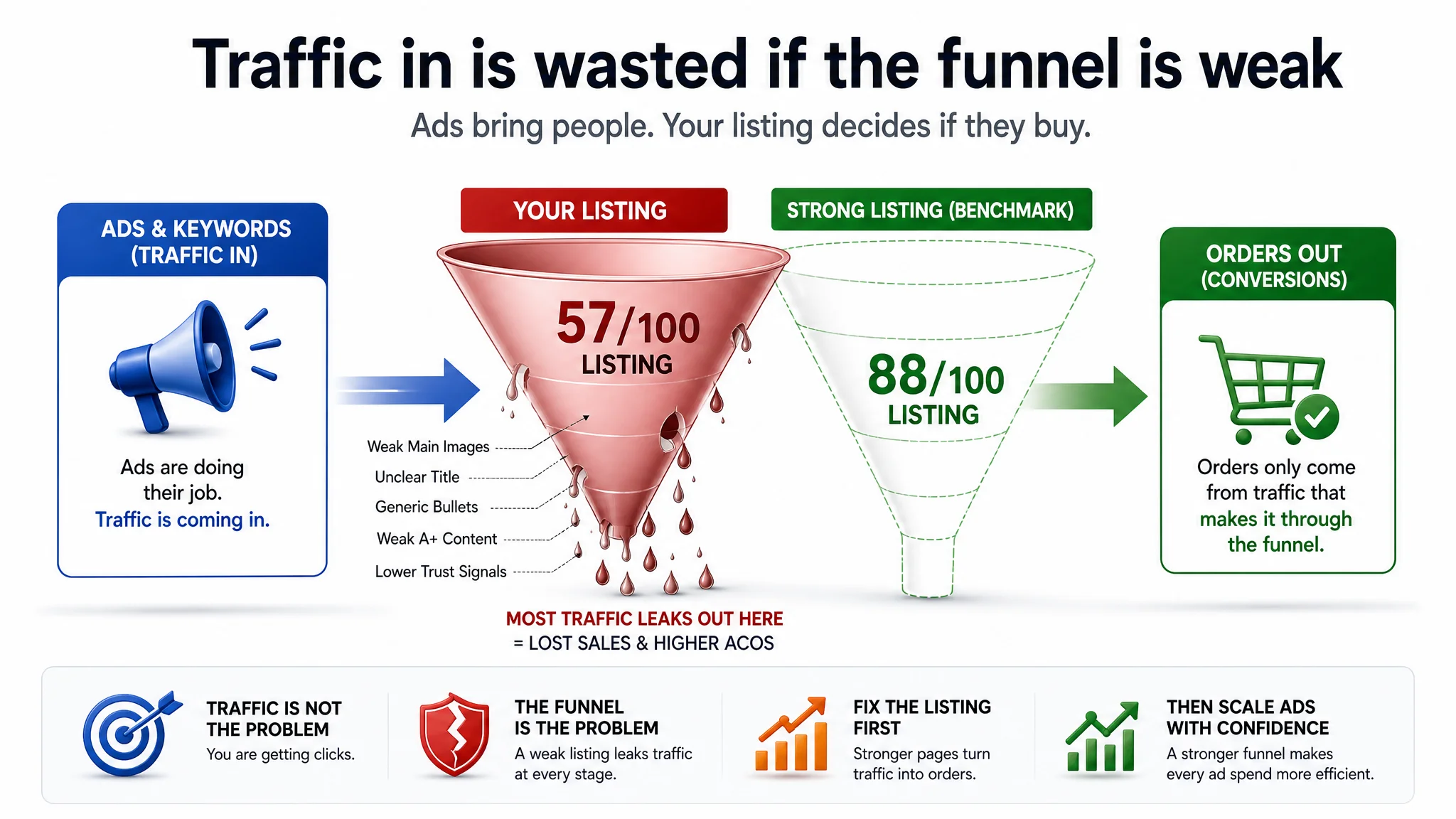
“The real problem was not that ads failed to bring traffic. It was that the page could not convert the traffic.”
Once the seller saw this 31-point gap, it became clear that no amount of incremental keyword tuning could compensate for a structurally weaker Listing.
The Real Constraint Was Listing Conversion Capacity
The scoring breakdown made the constraint explicit:
- Title: Customer: 14, Benchmark: 17, Full Score: 20, Gap: -3
- Main Image: Customer: 21, Benchmark: 26, Full Score: 30, Gap: -5
- Bullet Points: Customer: 6, Benchmark: 8, Full Score: 10, Gap: -2
- Detail / A+: Customer: 4, Benchmark: 23, Full Score: 25, Gap: -19
- Reviews: Customer: 12, Benchmark: 14, Full Score: 15, Gap: -2
Two things stood out:
- The detail page/A+ deficit (-19) was massive.
- The main-image and title gaps were not catastrophic in absolute numbers, but they were enough to erode CTR and trust when combined.
This meant:
- The Listing could attract some clicks, but failed to complete the persuasion path.
- Ads were effectively feeding an underdeveloped product page, turning each click into a higher-risk spend.
In other words, the store was trying to scale traffic into a funnel that was structurally weaker than the category’s benchmark.
What the Seller Originally Misdiagnosed
Before DeepBI’s diagnosis, the seller’s working assumptions looked like this:
- Primary belief: “Our ACOS is high because ads aren’t optimized enough.”
- Secondary belief: “We’re losing because we don’t have as many reviews as the top competitor; let’s wait for more reviews to accumulate.”
- Operational focus:
- Adjust keyword lists and bids.
- Test different ad formats.
- Consider minor tweaks to titles and images based on intuition.
This led to classic misalignment:
- Ad-side obsession: Weekly discussions around CPC, budgets, and search terms.
- Page-side neglect: The product page remained largely static—no A+ images, repetitive text, and a narrow origami-focused narrative that did not match real search intent.
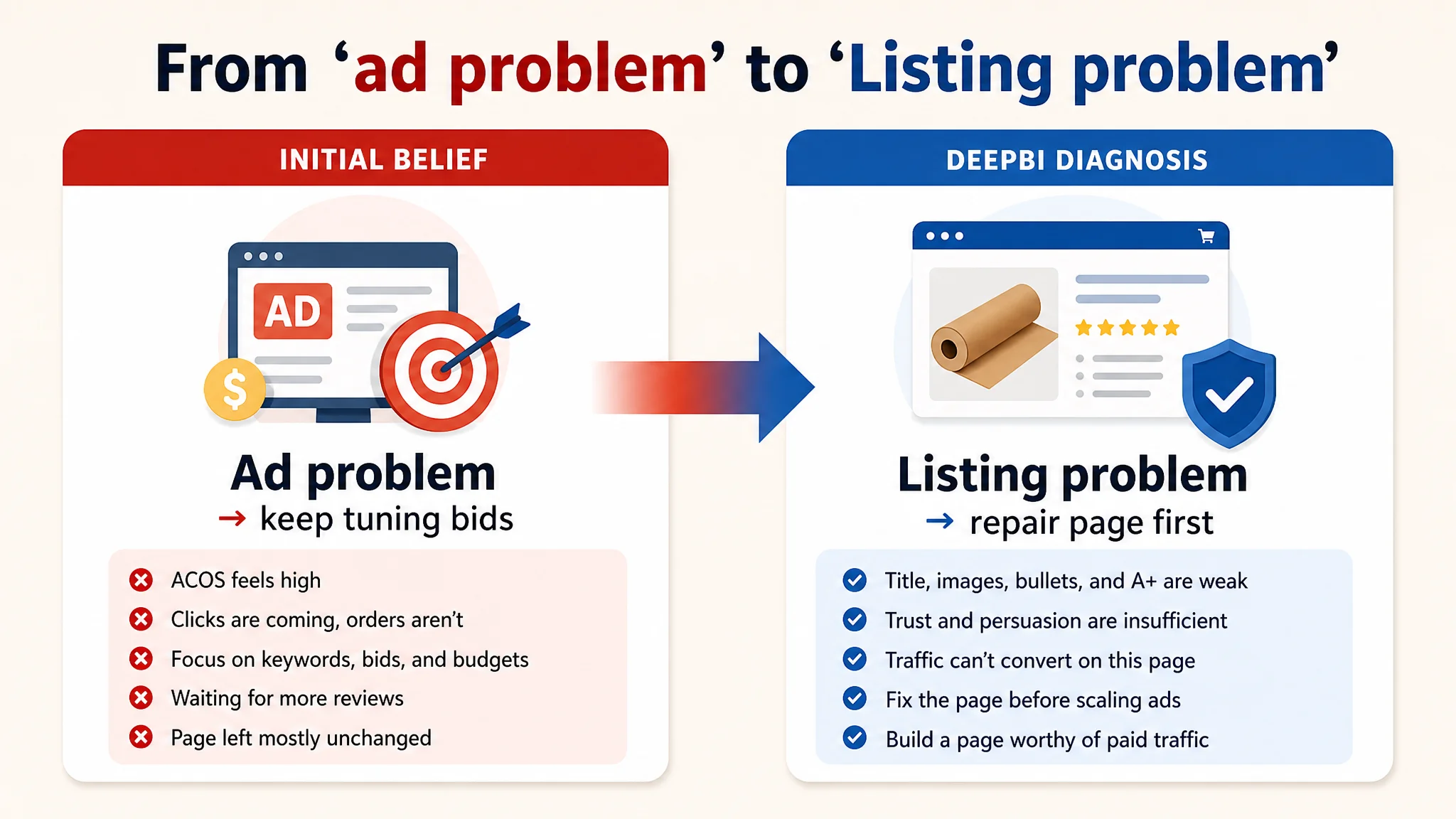
DeepBI’s scoring shifted the conversation from “we need better ads” to “our page is not yet worthy of the traffic we’re buying.”
This Product Page Did Not Lack Traffic. It Lacked Trust.
Title: Functional, but Not Yet a Decision Driver
The original title had some strengths:
- Core keyword “Wrapping Paper Roll” was positioned early.
- The “10m x 76cm” dimension and “80gsm” weight were present.
- Multiple uses were listed: arts, crafts, schools, painting, notice boards, display backing.
But in direct Amazon context:
- No brand term at the front, unlike the benchmark, which started with its brand name—reinforcing trust and brand search weight.
- No strong emotional or outcome hook—the benchmark title explicitly promised a “Premium & Rustic Finish,” while this title remained at the “80gsm, multi-purpose use” level.
- Overextended use list: eight different use cases stretched the structure and diluted keyword density.
The benchmark title, on the other hand, compressed:
- Brand + product type
- Clear dimensions
- Flexible roll-size choice
- “Recyclable” and “Premium & Rustic Finish”
- Concise coverage of high-value use cases (gift wrapping, parcel packing, arts & craft)
This meant the benchmark was not just keyword-rich—it was decision-oriented, while the customer’s title remained mostly descriptive.
Main Images: Stock Piles Instead of Use-Cases
The main-image sequence was the second structural weakness.
Across the first three images:
- The Listing showed repetitive bulk stock views—multiple rolls of brown paper, similar colors, similar compositions.
- No image anchored a clear first-frame promise such as:
- How it looks when wrapping a gift
- How large surfaces can be covered
- How thickness and quality are perceived in use
On the search results page:
- These images looked like raw stock, not solutions.
- There were no text callouts for size, gsm, or core benefits.
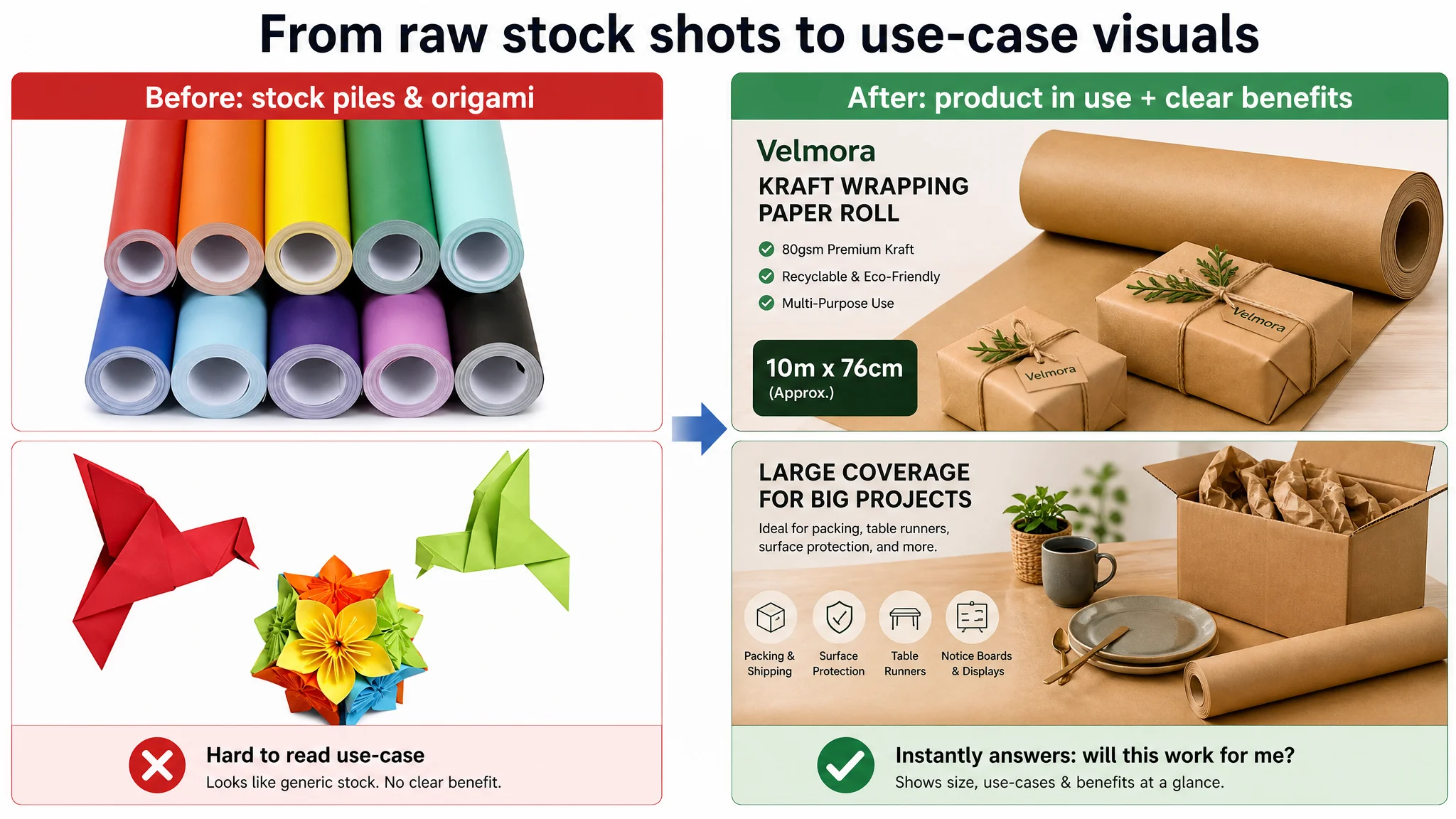
The benchmark competitor did the opposite:
- Used “product + key application” thumbnails.
- Highlighted “ECO FRIENDLY” and “PREMIUM QUALITY” within images.
- Showed clear multi-use scenarios: gift wrapping, surface protection, table runners, notice boards.
Result:
- The customer’s images blended into the category, dragging down CTR.
- Even visitors who clicked had no visual confirmation that this roll was suitable for their specific concern (large gifts, table runners, surface protection, etc.).
The Bullet Points Had Information, but Not a Buying Logic
The original bullet points were structured around:
- Multi-purpose use
- Dimensions and size
- Material characteristics
- Repeated scene lists (schools, offices, homes)
- General statements like “strong & practical”
What they missed was a coherent persuasion path.
The benchmark’s bullet logic was closer to a narrative:
1. Premium rustic finish → emotional and visual hook.
2. Versatile use → specific high-value scenarios.
3. Easy handling → operational experience (clean fold lines, no tearing).
4. Durable & lightweight (with gsm) → quantified strength and usability.
5. Eco-conscious, recyclable → value alignment and trust.
DeepBI’s comparison highlighted three key issues in the customer’s bullets:
- No emotional entry: The page opened with functional listing instead of a “look and feel” angle (e.g., rustic finish, professional presentation).
- Lack of quantified reassurance: While the competitor cited 90 gsm, “no tearing,” and “clean fold lines,” the customer remained at “strong & practical” without measurement.
- No clear eco-conscious framing: In a category where recycled and recyclable claims anchor trust, the Listing did not fully leverage kraft paper’s natural eco associations.
The new bullet suggestions focused on:
- Leading with “PREMIUM RUSTIC FINISH & VERSATILITY” instead of a flat functional opener.
- Explicitly tying 10m x 76cm to “EXTRA LARGE ROLL FOR MULTIPLE USES,” reinforcing the value for large-format projects.
- Introducing “EASY HANDLING & CRISP FOLDING” to answer fears about tearing and poor folds.
- Translating “strong” into a more precise “STRONG, PRACTICAL & DURABLE” story—strong enough for parcels, flexible enough for delicate creative work.
- Summarizing with an “ECO-CONSCIOUS & CREATIVE SOLUTION”, closing with plastic-free, recyclable positioning relevant to schools and institutions.
“The bullet points had information, but not a buying logic.”
Once reformulated, the bullets became a structured path from appearance → use → experience → durability → values.
A+ Content: The 19-Point Trust Gap
The most decisive gap was in the detail/A+ dimension:
- Customer Listing: 4/25
- Benchmark Listing: 23/25
- Gap: -19
In practice, this meant:
- The customer’s A+ section was effectively empty of images, relying on repeated text.
- The same claim (e.g., “Recyclable”) appeared multiple times as text, but without any visual proof or context.
- There was no modular narrative—no separation into key usage scenarios, eco story, or brand story.
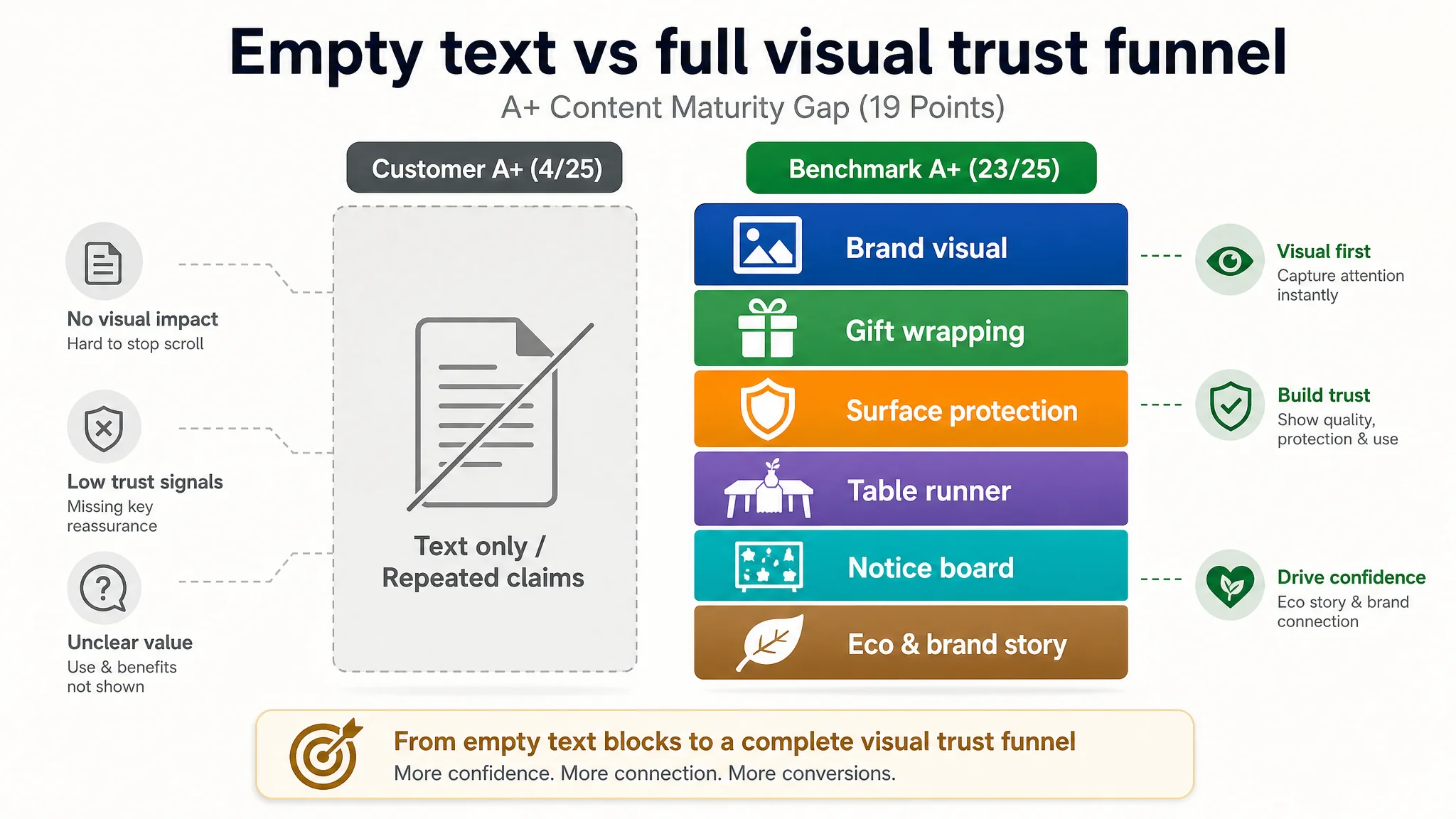
The benchmark’s A+ content, by contrast, was a full trust funnel:
- Brand main visual with clear logo and identity.
- Multiple modules, each with a single focus, such as:
- Gift wrapping
- Surface protection
- Table runner
- Notice board
- “Premium & Eco Values”
- Real product shots, situational setups, and associated product lines.
- Visible emphasis on:
- Being a UK manufacturer
- Large review base (17k+ reviews)
- “Zero Waste” and eco values
This detail-page maturity difference was not cosmetic; it defined whether a visitor could complete the decision:
- “Does this look premium enough for gifting?”
- “Will it actually protect surfaces during painting?”
- “Is this brand serious, or is this just anonymous stock?”
With only text and no visual hierarchy, the customer’s page lost high-intent visitors exactly where the benchmark closed them.
Why DeepBI Did Not Keep Tuning the Ads First
From a business-risk perspective, DeepBI framed the situation plainly:
- Scaling ads on a 57/100 Listing was equivalent to buying more expensive clicks into a weak funnel.
- The biggest controllable lever was not bid level; it was conversion capacity.
The decision order became:
1. Stop assuming ads are the core issue. ACOS pressure in this context was a downstream symptom.
2. Prioritize Listing repair:
- Title logic
- Main-image sequence
- Bullet-point narrative
- A+ visuals and trust anchors
1. Only then re-evaluate ad structure and budgets once the page could reasonably convert.
“Advertising does not only amplify advantages. It can also amplify a page’s existing defects.”
By choosing not to treat ads as the first line of optimization, the team reduced the risk of paying to amplify a low-conversion experience.
How the Page’s Sales Logic Started to Recover
DeepBI’s recommendations did not focus on cosmetic change, but on rebuilding a coherent Amazon product-page logic.
1. Main Images: From Raw Stock to “Product + Scenario”
Each main-image slot was redefined by role:
- Image 1:
- Before: Piled rolls, no context.
- After direction: “Product + key application”—e.g., a partially wrapped gift with visible kraft texture, plus size and gsm text callouts.
- Image 2:
- Before: Another bulk view.
- After direction: Visualize multi-scenario use—gift wrapping, arts & crafts, school projects—on one structured collage.
- Image 3:
- Before: Repetitive stock view again.
- After direction: Emphasize scale and coverage—large notice boards, wall displays, table runners, confirming suitability for large projects.
- Image 4:
- Before: Narrow niche origami example.
- After direction: Demonstrate rational trust—slicing, folding, taping, clean folds, no tearing.
- Image 5:
- Before: Another origami shot with redundant message.
- After direction: Address protective and heavy-duty use—packing, void fill, surface protection, handling messy activities.
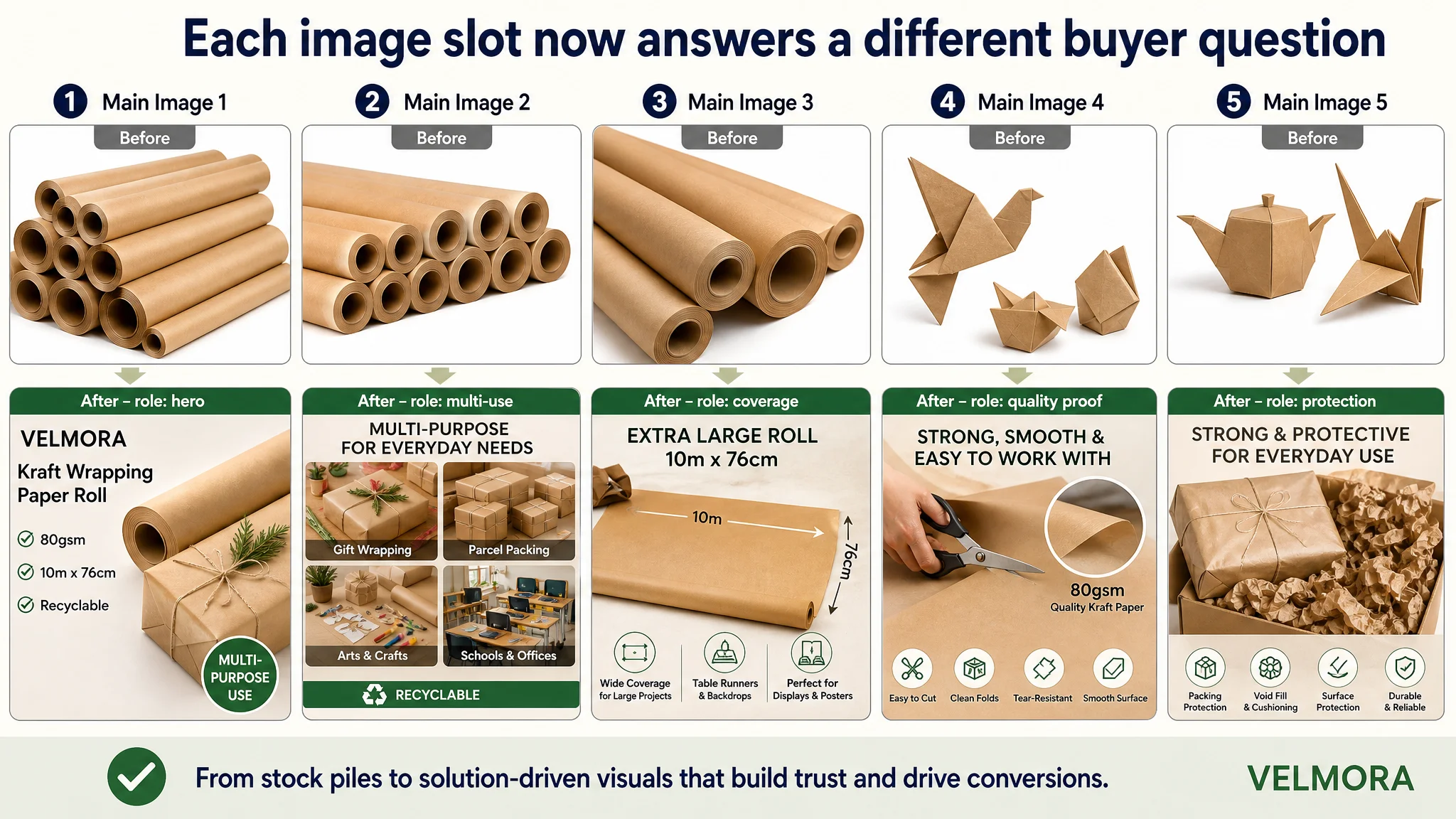
This turned the image set into a progressive answer to buyer doubts, instead of a sequence of near-duplicates.
2. Title: From Long Descriptions to Structured Signals
The suggested title:
Kraft Wrapping Paper Roll 80gsm 10m x 76cm - Recyclable Brown Paper for Arts, Crafts, Gift Wrapping, Parcel Packing, Schools, Painting and Notice Boards - Large Display and Backing Paper
Key shifts:
- Core keyword and material (“Kraft Wrapping Paper Roll”) and gsm moved to the front.
- Recyclable inserted early to tap into eco-conscious search behavior.
- Use cases were prioritized and compressed around high-value intents:
- Arts & crafts
- Gift wrapping
- Parcel packing
- Schools/painting/notice boards
- Dimensions were standardized in a familiar Amazon format.
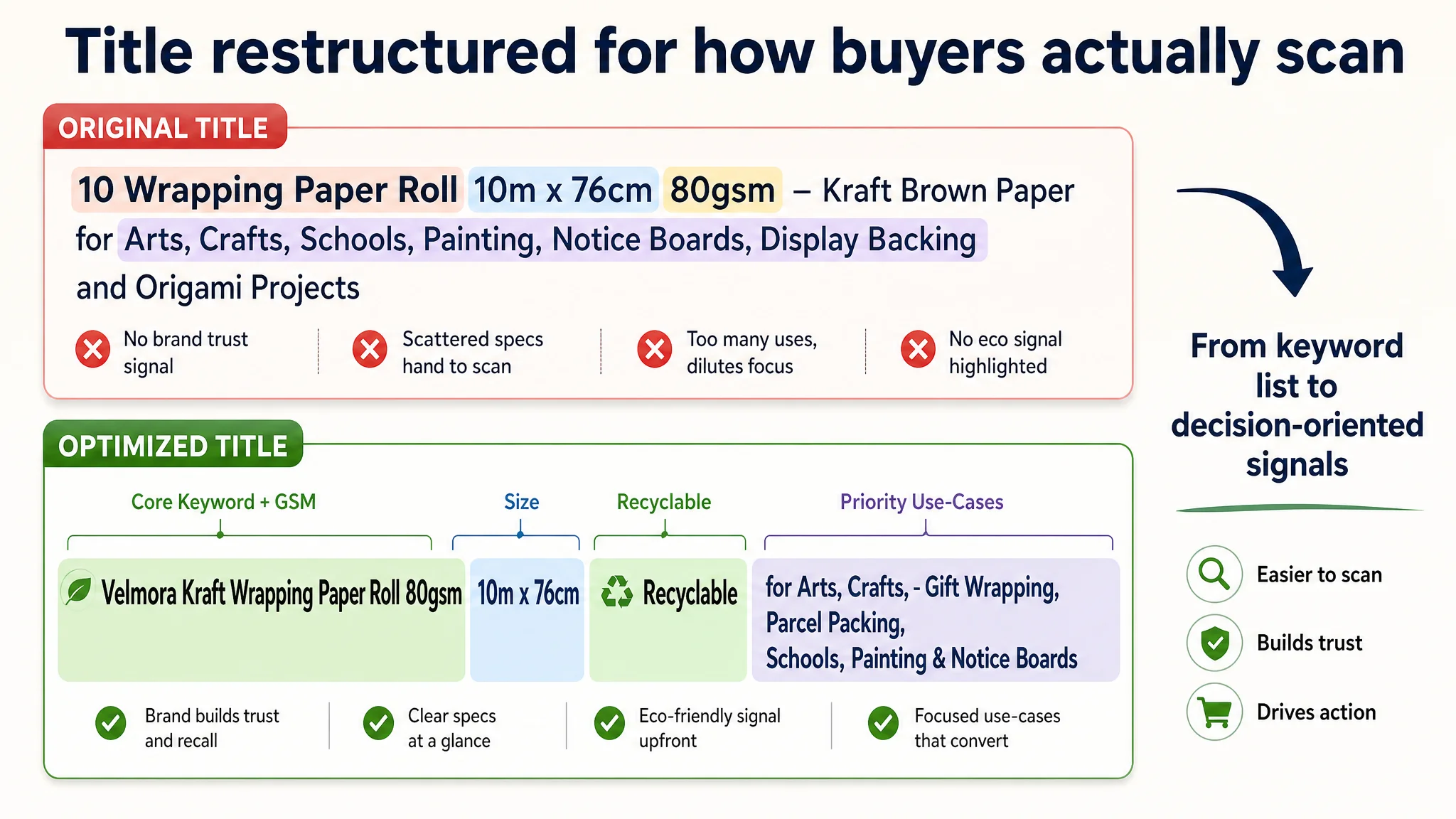
The goal wasn’t just clarity; it was alignment with how buyers actually search and decide.
3. Bullet Points: From Listing Uses to Structured Persuasion
Each bullet became a mini-argument:
1. PREMIUM RUSTIC FINISH & VERSATILITY
- Elevates perceived quality for gifting and displays.
1. EXTRA LARGE ROLL FOR MULTIPLE USES
- Links 10m x 76cm to real-world tasks like table runners and large backing boards.
1. EASY HANDLING & CRISP FOLDING
- Addresses folding, cutting, and anti-tear concerns.
1. STRONG, PRACTICAL & DURABLE
- Balances strength (parcel packing) with flexibility (sketching and art).
1. ECO-CONSCIOUS & CREATIVE SOLUTION
- Positions the product as a plastic-free, recyclable choice for schools, colleges, and events.
Together, they transformed the bullet section into a coherent decision path.
4. Detail / A+ Content: Building a Visual Trust Chain
The A+ rebuild focused on six concrete modules:
- Module 1:
Show high-resolution close-ups of paper texture and flexibility, proving professional gifting appearance.
- Module 2:
Demonstrate parcel versatility—different box shapes and sizes fully wrapped.
- Module 3:
Visual stress tests for durability and surface protection—painting, crafts, messy activities labeled as “Surface Protection.”
- Module 4:
Show social and event use—full table setups as casual table runners, expanding beyond purely utilitarian framing.
- Module 6:
Summarize core rational and ethical benefits:
- Premium texture
- Eco-friendly positioning (where data supports)
- Suitable for educational institutions
- Module 7:
Introduce a clear, professional brand logo and basic brand presence to anchor trust.
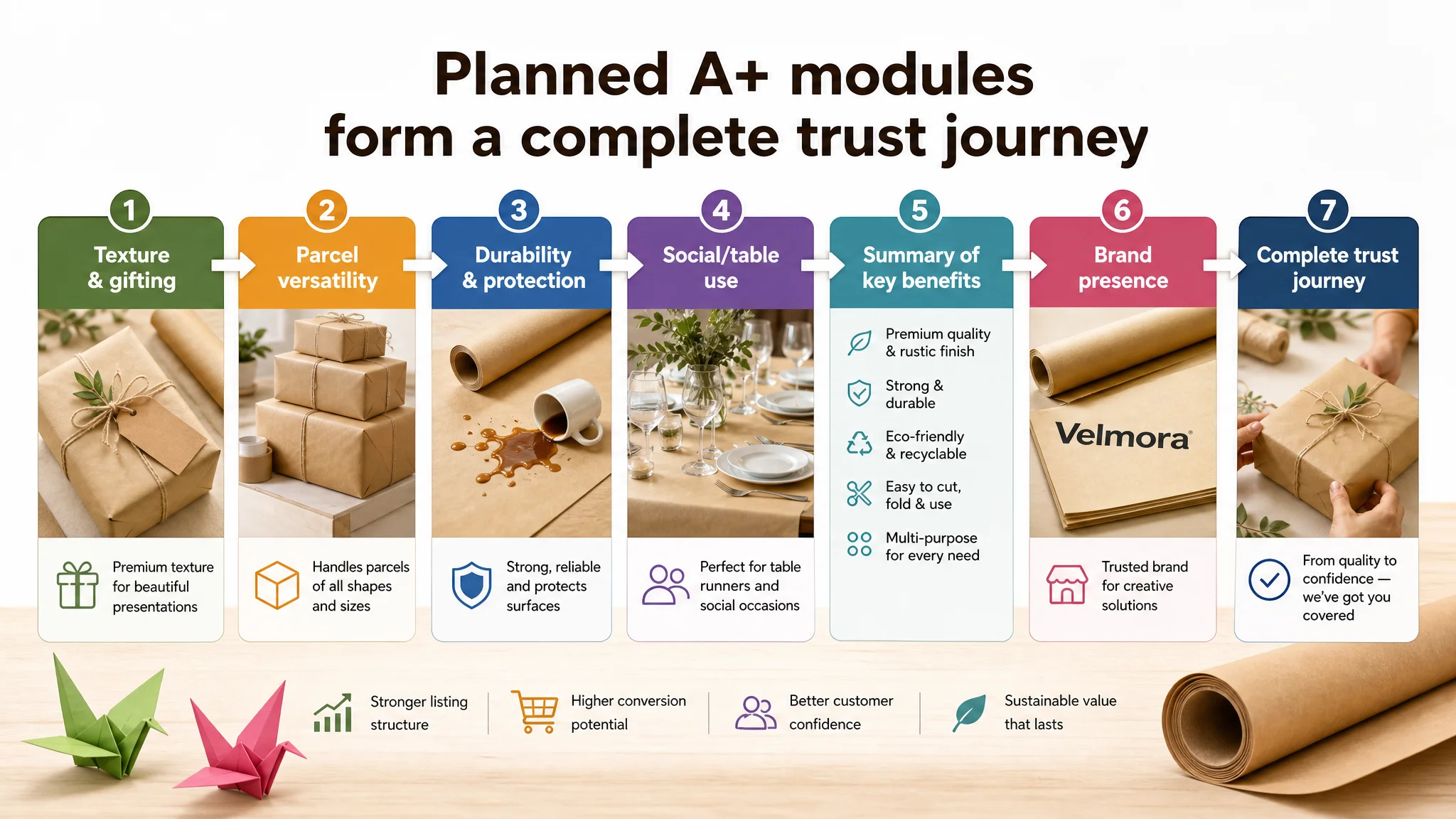
This turned a text-heavy A+ into a modular story, aligned with how buyers scan on Amazon.
How Ad Traffic Became Useful Again
Once the Listing’s structure shifted from:
- Repetitive stock visuals
- Functional-only bullets
- Text-only A+
to:
- Scenario-led images
- A persuasive bullet path
- A confidence-building A+ narrative
the character of ad traffic changed.
Even without inventing post-optimization performance numbers, several operational changes were clear:
- Each click carried less risk because visitors now had enough visual and textual information to complete a decision.
- The Listing regained organic conversion capability—not just for paid clicks, but also for organic visitors arriving via category browsing or non-branded searches.
- The seller’s dependence on “just push more traffic” shrank; the page itself began to do more heavy lifting.
Practically, this allowed the team to:
- Revisit ad spend with more confidence that ACOS movements reflected ad quality, not hidden page inefficiencies.
- Consider more balanced traffic structures, instead of compensating for a weak page with heavier ad budgets.
How the Seller’s Understanding Changed
Through this process, the seller made several durable shifts in judgment:
1. Ads are not the default culprit.
High ACOS and weak order growth can originate in the Listing, even when ad accounts look structurally “fine.”
1. Listing quality is the foundation of ad efficiency.
CTR and CVR are mutually dependent on:
- Title clarity and structure
- Main-image logic (product + scenario, not just product)
- Bullet-point persuasion flow
- A+ visual storytelling and trust anchors
1. Advertising amplifies whatever already exists on the page.
If the page lacks trust, ads amplify that distrust; if the page builds trust, ads amplify that strength.
1. Before scaling ads, judge whether the page deserves more traffic.
A Listing at 57/100 vs. a competitor at 88/100 is not yet structurally ready for aggressive ad scaling.
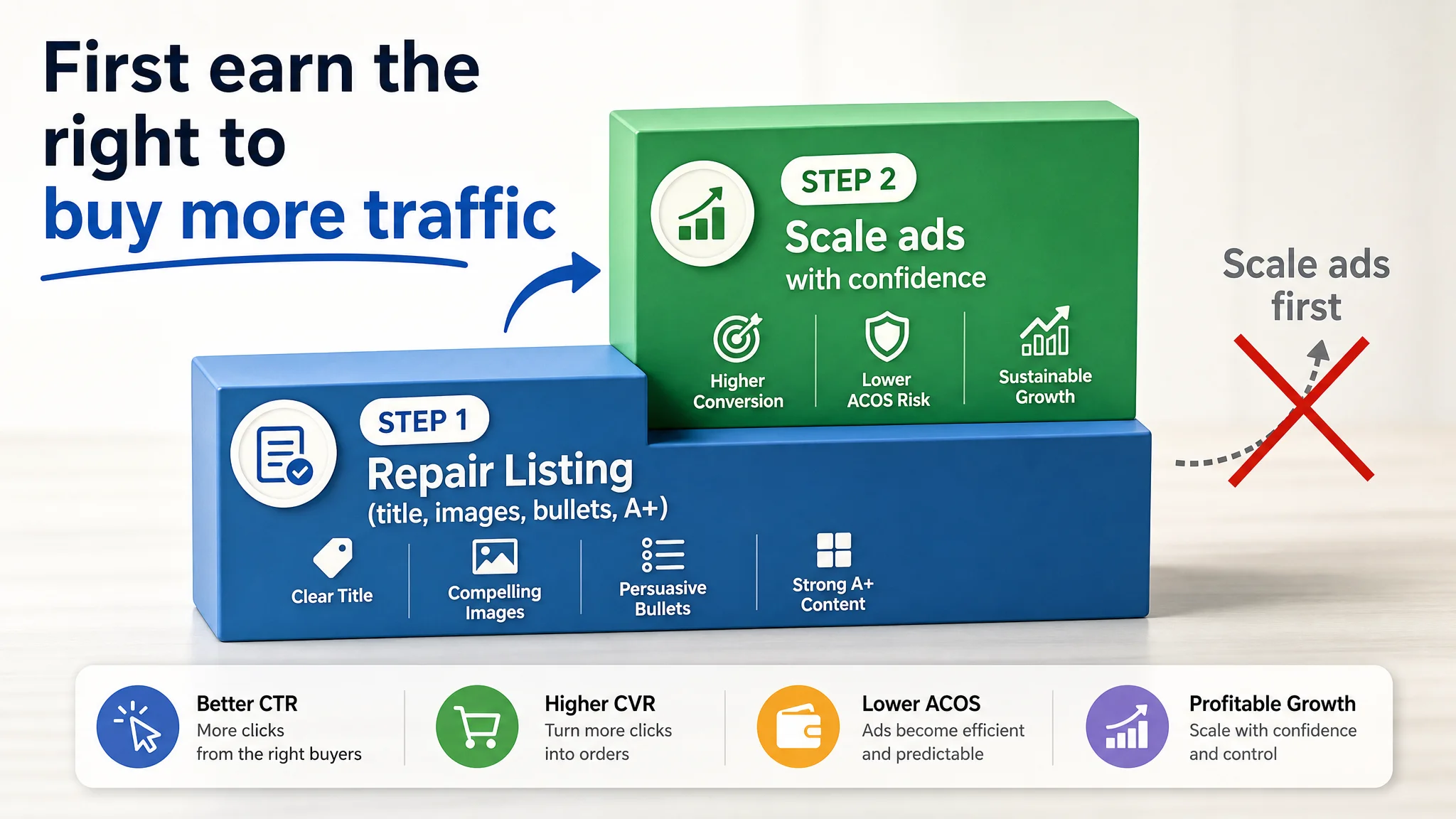
For other Amazon sellers, the lesson is straightforward but not trivial:
- When pressure builds around ACOS, resist the instinct to only iterate ads.
- Put your Amazon Listing under the same scrutiny you apply to campaigns.
- Ask whether clicks are failing because of traffic quality or because your page is not yet able to convert the traffic it already receives.
DeepBI’s value in this case was not in listing every possible tweak, but in reframing the problem: from “fix the ads” to “repair the conversion engine first,” and then letting ads become a growth amplifier instead of a cost amplifier.