

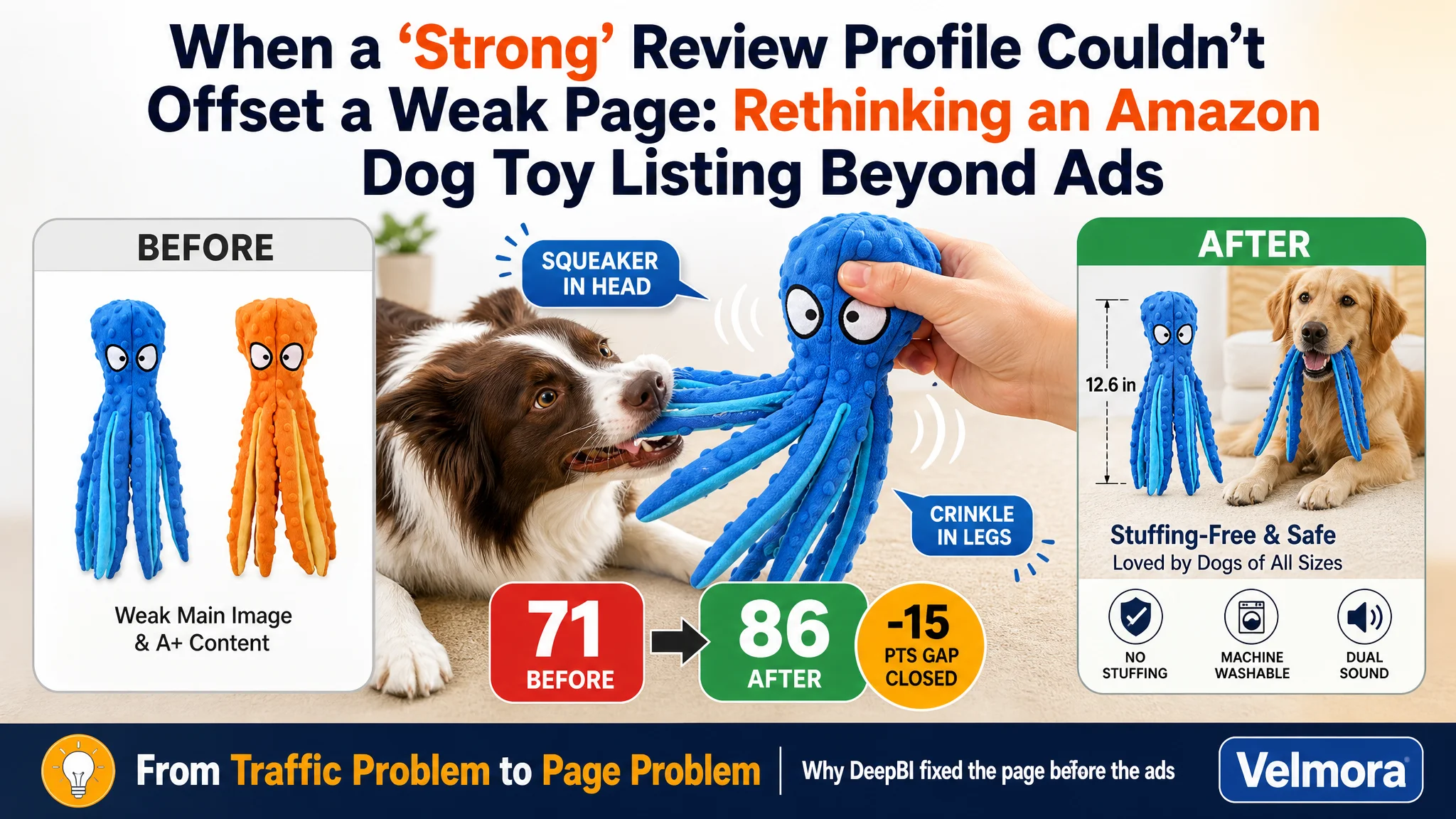
This case comes from an Amazon seller in the US pet-supplies category, focusing on squeaky plush dog toys. On the surface, the product had what many sellers dream of: over eight thousand reviews, a solid 4.2-star rating, and review quality slightly better than a leading competitor. Yet in DeepBI’s Listing scoring, the page still trailed a key benchmark by 15 points. The problem wasn’t in Amazon ads bidding or traffic volume; it was that the product page itself was consuming the traffic.
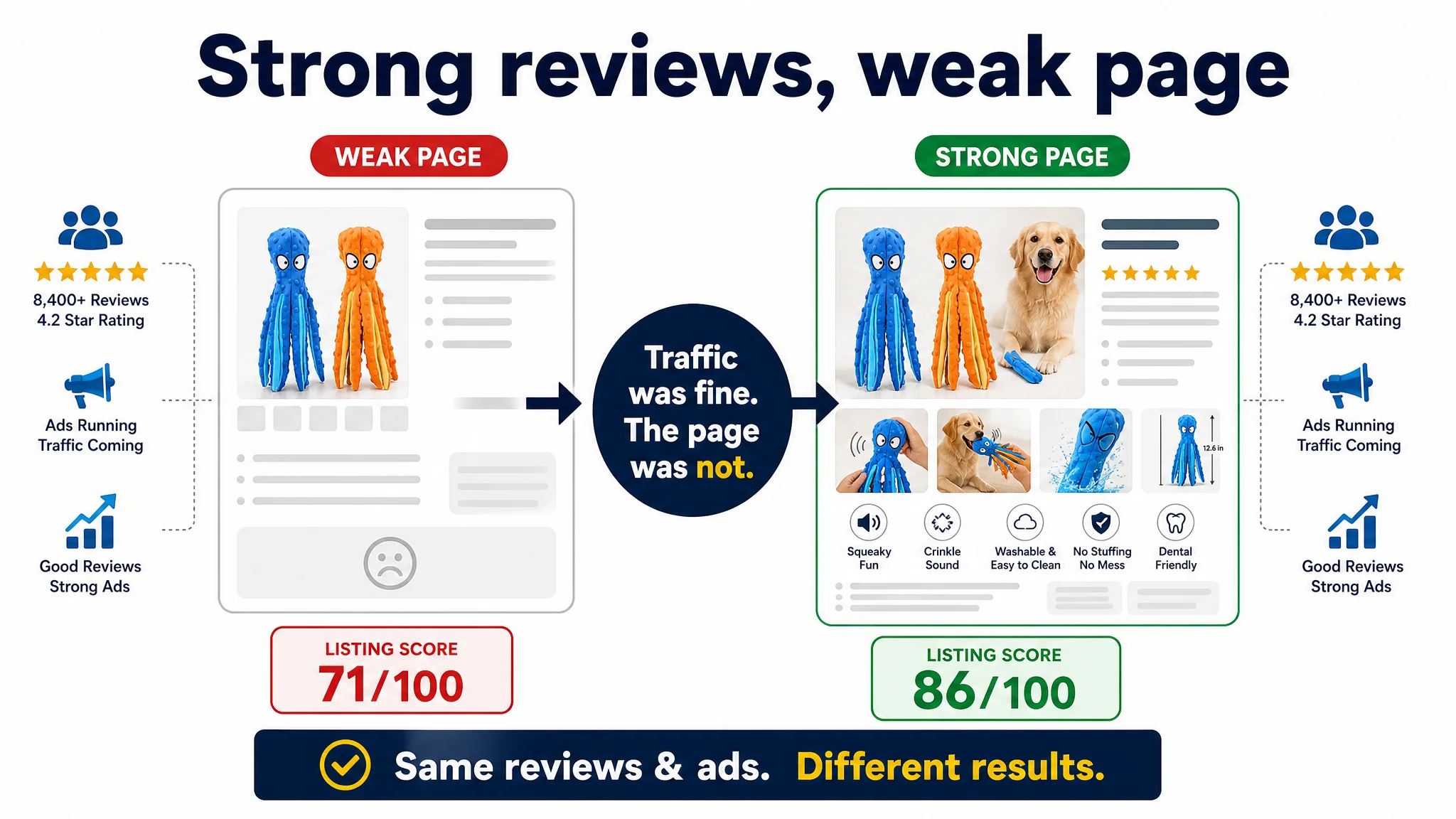
The seller originally believed the main constraint was “traffic and reviews”: they thought if they kept pushing ads and accumulating more social proof, conversion would naturally follow. DeepBI’s diagnosis told a different story. Title, main image, and A+ detail content all underperformed a direct competitor, and the gaps were precisely in how the page explained and visualized the product’s value, not in how much traffic it received.
Once the problem was reframed as an Amazon Listing conversion issue instead of an advertising one, the optimization path shifted. Rather than further tuning campaigns, the focus moved to rewriting the title and bullet points around real purchase logic, rebuilding the main-image set around clear functional demonstrations, and restructuring the A+ content so that “squeaky”, “no stuffing”, and safety benefits appeared early and convincingly. For other Amazon sellers, the lesson is blunt: a strong review profile and stable ads don’t guarantee results if the page cannot quickly show what the product does, why it’s safe, and which dogs it fits.
This was not a traffic problem. It was a page that couldn’t carry its own weight.
From the seller’s perspective, this Amazon Listing looked “healthy”:
- Star rating: 4.2, identical to a core competitor
- Review count: ~8,400+, actually higher than the benchmark
- Visible negative-review rate: lower than the competitor’s
On paper, this should have been enough to support ad scale.
But DeepBI’s Listing scoring exposed a structural weakness:
- The Listing’s total score: 71/100
- Benchmark Listing’s total score: 86/100
- Gap: -15 points
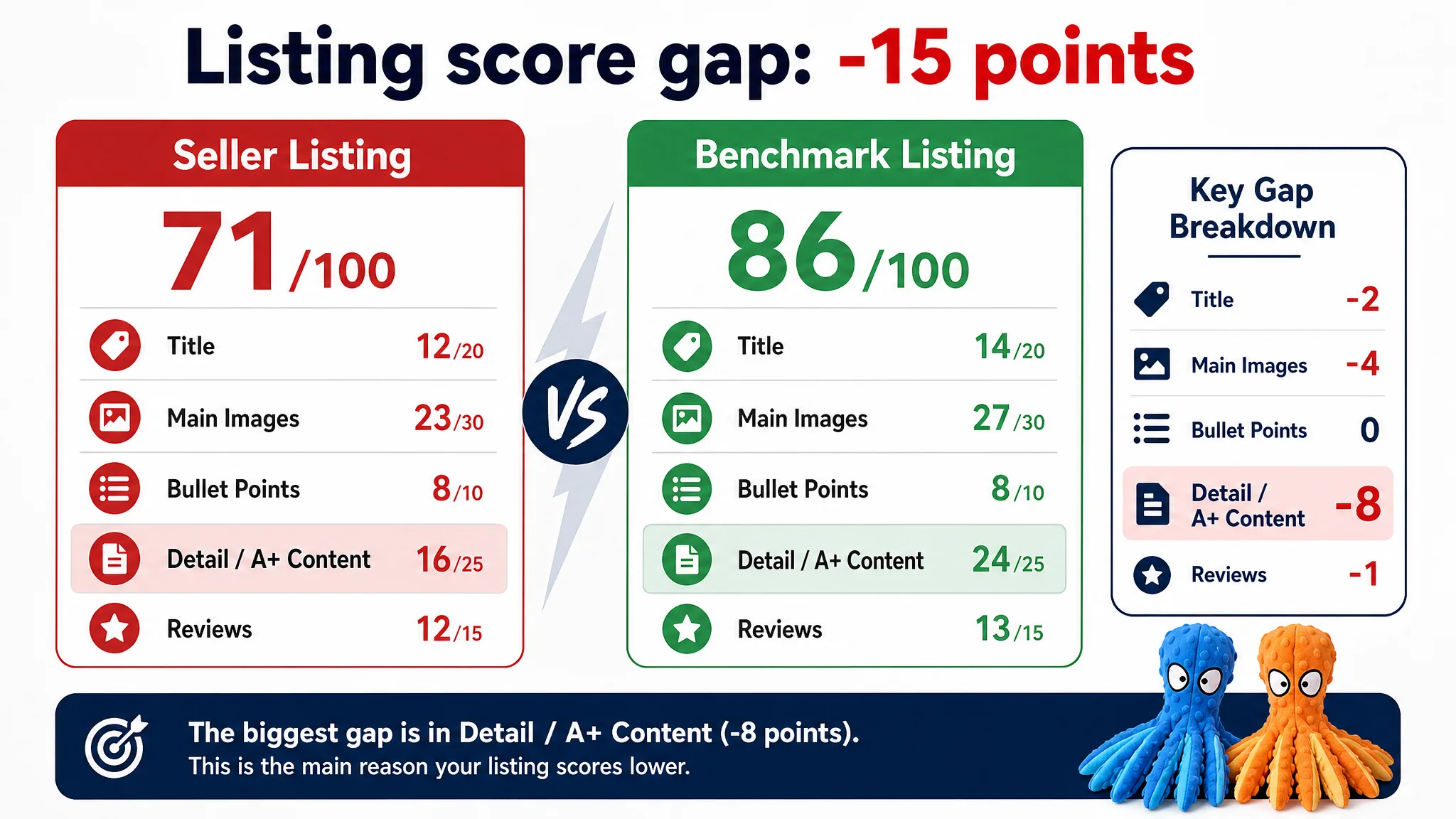
Breaking it down:
- Title: 12 vs 14
- Main images: 23 vs 27
- Bullet points: 8 vs 8 (no gap)
- Detail/A+ content: 16 vs 24 (largest gap, -8)
- Reviews: 12 vs 13
In other words, the seller’s real problem wasn’t “low review trust” or “bad feedback”. The real leak was the page’s ability to convert the traffic it already had, especially in the title, main images, and detail content.
“The real problem was not that ads failed to bring traffic. It was that the page could not convert the traffic.”
This is exactly the type of scenario where continuing to adjust ads first only amplifies the damage: more paid clicks feeding into a page that doesn’t fully explain why the toy is attractive, safe, and suitable.
The seller’s misdiagnosis: “If we keep pushing ads and reviews, conversion will catch up.”
Before DeepBI’s diagnosis, the brand’s operating logic was familiar:
- Ads are already bringing in traffic.
- Reviews are solid and growing.
- If conversion is under expectation, we need:
- Better bids and keywords.
- More reviews.
- Possibly some “nicer” images.
The underlying assumption: ads and social proof would eventually solve conversion.
The problem: data wasn’t confirming that story.
- The competitor, with fewer total reviews and the same star rating, still scored significantly higher on Listing quality.
- The largest gap was not in reviews or ad-related factors, but in detail-page content: -8 points vs the benchmark.
From DeepBI’s perspective, this mismatch was critical: the seller was pouring operational energy into traffic and reputation signals, while the on-page decision logic—what buyers actually see from search results into the detail page—was underbuilt.
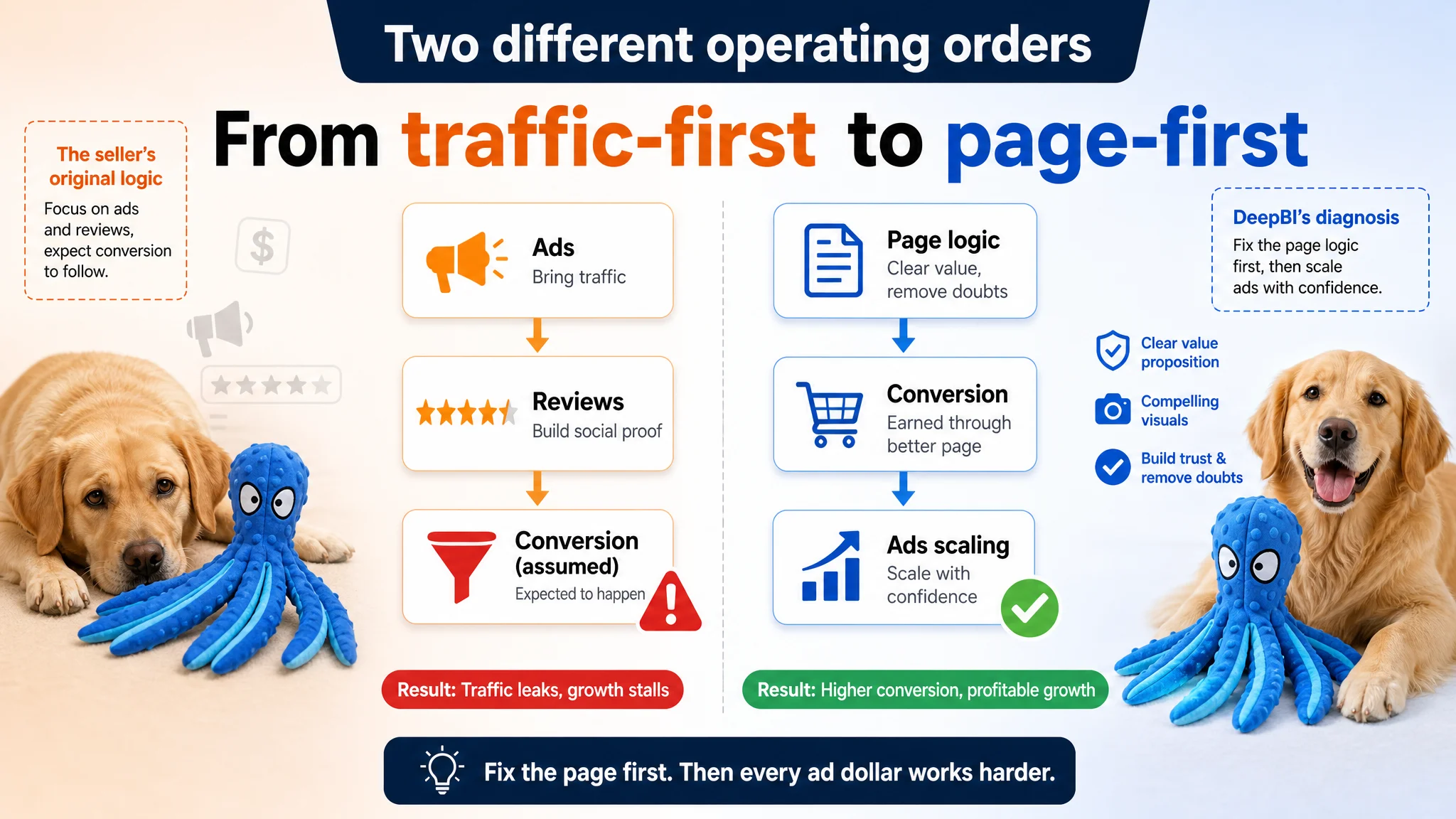
Amazon ads were not failing. The page was consuming the traffic.
When DeepBI looked at this Amazon Listing side by side with a benchmark in the same “squeaky dog toy / plush octopus / no stuffing” niche, several issues emerged.
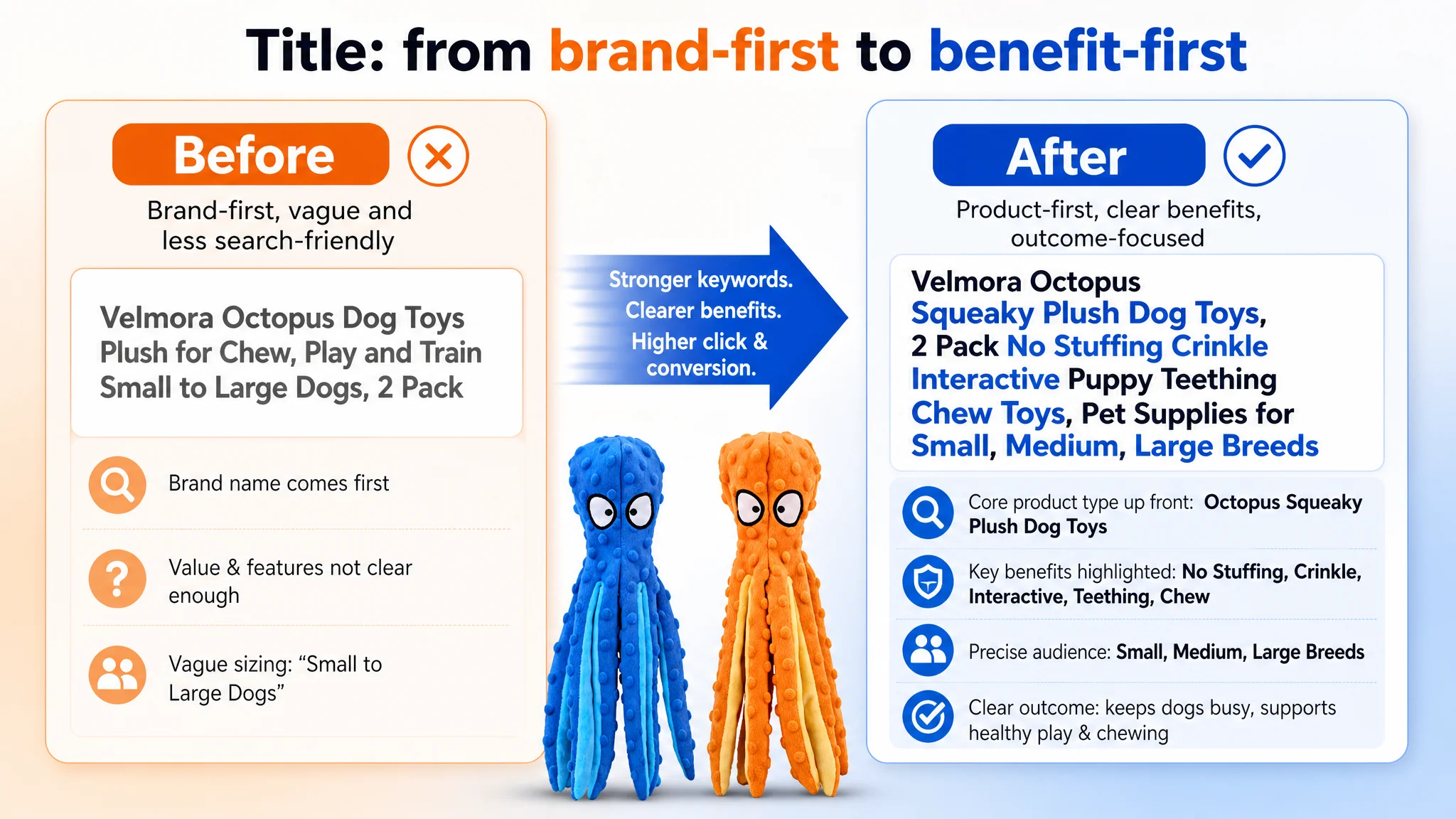
1. Title: search-friendly, but not decision-friendly enough
The seller’s title was structurally reasonable but lacked the benchmark’s balance between keyword coverage and persuasive language.
Key differences:
- The competitor front-loaded the core product term “Squeaky Dog Toys” and used compelling, scenario-driven wording like “Keep Them Busy” and “Interactive”.
- The seller front-loaded the brand name, lowering search friendliness and delaying the buyer’s understanding of “what this is”.
- The competitor broadened reach with “Pet Supplies for Chewer” and precise audience wording “Small, Medium, Large Breeds”.
- The seller used “Small to Large Dogs” – understandable, but less aligned with common Amazon search phrasing and less precise.
Result:
The title was not the worst part of the Listing, but it failed to:
- Maximise keyword weight on “squeaky plush dog toy”.
- Immediately communicate interaction, engagement, and safety outcomes.
- Anchor the product firmly as a “no stuffing”, “chew”, “interactive” toy in the first read.
2. Main-image set: no clear “reason to click”, no clear “reason to trust”
DeepBI’s visual diagnosis found the main-image set structurally reasonable, yet strategically weaker than the benchmark.
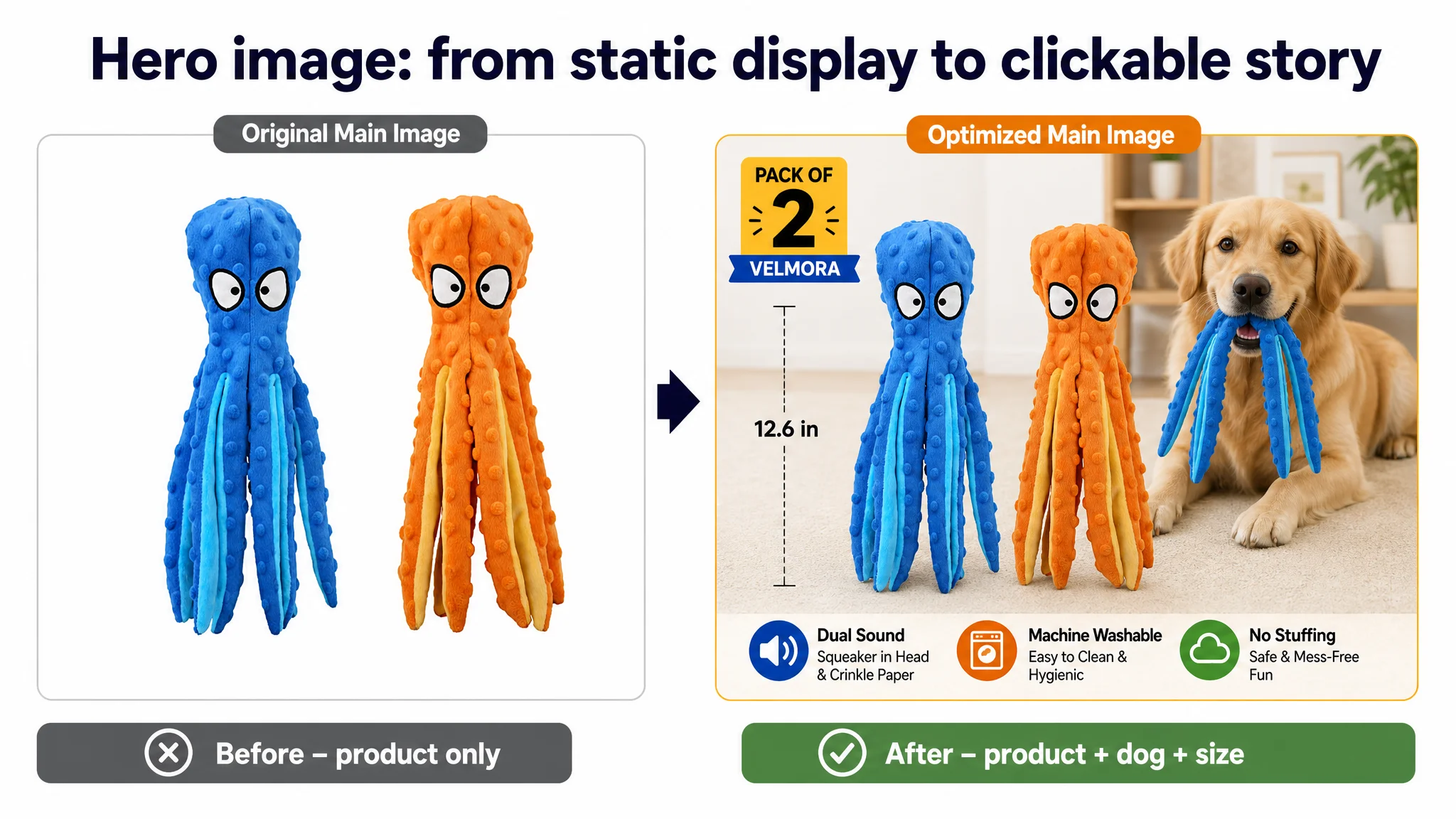
Core issues:
- Emotional hook missing on the first image
The seller’s primary image showed the two-color pack (blue and orange) clearly, but lacked a dog interacting with the toy. The competitor’s hero image included a Christmas tree and dogs actively engaged, creating an instant emotional trigger and a sense of fun and warmth.
- Functional clarity diluted across images
Critical functions—squeaker in the head, crinkle paper in the legs, washable material, size—were spread across multiple images. Buyers needed to piece together the story themselves. The competitor consolidated “core three benefits” in a single, well-structured functional illustration.
- No real-life “proof” of dogs enjoying the toy
The competitor used UGC-like photos (multi-dog, multi-environment shots) that implicitly answered the buyer’s big question: “Will my dog actually like this?” The seller’s images skewed toward static, product-only shots, with fewer genuine interaction scenes.
Impact:
- On the search-results page, the seller’s main thumbnail lacked the combined effect of emotional appeal + functional clarity.
- On the detail page, buyers were working harder than they should to understand:
- How the toy sounds.
- How dogs interact with it.
- Why “no stuffing” matters in practice.
- Which sizes/breeds it truly fits.
3. Bullet points: structurally fine, but under-leveraging emotional and outcome language
DeepBI’s scoring showed bullets at 8/10—on par with the benchmark. But under the surface, the difference was how much buying logic each bullet carried.
Patterns:
- The seller’s first bullet: broad product description. The competitor: combined appearance, interactive function (eight legs for tug-of-war), and gift scenario in one, high-density bullet.
- The seller was actually stronger in direct safety wording (“100% stuffing free”, “solid stitching”). The competitor, however, wrapped the same ideas in more outcome-oriented language (“indestructible dog toys”, “leave no bad smells”).
So while the bullet structure wasn’t disastrous, it wasn’t fully aligned with:
- A clear naming pattern (e.g., bracketed headers like “[No Stuffing – No Mess & Safe]”).
- A “pain point → solution → usage scenario” progression that drives conversion.
The gap here was less about “having bullets” and more about how those bullets spoke the buyer’s language of risk, mess, anxiety, and engagement.
The real constraint: detail-page conversion capacity, especially A+ content
The largest scoring gap was in the detail/A+ dimension:
- Seller: 16/25
- Benchmark: 24/25
- Gap: -8 points
This is where DeepBI judged the true bottleneck.
How the competitor’s A+ worked as a conversion engine
The benchmark A+ did several things extremely well:
1. Real-world “photo wall” trust
A multi-image grid showed various dogs, different breeds, indoors/outdoors, and multiple play styles. This creates instant proof: “Dogs like this, in situations like yours.”
1. A clear value module: “Why do pets need these toys?”
It explicitly walked through:
- Mental stimulation.
- Exercise.
- Anxiety reduction.
- Bonding with owners.
Together with 5 structured benefits and 3 clear Tips, this showed expertise and intentional design.
1. A complete buying journey
- Brand story module.
- Video entry.
- Practical tips about washing, usage, and limitations.
It guided the buyer from awareness → trust → decision → after-use confidence.
How the seller’s A+ undercut conversion
The seller’s A+ structure leaned heavily on:
- Holiday scenes and emotional companionship early on.
- Static product shots and icon-based benefit summaries.
- Short, generic benefit statements with limited depth.
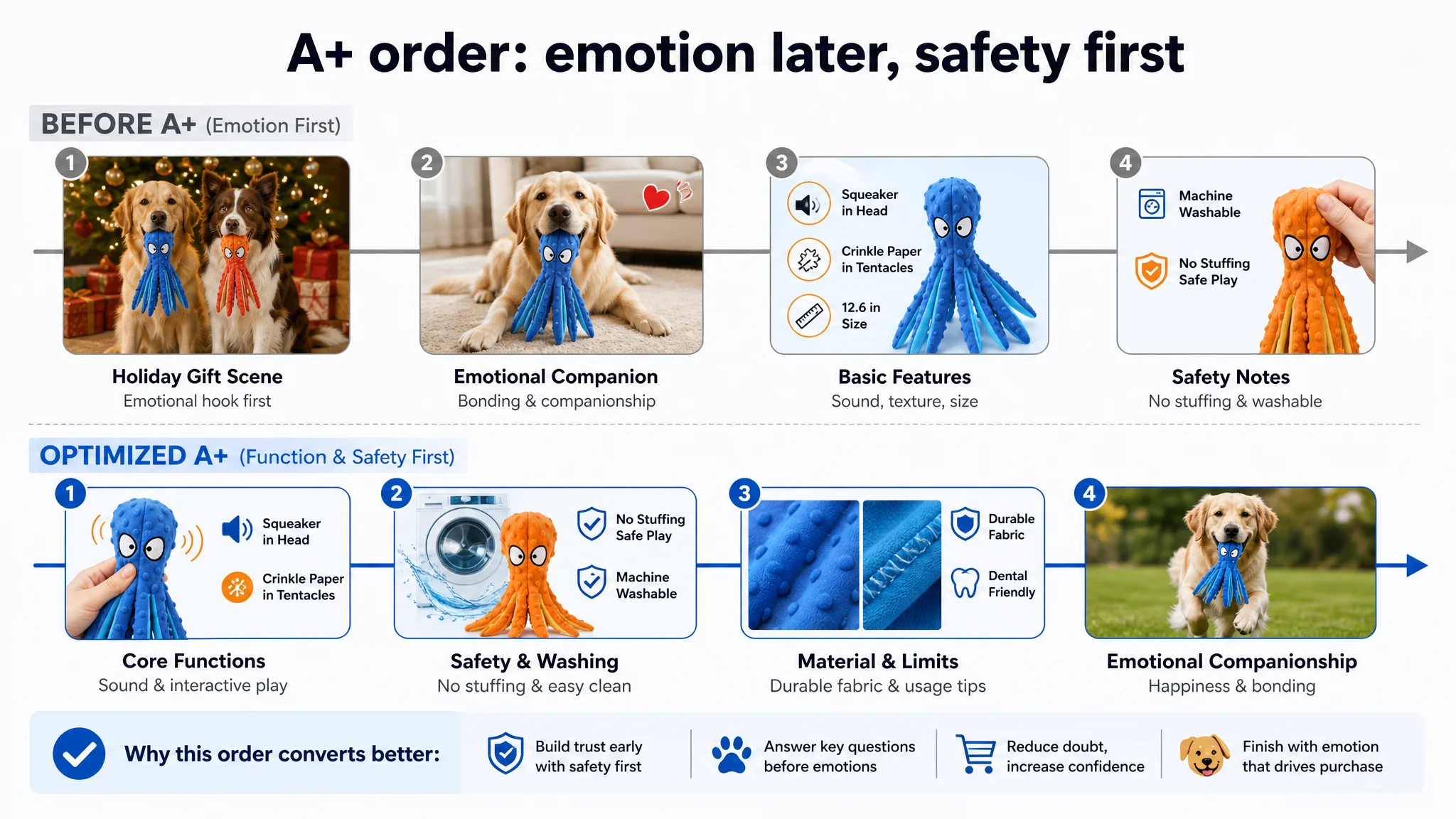
Specific issues:
- The opening module centred on a holiday gift scene. This may be useful during seasonal pushes, but as an everyday A+ opener it fails to quickly address the core questions:
- “What does it do?”
- “Is it safe?”
- “Is it durable enough for my dog?”
- The emotional module (“companion” positioning) appeared too early—before the buyer’s rational checks (sound, safety, durability, washing) were satisfied.
- The “no stuffing” safety benefit, arguably one of the strongest differentiators, was not deeply explained—either visually or textually:
- No clear depiction of how the toy folds, bends, and remains safe if chewed.
- Limited explicit reassurance around choking risk and cleanup relief.
- No strong module combining:
- Material quality.
- Machine-wash benefits.
- Honest usage limitations (e.g., not for heavy aggressive chewers, supervise play).
Effectively, the A+ never fully closed the trust gap. Buyers had to rely on reviews and imagination to fill the blanks—which is exactly where traffic begins to leak.
How DeepBI reframed the problem and reset the decision order
Based on Listing scoring and competitor comparison, DeepBI’s evaluation led to a clear judgment:
- This Listing did not lack traffic. It lacked structured, trust-building content.
- Ads were doing their job; the page was not.
Given that, continuing to prioritize ad optimization would have:
- Increased TACoS without structurally lifting conversion.
- Pushed more buyers into the same incomplete decision experience.
- Made it harder to interpret ad performance, because the real leak—page conversion—remained unaddressed.
DeepBI guided the team to reverse the operating sequence:
1. Fix the Listing conversion foundation first
- Title clarity and keyword logic.
- Main-image persuasive path.
- A+ storytelling and trust-building.
1. Only then re-evaluate ad efficiency
- With a more convincing page, each click’s probability of conversion improves.
- ACOS becomes more responsive to bid and keyword adjustments.
- Organic ranking gets a chance to benefit from improved CVR.
“Advertising does not only amplify advantages. It can also amplify a page’s existing defects.”
In this case, letting ads “run ahead” of the page’s conversion capacity was the biggest operational risk. DeepBI’s core value was not suggesting “more creative assets”, but insisting the seller rebuild how the Listing communicates value before scaling traffic further.
How the optimization focused on the page, not the ad console
1. Rebuilding the title around core search terms and outcomes
The recommended title:
Octopus Squeaky Plush Dog Toys, 2 Pack No Stuffing Crinkle Interactive Puppy Teething Chew Toys, Pet Supplies for Small, Medium, Large Breeds
Key shifts in logic:
- Front-loaded “Octopus Squeaky Plush Dog Toys” as the core searchable identity.
- Integrated “No Stuffing” and “Crinkle” as paired physical features, rather than scattered attributes.
- Added “Interactive” and “Chew Toys” to align with high-volume, buyer-intent modifiers.
- Standardized “Small, Medium, Large Breeds” wording to match common Amazon search phrasing and competitor practice.
This title doesn’t just chase keywords. It reorders the information so that a buyer scanning search results immediately knows the product type, key functions, and dog size applicability.
2. Turning bullet points into a persuasion path, not a checklist
DeepBI’s bullet-point optimization guided each point toward a clear theme:
- BP #1 – Attraction & gifting
“[Octopus Interactive Dog Toys]” + color appeal + size clarity + gift scenario (holiday/Christmas). This addresses “Will my dog be interested?” and “Is this a fun, giftable product?”.
- BP #2 – Sensory engagement & anxiety relief
“[Squeaky & Crinkle Sensory Fun]” focusing on squeaker + crinkle paper, explicitly connecting them to:
- Exercise.
- Anxiety reduction.
- Boredom relief.
- BP #3 – No stuffing, no mess, more safety
“[No Stuffing – No Mess & Safe]” directly tackles:
- Choking/swallowing fear.
- House mess from stuffing.
- Ease of carrying and interactive play (tug, fetch, toss).
- BP #4 – Material durability & dental health
“[Durable Material & Dental Health]” linking:
- Thick polyester fabric and solid stitching.
- Surface fuzz working like a gentle toothbrush, supporting dental hygiene.
- BP #5 – Service and honest limitations
“[Care Instructions & Service]” combining:
- Machine-washability.
- Not for aggressive heavy chewers.
- Supervised play recommendation.
- Service commitment, in a compliant, non-inducement way.
Instead of “five scattered facts”, the bullets now form a coherent argument: attraction → engagement → safety & mess control → health & durability → responsible usage and support.
How DeepBI rebuilt the main-image sequence as a conversion funnel
DeepBI did not simply ask for “better images”. It mapped each main image to a specific role in the buyer decision.
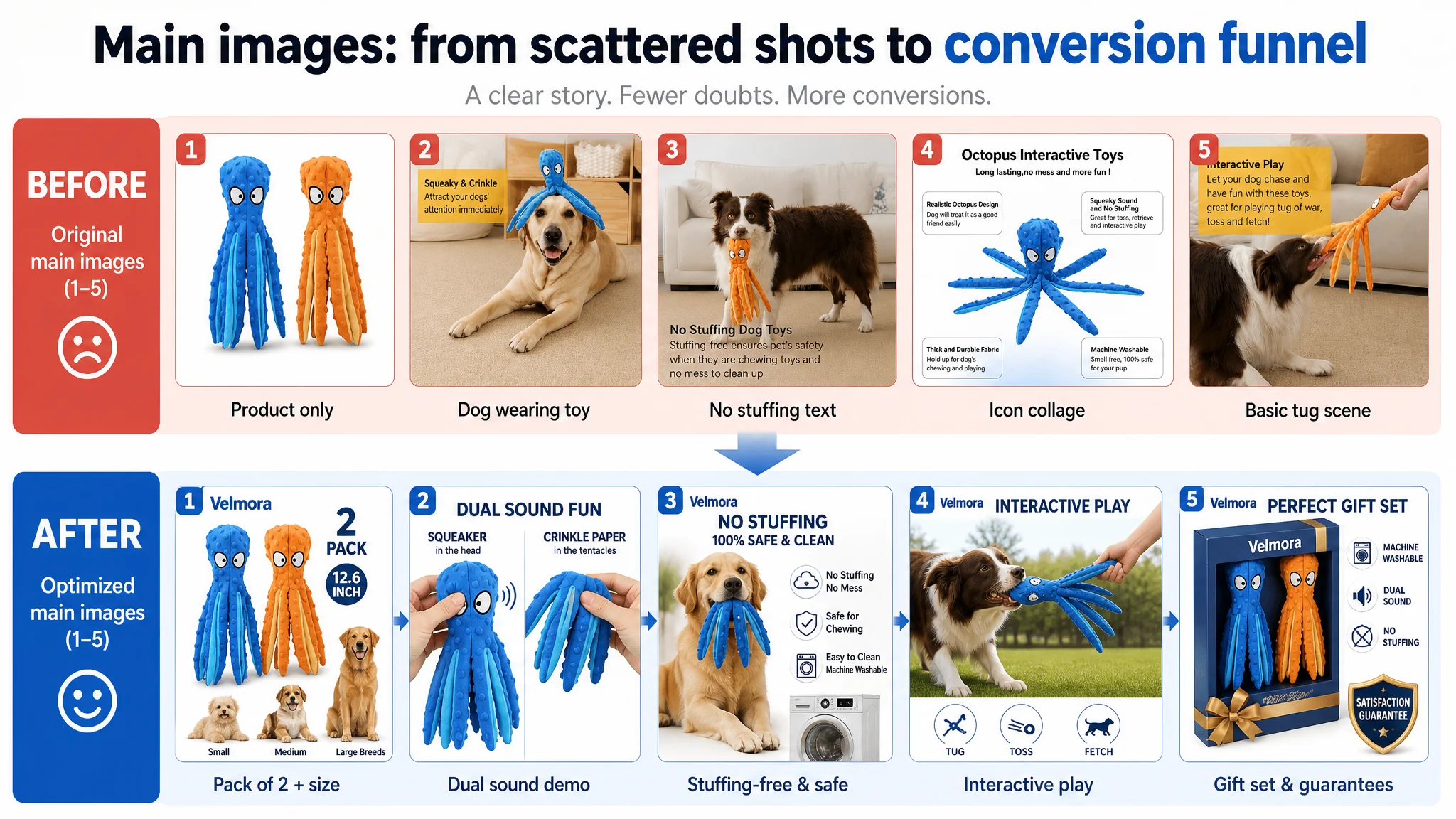
1. Image 1 – Hero: product identity + implied dog interest + clear “Pack of 2”
The optimized hero (dog in background, “Pack of 2” + 12.6 in) combines size, quantity, and dog engagement in a single glance.
1. Image 2 – Functional demonstration: squeaker + crinkle
A hand squeezing the head, with sound icons and a dog watching, visually explains “dual sound” without extra reading.
1. Image 3 – Stuffing-free safety, visually
Close-up of the empty interior plus dog interaction, turning “100% stuffing-free & safe” into something you can literally see.
1. Image 4 – Interactive play patterns
Outdoor tug-of-war scene with clear icons for tug, toss, fetch.
1. Image 5 – Giftability & guarantees
Packaged gift set with trust badges (machine washable, dual sound, no stuffing), increasing perceived value.
Together, these images move the buyer through identity → function → safety → play → gifting, rather than forcing them to piece together the story across scattered static shots.
Restructuring the A+ detail page around buyer logic, not just aesthetics
DeepBI re-ordered the A+ modules to match how buyers actually make decisions:
1. Module 1 – Practical overview & honest statement
2. Module 2 – Core function: sound and interaction
3. Module 3 – Physical structure & dental benefits
4. Module 4 – Emphasized “no stuffing + washable”
5. Module 5 – Material durability & rational trust
6. Module 6 – Emotional companionship & suitability across breeds
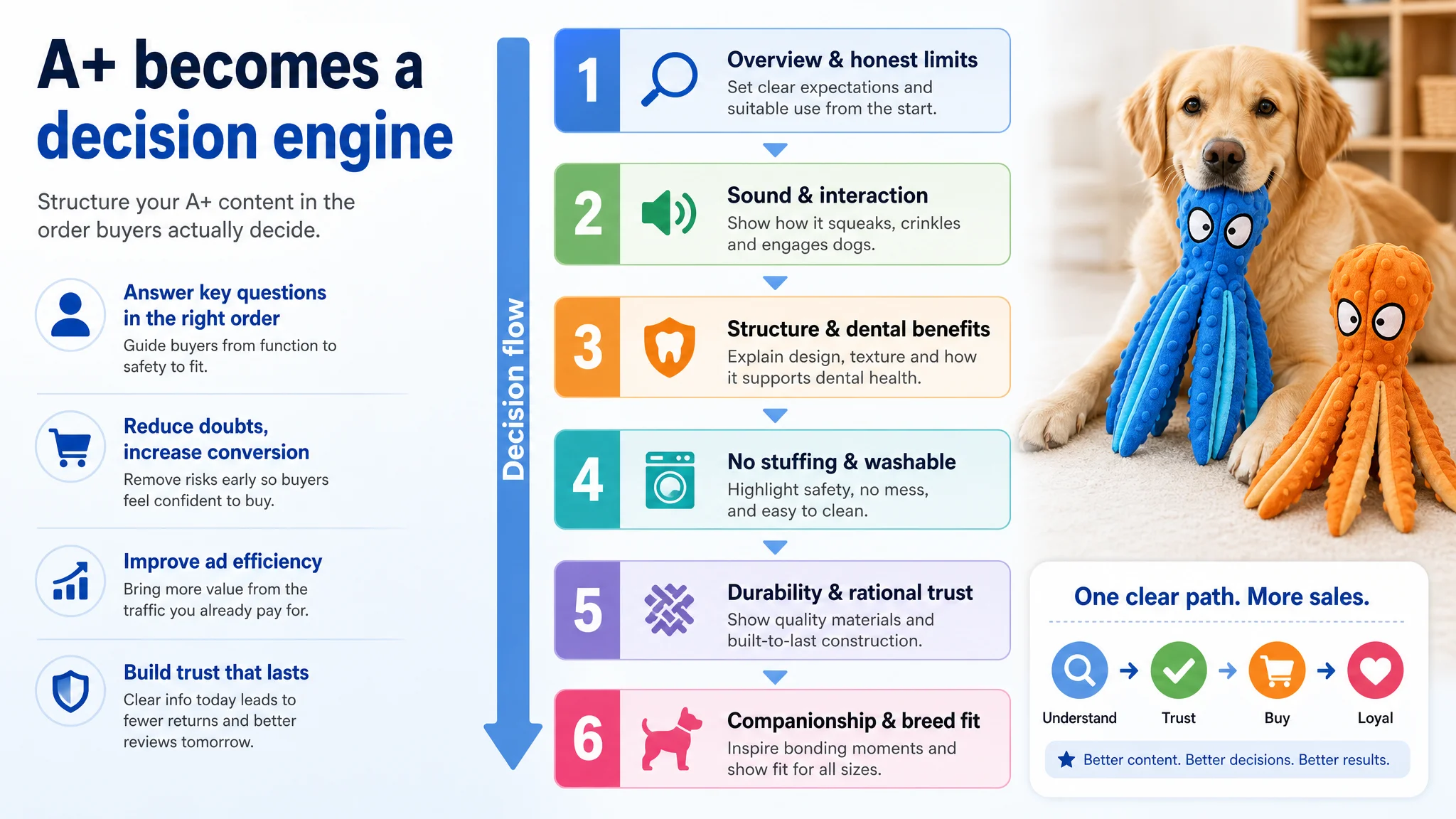
By reorganizing content this way, the A+ stops being an “emotional scrapbook” and becomes a structured decision engine: function → safety → maintenance → limitations → emotion.
What changed for the seller—and what other Amazon sellers can take away
Even without inventing performance numbers, several changes are clear from a business and risk perspective:
- Listing conversion capacity improved
- Title, images, and A+ content now carry a coherent story about what the toy is, how it works, why it’s safe, and which dogs it fits.
- Buyers no longer rely solely on reviews to understand the product.
- Advertising traffic became more valuable
- Each paid click lands on a page that does more work per session.
- Ad efficiency (ACOS, TACoS) has a real chance to move, not just fluctuate.
- Risk of “review dependence” decreased
- Conversion no longer leans entirely on past review accumulation.
- The page itself starts to pull its own weight.
- The team’s understanding of the problem changed
- They learned that:
- A strong review profile can coexist with a weak Listing.
- Ads can amplify page defects as easily as they amplify strengths.
- Title, main image, bullets, and A+ must operate as a single reasoning path, not separate assets.
For other Amazon sellers, this case is a reminder:
- If your Amazon ads bring traffic, your reviews look solid, but orders lag, the leak may be inside the Listing itself.
- Before raising bids or adding more campaigns, ask:
- Does my main image give a clear reason to click?
- Does my title immediately express what the product is and who it’s for?
- Do my bullets follow a pain point → solution → scenario logic?
- Does my A+ truly remove doubts about safety, durability, and fit?
DeepBI’s value in this case was not “adding features” or “making nicer visuals”, but aligning the entire Amazon product page around the actual decision logic buyers use—so that advertising investments are finally matched with a page that deserves the traffic.