

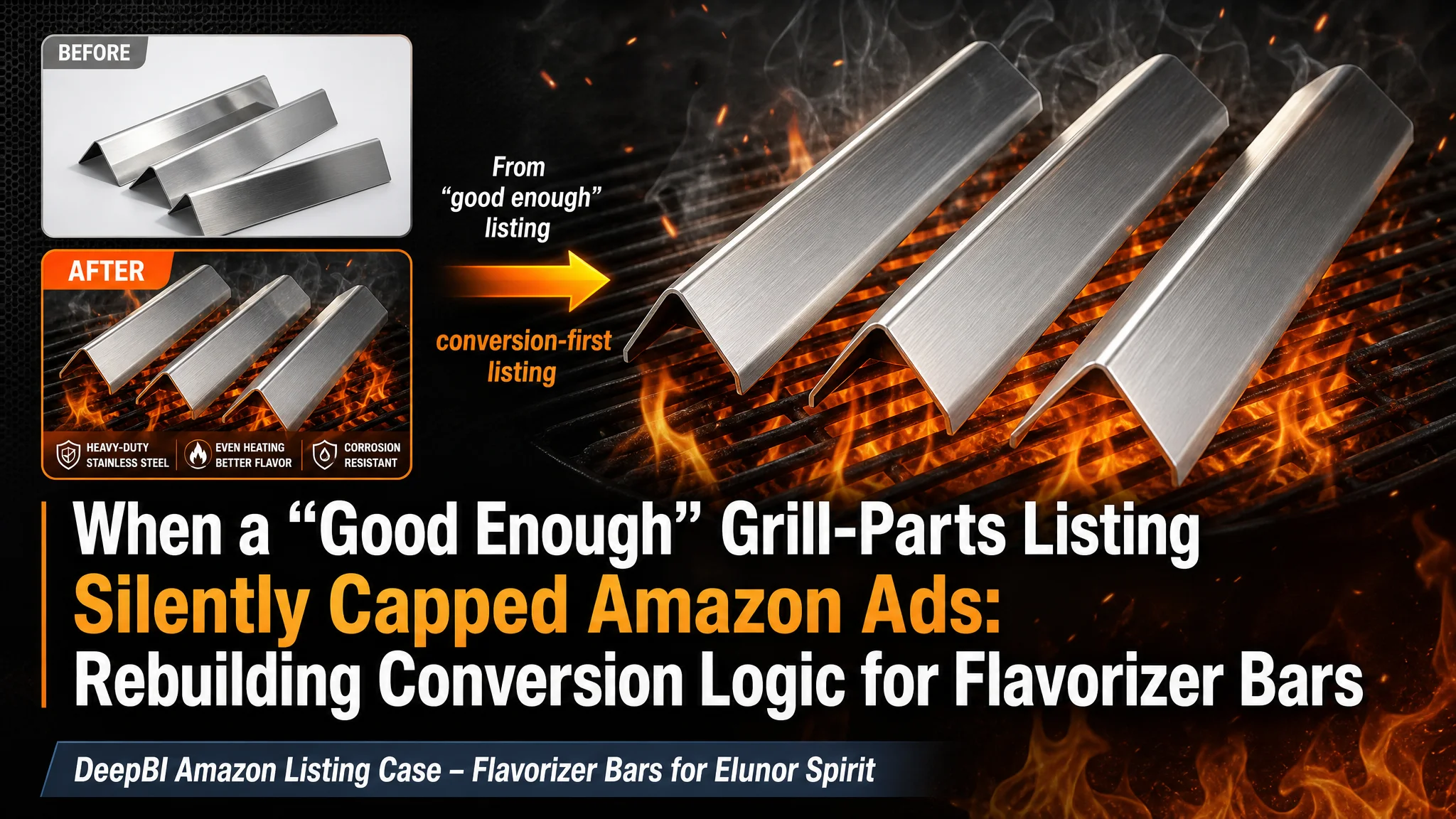
This case comes from an Amazon seller in the US barbecue-accessories category, selling stainless-steel flavorizer bars as replacement parts for Weber grills. On the surface, their Amazon Listing looked acceptable: decent reviews, solid bullet-point copy, and a clear product. Yet, despite continuous Amazon ads, the page struggled to convert as well as a leading competitor, and ACOS pressure kept rising.
The seller’s first instinct was to treat this as an advertising problem. They tweaked bids, adjusted keywords, and refined campaign structures—assuming the issue lay in traffic volume or targeting. DeepBI’s diagnosis pointed elsewhere: the core bottleneck was the Listing’s conversion capacity, especially in the title, main images, and the complete absence of A+ content, not in the ads themselves.
By reframing the problem from “ads are too expensive” to “this Amazon product page does not earn its traffic,” the optimization focus shifted: rebuild the page’s trust and decision logic first, then let ads amplify that improved conversion. For other Amazon sellers, this case is a reminder that even a technically compliant Listing can quietly bleed conversion when it lacks a clear compatibility story, visual proof of durability, and a structured A+ that resolves buyers’ compatibility anxiety and durability concerns.
Amazon Ads Were Not Failing. The Page Was Consuming the Traffic.
From the seller’s perspective, the business pressure was clear: ads were running, visibility existed, but orders lagged behind a comparable competitor offering similar Weber-compatible flavorizer bars.
They saw:
- A product with a 4.4-star rating and 48 total reviews
- An Amazon Listing that “checked the boxes” (title, bullets, images present)
- A competitor with only slightly higher rating (4.6 stars) but far more reviews and much stronger apparent traction
Because the operational habit was ad-centric, the team naturally concluded:
- ACOS pressure = keyword or bidding problem
- Weak orders = insufficient or misaligned traffic
- Next step = keep tuning Amazon ads
But when DeepBI ran the Listing scoring and benchmark comparison, the picture changed.
“The real problem was not that ads failed to bring traffic. It was that the page could not convert the traffic.”
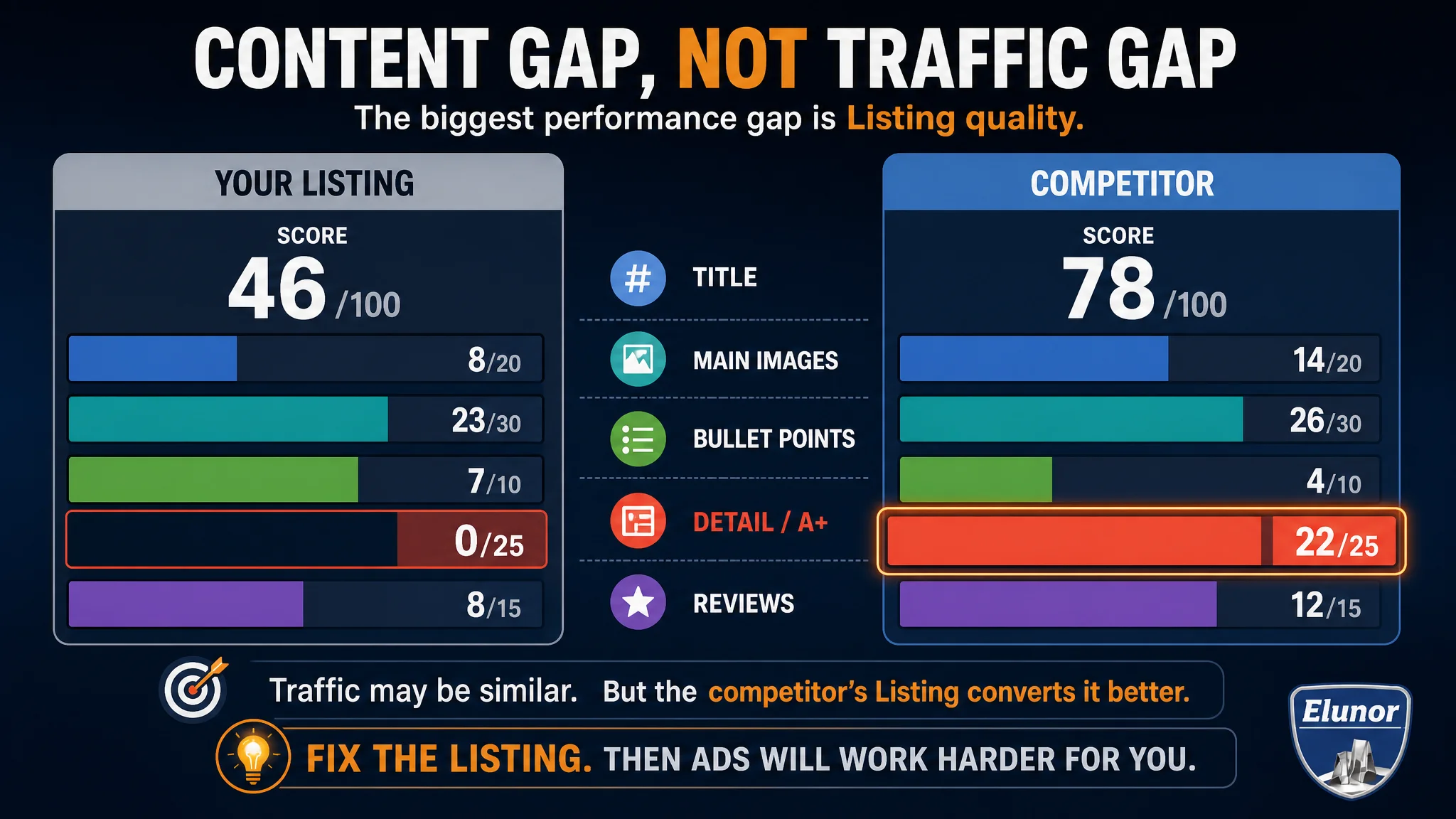
The target Listing scored 46/100 versus the competitor’s 78/100, a 32‑point gap. Crucially, the biggest missing piece was not traffic, but the detail/A+ content dimension, where the seller scored 0/25 against the competitor’s 22/25.
Once that was visible, it was obvious: continuing to push ad spend into a page with this level of content deficit was structurally risky. The ads were amplifying a conversion leak, not a conversion asset.
The Core Constraint Was Listing Conversion Capacity, Not Keywords
Looking at DeepBI’s dimension-by-dimension diagnosis, one core conflict emerged:
The Listing’s conversion capacity was far below the benchmark, especially in how it handled compatibility, durability, and use-case trust.
Quantified gap vs. benchmark
- Total score: 46 vs 78 (‑32)
- Title: 8 vs 14 (‑6)
- Main images: 23 vs 26 (‑3)
- Bullet points: 7 vs 4 (+3; text logic actually slightly stronger)
- Detail/A+: 0 vs 22 (‑22; complete vacuum)
- Reviews: 8 vs 12 (‑4; weaker social proof)
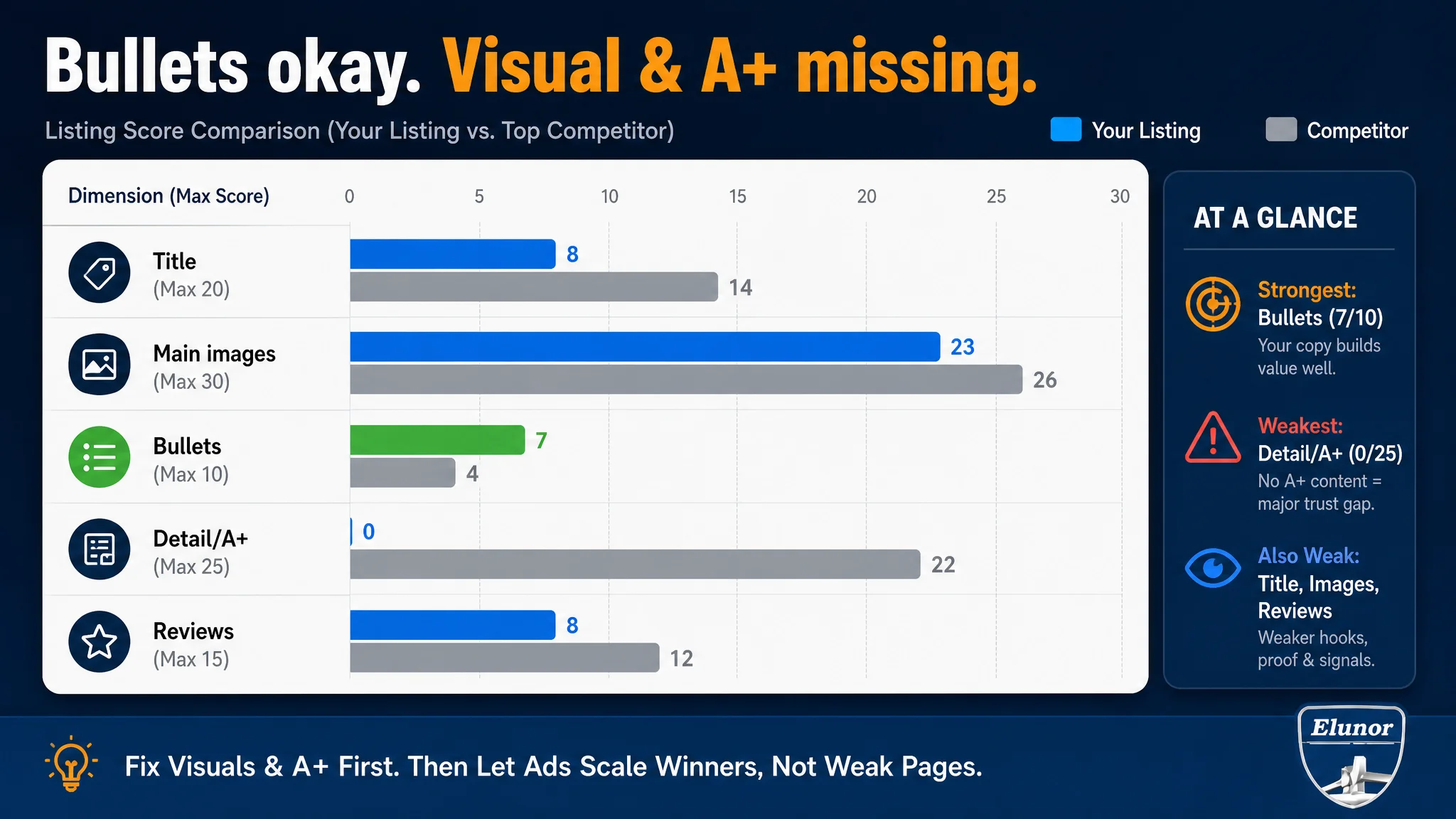
The key insight: the seller’s bullet-point text was not the main weakness. In fact, structurally and logically, it was competitive. The real bottleneck was everything around those bullets:
- The title did not fully map the search, compatibility, and model logic buyers use.
- The main image set lacked strong visual hooks and functional proof.
- The A+ area was empty, leaving compatibility anxiety and durability doubts unresolved.
In other words, the ad funnel was trying to compensate for a page that wasn’t yet structured to close the sale.
Where the Seller Misdiagnosed the Problem
Before working with DeepBI, the seller had built their Amazon operations around a familiar pattern:
1. Launch the Listing with conventional images and copy.
2. Run Amazon Sponsored Products campaigns.
3. Tweak bids and keywords whenever ACOS crept up or orders weakened.
The implicit diagnosis was:
- “If ACOS is high, we must fix the campaigns.”
- “If orders don’t follow, we need more relevant keywords.”
What they did not fully see:
- Their competitor’s Amazon Listing was not winning because of ads alone.
- It was winning because the page itself—title, main images, A+, and reviews—was structurally better at reducing buyer risk and clarifying compatibility.
Traditional ad optimization failed here for a simple reason: no amount of bid tuning can compensate for a page that does not systematically prove fit, durability, and outcome.
This Product Page Did Not Lack Text. It Lacked a Conversion Structure.
On paper, the seller’s bullet points were not weak. They followed a clear “problem/need → solution → result” logic:
- Compatibility & installation
- Material & durability
- Heat distribution & cooking results
- Size and package
- Cleaning & warranty
DeepBI’s analysis even showed they were more user-value driven than the competitor, whose bullets leaned heavily toward list-style model and compatibility information.
But in Amazon’s real decision process, bullets are only one layer. Buyers scan:
- Search results (thumbnail + title)
- Main images
- A+ content
- Then possibly bullets and reviews
On this Listing, the conversion chain broke in multiple earlier steps.
The title did not fully connect to how buyers actually search
The benchmark competitor’s title:
- Front-loaded the category’s core keyword: “Flavorizer Bars”
- Included critical search phrases: “Weber Spirit Grill Parts”, “Spirit 300”, “GS4 Spirit II 300 315 320 330”, “S310 E310”
- Reflected the standard Amazon format: core product + compatibility + quantity + OEM part number
The seller’s title:
- Contained generic marketing phrasing like “Grill Ready Now!”
- Did not sufficiently front-load “Flavorizer Bars” and key long-tail compatibility terms
- Felt more descriptive and less like a high-precision, parts-category title
DeepBI’s recommended title restructuring was not cosmetic. It was about aligning with how Amazon’s search and buyers both think:
“7636 Flavorizer Bars 15.3 Inch for Weber Spirit 200 & 300 Series, Spirit II E210 E310 S310 S320 Grill Parts, Replacement Heat Plates for Weber 67046, Burner Covers”
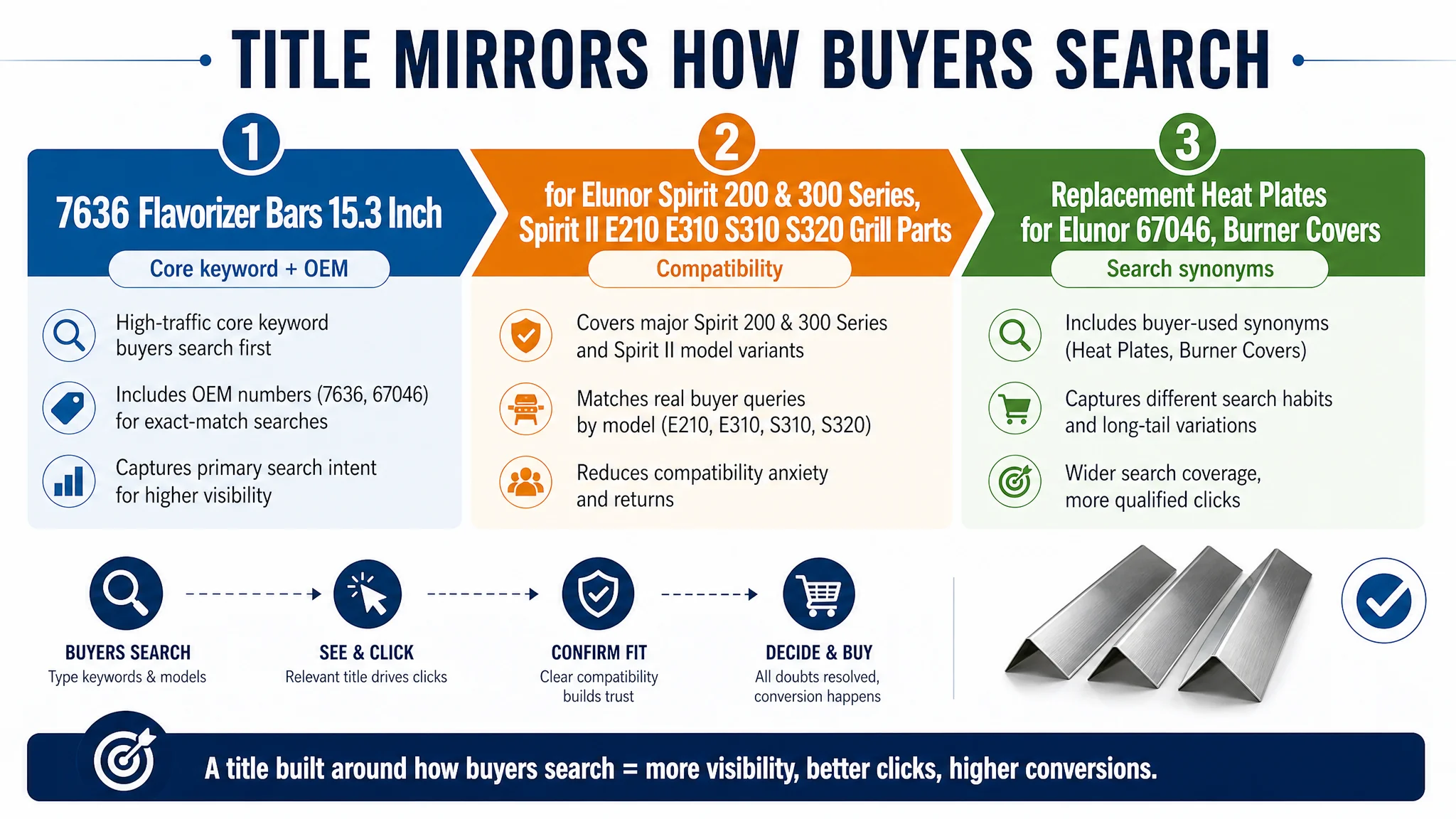
This does three things at once:
- Locks in OEM signals (7636, 67046) buyers actively type
- Broadens long-tail coverage with Spirit/Spirit II model names
- Uses buyer language (“Heat Plates”, “Burner Covers”) to catch more search patterns
The main images did not create enough reasons to click—or to trust
DeepBI’s visual diagnosis showed that the seller’s current main-image stack:
- Was visually “clean” but overly plain, with a white/blue look and limited emotional charge
- Lacked:
- Fire, smoke, or food imagery to create a heat/durability and taste association
- Clear 3D dimension callouts
- Strong compatibility visual logic (front-control vs side-control, specific model silhouettes)
- Any powerful before/after corrosion comparison
Meanwhile, the competitor:
- Used strong contrast (dark product + fire) to immediately telegraph “heat and durability”
- Visually emphasized technical attributes like “16GA thickness”, “enamel coating”, “non-stick for oil”
- Showed “enhances flavor” and “uniform heating” as visualized outcomes, not just text claims
In search results and on the Listing, that meant:
- The competitor’s thumbnail carried a clear promise: thicker, enamel-coated bars that improve flavor and resist heat.
- The seller’s thumbnail looked like generic stainless-steel strips with little sense of what they solve.
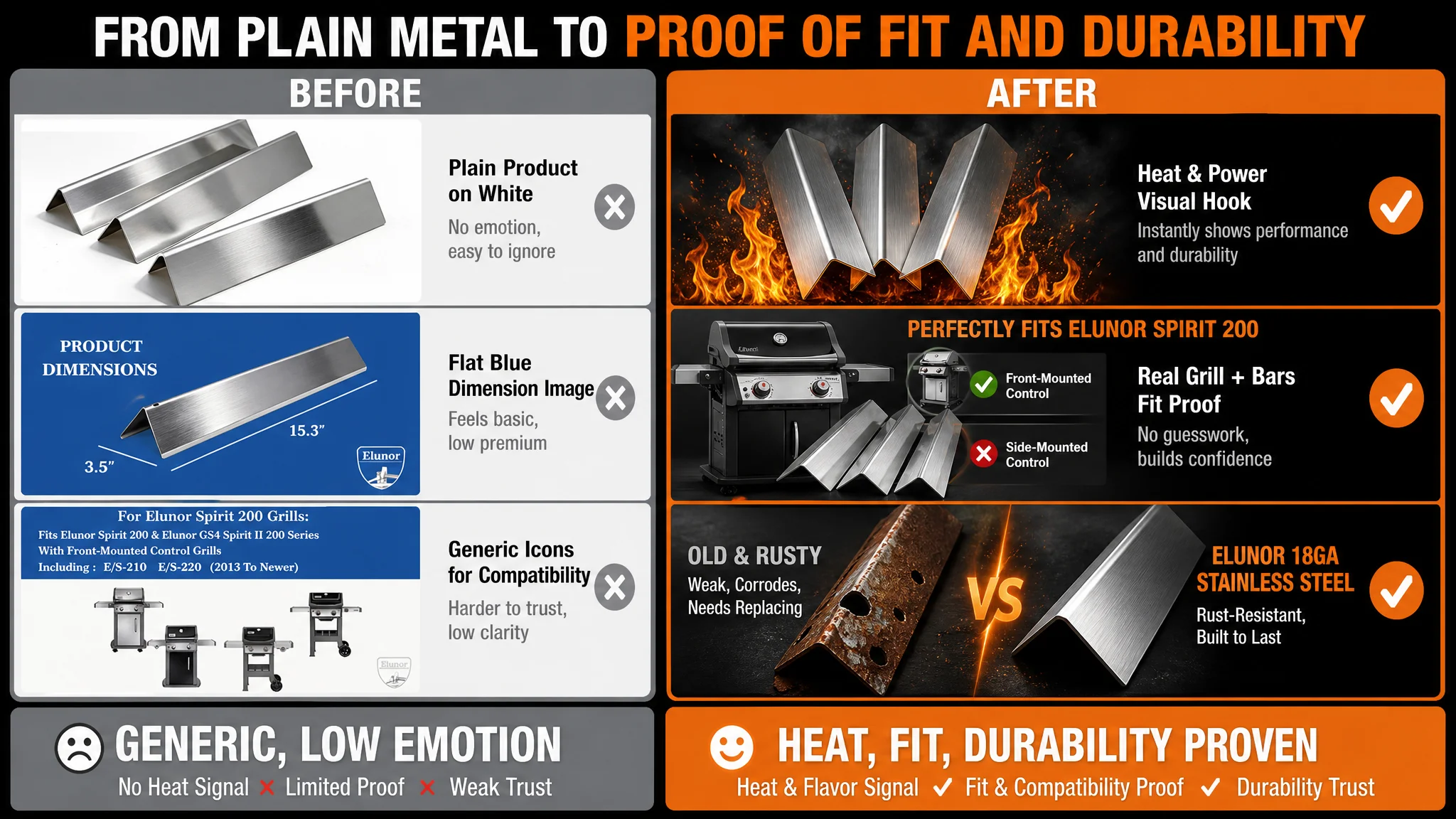
As DeepBI summarized:
“This product page did not lack traffic. It lacked a structured way to prove why this specific set of bars is the right, durable, flavor-enhancing replacement.”
The Most Dangerous Gap: Zero A+ Content in a Category That Sells Trust
The most decisive difference appeared in the detail/A+ dimension:
- Seller: 0/25
- Competitor: 22/25
In practical terms:
- The seller’s Amazon product page had no A+ modules.
- The competitor ran a full A+ storyboard:
- Lifestyle scene (couple grilling)
- Core-benefit tiles with icons
- Compatibility overview
- Dimension diagrams
- Material and thickness comparisons
- “Others vs Ours” visual contrasts
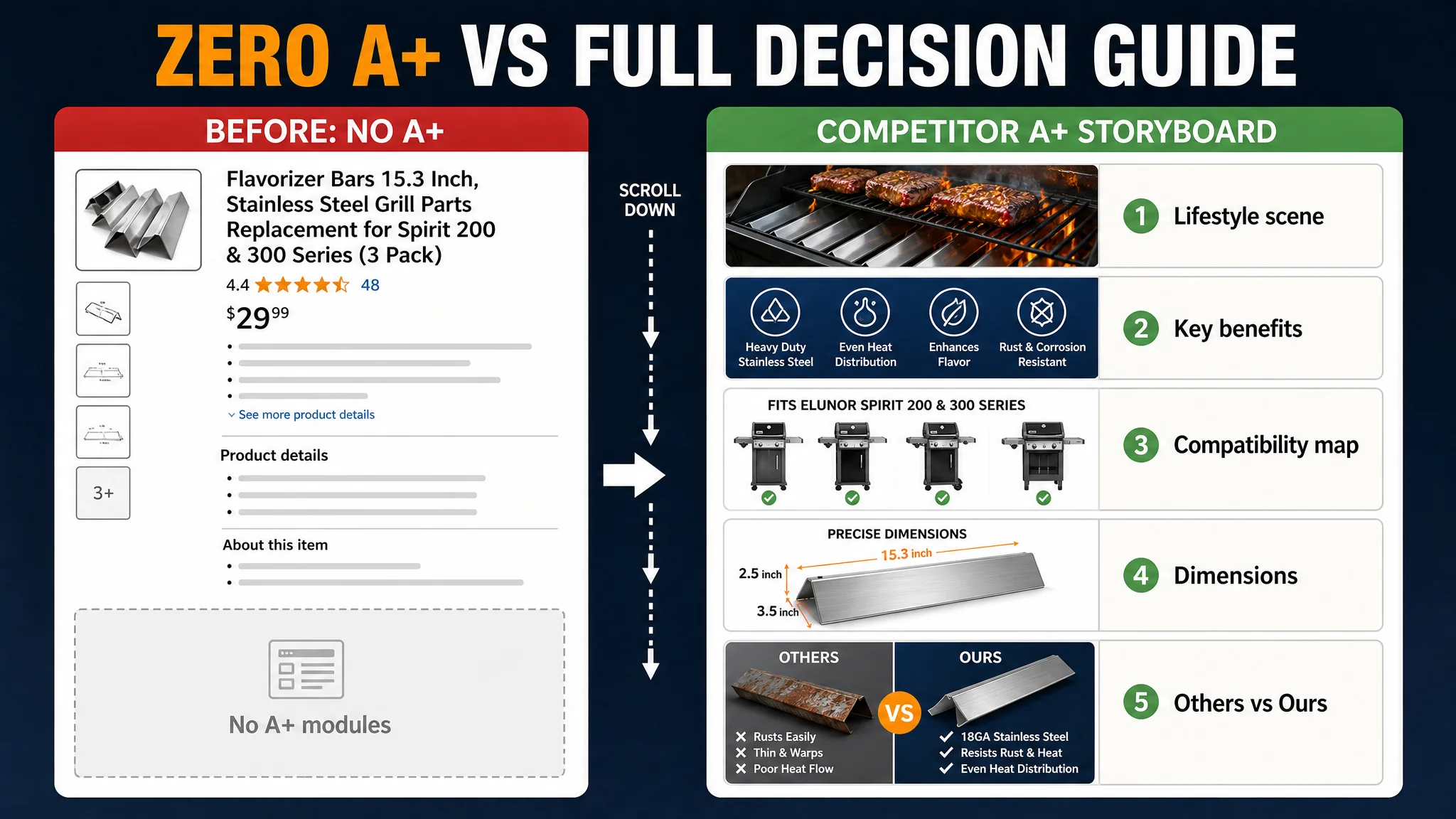
This matters because for grill replacement parts, the two biggest buyer anxieties are:
1. Compatibility: “Will these bars actually fit my exact model?”
2. Durability & flavor: “Are they going to rust again? Will they actually improve grilling?”
The competitor’s A+ directly walked through those concerns:
- Clear compatibility mapping with Weber models and front/side-control clarifications
- Explicit size visuals (“15.3" / 5 pcs / 1.5mm”)
- Material detail (porcelain-enameled steel, thickness)
- Heat-distribution diagrams
- Corrosion comparisons (others vs ours)
The seller’s A+ was blank. Buyers were forced to piece together:
- Fit, using only title and bullets
- Durability, using only a generic “stainless steel” statement
- Flavor improvement, relying on category knowledge instead of the page’s explanation
For DeepBI, this was a clear decision point:
“Before any further ad scaling, this Amazon Listing needed a complete A+ foundation. Otherwise, ads would keep amplifying unaddressed compatibility anxiety and durability doubts.”
Why DeepBI Did Not Recommend “Fix the Ads First”
Faced with these findings, there were two possible paths:
- Path A: keep iterating on ads—more keywords, new campaigns, bid optimizations
- Path B: treat the Listing as the primary lever and rebuild its conversion structure first
DeepBI chose Path B for clear business reasons:
1. The largest score gap (‑22 points) was in detail/A+ content, not in clicks.
- This pointed to a trust and decision-support problem, not a traffic deficit.
1. Bullet points were structurally stronger than the competitor’s, meaning the primary constraints lay in:
- Title’s search and compatibility mapping
- Main-image visual hooks and technical proof
- Complete absence of visual decision aids in A+
1. Continuing to increase ad spend into this Listing risked:
- Higher ACOS
- Wasted spend on returns from wrong-fit buyers
- Poorer review trajectory if compatibility issues turned into negative feedback
In other words, ads were not broken—they were overfeeding an under-built page. The most responsible decision was to raise Listing conversion capacity first, then let ads benefit from a more efficient funnel.
How the Page’s Sales Logic Was Rebuilt
DeepBI’s optimization focus was not “let’s make nicer images” or “let’s write prettier copy.” It was:
Rebuild the Amazon Listing around the real buyer decision logic for grill replacement parts: compatibility confidence, durability proof, and flavor outcome.
1. Reframing the title around compatibility and search logic
The new title direction:
- Front-loaded “Flavorizer Bars” and OEM numbers (7636, 67046)
- Explicitly spelled out:
- Spirit 200 & 300 series
- Spirit II E210/E310/S310/S320
- “Burner Covers” / “Heat Plates” synonyms
- Removed subjective, promotional phrases like “Grill Ready Now!” and “Ready to Install”
This anchored the Listing in:
- The exact language buyers use in Amazon search
- The compatibility clarity parts buyers expect
- A compliant, professional format Amazon’s A9 algorithm can parse and rank
2. Translating bullet strategy into concrete, buyer-facing bullets
DeepBI kept the seller’s user-value logic, but reframed each bullet to serve a specific decision gap:
- BP #1 – WARM TIPS
Lead with a “Warm Tips” structure to reduce mis-orders and signal professionalism:
- Ask buyers to verify model and size
- Emphasize front-mounted control and 2-burner constraints
- BP #2 – Expanded compatibility list
Use the competitor’s approach but tailored to the seller’s real models:
- Break out Spirit 200 series (E210, S210, E220, S220)
- Include Spirit II E-210 / S-210 and specific model codes
- Turn what used to be a single line into a dense, search-rich compatibility map
- BP #3 – GS4 system and drop-in fit
Clarify GS4 Spirit II compatibility and drop-in fit:
- “Perfect fit for GS4 system”
- Replace original Weber part number 7635
- Highlight that installation needs no tools
- BP #4 – Material as a differentiator, not a generic claim
Position premium stainless steel against porcelain-enameled alternatives:
- Non-magnetic stainless
- Resists rust, chipping, warping under heat
- Emphasize “upgrade replacement”
- BP #5 – Dimensions and package clarity
Remove ambiguity about quantity and size:
- Clear dimensions (15.3" x 3.5" x 2.5")
- Explicitly state “set of 3” heavy-duty bars
- BP #6 – Even heating & flavor
Translate “Flavorizer” into understandable benefits:
- Even flame distribution, fewer hot spots
- Trapping drippings to prevent flare-ups
- Smoke flavor creation
- BP #7 – Commitment & maintenance
Add a dedicated warranty and maintenance bullet:
- One-year coverage
- Pro tips on oiling and drying to extend lifespan
- Invite pre-purchase compatibility questions
This kept the original “problem → solution → result” logic, but aligned it tightly with how buyers and Amazon search interpret compatibility, material, and outcome.
The Main Image Was Not Just a Visual Issue. It Failed to Create a Reason to Click.
DeepBI’s main-image recommendations were guided by a clear principle:
Raise CTR and mid-funnel trust by visually proving what matters in this category: heat resistance, fit, durability, and flavor.
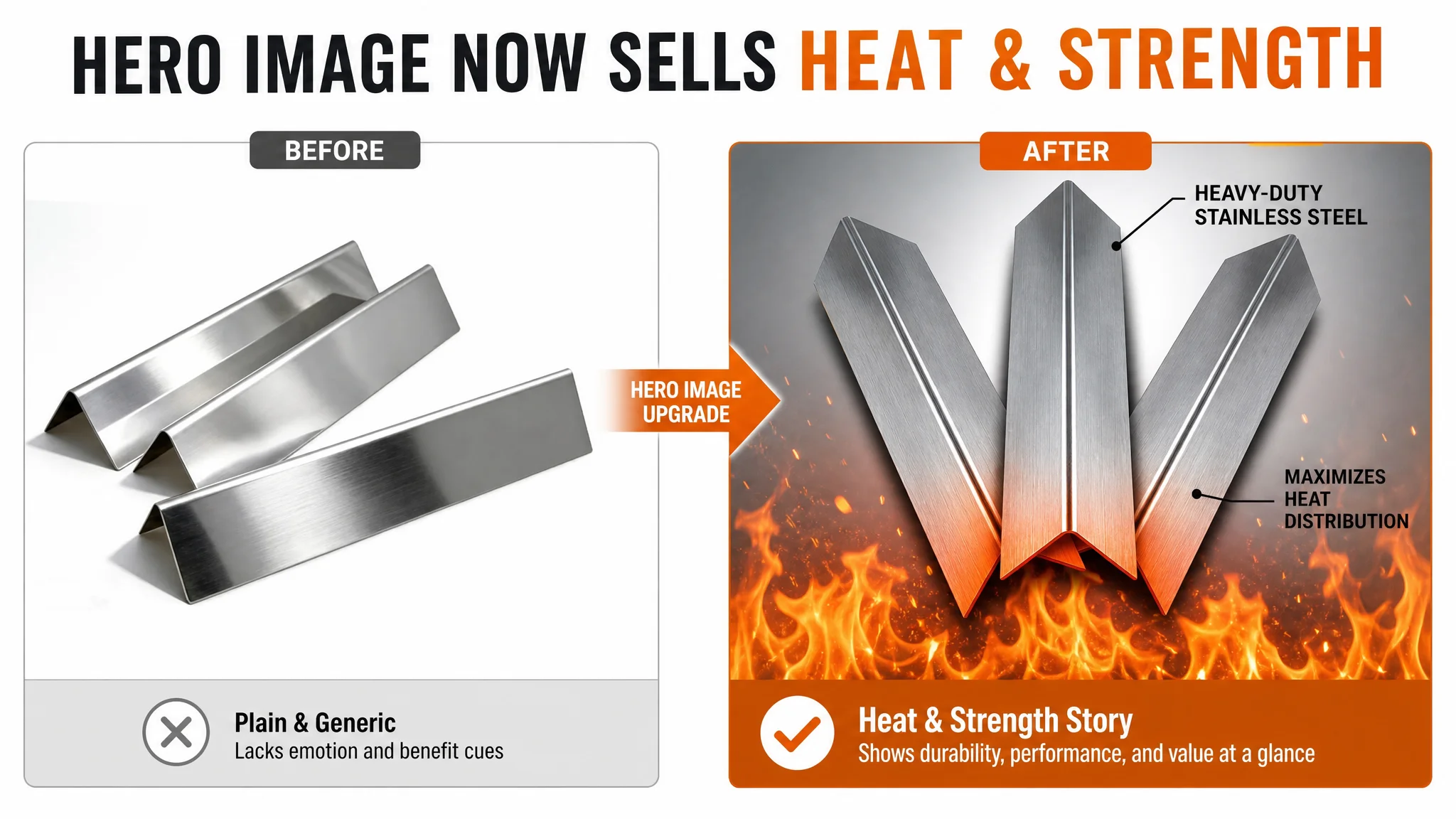
Key proposed changes:
Stronger hero image: industrial + heat narrative
- Flavorizer bars arranged in a 45° fan shape, filling ~70% of the frame
- Hard, industrial-lighting style with strong top-down light and sharp shadows
- Subtle gradient background (light grey), with orange-red flame effects beneath the bars
- Visual message: “these bars live in fire and stay solid.”
Dimension clarity in a premium way
- Replace cheap-looking blue backgrounds with:
- 30° angle product shot
- Clean outdoor balcony grilling scene
- Circular zoom callout highlighting “15.3 inches”
- Message: “this is a precise, professional-grade part, not a generic strip of metal.”
True-fit reassurance with real grills
- Show the bars installed inside a realistic Weber-style grill
- Overlaid text: “PERFECTLY FITS SPIRIT 200”
- Visual anchor: front-control panel vs side-control distinction, mapping directly to buyer concerns
Heat-distribution visual metaphor
- Bars shown above intense blue gas flames
- Light white smoke hints, high angle shot
- Message: “this is how your grill’s flame is managed and distributed.”
Direct corrosion comparison
- Left: rusted, deformed old bar
- Right: clean stainless replacement
- “VS” graphic with flame effect in between
- Background: dark wood, emphasizing contrast
- Message: “you know your old bars look like this—here’s your upgrade.”
In Amazon search, these visuals do more than “look nicer.” They reframe the product from “metal bar” to solution for rust, uneven heat, and bland flavor.
Turning a Blank Detail Page into a Professional Guide
Replacing a zero-content A+ with a structured, category-specific A+ was the most critical step. DeepBI’s A+ plan was built as a guided tour of the buyer’s doubts:
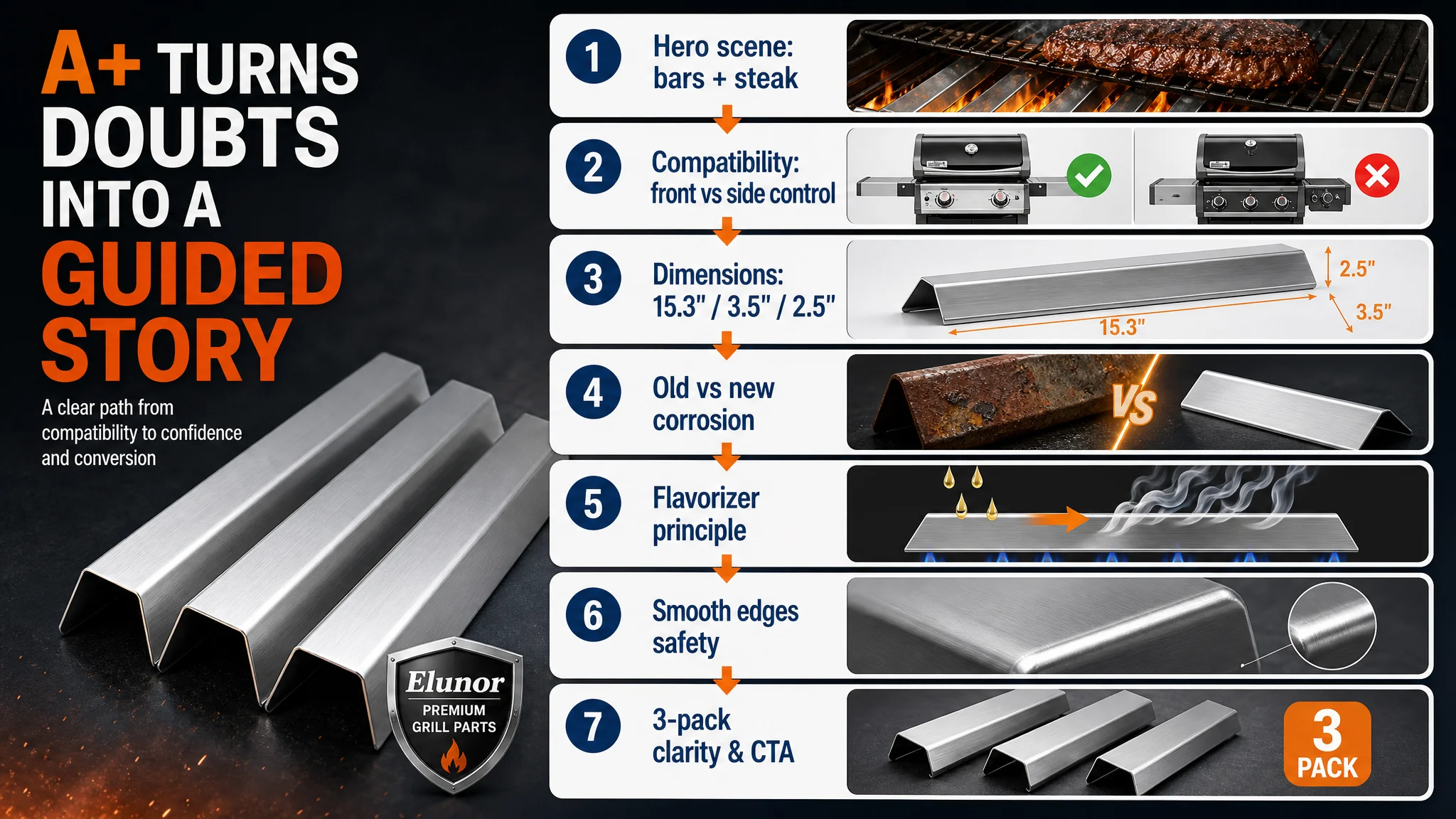
Module 1 – Hero scene: from cold metal to delicious result
- Bars installed inside a grill over glowing coals
- Steak above, white smoke rising
- Warm orange fire vs cool grey metal
- Visual message: “these bars sit at the heart of your flavor.”
Module 2 – Compatibility logic: front-control vs side-control
- Two Weber-style grills on left/right
- Green check on front-mounted-control model
- Red cross on side-mounted-control reference
- Model names labeled (E-210, S-210, etc.)
- Message: “if your grill looks like this, these bars fit; if it looks like that, they don’t.”
Module 3 – Dimensions & fit clarity
- 30° product shot on white
- Clean dimension lines for 15.3", 3.5", 2.5"
- Bold orange typography
- Message: “you don’t need to read text to confirm size.”
Module 4 – New vs old performance comparison
- Left: rusted, perforated old plate
- Right: 18GA stainless flavorizer bar
- Central glowing divider line
- Text: “Old & Rusty” vs “18GA Stainless Steel – Built to Last”
- Message: “this is why you’re replacing them, and why this upgrade lasts longer.”
Module 5 – Flavorizer principle visualized
- Side view of V-shaped bar
- Droplets hitting the bar, turning into spiral smoke
- Dark background with backlighting
- Message: “this is how fat becomes smoke and flavor.”
Module 6 – Safety via edge detail
- Macro shot of smoothed edge
- Side backlighting showing rounded corners
- Text: “Smooth Edges – No Sharp Cuts”
- Message: “won’t cut your hands during installation.”
Module 7 – Package clarity and call-to-action
- Three bars in stepped formation
- “3 PACK” badge
- Clean dark concrete background
- Message: “this is exactly what you’re buying; no surprises.”
This A+ structure turns the detail page from a minimalist spec sheet into a professional guide that:
- Reduces return risk
- Supports a higher price point versus indistinct competitors
- Gives ad-driven traffic a much better chance to convert
How Ad Traffic Became Useful Again
With the restructured Listing:
- Title now aligned with real search and compatibility queries.
- Main images provided both click-driving visuals (fire, scenes, comparisons) and mid-funnel proof (dimensions, fit, corrosion contrast).
- Bullets maintained their user-value logic but were reorganized and densified around compatibility, material advantage, and usage guidance.
- A+ finally told a complete story: fit → dimensions → durability → flavor → safety → package.
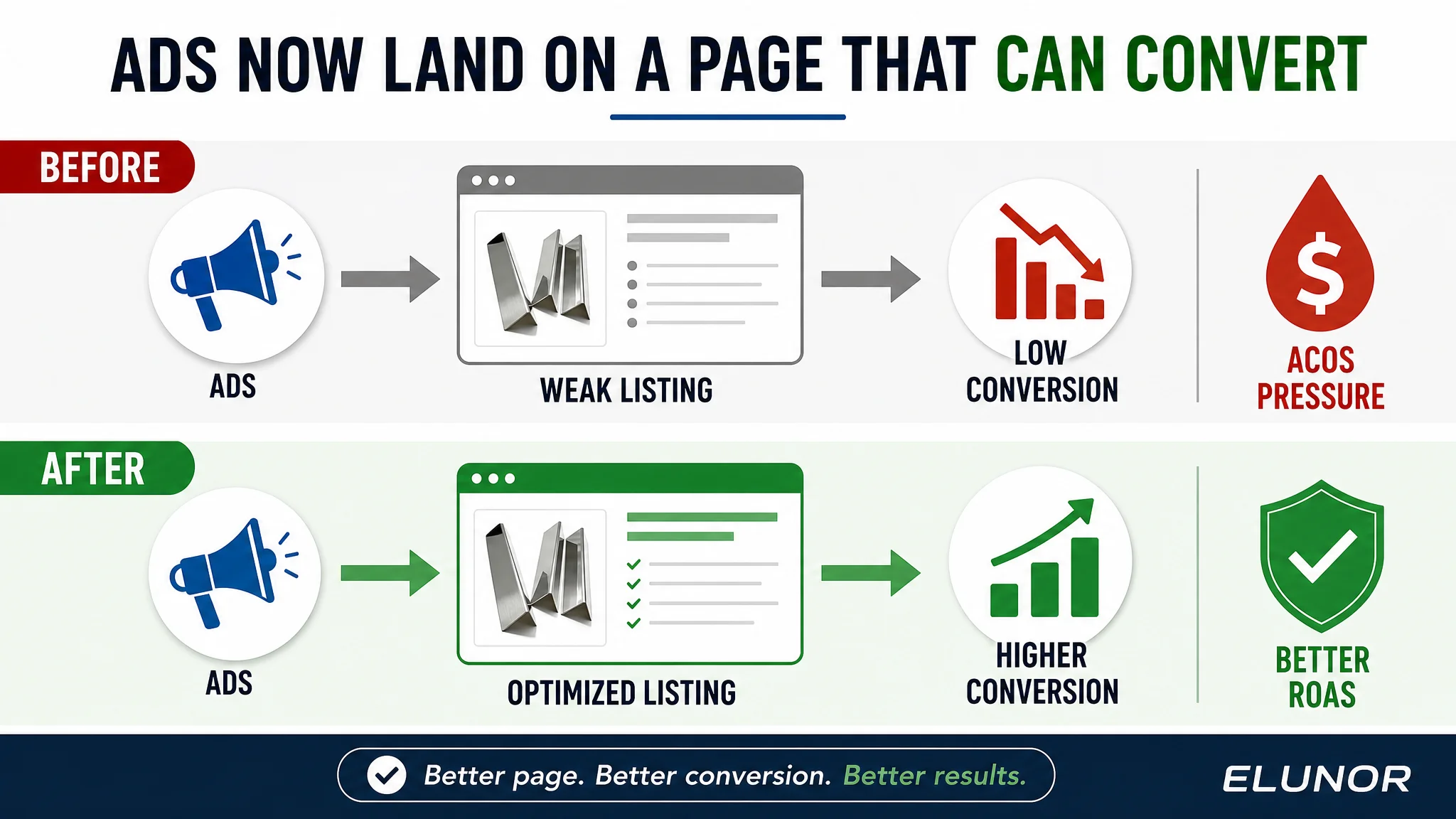
Even without inventing any numerical uplift, we can describe the change in operating state:
- The Amazon Listing began to regain its own ability to convert traffic, rather than depending on aggressive ads to brute-force volume.
- Paid traffic no longer had to fight against unmanaged compatibility anxiety and missing trust signals.
- The seller could rely more on organic and warm traffic, knowing the page provided a coherent, professional guide.
- Ad spend became more controllable: each click landed on a page that did more work to close the sale.
“Advertising does not only amplify advantages. It can also amplify a page’s existing defects.”
In this case, once those defects were structurally addressed, ads finally had a surface they deserved.
How the Seller’s Understanding Changed
By the end of the process, the seller’s internal narrative had shifted:
- From: “Our ACOS is high; we must adjust Amazon ads.”
- To: “Our Listing’s conversion capacity—especially A+ and main image logic—was the real bottleneck.”
Key realizations:
- Amazon ads cannot fix a weak product page. They can only expose it faster.
- Listing quality is the foundation of advertising efficiency. A better page doesn’t just look nicer; it changes the economics of every click.
- Title, main images, bullets, and A+ are not separate tasks. They must form a single, coherent decision path:
search → click → trust → proof → purchase.
- Before scaling ads, the right question is:
“Does this page deserve more traffic yet?”
For other Amazon sellers, especially in parts and accessories categories, this case is a warning and a roadmap:
- If you keep treating every ACOS problem as a bidding problem, you may be misdiagnosing a deeper conversion issue.
- If your competitor’s Listing feels effortlessly stronger, it’s likely not “just better design,” but a more complete compatibility and trust structure.
- Fixing that structure first can turn every future advertising dollar from a cost into an asset.