

This case comes from an Amazon seller in the US grill-accessories category. The team had been watching Amazon ads become more and more expensive on a replacement Flavorizer Bar & heat-deflector kit, and their instinct was simple: the ads must be the problem. They tried to “optimize” around bids and keywords, but orders remained unstable, ACOS pressure stayed high, and the Listing never really broke out.
DeepBI stepped in and reframed the issue: the core problem was not traffic volume or keyword coverage, but a structurally weaker Amazon product page that couldn’t convert the traffic it already had—especially when compared to a category-leading benchmark Listing. Title, main image set, bullets, A+ content, and reviews were collectively dragging down trust and conversion, so every click the ads bought was being consumed by an underperforming page.
After mapping the gaps against the benchmark, DeepBI guided the seller to pivot: pause the “ads-first” mindset and rebuild the Listing’s conversion capacity first—tightening the Amazon title logic, introducing a more professional main-image system, restructuring bullets around “pain point → mechanism → outcome,” and upgrading A+ to a clear, visual story about heat distribution, durability, and fit. The outcome wasn’t a magic spike, but a Listing that finally began to carry its own weight: ad traffic became useful again, conversion started to recover, and the seller fundamentally changed how they judged whether a page was ready for more Amazon ads.
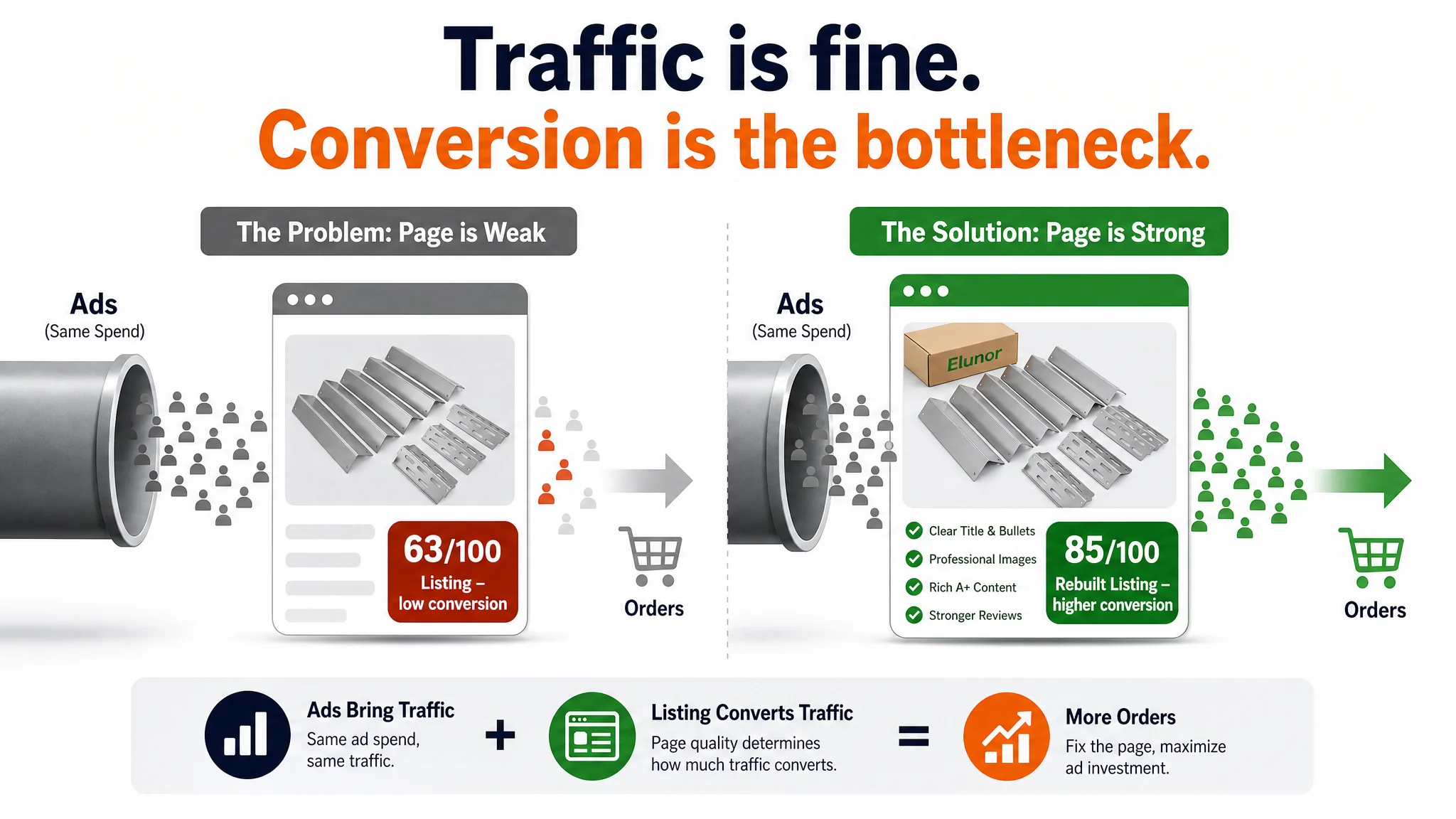
This Was Not an Advertising Failure. It Was a Page-Conversion Failure.
On paper, this was a typical Amazon operational pressure cooker.
- The product: a stainless-steel replacement kit for gas grills (Flavorizer Bars + Heat Deflectors) in the US marketplace.
- The category: highly competitive, with one clear benchmark Listing dominating rankings, reviews, and conversion.
- The seller’s pain: ads felt “expensive,” ACOS hard to control, and paid traffic did not translate into steady orders.
The seller’s first instinct was classical Amazon thinking: “We need better ad optimization—more precise bids, more long-tail keywords, better negative lists.” But DeepBI’s Listing scoring told a different story.
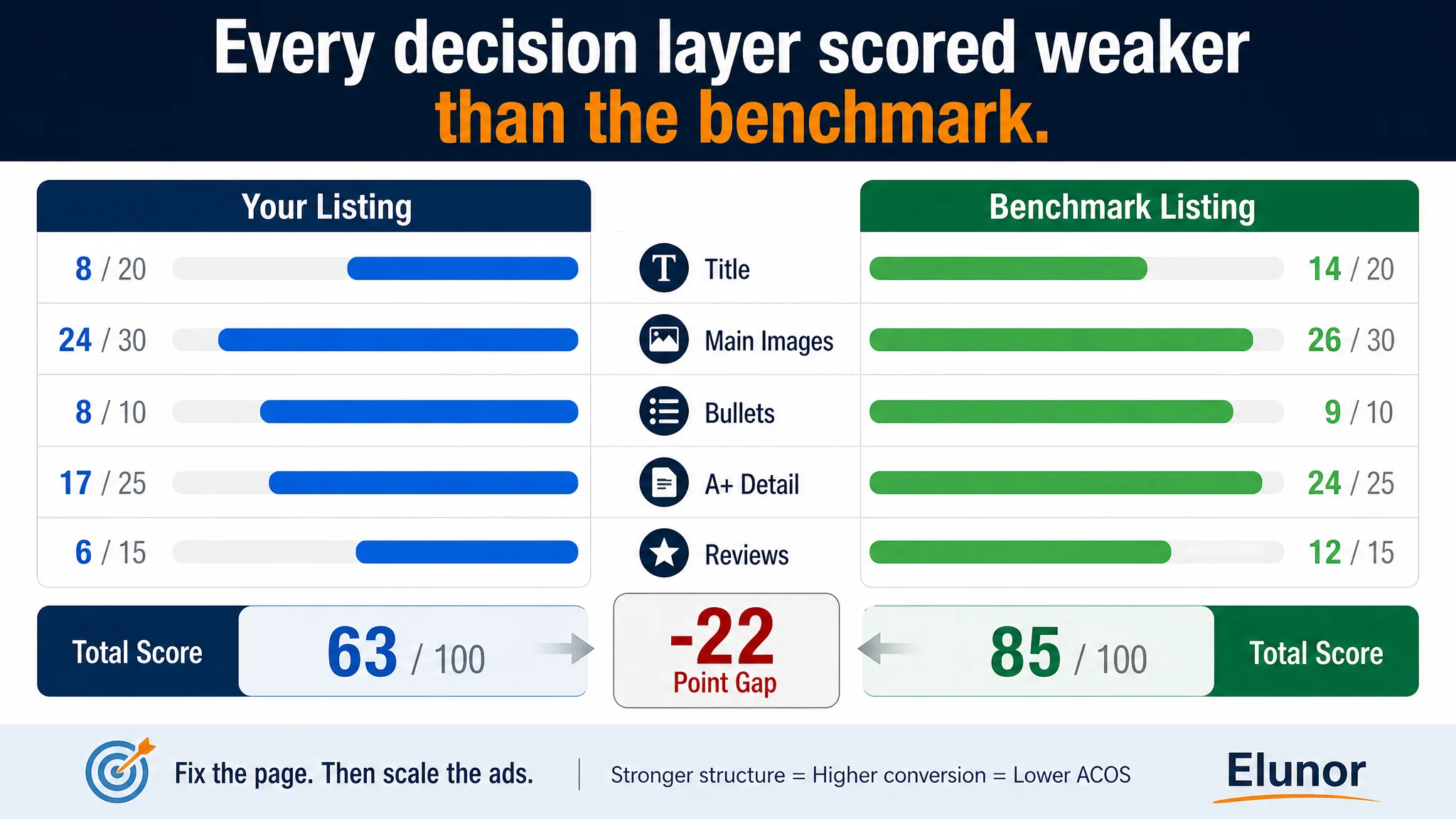
- Target Listing total score: 63/100
- Benchmark Listing total score: 85/100
- Deficit: -22 points, spread across every major decision layer on the product page.
At this point, it became clear: even if the ad engine brought perfect traffic, the page itself was not designed to win the decision.
“The real problem was not that ads failed to bring traffic. It was that the page could not convert the traffic.”
The Single Core Constraint: Listing Conversion Capacity
Among all the weaknesses, DeepBI identified one core bottleneck:
The Listing lacked the decision structure and trust depth to convert Amazon traffic—especially when benchmarked against the category leader.
Everything else—ads, bids, keyword choices—was downstream.
The score breakdown made this visible:
- Title: 8 vs 14 (out of 20) → the page was under-communicating core search terms and value.
- Main image set: 24 vs 26 (out of 30) → seemingly “OK,” but missing key professional trust triggers.
- Bullet points: 8 vs 9 (out of 10) → structurally weaker, with missing buying logic.
- Detail/A+ content: 17 vs 24 (out of 25) → a serious gap in explanation, proof, and visual storytelling.
- Reviews: 6 vs 12 (out of 15) → trust deficit magnified by low volume and high visible negative share.
The main risk here was structural:
- Traffic (both organic and paid) was being directed to a page that looked like it had basic content, but lacked the conversion “engine” the benchmark had already built.
- Continuing to throw ad budget at this Listing would not fix CVR; it would merely amplify the page’s existing weaknesses.
The Original Misdiagnosis: “This Is an Ads Problem”
From the seller’s perspective, the symptoms were straightforward:
- ACOS creeping up.
- Ads harder to optimize than in past years.
- Competitors capturing more share even at similar price levels.
So the working assumption became:
- “Our keywords must not be refined enough.”
- “Maybe our bids and campaign structure are inefficient.”
- “We should keep testing creatives and keyword groupings.”
DeepBI’s data contradicted this.
When the Listing score is sitting at 63/100 versus an 85/100 benchmark, and the gap is heaviest in title clarity, A+ depth, and review trust, the probability that ads alone are the problem drops sharply.
The misdiagnosis was clear:
- The seller treated high ACOS as primarily an advertising-optimization issue.
- In reality, low conversion on a structurally weaker Listing was inflating ACOS, undermining both ads and organic growth.
Amazon Ads Were Not Failing. The Page Was Consuming the Traffic.
Looking deeper into each dimension clarified why traditional ad tuning kept failing.
1. The Title Looked Like a Warehouse Label, Not a Buying Hook
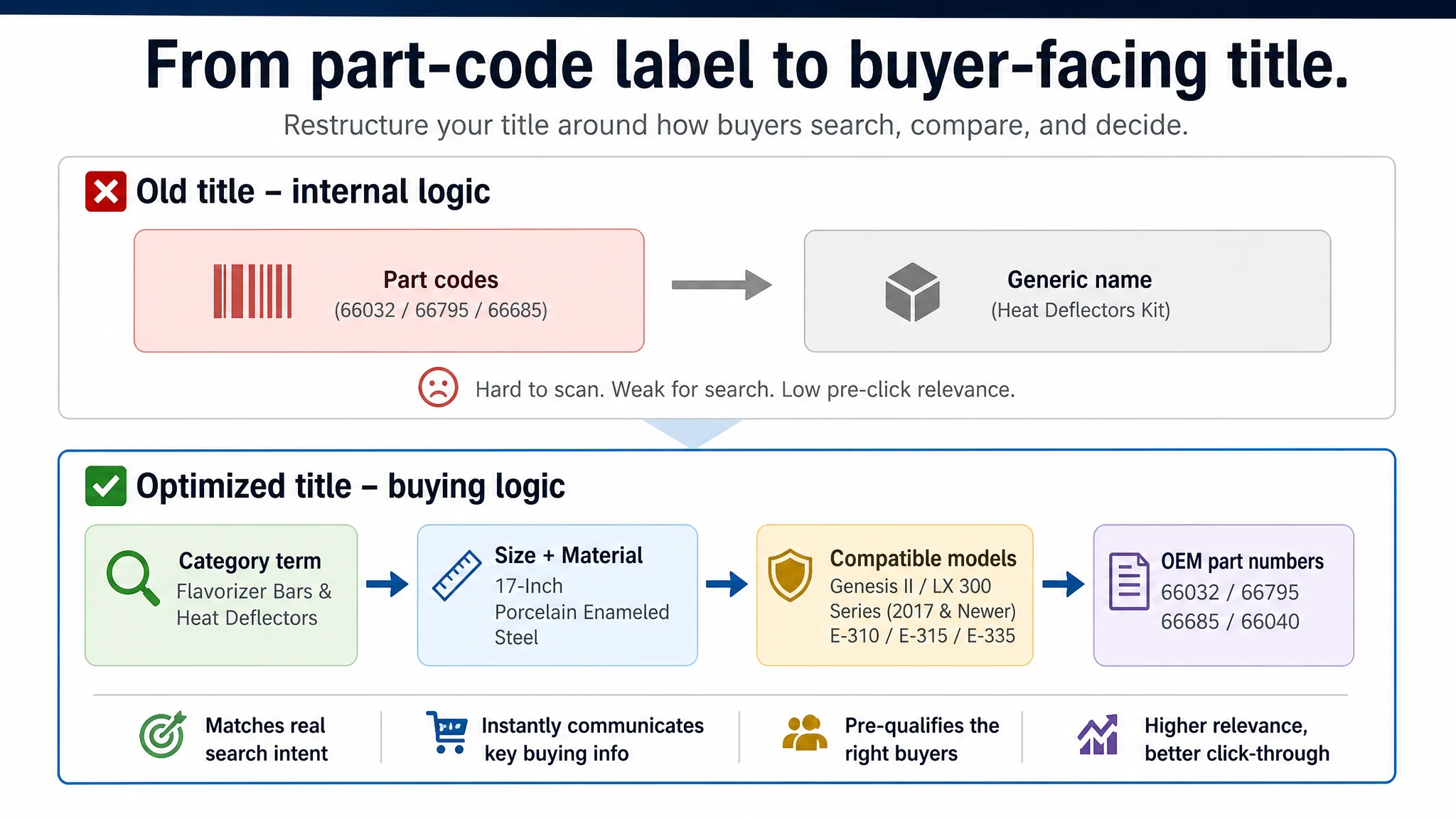
The original title led with part codes (66032/66795×5 + 66685×3) instead of the actual product logic buyers search for.
Problem patterns:
- Core category term “Flavorizer Bars” was buried instead of front-loaded.
- The structure read like internal inventory: codes first, product second.
- No clear, consumer-facing formula such as
Brand + Product Name + Compatible Models + Key Attributes (material, size).
- Material (Porcelain Enameled Steel on the benchmark) and size (17-Inch) were missing—both critical for search relevance and click confidence.
- The title used “Heat Deflectors” as a primary label—less standard than “Flavorizer Bars,” meaning weaker alignment with high-search keywords.
For the benchmark, the title alone already answered:
- What it is.
- For which grills.
- Material and size.
- Compatibility year range (2017 & newer).
For the seller’s Listing, the title answered:
- Internal part number structure.
- A non-standard naming variant.
In a competitive Amazon search page, this alone reduces click-through and pre-qualifies fewer right-fit buyers.
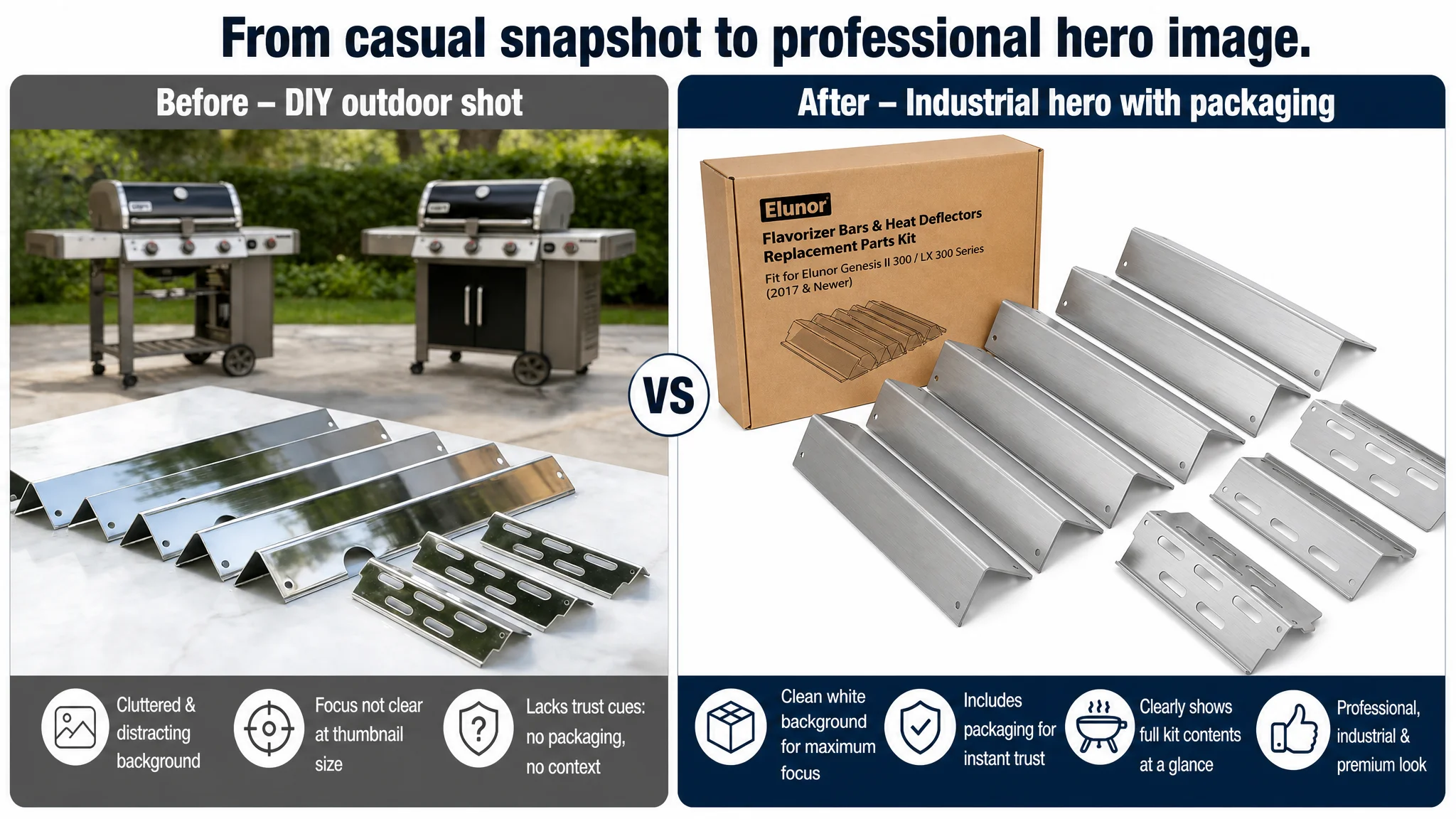
2. The Main Images Looked “DIY,” Not “Industrial-Grade”
At thumbnail level, buyers decide in milliseconds whether a product looks:
- OEM-grade and trustworthy, or
- Generic and possibly risky to fit/install.
DeepBI’s visual analysis flagged several issues:
- Background clutter and “AI-ish” tone → undermined perceived authenticity and brand seriousness.
- Focus drift → the product was not clearly the visual anchor, especially on mobile.
- Lack of industrial context → no calipers, no heat scenario, no in-grill installation photo.
The benchmark, by contrast:
- Puts the product in a clean, high-contrast, industrial-style environment.
- Shows packaging, implying professional production and quality control.
- Uses tools (calipers, gauges) and structural cutaways to communicate “engineer-level precision.”
This matters directly for CTR and CVR:
- Without a clear, professional main-image system, even interested buyers may not click.
- Those who do click have less reason to trust material claims or fit, and more reason to bounce.
This Product Page Did Not Lack Information. It Lacked a Buying Logic.
On paper, the seller did have bullet points and an A+ module.
The problem was not “no content,” but misaligned content.
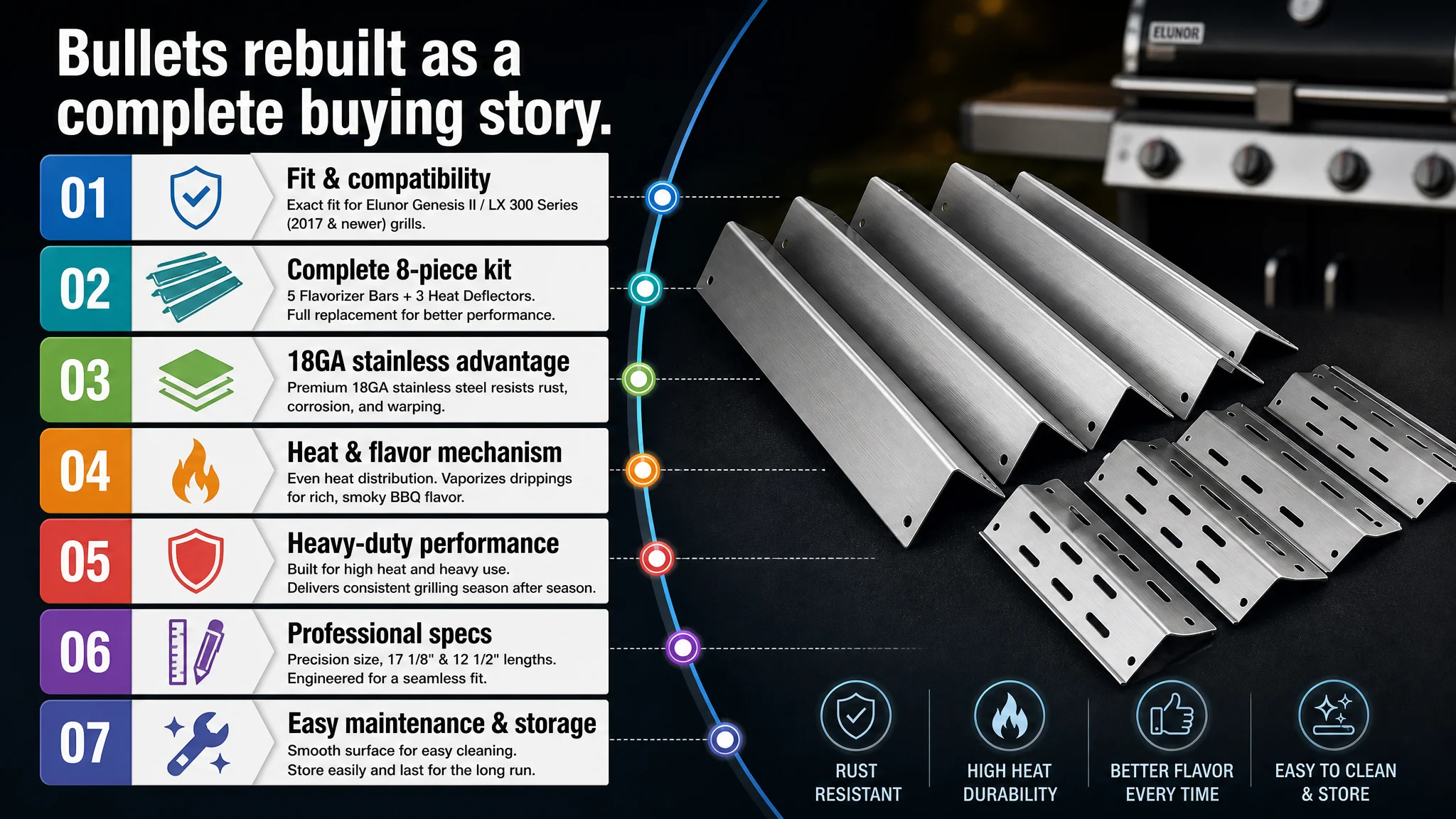
Bullet Points: Parameters Without a Narrative
DeepBI’s comparison showed that:
- The seller had 5 bullet points; the benchmark used 7, with higher information density.
- The seller’s bullets focused heavily on parameter comparisons (18GA vs 16GA, stainless vs porcelain), plus basic benefits like “no modification” and “easy to clean.”
The benchmark did something different:
- Led each bullet with a bracketed hook: 【Core Claim】 for instant scanning.
- Sequenced content from compatibility → dimensions → thickness → heat distribution → performance → coating technology → upgraded flavor experience.
- Made the mechanism explicit: oil drippings vaporize on the bars, generating smoky flavor and protecting burners.
The seller’s bullets promised outcomes like “perfect grill marks” but did not:
- Show how the design delivers those outcomes.
- Emphasize the full 8-piece kit as a complete overhaul.
- Exploit stainless steel’s long-term, no-rust advantages in a structured way.
DeepBI rebuilt bullets around a richer logic:
- BP #1 – Fit First:
Detailed compatibility list for specific Weber models, with clear “Perfect Fit” framing and explicit OEM part numbers (#66032, 66795, 66685, 66040).
- BP #2 – Complete Kit:
Positioning as an 8-piece complete overhaul (5 bars + 3 heat deflectors), not just a piece replacement.
- BP #3 – Material Advantage:
Highlighting 18GA stainless steel, with a direct contrast to porcelain-coated bars that chip and rust.
- BP #4 – Heat & Flavor Mechanism:
Explicit description of how even heat distribution and vaporized drippings create smoky flavor.
- BP #5 – Heavy-Duty Performance:
Stability, heat retention, and consistent searing results.
- BP #6 – Professional Specs:
Reinforcing food-grade stainless, corrosion resistance, and durability as a serious upgrade.
- BP #7 – Maintenance & Ease:
Easy cleaning, simple seasonal storage, and hassle-free installation.
In other words, bullets shifted from:
“We have parameters and some claims”
to
“We tell a complete story: fit, kit completeness, material upgrade, heat mechanism, performance, and ownership experience.”
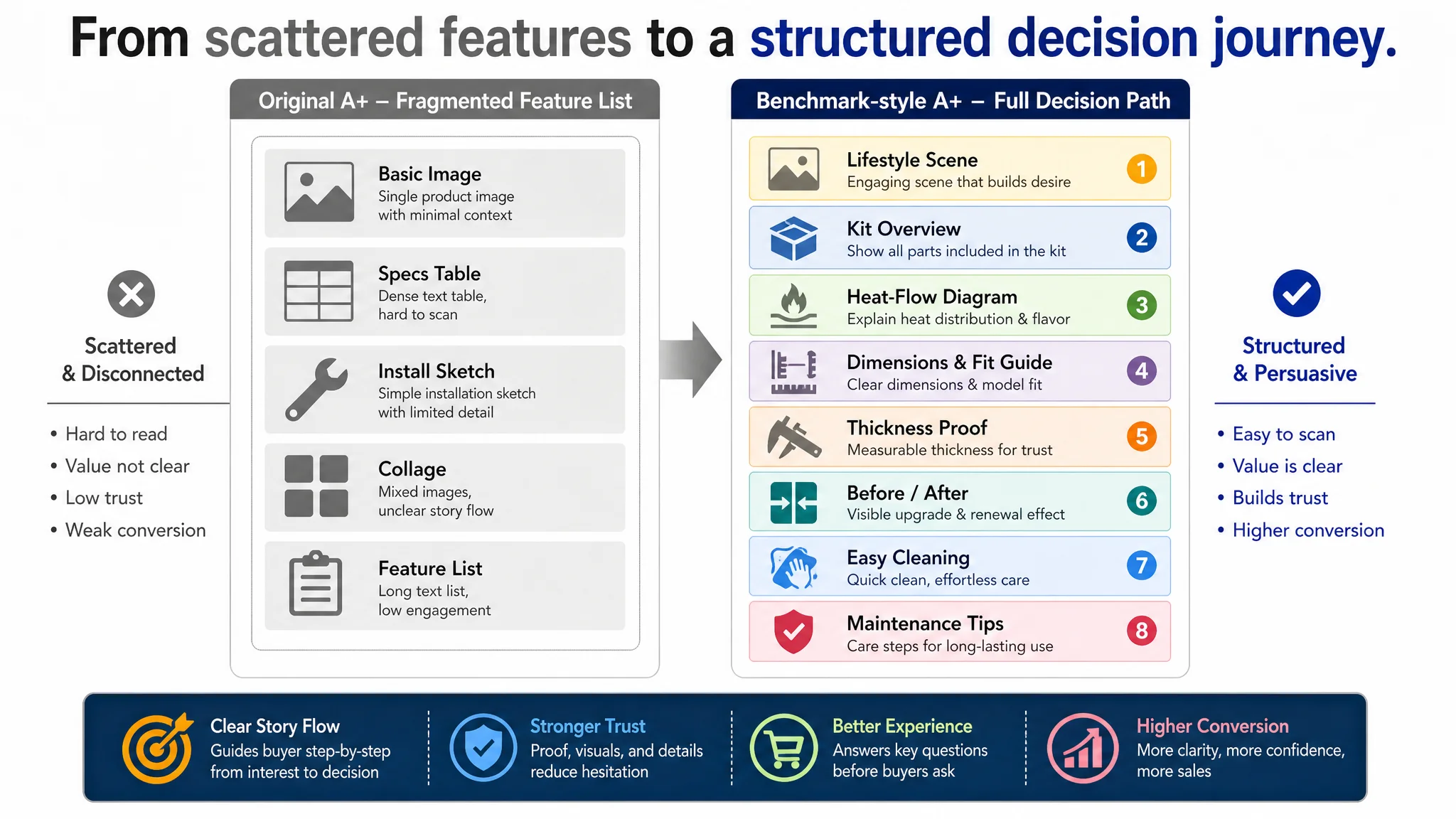
Detail/A+ Content: A Basic Feature List vs a Full Decision Journey
The A+ comparison was the most decisive.
Benchmark A+: High-Value Modules, High Trust
The category-leading competitor built a dense, structured page including:
- Lifestyle scene: grill in use, family context.
- Product combination overview: what exactly is in the box.
- Functional principle diagrams: heat flow, burner protection, drip vaporization.
- Precise dimension visuals: lengths, widths, thickness, annotated on the product.
- Layered structure diagrams: coatings, base metal, protection logic.
- Cleaning demonstration: real hand wiping grease off, visually conveying “easy clean.”
- Thickness comparison: calipers measuring 16GA vs thinner alternatives.
- Before/After visuals: rusty old parts vs renewed interior after replacement.
- Packaging and maintenance guidance: tackling after-purchase doubts and reinforcing long-term use.
This serves several functions:
- Converts “quality” from a vague claim into visible evidence.
- Reduces fit anxiety with visual dimension checks.
- Provides emotional closure: the grill looks “like new” again; the purchase feels like a restoration, not just a part swap.
Seller’s A+: Functional but Underpowered
DeepBI’s audit showed:
- Modules used: main visual, compatibility table, installation diagram, a nine-grid selling point collage, and a basic effect comparison.
- Strength: some structure, some attempt at explanation.
- Weakness:
- Few high-value proof elements (no caliper shots, no GA thickness evidence).
- Limited emotional context (no real-life barbecue scene, no clear Before/After shock).
- No clear maintenance or gift/long-term ownership angle.
As a result, the page stayed in “feature list” territory, not a fully persuasive journey.
DeepBI’s optimization approach focused on four axes:
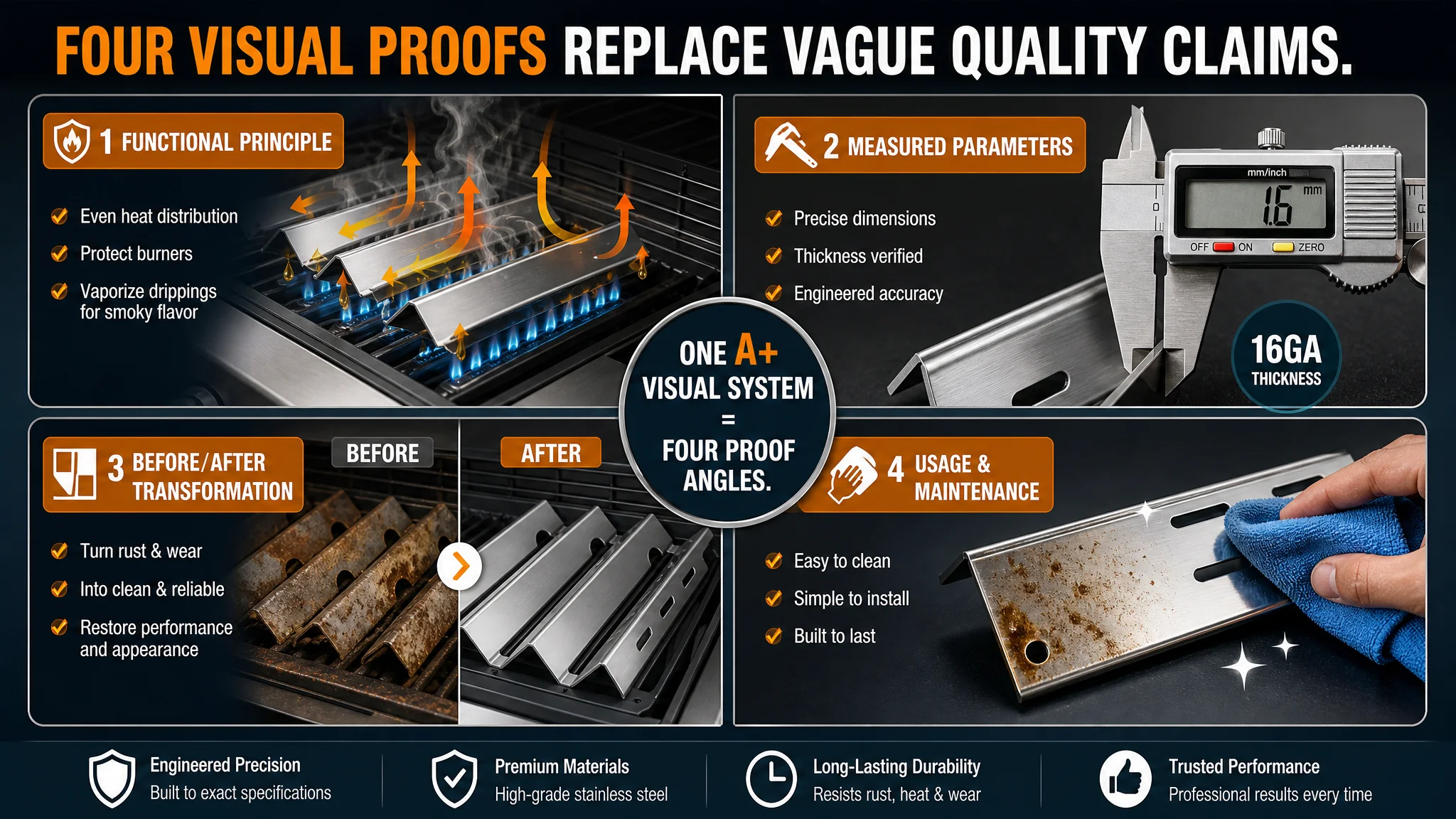
1. Functional principle visualized
Show heat distribution, burner protection, and smoke generation explicitly with diagrams: blue flames, orange heat arrows, drip-to-smoke logic.
1. Physical parameters evidenced
Use caliper shots with visible thickness readings (e.g., 1.6 mm/16GA visuals, positioned carefully to avoid misrepresenting real specs) to create a professional engineering impression.
1. Before/After transformation
Reinforce the core purchase motive—grill restoration and maintenance—via stark old vs new comparisons.
1. Realistic usage and maintenance
Real cleaning actions, visible oil removal, crisp metal surfaces, and simple maintenance steps to lower perceived hassle.
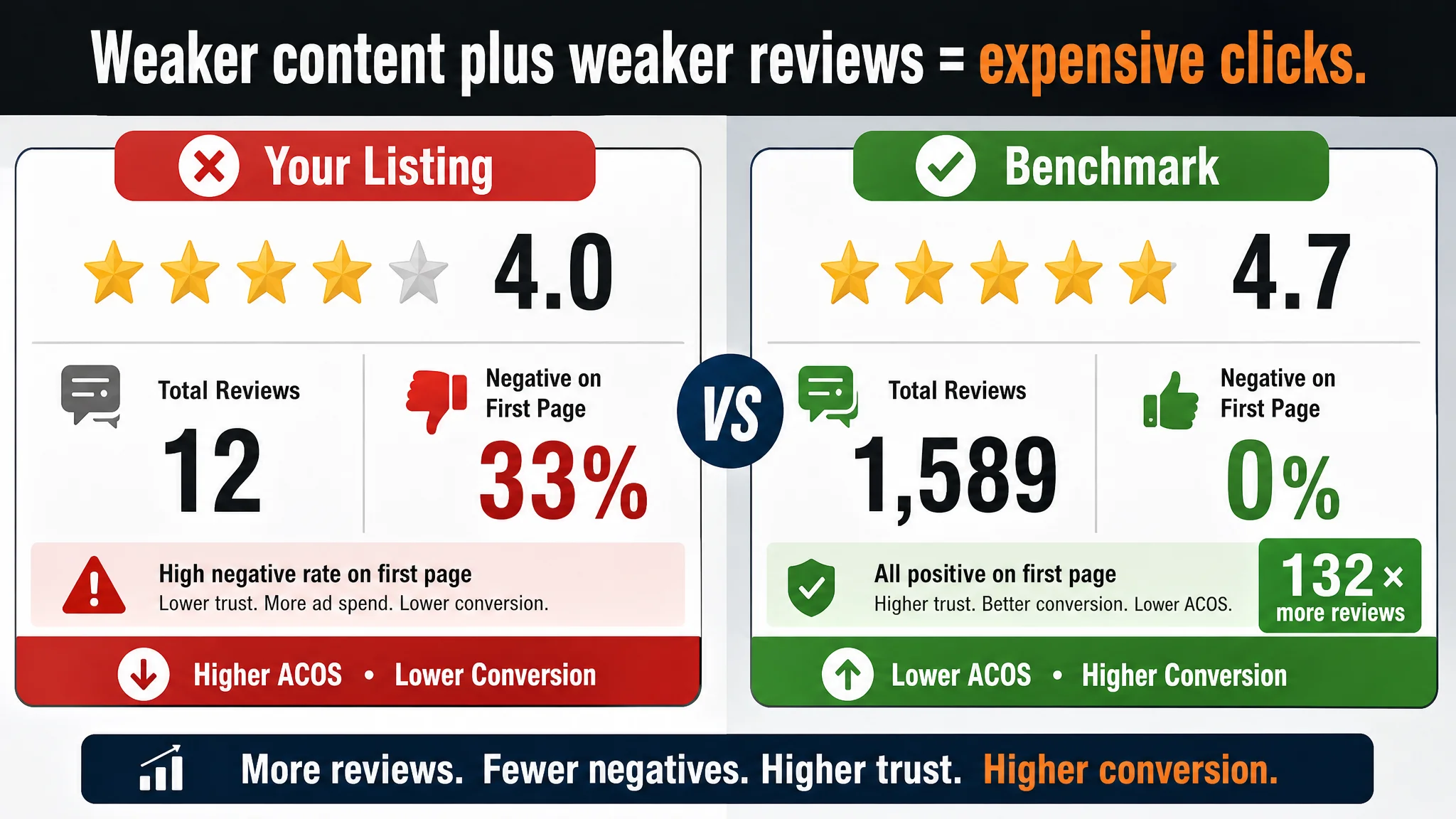
Reviews: Trust Deficit at the Most Visible Layer
The score gap in reviews was brutal:
- Seller: 4.0 stars, 12 total reviews, 6 visible on the first page.
- Benchmark: 4.7 stars, 1,589 total reviews, 12 visible on the first page.
Impact:
- Rating: -0.7 stars in a category where ≥4.5 is often the informal trust threshold.
- Volume: competitor had 132x more reviews, signaling far more social proof and usage history.
- First-page sentiment: benchmark had 0% visible negative reviews, while the seller had 33% negative among top-lined reviews.
This double-hit (weaker content + weaker reviews) means:
- Every click costs more to convert.
- Ad spend must fight both a structural trust deficit and a content deficit at the same time.
DeepBI’s judgment: Listing conversion must be repaired first to reduce the pressure on ads and create a foundation for review growth.
Why DeepBI Did Not Recommend “Keep Tuning Ads First”
From a decision standpoint, DeepBI confronted a simple trade-off:
- Option A: continue focusing on ad tuning—bids, keywords, campaign structures—for a Listing that is structurally weaker at every decision layer.
- Option B: temporarily shift energy into fixing the core Listing conversion drivers, then re-evaluate ads with a stronger page.
The biggest risks of Option A:
- Ads amplify defects. More traffic flows into a page that is still less persuasive than the benchmark.
- ACOS remains structurally inflated. Even better keyword targeting cannot fully offset low CVR.
- Organic ranking remains fragile. Amazon’s A9 algorithm favors Listings that convert; poor CVR undermines sustainable organic visibility.
DeepBI chose Option B because:
- The Listing was -22 points behind the benchmark; closing that structural gap offered more leverage than marginal ad tweaks.
- Title, main image, A+, and bullets all had measurable, fixable shortcomings.
- Without a stronger page, scaling ads would be equivalent to “buying expensive experiments” with low upside.
“Advertising does not only amplify advantages. It can also amplify a page’s existing defects.”
How the Visual and Text Logic Was Rebuilt
DeepBI’s optimization direction did not start from “make the page prettier,” but from reconstructing the decision path.
Title: From Codes to Compatibility + Material + Size
Old pattern:
- Codes, internal logic, and less-standard naming terms.
New direction:
- Front-load “Flavorizer Bars & Heat Deflectors” as the category term.
- Specify size and material: “17-Inch Porcelain Enameled Steel” or stainless steel where applicable.
- Explicit compatibility:
“For Weber Genesis II/LX 300 Series, Genesis II E-310, E-315, E-335 (2017 & Newer)”
- Keep OEM part numbers but push them to the later part of the title, structured and easy to scan.
This aligns the Listing title with both Amazon A9 logic and buyer search habits.
Main Image System: From “Amateur Shoot” to Industrial Professional
Instead of generic product-on-background photos, DeepBI guided a full system:
1. Hero image with packaging
- Product group centered, occupying ~70% of the frame.
- Packaging box in a corner to signal brand and completeness.
- Clean white background, high contrast, industrial lighting.
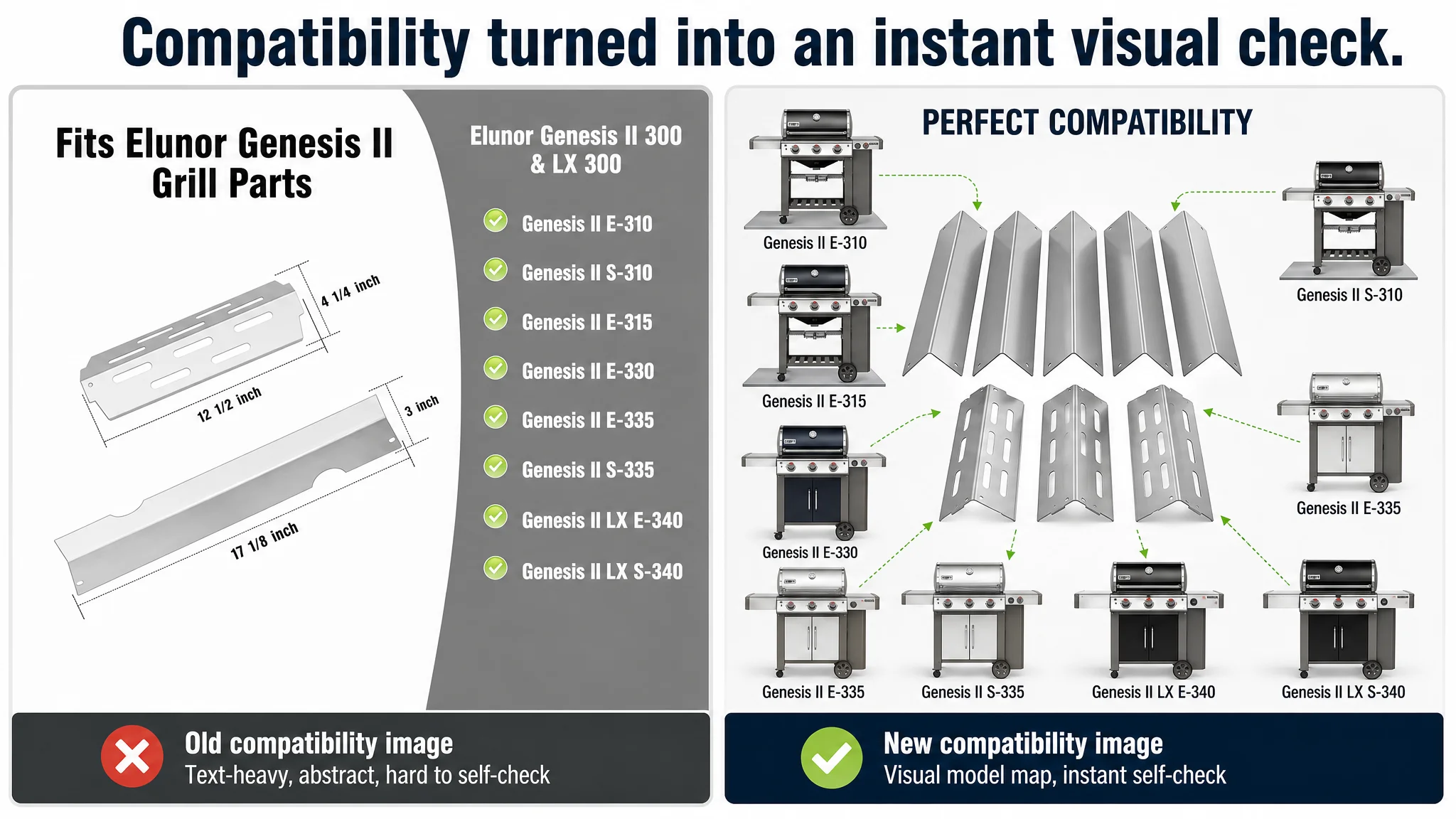
1. Compatibility visual map
- Main product in the center.
- Surrounding miniature grill models (Genesis II E-310, E-315, etc.) with labeled names.
- Lines visually connecting the kit to specific models; bold “Perfect Compatibility” tag.
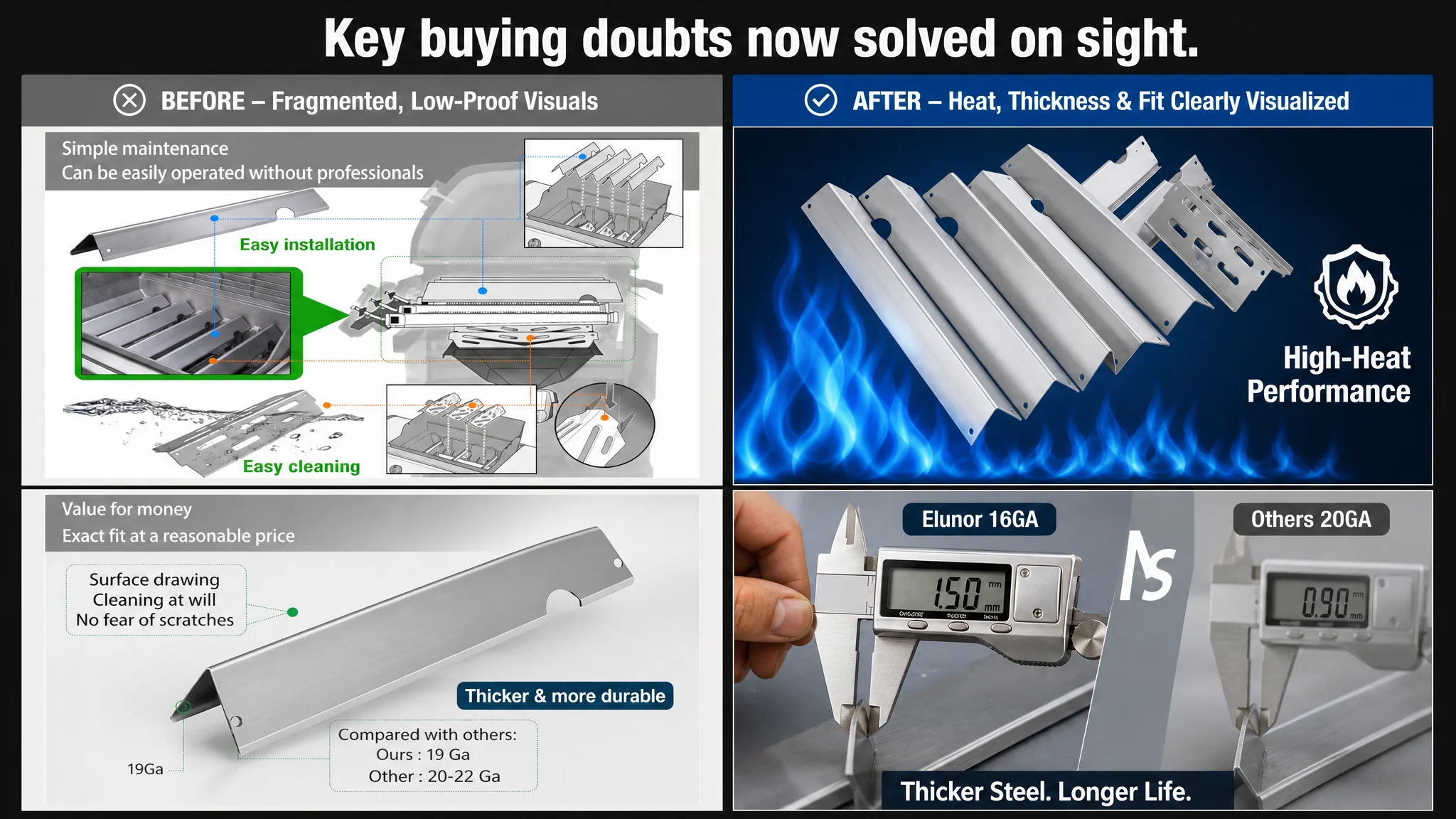
1. Heat-performance visual
- Bars at 45 degrees, blue flame effect beneath, dark blue industrial background.
- “High-Heat Performance” iconography to visually connect to durability.
1. Thickness and engineering proof
- Close-up of a caliper measuring the thickness.
- Text overlay: “18GA Stainless Steel” vs a thinner alternative, without misrepresenting reality.
1. Real in-grill installation
- Product installed inside the grill, occupying ~80% of the frame.
- Tagline: “Direct Fit, No Tools Needed.”
1. Functional principle
- Dripping oil turning into smoke over the bars, with heat and flow arrows.
1. Anti-mistake guide
- Visual cues on how to avoid buying the wrong size/fit, reducing returns.
The point is not aesthetic for its own sake—but visual proof of fit, durability, heat resistance, and ease of use.
A+ Content: Turning Abstract Claims into Visual Logic
DeepBI’s A+ direction focused on six strategic modules:
1. Lifestyle entry scene
- Outdoor barbecue scene, family in the background, grill in use.
- The grill and food clearly in focus, establishing emotional context: “restore your grill, upgrade your weekends.”
1. Core principle diagram
- Deep, industrial-style graphic showing bars over flames with heat and smoke flow.
- Clearly labeled: “Protects burners” + “Even heat distribution” + “Smoky flavor.”
1. Thickness proof module
- Split screen: left shows a hand using a digital caliper on the product, reading the real value; right shows a thinner competitor.
- Simple text: “Engineered for durable, food-safe performance.”
1. Before/After overhaul
- Rusted, corroded old parts vs new stainless kit installed.
- Visual contrast in light, color, and cleanliness.
1. Cleaning and maintenance
- Real hand wiping grease with a cloth, showing a sharp contrast between dirty and clean surfaces.
- Short, visual care instructions.
1. Exploded structure view
- Layered view of the bar’s material structure (base metal, protective finishes), reinforcing manufacturing quality.
These modules do one thing: turn “better quality” from a claim into a series of visible proofs that reduce friction in the buying decision.
What Changed for the Business (Even Without Inventing Numbers)
The case material doesn’t include post-optimization ACOS or CVR figures, so we will not fabricate data.
But there were clear shifts in operating state and risk:
- The Listing’s conversion capacity was no longer clearly outclassed by the benchmark on every dimension.
- The title and bullets began to align with real search behavior and decision logic instead of internal codes and generic claims.
- The main image and A+ started to carry their own weight in terms of trust, fit validation, and perceived professionalism.
- The seller’s dependence on ads as a “brute force” fix for conversion began to decrease; the Listing itself started to contribute more to closing traffic.
Equally important was a shift in understanding:
- The seller saw that Amazon ads cannot compensate for a structurally weaker product page—at least not in a sustainable way.
- They experienced, in their own category, that Listing quality is the base layer for ad efficiency, not an afterthought.
- They internalized the idea that title, main image, bullets, A+ and reviews are one conversion system, not isolated components.
What Other Amazon Sellers Can Take from This Case
For many Amazon sellers, this case will feel uncomfortably familiar:
- Ad costs rise; ACOS feels uncontrollable.
- Instinct says: “We must optimize ads harder.”
- Meanwhile, the Listing is structurally weaker than the benchmark, but this remains invisible without a disciplined comparison.
Three practical lessons stand out:
1. Treat ACOS as a conversion symptom, not just a bidding problem.
If your Listing is 20+ points behind a benchmark on title, images, A+, and reviews, no amount of keyword tuning will fully solve the issue.
1. Before scaling ads, ask: does this page deserve more traffic?
Look at your own title logic, main images, bullet narrative, A+ modules, and review structure relative to the best Listing in your exact subcategory. If the gap is obvious, fix that first.
1. Use data-driven Listing diagnostics, not intuition, to decide priorities.
A structured score and side-by-side benchmark comparison make it much easier to see whether your bottleneck is traffic quantity or page conversion capacity.
In this grill-parts case, DeepBI’s value was not in generating “prettier” images or fancier copy. It was in judging that the real problem was page conversion, not ads—and insisting on fixing that foundation before pouring more budget into traffic.