This Amazon seller in the grill-replacement-parts category came to DeepBI with a familiar concern: advertising on Amazon US was getting more expensive, yet orders were not keeping up. They suspected a keyword or bidding problem in Amazon ads. But once we put their Genesis-series grill parts Listing through DeepBI’s diagnostic, the real bottleneck was clear: it wasn’t a traffic issue at all, it was a product-page conversion problem.
On the surface, their Listing didn’t look weak. The main-image set was actually stronger than a leading competitor, and the title, bullet points, and A+ content all existed. But when we compared their Amazon product page directly with a high-performing benchmark, a pattern emerged: the title diluted core keywords, the A+ section lacked a persuasive visual story, and review volume and quality lagged badly. The competitor could convert cold traffic because the page built trust and made fit, durability, and value easy to judge; this Listing did not.
DeepBI advised the seller to stop chasing incremental ad tuning and first rebuild their Amazon Listing around three priorities: clarify “fit” and material quality in the title and bullets, transform main images from “colorful but noisy” to “precise and technical,” and turn the A+ section from sketch-style filler into a visual proof wall. After that, ad traffic would once again have somewhere solid to land.
For other Amazon sellers, this case is a pointed reminder: when ACOS feels out of control, the problem is often not in Amazon ads themselves. If the Listing cannot quickly prove fit, quality, and ease of use, ads will simply amplify conversion leaks. The real leverage lies in diagnosing where your product page is losing the buyer’s trust—and fixing that before you pay for more clicks.
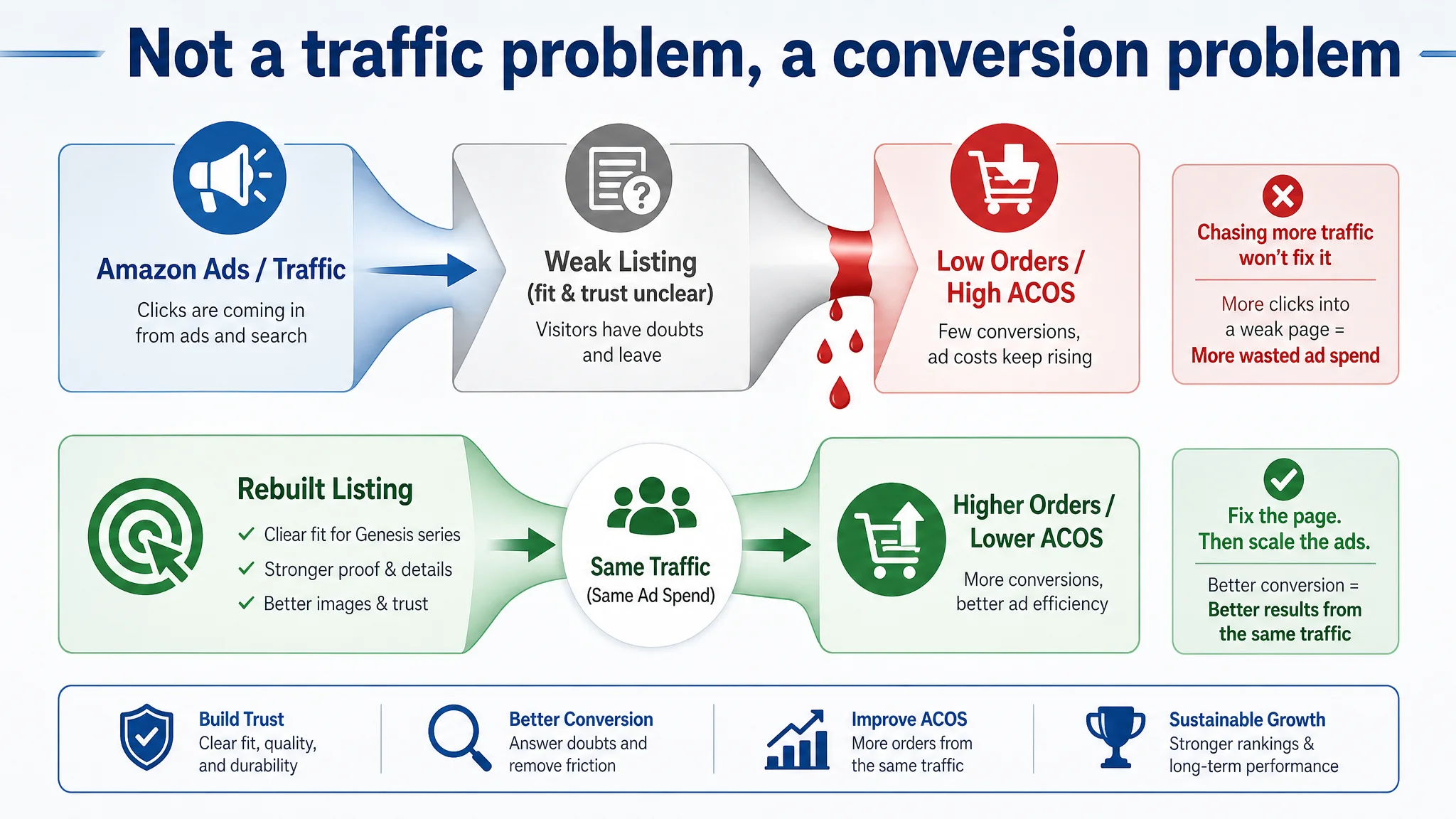
Amazon Ads Were Not Failing. The Page Was Consuming the Traffic.
From the seller’s perspective, the situation looked like a classic ads problem.
- Traffic was coming in through Amazon search ads.
- Costs were rising.
- Orders were not responding as expected.
Internally, the team’s first instinct was to rework campaigns: expand keywords around “Genesis grill parts,” refine bids, and adjust placements. They assumed better targeting would eventually “unlock” performance.
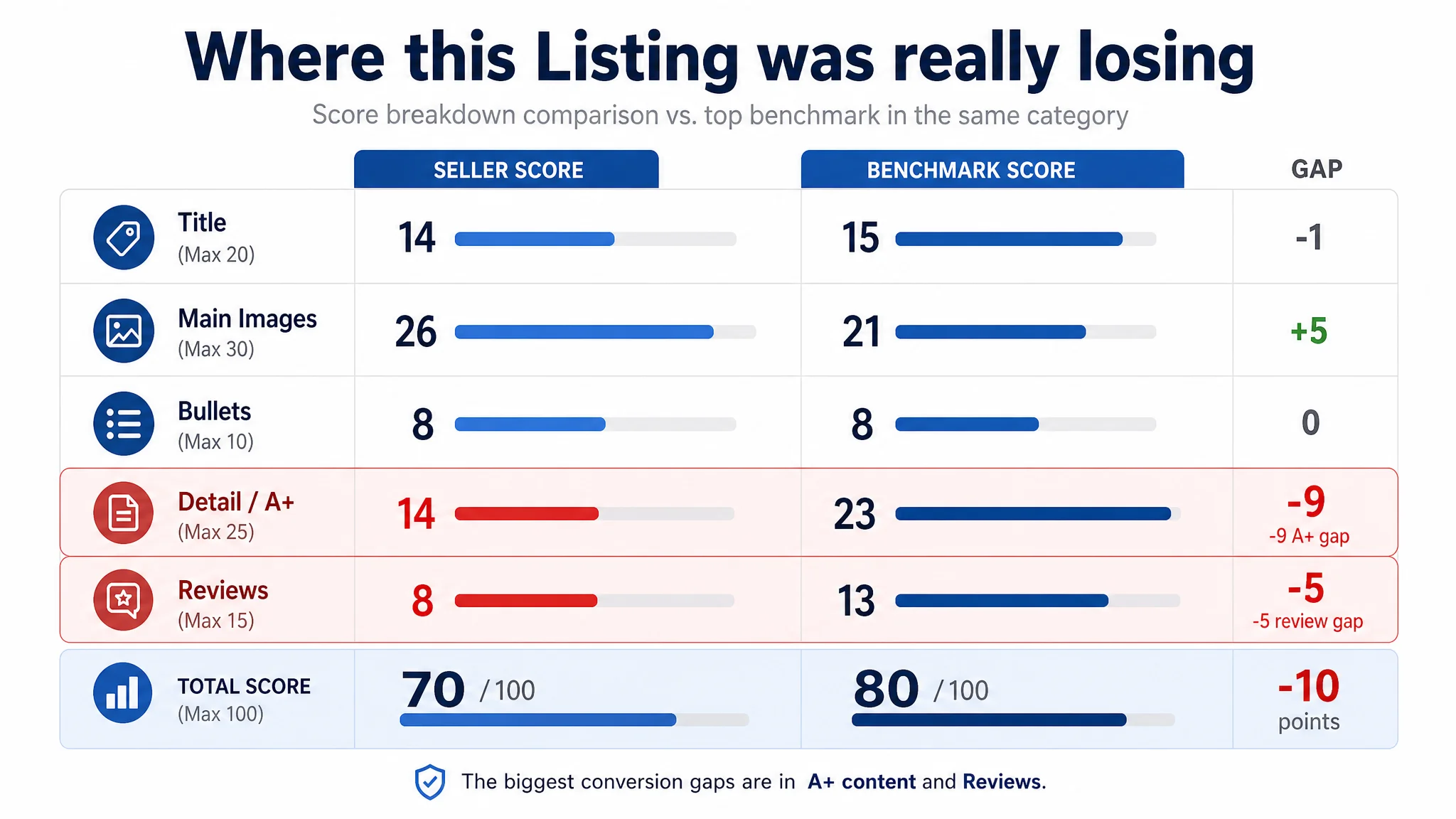
DeepBI’s Listing score told a different story. Against a carefully selected benchmark Listing in the same Genesis 300-series replacement-parts niche:
- Their total Listing score: 70/100
- Benchmark Listing score: 80/100
- Gap: -10 points
At first glance, -10 didn’t look catastrophic. But the breakdown showed where the real conversion risk lived:
- Title: 14 vs 15 (near-parity)
- Main images: 26 vs 21 (they were actually ahead visually)
- Bullet points: 8 vs 8 (no gap)
- Detail / A+: 14 vs 23 (-9 gap)
- Reviews: 8 vs 13 (-5 gap)
The Amazon ads weren’t the core problem; they were feeding traffic into a page that was structurally weaker at the exact bottom-of-funnel layers that push buyers to click “Add to Cart”: in-depth detail content and social proof.
“The real problem was not that ads failed to bring traffic. It was that the page could not convert the traffic.”
The Real Constraint Was Listing Conversion Capacity
The DeepBI diagnostic made one thing very clear: this Listing didn’t lack images or text; it lacked conversion capacity.
Where the numbers pointed
1. Detail / A+ content was the main drag
- Seller’s A+ score: 14/25
- Benchmark A+ score: 23/25
This is a severe gap in a category where fit, material, and durability are non-negotiable.
1. Review layer undermined trust
- Rating: 4.2 vs competitor’s 4.5
- Review count: 33 vs competitor’s 316 (almost 10×)
- First page included 1-star feedback for the seller, vs 100% 4–5-star on the benchmark.
For replacement parts, where “wrong fit” and “poor quality” are common fears, this difference is decisive.
1. Main images were strong, but misaligned with the brand story
The seller’s image set was actually more complete than the competitor’s: it covered functionality, material comparison, sizing, installation, and usage scenarios. But:
- The visual system was in a bright orange “marketing” style.
- Background elements (grill, umbrella, etc.) cluttered the frame.
- Some key images lacked narrative continuity—first impressions in the first few seconds were fuzzy.
DeepBI’s judgment: this is not a product that needs “more traffic” first. It needs a page that can earn the conversion of the traffic it already has.
What the Seller Originally Misdiagnosed
Because the team saw rising ACOS and inconsistent sales, they focused on:
- Increasing exposure on “Weber Genesis parts,” “Genesis 300 flavorizer bars,” etc.
- Tweaking bids, match types, and campaign structure.
- Watching category CPC as the main source of pressure.
This made sense from a traditional Amazon ads mindset: if performance is weak, it must be because we’re not hitting the right queries hard enough.
The Listing-level comparison showed a different picture:
- Title: their structure was usable, just sub-optimized—but not broken.
- Main images: they were actually better equipped than the competitor in sheer information coverage.
- Bullets: logical and adequate for the category.
The ad behavior (traffic coming in, but low efficiency) was simply surface-level evidence of something deeper:
- A+ didn’t give buyers enough proof.
- Visual style didn’t match the high-precision, “OEM-grade replacement” expectation.
- Reviews didn’t offset the “non-original part” risk.
Ads were not failing; they were accelerating visitors into a page with trust gaps.
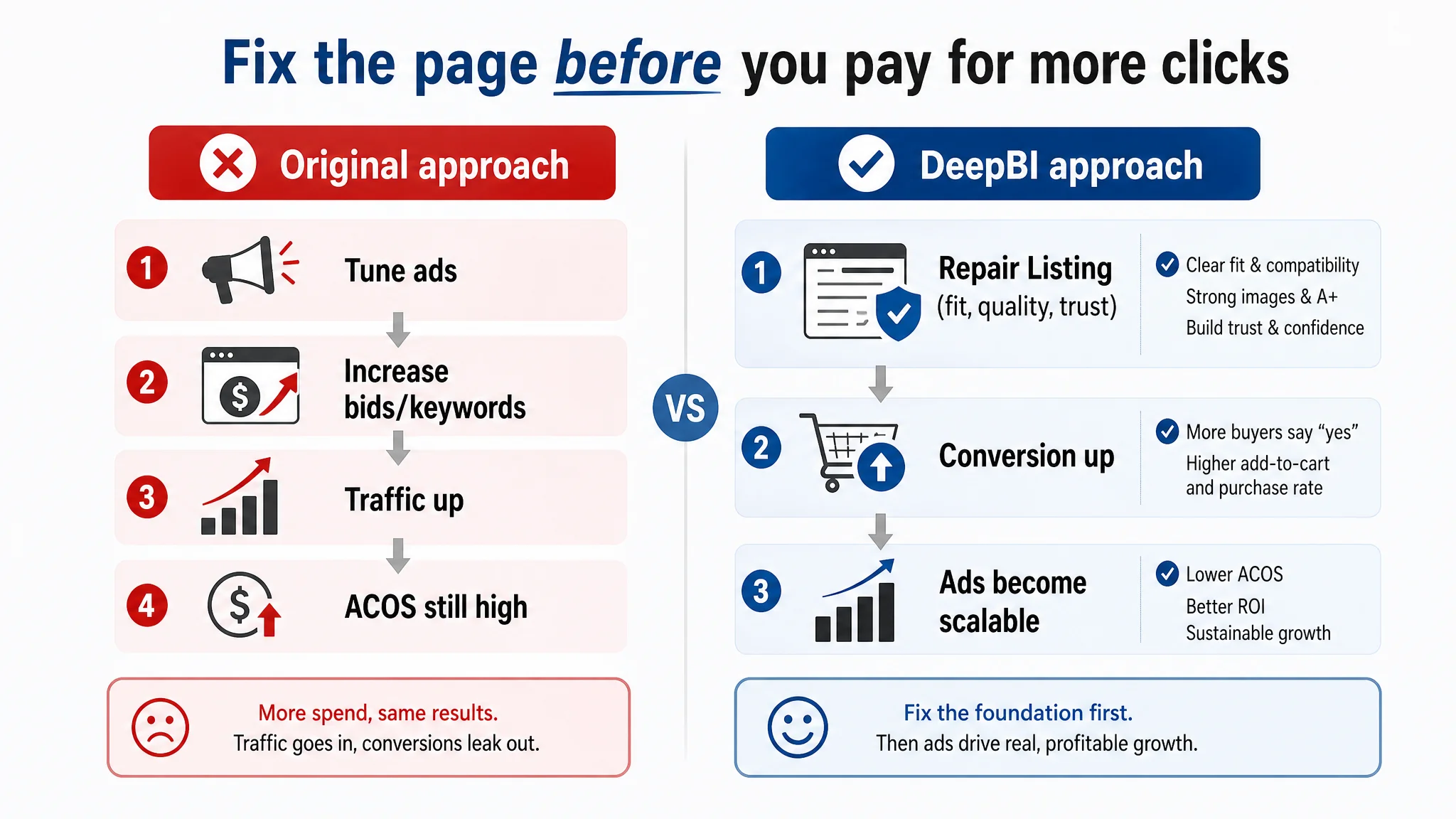
This Product Page Did Not Lack Traffic. It Lacked Trust.
For grill replacement parts, buyers typically want answers to three questions:
1. Will this fit my exact grill?
2. Is the material and thickness good enough not to rust, warp, or crack?
3. Is this safe, reliable, and worth the money vs OEM?
The competitor’s Amazon Listing addressed those questions quickly and visually. The seller’s Listing made buyers work harder to answer them.
Title: technically correct, but not strategically structured
What DeepBI found in the title:
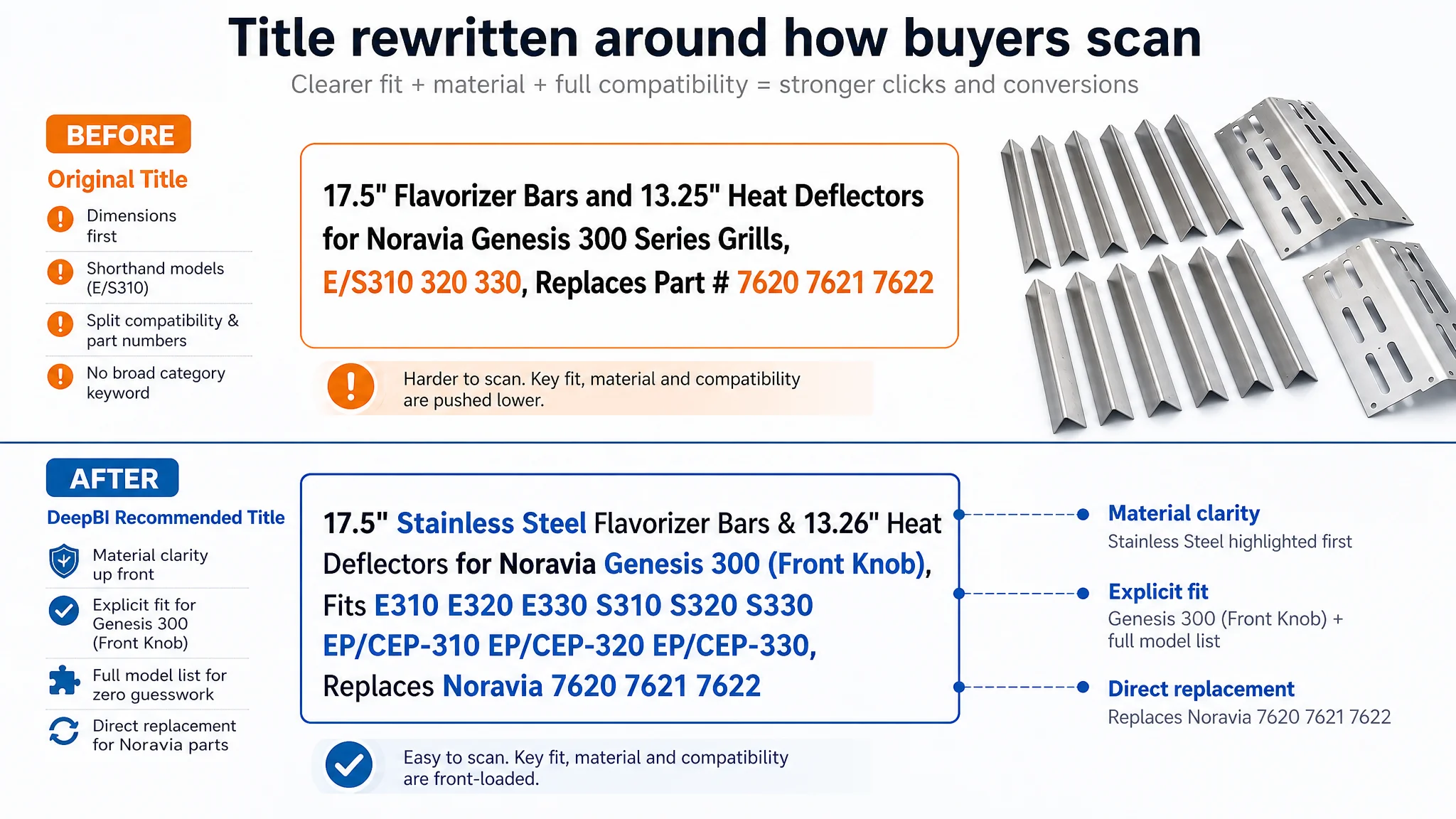
- Core keywords like “Genesis grill parts” were present but diluted by early, detailed dimension info, reducing keyword density where it mattered.
- The competitor front-loaded “Stainless Steel” after the core term, matching how buyers scan: generic → material → specifics.
- The seller split model compatibility (“E/S310 320 330”) and replacement numbers (7620, 7621, 7622) into separate blocks; the competitor merged them into a smooth “Compatible with …” clause.
- The competitor closed with a broad term (“Weber Accessories”), extending keyword reach; the seller did not.
- The seller used shorthand (“E/S310”), while the benchmark spelled out E310 E320 E330 S310 S320, removing ambiguity for buyers.
Conclusion: the title did not block sales, but it didn’t maximize clarity or search logic. The real damage came later in the funnel.
Main images: strong content, weak first impression
On paper, the seller’s image set was impressive:
- Coverage of functionality, material comparison, fit, installation, and usage.
- Technical details like cross-sections and component breakdowns.
But DeepBI’s visual agent flagged a few key issues:
- The bright orange marketing style fought against the product’s industrial, precision-fit positioning.
Grill owners looking for a serious OEM alternative expect a blue/white, steel-forward, “industrial” tone, not a promotional splash.
- The first image didn’t quickly answer “what is this part, and how does it sit in the grill?” The benchmark, with pure white background and disciplined composition, made it obvious.
- Some technical images lacked clear narrative progression—buyers were being shown “information,” but not taken through a decision flow.
Advertising does not only amplify advantages. It can also amplify a page’s existing defects.
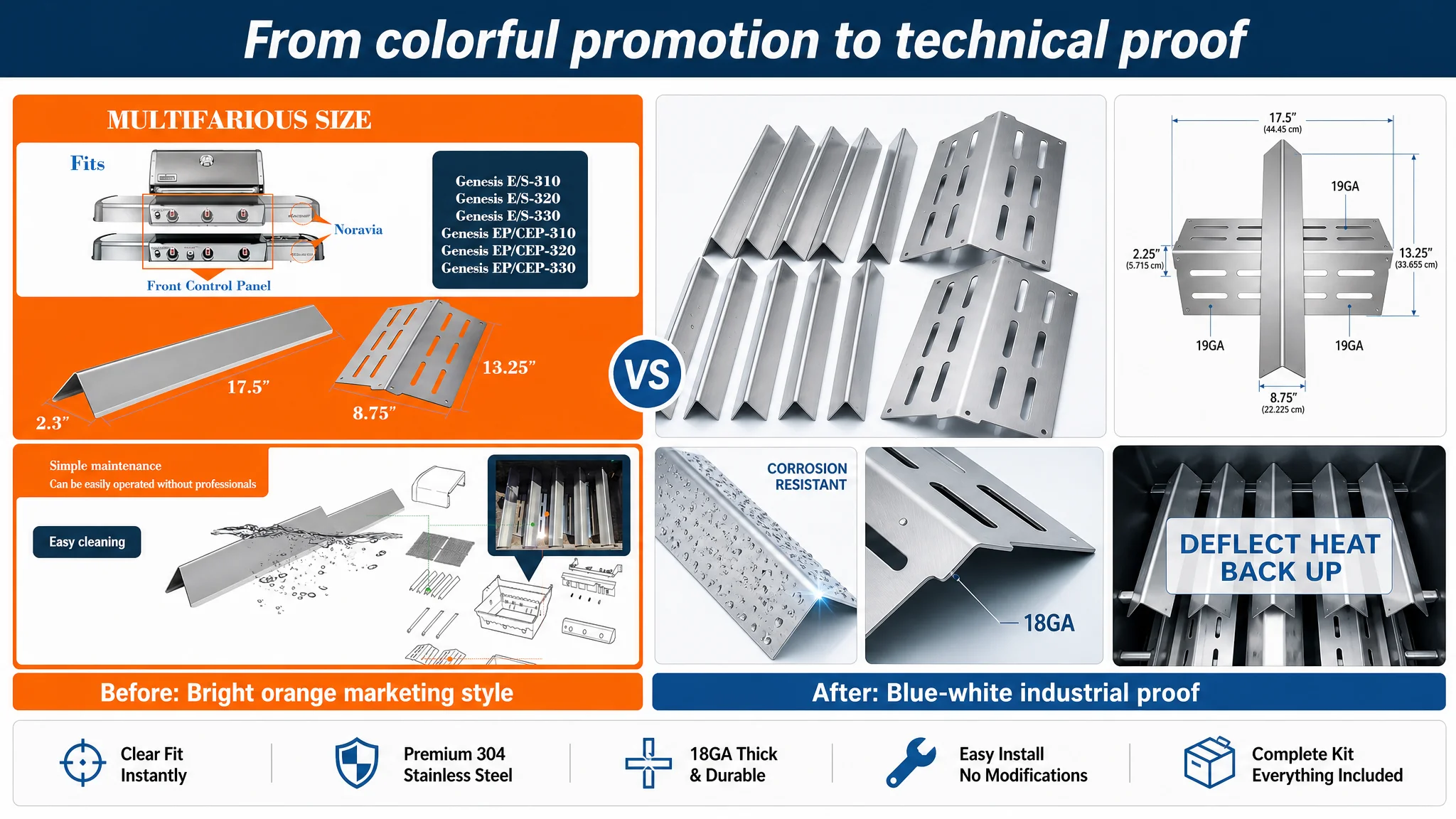
Detail / A+: where the conversion really broke
Here, the gap was stark.
Seller’s A+ approach:
- Black-and-white line art and sketch-style visuals.
- Icon-based feature blocks and generic slogans.
- Very little in the way of real product photography or contextual scenes.
Benchmark A+ approach:
- High-saturation, real-kitchen background scenes.
- Dual-material comparison (stainless vs black enamel) with clear visual contrast.
- Full kit visual, with all components clearly arranged.
- Integrated “customer testimony” modules, even if AI-generated but phrased realistically.
- Macro shots with calipers showing thickness.
- “SAFETY–THICKNESS–VALUE” clusters and green-labeled matrices (Quality / Fit / Performance), making benefits easy to scan and remember.
DeepBI’s judgment:
- Visual hierarchy was missing. The seller’s line art and grey blocks looked low-impact and generic, not like a robust mechanical part.
- Information was scattered. Key claims like “Engineered for Even Heat Distribution” lived in grey blocks not tightly tied to specific visuals.
- Trust devices were thin. No proof of thickness, no real-life scenes, no test or measurement visuals, no pseudo-testimonial context.
For a buyer on the fence about a non-OEM part, this A+ section did not do enough to overcome skepticism.
Reviews: scale and narrative both favored the competitor
- Seller: 4.2 stars, 33 reviews, with a visible 1-star on page one.
- Benchmark: 4.5 stars, 316 reviews, 100% 4–5 stars visible on page one.
Beyond star count:
- Benchmark reviews repeatedly reinforced “perfect fit,” “high quality,” and “value for money.”
- The seller’s review layer had less consistent messaging and lower scale.
This combination made the competitor feel like the “safe choice” even if prices or dimensions were similar.
Why DeepBI Did Not Keep Tuning the Ads First
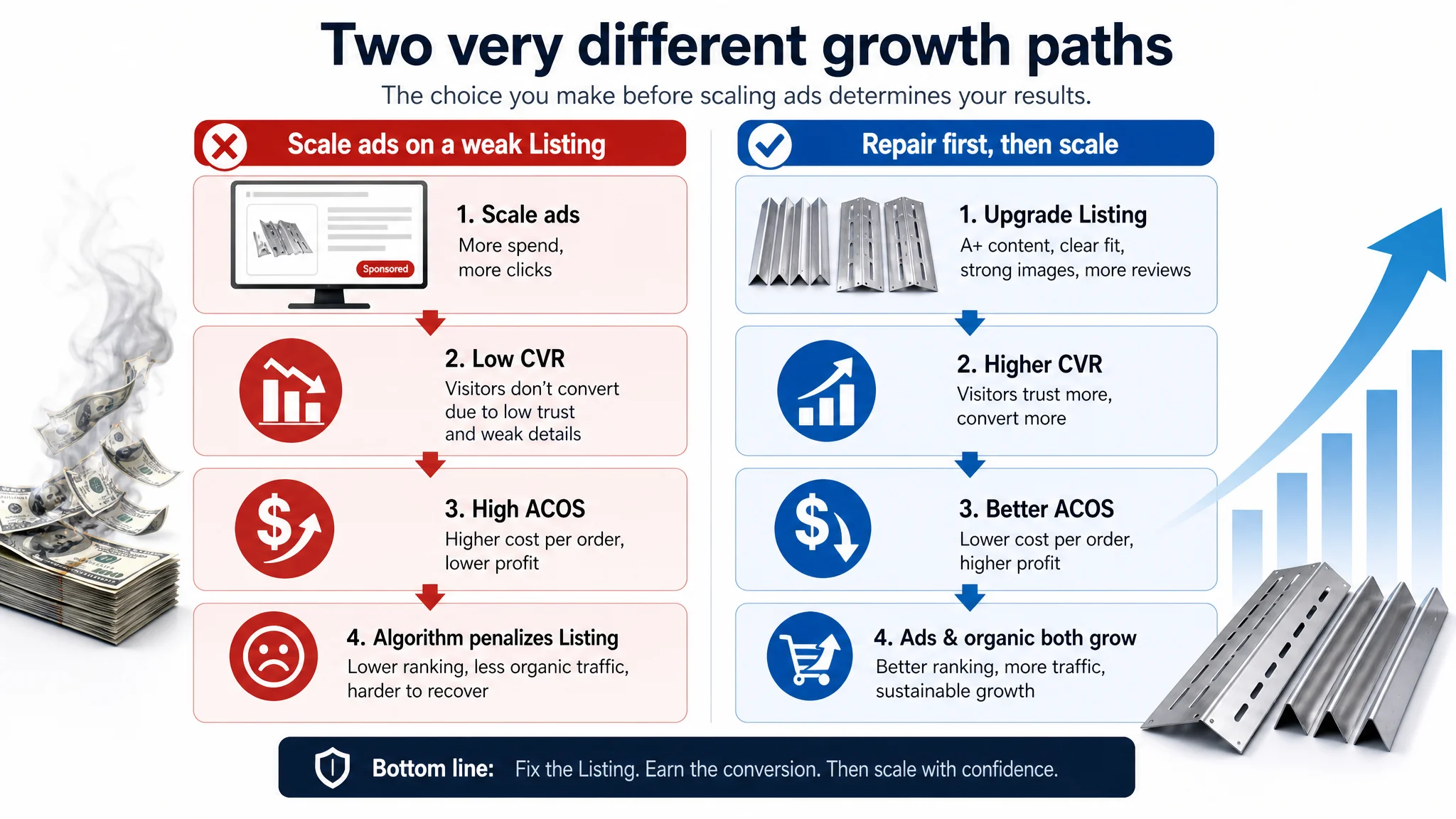
Given these findings, continuing to optimize Amazon ads while leaving the Listing as-is would have created three business risks:
1. Wasting budget on a page with limited ability to convert marginal clicks.
If the A+ and review layers can’t shift perception, additional traffic mostly burns cash.
1. Training Amazon’s algorithm in the wrong direction.
Poor conversion on paid traffic can signal low relevance / appeal, depressing both organic ranking and future ad efficiency.
1. Locking the team into a “bids vs. CPC” mindset.
The team would continue trying to “out-bid” their way out of a conversion problem they couldn’t fix with bids.
DeepBI’s recommendation was clear: freeze aggressive ad scaling on this ASIN until the Listing proved it could carry its own weight.
The operational sequence had to change from:
“Tune ads → hope for better ACOS”
to:
“Repair Listing conversion → then re-test ads on a stronger page.”
How DeepBI Reframed the Listing: From Orange Marketing to Blue-White Industrial Proof
The optimization work was not about making things “prettier.” It was about remapping the entire page to the way grill-part buyers actually decide.
1. Title: from mixed detail to structured decision logic
DeepBI’s recommended title:
17.5" Stainless Steel Flavorizer Bars & 13.26" Heat Deflectors for Weber Genesis 300 (Front Knob), Fits E310 E320 E330 S310 S320 S330, Replaces Weber 7620 7621 7622
Key decision logic embedded:
- Material clarity first: “Stainless Steel” spelled out instead of “SS,” reinforcing durability and search coverage.
- Core functions and sizes front-loaded: “Flavorizer Bars” and key dimensions appear early for mobile search.
- Explicit model fit: full E/S model list plus “Front Knob” specification—a direct answer to “Will it fit my grill?”
- Direct replacement framing: clear “Replaces Weber 7620 7621 7622” language aligns with “OEM-equivalent” mental model.
This structure doesn’t just help search; it puts a strong fit-and-quality narrative in front of the buyer before they even click.
2. Bullet points: from parameter listing to “pain point → solution” logic
DeepBI’s bullet-point redesign focused on mapping directly to buyer anxieties.
BP #1 – Material and rust anxiety
【Premium 304 Stainless Steel & 18GA Durability】 Crafted from heavy-duty 304 stainless steel with a robust 18-gauge thickness, these replacement parts offer superior corrosion resistance and lasting performance. Unlike porcelain-coated alternatives, they won't chip, flake, or rust, ensuring a clean and safe grilling surface for seasons to come.
- Makes 304 / 18GA explicit to match competitor’s professional language.
- Moves from generic “premium steel” to proof-like parameters.
BP #2 – Fit anxiety (Gen 300 vs Gen II, front knob vs side knob)
【Perfect Fit for Genesis 300 Front-Knob Models】 Specifically designed for Weber Genesis 300 series (2011–2016) with front-mounted control knobs, including E-310, E-320, E-330, S-310, S-320, S-330, and EP/CEP-310/320/330. (Note: NOT compatible with Genesis II series or side-knob models; please verify your grill type before ordering).
- Uses the bracketed headline for scanability.
- Combines positive fit and explicit “does not fit” disclaimers to reduce returns.
BP #3 – Replacement certainty
【Direct Replacement for OEM #7620 & #7621】 Includes 5× Flavorizer Bars (17.5" x 2.25") and 2× Heat Deflectors (13.25" x 8.75"). This kit is a precision-engineered drop-in replacement for Weber parts #7620, #7621, #7622, and #62783. Matches original specifications perfectly for a hassle-free installation without modifications.
- Concentrates dimensions and OEM numbers into a single “confirmation” bullet.
- Reinforces the sense of “drop-in OEM replacement” instead of a generic aftermarket part.
BP #4 – Cooking performance and burner protection
【Enhanced Flavor & Even Heat Distribution】 The flavorizer bars efficiently vaporize drippings to create the authentic smoky BBQ taste while protecting burners from clogs. Combined with precision-fit heat deflectors, this set ensures even heat distribution across the grate, reducing flare-ups and providing professional-grade searing results.
- Brings together flavor, flare-up reduction, and burner protection.
- Connects physical part to grilling outcome, not just specs.
BP #5 – Packaging and installation friction
【Secure Packaging & Ready to Install】 Each set is carefully inspected and shipped in secure, reinforced packaging to prevent damage during transit. Designed for a seamless “plug-and-play” replacement experience, allowing you to restore your grill’s efficiency and performance in minutes.
- Addresses fears about shipping damage and installation complexity.
- Moves beyond product to overall ownership experience.
This bullet framework aligns with what DeepBI saw in the benchmark—but in the seller’s own product language and constraints.
3. Main Images: From “Colorful” to “Precision Hardware”
DeepBI’s visual agents recommended a complete style shift:
- From: bright orange marketing theme, busy backgrounds.
- To: blue-white minimal industrial style, pure white or subtle gray backgrounds, technical overlays.
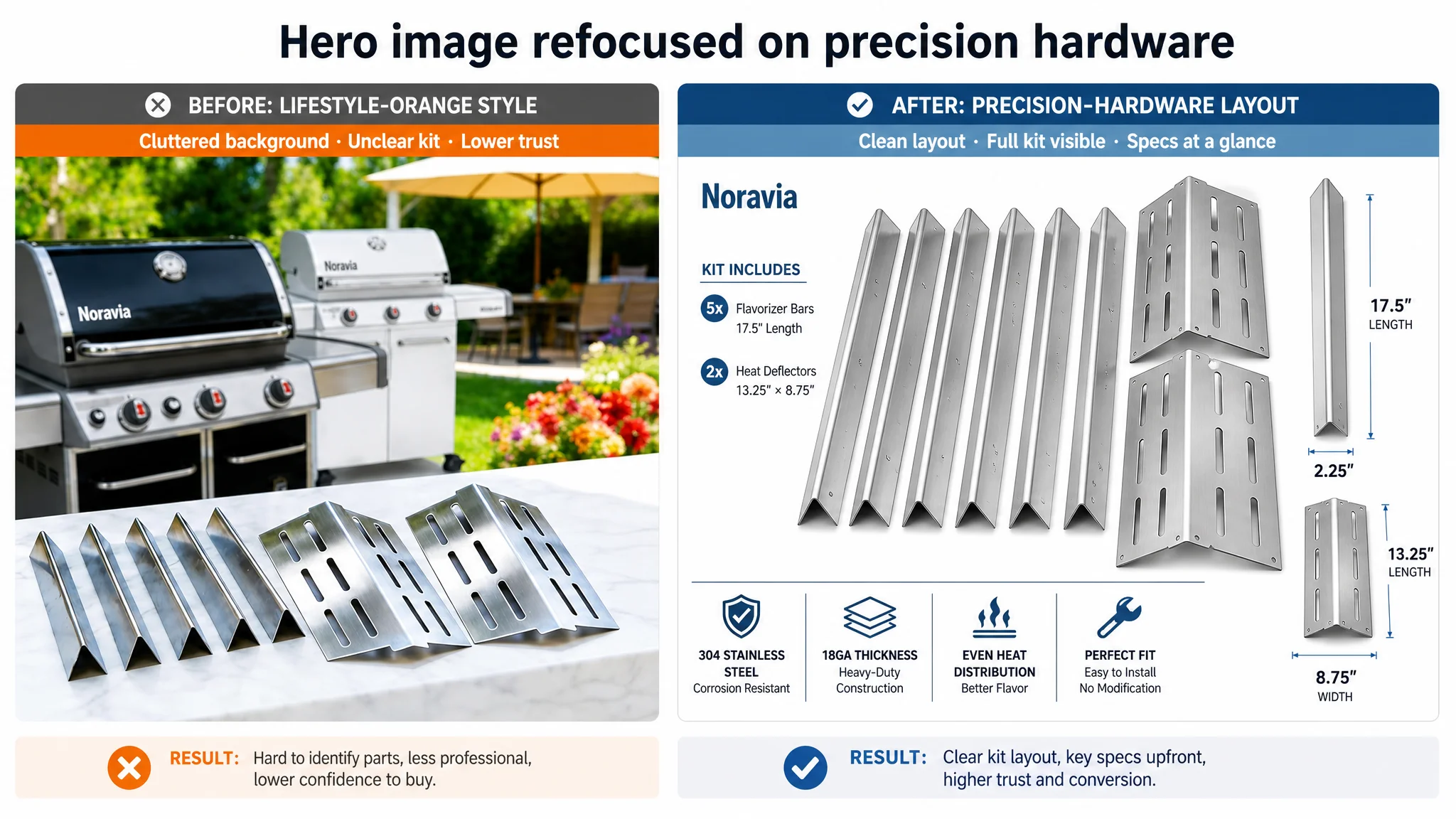
Examples of key adjustments:
Main Image 1 – Hero product clarity
- Product tilted at a 45° angle, evenly spaced, occupying ~80% of the frame.
- Pure white background, cool gray tone, soft white top light to remove shadows.
- No grill or umbrella in the background—no distractions.
Purpose: instantly communicate “serious, precision-engineered hardware” in search results.
Main Image 2 – Dimension credibility
- Cross arrangement of bars and deflectors, centered, with a flat perspective.
- Fine blue guide lines marking length, width, and key dimensions.
- Sans-serif black font for size labels.
Purpose: tackle “will it match my existing parts?” directly on the image, not buried in text.
Main Image 3 – Corrosion resistance proof cue
- Single bar diagonally across the frame, with consistent water droplet effect.
- Strong highlight on edge to show metal reflectivity.
- “CORROSION RESISTANT” in blue text in one corner.
Purpose: visually anchor the rust-resistance claim, not just state it.
Main Image 4 – Thickness emphasis
- Macro shot of cut edge, filling ~70% of frame.
- Side lighting to accent thickness.
- Subtle callout line with “18GA” or equivalent parameter language.
Purpose: match the competitor’s “thickness” narrative with a visual proof point.
Main Image 5 – Installed-in-grill context
- Real grill interior, 45° overhead shot, parts installed.
- “DEFLECT HEAT BACK UP” overlay in a transparent text frame.
Purpose: help buyers visualize the part in real use, not as abstract metal strips.
DeepBI’s stance was clear: in a category where buyers often compare several nearly identical thumbnails, the Listing that makes fit, material, and purpose visually obvious wins the click.
4. A+ Content: Turning a Sketchboard into a Trust Engine
The A+ overhaul was about replacing low-impact line art with realistic, high-clarity visual modules aligned to decision stages.
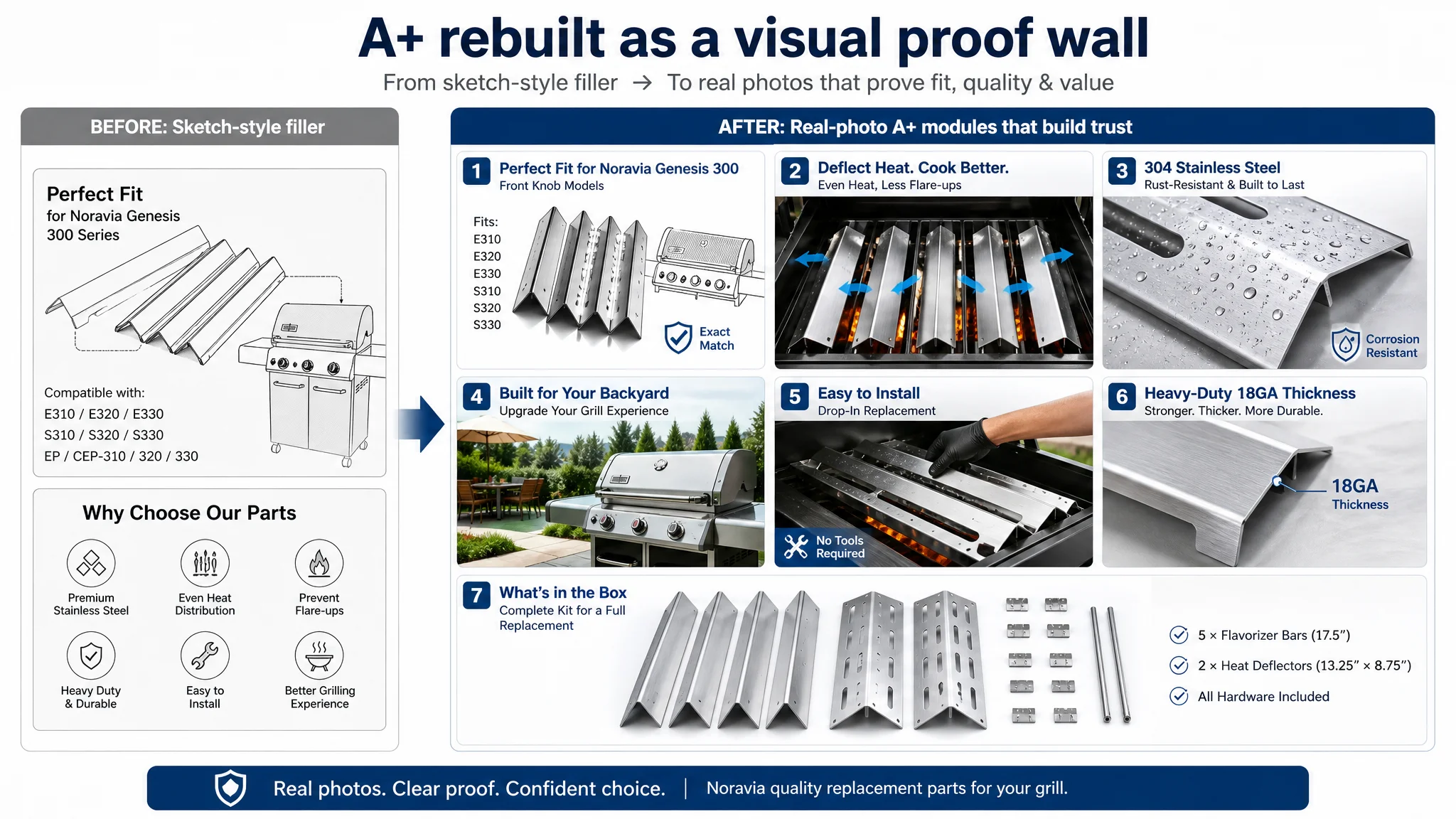
Module 1 – Fit and compatibility at a glance
- Hero product at 45° in the center, on pure white.
- Clean, dark-gray checklist of supported models (E310/320/330, S310/320/330) on the side.
- Crisp, shadowed lighting to keep edges and holes sharply visible.
Impact: removes ambiguity about whether this part is “for my grill” within seconds.
Module 2 – Even heat distribution in context
- Low-angle shot simulating product inside the grill box.
- Dark gray oven interior, soft top light, subtle warm reflection below (implying flame).
- Clear heat-flow illustration suggesting “even heat distribution.”
Impact: upgrades the vague “cooks better” promise into a concrete visual of how heat moves.
Module 3 – Macro material trust
- Close-up of surface texture on a light-gray stone background.
- High contrast to show finish, edges, and hole machining quality.
- Shallow depth of field, focus locked on the physical craftsmanship.
Impact: visually answers “will this rust or deform?” in a way icons never could.
Module 4 – Outdoor lifestyle integration
- Installed product on right, premium backyard patio scene blurred gently behind.
- Natural daylight, warm but controlled color.
- Visual link to “upgraded grill experience,” not just a cheap repair.
Impact: frames the purchase as an upgrade to a premium grilling setup, not a low-end patch.
Module 5 – Installation simplicity
- Top-down layout on stainless surface, bars and deflectors arranged in logical sequence.
- Directional arrows indicating installation order or orientation.
- Neutral-toned overall color, soft lighting.
Impact: combats anxiety about complexity; supports the “plug-and-play” bullet.
Module 6 – Thickness and spec evidence
- Clean profile view of cross-section on dark gray background.
- Edge illuminated with a point light to show depth.
- Callout pointing to thickness region (without inventing unconfirmed numbers, but clearly indicating a robust gauge).
Impact: aligns visually with the category’s “heavy-duty” language.
Module 7 – “What’s in the box”
- Symmetrical kit layout on pure white, occupying ~80% of frame.
- No filters, fully accurate color, no shadow noise.
Impact: visually assures buyers that all required parts are included, lowering fear of incomplete kits and returns.
Together, these modules reconstruct the A+ section into a structured story:
1. Fits my grill.
2. Delivers even heat and better cooks.
3. Built with durable, rust-resistant material.
4. Belongs in a premium outdoor setup.
5. Easy to install.
6. Thick and robust.
7. Full kit, nothing missing.
Exactly the narrative arc that was missing before.
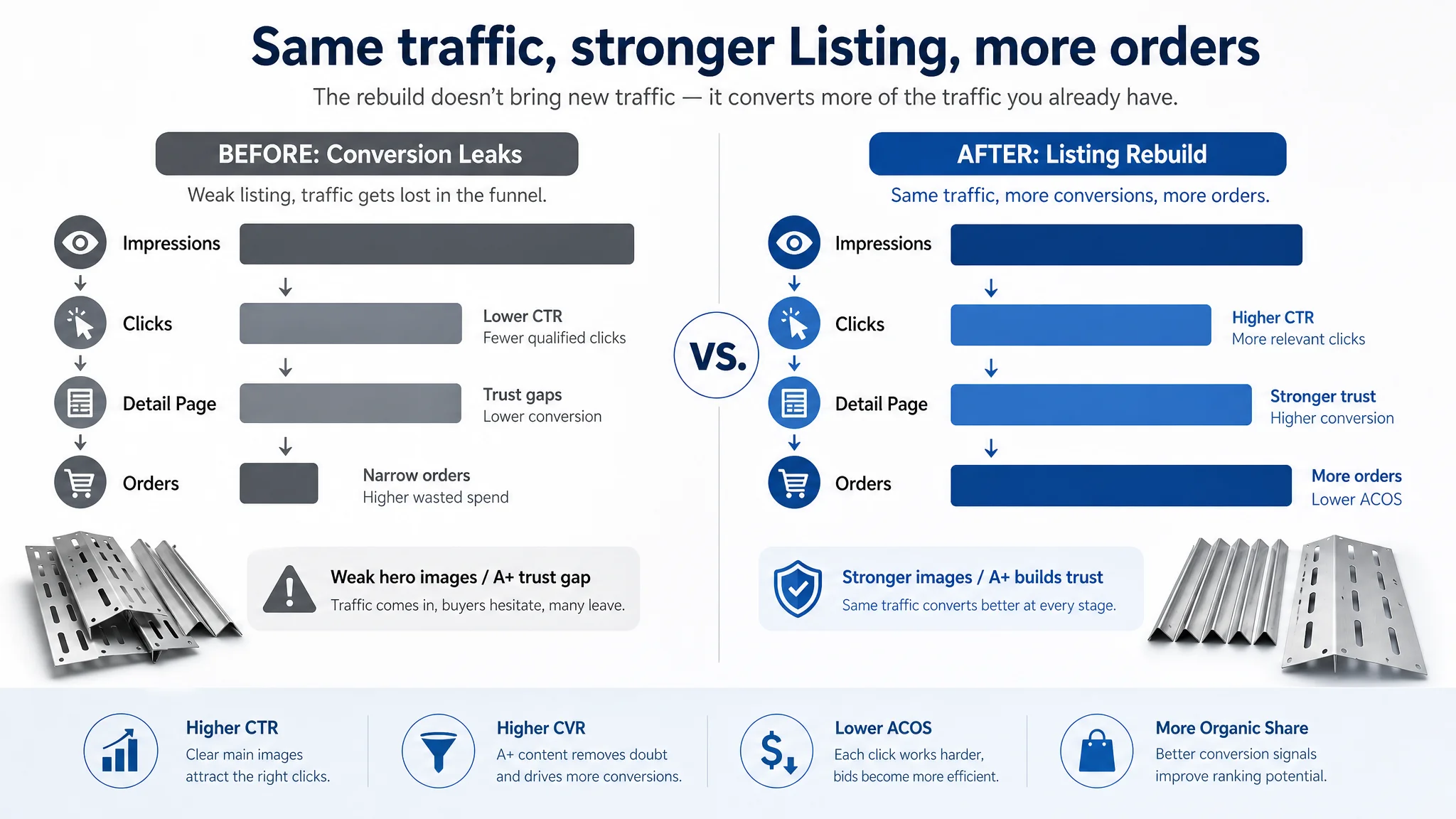
How Ad Traffic Became Useful Again
After such a Listing rebuild, Amazon ads stop being a blunt instrument and become a lever:
- CTR has a reason to rise: clear, industrial main images and strong titles attract the right clicks.
- CVR has a foundation: A+ and bullets answer the core doubts that previously drove visitors away.
- ACOS has room to move down: each paid click is more likely to convert, making bids more forgiving.
- Organic share can recover: as conversion stabilizes, Amazon’s ranking algorithm has better behavioral signals to work with.
Even without inventing numbers, the operational state changes:
- The Listing is no longer over-dependent on brute-force ad spend.
- The page can meaningfully convert both organic and paid traffic.
- The seller can scale ads knowing the product page is not silently wasting the budget.
What This Changed in the Seller’s Understanding
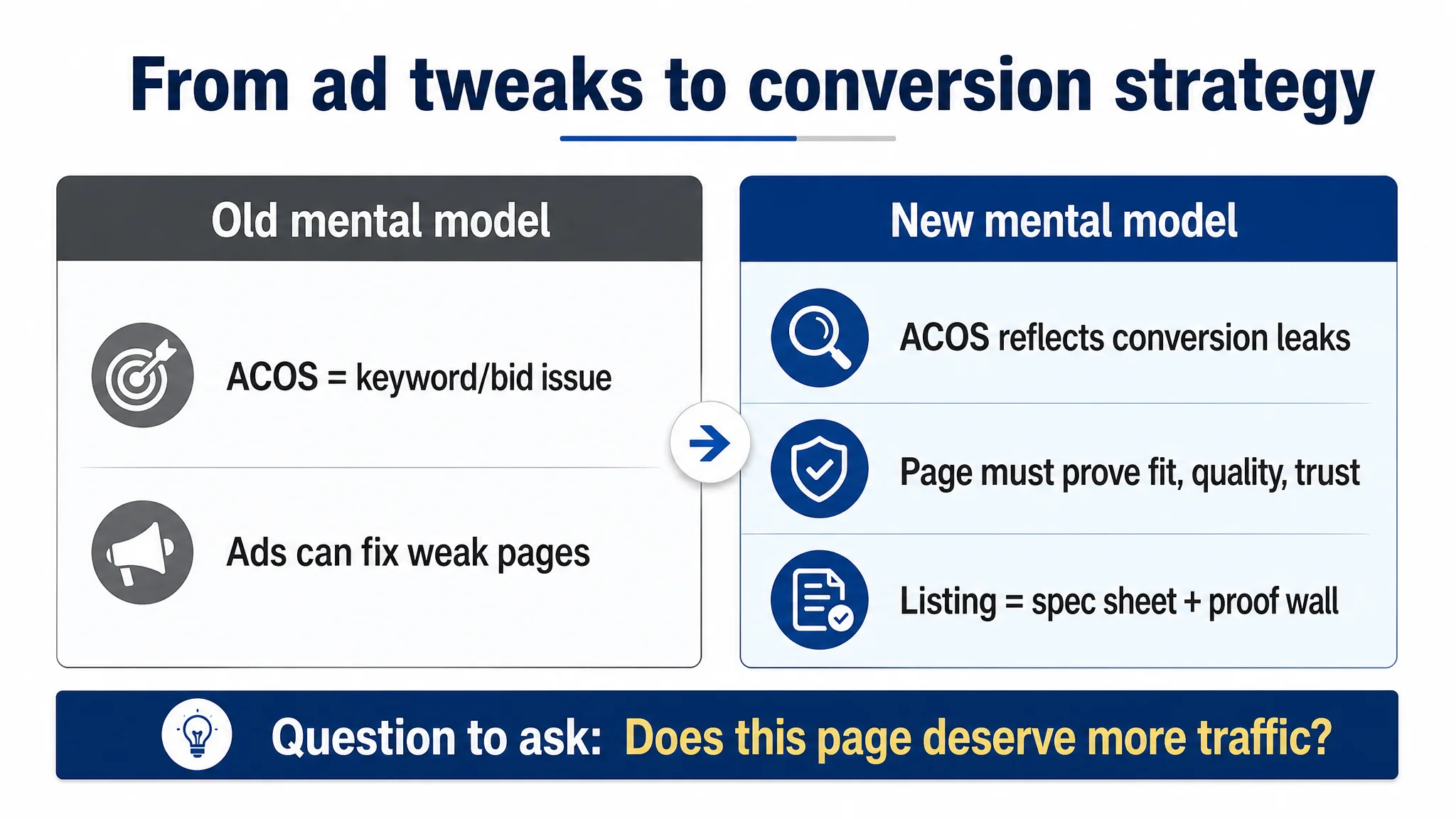
By the end of this process, the seller’s mental model of Amazon growth had shifted:
- From: “Our ACOS problem is a keyword and bid problem.”
- To: “If the page doesn’t prove fit, quality, and trust, no keyword structure will save us.”
Key takeaways they internalized:
- Amazon ads do not fix Listing-level trust gaps; they expose them.
- Main image, title, bullets, and A+ must form a single buying logic, not four isolated blocks.
- For technical categories like grill replacement parts, the Listing must behave like an online spec sheet plus proof wall, not a generic product page.
- Before scaling spend, you have to ask: “Does this page deserve more traffic?”
For other Amazon sellers, especially in replacement, parts, or technical categories, this case is a warning and a roadmap:
- If ads feel “too expensive,” check whether your Listing is giving buyers a fast, visual answer to fit, durability, and trust.
- Use competitor benchmarks not to copy, but to see what decision logic your page is missing.
- Treat Listing conversion as the foundation of ad efficiency—not the other way around.
Only once your Amazon product page can reliably convert the traffic it gets does it make sense to step back on the gas.