

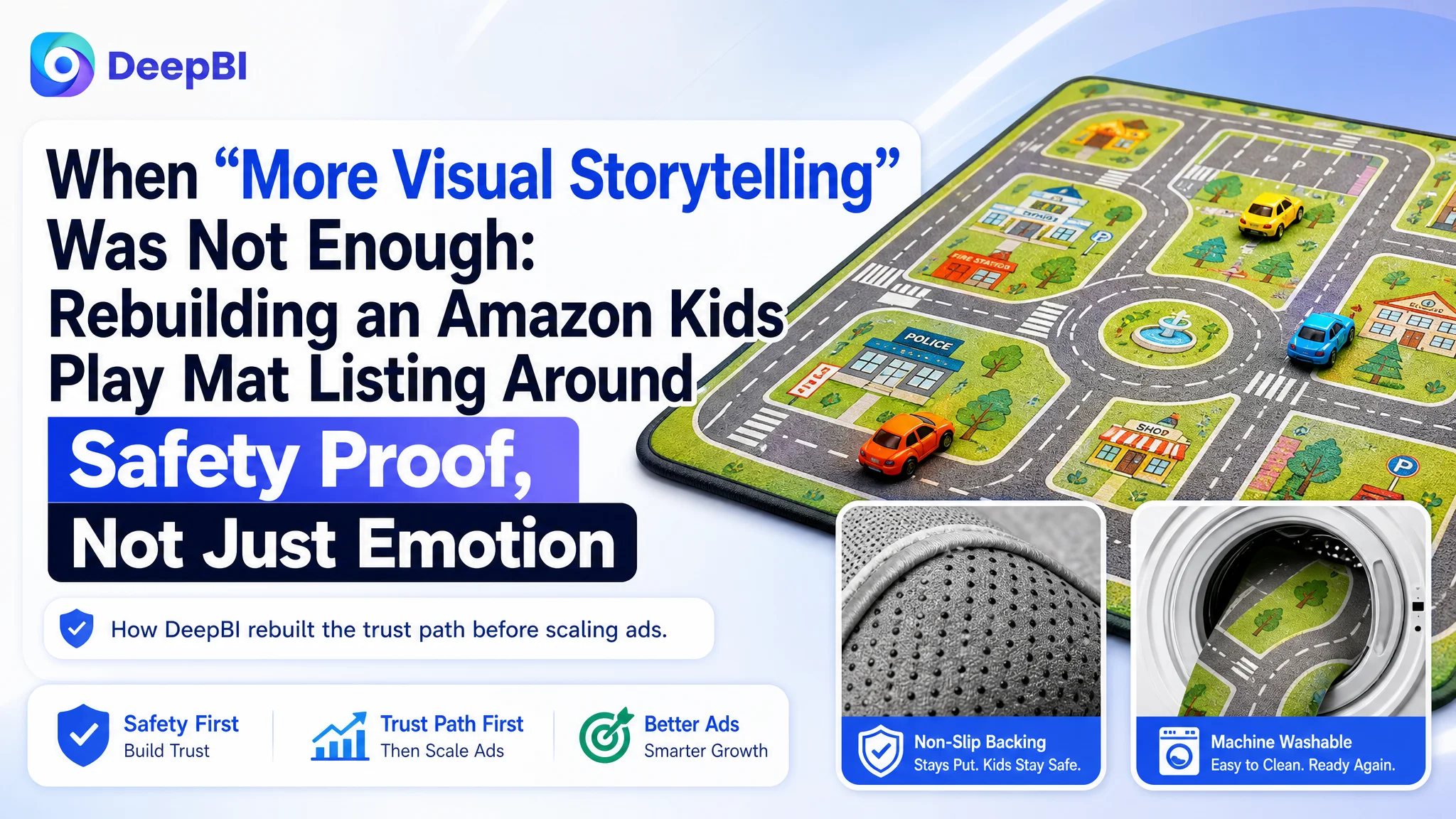
This case comes from an Amazon seller in the US kids’ home décor category, focusing on a traffic-road play mat for toy cars. The team had already invested in rich visuals and emotional copy, believed their Amazon Listing was “better crafted” than a key competitor’s, and naturally blamed rising ACOS and unstable orders on “ad issues” and “insufficient traffic.” On the surface, their DeepBI Listing score even slightly exceeded the benchmark competitor.
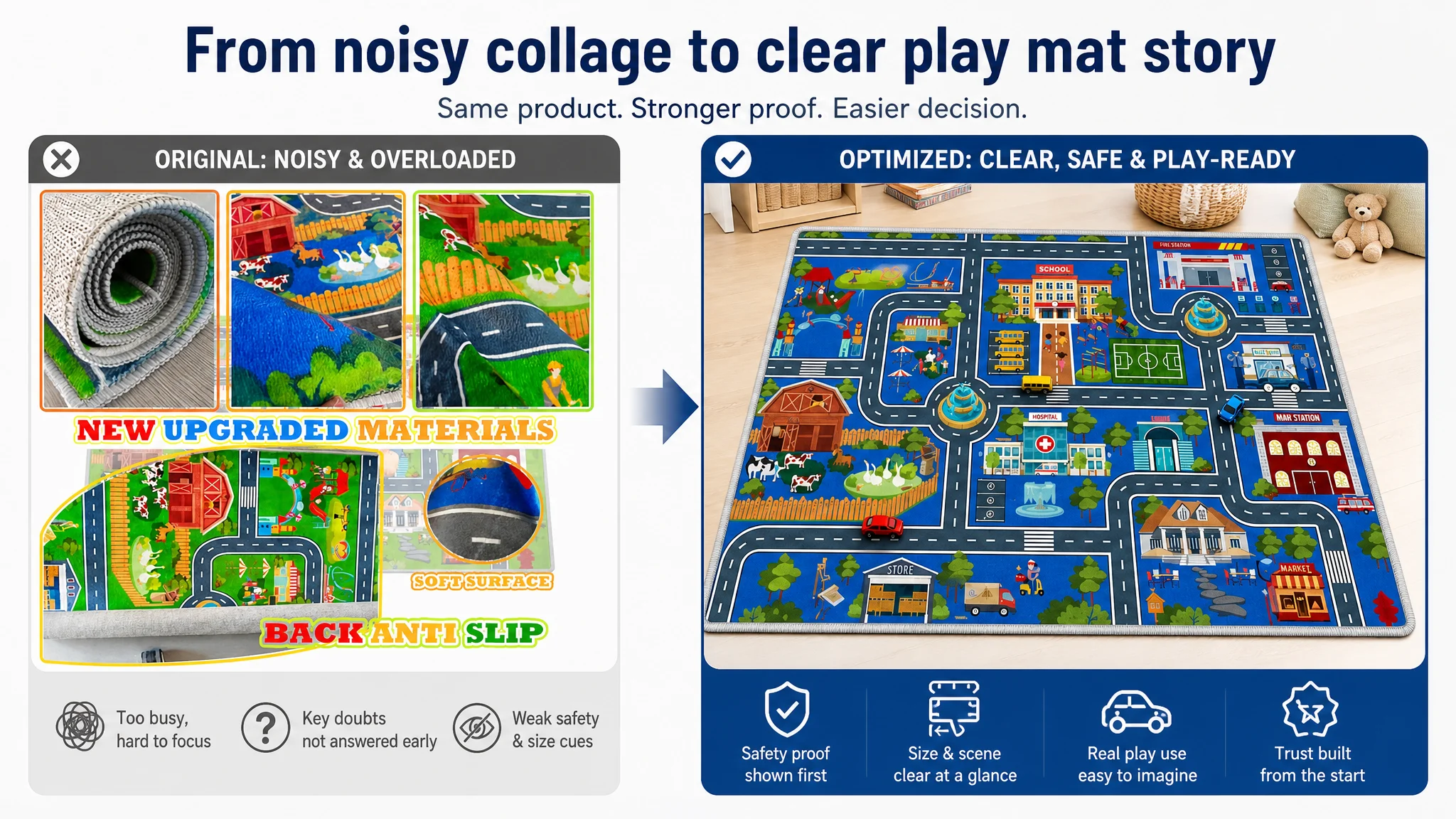
DeepBI’s diagnosis told a different story. The page was not short of visuals or emotion; it was short of explicit, visual proof on the two things parents worry about most on Amazon: anti-slip safety and physical quality. The seller’s Amazon ads were driving traffic into a Listing whose persuasion order was misaligned with buyers’ decision logic. Safety and physical evidence were buried behind atmosphere shots and brand story, so advertising spend kept amplifying a trust gap instead of sales.
Once the problem was reframed as a Listing conversion bottleneck, not an advertising problem, the optimization direction shifted. Instead of continuing to tune campaigns and keywords, the focus moved to: sharpening the title around “non-slip” and “educational,” restructuring the first five images to answer size, material, anti-slip, and cleaning doubts, and rebuilding A+ content as a step-by-step trust path. For other Amazon sellers, the lesson is clear: when ads stop “working,” check whether your product page is actually answering the questions your traffic brings.
This Amazon Listing Did Not Lack Content. It Lacked the Right Proof at the Right Time.
From a traditional operations perspective, this Listing did not look like a problem child.
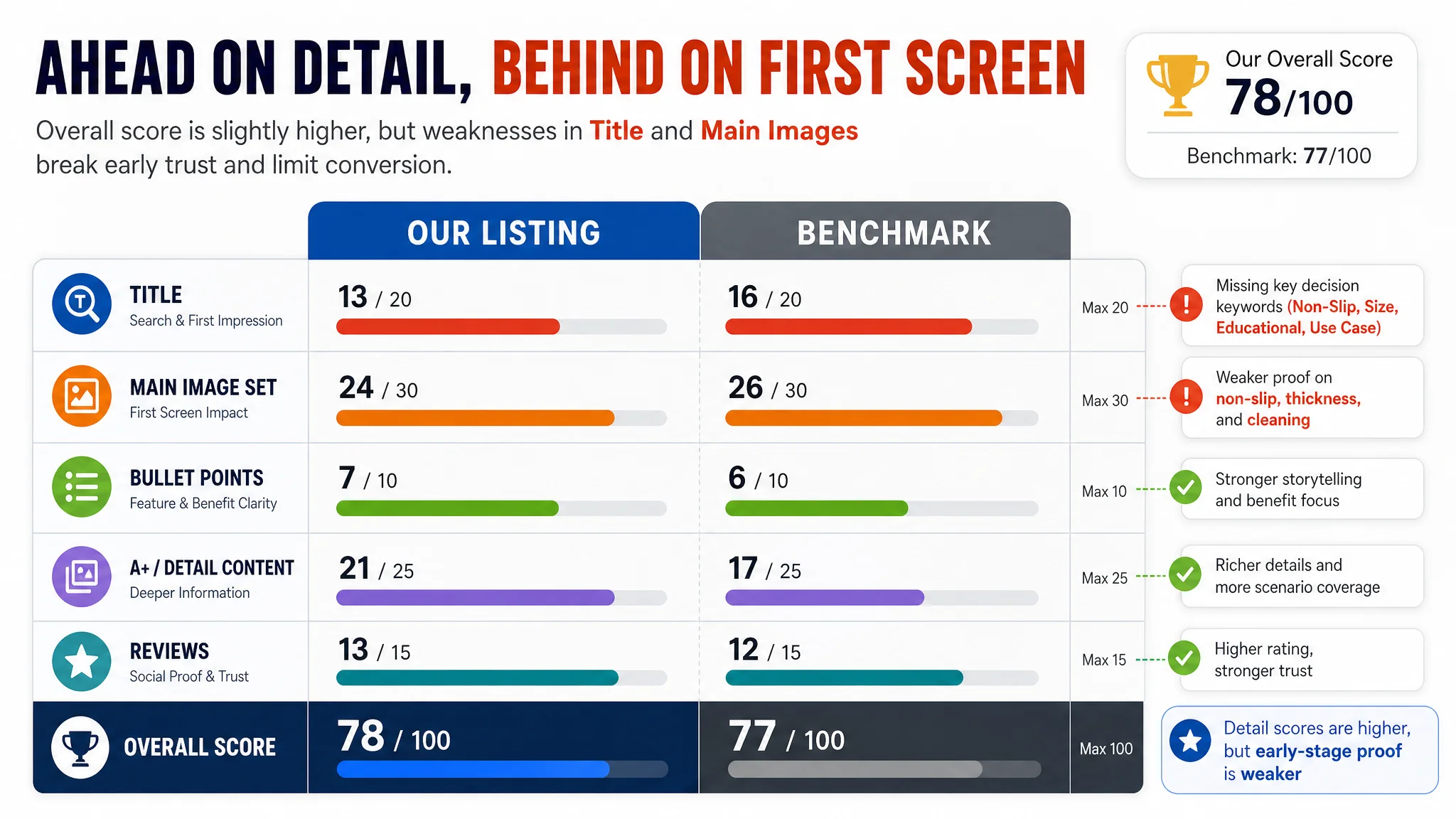
- Overall DeepBI Listing score: 78/100
- Benchmark competitor score: 77/100
By score alone, the seller felt confident: they were slightly ahead. A quick visual comparison seemed to confirm it:
- Higher review rating (4.6 vs. competitor’s 4.2)
- Emotionally richer bullet points and A+ visuals
- More polished, lifestyle-driven photography
However, when the team looked at their Amazon ads, the pressure was obvious:
- Paid traffic growth was not translating into stable order growth.
- ACOS was hard to bring down: bids and structure were adjusted, but the numbers kept hovering.
- The intuitive reaction in the team: “Our creatives and visuals are already strong; ads need deeper optimization.”
The implicit assumption was: “If we keep tuning ads, results will catch up.” DeepBI’s analysis showed this assumption was wrong.
“The real problem was not that ads failed to bring traffic. It was that the page could not convert the traffic on the most critical doubts parents have.”
What the Seller Misread: “Our Page Is Already Stronger Than the Competitor’s”
When DeepBI surfaced the dimension-level scores, the team saw what they had been relying on:
- Title: 13 vs. competitor 16 (–3)
- Main image set: 24 vs. competitor 26 (–2)
- Bullet points: 7 vs. competitor 6 (+1)
- A+ / detail content: 21 vs. competitor 17 (+4)
- Reviews: 13 vs. competitor 12 (+1)
In other words:
- They were ahead on detail richness, bullet storytelling, and review trust.
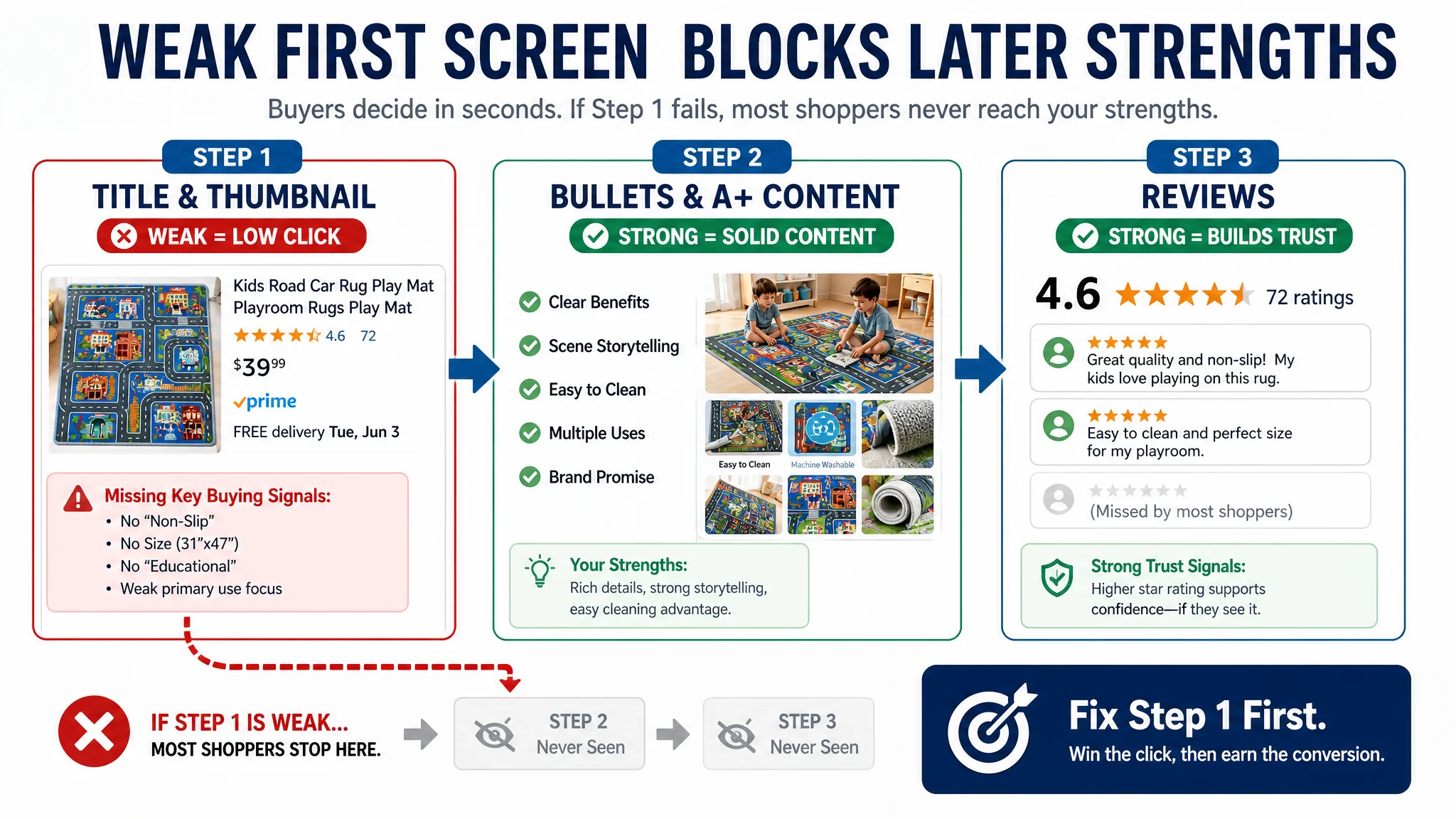
- They were behind on the title and main image—the first two elements every Amazon buyer sees.
Internally, the team’s mental model was:
- “Our A+ is richer; we show more scenarios and brand story.”
- “Our bullet points are more emotional and marketing-driven.”
- “Our rating is higher; buyers will trust us more.”
So when ad performance stressed the P&L, they defaulted to assuming:
- The problem must lie in bids, keywords, or campaign structures.
- Listing optimization was “basically done” and needed only marginal tweaks.
What they did not see yet was that their “stronger” storytelling was misaligned with when and how parents decide on Amazon.
Why Traditional Ad Optimization Kept Failing
From DeepBI’s perspective, continuing to tweak ads at this stage would only deepen the risk:
- The Listing had no obvious traffic gap; ads were already supplying impressions and clicks.
- The weaknesses sat before and at the first scroll of the product page: title + main images + early A+ modules.
- The core parental concerns—non-slip safety, thickness, size clarity, and cleaning ease—were not answered early enough and not in a proof-based way.
In this state:
- Every incremental ad dollar was driving more parents into a page that “looked nice” but did not quickly prove it was safe, practical, and easy to maintain.
- CTR and CVR could not fully reflect the actual potential of the product; ads were amplifying the Listing’s weakest logic, not its strengths.
DeepBI’s decision was therefore not to start from ad structure or keyword detail. The bigger commercial risk was:
“If we don’t fix the trust path on the page, any incremental ad spend will continue to leak on safety and evidence doubts.”
The Real Constraint: Listing Conversion Capacity Around Safety and Physical Evidence
DeepBI’s Listing evaluation Agent matrix highlighted two core gaps that outweighed all other advantages:
1. Title: Missing high-value decision keywords
The benchmark competitor’s title:
- Explicitly positioned the mat as a play mat for toy cars.
- Included “Non-Slip” and exact size (80×120cm/31×47in).
- Embedded emotional and functional tags like “Educational” and “Have Fun”.
- Anchored use scenario: Nursery Rug, City Life.
The customer’s original title:
- Used more generic phrases like “Playroom Rugs, Play Mat.”
- Lacked clear safety and size markers.
- Focused more on category labels than on the primary outcome and reassurance parents are scanning for.
1. Main image sequence: Weak, delayed proof on the two biggest fears
Benchmark main image set:
- Used a measured thickness comparison (e.g., phone pressed on surface).
- Visually showed anti-slip backing texture and labeling (e.g., “6mm thick,” “anti-skid bottom”).
- Adopted a low-saturation, Nordic-inspired palette that reads as safer and more “home-compatible.”
Customer main image set:
- Leaned into high-saturation, cartoonish visuals.
- Focused early images on atmosphere and playfulness, not on safety or physical proof.
- Referenced “crystal velvet” and material upgrades in copy—but without micro-detail shots or clear, numeric proof.
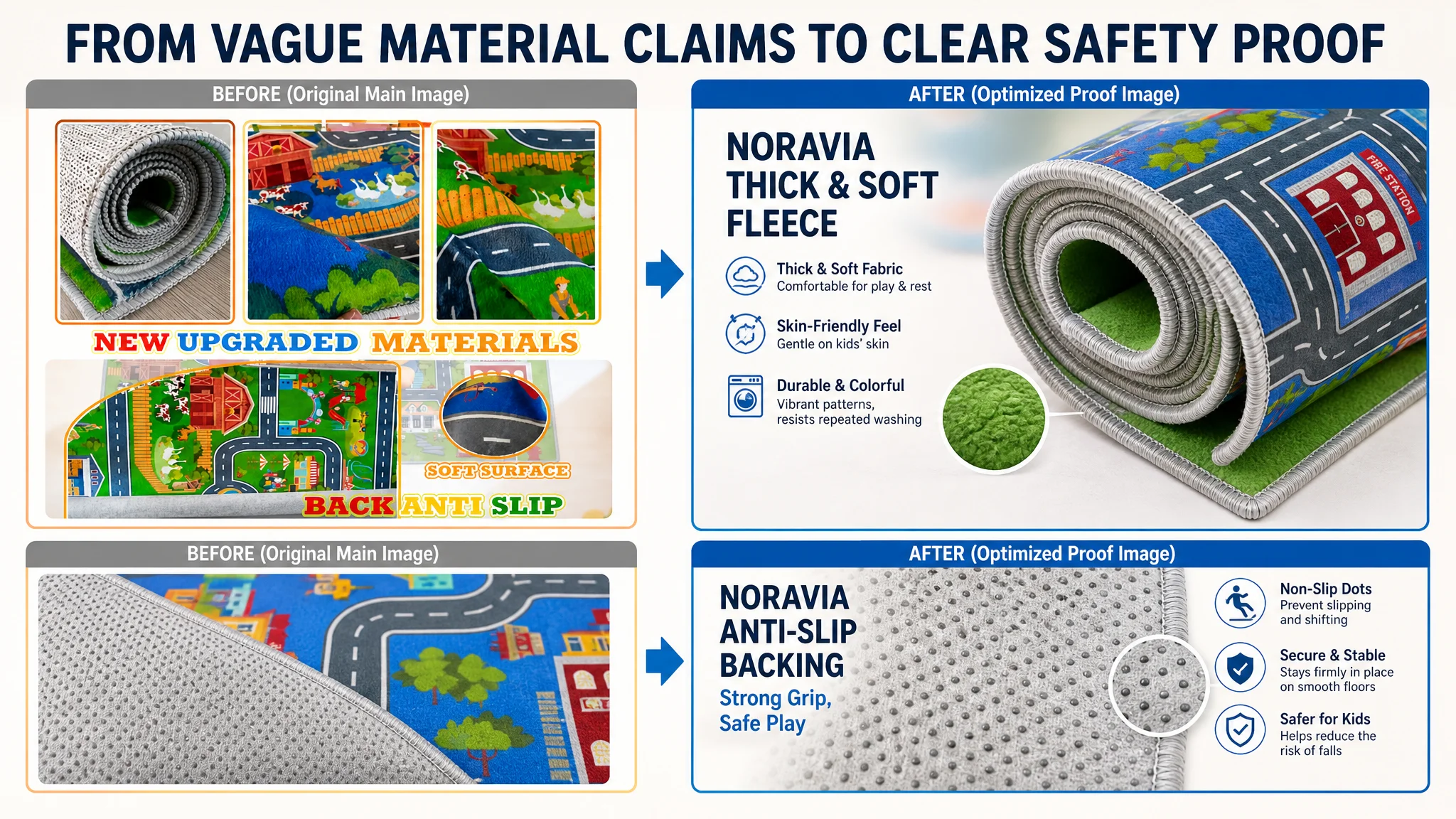
The consequence:
- Parents scanning search results see an energetic, busy thumbnail, but no immediate “non-slip,” “safe,” or “size” cue.
- Those who click in meet emotions and scenes before they meet evidence.
- The Listing’s most rational strengths—material, non-slip backing, easy cleaning—are under-leveraged at the decision point when ad traffic arrives.
This Product Page Did Not Lack Emotion. It Lacked a Clear Buying Logic.
DeepBI’s assessment of the bullet points and A+ content was not that they were “bad.” In fact, structurally they were stronger than the competitor’s.
- Bullet points used bracketed headings (e.g., “【场景探索】/【UPGRADED NON-SLIP】”) and connected features to user benefits.
- A+ content used:
- Full-width lifestyle shots of children playing.
- A “function triple” module (wipe / vacuum / machine wash).
- Color options and collage details.
The problem was sequence and focus, not richness.
“The bullet points had information, but not a buying logic aligned with how cautious parents actually decide.”
Where the persuasion logic broke:
1. Safety (anti-slip) did not come first.
On smooth flooring, the single largest fear is “Will this slip? Will my child fall?”
- Anti-slip backing details existed in bullet points, but early images and A+ modules did not visually prove it.
- A+ opened with large emotional scenes and left anti-slip confirmation for later, if at all.
1. Physical evidence was too verbal.
The Listing talked about:
- “Crystal velvet” surface.
- “Upgraded non-slip backing.”
- Soft, thick, comfortable short-pile fabric.
But:
- There were no rolled-edge close-ups to show thickness.
- No macro shots of the backing texture.
- No size module that clearly situates 31''x47'' in a child’s room with visible reference objects.
1. Cleaning ease—the seller’s real advantage—was not exploited in images.
The Listing emphasized “machine washable” in copy.
The competitor:
- Only lightly touched cleaning with text like “can be washed and dried, can be rolled up.”
Yet:
- The customer’s original image set did not visually demonstrate machine washing as a key differentiator in the first five images.
- The one place where cleaning was visualized (A+ function triple) was not tightly integrated with the main image sequence.
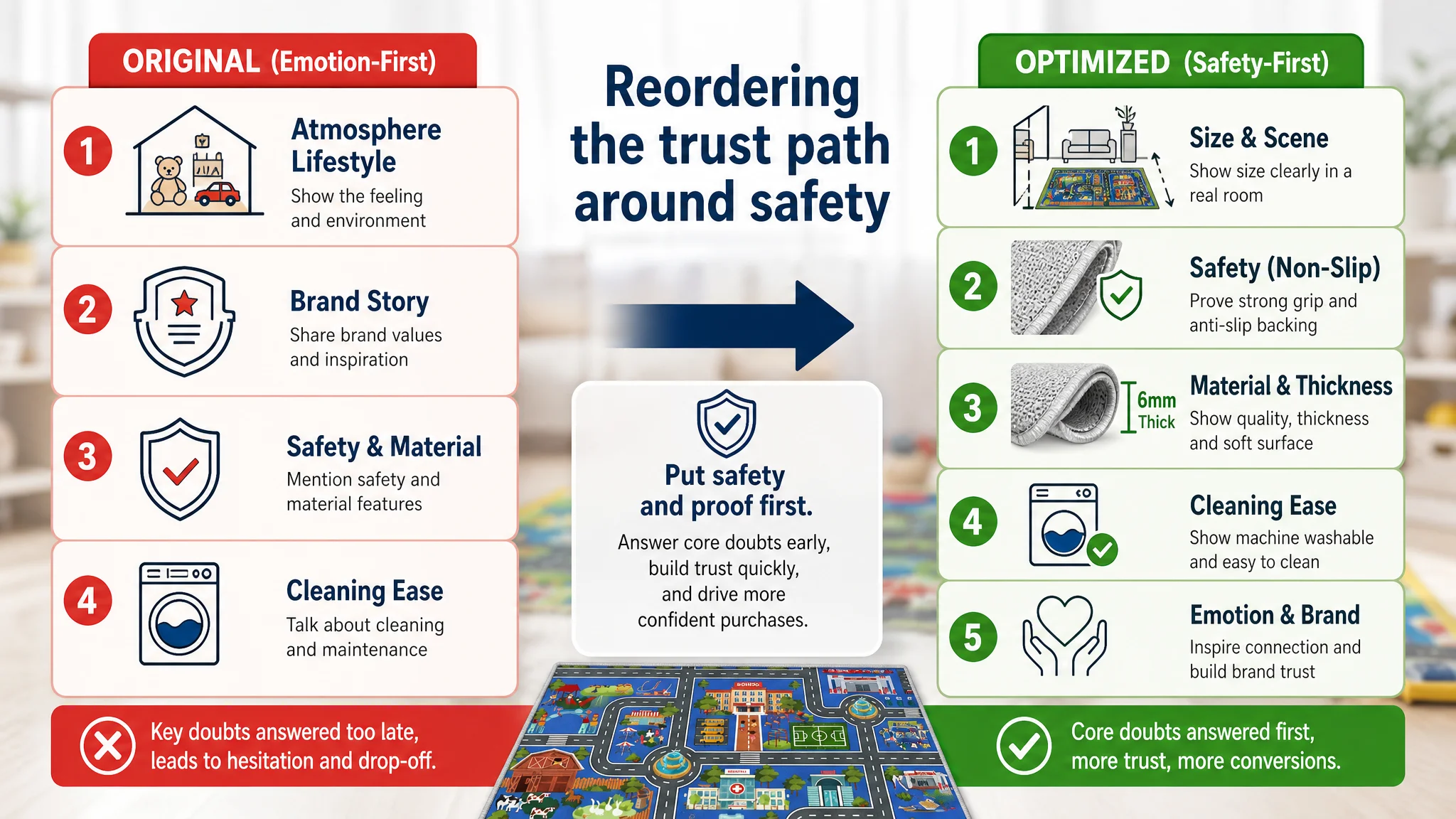
This meant that:
- The Listing’s strongest rational differentiator (easy cleaning) was invisible to many buyers.
- The most critical fear (slipping) was not resolved quickly enough.
- Emotional scenes appeared before the main rational objections had been neutralized.
How DeepBI Reframed the Problem and Prioritized Fixes
Given this diagnosis, DeepBI’s core judgment was:
“This product page does not lack traffic or content. It lacks a trust-first, evidence-first order. We must rebuild the persuasion logic before we feed it more ad traffic.”
Why the Listing had to be repaired before more ad tuning
- Ads were not the bottleneck: there was already sufficient exposure and click activity.
- The main commercial risk was wasted ad spend on traffic that would bounce for fixable, page-level reasons.
- Continuing ad-only optimization would produce diminishing returns and reinforce the wrong learning (“ads don’t work for this ASIN”).
The decision path:
1. Title first: reclaim critical keywords and decision cues.
DeepBI recommended moving to:
Kids Road Car Rug Play Mat for Toy Cars, 31''x47'' Non-Slip City Life Race Track Educational Area Rug, Nursery & Playroom Carpet for Boys and Girls
This change:
- Removes redundant “rug” repetition, reducing keyword stuffing risk.
- Explicitly introduces “Non-Slip” and “Educational”.
- Locks in size (31''x47'') as early as possible.
- Specifies key scenarios: Nursery, Playroom, Boys and Girls.
For buyers scanning on Amazon:
- The title now answers “what it is,” “why it’s safe,” “how big it is,” and “who it’s for” in one pass.
- Amazon’s algorithm receives cleaner, more targeted signals for long-tail search queries.
1. Main images: reorganize around parents’ top three questions.
DeepBI’s main image plan was not about “making it prettier,” but reassigning each image a clear decision role:
- Image 1 – Reason to click: keep the full mat view, but add toy cars on the roads to immediately signal “play mat for toy cars.” No models, no invented elements; only using existing product imagery plus the seller’s own toy assets.
- Image 2 – Material comfort proof: focus solely on surface softness and new fabric; remove conflicting anti-slip visuals from this frame. Add concise text derived from bullet points about soft, thick, skin-friendly short-pile fabric.
- Image 3 – Size and parameters: retain pattern close-ups but replace generic icons with:
- Clear size annotation 31''x47''.
- Short text list: “vivid colors,” “crystal velvet surface,” “durable under repeated machine washing.”
- Image 4 – Anti-slip safety: zoom into the backing (using existing backing visuals), and make anti-slip the sole message:
- Visual focus on dense anti-slip dots.
- Text like “upgraded encrypted non-slip backing,” “strong grip,” “helps prevent slipping.”
- Image 5 – Cleaning advantage: keep a single-product composition and overlay explicit text:
- “Easy to clean: vacuum regularly, roll up and machine wash cold, lay flat to dry.”
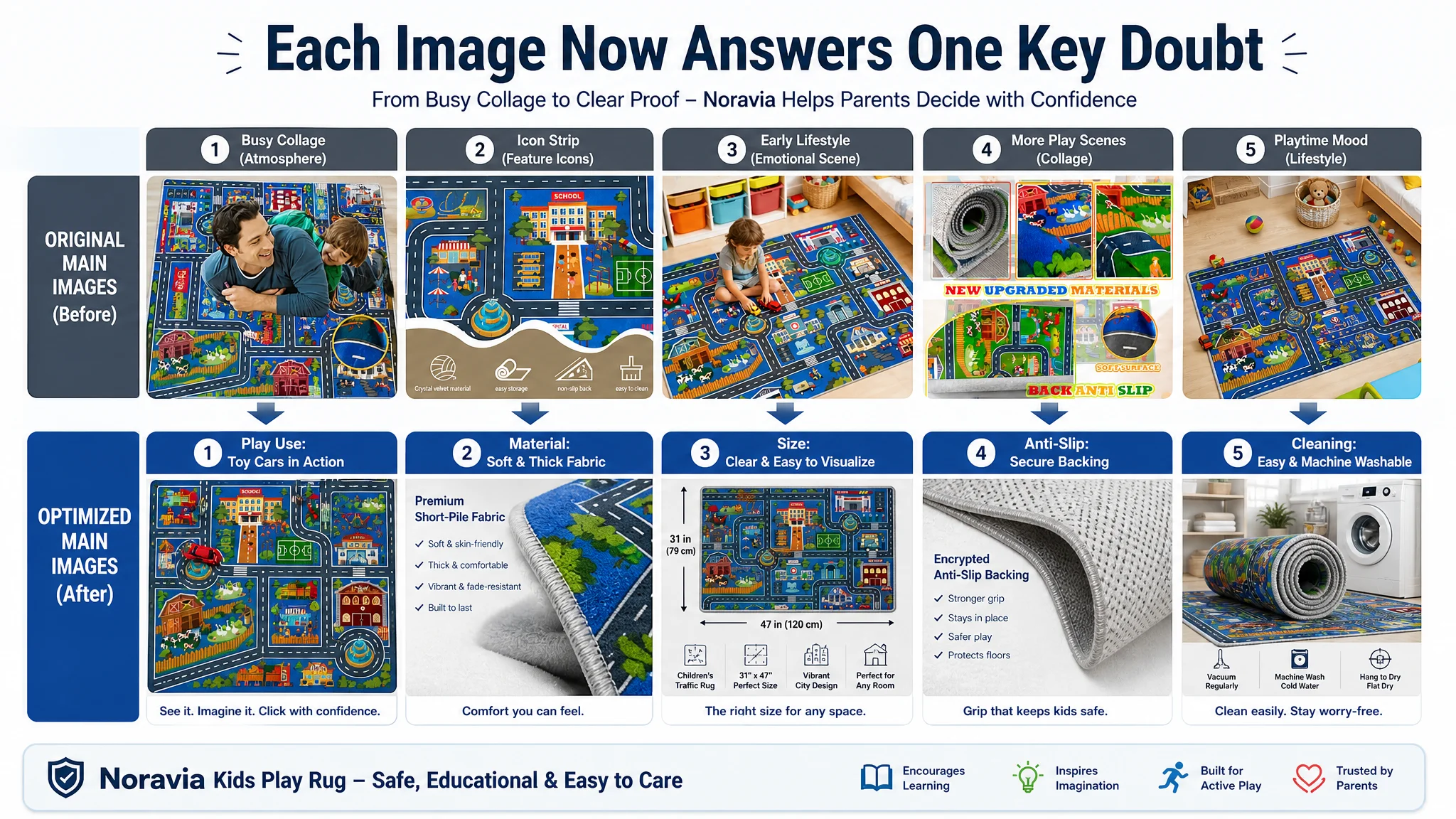
This restructuring ensures:
- Each of the first five images directly tackles one rational concern.
- Safety and cleaning doubts are resolved before parents scroll to softer emotional scenes.
- The Listing’s strongest differentiators are now visible to ad-driven traffic.
1. Bullet points: align structure with competitor strengths and parents’ search behavior.
DeepBI did not discard the seller’s emotional angle; instead, it layered in more concrete elements inspired by the benchmark:
- BP #1 – Learning & traffic logic: adds explicit references to schools, hospitals, police stations, gas stations, and role-playing, making the mat clearly a “kids learning & traffic road rug” for parents filtering by educational value.
- BP #2 – Non-slip and comfort: clarifies material (“skin-friendly polyester short-pile”) and role of non-slip backing, directly addressing comfort and safety.
- BP #3 – Occasion breadth: broadens scenarios to bedrooms, playrooms, classrooms, preschools, nurseries, opening B-side potential and capturing more query variants.
- BP #4 – Cleaning & storage: combines machine washing and roll-up storage to solve space and maintenance fears in one concise block.
- BP #5 – Expectation management & assurance: sets clear expectations around folding creases and offers practical advice (lay flat or low-heat iron), while restating a commitment to safety and parent–child interaction.
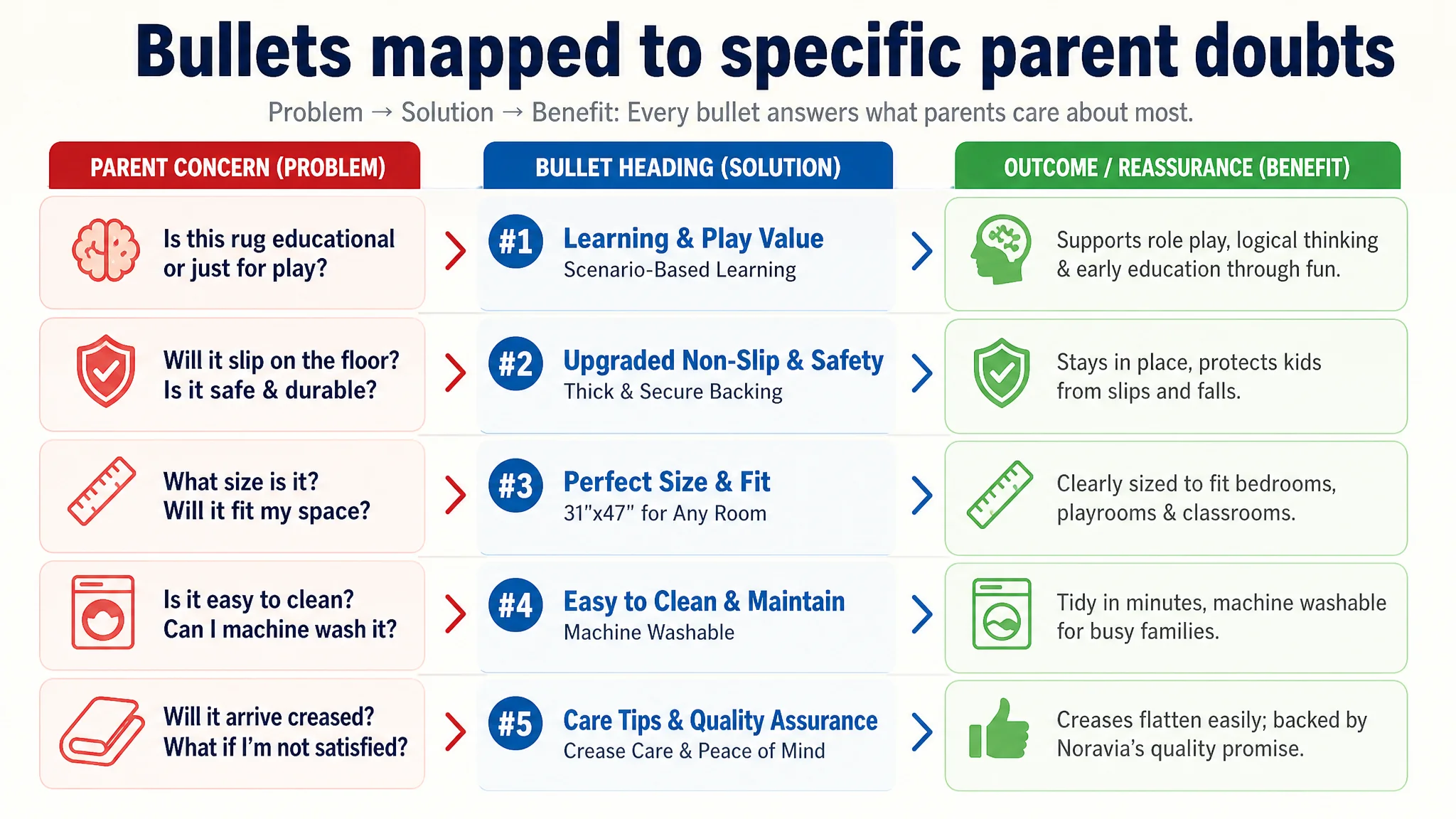
This gives each bullet a “problem → solution → benefit” arc rather than a pure descriptive list.
1. A+ detail page: rebuild the persuasion path as a sequence of answered doubts
DeepBI reorganized A+ modules into a seven-step trust path:
1. Indoor size perception: show the mat in a real room with children as reference to make 31''x47'' instantly understandable.
1. Immersive role-play & logic development: demonstrate children using the road network, schools, hospitals, etc., as a role-play space, emphasizing cognitive and narrative benefits.
1. Pattern clarity & educational richness: close-ups of specific scenes (school, farm, animals) to prove it’s not a blurry print and justifies educational claims.
1. Core safety – non-slip backing: a dedicated module for backing texture, visually confirming “encrypted anti-slip adhesive” and its role in preventing sliding.
1. Easy cleaning & maintenance: keep the triple cleaning module (wipe, vacuum, machine wash), but now positioned after safety, so “play without burden” is anchored in practical maintenance logic.
1. Comfort & easy storage: rolled-mat shots to show thickness and flexibility, reinforcing “not a thin sheet,” “comfort,” and “rolls up easily.”
1. Conditions & after-sales expectations: address crease issues, usage tips, and the brand’s positioning around happiness and growth—as the final reassurance layer.
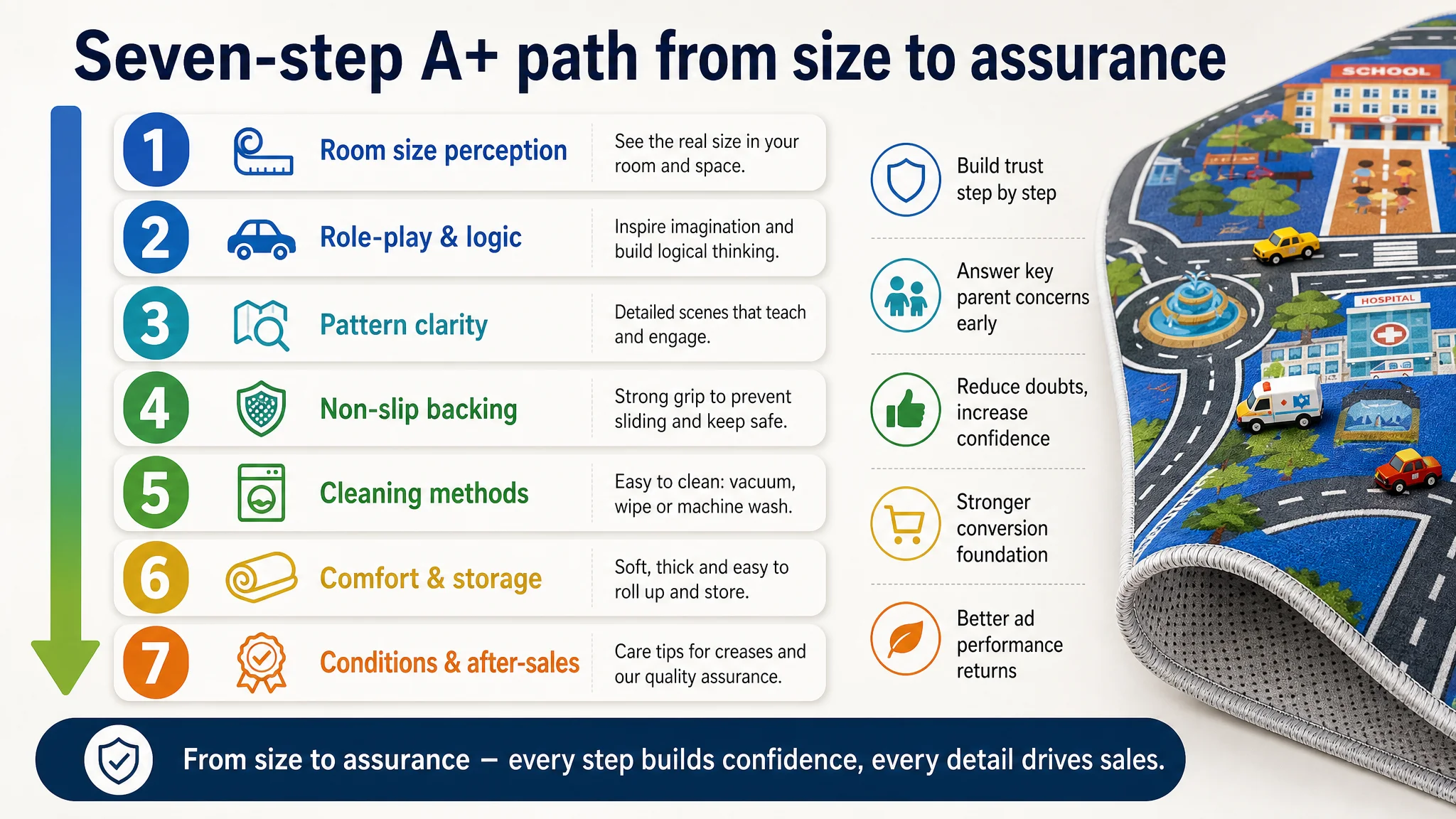
The result is a detail page that:
- Starts with size and use reality.
- Moves through learning value and safety.
- Ends with maintenance ease and brand reassurance.
Instead of scattered strengths, the Listing now walks a cautious parent through a complete decision journey.
How Ad Traffic Became Useful Again Once the Page Changed
DeepBI’s role in this case was not to promise instant, dramatic metric jumps; it was to rebuild the logic so that future ad investments had a fair chance to pay back.
After restructuring:
- The title began to surface the Listing more accurately in “non-slip kids rug,” “traffic learning rug,” “play mat for toy cars” type queries.
- The main image set started to signal safety, size, and educational value in the thumbnail stage, supporting higher-quality clicks.
- A+ content aligned with the parents’ concerns, reducing abandonment caused by unresolved doubts about slipping, size, or cleaning.
While specific ACOS or CVR numbers are not disclosed, the operational shift was clear:
- The seller no longer saw the Listing as “mostly fine” and ads as “the problem.”
- The team understood that Listing conversion is the foundation of ad efficiency.
- Ad spend could now be scaled with more confidence because:
- The page answered core questions early and visually.
- The strongest differentiators—non-slip safety and machine washability—were visibly leveraged.
- The traffic structure (mix of organic and paid) was less at risk of being dragged down by page-level trust leaks.
What Other Amazon Sellers Can Take from This Case
Several patterns in this case apply widely across Amazon categories, especially where safety, size, and material matter:
1. A higher Listing score than a competitor does not guarantee better conversion
If your weaknesses are concentrated in the title and main images, they can outweigh advantages in A+ and reviews.
1. Ads cannot compensate for a misordered persuasion path
If safety and physical proof come after atmosphere and story, traffic will leak regardless of how well the ads are tuned.
1. “Strong content” can still be the wrong content at the wrong time
Emotion, brand story, and lifestyle images are powerful—but only after core doubts (non-slip, size, material, cleaning) are clearly resolved.
1. Your best differentiator must be visible in the first five images
In this case, machine washability was a real edge over the competitor, but initially it was not visually obvious where buyers decide fastest.
1. Listing conversion capacity is not abstract; it’s the ability to neutralize specific doubts in a specific order
DeepBI’s value in this case was to identify that order and enforce it across title, main images, bullets, and A+.
For Amazon sellers, the takeaway is straightforward: when rising ad costs meet flat orders, do not assume “ads stopped working.” Ask first whether your Amazon product page deserves more traffic—whether it builds trust, proves safety and quality, and uses its strongest differentiators where buyers actually decide. Only then does ad optimization truly start to make sense.