

The brand in this case is a US Amazon seller in the automotive accessories category, focused on car covers for small coupe and sport cars. For months, the team had been wrestling with rising Amazon ads costs and unstable ACOS. Their instinct was familiar: keep tweaking bids, keywords, and campaign structure. Yet even when traffic grew, orders did not follow at the expected pace.
What they did not see was that their main benchmark competitor was running on a fundamentally stronger Amazon Listing. DeepBI’s diagnosis showed a 13‑point gap in overall Listing score (66 vs. 79), not because the product was poor, but because the product page could not convert the traffic it was already getting. Title structure, main-image click appeal, bullet-point logic, A+ trust-building, and review presentation were all slightly weaker than the benchmark—small gaps that added up to a real conversion ceiling.
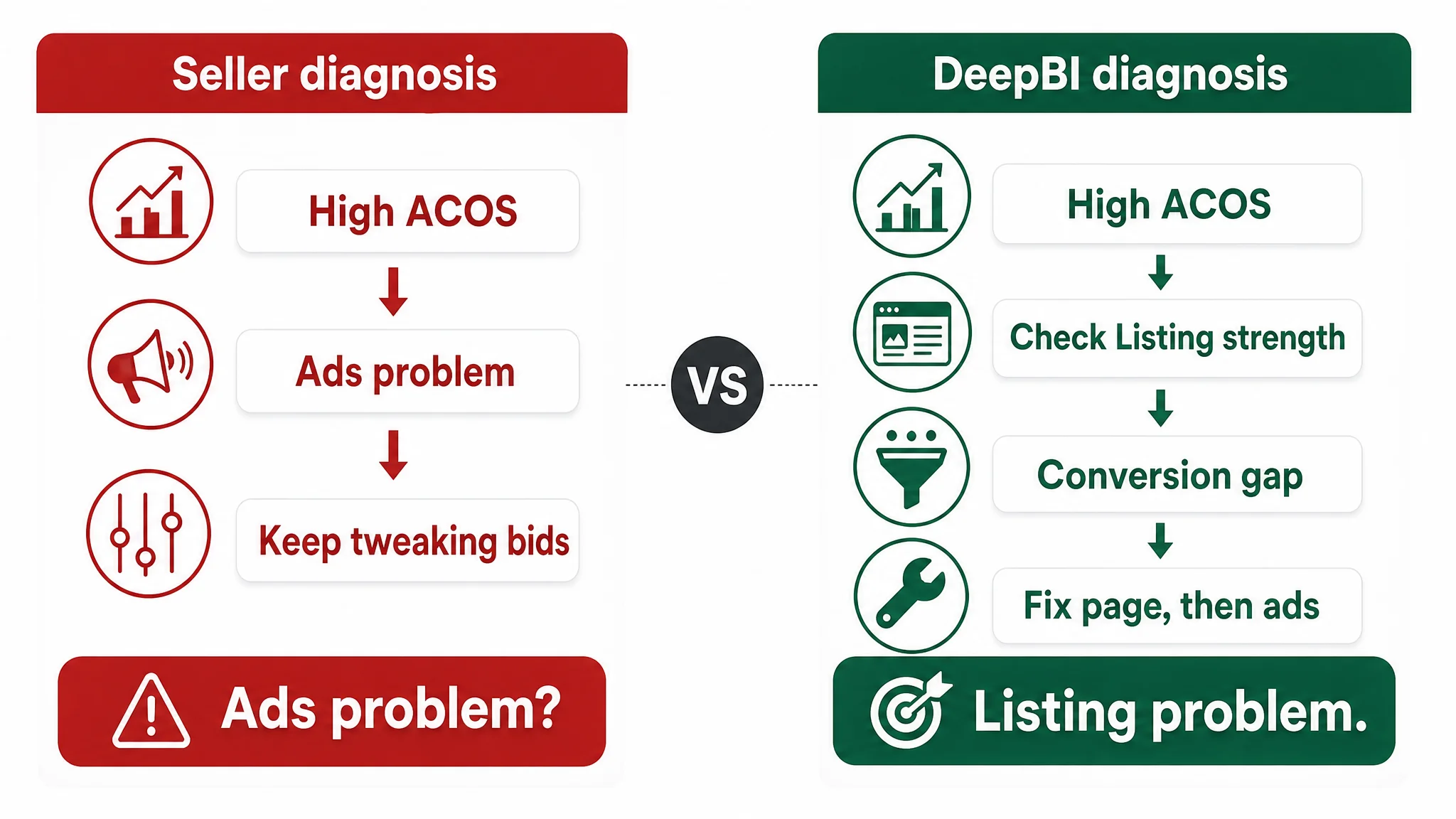
Once the problem was reframed as a Listing-conversion issue rather than an ads problem, the optimization path changed completely. Instead of pushing more ad budget into a leaky page, the focus shifted to rebuilding the title for search logic, restructuring the bullets into a persuasive value ladder, and reshaping the main and A+ images to visualize “all-weather protection” and durability. For other Amazon sellers, this case is a reminder: when ACOS feels “unmanageable,” it is often the Listing— not the campaigns—that is quietly consuming your ad traffic.
The Problem the Seller Saw: Rising Ad Pressure, Unstable Results
This Amazon seller had a classic mid-stage problem in the US marketplace:
- The product was not new; it already had 600+ reviews and a 4.1‑star rating.
- Ads had been running for some time, so keyword data and traffic volume were not the main bottlenecks.
- Yet ACOS remained uncomfortable, and incremental budget did not bring proportional order growth.
The operational intuition was: “Our Amazon ads aren’t efficient enough—we need to optimize campaigns better.” So the team focused on:
- Bid and budget adjustments
- Keyword expansion and negative keyword filtering
- Campaign restructuring and new placements
But the outcome barely moved. Traffic growth did not convert into stable, profitable orders.
“The real problem was not that ads failed to bring traffic. It was that the page could not convert the traffic.”
This is exactly the kind of situation where DeepBI does not start by tuning ads. It starts by asking: Does this Listing actually deserve more traffic?
The Original Misdiagnosis: Treating a Listing Problem as an Ads Problem
From the seller’s perspective, the logic seemed reasonable:
- ACOS is high → this is an advertising problem.
- Competitors are bidding aggressively → we must compete on bids and keyword coverage.
- Reviews are decent (4.1 stars) → the page should be “good enough” to convert.
What was missing in that logic:
1. Relative Listing strength
The seller never quantified how their product page compared to a high-performing benchmark Listing in the same Amazon car-cover subcategory.
1. Traffic vs. conversion separation
Ads can solve traffic; they cannot compensate for a page that:
- Fails to communicate core value in the title
- Fails to generate clicks with the main image
- Fails to build trust and logic in bullets and A+
- Shows higher negative-review exposure than competitors
1. The compounding effect of small gaps
No single module looked catastrophically bad. But each module was slightly weaker than the benchmark, and the sum of these “minor” weaknesses materially reduced conversion capacity.
What DeepBI Saw: A 13‑Point Listing Gap Behind the ACOS Pressure
DeepBI’s Listing scoring revealed the real constraint.
Overall score vs. benchmark:
- Target Listing: 66 / 100
- Benchmark Listing: 79 / 100
- Gap: –13 points
Broken down by dimension:
- Title: Seller: 10, Benchmark: 13, Max: 20, Gap: –3
- Main image: Seller: 24, Benchmark: 26, Max: 30, Gap: –2
- Bullet points: Seller: 3, Benchmark: 6, Max: 10, Gap: –3
- Detail / A+: Seller: 19, Benchmark: 22, Max: 25, Gap: –3
- Reviews: Seller: 10, Benchmark: 12, Max: 15, Gap: –2
On paper, these look like modest gaps. In Amazon practice, they are exactly the kind of structural weaknesses that:
- Depress CTR on the search results page
- Lower CVR on the product page
- Force ads to “work harder” and drive up ACOS
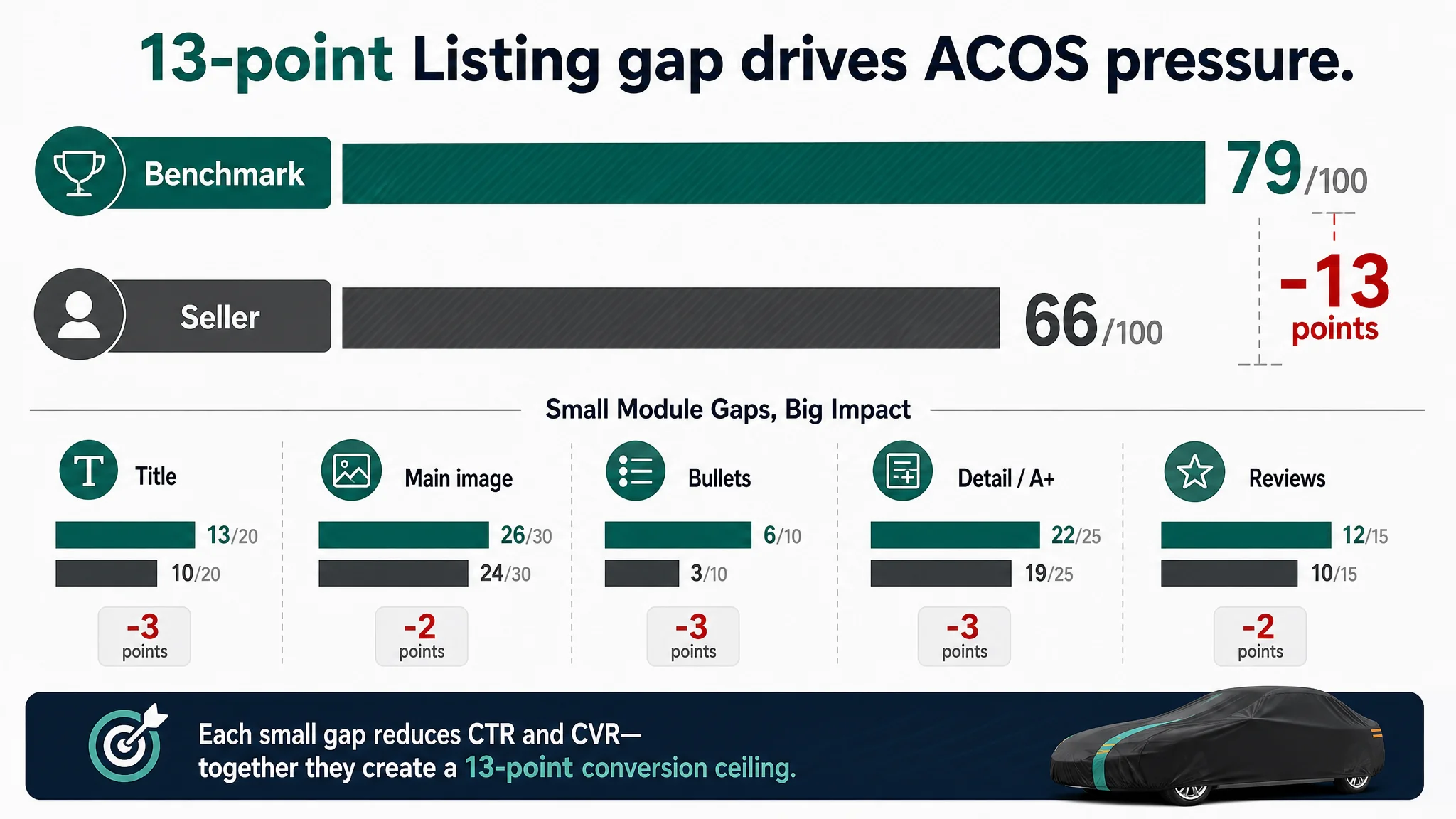
DeepBI’s judgment: this product page lacked conversion capacity relative to its category benchmark. Ads were amplifying a structurally weaker page.
Amazon Ads Were Not Failing. The Page Was Consuming the Traffic.
Title: Weak Search Logic and Value Signaling
The title opened with “Small Car Cover” while the benchmark led with “Car Cover,” aligning directly with the core keyword buyers actually search.
Key weaknesses vs. the benchmark:
- Keyword order: The benchmark followed a “core keyword + applicable vehicle type” pattern, which Amazon’s search logic and users both favor. The target Listing buried applicability in the middle.
- Professional phrasing: The benchmark used “Suitable for …” to introduce the model list, sounding more precise and professional than a simple “for.”
- Model coverage: The benchmark expanded its “long-tail” reach by including additional models such as Toyota MR2 Spyder and Volkswagen Cabrio; the target Listing’s model coverage was narrower.
Why this mattered for ads:
- Ads were buying impressions, but the title didn’t fully capitalize on them with maximized search-weight keywords.
- Many relevant long-tail searches were either under-served or not optimally captured.
- Even when the ad showed, the title did not immediately signal “this is for my car,” hurting click-through.
Main Image: Insufficient Click Motivation
On Amazon, the main image is the first and often only visual reason to click.
DeepBI’s main-image judgment:
- The first impression was weaker, likely depressing CTR by around 5–8% in mobile-first scenarios.
- The visual language leaned towards “functional listing” rather than “scene-driven protection” – more like a catalog shot than a solution to outdoor parking anxiety.
- Size/fit cues were not structured in a way that immediately reassured buyers on compatibility.
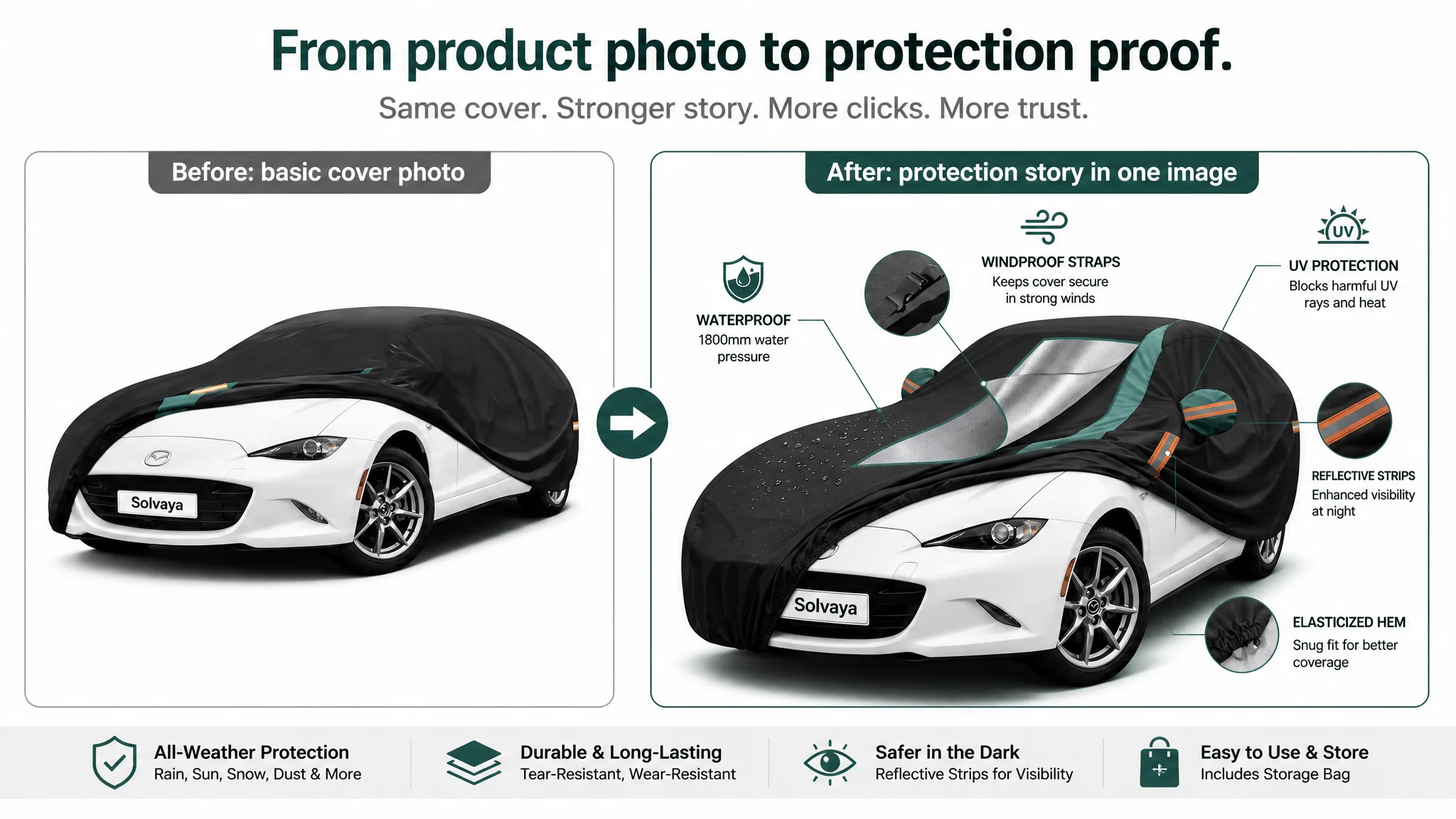
Result: Ads delivered impressions, but the thumbnail did not generate enough compelling clicks versus competitors with cleaner, more professional, and trust-heavy visuals.
Bullet Points: Information Without Buying Logic
The largest structural gap lay in the bullets:
- The seller led with compatibility (basic information) instead of material superiority or protection outcome.
- The benchmark used a “value ladder”: material → all-weather scene protection → differentiated design → compatibility → service.
- The target Listing’s bullets were flat and descriptive, not persuasive. Design advantages were under-described (only two detail points vs. the benchmark’s four).
This meant:
- Buyers saw specs, not a clear “why this cover is safer/more durable/easier to use.”
- Important differentiators (windproof straps, reflective strips, stitching durability) did not form a cohesive narrative.
A+ / Detail Page: Trust Without Proof
Both pages had A+ content. But the benchmark used that space more aggressively:
- Brand statement + customer ratings modules added visible social proof and brand narrative.
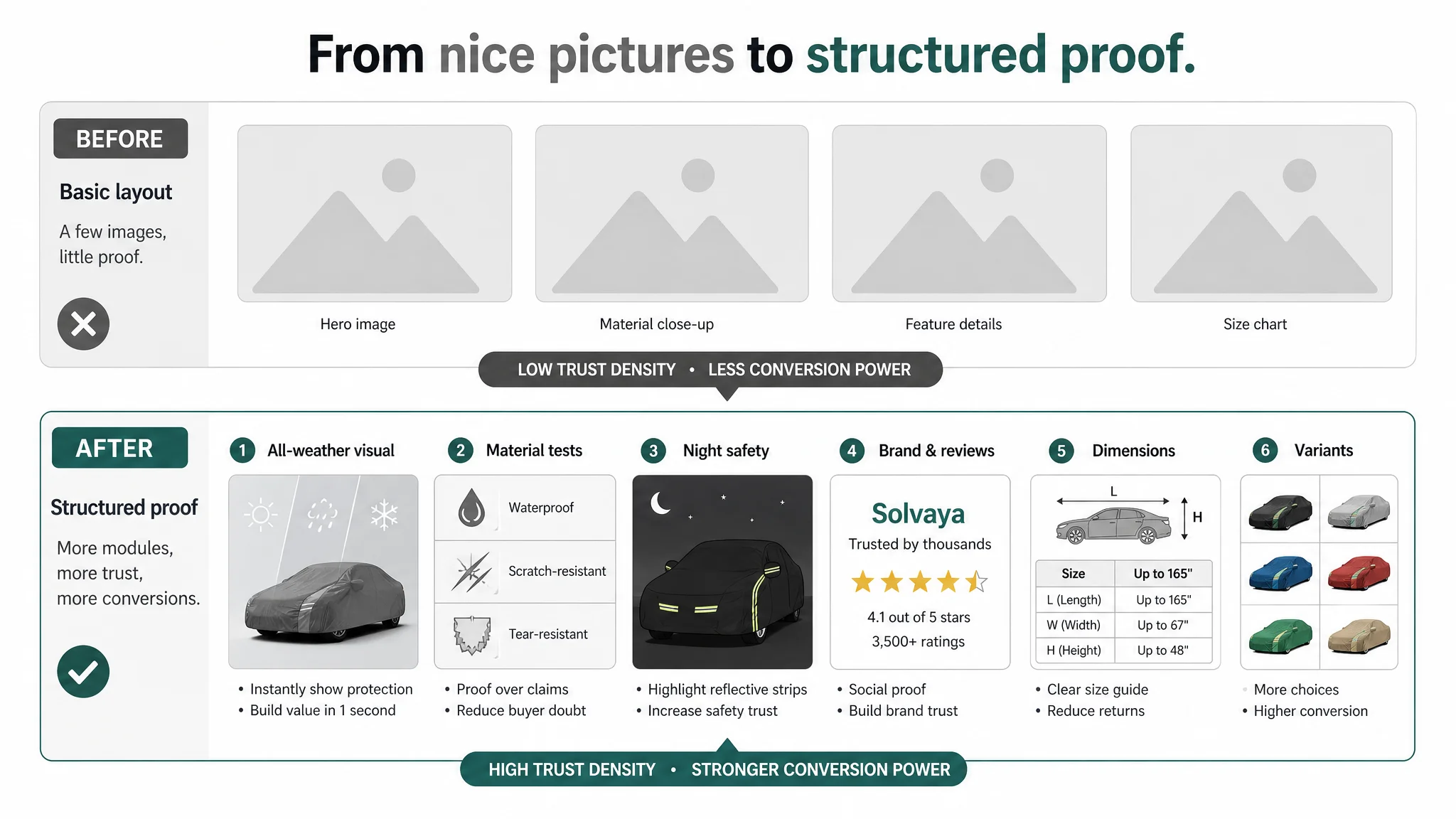
- Three-part functional close-ups with numbered labels (waterproof / scratch-resistant / tear-resistant) compressed a lot of information into quick-scanning visuals.
- Multiple color options and “Buying Options” visuals supported variant awareness and cross-sell.
- Detail shots included technical terminology (“Double Stitched,” “Windproof Straps”) with real operation photos, signaling professionalism.
By contrast, the seller’s A+:
- Showed scenes and details, but lacked explicit labels, numbering, and proof modules.
- Offered only one color presentation and did not leverage A+ to broaden variant perception.
- Forced buyers to “interpret” images without textual anchors, lowering information-transmission efficiency.
Reviews: Same Rating, Different Trust Signal
- Both Listings sat at 4.1 stars, but:
- Benchmark reviews: 3500+
- Seller reviews: 665
- The seller’s home-page negative-review ratio was about 23%, significantly higher than the benchmark’s ~9%.
Effect:
- On first glance, both show 4.1 stars—but the benchmark carries a stronger “scale and stability” signal.
- The seller’s higher visibility of negative reviews increased perceived risk.
The Real Constraint: Listing Conversion Capacity, Not Campaign Settings
Putting all this together:
- CTR was being capped by a weaker title structure and less compelling main images.
- CVR was suppressed by bullets that did not build a value ladder and A+ content that lacked explicit proof and trust modules.
- Trust and risk perception were weaker, due to fewer total reviews and higher visible negative-review share.
DeepBI’s evaluation: at this stage, no amount of bid optimization could fix a page that underperformed at every key decision step:
1. Search results: weaker title + weaker thumbnail → fewer clicks per impression.
2. Product page: less persuasive bullets + lower-density proof in A+ → fewer orders per visit.
3. Social proof: weaker review scale and negative-review exposure → decreased willingness to pay and to convert quickly.
Conclusion: ads were not the bottleneck; they were the amplifier of a weak page.
Why DeepBI Did Not Recommend “More Ad Tuning” First
From a business-risk perspective, continuing to iterate ads first would have:
- Increased spend on traffic that could not be fully monetized.
- Distorted performance data, making it harder to see that the issue lay in CTR/CVR rather than reach.
- Prolonged the period where the Listing underperformed the benchmark, risking erosion of organic ranking.
Instead, DeepBI prioritized Listing repair before ad escalation, for three reasons:
1. Foundation logic:
A Listing with a 13‑point gap vs. benchmark in a competitive Amazon category is a structural handicap. Fix that gap first, then scale traffic.
1. Avoiding “expensive learning”:
Running heavier traffic into an under-optimized page creates noisy data and burns budget. Fixing the page first lets future ad tests reflect real demand, not page friction.
1. Reducing long-term risk:
Better Listing conversion improves both organic and paid performance, stabilizing the traffic mix and lowering dependence on ads.
“Advertising does not only amplify advantages. It can also amplify a page’s existing defects.”
How the Optimization Reframed the Page’s Sales Logic
Rebuilding the Title: From Product Name to Search Engine
The proposed title moved from a “product-label” approach to a search-logic-first approach:
From (simplified):
- “Small Car Cover … for [some models] …”
To something like:
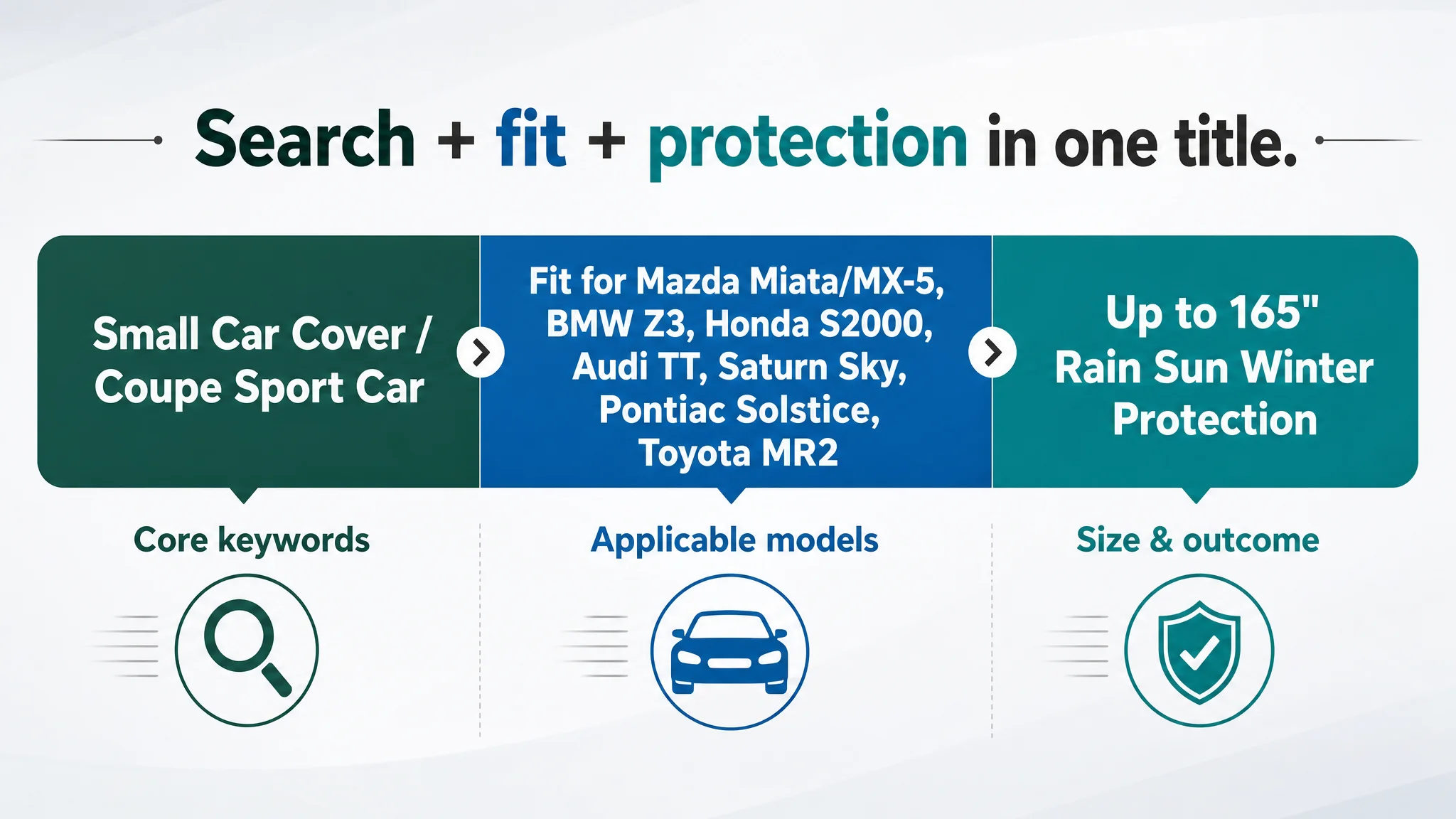
Small Car Cover Waterproof All Weather for Coupe Sport Car, Fit for Mazda Miata/MX‑5, BMW Z3, Honda S2000, Audi TT, Saturn Sky, Pontiac Solstice, Toyota MR2, Up to 165" Rain Sun Winter Protection
Key changes:
- Combined core terms: “Small Car Cover” + “Coupe Sport Car” gives coverage for both general and segment-specific queries.
- Broader model list: adds high-search models (Saturn Sky, Toyota MR2) referenced from benchmark behavior.
- Explicit size: “Up to 165"” gives instant clarity on fit.
- Protection outcomes: “Waterproof All Weather … Rain Sun Winter Protection” tells users what problem is solved.
Resulting logic: search-weight + applicability + outcome in one line.
Restructuring Bullet Points: From Flat Info to a Value Ladder
DeepBI’s suggested bullets did not just “add adjectives”; they reordered and reframed the logic:
1. BP #1 – Choosing the right model (compatibility with explicit “not for” warning)
- Clears doubts about fit (Sedan & Coupe up to 165", not for SUV/hatchback).
- Reduces returns from misfit purchases.
- Mirrors benchmark clarity while slightly expanding the range vs. their 163-inch limit.
1. BP #2 – Material as a premium differentiator
- Elevates high-density polyester and PA coating as premium, all-weather material.
- Links water-pressure metrics (1800mm) with real-world benefits (100% waterproof, UV protection, all-season use).
1. BP #3 – Design details as a cluster of advantages
- Integrates windproof straps, elastic hem, reflective elements, and double stitching into one integrated “durability and stability” story.
- Moves from 2 vague detail points to 3 structured, numbered design benefits.
1. BP #4 – All-weather, indoor + outdoor scenarios
- Turns generic “all-season protection” into a concrete list of hazards: sun, heavy rain, snow, ice, pollution, bird droppings, fallen leaves, pollen, acid rain.
- Reassures buyers that both driveway and street-parking risks are covered.
1. BP #5 – After-sales and warranty as a trust anchor
- Clearly lists what’s in the box.
- Emphasizes a 12-month warranty, longer than the benchmark’s 6 months.
- Commits to 24‑hour response, creating a perception of accountable support.
Together, these bullets shift the message from “here are some features” to “this is a robust, professional protection system with clear fit, premium materials, stable design, and reliable backup.”
Main Images: Turning Features into Clickable Visual Proof
The main-image optimization plan did not aim for “prettier” images; it aimed for more clickable and more informative images under Amazon’s constraints.
Examples of visual logic:
1. Hero image:
- Product covering ~70% of frame, 45° angle, realistic shadows, clean white background.
- The car partially covered to show silhouette and fit, visually anchoring size and shape.
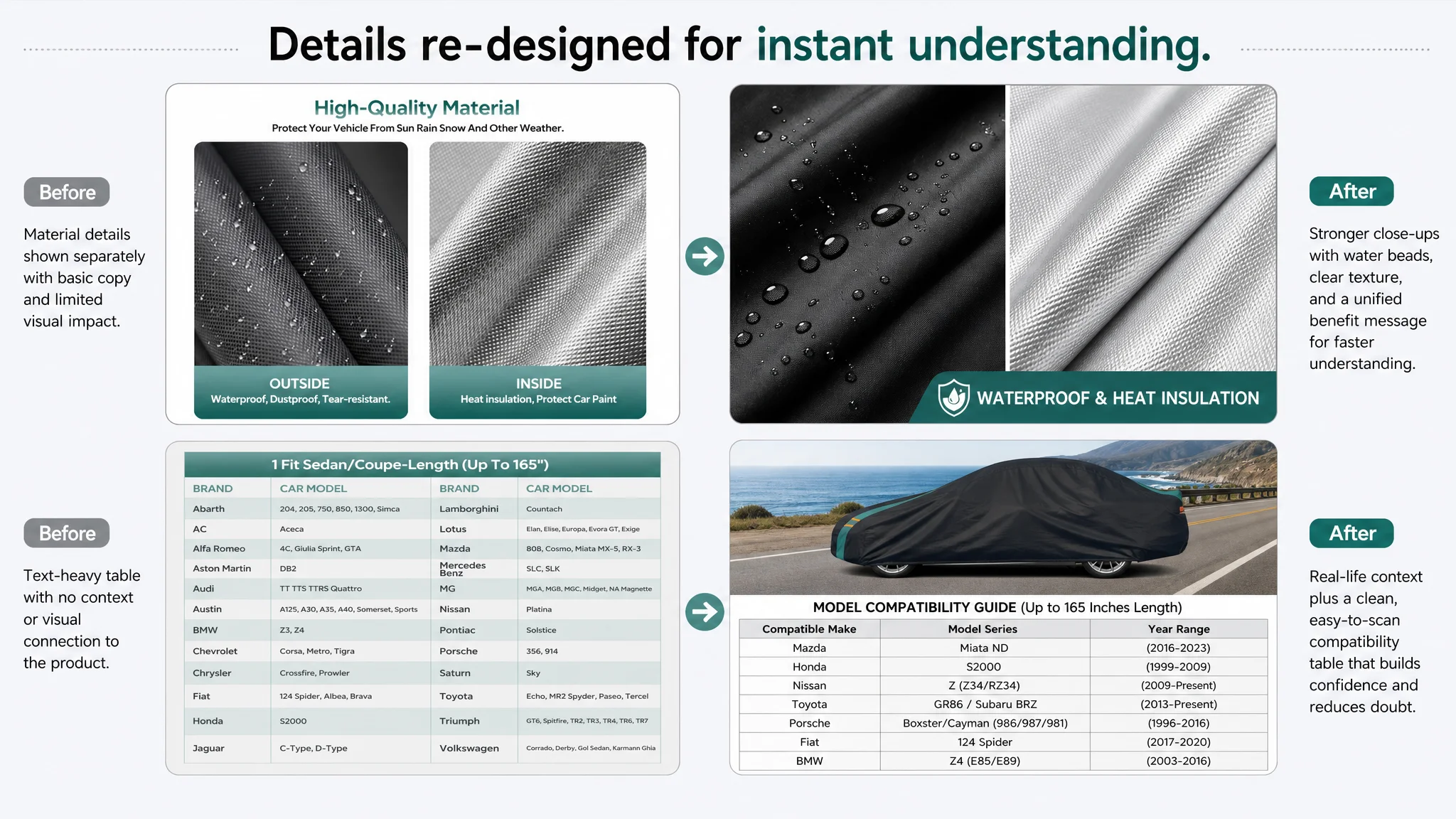
1. Material and function visualization:
- Split image showing outer surface with water beads vs. inner liner texture.
- Clear tag for “Waterproof & Heat Insulation” in clean sans-serif font.
1. Detail cluster image:
- Center product, with four circular zoom-ins pointing to:
- Windproof straps
- Double stitching
- Elastic hem
- Reflective strips
- Each close-up built as a macro view, turning abstract bullet claims into concrete visuals.
1. Protection-icon image:
- The car cover centered, surrounded by icons for rain, sun, snow, dust, leaves, scratches.
- One-second readability: “this protects from all directions and all seasons.”
1. Compatibility image:
- Upper portion: cover in a real road scene.
- Lower portion: a clear, readable compatibility table listing representative models and dimensions.
These changes:
- Increase CTR by making the listing thumbnail more professional and information-dense without clutter.
- Support CVR by aligning all secondary images with the bullet and A+ narratives.
A+ / Detail Page: From “Nice Pictures” to a Structured Story
DeepBI’s A+ optimization centered on six decision-critical modules.
1. All-weather core visual
- One composite image showing the cover under sun, heavy rain, and snow, with corresponding backgrounds.
- Immediate visual message: “one cover, all seasons.”
1. Durability proof (water and scratch tests)
- Left: macro shot of water beads sliding off fabric.
- Right: key or metal object scraping fabric without visible damage.
- This replicates and upgrades the benchmark’s “violence test,” giving buyers confidence in real-world abuse resistance.
1. Night safety (reflective strips in a dark street)
- Simulated dashcam perspective of a dimly lit road.
- Bright green reflective strips clearly visible under headlights.
- Communicates a unique safety angle beyond basic “protection from elements.”
1. Wind-resistance module (straps and buckles in a windy scene)
- Close-ups of buckles and elastic straps under a “windy environment” backdrop (leaves blowing).
- Visually addresses a common negative-review theme in this category: covers blowing away.
1. Inner coating and structure
- Folded view showing black outer layer and silver inner coating.
- Clear tags such as “Silver Coating” and “1800mm Water Pressure.”
- Connects the technical claim with a visible, tangible inner structure.
1. Dimension guidance and error correction
- Side and front car diagrams with L/W/H clearly labeled.
- Corrected spellings (“CLASS,” “Height”) compared to the original mis-typed version.
- Clean, flat design with readable fonts.
1. Installation and storage ease
- Visual scenario: a single adult easily carrying the folded cover in a storage bag in a clean garage environment.
- Subtly counters the “big and cumbersome” fear, promising straightforward installation and storage.
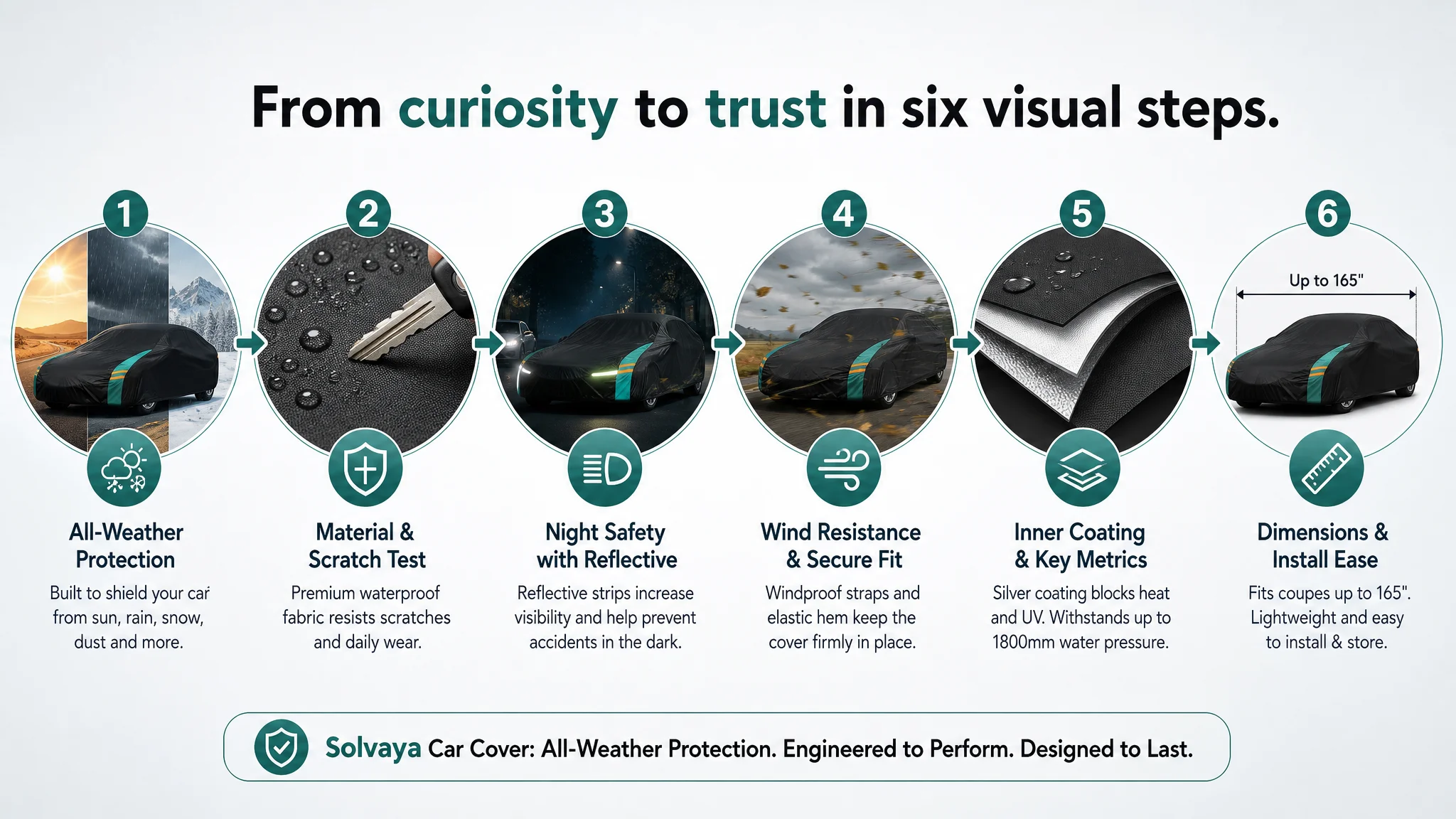
Net effect: the A+ page stops being “nice pictures of a cover” and becomes a structured argument:
- This cover protects in all weather.
- It survives harsh, real-world conditions.
- It improves safety in the dark.
- It stays in place in wind.
- It is professionally engineered and easy to use.
How Traffic Became Useful Again
Although this case does not attach specific CVR or ACOS numbers, the operational changes are clear:
- Listing conversion capacity improved:
- Titles aligned better with Amazon search logic.
- Main images created stronger click reasons.
- Bullets and A+ content reduced buyer uncertainty and increased perceived professionalism.
- Ad spend risk decreased:
- Each paid click landed on a more convincing page.
- Wasted clicks on mismatched vehicle types were reduced by clearer compatibility messaging.
- The Listing began to rebuild its organic conversion ability, relieving pressure on ads.
- Traffic structure became more stable:
- Better conversion supports stronger organic rank.
- Dependence on “paid pushes” falls as the page earns more of its own orders.
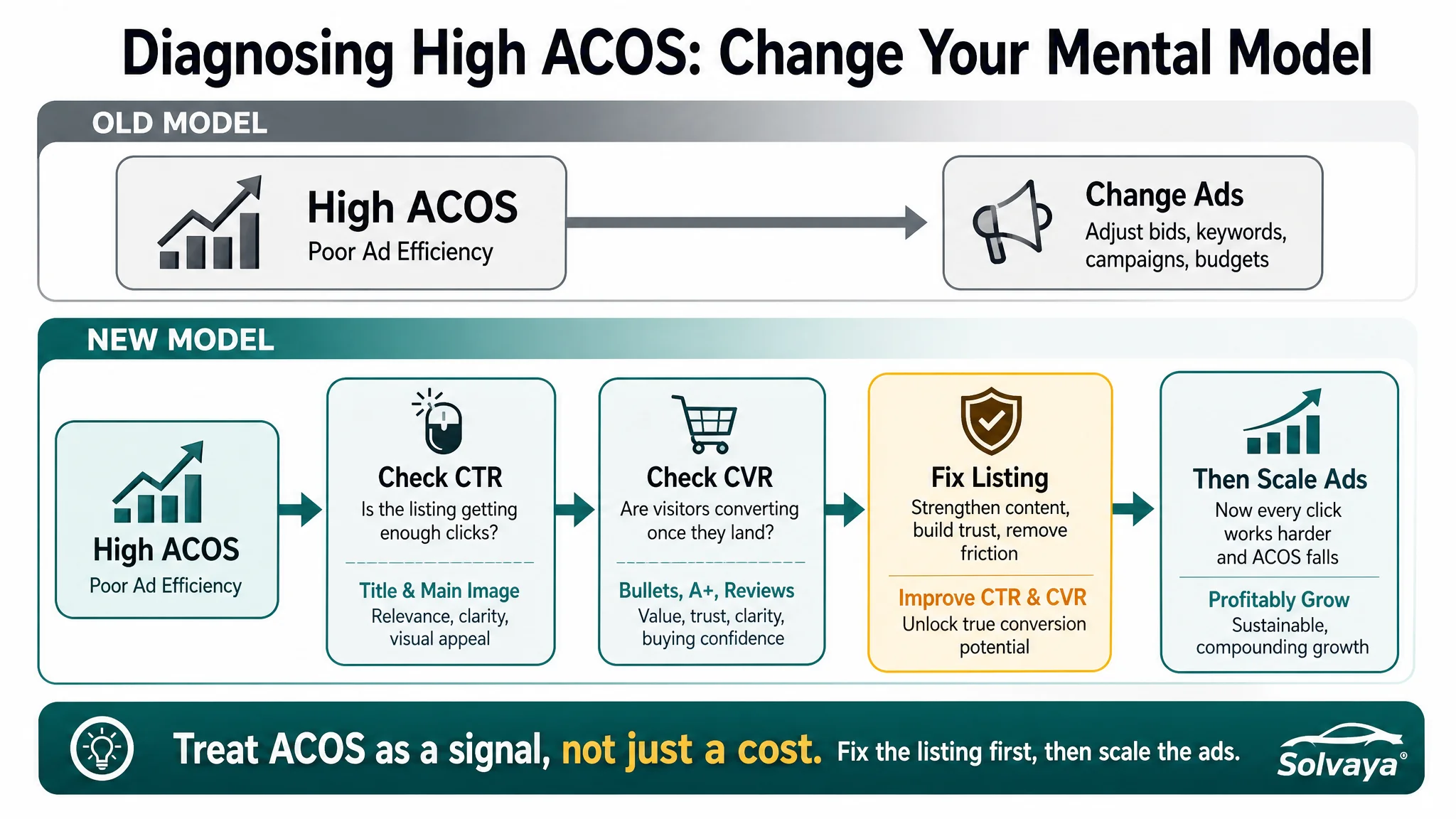
Most importantly, the team’s mental model shifted:
- From “ACOS is an ads problem”
→ To “ACOS reflects the combined performance of traffic and page conversion.”
- From “we must keep finding better campaign structures”
→ To “we must first ensure the Listing can extract maximum value from every visit.”
What Other Amazon Sellers Can Learn
1. Do not assume reviews alone guarantee conversion.
A 4.1‑star rating with 600+ reviews is not enough if:
- Title logic is weaker than category benchmarks.
- The main image lacks a strong click trigger.
- Bullets and A+ are not building a coherent buying path.
1. Treat ACOS as a diagnostic signal, not just a cost metric.
High ACOS with stable traffic often signals:
- CTR problems (main image, title)
- CVR problems (bullets, A+, reviews)
- Or both
1. Benchmark your Listing, not just your bids.
Before adding budget, ask:
- How does my title structure compare to the top Listings?
- Does my main image create at least as strong a click reason?
- Are my bullets and A+ modules as dense and trust-rich as theirs?
1. Fix page conversion before scaling ads.
Ads amplify whatever is already on the page. If the page leaks trust and clarity, ads will amplify that leak.
1. Align every module to one story.
In this car-cover case, the winning story was:
“High-durability, easy-to-use, all-weather safety for small coupe and sports cars.”
Title, main image, bullets, and A+ all shifted to support that.
For Amazon sellers, this case is not about a single car cover. It is about a general pattern: when ads feel “harder to optimize,” the Listing itself is often the real constraint. DeepBI’s value in this scenario was not listing more features or tools; it was in reframing the problem and forcing a return to the real foundation of Amazon advertising efficiency: a product page that converts.