

Why Competitor Listing Analysis is Your Amazon Growth Engine
In the hyper-competitive Amazon marketplace, listing optimization is no longer about subjective tweaks; it's a data-driven process of precise coordination. Without a clear diagnosis of the competitive landscape, any changes you make are simply guesswork. A systematic analysis of your competitors' listings is the essential first step, providing an objective data foundation that moves your strategy from "blind trial and error" to precision execution.
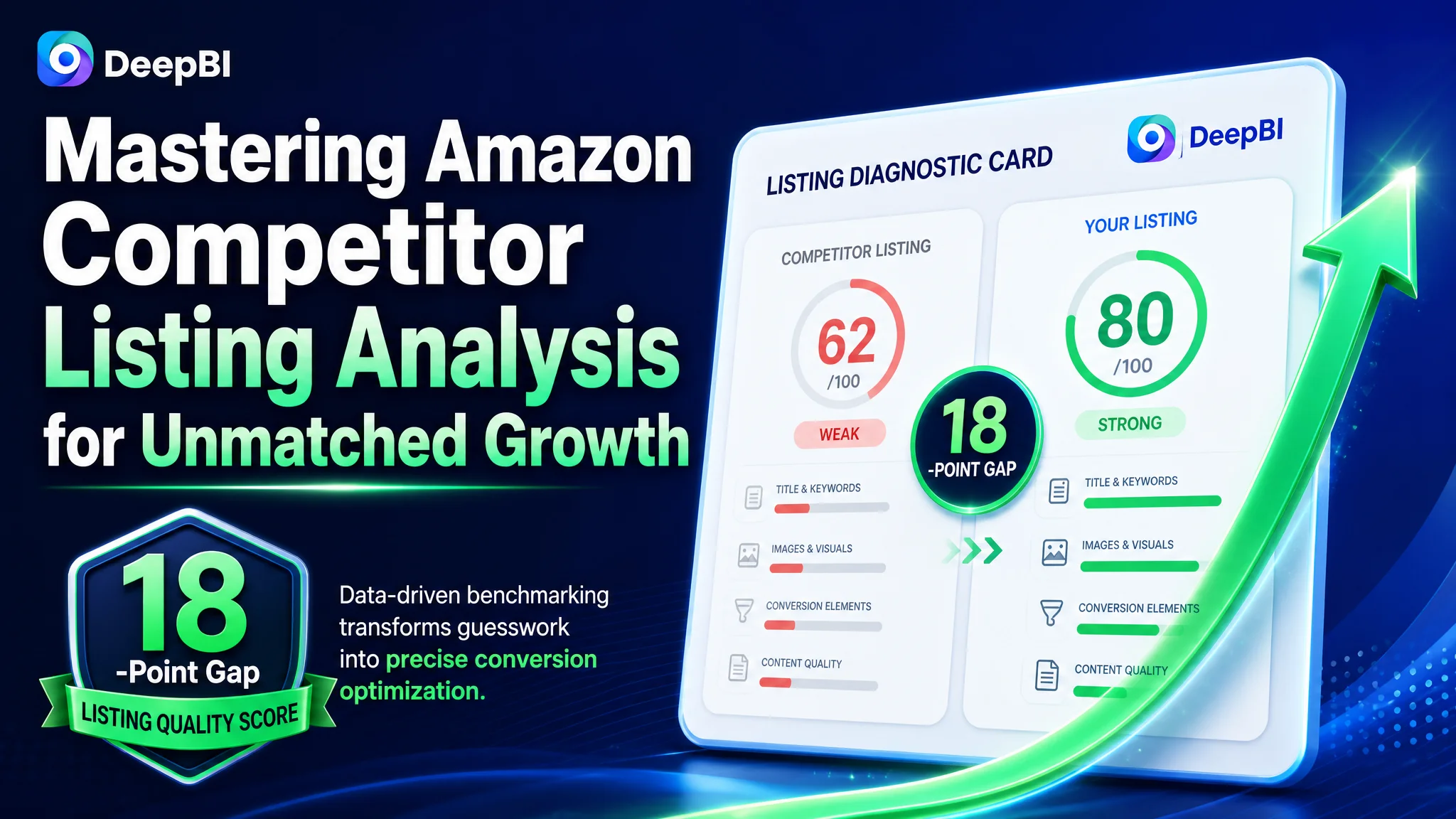
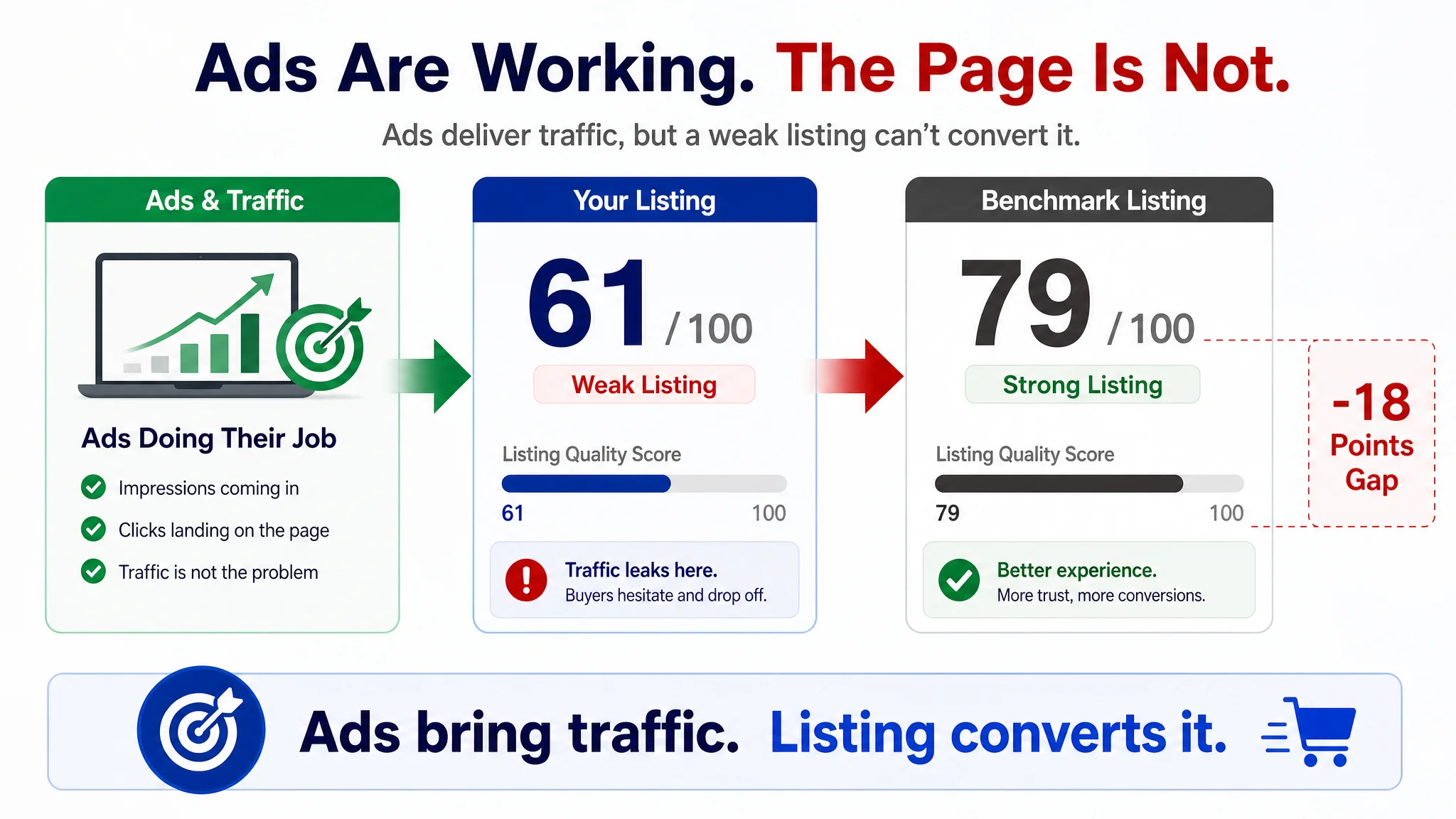
This becomes particularly clear when you look at how problems show up in real stores. A German seller in the DE fitness category, for example, operated a water-filled dumbbell set and initially framed their challenge purely as an ads issue: rising ACOS, “expensive traffic,” and a belief that “our creatives just aren’t attractive enough.” They cycled ad creatives, adjusted bids, and expanded keyword sets, yet orders stubbornly refused to follow the traffic curve. It wasn’t until their listing was benchmarked against a strong competitor that the real picture emerged: the page itself lagged 18 points behind on DeepBI’s listing quality score, with weaknesses across the title, main images, bullets, A+ content, and reviews. Ads were doing their job—delivering traffic—but the listing could not convert that traffic into buyers.
This deep dive allows you to deconstruct what makes top performers successful. By dissecting their titles, images, and customer reviews, you can uncover critical market intelligence: identify unmet customer needs that create market gaps, pinpoint pricing strategies that resonate with shoppers, and understand the exact pain points your product can solve better. Understanding a competitor's strengths and weaknesses provides a clear roadmap for your own optimization. For example, analyzing a rival's high-performing main image can reveal visual hooks that have the potential to significantly improve your Click-Through Rate (CTR). Similarly, identifying weaknesses in their A+ content can show you how to build more trust and boost your Conversion Rate (CVR).
In the water dumbbell case, the benchmark competitor’s listing clarified exactly which elements mattered: a structured title that spelled out “water dumbbells → fillable weight bags → clear weight range → usage scenario,” bright and trustworthy main images, scenario-rich A+ content, and a cleaner review profile. Once this contrast was visible, the seller finally had a concrete roadmap: instead of endlessly tuning campaigns, they needed to rebuild the listing’s decision logic so that every click had a fair chance of turning into a purchase. This is the practical impact of competitor listing analysis—it turns strategy from vague optimization into concrete, prioritized actions that directly influence sales, profitability, and market share.
Identifying Your True Amazon Competitors
Effective market strategy begins with accurately identifying who you are competing against, and your biggest threat might not be the most obvious one. To build a solid foundation for analysis, you must look beyond surface-level similarities and categorize your rivals into two distinct groups: direct and indirect competitors.
Direct competitors sell products nearly identical to yours, targeting the same customer base. The most straightforward way to find them is by searching your primary keywords and analyzing the top-ranking listings. For a more refined view, navigate to your product’s most specific, bottom-level category (Node) and identify the ASINs that consistently dominate that niche.
In the DE fitness water dumbbell example, the seller’s “true” direct competitor was not the global brand with the largest review count or the broadest catalog, but a focused water dumbbell listing that occupied a similar price band, targeted the same home-fitness use cases, and served the same regional audience. Before working with DeepBI, the team had loosely compared themselves to a wide range of fitness products—from traditional iron dumbbells to general home gym equipment—because they looked “similar enough.” However, once they restricted their comparison to a single, well-chosen water dumbbell benchmark in the same node, the gaps in title structure, image storytelling, and A+ completeness became stark. This tighter benchmark selection made the diagnostic conclusions far more actionable.
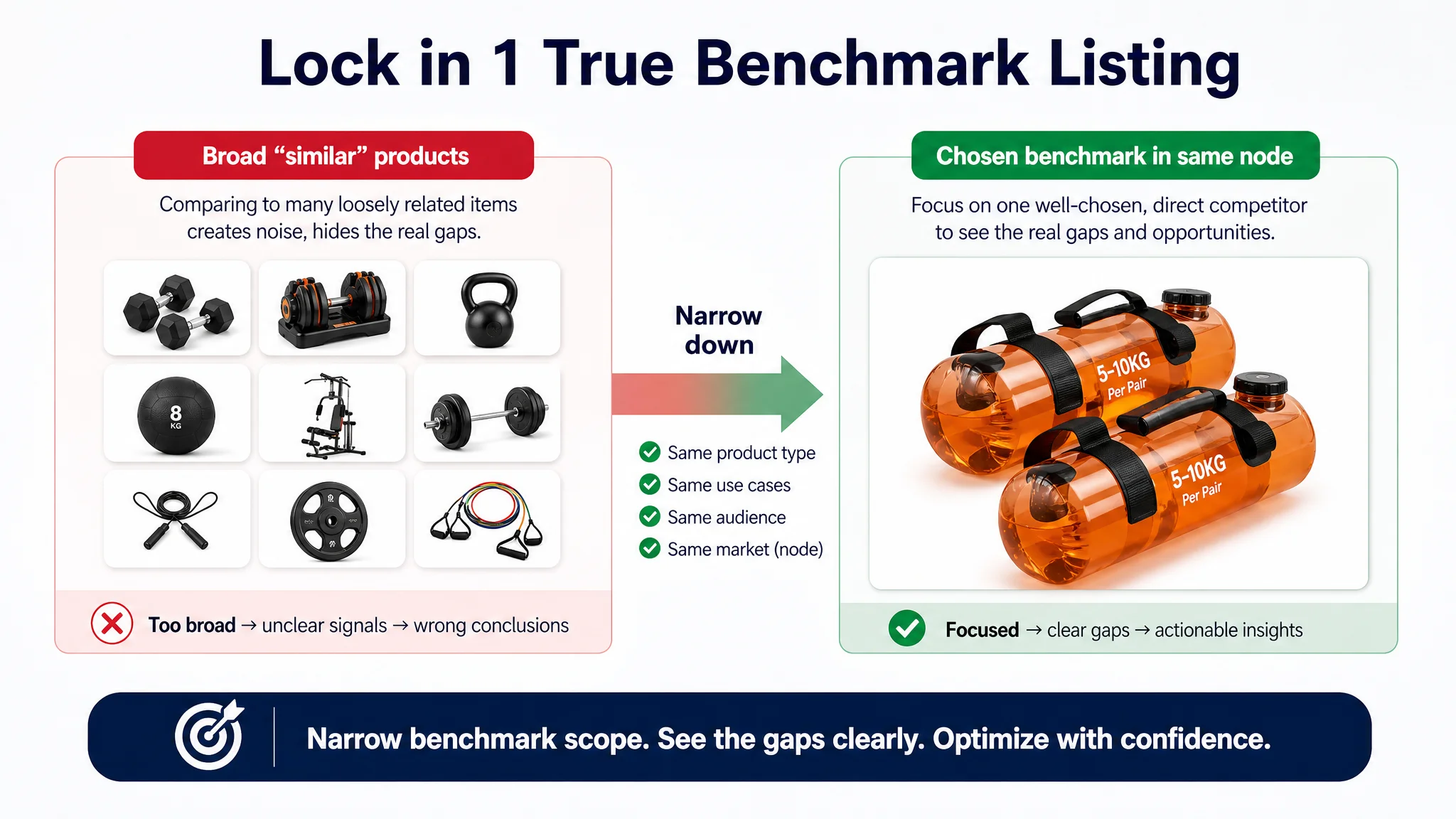
Indirect competitors are more subtle; they solve the same core customer problem but with a different product or approach. Uncovering them requires looking at functional and semantic similarities, not just visual ones. Ask which other products solve the same pain point for your target audience. A critical mistake to avoid is "survivor bias"—fixating only on the #1 Bestseller. This often leads to misaligned benchmarking if that top product has a vastly different price point, feature set, or audience. The goal is to create a curated list of true benchmark competitors who have sufficient market validation, setting the stage for meaningful analysis.
In practice, this means resisting the urge to simply copy what the top-ranked listing does. In the water dumbbell case, the benchmark that unlocked insight was not the absolute bestseller in the broader “dumbbells” category, but the best-structured listing inside the specific water dumbbell niche. Once that direct benchmark was identified, every deviation—from missing weight parameters in the title to weaker travel and safety storytelling—could be mapped as a specific optimization opportunity rather than a vague “we need to look better.”
Deconstructing Competitor Listings: A Deep Dive
To outperform the competition, you must first dissect their strategy. This involves a granular breakdown of their listing components to identify strengths and weaknesses. Leveraging DeepBI, sellers can filter high-performing benchmark ASINs from a vast database, building a robust comparison framework to clearly define optimization directions for their own listings.
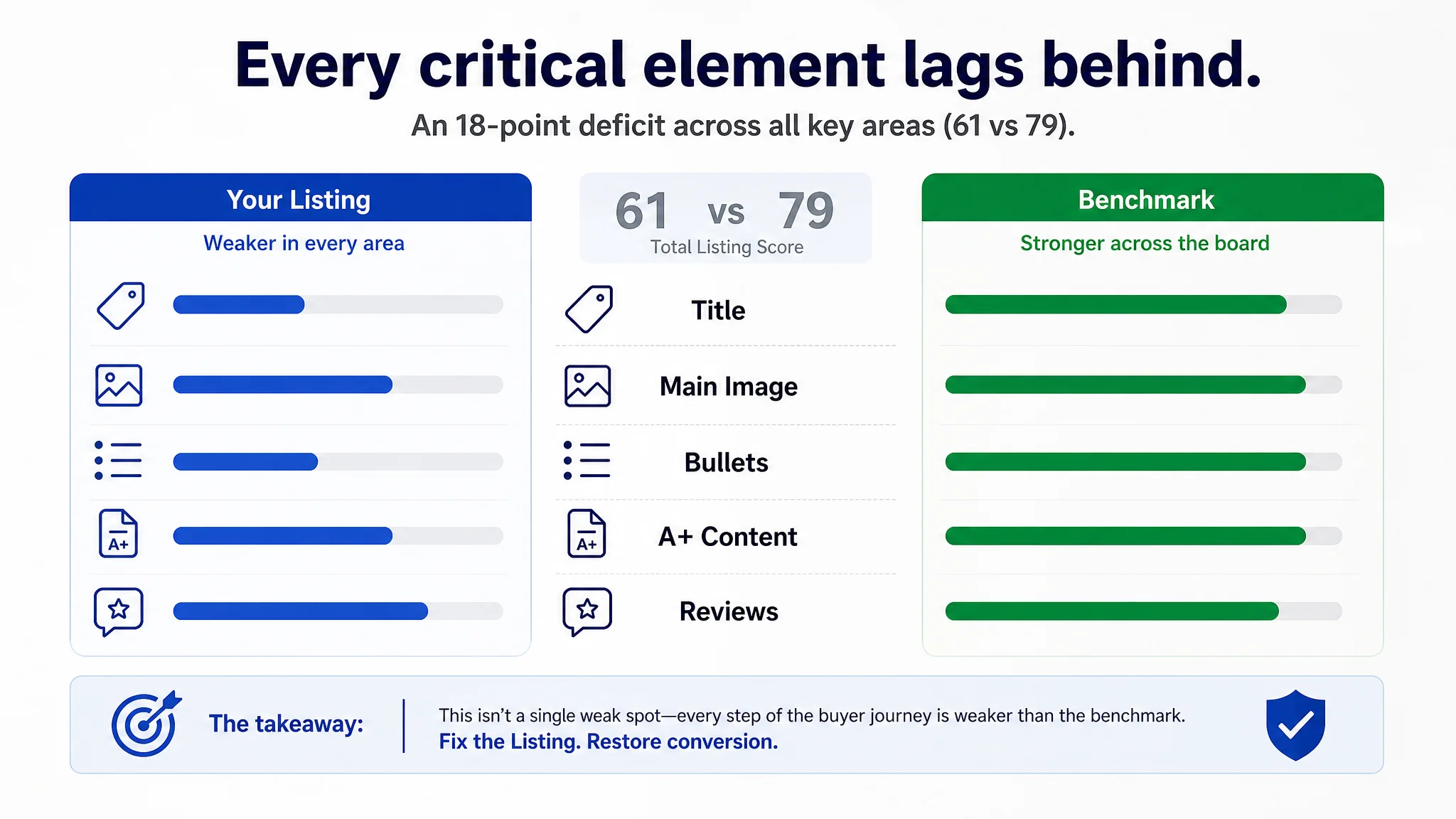
In the German water dumbbell case, DeepBI’s deconstruction revealed a total listing score of 61/100 for the seller versus 79/100 for the benchmark competitor—an 18-point deficit distributed across all critical elements: title, main image, bullets, A+ content, and reviews. This wasn’t a cosmetic issue; it showed that at nearly every step of the buyer journey, the competitor was clearer, more reassuring, and more aligned with buyer expectations.
Product Title and Bullet Points
Analyze competitor titles for primary keyword placement and clarity. In the bullet points, look for a logical structure that addresses customer pain points and highlights unique selling propositions (USPs). These elements are critical for search ranking and initial click-through rate (CTR).
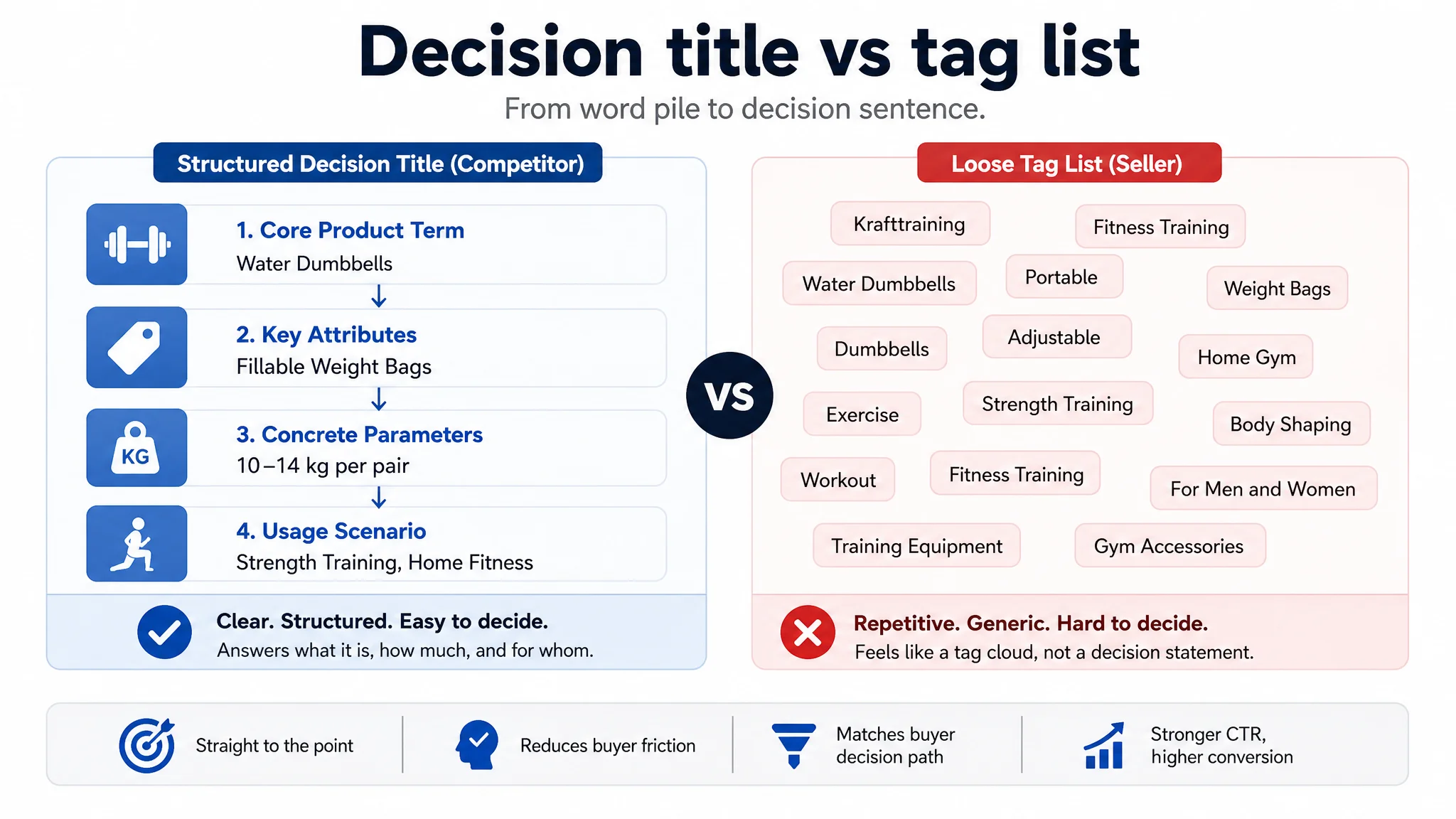
In the water dumbbell example, the competitor followed a mature title structure:
Core product term → Key attributes → Concrete parameters → Usage scenario.
Their title clearly mentioned water dumbbells, fillable weight bags, a specific weight range per pair, and target use cases like strength training and home fitness. By contrast, the seller’s original title read more like a loose collection of generic descriptors, repeating “fitness training” phrases without clearly stating maximum weight, form factor (weight bags), or key use cases. Shoppers scanning search results saw the competitor’s title as a compact decision statement, while the seller’s title felt like a tag cloud.
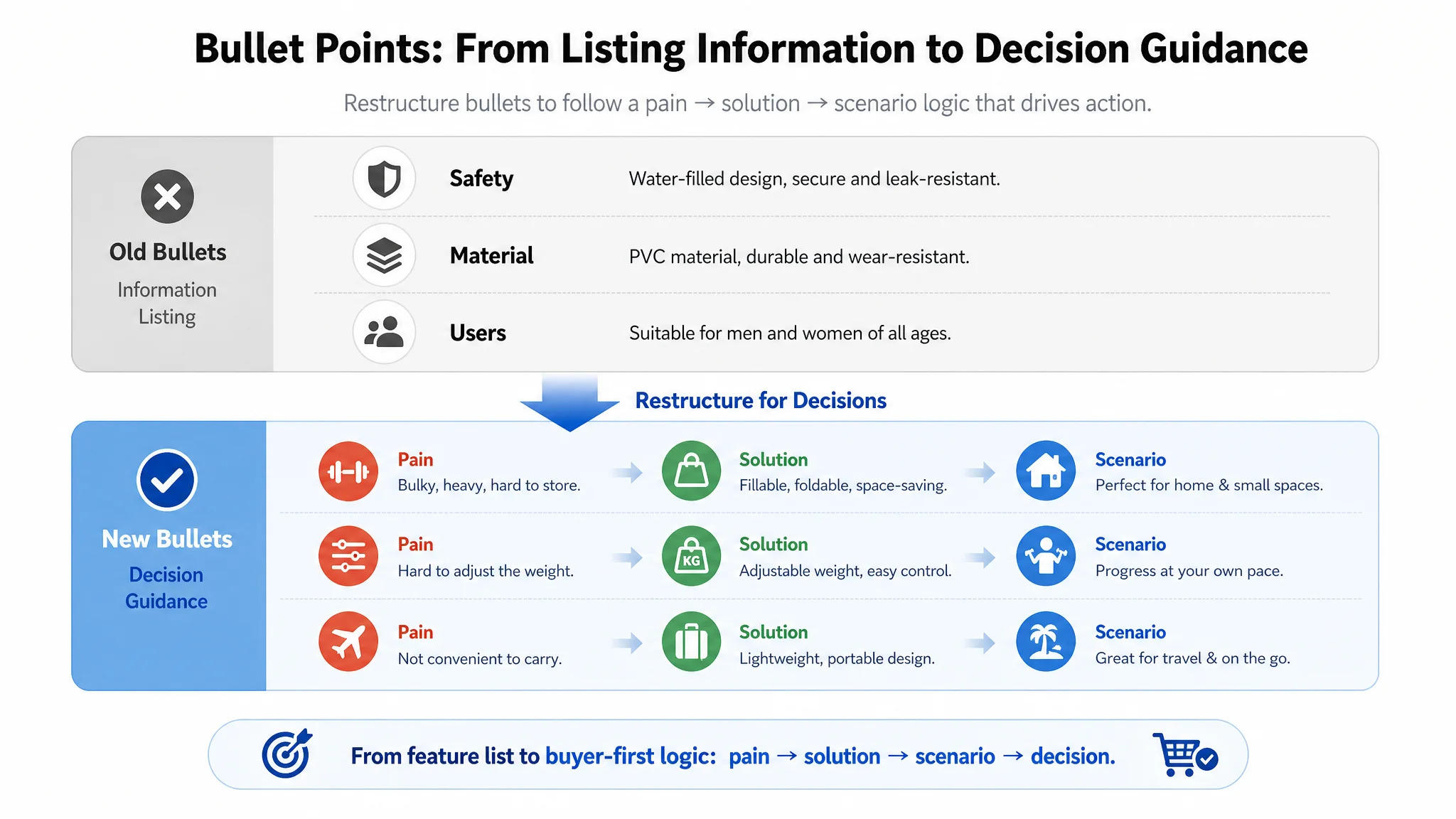
This misalignment extended into bullet points. The seller had bullets that technically mentioned safety, materials, and user groups, but the sequence lacked a “pain → solution → scenario” logic. The benchmark competitor structured bullets like a funnel: first highlighting relief from bulky iron weights and space-saving benefits, then quantifying weight adjustability, then anchoring those features in specific lifestyles (home, travel, family), and finally wrapping with aspirational outcomes. DeepBI’s diagnosis made this contrast explicit, allowing the seller to rewrite their bullets around clear benefits (foldable, floor-friendly, adjustable weight), proof (material and construction details), and scenarios (travel, small apartments, family use). The same words became far more powerful once structured to match how real buyers make decisions.
Main Images and A+ Content
Evaluate the main image gallery for visual appeal and the variety of shots (lifestyle, infographics). For A+ Content, assess the brand storytelling and use of conversion-focused modules like comparison charts. Strong visuals are paramount for conversion rate (CVR). To quantify this, DeepBI can automatically benchmark competitor main images, titles, bullet points, and A+ content, providing multi-dimensional scores to pinpoint areas for improvement.
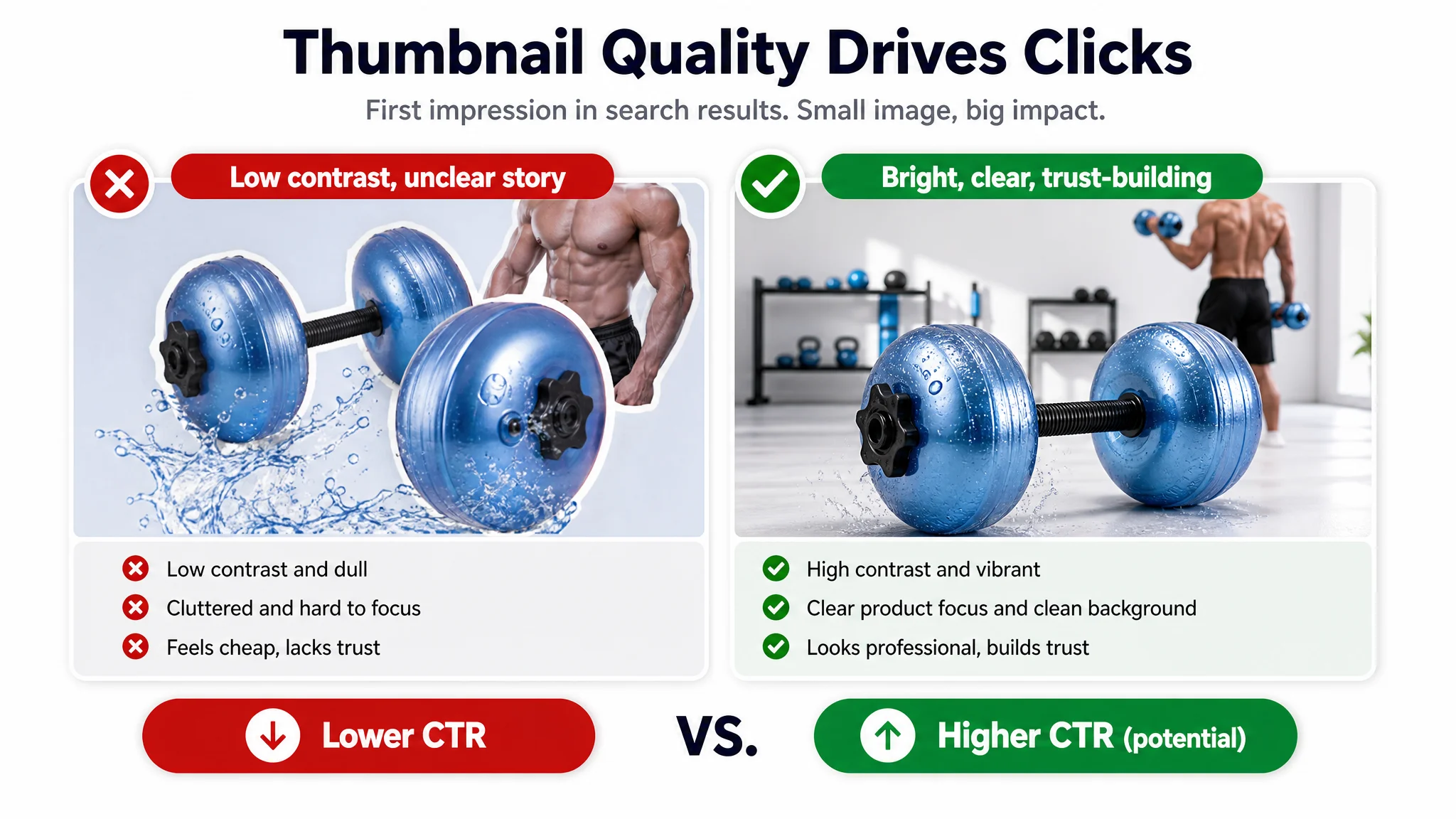
In the water dumbbell case, DeepBI flagged a 4-point gap in main image scoring (21 vs 25 out of 30). At thumbnail size, the competitor’s main image used a high-saturation color on a clean, bright background, presenting a clear product silhouette with micro callouts that highlighted features like thickened handles and leak-resistant valves. The seller’s main image, on the other hand, had lower contrast, visible cutout traces, and minimal visual storytelling about portability or safety. As a result, even before reading a word, shoppers were nudged toward the competitor.
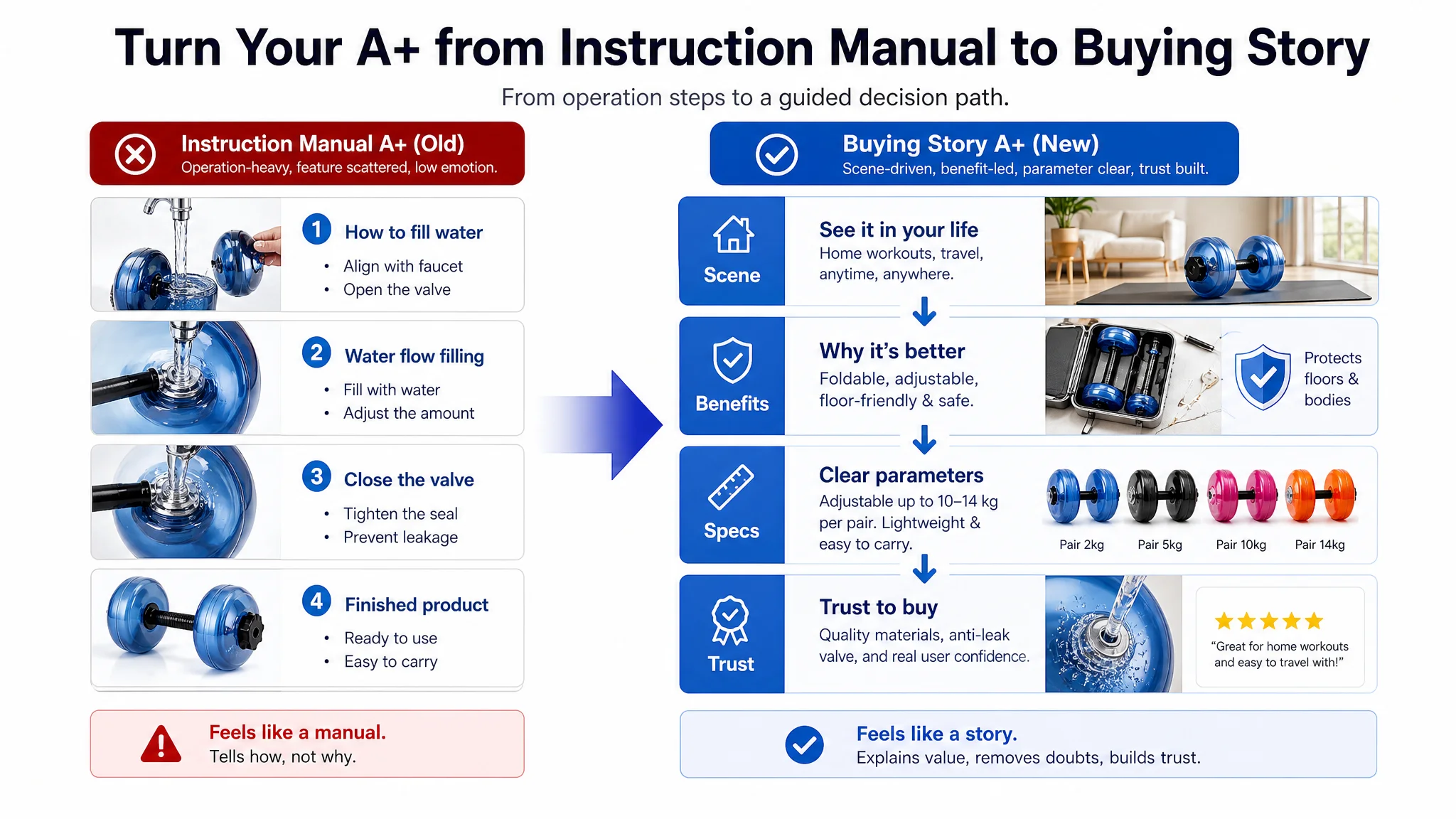
The A+ comparison revealed an even deeper gap. The competitor’s A+ modules combined lifestyle imagery (home workouts, travel scenes), technical close-ups, weight range diagrams, and brand story elements, making the product feel both practical and trustworthy. The seller’s A+ content, by contrast, leaned heavily on “how to fill water” sequences and basic product shots, offering little context on how the dumbbells fit into real life, how heavy they could get, or why they were safer for floors and families. DeepBI’s breakdown showed that the competitor’s A+ layout functioned as a guided decision path, while the seller’s A+ felt more like an instruction manual.
Once this nuance was exposed, the optimization direction became clear. The seller restructured their main image gallery around distinct conversion roles—hero product, home scene, travel proof, safety comparison, and technical trust—mirroring the competitive logic while staying true to their own product. Their A+ content was redesigned into a six-module story that opened with an aspirational home workout scene, logically introduced foldability and portability, quantified parameters, and closed with trust and specification elements. This is exactly how deep competitor analysis turns abstract advice (“improve your images and A+”) into precise, evidence-backed design decisions.
Pricing Strategy
Examine competitors' pricing tiers and promotional frequency. This isn't just about price matching; it’s about understanding their value proposition. This context is crucial for setting your own price to maximize profit without sacrificing sales velocity.
In categories like water dumbbells, where the functional outcome (resistance training) can be achieved with many different tools, price must be evaluated alongside perceived value. In the DE fitness case, early internal discussions at the seller’s team revolved around “maybe our price is just too high,” but the DeepBI diagnosis showed that their more pressing issue was messaging and trust, not price itself. The competitor’s price point was not dramatically lower; instead, they communicated their value proposition more completely: clear weight ranges, visible quality, and well-structured use cases.
This illustrates an important nuance in pricing analysis. Before you rush to cut price to “match the market,” competitor listings can reveal whether buyers are resisting because of misaligned pricing or because your content fails to justify your price. In the water dumbbell example, DeepBI did not recommend immediate price cuts. Instead, it prioritized raising perceived value through better titles, images, and A+ content, ensuring that price decisions later would be grounded in a listing that was already doing its job.
Customer Reviews and Ratings
Mine reviews to uncover recurring customer complaints, unmet needs, and praised features. This Voice of the Customer (VoC) data is a goldmine for identifying product gaps and finding powerful angles to emphasize in your own listing copy.
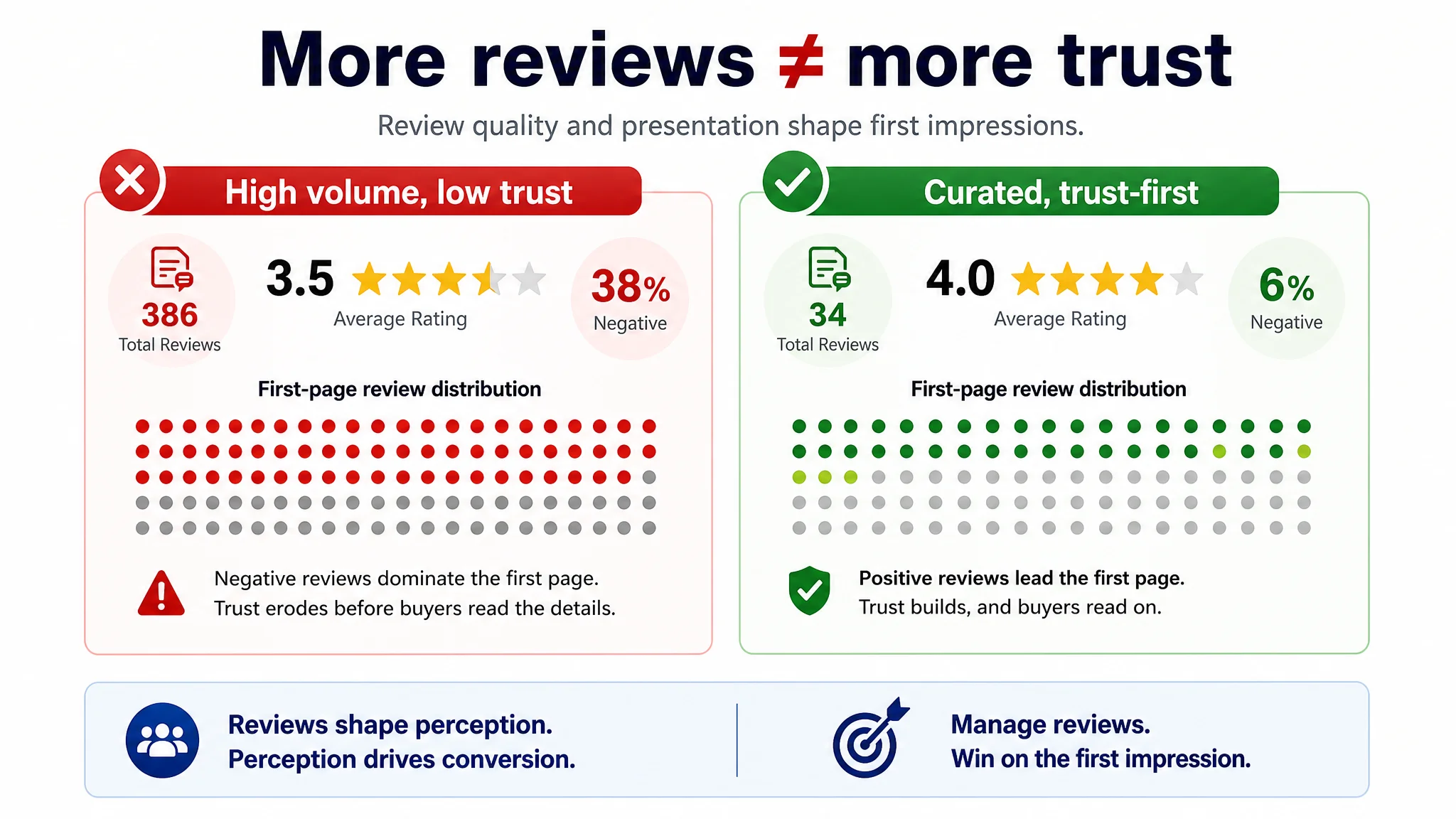
In the DE fitness case, review analysis revealed a critical trust problem: the seller had many more total reviews than the benchmark competitor but a lower average rating and a significantly higher share of negative feedback. Importantly, the first page of reviews surfaced disproportionately negative experiences—issues around durability, leaks, or user expectations—so new visitors were confronted with risk signals before they even scrolled to A+ content.
The competitor, with fewer total reviews, had curated a front page that was dominated by positive experiences and diverse language coverage. This didn’t just reflect product quality; it showed that the competitor actively managed their review ecosystem to ensure that early impressions supported trust. For the seller, seeing this through a competitive lens clarified why their listing felt fragile: they were asking buyers to overlook a dense cluster of negative reviews without offering equally strong visual and textual reassurance elsewhere on the page. VoC analysis in this context did double duty—it highlighted product improvement opportunities and exposed how review presentation shaped competitive positioning.
Backend Keywords and Search Terms (Inferred)
While you can't see backend keywords, you can infer their strategy. Analyze the root keywords and long-tail phrases they consistently use in their title and bullets to understand which search terms they are targeting to drive traffic.
In the water dumbbell niche, inferred keyword strategy was closely tied to how titles and bullets were structured. The benchmark competitor’s repeated emphasis on “water dumbbells,” “fillable,” “portable weight bags,” and specific weight ranges signaled a deliberate focus on buyers searching for lightweight, space-saving alternatives to iron weights. Their bullet points reinforced search intent phrases like “home fitness,” “travel,” and “floor-friendly.”
The seller’s original use of generic fitness terms suggested a more diffuse keyword strategy. They were partially aligned with water dumbbell searches but diluted their relevance with broad, repeated phrases that did not map cleanly to long-tail queries. DeepBI’s listing comparison made this visible by highlighting how often certain functional terms appeared in competitor copy versus the seller’s. This allowed the seller to realign their title and bullets around higher-intent, niche-specific keywords, increasing the likelihood that their listing would surface for the most relevant traffic—and that the content buyers saw would match what they had searched for.
Leveraging DeepBI for Advanced Listing Intelligence
While traditional tools provide surface-level data, overcoming the limitations of manual analysis requires a system built from the ground up for Amazon's ecosystem. DeepBI offers an end-to-end intelligent platform that transforms competitor analysis from a reactive chore into a proactive growth engine. It automates the entire optimization workflow, saving dozens of hours and connecting strategy directly to execution.
In the German water dumbbell case, this distinction was critical. Prior to DeepBI, the seller’s internal process consisted mainly of ad dashboard reviews and sporadic visual comparisons against a handful of competitors they happened to notice. They had no structured way to quantify how far their listing lagged behind or which specific elements were holding them back. DeepBI’s multi-dimensional scoring immediately changed that: it translated subjective impressions (“their images look nicer”) into concrete gaps in title logic, main image impact, A+ storytelling, and review health. This turned the discussion from “our ads don’t work” into “our listing is 18 points weaker than our benchmark, with clear sub-score deficits.”
The process begins with Multi-dimensional Diagnosis, where the platform automatically deconstructs top competitor listings. It breaks down key factors influencing CTR and CVR, allowing you to pinpoint specific weak spots in your own listing—from a low-scoring main image to poorly structured bullet points—and prioritize efforts based on proven market performance.
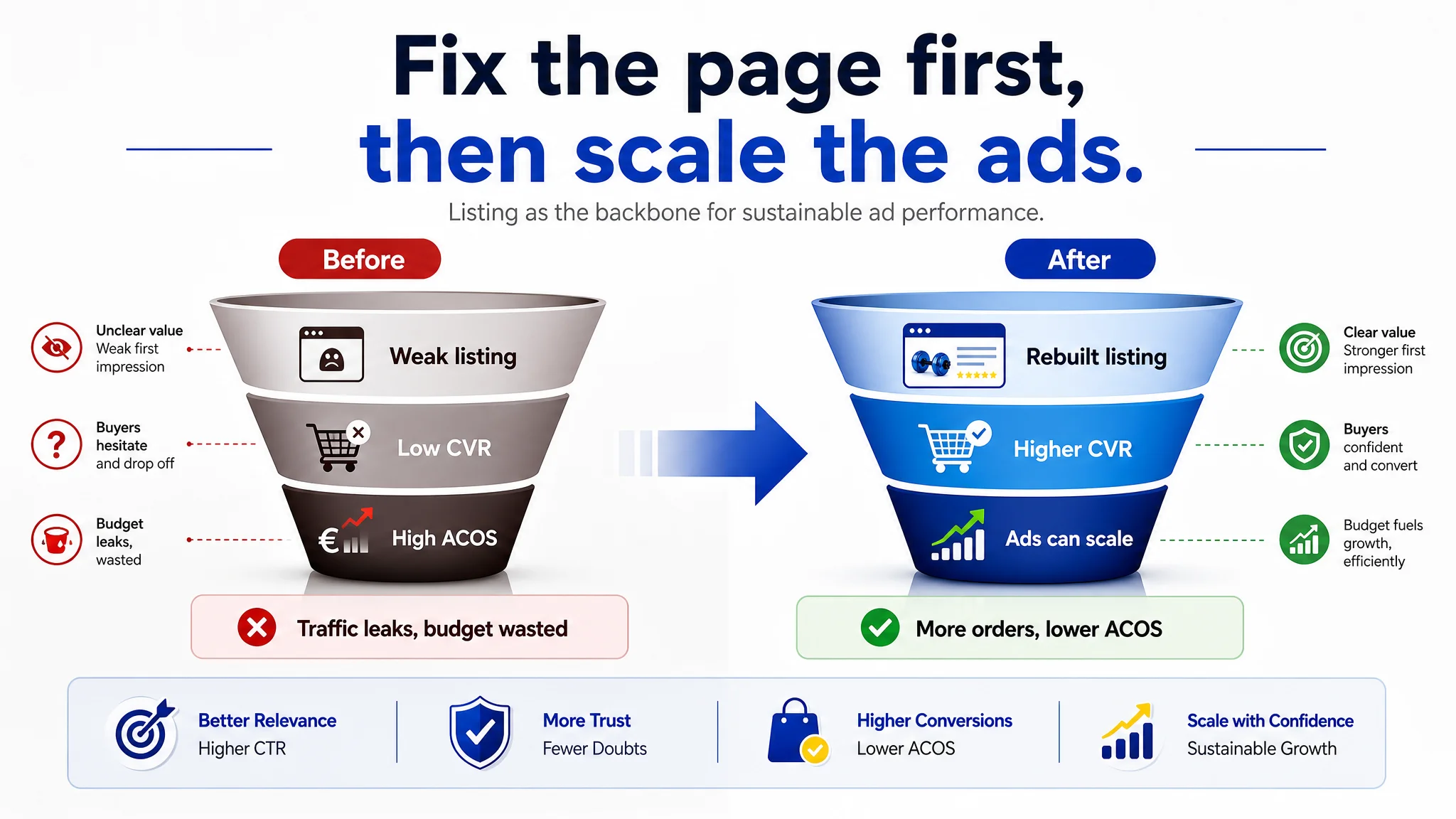
For the water dumbbell seller, this diagnosis revealed that their constraints were primarily page-level: a weakly structured title, underutilized main images, A+ content that overemphasized usage steps and under-delivered on scenarios and specifications, and a risky review profile. Rather than recommending more granular ad experiments, DeepBI explicitly prioritized “Listing conversion repair first, then ad scaling,” protecting the seller from pouring additional budget into what was essentially a leaky bucket.
Next, DeepBI’s AI-powered Content Generation translates these diagnostic insights into optimized assets. Based on a product's unique "DNA" to ensure authenticity and prevent AI hallucinations, the system generates competitive main images, A+ content, titles, and bullet points. It provides multiple design options and front-end previews, turning abstract suggestions into tangible, high-performing content.
In practice, this meant that the seller didn’t just receive a note saying “add lifestyle images” or “explain weight ranges better.” Instead, they were given structured title templates matching competitive patterns, bullet frameworks that anchored each point in a clear benefit and scenario, and a main image system that assigned each slot a specific decision-support role (hero, home scene, travel proof, safety comparison, technical trust). The A+ modules were similarly mapped: open with an aspirational scene, move into core advantages (foldable, portable, floor-friendly), then close with specs and brand trust. This is where AI-powered content generation added practical value: it operationalized competitive insight into ready-to-use creative directions.
Finally, the One-Click Application feature closes the loop. Instead of a tedious manual process of downloading and uploading files, DeepBI uses the Amazon SP-API to synchronize all optimized content directly to your listing in seconds. This seamless workflow, complete with new vs. old version comparisons, ensures that data-driven strategy is implemented instantly, accelerating your listing optimization cycle.
In the DE fitness case, this end-to-end flow turned what could have been a long, manual redesign project into a manageable, iterative process. The team could see old versus new titles, bullets, and images side by side, understand which changes were driven by specific competitive gaps, and push updates live without duplicating work in multiple tools. The result was not just a better-looking listing but a listing whose structure and storytelling were explicitly grounded in the competitive realities of their niche.
Translating Insights into Action: Optimizing Your Amazon Listings
Effective analysis is meaningless without execution. Once you've gathered intelligence on your competitors, the next step is to translate those insights into tangible improvements for your own listings. This involves a systematic approach to content, pricing, product development, and promotion.
The water dumbbell case shows how this transition from insight to action works in practice. Once DeepBI’s diagnosis confirmed that the listing itself was the bottleneck, the optimization roadmap shifted away from campaign panels and toward the page. Each listing element—title, bullets, images, A+ content, reviews—was mapped to a clear competitive gap and then rebuilt with a specific role in the buyer’s decision path. The advertisements remained important, but only after the destination they were sending traffic to had been structurally improved.

Content Optimization
Refine your listing by mirroring the best practices of top performers. Reconstruct your title to include high-click-rate keywords, focusing on a formula of Brand + Core Selling Point + Product Form. Transform your bullet points from simple feature lists into compelling "Pain Point -> Solution" narratives. For example, instead of just "10000mAh," frame it as "Ultra-long battery life (10000mAh) to eliminate power anxiety during travel." Enhance your A+ Content by replacing vague claims with trust-building evidence, such as high-resolution images of quality certifications.
In the water dumbbell scenario, content optimization began with turning a “tag list” title into a structured decision statement. The revised title sequence introduced precise weight ranges, clarified that the product was a fillable, foldable water dumbbell set, and grounded it in travel and home fitness use cases. Bullet points were rewritten to follow a “pain → solution → scenario” logic: from highlighting relief from bulky iron weights and space-saving benefits, to explaining adjustable weight per ball, to emphasizing floor-friendly safety for families and seniors.
A+ content underwent a similar transformation. Instead of leading with operational steps like “how to fill water,” the new modules opened with a warm home workout scene, visualized foldability and suitcase packing to prove portability, explicitly demonstrated floor safety, and closed with clear specifications and series options. These changes were not made in isolation; each one was directly inspired by how the benchmark competitor’s content supported the buyer journey. The result was a listing where every piece of content had a clear job to do and could be traced back to a specific competitive insight.
Pricing Adjustments
Use competitor pricing not as a target to match, but as a map to position your product strategically. Analyze the price spectrum in your niche to decide whether to compete as a premium, value, or mainstream offering. Your pricing should align with your product's perceived value, quality, and target ACoS. Avoid reactive price wars; instead, ensure your price is justified by superior content, features, or customer service highlighted in your listing.
In the DE fitness case, the initial reflex in the seller’s team was to attribute high ACOS to “maybe we’re too expensive.” But once DeepBI highlighted that the benchmark competitor, at a similar price level, was outperforming on listing quality, the team recognized that content, not price, was the primary constraint. They paused price experiments and focused instead on making the page clearly express why their water dumbbells were worth their ask: emphasizing portability, foldability, safety, and home/travel versatility.
Only after these value signals were reinforced did the team revisit pricing decisions, now armed with a listing that actually carried the argument. This sequence—content first, price second—meant that any future price adjustments could be evaluated in a fair environment, where buyers understood what they were paying for. It’s a useful pattern for other sellers: ensure your listing’s perceived value matches or exceeds your competitor’s before you decide that price is the main lever.
Product Improvement
Leverage competitor reviews as a free source of product development research. Systematically analyze their negative feedback to identify recurring complaints, feature gaps, or quality issues. While you cannot alter your current product, these insights are invaluable for your next product iteration or line extension. Identifying what customers wish your competitor's product had allows you to build a superior offering in the future.
In the water dumbbell case, review analysis highlighted more than messaging issues. Negative reviews frequently pointed to leakage, durability concerns, or mismatched expectations around maximum weight and ease of filling. Meanwhile, competitor reviews often praised clarity of instructions, sturdiness, and convenience. This contrast provided a roadmap not only for better communication (e.g., clearer specifications and filling instructions) but also for future product iteration.
For the seller, this meant acknowledging that some ACOS and CVR issues stemmed from real product constraints, not just listing weaknesses. DeepBI’s role here was to separate what could be solved through content (e.g., better explanation of weight range and use cases) from what would need engineering or manufacturing changes in the next batch. The key takeaway: competitor listing analysis doesn’t just improve your page; it informs your product roadmap by revealing where buyers feel underserved.
Marketing and Promotion
Let performance data guide your optimization efforts. If your listing suffers from a low Click-Through Rate (CTR), prioritize enhancing your main image's visual impact. If the Conversion Rate (CVR) is the problem, focus on improving the information density and persuasive power of your A+ Content. Use your competitor's promotional calendar and ad strategies to inform your own campaigns, ensuring you are visible when and where customers are looking.
In the DE fitness example, the marketing problem was misdiagnosed as purely campaign-related. The team believed better creatives and more refined campaigns would fix high ACOS. DeepBI’s analysis made it clear that ads were already bringing “okay” traffic; the real leak was on the page. Once the listing was structurally improved, ad traffic finally landed on a destination that could explain weight capacity, visually prove portability and safety, and reduce uncertainty about materials and durability.
This shift changed how the team approached promotion. Instead of continuously tweaking bids and targeting while the page remained fragile, they aligned their campaign strategy with the upgraded listing. CTR improvements became more attainable because the main image and title were now competitive; CVR improvements became realistic because A+ content and bullets supported the buyer’s decision logic. The result was an ad program that could be scaled with more confidence, knowing that the listing’s capacity to convert had been significantly strengthened.
Common Pitfalls in Competitor Listing Analysis
Effective competitor analysis is a powerful growth lever, but many sellers fall into common traps that lead to wasted resources and declining performance. All optimization detached from real market benchmarking is an ineffective use of time and money. The most frequent mistake is relying on subjective aesthetics; a listing that looks "good" to you or your designer does not necessarily sell well.
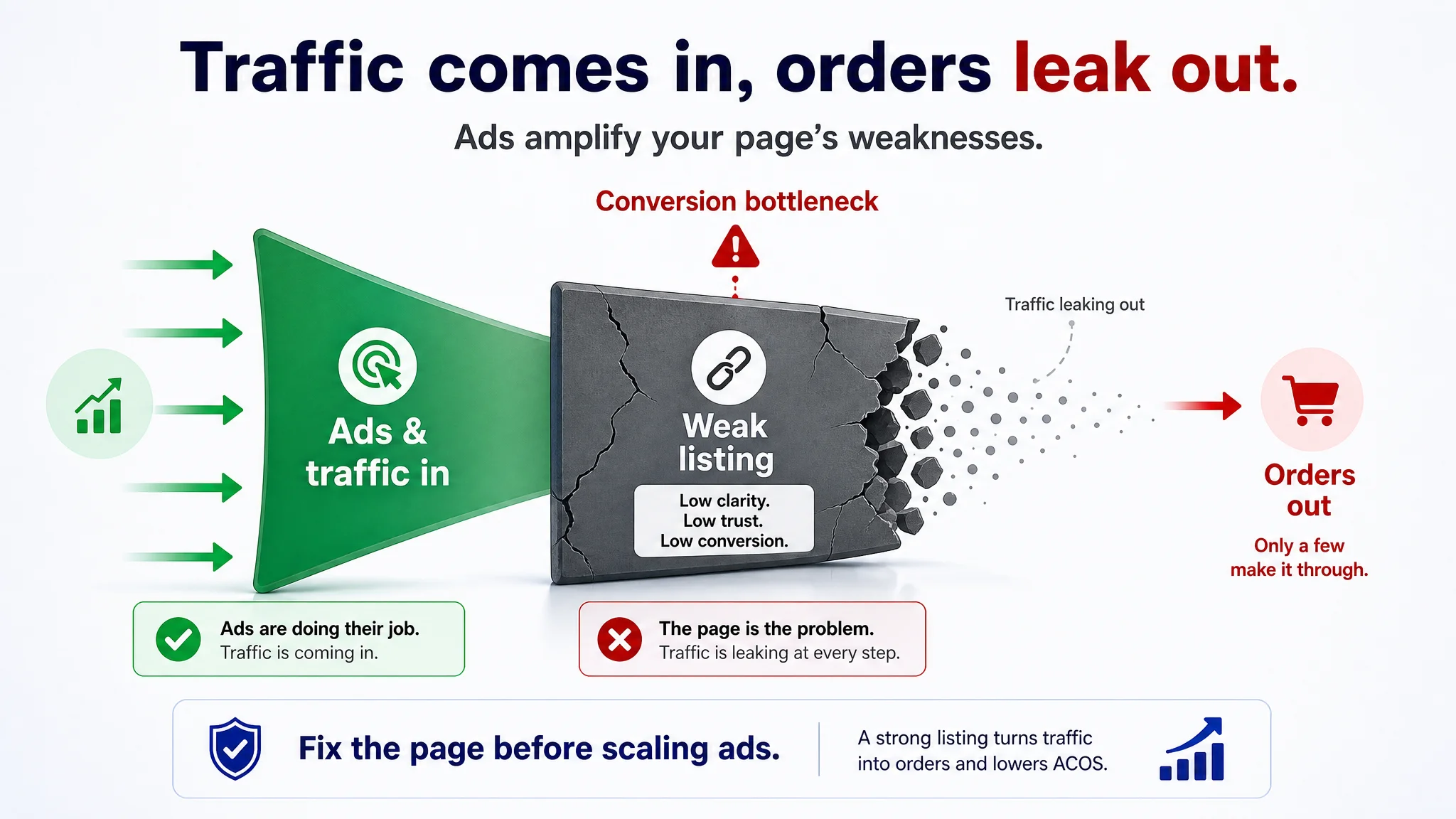
The DE fitness water dumbbell case is a textbook example of a deeper pitfall: misdiagnosing an ads problem when the real issue lies in listing conversion. For months, the seller’s internal narrative was “our images look cheap; our ads need better visuals.” They poured effort into rotating ad creatives, adjusting placements, and experimenting with keywords, all without materially changing the listing’s title logic, image hierarchy, A+ storytelling, or review profile. Advertising, in this context, did not just fail to solve the problem—it amplified it by driving more traffic into an underperforming page.
A critical error is "survivor bias"—focusing exclusively on the #1 Bestseller while ignoring crucial differences in product function, price point, or target audience. This leads to misaligned benchmarking, where you adopt strategies irrelevant to your specific market segment. Another pitfall is static, one-time analysis. The Amazon marketplace is dynamic, and a competitor's strategy that works today may be obsolete tomorrow. Continuous monitoring is essential to stay ahead.
Furthermore, many sellers fail to connect listing elements to performance metrics quantitatively. They might see a competitor’s high click-through rate (CTR) but can't diagnose the specific main image attributes driving it. This leads to blind imitation rather than strategic innovation. In the water dumbbell case, the seller initially perceived the competitor’s visuals as simply “more professional.” It was only after DeepBI decomposed those images into concrete traits—higher contrast, clearer silhouettes, explicit technical callouts, and scenario-rich shots—that they understood what, exactly, needed to change in their own gallery.
The goal is not to copy competitors but to deconstruct their success, understand the underlying principles, and adapt those insights to differentiate your own brand and value proposition. The German seller’s eventual success lay not in cloning the benchmark listing but in applying the same structural logic—clear title decision path, image roles aligned with buyer questions, A+ modules that balance emotion and information—to express their own product’s value more convincingly. Avoiding these pitfalls means anchoring every optimization in real, evidence-based comparisons rather than intuition or aesthetics alone.
Conclusion: Sustained Growth Through Smart Competitor Insights
Mastering the Amazon marketplace requires moving beyond static, one-time listing fixes. The insights we've explored demonstrate that competitor analysis is not a project to be checked off a list, but a continuous operational rhythm essential for survival and growth. The market is in constant flux, and your strategy must be equally dynamic, iterating in real-time based on competitor actions and customer feedback.
The water dumbbell case shows how a shift in perspective—away from “our ads don’t work” toward “our listing cannot convert the traffic we already have”—can fundamentally change your growth trajectory. Once the seller saw their listing through a competitive lens, they realized that advertising was amplifying weaknesses instead of strengths. By rebuilding the title, bullets, main images, A+ content, and decision logic based on benchmark insights, they turned their product page from a bottleneck into a more capable conversion engine. Ad spend then became fuel for a structurally sound funnel rather than a cost center feeding a leaky bucket.
This is where a sustainable competitive advantage is forged. By transforming operational experience into a data-driven evidence chain, you can move from guesswork to calculated precision. Every optimization—from a keyword adjustment to a main image refresh—becomes a precise strike targeting a competitor's core weakness, designed to drive quantifiable improvements in your CVR and BSR. This scientific approach turns listing management into a predictable driver of growth. With an intelligent partner like DeepBI, this entire lifecycle—from diagnosis to delivery—becomes a unified, data-backed process, ensuring your brand consistently outmaneuvers the competition and achieves long-term success.