

Introduction: The Imperative of Amazon Listing Optimization
In the hyper-competitive Amazon marketplace, where traffic costs are constantly rising, simply having a great product is no longer enough. Success hinges on your ability to capture and convert customer attention. This is where Amazon listing optimization becomes a critical business discipline. It is no longer a simple matter of copywriting touch-ups or subjective image beautification; it has evolved into a precise, data-driven process of strategically enhancing every component of your product page—from titles and images to bullet points and A+ Content—to maximize shopper engagement and drive sales.
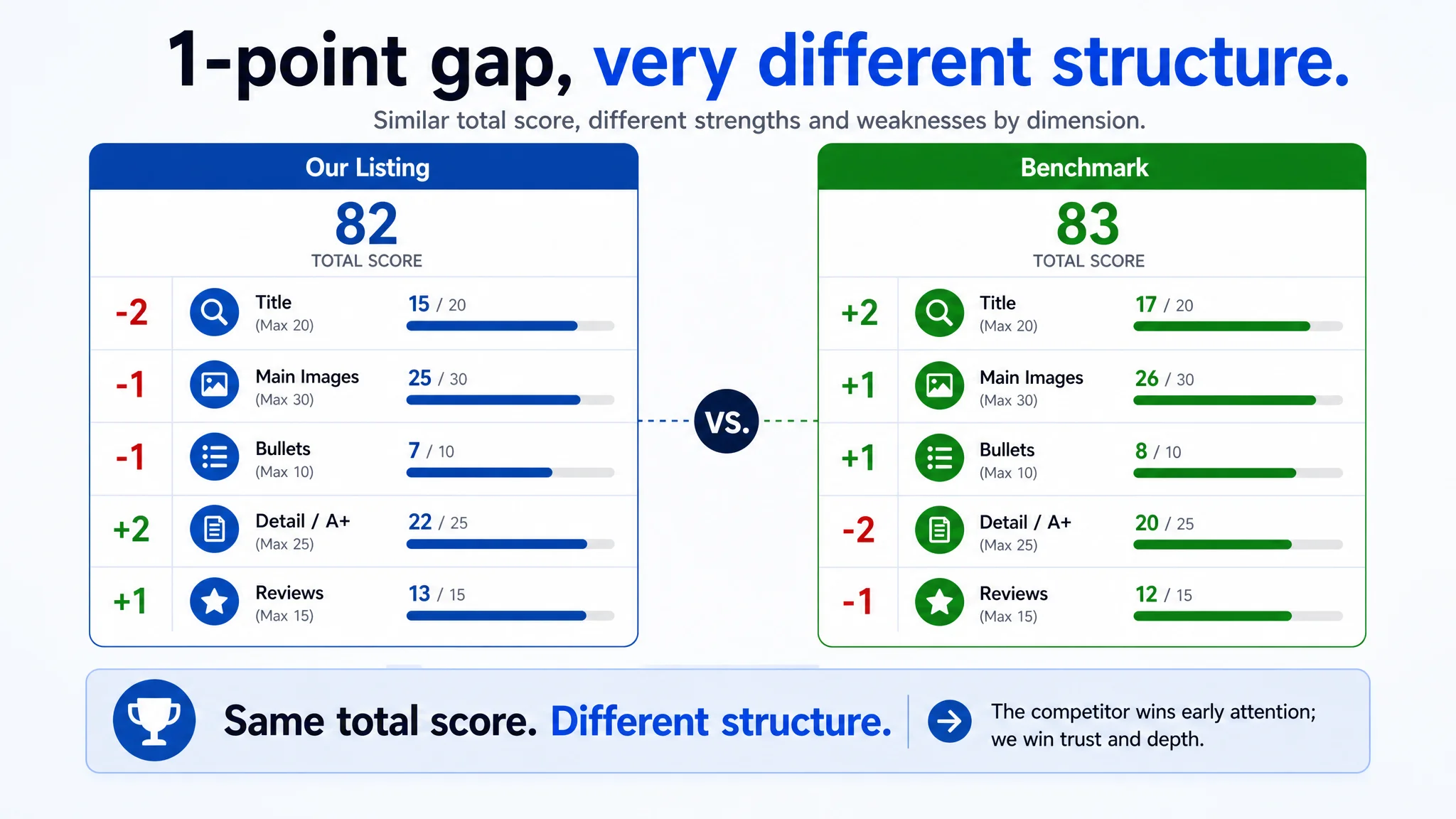
In real operations, the gap between “we think the listing is already good” and “the listing actually converts” is often much larger than teams expect. A seller in the mobile content-creation accessories category once treated their listing as “good enough”: an 82/100 overall listing score vs. a benchmark competitor at 83/100, 4.4 stars with over 500 reviews, and an A+ story they felt was richer than most peers. On paper, nothing looked broken. Yet as Amazon ad costs climbed, both paid and organic traffic were quietly failing to translate into proportional orders, and ACoS became harder and harder to keep in a safe band.
Their instinctive response was typical: assume this was an advertising issue and keep adjusting keywords, bids, and creatives. But despite constant movement in click volume and ad structure, conversion refused to budge. Only when the listing was diagnosed in detail did the real pattern emerge: the problem was not “bad ads”, it was a page that could not convert the traffic ads brought in—a main image set that did not clearly confirm what buyers actually get, a title that buried the core search term behind the brand, and bullets that leaned on emotion instead of a clear “pain point → solution → proof” logic.
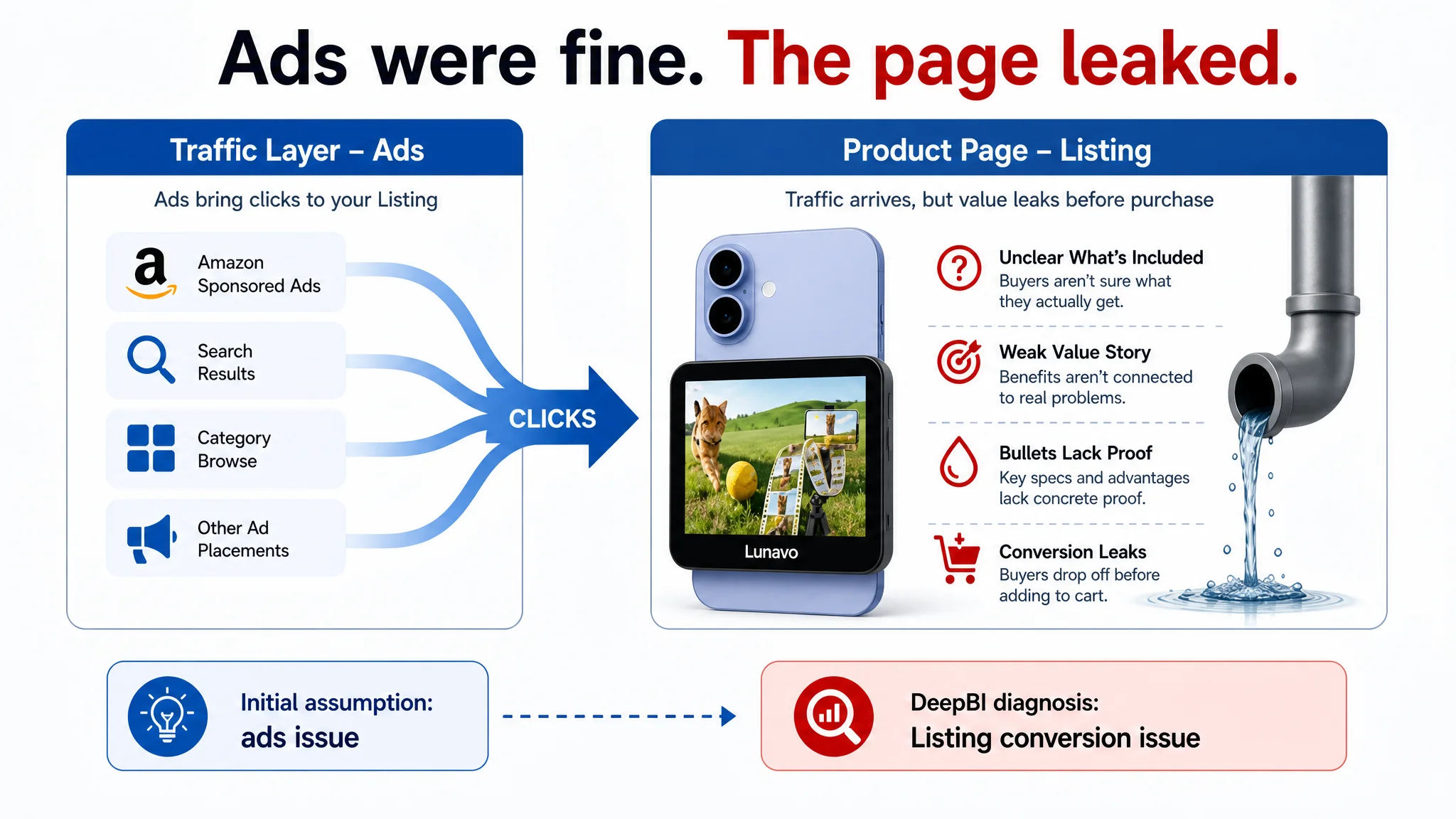
The ultimate measure of your listing's effectiveness is its conversion rate (CVR), which represents the percentage of visitors who make a purchase after landing on your page. A higher CVR is the most direct indicator that your listing is successfully communicating value, building trust, and persuading customers to click "Add to Cart." In the case above, it was not until the team reframed the problem—from “ads are inefficient” to “the listing is wasting the traffic ads bring”—and rebuilt the sales logic of the page, that advertising spend started to work as intended again.
The connection between optimization and profitability is direct and powerful. A meticulously optimized listing not only attracts more qualified buyers, improving your click-through rate (CTR), but it also works harder to convert that traffic into revenue. This boosts sales, improves the efficiency of your advertising spend, and positively influences your Best Sellers Rank (BSR). In an environment defined by intense competition, mastering listing optimization is not just an advantage—it is an essential strategy for sustainable growth and long-term success.
Understanding Amazon's Ranking Factors and Conversion Dynamics
To succeed on Amazon, it's essential to understand that the platform is not just a marketplace; it's a powerful search engine. At its core, Amazon's algorithm is designed to maximize revenue by showing customers the most relevant products they are likely to purchase. When a buyer enters a search query, the system matches those keywords with the information you provide in your product title, bullet points, and backend search terms.
However, simple keyword relevance is only the starting point. The algorithm heavily weighs performance metrics to determine your product's rank. Key signals include:
- Relevance: How well your listing's text matches a customer's search terms.
- Performance: Your sales velocity, Click-Through Rate (CTR), and most importantly, your Conversion Rate (CVR). A high CVR is a powerful signal to Amazon that your product is desirable and effectively turns traffic into sales.
- Customer Satisfaction: Factors like positive reviews, star ratings, and a low return rate indicate a quality product and a trustworthy seller.
Among these, the conversion rate is a pivotal factor. A product with a high CVR demonstrates its ability to satisfy customer needs, which Amazon rewards with increased visibility. This creates a positive feedback loop: better conversion leads to a higher ranking, which drives more traffic, resulting in even more sales. Optimizing your listing is about proving to the algorithm that your product is a top performer.
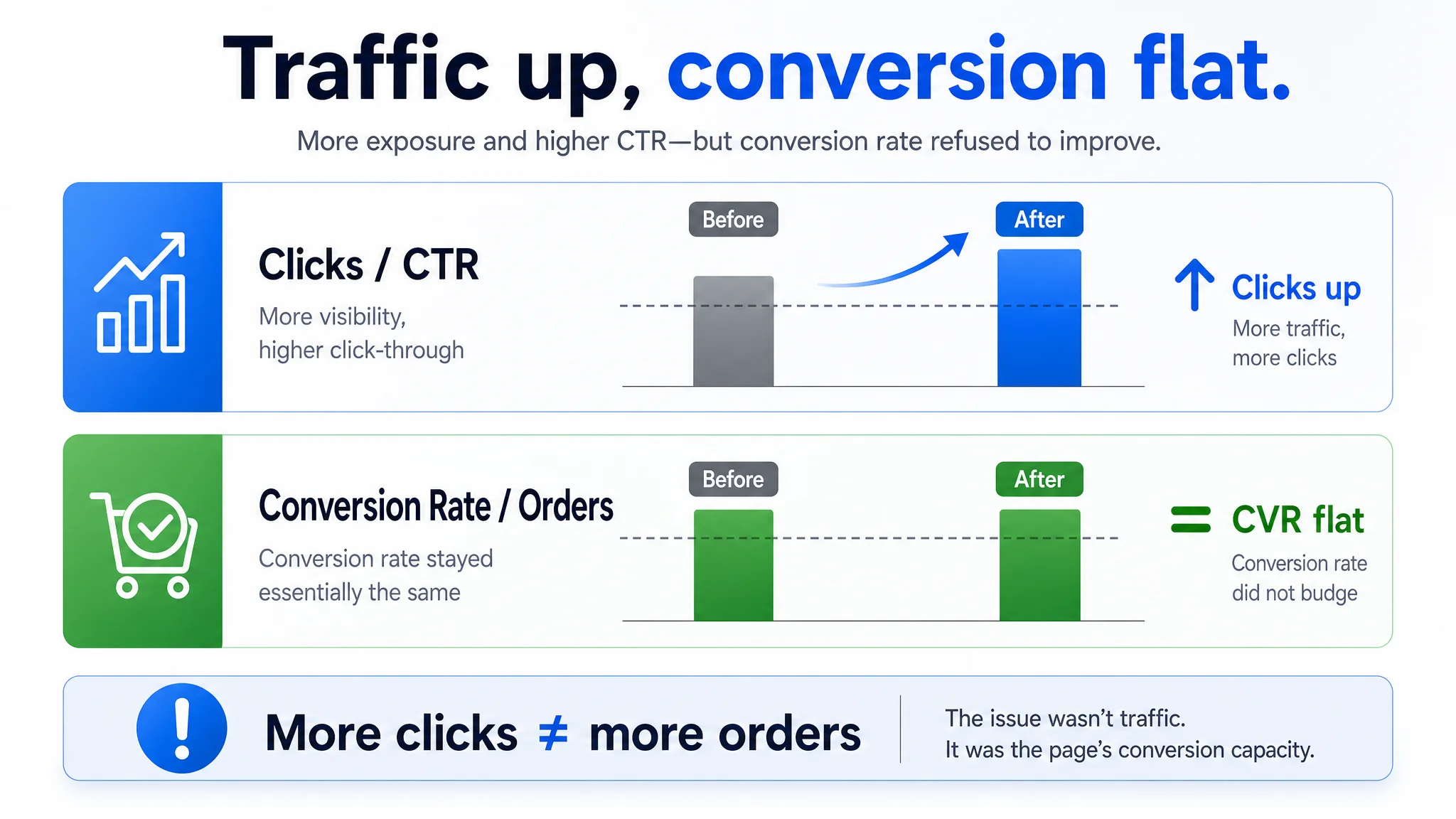
This algorithm logic becomes much clearer when you look at how misdiagnosis plays out in reality. In the vlogging monitor example, the seller initially focused almost entirely on traffic signals: rising CPCs, fluctuating CTR, and campaign structure. They assumed that because their review volume was far higher than a key competitor’s, star ratings were similar, and their A+ content looked more “premium,” the listing side must be fine. Ads were seen as the obvious lever to fix performance.
But when DeepBI benchmarked that listing against the top competitor, it found that while the overall scores were close (82 vs. 83), the differences were concentrated exactly where the algorithm cares most about conversion: title clarity, main image effectiveness, and bullet-point persuasiveness. The competitor’s page was tightly organized around the buyer’s decision logic; this seller’s page was organized around feature enumeration. Traffic volume was not the constraint—the page’s ability to convert that traffic was. Once the listing began converting better, Amazon’s algorithm responded with more stable visibility and a healthier feedback loop, illustrating how closely CVR and ranking are intertwined.
The Anatomy of a High-Converting Amazon Listing
A high-converting Amazon listing is a carefully constructed sales funnel where every element works in concert to build trust and drive conversions. Each component plays a distinct role in guiding a shopper from discovery to purchase, creating a holistic customer experience that directly impacts your Click-Through Rate (CTR) and Conversion Rate (CVR).
- Product Title: Your title is your primary hook. It must be keyword-rich, informative, and concise, clearly communicating the product's core function and primary benefit while adhering to Amazon's character limits.
- Bullet Points (Key Features): Use this space to highlight your unique selling propositions. Frame features as direct solutions to customer pain points, using strong action verbs to convey benefits and build value quickly.
- Product Images & Videos: High-quality visuals are non-negotiable. Your main image must have a pure white background to drive CTR, supplemented by lifestyle shots, infographics, and multi-angle views to explain the product. Videos are especially powerful for demonstrating use cases and increasing engagement.
- A+ Content: For Brand Registered sellers, A+ Content is essential for telling a deeper brand story with rich media and comparison charts. According to Amazon data, premium A+ content can increase conversion rates by an average of 5%.
- Customer Reviews & Ratings: Social proof is paramount. A high star rating and a significant volume of reviews build immense trust. Programs like Amazon Vine can be instrumental; participating sellers have seen sales boosts of up to 30%.
- Backend Optimization: Don't neglect the invisible elements. Accurate Product Category selection ensures you appear in the right searches, while strategic Backend Search Terms help you index for relevant keywords not present in your visible copy. Finally, a competitive Pricing Strategy is crucial for winning the Buy Box and closing the sale.
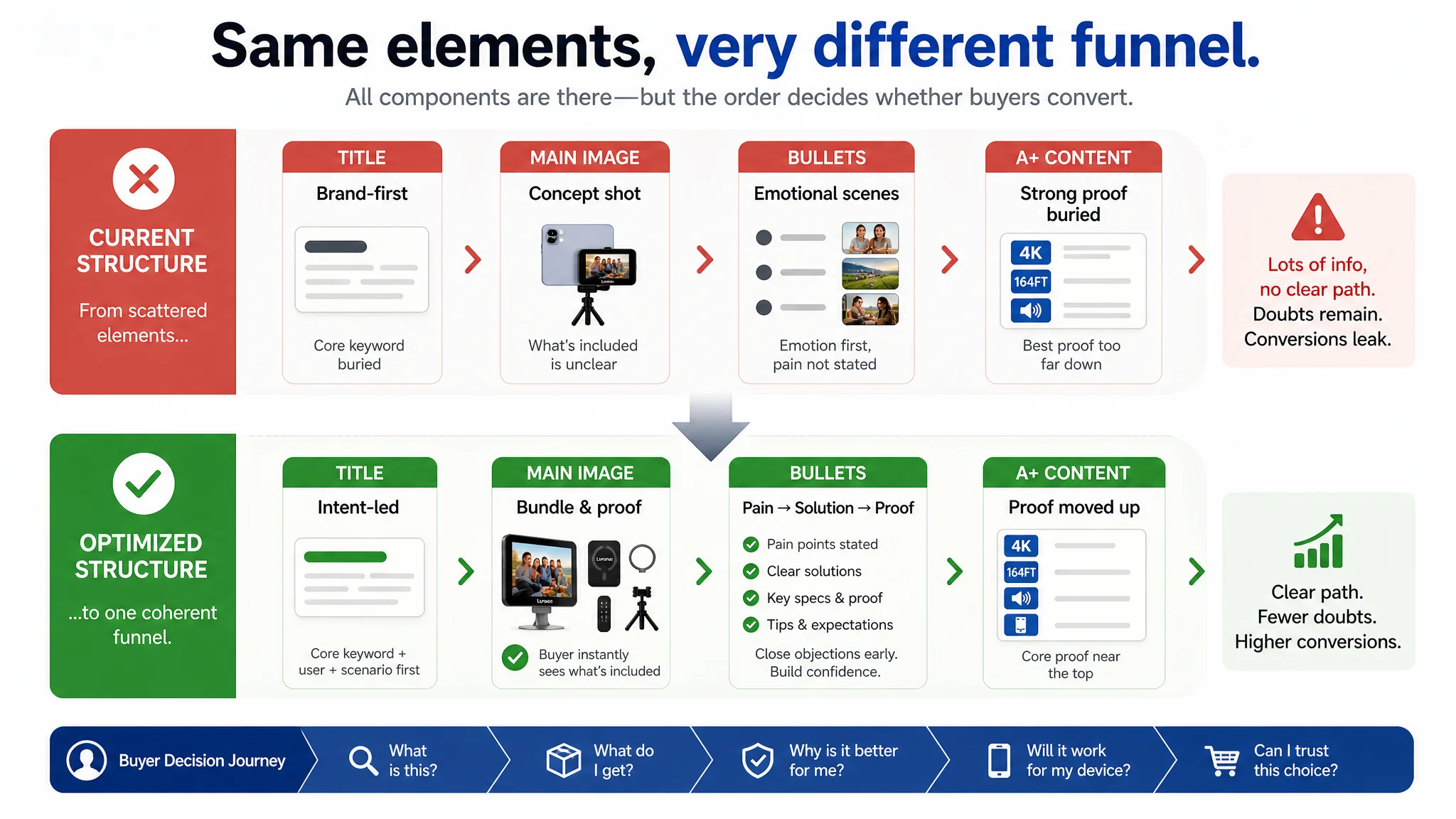
On paper, many mature sellers tick all of these boxes and still struggle with conversion, which is where structure and sequencing become critical. In the vlogging monitor case, each component existed, but it wasn’t doing its specific job in the funnel:
- The product title led with the brand and buried the core search term. Instead of front-loading “magnetic vlog selfie monitor screen” and clearly signaling “for content creators / YouTube / TikTok,” it prioritized branding and a string of specifications. In search results, this weakened both keyword relevance and instant user recognition.
- The main images were visually polished, but the gallery opened with a conceptual lifestyle shot and delayed basic confirmation of what buyers actually received in the box. The strongest proof image—showing the stark difference between front-camera and back-camera footage—was buried deep in the sequence, where many shoppers would never scroll. That meant the gallery wasn’t eliminating doubts in the right order: “What am I buying?”, “Will it work at the distance I need?”, “Is it really better than just using my front camera?”
- The bullet points described warm, emotional scenarios (“capture warm moments”) but did not walk through a complete “pain → solution → proof” chain. Critical differentiators—like built-in speakers for instant audio review, ultra-low latency, and long wireless range—were either underplayed or not presented as standalone reasons to choose this product. There was no “tips” bullet to proactively answer operational questions, which the benchmark used to both reduce returns and increase buyer confidence.
- The A+ content was actually richer and more elaborate than the benchmark’s, with solid problem–solution modules and realistic lifestyle visuals. Yet the modules containing the strongest proof—the front vs. back camera comparison, the quantitative range and latency advantages—sat too low on the page. Shoppers had to commit to deep scrolling before encountering the content that truly de-risked the purchase.
The result was a listing that “had everything” but did not behave like a coherent funnel. In contrast, the benchmark competitor used the same building blocks—title, images, bullets, and A+—to tell one continuous, decision-oriented story. This contrast underlines a crucial point: it’s not enough to have these elements in place; they must be deliberately ordered and written so that each step answers the next logical question in the buyer’s mind.
Leveraging DeepBI for Superior Listing Performance
While manual optimization relies on experience and subjective judgment, a data-driven approach is essential for scalable success. DeepBI provides an AI-core, full-link intelligent optimization system designed exclusively for Amazon, integrating the entire workflow from diagnosis and planning to content production and delivery.
The process begins with a comprehensive diagnostic audit. Using distributed data crawling and multi-dimensional semantic analysis, DeepBI automatically identifies your top-performing competitors and benchmarks your listing against them. It quantitatively scores key elements—main images, titles, bullet points, and A+ content—to pinpoint specific weaknesses and guide your optimization strategy.
In the vlogging monitor case, this diagnostic phase was precisely where the seller’s initial assumptions were overturned. They came in convinced the issue was purely on the ads side, because high-level listing indicators looked healthy: strong review volume compared to the benchmark, similar star ratings, a richer A+ layout, and only a one‑point gap in overall listing score (82 vs. 83). From their perspective, the page was “already above average”; ads had to be the bottleneck.
DeepBI’s scoring, however, broke that illusion by showing how tightly the gaps clustered where conversion is made or lost:
- The benchmark title outscored theirs and clearly led with the core search intent and target user (“magnetic vlog selfie monitor screen” for content creators), while theirs buried these signals behind the brand and generic spec phrases.
- The main image gallery for the benchmark immediately confirmed what was in the bundle and addressed setup and use cases, whereas the seller’s images favored aesthetics over fast objection handling.
- Bullet points for the benchmark followed a clean pain–solution–outcome structure, even dedicating a bullet to “tips” that preempted issues which could otherwise show up as negative reviews or returns.
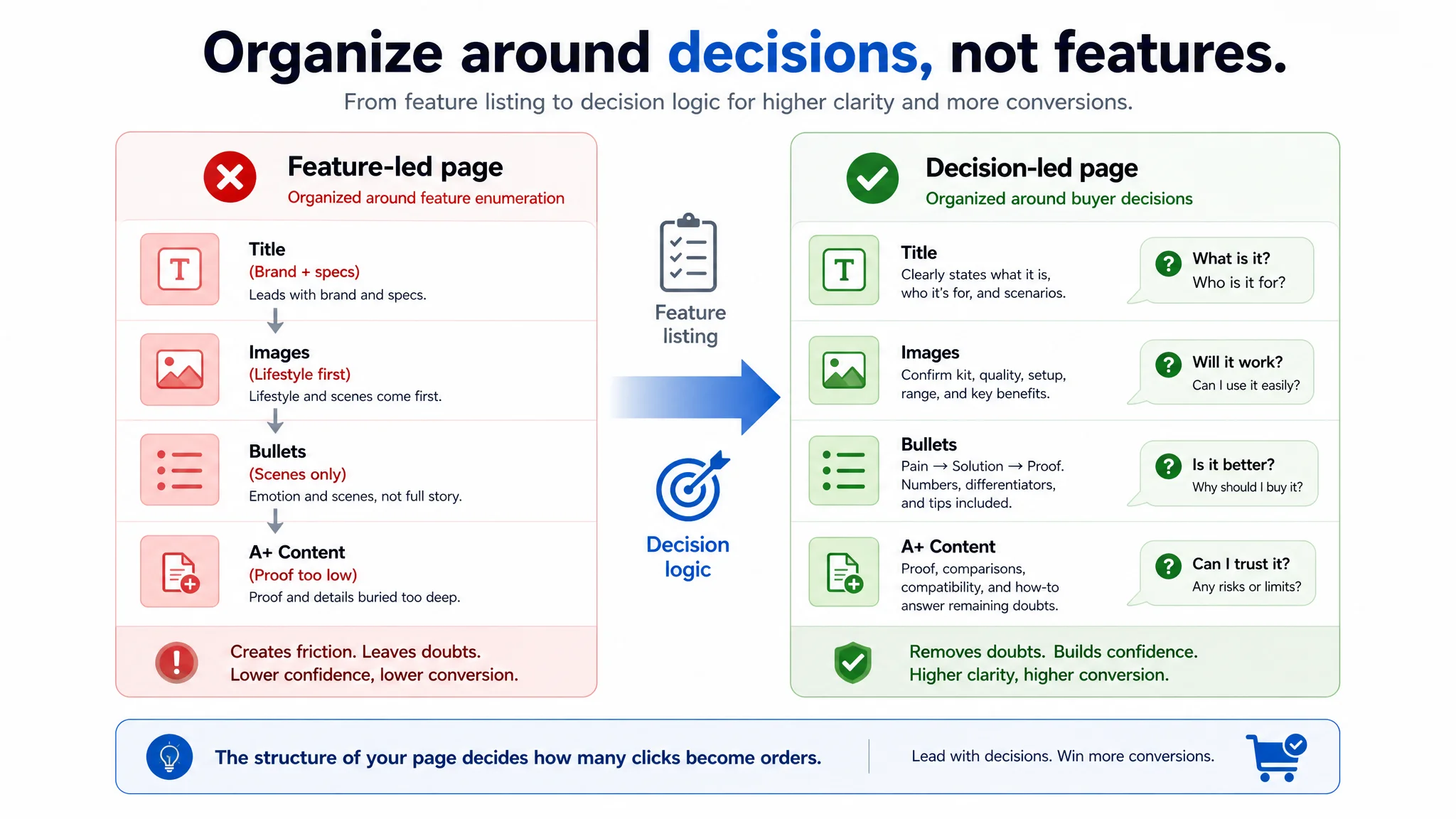
Based on this data, DeepBI’s AI generates multiple optimized content solutions. This system is a commercial production tool, not a creative drawing board; it uses a "Product DNA" map to constrain the AI, ensuring generated visuals remain authentic to your product and mitigating post-sale risks. In the monitor case, that meant re-architecting the title to lead with the core keyword and creator scenarios, reshuffling the image sequence so that bundle confirmation and front-vs-back-camera proof moved to the top, and turning previously scattered advantages (built-in speakers, 164FT range, 40ms latency, 3-hour battery) into clear bullet-point promises.
Once you approve the new content, it can be applied to your listing with a single click via the Amazon SP-API, reducing a 30-minute manual upload process to mere seconds.
Finally, DeepBI creates a powerful feedback loop by analyzing your advertising data to identify high-CTR and high-CVR keywords. These insights are used to further refine your listing for better organic ranking. In the vlogging monitor project, this sequence was crucial: DeepBI deliberately refused to keep “fixing” ads on top of a page that was structurally weak for conversion. Only after the listing’s sales logic had been rebuilt—so that each incoming click had a higher probability of turning into an order—did it make sense to revisit keyword portfolios and bid strategies. That shift, from reflexively tuning ads to first upgrading listing conversion capacity, is exactly what a data-driven evidence chain enables.
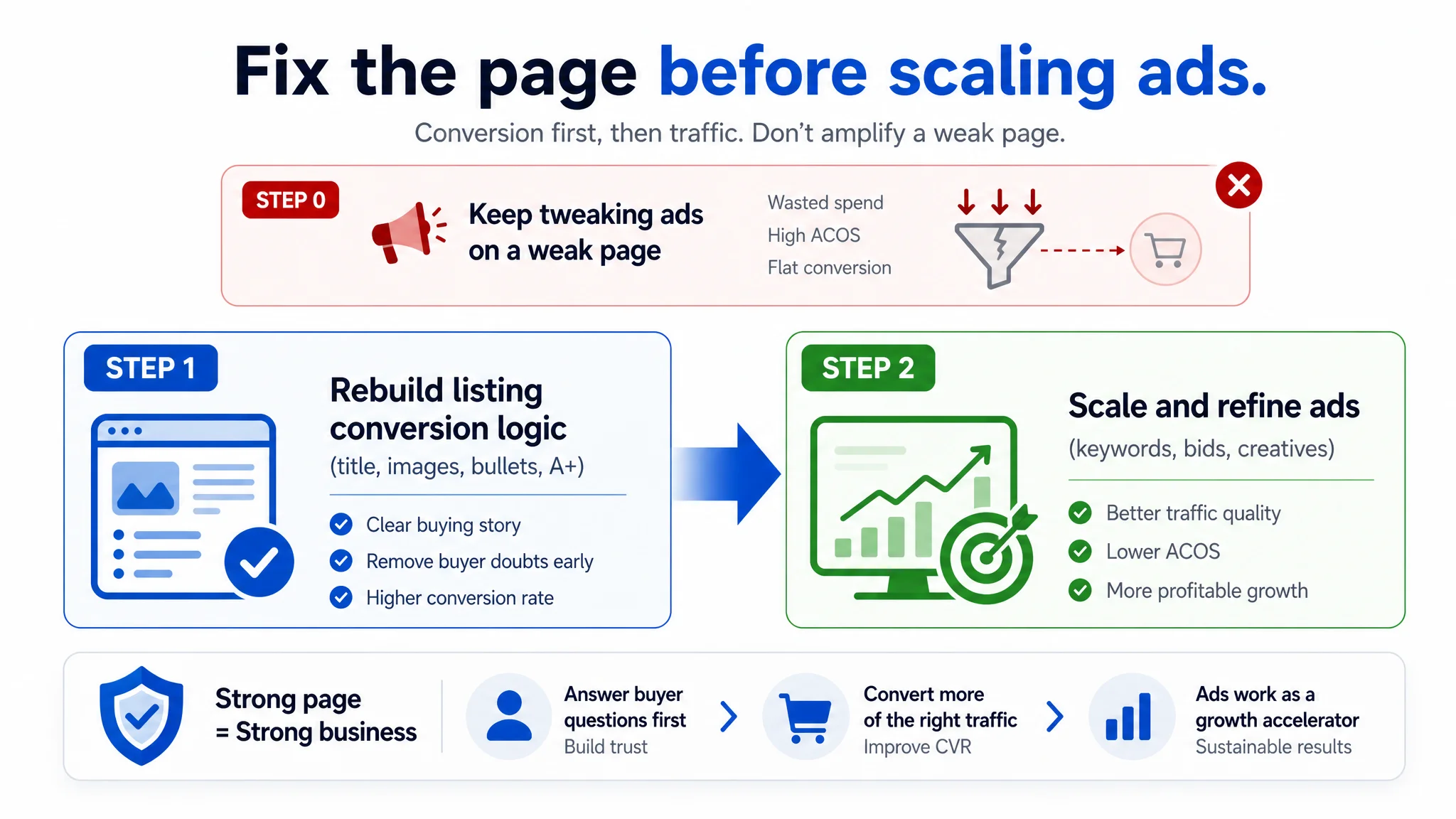
This ensures that traffic driven by dynamically managed ad campaigns lands on a highly converted page, maximizing your return on ad spend (ROAS) and lowering ACoS. By shifting from intuition to a data-driven evidence chain, DeepBI helps build a foundation for stable, long-term profitability.
Measuring and Continuously Improving Your Conversion Rate
Your conversion rate (CVR) is the percentage of visitors who purchase your product after viewing your listing. The calculation is simple: divide total orders by total sessions and multiply by 100. For example, if 5,000 visitors result in 250 purchases, your CVR is 5% (250 ÷ 5,000 x 100).
This metric is critical because it directly impacts sales and profitability. A higher CVR improves your Advertising Cost of Sales (ACoS) by turning more clicks into revenue. The effect is powerful: doubling your CVR from 2% to 4% on 10,000 visitors doubles your sales without any increase in traffic. Amazon's algorithm also favors high-converting listings, which can boost your Best Seller Rank (BSR).
To contextualize your performance, compare it against industry averages. While CVRs vary, general benchmarks include:
- Food and beverages: 3.7%
- Beauty and skincare: 3.3%
- Sporting goods: 2.3%
- Electronics and accessories: 1.9%
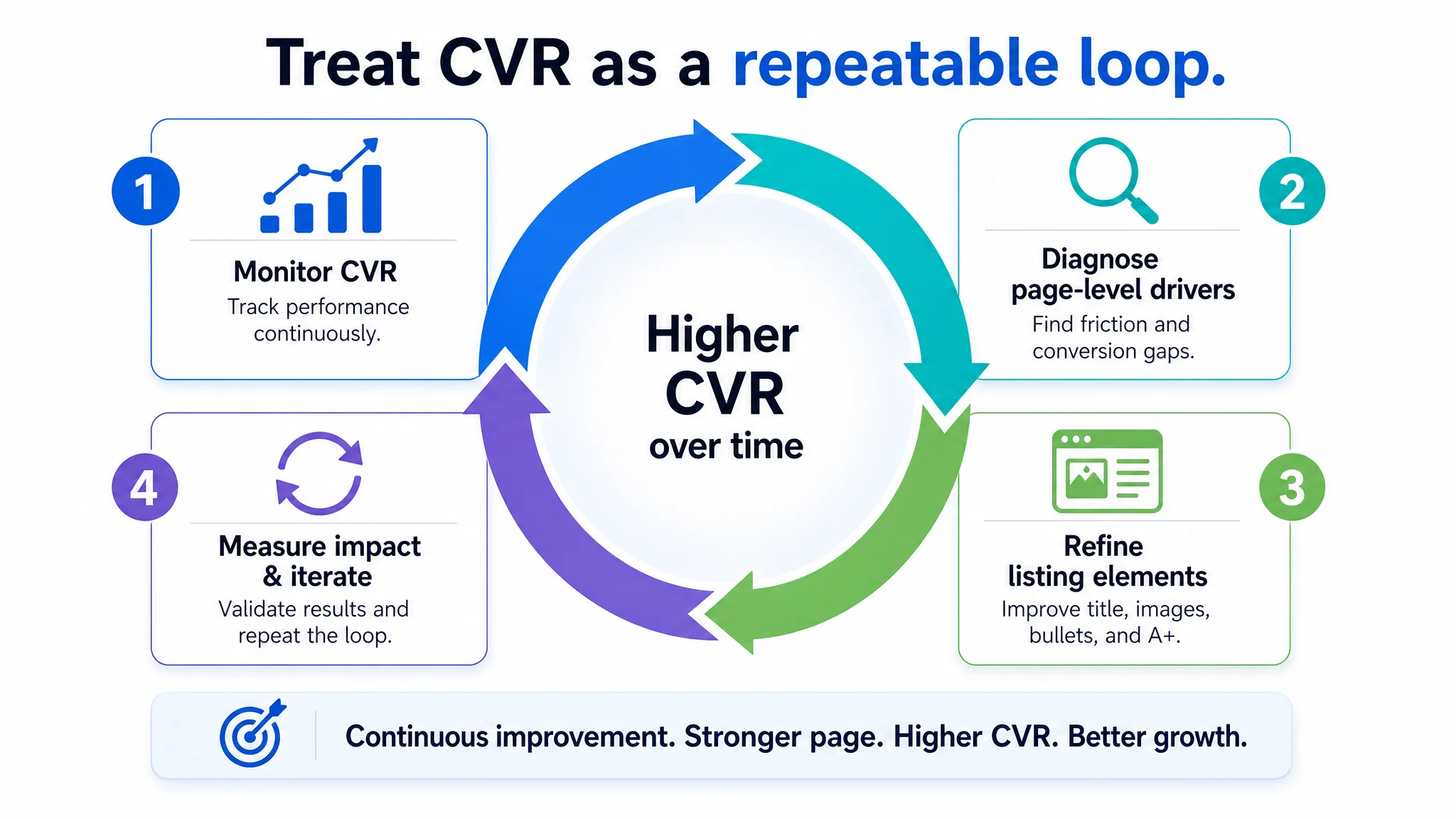
These figures provide a baseline, but your main goal should be continuous improvement over your own historical data. Achieving a strong CVR requires a continuous optimization cycle: monitor, diagnose, refine, and measure. This data-driven process transforms listing improvement from subjective guesswork into a predictable science. By diagnosing specific weaknesses—such as linking a low CVR to unconvincing A+ Content—you can make targeted changes and track their impact. This closed-loop approach ensures every modification is a calculated step toward higher conversions and sustainable growth.
In practice, many sellers stall because they misread what the CVR is telling them. The vlogging monitor seller saw stable traffic and a CVR that lagged behind expectations, yet treated it as purely an advertising efficiency problem. Ad metrics—CPC, impressions, CTR—were scrutinized in detail, while the listing was treated as a fixed asset. Despite repeated campaign tweaks, CVR barely moved, and ACoS remained heavy.
When DeepBI decomposed that CVR into specific page-level drivers, the picture changed:
- Sessions were adequate, but too many visitors were dropping off before completing basic checks: what’s in the box, will it work with my device, is it really better than my current setup?
- Review sentiment was generally positive, but support tickets and scattered comments revealed recurring confusion around compatibility and usage—exactly the kind of friction that suppresses conversion.
- Modules that could have raised CVR—like quantitative proof of range and latency, clear compatibility diagrams, and “pro tips” that align expectations—existed, but were buried too far down the page or not surfaced clearly enough in the bullets and images.
Once the listing was restructured around these findings, the seller no longer had to guess why CVR was underperforming. They could see how each change in the title, image order, bullets, or A+ modules was meant to affect a specific step in the user’s decision process, and then watch CVR respond.
This is the essence of continuous improvement: instead of asking, “Why is my CVR low?” in the abstract, you tie it back to concrete, testable hypotheses about your listing. The moment you treat conversion not as a single number but as the result of dozens of small trust and clarity decisions on your page, the optimization cycle becomes much more manageable and measurable.
Conclusion: Your Path to Amazon Success
Mastering Amazon requires moving beyond isolated tweaks and embracing a holistic, data-driven strategy for listing optimization. The journey from diagnosis and strategy to production and delivery is not a series of disconnected tasks but a single, integrated lifecycle. This unified approach breaks down traditional operational silos, transforming listing management from a process based on guesswork into a predictable, quantifiable science.
The experience of the vlogging monitor seller illustrates how easy it is to get stuck when you treat ads as the primary growth lever and the listing as “good enough.” For weeks, they cycled through keyword and bid adjustments while a deeper constraint quietly capped their growth: a product page that looked strong on the surface but did not clearly answer what buyers were getting, why it was better than their current front-camera setup, and how it would work in their real shooting scenarios. Only after the title, image sequence, bullet logic, and A+ module order were rebuilt around one coherent conversion story did their advertising spend begin to produce the returns they expected.
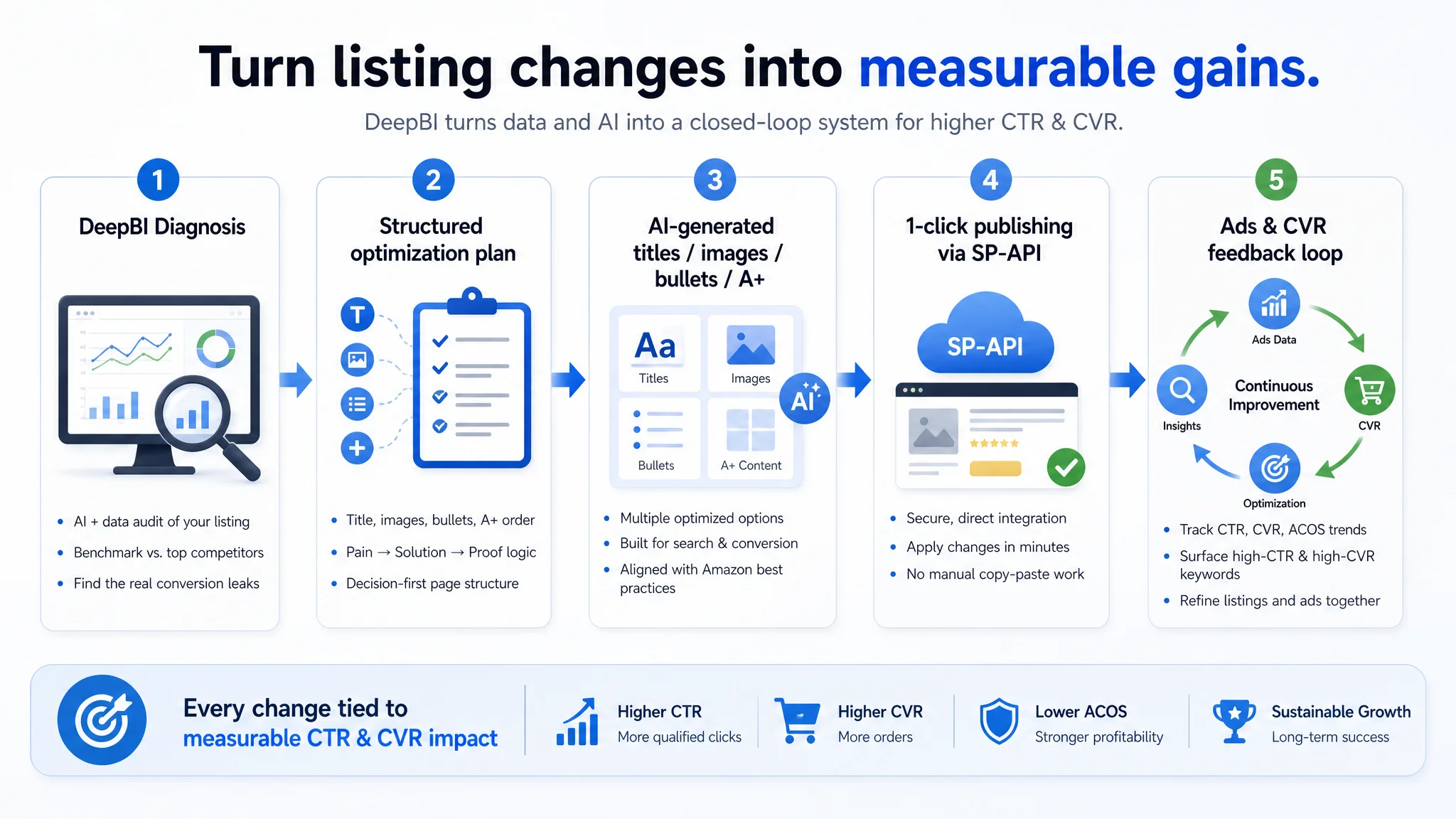
By leveraging advanced tools like DeepBI, you can translate vague improvement ideas into precise, AI-executable instructions that directly impact performance. This redefines the optimization process, ensuring every change is engineered to convert visual assets into measurable increases in Click-Through Rate (CTR) and Conversion Rate (CVR). It also helps you make better strategic choices—such as knowing when to pause aggressive ad scaling to first strengthen your listing’s conversion capacity.
This systematic evolution of your listings is the key to not only boosting short-term sales but also achieving refined operations and securing long-term brand growth. By adopting this intelligent, full-funnel methodology, and by consistently asking “does my page really deserve more traffic?” before pouring more budget into ads, you position your business to win in an increasingly competitive marketplace.