

Understanding the Foundation: Why Campaign Structure Matters
In Amazon advertising, campaign structure is not merely an organizational preference; it is the strategic foundation upon which all successful optimization is built. Without a logical framework, ad spend becomes reactive, and performance analysis relies more on subjective judgment than on data. This leads to a fragmented understanding of the traffic funnel, making it nearly impossible to diagnose the root cause of poor performance. For example, you might be unable to determine if a low Click-Through Rate (CTR) is due to weak ad creative or imprecise targeting, or if a low Conversion Rate (CVR) stems from listing quality issues or an uncompetitive offer.
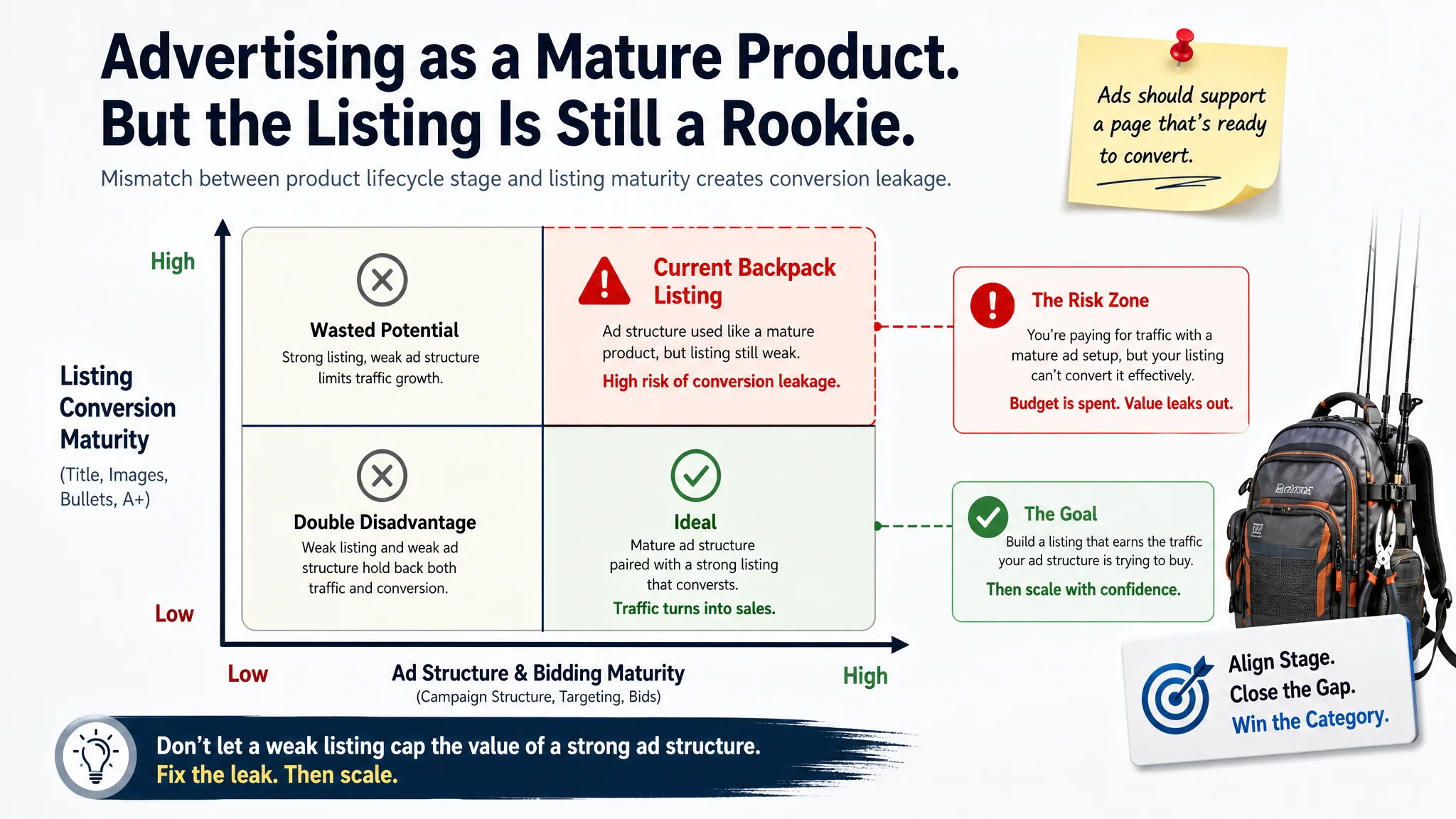
This disconnect between ad data and real business issues shows up repeatedly in practice. One fishing-gear seller on Amazon US, for instance, was seeing stubborn ACoS and a CVR that simply did not match what you would expect from a 4.6‑star product with hundreds of reviews and full A+ content. Their instinct was to keep “fixing the ads”: adjusting bids, restructuring campaigns, and widening keyword coverage. But when DeepBI benchmarked their listing against a top competitor in the same fishing backpack segment, it became clear that ads were not the weak link. The core constraint was how the title and image sequence translated traffic into a buying decision. On the surface, it looked like an advertising problem; structurally, it was a conversion problem.
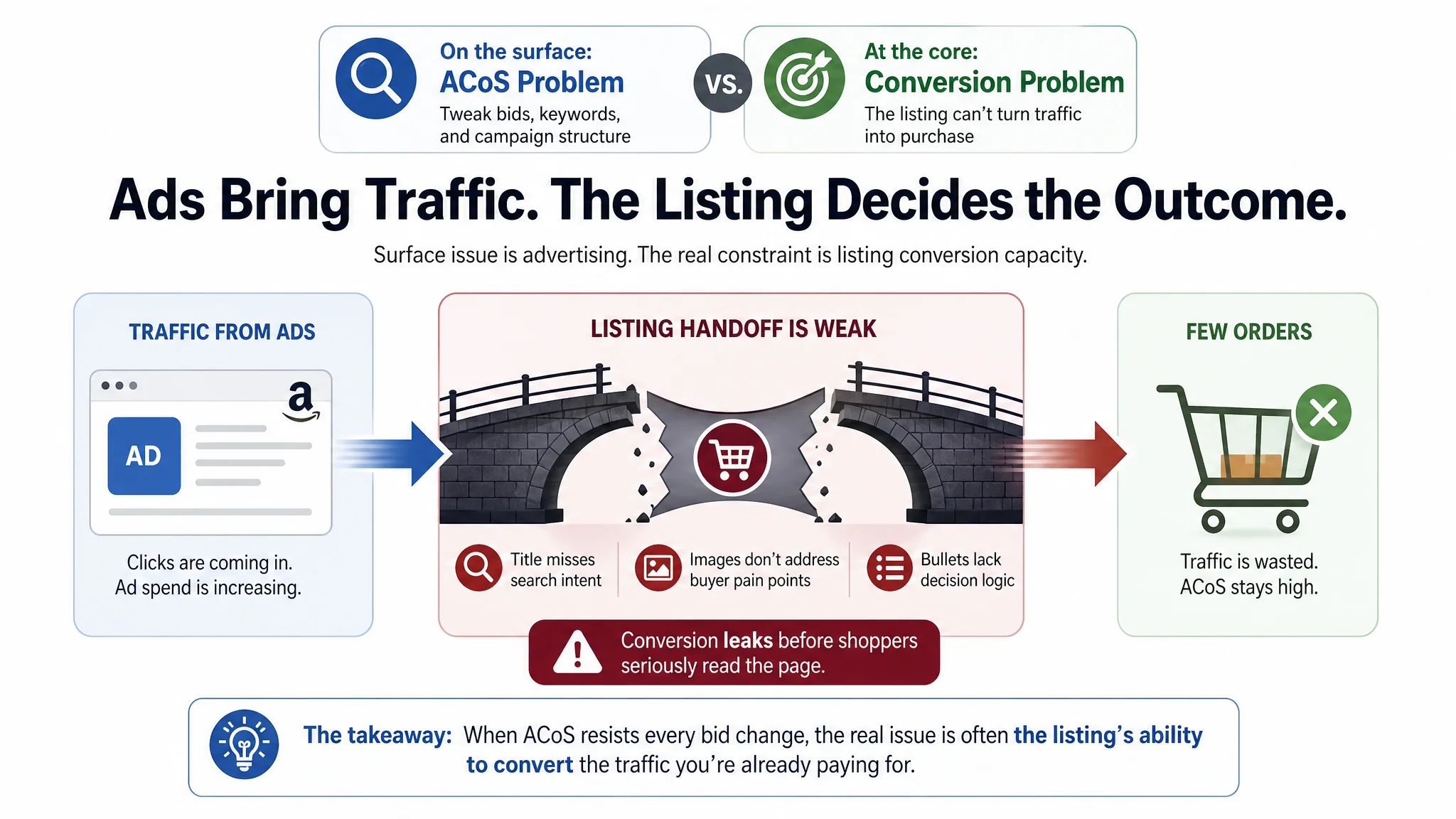
A well-organized campaign structure solves the advertising side of this equation by creating clarity and control. It allows for precise budget allocation, ensuring funds are directed to the most effective targets. More importantly, it provides the clean, segmented data necessary for meaningful analysis. This clarity transforms advertising metrics from noise into actionable signals. By establishing a direct link between campaign inputs and performance outcomes, you can systematically identify weaknesses, test hypotheses, and scale successes. Crucially, when this structured view shows that CTR is reasonable but CVR is lagging, you can, as in the fishing backpack case, question the listing rather than endlessly tweaking campaigns. Ultimately, a sound structure is the key to improving advertising efficiency, lowering your Total Advertising Cost of Sale (TACoS), and building a profitable, data-driven growth engine on Amazon.
Core Components of an Effective Amazon Campaign Structure
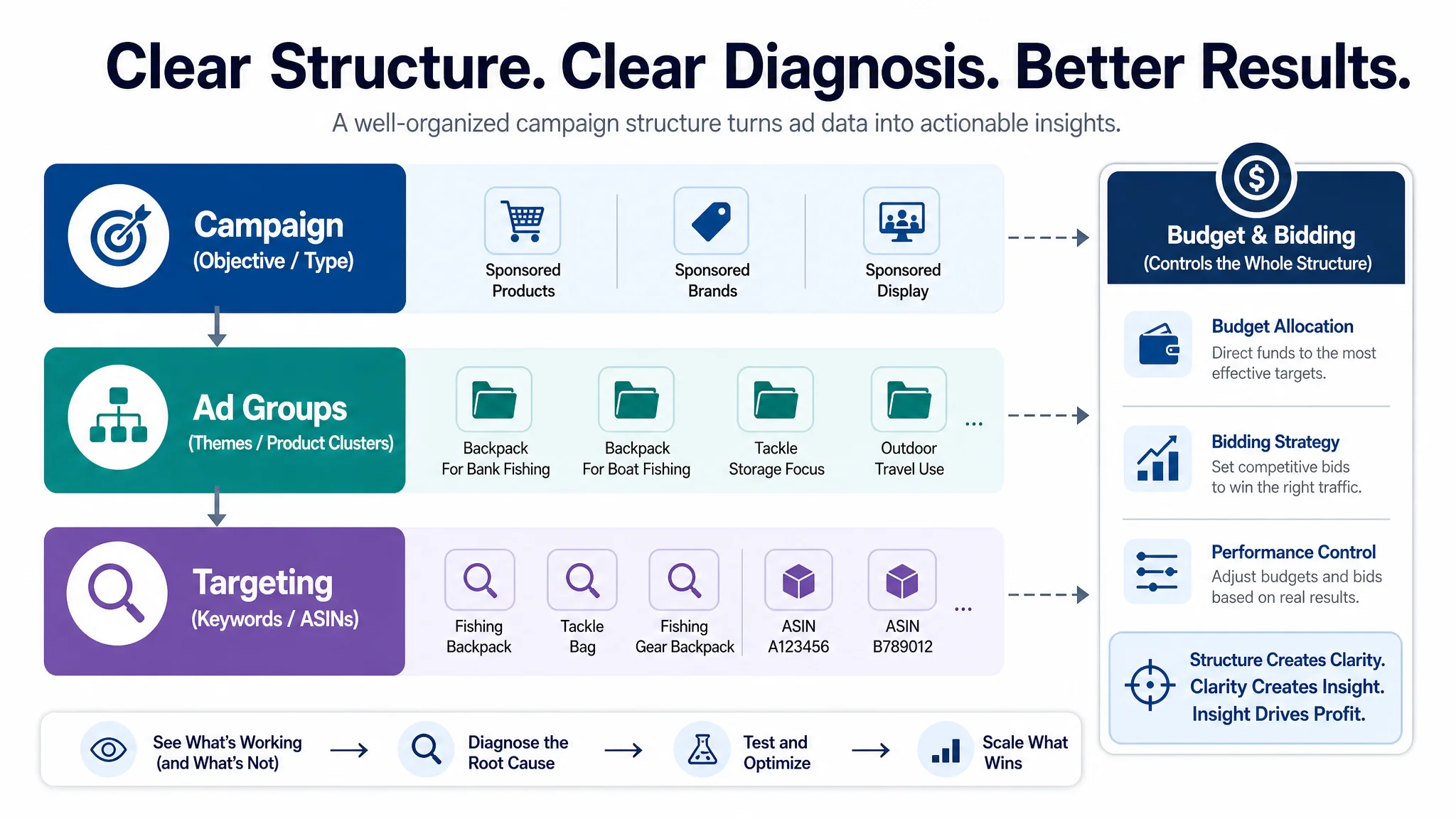
An effective Amazon advertising strategy is built upon a well-organized campaign structure. This framework not only simplifies management but also provides the control needed to optimize performance and manage advertising cost of sales (ACoS). Understanding the core components and their hierarchy is the first step toward building a profitable PPC engine.
At the highest level are the campaigns themselves, which are defined by their type and overall objective. The primary options include:
- Sponsored Products: These ads promote individual product listings and appear within search results and on competitor product detail pages, directly driving sales for specific ASINs.
- Sponsored Brands: Focused on top-of-funnel awareness, these ads feature your brand logo, a custom headline, and a collection of products, typically appearing at the top of search results.
- Sponsored Display: This type allows you to retarget shoppers who have viewed your products or target audiences based on shopping signals, both on and off Amazon.
Within each campaign, you create Ad Groups to organize your targeting. Ad groups allow you to cluster similar products or keywords, enabling you to set specific bids and serve highly relevant ads. For instance, a "Men's Running Shoes" campaign might have separate ad groups for different shoe models or keyword themes.
The foundation of each ad group is its Targeting Method. This determines where your ads appear. You can use keyword targeting to bid on specific customer search terms or employ product targeting to place your ads on specific ASIN detail pages or within relevant product categories. Finally, Budgeting and Bidding Strategies act as the financial controls, allowing you to set spending limits and define how aggressively you compete for ad placements.
In real accounts, the absence of this hierarchy often leads to misdiagnosis. In the fishing backpack example, the seller gradually added more and more keywords and segments into a patchwork of campaigns and ad groups, assuming that finer targeting and bid tuning would fix ACoS. Because the structure did not clearly separate “exploration” from “proven” terms, or brand defense from competitor targeting, they had no clean way to see that traffic volume and CTR were not the problem. Once DeepBI overlaid listing-level diagnostics against the campaign data, it was obvious that the traffic being bought was roughly adequate; what was missing was a listing that could carry that traffic to purchase. A coherent structure is what makes that kind of judgment possible—it keeps campaigns from becoming a black box and lets you see when the problem is beyond the ad account.
Strategic Approaches to Campaign Structuring
Effective campaign architecture is not a one-size-fits-all template but a flexible framework adapted to your specific goals. Choosing the right structure is fundamental to controlling ad spend, improving key metrics like ACoS, and scaling your advertising efforts efficiently.
Single Keyword Ad Group (SKAG) vs. Thematic Ad Groups
The Single Keyword Ad Group (SKAG) model dedicates one ad group to a single keyword, offering maximum control over bids and ad copy relevance. This granularity can lead to higher Click-Through Rates (CTR) and better ACoS for top-performing terms. However, SKAGs can become complex and time-consuming to manage, especially for large catalogs.
Conversely, thematic ad groups bundle closely related keywords together. This approach simplifies campaign management and is excellent for capturing broader search intent. While offering less granular control than SKAGs, thematic groups are ideal for sellers with limited time or those wanting to test a wider range of terms quickly.
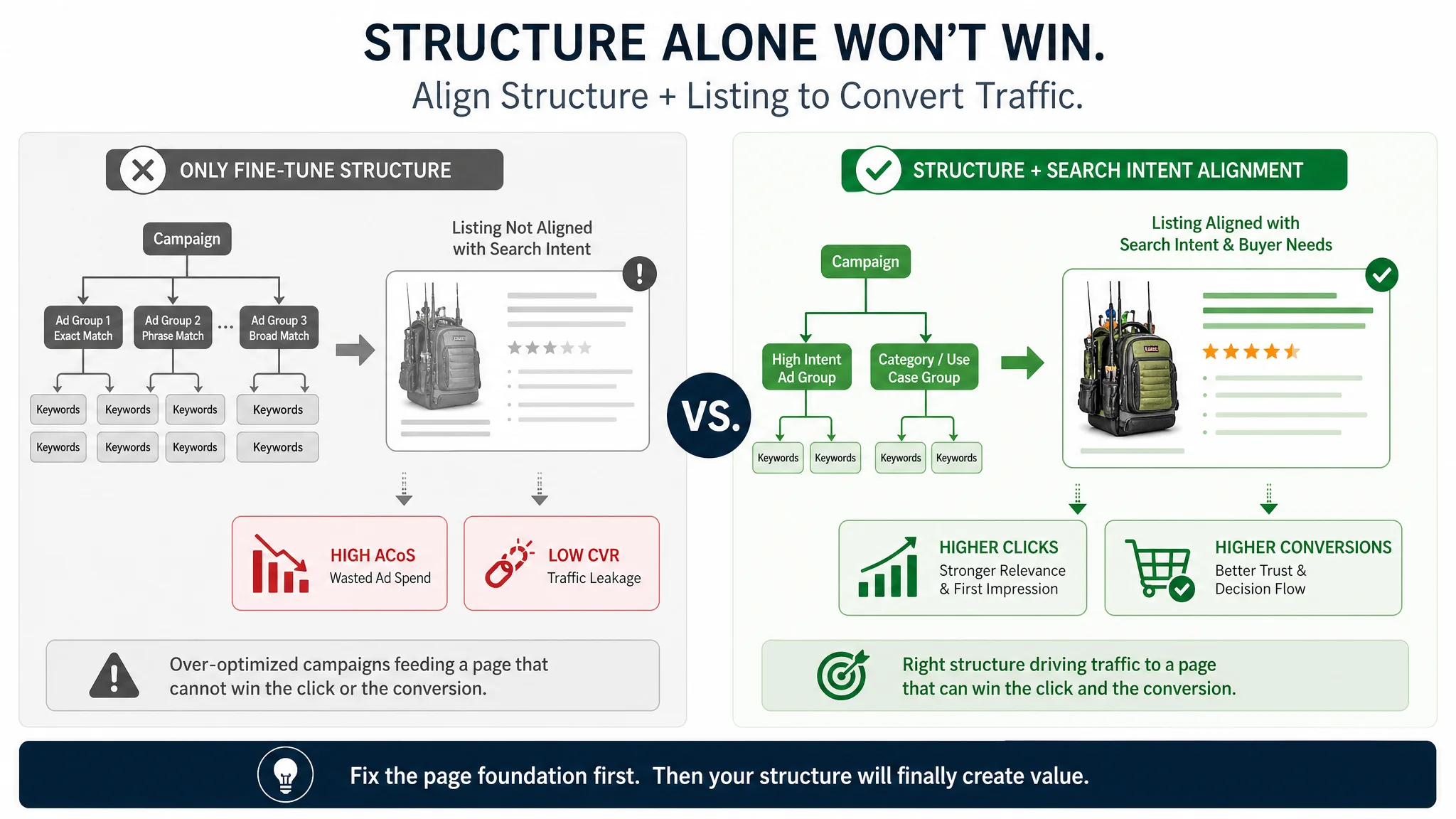
The choice between SKAGs and thematic groups becomes particularly meaningful when your listing and your ads are out of sync. The fishing backpack seller, for instance, kept splitting and refining ad groups around variations of “fishing backpack”, “tackle bag”, and related long-tail terms, trying to squeeze efficiency from structure alone. But DeepBI’s comparison against a benchmark listing showed that the title under-leveraged the core phrase “Fishing Tackle Backpack” and buried concrete benefits behind brand-centric wording. No matter how precisely the keywords were grouped in the campaigns, the listing itself was not matching buyer search language effectively. The takeaway is that granular structures like SKAGs only create value when the listing is already aligned with the search intent you are targeting; otherwise, you risk over-engineering campaigns to feed a page that cannot win the click or the conversion.
Structuring for Product Lifecycle and Goals
Your campaign structure should evolve with your product's maturity.
- New Product Launches: Prioritize discovery. Use broad match and automatic campaigns to gather data on converting search terms and identify competitor ASINs to target. The initial goal is visibility and data collection, not immediate profitability.
- Mature Products: Shift focus to efficiency and profitability. Emphasize exact match keywords in manual campaigns, optimize bids to hit target ACoS, and run defensive product targeting ads to protect your brand space.
- Seasonal Promotions: Prepare for short-term traffic spikes. Create dedicated campaigns with increased budgets and aggressive bidding on seasonal keywords to maximize visibility and sales during peak demand periods.
This lifecycle thinking matters because it shapes what you expect from your campaigns. The fishing backpack was not a brand-new ASIN; it already had hundreds of reviews and a complete A+ section. The seller treated it as a mature product and focused their structure on squeezing better ACoS from exact-match and segmented campaigns. DeepBI’s assessment, though, showed that while the product had maturity in ratings, it lagged behind top competitors in “front-line” listing elements: the title scored significantly lower than the benchmark, and the main image sequence did not address key buyer pain points early enough. In other words, they were using a mature-product campaign structure on a page that was still, in conversion terms, underbuilt. Matching your campaign structure to lifecycle is necessary, but you also need to ensure the listing has actually grown into that stage.
Leveraging Automatic and Manual Campaigns
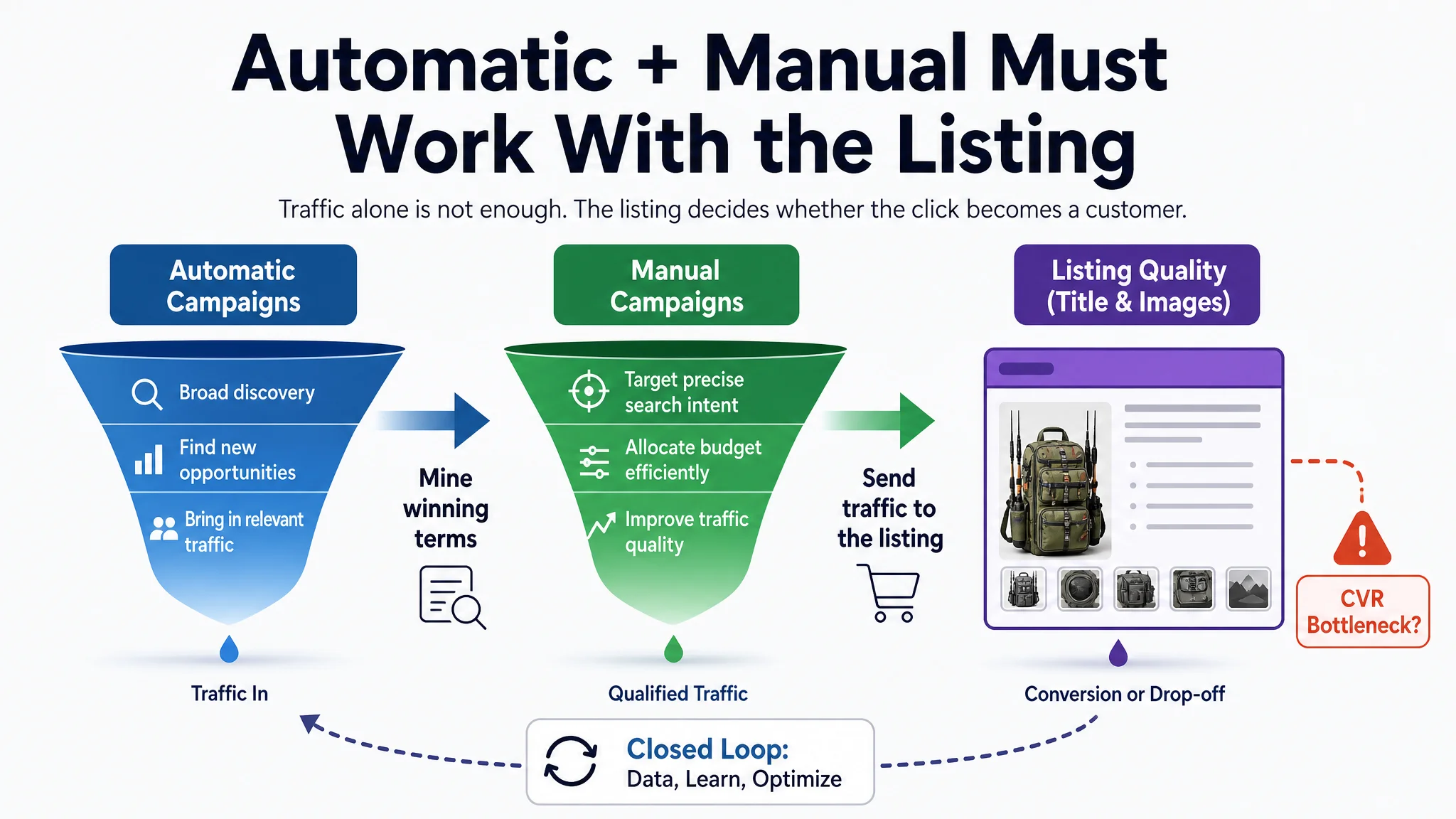
Automatic and manual campaigns work best in a symbiotic relationship. Automatic campaigns serve as a powerful research tool, unearthing new, high-converting customer search terms and competitor ASINs. The key is to systematically harvest these "winning terms" and move them into manual campaigns.
This creates a continuous optimization loop. Insights from automatic campaigns feed manual campaigns with proven keywords for precise bid control and scaling. This data-driven feedback loop extends beyond keywords; a low CTR might signal a weak main image, while a poor Conversion Rate (CVR) could indicate that the A+ content isn't effectively building trust, creating a direct link between ad performance and listing optimization.
In the fishing backpack case, the seller had enough traffic history for DeepBI to see that impressions and clicks from automatic campaigns were not the core limitation. What the data showed was a pattern: terms around “fishing tackle backpack” and “gear storage” were driving visits, but CVR lagged behind what similar traffic achieved on a benchmark backpack listing. When DeepBI dug into the listing, the cause aligned neatly with the campaign data: the title delayed the main keyword and used vague benefit language, and early images focused on dense feature diagrams instead of scenario usage and comfort. Automatic campaigns had done their job of surfacing relevant demand; the manual campaigns were structured to capitalize on it. But without a page that spoke the buyer’s language and sequence of concerns, the loop could not close. This illustrates why automatic–manual interplay must be evaluated alongside listing quality, not in isolation.
Advanced Optimization Techniques for Campaign Structures
To move beyond basic campaign setups, sellers must adopt advanced techniques that refine targeting, control costs, and maximize return on ad spend (ROAS). These methods involve a more strategic approach to keywords, bidding, and targeting, transforming campaigns from simple traffic drivers into precision instruments for sales growth.
Granular Keyword Management and Match Types
Effective keyword management hinges on creating highly relevant ad groups. Instead of grouping many disparate keywords together, organize them into tight, thematic clusters where each keyword is directly related to the ad copy and the product. This enhances relevance, which can improve Click-Through Rates (CTR) and lower costs.
A sophisticated strategy involves using different match types with clear intent:
- Broad Match: Use sparingly in research-focused campaigns to discover new, high-performing customer search terms.
- Phrase and Exact Match: Allocate the majority of your budget to these campaigns, targeting keywords that have already proven to convert. This provides greater control over who sees your ads.
- Negative Keywords: Proactively add irrelevant search terms as negative keywords. This is one of the most effective ways to reduce wasted ad spend and lower your Advertising Cost of Sales (ACoS) by preventing your ads from showing for searches that will not convert.
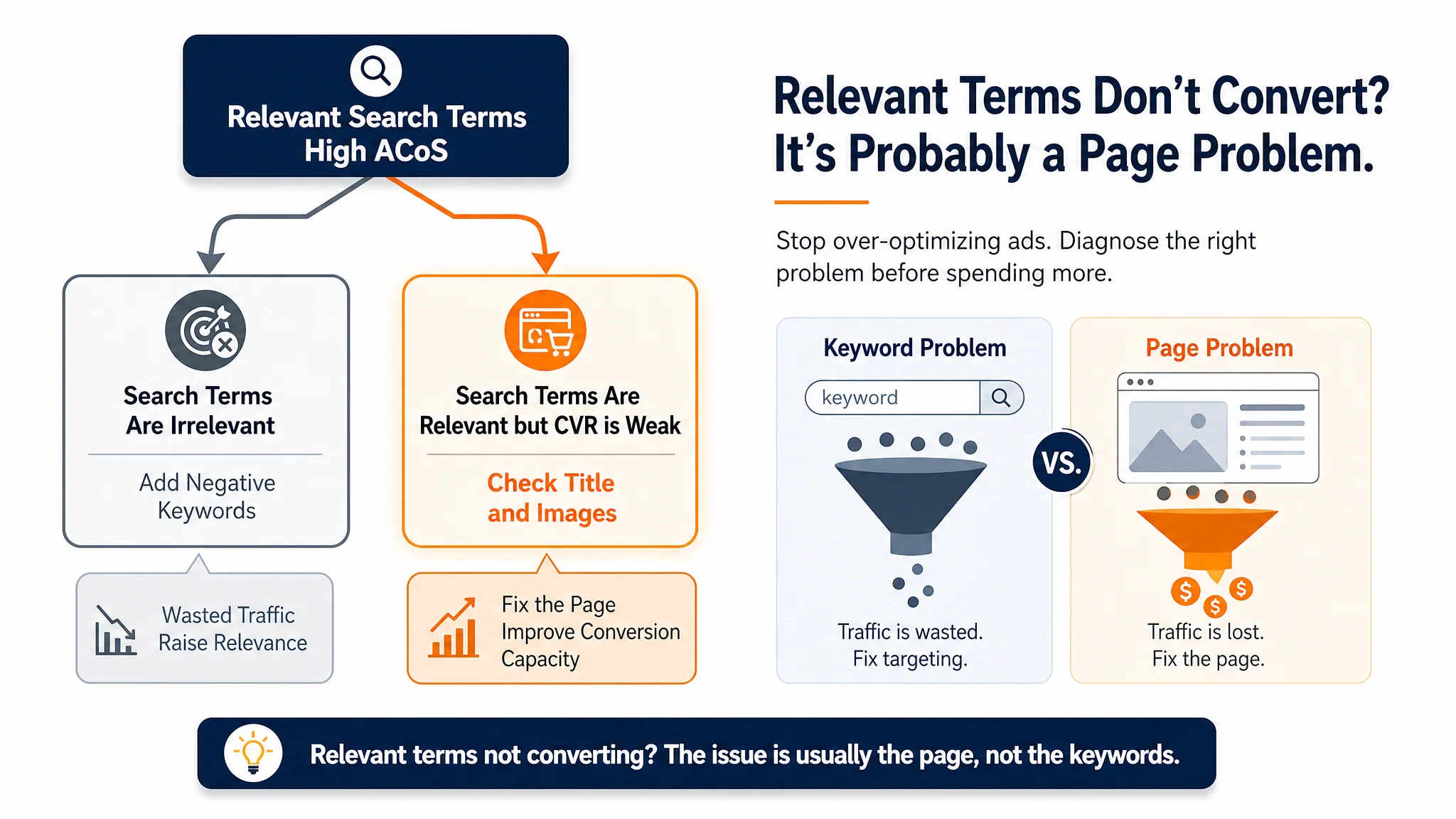
This is also where the line between “ad problem” and “page problem” often gets blurred. In the fishing backpack account, search term reports showed plenty of relevant queries—“fishing backpack”, “tackle storage bag”, and related phrases—that any reasonable keyword strategy would want to keep. The seller’s reaction to high ACoS was to further refine match types and add more negatives. But DeepBI’s benchmark analysis revealed that the listing title did not front-load “Fishing Tackle Backpack” and used less compelling modifiers than the top competitor (“Lightweight”, “Protective Rain Cover”). As a result, even when the right queries triggered ads, the landing page was not maximally relevant from a shopper’s perspective. Granular keyword work is powerful, but when reporting shows relevant queries with weak conversion, it can be a sign that it’s time to re-evaluate title, images, and bullets—as was the case here—rather than endlessly pruning search terms.
Bid Optimization and Budget Allocation
Strategic bidding and budget allocation are critical for profitability. Amazon offers several dynamic bidding strategies: "up and down" bidding allows Amazon to increase bids for likely conversions, while "fixed bids" provide predictable spending. The optimal choice depends on the campaign's goal, whether it's aggressive growth or stable profitability.
Budgets should be allocated based on performance. Funnel more budget into campaigns and ad groups with a low ACoS and high conversion rate, and reduce spending on underperforming ones. Tools can automate this process; for instance, DeepBI's dynamic parameter adjustment mechanism can optimize bids and budgets based on real-time performance metrics like clicks, conversions, and ACoS, ensuring capital is deployed efficiently.
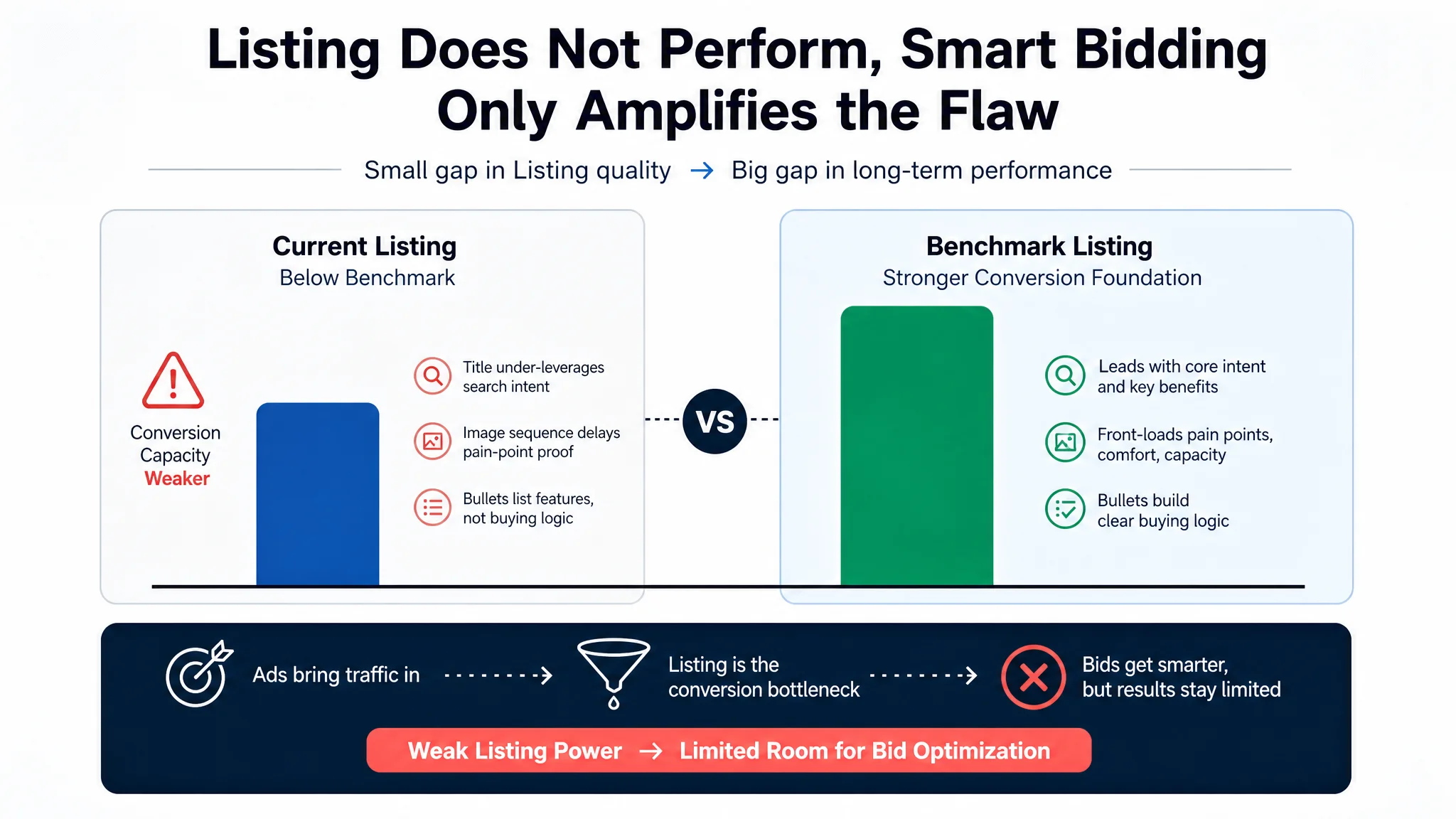
However, the fishing backpack case underlines a crucial nuance: bid and budget automation can only optimize within the constraints of the listing. In that account, advertisers kept nudging bids and reallocating budget between campaigns without seeing the expected improvement in ACoS. DeepBI’s listing score—73/100 versus a category benchmark at 82/100—showed the root issue was not lack of traffic or underbidding. The title scored significantly lower than the benchmark, and the main image sequence delayed key comfort and capacity assurances. Under those conditions, “smart” bidding simply pushed more paid clicks into a page that was structurally weaker at converting. The business implication is that bid optimization should be paired with a periodic check: does this page deserve more traffic yet? If the answer, as in this case, is no, then allocating more budget—even efficiently—will not deliver the expected ROAS improvement.
Product Targeting and ASIN Segmentation
Beyond keywords, targeting specific ASINs allows for precise offensive and defensive maneuvers. By creating dedicated product targeting campaigns, you can segment your strategy for maximum control and impact.
- Offensive Targeting: Target the ASINs of direct competitors to display your product on their detail pages, capturing consideration from their potential customers.
- Complementary Targeting: Target products that are frequently purchased alongside yours to drive relevant cross-sells.
- Defensive Targeting: Target your own product ASINs to ensure your ad space is occupied by your own brand, preventing competitors from siphoning away your traffic.
Structuring these targets into separate campaigns or ad groups enables you to set specific bids and monitor performance for each segment, refining your strategy based on what drives the best results.
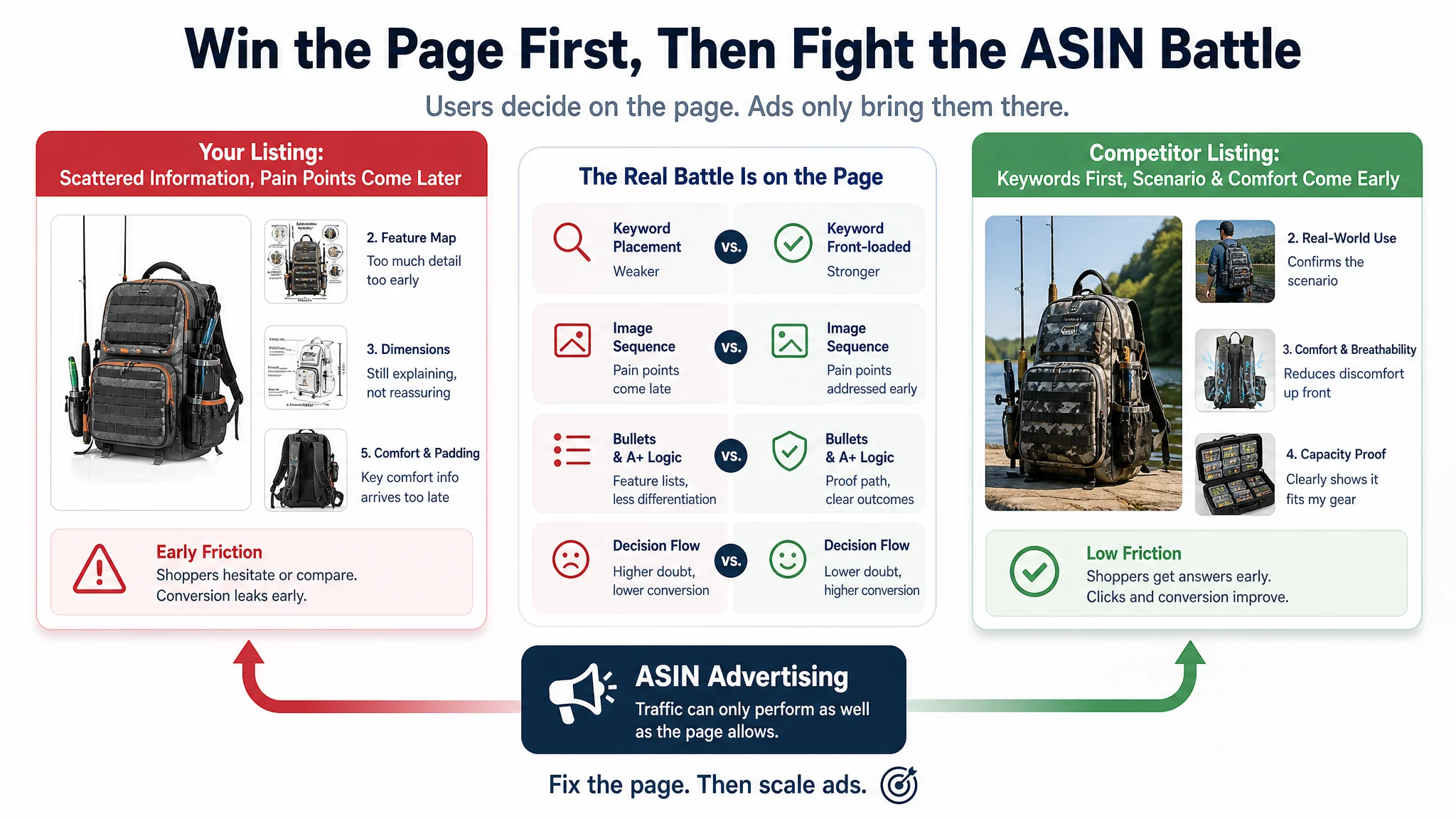
This segmentation is especially important when your listing is competing head-to-head with stronger pages. In the fishing backpack example, DeepBI’s benchmark was not an abstract “ideal listing” but a real, directly competing backpack in the same segment. That competitor:
- Led with the core intent phrase “Fishing Tackle Backpack” in the title,
- Layered in concrete benefits like “Lightweight” and “Protective Rain Cover”,
- And used early images to confirm outdoor use scenarios and comfort.
The target listing, by contrast, opened the title with the brand name, pushed core keywords back, and put dense feature diagrams in early image slots while burying key comfort visuals later. If you run offensive product targeting against such a benchmark without first upgrading your own listing, your ads essentially drive shoppers into a comparison where the competitor has the clearer, more compelling page. Proper ASIN segmentation in campaigns tells you which battles you’re losing; listing analysis tells you whether you’re adequately equipped to fight them.
Measuring and Iterating: Performance Analysis and Continuous Improvement
An effective campaign structure is not static; it requires continuous, data-driven refinement. Any optimization detached from real market benchmarks is a waste of resources. The foundation of this process lies in diligently tracking key performance indicators (KPIs) to diagnose issues and validate improvements. Metrics like Advertising Cost of Sales (ACoS), Return on Ad Spend (RoAS), Click-Through Rate (CTR), and Conversion Rate (CVR) are your core diagnostic tools.
It's crucial to set realistic targets. A "good" ACoS is not a universal percentage but is determined by your product's profit margin and specific campaign goals, such as launching a new product versus maximizing profitability. Similarly, while a higher CTR indicates better ad relevance, a low CTR often points to a "traffic funnel" issue, such as a weak main image. A low CVR, in contrast, suggests a "trust funnel" problem on the detail page, like poor A+ content or negative reviews.
The fishing backpack listing is a good illustration of this logic in action. On paper, the page appeared trustworthy: 4.6 stars, hundreds of reviews, and a fully built A+ segment. If you only looked at reviews, you might assume the “trust funnel” was solid and focus on traffic. But DeepBI’s analysis showed that the real leak occurred earlier:
- The title underplayed category intent and concrete benefits compared to a benchmark, affecting both relevance and click appeal.
- Early images were packed with feature diagrams and dimensions but delayed crucial reassurances about comfort and real-world usage.
- Bullets listed features and materials but did not walk the shopper through a clear “pain point → design → outcome” logic.
In performance terms, that translated into ad traffic that “looked fine” in volume but converted below what a stronger listing achieved for similar queries. DeepBI’s four-layer traffic funnel model—exploration, initial screening, precision, and scaling—helped make this explicit: the bottleneck was not in exploration or initial screening (campaigns were driving relevant visits), but in precision and scaling, where the page failed to consistently close the sale. When the listing was reworked—title recentered around buyer search, images reordered to align with buyer resistance, bullets turned into a proof path—subsequent performance analysis could finally show whether bid and keyword changes were genuinely improving outcomes instead of running into an invisible ceiling.
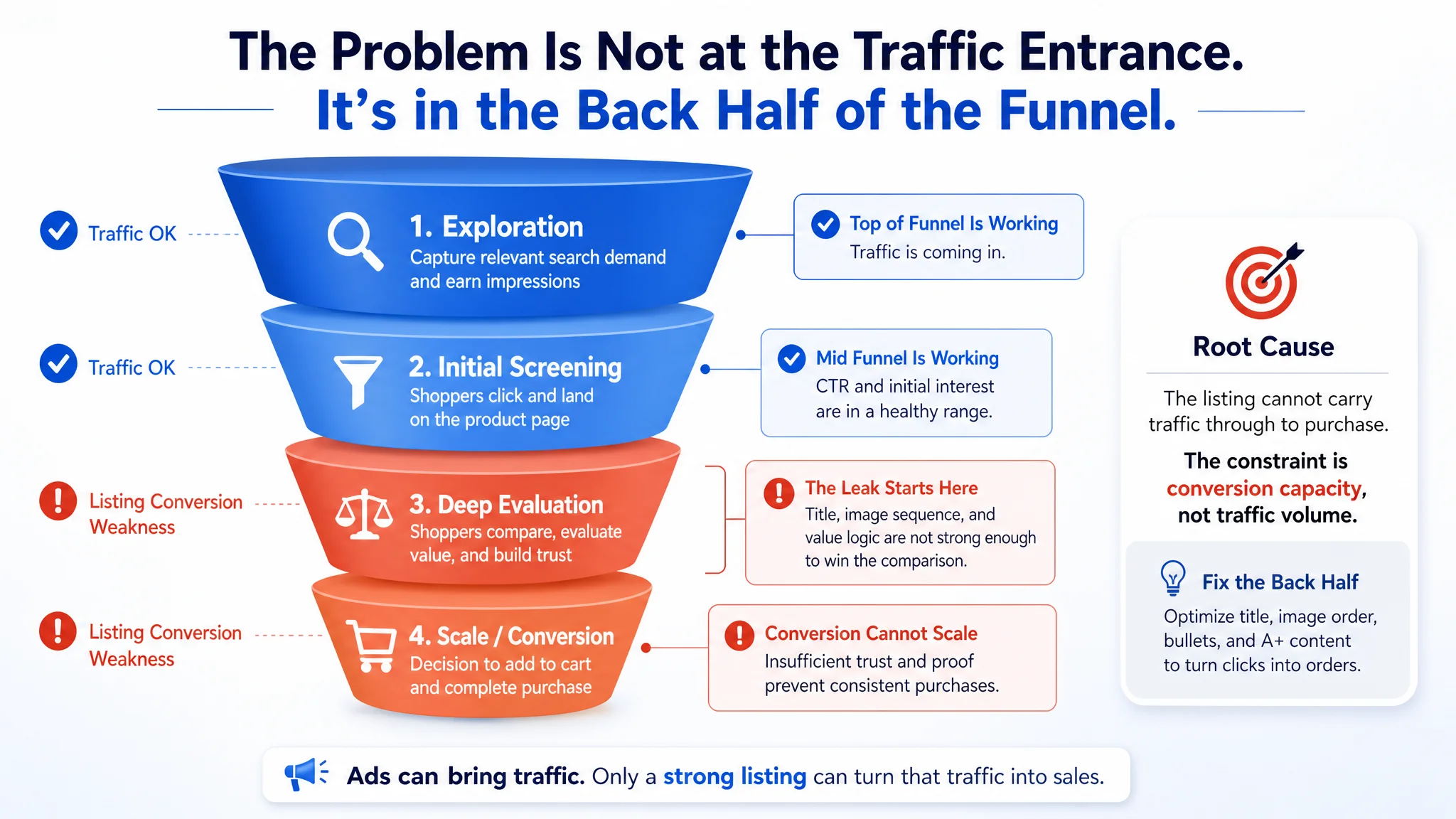
The optimization cycle is iterative: test, analyze, and adjust. Dive into your search term reports to identify high-converting "winning terms." These insights should not only refine your keyword targeting and campaign structure but also inform optimizations to your listing's title and images to improve CVR. When you implement a change, such as updating a main image, you can track the subsequent impact on CTR over the next 7-14 days to measure its effectiveness. This creates a closed-loop system where advertising data continuously fuels listing and campaign evolution. To manage this process at scale, DeepBI provides a four-layer traffic funnel model—exploration, initial screening, precision, and scaling—that offers a structured, data-driven approach to traffic acquisition.
Integrating Listing Quality and Organic Growth with Campaign Structure
Effective advertising campaigns and high-quality product listings are not independent functions; they are deeply interconnected components of a successful growth strategy. A well-optimized listing is the foundation for ad performance, directly influencing key metrics. Compelling visuals and a relevant title drive a higher Click-Through Rate (CTR), while informative bullet points and rich A+ content build trust and increase the Conversion Rate (CVR) of your paid traffic.
The fishing backpack case makes this interdependence very tangible. The seller initially assumed that a 4.6‑star rating, over 400 reviews, and complete A+ content meant the listing was “good enough”, so they kept escalating their focus on ads. DeepBI’s listing benchmark score challenged that assumption. Compared to a top competitor:
- The overall listing scored noticeably lower, with the biggest gaps in the title and main images.
- The title scored nearly half of the benchmark’s value on a 20‑point scale, because it led with the brand name and diluted the core “Fishing Tackle Backpack” intent with vague benefits.
- Main images scored slightly lower, not because they were low quality, but because their sequence didn’t match how buyers evaluate the product: comfort and real-world capacity were proven too late.
- Bullets were serviceable but overlapped in content and leaned on features rather than clear outcomes, giving lower scores than the benchmark’s tightly themed, outcome-driven bullets.
To ensure your ad spend is not wasted on a listing that can't convert, DeepBI provides an automated market health check. Its intelligent scoring system performs a multi-dimensional diagnosis of your product page, cross-validating its findings with your campaign data. For example, if ad reports show a low CTR and the system also flags a weak main image, it confirms a lack of a "visual hook." Likewise, a low CVR paired with a poor A+ content score indicates a trust deficit that must be resolved.
In the backpack case, this kind of cross-validation was critical. Ad data alone showed that ACoS remained high despite adjustments, and CVR lagged expectations. Listing diagnostics then pinpointed that the “trust issue” was not about reviews or the existence of A+, but about how the title, images, bullets, and A+ modules were ordered and framed. Once the page was rebuilt around buyer search language and decision logic—front-loading category keywords in the title, reordering images to show scenarios and comfort earlier, and turning bullets into a structured proof path—ad traffic became useful again instead of being consumed by a half-convincing page.
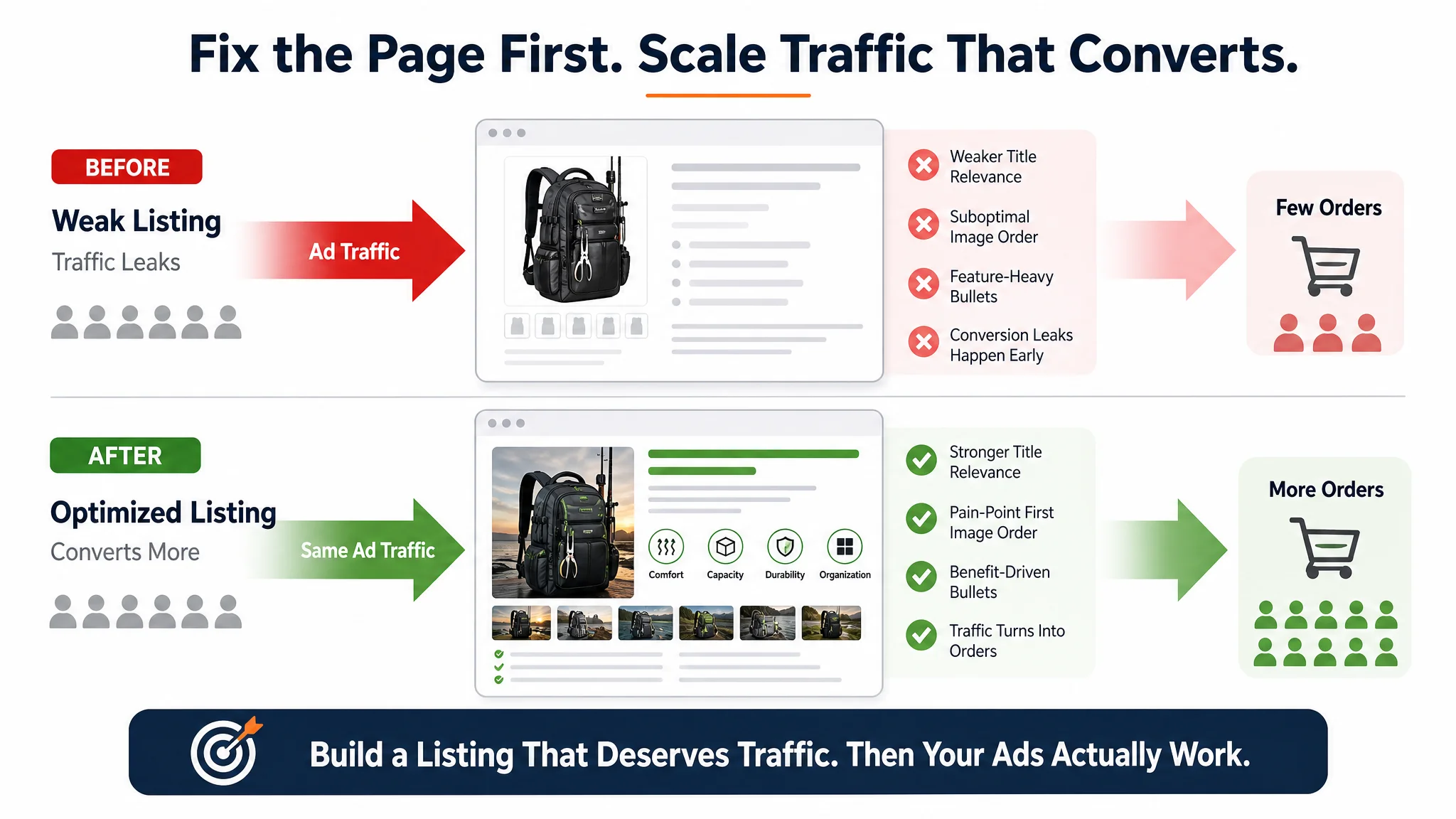
This synergy creates a powerful flywheel effect. Successful ad campaigns generate sales and signal product relevance to Amazon's algorithm, which in turn boosts organic rankings. DeepBI accelerates this cycle through its organic traffic growth strategy. By analyzing ad reports to identify high-conversion "Winning terms," it provides the data needed to launch targeted campaigns and optimize listing content. This process systematically converts advertising signals into stronger natural rankings, creating a sustainable business loop of better listings and more precise traffic for long-term growth.
Common Pitfalls and How to Avoid Them
Navigating Amazon's advertising landscape requires avoiding common mistakes that can drain budgets and suppress performance. By understanding these pitfalls, sellers can build a more resilient and profitable campaign strategy.
- Unbalanced Campaign Structures: Many sellers either create overly simplistic structures that offer no control or overly complex ones that are impossible to manage. The solution is to find a balance, segmenting campaigns logically by product line, keyword strategy, or performance goals without creating unnecessary administrative burdens.
In the fishing backpack account, the seller drifted toward complexity—more segments, more campaign types—without a clear diagnostic framework. Because the structure did not cleanly differentiate research from scaling, they read rising ACoS as a pure ad-configuration issue and kept layering on more adjustments. Only when DeepBI benchmarked the listing and found a significant gap versus a top competitor in title and image logic did it become clear that complexity in structure could not compensate for a page that wasn’t yet conversion-competitive.
- Neglecting Negative Keywords: Failing to use negative keywords is a primary source of wasted ad spend. Consistently review search term reports and add irrelevant queries as negative keywords to prevent your ads from showing to unqualified shoppers, thereby improving both Click-Through Rate (CTR) and ACoS.
- Inconsistent Match Type Strategy: A common error is applying keyword match types without a clear plan. A disciplined approach is essential: use broad match for research and discovery, phrase match for control, and exact match for targeting high-converting, proven search terms.
- Generalized ACoS Targets: Setting a single ACoS target for all products ignores variations in profit margins and strategic goals. Instead, set product-specific ACoS targets based on each item's profitability and its current lifecycle stage, whether it's a new launch requiring aggressive visibility or a mature product focused on profit.
- Misunderstanding Ad Capabilities: A frequent misconception is that only certain ad types offer specific features. For instance, both Sponsored Brands and Sponsored Display provide powerful retargeting functionalities to re-engage shoppers who have previously interacted with your products or brand.
- Ignoring Mobile Title Optimization: While Amazon's title limit is often 200 characters or more, mobile devices typically truncate titles after about 80 characters. Failing to front-load your most critical keywords and benefits can lead to a significant drop in mobile CTR.
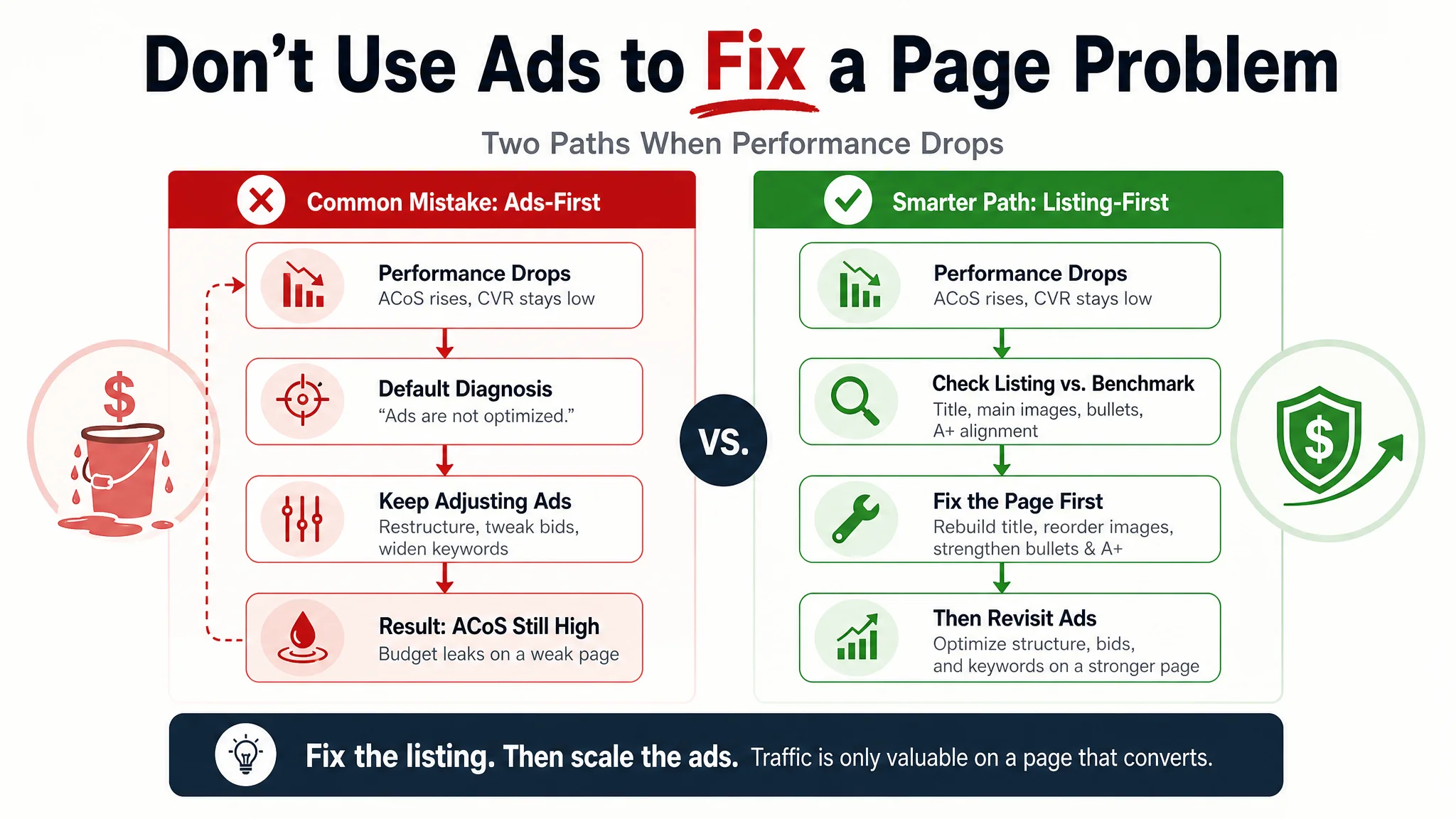
Another widespread pitfall, highlighted by the fishing backpack case, is treating ads as the default solution to any performance issue. The seller believed that their strong ratings and complete A+ meant the listing was off the hook, so they kept diagnosing rising ACoS as an ad-side problem. DeepBI’s listing score and benchmark comparison showed a different reality: the page was “respectable” but not truly competitive in that niche. The title, image order, and bullet logic all sat just below the standard set by the category leader. As a result, each extra dollar in ads was being used to fight a page-level problem. This pattern—ads-first, page-later—is one of the most expensive pitfalls on Amazon. The way to avoid it is to make listing benchmarking a routine part of your optimization process, not a last resort when campaigns feel uncontrollable.
Conclusion: The Power of a Strategic Amazon Campaign Structure
Mastering Amazon PPC requires a fundamental shift from creating ad-hoc campaigns to engineering a strategic, scalable structure. This is not merely an organizational exercise; it is the foundation for sustainable profitability and growth. A well-designed campaign architecture transforms advertising management from a series of isolated projects into a dynamic, iterative system that provides clarity, control, and actionable insights. It directly impacts your bottom line by enabling more precise budget allocation, improving ACoS, and revealing clear pathways for scaling successful strategies.
The fishing backpack listing illustrates what happens when this structural mindset is extended beyond campaigns to the product page itself. Initially, the seller treated high ratings and fully built A+ content as proof that the listing was “done” and focused all structural work on ads. DeepBI’s diagnosis—showing a measurable gap versus a benchmark in title, main images, and bullets—forced a different conclusion: the real bottleneck was the listing’s conversion capacity. Once the title was recentered on buyer search intent, images were reordered around pain points and scenarios, and bullets and A+ were turned from feature lists into a coherent proof path, the same ad structure started to work very differently. Traffic that previously hit an invisible ceiling now had a page capable of converting at a level closer to the category leader.
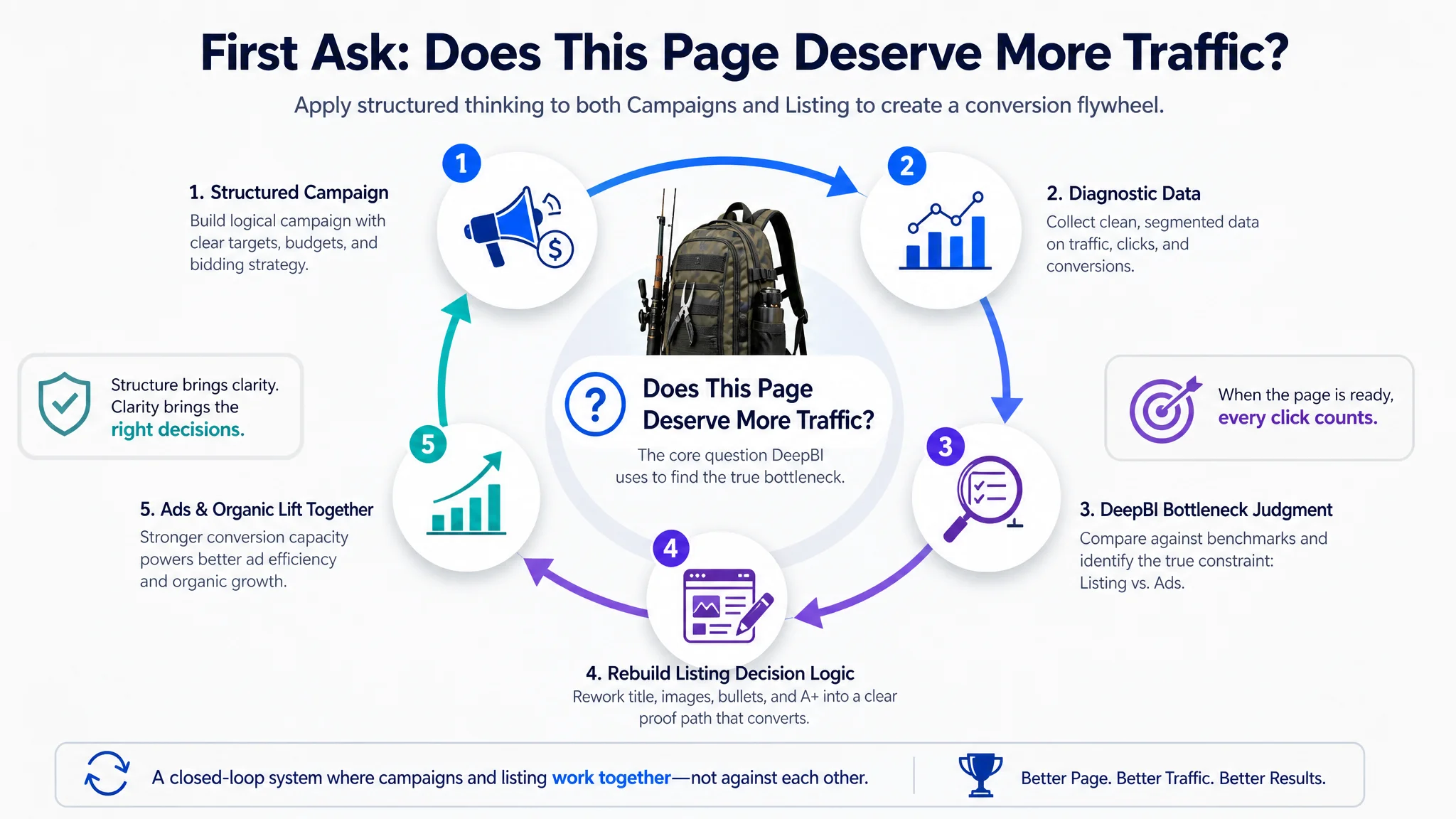
This systematic approach bridges the critical gap between performance analysis and tactical execution. It elevates your strategy from subjective guesswork to a quantifiable science, where every adjustment is measured against its impact on core KPIs like CTR and CVR. By building this robust framework—and by being willing to ask, as DeepBI did in this case, whether your page truly deserves more traffic—you create a powerful feedback loop where market data continuously informs optimization. This ensures your advertising efforts are not just active, but are actively evolving to lock in a winning advantage in Amazon's competitive marketplace.