

The Foundation: Understanding Amazon's Fulfillment Ecosystem
Amazon's logistics network is the backbone of its e-commerce dominance, a colossal ecosystem built on massive investment and operational precision. For sellers, tapping into this network through Fulfillment by Amazon (FBA) is a strategic imperative, not just a convenience. FBA outsources the entire post-order process—from warehousing and inventory management to picking, packing, shipping, and even customer service and returns. This allows sellers to offer the Prime badge and promise the rapid delivery that customers have come to expect.
However, simply enrolling in FBA is not enough. The value of fast, reliable fulfillment must be effectively communicated on your product detail page to influence customer decisions. This is where data-driven listing optimization becomes critical. An optimized listing clearly signals Prime eligibility and fast shipping times, directly impacting key performance indicators.
This point becomes very concrete when you look at how sellers often misread where their real bottleneck is. One home-organization brand selling a plastic pegboard kit on Amazon US was convinced their main issue was advertising. On paper, their listing looked strong: over 1,600 reviews at 4.3 stars and a total listing score not far behind a benchmark competitor. Because social proof and basic content looked “good enough,” the team assumed rising ACOS and disappointing order volume were primarily a matter of bids, keyword sets, and campaign structure. They spent cycles tweaking ads, but performance barely moved.
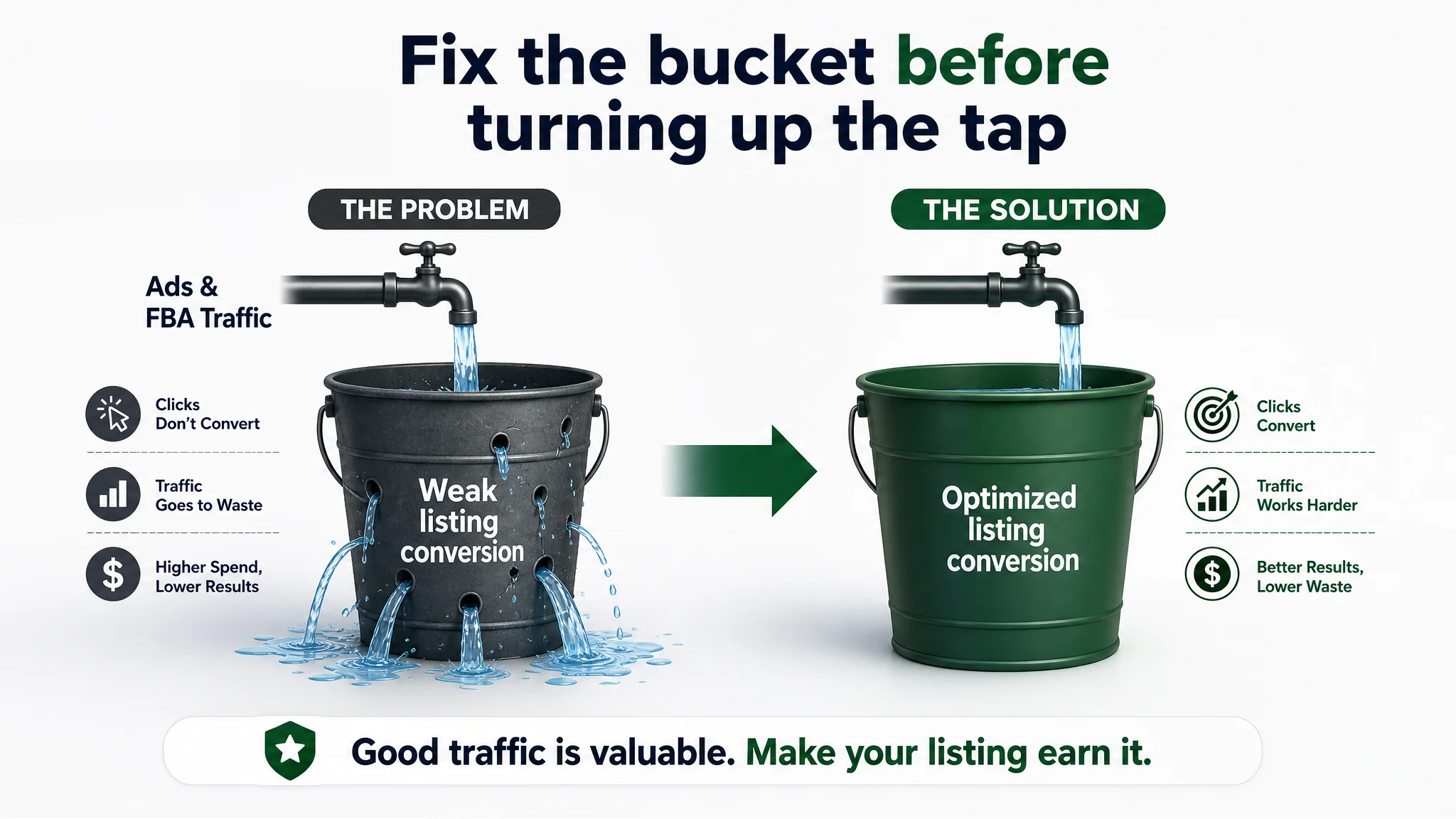
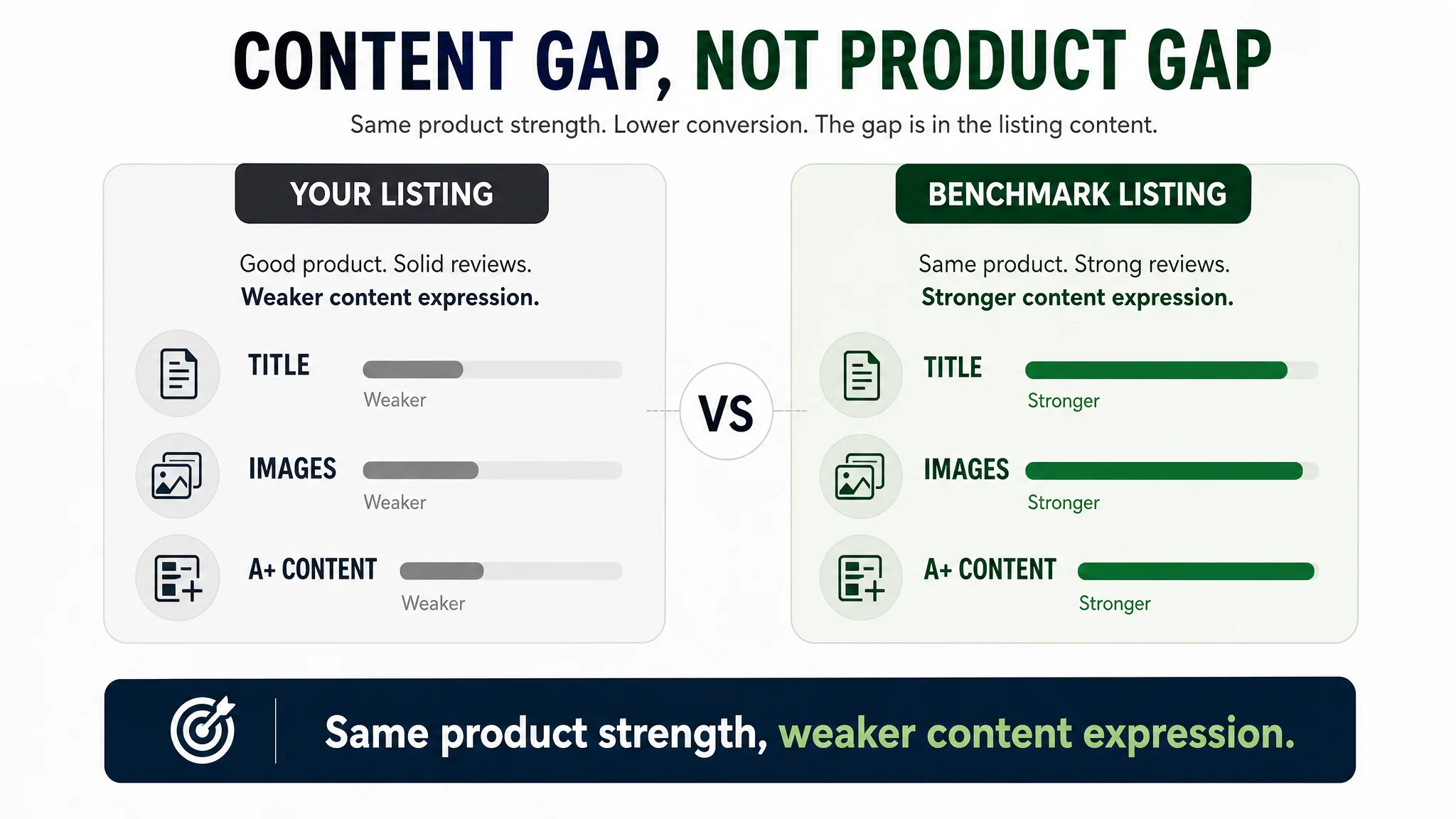
When that listing was put through DeepBI’s diagnostic workflow and benchmarked against a high-performing competitor, a different picture emerged. The ads were doing their job bringing traffic, but the product page was under-converting relative to the category leader—especially for high-intent gaming and workspace shoppers. The issue was not “no traffic”; it was that the page wasn’t translating Amazon’s fulfillment and service advantages into a compelling, trustworthy buying experience. The narrative and visual structure lingered at “what it is and where you can use it,” while the competitor took the shopper all the way from “why I need this” to “this is worth buying now,” including clear signals of fast, reliable delivery.
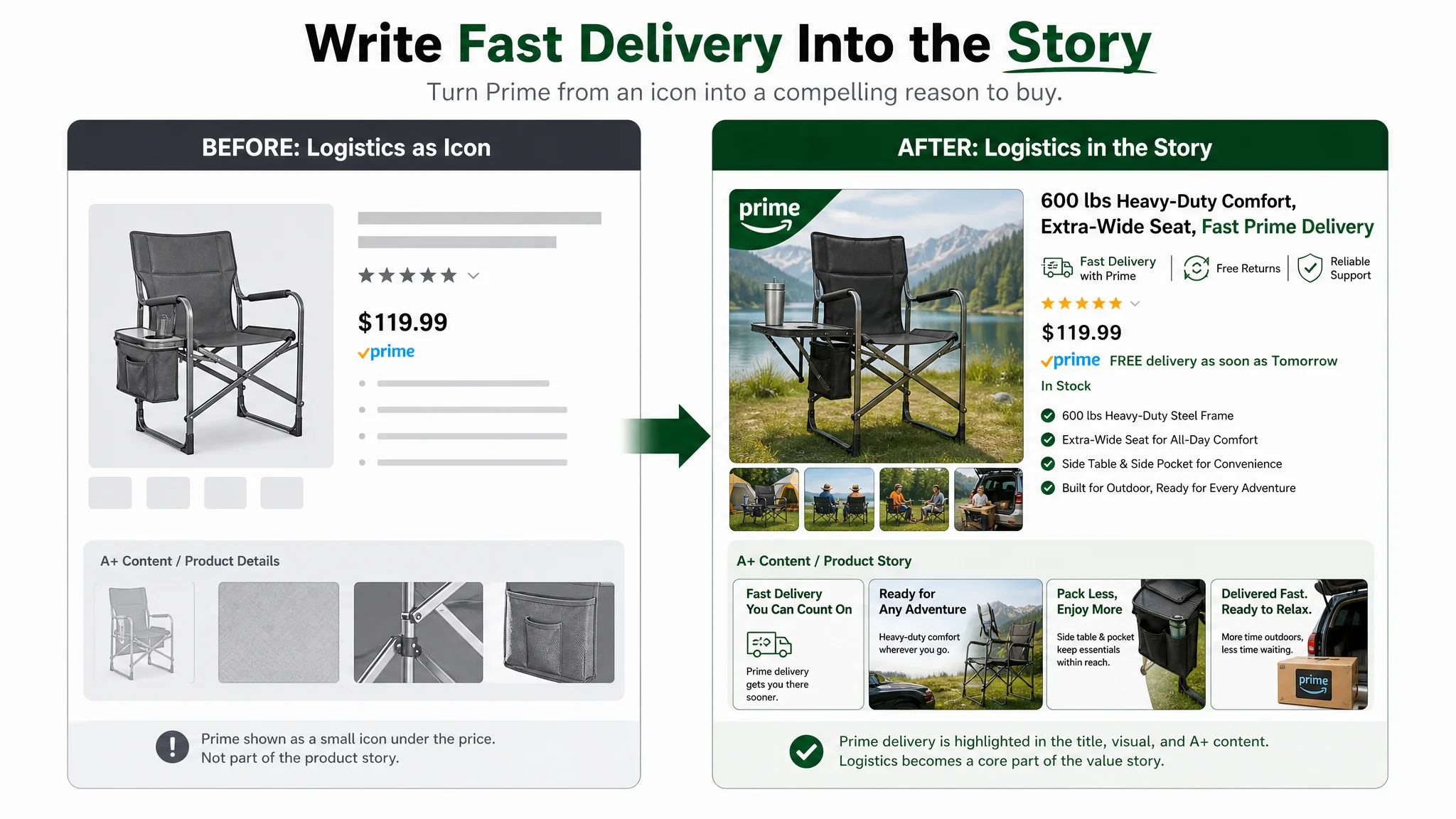
Tools like DeepBI analyze your business data to ensure that every element of your listing is engineered to translate these fulfillment advantages into a higher Click-Through Rate (CTR) from search results and a stronger Conversion Rate (CVR) on the product page. In the pegboard case, this meant reorganizing titles, main images, bullets, and A+ content so that Prime eligibility, trust, and ease of ownership were obvious at a glance. By aligning your marketing message with Amazon's operational strength, you transform a logistical advantage into measurable sales growth, rather than letting that advantage get “consumed” by a weak page.
Strategic Advantages: How FBA Fuels Seller Growth
Leveraging Fulfillment by Amazon (FBA) allows sellers to integrate their business with a world-class logistics network, transforming fulfillment from an operational burden into a strategic growth driver. By outsourcing storage, packing, shipping, and customer service to Amazon, sellers reclaim critical time and resources. This shift enables a sharper focus on core business activities like product innovation, brand building, and marketing—a strategy successfully used by brands like Hope & Henry to scale their operations.
One of the most significant benefits is gaining the Prime badge, which grants access to Amazon's most loyal and engaged customers. The promise of fast, reliable Prime delivery is a powerful tool for building buyer trust and enhancing the customer experience. This reliability, demonstrated by sellers such as Kahili Creations, fosters the brand loyalty that leads to repeat purchases. Operationally, FBA provides the infrastructure to scale seamlessly, handling seasonal peaks and rapid growth without the need for heavy investment in warehousing. Furthermore, FBA can provide significant cost efficiencies. While results vary, Amazon FBA can offer competitive shipping rates, in some cases up to 70% lower than other major US carriers under specific conditions. Sellers should consult detailed studies or use Amazon's fee calculators for precise estimates.
In practice, though, many teams discover that simply having Prime and fast delivery isn’t automatically reflected in their numbers if the listing doesn’t help customers recognize that value. In the pegboard example, both the target listing and its competitor benefited from Amazon’s logistics and could legitimately offer fast, dependable fulfillment. Yet the competitor tied that reliability into its positioning much more tightly: visuals and copy framed the product as a robust, “revamp your space” system built for valuable gaming setups, with clear depictions of what you receive and how securely it mounts. The target listing, while also FBA-based, came across as a generic organizer with less emphasis on protection of high-value gear or ease of installation. The result was that the same underlying FBA reliability translated into stronger perceived value and higher conversion for the competitor.
This kind of gap shows why using FBA is only the first step. To truly let FBA fuel growth, your content has to make that fulfillment advantage part of a broader story about trust, convenience, and lifestyle fit. Otherwise, you risk the situation seen in this case: logistics are strong, ad traffic is adequate, but your listing still leaves money on the table compared to a well-positioned rival drawing on the same FBA network.
Navigating FBA Fees and Optimizing Costs
Effectively managing Fulfillment by Amazon (FBA) fees is a critical lever for maximizing profitability. These costs are not a single line item but a combination of fulfillment, referral, and storage fees, with the latter escalating into significant long-term storage penalties for slow-moving inventory. Failing to control these expenses directly erodes your margins and can make even high-volume products unprofitable.
The core challenge lies in balancing inventory levels. Overstocking leads to costly monthly and long-term storage fees that eat into your capital. Conversely, understocking results in lost sales, damages your sales velocity, and can permanently harm your Best Sellers Rank (BSR), making it harder to regain search visibility. Both scenarios represent a direct business loss stemming from reactive, rather than proactive, inventory planning.
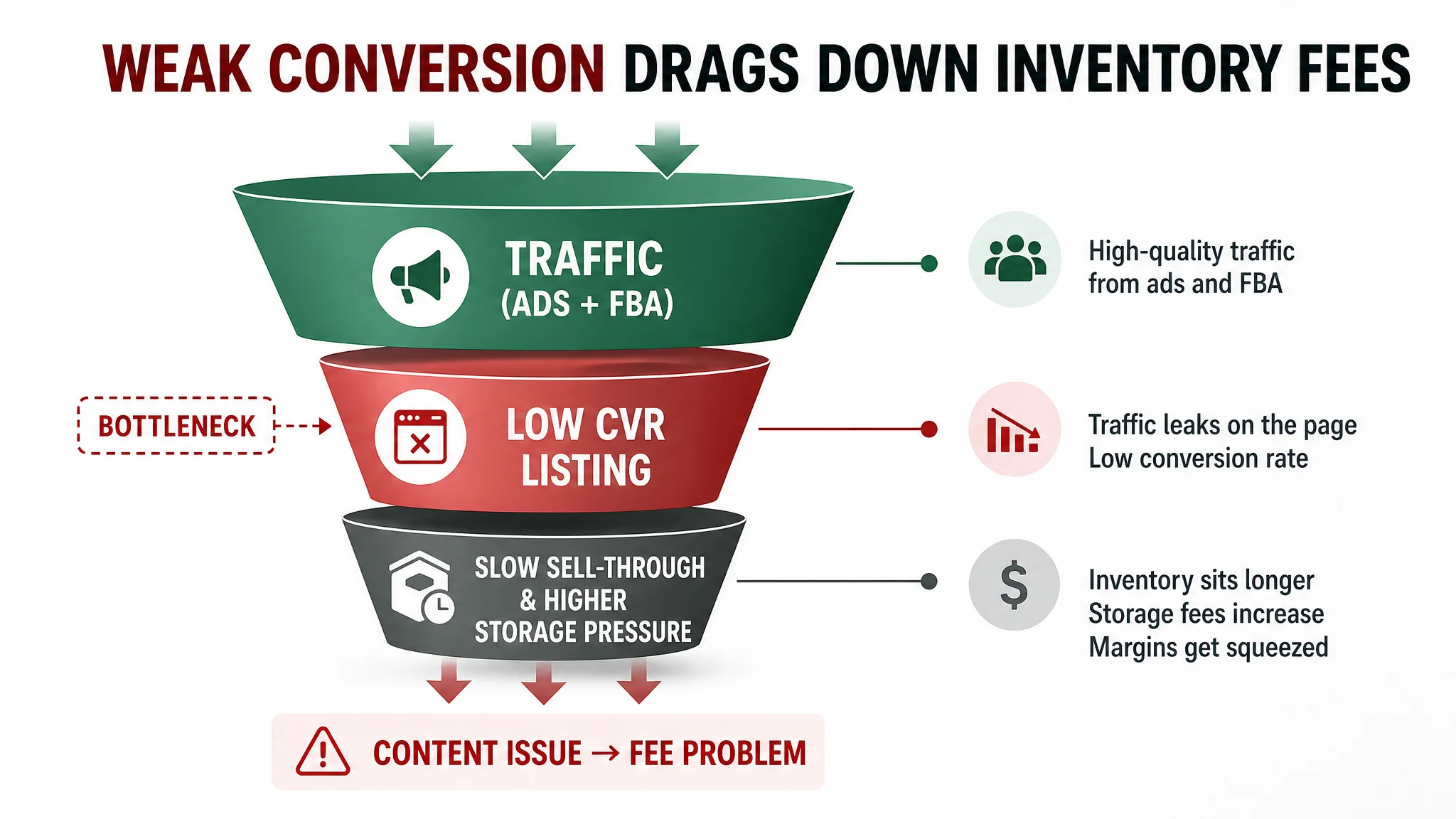
Where many sellers go wrong is treating fees as a purely “logistics-side” issue and ignoring how listing quality impacts the speed at which inventory turns. In the pegboard case, for instance, the brand had significant review volume and steady traffic from ads but was under-converting relative to the benchmark listing. Every click that didn’t convert meant slower sell-through, which, at scale, feeds into the risk of longer storage durations and less efficient use of FBA capacity. The seller initially tried to fix profitability by fine-tuning campaigns—hoping better ads would drive the volumes needed to offset rising ACOS and fee pressure—without questioning whether the product page itself was limiting conversion.
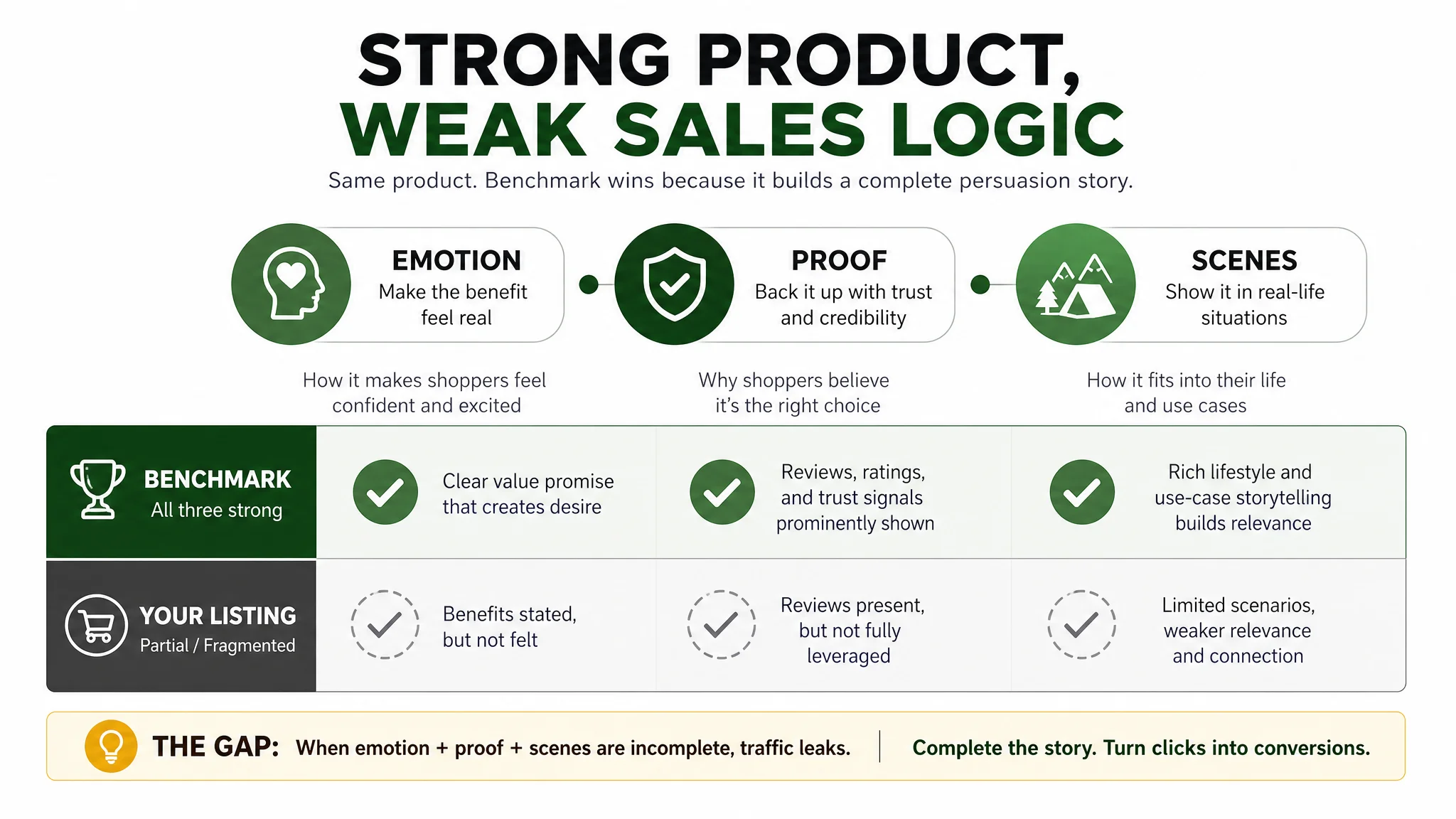
When DeepBI’s analysis showed that main images, bullets, and A+ content weren’t building a complete decision path, the optimization focus shifted. The goal became to lift CVR so that each unit spent less time in storage and each ad dollar produced more revenue. This is exactly where listing optimization and fee management intersect: a page that converts at or above category benchmarks turns inventory faster, which directly improves your effective cost per unit, including storage.
To transform FBA fees from a liability into a manageable cost, sellers should implement several key strategies:
- Optimize Inventory Levels: Use sales data and forecasting tools to maintain just-in-time inventory, avoiding the financial penalties of both overstocking and stockouts. Benchmarking your conversion rate against top competitors helps you forecast more realistically; if your CVR is lower than you assume, your inventory will sit longer and cost more.
- Master Dimensional Weight: Fulfillment fees are often calculated based on dimensional weight (DIM), not just actual weight. Reduce packaging size and eliminate empty space to lower per-unit shipping costs.
- Design for FBA Size Tiers: Be mindful of Amazon's product size tiers during product development and packaging design. A few millimeters can push a product into a more expensive tier, drastically increasing fulfillment costs.
- Stay Ahead of Fee Changes: Regularly review Amazon's fee structure, including Amazon's recent fulfillment fee adjustments set to take effect in early [current or next year, e.g., 2024 or 2025], to adjust your pricing and cost models accordingly.
In other words, managing FBA fees isn’t just about back-end spreadsheets; it’s also about front-end conversion quality. A listing that “consumes traffic” without converting doesn’t just hurt ACOS—it silently worsens your unit economics inside FBA.
Best Practices for Inventory Management and Fulfillment Efficiency
Effective inventory management is the operational backbone of any successful FBA business, directly impacting profitability by preventing lost sales from stockouts and minimizing fees from overstocking. Mastering this requires a multi-faceted approach, drawing inspiration from Amazon's own highly efficient warehouse systems that utilize robotics and dynamic slotting to achieve massive scale.
For sellers, best practices begin with strategic inventory planning and demand forecasting to maintain optimal stock levels. This must be paired with meticulous product preparation and labeling to ensure compliance and prevent costly inbound delays at fulfillment centers. Furthermore, leveraging Amazon's distributed network through smart inbound shipping plans can place your products closer to customers, reducing delivery times and improving the buyer experience.
What often gets overlooked is that inventory and listing health are deeply connected. A stockout can severely damage the search visibility and BSR of any listing, but the negative impact is often exacerbated for listings that are already poorly optimized. In the pegboard case, the listing had enough reviews and traffic to suggest “healthy demand,” yet its conversion lagged behind the category leader because the page stopped at functional description and did not fully address buyer anxieties such as installation clarity, stability for expensive gear, or what exactly came in the kit. If such a listing goes out of stock, the recovery is harder: once the algorithm sees weak conversion and interrupted availability, the page has little “buffer” in the form of strong engagement metrics to support a quick rebound.
Tools like DeepBI can perform an Intelligent Scoring and Diagnosis to identify underlying weaknesses in your listing's content. In the pegboard example, this diagnosis broke the listing down into components—title, main images, bullets, A+ content, reviews—and scored each relative to the competitor. On the surface, the scores looked close: the target listing slightly ahead on reviews, almost tied on main images, and modestly behind on bullets and A+. But the structural comparison revealed that the competitor’s page formed a complete decision chain (pain → solution → proof → versatility → trust), whereas the target listing offered a scattered feature list.
By using the Competitor Benchmark feature to analyze the top-performing listings in your category, you can understand the standard of quality required to compete effectively. For the pegboard seller, this meant reworking visuals to anchor more clearly around gaming and “revamped space” setups, reshaping bullets into a narrative that started with clutter pain and ended with emotional and gifting value, and reorganizing A+ content to show installation steps and multi-scene usage in a more reassuring way. Ensuring your listing is fully optimized creates resilience, helping it maintain rank better during inventory fluctuations and fully capitalize on sales velocity when stock is available. A strong listing gives you more room for error in inventory planning because when you are in stock, you maximize every visit.
Leveraging DeepBI for Enhanced Logistics and Performance
An efficient logistics network is a powerful competitive advantage on Amazon, but its value is lost if not effectively communicated to customers. DeepBI bridges this gap by transforming your operational strengths into a core commercial engine that drives higher Click-Through Rates (CTR) and Conversion Rates (CVR). The platform moves beyond subjective creative choices, generating precise, data-driven optimization strategies for your listings.
The pegboard case illustrates how this works in real life. From the seller’s perspective, the listing was already “polished”: a detailed title, broad scene coverage in images, a large volume of reviews, and some trust elements like media mentions. Yet when DeepBI scored the page and placed it side by side with the benchmark listing, the core issue emerged: the narrative and visual flow were weaker. The competitor’s title led with a promise to “revamp” the space; its main images foregrounded high-value gaming gear in crisp, symmetric setups; its bullets walked through pain, solution, proof, and emotional value; and its A+ content covered the full decision chain, including easy-to-understand installation visuals and clear “what you get” layouts.
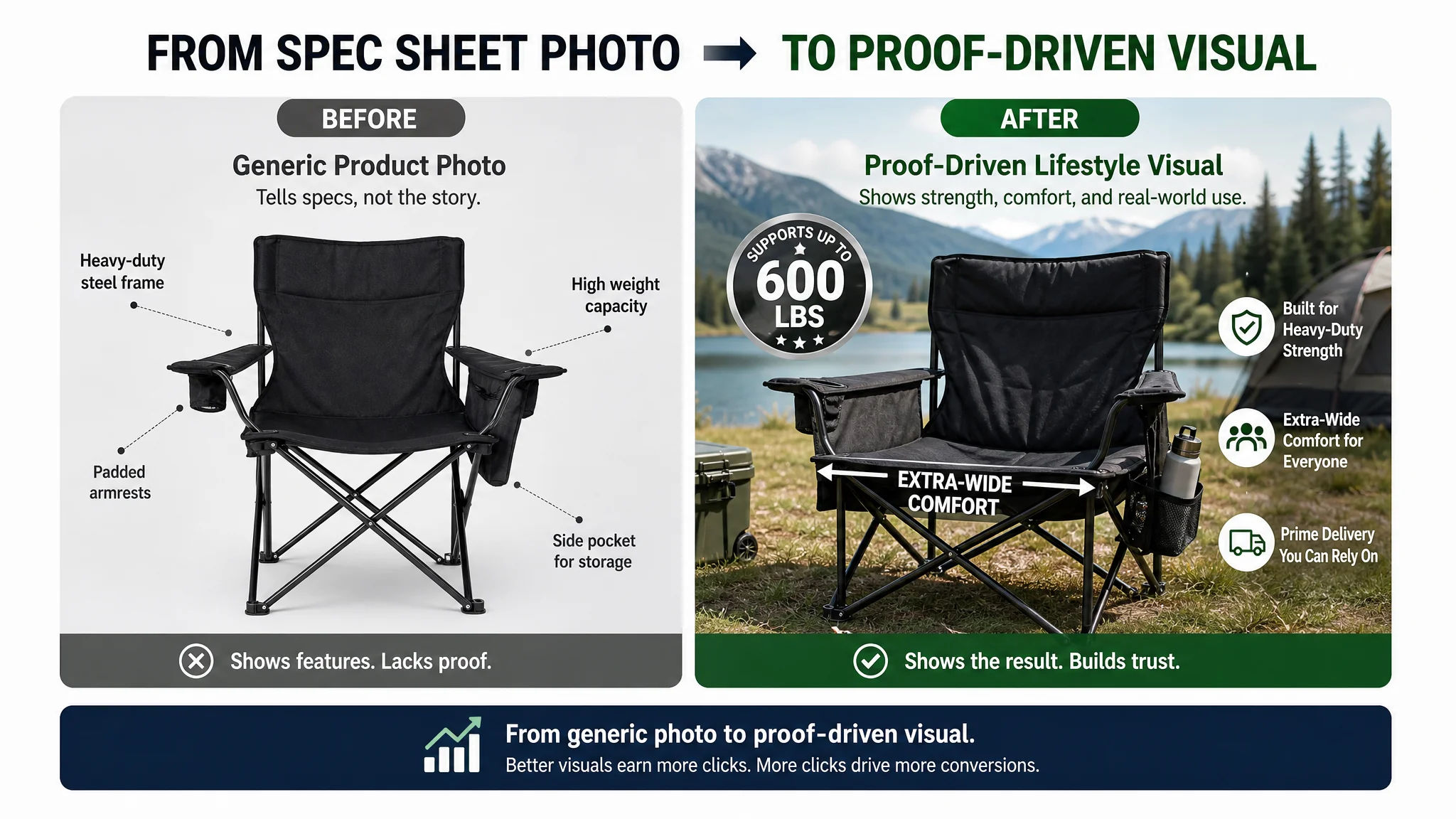
DeepBI’s AI-powered content creation tools build compelling main images, A+ content, titles, and bullet points designed to highlight product value and fast fulfillment promises like Prime eligibility. In the pegboard scenario, that meant proposing a main image that clearly signaled gaming readiness and modular expansion, producing bullets that explicitly mentioned load capacity, dual mounting options, and giftability, and structuring A+ content to answer the key question buyers had: “Will this safely hold my gear, and how hard is it to mount?”
To mitigate the risks of AI-generated content, the system operates under a strict "Product DNA" constraint, ensuring all visuals are authentic to the physical product and preventing mismatches that lead to negative reviews. Once optimized, this content can be deployed instantly using a one-click application via the Amazon SP-API, reducing a process that once took minutes to mere seconds. For the pegboard seller, this meant they could quickly implement a revised visual and copy framework that better supported Amazon’s strong logistics promises, rather than waiting through slow, manual iterations.
This integration creates a powerful feedback loop between advertising and organic growth. DeepBI’s keyword filtering identifies high-conversion search terms from your successful ad campaigns. By optimizing your listing for these terms, you leverage your strong logistics to improve CVR, which in turn helps boost organic rankings. In the pegboard case, this meant capitalizing on keywords around “gaming setup,” “desk organization,” and “modular storage,” and then ensuring that the page visitors landed on fully reflected the expectations created by those search terms. This creates a dual growth effect where advertising success directly feeds long-term organic visibility. Furthermore, as superior logistics improve your baseline conversion rate, DeepBI's dynamic parameter adjustment for ad bids and budgets becomes even more effective, driving down ACoS and maximizing your return on ad spend. Crucially, ad spend is no longer trying to compensate for an underperforming listing; it is amplifying a page that truly “deserves the traffic.”
Beyond FBA: Complementary Fulfillment Strategies
While Fulfillment by Amazon (FBA) is a powerful tool, a diversified logistics strategy can provide greater flexibility and control. Successful sellers often complement FBA with other models, such as using a Third-Party Logistics (3PL) provider or managing their own fulfillment (Fulfillment by Merchant, FBM). The key to success outside of FBA is not abandoning its core tenets but applying them rigorously to these alternative channels.
The same principles of operational excellence—speed, accuracy, and customer-centricity—that define FBA are critical for any fulfillment method. A specialized 3PL, for instance, can act as a strategic partner, offering deep expertise in navigating Amazon's complex ecosystem. They can manage multi-channel inventory, prevent stockouts through strategic planning, and ensure that products meet the demanding Prime delivery standards, thereby protecting your seller metrics.
The pegboard case highlights another dimension: regardless of whether you use FBA, 3PL, or FBM, your fulfillment strength has to be matched by a product page that reduces friction and builds trust. In that case, even with FBA’s backing, shoppers hesitated because the listing didn’t make installation simplicity, sturdiness, or kit contents visually obvious. If a seller were to move a similar product to an FBM or 3PL setup without fixing these on-page issues, they would face the same conversion constraints—just with more operational complexity.
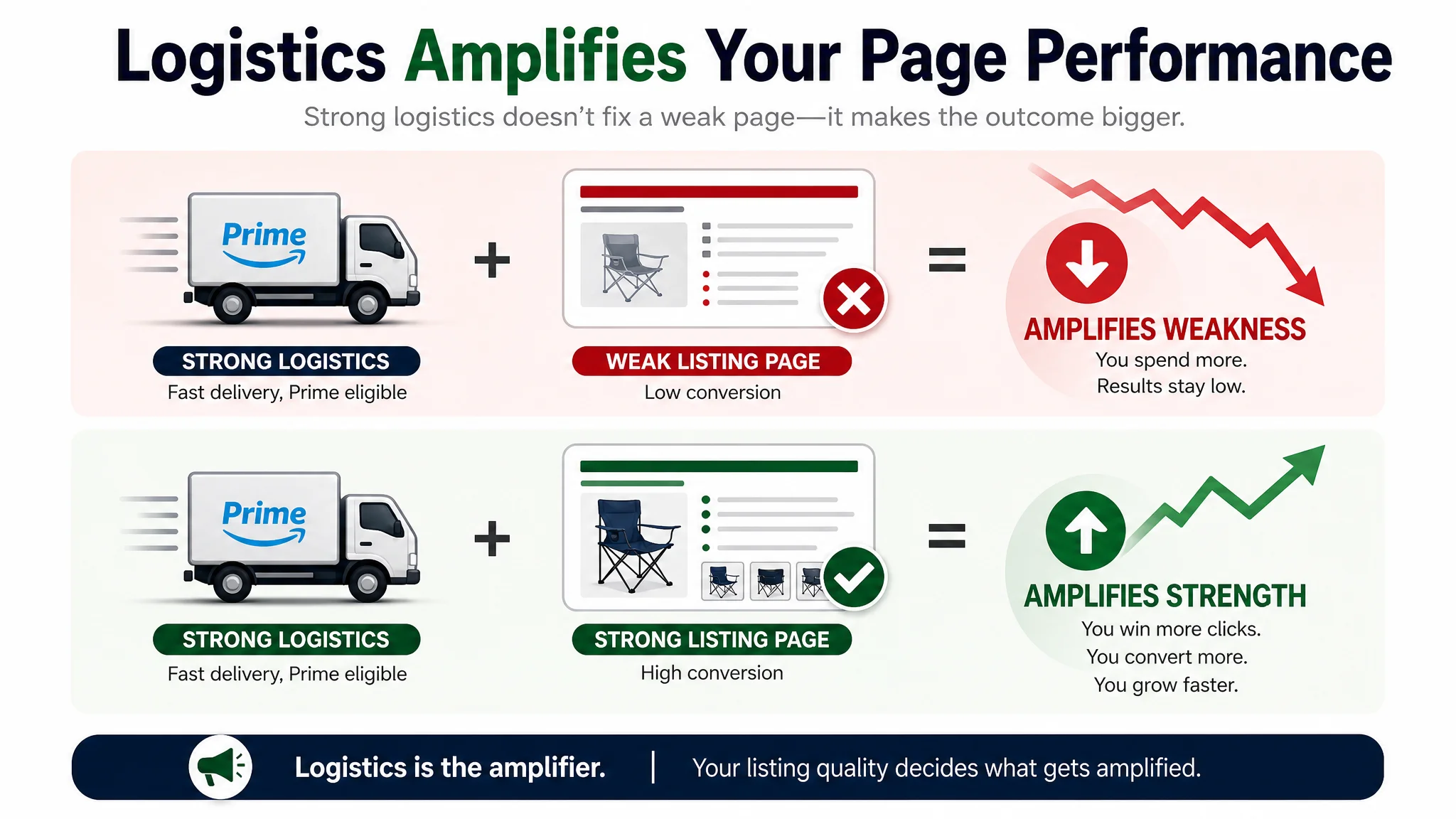
For sellers who manage their own warehouses, implementing a robust Warehouse Management System (WMS) is essential. A WMS allows you to adopt Amazon-inspired best practices for inventory tracking, order processing, and picking and packing efficiency within your own operations. By instilling this discipline, you can build a resilient and scalable fulfillment network that leverages the best of FBA while retaining direct control over key aspects of your supply chain. But as the pegboard example shows, operational rigor must be paired with equally rigorous listing optimization; otherwise, your logistics investments won’t fully translate into sales.
Seller Success Stories: Realizing the Potential
The true power of Amazon's logistics network is best seen through the growth of the sellers who leverage it. Businesses of all sizes are discovering that offloading fulfillment complexities is a direct path to scaling their operations and enhancing customer satisfaction. By entrusting storage, packing, shipping, and customer service to Amazon, sellers can reclaim invaluable time and resources.
A prime example is the spice company USimplySeason. By adopting Fulfillment by Amazon (FBA), they were able to move beyond the daily grind of managing inventory and shipping orders. This strategic shift allowed them to concentrate their efforts on their core competencies: sourcing high-quality ingredients, innovating new product blends, and building their brand. Instead of being constrained by logistical hurdles, they were free to focus on the activities that fueled their expansion.
The pegboard seller’s experience, while coming from a different category, reinforces the same underlying lesson from a different angle. Their challenge was not the absence of FBA—fulfillment and review volume were both in place—but a misalignment between their confidence in the listing and how buyers actually made decisions on the page. Their initial instinct was to “fix ads,” assuming logistics and content were already solid. Only after a structured diagnosis did they recognize that their FBA-backed logistics advantage was being underutilized because the page didn’t fully capitalize on it: the story stopped at functionality, and critical decision points like installation ease and outcome visualization were weaker than the competitor’s.
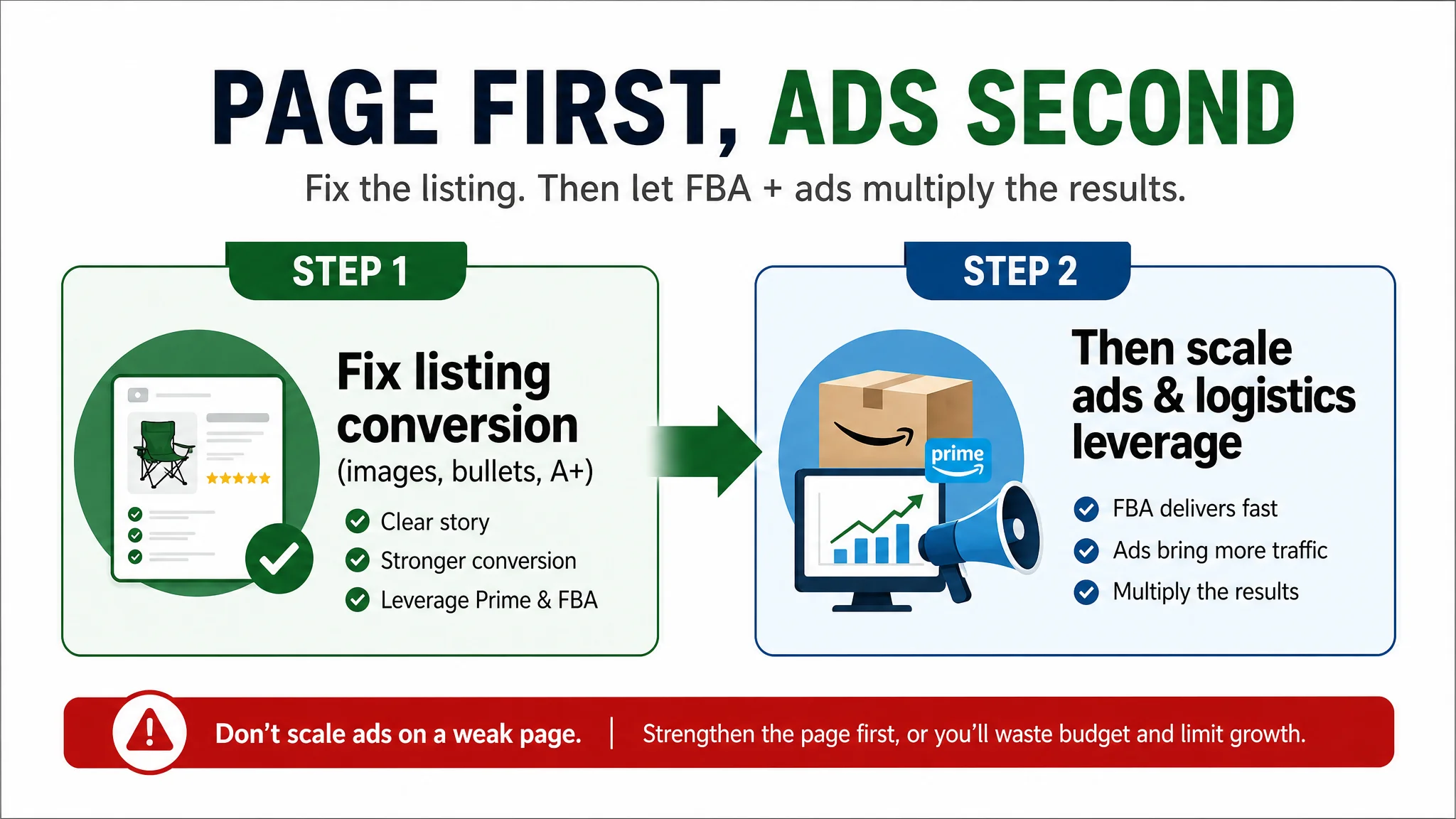
This story is not unique. Across countless categories, sellers find that integrating with Amazon's logistics frees them to act as business owners rather than warehouse managers. The result is a powerful flywheel effect: improved delivery speeds and service lead to happier customers and better reviews, which in turn drives visibility and sales, allowing for even greater investment in product and brand development. But as the pegboard case demonstrates, that flywheel spins fastest when you simultaneously invest in the quality of your listing. FBA and strong logistics set the stage; a data-driven, competitively benchmarked product page turns that operational strength into realized growth.
The Evolving Landscape: Future Trends in Amazon Logistics
Amazon's logistics network is in a state of continuous evolution, driven by the dual goals of enhancing customer satisfaction and operational efficiency. A primary strategic shift is the regionalization of its fulfillment network, designed to position products closer to the end consumer. This initiative has already yielded significant results, with the percentage of orders fulfilled from within a customer's region increasing from 62% to 76%. For sellers, this translates directly into faster delivery speeds, which can improve conversion rates, and reduced last-mile transportation costs, potentially lowering FBA fees over time.
Beyond regionalization, two other key trends are shaping the future of Amazon logistics. First, the integration of advanced technology, including AI and robotics, continues to accelerate fulfillment processes, from inventory sorting to package handling. This automation aims to reduce errors and shorten the time from click to delivery. Second, there is a growing emphasis on sustainability. Amazon is actively working to optimize delivery routes and reduce packaging waste, aligning its massive logistics operations with broader environmental goals. While these large-scale changes introduce complexities, they signal a clear direction toward a faster, more cost-effective, and sustainable fulfillment ecosystem for sellers.
For brands, the pegboard case is a reminder that as logistics capabilities become more advanced and more evenly available across sellers, differentiation will increasingly come from how well you translate those capabilities into on-page trust and clarity. When delivery is fast for everyone, the listings that most effectively show “why this product, why now” will capture the incremental gains from logistics evolution. Sellers who rely on logistics alone, without continuously refining their product pages based on benchmarking and structured diagnosis, may find that they benefit less from these macro improvements than competitors who do both.
Conclusion: Mastering Your Amazon Logistics Strategy
Successfully navigating Amazon's vast logistics network is not a one-time setup but a continuous strategic endeavor. The opportunities for growth are immense, but they are directly tied to your ability to adapt, refine, and optimize every facet of your fulfillment process. From selecting the right inventory placement program to managing returns efficiently, each decision impacts your profitability, customer satisfaction, and ultimately, your Best Seller Rank (BSR). The key to sustained success lies in moving beyond reactive problem-solving to proactive, data-driven management.
The pegboard listing story encapsulates this mindset on the commercial side. The seller began with a reactive approach—repeatedly adjusting ads in response to stubborn ACOS—while assuming that logistics and listing quality were fixed assets. Only when they stepped back and used DeepBI to benchmark their page against a category leader did the real constraint become visible: conversion capacity, not traffic volume. Once they rebuilt their title, main images, bullets, and A+ content around a coherent decision path, every subsequent logistics and advertising decision produced better returns.
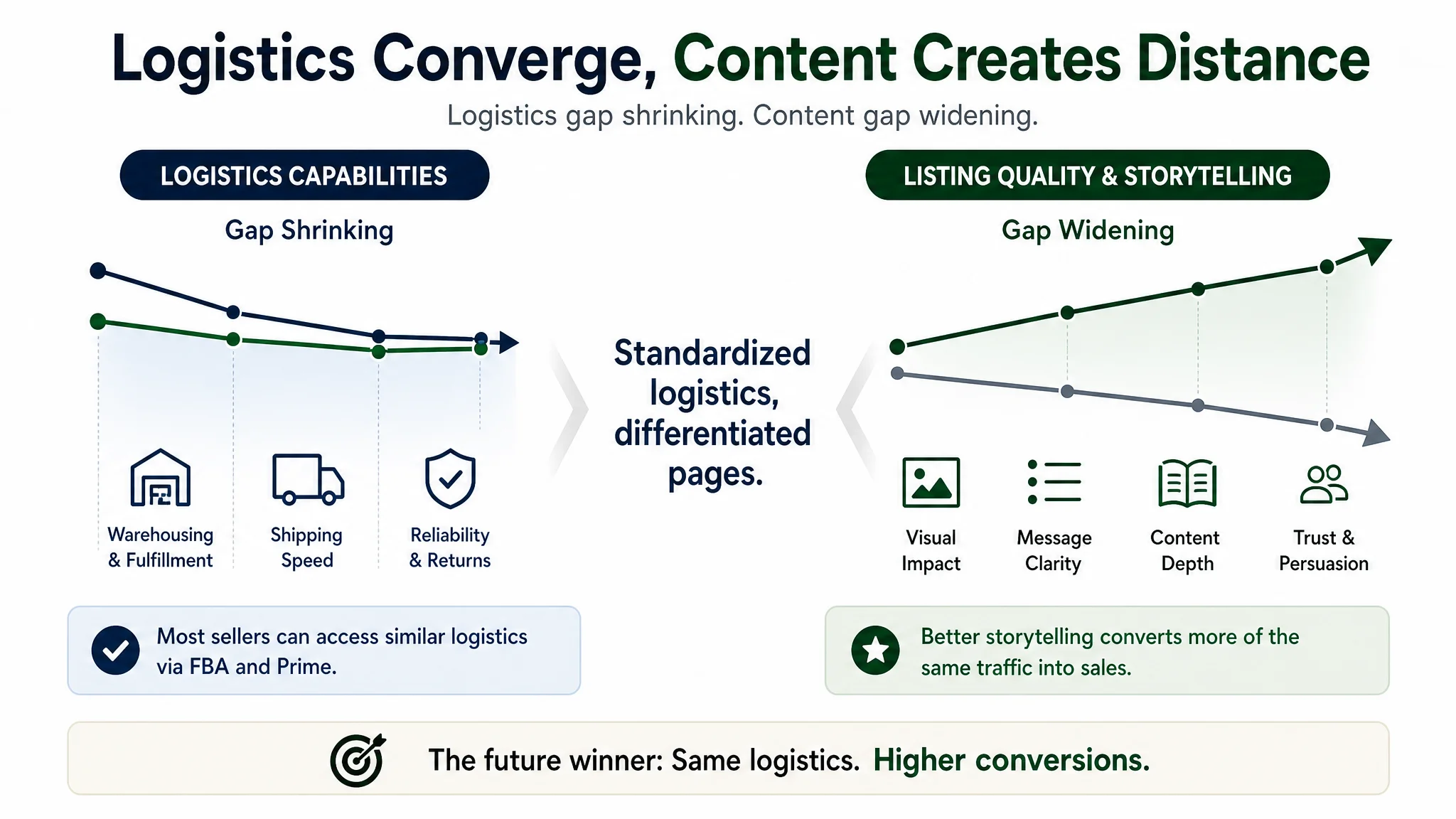
This principle of continuous improvement extends across your entire Amazon operation. Just as logistics demand precision, so does the optimization of your digital storefront. The most competitive sellers now treat listing management not as a creative exercise but as a scientific process. Tools like DeepBI exemplify this shift, transforming complex operational decisions into a standardized, engineered path. By integrating diagnosis, strategy, and execution, such systems turn subjective guesswork into a predictable, quantifiable method for improving vital KPIs like Click-Through Rate (CTR) and Conversion Rate (CVR). Whether in the warehouse or on the product page, a commitment to a data-first, systems-oriented approach is what separates fleeting success from long-term market leadership.
Continuous optimization remains essential because Amazon rankings, shopper expectations, and competitive pressure keep changing. As the pegboard case shows, the sellers who thrive are those who routinely question their assumptions, measure themselves against the real category benchmark, and ensure that their logistics advantages are fully reflected in the way their listings tell the product story.
Frequently Asked Questions (FAQs)
What is Fulfillment by Amazon (FBA)?
Fulfillment by Amazon (FBA) is a service where sellers send products to Amazon's fulfillment centers. Amazon then handles storage, packing, shipping, customer service, and returns for those orders, allowing sellers to leverage its global logistics network.
How do FBA fees work and how can they be managed?
FBA fees are based on product size, weight, and storage duration. They can be managed by optimizing packaging and ensuring high inventory turnover to avoid costly long-term storage penalties. If your listing under-converts, as in the pegboard case, your inventory will move slowly and fees will be harder to absorb, so improving conversion is part of managing costs.
What are the primary benefits of using FBA for my business?
The main benefits are gaining Prime eligibility for your products, which boosts visibility and sales, and outsourcing complex logistics and customer service operations to Amazon. These benefits are maximized when your product page clearly communicates fast, reliable delivery and uses that reliability to support a strong value proposition.
How can I optimize my FBA inventory to avoid common pitfalls?
Optimize inventory by forecasting demand accurately to prevent overstocking. Monitor your Inventory Performance Index (IPI) score and proactively manage slow-moving products to avoid long-term storage fees. If ad spend is high but ACOS and CVR don’t improve as expected, consider whether, like the pegboard seller, you have a listing conversion issue that is slowing inventory turnover.
How does DeepBI specifically help Amazon sellers overcome logistics-related challenges and improve performance?
DeepBI improves sales velocity, a key factor in logistics efficiency. By optimizing your listings to boost CTR and CVR, it increases sales turnover, helping you avoid long-term storage fees and improve inventory health. In cases like the pegboard listing, DeepBI’s scoring and competitor benchmarking reveal whether your real bottleneck is not logistics or ads but the product page’s ability to convert traffic, allowing you to fix the root cause before scaling spend.