

The Foundation: Setting Clear Goals and Understanding Key Metrics
Effective advertising on Amazon begins not with bidding, but with clear, strategic objectives. Without a defined goal, it is impossible to measure success or allocate your budget effectively. Your campaign strategy will differ significantly depending on whether you aim to maximize revenue, launch a new product to capture market share, improve overall profitability, or build long-term brand awareness.
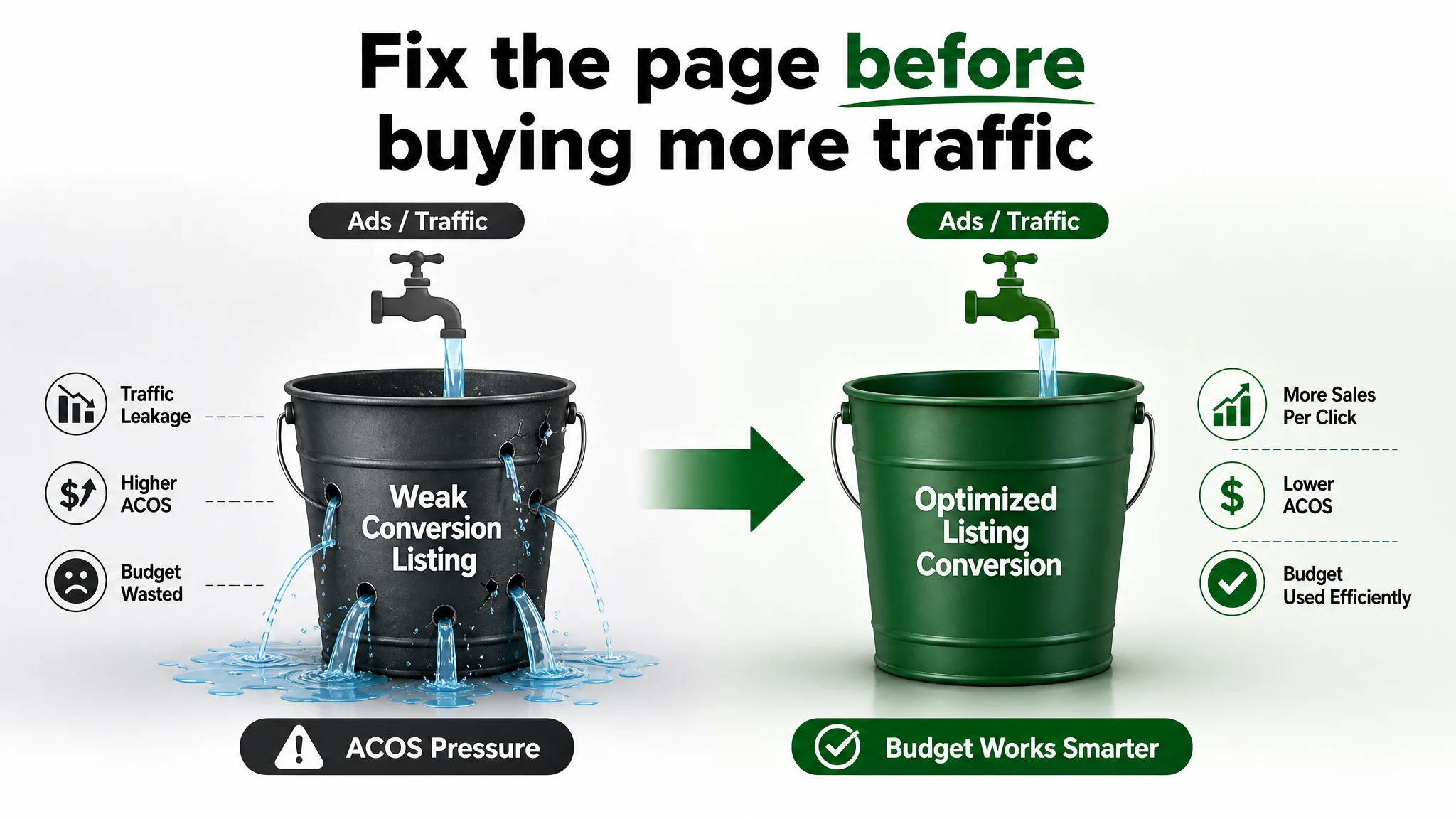
In real operations, the absence of clear objectives often leads teams to “optimize ads” in a vacuum. One outdoor brand selling an oversized camping director’s chair kept raising bids and reshuffling campaigns because ACOS felt high and competitors seemed stronger. The internal assumption was straightforward: “we have good reviews, so the problem must be keywords and bids.” It was only after a deeper diagnostic that they realized the real constraint wasn’t traffic acquisition at all, but how the listing itself converted that traffic. Their ad budget was working hard—but not necessarily toward the right goal.
Defining Your Amazon Advertising Objectives
Before spending a single dollar, you must define what success looks like for your campaign. Common objectives include:
- Profit Growth: Focusing on campaigns and keywords that deliver sales significantly below your breakeven ACoS.
- Market Share & Product Launches: Bidding aggressively to maximize visibility and sales velocity, potentially accepting a higher ACoS as an investment in gaining traction and improving organic rank.
- Brand Awareness: Prioritizing impressions and top-of-search placement for branded or high-level category terms to establish a market presence.
- Reducing TACoS: A strategic goal to leverage stable advertising performance to strengthen organic rankings, creating a sustainable, long-term profit cycle.
In the camping chair case, the seller was effectively chasing profit growth and competitive defense but behaving as if they were in a pure “traffic acquisition” phase. Because they had not clearly articulated whether they were willing to sacrifice short-term efficiency for long-term rank, every ACOS fluctuation felt like a problem to “fix” in the ad console. Once DeepBI clarified that the listing underperformed a category benchmark in conversion capacity, the goal was reframed: first restore listing efficiency, then pursue profitable growth. That shift in objectives changed the entire budget conversation from “how much more traffic can we buy?” to “how do we make each click worth more?”
Essential PPC Metrics: ACoS, TACoS, CTR, and CVR
To track progress toward your goals, it is essential to understand four key metrics:
- ACoS (Advertising Cost of Sale): Calculated as (Ad Spend ÷ Ad Revenue), this is the most direct measure of campaign profitability.
- TACoS (Total Advertising Cost of Sale): Calculated as (Ad Spend ÷ Total Revenue), this metric reveals advertising's impact on your overall business health by factoring in organic sales.
- CTR (Click-Through Rate): Calculated as (Clicks ÷ Impressions) x 100%, CTR measures how effectively your product image and title capture shopper attention in search results.
- CVR (Conversion Rate): The percentage of clicks that result in a purchase, CVR indicates how well your product detail page—including images, A+ content, and reviews—persuades visitors to buy.
CTR and CVR represent two critical hurdles in the sales funnel. By analyzing these metrics, DeepBI provides a data-driven diagnosis to identify specific weak points in your listing. For instance, the system can link a low CTR directly to a main image that lacks a compelling visual hook or connect a low CVR to a detail page that fails to build shopper trust.
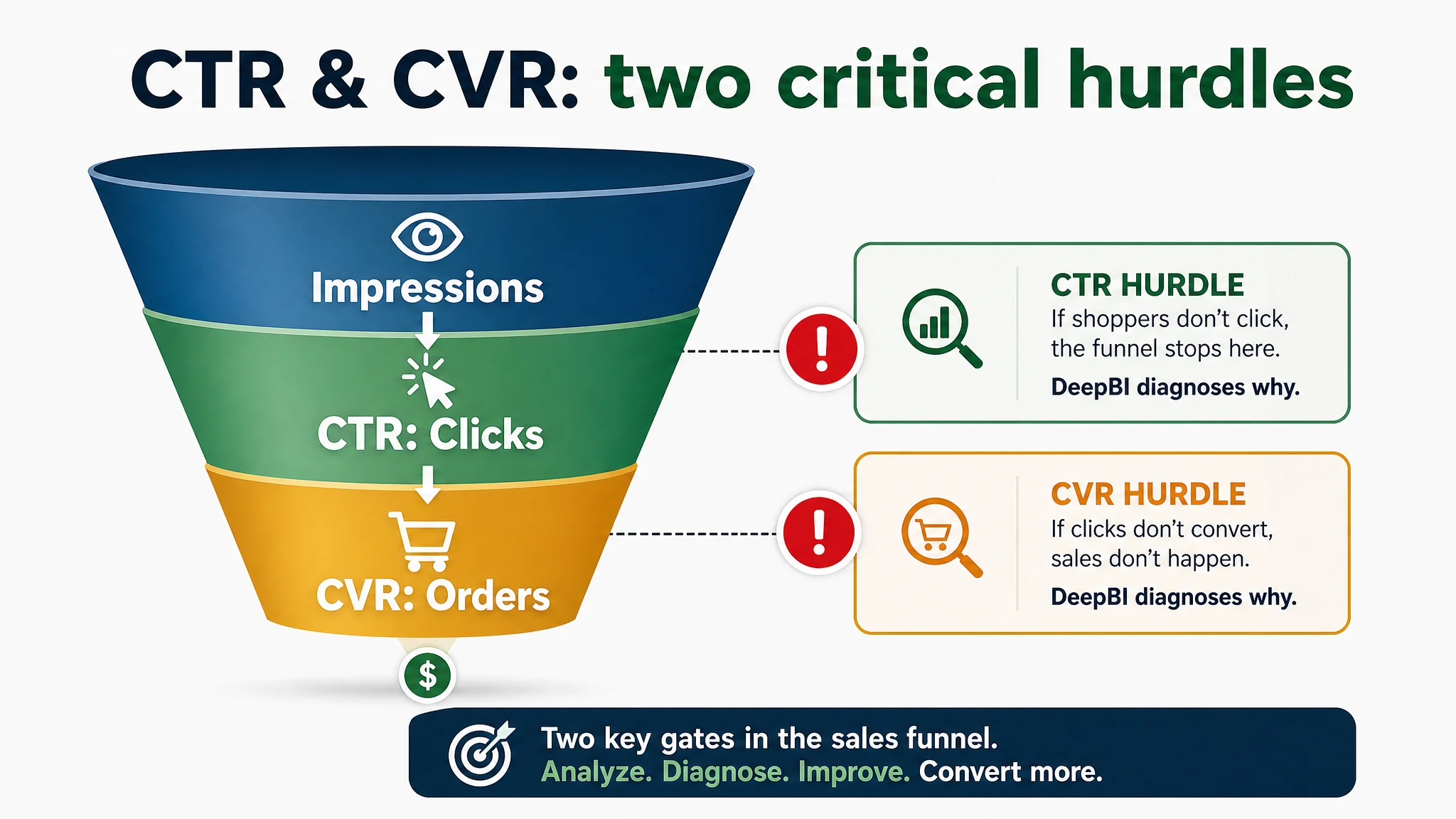
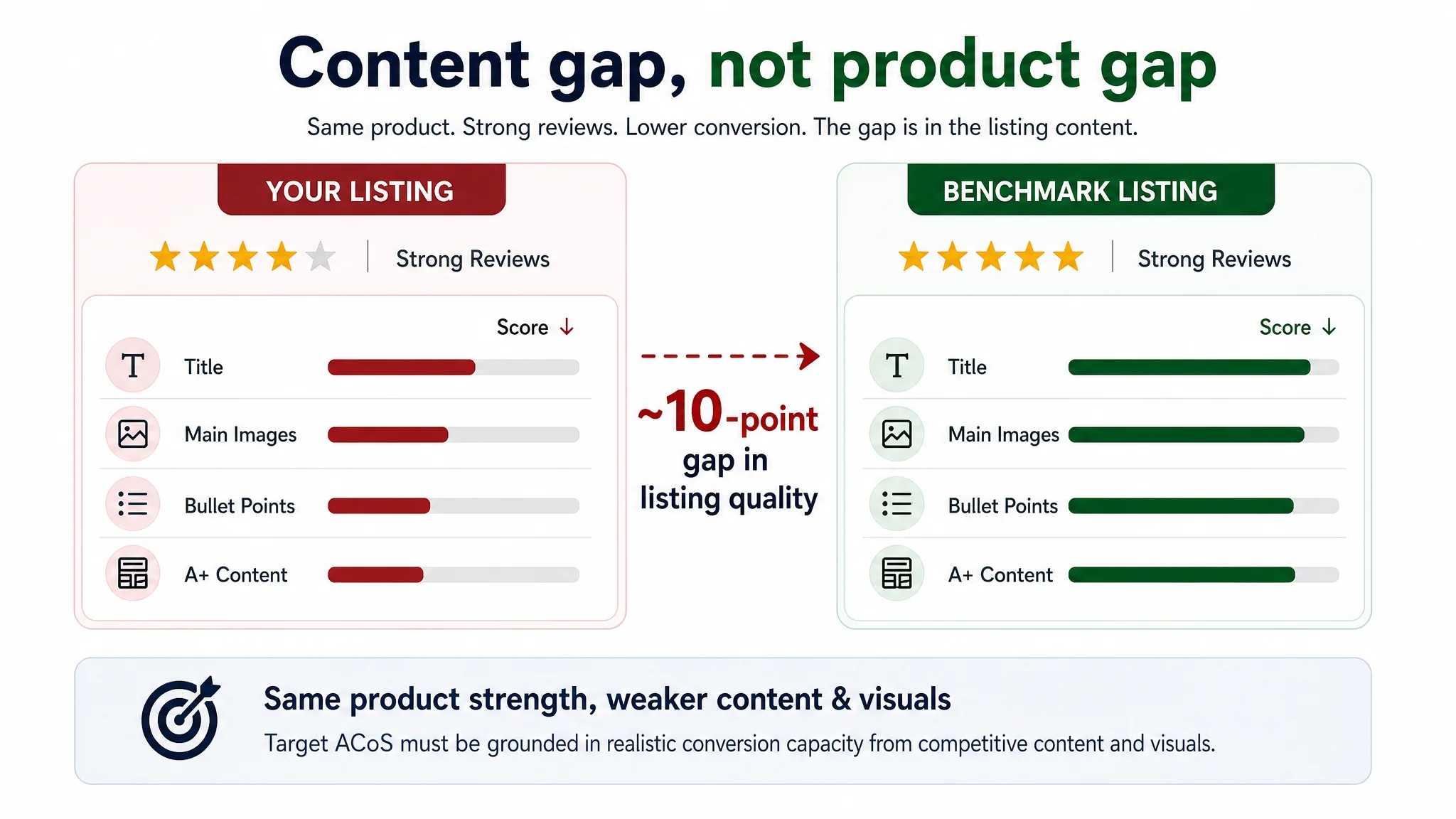
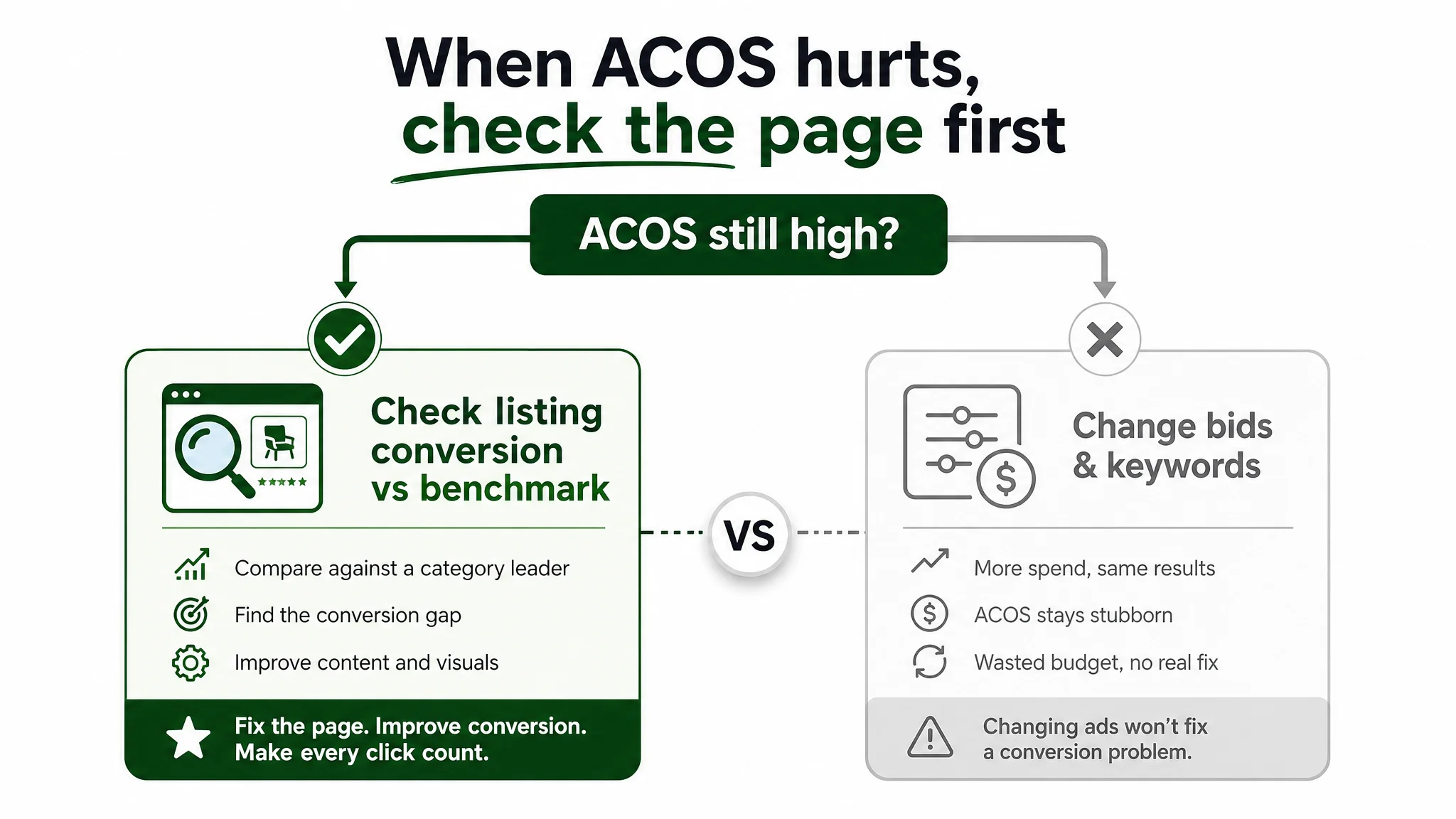
In the camping chair example, ad reports showed that traffic was not the core issue: impressions and clicks on Sponsored Products were adequate for the main category terms. What DeepBI highlighted was a persistent conversion gap versus a leading benchmark listing selling a nearly identical heavy-duty chair. Despite a strong 4.6+ rating and hundreds of reviews, the chair’s CVR lagged behind the benchmark. When the listing was scored, the main image set, bullets, and A+ content all trailed the benchmark by small but compounding margins. The data narrative was clear: ACOS pressure was not primarily a bidding issue; it was the result of pushing paid clicks into a page that converted below its potential. This is exactly the kind of misalignment CTR and CVR diagnostics are designed to reveal.
Calculating Your Breakeven ACoS and Target ACoS
Your breakeven ACoS is your product's pre-advertising profit margin. For example, if your profit margin is 25%, your breakeven ACoS is also 25%. At this level, you are neither making nor losing money on your advertising spend.
Your Target ACoS is a strategic figure derived directly from your business objective.
- For profitability, your Target ACoS must be set comfortably below your breakeven ACoS.
- For an aggressive product launch, your Target ACoS might be set at or even above your breakeven point, treating any resulting loss as a marketing investment to generate the sales velocity required for strong organic ranking.
In practice, many sellers mechanically set a Target ACoS without questioning whether their listing can actually support it. In the camping chair case, the seller wanted to maintain ACOS at a level they considered “healthy,” but because the listing converted worse than the category leader, they had to bid higher just to sustain visibility. The result was constant tension between the desired ACOS and the bids required to win impressions. Once DeepBI’s analysis showed a roughly 10‑point gap in listing quality versus the benchmark, the team recognized that their “ideal” Target ACoS assumed a stronger conversion rate than the page was delivering. The lesson: Target ACoS is not just a financial setting; it must be grounded in realistic conversion capacity that comes from competitive content and visuals.
Crafting Your Initial Amazon Ad Budget
Establishing your initial advertising budget is less about finding a perfect number and more about funding a data-gathering initiative. The primary goal is to generate sufficient performance data to diagnose listing health and inform intelligent optimization, with the ultimate aim of lowering your Total Advertising Cost of Sale (TACoS).
Determining Your Total Advertising Spend
Rather than basing your budget on a fixed percentage of revenue, view your initial advertising spend as an investment in establishing clear performance baselines. The main objective is to generate enough impressions and clicks to yield statistically relevant data on key metrics like Click-Through Rate (CTR) and Conversion Rate (CVR). This data serves as the raw material for identifying specific listing weaknesses; for instance, a low CTR may indicate a problem with the main image, while a poor CVR could suggest that the A+ content needs improvement. Your total budget must be sufficient to sustain campaigns long enough to collect these crucial diagnostic signals.
In the camping chair scenario, the seller had already reached a point where advertising was producing consistent traffic, but no one had systematically used that traffic as a diagnostic tool. They interpreted the steady flow of clicks and the pressure on ACOS as proof that “ads are expensive,” instead of asking whether the page was making the most of those clicks. When DeepBI scored the listing against a top competitor, the data explained why the same category traffic was yielding better outcomes for the benchmark: the competitor’s listing was simply more efficient at converting. For your own brand, committing budget to an initial testing period should be coupled with a plan to read that data as a health check on your listing, not just on your bids.
The Role of Daily Budgets and Campaign Structures
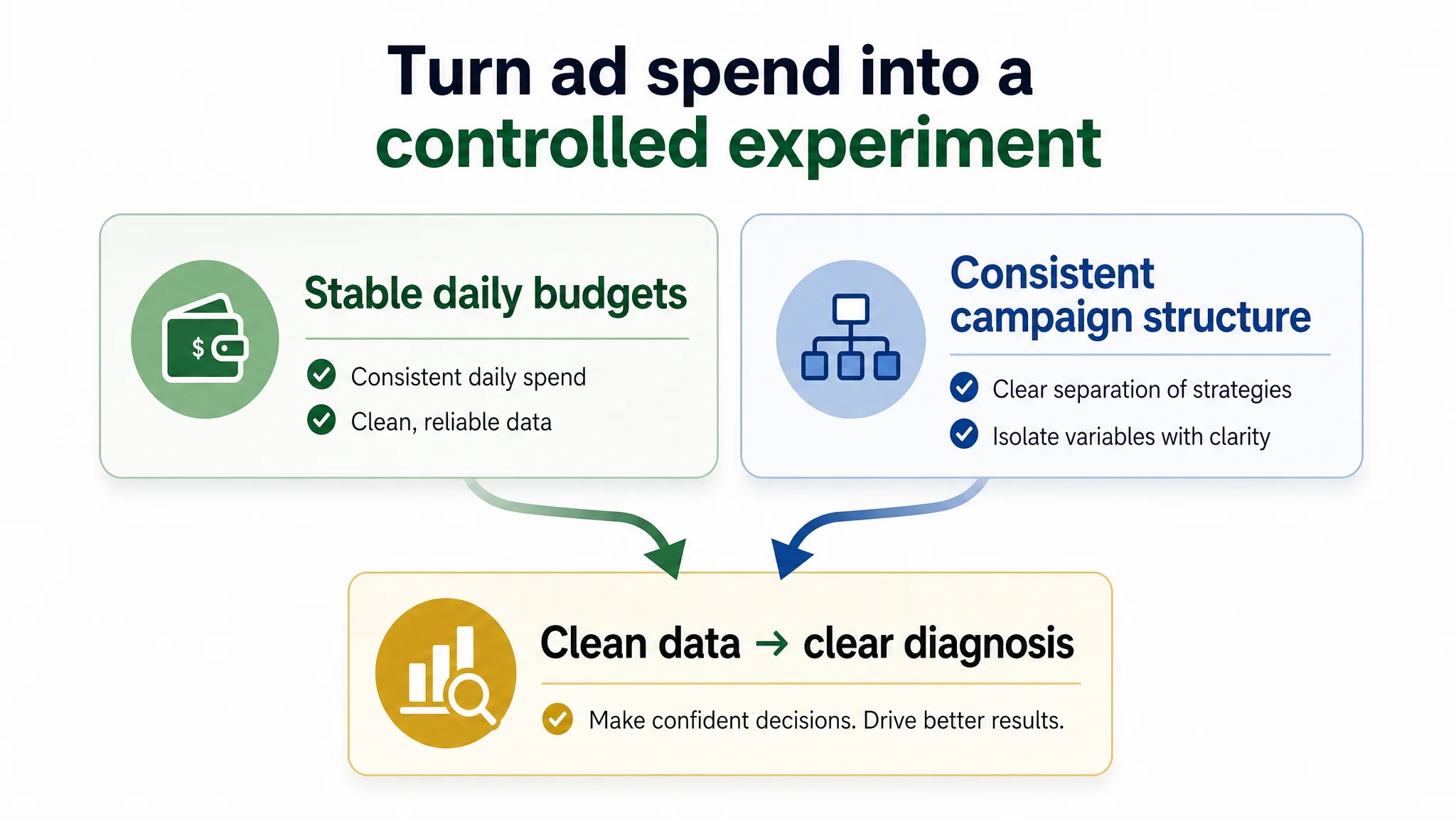
Translating your total budget into consistent daily allocations is critical for collecting stable data, as sporadic spending creates noisy and unreliable signals. A steady daily spend ensures you can accurately measure performance over a 7- to 14-day period. Furthermore, a well-organized campaign structure that separates different products or targeting strategies allows you to isolate variables. This clarity makes it easier to pinpoint which specific listing requires visual optimization and to measure the direct impact of any changes on its performance metrics.
The camping chair seller, for example, ran multiple Sponsored Products and Sponsored Brands campaigns but treated them primarily as levers for volume. They adjusted bids and keywords frequently, making it harder to isolate whether performance shifts came from ad changes or from day-to-day demand fluctuations. After DeepBI identified that the listing itself was underperforming, the team stabilized daily budgets and preserved consistent campaign structures during and after content iterations. This allowed DeepBI to mark “visual iteration event points” and see how CTR and CVR moved following the new main images and A+ layout. Consistent budget and structure are what turned their ad spend into a controlled experiment, instead of an expensive guessing game.
Avoiding Common Budgeting Pitfalls
The most common budgeting pitfall is exhausting your daily funds prematurely. This not only halts potential sales but, more importantly, interrupts the flow of performance data, making it impossible to gain a clear picture of your listing's effectiveness. Another frequent mistake is setting the budget too low to generate meaningful data, which leaves you unable to make confident optimization decisions. The objective is to establish a sustainable feedback loop where advertising data informs listing improvements, ultimately leading to a higher organic rank and healthier long-term growth.
Another subtle but equally damaging pitfall is assuming that any ACOS problem must be solved at the campaign level. The camping chair seller repeatedly split ad groups, tweaked keyword types, and lifted bids in the hope of “fixing” ACOS, all while their listing quietly lost the comparison battle to a benchmark with a sharper story and more persuasive visuals. Because the budget conversation never explicitly included listing quality, they kept funding traffic into a page that could not fully convert it. Avoiding this trap means adding a simple question to your budgeting routine: if ACOS is stubborn, have you ruled out a page-level conversion issue by benchmarking your listing against a true category leader?
Strategic Allocation Across Amazon Ad Types
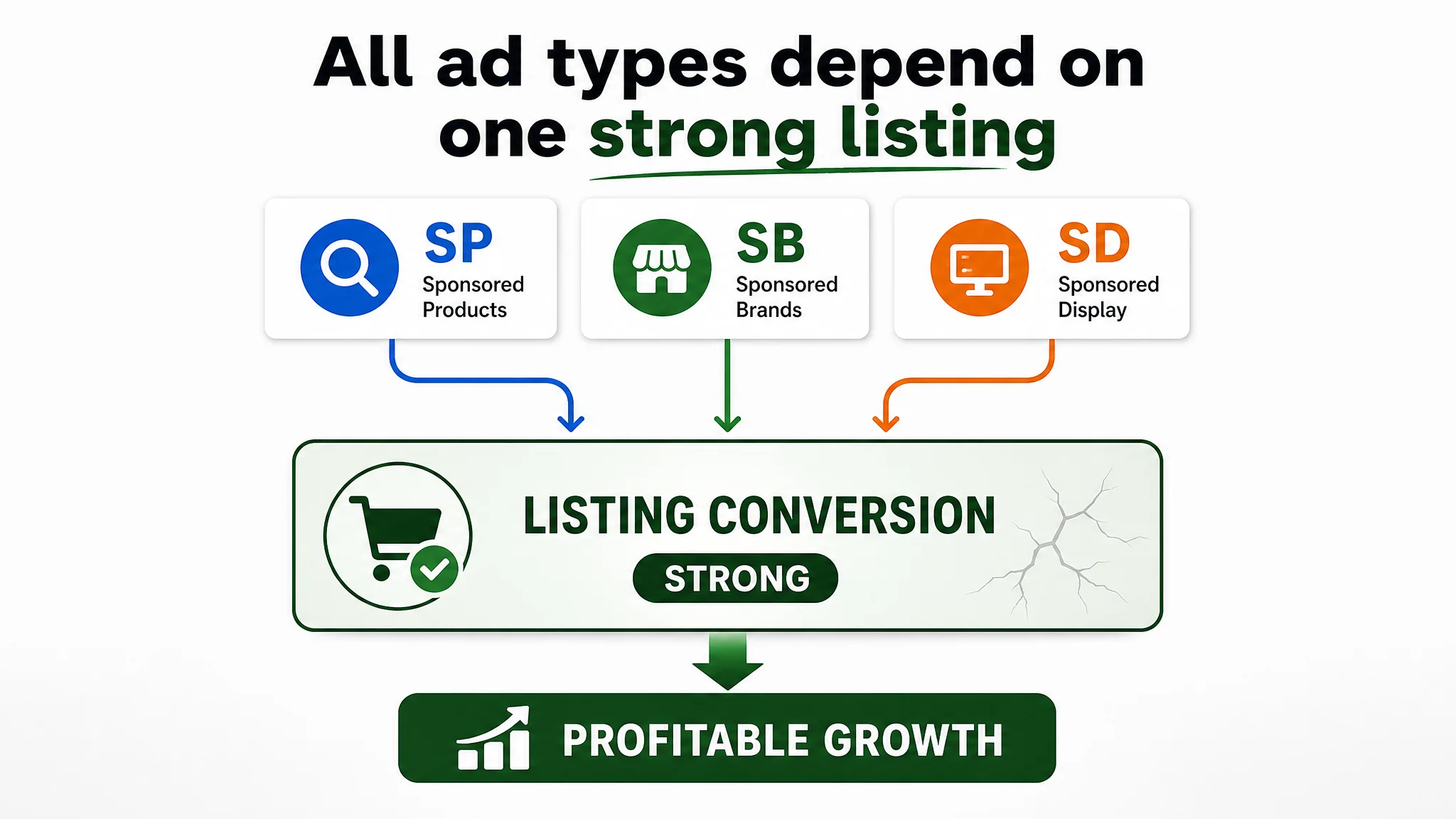
A successful Amazon advertising strategy requires more than just a total budget; it demands a nuanced allocation across different ad types. Each format—Sponsored Products, Sponsored Brands, and Sponsored Display—serves a distinct purpose within the customer journey. Understanding their unique roles is the first step toward optimizing your ad spend for maximum return.
Understanding Sponsored Products (SP)
Sponsored Products (SP) are the cornerstone of most Amazon advertising strategies, designed to capture high-intent buyers at the point of purchase. These ads appear directly in shopping results and on product detail pages, targeting specific keywords or products. Their primary advantage is a direct correlation with sales, which often results in the highest Conversion Rate (CVR) among all ad types. Consequently, SP campaigns are fundamental for driving immediate revenue, improving Best Seller Rank (BSR), and gathering valuable performance data.
In the camping chair example, Sponsored Products were already delivering meaningful traffic on core search terms like “heavy-duty camping chair” and “director’s chair with side table.” The seller’s impression share was not dramatically worse than the benchmark. Yet the benchmark converted those visitors into buyers at a higher rate. This showed up in DeepBI’s scoring: both products sold similar kinds of chairs, but the benchmark listing’s title, main images, and A+ content earned a higher overall score. The practical implication is critical: if your SP ads are feeding traffic into a listing that converts weaker than a comparable competitor, SP spend will feel artificially “expensive” no matter how you tune the campaigns.
Leveraging Sponsored Brands (SB) for Brand Growth
Sponsored Brands (SB) campaigns focus on building brand awareness and capturing top-of-funnel traffic. Appearing prominently at the top of search results, these ads feature custom headlines, logos, and can direct shoppers to a curated brand Storefront. While the Cost-Per-Click (CPC) for these premium placements can be competitive, SB campaigns are invaluable for communicating a broader brand story, cross-selling products, and establishing a strong market presence.
For the camping chair seller, Sponsored Brands were used to showcase a range of outdoor products, including the heavy-duty chair. However, SB traffic still had to land somewhere—and it landed on a product page whose story and visuals lagged behind the benchmark’s. The result: a portion of those high-visibility, higher-CPC clicks underperformed at checkout. Only once DeepBI guided the rebuilding of the title logic, main image sequence, and A+ narrative did Sponsored Brands spend start to support a convincing brand story from search bar to detail page. The lesson is that SB budgets work best when the destination listing is already structurally persuasive.
Utilizing Sponsored Display (SD) for Reach and Retargeting
Sponsored Display (SD) extends your reach both on and off Amazon by targeting audiences based on their shopping behaviors. Its key functions include retargeting—re-engaging shoppers who have viewed your products but did not purchase—and prospecting for new, relevant audiences. Although SD can sometimes have the highest average CPC, its ability to keep your brand top-of-mind and recapture lost sales makes it a powerful tool for executing a full-funnel advertising strategy.
Retargeting is particularly sensitive to listing quality. In the camping chair case, any SD campaigns aimed at re-engaging viewers were essentially inviting them back to a page that lost the comparison the first time. If the first visit failed because the images didn’t convincingly show “600 lbs heavy-duty” or because the A+ content didn’t answer comfort and stability doubts, bringing the same user back without improving the story would only repeat the same outcome. After DeepBI’s recommended changes—such as a main image clearly demonstrating load-bearing and A+ modules showing family and multi-scene usage—retargeting impressions had a more convincing page to “finish the job.” This is why SD budget should often be sequenced after a listing upgrade, not before.
Tailoring Budget Allocation by Business Size and Goals
The optimal mix of these ad types depends heavily on your business stage and strategic goals. A balanced approach ensures you are driving sales today while simultaneously building a brand for the future.
- Brands Under $1M in Revenue: The primary focus should be on validating products and generating immediate sales. A typical allocation is 60-70% to SP, 20-30% to SB for initial brand building, and 0-10% to SD for targeted retargeting.
- Brands Between $1M-$5M: At this stage, balance direct sales with scaling brand presence. A recommended split is approximately 70% for SP, 15% for SB, and 15% for SD to expand reach and retargeting efforts.
- Brands Over $5M: For established brands, the goal is market defense and efficient growth. A common strategy involves dedicating around 80% to SP to protect core product sales, 10-15% to SB for brand dominance, and 5-10% to SD for strategic audience engagement.
Whatever your size, these percentages are only meaningful if your listings can convert the traffic they receive. The camping chair seller was effectively behaving like a brand in the “growth” stage—diversifying across SP and SB, and considering broader visibility—while their core product page still lagged behind a benchmark in conversion architecture. DeepBI’s diagnosis effectively reset the sequence: first close the conversion gap through listing improvements, then lean back into a more aggressive multi-format budget allocation. That order ensured each ad dollar, regardless of format, supported a page capable of turning attention into revenue.
Optimizing Your Keyword and Targeting Strategy
A successful advertising strategy hinges on reaching the right customers through precise keyword and product targeting. Effectively managing these elements prevents wasted ad spend and channels your budget toward high-conversion opportunities, which directly improves your ACoS.
The Power of Match Types: Broad, Phrase, and Exact
Understanding keyword match types is fundamental to controlling traffic quality, as each type serves a distinct purpose in your advertising funnel.
- Broad Match: Casts the widest net, showing your ad for a variety of related searches. It's ideal for initial keyword research and discovering new customer search terms but can lead to irrelevant clicks if not monitored.
- Phrase Match: Offers more control, displaying your ad when a search includes your keyword phrase in the correct order. This helps filter out less relevant traffic while still allowing for some discovery.
- Exact Match: Provides the most precision, showing your ad only for searches that match your keyword exactly. This type is best for high-intent, proven keywords and typically yields the highest conversion rates (CVR) and lowest ACoS.
In the camping chair case, the team manually explored various match types in an attempt to stabilize ACOS. They added exact matches for “600 lbs camping chair” and related intent-heavy terms, hoping tighter matching would fix efficiency. Yet the underlying issue remained: even when they brought in highly relevant traffic, the listing converted at a lower rate than the benchmark. The content didn’t immediately make “600 lbs” or “extra-wide comfort” believable in a single glance; emotional cues for family decision-makers were weaker. This demonstrates that while match types refine who sees your ads, they cannot compensate for a listing that doesn’t fully persuade the qualified visitors you already have.
Strategic Use of Automatic and Manual Campaigns
The most effective approach combines the strengths of both automatic and manual campaigns. Use automatic campaigns as a discovery engine, allowing Amazon’s algorithm to test your product against a wide range of search terms and competitor products. By regularly analyzing your search term reports, you can identify high-performing keywords to leverage.
Once you identify these "winning terms," transfer them into a manual campaign using phrase or exact match types. This strategy allows you to set specific bids, control ad placement, and confidently scale your budget on keywords with proven conversion history, creating a virtuous cycle of continuous optimization.
For the camping chair seller, automatic campaigns had already surfaced valuable search terms and competitor ASINs. However, manual campaigns built on these “winning” terms still felt expensive relative to revenue. DeepBI’s diagnosis reframed this: the problem wasn’t that the terms were wrong, but that the landing page was not hitting the emotional and proof points those shoppers needed. After the listing iteration—new main images showing real load-bearing, clarified bullets, and coherent A+ storytelling—the same set of keywords began performing more like “true winners.” The cycle only became virtuous once the listing itself was aligned with what those search terms implied about shopper intent.
Product Targeting and ASIN-Specific Strategies
Beyond keywords, you can also target specific products (ASINs) or entire categories. ASIN targeting enables you to place ads on the detail pages of direct competitors, complementary products, or even your own items to facilitate cross-selling. Category targeting helps you reach a broader yet still relevant audience browsing within specific product segments.
A critical component of this strategy is the use of negative keywords and product targets. By identifying and negating irrelevant search terms and ASINs that generate clicks but no sales, you prevent budget leakage and continuously refine your targeting. DeepBI’s four-layer traffic funnel model helps structure this entire process, enabling sellers to discover new traffic, filter out low-quality clicks, and concentrate investment on the most profitable keywords and targets.
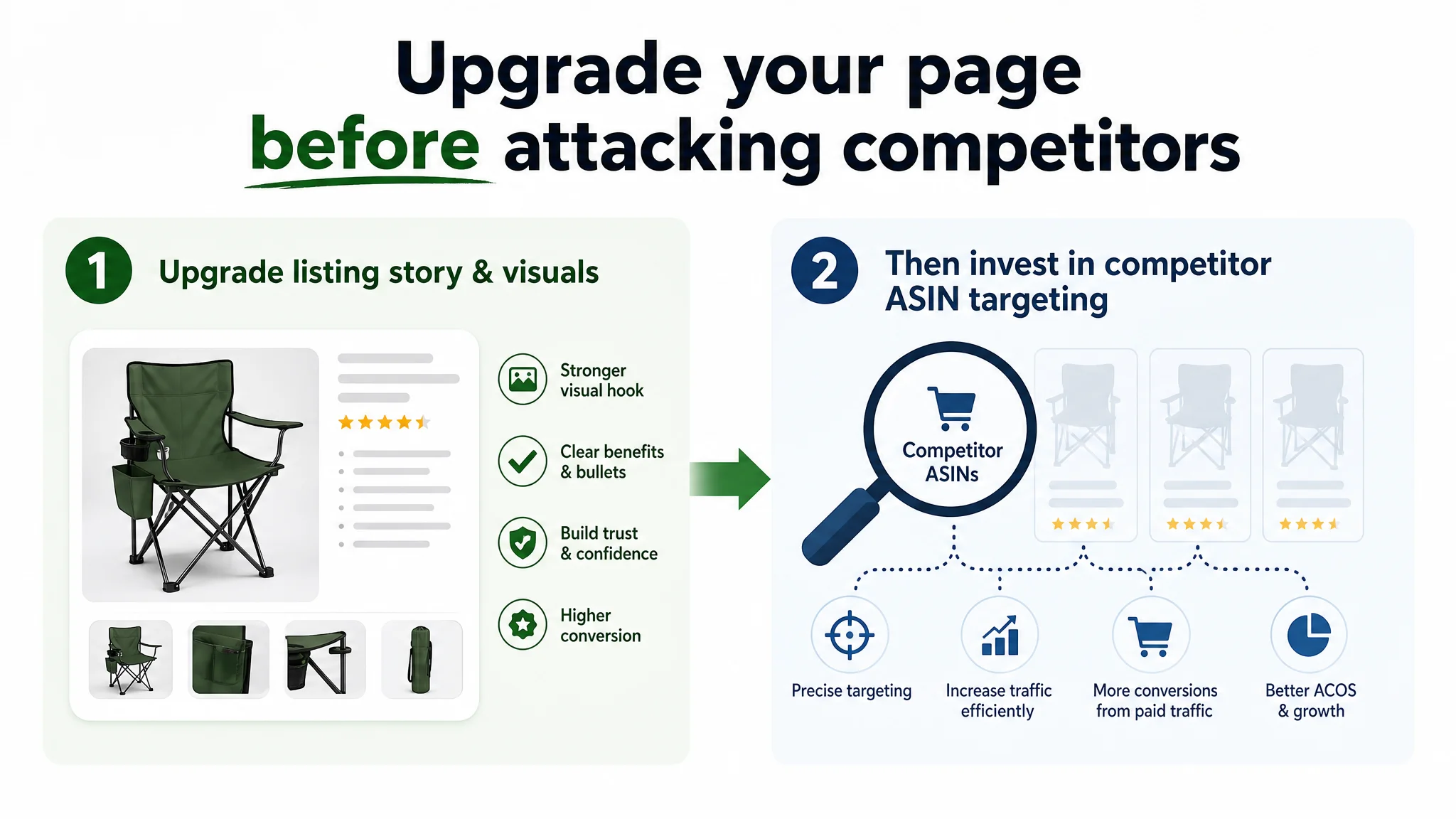
In the camping chair case, product targeting revealed a revealing contrast. Ads placed on the benchmark’s listing generated clicks—meaning shoppers were interested enough to check out an alternative—but conversion lagged. When DeepBI scored both pages, the reason became obvious: the benchmark’s images and A+ content made oversized comfort and family use cases immediately tangible, while the seller’s page scattered those messages across multiple less-focused modules. That insight changed how the seller used ASIN targeting: instead of simply trying to “steal” traffic from the benchmark, they first upgraded their own page to match or exceed the benchmark’s persuasion structure. Only then did investing more into competitor ASIN targeting make sense.
Continuous Optimization and Performance Monitoring
Effective PPC management is not a "set it and forget it" activity but an iterative process of continuous monitoring, analysis, and adjustment. Success on Amazon requires a dynamic approach where advertising strategy evolves in response to real-time market feedback and performance data.
Dynamic Bid and Budget Adjustments
Consistent, hands-on monitoring is essential for maintaining budget efficiency. Top-performing sellers review key metrics daily or weekly to make informed decisions, which involves dynamically adjusting bids to maintain competitive positioning and reallocating budgets based on campaign performance. To support this process, DeepBI’s dynamic parameter adjustment mechanism automatically fine-tunes bids and budgets daily, using recent performance data to drive stable and scalable growth.
In the camping chair example, the seller’s early optimization routine centered on bid changes: raise bids when impressions dropped, lower them when ACOS felt uncomfortable, split campaigns when data looked inconsistent. This reactive pattern never addressed the root cause revealed by DeepBI: the listing’s sales logic was structurally weaker than the benchmark’s. After the listing overhaul, dynamic adjustments started to behave very differently. Raising bids on high-intent keywords now drove more profitable conversions because the page answered the right questions with clearer visuals and narratives. The same optimization tools, applied after a listing fix, produced a far healthier performance curve.
Identifying and Addressing Underperforming Campaigns
A core optimization strategy is to systematically shift ad spend from underperforming campaigns to those delivering a higher return. Performance data can reveal the root cause of poor results, such as a low Click-Through Rate (CTR) pointing to a weak main image or a low Conversion Rate (CVR) indicating issues with A+ content. By diagnosing the specific issue, you can pause or refine the weak campaign and reallocate its budget to proven winners.
In practice, “underperformance” is often misattributed purely to keywords or bids. With the camping chair, DeepBI’s scoring mapped campaign metrics back to content modules. Lower-than-expected CTR on certain search results aligned with main images that failed to instantly convey “extra-wide, heavy-duty comfort.” Lower CVR segments corresponded with A+ modules that showed features but not a cohesive family-oriented outdoor story. Instead of endlessly splitting campaigns, the team used this linkage to rework the main image sequence and restructure bullet points into a clearer buying logic. Once those changes were in place, campaigns that previously looked weak began to justify increased budget, demonstrating how content-level fixes can transform an “underperforming” campaign into a scalable one.
The Synergy Between Paid Ads and Organic Ranking
A powerful, direct link exists between advertising performance and organic search ranking. Successful ad campaigns drive traffic and sales, which Amazon’s algorithm interprets as signals of relevance and authority, thereby boosting your product's organic visibility. DeepBI helps identify high-conversion keywords from your advertising data, allowing you to strategically integrate these top-performing terms into your listing to improve both ad performance and long-term organic rank.
In the camping chair case, the seller had been investing significantly in ads without seeing organic rankings rise in proportion. DeepBI exposed why: the listing’s conversion capacity was below what its product quality and reviews could support, especially when contrasted with the benchmark. Ads were driving traffic, but the page was not turning that traffic into enough incremental sales to send strong ranking signals. After the title logic, main images, and A+ modules were rebuilt around clear XXL comfort, heavy-duty proof, and multi-scene family usage, the same ad spend began generating a healthier blend of paid and organic orders. This illustrates the synergy: when your listing is structurally strong, ad-driven sales not only pay for themselves but also help your organic presence catch up to your product’s true potential.
Leveraging Advanced Analytics for Data-Driven Decisions
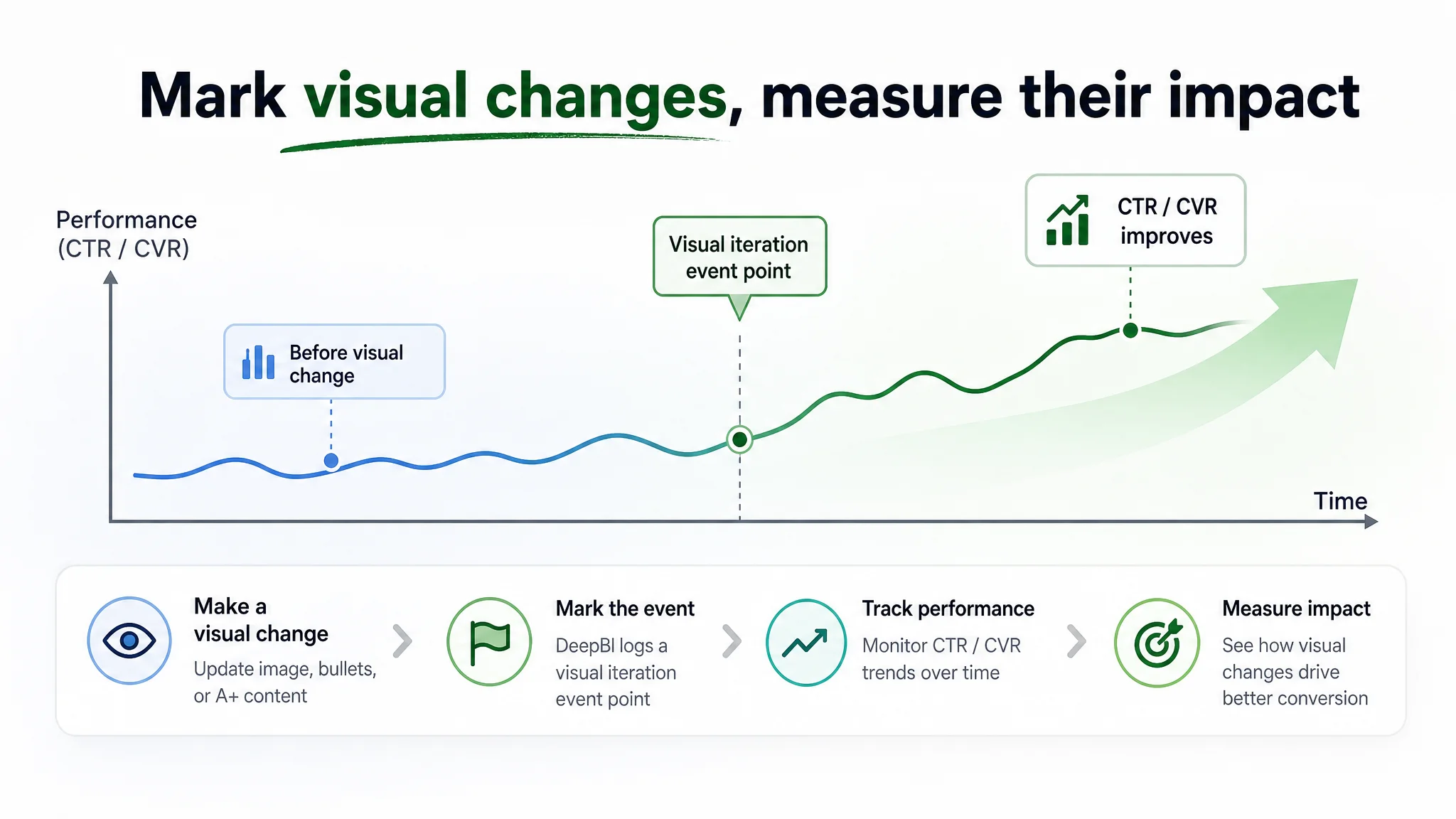
Advanced analytics create a direct connection between advertising and listing optimization. When a listing element, such as a main image, is updated based on performance diagnostics, DeepBI can automatically mark a "visual iteration event point" in your ad reports. This feature allows you to precisely track the impact of the change on metrics like CTR over the subsequent 7 to 14 days, turning ad spend into a powerful engine for continuous, data-validated listing improvement.
For the camping chair seller, this mechanism turned a vague “we improved the images” step into a measurable experiment. After implementing a new main image that clearly emphasized “600 lbs” capacity and extra-wide seating with real-life proof shots, DeepBI tracked CTR changes on relevant keywords before and after the iteration point. Similarly, restructuring A+ content into a coherent family-outdoor narrative allowed the team to monitor shifts in CVR across ad campaigns. Instead of relying on intuition about whether the redesign “felt better,” the seller could see in the data that each click was now more likely to convert. This closed the loop between creative changes and budget decisions.
DeepBI: Your Partner in Amazon Ad Budget Mastery
Effective budget allocation requires more than just adjusting bids; it demands a deep understanding of how advertising performance connects to your entire sales funnel. DeepBI is an AI-powered, Amazon-focused system designed to bridge this gap. It integrates diagnosis, strategy, execution, and optimization across your product listings, ads, and organic traffic to build a foundation for long-term profitability.
Streamlining Budget Allocation with AI-Powered Insights
DeepBI transforms raw advertising data into clear, actionable directives for resource allocation. Instead of merely reporting ACoS, the system diagnoses the root causes of poor performance. By analyzing campaign reports, for example, DeepBI can pinpoint whether a low Click-Through Rate (CTR) stems from an underperforming main image or if a low Conversion Rate (CVR) is caused by weaknesses on the A+ detail page. This intelligence allows you to stop wasting ad spend on a flawed listing and instead invest in the specific creative optimizations most likely to improve results.
In the camping chair case, DeepBI’s benchmarking made this distinction very concrete. The product itself had strong real-world satisfaction: high ratings, hundreds of detailed reviews, and competitive specs. Yet the listing scored meaningfully below a top competitor because its title, images, bullets, and A+ modules did not form as sharp or emotionally resonant a sales narrative. The seller’s initial instinct was to keep “fixing” ad campaigns to tame ACOS. DeepBI’s insight reallocated focus and resources: rather than pouring more budget into traffic, the priority became elevating listing conversion capacity to match product quality. Only then did it make sense to scale ad investment again.
Dynamic Optimization for Sustained Growth
Mastering your budget is a continuous process, not a one-time setup. DeepBI facilitates this by creating a complete optimization cycle. The system analyzes high-conversion search terms from your ad campaigns and uses these data signals to guide AI-powered optimizations for your titles and images. When an updated asset is applied, DeepBI automatically logs a "visual iteration event point" in your ad reports, enabling you to precisely track the subsequent impact on CTR and other key metrics. This ensures that your budget decisions are always based on current, validated performance data.
For the camping chair seller, this cycle played out clearly: ad data revealed that certain heavy-duty and comfort-related queries brought in engaged traffic; listing scoring showed that the page did not yet fully capitalize on that intent. DeepBI then guided the rework of the main image system to visually prove “600 lbs heavy-duty + extra-wide comfort,” and helped re-architect A+ content around family-oriented outdoor scenarios and multi-scene usage. As those assets went live, the system tracked CTR and CVR changes by marking iteration points. The improvement in conversion made each subsequent budget increase less risky and more defensible, because it was backed by fresh, concrete evidence of listing performance.
Holistic Performance Analysis and Strategic Adjustments
DeepBI helps break down the operational silos that can hinder growth by establishing a direct link between ad spend, listing quality, and organic ranking. By using advertising data to improve your listings, you can enhance both CTR and CVR. This improvement not only makes your advertising more efficient but also boosts your product's organic visibility. This holistic approach enables strategic, system-level adjustments, converting advertising signals into sustainable long-term growth and a lower Total Advertising Cost of Sale (TACoS).
The camping chair case illustrates this holistic view in action. On the surface, the issue looked like an “ad cost problem”: ACOS was under pressure, and the seller felt forced to keep ads running just to maintain volume. Underneath, DeepBI’s analysis showed that the listing’s sales logic—across main images, bullet points, and A+—was weaker than the benchmark’s despite comparable reviews and specs. By treating ads, listing, and organic performance as one system, the seller stopped isolating “traffic” from “page quality.” Adjusting the listing first and ads second created a healthier path: ad-driven traffic produced more sales, Amazon rewarded the improved conversion with better organic ranking, and over time TACoS became easier to manage. This is budget mastery at the system level, not just at the campaign level.
Conclusion: Key Takeaways for Amazon Ad Budget Success
Mastering your Amazon ad budget is not a one-time task but a continuous cycle of strategic allocation, data analysis, and agile optimization. The most successful sellers move beyond intuition-based spending and treat their ad budget as a dynamic asset. Every dollar should be deployed with a clear objective, its performance rigorously measured against key metrics like ACoS and CVR, and the overall strategy constantly refined based on real-time market feedback. This commitment to a goal-oriented, data-driven approach is what separates stagnant campaigns from those that deliver scalable growth.
The camping chair example underscores several practical lessons: high ratings and solid reviews do not guarantee a high-converting listing; ACOS problems are often rooted not in traffic but in page-level conversion gaps; and advertising can just as easily amplify a weak story as a strong one. Before assuming that bids, match types, or campaign structures are the main culprits, it pays to benchmark your listing’s title, images, bullets, and A+ against the best in your niche and ask whether your page truly deserves the traffic you’re buying.
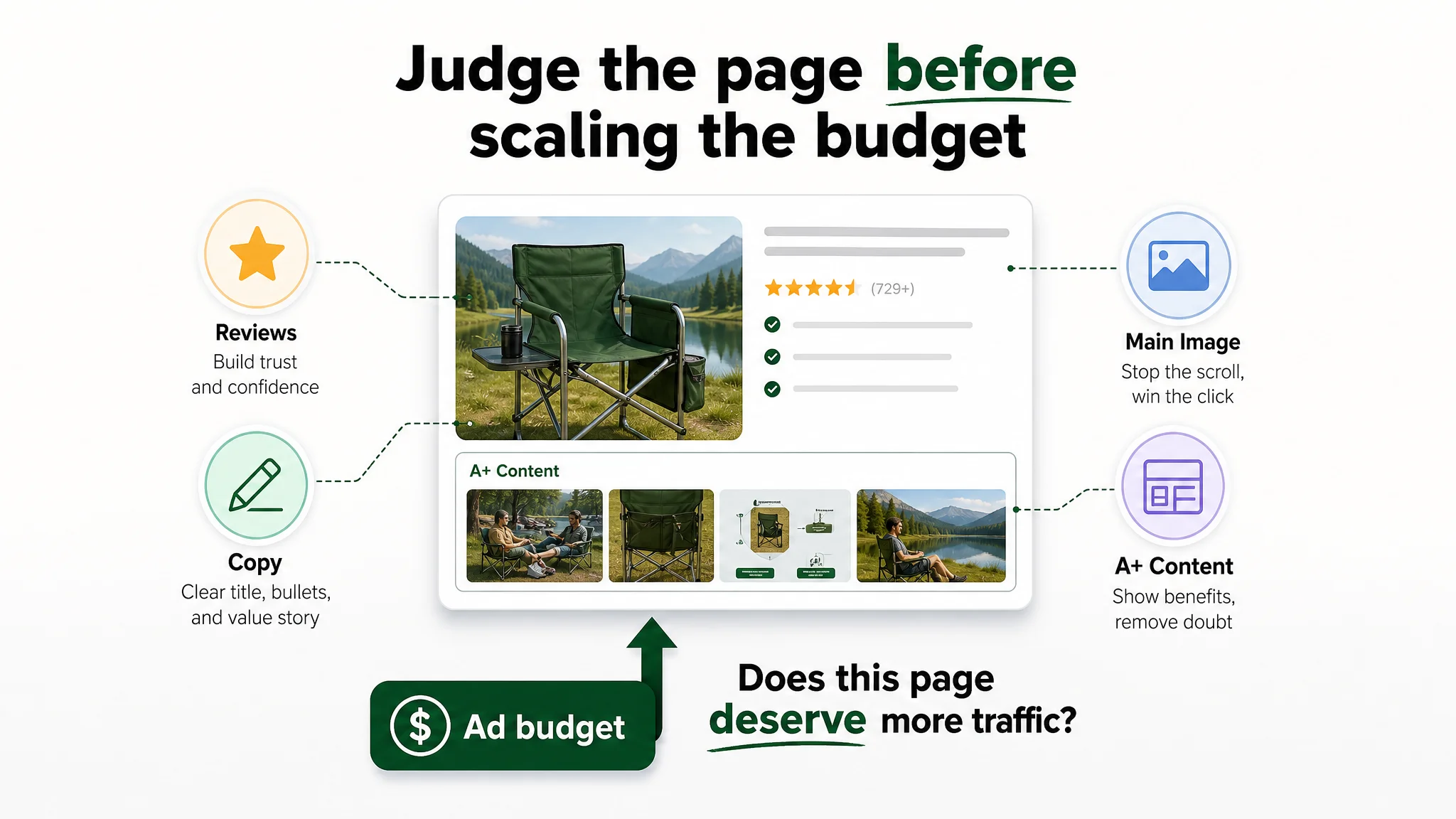
This is where the right tools provide a critical advantage. Platforms like DeepBI function as an intelligent decision-making engine, turning the complex process of budget management into a more data-driven science. By converting operational experience and performance data into a clear evidence chain—from keyword intent to listing modules to conversion outcomes—DeepBI empowers you to make more profitable decisions, ensuring your advertising efforts translate directly into improved conversion rates and sustainable business growth. Ultimately, a proactive, data-informed strategy, grounded in an honest view of your listing’s conversion capacity, is the key to unlocking profitability and securing a competitive edge in the Amazon marketplace.