

The Rise of AI in Amazon Selling: A New Era of Efficiency
The Amazon marketplace has become a highly competitive environment where rising traffic costs place immense pressure on sellers to optimize for both click-through rates (CTR) and conversion rates (CVR). In this landscape, relying on manual processes and intuition is no longer a viable strategy for sustainable growth. Artificial intelligence has emerged as a critical technology, enabling sellers to navigate this complexity with unprecedented precision and speed.
Why AI is Indispensable for Modern Amazon Sellers
AI-powered systems are uniquely capable of processing vast amounts of market data in real-time, identifying benchmark competitors and uncovering performance trends that are invisible to human analysis. This capability is essential for making informed decisions. Furthermore, AI automates tedious and repetitive operational tasks, such as competitor research and manual data entry. For example, tasks that once took hours, like updating listing content, can be reduced to seconds. This automation frees up valuable time for operations teams, allowing them to shift their focus from low-impact manual work to high-level business strategy and growth initiatives.
This shift from manual effort to automated intelligence becomes especially clear when you look at how teams typically react to performance pressure. In one industrial tools account, the seller believed they were already “doing everything right”: ratings were high, reviews were plentiful, A+ content looked polished, and even an initial DeepBI Listing score showed only a narrow gap versus a strong benchmark competitor. The team’s instinct under rising ACOS was to push harder on ads—more keyword tuning, more bid adjustments—because nothing on the page looked obviously broken.
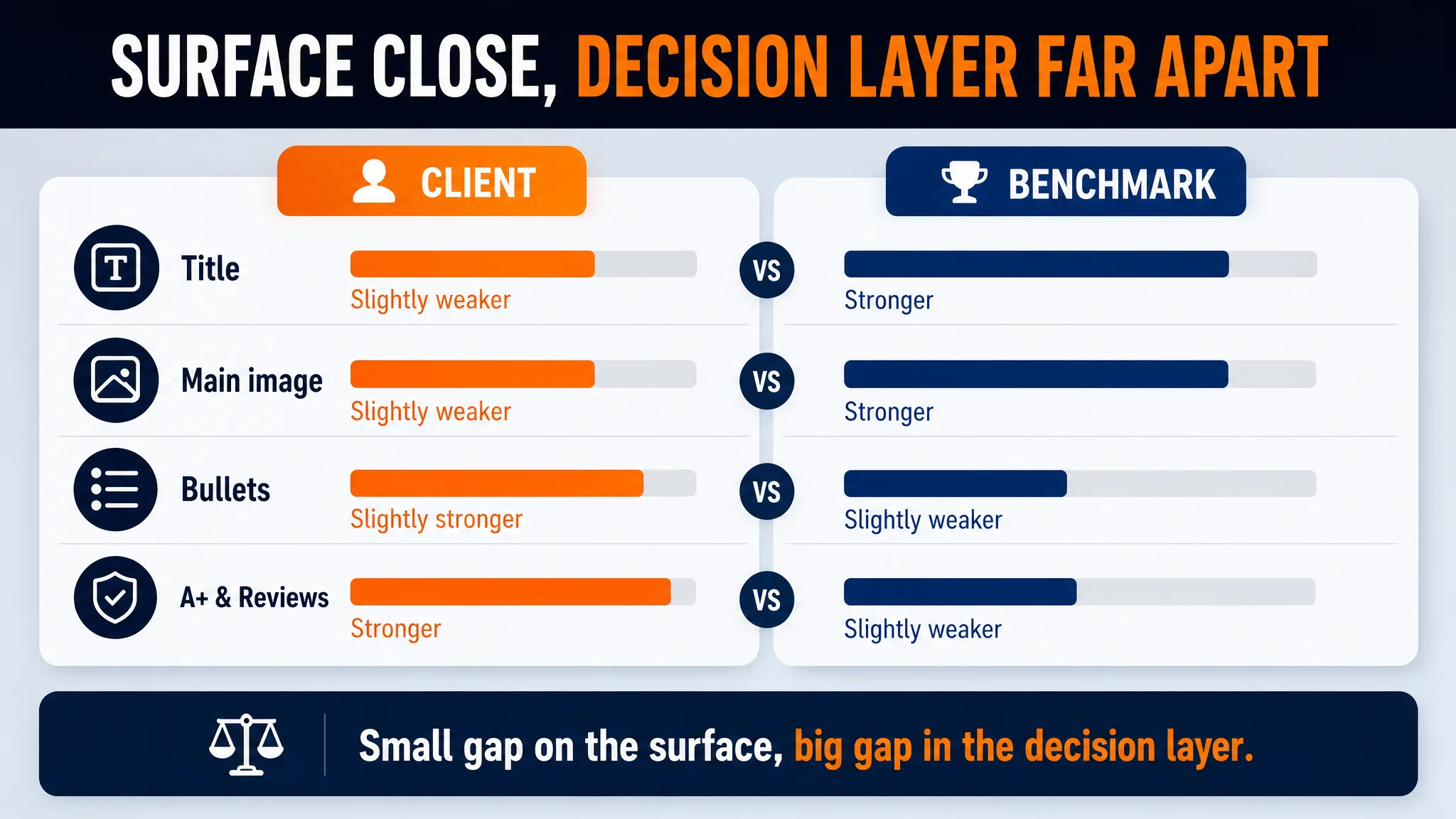
Once DeepBI’s AI diagnostics were turned on, the picture changed. The system’s multi-dimensional scoring showed that the problem was not a lack of traffic but decision friction in the first seconds after a click. Title, bullets and main-image logic were misaligned with how industrial and automotive buyers actually searched and decided. In other words, manual judgment said “fix ads,” but AI’s evidence chain pointed to a listing conversion issue. That kind of misalignment is extremely hard to spot without systematic, AI-driven analysis—and it illustrates why AI has become indispensable for modern Amazon operations.
The Strategic Shift: From Manual to Data-Driven Operations
The most significant impact of AI is the fundamental shift from subjective, intuition-based decision-making to a disciplined, data-driven approach. Relying on personal aesthetics often leads to ineffective listing changes, as what looks "good" does not always sell well. AI eliminates this guesswork by establishing a clear "data evidence chain" for every optimization decision.
Systems like DeepBI are designed to manage this entire workflow, creating an end-to-end intelligent optimization loop that connects diagnosis, planning, production, and delivery. It translates abstract business strategies into precise, AI-executable instructions, ensuring that every modification is based on quantitative analysis. This transforms listing optimization from an art into a science, linking every change directly to measurable improvements in commercial performance.
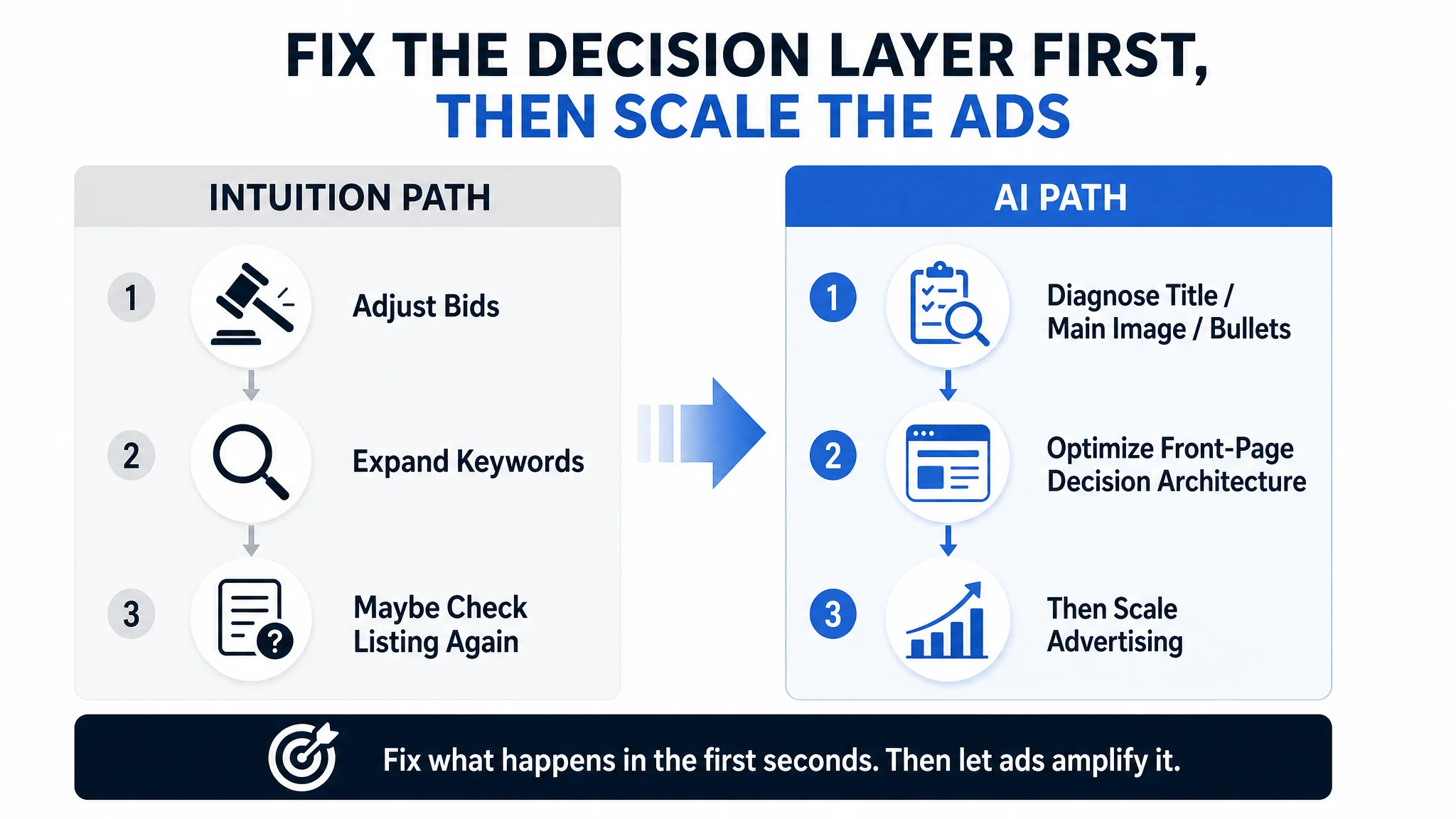
The industrial borescope example illustrates this strategic shift in practice. Initially, the seller treated stubborn ACOS as an advertising problem. DeepBI’s data-driven diagnosis reframed it as a “front-page decision architecture” problem: the benchmark competitor was gaining an edge in title clarity and bullet-driven decision logic, while the client’s strength lay in A+ content and review proof deeper on the page. Without AI, the team would likely have stayed in a cycle of manual bid changes and keyword expansion. With AI, they were presented with a structured evidence chain showing exactly where the early-page decision path was underperforming and how that constrained conversion capacity. That’s the essence of moving from intuition to data: you stop treating symptoms (ad metrics) and start correcting the structural issues that the data exposes.
The Foundation: AI for Amazon Listing Optimization
A high-performing product listing is the engine of your Amazon business, directly influencing everything from search visibility to conversion rates. While manual optimization is time-consuming and often based on guesswork, AI introduces a data-driven, systematic approach to building listings that capture traffic and drive sales. It moves beyond simple keyword stuffing to a holistic strategy that encompasses content, visuals, and competitive positioning.
Intelligent Content Creation for Higher Conversion
AI-powered systems can generate SEO-friendly titles, compelling bullet points, and persuasive descriptions tailored to your target audience. By analyzing market trends and top-performing competitors, these tools craft copy designed to improve both click-through rates (CTR) and conversion rates (CVR).
In the borescope case, DeepBI’s content intelligence didn’t just note that the title was “a bit weaker” than the benchmark. It decomposed how it was weaker. The competitor’s title led with the core product term (“3.9mm Endoscope Camera”), tied it immediately to output quality (“1920P HD”) and screen size (“4.3" IPS Screen”), and embedded quantified specs and professional use scenarios (“Car Engine Aircraft Mechanic Tools”). The client, by contrast, pushed the brand name to the front, emphasized “dual lens” without anchoring it in search intent, and mixed in broad phrases like “Gift for Men” that diluted the professional focus.
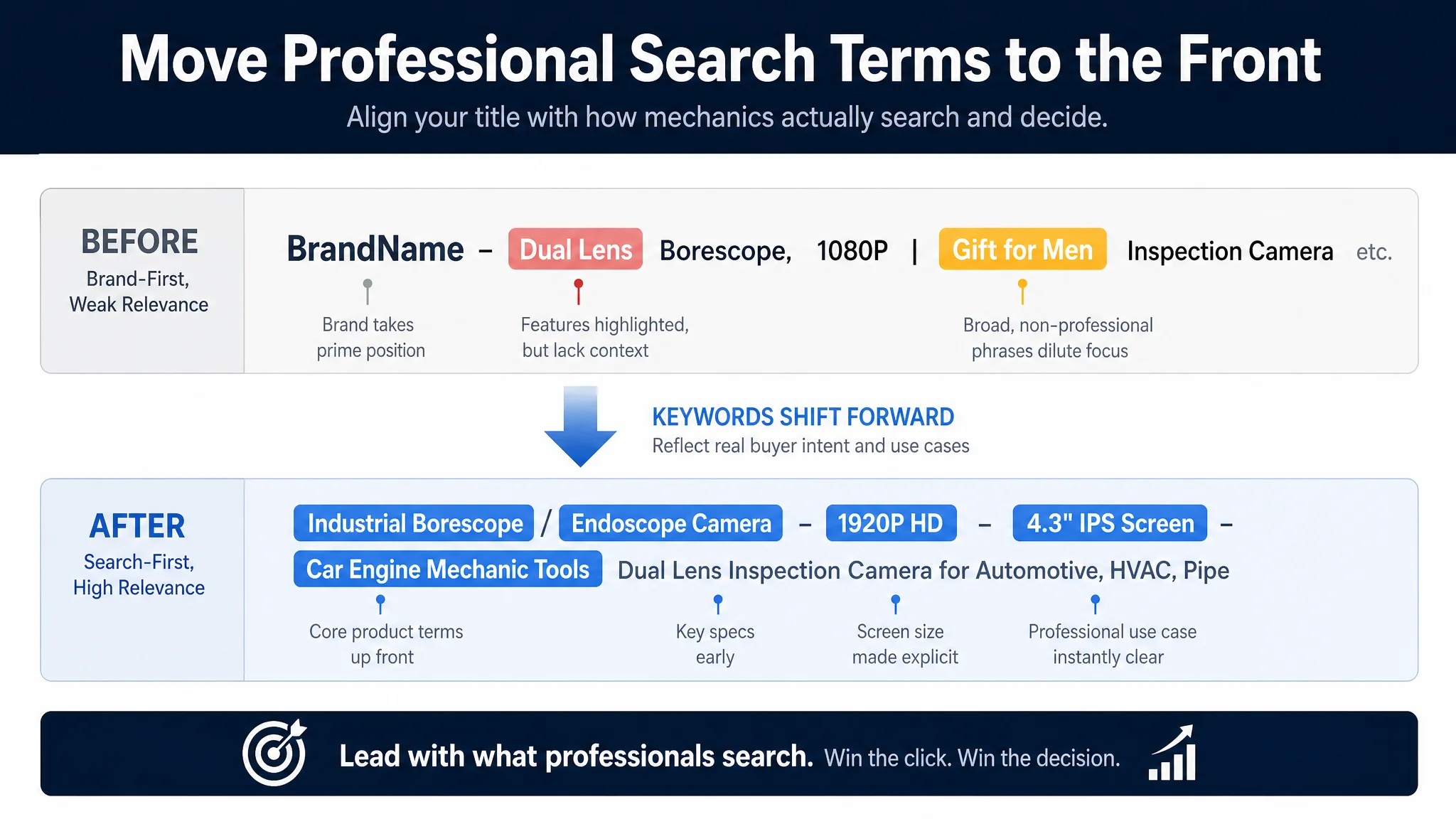
An AI system can detect those patterns at scale and propose a restructured title that puts “Industrial Borescope” and “Endoscope Camera” up front, surfaces “Dual Lens” as a meaningful differentiator, and aligns scenario terms with how mechanics actually search. Instead of a subjective debate over wording, AI builds a title that is statistically aligned with high-performing patterns in similar listings.
For visual content, advanced AI goes beyond generic image creation. Instead of risking "AI hallucinations" that lead to product-image mismatches and negative reviews, a commercially-focused system operates on a principle of 'product entity consistency.' By first mapping a product’s core "DNA"—its unchangeable material, color, and design—the AI generates main images, detail shots, and A+ content that are not only visually appealing but also strictly authentic. This allows sellers to compare multiple AI-generated content schemes and preview their impact before committing to an update.
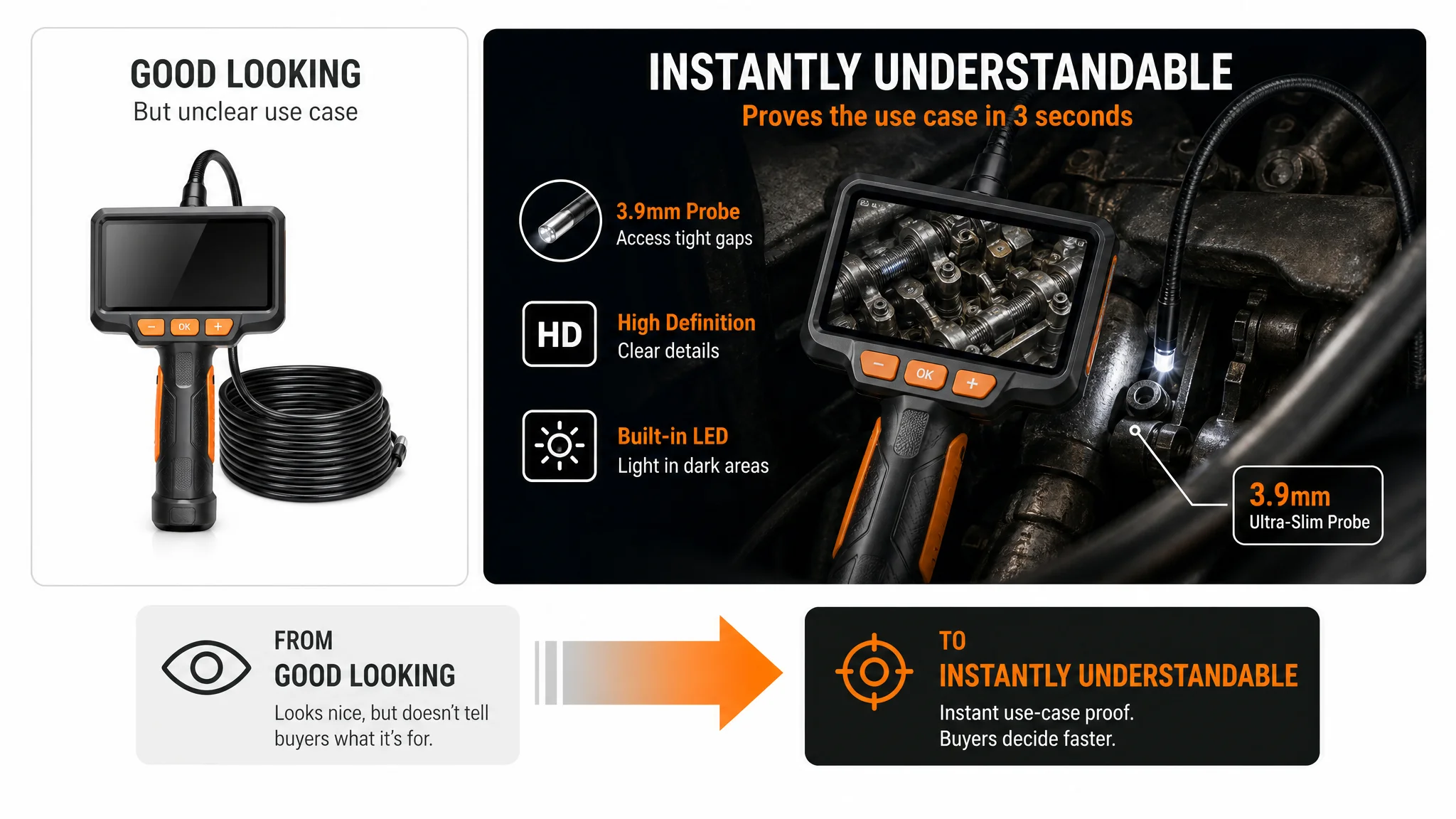
This “DNA-first” approach is crucial in categories where buyers depend on small visual cues to make decisions. In the borescope Listing, DeepBI’s analysis found that the client’s main images were aesthetically solid—and even slightly outscored the benchmark in raw quality metrics—but failed to deliver instant use-case clarity. Scenario anchoring (“this is for engines, pipes, HVAC”) was scattered across multiple frames instead of being hammered into the first image. AI-guided visual optimization reframed the main image around industrial “hard tech” cues: dark, mechanical backgrounds, the probe visibly entering tight gaps, clear on-image callouts for probe diameter, and a vivid screen showing real mechanical detail. That is not just “prettier design”; it is an AI-informed layout that compresses the buyer’s decision into the first few seconds.
Performance Diagnostics and Competitive Benchmarking
Before you can optimize, you must diagnose. AI transforms this process from a manual audit into an automated market health check. By deploying distributed data capture and multi-dimensional semantic analysis, AI systems can screen massive numbers of ASINs to identify high-competitiveness benchmarks, providing a clear, data-backed direction for improvement.
This diagnostic process breaks down the key factors affecting your listing's performance, pinpointing specific weaknesses in your main image, title, bullet points, or A+ content that may be suppressing CTR or CVR. The output is not just a score, but a structured and actionable optimization strategy. By collaborating, multiple AI agents translate these diagnostic findings into a prioritized plan, outlining the exact copywriting, visual, and hierarchical changes needed to strengthen your listing against the competition.
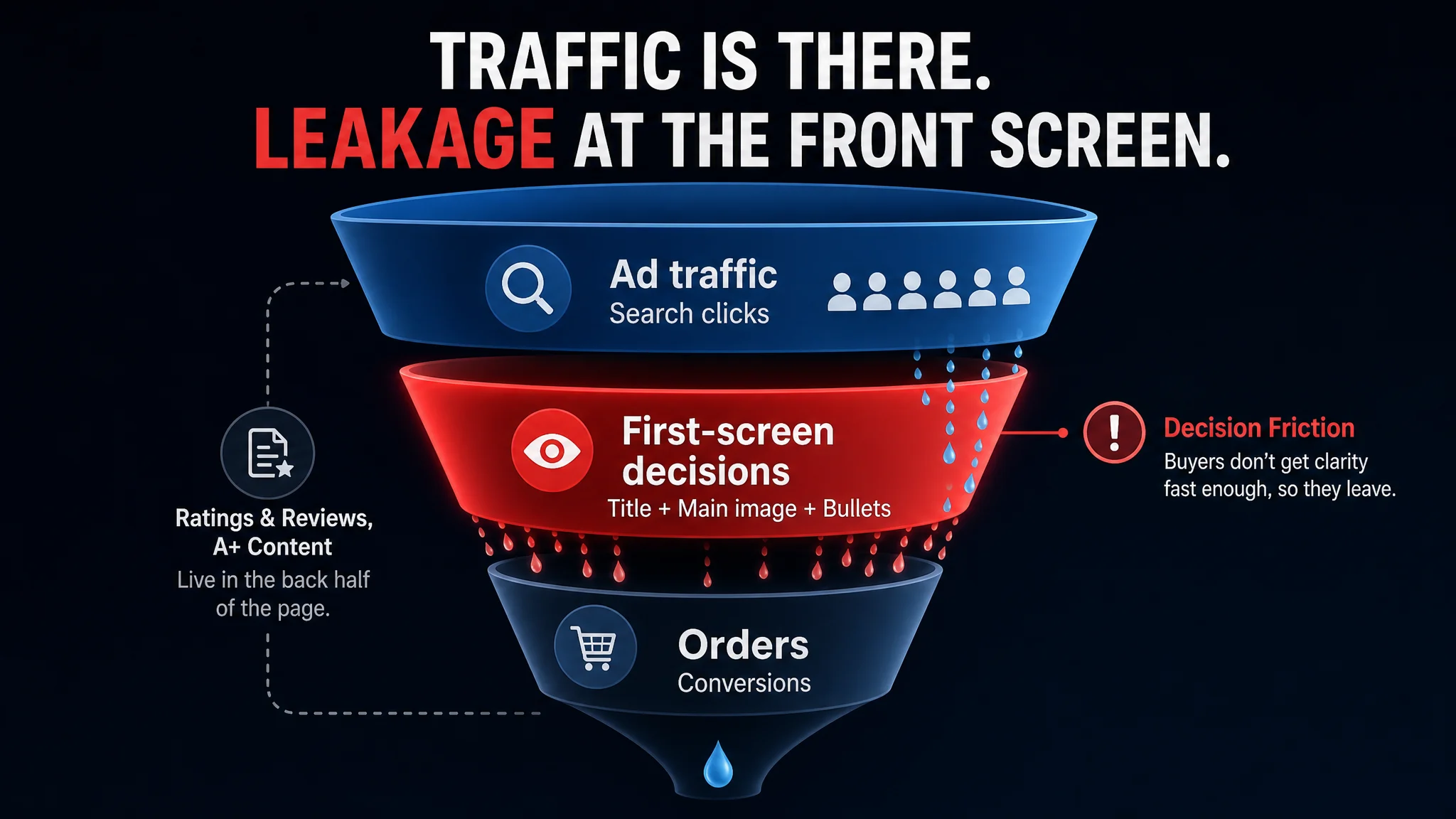
In the industrial borescope project, DeepBI’s scoring made a counterintuitive point: the Listing did not have a trust problem. Ratings and review volume were actually stronger than the benchmark. The “back half” of the page—A+ and reviews—was scoring higher, while the “front half”—search result snippet, hero section, title, bullets—lagged. AI highlighted that the benchmark’s edge came from title clarity and bullet-driven decision logic, whereas the client’s edge was in deep visual storytelling and social proof.
Without AI, this would likely have remained invisible. From a distance, the Listing looked “near perfect”: a 79/100 score versus the benchmark’s 81/100, strong A+ modules, and a 4.7-star rating. Many teams would accept that narrow score gap as “good enough” and focus on ads. DeepBI’s diagnostic layer showed that a seemingly small two-point gap was hiding a much larger front-loaded decision gap—exactly where ad traffic lands. That reorientation only happens when an AI system decomposes performance into granular, comparable components instead of a single, static score.
Driving Visibility: AI in Amazon Advertising
A high-quality listing is only effective if customers can find it. Driving targeted traffic through Amazon's advertising platform is essential, but manual campaign management is often inefficient and complex. Relying on subjective judgment to adjust bids and allocate budgets can lead to wasted ad spend and missed opportunities, failing to connect with high-intent buyers.
Optimizing Ad Spend and Maximizing Reach
AI-powered advertising tools transform this process by automating the core levers of campaign performance. For Sponsored Products ads, AI systems can dynamically manage bid adjustments, optimize budget allocation across campaigns, and refine keyword targeting in real-time. This is often achieved through a sophisticated, multi-layered funnel approach. Campaigns begin in an exploration layer to discover a wide range of potential keywords, move to an initial screening layer to filter for relevance, advance to precise targeting to focus on high-conversion terms, and finally enter a scaling layer to maximize exposure for proven winners. This structured automation ensures that ad spend is concentrated on the most profitable activities, driving down ACoS while maximizing reach to relevant audiences.
The industrial borescope seller followed a pattern familiar to many advertisers. With ACOS stuck at an uncomfortable level and a competitor visible on the same search terms, they leaned on the tools they knew: more keyword expansion, more granular campaign structures, and incremental bid adjustments. Because the Listing “looked fine,” they assumed the answer lay entirely in traffic engineering.
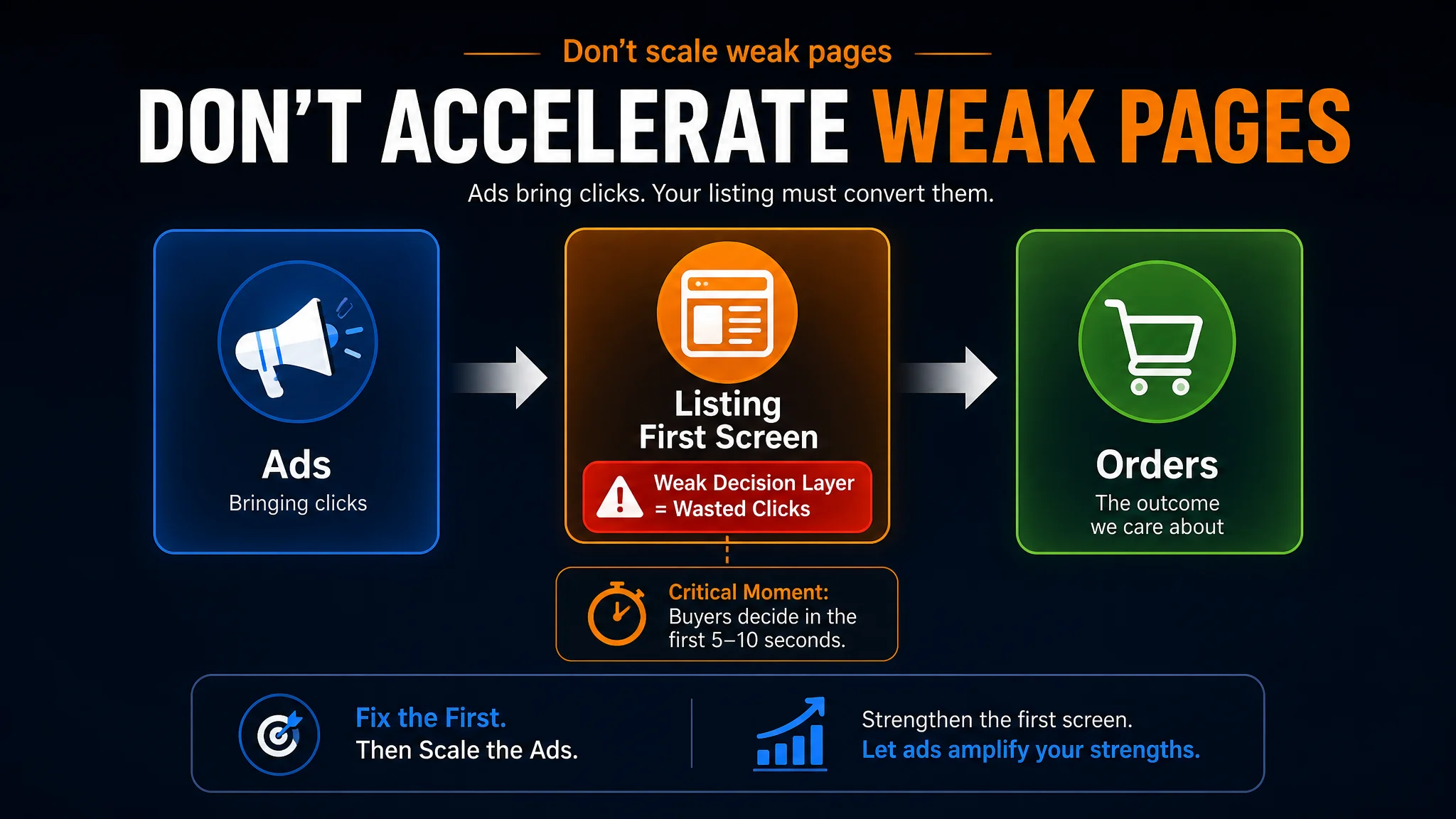
Under DeepBI, AI-driven diagnosis intervened at this point. Instead of simply automating the existing bid logic, the system exposed that the ads were already doing their job: they were bringing in clicks. The constraint was what happened after the click. In other words, AI didn’t just optimize bids; it questioned whether additional spend would be efficient without first correcting the front-page decision path. That is a critical distinction: intelligent advertising AI doesn’t blindly scale spend; it cross-references listing health to avoid amplifying structural weaknesses.
Bridging Advertising Performance to Listing Success
Generating traffic is only half the battle; converting that traffic into sales is what drives growth. A truly intelligent strategy creates a closed loop where advertising data directly informs listing optimization. The goal is to achieve a state where a 'Better Listing + More Precise Traffic = Healthier Long-term Growth'.
Instead of guessing why a campaign has a low Click-Through Rate (CTR), AI systems can diagnose the root cause by linking ad metrics to specific listing elements. For example, a persistently low CTR can be attributed to a weak main image, while a poor Conversion Rate (CVR) may point to ineffective A+ content. By analyzing these signals, AI not only identifies problems but also guides the creative optimization process. After deploying an AI-enhanced image, the system can automatically create an "event point" in advertising reports, allowing you to track the direct impact on CTR and CVR, turning creative improvements into a quantifiable, data-driven process.
In the borescope case, this bridge was exactly what had been missing. The team treated low conversion as an advertising issue and never linked CTR and CVR back to specific listing components. DeepBI’s AI connected the dots: stubborn ACOS combined with relatively healthy click volume indicated that ads were functioning, but the Listing’s early decision layers—title, main images, bullets—were not helping professional buyers decide fast enough. Once the title was restructured, bullets were rewritten from spec lists into outcome-centric scripts, and the main image was refocused around a clear industrial use case, subsequent ad traffic behaved differently. While the case did not anchor the change to specific numeric uplifts, operationally the pattern was clear: ads stopped acting as a patch for weak messaging and began acting as a multiplier for a stronger listing.
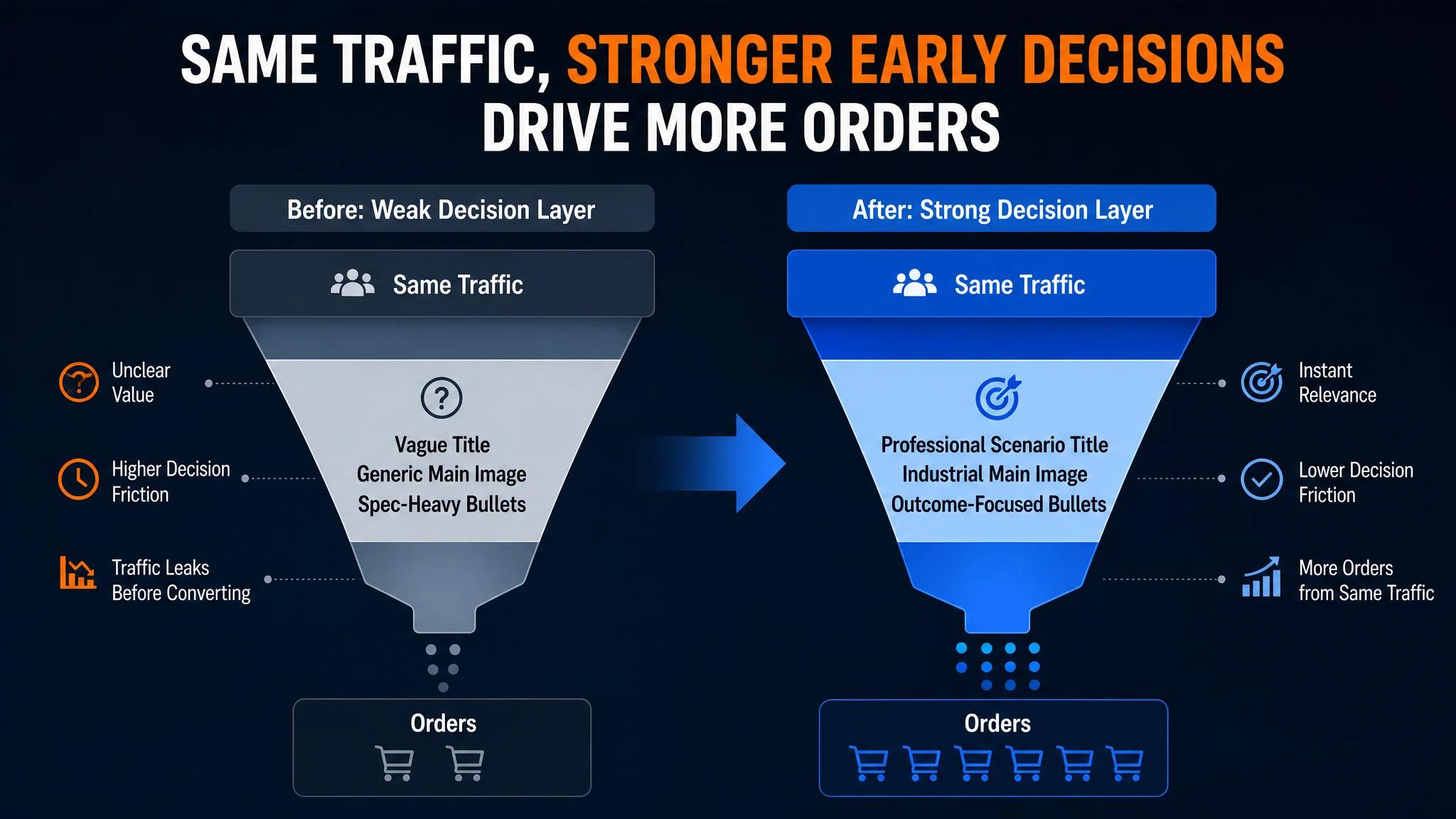
The lesson is that AI should be used not just to press harder on the advertising gas pedal, but to evaluate whether the vehicle (your Listing) is capable of converting additional speed into forward motion. Bridging advertising data to listing diagnostics closes that loop.
Sustaining Growth: AI for Organic Traffic
While paid advertising is crucial for initial traction, long-term profitability on Amazon hinges on achieving high organic search visibility. Relying solely on ads creates a costly cycle, whereas strong natural rankings build a sustainable asset that generates sales with lower marginal costs. The strategic goal is to convert paid advertising data into a durable organic advantage, creating a flywheel for healthier, scalable growth. AI provides the analytical power to build this bridge effectively.
Strategic Keyword Targeting for Natural Search Dominance
Effective organic strategy begins with identifying the right keywords. AI-powered platforms move beyond basic tools by performing deep competitive analysis, using multi-dimensional algorithms to benchmark against ASINs that share a similar use case and functional logic. This ensures you are learning from the most relevant and successful competitors.
More importantly, AI mines your own advertising reports to uncover "winning terms"—search queries with a proven history of high Click-Through Rates (CTR) and Conversion Rates (CVR). By strategically applying advanced filters, AI identifies these high-performing keywords, providing a data-validated foundation to improve your ranking potential and focus optimization efforts where they will have the greatest impact.
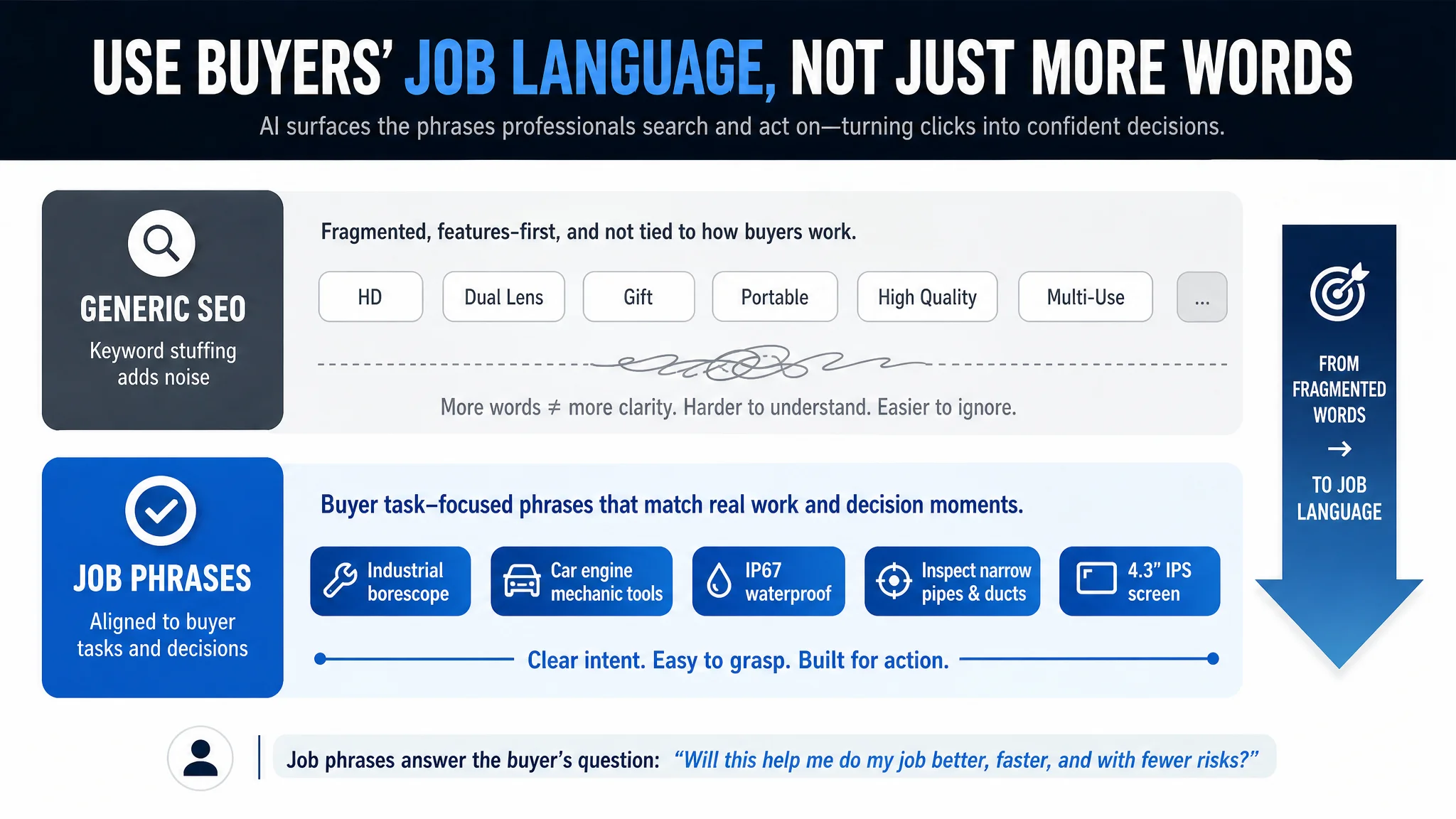
The borescope case underscores why this keyword intelligence must be interpreted through the lens of buyer jobs, not just search volume. The benchmark competitor didn’t win by listing more features; it won by structuring its title and bullets around how industrial buyers actually describe their tasks: probe diameter in millimeters, cable length in feet, screen type, and concrete scenarios like “car engine” or “aircraft mechanic tools.” An AI system that analyzes both search queries and winning competitor copy can surface these “job phrases” and suggest them as primary title and bullet elements, instead of relegating them to secondary positions or generic phrasing. That alignment between keyword intelligence and job language is what lays the groundwork for stronger organic positioning.
Enhancing Natural Search Rankings and Reducing TACOS
The insights gained from advertising data are then used to create a powerful feedback loop. AI systematically integrates these high-conversion keywords into your product titles, bullet points, and descriptions. This process enhances the listing's relevance for terms that real buyers are using to make purchases, directly boosting its potential to rank higher in Amazon's natural search results.
As organic ranking improves for these valuable keywords, you capture more sales without paying for each click. This increased organic traffic reduces your dependency on paid advertising, leading to a direct improvement in your Total Advertising Cost of Sales (TACOS). This creates a virtuous cycle: a better listing, fueled by precise traffic data, drives healthier long-term growth and a more resilient business.
Translating that into the borescope scenario, the AI-guided rewrite of title and bullets effectively “hard-coded” high-intent job phrases—such as “industrial borescope,” “endoscope camera with light,” “IP67 waterproof,” and specific use cases like “car engine mechanic tools”—into the Listing. These are not just SEO tweaks; they are the same terms that had already proven their ability to drive conversions via ads. Once embedded into the content, they improve the Listing’s eligibility to rank organically for those queries. Over time, that shift reduces the need to “buy back” the same traffic repeatedly and helps bring TACOS down as a natural consequence of better, AI-informed content alignment.
DeepBI: A Unified AI System for Amazon Success
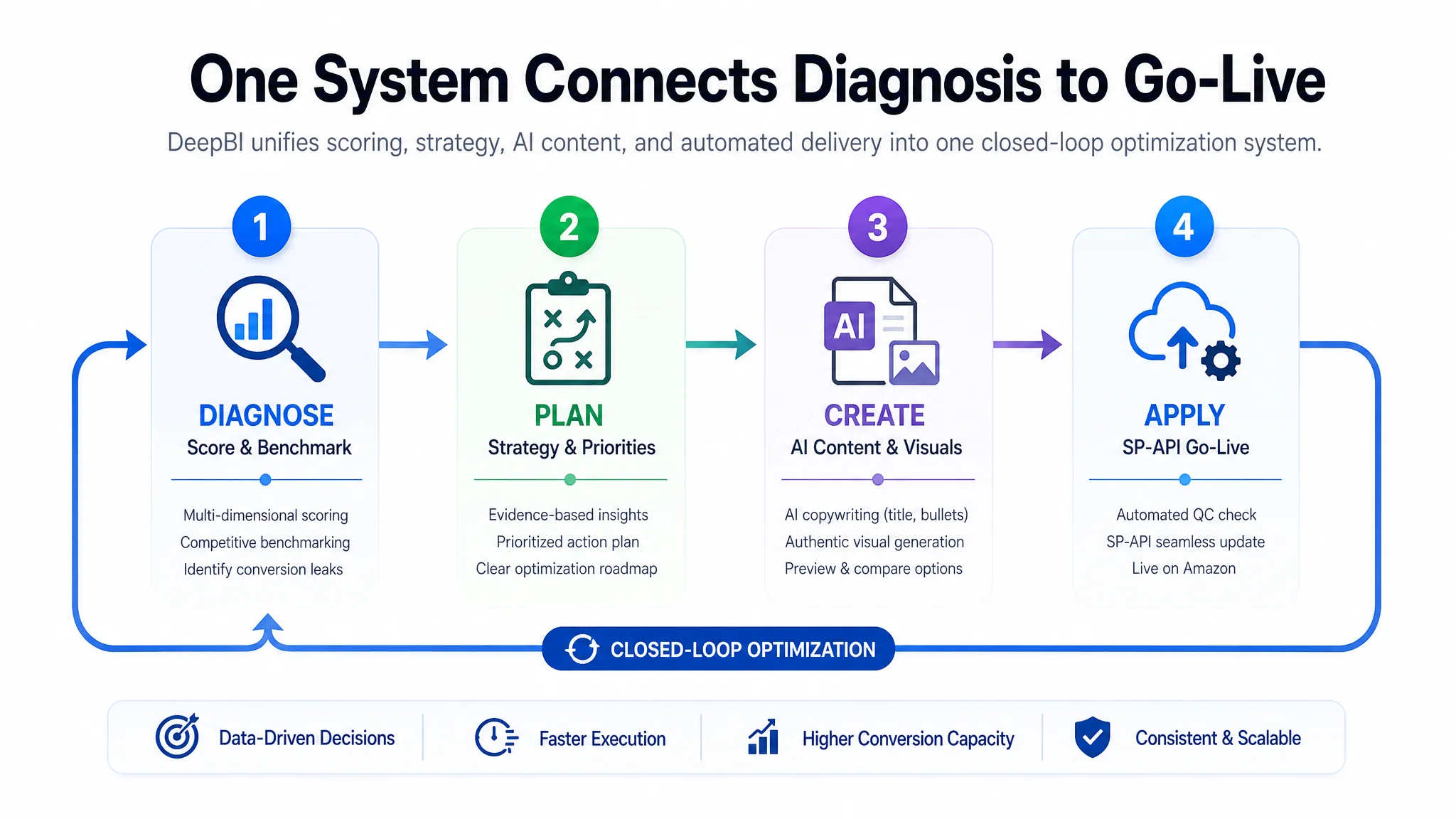
Effective Amazon management requires breaking down the silos between diagnosis, strategy, production, and delivery. DeepBI functions as an AI-centric, Amazon-only, full-link optimization system designed to unify this fragmented workflow. By integrating intelligent scoring, strategic suggestions, AI content generation, and automated delivery into a single algorithmic context, it transforms complex operational decisions into a standardized, engineering-driven path. This approach moves beyond simple analysis, turning DeepBI into an execution center that closes the loop from identifying a performance gap to deploying the solution within one platform.
The industrial borescope project demonstrates what this unification looks like in practice. The process did not end at highlighting that the title was -3 versus the benchmark or that the main image lacked scenario anchoring. DeepBI converted that diagnosis into a concrete sequence of actions: re-architect the title around core product terms and job scenarios, reframe bullets from raw specifications to pain–solution–value arcs, and redesign the main image to visually prove probe size and usage environments in a single glance. Each step was linked back to the earlier scoring and benchmark comparisons, ensuring that execution remained tightly coupled to the original diagnostic evidence.
Seamless Implementation and Iterative Refinement
DeepBI bridges the gap between strategy and execution with a one-click application module. Using the official Amazon Selling Partner API (SP-API), the system securely connects to your seller backend to automate the launch process. This allows for the direct synchronization of optimized listing content, such as AI-generated images, to the correct slots without manual uploads. This standardized process not only ensures execution accuracy but also mitigates account risks associated with manual backend logins. Before committing to a change, a flexible replacement mechanism allows you to compare new and old versions side-by-side, enabling confident, iterative improvements to your listings.
In the borescope case, this kind of controlled rollout was important. The team had invested heavily in their existing listing and was understandably cautious about sweeping changes. DeepBI’s ability to stage AI-optimized titles, bullets, and images as alternative versions made it possible to compare “before” and “after” both visually and through downstream performance data. Instead of a one-time redesign, the Listing became an iterative project: implement the new title, track its impact; then refine bullets; then rotate in updated visuals. Each iteration stayed anchored to the AI’s original diagnosis, avoiding random experimentation.
Measuring Impact and Continuous Improvement
The system creates a full-loop optimization cycle: analysis, strategy, execution, launch, and continuous refinement driven by performance data. After an update is published via the SP-API, DeepBI automatically tags the event in advertising reports. This critical step helps you quantify the direct impact of listing changes on key business metrics like Click-Through Rate (CTR) and Conversion Rate (CVR). By continuously feeding this performance data back into the system, DeepBI’s strategic models evolve without manual intervention. This makes listing optimization a predictable and measurable process, ensuring that every adjustment is a deliberate step toward improving your most important Amazon KPIs.
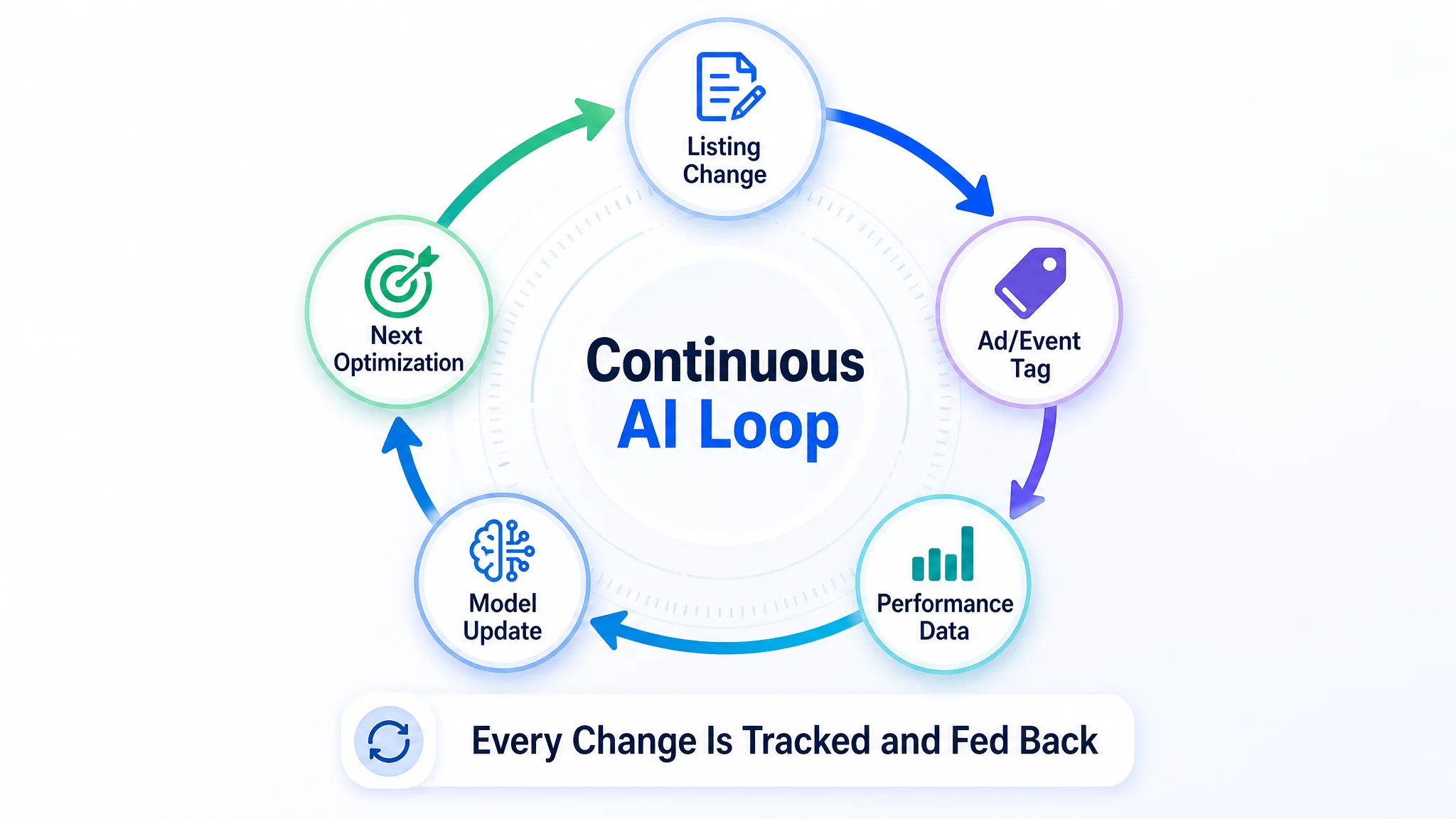
This event-tagging is what allows a seller to understand whether, for example, the new bullet structure in the borescope Listing actually reduces decision friction for professional buyers or whether a revised main image meaningfully improves CTR. In that project, ads that previously magnified the Listing’s weaknesses began to behave differently once the early-page decision path was strengthened. While the case does not assign that change to specific uplift percentages, the operational shift was evident: the Listing’s conversion capacity became more robust, and ad spend no longer had to compensate for misaligned titles and generic bullets. That kind of closed-loop measurement is only possible when AI orchestrates both the changes and the tracking.
Best Practices for Leveraging AI in Amazon Operations
Understanding AI's Role and Realistic Expectations
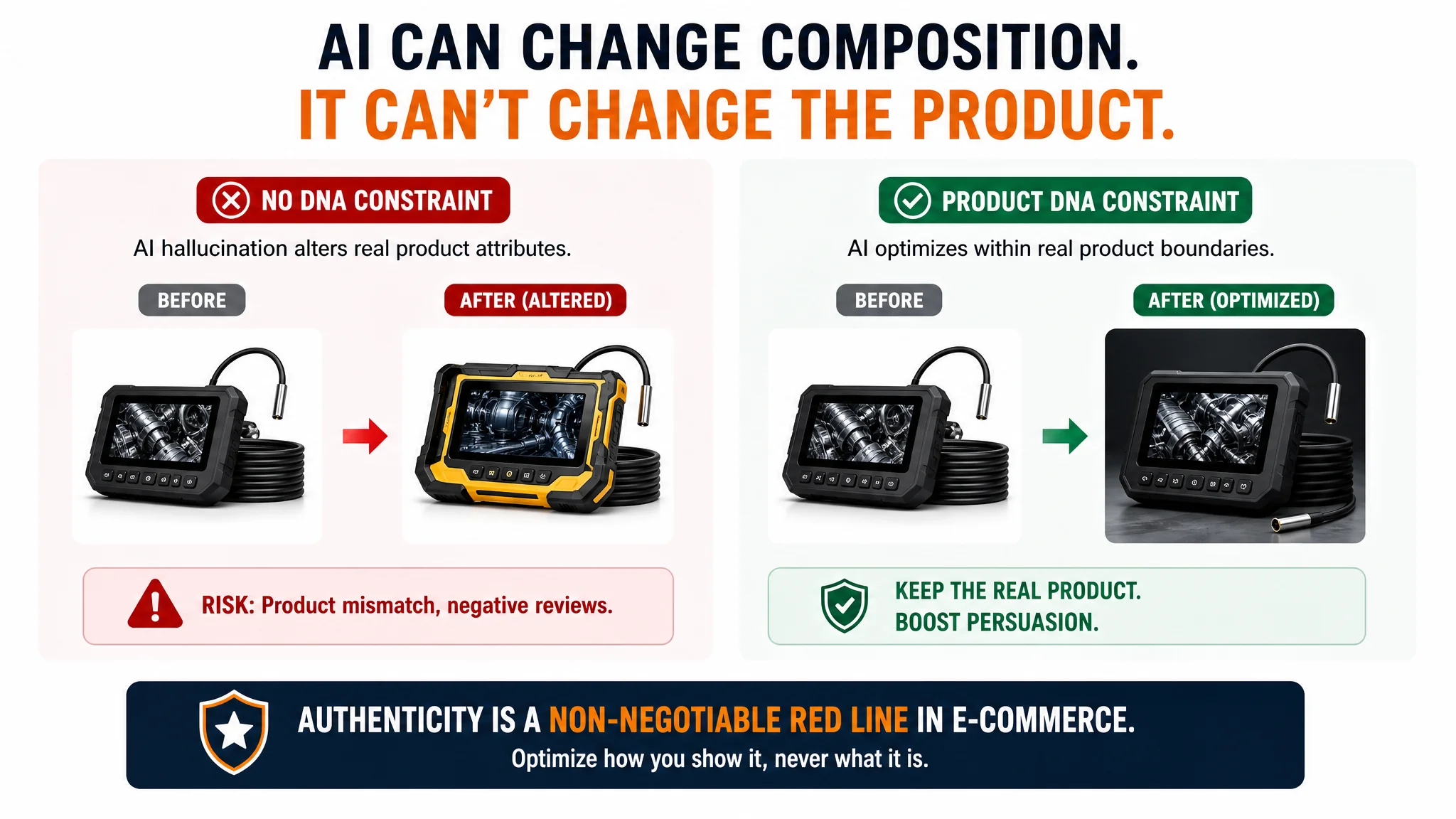
To effectively harness AI, it's crucial to view it as a powerful executor, not a blind creator. AI lacks the subjective judgment and real-world selling experience that informs seasoned sellers. Its outputs might be visually appealing but not necessarily effective at driving sales if not guided by a clear strategy. A significant risk is "AI hallucination," where the tool might alter a product's core physical attributes—like its material, color, or structure. This can lead to customer complaints, returns for "product not as described," and lasting damage to your brand's reputation. Authenticity is a non-negotiable red line in e-commerce.
The industrial borescope case offers a concrete warning here. The seller’s original visuals were already polished, and a naive use of generic image-generation tools could easily have pushed them into over-designed territory—adding unrealistic lighting effects, altering the perceived size of the probe, or depicting impossible scenarios that looked impressive but misrepresented the product. DeepBI’s “product DNA” discipline prevented that. The AI was constrained to stay within the real probe diameter, screen size, and material properties while enhancing composition and storytelling. That balance—strict entity consistency with creative framing—is where AI delivers commercial value without compromising authenticity.
Strategic Integration for Maximum Impact
Successful AI integration begins with clear, metric-driven objectives. Instead of vague requests, define tasks using key performance indicators (KPIs). For instance, if your Click-Through Rate (CTR) is underperforming, direct the AI to optimize the main image. If a low Conversion Rate (CVR) is the problem, task it with enhancing A+ content based on data from top-performing competitors.
Establish firm guardrails by defining a "Product DNA"—a set of unchangeable rules covering brand identity and core product attributes. This ensures all AI-generated content maintains product entity consistency and brand compliance. Finally, always retain human oversight. AI should present options, but the final publishing decision must be yours. A side-by-side comparison of old and new visuals allows for a final strategic check, ensuring the AI's execution aligns perfectly with your business goals.
In the borescope project, these best practices played out as follows:
- The objective was explicitly framed as improving listing conversion capacity, not just “making the page look better.”
- DeepBI’s scoring decomposed the problem into specific KPIs: title relevance, bullet logic, main image scenario anchoring.
- AI was then tasked with restructuring those exact elements, using benchmark patterns from higher-performing competitors.
- The seller retained the final say, reviewing each proposed change to ensure it reflected their positioning as a professional tool, not a generic gadget.
This division of labor—AI for diagnosis and execution, humans for strategic intent—helped avoid two common pitfalls: over-trusting AI to “figure it out” and under-using AI as a mere idea generator without operational follow-through.
Conclusion: The Future of Amazon Selling with AI
The era of manual guesswork and subjective optimization on Amazon is rapidly closing. To secure a durable competitive advantage, sellers must now treat AI not as an experimental tool, but as a core operational necessity. The true power of this technology is realized in integrated systems that unify the entire listing optimization lifecycle—from diagnosis and strategy to production and execution.
Platforms like DeepBI break down the traditional silos between these stages, transforming listing management from an intuitive art into a quantifiable science. By connecting objective analysis with AI-powered content generation and seamless application, this full-funnel approach ensures every optimization is engineered for measurable improvements in Click-Through Rate (CTR) and Conversion Rate (CVR). The system acts as a high-quality executor of your strategy, turning data-driven insights into high-performing assets with precision.
The industrial borescope Listing illustrates what is at stake. On the surface, it was a “good enough” page: strong ratings, rich A+ content, and only a marginal score gap versus a benchmark. Yet AI diagnosis exposed a quiet cap on performance: titles and bullets that didn’t reflect how professionals search, main images that looked good but didn’t instantly prove use cases, and a front-page decision path that lagged the back-page storytelling. Advertising spend was unknowingly amplifying these weaknesses.
Once AI reframed the problem—from “drive more traffic” to “fix what happens in the first 5–10 seconds after a click”—and guided systematic changes, ads began amplifying strengths instead. For sellers in any category, this is the key takeaway: AI is not just a way to automate tasks; it is the mechanism that ties your entire Amazon operation into a coherent, evidence-based system. As the marketplace evolves, those who use AI to reveal and remove hidden bottlenecks in their listings will be the ones who make smarter decisions, drive profitability, and lock in a winning position.