

The Illusion of ACOS: Why Ad Efficiency Doesn't Always Mean Profit
For most Amazon sellers, Advertising Cost of Sale (ACoS) is a primary performance indicator. It is calculated by dividing total ad spend by the revenue generated from those ads, serving as a direct measure of an advertising campaign's efficiency. A lower ACoS signifies that less is being spent to generate each dollar of ad-attributed sales, making it a key target for optimization.
However, a singular focus on lowering ACoS can be deceptive. This narrow approach can create an "Illusion of ACoS," where strong advertising metrics mask fundamental weaknesses in overall profitability. A low ACoS does not automatically translate to a healthy business, as the metric ignores crucial factors like product cost, Amazon fees, and shipping expenses. Consequently, a campaign with an excellent ACoS can still be unprofitable on a net basis.
In real operations this “illusion” often appears when teams assume “ads are the problem” simply because ACOS looks high or volatile. In one women’s “secret pocket” travel-underwear listing, the seller saw rising ACOS and flat orders despite solid review numbers and traffic. Internally, the instinct was to push harder on ad structures—tuning bids, search terms, and campaign types—under the assumption that targeting and volume were the bottleneck. On the surface, this made sense: ratings were strong, review volume beat a key competitor, and ads were already bringing clicks. It felt like a classic “we just need to optimize the campaigns” situation.
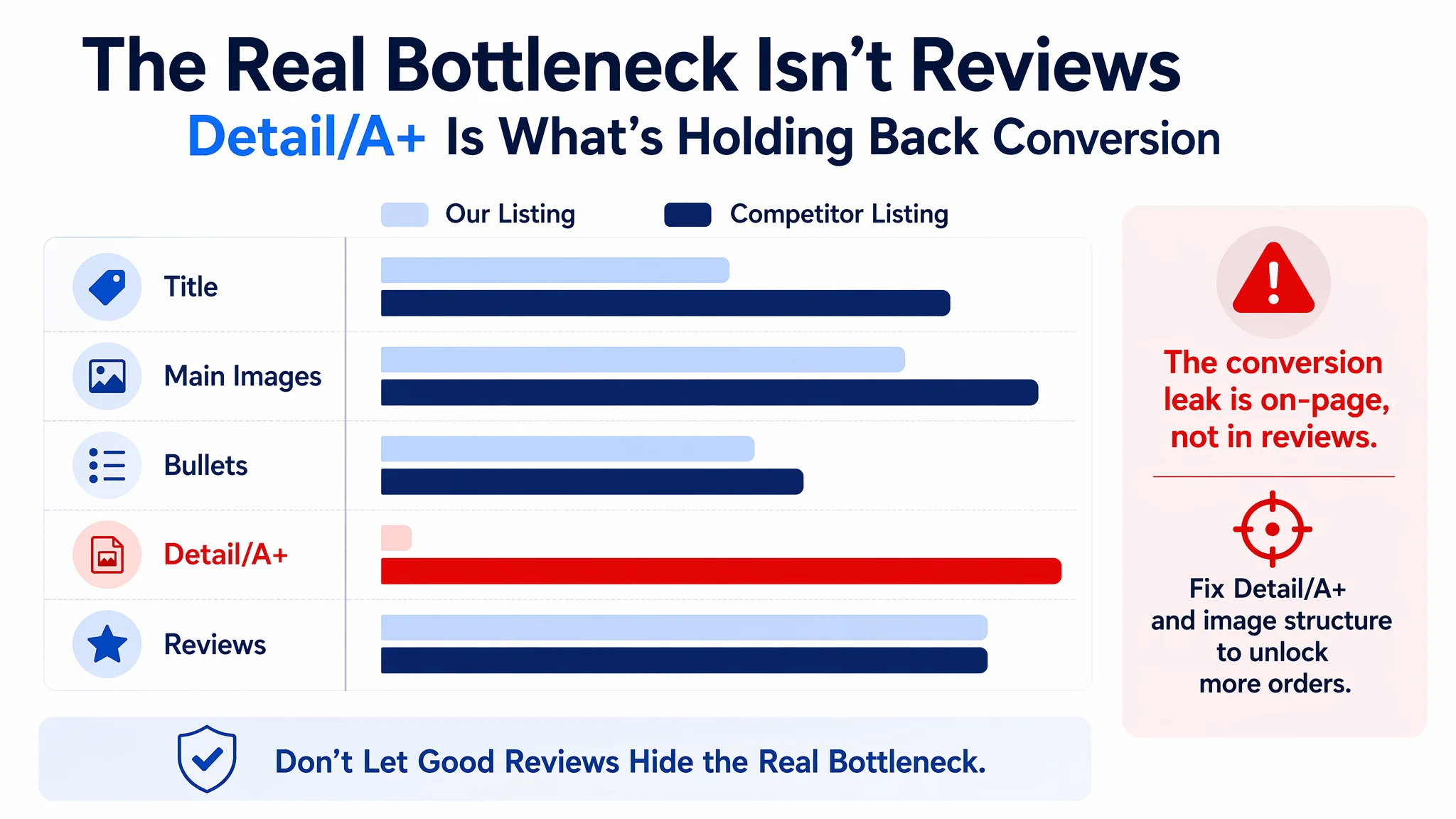
DeepBI’s diagnosis showed something very different. When the listing was benchmarked against a directly comparable competitor, the page scored only 50/100 versus 83/100, with a massive -21 gap in the detail/A+ content dimension and a -7 gap on main images. In other words, advertising was doing its job—delivering traffic—but the page could not carry that traffic into orders. The business was facing a conversion-capacity problem disguised as a media-efficiency problem. That is exactly how an apparently “normal” ACOS can coexist with poor profitability: the metric is reflecting ad efficiency, not the structural weakness of the product page.
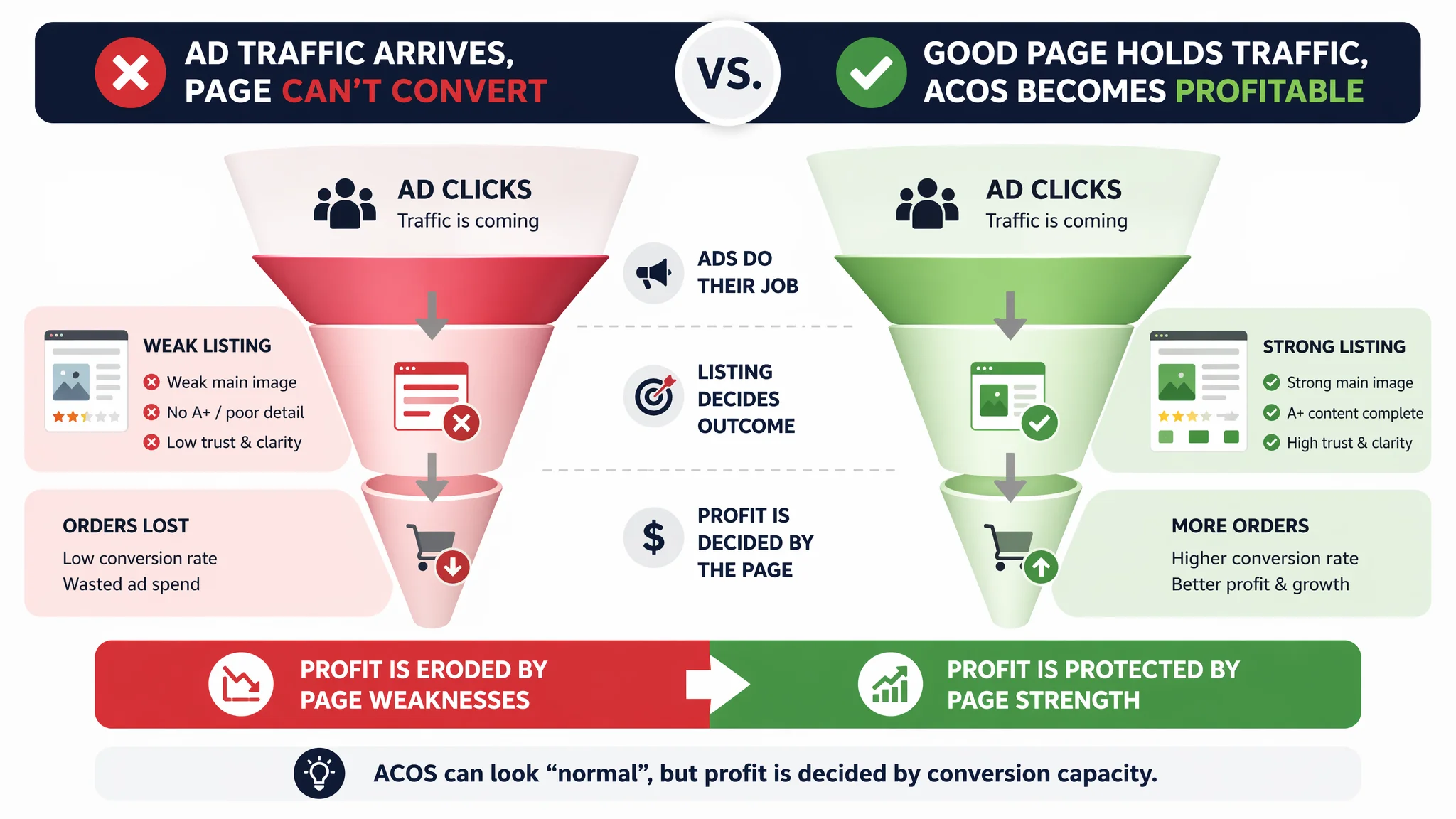
Furthermore, ACoS does not capture the full scope of marketing efforts, particularly the impact on organic sales and search ranking. A more complete perspective often incorporates Total Advertising Cost of Sale (TACoS), which measures ad spend against total revenue. An obsessive focus on ACoS can also conceal critical listing flaws. For instance, a campaign might achieve a decent ACoS but suffer from a low click-through rate (CTR), indicating a weak main image that fails to attract shoppers. Or, as in the underwear example, a seller may have enough clicks but an underbuilt detail/A+ section that cannot answer buyers’ doubts, resulting in wasted spend and eroding margins. Genuine profit growth requires moving beyond simple ad efficiency to a comprehensive analysis of the entire business cycle.
The Hidden Costs: Factors That Distort ACOS and Erosion Profit
While Advertising Cost of Sale (ACoS) is a fundamental metric, relying on it exclusively provides a limited view of your business's financial health. Several underlying factors can distort what ACoS communicates, potentially leading to decisions that erode margins even when ad performance appears strong. Achieving sustainable profitability requires looking deeper at these hidden costs.
- Fluctuating Market Dynamics: A stable ACOS can mask underlying problems. If your cost-per-click (CPC) is rising, you need a higher conversion rate (CVR) just to maintain the same ACOS, which often means lower profit per sale. Conversely, a drop in your CVR indicates that your ads are becoming less effective at turning clicks into sales, directly impacting your bottom line regardless of the ACOS figure.
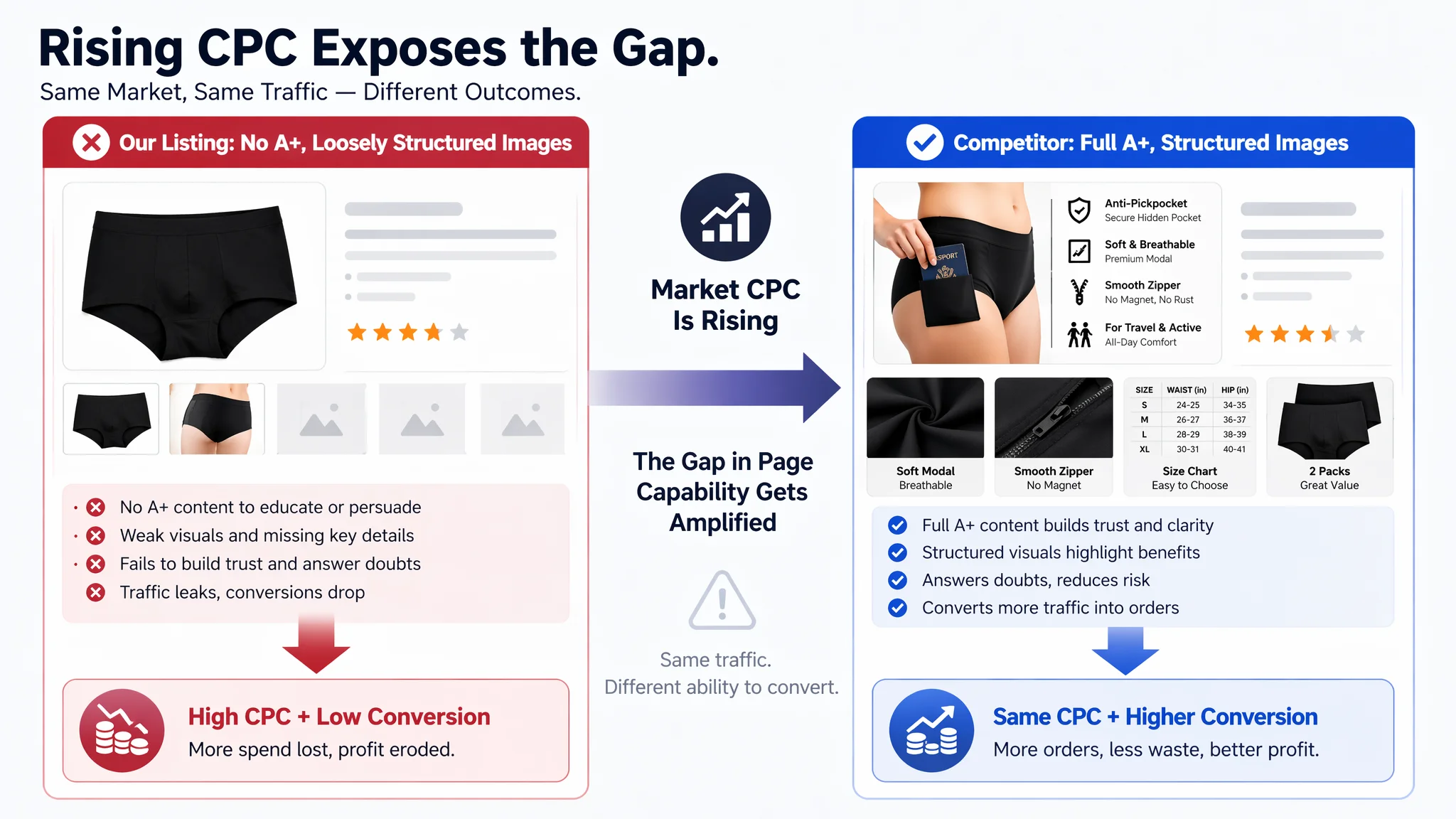
This effect becomes particularly visible when competition professionalizes around you. In the “secret pocket” underwear case, the seller experienced growing pressure on CPCs while assuming ad structure was the sole lever. At the same time, a competitor’s listing had a fully built A+ section, clear size charts, and a structured image sequence, while the seller’s own product page had no A+ at all and a loosely structured image set. As CPCs rose, the competitor could still convert a healthy portion of each paid visit thanks to stronger on-page persuasion, whereas the underbuilt listing saw more and more expensive clicks fail to convert. From an ACOS perspective, things looked like “ads are getting expensive”; from a profit perspective, the real problem was a weaker conversion engine failing to justify those higher clicks.
- Product Margins and Amazon Fees: ACoS operates in a vacuum, ignoring the unique profit margin of each product. A "good" ACoS for a high-margin item could be disastrous for a low-margin one. Furthermore, the calculation does not factor in Amazon's various charges, such as FBA fulfillment fees, referral fees, and long-term storage costs, which are essential for determining net profit.
Sellers with seemingly “healthy” ACOS often discover this disconnect when they finally quantify their fee and cost structure. In the underwear example, the team initially evaluated performance mostly through ACOS and review strength, assuming that if ad efficiency improved slightly, profitability would follow. Once they saw a listing score breakdown—segmenting title, images, bullets, and detail/A+—the conversation shifted from “can we push ACOS lower?” to “does this product page actually earn enough per visit to cover all fees and COGS?” Only after mapping those costs did the team understand that minor ACOS gains on an under-converting page could still leave them below break-even.
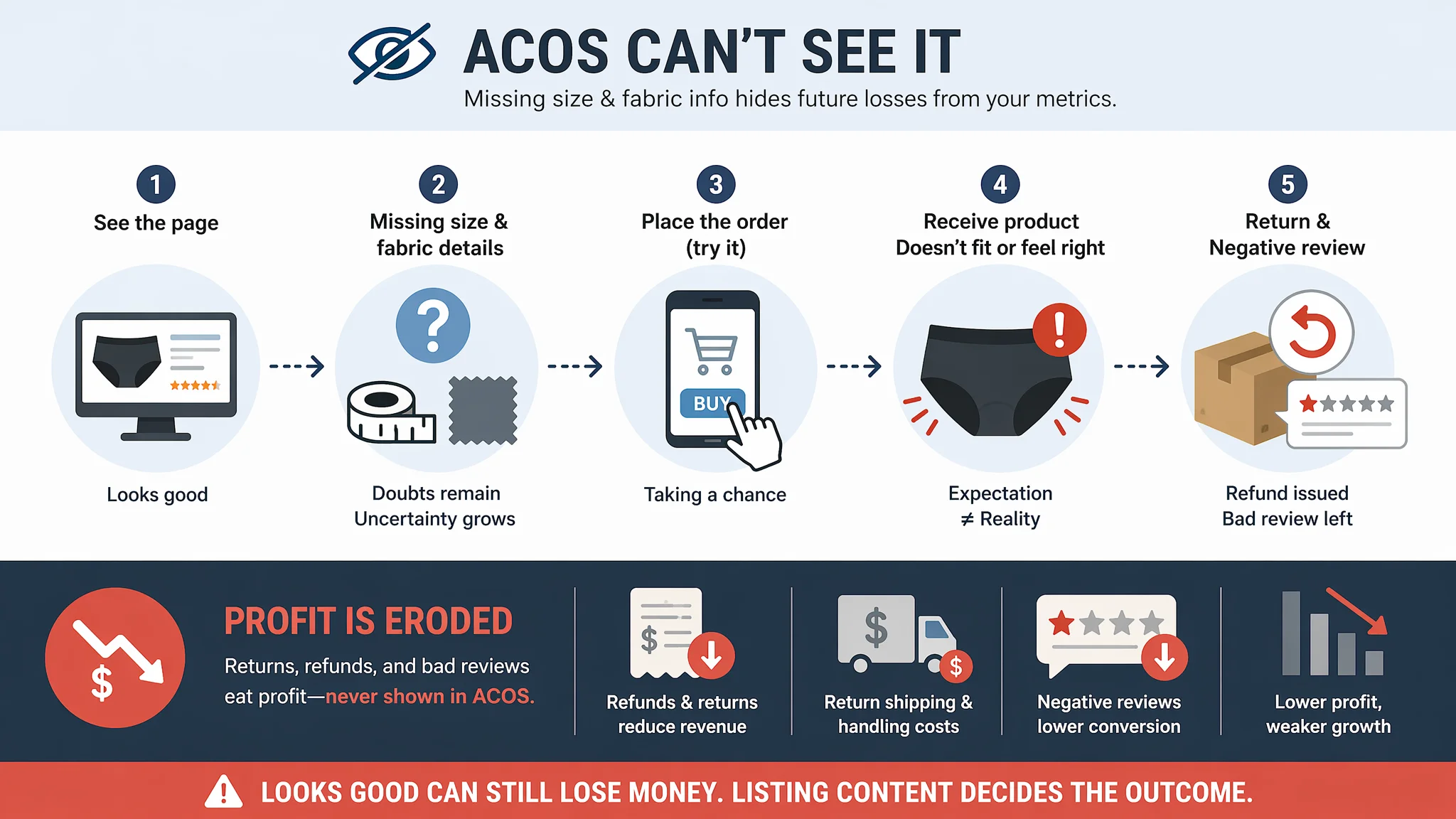
- Returns and Refunds: Every return eats directly into your ad-generated revenue and incurs additional administrative costs. This issue is often rooted in listing quality. For instance, a main image that misrepresents a product's color, material, or scale can lead to a surge in returns, negative reviews, and a "refund crisis" that ACoS will never show.
In categories involving fit and comfort, like apparel or travel underwear, missing detail/A+ content and unclear sizing can quietly manufacture returns. In the “secret pocket” underwear listing, the absence of a visual size chart and detailed fabric explanation meant buyers could only guess about fit and feel from sparse bullets. By contrast, the competitor showed clear size guidance and multiple fabric close-ups. Any misalignment between expectation and reality—whether the underwear felt thicker than imagined, fit tighter than expected, or didn’t accommodate specific devices comfortably—would surface after purchase as returns and refunds, not in ACOS. Without a diagnosis of listing content, the seller might have blamed ads for poor financial performance while the real leak was post-purchase dissatisfaction driven by under-specified product information.
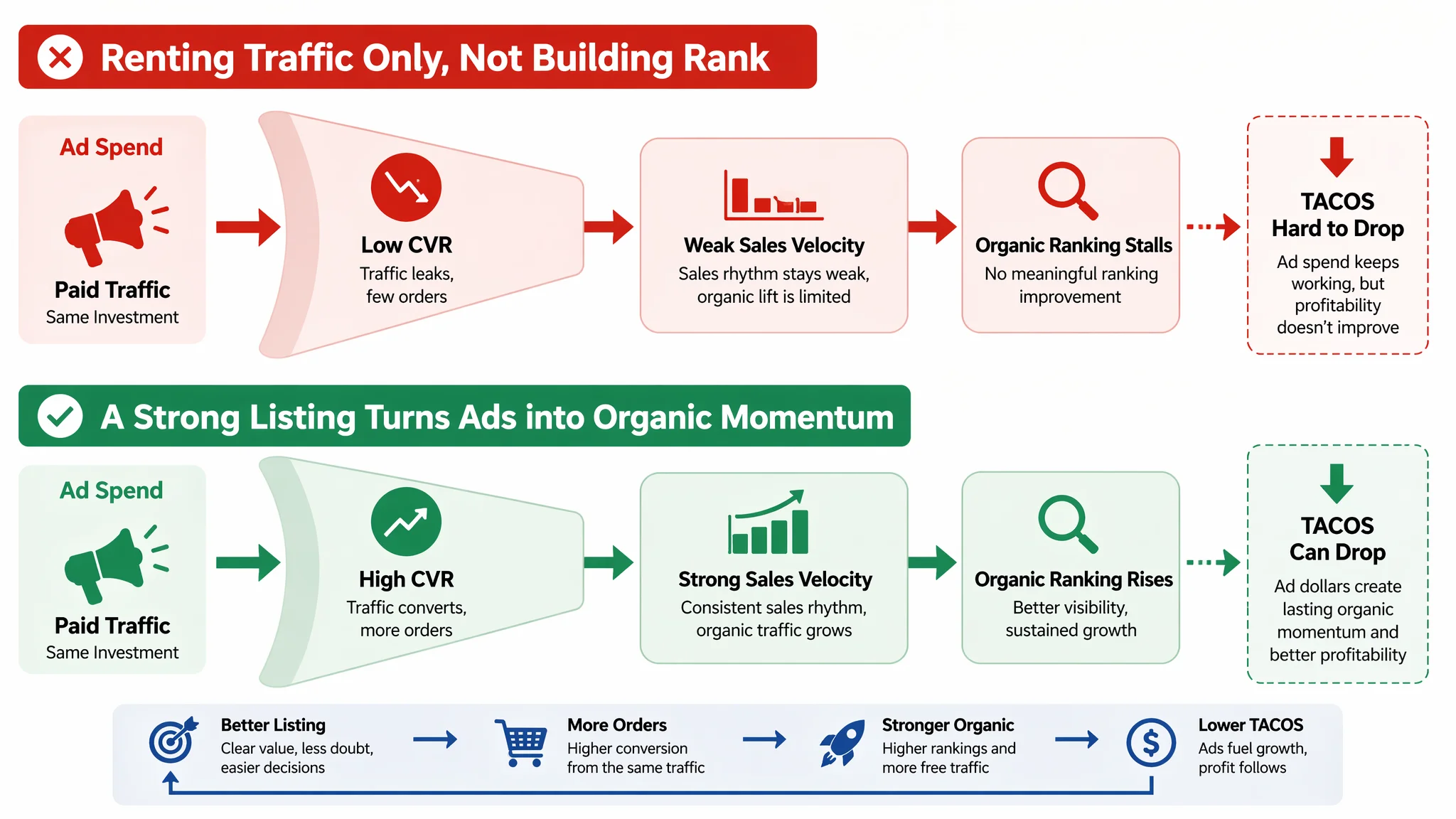
- Organic Sales Impact: ACoS only tracks sales directly attributed to a click, ignoring the significant "halo effect" advertising has on organic sales. Effective ads improve a product's sales velocity, which in turn boosts its organic ranking. This creates a positive feedback loop, lowering your Total Advertising Cost of Sale (TACoS) over time—a crucial long-term benefit that ACoS fails to capture.
The underwear example illustrates what happens when listing quality limits this halo effect. Before optimization, ads were indeed sending traffic, but the page’s low conversion capacity—especially the 0/25 score on detail/A+—meant that sales velocity remained constrained. Organic rankings had little chance to benefit because the underlying listing could not convert enough incremental sessions into orders to sustain a strong sales rhythm. After the listing was rebuilt around a coherent “comfort + security” narrative, with structured images and A+, the same or similar ad spend was far more likely to lift both paid and organic sales. TACOS, not just ACOS, became the meaningful reflection of whether the seller was building a sustainable growth loop rather than simply renting traffic.
Introducing True Profitability: TACOS and the Holistic View
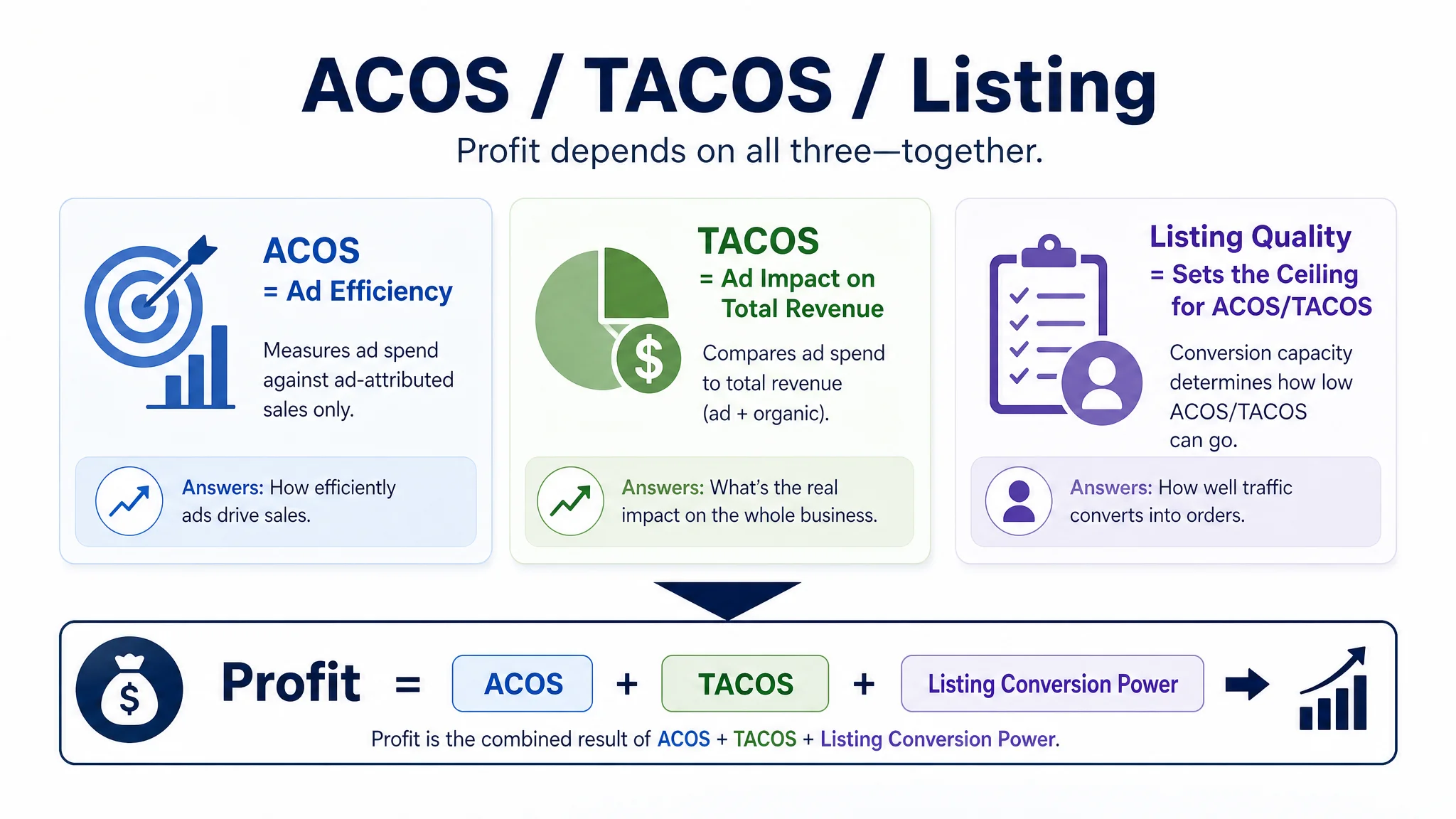
While many sellers concentrate on Advertising Cost of Sales (ACoS), this metric only reveals the efficiency of ad spend relative to ad-generated revenue. To understand the true impact of advertising on overall business performance, it is essential to evaluate a more encompassing metric: Total Advertising Cost of Sales (TACoS).
TACoS is calculated as (Total Ad Spend ÷ Total Revenue) × 100. The critical distinction lies in its use of "Total Revenue," which includes all sales from an Amazon account—both ad-driven and organic. This metric reveals the powerful flywheel effect of advertising, where successful campaigns not only generate direct sales but also boost organic ranking, leading to more organic sales over time. A decreasing TACoS, even with stable or increasing ad spend, indicates that advertising is effectively fueling long-term growth.
Yet TACOS alone still needs to be interpreted through the lens of listing quality and conversion capacity. In the travel-underwear case, the seller initially sought to reduce ACOS by more precisely tuning bids and keywords. Had they focused only on TACOS without examining the page, they might have concluded that the product “just doesn’t scale” when TACOS failed to improve. DeepBI’s listing score, however, exposed a -33 point gap to a benchmark competitor, driven primarily by the absence of A+ content and weaker main images. Once the listing was rebuilt—repositioned from a narrow “anti-theft gadget” to “comfortable travel underwear with integrated secure storage,” with structured images and A+ modules addressing comfort, security, sizing, and use cases—the same advertising investment had a better chance of translating into both direct and halo sales. In other words, TACOS improved not because of clever bidding alone, but because the underlying page finally deserved more traffic.
For additional context, Return on Ad Spend (ROAS)—calculated as (Ad Revenue ÷ Ad Spend) × 100—measures the revenue earned for every dollar spent on ads. However, neither ACoS nor ROAS indicates whether your campaigns are actually profitable. To determine this, you must calculate your break-even ACoS, which is the maximum ACoS a product can sustain before it starts losing money. This calculation incorporates all associated costs: Cost of Goods Sold (COGS), Amazon fees, shipping, and other overhead. Knowing this profitability threshold is essential for setting realistic and effective advertising targets.
In practice, the underwear seller’s turning point came when break-even logic was combined with listing diagnostics. Rather than chasing an arbitrarily “low” ACOS, the team could compare real break-even thresholds with the page’s conversion potential. The insight was straightforward: before expecting ads to hit profit targets, the listing itself needed to be capable of converting enough of each paid session to cover COGS and fees. Break-even ACOS moved from a theoretical number to a concrete design constraint on the listing.
Strategies for Optimizing Both ACOS and Profit
To genuinely drive profitability, sellers must shift from a singular focus on ACOS to an integrated optimization strategy. The objective is to create a positive feedback loop where high-quality product listings and precise ad targeting reinforce each other, resulting in sustainable growth and a lower Total Advertising Cost of Sales (TACoS).
This process begins with setting profit-driven advertising goals, which requires a granular analysis of all costs associated with each product to establish a viable target ACOS. With a clear profit margin defined, the most critical lever for ad efficiency becomes product listing optimization. A well-optimized listing—from its main image and title to its bullet points and A+ content—directly increases the Conversion Rate (CVR). A higher CVR yields more sales for the same ad spend, naturally lowering your ACOS. For example, a low Click-Through Rate (CTR) often points to a weak main image, while a low CVR can signal issues with trust or detail on the A+ page.
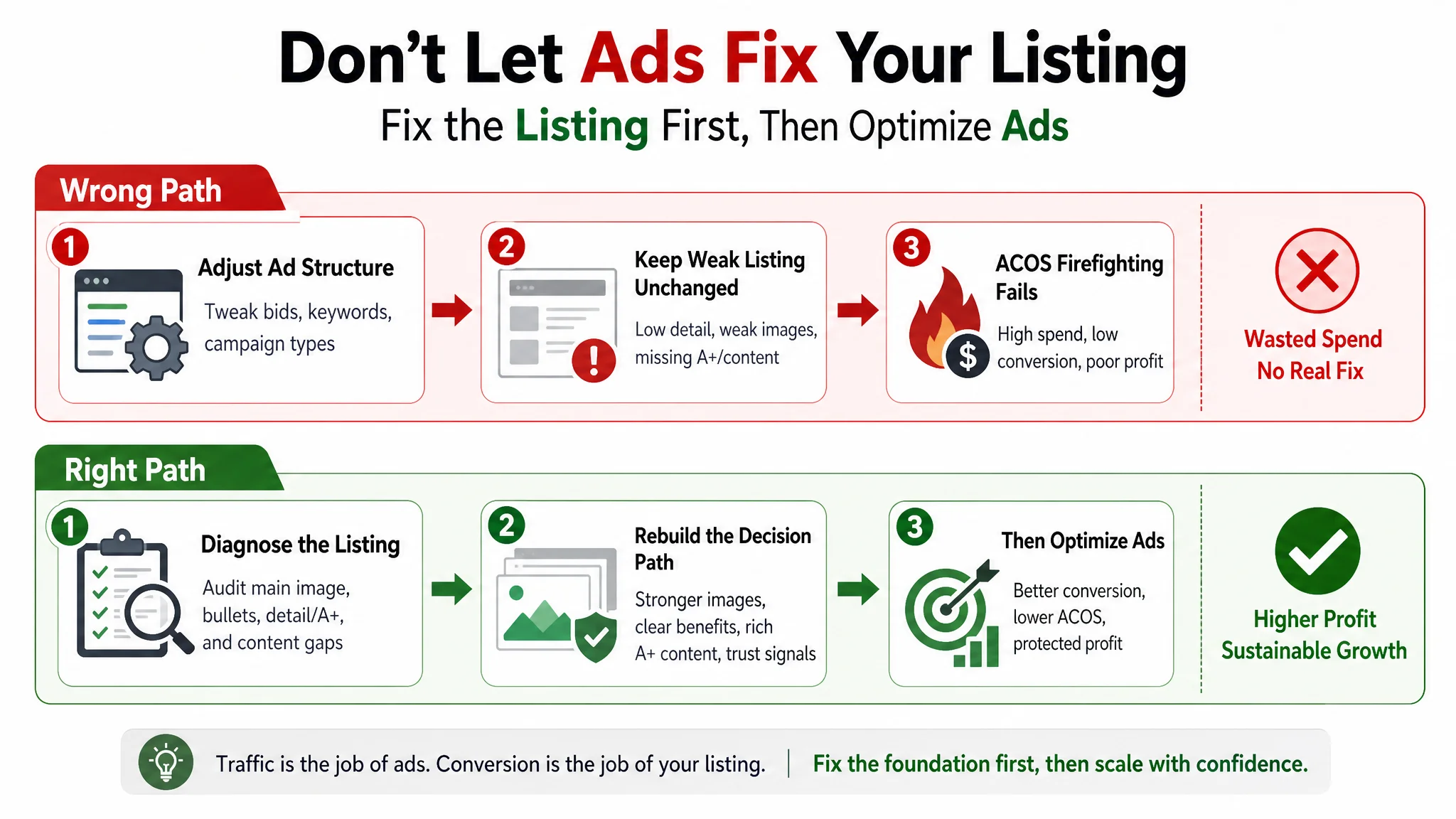
The women’s travel-underwear ASIN offers a concrete illustration of this strategy in action. Initially, the team tried to solve an ACOS problem exclusively through media tactics: more precise bids, better keyword structures, and additional campaign tests. DeepBI’s analysis made it clear that they were asking ads to fix what was fundamentally a listing issue. The diagnosis quantified exactly where the listing underperformed: a -7 gap on main images and a 0/25 score in the detail/A+ dimension compared to a key competitor. In practical terms, this meant the page could attract clicks but lacked a structured visual and textual decision path—no A+ modules for sizing, comfort, material proof, or use scenarios, and images that repeated similar angles instead of advancing buyer confidence.
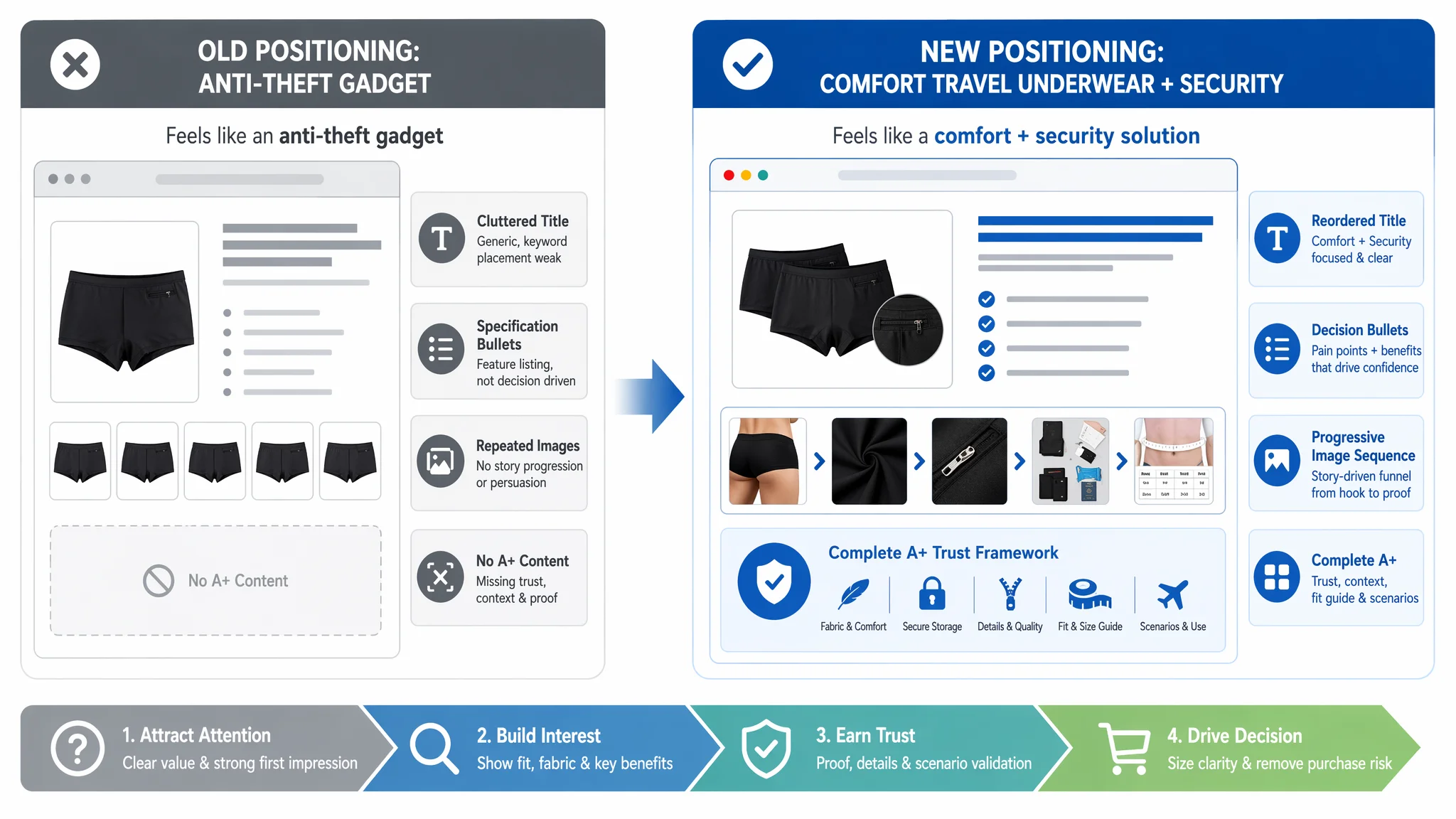
Instead of launching new campaigns, the optimization began with a reframe: positioning the product as “comfortable travel underwear with secure storage” rather than merely “underwear with a secret pocket.” This strategic shift cascaded into the content:
- The title was re-ordered to front-load “Women’s Underwear with Secret Zippered Pocket” and explicitly call out “Anti-Pickpocket” and “Travel Panties,” aligning better with search logic and buyer intent.
- Bullet points were rewritten from parameter lists into a decision-driven structure—linking modal fabric to superior comfort, the pocket to safety for valuables and insulin pumps, the zipper to security and device compatibility, and scenarios to emotional outcomes like “peace of mind in crowded events.”
- The main image sequence was rebuilt as a persuasion funnel: first showing the 2-pack and pocket function; then demonstrating fit and invisibility under clothes; then proving material quality and zipper details; and finally resolving use cases and sizing doubts.
- A completely new A+ section was added to provide a trust backbone: modules for style and coverage clarity, detailed sizing guidance, fabric and seam comfort, zipper safety, and pack value.
Only after this rebuild did the seller re-engage with ad optimization. When the campaigns resumed, each click landed on a page that visually and structurally answered the buyer’s key questions. CVR now had room to increase, making it realistically possible to reach the previously defined profit-driven ACOS targets. This sequence—listing repair first, ad refinement second—turned what had been an endless ACOS firefight into a controlled, data-backed improvement in both efficiency and profitability.
This data-driven approach extends directly to ad management. Instead of using ad reports solely for bidding adjustments, high-converting "winning terms" should be fed back into your listing content. If "fast charging" is a top-performing keyword, that feature should be made visually and textually prominent. Similarly, in the underwear case, terms related to “anti-pickpocket,” “travel” and “insulin pump” were not just left inside campaigns; they became structural anchors in the title, bullets, and A+. This continuous refinement of both your listing and your keyword and ASIN targeting enables more dynamic bid and budget management. By improving your listing's conversion power and focusing spend on proven targets, you can scale campaigns confidently without sacrificing profitability.
Leveraging DeepBI for Data-Driven Profitability on Amazon
To move beyond surface-level metrics, effective ad management requires a precise understanding of net profitability. DeepBI achieves this by integrating a comprehensive range of cost data, including over 40 distinct Amazon fee types, Cost of Goods Sold (COGS), and return-related expenses. This allows the platform to calculate a real-time, SKU-specific break-even ACOS, providing a clear baseline for what constitutes a profitable ad campaign and revealing the actual financial performance of your advertising.
In the “secret pocket” underwear project, this profit perspective was tightly coupled with a structural assessment of the listing. By scoring each dimension—title, main images, bullet points, detail/A+, and reviews—DeepBI could show the team that their strongest area (reviews) was not where the bottleneck lay. Reviews scored on par with the benchmark competitor; the conversion drag came from the 0/25 detail/A+ score and weaker image structure. This kind of diagnosis prevented the seller from misreading ACOS and reviews as proof that “the product is fine” and instead spotlighted the exact segments where investment would most impact net profit. Once the listing improvements were in place, the same break-even ACOS thresholds could be revisited with a realistic expectation that the page could now support the required CVR.
With this profit baseline established, DeepBI automates optimization. Its dynamic adjustment mechanism analyzes the past seven days of performance data—including clicks, conversions, ad spend, and ACOS—to make daily, data-driven changes to bids and budgets. This process ensures that ad spend is continuously aligned with profitability targets, systematically improving your return on investment.
The underwear case also illustrates how this automation is most powerful when it is not asked to compensate for structural weaknesses. Before optimization, the page's limited conversion capacity meant that any automated bidding system would be forced to reduce bids or cut traffic simply because the economics didn’t work. After the listing rebuild, the automation could operate in a healthier environment: each click had a better chance of becoming an order, returns risk was reduced through clearer sizing and material communication, and the combination of break-even ACOS and improved CVR allowed for more confident scaling. Instead of repeatedly throttling spend due to poor conversion, the system could pursue a more balanced strategy between ACOS control and growth.
The platform also provides the strategic insights needed to balance competing objectives. By presenting a unified view of advertising performance alongside real profit margins, DeepBI empowers sellers to make informed decisions on when to prioritize a low ACoS for efficiency or a higher TACoS to drive sales volume and market share, depending on the product's lifecycle and business goals. This data transforms advertising from a cost center into a tool for long-term organic growth by identifying high-CTR and high-CVR keywords that can be targeted to improve natural search rankings.
In the travel-underwear niche, this meant the seller could consciously decide when to tolerate a higher TACOS to push into more competitive “travel underwear” or “anti pickpocket” terms, knowing that the listing could adequately convert and that organic positioning could be strengthened as a result. Ad spend stopped being an open-ended experiment and became a calibrated lever in a broader profitability strategy.
Conclusion: The Path to Sustainable Amazon Success
The journey to lasting success on Amazon requires a fundamental shift from a narrow focus on ACoS toward a comprehensive, profit-driven strategy. Relying on isolated metrics and subjective optimizations can lead to wasted resources and missed opportunities. True financial health is not found in a single campaign's performance but in the vitality of the entire commercial ecosystem, from ad spend to organic rank.
The experience of the women’s “secret pocket” underwear listing underscores this shift. A strong review base, decent ratings, and active advertising did not prevent ACOS from becoming hard to control or orders from lagging. As long as the team framed the challenge as an “ads are getting expensive” problem, their actions centered on media tweaks. Only when DeepBI’s listing diagnosis exposed the structural gaps—no A+ content, underleveraged images, and a narrow, gadget-like positioning—did the strategy pivot to rebuilding the page’s decision logic. Once the listing was re-engineered around comfort, security, and sizing clarity, advertising finally had a page worthy of its traffic, and profitability targets became realistic rather than aspirational.
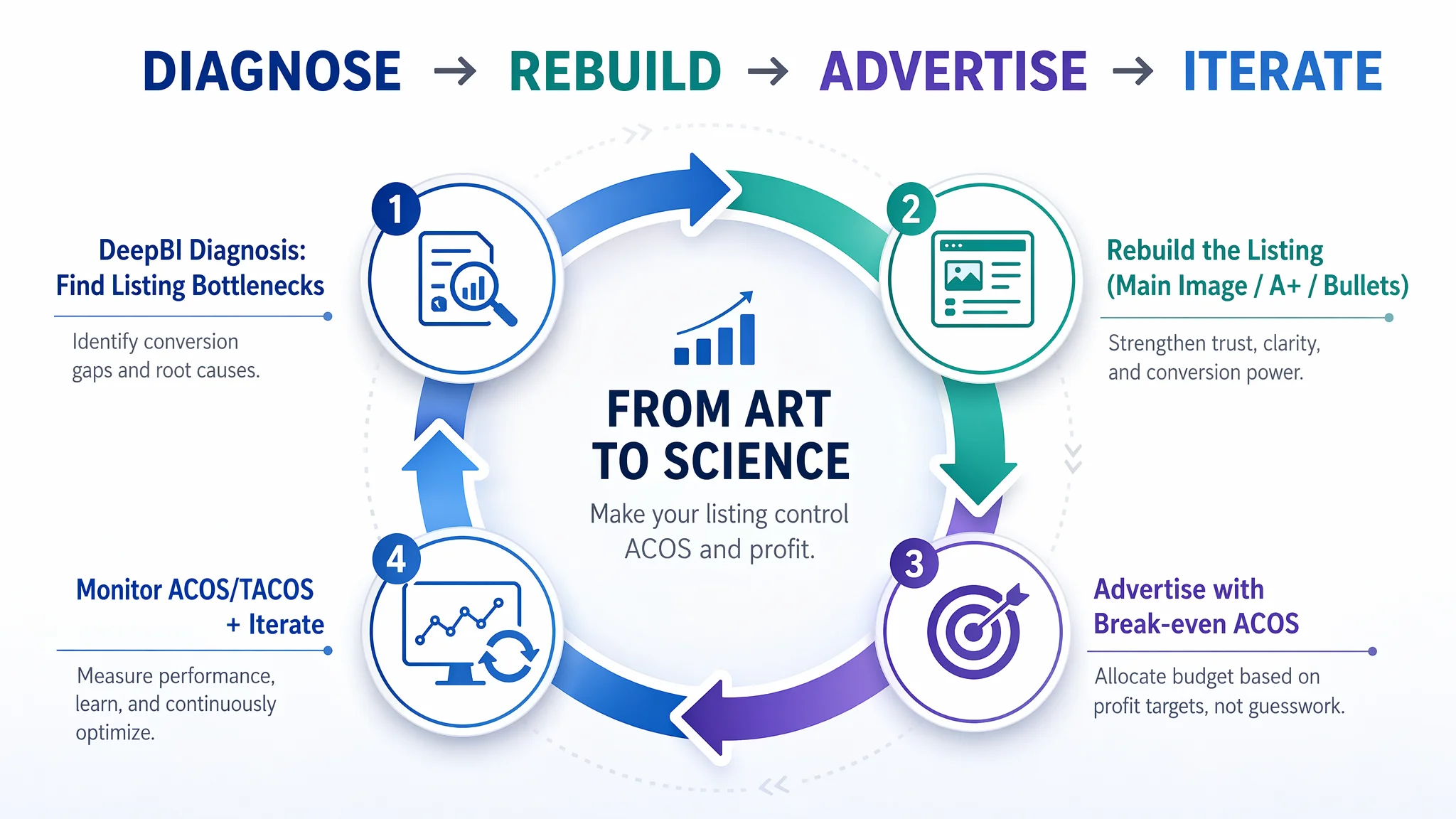
Adopting an all-encompassing approach, supported by intelligent systems like DeepBI, is the key to unlocking this potential. By breaking down the silos between diagnosis, planning, and execution, sellers can transition from guesswork to precision targeting. This integrated strategy ensures that every operational decision is backed by data and designed to create a direct, positive impact on critical KPIs like Click-Through Rate (CTR) and Conversion Rate (CVR).
This creates a powerful commercial loop: better listings attract more qualified traffic, which in turn drives healthier long-term growth, stronger organic rankings, and a lower Total Advertising Cost of Sales (TACoS). The travel-underwear seller’s shift—from treating high ACOS as purely an ads issue to recognizing a deeper listing-conversion constraint—is a pattern many Amazon businesses can relate to. Ultimately, the goal is not just to create a visually appealing listing but to engineer a more profitable one based on commercial logic. This methodology transforms listing management from an art into a science, securing a predictable and sustainable competitive advantage.