

The Transformative Power of AI in Amazon Selling
In today's hyper-competitive Amazon marketplace, sellers are moving beyond intuition-based tactics to gain a a sustainable edge. Artificial intelligence is at the forefront of this shift, transforming how brands approach growth, efficiency, and profitability. AI-powered strategies enable businesses to replace subjective guesswork with data-driven precision, automating complex processes and unlocking new levels of performance.
What is AI Optimization for Amazon?
AI optimization for Amazon is not merely about beautifying images or refining copy; it represents a fundamental shift to a systematic, data-centric operational model. It moves listing management from a world of subjective aesthetics and manual adjustments to one of "precise collaboration" based on data algorithms.
A recurring pattern in real operations is that teams instinctively equate “optimization” with “better-looking creatives.” For example, a hitch camera brand that sold a wireless backup camera in the truck/RV niche initially framed its problem this way: their product clearly outperformed a key competitor on paper—larger battery capacity, longer wireless range, solid protection and flexible mounting—yet they were losing on overall listing score, rating, and first-page review sentiment. Internally, the diagnosis was simple: “our specs are better, so it must be a visual problem; we just need stronger images and A+.”
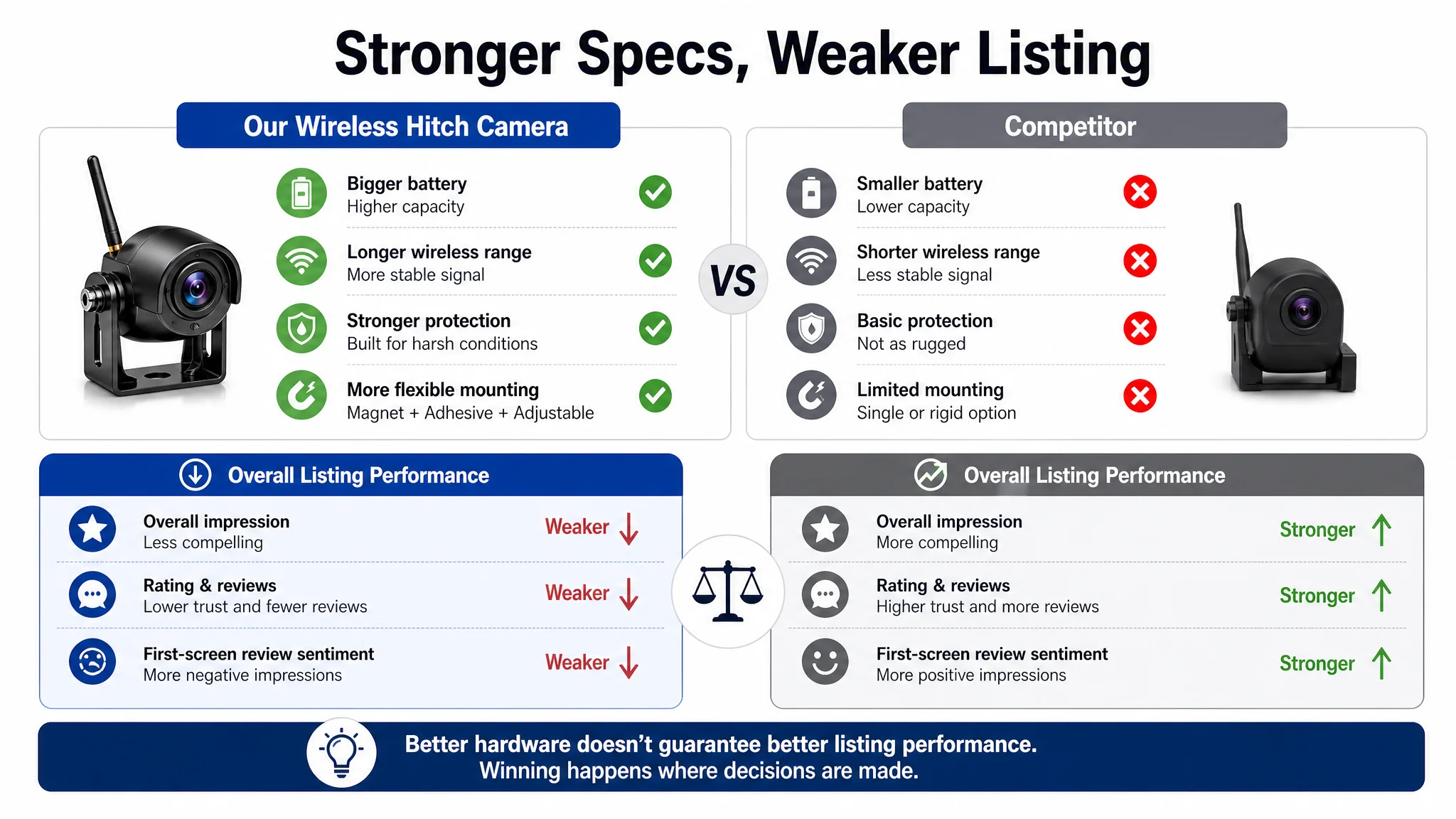 They proceeded to add more images, more icons and more “upgraded” language. From a subjective lens, the listing felt richer and more “professional,” but key indicators like CTR and CVR did not move as expected. Only when AI-based diagnosis was introduced did it become apparent that the issue wasn’t the lack of visuals, but how those visuals, titles, bullets and A+ were orchestrated along the shopper’s decision path.
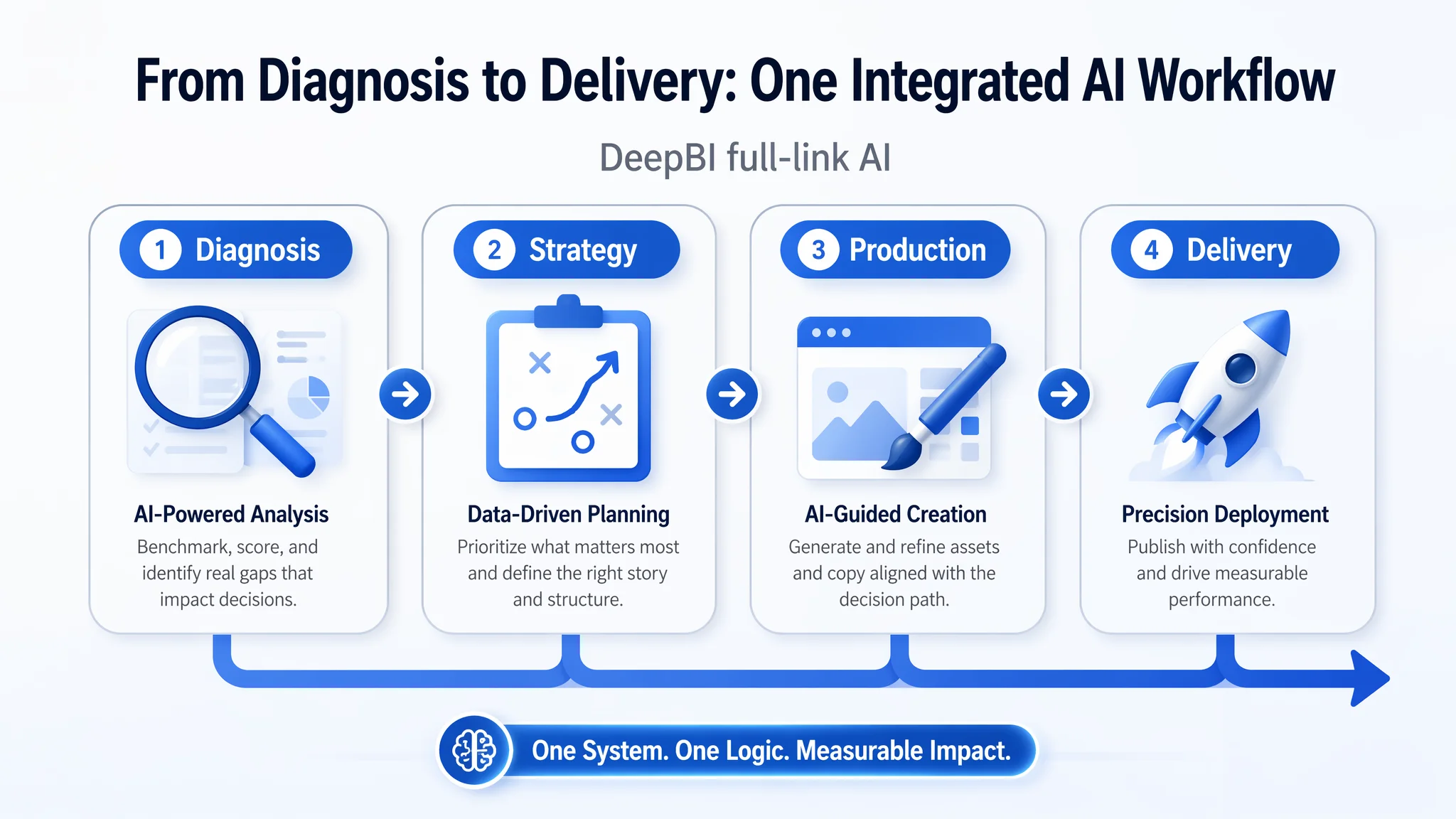
Traditionally, the effectiveness of an optimization effort relied on subjective judgment and could not be easily quantified. With AI, this changes. An AI-driven system integrates diagnosis, strategy, production, and delivery into a single, automated workflow. In the hitch camera case, an AI scoring model broke the listing down by dimension—title, main images, bullet points, A+ and reviews—and exposed gaps that the team’s intuition had overlooked: the brand “won” on image count and parameter richness, but “lost” where decisions are actually made, such as title clarity, bullet persuasiveness and trust signals.
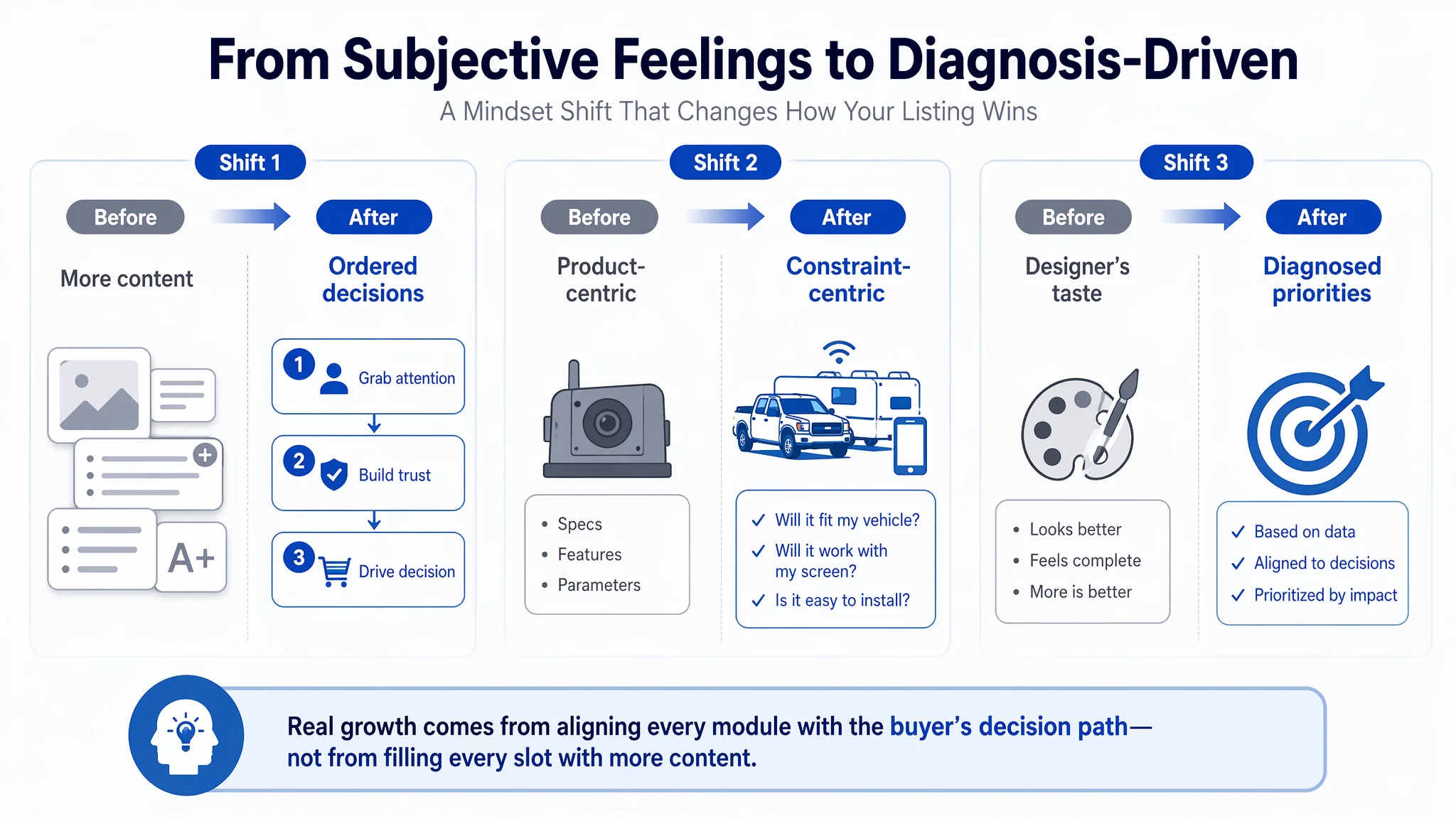
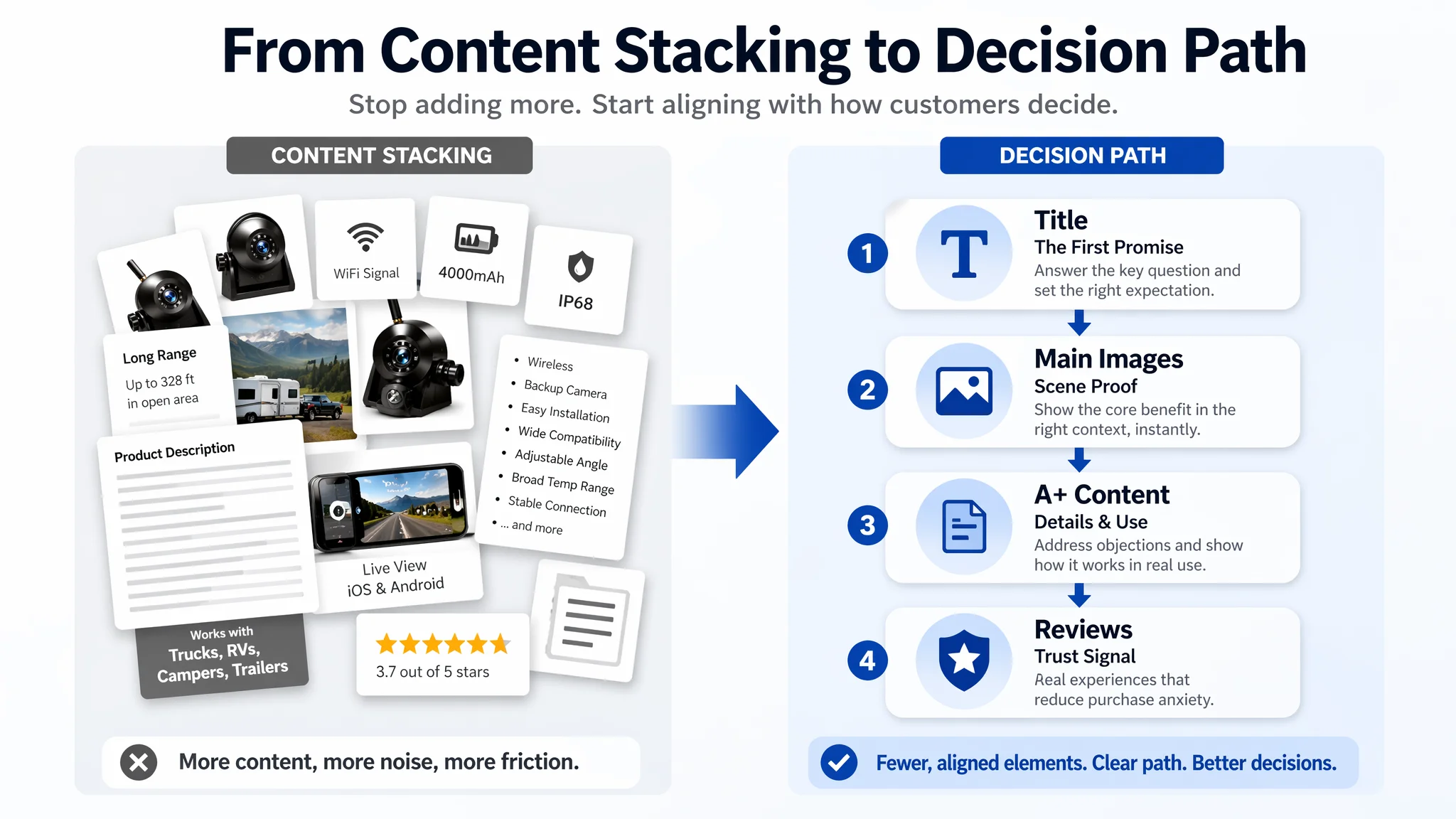 The core vision is to eliminate human error and ensure that every change, from a single word in a title to a pixel in an image, is directly linked to measurable improvements in key performance indicators like Click-Through Rate (CTR) and Conversion Rate (CVR). Instead of “more content,” AI forces a shift toward “correctly ordered decisions,” so that each module in a listing has a clear, evidence-backed job in the conversion chain.
Why AI is Crucial for Amazon Sellers Today
As competition on Amazon intensifies and traffic costs rise, the pressure on conversion rates has never been higher. Manual methods of competitor analysis, A/B testing, and content updates are too slow and resource-intensive to keep pace. AI provides the necessary speed and scale to thrive in this environment.
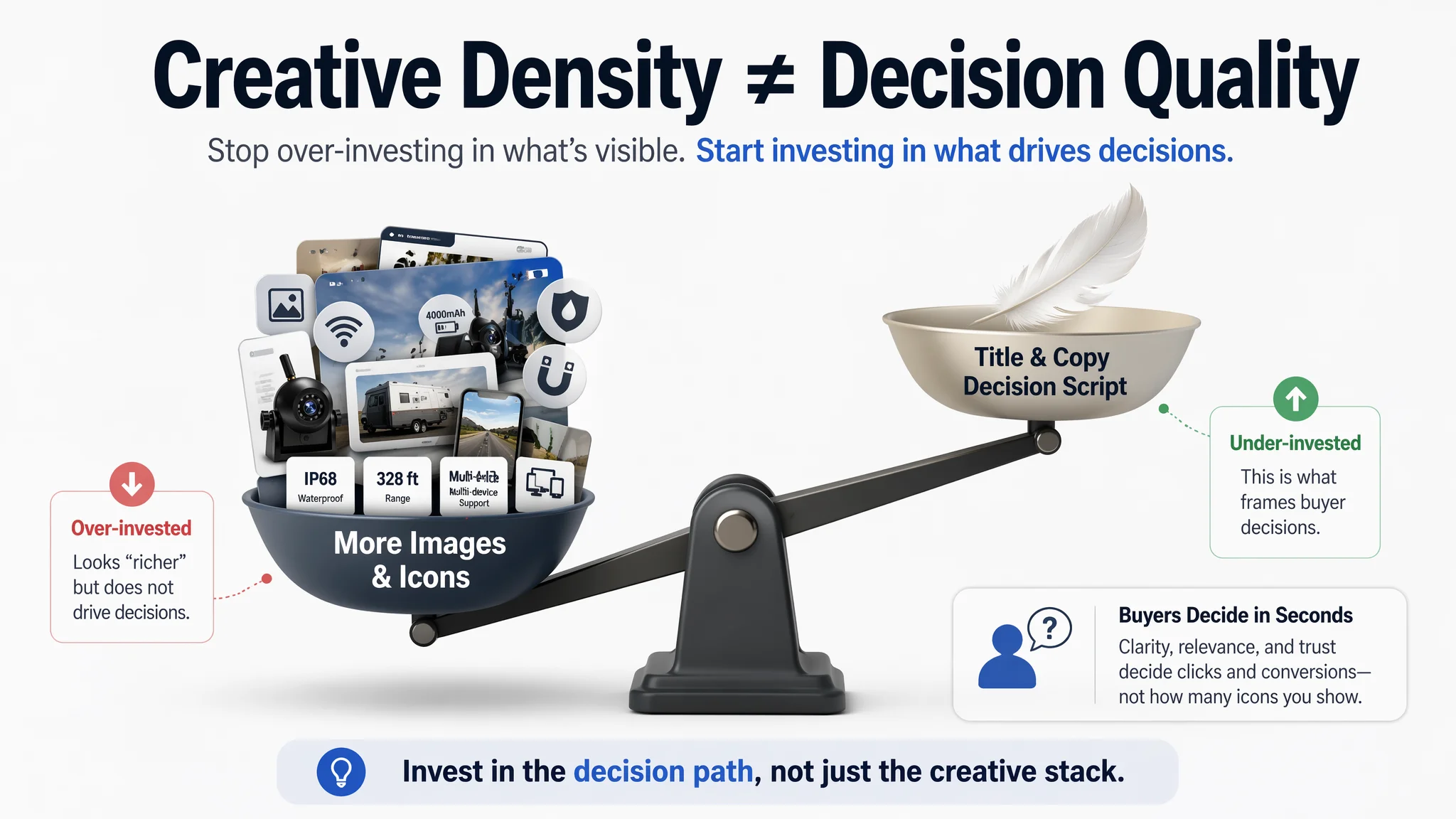
In the hitch camera example, the team spent cycles iterating images based on internal taste, only to discover later that the biggest scoring gaps were in the title, bullets, A+ and reviews. They were effectively over-investing in what they could see and touch—creative density—and under-investing in what actually framed buyer decisions. Without AI, this kind of misallocation can run for months: teams repeatedly polish creatives while ignoring a misaligned title that burns the first three seconds of attention, or bullets that stack specs without answering concrete user questions like “will this work with my screen?” or “how hard is installation?”
 By automating tedious tasks, AI-powered systems allow teams to focus on high-level strategy instead of manual execution. This turns listing optimization from an occasional, project-based task into a dynamic, continuous process that can be iterated in real-time based on market feedback. In practical terms, AI can maintain a live benchmark against a key competitor, quantify where your listing is underperforming—whether it’s decision framing, trust, or narrative coherence—and then translate that diagnosis into actionable creative and copy briefs.
This capability is essential for scaling a business effectively. Furthermore, by creating a clear data evidence chain for every decision, AI helps sellers move from blind trial and error to confident, data-backed actions that drive healthier long-term growth. As the hitch camera brand discovered, AI’s greatest value was not in generating more assets, but in revealing that the real constraint was a flawed decision script—what the listing promised first, how it backed that promise, and how each element reduced or amplified purchase anxiety.
DeepBI's AI-Powered Approach to Amazon Success
DeepBI is an AI-centric, full-link optimization system designed specifically for Amazon. It breaks down the traditional silos between diagnosis, planning, production, and delivery, creating an end-to-end intelligent system. This approach moves sellers away from reliance on intuition and towards data-driven operations engineered for long-term, stable profitability.
In the wireless hitch camera case, DeepBI functioned as this “full-link” brain. Instead of starting with “let’s beautify pictures,” the system began with a structured, five-dimension benchmark against a single high-performing competitor. It assigned scores to title, main images, bullet points, A+ content and reviews, revealing an 11-point overall gap and showing precisely which parts of the listing were holding the product back. The seller had previously tried to solve the problem by adding more visuals and icons, but DeepBI’s diagnosis showed that visual density was not translating into visual persuasion; the listing was optimized around what the product could do rather than how customers actually decide.
 AI for Maximizing Ad Performance
Effective advertising requires a constant feedback loop between spending and results. DeepBI strengthens this connection by using AI to directly link creative assets to performance metrics. When an optimized product image is published, the system automatically tags the event within advertising reports. This allows strategists to precisely quantify the impact of visual changes on key performance indicators like Click-Through Rate (CTR), isolating the effect of creative optimization from other variables and providing clear data on what drives engagement.
In real campaigns, this linkage often surfaces unexpected findings. For the hitch camera brand, the assumption was that “more impressive technical visuals” would lift CTR. Yet once DeepBI linked image iterations to ad reporting, it became clear that images emphasizing abstract range lines or dense parameter icons did less to attract clicks than visuals that immediately answered, “Will this work with my truck, RV or camper, and with my existing screen?” When the first image shifted from a generic product shot to a scenario-based composition—camera on a hitch, live feed on both iPhone and Android screens, and explicit vehicle types—CTR response could be measured directly, instead of inferred.
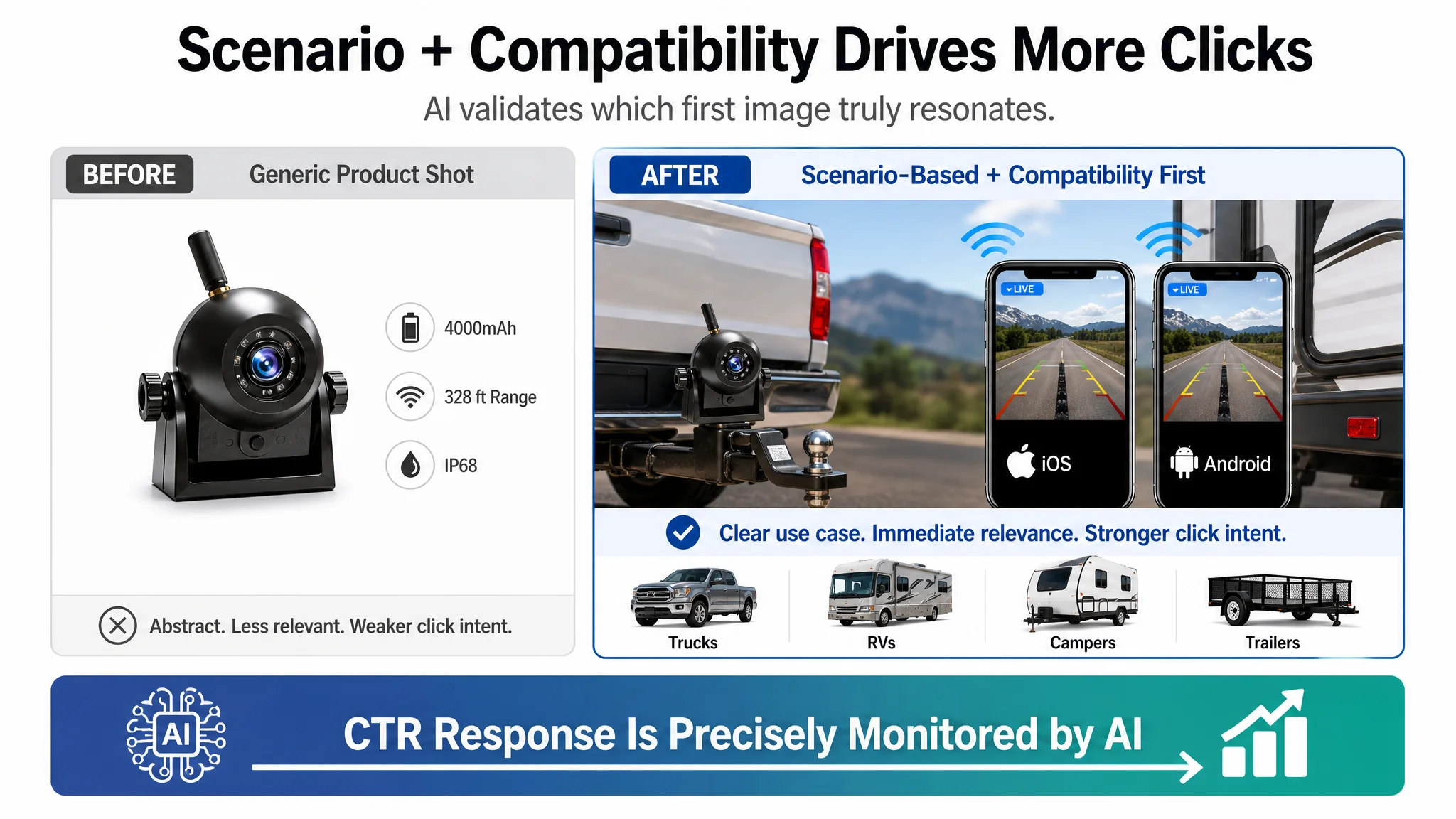 This kind of evidence forces teams to rethink what “strong visuals” mean in an advertising context. AI doesn’t just log that a new image was uploaded; it measures whether that image, in combination with a specific title and ad keyword set, actually contributes to more qualified clicks. In cases where CTR remains flat or declines after a visually “richer” update, DeepBI’s tagging and analytics can show that it’s not the sheer presence of more details that matters, but whether those details align with the user’s first decision filters.
AI for Advanced Ad Strategy and Execution
Beyond simple performance tracking, DeepBI uses advertising data to proactively shape creative strategy. The platform analyzes stable advertising signals, such as winning search terms and high-conversion attributes, and translates them into specific weights for visual optimization. This means that insights gained from your most successful ad campaigns can be used to systematically improve your product listings, creating a virtuous cycle where more precise traffic is directed to a more compelling offer, ultimately improving Conversion Rate (CVR) and lowering Total Advertising Cost of Sales (TACoS).
In the hitch camera project, this looked like connecting high-performing search terms and ad placements—phrases related to “hitching,” “no-drill install,” “wireless backup camera for trucks/RVs,” and “works with phone”—directly into the creative brief. DeepBI’s logic effectively said: if ad data shows that buyers are responding to “hitch camera” and “no-drill wireless install,” then the listing’s title and images should make those phrases and scenarios unmistakable. Instead of generic “upgraded” language, AI recommended a title structure that started with the category (“Wireless Backup Camera Magnetic Hitch”), followed by key rational advantages, and ended with clear compatibility and vehicle types.
By treating ad data as a source of creative constraints rather than a separate domain, DeepBI ensured that winning keywords didn’t just live in campaigns—they shaped the way the listing told its story. That same feedback loop also highlighted misalignments: if ads were driving clicks on “CarPlay” and “in-dash screen” queries but the listing downplayed or delayed compatibility information, users would land on a page that didn’t immediately confirm their expectations, leading to weaker CVR. AI’s role was to surface this disconnect and recommend that compatibility be promoted from an afterthought to a first-order promise in titles, images, and A+ modules.
AI for Enhancing Product Listing Competitiveness
DeepBI transforms listing optimization from an art into a science. It begins with an automated market health check, benchmarking a listing against top competitors to identify specific weaknesses. The system then converts vague strategic goals into precise, executable instructions for AI. For example, instead of suggesting "improve texture," it generates parameterized instructions specifying composition, camera angle, and lighting. To ensure authenticity, DeepBI first maps a product's core physical attributes into a "Product DNA" profile. This acts as a hard constraint, preventing AI from generating misleading visuals that could lead to negative reviews and returns, ensuring all optimizations are both effective and true to the product.
In the hitch camera scenario, the health check made explicit that the brand’s main images were “strong” in a checklist sense—more total images, more technical visualizations, more icons—yet weaker in narrative coherence. AI agents flagged that the first image verified the product type but failed to communicate compatibility or scale; subsequent images tried to show too many angles and specs at once, diluting the core messages around no-drill installation, app control, and real reversing scenarios.
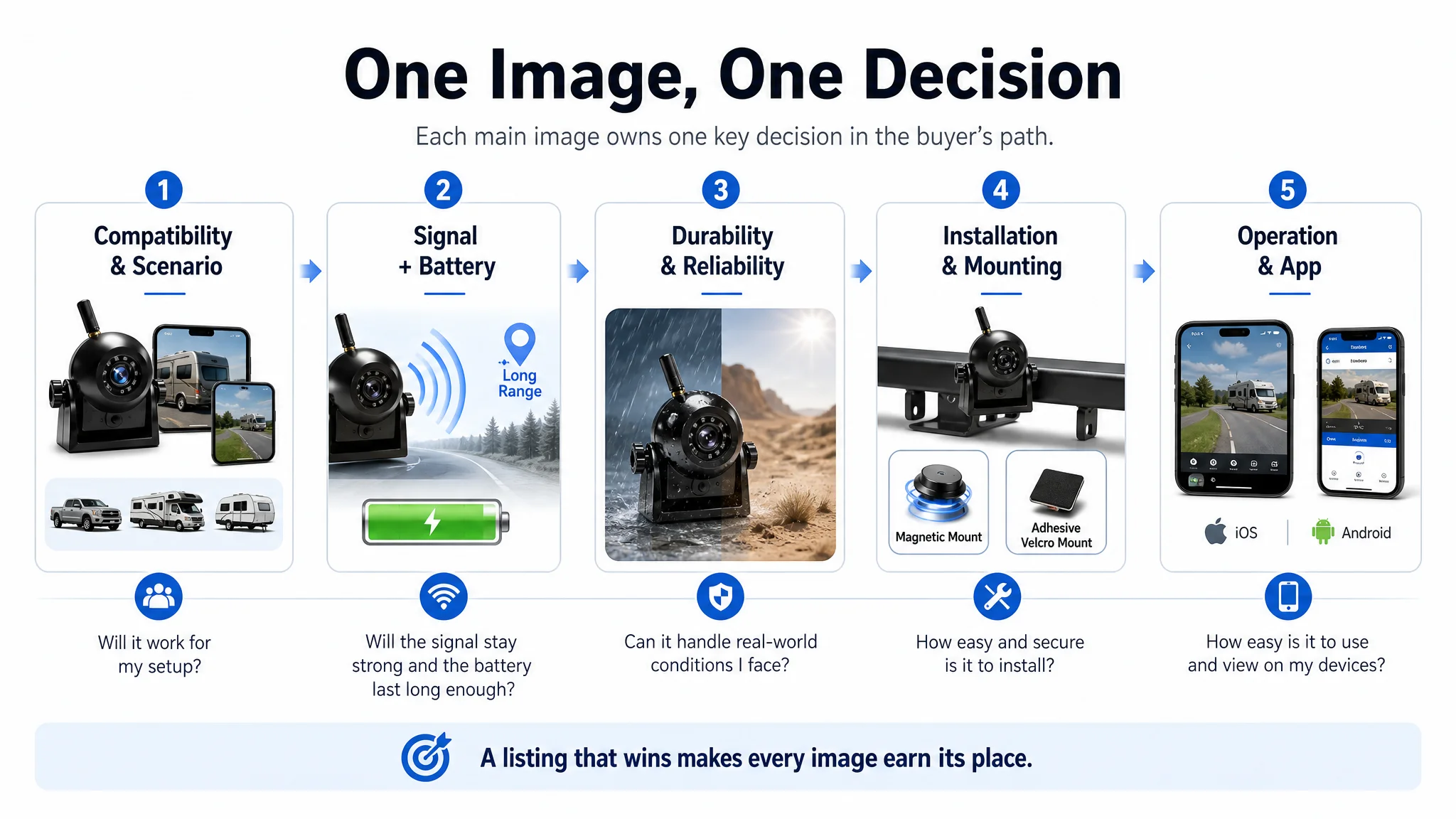
DeepBI converted this diagnosis into a reordered image stack: Image 1 became a compatibility and scenario proof (big truck/RV, live view on phone, device types clearly shown); Image 2 combined wireless range and battery capacity into a single long-distance use proof; Image 4 was reframed around installation as the core win, with magnet and Velcro use separated and clarified. Rather than instructing “add more images,” the AI output defined what each image had to prove, in what order, and with what constraints tied to Product DNA—no fabricated resolution, no exaggerated range claims, and no visuals implying screen types the product didn’t actually support.
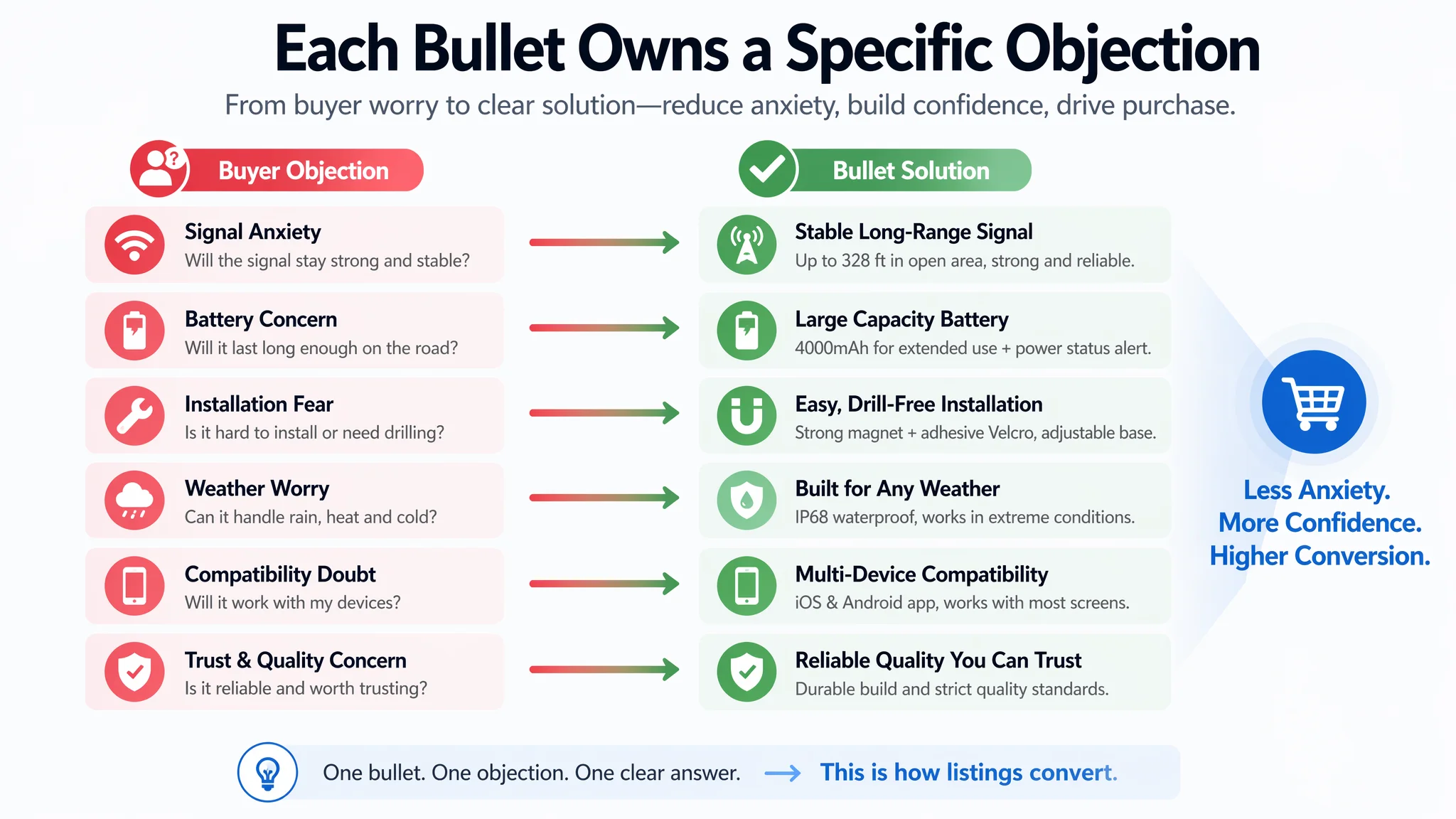
 The same principle applied to text. DeepBI broke bullet points and A+ modules into decision roles, asking: which buyer fear or desire does each element address, and what proof supports it? For the hitch camera, this meant reworking bullets from feature lists (“strong WiFi signal, IP68 waterproof”) into pain–outcome–proof structures: addressing signal stability anxiety with range and antenna details, tackling installation fear with no-drill magnetic mounting and Velcro backup, and translating night vision specs into concrete reversing outcomes. AI thereby turned a “feature salad” into an ordered decision script and aligned every visual and textual element with a specific stage in the buying journey.
 Best Practices for Implementing AI in Your Amazon Strategy
Successfully integrating AI requires shifting from subjective operational habits to a structured, data-centric framework. The goal is to leverage AI for scalable insights and precise execution, not just automated content creation. By establishing clear goals and feedback loops, you can transform AI from a simple tool into a core component of your growth engine.
Data-Driven Decision Making
The most effective AI implementation begins with diagnosis, not generation. Before making any changes, use AI to conduct a quantitative audit of your listings—from the main image and title to A+ content—to establish a data-driven evidence chain. This replaces guesswork with an objective analysis of performance gaps.
The hitch camera listing illustrates why this order matters. Before DeepBI, the team’s instinct was to jump straight to asset creation: more photos, more icons, more “upgraded” claims. When DeepBI ran its five-dimension benchmark, the output showed that the largest gaps were not in the mere existence of visuals but in the title, A+ structure, bullets and reviews. The title opened with a vague “Upgraded” claim and pushed a relative weakness (“720P”) into a prominent position; bullets led with technical parameters instead of use scenarios, and A+ modules emphasized aesthetics over decision checkpoints.
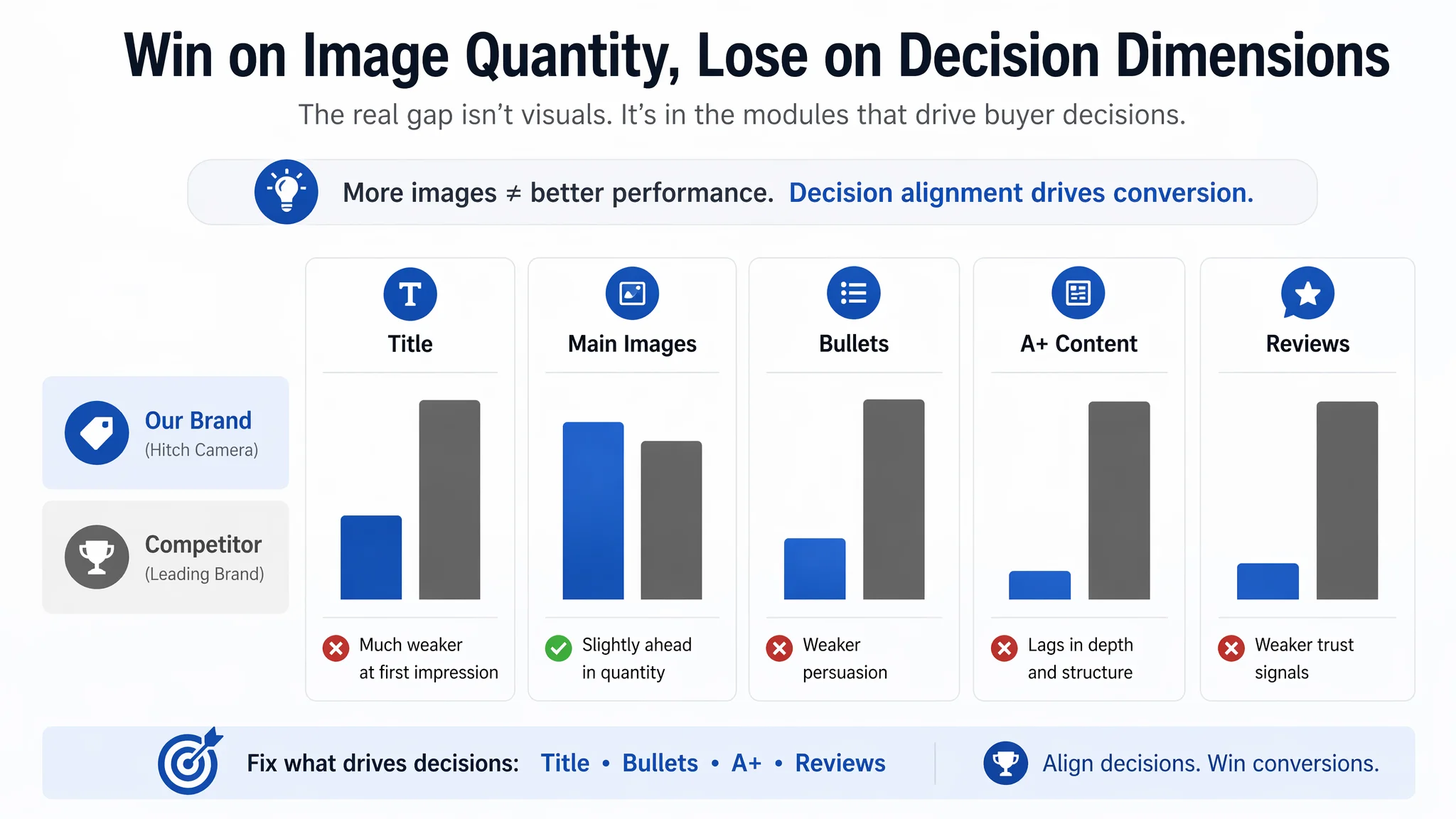 Set clear, KPI-driven goals for your AI tools. For instance, if data reveals a low Click-Through Rate (CTR), the AI's primary task should be to identify and enhance the 'visual hooks' in the main image. If the Conversion Rate (CVR) is the issue, the focus should shift to improving trust signals and product details in the A+ content. In the hitch camera case, DeepBI’s diagnosis combined performance metrics with structural scoring: overall traffic was not the core issue; instead, the listing failed to answer early questions about compatibility, installation ease, and real use scenarios, while also carrying a rating and review-volume disadvantage. That pushed the team to define AI goals around decision framing (title and bullets), risk reduction (copy and visual proof nodes), and narrative coherence rather than purely cosmetic enhancements.
This ensures that AI-driven optimizations are directly tied to measurable business outcomes. Rather than asking “how do we make this look better,” teams can ask, “which specific decision or anxiety is depressing CTR or CVR, and how can AI help us diagnose and address that in a structured way?” The hitch camera team’s shift—from “more content” to “ordered decisions”—was a direct result of letting AI quantify where their assumptions diverged from buyer behavior.
Continuous Optimization and Adaptation
AI is not a "set it and forget it" solution. Implementing a continuous feedback loop is essential for long-term success. After deploying AI-generated assets, mark the date as a 'visual iteration event' and closely monitor subsequent changes in CTR and CVR over the next 7-14 days. This process validates the effectiveness of your strategy and informs future optimizations.
In practice, this means treating each major change—such as a restructured title, a new main image sequence, or a redesigned A+ layout—as an experiment rather than a final answer. In the hitch camera example, DeepBI helped reframe the title into a clearer decision sentence, reorganize bullets around specific tensions (signal stability, battery life, installation fear, night safety), and reshape the image stack into a stepwise argument. While the case did not track post-optimization numbers within DeepBI itself, the team now had a framework: when they pushed the new assets live, they could mark that moment and watch how CTR and CVR evolved, knowing exactly which modules had changed and why.
It is also critical to understand and enforce AI's operational boundaries. A non-negotiable rule is maintaining product authenticity, or 'Product DNA'. AI should be constrained to modifying external elements like composition, lighting, and background, while being strictly prohibited from altering the product's inherent physical attributes. This prevents image-product mismatches that can damage customer trust and lead to negative reviews.
The hitch camera team encountered this constraint when considering how to compete against a rival that advertised a higher resolution and certain protection ratings. DeepBI’s analysis made it clear that AI should not be used to visually imply 1080P performance or IP ratings that the product did not actually hold. Instead, the system suggested re-anchoring the narrative around genuine strengths—battery capacity, wireless range, flexible mounting—and shifting focus from pure resolution to night vision clarity, stability and ease of use. By respecting Product DNA, the brand avoided the temptation to “design away” real disadvantages and instead used AI to maximize the commercial impact of authentic strengths.
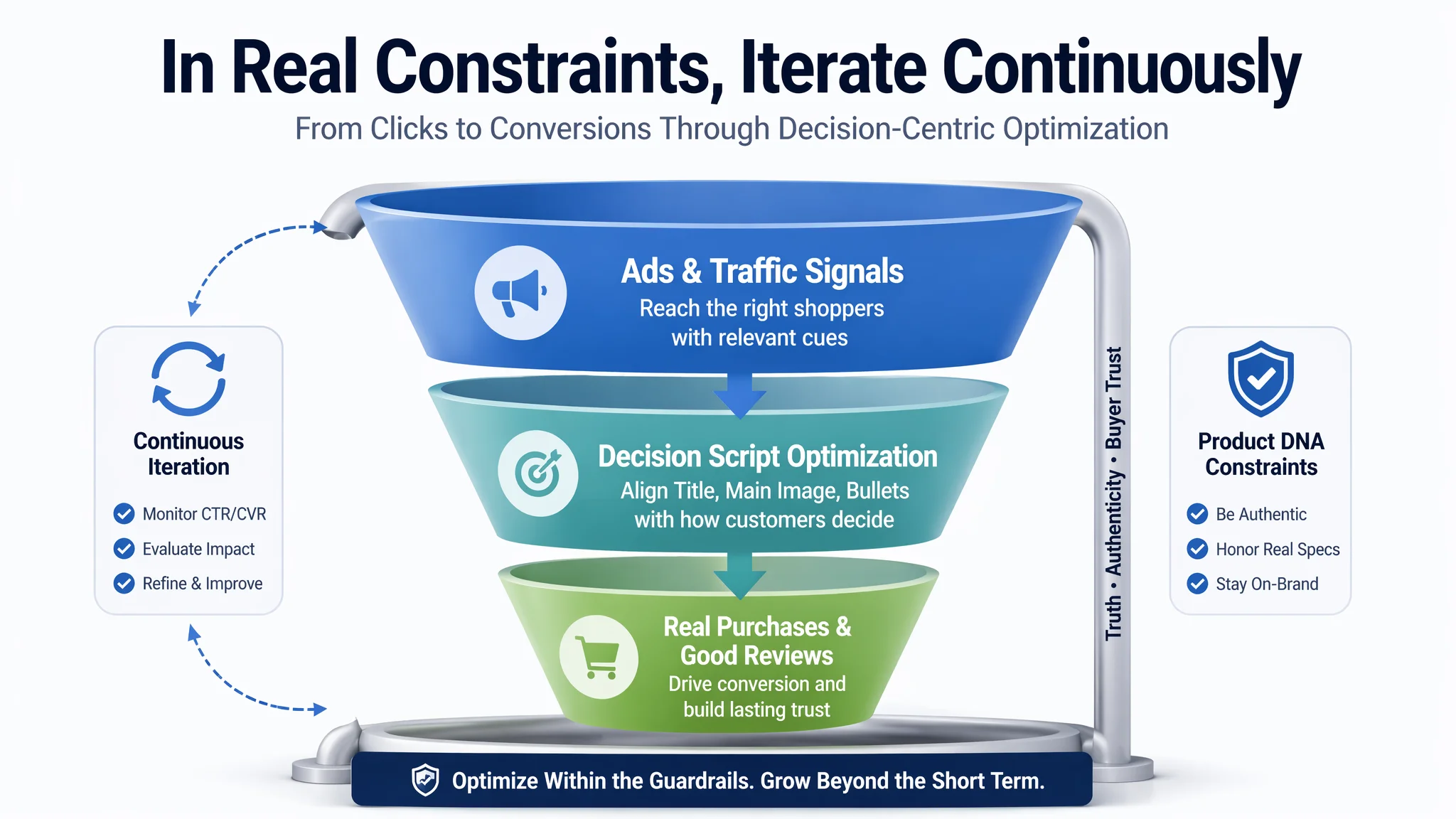 Over time, this discipline builds trust not only with customers but also within the team: AI becomes a reliable partner that surfaces real constraints and trade-offs, rather than a shortcut for overstating capabilities. Continuous optimization then becomes a process of iterating within those constraints—refining decision scripts, clarifying proof nodes, and aligning creatives with winning ad signals—rather than chasing ever “prettier” assets.
The Future of Amazon Selling: AI as Your Strategic Partner
The era of fragmented Amazon operations—where listing diagnosis, creative production, and performance analysis exist in separate silos—is rapidly ending. The integration of AI transforms this disjointed workflow into a single, unified algorithmic context. It breaks down the barriers between diagnosis, planning, production, and delivery, turning subjective operational experience into a data-driven, quantifiable, and scientific process.
The hitch camera brand’s journey underscores this shift. Initially, each function operated in isolation: product teams emphasized specs, design teams produced dense visuals, and operations teams watched CTR and CVR from the sidelines. Without a shared diagnostic language, they defaulted to a familiar narrative—“we just need stronger visuals”—and kept adding content. Once DeepBI entered the picture, those silos were forced into a common frame: title, images, bullets, A+ and reviews were all scored against a benchmark, linked to buyer decisions, and prioritized accordingly. What had felt like a “visual problem” revealed itself as a misaligned decision framework.
Platforms like DeepBI embody this shift, functioning as an intelligent decision-making brain for sellers rather than a simple tool. By creating a closed feedback loop where advertising data directly informs future optimizations, the system ensures that every visual modification is engineered to produce measurable improvements in Click-Through Rate (CTR) and Conversion Rate (CVR). This turns a one-time optimization project into a dynamic logic that iterates based on real-time market feedback.
In the hitch camera case, DeepBI did not manage the ad account or run experiments end-to-end, yet it fundamentally changed how the team thought about their listing. They moved from “fill all slots with more images and features” to “assign each module a specific decision to own.” Designer preferences were replaced by diagnosed priorities; product-centric boasting gave way to constraint-centric storytelling that acknowledged weaknesses and amplified genuine strengths. AI served as a judgment engine, revealing that the real bottleneck wasn’t asset scarcity but decision misframing.
 Looking ahead, the core value of AI is not merely generating a "beautiful image," but its capacity to consistently calculate and generate a more profitable image based on business logic and strict authenticity constraints. For sellers aiming to secure a winning advantage, AI is becoming an indispensable strategic partner. Leveraging this technology is the definitive lever for transforming visual assets into concrete conversion gains, higher organic rankings, and sustainable long-term business growth. And as the hitch camera brand discovered, the most powerful transformation often begins not with “better creatives,” but with AI exposing where your listing’s story no longer matches the way your customers actually decide.