

The Imperative of Amazon Listing Optimization in a Competitive Marketplace
In today's highly competitive Amazon landscape, where a majority of online shoppers begin their search and rarely venture past the first page, securing visibility is paramount. As the platform enters an era of intense "stock competition," rising traffic costs mean that every click and every impression must be maximized. Success is no longer guaranteed by simply having a relevant product; it's won by having the most effective listing.
The key lies in understanding Amazon's search algorithm. Its primary goal is to maximize revenue per customer, which means it systematically favors products with a proven history of high conversion rates (CVR) and strong sales velocity. A listing that fails to convert visitors into buyers quickly loses ranking, regardless of its keyword relevance or ad spend. This transforms listing optimization from a simple task of copywriting and image beautification into a strategic necessity driven by data. Your listing's visual and textual assets must function as a core commercial engine, engineered to drive both Click-Through Rate (CTR) and CVR.
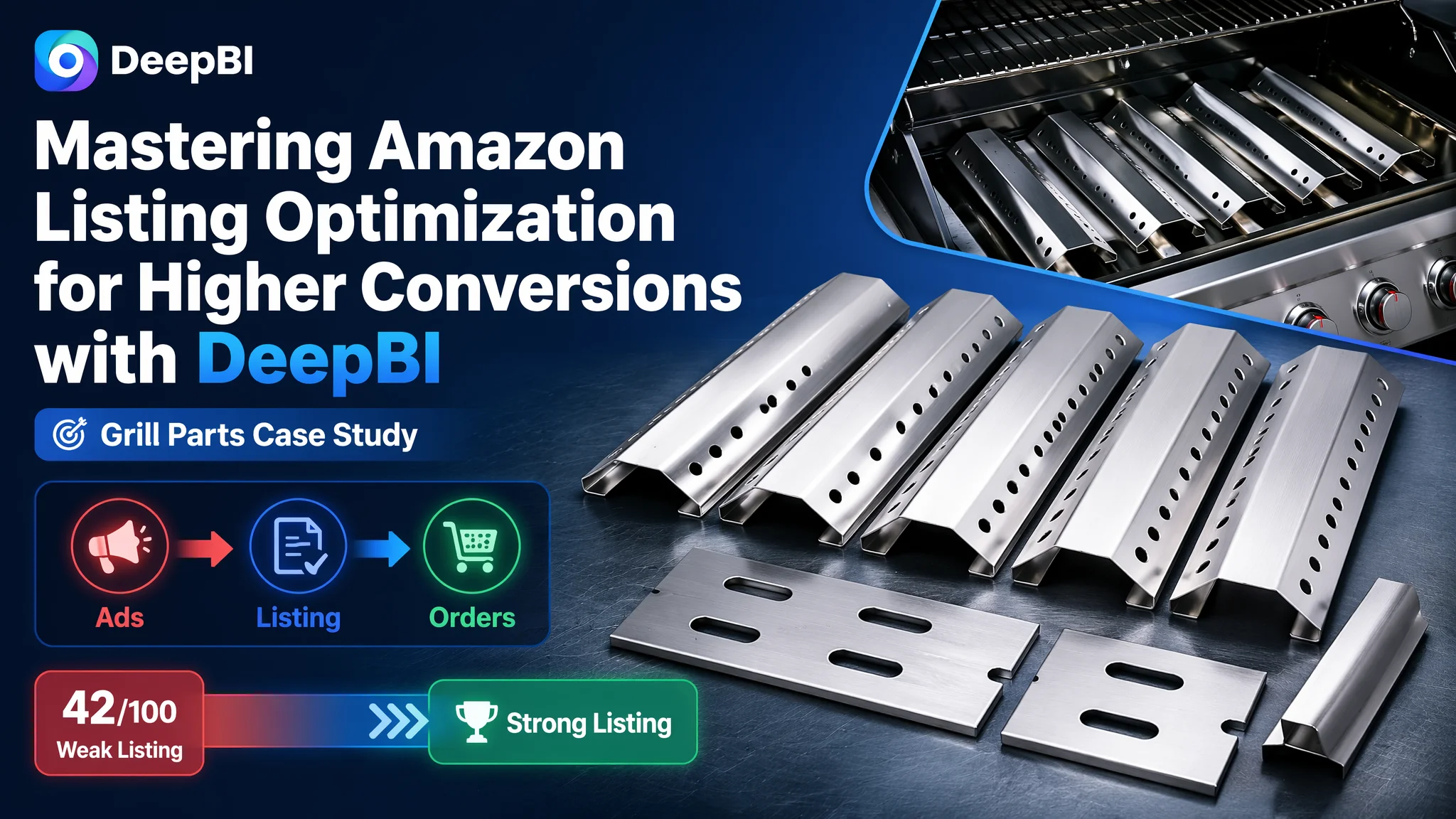
This is where many sellers struggle, finding it difficult to connect poor metrics like a low CVR to specific root causes, such as a lack of trust signals on the detail page. In one real example from the grill accessories category, a seller was convinced that their problem was “bad ads” because ACOS kept climbing and orders were unstable. DeepBI’s diagnosis showed something very different: ads were delivering traffic, but the listing itself scored only 42/100 versus a comparable competitor at 81/100. The page had weak bullets, no A+ content, and a layout that looked more like a compatibility spreadsheet than a solution. The result was simple: traffic came in, but the listing couldn’t convert.
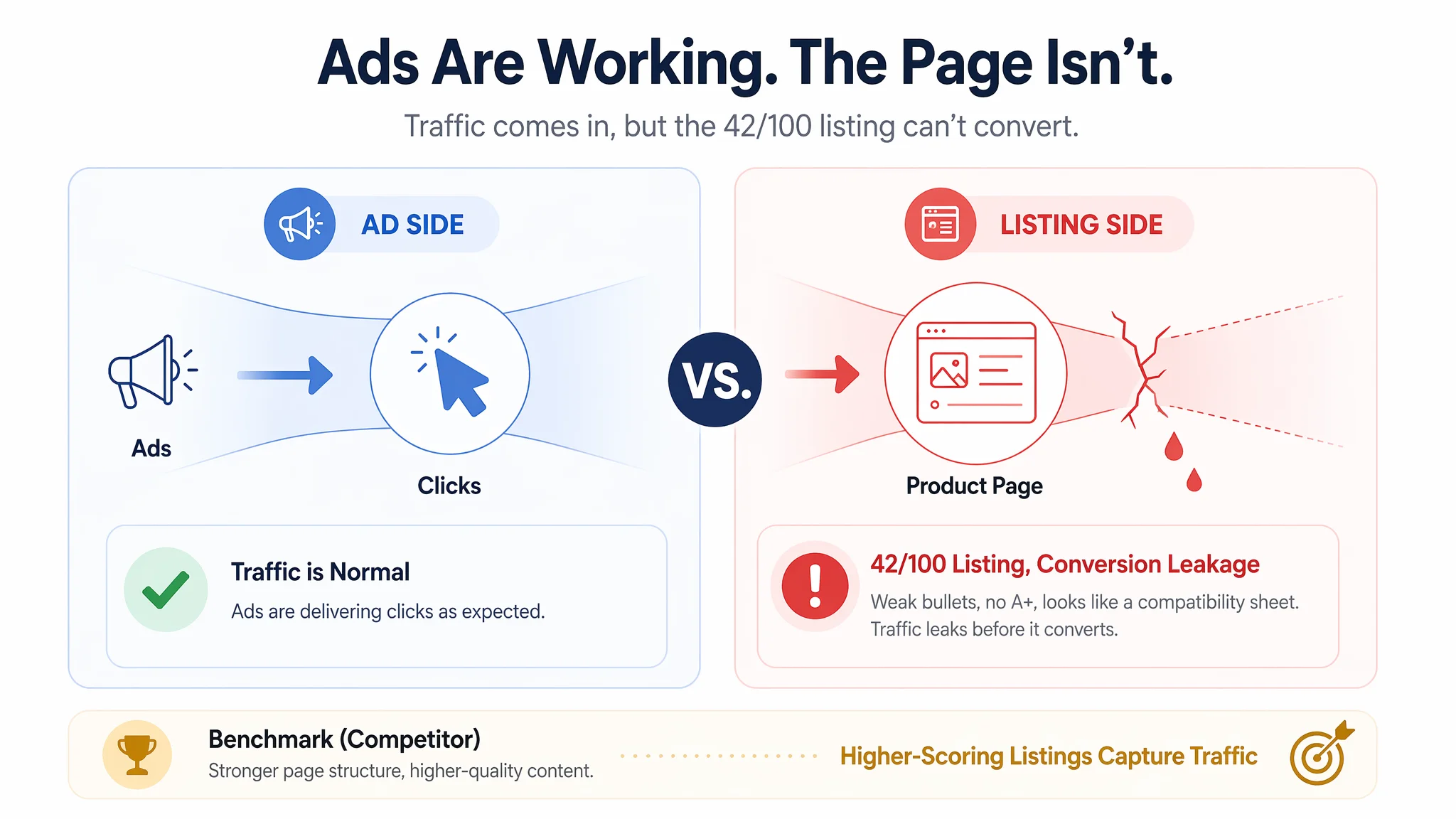
DeepBI provides the solution in these situations by serving as an AI-powered diagnostic system. It establishes a clear "data evidence chain" to uncover the core weaknesses in your listing, providing an objective foundation to guide optimization efforts and ensure every change is aimed at delivering measurable business growth. Instead of guessing whether “it must be the ads,” sellers can see in black and white where the true conversion bottleneck sits.
Deep Dive into Keyword Research: Fueling Visibility and Relevance
Effective keyword research is the foundation of any successful Amazon listing, directly influencing both visibility and conversion rates. Without targeting the right search terms, even the best product will remain invisible to potential buyers. The goal is to build a comprehensive keyword strategy that captures a mix of high-volume and high-intent traffic.
A robust strategy balances two types of keywords:
- Short-tail keywords: Broad, high-volume terms (e.g., "water bottle") that drive general visibility and brand awareness.
- Long-tail keywords: More specific, multi-word phrases (e.g., "insulated stainless steel water bottle with straw lid") that attract customers with a clear purchase intent, often leading to a higher conversion rate (CVR).
Identifying these terms involves analyzing competitor listings and using specialized research tools. However, DeepBI elevates this process by moving beyond simple keyword matching. It employs multi-dimensional semantic analysis to identify your true benchmark competitors and reverse-engineers their titles to uncover the high-performing "winning terms" that drive clicks. This data-driven approach allows you to strategically absorb high-click-rate keywords from top performers.
In the grill replacement parts case, for example, both the underperforming listing and the benchmark competitor were targeting similar functional keywords around “flame tamer,” “heat plate,” and specific grill models. On the surface, the keyword coverage looked acceptable; the seller had already spent weeks expanding and pruning keyword lists in the ad console. Yet DeepBI’s benchmarking revealed that the competitor’s title structure aligned those terms into a clear decision-making headline—combining the core term “Grill Flame Tamer,” synonyms like “Grill Heat Plate Shield,” material cues such as “Stainless Steel,” and structured model references. The client’s title also contained many of those terms, but dumped them into an unstructured compatibility chain that signaled “parts catalog” rather than “premium replacement kit.” The problem wasn’t only which keywords they had, but how those keywords were deployed to signal value.
Finally, your keyword list fuels both your visible content and your backend search terms. While the title and bullet points should feature the most critical, customer-facing keywords, the backend is a strategic space for synonyms, related concepts, and alternate phrasing to broaden your indexing reach without cluttering the visible listing. The grill parts seller learned that simply “having the keywords” was not enough; mapping them into a structured title and value-focused bullets, as surfaced by DeepBI’s analysis of the benchmark, was what actually supported higher CTR and CVR.
Crafting High-Converting Product Titles and Bullet Points
Your product title and bullet points are the most critical text elements for driving both search visibility and conversions. They must effectively communicate value to both Amazon's A9 algorithm and human shoppers, directly impacting your Click-Through Rate (CTR) and Conversion Rate (CVR).
A high-performing title balances SEO with readability. Structure it for clarity: start with your Brand, followed by your main keyword, a core selling point or result promise, the product form, and any key compatibility details. The goal is to embed relevant keywords without sacrificing customer appeal, all within Amazon's character limits.
For bullet points, shift your focus from simply listing features to articulating customer benefits. Instead of stating a technical specification, explain how it solves a customer's problem.
- Instead of: 10000mAh battery.
- Say: All-Day Power: Packed with a 10000mAh power core, you can say goodbye to power outage anxiety during travel.
This "pain point-solution" structure, combined with strong action verbs, makes your unique selling propositions resonate with shoppers.
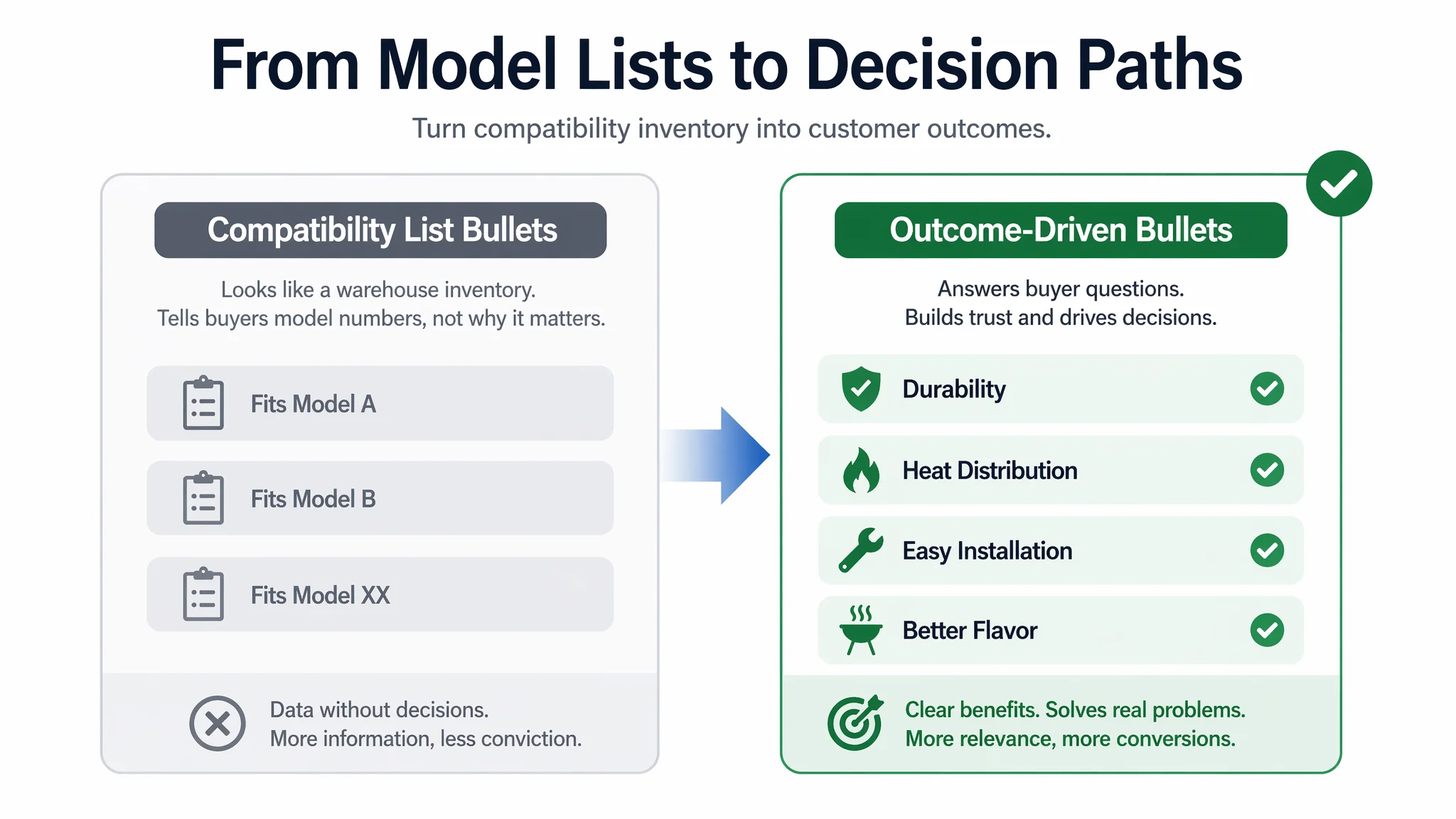
In the real grill kit case DeepBI analyzed, this distinction between “data” and “decision logic” was stark. The seller’s bullets were almost entirely composed of compatibility lists and part numbers. To a buyer, it felt like reading a warehouse inventory: technically accurate, but offering no reason to prefer this kit over any other. The bullets did not address core concerns such as:
- How thick and durable the stainless steel was
- Whether the kit would improve heat distribution and reduce flare-ups
- How easy it was to install and clean
- How the replacement would affect the actual grilling experience
The benchmark listing, by contrast, used a structured bullet sequence where each line anchored on an outcome—durability, performance, ease of installation, and better flavor—then supported it with the relevant specs. DeepBI’s scoring reflected this: the client’s bullets scored 2/10, the competitor’s 7/10. Once the bullets were rewritten into a clear flow—“What’s in the box” → “Premium stainless steel & thickness” → “Fit by brand/model” → “Enhanced cooking performance” → “Durability & easy maintenance”—the page started to behave like a salesperson instead of a parts sheet.
The traditional process of optimizing these elements is often disconnected and subjective. Teams will “improve” bullets by adding more text or more model numbers without testing whether this genuinely helps the buyer decide. DeepBI streamlines this by using AI to generate multiple SEO- and conversion-oriented titles and bullet points. The system analyzes competitor data and automatically applies proven structures, like the benefit-driven format above. In the grill example, it effectively guided the seller from raw compatibility dumps to a persuasion sequence that mirrored what the best listings in the category were doing. You can then compare different optimization schemes and preview their front-end appearance before publishing, reducing listing cycle time and eliminating guesswork.
Optimizing Product Images and Videos for Visual Impact
While compelling copy is essential, your product’s visual presentation is what first captures a shopper's attention and ultimately drives conversions. The main image is your primary tool for earning the click (CTR), while your supporting images and videos work together to close the sale (CVR).
Your main image must strictly adhere to Amazon's guidelines: a pure white background, with the product occupying at least 85% of the frame, and no additional text, logos, or watermarks. To enable Amazon's critical zoom function, all images should be high-resolution, with at least 1600 pixels on the longest side. Beyond the main image, a strong visual gallery includes:
- Lifestyle Images: Show the product in a real-world context to help customers visualize its benefits.
- Infographics & Feature Call-outs: Highlight key features and technical specifications in an easily digestible format.
- Scale Images: Provide a clear sense of the product's size relative to common objects.
- Product Videos: Demonstrate functionality, build trust, and answer potential questions before they are asked.
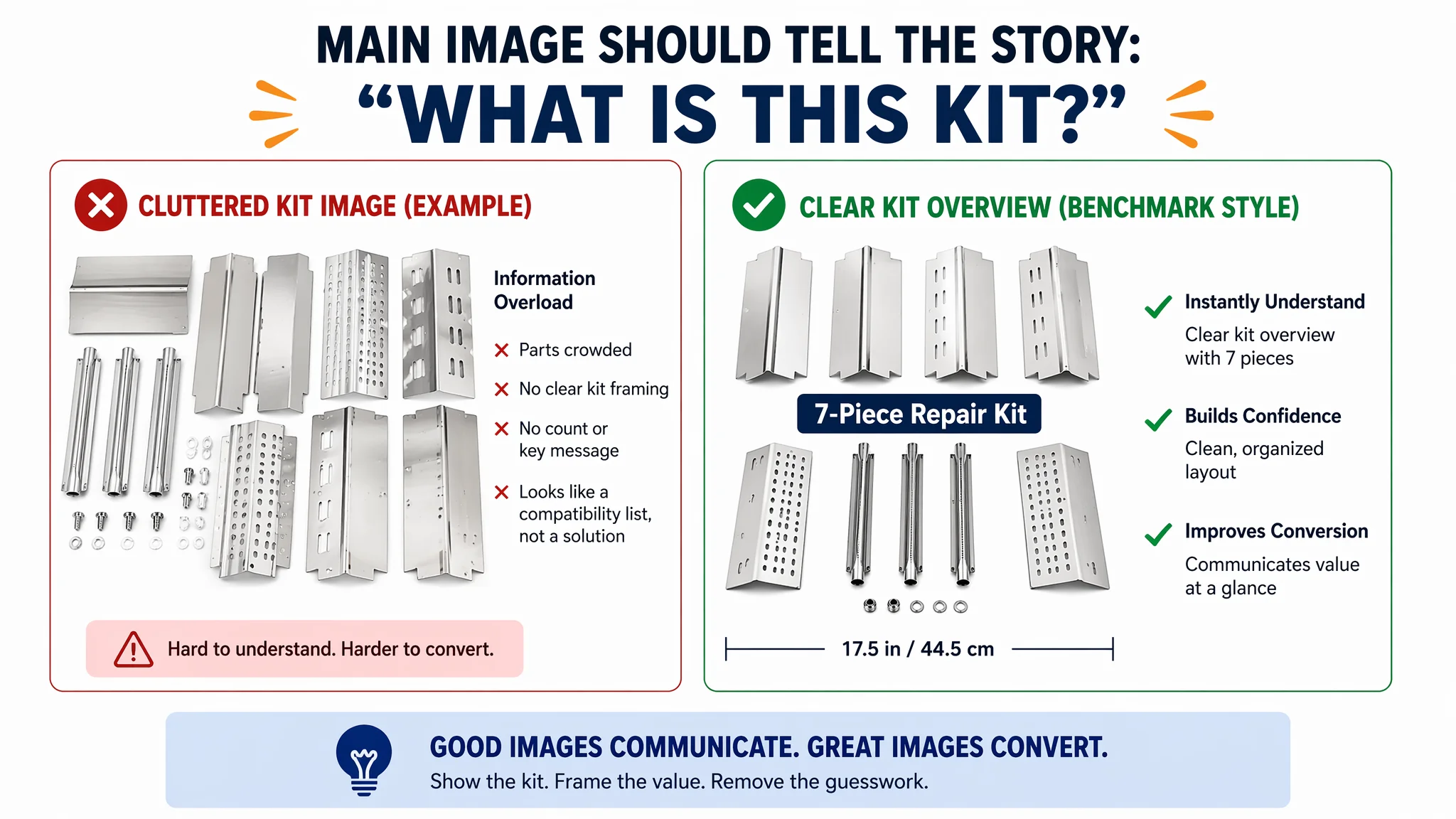
In practice, many listings technically “have images” but still fail to communicate. In the grill replacement kit case, DeepBI’s visual comparison found that the client’s main image did show the product, yet it lacked a clear visual logic. The kit pieces were crowded into frame with inconsistent angles, parameter text was small and hard to read on mobile, and there was no explicit framing like “7-Piece Repair Kit” to help shoppers instantly understand what they were getting. The competitor, on the other hand, used a cleaner layout with a clear kit overview, simple dimension callouts, and imagery that looked professionally engineered rather than improvised.
Support images told a similar story: the competitor used zoomed shots to prove material thickness (e.g., a caliper on the plate), contextual installs inside a grill, and simple diagrams for size and fit. The client’s gallery lacked this narrative chain; even where information existed, it wasn’t visually prioritized. DeepBI’s scoring didn’t just flag a three-point numerical gap on the main image (23 vs 26 out of 30); it highlighted specific missing roles in the gallery—no single image clearly showed dimensions at a glance, no dedicated “kit content” frame, no visual reassurance of fit or usage.
Creating this diverse set of high-quality, compliant assets can be a significant bottleneck. While general-purpose AI tools can generate images, they risk "hallucinations" that alter a product's appearance, leading to customer complaints of "image-product mismatch" and damaging negative reviews. DeepBI solves this by operating as an automated visual production system, not a creative drawing board. It first establishes a "Product DNA" map, locking in your product's authentic material, color, and design as an unchangeable constraint. The AI then generates compliant main images, data-driven infographics, and compelling lifestyle scenes that are guaranteed to be true to the physical product, turning abstract strategy into conversion-focused visual assets. In the grill case, that meant moving from a cluttered, generic-looking kit image to a visually disciplined set where each picture had a purpose: attract the click, prove thickness, show fit in the grill, and make the install feel straightforward.
Developing Persuasive Product Descriptions and A+ Content
Beyond your title and images, the product description and A+ Content sections are where you convert shopper interest into sales. A well-crafted product description should be easy to scan, using short paragraphs and basic HTML like bolding to highlight key benefits. Structure your points to address customer problems directly and present your product as the clear solution.
For brand-registered sellers, A+ Content (formerly Enhanced Brand Content) is a powerful tool for elevating your listing. By replacing the standard text description with a visually rich layout of custom modules, you can tell a deeper brand story, showcase product features dynamically, and significantly boost shopper confidence. This enhanced experience is proven to drive results, with Amazon data indicating that A+ Content can increase conversion rates by an average of 5%.
However, the effectiveness of A+ Content depends entirely on its strategic execution. Simply adding more images is not enough. A pattern DeepBI sees frequently is that underperforming listings either have no A+ at all or treat it as a decorative strip of extra photos. In the grill parts example, the conversion gap was obvious in the scoring: the client’s listing had 0/25 on the detail/A+ dimension, while the competitor scored 23/25. There was literally no A+ story—no visual proof of material thickness, no install diagrams, no heat distribution explanation, no cleaning or lifestyle scenes. For a buyer worried about fit, durability, and cooking performance, the lower part of the page was simply silent.
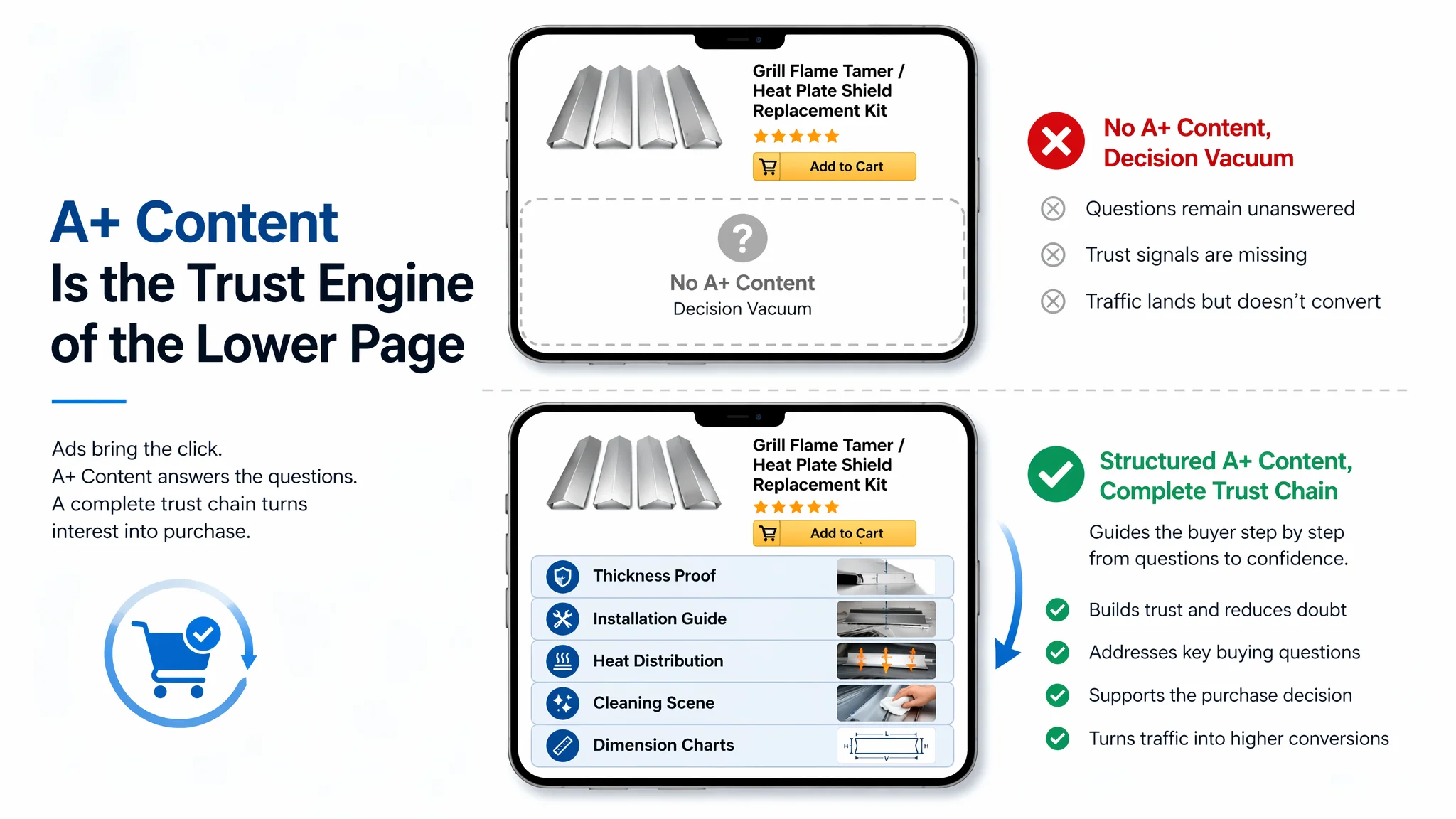
The competing listing used A+ as a structured conversion engine: a full-width BBQ scene to set context, close-up shots with a caliper on the plate to prove 16GA thickness, overhead images showing plates installed in a grill, illustrated heat and smoke flow to explain performance, cleaning scenarios, and dimension charts. This content answered the questions the client’s page left hanging—and DeepBI’s data confirmed that this was where much of the CVR difference originated.
DeepBI provides a data-driven framework for this process by deconstructing the detail page into logical modules that align with user psychology: introduction, core selling points, pain point solutions, and trust endorsements. In the grill case, the system’s diagnosis didn’t just say “add A+.” It spelled out that the core trust gap was in material proof, fit reassurance, and usage scenarios, then recommended specific modules—hero BBQ scene, thickness proof, installed-view, cleaning, and dimension grid—to close that gap. If the system diagnoses a low conversion rate (CVR), it may identify a trust deficit and recommend enriching the A+ page with modules like authority certifications, detailed usage scenarios, or competitor comparison charts. This transforms A+ design from a subjective creative exercise into a structured, conversion-focused strategy.
Leveraging Customer Reviews and Seller Performance for Trust
A compelling listing involves more than just optimized text and images; it requires building an ecosystem of trust. Customer reviews and your seller performance are the foundation of this trust, directly impacting both shopper confidence and your ranking within Amazon's algorithm.
Customer reviews act as powerful social proof. A high volume of positive feedback signals a trustworthy product, influencing purchasing decisions and boosting your relevance for the A9 algorithm. Amazon itself recognizes this, recommending that sellers focus promotional efforts on products that have secured at least five reviews and maintain a 3.5-star rating or higher. To build this crucial asset, sellers should leverage ethical strategies like the Amazon Vine program to generate early, credible feedback.
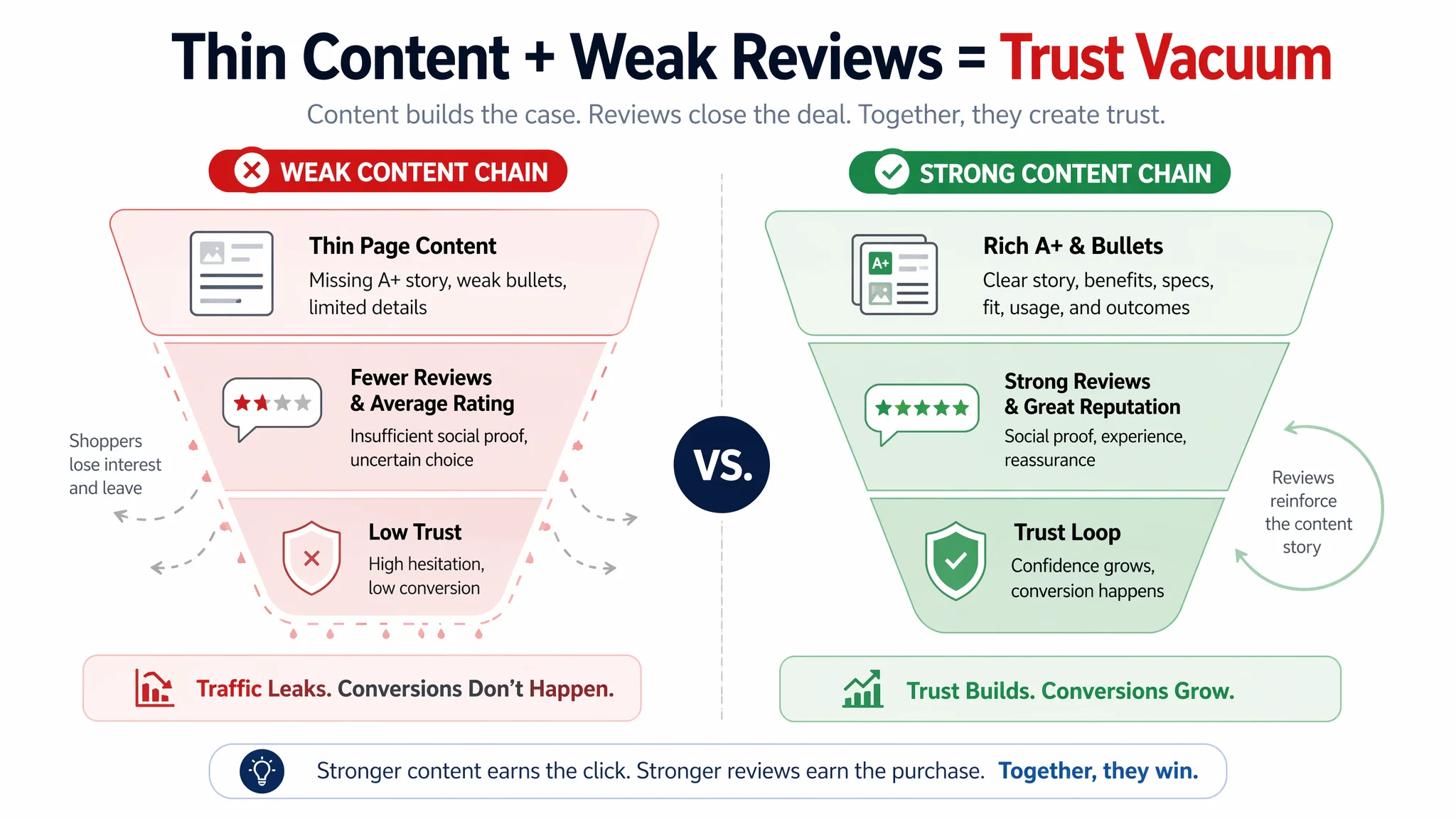
In the grill replacement kit case, DeepBI’s scoring also highlighted a review gap: the client’s listing lagged behind the benchmark on review metrics (5/15 vs 11/15). Both products operated in the same price and category band, but the competitor had accumulated a stronger pattern of ratings and qualitative feedback that reinforced its A+ narrative—buyers mentioning durability, fit, and improved grilling results. Meanwhile, the client’s relatively weaker review profile meant that even once a shopper scrolled past the bare listing content, there was less social proof to counteract doubts raised earlier on the page. This is a common pattern: when the page content is thin and reviews are also modest, shoppers default to the listing that “feels” more complete, which they often interpret as “more reliable.”
Beyond reviews, your operational excellence is constantly being evaluated. Seller performance metrics such as fast shipping times, low return rates, and responsive customer service are critical to your listing's health and visibility. Utilizing Fulfillment by Amazon (FBA) is a key strategy, as it not only ensures reliable logistics but also grants your listing the coveted Prime badge—a powerful symbol of trust that can significantly increase attractiveness and conversion rates (CVR).
Understanding how these trust signals impact performance is essential. DeepBI's intelligent diagnosis module incorporates your "review reputation" as a critical input for assessing listing competitiveness. By analyzing review volume, star rating distribution, and patterns in negative feedback, the system can help diagnose if a low CVR is rooted in a lack of customer trust. In the grill case, the combination of missing A+ content and weaker review strength reinforced the same conclusion: the listing needed to build a convincing trust story before additional traffic would translate into stable sales. DeepBI then provides a data-driven path—improving page content, enhancing post-purchase experience, and monitoring how review patterns change as those improvements go live—to strengthening your market position.
Dynamic Pricing and Promotional Strategies to Boost Sales Velocity
An optimized listing is only effective if it receives traffic that converts. Pricing and promotional strategies are powerful levers for driving the sales velocity that Amazon’s algorithm rewards. The goal is not simply to offer the lowest price, but to price competitively and use promotions to create buying urgency, which directly impacts your Best Seller Rank (BSR).
Start with a thorough competitive pricing analysis, researching competitor strategies within a similar price band to ensure your offer is perceived as valuable. From there, deploy strategic promotions to stimulate demand. Amazon’s native tools, such as coupons, discounts, and Lightning Deals, are excellent for creating short-term sales spikes. Furthermore, consider product bundling to create unique, value-added offers that can increase your average order value (AOV) and differentiate you from competitors.
Driving traffic is essential to capitalizing on these strategies. This is where advertising becomes a critical amplifier. Many sellers, like the grill accessories seller, instinctively start here when ACOS rises: they expand keyword lists, adjust bids, and restructure campaigns, assuming that “there must be hidden demand” that better ads will unlock. DeepBI’s analysis in that case showed that ads weren’t the primary constraint—impressions and clicks were coming through—but the listing’s conversion capacity was too weak to capitalize on that traffic.
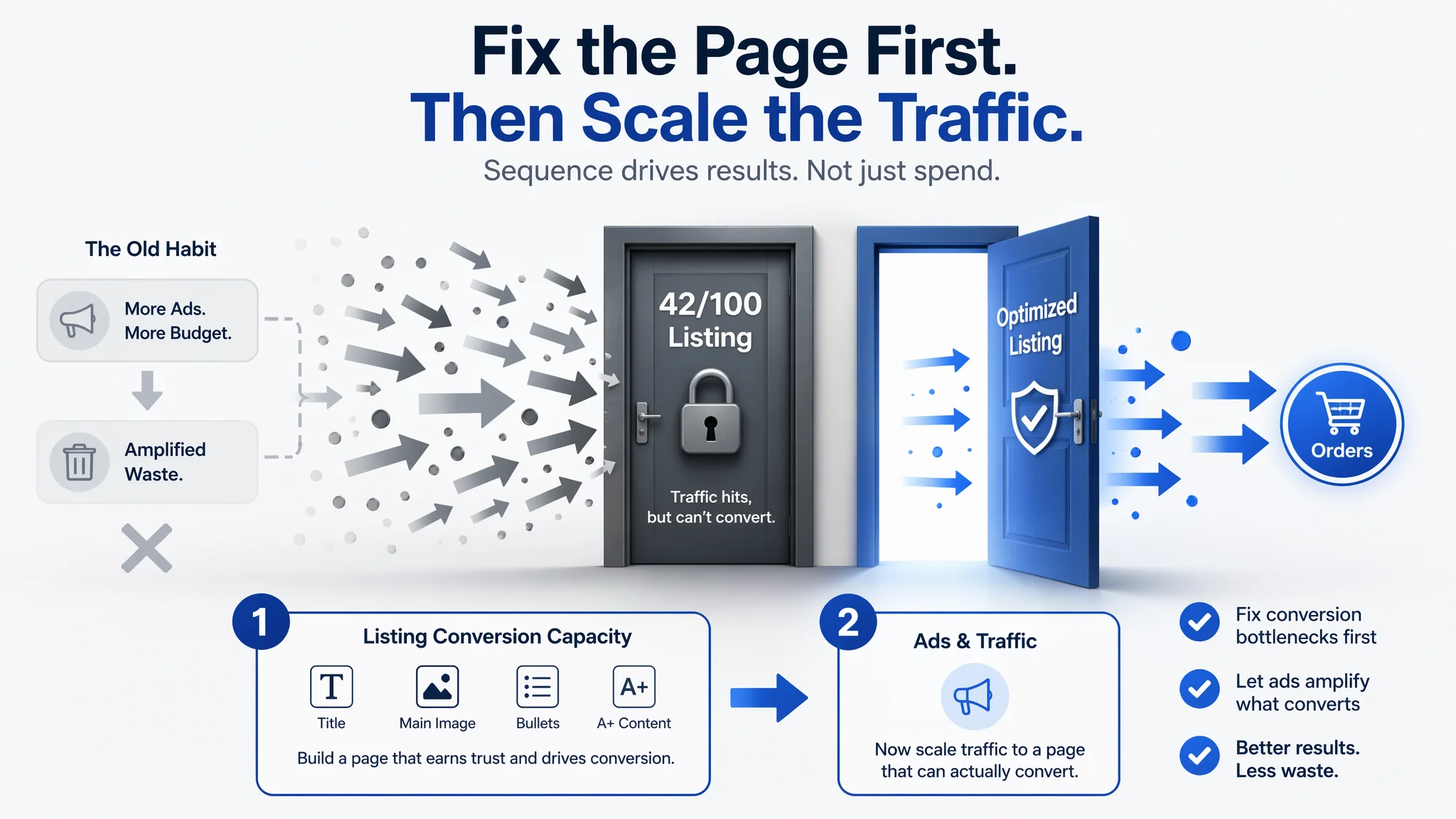
DeepBI's Ads Quant module helps optimize your ad spend and bidding strategies, ensuring your budget is directed toward driving the most qualified, high-intent traffic to your listing. The key lesson from the grill case is sequencing: pushing more budget into a 42/100 listing with no A+ and weak bullets primarily amplified waste. Once the listing was rebuilt to better benchmark standards—clarified title, stronger main images, outcome-focused bullets, and a full A+ story—ad spend started to serve its intended role: feeding a page that could actually close. By combining a compelling offer with precise, data-driven advertising, you create a powerful feedback loop: targeted traffic converts at a higher rate, which increases sales velocity and improves your organic ranking over time.
Continuous Monitoring, Testing, and Iteration with DeepBI
Effective listing optimization is not a one-time project but a dynamic, iterative process. Market conditions, competitor actions, and customer preferences constantly evolve, requiring a systematic approach to stay ahead. This means continuously monitoring performance, testing new approaches, and refining your listing based on hard data rather than guesswork.
The foundation of this cycle is tracking Key Performance Indicators (KPIs) such as conversion rate (CVR), click-through rate (CTR), sales velocity, and organic rank. By analyzing this data, you can move from 'groping in the dark' to precision targeting, making informed adjustments to specific listing elements that are underperforming.
In the grill kit case, DeepBI’s scoring snapshot—42/100 vs 81/100—was only the starting point. The more valuable part was how that score decomposed into actionable levers (title, main image, bullets, detail/A+, reviews) and how changes could be measured over time. Initially, the seller’s iteration cycle lived almost entirely inside the ad console: they would tweak bids, wait, watch ACOS, and tweak again, without touching the page. Because the underlying conversion capacity of the listing never changed, the performance swings were small and fragile.
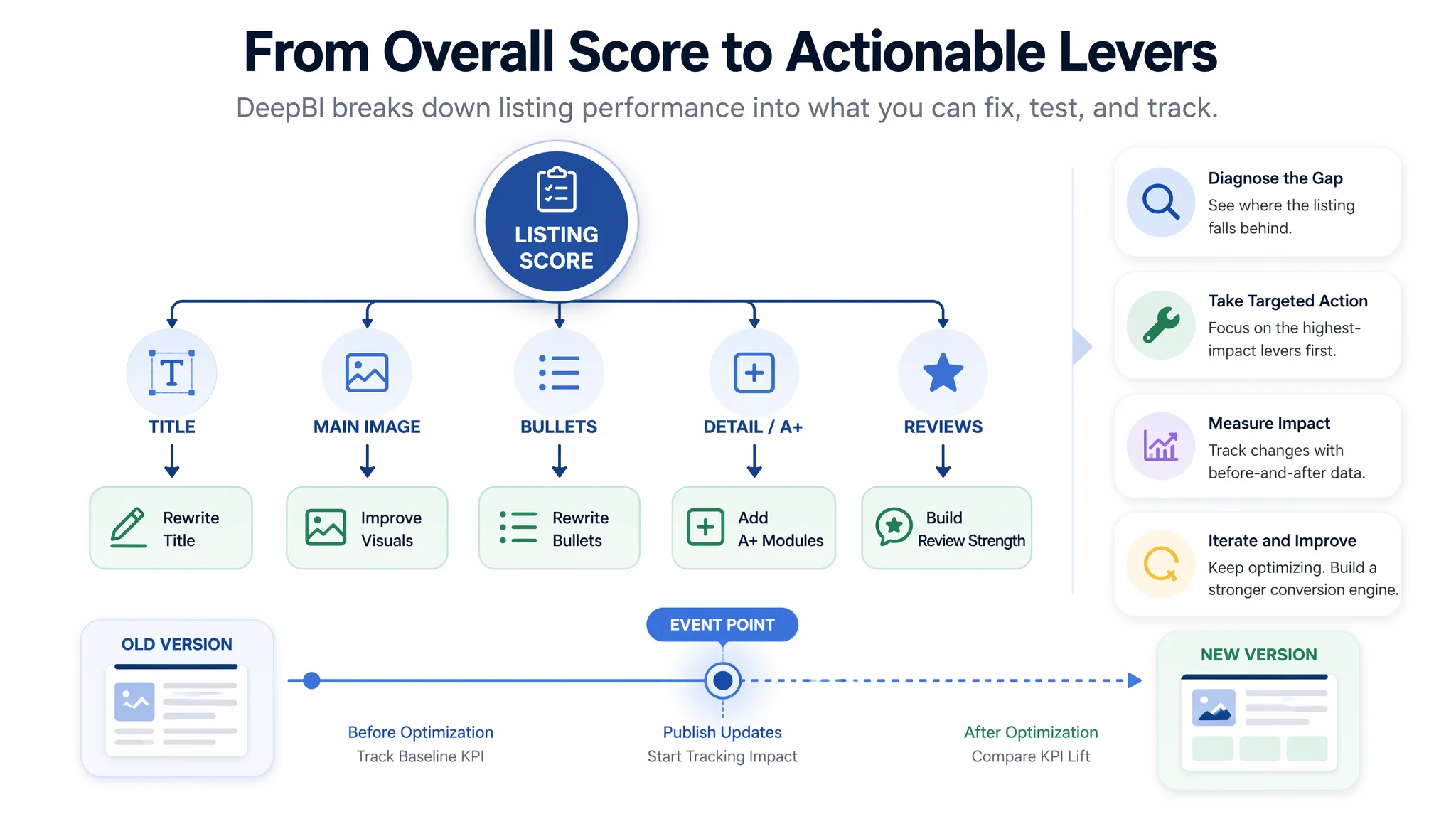
DeepBI is engineered to manage this entire feedback loop. It provides a full-link optimization system that starts with data-driven diagnosis and strategy, moves to AI-powered content generation, and culminates in execution. With its one-click synchronization via the secure Amazon SP-API, DeepBI transforms from an analysis center into an execution center. The platform facilitates continuous improvement by allowing you to compare new and old versions of your content before applying changes. In a practical flow like the grill listing, that means you can stage a new title and image set, preview how they render, and roll them out together instead of pushing isolated, uncoordinated edits.
After an update is published, DeepBI automatically marks an event point, enabling you to clearly track the before-and-after impact on your KPIs. For the grill seller, this clarified which upgrades moved the needle: improving bullet logic and launching a robust A+ section had a more direct CVR impact than previous small keyword tweaks in ads. Over time, this builds confidence in the iteration process itself—teams stop guessing and start learning.
Finally, DeepBI’s Organic Traffic module helps you monitor the long-term effects of your optimizations on natural ranking stability and organic order share. This completes the business growth loop, creating a virtuous cycle where a better listing attracts more precise traffic, leading to healthier, sustainable growth. The grill case underscores this: once the listing “deserved” its traffic, organic visibility had a chance to stabilize instead of constantly being propped up by inefficient paid clicks.
Conclusion: Sustained Growth Through Strategic Amazon Listing Optimization
Mastering the Amazon marketplace requires more than just a great product; it demands a meticulously optimized product listing. This is the foundation for driving higher conversions, improving Best Seller Rank (BSR), and achieving sustained business growth. Throughout this guide, we've explored the critical components of a high-performing listing, from compelling titles and imagery to persuasive A+ Content.
The grill replacement kit example illustrates what happens when this foundation is weak: a listing that looks like a compatibility sheet, has no A+ story, and scores 42/100 will turn ad spend into leakage, no matter how many times bids and keywords are adjusted. The seller’s initial assumption—“it must be the ads”—was understandable, but incomplete. Once DeepBI benchmarked the listing against an 81/100 competitor and broke the score down into specific weaknesses (bullets, A+, review strength), the path forward became clear: rebuild conversion capacity first, then let ads amplify a page that can actually convert.
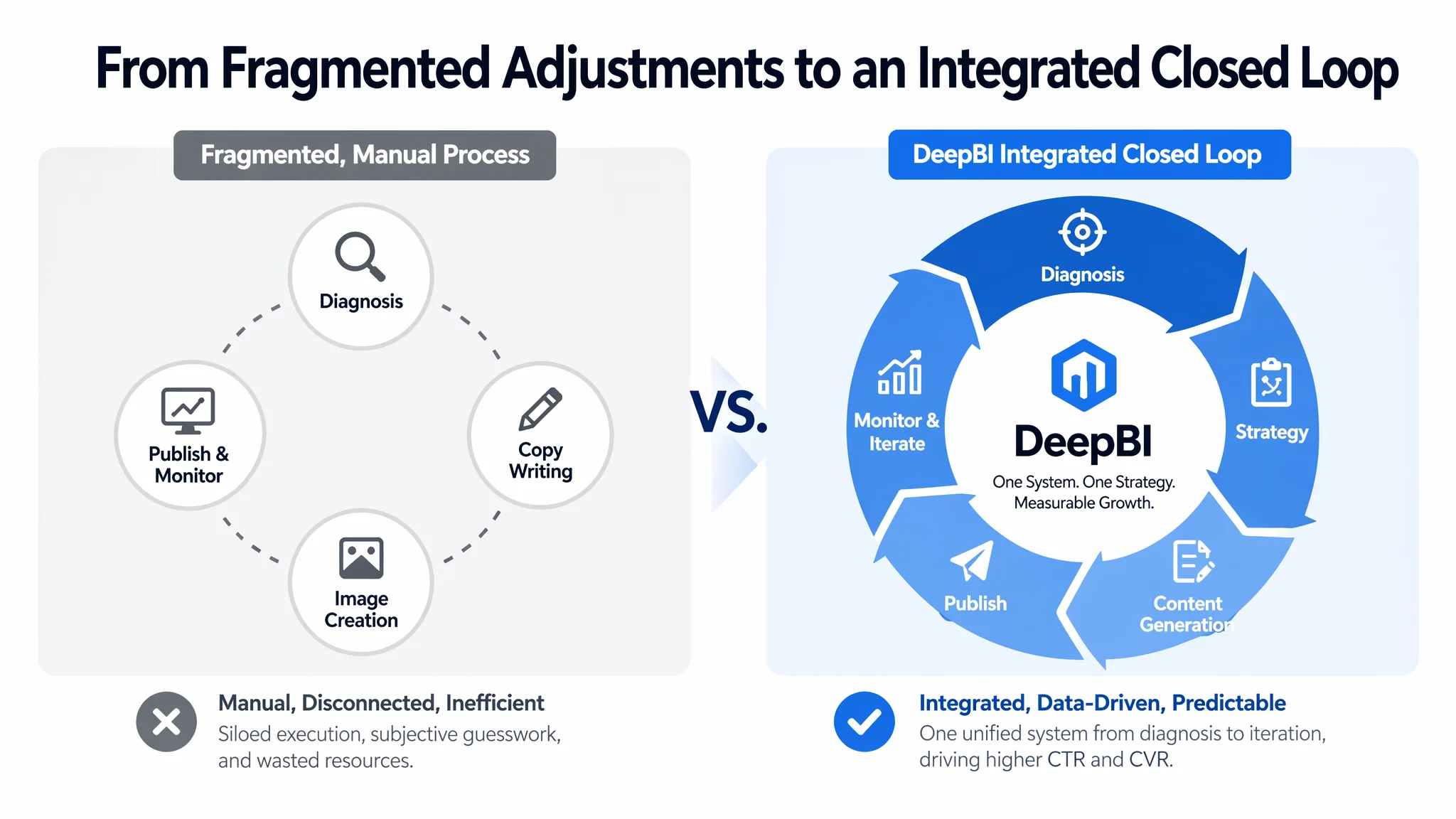
Traditional optimization methods are often fragmented, relying on subjective guesswork that separates diagnosis from execution. This disconnect leads to wasted resources and unpredictable results. The key to breaking this cycle is to adopt a holistic, data-driven methodology.
DeepBI provides this crucial advantage by transforming listing optimization into a predictable, quantifiable, and scientific process. It integrates the entire workflow—from diagnosis and strategic suggestions to content production and delivery—into a single, unified system. By eliminating subjective errors and aligning every change with market data, DeepBI ensures that each optimization directly contributes to measurable improvements in click-through rate (CTR) and conversion rate (CVR). For sellers like the grill accessories brand, this means moving from “adjust the ads when ACOS is bad” to a more robust playbook: diagnose the listing, fix the real bottlenecks, and then invest in traffic. It functions as an intelligent decision-making partner, empowering you to unlock the full commercial potential of your visual assets and secure a lasting competitive edge.