

The Critical Impact of Organic Rank Decline on Amazon Businesses
For any Amazon seller, organic search is the primary engine of customer discovery and sales. A high organic rank places your product directly in the path of motivated buyers, driving consistent traffic and revenue. However, in an era of intense competition and rising advertising costs, a sudden drop in this ranking is not a minor setback—it's a direct threat to your business's viability. This decline immediately reduces visibility, leading to a cascade of negative effects: lower click-through rates (CTR), a sharp fall in sales velocity, and a weakened competitive position.
The most common reaction to a ranking drop is often the most damaging: making reactive, subjective changes to the listing based on guesswork. This approach of "blind trial and error" frequently fails to address the root cause and can even accelerate the decline, wasting valuable time and resources. Without a clear data evidence chain, it's impossible to connect a low CTR to a specific main image flaw or a poor conversion rate (CVR) to a lack of trust signals in the A+ content. To effectively diagnose the problem, reverse the damage, and build a resilient ranking strategy, sellers must move beyond intuition and adopt a structured, data-driven methodology for optimization.
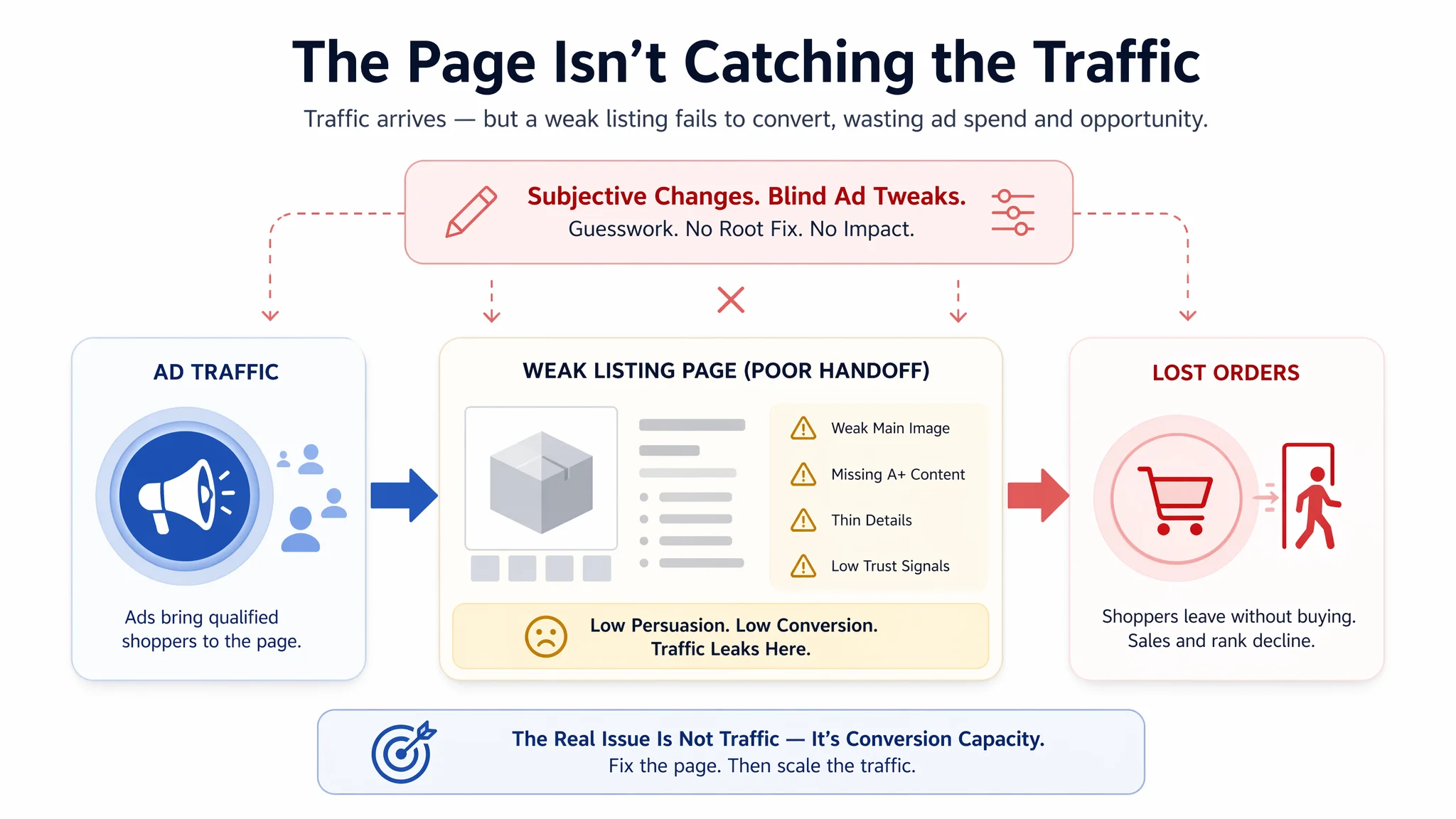
This gap between intuition and reality shows up frequently in real operations. In one women’s travel underwear listing with a “secret pocket” feature, the seller saw rising ACOS and unstable orders and immediately assumed “ads are getting expensive” and keywords or bids were at fault. On paper, the product looked healthy: a solid star rating, more reviews than a key competitor, and ongoing ad traffic. The team’s response was to “optimize ads and keywords harder,” repeatedly tweaking campaigns in the hope that better traffic alone would fix performance.
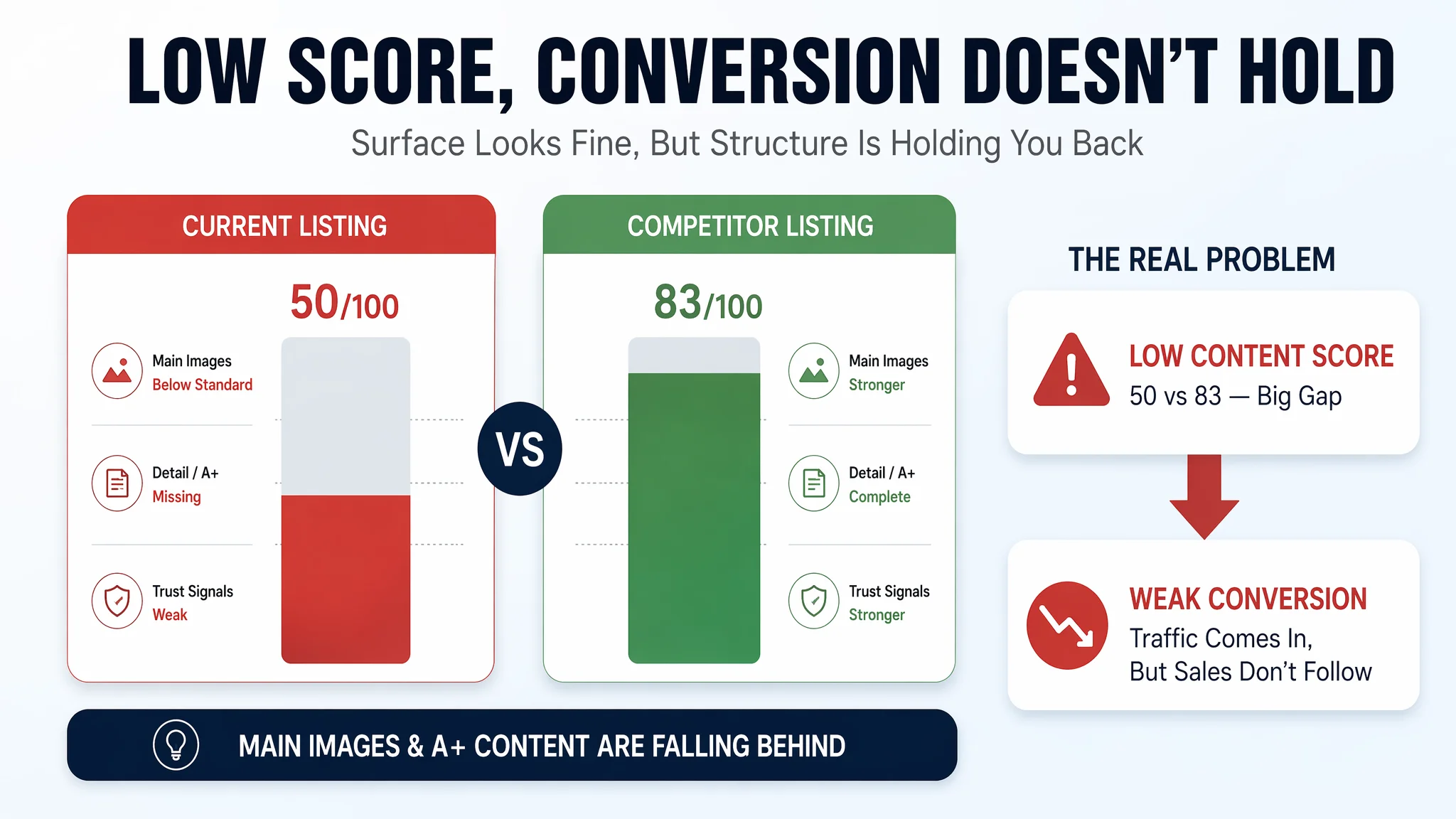
Only when DeepBI’s diagnosis quantified the listing did the real issue surface: the page scored 50/100 versus a direct competitor’s 83/100, with a huge gap in detail/A+ content and a clear deficit in main images. In other words, the problem wasn’t traffic—it was conversion capacity. The listing simply could not convincingly carry the traffic it was already getting. This kind of misalignment is exactly why a rank decline can worsen when sellers respond by only touching ads or cosmetic elements on the listing instead of understanding where the page is structurally weak.
Understanding the Root Causes of Organic Rank Drops on Amazon
A sudden decline in organic search ranking is rarely caused by a single event. More often, it's a symptom of complex interactions across five key areas. Understanding these categories is the first step toward an accurate diagnosis and effective recovery.
- Something You Changed: Internal modifications are a frequent cause. This can range from well-intentioned but ineffective updates based on subjective aesthetics to critical errors, such as using AI-generated images that alter the product's appearance. Any mismatch between your listing's visuals and the actual product risks triggering destructive negative reviews, which directly harms your rank.
In the “secret pocket” underwear example, the seller hadn’t broken the listing technically, but they had allowed the content structure to lag far behind a benchmark competitor. Bullet points were written from an internal perspective, and the main image sequence repeated similar visuals instead of advancing a decision. From the team’s point of view, they had “updated the listing” and felt the page was fine; from DeepBI’s scoring perspective, the result was a 50/100 page against an 83/100 competitor. This is a typical pattern: internal changes that feel like improvements can, in fact, reduce persuasive power if they’re not anchored to buyer logic and competitive standards.
- Something Your Competitors Changed: Your rank is relative. A competitor may have launched a new product, initiated aggressive advertising, or significantly improved their listing. For example, they might optimize their titles with high-traffic keywords or enhance their A+ content with comparison tables, causing your Click-Through Rate (CTR) and Conversion Rate (CVR) to fall in comparison.
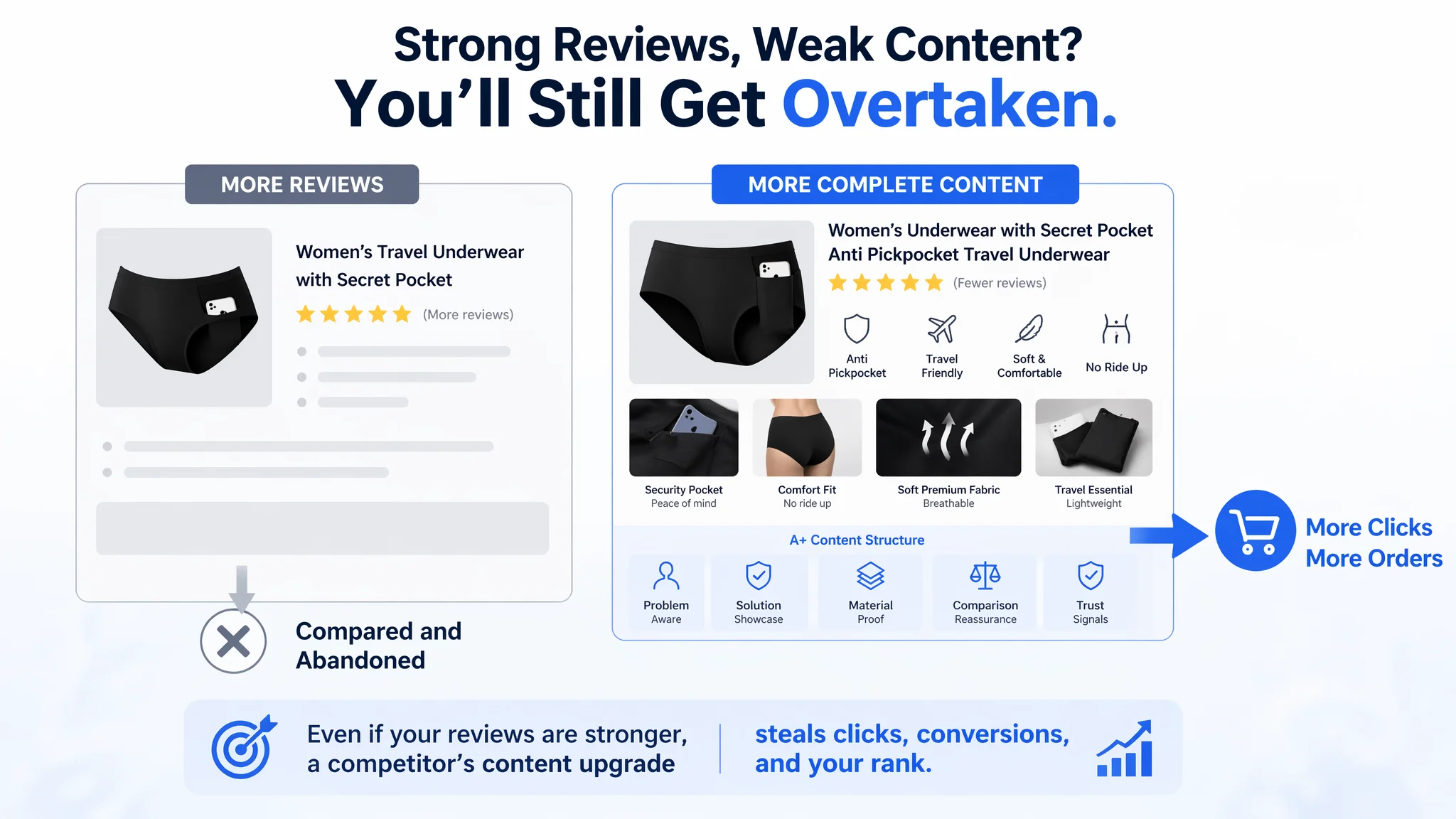
In the same niche, the competitor’s page had a fully built A+ section, a main image sequence that progressed from value to fit to material proof, and a title front-loaded with “Women’s Underwear with Secret Pocket” and “Anti Pickpocket.” Nothing about the seller’s product reviews suggested weakness, but side-by-side, the competitor’s content gave a cleaner and more reassuring decision path. The effect in the marketplace is subtle but powerful: even if your review base is stronger, a competitor’s content upgrade can quietly steal both clicks and conversions, gradually pulling your rank down.
- Changes in Customer Demand: Buyer behavior is not static. If your listing's keywords become outdated and no longer align with current high-frequency search terms, your product will lose visibility to more relevant competitors.
- Changes in Traffic Sources: Shifts in how customers discover products, whether through social media, external blogs, or new Amazon features, can alter traffic patterns and impact the performance of previously stable listings.
- Amazon Algorithm Changes: Amazon periodically refines its search algorithm to improve the customer experience. These updates can change how listings are weighted, often favoring titles and bullet points that balance keyword relevance with natural, consumer-friendly language over simple keyword stuffing.
Across all these categories, the deeper pattern from the underwear case remains instructive: the team kept insisting it was a traffic and ads problem until quantified evidence showed that the root cause sat squarely in listing quality. Rank declines often start looking like “traffic issues,” but in practice, they are frequently the outcome of your page falling behind evolving buyer expectations and competitor standards.
The DeepBI Framework: A Systematic Approach to Diagnosis
A sudden drop in organic rank demands a structured, data-driven investigation, not a panicked reaction. This framework moves from broad data collection to specific root-cause analysis, ensuring you address the actual problem.
Initial Data Collection & Scope Definition
The first step is to establish a clear timeline and scope. Using Amazon Seller Central and Brand Analytics, pinpoint the exact date the organic rank decline began. Isolate the impact by segmenting your data: determine which specific ASINs, countries, and keywords are most affected. This initial analysis defines the problem's boundaries. To establish a performance baseline, use DeepBI's keyword filtering on your advertising data. This quickly identifies historically high-performing keywords (strong CTR, CVR, and order value), creating a data-driven target list for your recovery efforts.
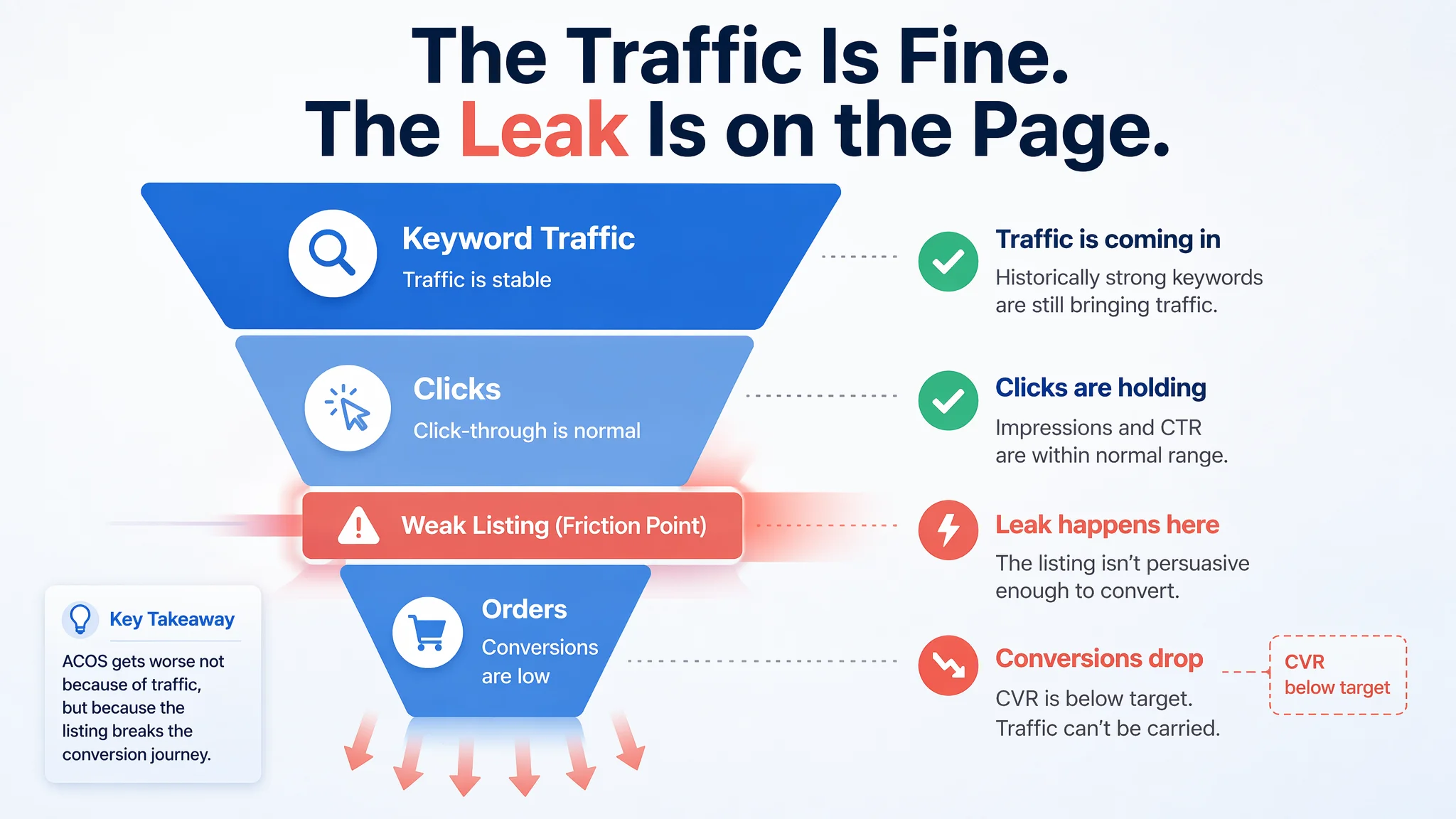
This initial segmentation is often where misdiagnosis begins or ends. In the “secret pocket” listing, the team’s internal view was simply “ACOS is getting worse.” Only by breaking down performance by keyword and pairing ad data with listing diagnostics did it become clear that historically strong keywords were still bringing traffic, but those sessions weren’t converting at a sustainable rate. Without that layer of analysis, the intuitive reaction was to keep refining bids and search terms; with it, the conclusion shifted to “the traffic is fine; the page isn’t.”
Analyzing Technical Health & Listing Integrity
Before analyzing content, verify your listing's technical foundation. Manually check for common backend issues within Seller Central that can cripple visibility, such as indexing errors, product suppressions, or broken parent-child ASIN variations. A technically sound listing—with a valid title, bullet points, description, A+ Content, and images—is the non-negotiable prerequisite for earning organic rank. Any unresolved technical glitches will undermine even the most sophisticated content optimization efforts.
In the underwear case, there were no major suppressions or indexing failures; technically the ASIN was healthy. That absence of technical errors is, in itself, a useful signal: when performance drops on a technically intact listing, the investigation should move quickly past backend checks and into content, competitive positioning, and conversion structure. Sellers who stay stuck at the “is my listing suppressed?” stage can lose critical weeks while the real problem—weak images, missing A+, or poor positioning—continues to depress rank.
Evaluating Content Relevance & Competitor Landscape
With technical issues ruled out, assess your listing's persuasive power. Is your content still relevant to current customer search intent? A drop in rank often signals a disconnect. Simultaneously, analyze the competitive landscape. Have top competitors recently changed their pricing, main images, or titles? Their strategic moves can directly erode your position. Effective diagnosis requires benchmarking against the market; optimization without this context is often a waste of resources.
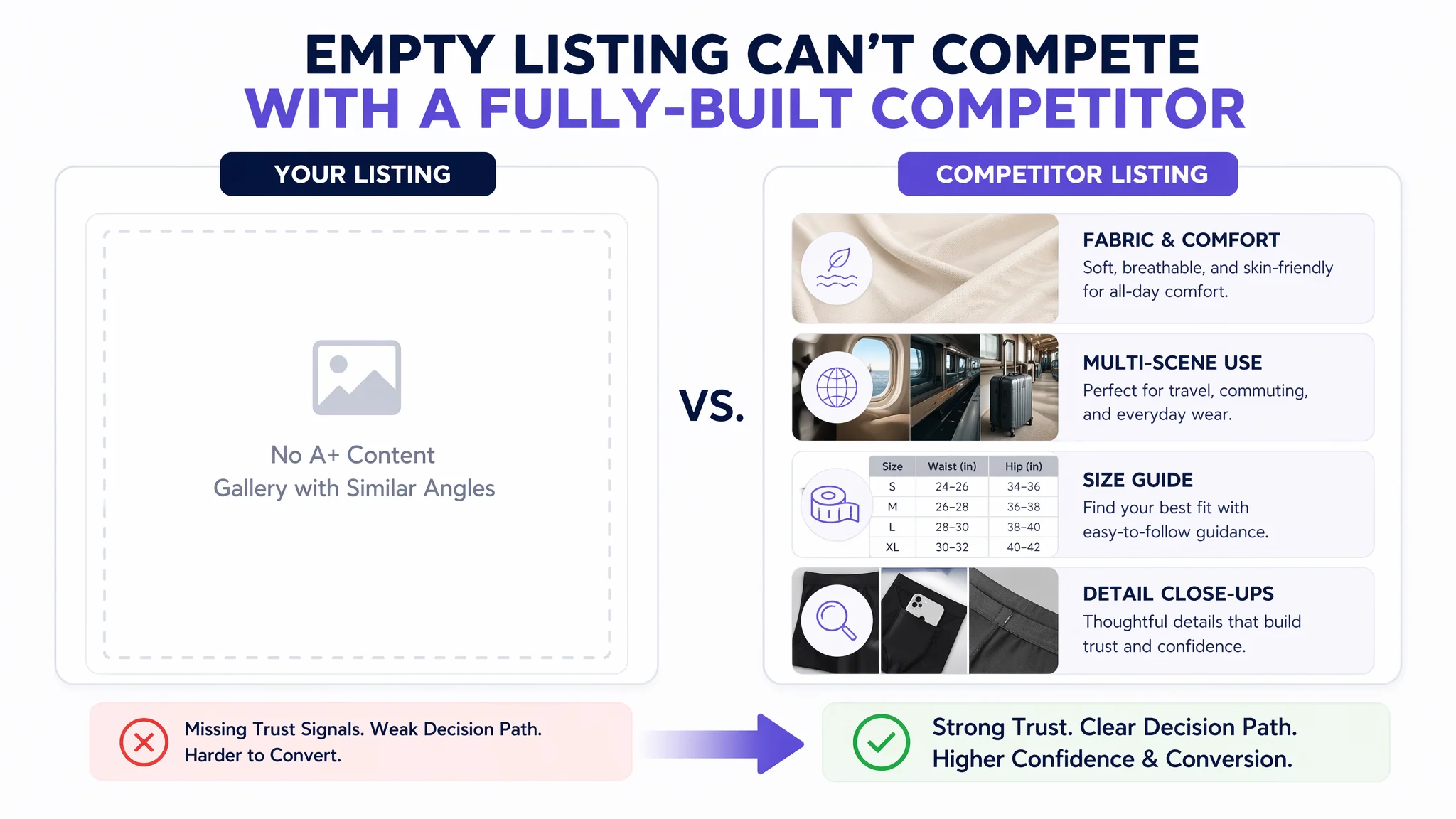
In the travel-underwear example, content benchmarking exposed the gap very clearly. DeepBI’s scoring showed a 33-point deficit versus a directly comparable competitor, including a -21 gap in the detail/A+ dimension and a -7 gap on main images, while both listings were at parity on review quality. The competitor’s title led with “Women’s Underwear with Secret Pocket” and “Anti Pickpocket,” A+ modules covered material comfort, usage scenarios, sizing guidance, and fabric close-ups, and the image set walked buyers from core value to detailed proof. The seller’s listing, by contrast, had no A+ at all and a gallery that reused similar angles instead of building a decision path. This diagnostic contrast turned a vague sense of “maybe our page is weaker” into a quantified mandate to rebuild content before touching ads.
Investigating Amazon Algorithm Updates & SERP Changes
Finally, consider external factors. Investigate whether your rank drop correlates with a known Amazon algorithm update by monitoring official announcements and reputable industry sources. Furthermore, analyze the Search Engine Results Page (SERP) for your main keywords. New ad placements or enhanced Amazon-owned features can absorb clicks and reduce organic traffic, even if your ranking number hasn't changed. The strategic response, similar to principles in Google's core update guidance, is not to chase the algorithm but to focus on improving overall listing quality and value to the customer.
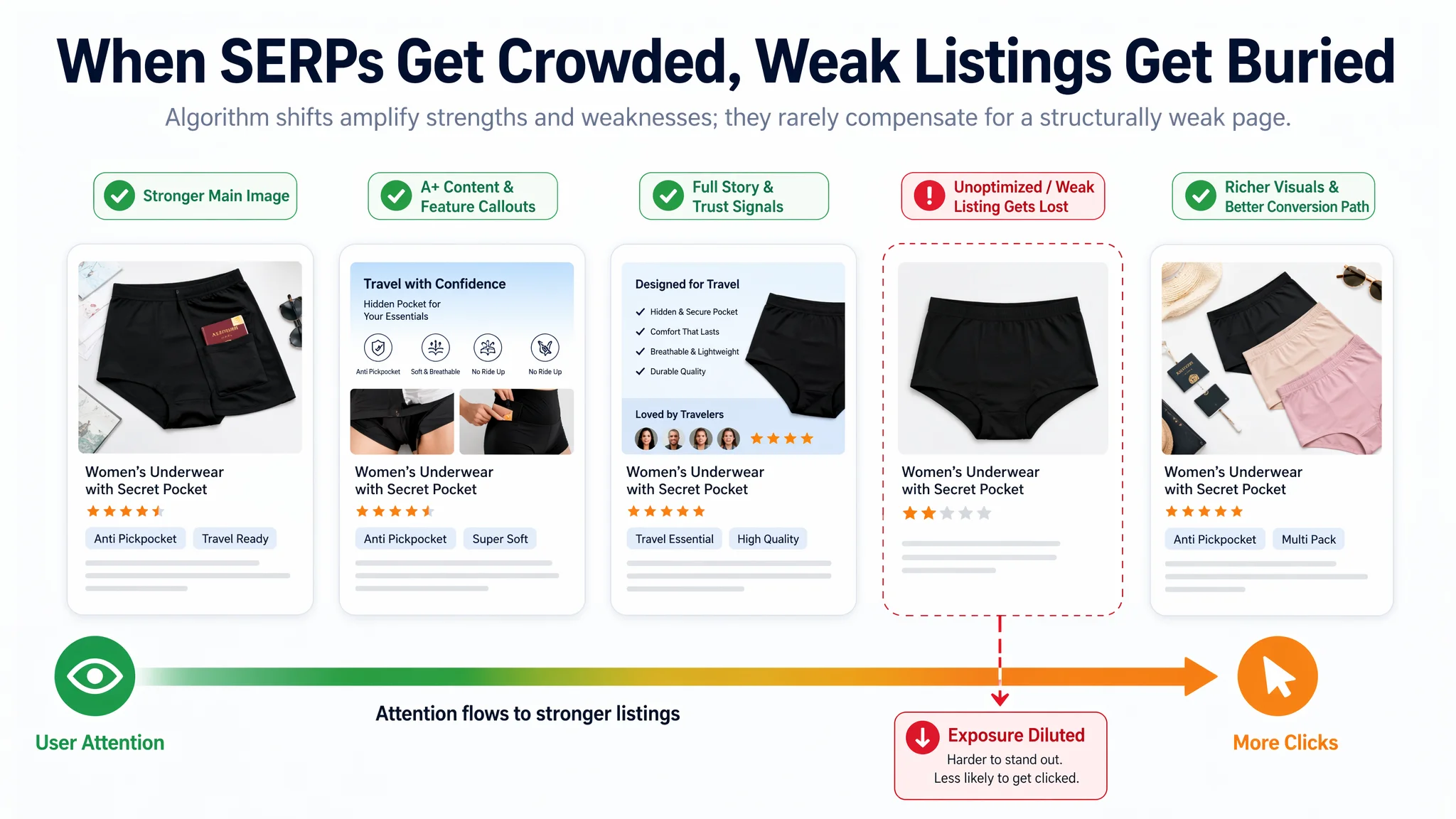
In practical terms, when the underwear seller checked SERPs for their core queries, they found a more crowded page: additional Sponsored placements, richer competitors’ creatives, and Amazon’s own features occupying above-the-fold space. Yet, their own product tile and listing had not evolved at the same pace. Instead of trying to “game” changing SERP layouts, DeepBI’s recommendation focused on listing quality—stronger titles, main images, and A+—so that regardless of layout changes, the product would have a more competitive presence wherever it appeared. This mirrors a broader principle: algorithm shifts amplify both strengths and weaknesses; they rarely compensate for a structurally weak page.
Strategic Recovery & Long-Term Prevention on Amazon
Recovering from an organic rank decline and preventing future drops requires a multi-faceted strategy that addresses technical issues, content quality, brand authority, and advertising synergy. A systematic approach ensures that short-term fixes contribute to long-term, sustainable growth.
Addressing Technical & Listing Deficiencies
First, resolve any technical barriers like indexing errors or product suppressions that make your listing invisible. From there, focus on optimizing your content for both relevance and conversion. DeepBI’s Intelligent Scoring and Diagnosis provides a clear path by benchmarking your main image, title, bullet points, and A+ content against top-performing competitors. It translates vague goals into specific instructions that its AI Image and Text Generation engine can execute, creating optimized assets. This process is constrained by a "Product DNA" map to ensure authenticity, mitigating risks from AI-generated inaccuracies. Finally, new content can be synced to your listing in seconds via API, eliminating manual upload friction.
In the travel-underwear case, the scoring breakdown made prioritization obvious. The review dimension was already strong, the title was “salvageable” with better ordering and keyword emphasis, but the page scored zero in detail/A+ and lagged significantly in main images. Acting on this diagnosis, DeepBI’s process focused first on rebuilding the listing’s decision logic:
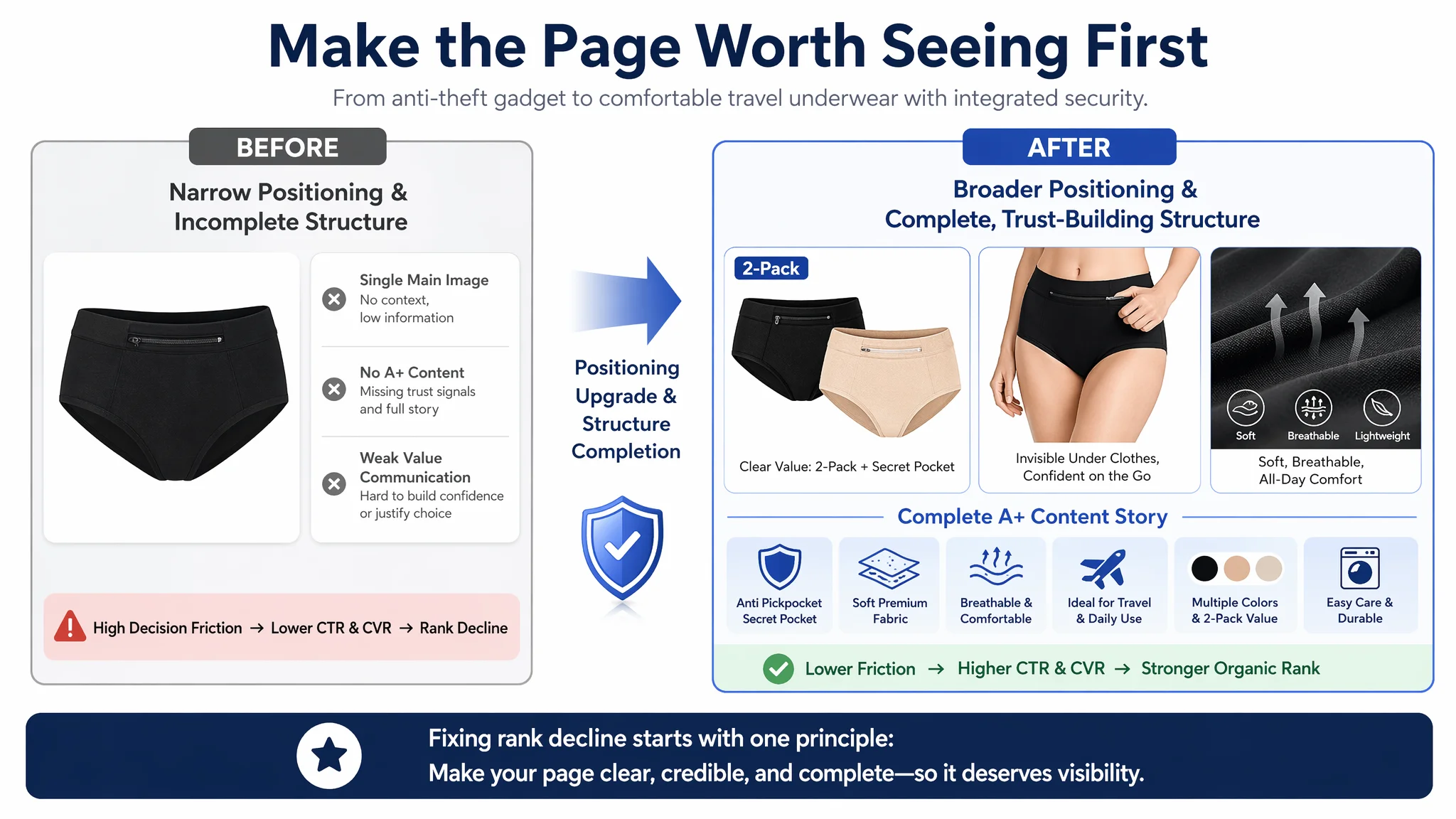
- Reframing the positioning from a narrow “anti-theft gadget” to “comfortable travel underwear with integrated security.”
- Restructuring the title so “Women’s Underwear with Secret Zippered Pocket” and “Anti Pickpocket” appeared early, aligning with how buyers search and how Amazon weights terms.
- Redesigning the main image sequence to move from 2-pack value and secret pocket hook, to fit and invisibility under clothes, to fabric proof and zipper detail.
- Constructing a complete A+ story that clarified style and coverage, explained sizing with visuals, demonstrated modal fabric comfort, and reassured buyers about zipper safety for devices and security scanners.
Only after those structural deficiencies were addressed did the seller return to campaign adjustments. This order of operations illustrates the core principle: fixing rank decline means first making sure the page deserves visibility, not trying to brute-force visibility into a weak page.
Enhancing Content & Keyword Strategy
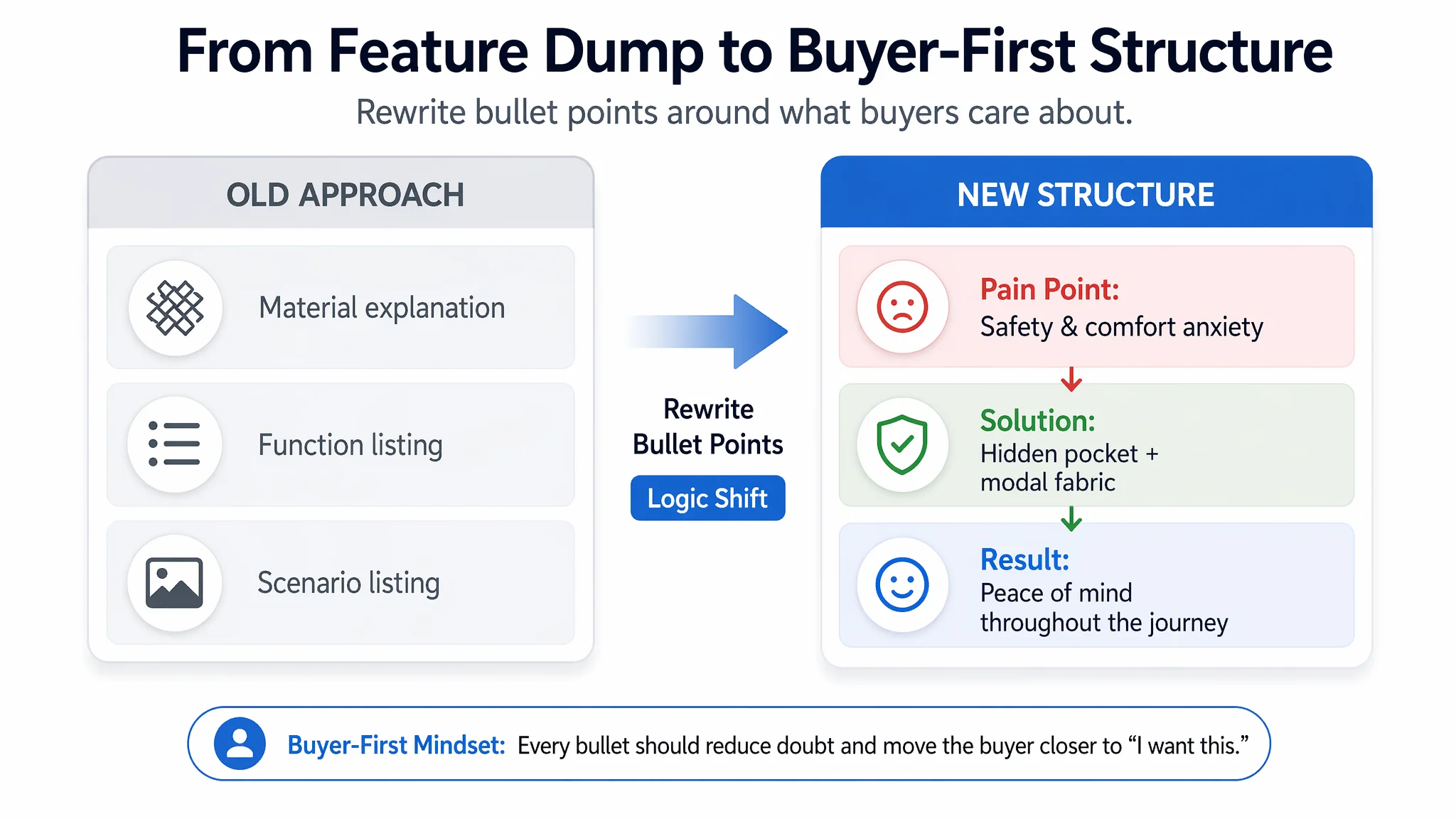
Static content becomes stale. Regularly refresh your listings to improve content depth, expand keyword targeting, and maintain relevance. This involves more than simple text swaps; it means restructuring bullet points around a "Pain Point -> Solution" framework and enriching A+ content to answer customer questions preemptively. For high-impact keywords identified through performance data, DeepBI’s Top of Search strengthening capability helps concentrate advertising efforts. This focused push is designed to drive visibility and sales velocity for terms that matter most, creating a strong signal to Amazon's algorithm and helping to secure first-page organic rankings.
In the underwear listing, bullet points were a clear example of how content can drift away from buyer logic. The original bullets listed materials and use cases, but in a way that felt internal and descriptive rather than decision-oriented. Through DeepBI’s diagnosis, each bullet was rewritten into a pain point–driven structure:
- Highlighting modal fabric as a tangible comfort advantage over standard cotton, not just a technical spec.
- Framing the secret zippered pocket as a safety and anti-pickpocket solution, especially for insulin pumps and valuables, instead of a generic “hidden pocket.”
- Turning the zipper into a trust element—smooth, rust-resistant, magnet-free—so buyers with medical devices or travel concerns had a reason to believe.
- Anchoring scenarios like travel, workouts, and festivals in the emotional outcome of “peace of mind in crowded places.”
- Clarifying sizing with specific waist ranges and pointing users to visual size guides in the images and A+.
As these content changes aligned more closely with actual buyer questions, the page became better equipped to convert traffic for the very keywords that ads and organic search were already delivering. This is the essence of content and keyword synergy: keyword work brings the right visitors; structured content gives them a clear reason to buy.
Building Authority & External Signals Strategically
Your on-Amazon performance is also influenced by off-Amazon factors. External signals like brand mentions on social media, high-quality backlinks to your brand website, and external traffic driven to your product detail page all contribute to your brand's authority. These signals indicate to Amazon that your brand is credible and established. Pursue these ethically through content marketing, influencer collaborations, and public relations efforts that build genuine interest and drive qualified traffic, reinforcing your product's market position.
In the case of the travel-underwear seller, the primary bottleneck was listing architecture rather than external authority, but the broader lesson still applies: once the product page can convert, external signals become far more valuable. Sending influencer traffic or social mentions into a weak, underbuilt listing would simply replicate the ads problem—more sessions into a low-conversion page. After DeepBI helped the seller rebuild the listing’s trust backbone, external efforts could credibly support both organic rank and conversion without leaking opportunity at the product detail page.
Leveraging Ads for Organic Uplift
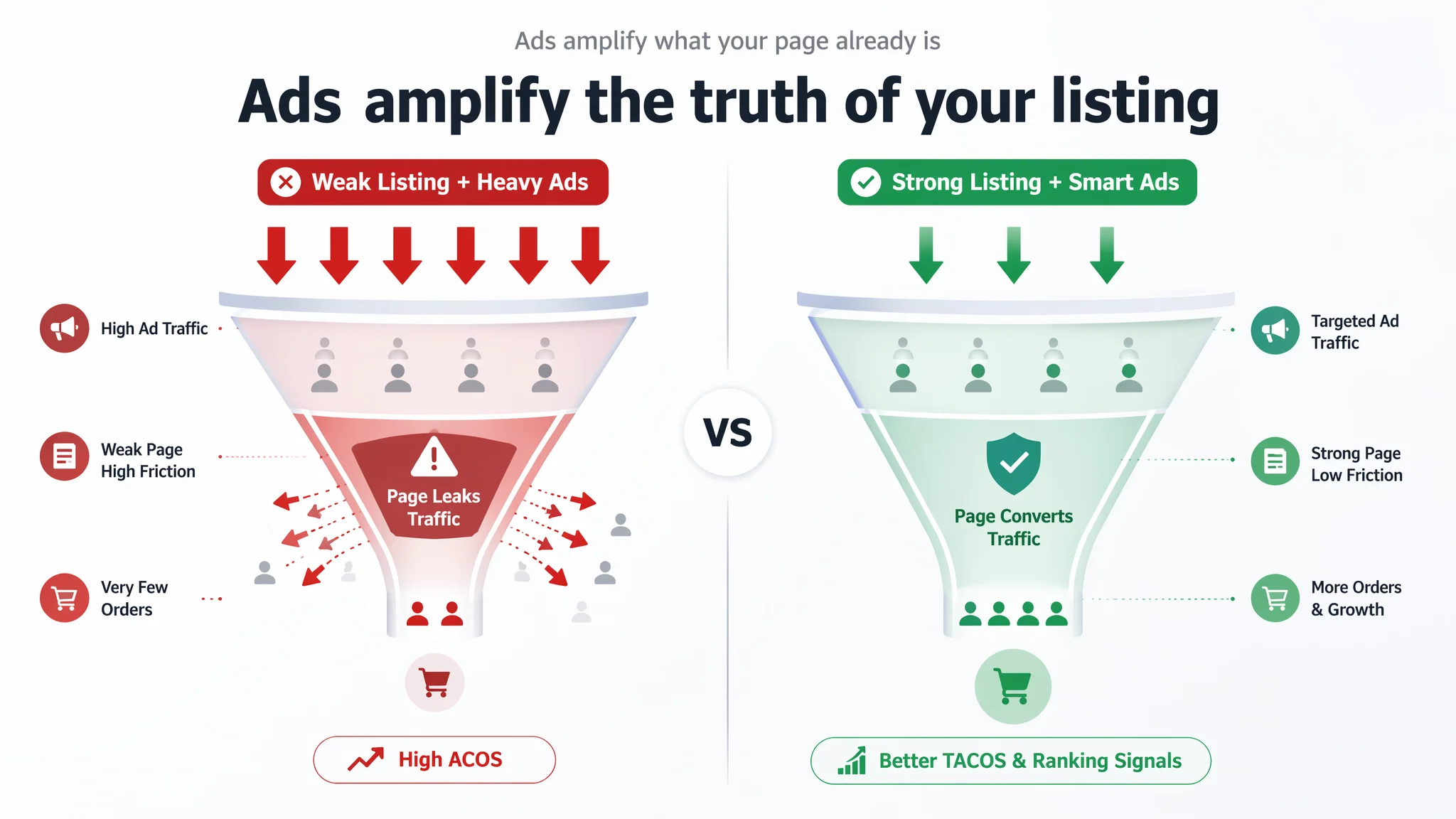
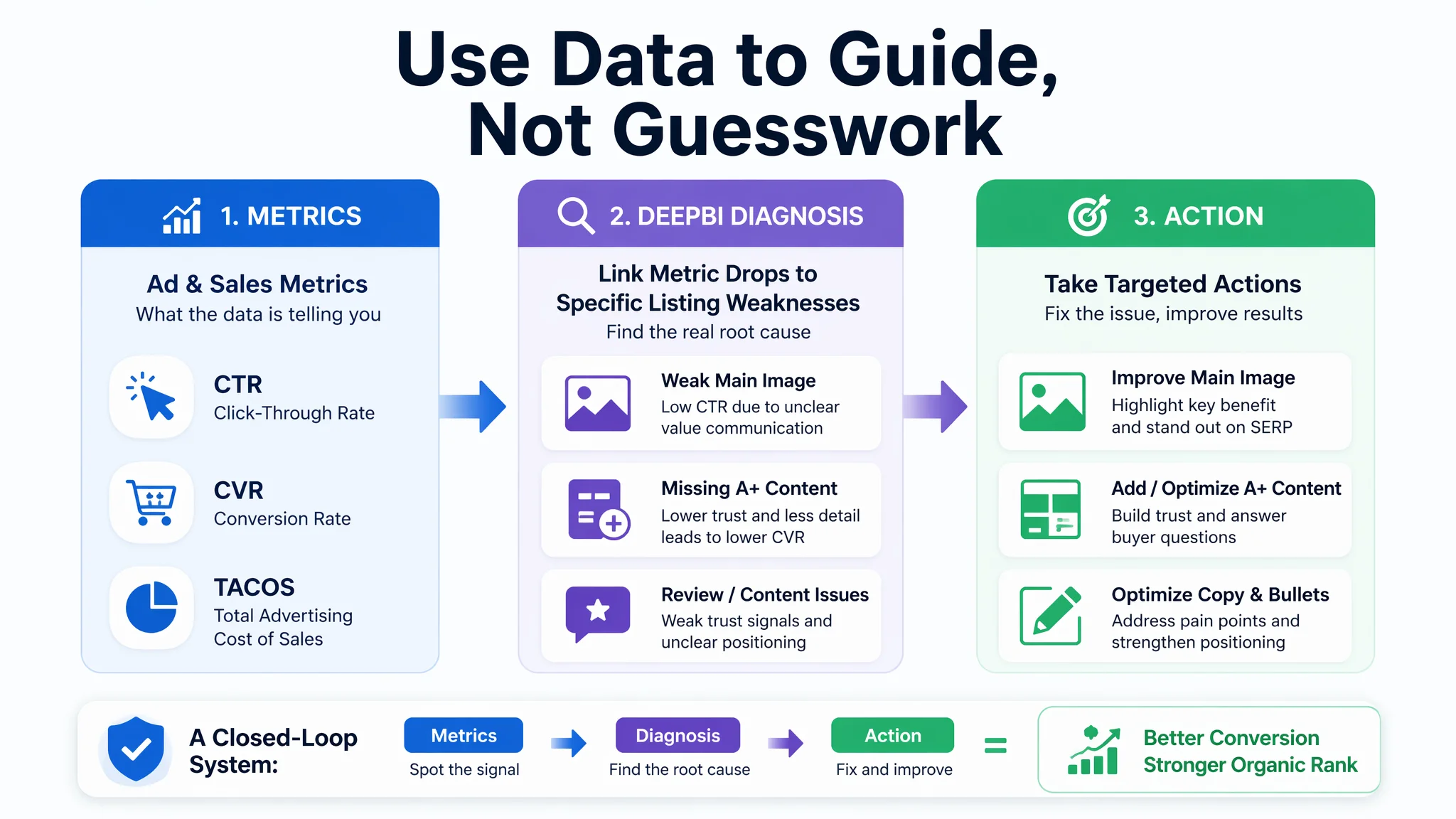
A well-executed Sponsored Products strategy is a powerful catalyst for organic growth. Ads generate immediate sales velocity—a key ranking factor—and provide invaluable keyword and conversion data. DeepBI facilitates this dual growth by creating a feedback loop between advertising and organic health. For instance, if ad data reveals a low Click-Through Rate (CTR), it signals a need to optimize the main image. If Conversion Rate (CVR) is poor, the A+ content likely needs more depth. This allows you to use ad spend not just for short-term sales, but as a diagnostic tool to systematically strengthen your listing for long-term organic success.
The “secret pocket” case is a textbook illustration of using ads as a diagnostic tool rather than just a growth lever. Ad campaigns were already in place and driving impressions, but ACOS remained difficult to control. Rather than interpreting this as a sign to pull back ads or endlessly iterate bidding structures, DeepBI connected the dots: acceptable CTR combined with weak conversion and a 50/100 listing score pointed to a page problem, not a traffic problem. Once the listing was restructured—title, bullets, main images, and A+ aligned around comfort and security—ad traffic started to behave differently. Each click carried a higher probability of conversion, and the same ad budgets could now feed both short-term sales and improved organic signals. This reinforces a critical insight for rank recovery: ads amplify whatever is already true about your listing. They will not compensate for a structurally weak page.
Monitoring & Sustaining Organic Health with DeepBI
Sustaining a high organic rank is not a one-time project but a continuous process of monitoring, adaptation, and proactive maintenance. A drop in performance is often the result of gradual decay rather than a single event. Establishing a systematic routine is the only way to protect and grow your organic traffic long-term.
Continuous Performance Monitoring
Effective monitoring goes beyond simply watching your Best Sellers Rank (BSR). It requires a disciplined focus on a core set of metrics, including organic sessions, keyword rankings, conversion rates (CVR), and, most importantly, Total ACoS (TACOS). TACOS provides a holistic view of your marketing efficiency by measuring the relationship between advertising spend and total revenue, revealing the true health of your organic sales engine.
DeepBI functions as an automated market health check system, translating advertising data into actionable organic insights. The platform helps you diagnose underlying issues by connecting poor KPIs to specific listing weaknesses. For instance, a low Click-Through Rate (CTR) combined with a poor main image score points directly to a weak visual hook, while a low CVR can be correlated with deficiencies in A+ content or negative customer feedback, indicating a failure to convert traffic. The goal is to leverage stable advertising signals to build stronger organic rankings, increase the proportion of natural orders, and consistently lower your TACOS.
In the underwear example, continuous monitoring made the pattern impossible to ignore: ads were consistently delivering visits, but CVR remained below expectations and ACOS stayed stubbornly high. DeepBI’s linkage between performance metrics and listing scores showed that the problem was persistently rooted in missing A+ content and under-optimized images, not in campaign setup alone. By treating these signals as an early warning system rather than as noise, the seller avoided further ad-heavy experiments and instead invested effort where the data pointed: rebuilding the product page as a real conversion engine.
Adapting to Evolving Amazon & SERP Dynamics
The Amazon marketplace is in constant flux. The search algorithm evolves, and new features on the Search Engine Results Page (SERP) can change customer behavior overnight. A strategy that works today may become obsolete tomorrow. Therefore, strategic flexibility and continuous learning are non-negotiable for sustained success.
A robust Amazon strategy requires a closed-loop system where performance data continuously informs optimization. DeepBI is built for this dynamic environment. As real-world advertising data, such as CTR and CVR, flows back into the system, its diagnostic and strategic models evolve. This feedback loop allows for ongoing adaptation without constant manual intervention, ensuring your listing strategy remains aligned with the current state of the algorithm and market.
For the women’s travel-underwear seller, this adaptability meant more than a one-time fix. Once the initial rebuild was in place, ongoing data allowed the team to test variations in image order, refine bullet copy around new questions emerging in reviews, and adjust A+ modules as they saw which sections buyers engaged with most. Instead of reacting only when rank visibly dropped, they began to treat each small shift in CTR or CVR as information about how buyers and SERP conditions were evolving. In practical terms, this reduced the likelihood of another sudden decline caused by slow, unnoticed listing decay.
Proactive SEO Maintenance
Instead of reacting to rank drops, implement a proactive maintenance routine to prevent them. This cycle should be built on three core pillars: competitor analysis, content updates, and technical checks.
- Competitor Analysis: Regularly identify and analyze benchmark competitors. DeepBI facilitates a quantitative comparison across key listing dimensions—from the main image and title to A+ content—to reveal where you are falling behind market standards.
- Content Updates: Periodically refresh your listing content based on performance data and competitive intelligence. This includes restructuring titles to be more algorithm-friendly or reframing bullet points to better address customer pain points and improve CVR.
- Technical Checks: Utilize DeepBI's scoring module for routine health checks. This automated process helps identify and flag potential issues in your listing's structure or content before they escalate and negatively impact your organic visibility.
The “secret pocket” listing demonstrates what happens when this maintenance cycle is absent and what changes when it is introduced. Initially, the seller relied on a static page: no A+ content, a main image set that hadn’t evolved with competition, and bullets that had never been rewritten around buyer pain points. Their only ongoing adjustment lever was advertising, which led them to misread ACOS trends as purely an ad issue. When DeepBI’s competitor analysis revealed the 33-point score gap and the zero score on detail/A+, it effectively jump-started a maintenance habit:
- Competitive content became a regular reference point, not a one-time snapshot.
- The team began to treat A+ and image updates as recurring work, not optional add-ons.
- Technical health checks ensured that any future changes did not inadvertently harm indexing or visibility.
By institutionalizing this routine, the seller moved from reactive firefighting to proactive SEO care, reducing the risk that organic rank would again be undermined by slow, unmonitored erosion in listing quality.
Ultimately, mastering organic rank decline on Amazon is less about finding a single clever trick and more about aligning diagnosis, content, and advertising around one principle: your listing’s ability to earn and convert attention sets the ceiling for everything else. The women’s travel-underwear case underlines this clearly. Strong reviews and persistent ad spend could not rescue a page that lacked a trust-building narrative and structural depth. Once DeepBI exposed and repaired that structural weakness, ads stopped being a blunt instrument and became a strategic amplifier, supporting both recovery and long-term organic health.