

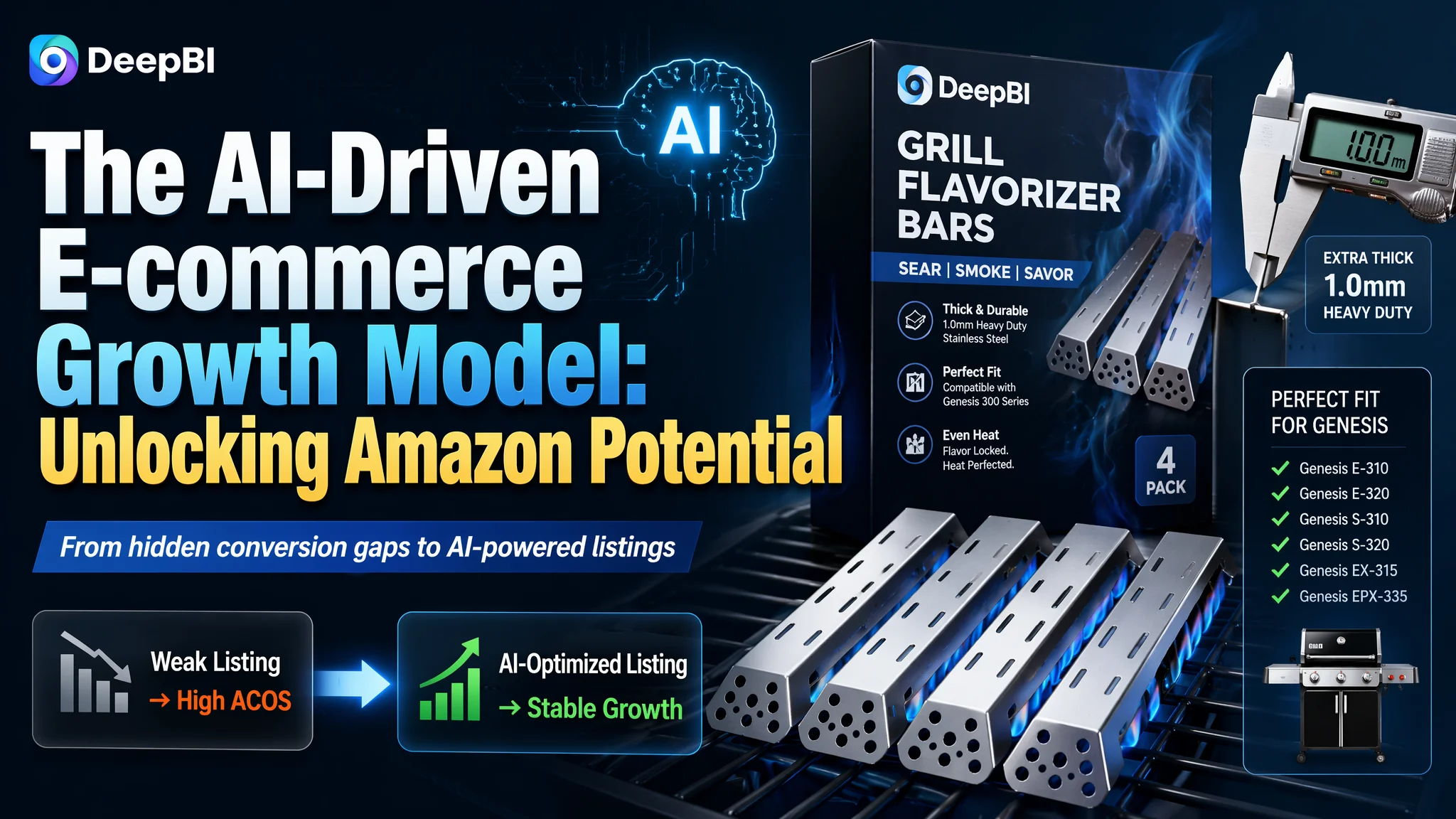
The Imperative of AI in Modern E-commerce Growth
The Amazon marketplace has evolved into a highly competitive environment where rising traffic costs place immense pressure on key performance indicators like Click-Through Rate (CTR) and Conversion Rate (CVR). In this landscape, traditional listing optimization methods—often disconnected across diagnosis, production, and delivery stages—are no longer sufficient. Relying on subjective aesthetics and manual processes leads to inefficient workflows and, more critically, optimization efforts that fail to produce measurable gains. This approach of "blind trial and error" is a significant drain on resources and a primary cause of stagnant growth.
In real operations, this “blind trial and error” often shows up as teams repeatedly tweaking ads while ignoring the underlying listing. One US seller in the grill accessories niche, for example, was struggling with rising ad costs and unstable ACOS on a set of flavorizer bars for Genesis grills. The internal narrative was simple: “ads are too expensive, we need to tune bids and keywords.” They spent weeks restructuring campaigns, expanding keyword lists, and adjusting placements, assuming the problem lived entirely inside the advertising console.
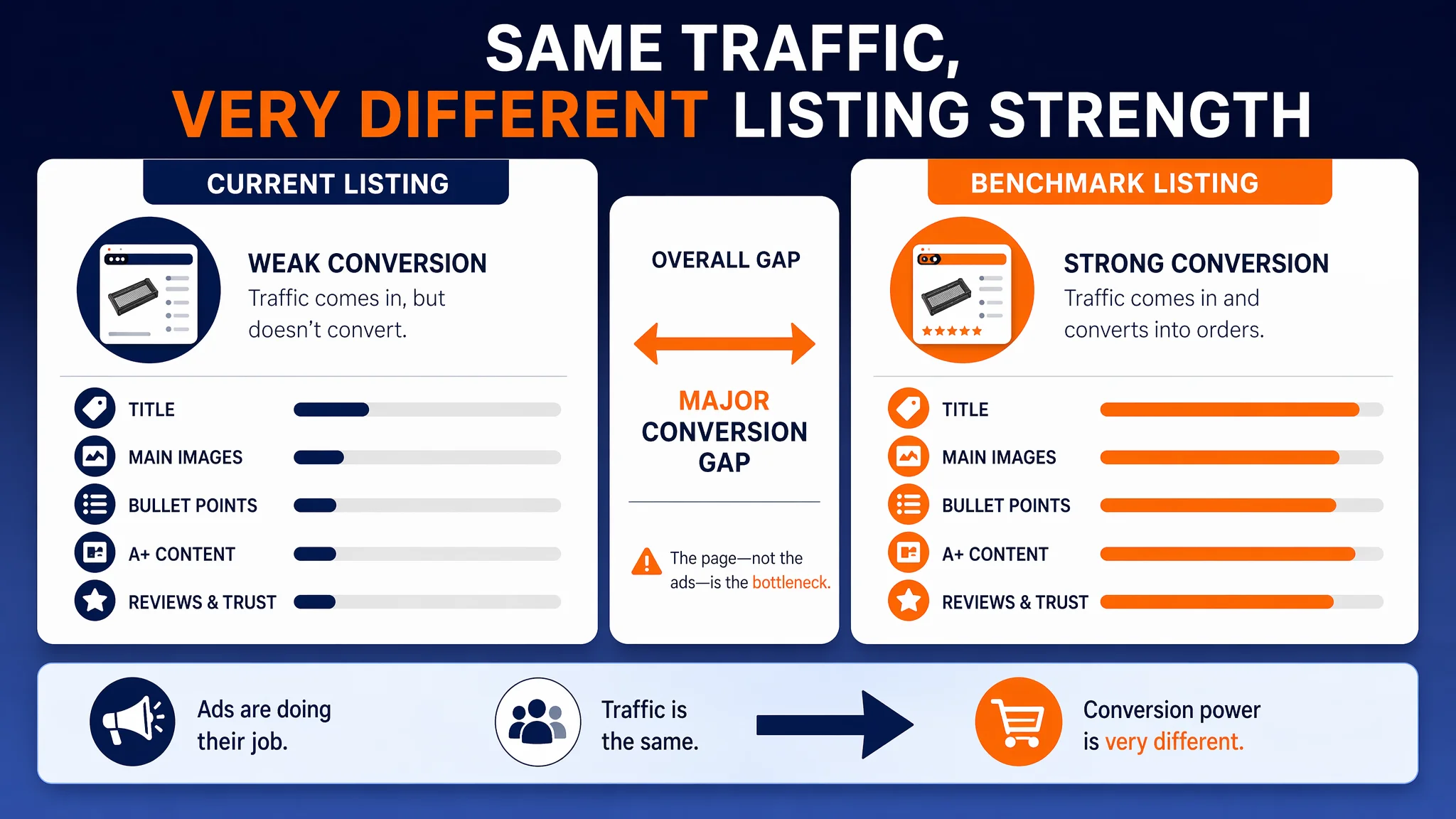
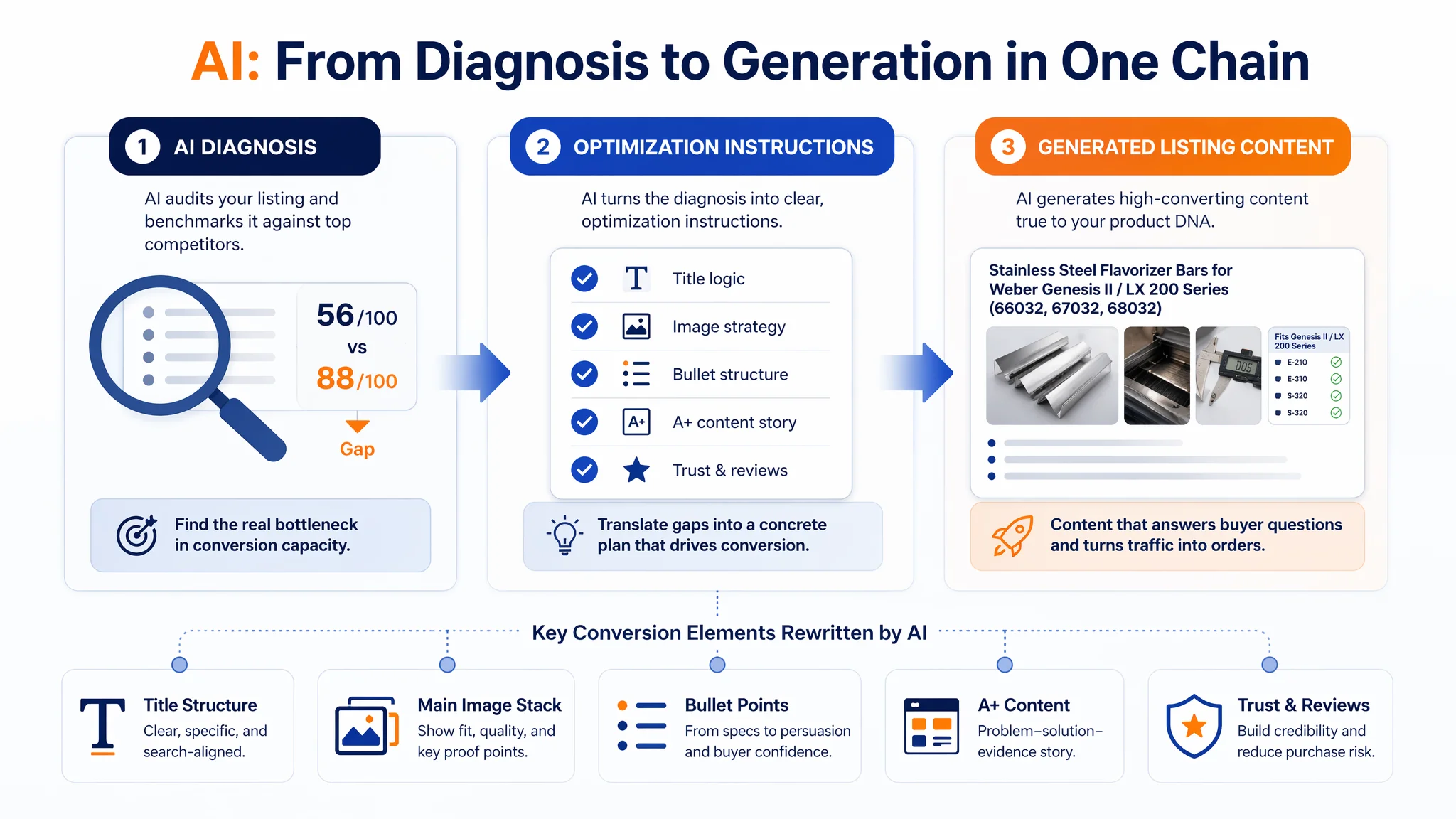
When their listing was benchmarked against a leading competitor, however, the diagnosis told a very different story. The page scored 56/100 versus the competitor’s 88/100. The largest gaps weren’t in traffic volume at all—they were in how the title, main images, bullet points, A+ content, and reviews converted that traffic into orders. Ads were doing their job; the product page was not. This is exactly the kind of misalignment that AI is designed to surface quickly: the problem was not “bad campaigns” but a weak conversion engine.
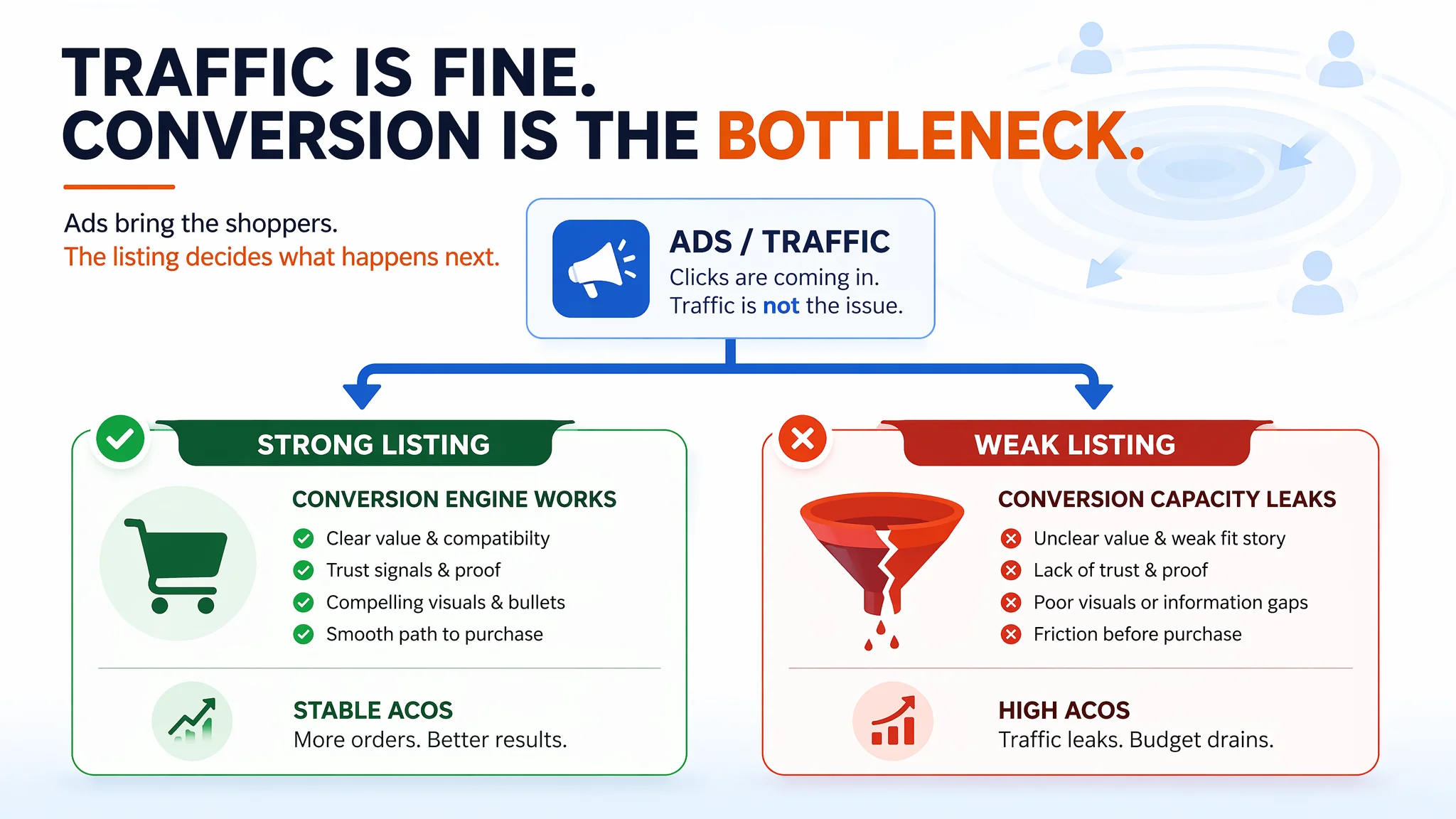
Adopting an AI-first strategy is the necessary response to these challenges. Artificial intelligence transforms the entire optimization lifecycle from a fragmented art into a unified, data-driven science. It enables sophisticated automation that can reduce operational tasks, such as deploying visual assets to a listing, from a 30-minute manual process to mere seconds. More importantly, a customer-centric AI model introduces critical safeguards against common pitfalls. By enforcing "product entity consistency," AI ensures that generated images enhance a product's appeal without altering its core attributes like material or color. This prevents the "image-product mismatch" that often leads to destructive negative reviews, protecting both the customer experience and the seller's brand reputation. This strategic shift ensures every optimization is rooted in a data evidence chain, designed to predictably improve performance—instead of being driven by guesswork about whether the problem is “ads” or “listing quality.”
The Foundation: AI for Optimized Product Listings and Conversion
A high-converting Amazon listing is the cornerstone of success, yet optimizing it often relies on intuition rather than data. AI-driven platforms are changing this by transforming listing management from a subjective art into a data-backed science, enabling sellers to systematically improve product competitiveness.
This process begins with intelligent diagnosis. An AI system can perform a quantitative audit by automatically identifying and benchmarking your listing against top competitors. Using multi-dimensional semantic analysis, it provides data-driven scores for critical elements like main images, title keyword weight, bullet point structure, and A+ content richness. This analysis forms a clear, evidence-based roadmap for optimization.
In the grill-parts seller’s case, this kind of AI-driven audit made the bottleneck impossible to ignore. Against a direct competitor targeting the same Genesis flavorizer bar segment, their listing scored 56/100 while the benchmark reached 88/100. Breaking it down further, they were behind on almost every decision-critical dimension: title, main image set, bullets, A+ detail page, and review strength. The title was “SEO-looking” but structurally loose and vague on material and precise compatibility; images showed what the bars looked like but did not visually answer “Will this fit my grill and last?”; bullets repeated specs without building a clear buying logic; A+ content looked nice but did not tell a problem–solution–evidence story; the review landscape signaled much lower trust than the benchmark. From an AI perspective, this was not a traffic issue at all—it was a conversion-capacity gap.
Based on this strategy, AI-powered generation engines create compelling content. Unlike general-purpose AI that can "hallucinate" and create product-image mismatches, a specialized e-commerce AI is constrained by a "Product DNA" map. This ensures every generated visual asset is authentic to the physical product, mitigating the risk of negative reviews. The system translates vague goals like "improve battery life" into precise, executable instructions for creating high-impact visuals and text.
In the flavorizer bar example, the abstract problem “our page isn’t as good as the competitor’s” was translated into very concrete instructions: restructure the title to group Genesis II/LX 200 series models and OEM part numbers into a tight, high-relevance pattern; rebuild the main image stack to show installed views, exact dimensions, compatibility matrices, heat resistance, and bar thickness via caliper shots; rewire bullet points from a list of specs into a persuasion path that goes from perfect fit, to dimensions and packaging transparency, to material and durability, to heat distribution and flavor, to risk management and cleaning guidance; and reshape A+ from a generic brand showcase into a sequence of compatibility clarity, functional diagrams, thickness comparisons, installation walkthroughs, maintenance advice, and before/after grill refurbishment visuals. Each of these changes is the output of a diagnosis→instruction→generation chain—precisely where AI excels.
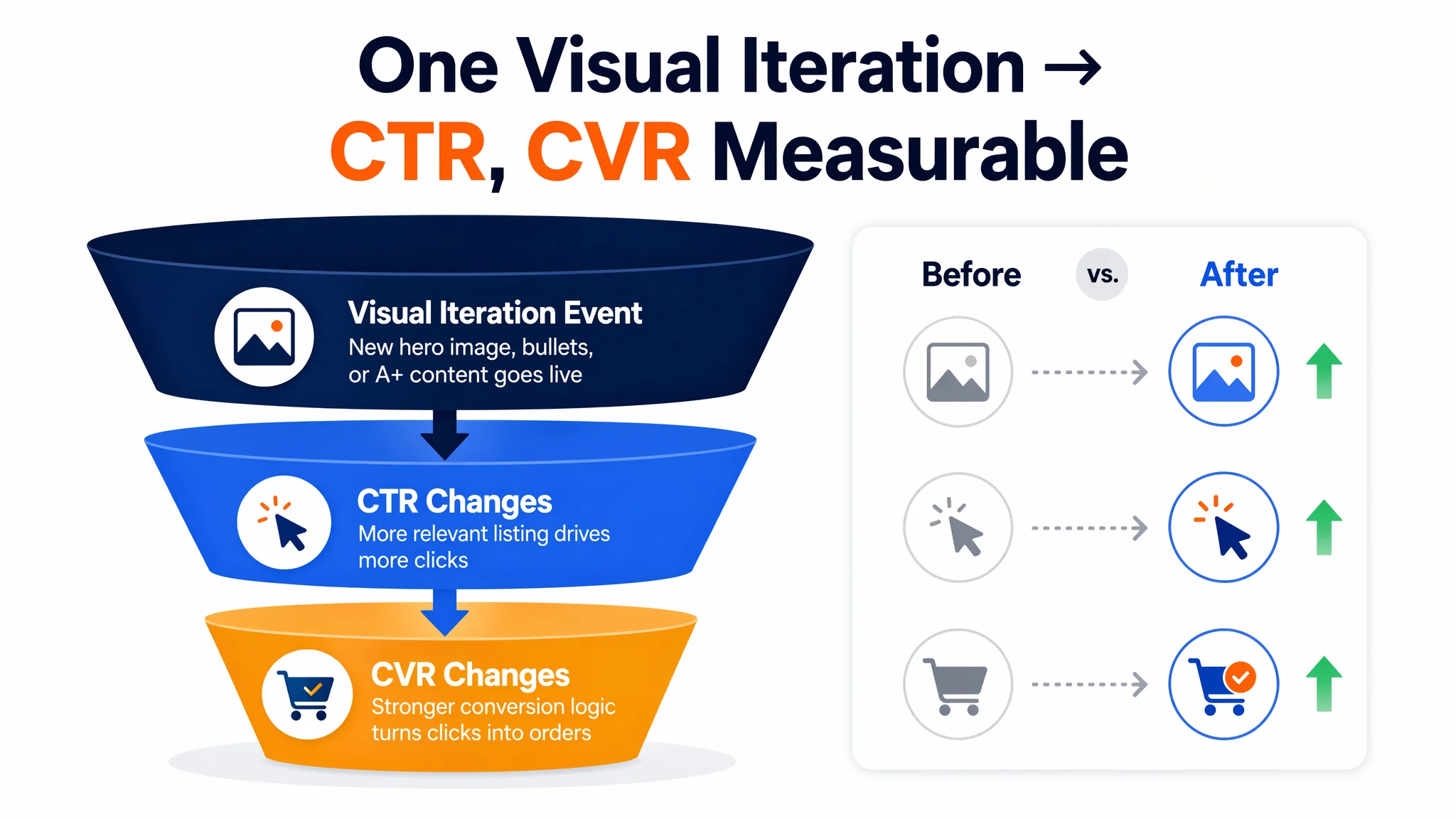
Finally, this optimized content can be deployed with a single click via the Amazon SP-API, reducing a manual process of minutes to seconds. To complete the cycle, the system automatically links content updates to performance data, allowing you to directly measure the impact on your Click-Through Rate (CTR) and Conversion Rate (CVR), ensuring every optimization is a measurable step forward. In practice, that means the grill-parts seller can tie a specific “visual iteration event” (like rolling out a new hero image and bullet set) to subsequent shifts in CTR and CVR, instead of guessing whether “some creative changes” helped.
Driving Traffic: AI for Quantified Ad Spend and Acquisition
Effective Amazon advertising requires more than just managing bids; it demands a strategic approach to traffic acquisition. AI-powered systems move beyond manual guesswork by implementing a multi-layered traffic funnel model. This process begins by continuously discovering competitive traffic opportunities through keyword and competitor ASIN expansion. It then systematically filters out low-conversion traffic sources, allowing for precise targeting of high-conversion keywords and ASINs where budget will have the most impact. Finally, it enables effective scaling by dynamically adjusting bids and budgets based on daily performance metrics.
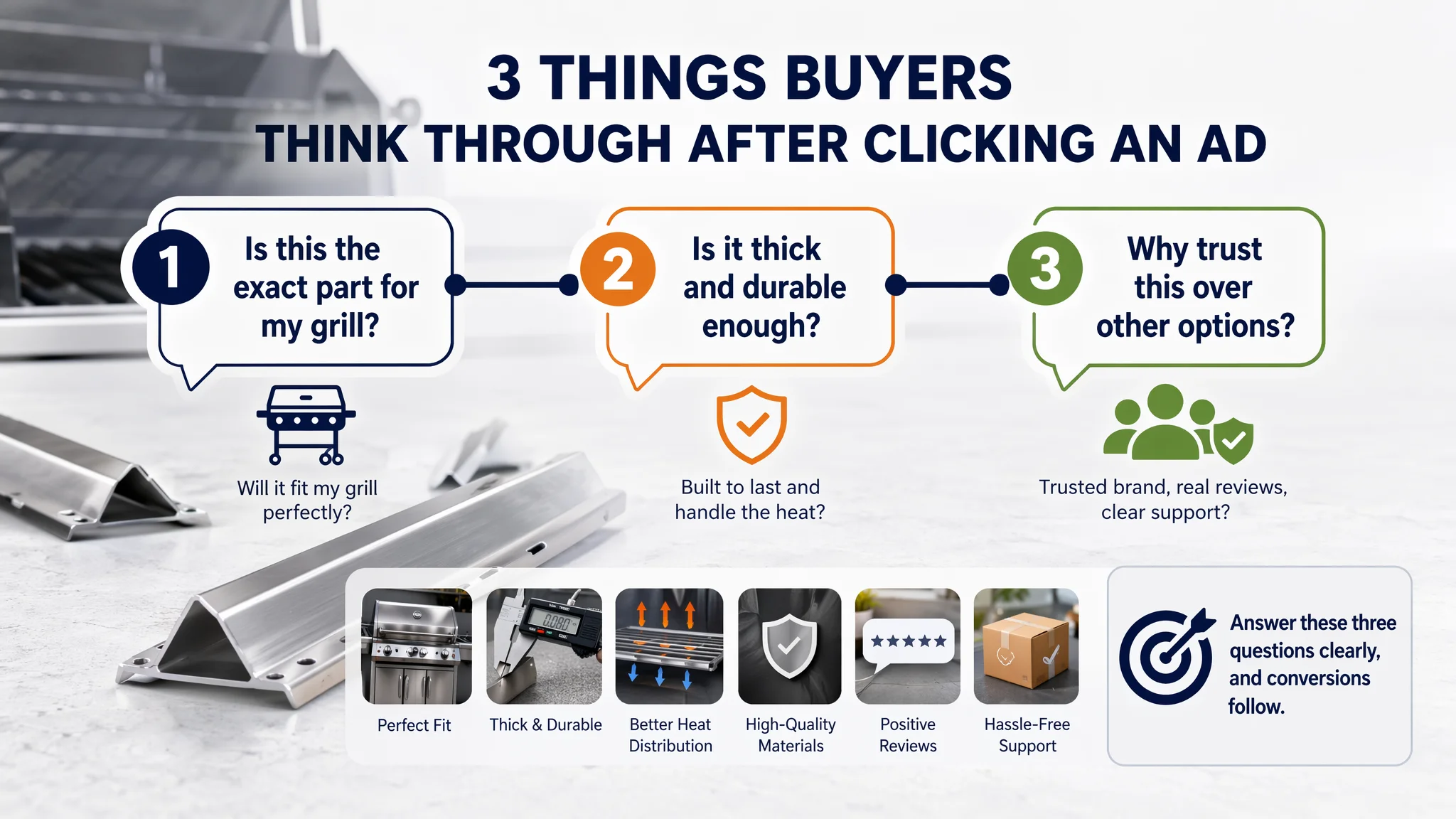
In the grill accessories case, the seller initially treated advertising as the primary lever: they expanded keyword lists, adjusted bids by placement, and split campaigns into more granular ad groups. However, with a listing that was structurally weaker than the category leader across title, imagery, bullets, and social proof, those extra clicks simply hit a wall. ACOS stayed unstable because a large share of paid traffic was landing on a page that didn’t fully answer: “Is this the exact part for my grill?”, “Is it thick and durable enough?”, and “Why trust this over other options?” This is a common pattern AI can detect early: the ads are bringing visitors, but the page’s conversion logic is consuming that traffic.
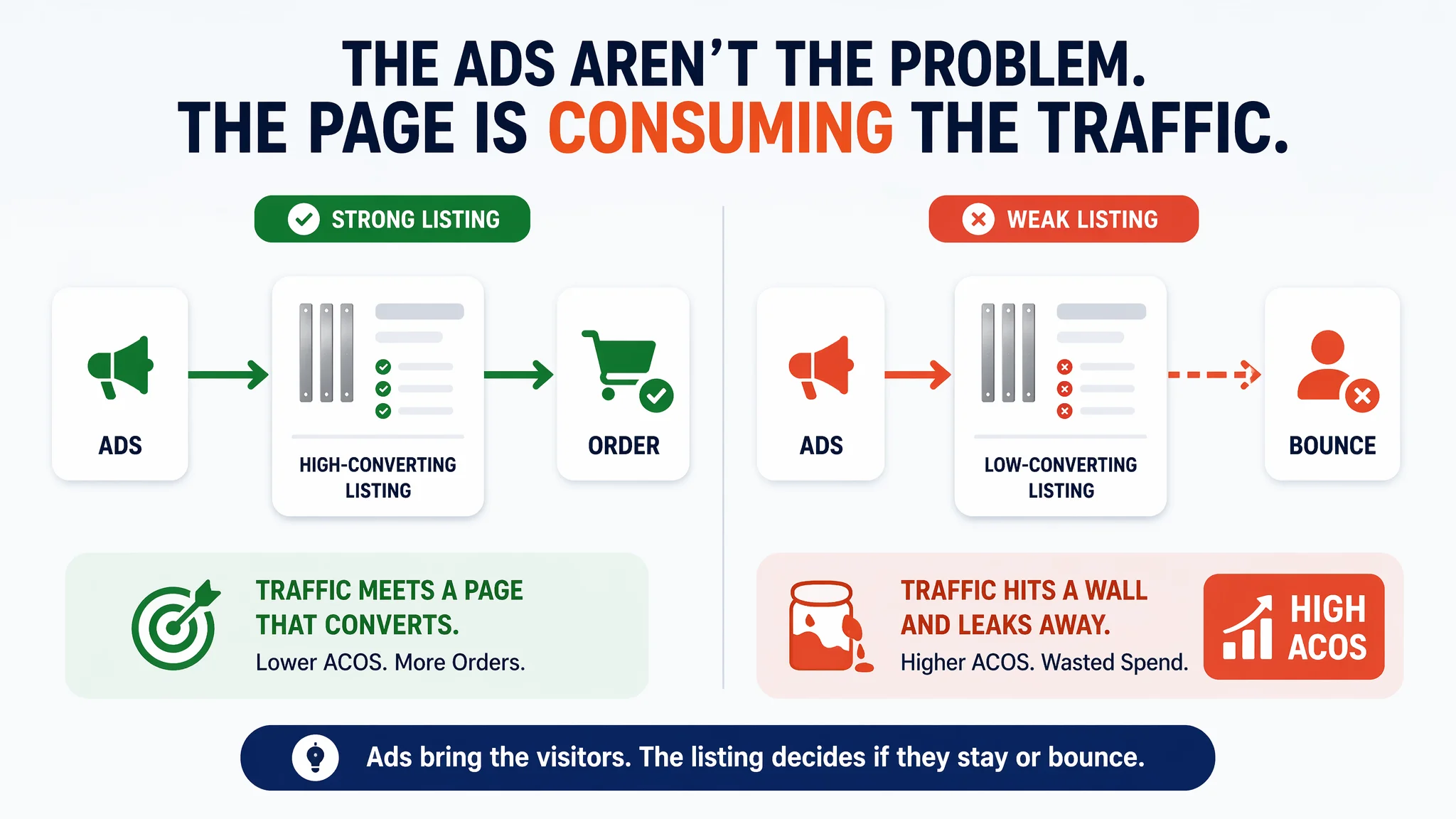
This creates a powerful synergy between paid traffic and listing quality. The core business loop becomes: Better Listing + More Precise Traffic = Healthier Long-term Growth. AI not only drives higher-quality traffic to your page but also analyzes the performance of that traffic. By deeply mining high-conversion search terms, or "Winning terms," from ad reports, the system provides data-driven recommendations for optimizing titles and images. This feedback loop ensures that your listing is continuously improved to maximize conversion rates for the specific audience you are paying to attract.
In practice, this means AI can show you that queries like “Genesis II flavorizer bars 2017+ stainless” or specific OEM part-number searches convert strongly, and then push you to reflect that pattern in your title and image overlays. For the grill seller, shifting the title and visuals to match how buyers actually search and decide—explicit series/year coverage, precise dimensions, and visual proof of thickness and heat resistance—aligns the listing with the same “winning terms” the ads are already uncovering. Instead of endlessly bidding on traffic that leaks, AI rebalances the equation so each incremental dollar in ad spend has a higher chance of turning into a profitable order.
The impact of these changes is directly measurable. When a listing is updated, the system can automatically mark this "visual iteration event" in advertising reports. This allows sellers to track the direct impact on Click-Through Rate (CTR) over the following weeks, quantifying the ROI of creative optimizations and translating ad data into a lower Total Advertising Cost of Sale (TACoS). For a seller who previously blamed “high ACOS” purely on auction dynamics, seeing how a rebuilt listing stabilizes CVR and improves the economics of the same traffic is often the turning point that proves why ad strategy and listing quality cannot be managed in isolation.
Sustaining Growth: AI for Organic Visibility and Profitability
Achieving sustainable growth on Amazon requires moving beyond temporary, ad-fueled sales spikes to build lasting organic visibility. The key to long-term profitability lies in creating a flywheel where paid advertising insights directly strengthen your organic ranking. This strategy transforms advertising from a simple sales driver into a powerful data source for continuous optimization.
AI-driven platforms excel at creating this connection. By analyzing performance data from your ad campaigns, AI identifies the highest-performing keywords—those with superior Click-Through Rates (CTR), Conversion Rates (CVR), and order values. These "winning terms" reveal precisely what language and features motivate customers to buy. Instead of relying on guesswork, this data provides a clear evidence chain for every optimization decision. For example, if ad data shows that "fast charging" is a high-conversion attribute for a product, AI will prioritize that feature in the main image, title, and A+ content.
The grill-parts seller’s journey illustrates how this plays out beyond a single optimization cycle. Initially, their ads were treated as a volume pump for a “good enough” listing. Once AI diagnosis exposed their conversion gap versus a stronger benchmark, the focus shifted to rebuilding the listing around the actual decision path buyers followed: from model and year compatibility, to dimensions and thickness proof, to heat distribution and flavor outcomes, to installation and maintenance guidance, to visible trust through reviews. As that conversion structure strengthened, the same ad-derived queries and placements started feeding a page that could defend its position. Over time, Amazon’s algorithm can observe improved conversion performance—particularly on those high-value search terms—and reward the listing with better organic placement.
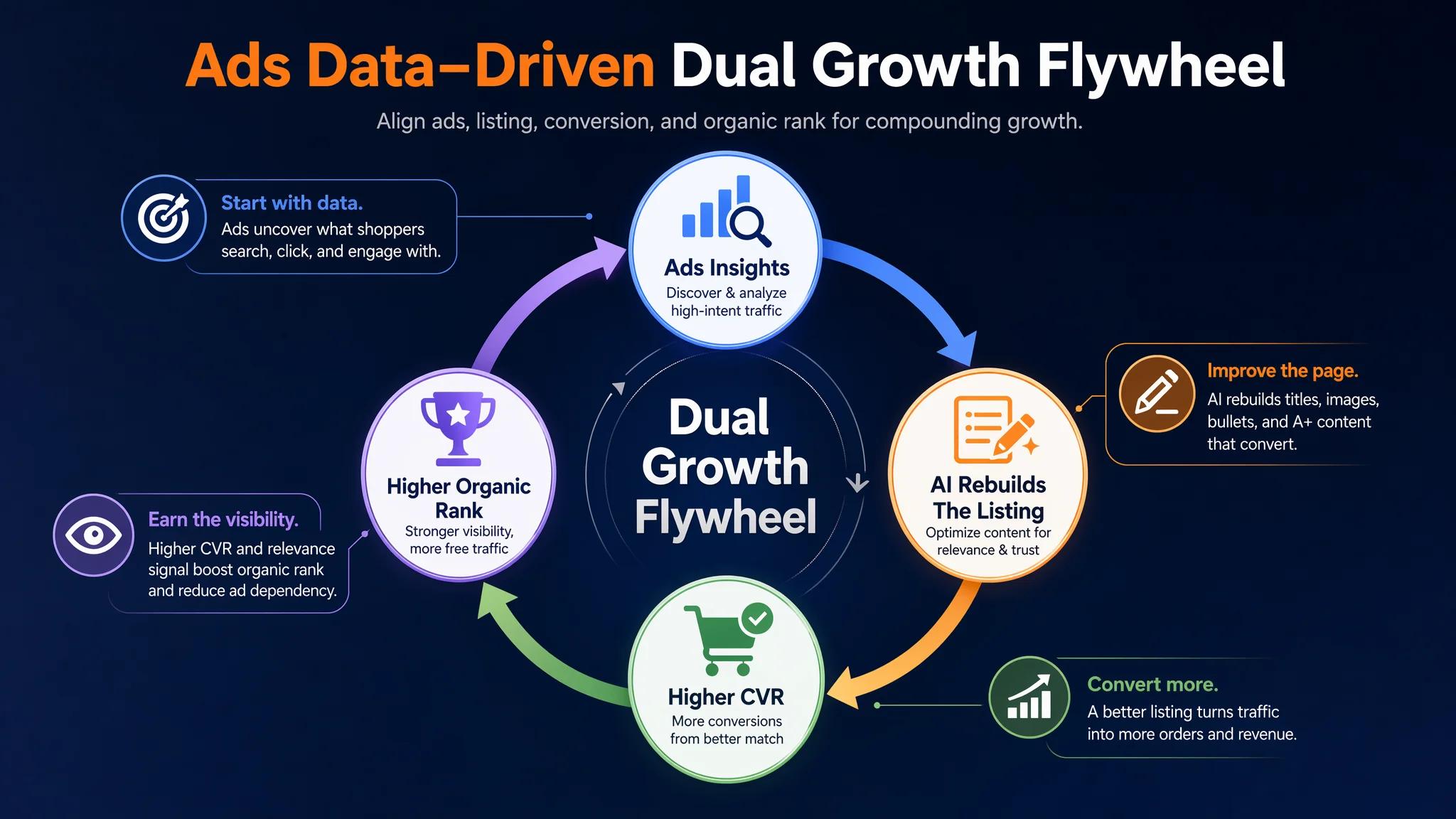
This process establishes a "dual growth" model. The optimized listing not only performs better for paid traffic but also sees a significant uplift in organic conversion. As Amazon's algorithm recognizes the improved performance, your organic rank climbs, especially for your most valuable keywords. This reinforces a Top of Search position, reducing your dependence on paid ads over time, lowering your Total Advertising Cost of Sale (TACoS), and building a healthier, more profitable business flywheel. The crucial mindset shift, as the grill seller discovered, is to see advertising and content not as separate workstreams but as two sides of a single AI-orchestrated system: ads reveal what works, AI restructures the listing to reflect that, and improved listing performance feeds back into stronger organic visibility.
Implementing an AI-First E-commerce Strategy on Amazon
With business leaders across industries integrating generative AI into core operations, a proactive, AI-first strategy is becoming essential for competitive Amazon sellers. A successful implementation moves beyond isolated tools and embeds AI across the entire operational workflow, from initial diagnosis and strategic planning to asset production and final delivery.
This process begins with a robust data infrastructure, ideally using a direct connection like Amazon's SP-API to eliminate manual uploads and ensure a constant flow of accurate information. The first step is a data-driven diagnosis, where AI analyzes competitor strategies and Voice of Customer (VoC) data to identify optimization opportunities. From there, the system translates abstract findings into concrete, executable instructions for generating new listing content.
In the grill accessories case, that implementation sequence was critical. Instead of starting with “let’s generate some new images,” the AI-led workflow started by asking: “Where exactly are we losing compared with the category leader?” The scoring showed that while the main image stack left CTR on the table, the bigger issues lay deeper in the funnel: bullet points that didn’t build a persuasive chain, A+ content that failed to tell a complete problem–solution–proof story, and a review profile that signaled weaker trust. With this diagnosis, the team could prioritize rebuilding the decision logic of the page before pushing more traffic—transforming a fuzzy complaint about “high ACOS” into a clear, ordered set of listing upgrades.
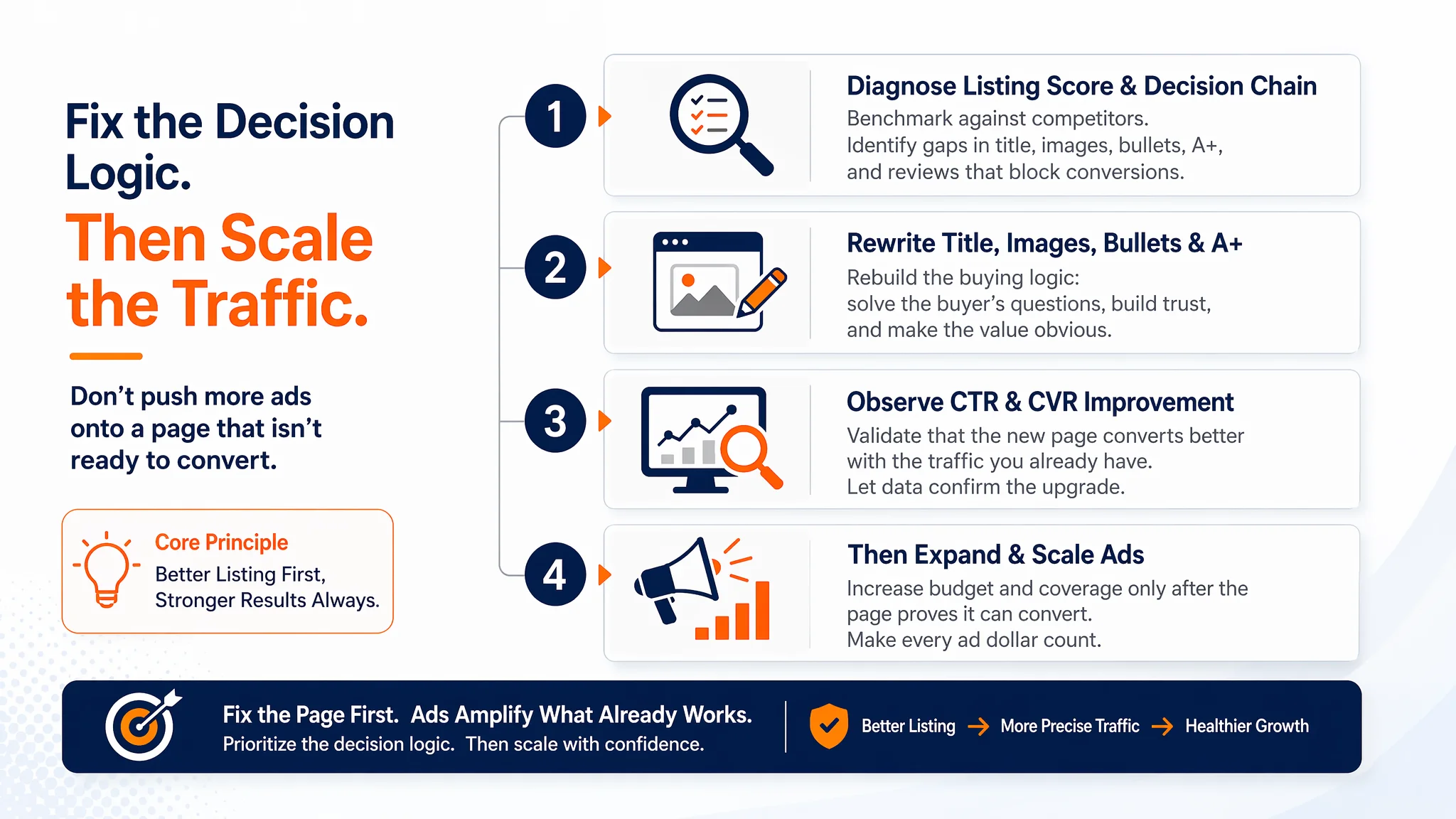
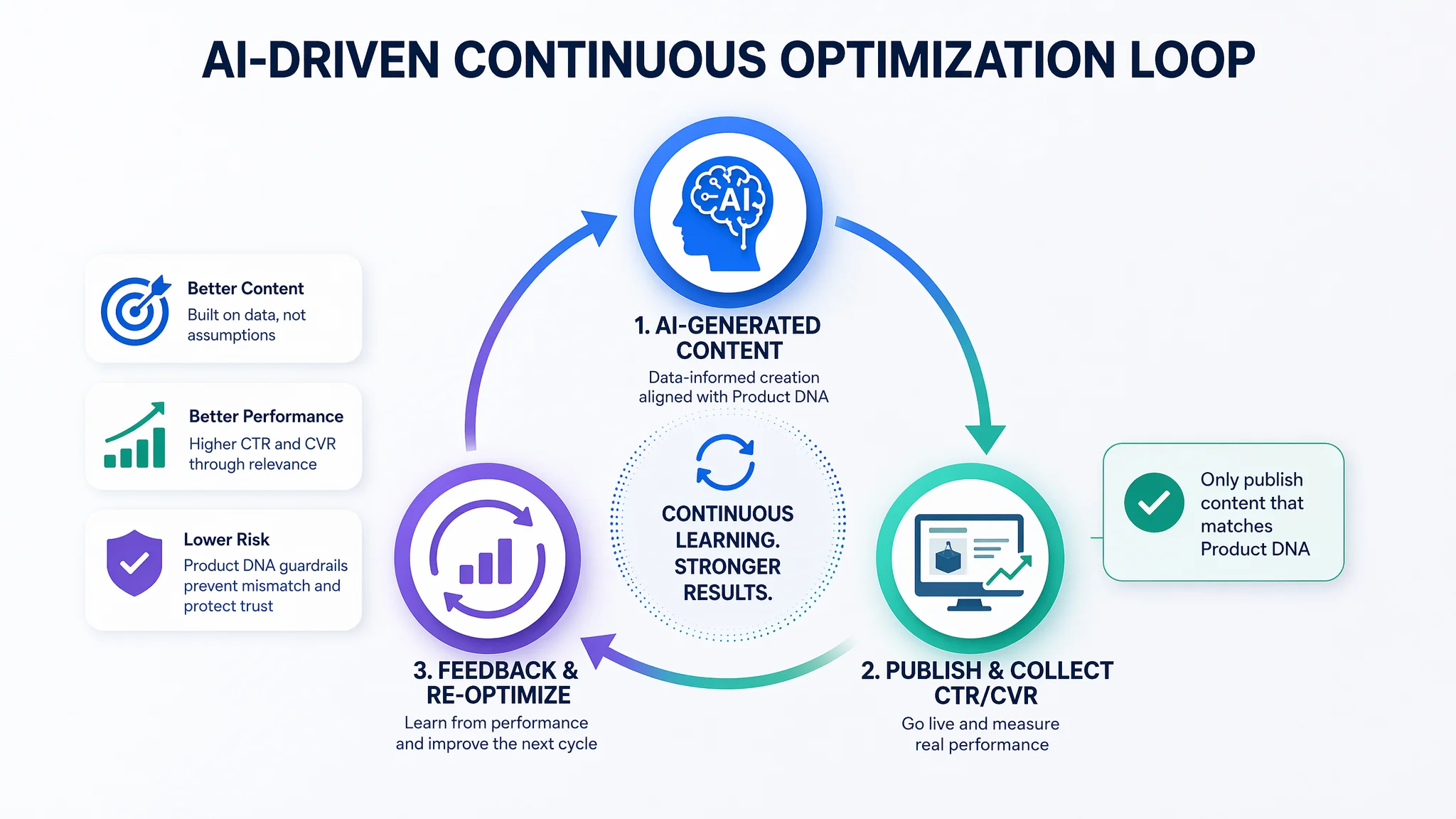
Crucially, AI should function as a high-performance executor, not a replacement for human strategy. Your team’s expertise is vital for setting guardrails—such as locking in core product attributes to prevent AI "hallucinations"—and providing the final confirmation before any changes go live. In a product like flavorizer bars, for instance, attributes such as material, thickness, and exact compatible models must be anchored in real product specs; AI can then scale out the compatible image and text variations without ever changing those locked “Product DNA” values. The ultimate goal is to create a continuous optimization loop where the performance of AI-generated assets, measured by metrics like CTR and CVR, is fed back into the system. This ensures that every subsequent optimization cycle is more data-informed and customer-centric than the last, and helps prevent the common misstep of pushing ad budgets into a listing that has not yet earned them.
The Future of Amazon E-commerce is AI-Driven
The strategic role of artificial intelligence in e-commerce has evolved far beyond simple automation. AI now provides an end-to-end intelligent optimization system that breaks down the silos between diagnosis, planning, production, and delivery. This transforms listing and advertising management from a series of disconnected, project-based tasks into a dynamic and iterative process driven by market feedback.
In operational terms, this means fewer situations where teams misdiagnose problems—like blaming persistent high ACOS solely on campaigns when the true constraint is listing conversion capacity. AI-driven diagnosis exposes where the real bottleneck sits on the page: whether it’s a title that doesn’t follow buyer search patterns, images that describe “what it is” but not “why it’s safe to buy,” bullets without a conversion logic, or A+ content that looks nice but doesn’t answer core objections. Once those gaps are clear, AI-powered generation and deployment give sellers the ability to rebuild their decision paths at scale and measure the impact of each change.
This integrated approach creates a powerful business loop: better listings lead to more precise traffic, which in turn fosters healthier long-term growth. By unifying product content, advertising strategy, and organic visibility efforts within a single algorithmic context, sellers can achieve full-funnel synergy. The measurable outcomes are tangible increases in Click-Through Rate (CTR) and Conversion Rate (CVR), significant leaps in organic ranking, and accelerated brand growth. Operationally, efficiency skyrockets as tasks like manual content uploads are reduced from minutes to seconds.
In the future of e-commerce, AI will serve as the intelligent decision-making brain for sellers. Through continuous data feedback and logical self-evolution, the process of optimizing a brand's presence on Amazon becomes predictable and quantifiable. For brands aiming to secure a competitive advantage, adopting an AI-first strategy is no longer an option—it is the essential mechanism for locking in a winning edge in a dynamic global marketplace, and for avoiding the costly, all-too-common trap of treating ads as the problem when the real issue is that the listing itself has not yet been engineered—through AI and data—to convert.