


Introduction: Navigating the Amazon Ecosystem
The Amazon marketplace represents the pinnacle of global e-commerce, a vast and dynamic ecosystem offering unparalleled reach. For the millions of third-party sellers who power its growth, however, this landscape has become a "deep water zone" of intense stock competition. With traffic costs steadily rising, sellers face significant pressure to optimize every aspect of their business, feeling constant anxiety over crucial performance metrics like Click-Through Rates (CTR) and Conversion Rates (CVR). In this high-stakes environment, the old methods of relying on intuition or simple aesthetic changes are no longer sufficient. Success is no longer a matter of basic copy-editing or image beautification, but a game of "precise coordination" driven by data.
This shift from “intuition” to “evidence” is not theoretical. In one recent project in the home-fitness category on the German marketplace, a seller operating a water-filled dumbbell set had been under mounting pressure: ad spend kept climbing, ACOS was difficult to control, and the product-page conversion rate felt “fragile”. Internally, the team blamed “too many bad reviews” and “unlucky traffic” from Amazon ads. Only when the Listing was benchmarked against a strong category competitor did it become clear that the core constraint was not the ads themselves, but a structurally weaker product page: missing purchase parameters in the title, main images that didn’t build trust, and underdeveloped A+ content. The seller had been optimizing around the wrong problem simply because they lacked a solid data evidence chain.

Optimizations made without a solid foundation in real market benchmarks are an ineffective waste of resources. To thrive, sellers must transition from blind trial and error to building a "data evidence chain" that informs every strategic choice. This article is designed to provide that foundation. We will cut through the noise to deliver the essential facts and statistics that matter most for sellers on the platform. By understanding the core data points that define customer behavior, competitive pressures, and operational efficiency, you can empower your business to make smarter, more impactful decisions, turning raw data into a tangible competitive advantage and sustainable growth.
Amazon's Global Footprint and Market Dominance
Understanding Amazon's scale is the first step toward mastering it. The platform is not merely a marketplace; it is a global economic engine that has reached a state of maturity defined by intense "stock competition." For sellers, this means navigating an environment with rising traffic costs and a massive number of competing products, where gaining visibility is a primary challenge. The sheer volume of ASINs creates a landscape where superior strategy is essential to stand out.
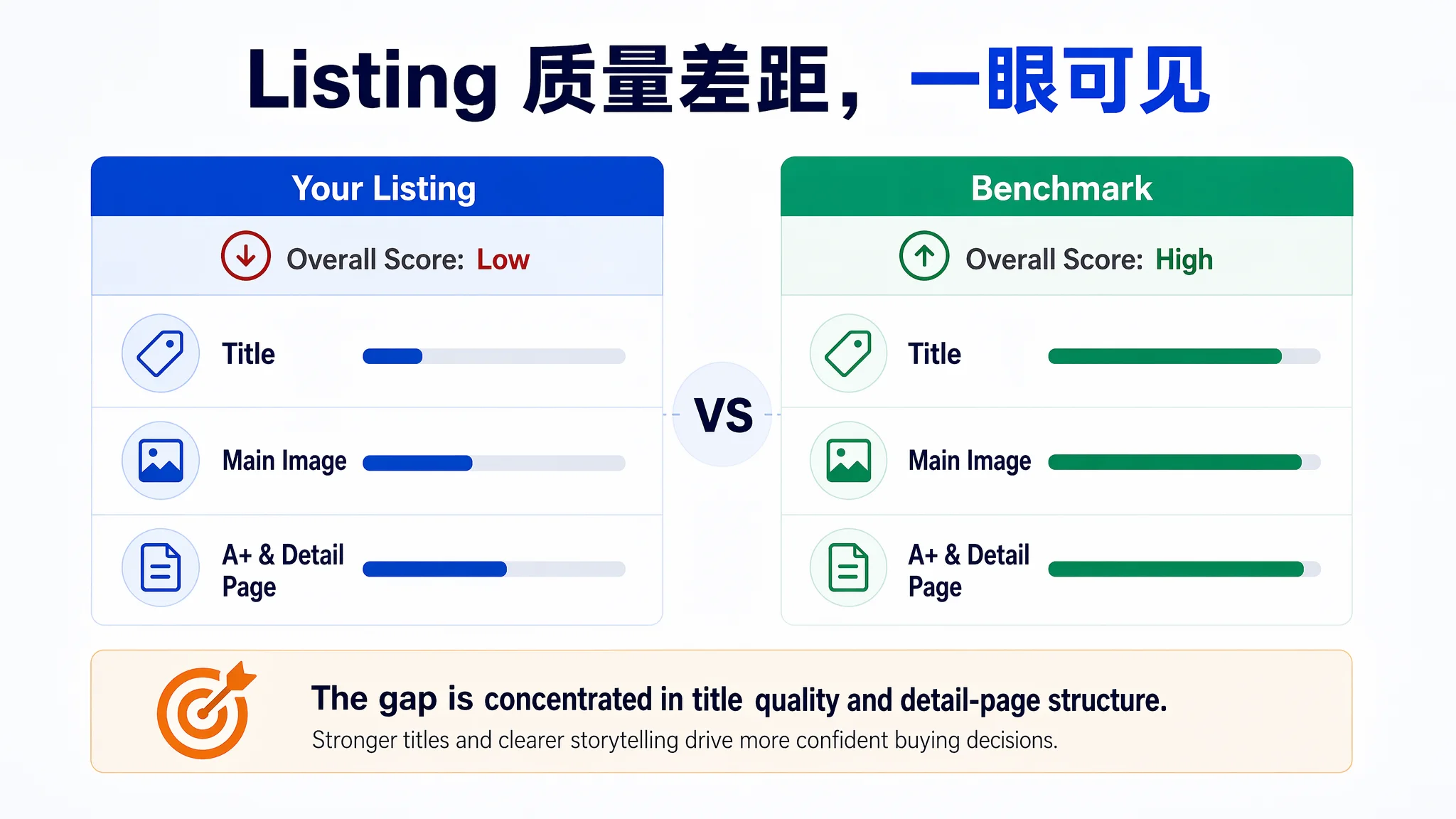
This reality becomes especially clear when you look at cross-border cases. The water-dumbbell seller mentioned earlier was operating on Amazon Germany, competing against other global and local brands in a niche, yet still highly crowded category. From the outside, their Listing seemed “good enough”: hundreds of reviews, solid exposure through advertising, and placement within a mature home-fitness segment. But once their page was benchmarked, the numbers showed a different picture: an overall Listing score that lagged a key competitor by nearly 20 points, with pronounced gaps in title quality, main images, and A+ storytelling. In a marketplace where thousands of similar products occupy the same shelf, these structural weaknesses meant they were effectively invisible where it mattered most — in the user’s decision-making moments.
This dominance is built on a sophisticated international infrastructure. The marketplace supports a vast ecosystem of global cross-border e-commerce sellers and established overseas brands, operating across more than 20 distinct country sites. Each of these sites is a unique environment with its own geographical coordinates, currency, time zone, and language configurations managed by Amazon's backend. This expansive and complex network provides sellers with unparalleled reach but also demands a high level of operational precision. Success in this environment requires leveraging data to seize market share, as the scale of competition makes manual analysis and subjective decision-making ineffective.
The Dynamic Amazon Seller Ecosystem
The Amazon marketplace has evolved into a highly competitive arena, often described as an era of "stock competition." In this environment, rising traffic costs create significant pressure on sellers, leading to persistent anxiety over key performance metrics like Click-Through Rates (CTR) and Conversion Rates (CVR). For the global community of cross-border e-commerce sellers and brand owners, from boutique shops to large, multi-SKU enterprises, simply having a product listed is no longer a guarantee of success.
Thriving in this ecosystem requires a strategic shift away from basic copy-editing and image updates toward a model of precise, data-driven optimization. Success is now a function of 'precise collaboration' based on data algorithms that can identify and exploit competitive weaknesses. To gain an edge, sellers must systematically analyze the landscape and understand what top performers are doing differently.
The water-dumbbell case illustrates how easily teams can misread this landscape. From the seller’s internal perspective, the symptoms seemed straightforward:
- Amazon ads were driving exposure, but orders were unstable.
- The product hovered around a mid-range star rating with several hundred reviews, creating a visible “trust drag”.
- Competing water dumbbells held slightly higher ratings with fewer reviews — yet often won the buying decision.
The team’s conclusion: “Our reviews are killing us, and the ads have stopped working.” So they focused their energy on review management and incremental ad tweaks.
However, once DeepBI ran an intelligent listing score and dynamic benchmark comparison, the diagnostic picture shifted. The review score did contribute to the problem, but the deeper constraints were structural:
- A title that lacked concrete purchase parameters like weight range and key usage scenarios.
- Main images that showed “something blue on white” instead of visual proof of portability, safety, and valve reliability.
- A+ content that leaned heavily on filling instructions rather than telling a complete, confidence-building buying story.
From a scoring perspective, the largest gaps versus the competitor were in the title and detail-page dimensions, not in reviews. In other words, the Listing would still underperform even if the star rating improved, because it was not designed to convert the traffic it already had. This is precisely the type of misdiagnosis that a data-driven ecosystem helps avoid.
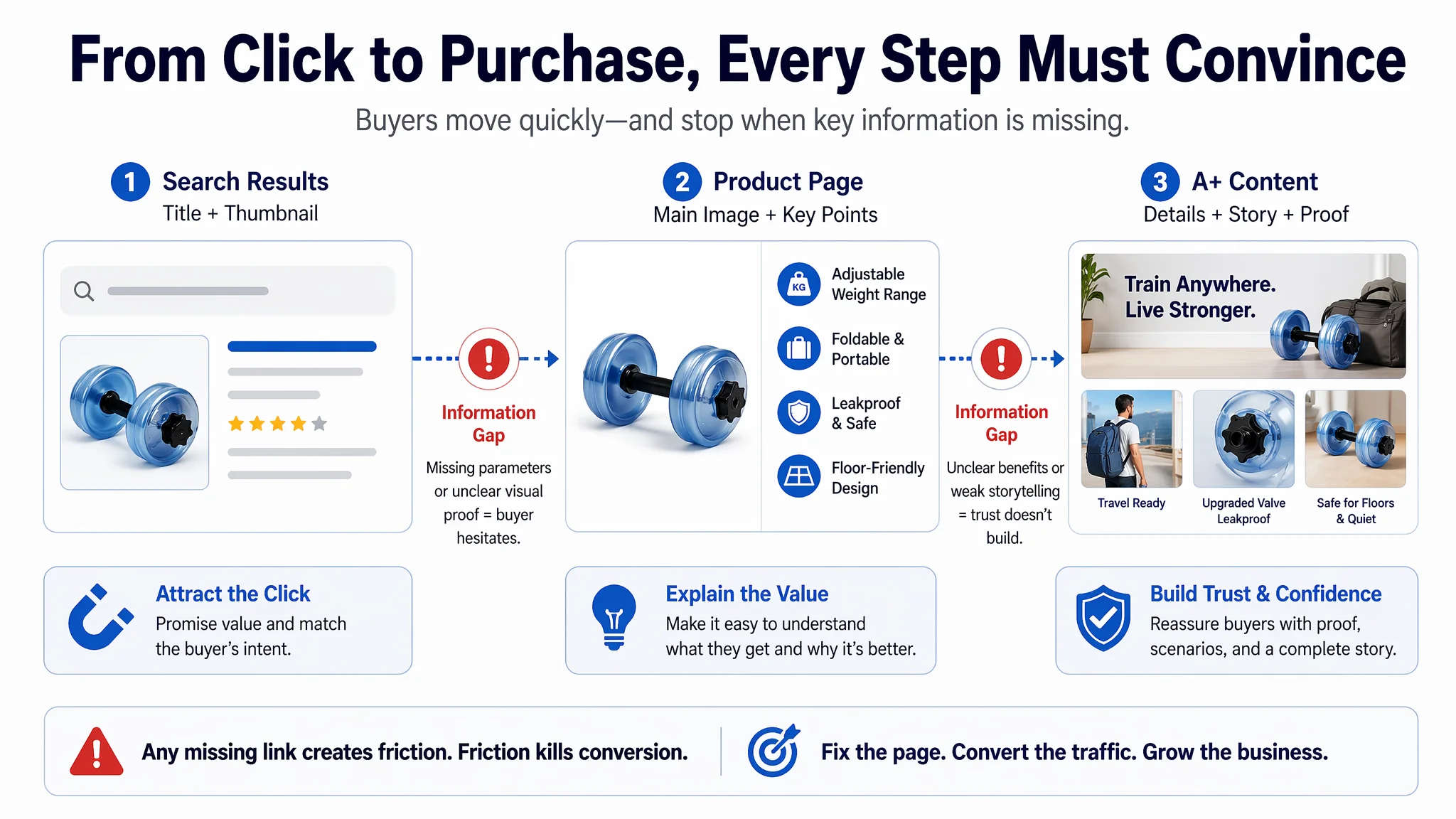
You can leverage DeepBI's intelligent scoring and diagnosis to benchmark your Listing against top competitors, identifying areas for improvement in titles, bullet points, and A+ content. In the dumbbell case, this meant moving from vague, repetitive phrasing to a title that explicitly mentioned the adjustable weight, portable nature, and home-fitness scenarios; and from generic lifestyle shots to images that clearly demonstrated foldability, floor safety, and upgraded valve technology. This analytical approach is essential for building a healthy growth model and turning competitive pressure into a sustainable advantage.
Key Amazon Events and Their Impact on Sellers
Major sales events like Prime Day represent a critical opportunity for Amazon sellers, driving massive traffic and sales volume that can define a quarter's success. However, capitalizing on this surge requires meticulous preparation. With increased traffic comes heightened scrutiny; a single misleading image or poorly optimized bullet point can lead to a spike in negative reviews and returns, eroding the profits gained from higher sales. Manually preparing every listing element under a tight deadline is a significant operational bottleneck.
This risk is not hypothetical. Consider again the water-dumbbell seller on Amazon Germany. Before optimization, their Listing already exhibited signs of structural weakness:
- The title did not clearly state the maximum weight capacity, a core decision factor for any dumbbell buyer.
- Main images failed to reassure buyers about leakage risk or show how compact the product could be when folded and packed.
- A+ modules focused on operation steps rather than building a lifestyle narrative around home and travel training.
During normal traffic periods, these issues translated into inefficient ad spend and an unstable conversion rate. If a similar Listing were pushed aggressively during a peak event — with a surge of fresh, often first-time visitors — the consequences could be amplified: more hesitation, higher bounce rates, and a concentration of negative feedback from buyers who felt “the product page didn’t match what they expected.” In other words, peak events magnify whatever is already structurally true about your Listing, good or bad.
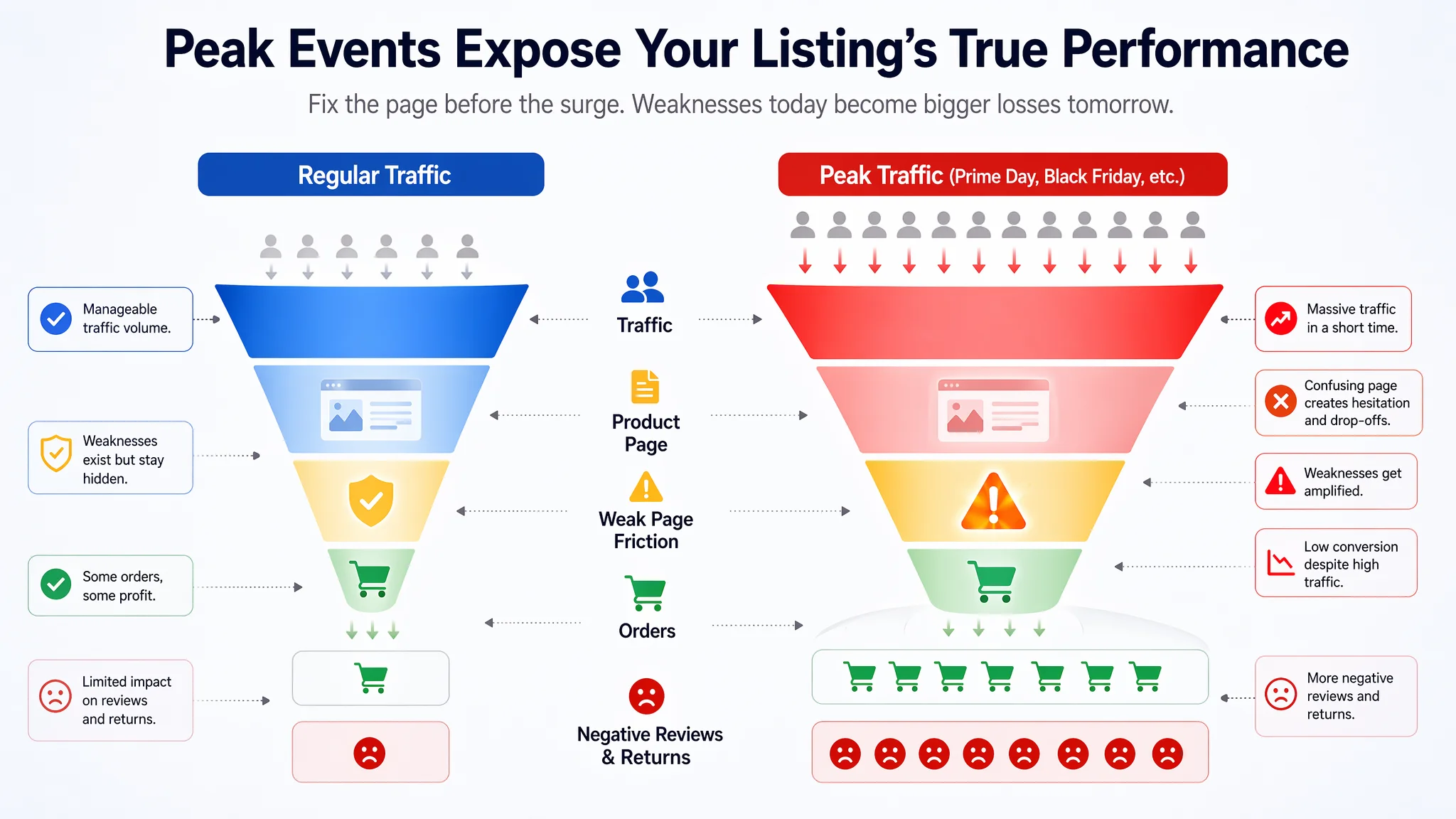
To effectively compete, sellers must rapidly deploy conversion-focused listing content. AI-powered optimization provides a strategic advantage for getting listings Prime Day-ready. For instance, DeepBI's platform can generate optimized main images, A+ content, titles, and bullet points designed to improve both Click-Through Rate (CTR) and Conversion Rate (CVR). The system operates as an automated visual production system, not a creative tool prone to errors. It uses a "Product DNA" map to lock in product authenticity, ensuring AI-generated visuals are accurate and preventing the kind of product-image mismatches that cause customer complaints.
In the dumbbell case, this meant systematically rebuilding the visual story: a hero image that clearly positioned the product in a modern home-fitness setting; a suitcase flat-lay that finally proved its portability; comparison shots that highlighted floor-friendly safety versus iron dumbbells; and close-ups that showcased the upgraded, anti-leak valve. These changes directly addressed the very concerns that would otherwise surface as negative reviews during high-traffic events. Features like one-click API synchronization then reduce update times from over 30 minutes to mere seconds, ensuring listings are optimized and live just in time for peak traffic.
Innovation, Logistics, and Customer Experience
Amazon's dominance is built on a foundation of relentless investment in logistics and technology, which directly shapes the selling environment. The Fulfillment by Amazon (FBA) network has set the global standard for delivery speed, creating a customer expectation of rapid, reliable service that sellers can leverage to build trust and drive conversions. This commitment to a seamless customer journey extends from the physical warehouse to the digital storefront.
On the platform, technological innovations like A+ Content allow sellers to create rich, informative product detail pages that improve the customer experience and can significantly boost CVR. To maintain a consistent and trustworthy marketplace, Amazon enforces strict technical and data authenticity standards for all listings. For sellers, Amazon provides powerful tools like the Selling Partner API (SP-API), which enables secure, automated workflows for listing management. This technology is critical for operating efficiently at scale, allowing for the integration of advanced systems while adhering to security principles like least privilege access.
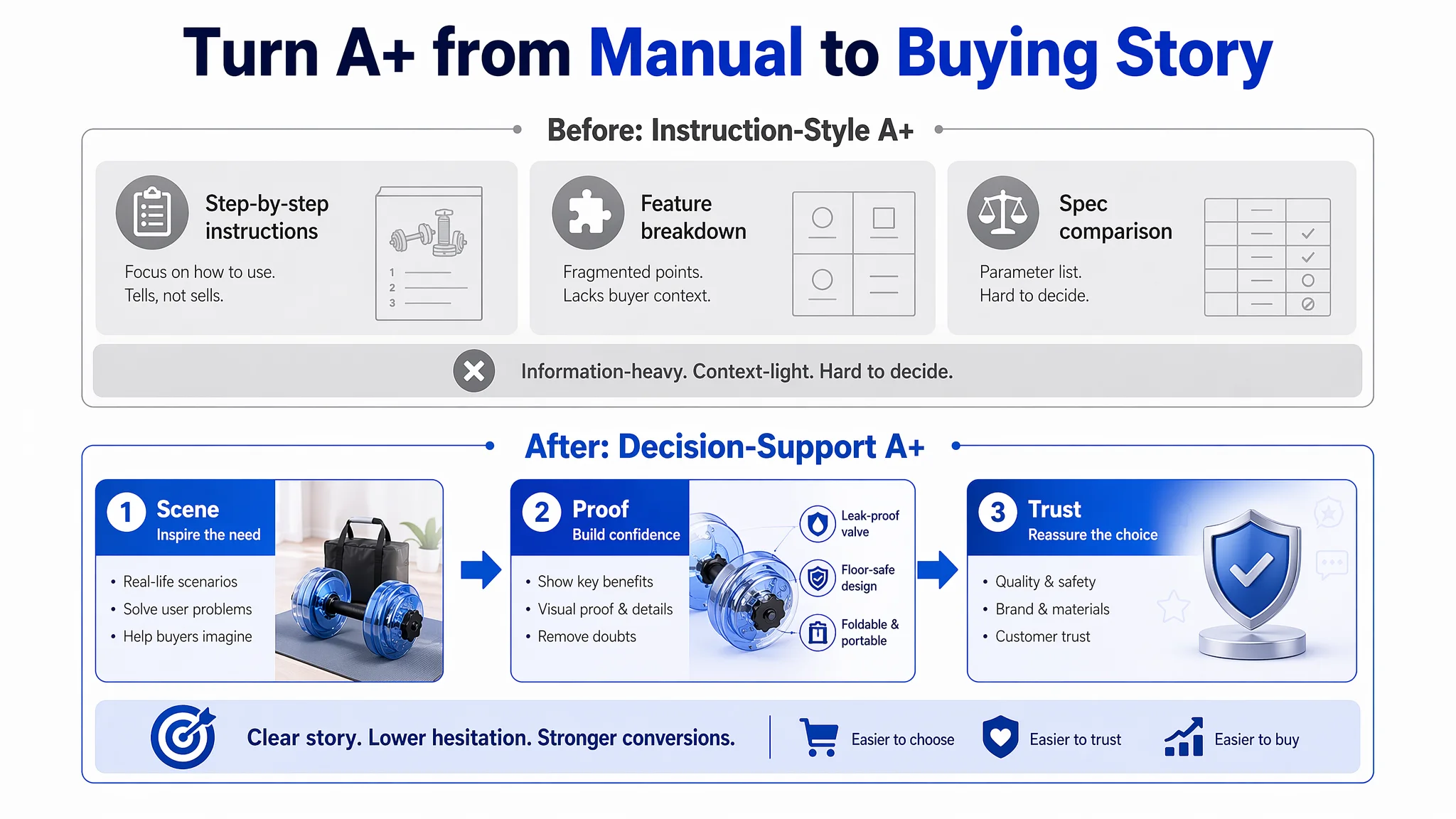
In practice, however, many sellers underuse these capabilities. In the water-dumbbell example, the A+ modules initially resembled a basic instruction leaflet: they walked through how to fill the product, showed some structural comparisons, and included a few lifestyle touches — but stopped short of building a full decision-support experience. By contrast, the benchmark competitor used the same A+ framework to:
- Present a clear opening scene of at-home fitness, immediately placing the buyer in a relatable environment.
- Display a multi-variant “family photo” of colors and weight options, with each labeled and contextualized.
- Highlight close-ups of key structural features like transparent windows, water inlets, and folded states.
- Integrate brand-story and trust elements, such as years of experience and visual cues of product reliability.
The difference was not in access to Amazon features, but in how deliberately those features were used to answer buyers’ questions and reduce perceived risk. When DeepBI reconfigured the dumbbell seller’s A+ content, the focus shifted from “operating steps” to a structured buying story: from showing the foldable advantage and floor safety, to demonstrating valve upgrades and giving clear, visual guidance on available weights and who they’re for. This is exactly how innovation on the platform side — A+ modules, visual slots, and APIs — translates into better customer experience when combined with data-led diagnosis.
Furthermore, Amazon's broader corporate initiatives in areas like sustainability and community investment contribute to its overall brand perception. This can create a positive halo effect for sellers on the platform, aligning their businesses with a brand that customers increasingly value for its wider social and environmental commitments.
Strategic Implications for Amazon Sellers
On a marketplace as vast as Amazon, relying on intuition is no longer a viable strategy. Success requires moving from "groping in the dark" to "precision targeting," where every decision is backed by data. This means treating your product listings, advertising, and organic visibility not as separate tasks, but as interconnected components of a single growth engine.
The foundation of this engine is a robust, optimized listing. To achieve this, you must first diagnose the root causes of underperformance. A multi-dimensional analysis can pinpoint critical factors constraining your listing's Click-Through Rate (CTR) and Conversion Rate (CVR). For example, a data-driven audit might reveal that a low CTR is directly caused by a main image that fails to capture attention, while a low CVR stems from A+ content that doesn't build sufficient trust.
In the water-dumbbell case, that diagnosis was made explicit. The Listing did not suffer from lack of traffic; ads were already driving visits, and the product had accumulated hundreds of reviews. Instead, the problem lay in conversion capacity:
- The title scored significantly lower than the competitor’s because it lacked clear weight parameters and scenarios, making it less likely to win the click from search results.
- Main images couldn’t visually answer the two biggest questions in the category: “Will this leak?” and “Is it really portable?” Without close-ups of the valve, suitcase scenes, or floor-safety comparisons, buyers had to guess.
- A+ content did not form a cohesive sales argument; it presented functional steps but failed to build a compelling narrative around home-fitness outcomes, portability, and safety.
Internally, the team had initially framed the challenge as “ads not working” and “reviews dragging us down.” The data told another story: review-related scoring gaps were relatively small compared to the gaps in title and detail-page structure. In other words, even a perfect ad strategy would be pouring more traffic into a leak-prone funnel.
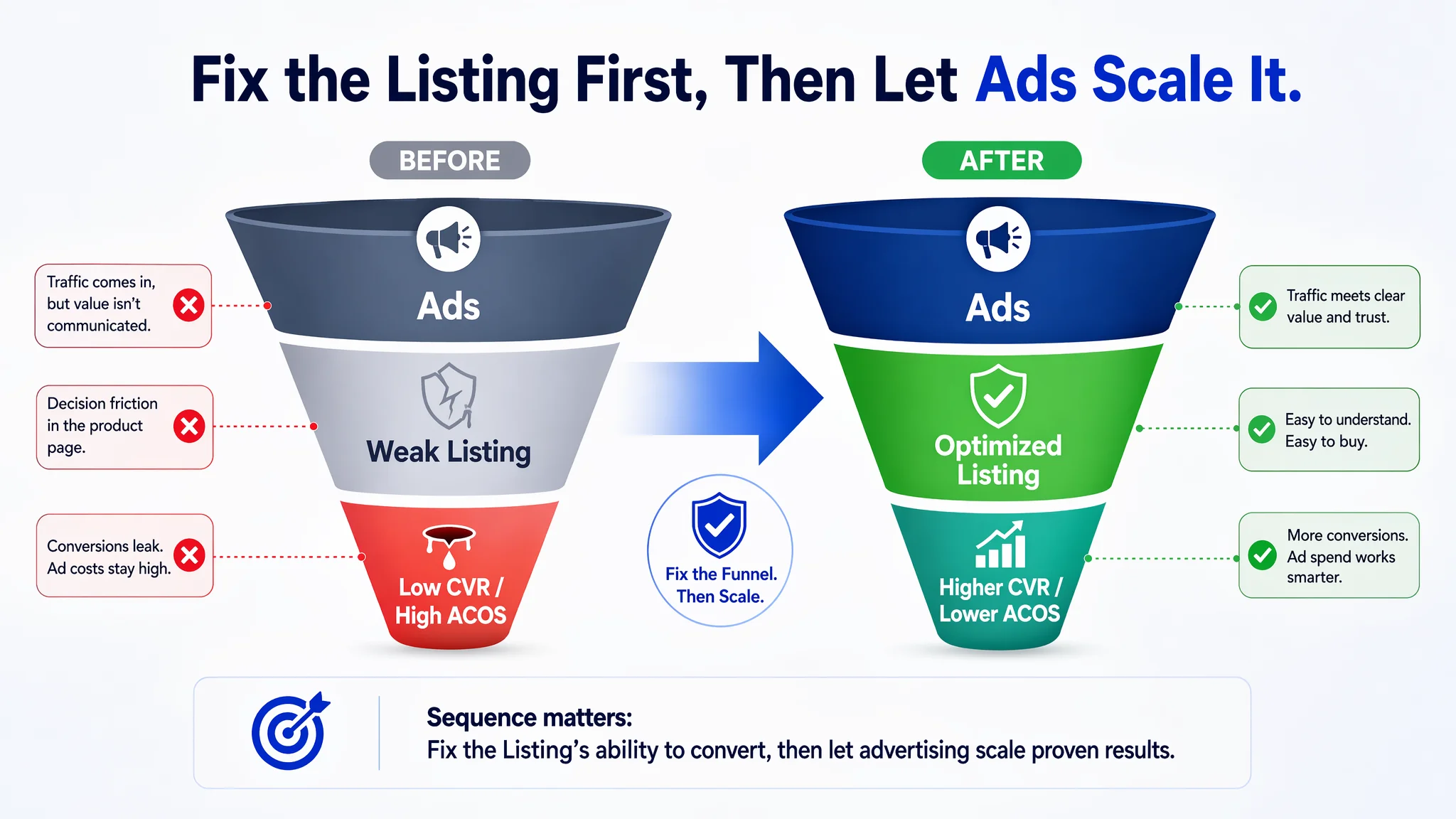
Effective advertising then becomes more than just a sales driver; it becomes a source of crucial market intelligence. But that intelligence is only usable if the underlying Listing is structurally sound. After DeepBI helped restructure the dumbbell Listing — rewriting the title around adjustable weight and travel use, reorganizing bullet points into a clear pain-point-to-solution path, and redesigning the image set to visually prove portability and safety — the page became much more aligned with how buyers actually make decisions in this category. Only at that point did it make sense to revisit campaign structures, keywords, and bids.
By integrating insights from advertising campaigns, you can identify the highest-converting keywords and use them to refine your listing's SEO. This data-driven feedback loop strengthens your organic traffic strategies, improving your natural ranking over time. The result is a virtuous cycle where better listings attract more precise traffic, leading to healthier long-term profitability and a lower Total Advertising Cost of Sales (TACoS). The key strategic implication from the dumbbell case is sequence: fix the Listing’s ability to convert (title, bullets, images, A+), then ask advertising to scale that proven sales logic — not the other way around.
Conclusion: Thriving in the Amazon Marketplace
Success on the Amazon marketplace is not a matter of chance; it is the direct result of a deep, data-informed understanding of its competitive dynamics. Navigating this landscape requires moving beyond intuition and embracing a systematic approach. The path to sustained growth and profitability is paved with continuous, evidence-based optimization across every critical pillar of your business—from product listings and advertising campaigns to organic traffic strategies. Each element must work in concert, refined by market feedback and performance data.
The experience of the water-dumbbell seller underscores this point. For a long time, the team treated ads and reviews as the main levers, assuming that better campaigns and more positive feedback would fix their problems. Only when a data-driven diagnosis exposed the real constraints — weak title structure, underperforming images, and an incomplete A+ story — did they shift their focus to rebuilding the Listing’s sales logic itself. Once the page was re-authored to clearly express adjustable weight ranges, foldable portability, and safe, floor-friendly use, and once visual proof of valve reliability and travel convenience was added, the Listing became a more credible destination for both organic and paid traffic.
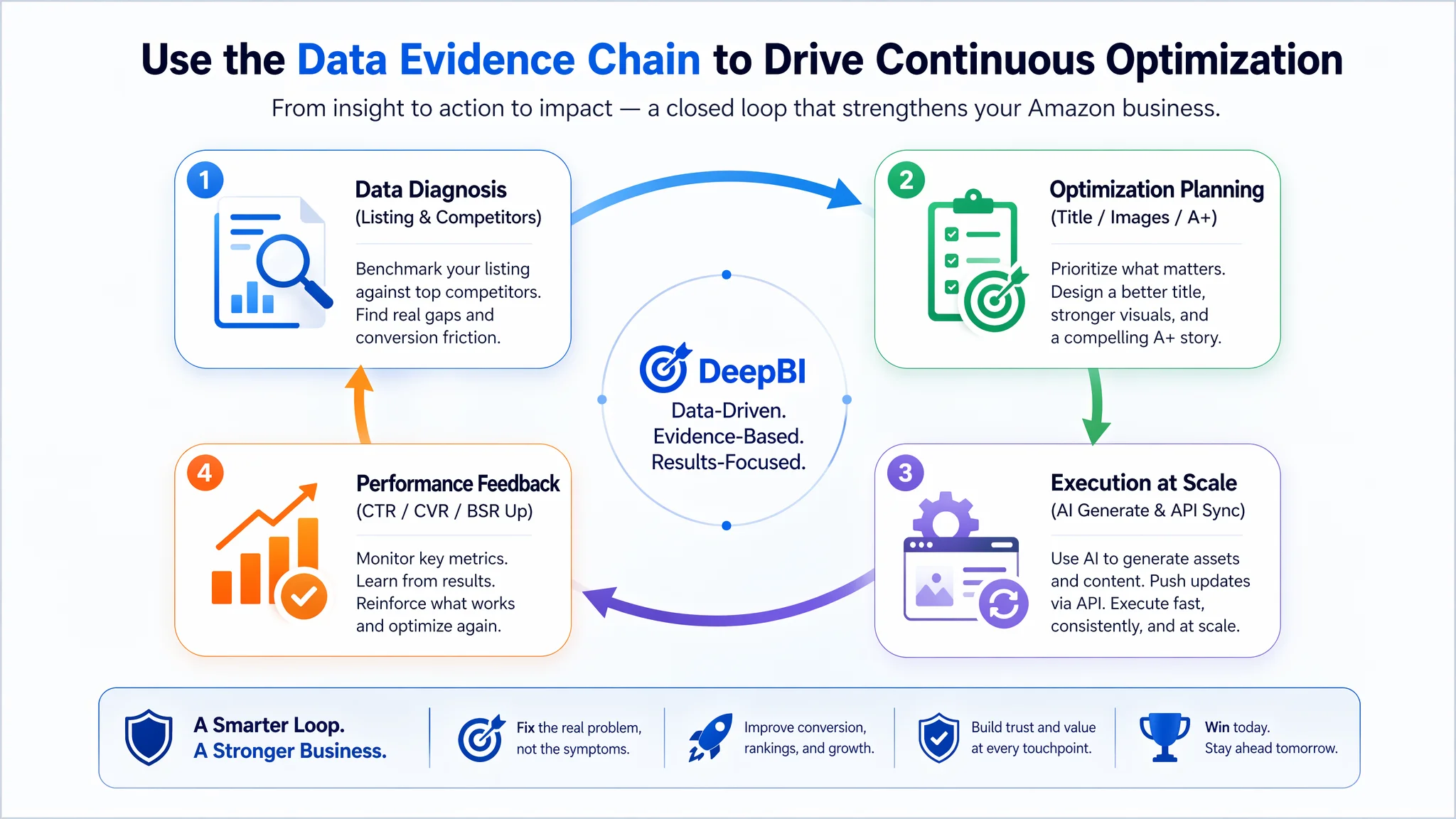
This is where advanced tools become indispensable partners. A platform like DeepBI transforms the art of selling into a quantifiable science, turning abstract operational experience into a concrete data evidence chain. By integrating diagnosis, planning, and execution, it ensures that every decision, particularly around visual assets, is calculated to be more profitable. In the dumbbell case, that meant not just “beautifying” the page, but aligning every element — title, bullets, images, and A+ — around the way real Amazon buyers think and decide.
This process directly translates into tangible gains in key performance indicators like Conversion Rate (CVR) and Best Sellers Rank (BSR). Ultimately, leveraging such a system allows you to make every optimization a precise strike against competitor weaknesses, locking in your winning advantage for long-term success.
Continuous optimization remains essential because Amazon rankings, shopper expectations, and competitive pressure keep changing. The most resilient sellers are those who, like the water-dumbbell team eventually did, learn to treat data not as a periodic report, but as the primary language in which their Amazon business speaks — and then respond with structured, evidence-based improvements at every critical point in the customer journey.