

Introduction
In the competitive Amazon marketplace, sellers face constant pressure from rising traffic costs and the dual challenge of improving Click-Through Rates (CTR) and Conversion Rates (CVR). To navigate this environment, many have adopted a single metric as their primary guide: Advertising Cost of Sale (ACoS). Defined as the ratio of advertising spend to advertising revenue, ACoS is widely used to measure the efficiency of PPC campaigns. A low ACoS is often celebrated as the hallmark of a successful advertising strategy.
However, this singular focus on ACoS can be a significant oversimplification. While the metric effectively measures campaign efficiency, it fails to capture true business profitability. A low ACoS does not guarantee that a business is making money, as it ignores crucial factors like product profit margins, the influence of ads on organic sales, and overall account health. Optimizing for ACoS alone can lead to misguided decisions, such as cutting bids on high-performing keywords that drive substantial organic lift, ultimately stifling long-term growth.
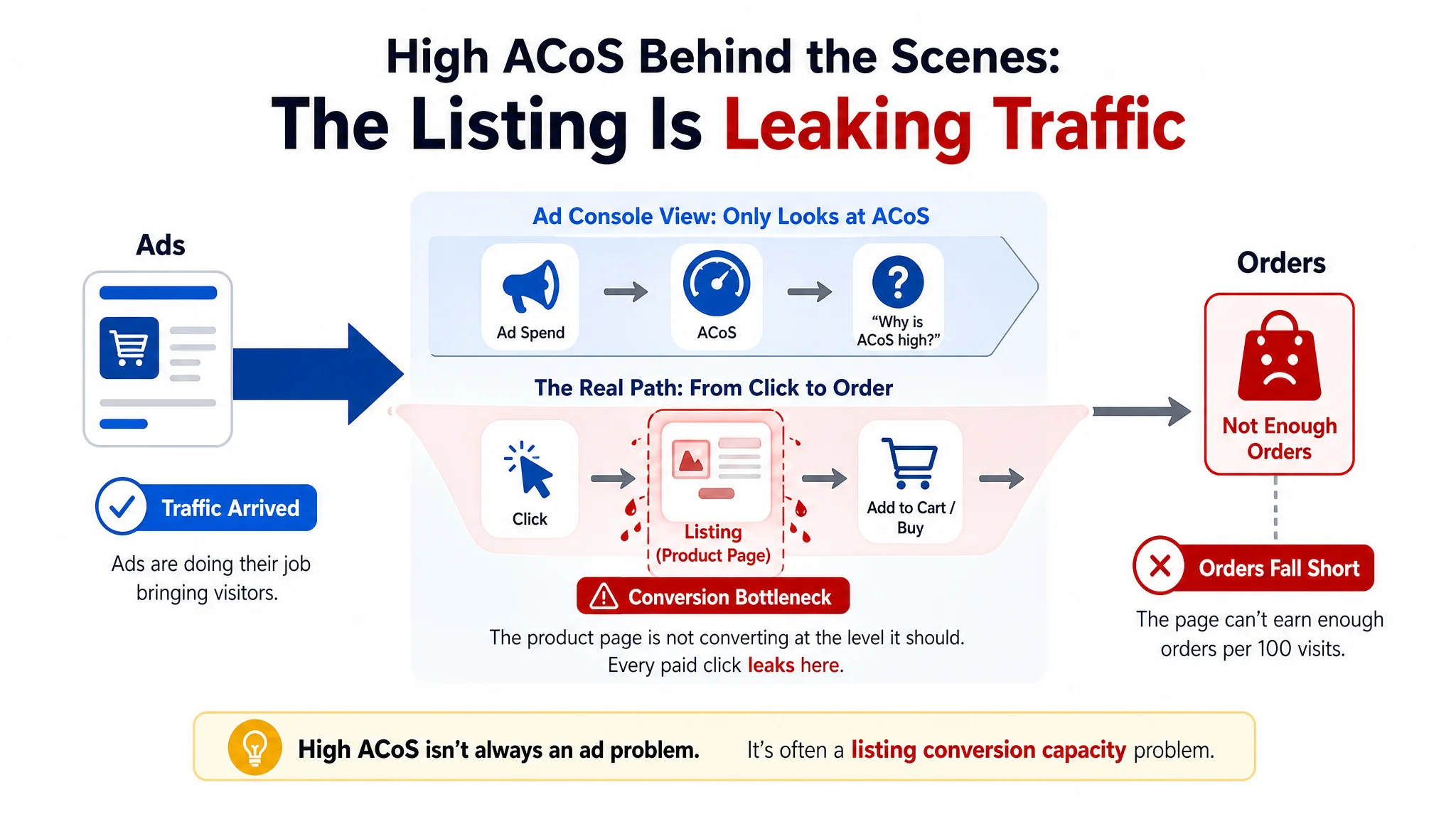
This isn’t just a theoretical concern. In one outdoor LED rope light account we observed, the team had been fighting a “stubbornly high ACoS” for weeks. They kept lowering bids, restructuring campaigns, and tightening keyword lists. On paper, some campaigns even reached what they considered an “acceptable” ACoS. Yet profitability didn’t improve. Once the Listing was examined, it became obvious that the page itself was under-converting relative to the traffic volume and category benchmark. The ads were doing their job bringing visitors; the product page was failing to earn enough orders per 100 visits. Focusing purely on ACoS had masked a much more fundamental profit problem.
The objective is to move beyond chasing a vanity metric and embrace a strategy centered on actual profit. This requires a more sophisticated approach that connects advertising performance to the bottom line, incorporating metrics like Total Advertising Cost of Sale (TACoS) to understand the relationship between paid and organic growth. This guide will provide a comprehensive framework for shifting your focus from simple ad efficiency to maximizing true return on investment, ensuring every dollar spent on advertising contributes directly to sustainable profitability.
Understanding ACoS: The Foundational Metric
For any Amazon seller leveraging paid advertising, Advertising Cost of Sale (ACoS) is the most fundamental performance indicator. It provides a direct measure of campaign efficiency by showing how much is spent on advertising for every dollar of revenue earned from those ads. In essence, ACoS answers the critical question: "How efficiently are my ad dollars converting into sales?" A lower ACoS generally indicates a more effective ad campaign, as less is being spent to generate each sale.
The calculation is straightforward. ACoS is your total ad spend divided by your total ad sales revenue, expressed as a percentage. The formula is:
ACoS = (Ad Spend / Ad Sales Revenue) * 100
To illustrate, if you spend $25 on a Sponsored Products campaign and it generates $100 in attributed sales, your ACoS would be 25%.
($25 Ad Spend / $100 Ad Sales) * 100 = 25%
This single metric has become the default indicator for campaign health and is the starting point for nearly all advertising optimization efforts. While mastering this calculation is the first step, relying on ACoS alone can obscure the true profitability of your business and lead to flawed strategic decisions.
You can see how this plays out in practice. In the rope light example mentioned earlier, the team’s entire diagnostic effort lived inside the ad console. Because they understood ACoS well and could calculate it quickly, they assumed that if they could just push ACoS down, the business would be healthy. The Listing was never seriously questioned because “ACoS is an ad metric.” As a result, they kept tweaking campaigns around a familiar formula while ignoring the actual point where profit is created or lost: conversion on the product page. Knowing how to compute ACoS is necessary, but treating it as the only lens kept them blind to why profit wasn’t showing up even when ACoS occasionally looked “okay.”
Why ACoS Alone Doesn't Tell the Whole Profit Story
For many sellers, Advertising Cost of Sales (ACoS) is the primary metric for gauging campaign success. It offers a simple ratio of ad spend to ad-generated revenue, providing a quick assessment of advertising efficiency. However, depending on ACoS as the sole indicator of profitability is a critical error that can create a significant blind spot in your financial analysis.
The fundamental limitation of ACoS is that it operates in a vacuum. It only considers two variables—ad spend and ad revenue—while ignoring the complete financial context of your product. True profitability is determined by your net margin after all expenses are accounted for. These often-overlooked costs include the cost of goods, Amazon referral and fulfillment fees, and other operational overhead.
- Cost of Goods Sold (COGS)
- Amazon referral and FBA fees
- Warehousing and long-term storage fees
- Shipping and handling costs
- Expenses related to customer returns and refunds
A campaign can achieve a low, seemingly "good" ACoS but still lose money on every sale. For example, if your product's pre-ad profit margin is 30%, any ACoS higher than that figure means you are paying more for the sale than the profit you generate. To accurately gauge performance, you must look beyond ACoS and consider the total cost structure that impacts your bottom line.
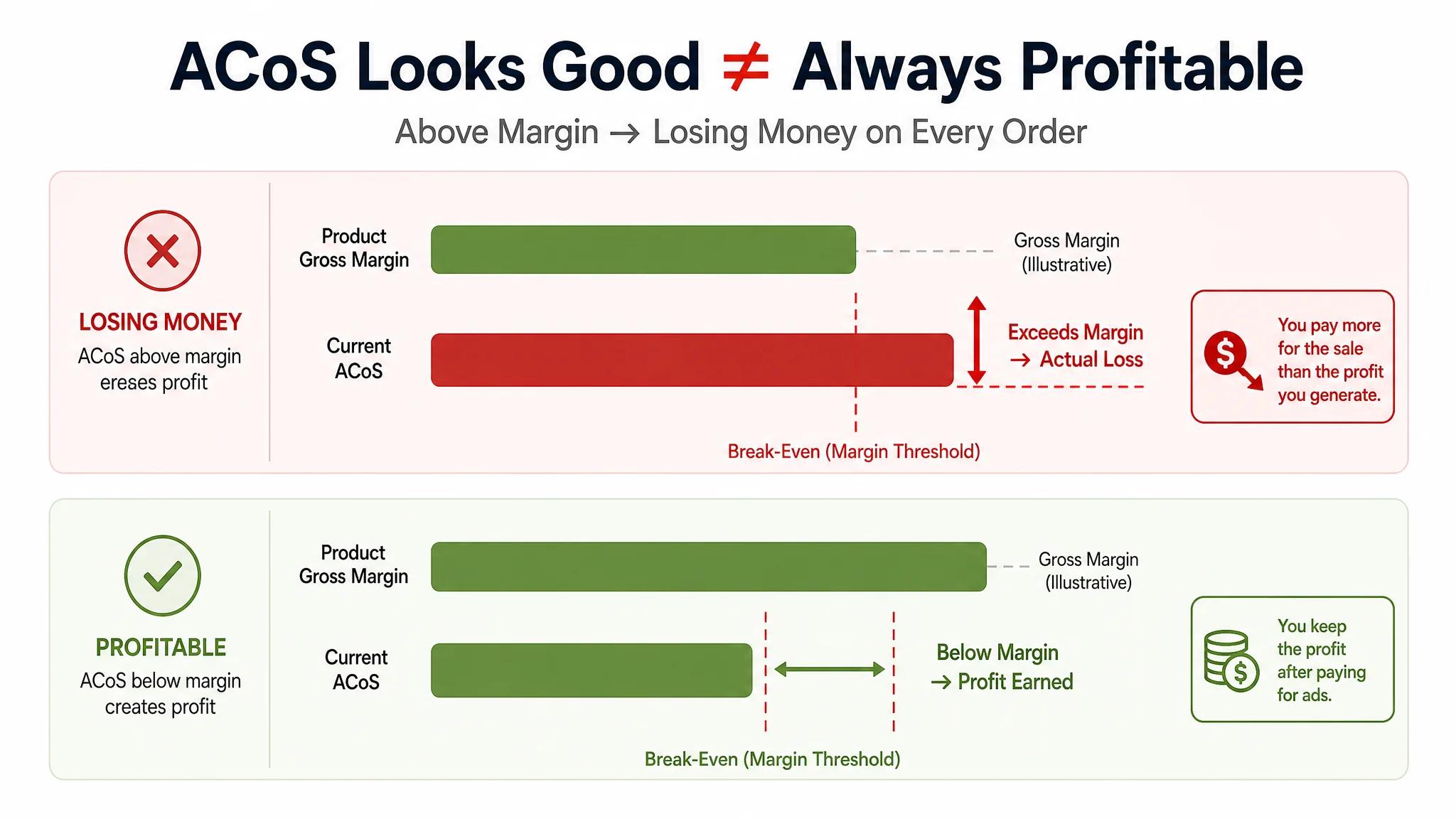
In the rope light case, this disconnect became very clear once the numbers were placed in context. The seller knew their rough product margin and could see that certain campaigns were running close to that margin in terms of ACoS. On the surface, that didn’t look disastrous. But when fees, returns risk, and operational costs were layered in, it was obvious that these “acceptable” ACoS campaigns were effectively erasing profit. Because they never systematically mapped ACoS to a break-even threshold, the team kept pushing for slightly lower ACoS instead of asking the sharper question: Is this product, with this fee structure and this Listing, capable of generating profit at all under our current setup? The answer, before fixing conversion and cost context, was no.
This illustrates the core point: ACoS can look fine while the business quietly burns cash. Without incorporating margins and costs, you’re optimizing a ratio, not profit.
Key Profitability Metrics: Break-Even ACoS and TACOS
While ACoS is a foundational advertising metric, relying on it exclusively can obscure the true financial health of your business. To transition from simply managing ad spend to driving genuine profit, you must adopt more sophisticated metrics that provide a complete picture of performance.
The first is your Break-Even ACoS. This figure represents the maximum ACoS you can sustain on a product before you start losing money on each ad-driven sale. It is calculated based on your pre-ad profit margin, which is the sales price minus Amazon fees and the Cost of Goods Sold. Knowing this ceiling is critical; any campaign running with an ACoS above this threshold is actively eroding your profits with every conversion.
In the rope light scenario, this was exactly the kind of clarity that had been missing. Once the Listing went through DeepBI’s diagnosis and product-level cost structure was mapped, it became possible to see where the real financial line sat. The team realized that what they had previously considered a “tolerable” ACoS actually crossed their effective break-even once all Amazon fees and COGS were included. That meant every additional ad-attributed order above that ACoS wasn’t just under-optimized—it was value-destructive. The realization shifted the discussion from “how do we shave a few more points off ACoS?” to “how do we either improve conversion enough to get below break-even or rethink whether this SKU deserves aggressive ad spend at all?”
The second key metric is Total Advertising Cost of Sales (TACOS). Unlike ACoS, which only measures ad spend against ad-attributed sales, TACOS measures your total ad spend against your total sales from all sources (both organic and ad-driven). This provides a holistic view of your advertising's effect on overall business growth. A declining TACOS indicates that your ads are successfully boosting organic rank and sales, creating a virtuous cycle of growth.
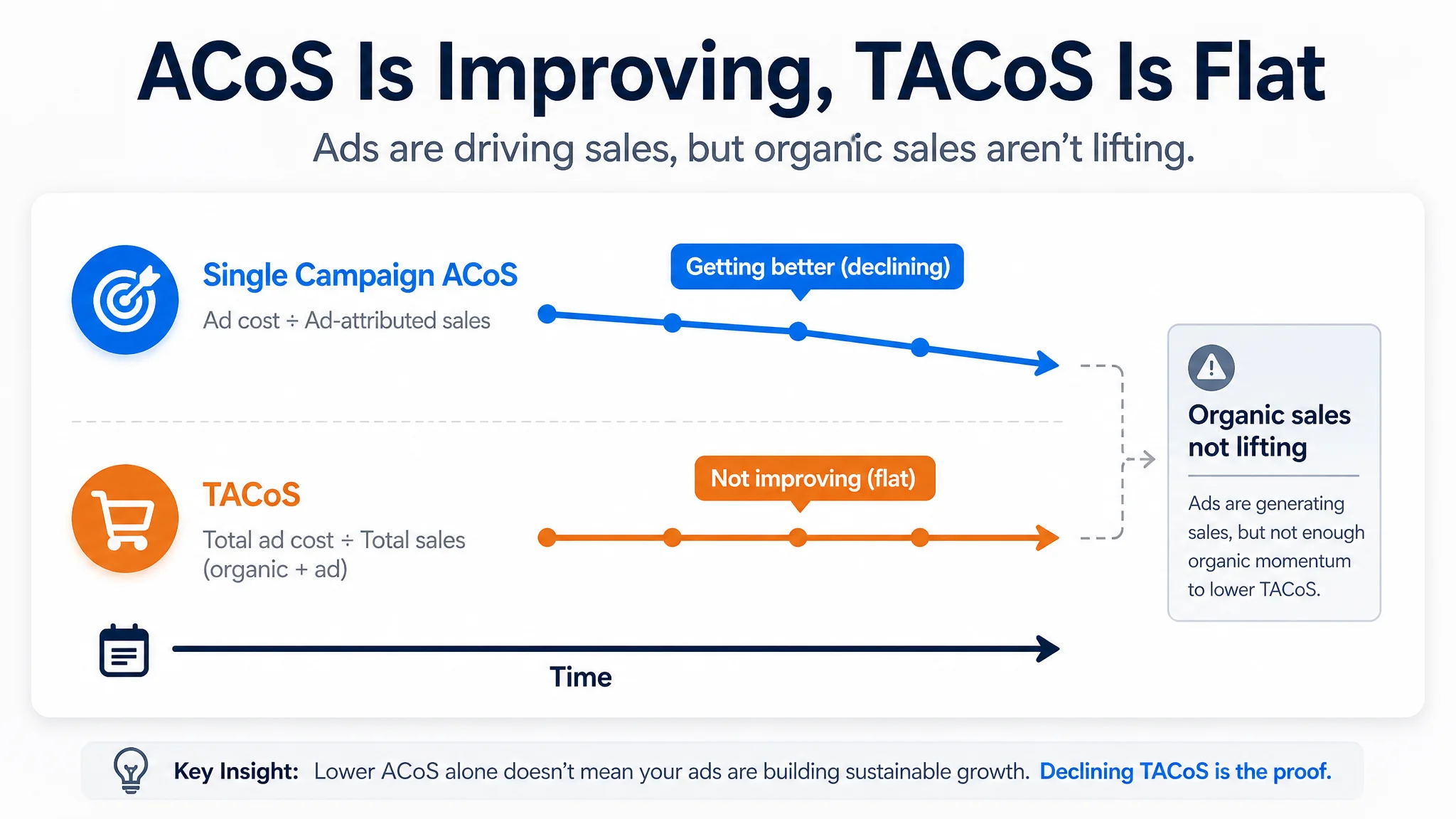
In the rope light account, one of the early warning signs was that TACOS wasn’t improving even when isolated campaign ACoS looked slightly better. Ads were driving sales, but the Listing’s underpowered conversion meant those sales weren’t translating into strong, durable organic rank gains. In other words, the business was paying repeatedly for traffic without building enough organic momentum to pull TACOS down over time. Seeing TACOS alongside break-even ACoS made the underlying issue obvious: without stronger on-page conversion, ad dollars would stay stuck in a loop of “pay, get sale, repeat,” instead of “pay, build rank, lower future ad dependence.”
Actively managing these metrics requires a systematic approach to traffic quality. For instance, DeepBI's Four-Layer Traffic Funnel Model helps optimize ad spend by continuously exploring new keywords and competitor ASINs, filtering out low-conversion traffic, and concentrating budget on high-performing segments. This process directly improves your ACoS and helps lower TACOS, aligning your advertising efforts with long-term profitability.
In the rope light case, this funnel thinking also helped distinguish between a “traffic problem” and a “conversion problem.” The seller had assumed they needed “better keywords” to fix ACoS. After running through a structured exploration and filtering process, it became clear the campaigns were already reaching relevant, high-intent queries. The bottleneck was not who was arriving; it was what happened when they landed. This distinction is crucial: refining traffic and lowering ACoS is powerful, but only when the Listing can already convert at a level that justifies that traffic.
Factors Driving Amazon Ad Profitability
True advertising profitability extends far beyond a simple ACoS target. It is the outcome of a complex interplay between your product's underlying economics and the efficiency of your campaigns. Understanding these key drivers is the first step toward maximizing your net profit.
Your product's profit margin sets the ultimate ceiling for your ad spend. Higher margins provide more flexibility for aggressive bidding and can sustain a higher ACoS. However, this calculation is only meaningful after accounting for all Amazon fees. Costs such as referral fees, FBA fulfillment, and storage directly erode the net profit from each ad-driven sale, making campaign efficiency paramount.
Once your financial baseline is clear, profitability hinges on core advertising performance metrics, including Click-Through Rate (CTR), Conversion Rate (CVR), and Cost-Per-Click (CPC).
- Conversion Rate (CVR): A strong listing is your most powerful asset. High-quality images, compelling copy, and competitive pricing work together to increase CVR, ensuring that the traffic you pay for is more likely to convert into sales. A low CVR means you are wasting ad spend on clicks that don’t materialize into revenue.
This principle was on full display in the rope light Listing. Against a benchmark competitor, the page “looked fine” at a glance. But DeepBI’s Listing scoring showed that while the overall numerical gap (76 vs 80) seemed small, it was concentrated in conversion-critical areas: the title was not structured around the strongest keyword and value logic, the hero image tried to show everything at once without a clear focal promise, bullet points described materials instead of solving buyer pain points, and the A+ section underplayed safety certifications and professional scenarios. Ads were consistently sending shoppers to this page, but the Listing lacked the conversion capacity to turn enough of those visits into orders. The result: lower CVR than the category leader, and a feeling that “ACoS just won’t come down,” when the real issue was that each click had a lower probability of becoming revenue.
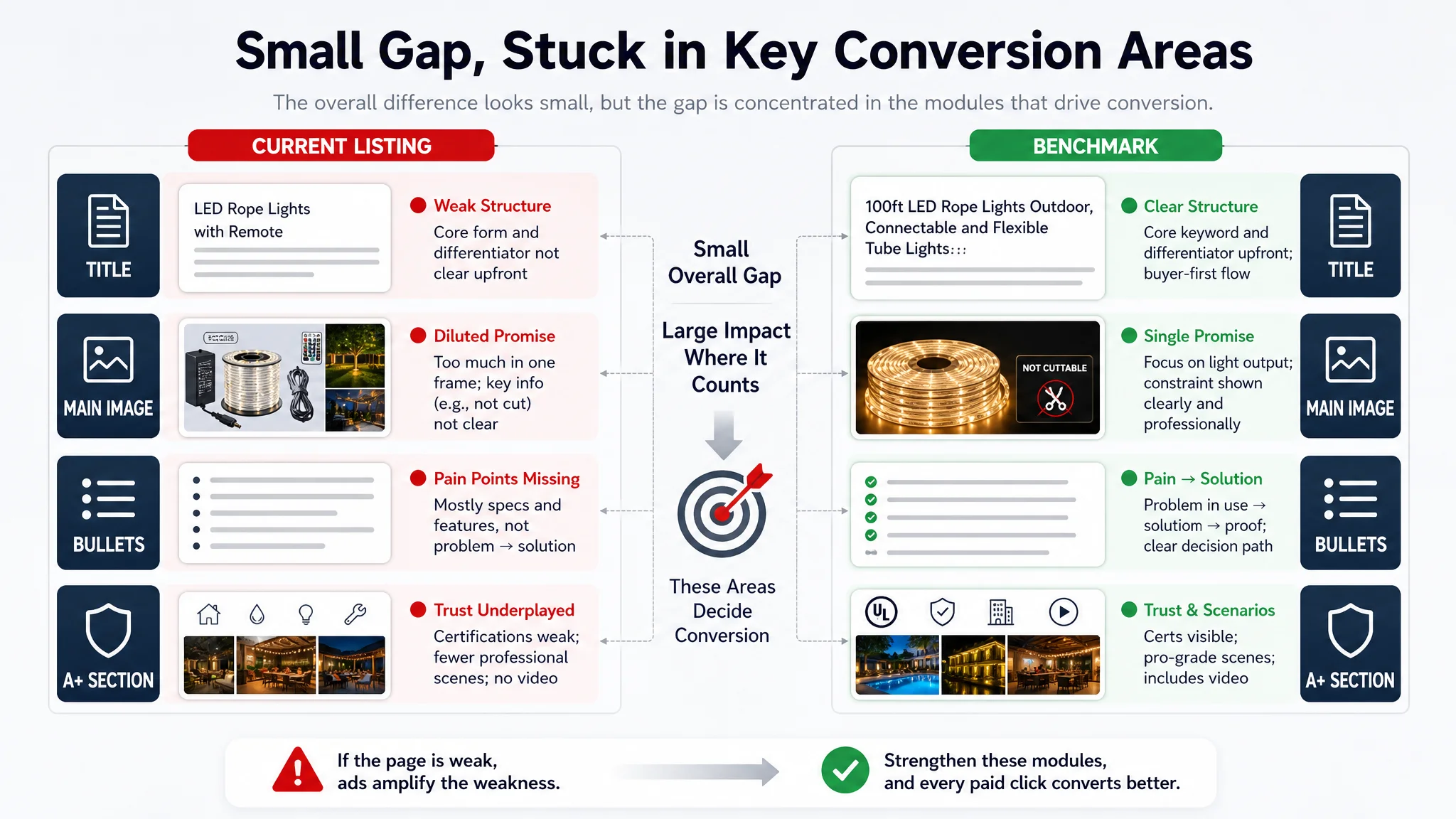
Once the title, images, bullets, and A+ were rebuilt around a sharper decision path—clarifying the product form, emphasizing connectable/flexible usage, highlighting IP65 durability, and visually proving professional use cases—CVR began to recover. Importantly, this happened without changing the ad tactics first. The case underlines the core idea: ad profitability starts with how competently your Listing converts the traffic you already have.
- Click-Through Rate (CTR) & Cost Per Click (CPC): Your CTR reflects ad relevance, while your CPC is a direct cost. In Amazon's second-price auction, your bid determines your ad rank, but you typically pay just enough to beat the next highest bidder. A higher CTR can improve ad placement even with a lower bid, making relevance a key lever for reducing traffic costs.
In the rope light example, the initial response to high ACoS was to treat it as a pure traffic/auction problem. The team adjusted bids and experimented with different keyword match types, expecting that finer bid control alone would bring ACoS down. But because the hero image, title, and listing content weren’t optimally aligned with how buyers searched and what they wanted to see, CTR and post-click behavior weren’t strong enough to reward those bid adjustments. This is a common trap: sellers push the CPC lever harder and harder without fixing the creative and relevance elements that actually drive CTR and conversion. As the case illustrates, meaningful CPC improvements usually come when your ad and Listing are tightly relevant and compelling, not just when you “bid smarter.”
Manually balancing these variables is a constant challenge. To address this, DeepBI's Dynamic parameter adjustment mechanism automatically adjusts bids and budgets daily. By analyzing 7-day trends in clicks, conversions, spend, and ACoS, it optimizes your campaigns for stable, profitable growth while avoiding reactive adjustments to short-term fluctuations.
In the rope light case, this kind of disciplined, trend-based adjustment was exactly what the team needed after they repaired their Listing. Before the fixes, every bid change felt like firefighting: a short-term drop in ACoS would be followed by volatility because the underlying conversion issues had not been solved. After the Listing’s conversion logic was strengthened, dynamic adjustments could finally “stick”: when bids were tuned according to performance data, the better CVR translated into more predictable ACoS and a healthier margin. The lesson extends far beyond one product: automation and smart bidding can only do so much if your product page and economics are not ready to support profitable scaling.
Setting Strategic ACoS and Profit Targets with DeepBI
A common pitfall for Amazon sellers is the pursuit of a universal "good" ACoS. In reality, the ideal ACoS is not a fixed number but a dynamic target that must align with specific business objectives. Factors such as product category, competitive landscape, profit margins, and the product's lifecycle stage all determine what an effective ACoS looks like for your business. A rigid, one-size-fits-all ACoS target can either stifle growth or erode profitability.
Strategic goal-setting requires adapting your ACoS targets to the situation:
- New Product Launches: For a new product, a higher ACoS is often a necessary investment. The goal is to gain initial visibility, drive sales velocity to improve organic ranking, and gather crucial early reviews. In this phase, market penetration is more important than immediate ad profitability.
- Profit Maximization: For mature products with established sales history and organic rank, the focus shifts to efficiency. The objective is to maintain sales volume while lowering ACoS to maximize the net profit on every unit sold.
- Aggressive Growth: When aiming to capture market share from competitors, a temporarily higher ACoS may be a strategic choice to ensure top-of-search placement and win conversions on high-volume keywords.
This dynamic approach requires moving beyond a singular focus on ad spend efficiency. DeepBI facilitates this strategic shift by providing real-time insights into both ACOS and true ROI. By integrating ad performance data with overall profitability metrics, the platform empowers you to make informed decisions. You can confidently set aggressive ACoS targets for a product launch, knowing the impact on long-term growth, or fine-tune campaigns for maximum profit on established products, ensuring your advertising strategy always serves your ultimate business goals.
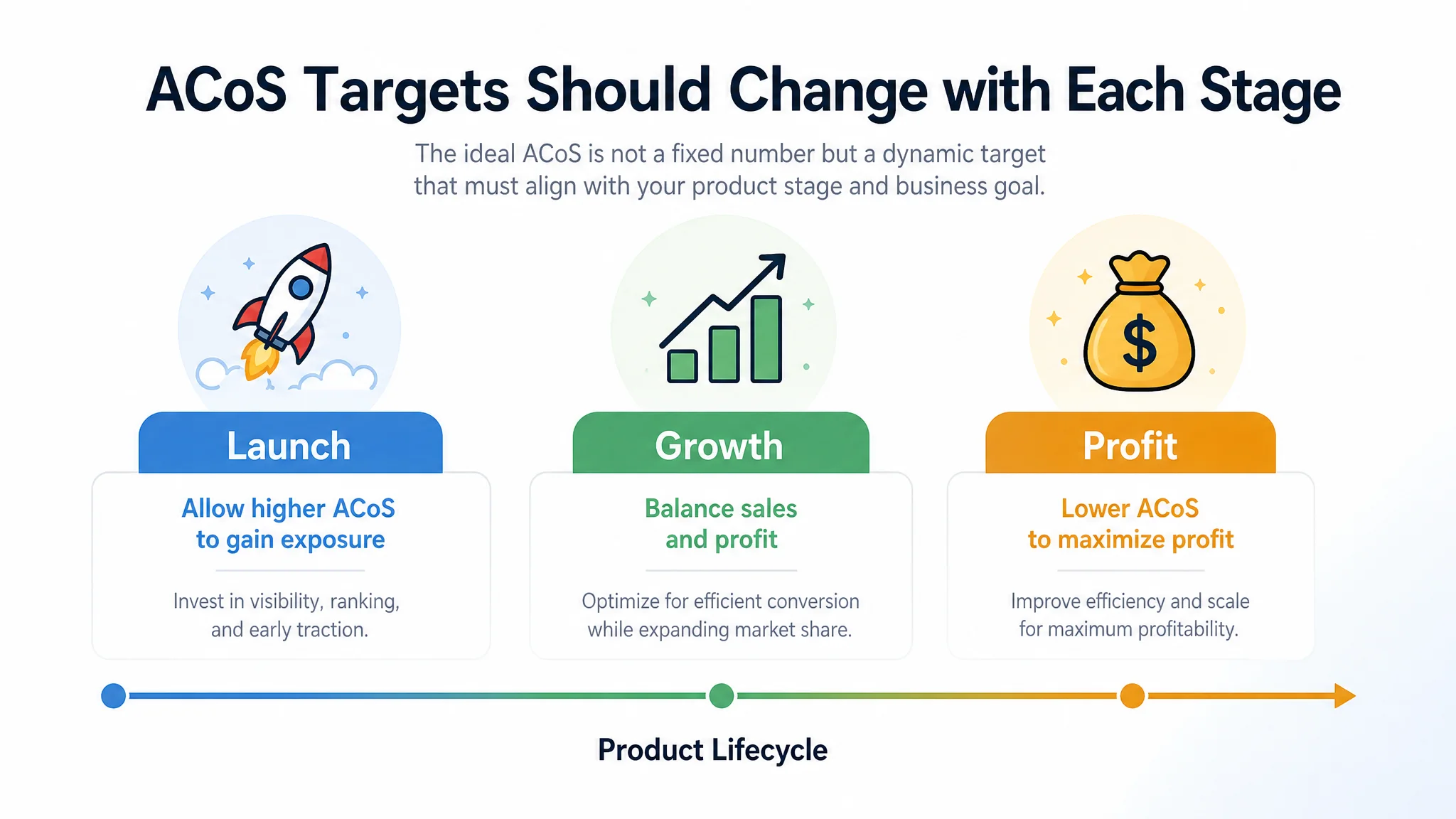
The rope light experience is a vivid example of why ACoS targets must be tied to strategy and Listing readiness, not just a number on a dashboard. Initially, the team was chasing a lower ACoS almost on principle, without distinguishing between “launch investment,” “efficiency mode,” or “share capture.” At the same time, the Listing’s conversion capacity lagged behind the category benchmark. That meant they were, in effect, trying to force a mature-product efficiency target onto a page that hadn’t yet earned it.
Once DeepBI’s diagnosis reframed the situation as a Listing-conversion bottleneck, the approach to ACoS changed. Instead of insisting on an aggressively low ACoS while the page remained weak, the team accepted a more strategic sequence: first, improve conversion and alignment with buyer expectations; second, re-evaluate break-even and realistic ACoS bands; third, decide whether the rope light should be run in a “growth” or “profit” mode. That sequencing is what sellers in any category can replicate: your ACoS target should reflect where the product is in its lifecycle and how strong its current Listing is, rather than an arbitrary “industry standard” number.
DeepBI's Holistic Approach to Amazon Ad Profitability
Focusing solely on Advertising Cost of Sales (ACoS) can be misleading, often masking the true profitability of your campaigns. To achieve sustainable growth, sellers must connect ad performance directly to bottom-line results. DeepBI provides a comprehensive, AI-driven solution designed for the Amazon ecosystem, moving sellers from superficial metrics to a deep understanding of profit.
The platform’s strength begins with financial clarity. It calculates a precise, product-level break-even ACoS by systematically accounting for the full spectrum of costs, including over 40 distinct Amazon fees, Cost of Goods Sold (COGS), and return-related expenses. This allows you to move from estimation to setting ad targets that guarantee real profit on every sale.
In the rope light case, this kind of granular accounting exposed a subtle but critical reality: even when ACoS didn’t look extreme, the combination of Amazon fees and the Listing’s weaker conversion meant the margin for error was very thin. Prior to running a detailed cost and Listing audit, the seller had no reliable way to distinguish between “we’re spending aggressively but strategically” and “we’re slowly bleeding margin.” Once DeepBI surfaced a clear break-even ACoS and tied it to observed conversion, the team could see that current campaigns were often operating on the wrong side of that line. That clarity turned a vague sense of “ads feel expensive” into a concrete, actionable diagnosis.
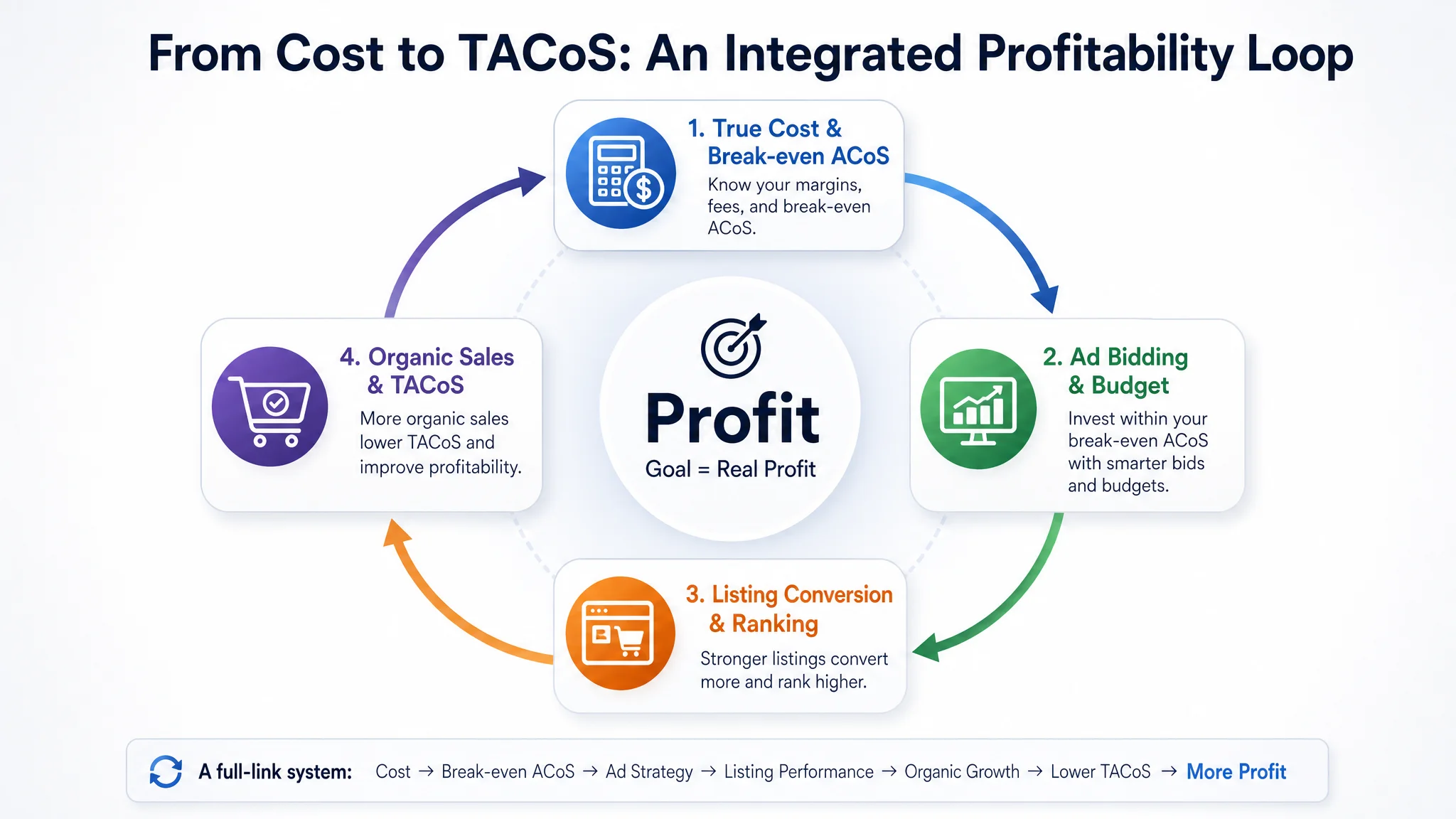
This financial foundation powers DeepBI's Full-link closed loop system, which integrates data analysis, strategy, and execution. The platform’s Organic Traffic Growth Strategy identifies high-value keywords from ad data to build targeted campaigns that boost organic rankings. This creates a positive feedback loop: successful ads improve organic visibility, which in turn reduces reliance on paid traffic and lowers your Total Advertising Cost of Sales (TACoS). By transforming ad data into a clear roadmap, DeepBI builds a sustainable engine for long-term profitability.
Again, the rope light Listing illustrates the importance of viewing “the full link” instead of isolated metrics. Before the Listing was strengthened, ads were driving some sales but were not reliably lifting organic rank because conversion and trust cues weren’t competitive enough. That kept TACOS from improving, even when individual campaigns appeared to stabilize. After aligning the page with category-winning patterns—clearer title structure, focused hero image, buyer-centric bullets, and trust-building A+ content—the same ad spend started to do more than just buy immediate orders. It began to support better organic positions, which is the only durable path to a healthier TACOS. The case underscores the core of DeepBI’s approach: profitability is a chain of connected steps, and if one link (like Listing conversion) is weak, the whole system underperforms no matter how sophisticated your bidding is.
Conclusion: Achieving Sustainable Profit with a Smart Ad Strategy
As competition on Amazon intensifies, relying on a single metric like ACoS is no longer sufficient for building a resilient business. True profitability demands a more sophisticated, holistic view that places your actual bottom line at the center of every advertising decision. By embracing crucial KPIs like Break-Even ACoS and Total Advertising Cost of Sales (TACOS), you can accurately measure the full impact of your ad spend on both paid and organic sales, ensuring every dollar contributes to healthy, long-term growth.
Real-world experiences, such as the outdoor rope light seller who spent weeks blaming “bad ads” for high ACoS only to discover that the real constraint was Listing conversion, highlight why this mindset shift is so important. When you see ads as the only lever and ACoS as the only scorecard, you risk pouring budget into a page that is structurally incapable of earning enough orders per visit. Once you connect costs, margin, conversion, and organic impact into a single profit narrative, it becomes much easier to decide whether you need new keywords, new bids—or a fundamentally stronger product page.
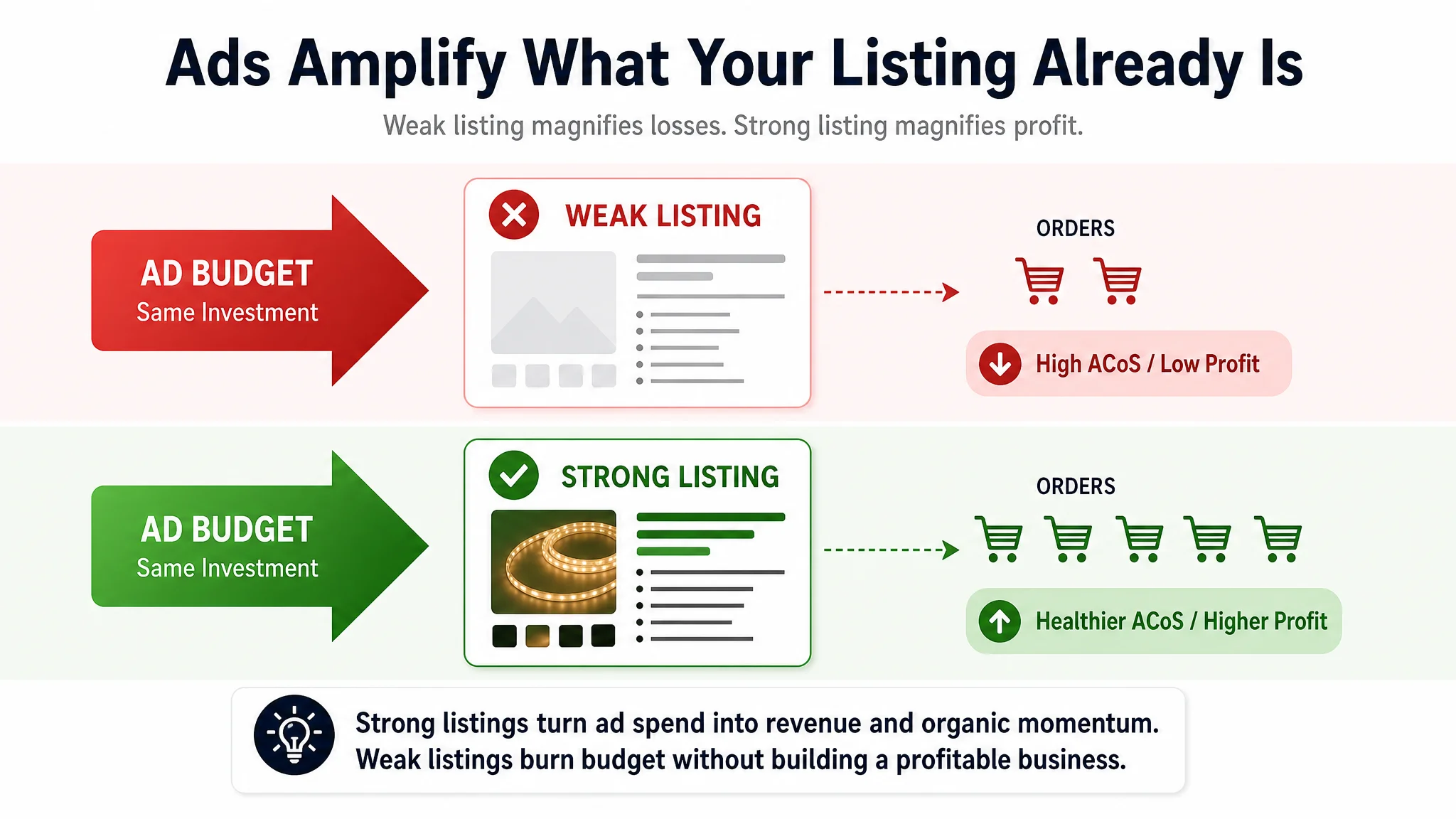
Adopting this profit-centric mindset requires moving from subjective guesswork to data-driven execution. Advanced, AI-powered platforms like DeepBI are essential for this transition, transforming complex data signals into actionable strategies. These tools help convert advertising performance into stronger organic rankings and a lower TACOS by ensuring your entire funnel is logically aligned for maximum impact. By making your optimization efforts a predictable and quantifiable process, you can secure a decisive competitive advantage and transform your advertising from a cost center into a powerful engine for sustainable brand growth.