

Introduction
In the intense landscape of Amazon e-commerce, sellers are facing increasing pressure from declining organic rank, often driven by falling click-through rates (CTR) and conversion rates (CVR). A common and costly mistake is to react with blind modifications to a listing based on subjective aesthetics. These efforts, detached from data, frequently result in wasted resources and a further decline in core performance metrics, leaving teams unsure of what went wrong.
This is not just a theoretical risk. One automotive tools seller running a radiator pressure tester kit assumed their problem was “expensive ads and high ACOS.” The team cycled through all the familiar levers—adjusting bids, refining keyword match types, launching new campaigns—yet orders did not grow in step with traffic. From the inside, it looked like “advertising isn’t optimized enough.” Once the listing was pulled into a diagnostic system, a different pattern emerged: traffic was not actually the bottleneck; the page could not convert the visitors it was already getting. The main image set, title structure, and A+ storytelling were all materially weaker than a direct competitor, so every extra dollar of ad spend was effectively pouring more water into a leaky bucket.
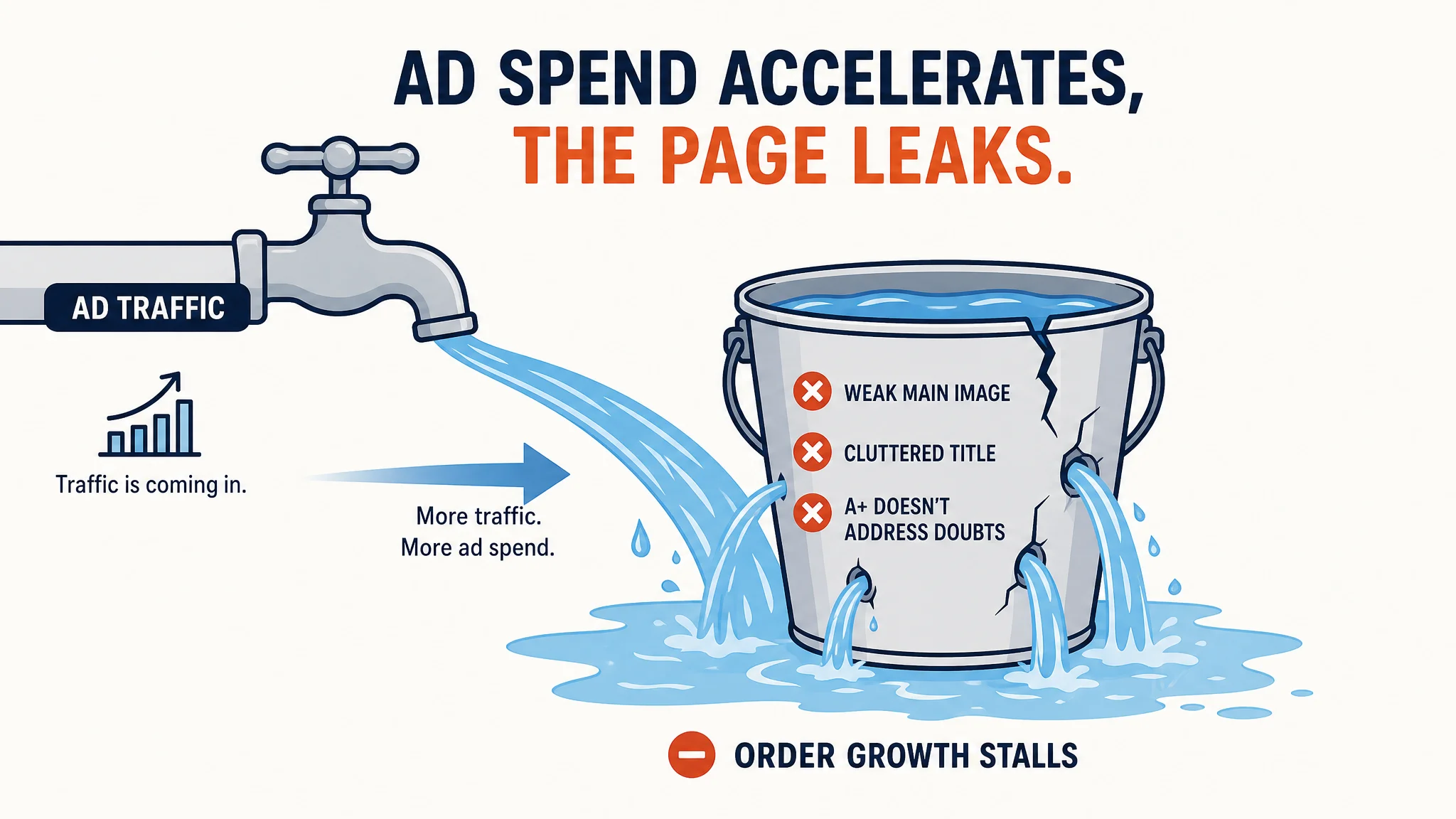
The root of this problem lies in a disconnected operational workflow. Traditional optimization suffers from silos that separate diagnosis from planning and content production from delivery. This makes it nearly impossible to confidently link a low CTR to a specific main image defect or a poor CVR to a trust gap in the A+ Content. Listing optimization should not be guesswork; it must be a precision activity based on data algorithms.
DeepBI provides an end-to-end intelligent optimization system designed to break down these silos and move sellers from “blind trial and error” to establishing a “data evidence chain” for every decision. By unifying the stages of diagnosis, planning, production, and delivery, DeepBI ensures that every modification is a calculated action aimed at delivering measurable improvements. It transforms visual assets from simple aesthetic displays into a core commercial engine that actively drives clicks and conversions, reversing rank decline and securing a competitive advantage.
Understanding Amazon Organic Rank and Its Importance
What is Amazon Organic Rank?
Amazon's organic rank is your product's natural, unpaid position in customer search results. Unlike sponsored placements, which are paid advertisements appearing at the top or alongside search results, organic rank is earned based on performance and relevance as judged by Amazon's A9 algorithm. This algorithm continuously evaluates numerous factors to determine which products best match a customer's query and are most likely to result in a purchase.
Key drivers of your organic rank include:
- Relevance: How effectively your title, bullet points, and backend keywords align with customer search terms.
- Performance Metrics: Your Click-Through Rate (CTR), which is heavily influenced by your main image, and your Conversion Rate (CVR), driven by the persuasive power of your A+ content and the strength of your customer reviews. These metrics combine to create strong sales velocity, a critical signal to the algorithm.
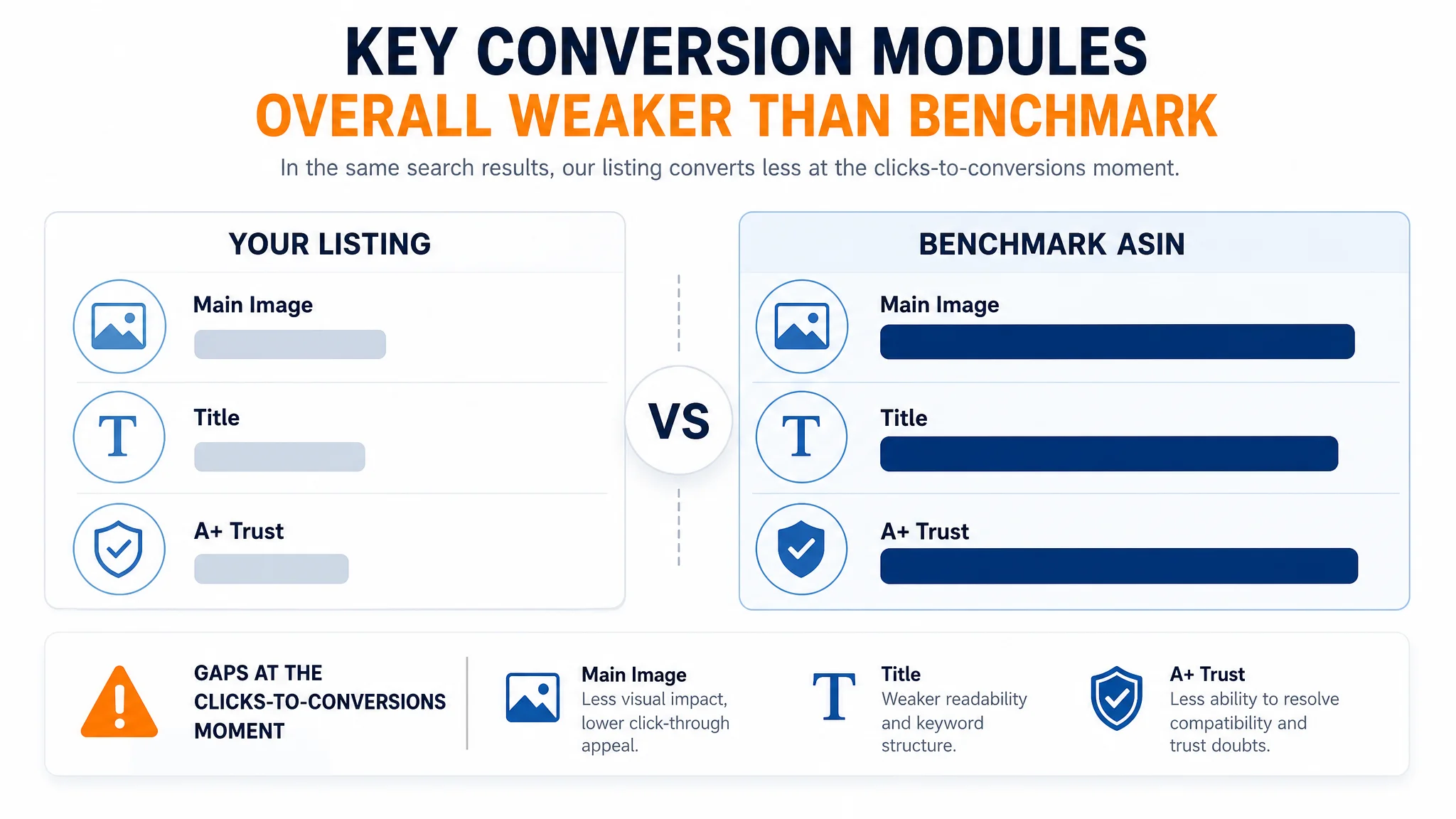
In practice, when these levers underperform, rank follows. In the radiator tester case, the seller’s bullets were detailed and technically solid, so on the surface the listing looked “complete.” However, against a direct benchmark ASIN, the overall listing scored noticeably lower, with the biggest gaps exactly where CTR and CVR are formed: the main image set, the title’s readability and keyword structure, and A+ content’s ability to resolve compatibility doubts. Ads were successfully delivering impressions; the page simply did not convert at the same efficiency as the competitor shown in the same search results, which inevitably pulled down the product’s perceived performance and, over time, its organic standing.
Why Organic Visibility is Crucial for Amazon Sellers
Securing a high organic rank is a cornerstone of a profitable and sustainable Amazon business. Strong organic visibility directly reduces your dependency on paid advertising, leading to a lower Total Advertising Cost of Sale (TACoS) and healthier profit margins. This creates a powerful, self-reinforcing growth loop.
A well-optimized listing with a high rank attracts more qualified traffic, which generates more sales. These sales signal to Amazon that your product is a strong performer, further solidifying its high rank and creating a long-term, healthy revenue flywheel. Furthermore, products that consistently appear at the top of organic search results build significant brand equity and earn greater customer trust, establishing them as credible market leaders in the eyes of shoppers.
The radiator kit seller’s experience illustrates what happens when this loop breaks. Because the listing lagged behind a benchmark competitor on core conversion drivers, the seller felt compelled to “push harder” with ads just to maintain visibility. Spend rose faster than sales, ACOS stayed uncomfortably high, and organic rank did not improve because the underlying CTR/CVR gap remained. Only after the listing’s conversion capacity was rebuilt—clearer title, more compelling main image, compatibility-focused A+—did the conditions exist for organic visibility to strengthen without endless ad pressure. In other words, organic rank only becomes sustainably defensible when the page itself can consistently win both clicks and conversions versus realistic competitors.
Common Causes of Amazon Organic Rank Decline
A sudden drop in your product's organic search ranking can be alarming, directly impacting visibility and sales. This decline is rarely arbitrary; it's typically a symptom of underlying issues in your strategy or the competitive environment. Understanding these root causes is the first step toward diagnosing the problem and implementing a data-driven recovery plan.
Keyword Performance Degradation
Your product's rank is tied directly to its performance on specific keywords. A decline often begins here, driven by several factors. First, overall search volume for a core keyword may decrease, reducing the total available traffic. More commonly, your product's own metrics for high-volume keywords begin to falter. A low Click-Through Rate (CTR) signals to Amazon that your main image or title is not compelling enough for shoppers, while a low Conversion Rate (CVR) indicates that your detail page fails to turn clicks into sales. This poor performance on critical keywords tells the A9 algorithm that your product is not a relevant or desirable result, leading to a lower rank.
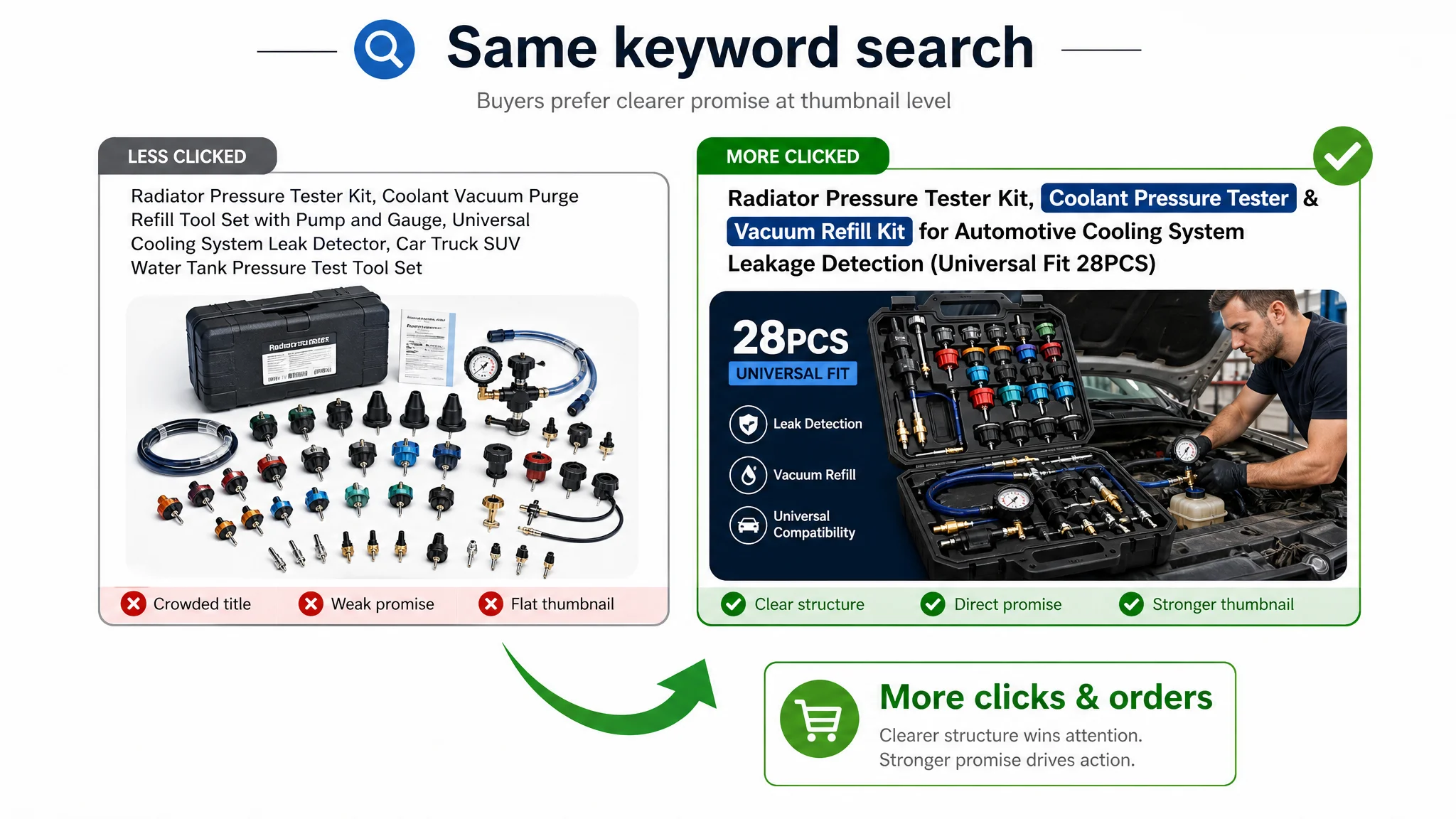
In the automotive tools case, ads were already putting the product in front of many relevant “radiator pressure tester” and “cooling system refill” searches. The impression volume was not the issue. The problem surfaced in how those impressions translated into clicks and then orders when buyers compared this listing to a direct rival. The competitor’s title structured the same core search terms into a faster, clearer promise—“radiator pressure tester kit + coolant pressure tester + universal 28PCS”—which read more intuitively and captured more keyword coverage in one glance. At thumbnail level, that subtle structure advantage made their result more clickable for the same queries. On the detail page, stronger compatibility and professional trust visual cues meant more of those clicks turned into purchases. From Amazon’s perspective, the competing ASIN simply performed better on the same keyword set, justifying higher organic placements.
This illustrates that “keyword performance degradation” is often less about losing relevance in text fields and more about losing relative CTR/CVR for those keywords because other listings are doing a better job of converting the same demand.
Listing Quality Issues
A high-quality listing is your primary tool for conversion. When elements are weak, your CTR and CVR suffer, directly harming your organic rank. This goes beyond simple typos. Ineffective bullet points that merely list product parameters instead of framing them as solutions to customer pain points fail to persuade buyers. Likewise, A+ Content that lacks high-value modules like comparison charts or authoritative endorsements misses a key opportunity to build trust and drive conversions. Most critically, visual quality issues—from a main image that lacks a "visual hook" to lifestyle images that create a mismatch with the actual product—can lead to poor engagement and destructive negative reviews, severely damaging your product's standing.
The radiator tester listing was a textbook example of this problem hiding in plain sight. The seller had invested time into bullet points that clearly described functions and even touched on cost savings and ease of use. On paper, “content exists” and the team felt confident that the listing was not the issue. But when benchmarked against a strong competitor, specific quality gaps became obvious:
- Title logic: The customer’s title leaned into long, technical phrasing that read more like a parts string than a clear solution. The competitor used a simple, scannable pattern—core product, function, application scope—making it much easier for shoppers to decode at a glance.
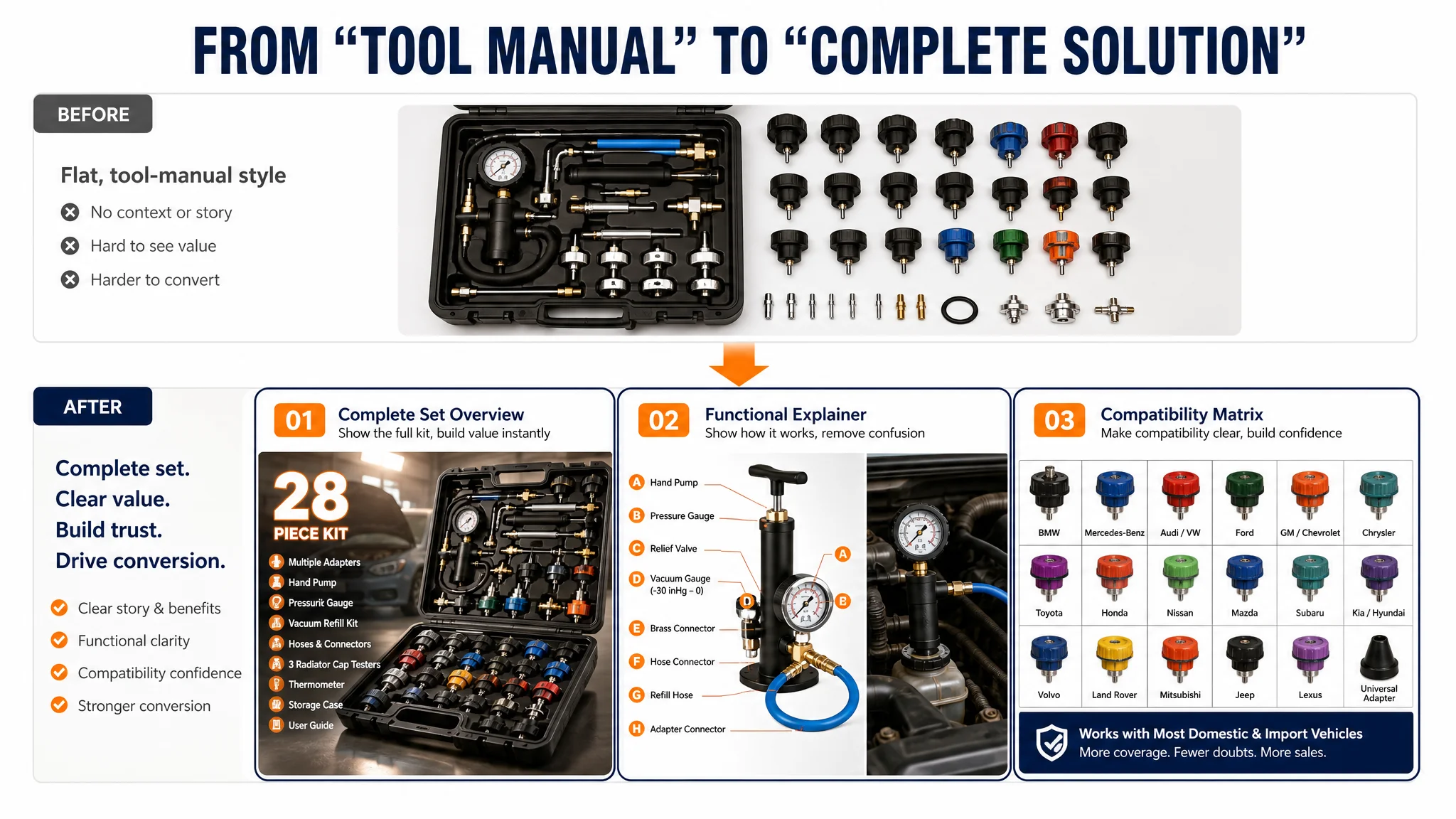
- Main image set: The seller’s visuals resembled a tool manual—flat lays, top-down angles, and diagrams. The rival listing used warm workshop scenes, a human in action, and overlay badges like “professional” and “widely compatible.” At search results level, one looked like “equipment on a table,” the other like “a solution in real use.”
- A+ layout: The seller’s A+ content was packed with technical diagrams and steps, but loosely structured and not explicitly tied to the buyer’s biggest risk: “Will this fit my vehicle?” The competitor devoted multiple modules solely to visualizing compatibility across brands and years, completing the trust story more convincingly.
Even though the seller slightly outperformed the competitor on bullet-point scoring, those strengths were buried behind weaker title and imagery. This demonstrates that listing quality is an integrated system: if your main visual and above-the-fold narrative underperform, deeper content rarely gets the chance to influence behavior, and your organic rank will reflect that.
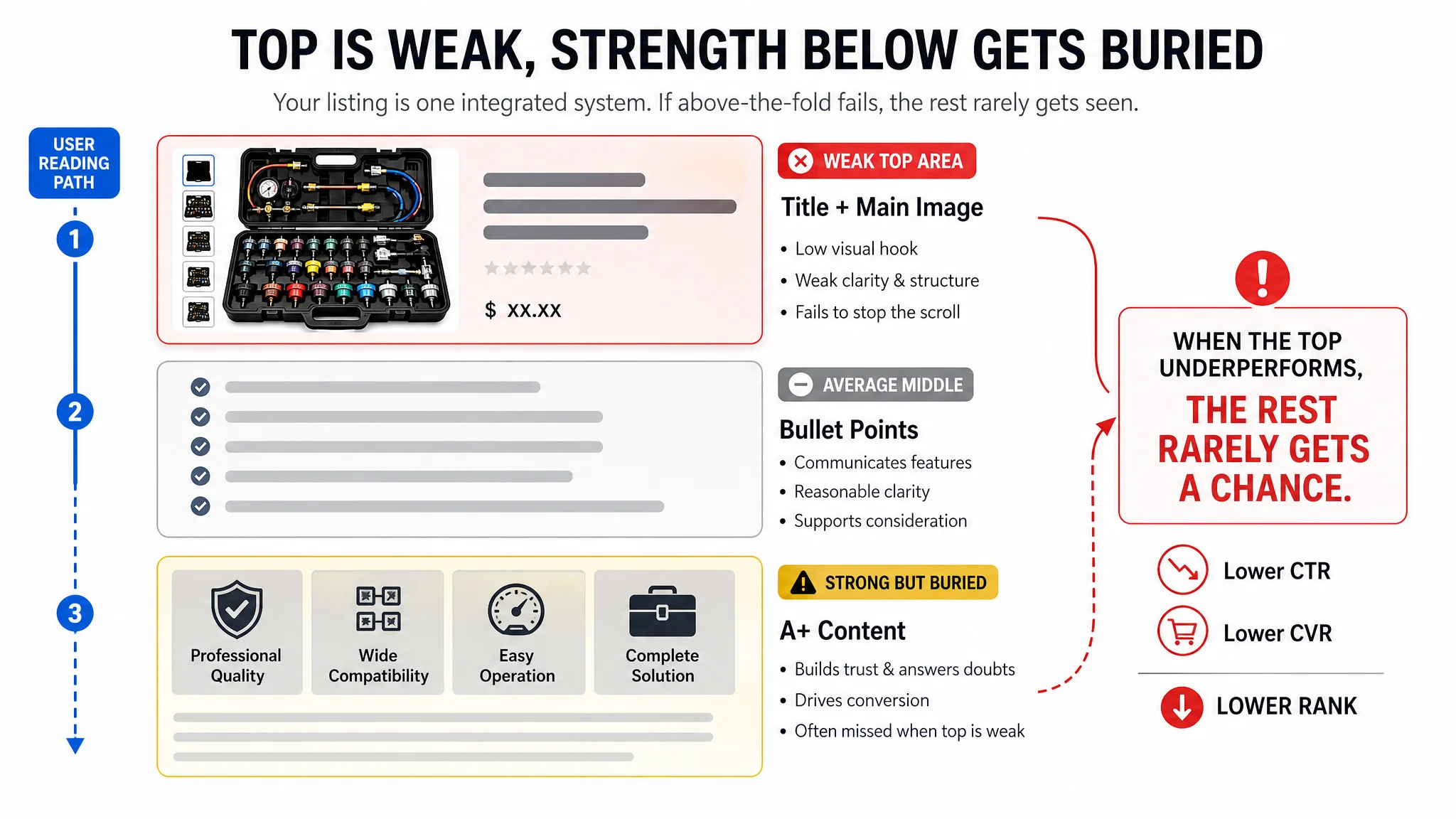
Competitive Landscape Shifts
Organic ranking is a relative measure, not an absolute score. Your product can lose ground even if you make no changes. A new competitor might enter the market with a more compelling offer, a lower price point, or a more effectively optimized listing, capturing market share and pushing your product down the search results page. Furthermore, existing competitors may be continuously improving their listings, widening the gap between their performance and yours. A common strategic error is "misaligned benchmarking"—comparing your product only to the top bestseller without accounting for differences in features or price. This can mask the real threat from closer, more direct competitors who are eroding your rank.
The automotive tools seller unconsciously fell into this trap. Internally, they believed their page looked “professional enough” based on generic category browsing and their own sense of design. But when DeepBI aligned them with a highly relevant benchmark—similar price level, similar feature set, validated demand—the real gap surfaced: an overall listing score several points lower, with deficits concentrated in high-impact areas. The competitor wasn’t necessarily the category’s absolute bestseller; it was the most realistic “mirror image” of their own product. That mirror revealed that while the seller was iterating ad tactics week after week, the competitor had quietly built a listing that answered the category’s key questions—professional grade, compatibility, completeness—more directly.
From an algorithm perspective, it doesn’t matter that you are “better than average” if the buyer’s actual choice set is between you and that specific, better-optimized competitor. Organic rank moves according to those real competitive matchups, not to your internal perception of quality.
Advertising Strategy Impact
Paid and organic performance on Amazon are deeply intertwined. An inefficient advertising strategy can actively harm your organic rank. For example, driving paid traffic to a poorly optimized listing with a low CVR sends negative signals to the algorithm, indicating your product doesn't satisfy customer intent. Conversely, a reduction in ad spend can decrease your overall sales velocity, which is a key factor in the ranking algorithm. A successful strategy uses advertising data to create a positive feedback loop: insights from high-performing ad campaigns should be used to strengthen your listing's organic appeal, ensuring that your ad spend not only generates immediate sales but also builds the long-term authority needed for top organic placement.
In the radiator tester scenario, the seller’s default assumption was “ads are failing us,” so the team kept tightening and reshuffling campaigns. However, when performance data was viewed alongside listing diagnostics, a different picture became clear:
- Impressions were acceptable; certain search terms were consistently driving traffic.
- Spend was rising, but because the listing converted worse than a key category competitor, orders did not grow proportionally.
- The net effect was high ACOS and weak contribution to organic signals, even though the ad engine itself was functioning.
Continuing to force more paid traffic through an underperforming detail page would only deepen the pattern: more clicks leading to the same or worse CVR, reinforcing to Amazon that this ASIN is a weaker answer for those queries. Once the listing’s conversion factors were reworked—title clarified, visual story rebuilt around “complete, professional, compatible solution”—the same ad impressions had a better chance of creating sales velocity and feeding positive data back into organic ranking.
The lesson is that advertising strategy cannot be evaluated in isolation. When ACOS stalls or rises, it’s crucial to ask whether the “strategy problem” is really rooted in campaign configuration, or in a page that is not structurally capable of converting the traffic being bought.
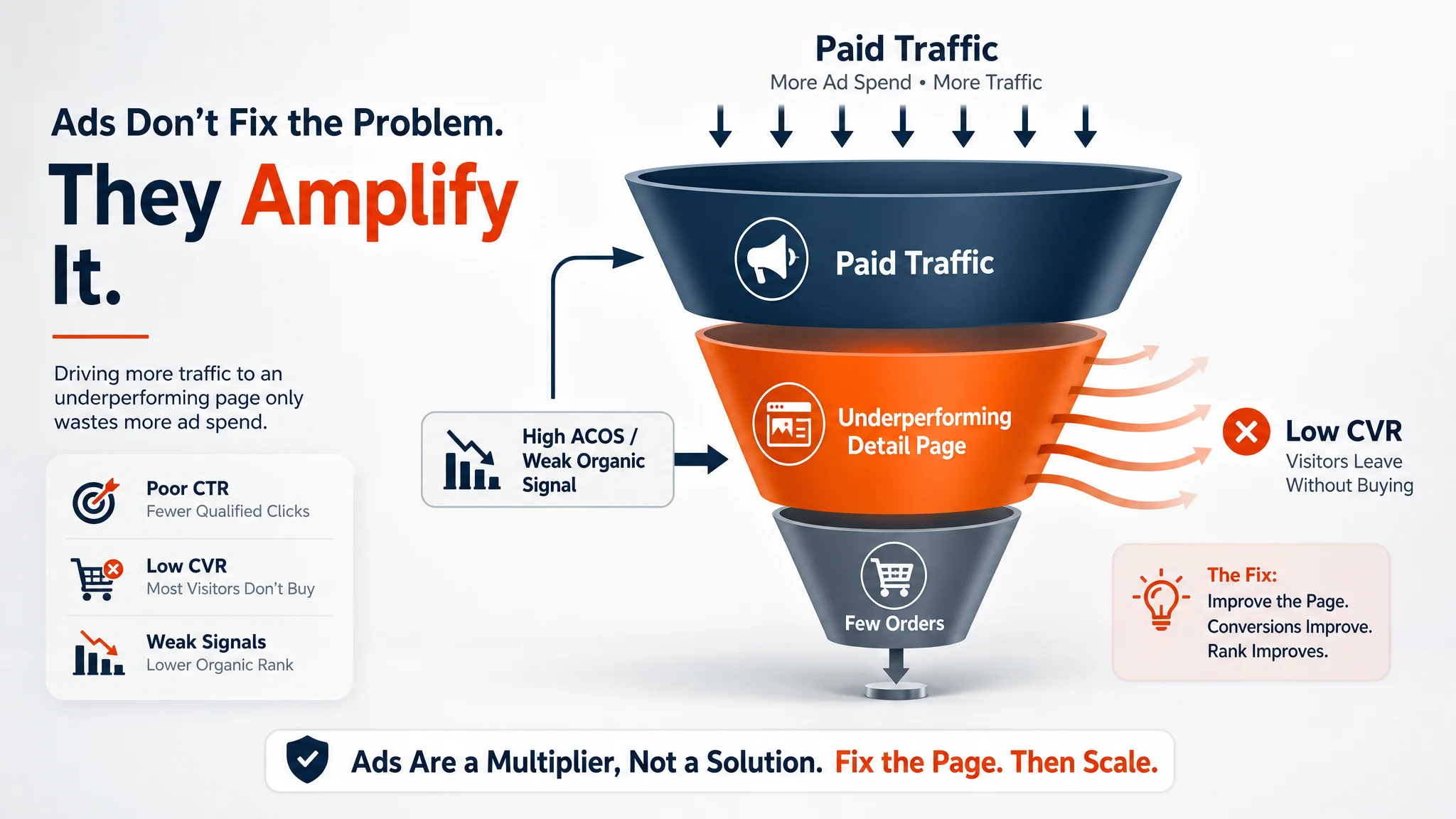
Amazon Algorithm Updates
Finally, a rank decline can be caused by factors outside of your direct control: changes to Amazon's A9 search algorithm. Amazon constantly refines its algorithm to improve the shopping experience. These updates can alter the weight of various ranking factors, such as sales history, conversion rate, keyword placement, or even the influence of certain listing features. A sudden, widespread drop in rankings that isn't explained by competitive action or internal performance metrics may indicate an algorithm shift. This requires sellers to stay vigilant, analyze performance changes, and adapt their optimization strategies to align with the new ranking logic.
Even in such cases, the radiator kit example underlines an important principle: when the platform starts emphasizing “better shopping experiences,” the listings that are most insulated are those that already convert efficiently and communicate trust clearly. While you cannot control algorithm tweaks, you can control how tightly your listing aligns with buyer intent. Structurally strong pages—those that make compatibility, completeness, and professional credibility obvious—are more resilient to changes in ranking logic than pages that rely on aggressive ads and vague content to stay afloat.
DeepBI's AI-Powered Diagnostic Framework for Organic Recovery
Effective recovery from an organic rank decline begins with an accurate diagnosis. Instead of providing a simple score, DeepBI functions as an automated market health check system, establishing a clear "data evidence chain" to uncover the root causes of underperformance. This framework moves beyond surface-level metrics to deliver a detailed battle map for strategic optimization.
Comprehensive Data Collection and Analysis
To understand why a product's rank is falling, you must first see the entire competitive landscape. DeepBI initiates its diagnostic process by deploying a distributed crawling matrix to capture real-time global market data from Amazon. It systematically gathers and processes vast amounts of information, including competitor sales data, listing content, and user feedback (VoC). Crucially, the system cross-validates these external market signals with your internal business metrics—such as impressions, Click-Through Rate (CTR), and Conversion Rate (CVR)—by connecting to your authorized Seller Central account. This integrated approach directly links observable market shifts to tangible impacts on your key performance indicators.
In the radiator tester case, this integration was decisive. On one side were the seller’s internal reports: impressions, spend, and ACOS trends that seemed to indict the ad setup. On the other side, DeepBI overlaid external signals: how competing ASINs in the same niche were structured, what their visual and semantic strengths were, and how buyers responded to different listing patterns. When those two data streams were combined, it became apparent that ads were successfully driving traffic; the relative weakness lay in how that traffic behaved once it hit the page compared with a benchmark listing. Without tying marketplace context back to Seller Central metrics, the team would have continued to see only “rising ACOS,” not “a listing conversion deficit relative to your most relevant competitor.”
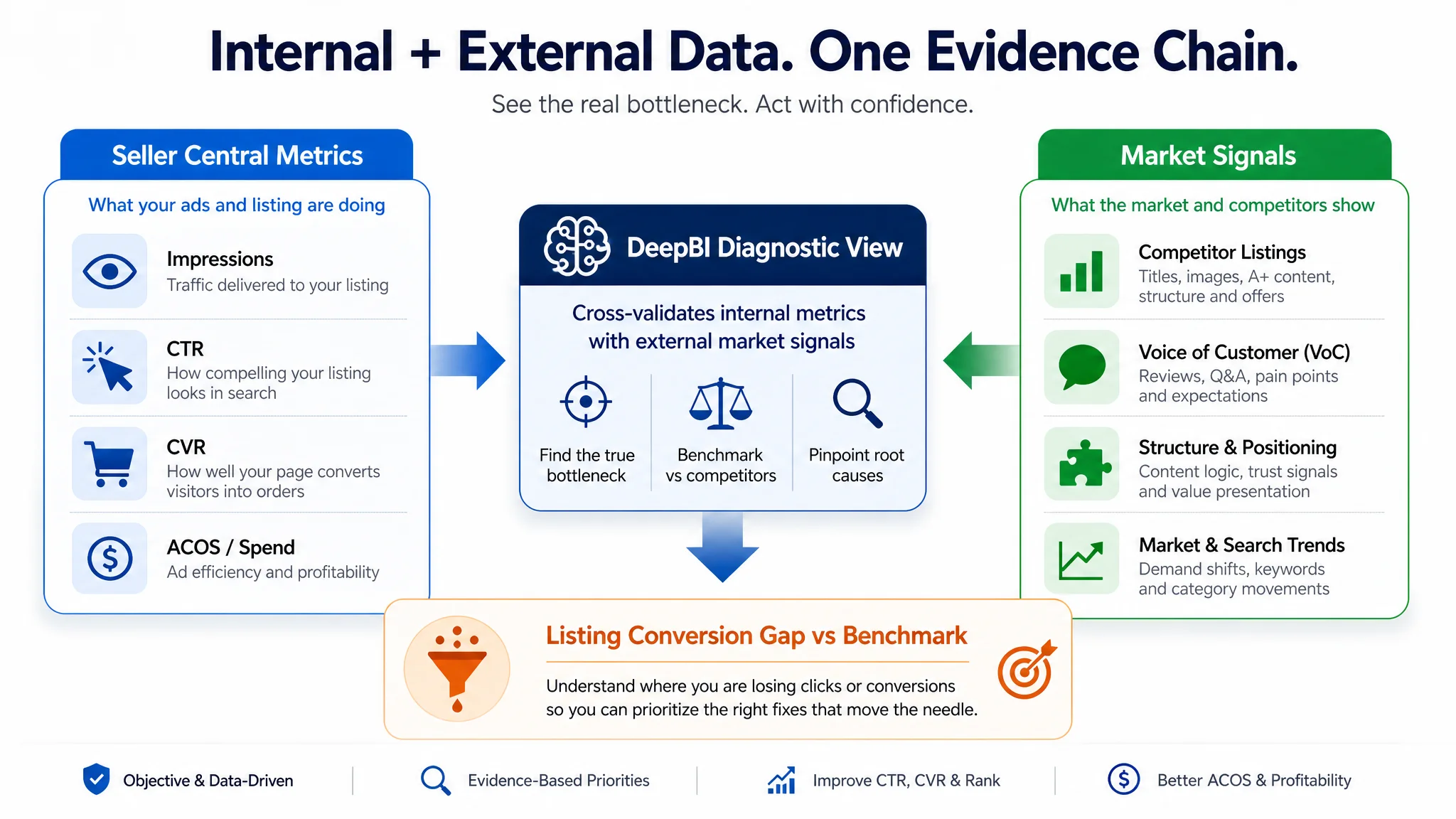
Identifying Underperforming Keywords and ASINs
A declining Best Sellers Rank (BSR) is a symptom, not a cause. Actionable insights require knowing precisely where you are losing ground. DeepBI uses advanced semantic analysis to reverse-engineer your product's title and bullet points, extracting the core search terms that simulate real buyer behavior. By analyzing search results for these specific keywords, the platform pinpoints exactly where your product has lost visibility and, more importantly, identifies the specific competitor ASINs that are now outranking you. This transforms a vague problem like "low traffic" into a concrete list of keywords to reclaim and competitors to analyze.
Applied to the radiator pressure tester, this meant moving from “our category seems expensive to advertise in” to “for queries like ‘radiator pressure tester kit’ and related terms, this particular competitor now sets the standard your listing is failing to meet.” Once that ASIN was identified, it was possible to compare performance drivers side by side—title construction, image strategy, A+ structure—rather than guessing at abstract causes. The underperformance wasn’t spread evenly across all keywords; it clustered around specific intent phrases where the competitor’s listing delivered a clearer, more reassuring answer.
By surfacing those exact matchups, DeepBI turned an unfocused anxiety about rank and ACOS into a defined target: “these keywords, versus that listing, are where we’re losing organic visibility.”
Benchmarking Against Top Competitors
Optimization efforts detached from real market benchmarks are a waste of resources. To guide effective changes, DeepBI automatically identifies a single, high-relevance "Benchmark ASIN" to serve as a data-driven standard for comparison. The system’s core competency lies in its multi-dimensional semantic benchmarking algorithm, which goes beyond simple keyword matching. It uses feature vector analysis to assess both the "visual template" and "semantic function" of potential competitors, ensuring the benchmark is a true market equivalent. This process filters out irrelevant products with different price points or insufficient market validation, allowing you to see the "real gap" between your listing and a top performer in your specific niche.
For the radiator tester, this process revealed a benchmark with an overall listing score roughly a full grade higher, not because of massive differences in reviews or bullet completeness, but because of stronger execution in three pivotal areas: main image strategy, title clarity, and A+ trust construction. That single comparison carried a lot of operational weight:
- It showed that the seller’s bullets were actually competitive, reducing the temptation to rewrite everything.
- It isolated the true levers—visual trust, compatibility communication, and above-the-fold clarity—that needed to be improved to close the gap.
- It reframed the problem away from “maybe our product is just hard to sell” toward “our listing format is less aligned with buyer expectations than our closest competitor.”
Benchmarking in this way prevents teams from optimizing in the dark or chasing aesthetics for their own sake. It anchors every proposed change in a clear competitive reality: “this is how a high-performing equivalent listing structures information and visuals, and here is where you currently fall short.”
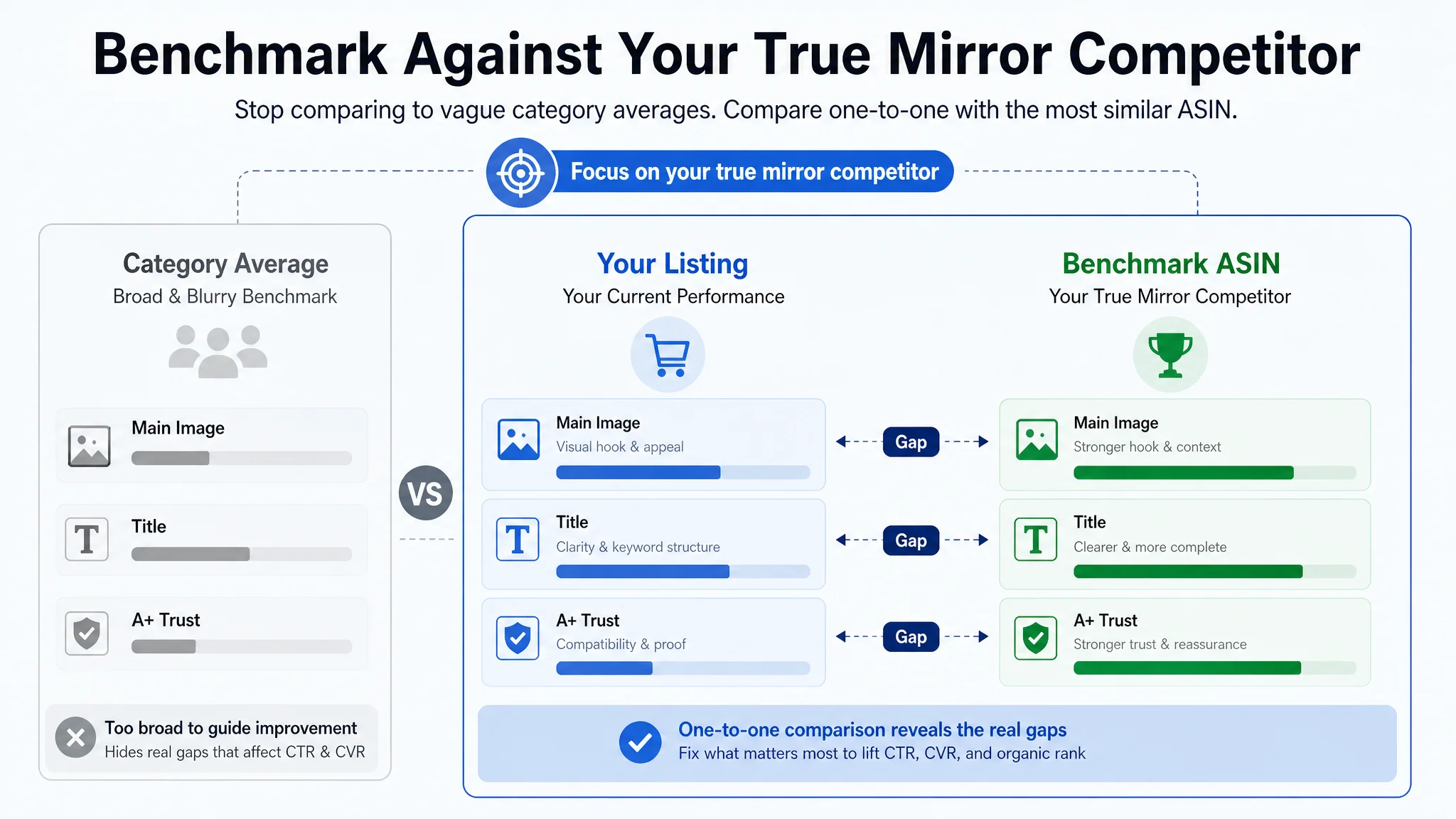
Strategic Solutions with DeepBI for Recovery and Growth
Once a performance decline is diagnosed, the path to recovery requires a multi-faceted strategy that addresses the root causes. DeepBI provides a suite of tools designed not just to identify problems but to generate and execute data-driven solutions that rebuild and grow organic rank.
Optimizing Listing Content for Organic Relevance
Effective listing optimization moves beyond guesswork. DeepBI initiates this process with an intelligent scoring module that audits your listing across five critical dimensions: main image visuals, title structure, bullet point logic, A+ content, and customer feedback. The system then employs a “multi-dimensional semantic benchmarking algorithm” to identify your most relevant market competitor, generating a "competitiveness radar chart" that visually exposes your listing's core weaknesses.
Instead of offering vague advice like "improve the main image," DeepBI translates these diagnostic insights into precise, engineering-like instructions. For example, a low CTR might result in a directive to change the composition to a "centered symmetrical" layout or to add a "visual diagram of the technical principle" to enhance clarity, directly targeting conversion and click-through rates.
In the radiator tester optimization, this approach played out very concretely. The system did not simply flag “images need work.” It surfaced that:
- The primary image should shift from a flat top-down layout to a 45° angled view of the open case, set in a workshop context, with a concise text call-out like “28 PIECE KIT” to immediately signal completeness.
- One secondary image needed to act as a “functional explainer,” labeling key components of the vacuum system and showing it connected to an actual radiator, so a technician could understand usage in one glance.
- Another image had to become a compatibility matrix, grouping adapters by vehicle brands and visually answering “Is my car covered?” without forcing users to parse dense text.
- Close-up shots of the gauge and connectors should emphasize professional-grade quality and precision, replacing generic, low-context visuals that did little to build trust.
On the text side, DeepBI’s guidance focused on restructuring rather than simply adding more words. The title was reframed so that “28PCS” and “universal” appeared prominently up front, with the core function (“radiator pressure tester kit” and “vacuum type cooling system purge and refill”) and compatibility scope (“domestic and import vehicles, motorcycles”) clearly sequenced. This made the same keyword set more legible both to buyers and the algorithm, improving relevance and click appeal simultaneously.
By tying each instruction back to a specific deficit versus the benchmark (e.g., weaker professional impression, unclear compatibility), listing optimization became a precise response to measured gaps instead of a creativity exercise.
Refining Advertising to Boost Organic Rank
Advertising and organic rank are deeply interconnected. DeepBI leverages this synergy by integrating with your advertising reports to analyze clicks, conversions, and ACoS. This process uncovers your "high-conversion search terms"—the keywords that are already proving effective at driving sales.
The system then creates a powerful feedback loop. These winning terms are assigned a "Keyword Weight" that directly influences visual optimization. If ad data shows that a term like "fast charging" has a high conversion rate, the image generation engine will visually emphasize that feature. This strategy of aligning your listing content with proven ad performance attracts more qualified traffic, boosts conversion rates, and signals increased relevance to Amazon's algorithm, ultimately strengthening long-term organic rank and improving TACoS.
The radiator tester case shows the consequences when this loop is absent. Initially, the seller treated ad data and listing content as separate worlds: campaigns were tuned on their own, while the page remained largely unchanged because “we already explained the product.” As a result, the same terms that were bringing in interested traffic—keywords tied to vacuum refilling, leak testing, and system compatibility—were not clearly reflected or reinforced in the visual story. Buyers clicked, then had to work too hard to see how the kit solved those specific problems and whether it fit their vehicles, leading to drop-offs and stubbornly high ACOS.
Once the listing was restructured with compatibility matrices, step-by-step operational visuals, and a solution-oriented title, the ad side finally had a solid conversion environment to land on. In that state, future advertising optimizations could become truly data-driven: high-performing search terms could be echoed in images and A+ panels, while underperforming terms could be deprioritized or removed. Instead of blaming “expensive traffic,” the team could see how ad insights and listing adjustments should reinforce each other to build both paid and organic strength.
Enhancing Overall Product Competitiveness
A product's market appeal extends beyond its listing content. DeepBI incorporates this reality through its "Voice of Customer (VoC) Insight Agent," which analyzes star ratings and review sentiment. This data is fed back into the listing's overall quality score, ensuring that optimizations are aligned with what customers value and complain about.
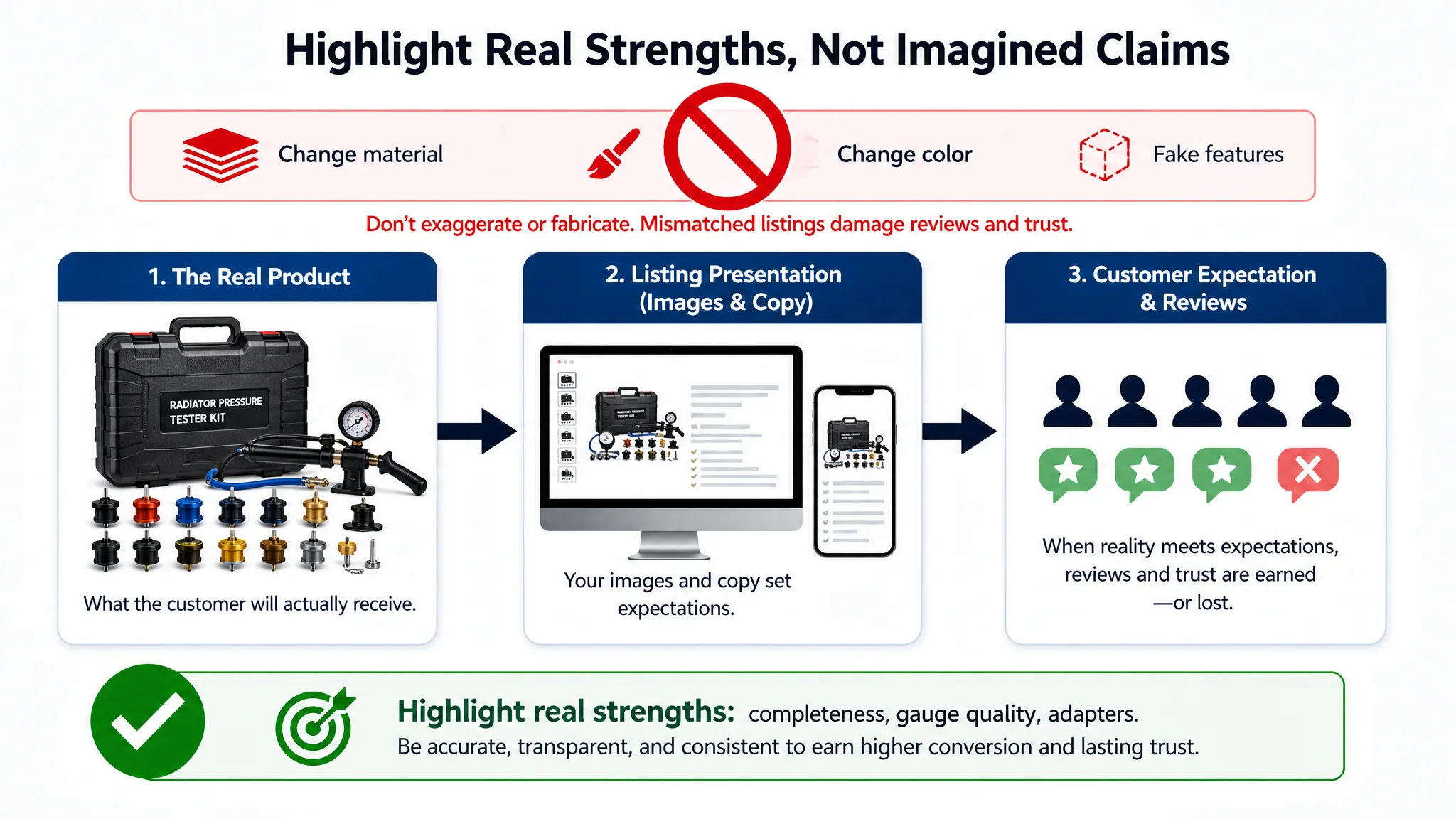
Furthermore, while the system does not directly manage pricing or inventory, it uses these factors as critical filters when selecting benchmark competitors, ensuring that all strategic comparisons are grounded in market reality. Crucially, every optimization is governed by the "product entity consistency" principle. This strict constraint prohibits AI from altering a product's material, color, or design, ensuring all generated visuals are authentic and mitigating the risk of damaging negative reviews caused by an "image-product mismatch."
In the radiator kit project, this principle was essential. The goal was not to “beautify” the product into something it wasn’t, but to present its real strengths—completeness of the kit, professional-grade gauge, variety of adapters—in a way that directly addressed recurring buyer concerns around compatibility and ease of use. Reviews in similar categories often revolve around “does it fit my car?” and “is it durable enough for repeated use?” DeepBI’s recommendations focused on making those answers obvious in the visuals and structure of the content, without suggesting any changes to the underlying product specs.
By doing so, the listing became more competitive not because reality changed, but because the page finally aligned its messaging with the product’s true value proposition and the category’s decision drivers. That alignment is what ultimately supports both better conversion and more stable organic rank.
Implementing and Monitoring Your Organic Recovery with DeepBI
After diagnosing the root causes of a rank decline, the next step is to execute a targeted recovery plan and measure its impact. DeepBI transforms this process from a series of disconnected manual tasks into a streamlined, data-driven workflow, turning your diagnostic insights into direct action on your listings.
Executing Data-Driven Optimization Strategies
DeepBI closes the loop between analysis and execution. Once you have approved the AI-generated titles, bullet points, or images, the system allows for one-click application directly to your Amazon listings via the SP-API. This automated delivery mechanism replaces the traditional, error-prone manual process of downloading assets, renaming files, and uploading them one-by-one through the Seller Central backend. What previously took dozens of minutes is reduced to seconds, dramatically shortening your listing optimization cycle time and minimizing account security risks associated with manual backend access. The system functions as an execution center, not just an analysis tool.
For a team like the radiator tester seller, whose initial instinct was to tweak ads weekly while leaving the listing mostly static, this kind of execution speed changes the operational rhythm. Instead of spending their bandwidth repeatedly restructuring campaigns to fight high ACOS on an unchanged page, they could:
- Approve a restructured title and image set that directly responded to benchmark gaps.
- Push those changes live quickly through API delivery, avoiding backend friction.
- Free up internal effort to interpret results and plan the next iteration rather than manually uploading assets.
By tightening the loop from “diagnosis → decision → deployment,” listing optimization becomes an active, ongoing lever rather than a rare, high-friction project.
Tracking Key Performance Indicators (KPIs)
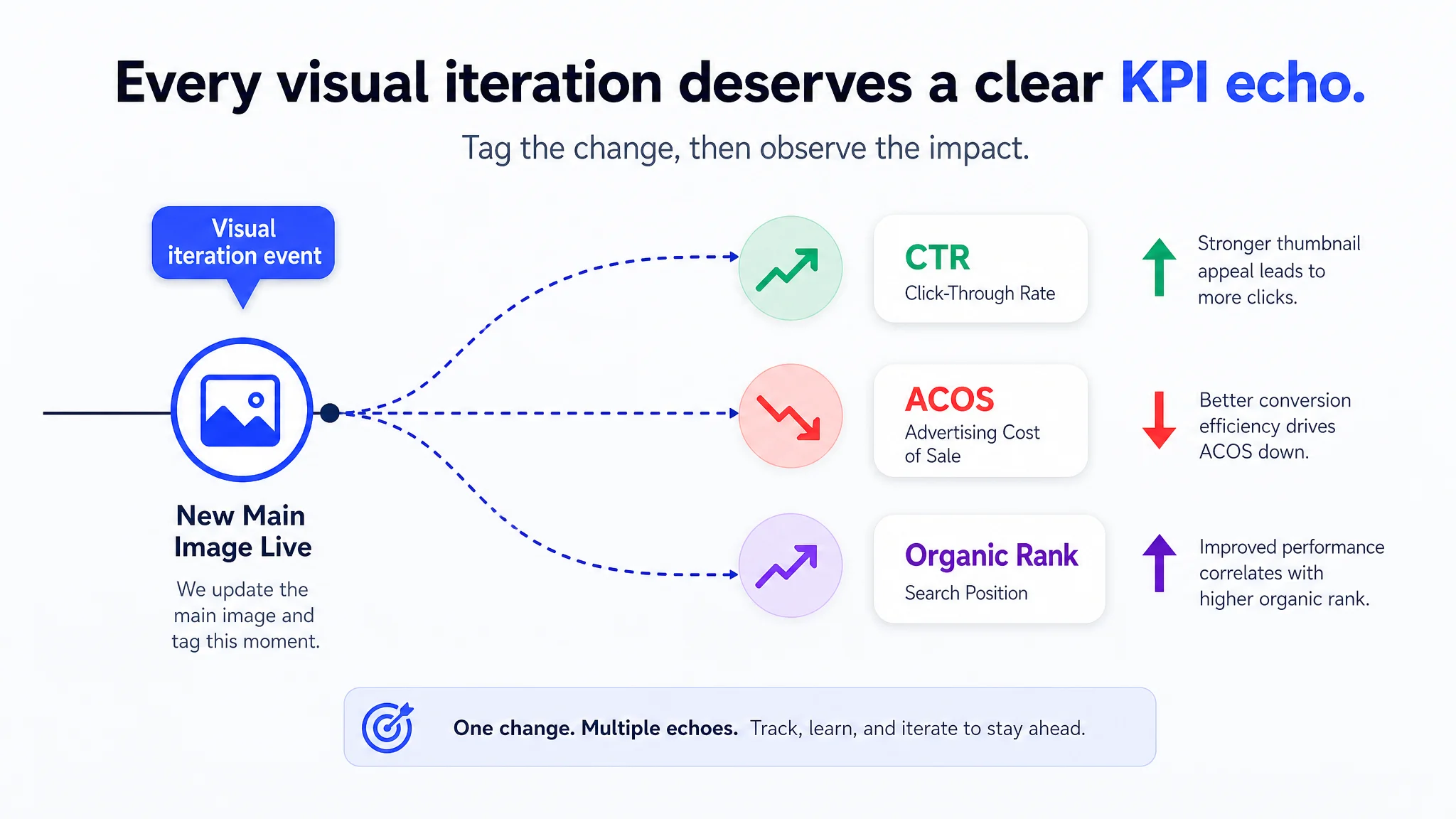
To validate your optimization efforts, you must track the right metrics. The primary goal is to see an improvement in organic rank, leading to increased organic sales and a healthier share of natural orders. DeepBI provides a crucial link for this analysis. When a listing change, such as a new main image, is successfully published via the API, the system automatically tags this "visual iteration event" in your advertising reports. This allows you to directly observe the impact of the optimization on key ad metrics like Click-Through Rate (CTR) and Total Advertising Cost of Sales (TACOS) in the subsequent days, quantifying the return on your optimization efforts.
In the context of a seller struggling with high ACOS, this level of traceability is especially valuable. Instead of guessing whether a refreshed image set or reworked title “probably helped,” you can see:
- How CTR from sponsored placements changed immediately after the new main image went live.
- Whether the improved compatibility visuals and clearer solution framing translated into better CVR and lower ACOS for the same keyword set.
- How these ad-side improvements correlated with changes in organic rank for core search terms over time.
For the radiator tester listing, this kind of tagged iteration would let the team separate “ad optimization effects” from “listing repair effects,” reinforcing the insight that ad campaigns were never the sole culprit. Over time, this evidence helps shift internal decision-making away from blaming traffic sources and toward systematically improving the page’s ability to convert.
Continuous Iteration and Adaptation
Recovering and maintaining organic rank is not a one-off project; it is a continuous process of adaptation. The Amazon marketplace is dynamic, with competitor strategies and platform algorithms constantly evolving. DeepBI is built for this reality. The performance data gathered after each optimization—such as changes in CTR, Conversion Rate (CVR), and ACoS—feeds back into the system. This creates a closed-loop system where real-world results are used to refine future diagnostic scores and AI-generated recommendations, making the evolution of your listing a predictable and quantifiable scientific process. This enables you to consistently adapt and stay ahead of market shifts.
The radiator tester example highlights why this mindset matters. Even after the listing was strengthened, competitors are free to keep improving their own pages—adding clearer compatibility charts, refining imagery, or adjusting messaging based on fresh reviews. A single optimization round may restore competitiveness for a time, but without continued observation and periodic adjustment, the same “silent gap” can reopen.
By treating optimization as ongoing, sellers can:
- Regularly re-benchmark their listings against the most relevant ASINs.
- Identify new areas where competitors have pulled ahead, such as upgraded A+ modules or better structured titles.
- Prioritize micro-iterations—small, targeted tweaks to images or text—based on observed shifts in CTR, CVR, or rank.
This continuous loop helps ensure that the listing remains aligned with evolving buyer expectations and competitive standards, making organic performance more durable.
Conclusion: Sustaining Organic Growth on Amazon
Sustaining organic rank on Amazon is no longer a matter of subjective experience or occasional adjustments. The key to long-term success lies in adopting a proactive, data-driven approach that transforms listing optimization from a reactive task into a predictable, scientific process. This requires breaking the traditional disconnect between diagnosing a problem and executing a solution.
The radiator pressure tester case demonstrates how easily teams can misdiagnose the core issue. Faced with rising ACOS and flat orders, the seller assumed the problem lived in the ad account. Only when an objective diagnostic chain was established—scoring the listing, comparing it to a realistic benchmark, and linking those gaps to live CTR and CVR—did it become clear that the real constraint was on-page conversion capacity. Ads were not failing; the page was consuming the traffic.
DeepBI provides the essential framework for this modern strategy. By integrating diagnosis, planning, and execution into a unified algorithmic context, the system turns ambiguous operational challenges into a clear, data-supported evidence chain. This full-link approach ensures that every optimization—from keyword adjustments to image updates—is directly tied to measurable outcomes.
Ultimately, DeepBI functions as an intelligent decision-making engine for your business. It empowers sellers to move beyond guesswork and systematically engineer improvements that lead to definite gains in conversion rates, sustained advances in natural rank, and long-term, profitable brand growth on the Amazon marketplace. Most importantly, it helps you answer the critical question before pouring more money into traffic: “Does my page truly deserve more visitors—and can it convert them better than the competition?”