

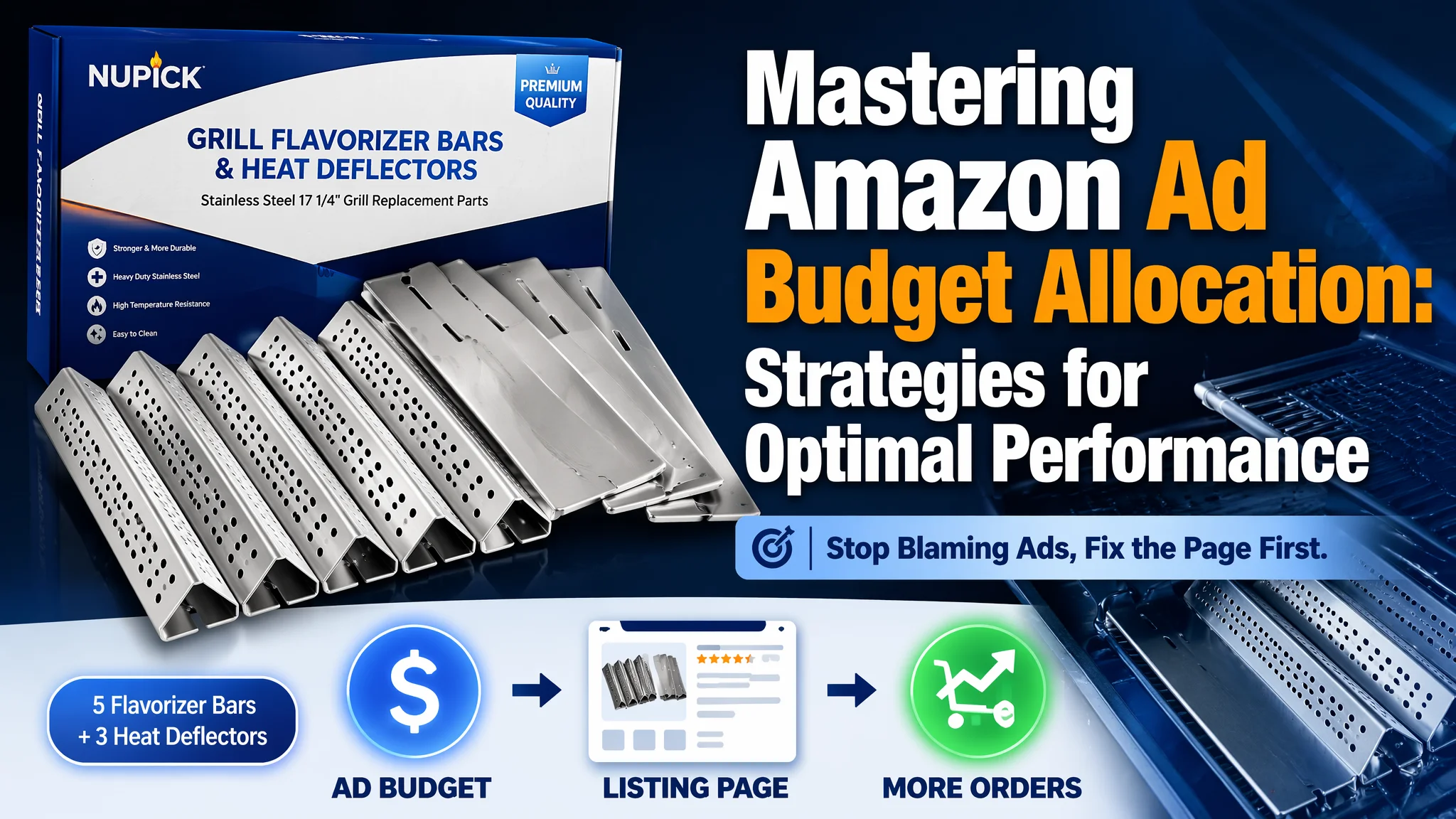
Why Strategic Amazon Ad Budgeting is Crucial
An Amazon advertising budget is not merely a spending limit; it is a critical component of your overall marketing strategy and a foundational tool for sustainable growth. Without a defined budget, ad spend becomes a reactive, unpredictable expense, making it impossible to forecast costs or plan for long-term business expansion. This lack of structure often leads to two equally damaging outcomes: uncontrolled overspending that inflates your ACoS and erodes profitability, or timid underspending that sacrifices sales velocity and surrenders market share to competitors.
In real operations, this “budget without strategy” problem often appears together with a second misjudgment: assuming that any pressure on ACoS is purely an “ad cost” issue. One grill-accessories seller on Amazon’s US marketplace offers a telling example. As their replacement Flavorizer Bar & heat-deflector kit faced rising ad costs and unstable orders, the team’s conclusion was simple: ads had gotten too expensive. They focused almost entirely on tweaking bids, keywords, and negative lists. Budget discussions revolved around how much more they could afford to “test,” not whether the traffic they were buying had any chance of converting efficiently in the first place.
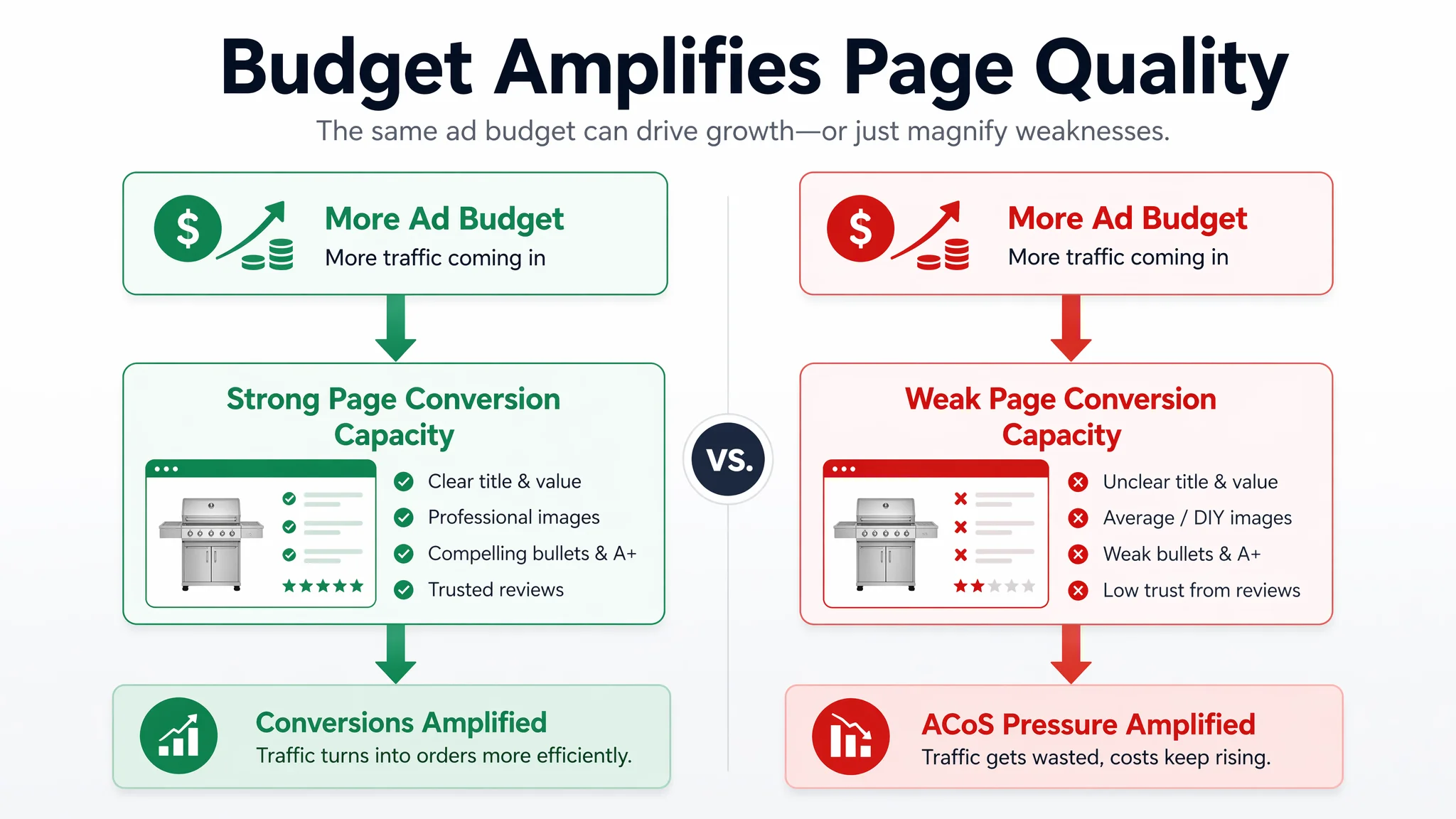
When DeepBI later reviewed their setup, the budget issue looked very different. The seller wasn’t just overspending; they were overspending on traffic that was being consumed by a structurally weak product page. Every extra dollar of budget was pushed through a listing that lacked trust, clarity, and persuasive structure compared to a benchmark leader in the same category. Their ad budget didn’t just fail to scale growth—it amplified the weaknesses of the listing and kept ACoS under constant pressure.
Establishing a strategic budget transforms advertising from a financial drain into a predictable investment. It provides the financial guardrails necessary to manage cash flow and align your advertising efforts with concrete business goals. The objective is not just to control costs, but to maximize the efficiency of every dollar spent.
Modern analytics platforms are essential for this process. They help you track ad spend against predefined goals and provide deep insights into budget utilization. By connecting your advertising data directly to performance metrics like CTR and CVR, these systems ensure your budget is actively working to improve your listings, lower your Total Advertising Cost of Sales (TACoS), and fuel a healthier, long-term growth flywheel. Just as in the grill-parts case, where DeepBI reframed the question from “How much can we afford to spend on ads?” to “Is the page itself strong enough to deserve more budget?”, the right tools help you see whether budget changes will actually move the needle—or simply fund inefficient traffic.
Understanding Amazon's Ad Budget Mechanisms
Mastering your Amazon ad spend begins with understanding how the platform manages your budget. While you set a daily budget, your actual spend on any given day can fluctuate. Amazon will not charge you more than your daily budget multiplied by the number of days in that month. For example, a $50 daily budget in a 30-day month will not exceed $1,500 in total charges for that campaign.
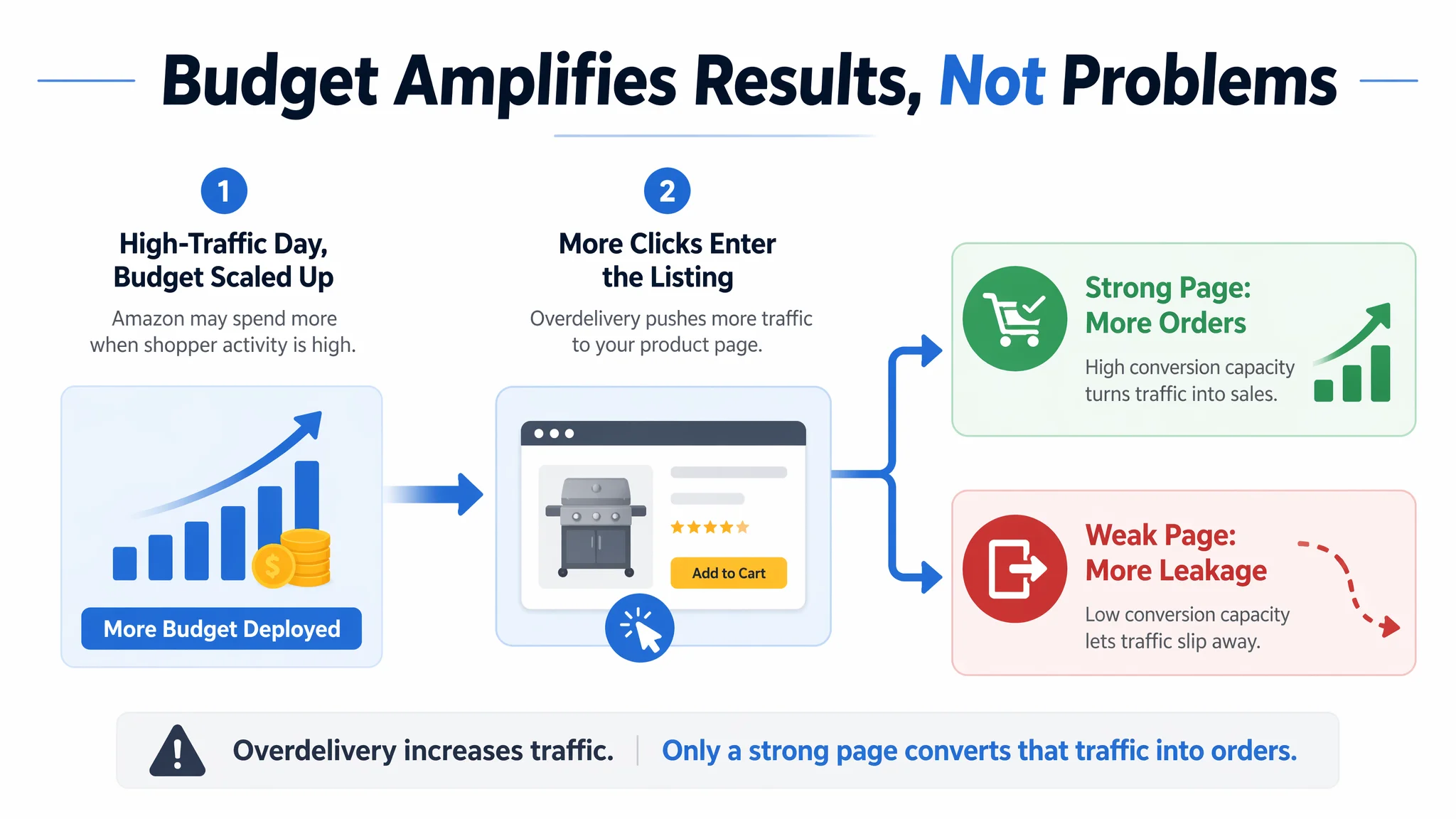
To capitalize on fluctuating traffic, Amazon uses a budget overdelivery mechanism. On days with high shopping activity and a greater chance for clicks and sales, Amazon may spend up to 100% more than your set daily budget. For instance, with a $50 daily budget, your spend could reach $100 on a peak day. This is balanced by spending less on low-traffic days, ensuring your monthly cap is respected. This flexibility helps maximize your visibility and sales opportunities when it matters most.
In practice, sellers often misunderstand what this flexibility does and doesn’t solve. In the grill-parts example, the seller watched spend spike on busy days, then dialed budget down when ACoS felt “out of control.” They assumed that if they could just smooth the daily spend—by capping budgets hard or switching campaigns on and off—the profitability problem would ease. But the underlying issue wasn’t when the money was spent; it was what kind of page the traffic landed on. Amazon’s overdelivery logic was doing its job: showing the ads more when shoppers were active. The waste arose because those extra impressions and clicks were flowing into a listing that simply couldn’t match the category leader’s conversion strength.
It's crucial to distinguish between your budget and your bid. Your budget is the maximum amount you're willing to spend over a period, controlling your total investment. Your bid is the amount you're willing to pay for a single click on your ad. These two levers work together: your bid determines your competitiveness in the ad auction, while your budget determines how long your campaign can remain active throughout the day. Setting a budget below Amazon's suggestion risks exhausting your funds early, causing you to miss out on valuable impressions and sales later in the day.
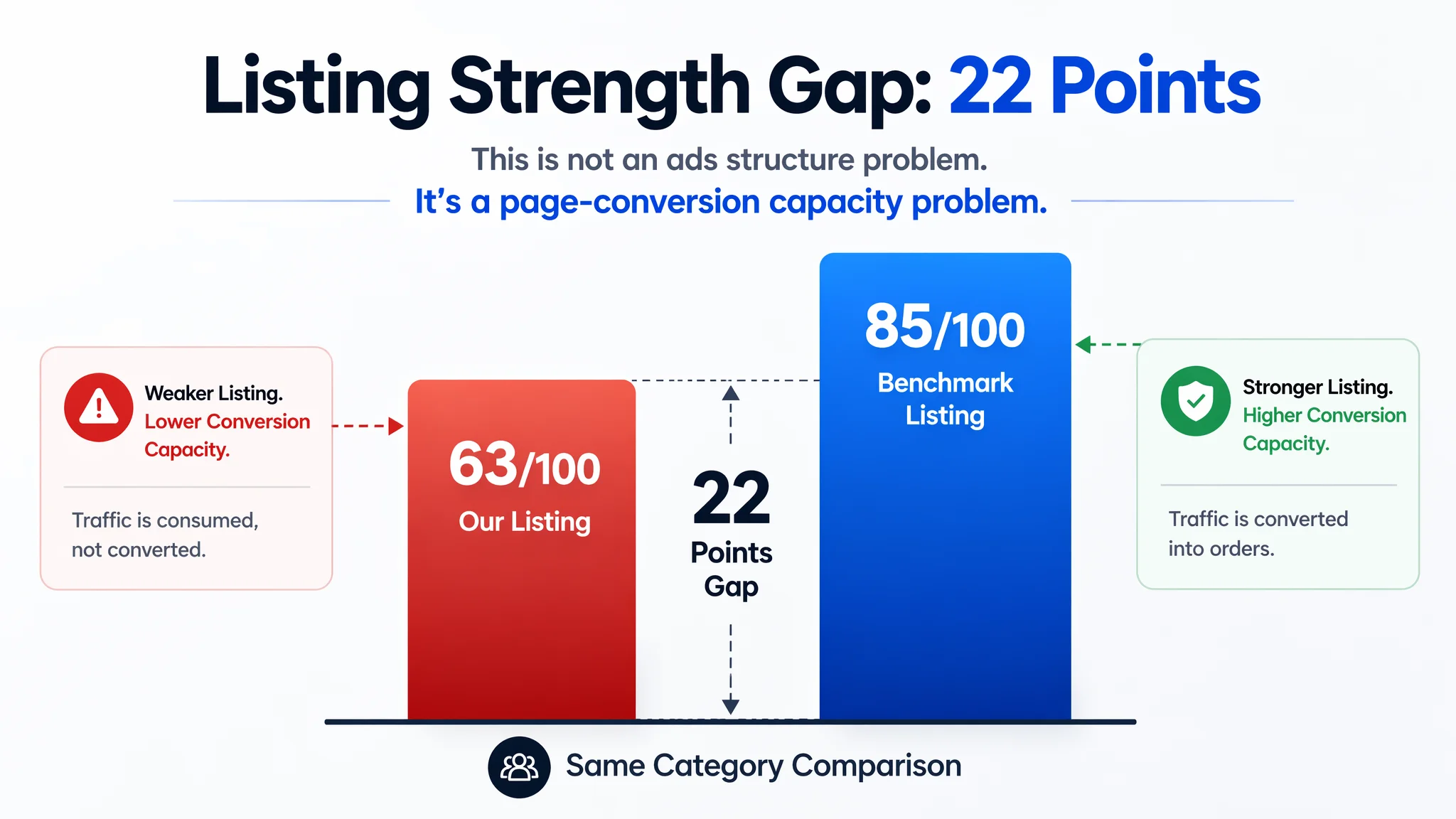
In the grill-accessories case, the team initially tried to solve rising ACoS by dropping bids and tightening budgets, expecting that more “efficient clicks” would fix the problem. However, when DeepBI benchmarked their listing against the category leader, it scored 63/100 versus 85/100—revealing a 22-point deficit spread across title, main images, bullets, A+ content, and reviews. Even if they had perfectly tuned bids to win cheaper clicks, the page itself still lacked the decision structure and trust depth needed to convert that traffic. The budget and bid controls were working technically, but they were feeding a conversion engine that was fundamentally weaker than the competition’s.
Manually adjusting these settings daily is inefficient. Advanced tools can automate this process. DeepBI’s dynamic parameter adjustment mechanism, for example, automatically optimizes bids and budgets daily based on performance metrics, ensuring your campaigns stay active and effectively capitalize on high-traffic periods. In the grill case, this kind of automation only became truly valuable after the listing was structurally improved; once the page could pull its weight, automated budget and bid tuning translated directly into more profitable traffic, rather than just more expensive experiments.
Data-Driven Approaches to Setting Your Amazon Ad Budget
Determining the right Amazon advertising budget is not a one-size-fits-all calculation. The optimal amount depends heavily on your brand’s maturity, your product's lifecycle stage, and your specific profit margins. For instance, a new product launch may require an aggressive initial budget focused on visibility, while a mature product might have a maintenance budget aimed at defending market share. Crucially, your break-even Advertising Cost of Sales (ACoS) sets the upper limit for sustainable spending, a figure directly impacted by Amazon’s referral and FBA fees.
A truly data-driven approach begins with a thorough review of past campaign performance. Instead of simply reallocating funds to what worked, analyze why certain campaigns underperformed. For example, consistently low Click-Through Rates (CTR), such as below 0.35%, often indicate a weak main image that fails to capture attention. Likewise, a low Conversion Rate (CVR), perhaps under 7%, suggests that your A+ content and product details are not effectively persuading shoppers who click your ad.
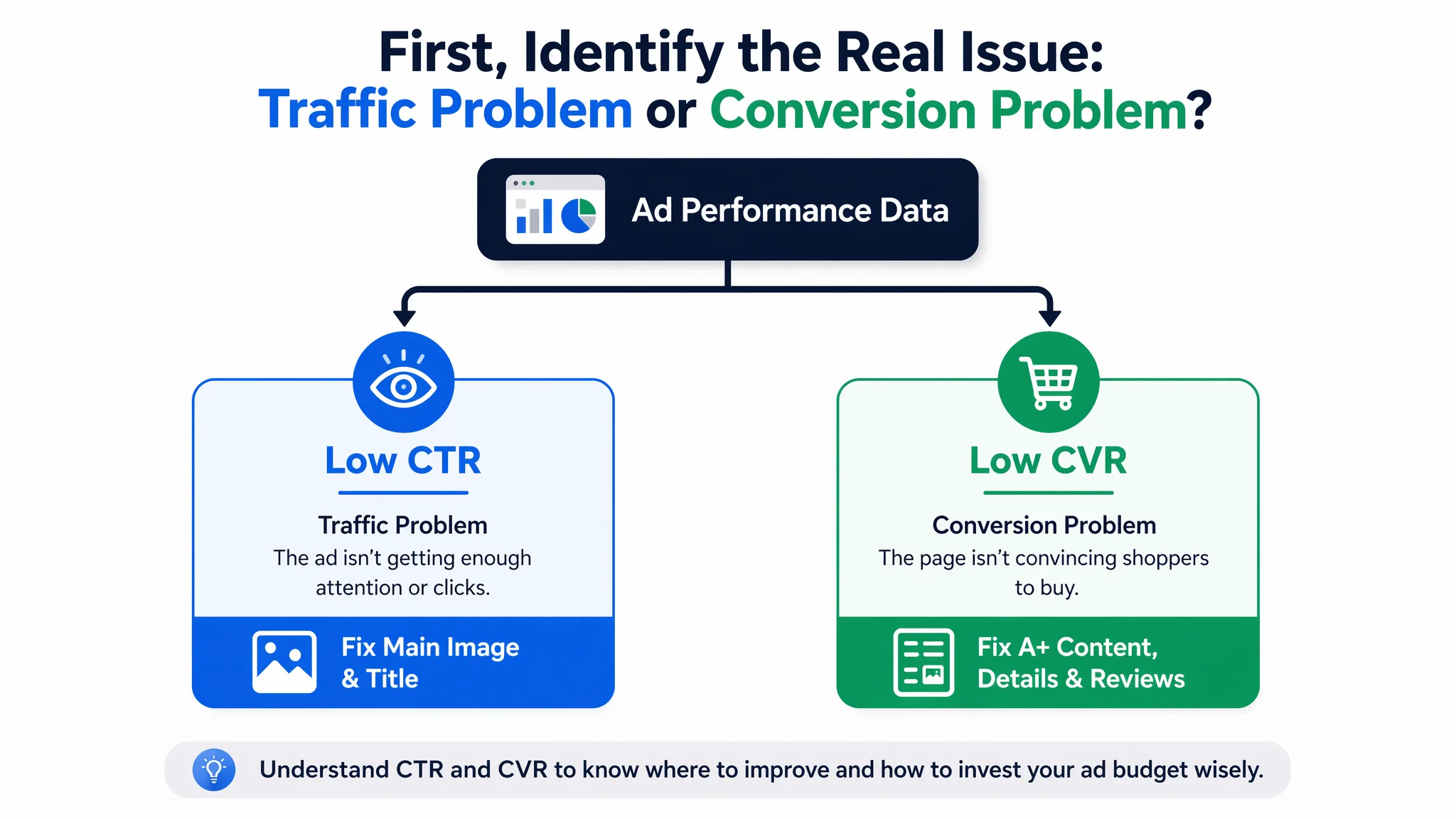
This distinction between “traffic problem” and “conversion problem” is where many teams misallocate budget. In the grill-accessories case, the seller interpreted high ACoS as a signal to pour more time and money into ad structure—more long-tail keywords, tighter negatives, re-grouped campaigns. On the surface, this looked like a data-driven response: they monitored ACoS, adjusted bids, and tracked spend. But when DeepBI applied its listing scoring and funnel analysis, the pattern was stark:
- The listing’s total score was 63/100 versus an 85/100 benchmark.
- The biggest gaps were not in discoverability alone, but in title clarity, A+ depth, and review trust.
- The main image set looked “DIY,” with background clutter and an almost “AI-ish” feel, while the benchmark used clean, industrial visuals, calipers, and in-grill shots that clearly signaled professional-grade quality.
In other words, the seller was treating ACoS as mainly a bidding issue, when in reality low conversion on a structurally weaker page was inflating ACoS. Their budget decisions—how much to allocate, and where—were being made without a clear view of the listing’s real conversion capacity.
This is where intelligent tools can provide a significant advantage. DeepBI’s system helps automate this diagnostic process. Its intelligent scoring module benchmarks your listing against top competitors, identifying specific weaknesses in visuals or text that are suppressing ad performance. In the grill case, this meant quantifying exactly how far behind the listing was on title logic (codes first, key terms buried), main images (no strong proof of fit or durability), bullets (parameters without a buying narrative), and A+ content (features listed but little visual proof or emotional context).
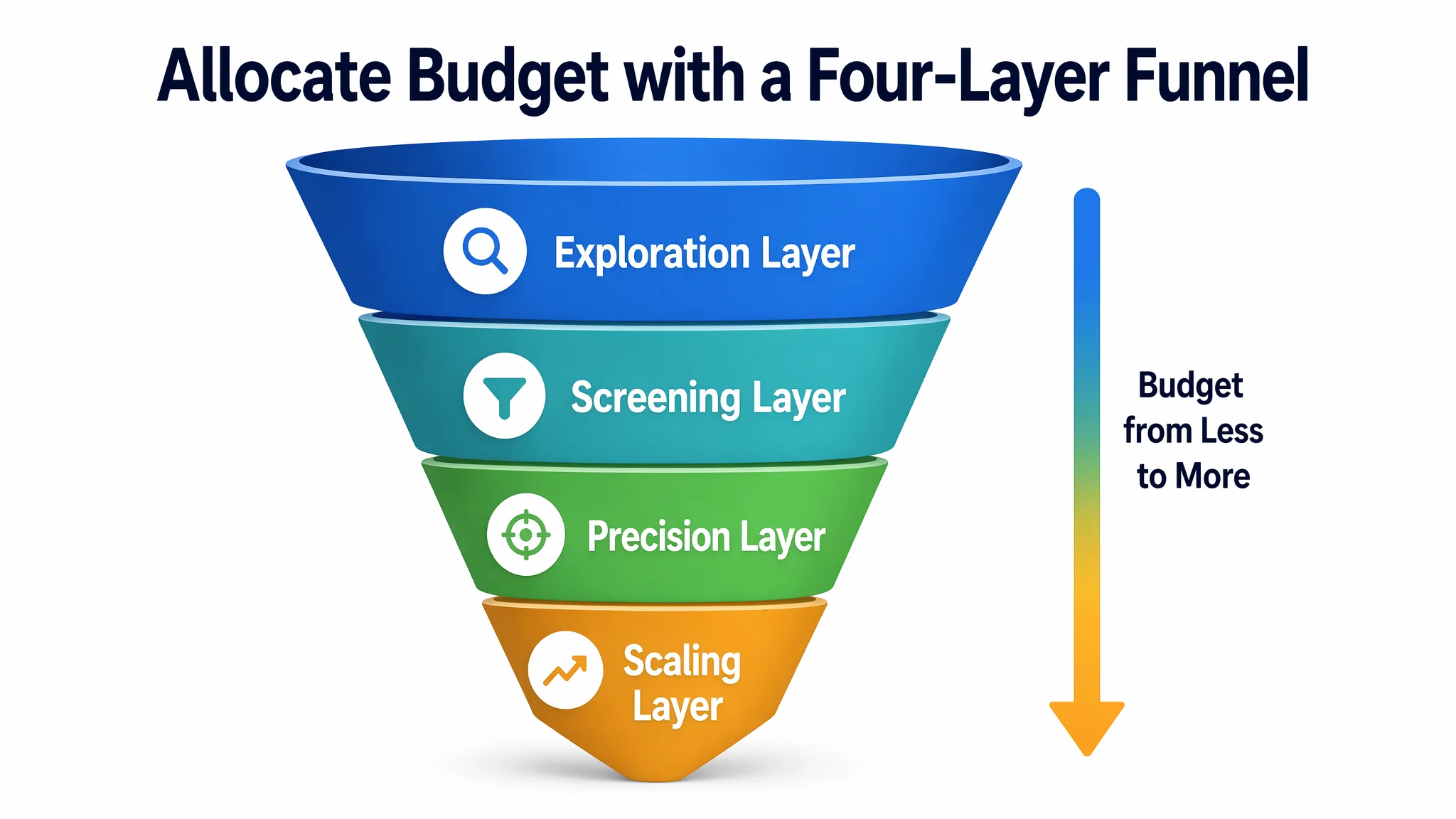
Furthermore, its four-layer funnel model guides budget allocation by systematically identifying high-potential keywords and ASINs for exploration, screening, precision targeting, and scaling. For the grill seller, once the listing was rebuilt around buyer logic—clear compatibility, material advantages, heat-distribution visuals, before/after imagery, and strengthened review strategy—budget could then be shifted confidently into the exploration and scaling layers. Clicks were no longer being funneled into a page that “looked” complete yet lacked persuasive depth; they were feeding a listing that could finally turn paid traffic into profitable orders.
By combining strategic budget allocation with data-driven listing optimization, you ensure that your ad spend is not just driving traffic, but converting it, maximizing your return and lowering your Total Advertising Cost of Sales (TACoS). The grill-parts example underlines this: until the page conversion bottleneck was addressed, no budget formula—aggressive or conservative—could deliver stable, sustainable performance.
Optimizing and Monitoring Your Amazon Ad Budget with DeepBI
Effective budget management goes beyond simply adjusting daily spend; it requires maximizing the return on every dollar. DeepBI achieves this by creating a powerful feedback loop between your advertising performance and your product listing's core strength. Instead of focusing solely on bid adjustments, the platform uses machine-learning models to analyze historical campaign data—including clicks, conversions, spend, and ACOS from the past seven days—to identify what truly drives sales.
This kind of feedback loop becomes especially valuable when you’re facing what looks like an “ad problem” but is actually a page problem. In the grill-accessories case, campaign data showed a familiar pattern: traffic wasn’t nonexistent, but orders were unstable and ACoS remained stubbornly high despite ongoing bid and keyword tweaks. DeepBI’s analysis made the hidden dynamic visible:
- Ads were bringing in visitors.
- Clickers weren’t converting at the rates seen in the benchmark listing.
- Review volume and sentiment were weaker, further suppressing conversion at the most visible trust layer.
By diagnosing that the listing’s conversion capacity—not traffic quantity—was the primary constraint, DeepBI helped the seller temporarily pause the “ads-first” mindset. Instead of continuing to tune budgets and bids on a weak foundation, the focus shifted to rebuilding title, images, bullets, A+, and review strategy so the page could justify additional ad investment.
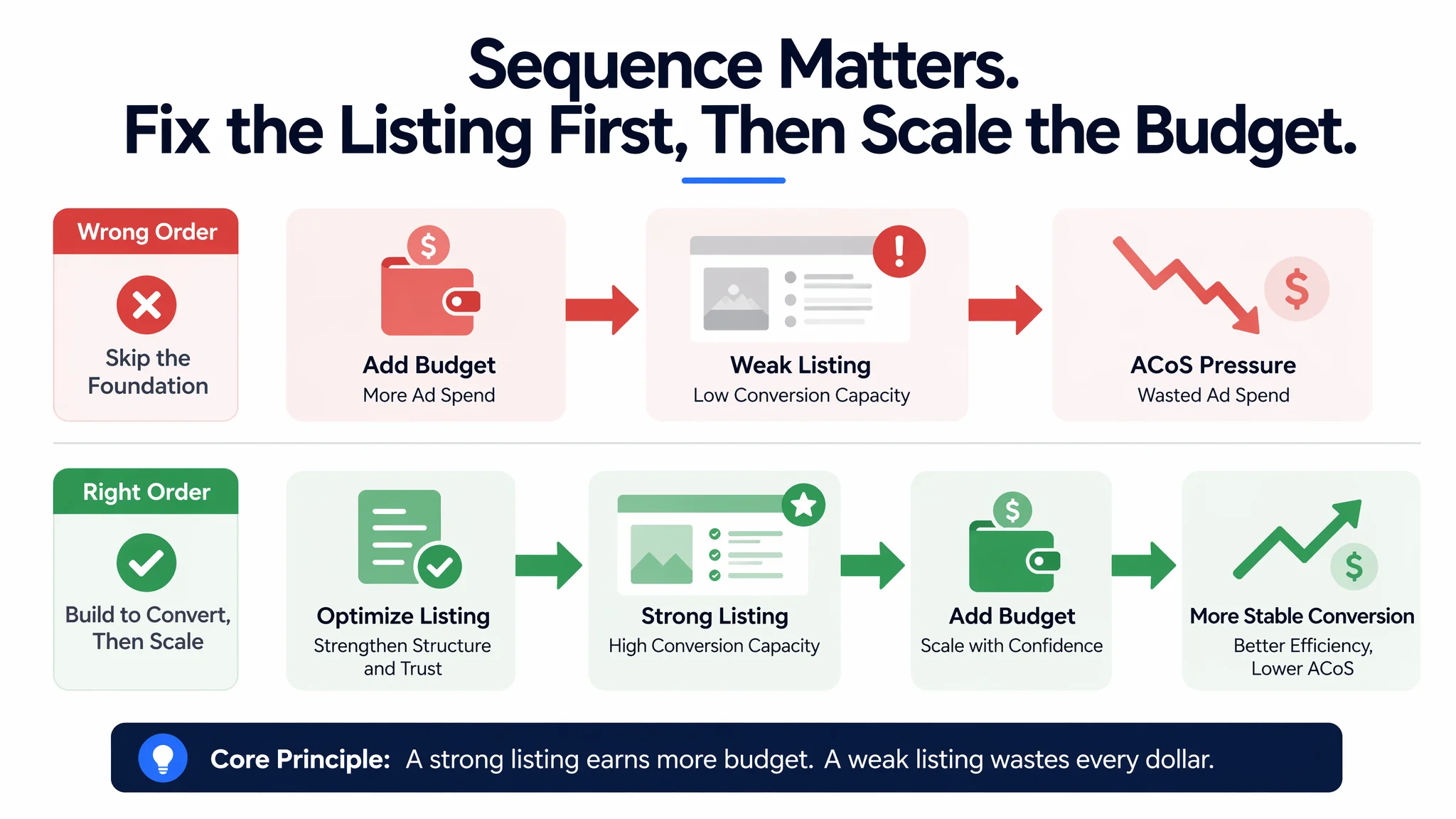
This data-driven approach transforms ad insights into actionable listing improvements. DeepBI identifies your high-converting "winning" keywords and uses them to guide the optimization of your titles and images. This enhances the listing's intrinsic appeal and conversion rate (CVR), which in turn improves ad performance. A better listing leads to a higher click-through rate (CTR) and lower Advertising Cost of Sales (ACoS), making your ad spend more efficient without constant manual intervention, especially during high-traffic periods.
For the grill seller, this meant:
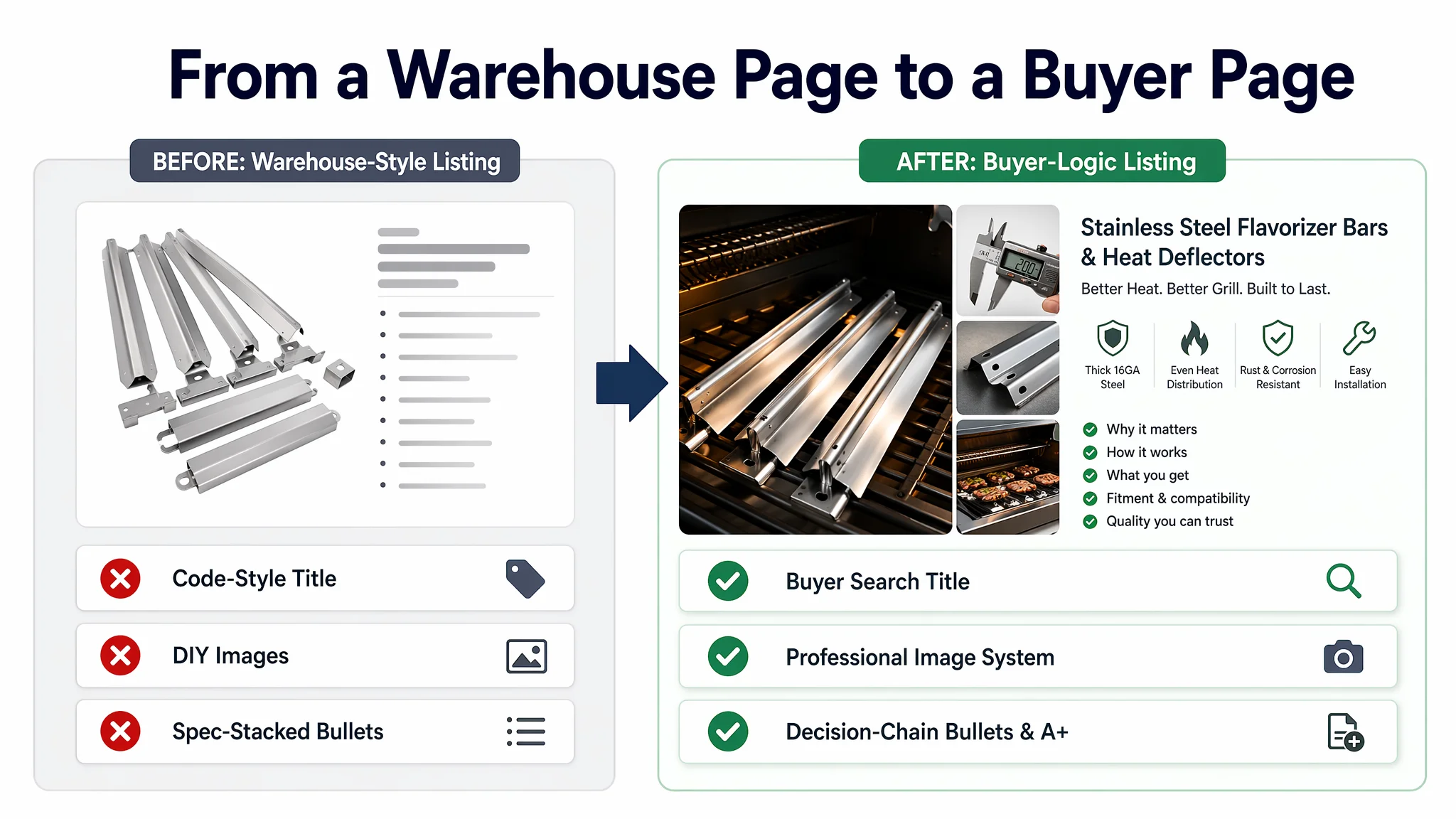
- Rewriting the title from a part-number-heavy “warehouse label” into a buyer-centric structure: clear category term (“Flavorizer Bars & Heat Deflectors”), compatibility, material, and size.
- Rebuilding the main image set into a professional system: hero image with packaging, in-grill installation photos, heat-distribution visuals, and caliper shots that signaled engineered thickness and durability.
- Restructuring bullets from loosely organized parameters into a narrative: fit and compatibility, complete kit value, material upgrade, heat/flavor mechanism, performance, and maintenance ease.
- Upgrading A+ content from a basic feature list into a full decision journey with lifestyle scenes, principle diagrams, before/after transformations, thickness evidence, and cleaning demonstrations.
Once these changes went live, the same ad budget began behaving differently. Clicks landed on a page that matched category-leading expectations for trust and clarity, and the listing started to “carry its own weight” instead of relying on ever-more-precise bidding to push conversions.
This strategy creates a synergistic effect that fuels sustainable growth. As your ads perform better, the associated keywords gain traction, boosting your product's natural search ranking. This improvement in organic visibility reduces your long-term reliance on paid advertising, leading to a healthier Total Advertising Cost of Sales (TACOS). In the grill case, this translated into a gradual shift from using ads as a blunt-force tool to “buy growth” toward using them as an accelerator for a listing that was already structurally sound.
By connecting ad performance directly to listing quality, DeepBI enables you to scale your ad spend profitably while building a resilient foundation for organic growth. The key lesson from the grill-accessories experience is clear: budget optimization is most powerful when it is explicitly linked to, and constrained by, your page’s conversion capacity—not treated as a separate, ad-only problem.
Conclusion: Continuous Optimization for Amazon Ad Success
Mastering Amazon ad budget allocation is not a one-time setup but a continuous process of refinement. Lasting success depends on moving beyond static, perception-based decisions and embracing a dynamic strategy grounded in performance data. Any optimization effort detached from real market benchmarks risks wasting resources and falling behind competitors. Thriving in the Amazon ecosystem requires constant adaptation, turning operational experience into a verifiable data evidence chain.
The grill-parts seller’s journey illustrates what happens when this chain is broken. They saw rising ad costs and unstable orders, assumed the issue lay solely in bids and keywords, and cycled through budget tweaks that never fundamentally changed performance. Only when a structured comparison showed their listing 22 points behind a category benchmark—across title, images, bullets, A+ and reviews—did the real problem become clear: the page itself was the bottleneck. Their ad budget wasn’t failing to buy traffic; it was funding a structurally weaker conversion engine.
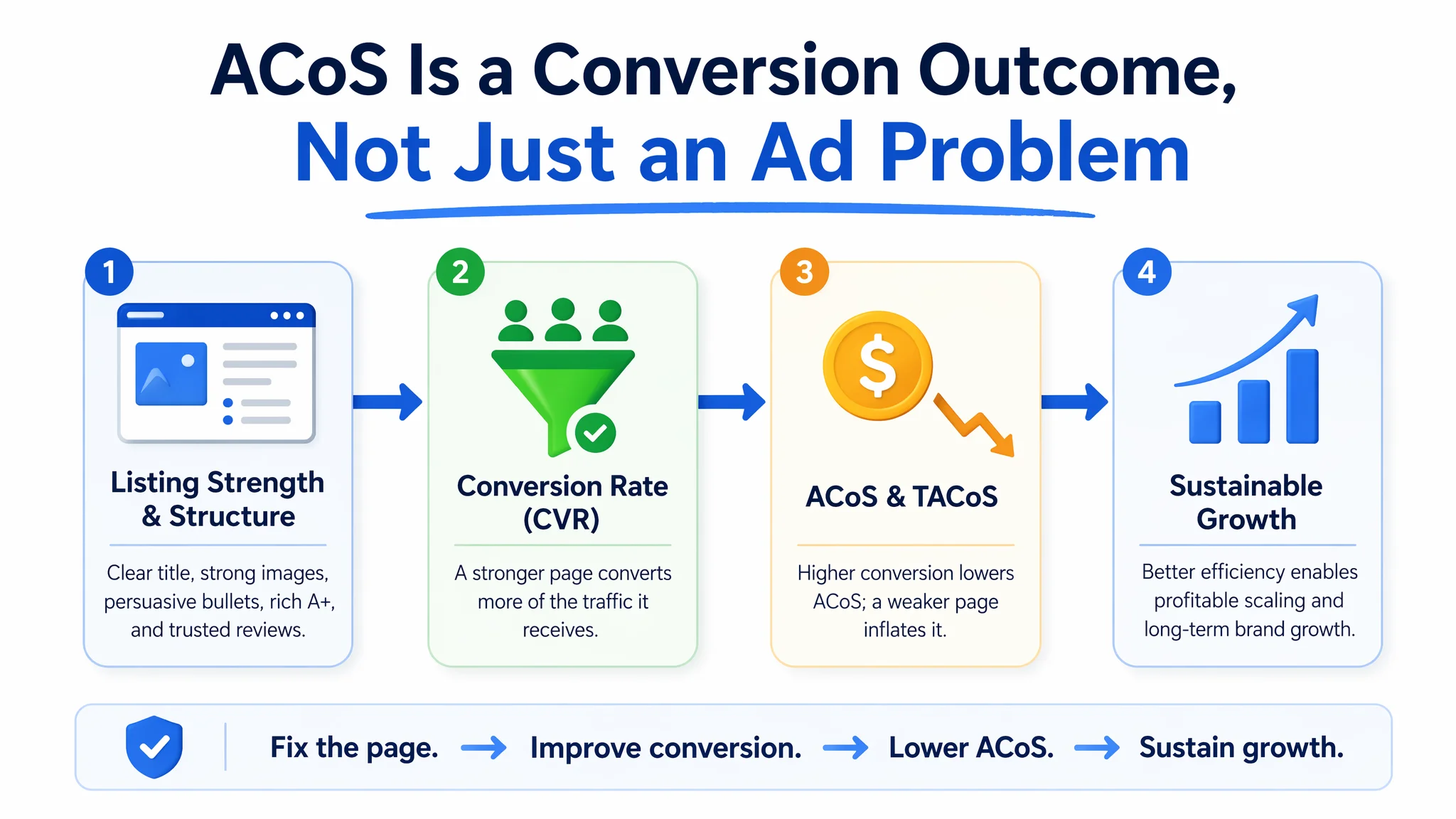
This is where advanced tools like DeepBI provide a critical advantage. They transform the complex work of monitoring, diagnosing, and optimizing ad spend into a standardized, manageable process. By creating a direct feedback loop between actions and outcomes—such as tracking how a change impacts CTR or ACoS—these systems enable sellers to make faster, more intelligent decisions. Just as importantly, they help answer a foundational question before you increase budget: “Does this listing deserve more traffic yet?”
Ultimately, this disciplined, data-driven approach allows you to build a healthy revenue flywheel. By consistently aligning your budget with your best-performing assets and most precise traffic sources—and by ensuring that your pages are structurally capable of converting that traffic—you can shift from reactive campaign management to proactive, long-term growth. The grill-accessories case underscores the point: treating ACoS as a pure “ad cost” problem led to repeated missteps, while reframing it as a conversion and listing-strength issue opened the door to sustainable improvement.
This commitment to continuous optimization—grounded in real performance data, benchmark comparisons, and an honest view of your listing’s strengths and weaknesses—is the definitive path to achieving sustained profitability and scaling your brand on Amazon.