

The AI Revolution in Amazon Selling: An Introduction
In the hyper-competitive Amazon marketplace, the era of simple listing optimization through basic copywriting and image beautification is over. Sellers now operate in an environment of intense 'stock competition,' where success demands a more precise, data-driven, and algorithmic approach. With rising traffic costs and immense pressure to improve both Click-Through Rates (CTR) and Conversion Rates (CVR), relying on subjective aesthetics or incomplete data for listing changes is no longer a viable strategy—it's a costly liability.
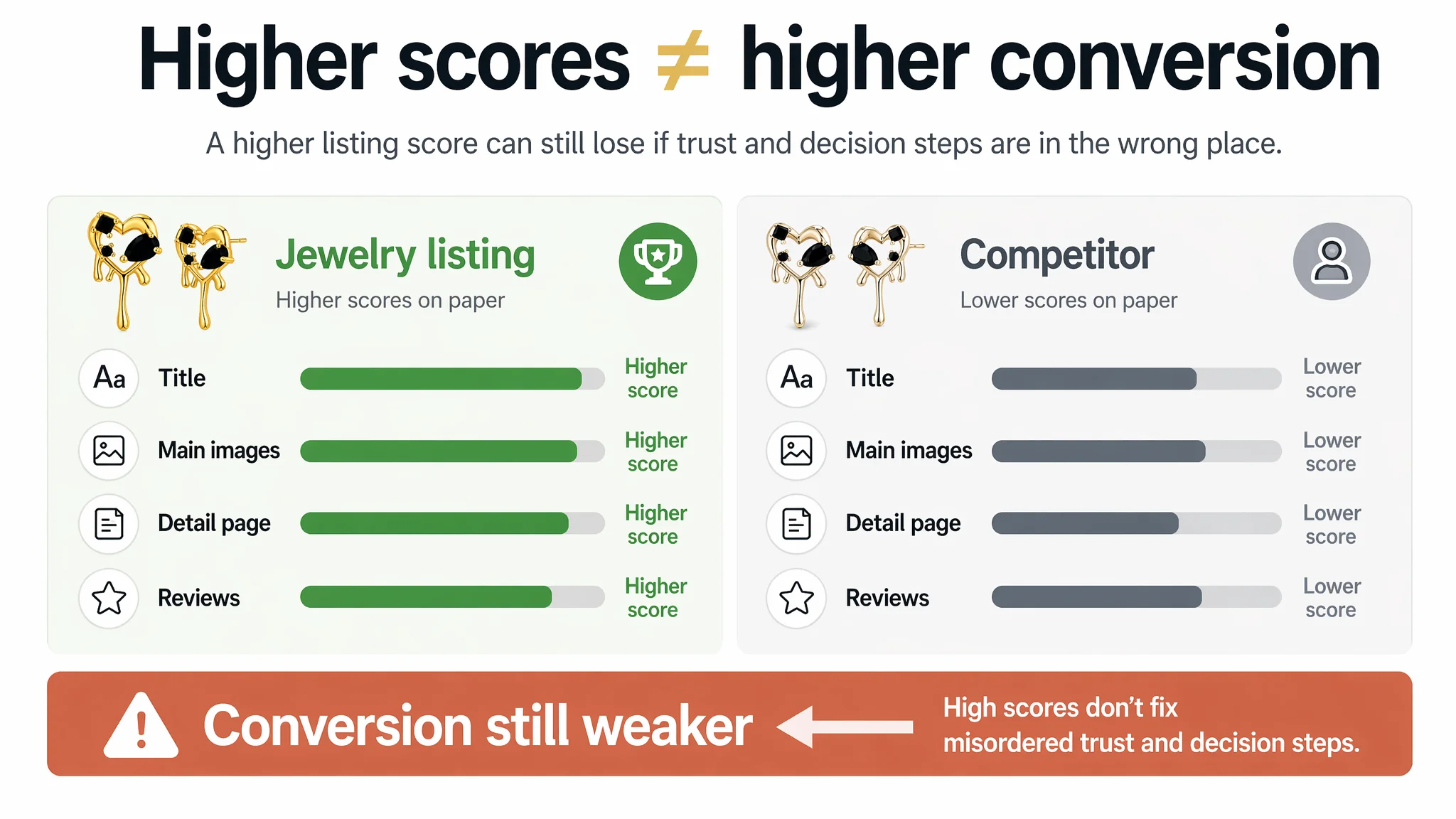
This isn’t just a theoretical risk. One jewelry seller DeepBI worked with had what looked like a “winning” product page for a pair of pearl earrings: higher listing scores than a key competitor, better reviews, richer A+ content, and more polished visuals. On paper, everything suggested the listing was superior. Yet ad costs were difficult to control and the page simply did not convert traffic as efficiently as it should. The team’s instinct was to keep tweaking Amazon ads and polishing visuals, convinced that the problem must be in campaign setup or not‑“pretty enough” images.
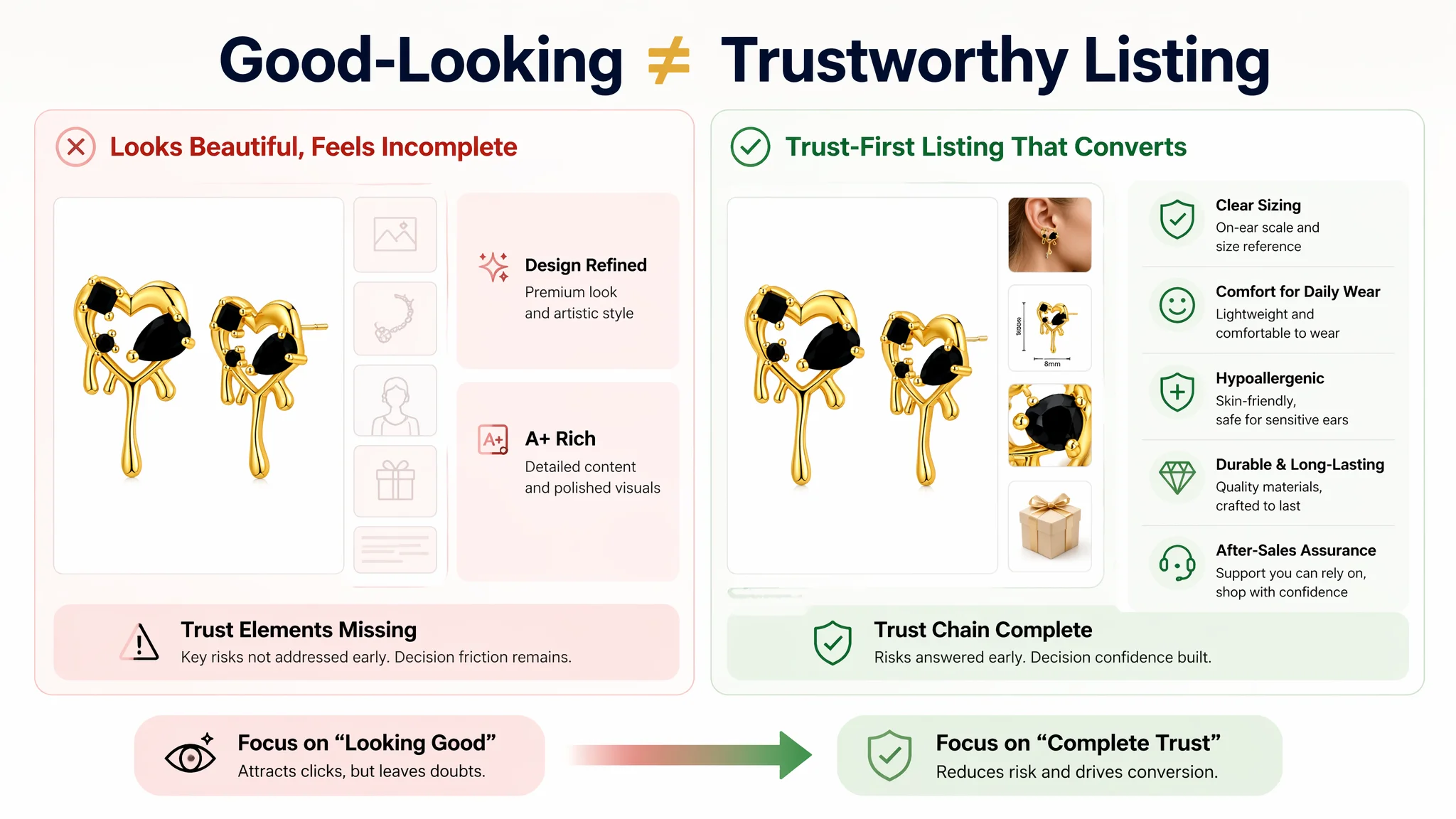
The underlying issue was different. The page was visually refined but structured around the wrong story. It over‑invested in aesthetics and technical polish while delaying or underplaying what actually reduces decision risk in jewelry: sizing clarity, everyday wear comfort, allergy safety, durability, and after‑sales reassurance. Ads were pushing traffic into a beautiful page that still felt incomplete in terms of trust.
This is where Artificial Intelligence (AI) becomes an indispensable strategic partner. AI-powered platforms are transforming the traditional, fragmented approach to optimization into a cohesive engine for growth. Previously, operational workflows were plagued by inefficiency and a lack of clear performance measurement. A simple task like updating product images could involve a tedious manual process taking dozens of minutes. More critically, it was nearly impossible to quantify the direct impact of these visual changes on business metrics—or to see that a page with a high “quality score” could still be misaligned with how buyers actually decide.
AI solves these core challenges by automating time-consuming tasks and creating a closed-loop system for performance analysis. It can reduce a multi-minute upload process to mere seconds through API integration. More importantly, it connects every optimization action—like publishing a new main image—directly to advertising performance data. This allows sellers to track the subsequent impact on CTR and CVR and to diagnose whether the true constraint is traffic quantity, creative clickability, or on‑page conversion logic. Decisions shift from guesswork and aesthetics to objective, behavioral signals, ensuring every change is a calculated move toward higher performance.
AI as the Core of Amazon Listing Optimization
Your product listing is the single most critical asset for driving sales on Amazon. Optimizing it effectively is no longer a matter of guesswork; it requires a data-driven, AI-powered approach. AI serves as the central intelligence for this process, analyzing vast datasets of market trends, competitor strategies, and customer reviews to uncover the precise elements that drive clicks and conversions.
In the jewelry case above, a conventional surface review of the page would have concluded that “the listing problem is solved.” The seller’s listing scored higher than a benchmark competitor across title, main images, detail page, and reviews. The team therefore defaulted to an advertising explanation for weak performance: they assumed ads were not optimized enough, keywords needed more tuning, and creatives needed “more pop.” Without deeper analysis, there was little reason to question the listing itself.
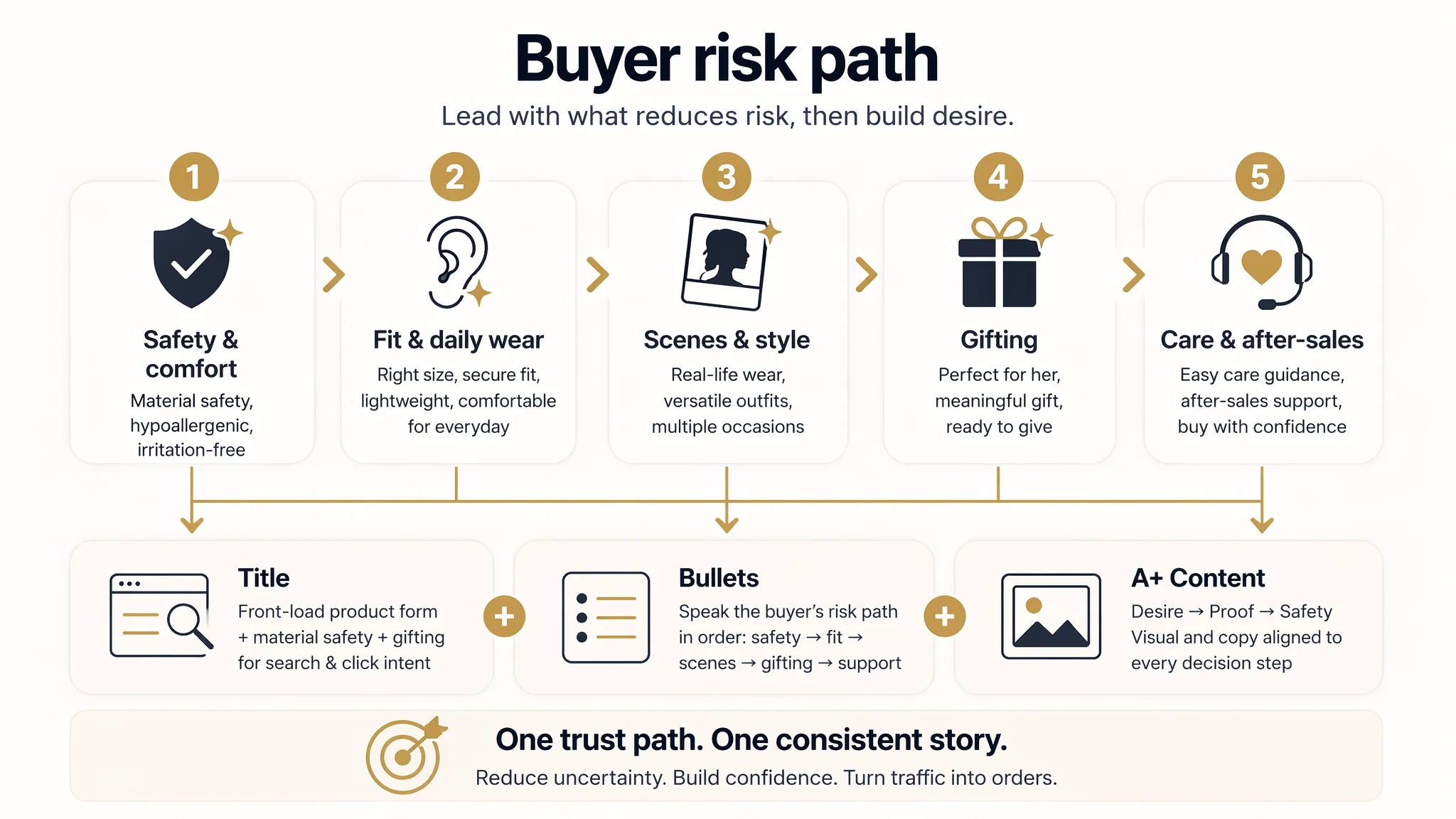
An AI-led diagnosis changed that. By benchmarking the listing against top‑performing competitors using multi-dimensional semantic analysis, DeepBI exposed a different bottleneck: conversion capacity, not visual quality. The system didn’t just compare word counts or image quantity; it evaluated whether the title, bullets, images, and A+ content collectively addressed the same risk sequence that real buyers care about. Material safety and hypoallergenic reassurance were treated as secondary instead of primary; sizing and comfort were explained later rather than early; post‑purchase protection was implied instead of clearly promised. In other words, strong assets existed, but the trust story was misordered.
DeepBI provides an end-to-end intelligent optimization system that transforms this kind of analysis into action. It begins with a smart diagnosis, using multi-dimensional semantic analysis to benchmark your listing against top-performing competitors. This process identifies specific weaknesses across your main images, title, bullet points, and A+ content, providing clear directions for improvement.
From this strategic foundation, DeepBI’s AI generates multiple optimized content solutions. For visual assets, it operates as an automated production system, not just a creative tool. By establishing a "Product DNA" map, it ensures all generated images maintain absolute product authenticity, mitigating the risk of negative reviews from "image-product mismatch" issues common with general AI tools. For text, it restructures titles and bullet points to highlight core selling points and solve customer pain points.
In the pearl earrings example, that meant taking a title that already had strong keyword coverage but weak decision positioning, and reshaping it so the product form (“pearl stud earrings”), material safety (sterling silver pins, hypoallergenic), and gifting scenarios appeared in the precise order that supports both search relevance and click intent. Bullets were also re‑sequenced from a design‑first narrative to a risk‑first path: safety and comfort, then fit and use scenarios, then gifting logic, and only then care guidance. The A+ content was adjusted from a “technical‑first” structure to a “desire → proof → safety” story.
Finally, the system bridges the gap between generation and launch. Instead of a manual upload process that takes dozens of minutes, DeepBI’s one-click application syncs all optimized content directly to your Seller Central account via the SP-API in seconds. This integrated workflow—from diagnosis and strategy to generation and delivery—is engineered to produce measurable improvements in your listing's Click-Through Rate (CTR) and Conversion Rate (CVR), and, critically, to ensure that apparently “good” listings are actually aligned with how buyers evaluate risk and make decisions.
Strategic AI for Enhanced Amazon Ad Performance
Maximizing return on ad spend (ROAS) on Amazon requires more than just aggressive bidding and keyword stuffing. The true driver of advertising efficiency is the underlying quality of the product listing itself. Stagnant Click-Through Rates (CTR) and low Conversion Rates (CVR) often point not to a flawed ad strategy, but to a creative-to-traffic mismatch. AI-driven platforms address this by creating a powerful feedback loop between your advertising data and your listing content.
The jewelry seller’s experience is a textbook example of this mismatch. Their ads were not failing to bring traffic—in fact, ad reports showed stable clicks in line with category norms. However, as traffic scaled, orders did not keep pace. Advertising teams felt constant pressure on ACoS and TACoS and responded the way most teams do: tweaking bids, expanding keywords, and requesting fresher ad creatives. Because listing scores and reviews looked strong, traffic quality was not considered the primary suspect; the team interpreted the pattern as a purely advertising issue.
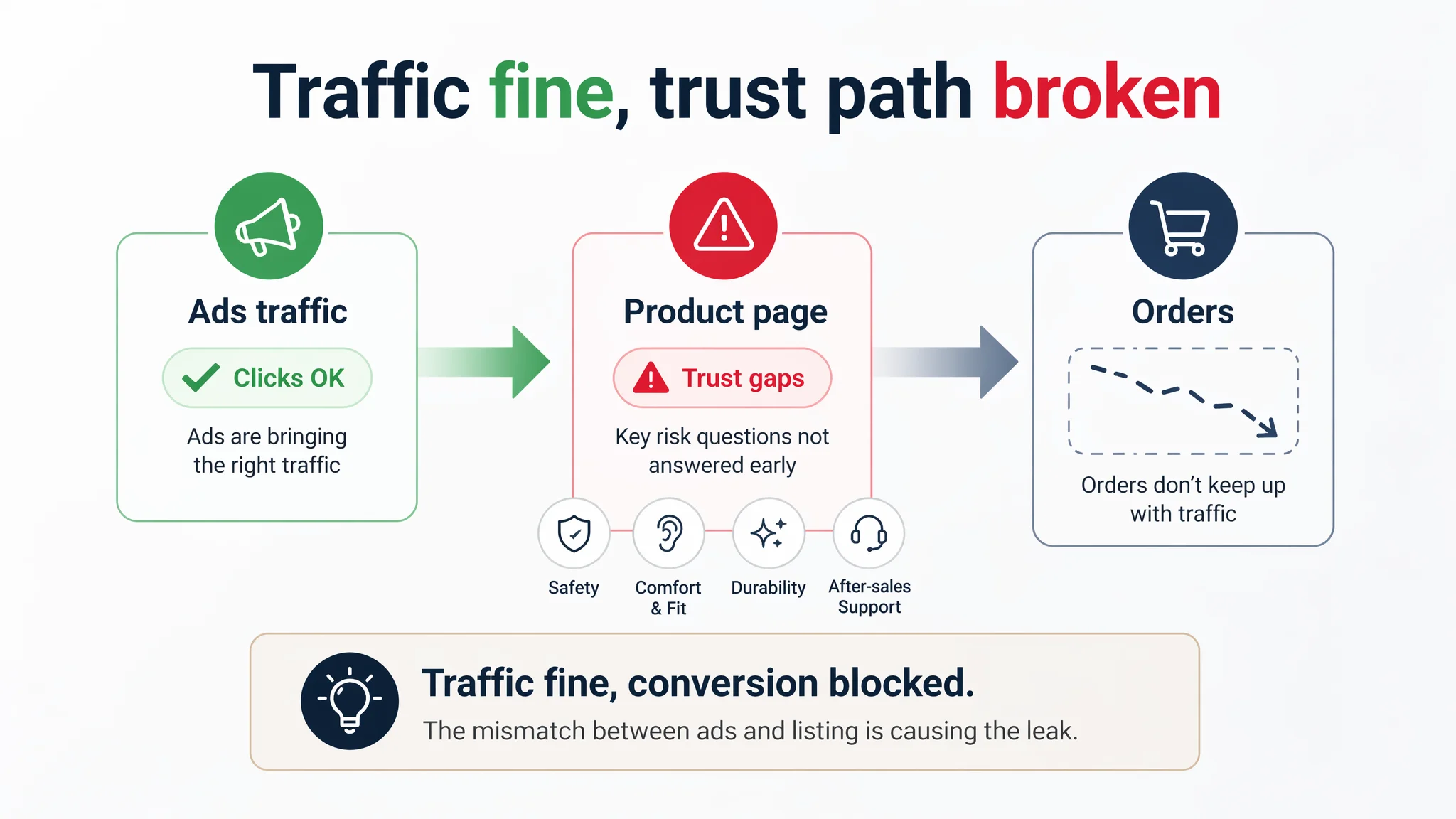
An AI-led diagnostic reframed the situation as a conversion constraint. By correlating ad performance with on‑page structure, DeepBI’s system could see that traffic was being fed into a page that looked premium and artistic, but did not immediately answer the practical risk questions jewelry buyers have: will this irritate my skin, will it fit and look right on my ear, will it fade quickly, and what happens if I’m not satisfied? The competing listing, though visually less refined, addressed those points early in bullets and made after‑sales support explicit. The AI could flag this gap not just as a vague “trust issue,” but as a specific creative‑to‑traffic misalignment.
DeepBI leverages this synergy by treating ad performance metrics as a diagnostic tool for creative optimization. Instead of operating in a silo, the system deeply integrates with your Amazon ad reports to identify the root causes of poor performance. For instance, a consistently low CTR (e.g., below 0.35%) triggers an AI-driven analysis and optimization of the main image, as it is failing to capture shopper attention. Conversely, if ads are driving clicks but the CVR is poor (e.g., below 7%), the system flags the A+ content and detail page for enhancement, focusing on clarifying value propositions and addressing conversion barriers.
In the earrings case, CTR was not catastrophically low, but CVR lagged expectations despite strong reviews and listing scores. That pattern guided the AI to prioritize bullets, detail page content, and A+ sequencing over ad creative changes. Instead of blindly pushing more impressions into a leaky page, the system insisted on fixing the trust and decision logic first—making allergy safety, gift suitability, and post‑purchase protection visible in the first scroll for every ad‑driven visitor.
This process creates a closed-loop system where advertising insights directly fuel creative improvements. The AI analyzes high-conversion search terms—your "Winning terms"—to understand which features and benefits resonate most with buyers. For a product like jewelry, those terms might cluster around “hypoallergenic,” “nickel free,” or “gift for mom.” These data signals then guide the optimization of listing titles and images, ensuring your creative is precisely aligned with proven customer intent. By systematically improving the listing's conversion power, this approach not only lowers your Advertising Cost of Sale (ACoS) but also strengthens your organic ranking by improving the unit session percentage, ultimately reducing your Total Advertising Cost of Sale (TACoS).
Leveraging AI to Boost Amazon Organic Visibility
A sophisticated AI strategy moves beyond simply optimizing ad spend; it transforms advertising data into a powerful engine for organic growth. The core mission is to create a positive feedback loop where paid advertising signals directly strengthen natural search rankings. This process begins with deep analysis, as AI reverse-engineers top competitor listings to identify high-CTR keywords and deconstructs your own product data to find its most essential search terms.
In the jewelry scenario, part of DeepBI’s work involved isolating which attributes in the ad reports actually correlated with higher conversion once visitors reached the page. Terms connected to material safety, gift suitability, and wear comfort tended to perform better than vague, purely aesthetic descriptors. The competitor’s bullets and title structure already reflected this, opening with allergy‑free claims and clear sizing references, while the customer’s listing foregrounded design language and use scenes. AI could quantify this gap and then feed those insights back into the organic optimization process.
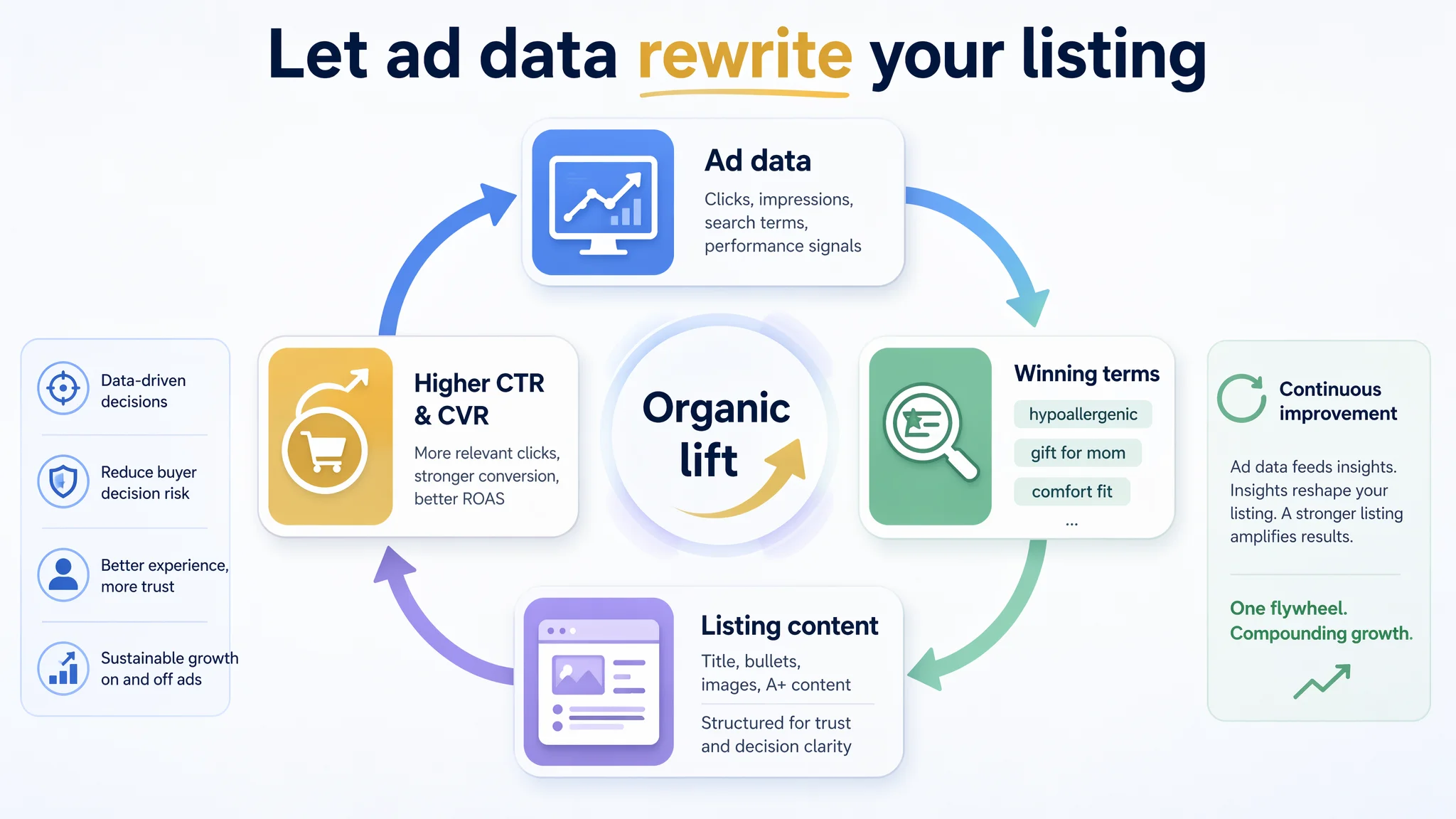
These insights directly fuel the listing optimizations that improve core performance metrics. For example, if ad reports show a specific attribute like "fast charging" results in a high conversion rate (CVR), the AI ensures that feature is visually prominent in your images. In the case of pearl earrings, the equivalent might be “nickel-free hypoallergenic sterling silver pins” or “comfortable for everyday wear”—phrases that, when proven to lift conversion in ads, are then promoted to title, top bullets, and main images. This creates a powerful commercial flywheel: a better, more relevant listing earns a higher click-through rate (CTR) and CVR in ad campaigns. This increased sales velocity is a critical signal to Amazon's search algorithm, leading to improved organic placement.
The strategy culminates in a targeted growth loop. AI systems filter your advertising reports to isolate the keywords with the highest CTR, CVR, and order values. These proven, high-performing terms are then used to build new, focused campaigns aimed specifically at securing 'Top of Search' visibility. This investment in top-performing keywords provides a significant and direct lift to their organic ranking, turning ad spend into a long-term asset and driving down your Total Advertising Cost of Sales (TACoS). In practice, that means not just purchasing more visibility, but making sure the landing experience—your listing—has been structurally re‑aligned to convert the incremental traffic those keywords bring.
Integrating AI Across the Amazon Growth Funnel with DeepBI
Effective Amazon growth requires a unified strategy, yet many sellers operate with disconnected workflows for listing optimization, advertising, and organic ranking. DeepBI addresses this by functioning as an AI-centric, full-link operational system that integrates diagnosis, strategy, execution, and launch into a single, cohesive process. It breaks down the traditional silos, ensuring that every optimization is data-driven and aligned with core business objectives.
The pearl earrings seller’s journey illustrates what happens when these workflows are disconnected. Initially, the team treated listing quality as a binary checkbox—“the page looks great, scores are high, reviews are strong”—and poured most of their operational energy into advertising: adjusting bids, trying new ad types, and refreshing creatives. Meanwhile, the listing’s internal logic remained unchanged: design‑focused titles, bullets that delayed safety and after‑sales reassurance, and A+ modules that opened with decorative brand content and technical diagrams rather than desire and trust.
Once DeepBI’s AI scored and compared the listing against a tightly matched competitor, the system exposed misallocated advantages. The seller invested heavily in brand aesthetics, technical precision, and high-quality product imagery, but the elements that directly convert ad traffic—material safety, clear after‑sales protection, practical sizing guidance—were not leading. The operational model had inadvertently turned ads into a mechanism for amplifying the listing’s weakest points.
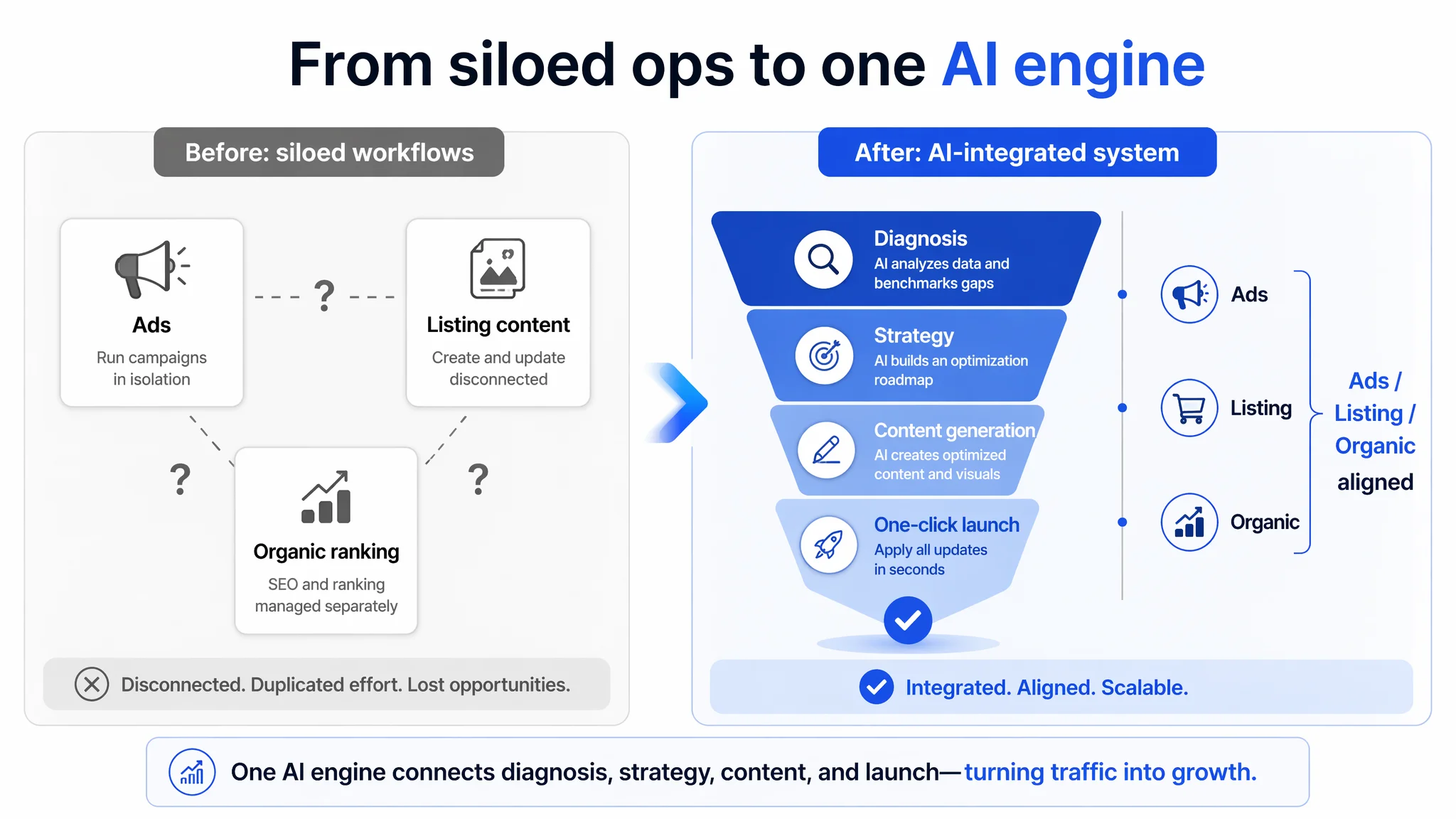
The system creates a powerful feedback loop between advertising performance and creative assets. By analyzing ad report data, DeepBI identifies performance gaps. For instance, if data reveals a low Click-Through Rate (CTR), the AI prioritizes strengthening the main image's visual impact. If a low Conversion Rate (CVR) is the issue, it focuses on enhancing the information density of A+ content. This converts stable advertising signals into stronger organic rankings and a lower Total Advertising Cost of Sales (TACoS).
In this jewelry case, that meant:
- Rebuilding the bullet sequence so it mirrored the buyer’s mental steps: safety → fit → style/scene → gifting → after‑sales.
- Repurposing main image slots from “pretty pictures” to a structured visual argument: on‑ear scale for comfort, size diagram plus material cred, macro shots that prove durability, and explicit gifting readiness.
- Reordering A+ modules to move from desire (multiple model angles) to proof (technical diagrams, macro details) to safety and care (hypoallergenic claims, realistic care instructions, and support assurances).
Only after the listing itself carried a coherent trust story did it make sense to re‑accelerate ad optimization and scaling. Ads could then work with the page instead of against it.
This collaborative model positions the seller as the strategist and DeepBI as the executor. You define the high-level business goals—such as prioritizing profit or aggressive growth—and set strategic guardrails like ACoS targets or brand identity constraints via 'Product DNA'. DeepBI then handles the complex data analysis, generates an optimization plan, and, upon your approval, executes the changes directly through the SP-API. This partnership requires human oversight; the AI augments your decision-making with powerful execution capabilities, but the final strategic approval always remains with you.
Conclusion: The Future of AI in Amazon Selling
The era of optimizing Amazon listings through subjective guesswork and manual trial-and-error is rapidly closing. As we've explored, AI-powered platforms are fundamentally transforming e-commerce operations by converting artistic intuition into data-driven science. Real-world cases like the pearl earrings seller show that even high-scoring, visually refined listings can underperform when they tell the wrong story in the wrong order—and that ad spend alone cannot compensate for a misaligned trust path.
By integrating the entire optimization lifecycle—from performance diagnosis and strategic planning to AI-powered content generation and one-click deployment—these systems eliminate costly human errors and create a direct, measurable impact on key performance indicators like Click-Through Rate (CTR) and Conversion Rate (CVR). Critically, they also help answer a question every seller faces but often cannot quantify: is my bottleneck traffic, clickability, or conversion capacity?
This shift redefines listing management from a series of disconnected tasks into a unified, automated workflow. Instead of simply creating content, AI now serves as a comprehensive operational execution system, turning every optimization into a predictable, quantifiable process. Looking ahead, the role of AI will only expand, evolving into an indispensable intelligent decision-making brain for sellers. For brands aiming to secure a lasting competitive advantage in the dynamic global marketplace, embracing this technology is no longer an option—it is the critical path to ensuring that every click lands on a page that truly deserves it, and to building sustainable growth and long-term success.