


Understanding Amazon Listing Conversion Rate
What is Amazon Listing Conversion Rate?
The Amazon listing Conversion Rate (CVR) is a fundamental performance metric that measures the percentage of visitors to your product detail page who complete a purchase. Calculated by dividing the number of orders by the number of sessions for a specific period, CVR is the ultimate indicator of your listing's persuasive power. It directly answers the question: how effectively does your content—from images and titles to A+ content—convince a potential buyer to act?
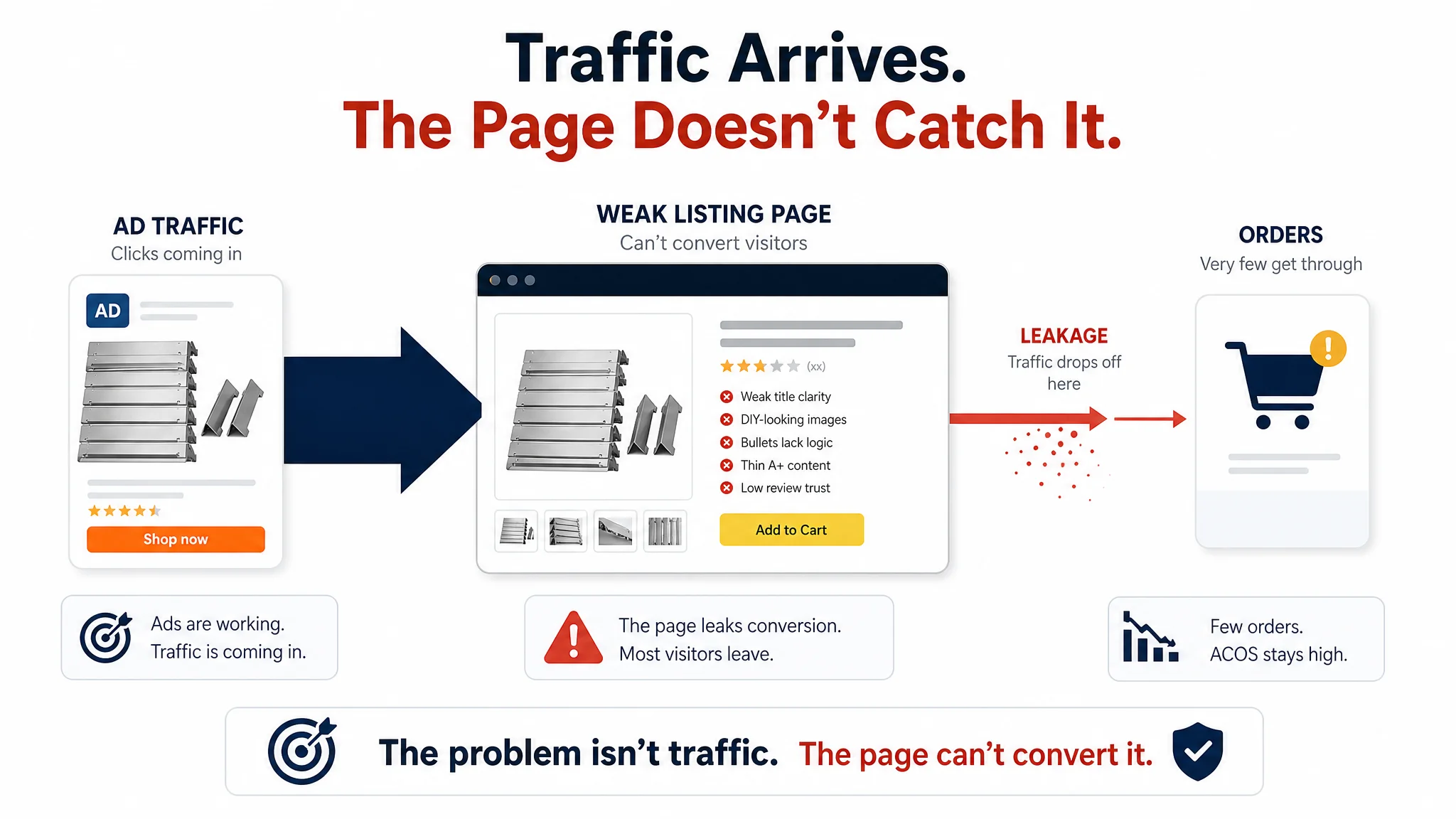
This isn’t just a theoretical definition; the impact becomes painfully clear when a listing receives traffic yet fails to close the sale. In one grill-accessories case, the seller’s replacement Flavorizer Bar & heat-deflector kit was getting a steady stream of paid traffic, but orders were unstable and ACOS stayed high. On paper, traffic volume looked “acceptable.” In practice, the product page itself wasn’t converting visitors into buyers, which is exactly what a weak CVR looks like when you zoom into a real SKU.
Why is Conversion Rate Optimization Crucial for Amazon Sellers?
Optimizing your CVR is one of the most efficient paths to greater profitability. A higher conversion rate allows you to generate more sales from your existing traffic, which can lower your Advertising Cost of Sales (ACoS) and reduce dependency on paid ads. This creates a healthy growth flywheel where improved organic performance fuels sustainable revenue.
But this flywheel only works if you’re diagnosing the right problem. Many sellers lock onto rising ad costs and assume “ads are broken,” while the real failure sits on the product page. In the grill-parts example, the team’s first instinct was to keep tweaking bids, keywords, and campaign structures. Yet DeepBI’s structured scoring showed the listing lagging a category-leading benchmark by more than twenty points across title, images, bullets, A+ and reviews. Every click was being sent into a weaker page, so ACOS pressure was a symptom of poor conversion, not a standalone ad issue.
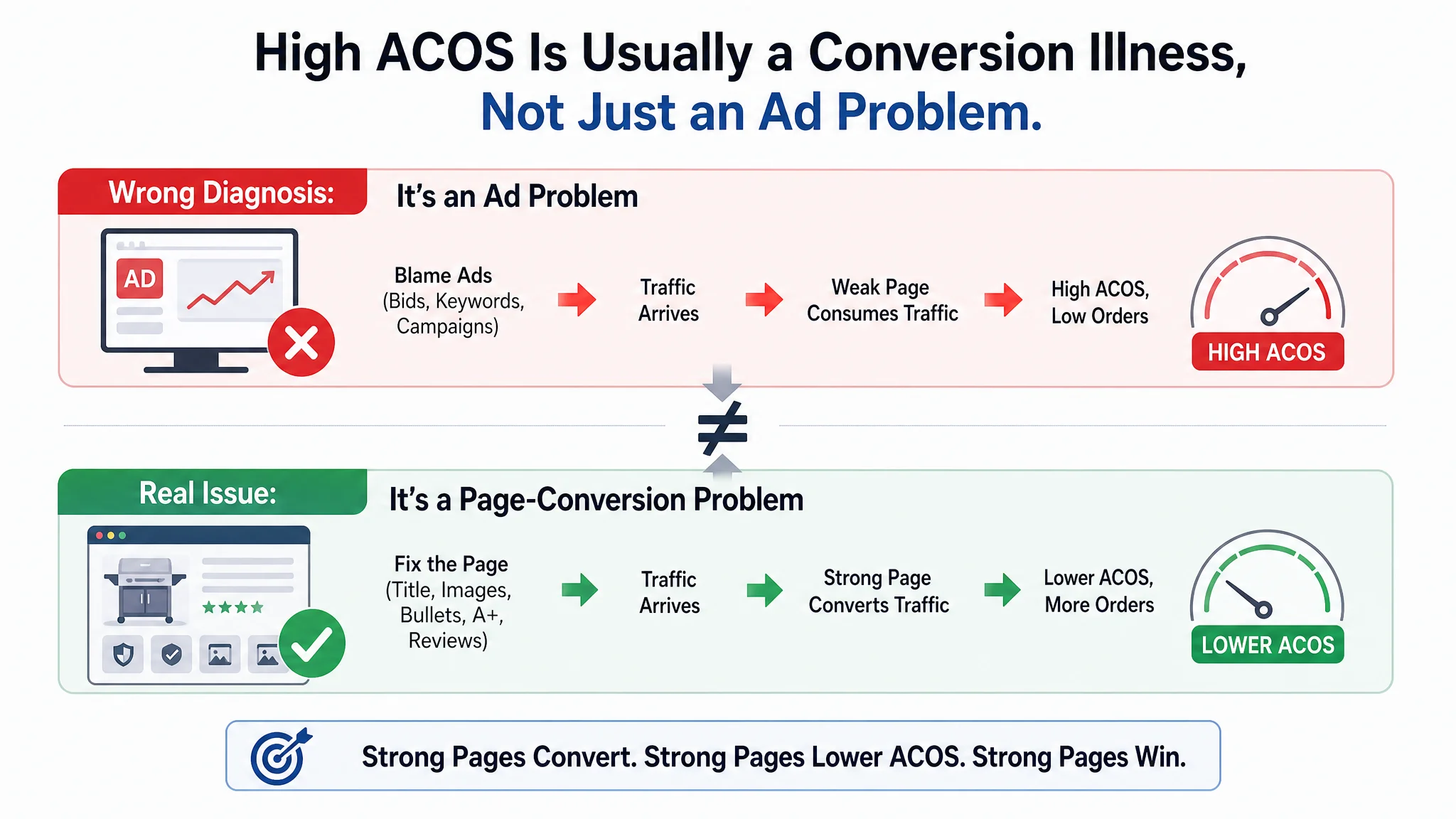
The inability to connect a poor CVR to specific weaknesses—such as a lack of trust conveyed by the detail page or unconvincing main images—leads to inefficient, trial-and-error updates. This is where data-driven diagnosis becomes critical. A system like DeepBI can quantitatively audit every element of your listing against key competitors, uncovering the core issues that restrict conversions and turning ambiguity into a clear, actionable optimization plan. In the grill case, this shift—from “ad problem” to “page-conversion problem”—was the turning point that made subsequent optimizations actually pay off.
Measuring and Benchmarking Your Conversion Rate
To optimize your listing, you first need to understand its current performance. Your conversion rate (CVR) is the single most important metric for measuring how effectively your product page turns traffic into sales.
How to Calculate and Find Your Amazon Conversion Rate
You can find your CVR within Amazon Seller Central by navigating to Reports > Business Reports > Detail Page Sales and Traffic. The key metric to focus on is the Unit Session Percentage. This figure represents the number of units ordered divided by the number of unique sessions.
Amazon calculates this as: (Total Orders / Total Sessions) x 100%
It's crucial to use sessions rather than page views for this analysis. A "session" represents a unique visitor's activity within a 24-hour period, regardless of how many times they view your page. This provides a more accurate measure of your ability to convert distinct potential buyers, filtering out repeat views from a single user.
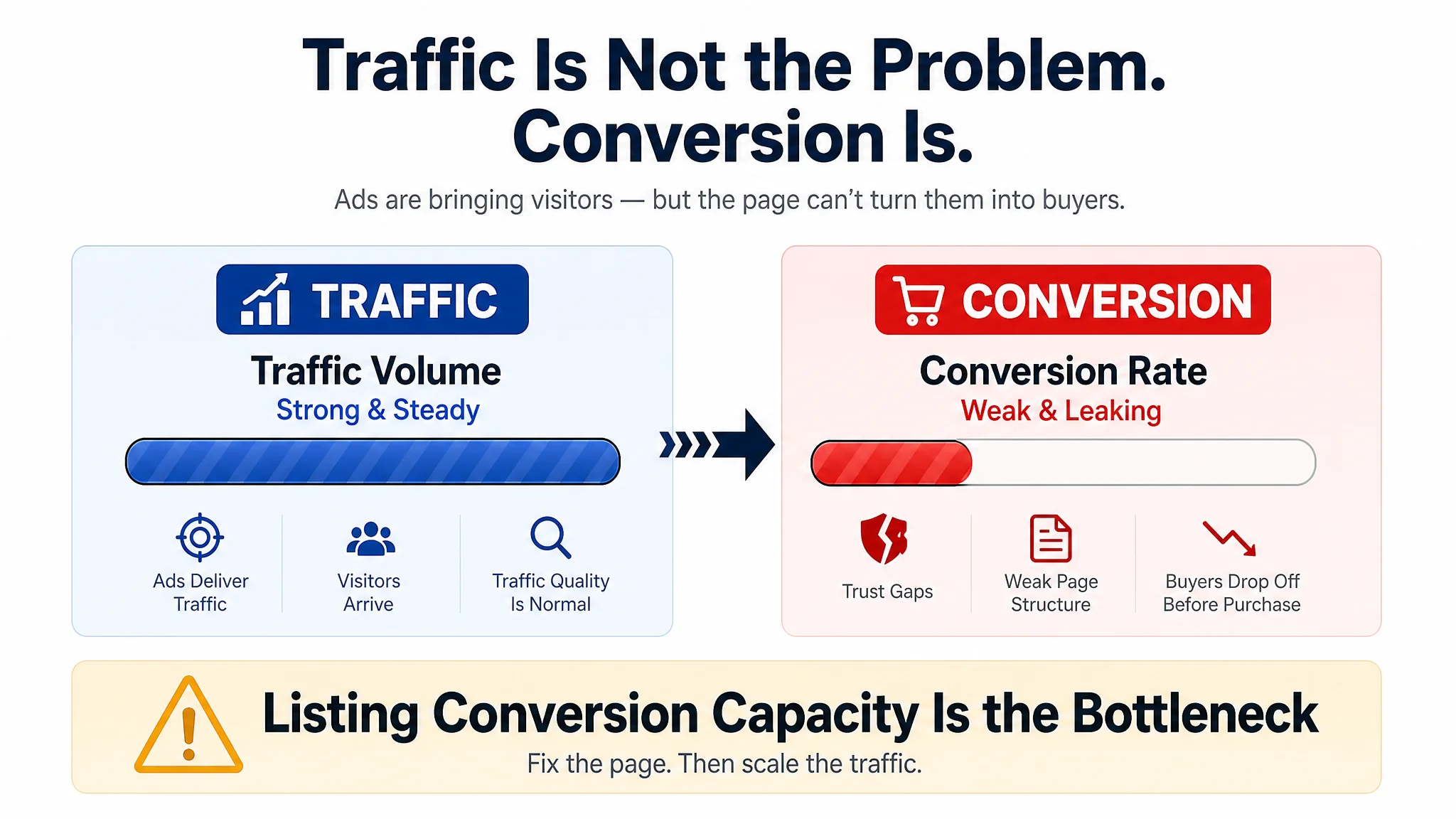
In practice, simply knowing the formula is not enough; you must interpret CVR in context. In the grill-accessories case, the seller saw ad spend increasing and assumed the core metric to watch was ACOS. When DeepBI overlaid listing CVR and competitor benchmarks, it became obvious that the product page’s conversion capacity was the structural bottleneck. Traffic wasn’t the missing piece—conversion was.
What is a Good Amazon Conversion Rate? Benchmarks and Context
While Amazon does not publish official CVR benchmarks, industry data suggests that a rate above 10% is generally considered strong. However, a "good" CVR varies significantly by category, price point, and competition.
Instead of relying on vague averages, a more effective approach is to benchmark against your direct, high-performing competitors. This is where automated analysis provides a critical advantage. For instance, a CVR below 7% can be a key indicator that your listing is underperforming and failing to convert valuable traffic.
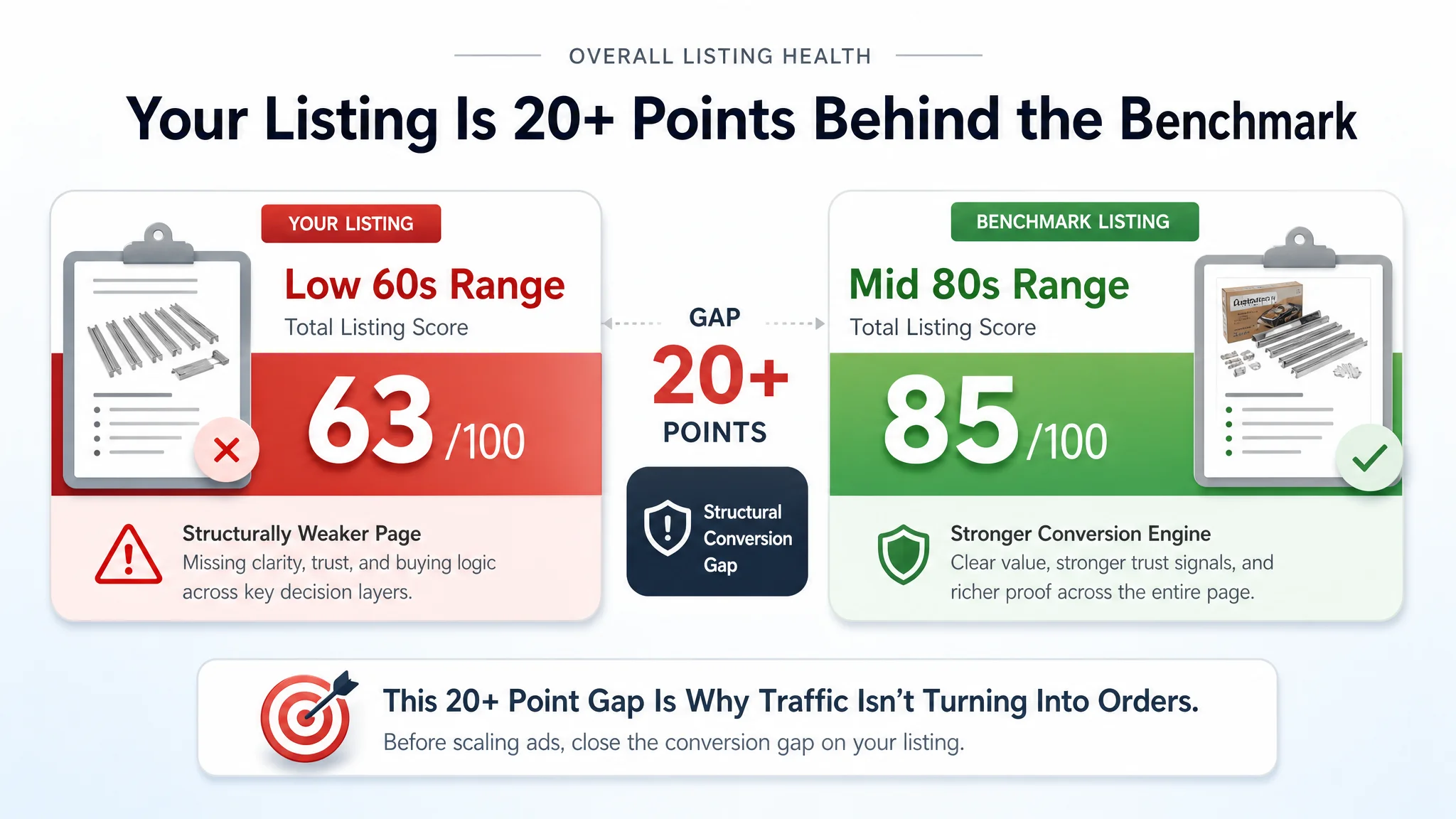
In the grill-parts scenario, the misjudgment wasn’t only about the absolute CVR number; it was about relative performance. DeepBI’s automated market health check system compared the seller’s page to a category-leading benchmark and translated that into a structured score: the target listing sat in the low 60s out of 100, while the benchmark landed in the mid 80s. That 20+ point gap was not abstract—it was concentrated in areas like title clarity, A+ depth, and review strength.
DeepBI’s automated market health check system addresses this challenge directly. It uses a multi-dimensional semantic algorithm to identify your most relevant benchmark competitor, not just a keyword match. The system then diagnoses performance gaps by scoring your listing against theirs across five core areas: main image visuals, title, bullet points, A+ page richness, and customer reviews. This establishes a clear, logical link between a low CVR and specific, fixable issues, such as a lack of trust elements or weak usage scenario descriptions in your A+ content.
In the grill case, that meant seeing, in one snapshot, that the review layer had a visible negative sentiment problem, the title read like an internal part label rather than a consumer-facing promise, and A+ lacked the proof-laden modules the benchmark used to walk shoppers toward a confident purchase.
Core Pillars of Amazon Listing Optimization
A high-converting Amazon listing is built on several foundational elements that work together to attract, inform, and persuade customers. Mastering these pillars is essential for turning clicks into sales and improving your Conversion Rate (CVR).
High-Quality Product Imagery and Video
Visuals are your primary tool for building trust and communicating value. A strong image gallery includes high-resolution, white-background main images, lifestyle shots showing the product in use, and infographics that highlight key features. While general AI tools can create images, they risk generating "hallucinations" that misrepresent the product, leading to customer complaints and returns.
The difference between “adequate” and “conversion-driving” visuals becomes sharply visible when you compare real listings side by side. In the grill replacement-kit example, the seller’s main image set initially looked passable at a glance: the parts were visible, the background was light, and there were a few angle shots. But DeepBI’s visual analysis, benchmarked against the category leader, exposed subtle yet impactful gaps:
- The seller’s hero image had a slightly “DIY” tone—lighting and composition made the metal finish feel less industrial and more generic.
- There was no in-grill installation shot to instantly answer, “Will this really fit and look right in my grill?”
- No thickness or material proof (such as calipers or close-up texture) was present, leaving “heavy-duty” claims unsubstantiated.
By contrast, the benchmark’s gallery wove a consistent story: precise caliper shots, clean industrial backgrounds, installed-in-grill visuals, and packaging all worked together to scream “professionally engineered, trustworthy, OEM-grade alternative.”
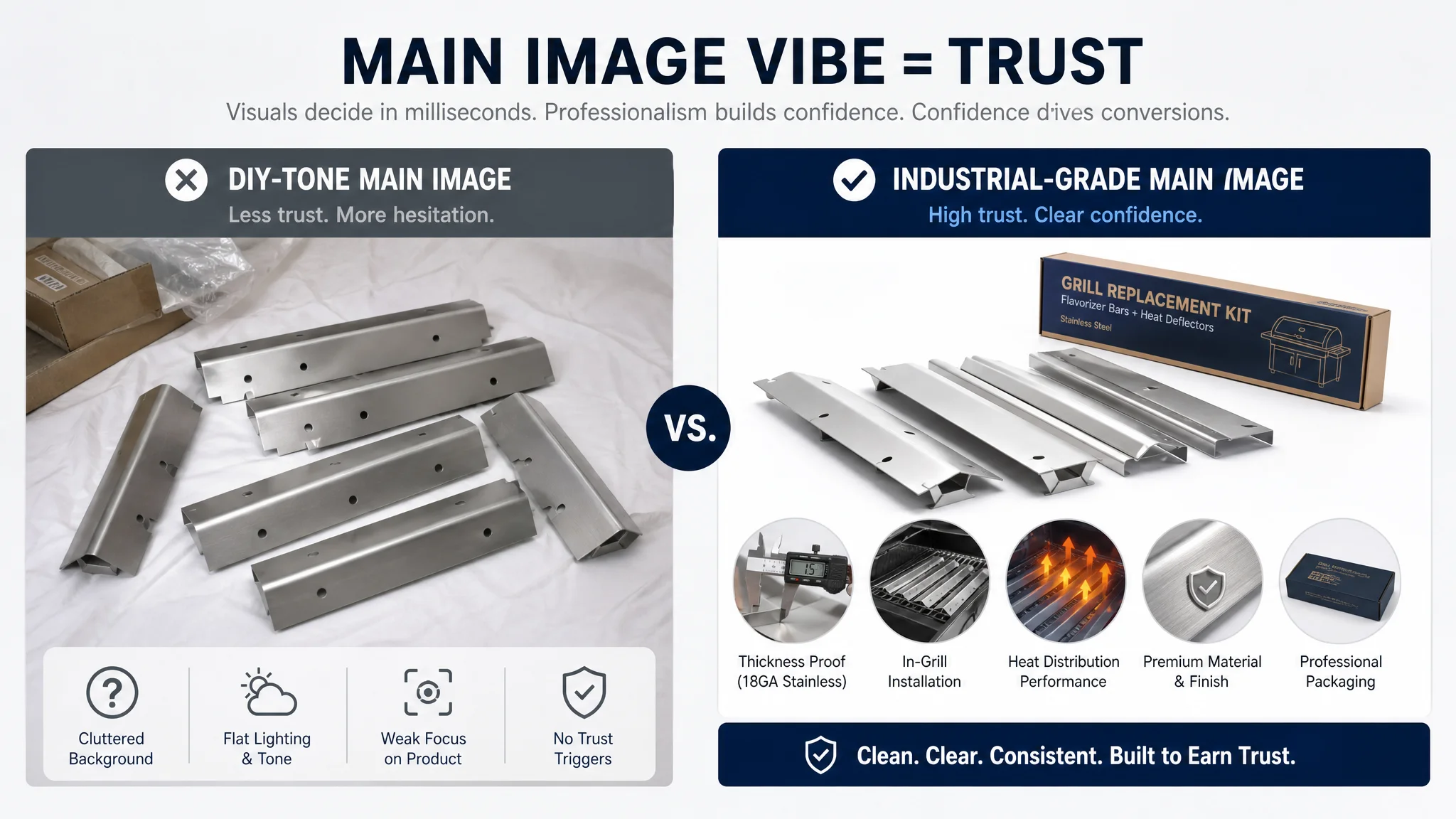
When DeepBI guided the grill seller to rebuild the image system, the focus was not on making the images “prettier,” but on addressing specific conversion questions: show compatibility visually, prove material thickness, demonstrate heat performance, and depict real-life usage and maintenance. The result was a gallery that aligned far more closely with shopper decision logic.
DeepBI's AI image generation operates as an automated visual production system, not a creative drawing board. It establishes a "Product DNA" map, locking in your product's authentic material, color, and design as a non-negotiable constraint. This principle of 'product entity consistency' ensures all generated lifestyle and infographic images are true to the physical item, fundamentally mitigating the risk of 'image-product mismatch'. In the grill-parts case, that meant any new lifestyle or infographic assets had to respect the actual stainless-steel structure and real dimensions, avoiding the temptation to “enhance” the product visually in ways that would backfire in reviews.
Compelling Product Titles and Bullet Points
Your title and bullet points must serve two functions: attract shoppers via SEO and convert them with compelling benefits. They should be rich with relevant keywords while clearly addressing customer pain points and highlighting your unique selling propositions.
A frequent real-world failure is that titles end up written for internal catalog logic rather than for buyers. The grill seller fell into this trap: the original title led with a string of part codes, followed by a less commonly searched term, and only secondarily hinted at what the product actually was. DeepBI’s comparison with the benchmark clarified that shoppers in this subcategory searched first for the core component name (e.g., “Flavorizer Bars”), plus size and material, then compatibility models.
Because the title didn’t mirror this mental model, the listing underperformed on both click-through and pre-qualification: fewer correct shoppers clicked, and those who did still had unanswered questions about fit and material.
The bullets showed a similar pattern. The seller had five bullet points listing parameters (gauge, stainless steel, “easy to clean”) in a fairly flat format. The benchmark, however, used more bullets with a structured flow—starting from compatibility, then moving through dimensions, thickness, heat distribution, and flavor mechanism. Each bullet led with a bracketed hook and tied a specification to a real, lived benefit.
When DeepBI restructured bullets for the grill listing, the framework shifted to “Pain Point → Mechanism → Outcome.” For example:
- Instead of simply stating “18GA stainless steel,” the bullet highlighted the problem of rusted porcelain-coated bars, explained that thicker stainless resists chipping and corrosion, and then connected that mechanism to stable heat and longer service life.
- Another bullet reframed the kit as a complete grill overhaul (5 bars + 3 deflectors) rather than just spare parts, directly addressing the homeowner’s desire to “make the grill feel new again.”
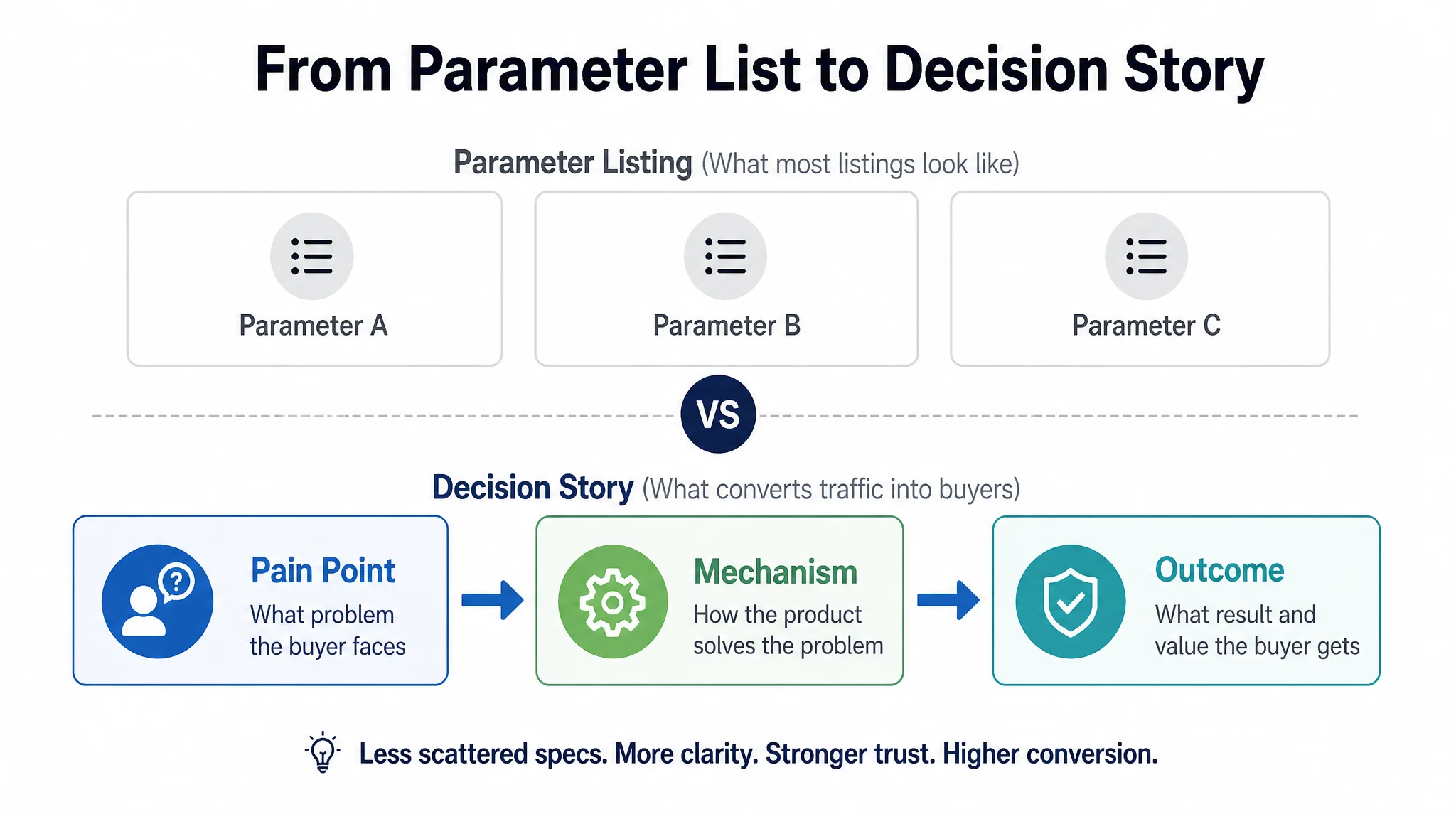
DeepBI's AI assists by crafting SEO-friendly and conversion-oriented copy based on proven formulas. It generates structured optimization strategies, turning diagnostic insights into an executable blueprint. For instance, it can restructure bullet points to follow a "Pain Point - Solution" logic, combining a selling point with data support and a clear resolution for the customer. The grill case illustrates how this shift transforms bullets from a scattered spec list into a coherent, persuasive narrative.
Detailed and Persuasive Product Descriptions (A+ Content)
For brand-registered sellers, A+ Content (formerly Enhanced Brand Content) is a powerful asset for boosting CVR. It allows you to use rich visuals and detailed text to tell a brand story, dive deeper into product features, and proactively answer common questions. By incorporating elements like comparison tables and brand narratives, you can significantly increase shopper engagement and build the credibility needed to secure a purchase.
In practice, though, many A+ modules end up as loosely assembled feature blocks that don’t mirror the customer’s decision journey. The grill listing’s original A+ is a typical example: it had a compatibility table, an installation diagram, and a nine-grid collage of selling points. On paper, the modules were present; in reality, they lacked high-value proof elements and emotional context.
The category-leading benchmark, by contrast, treated A+ as the “decision engine” of the page:
- Clear functional diagrams showed how drippings vaporize to create smoky flavor while protecting burners.
- Before/after visuals dramatized the difference between rusted old parts and a clean, newly installed kit.
- Thickness, material layers, and cleaning ease were all visually demonstrated, not just claimed.
DeepBI’s diagnostic scoring surfaced this as one of the largest gaps between the grill seller and the benchmark. The optimization direction focused on turning abstract claims (“thicker steel,” “better heat distribution”) into visible logic: calipers on metal, heat-flow diagrams, real cleaning shots, and explicit before/after transformations.
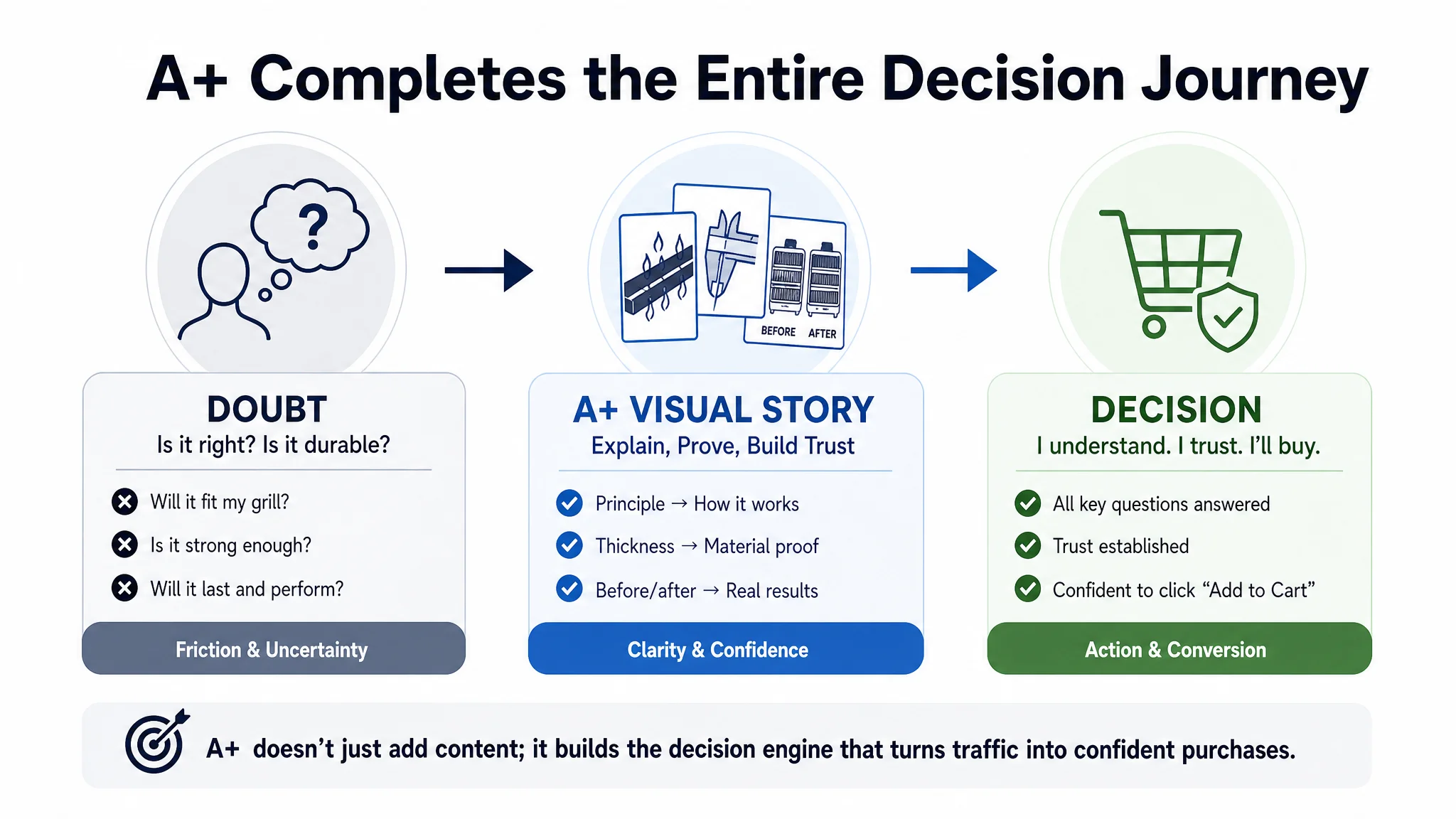
The lesson generalizes: if your A+ looks active but still leaves buyers to “fill in the blanks” on fit, durability, usage, and maintenance, your CVR will be artificially capped. Strong A+ content doesn’t just pad the page; it systematically removes doubts that keep shoppers from clicking “Add to Cart.”
Competitive Pricing and Promotions
Price is a critical factor in the buying decision. A successful strategy involves not just setting a competitive price point but also monitoring the market to maintain it. Additionally, strategic promotions like coupons and limited-time deals create a sense of urgency and increase the perceived value of your offer. This can be the final nudge a customer needs to add your product to their cart instead of a competitor's.
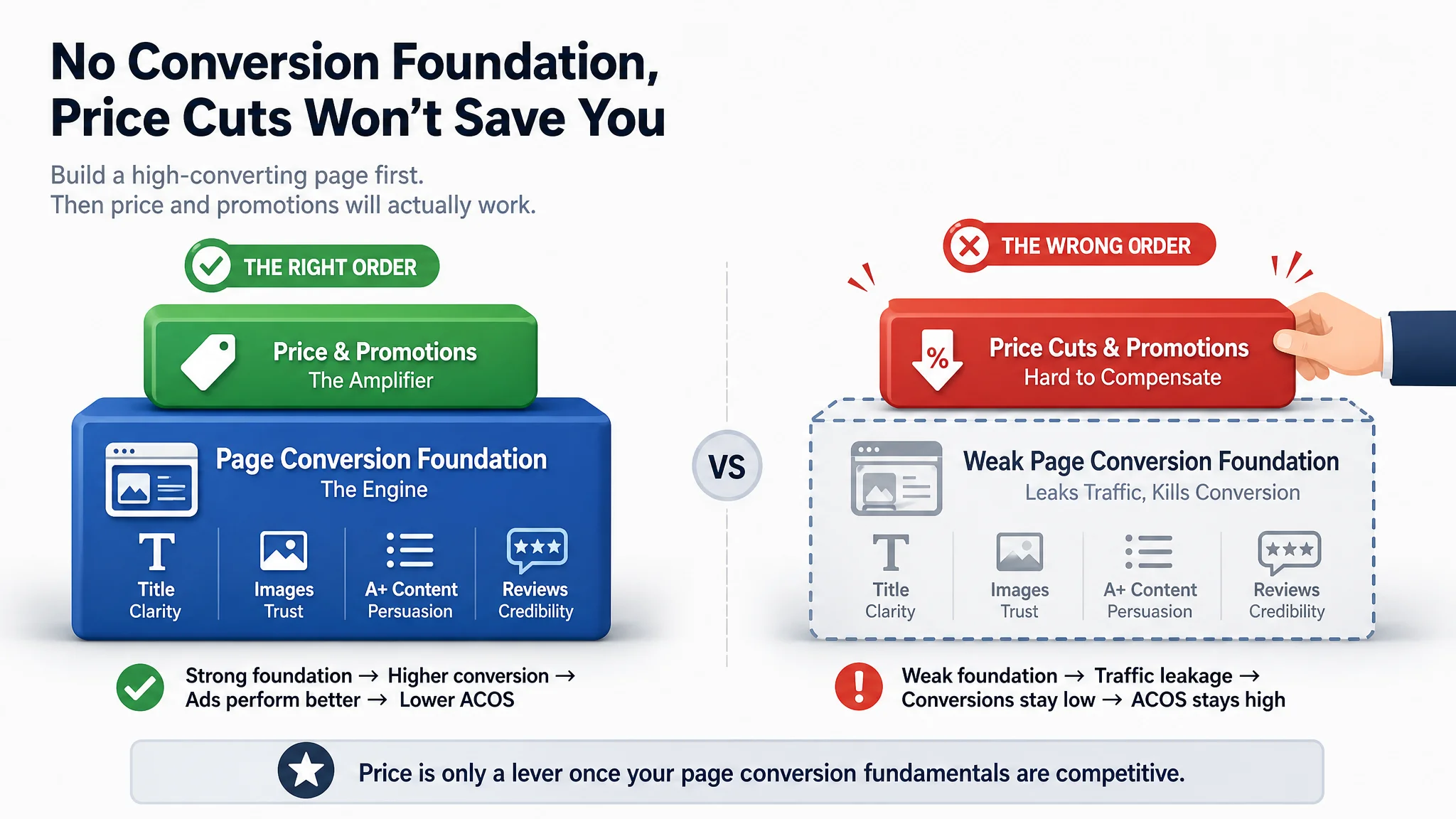
What real cases often show, however, is that sellers lean on price and promotions to compensate for underlying conversion weakness. In the grill-kit example, the seller was competing at a similar price level to the benchmark yet felt forced to push ads harder because the page wasn’t closing traffic efficiently. If your title, images, A+, and reviews trail a key competitor, lowering price or pushing more deals tends to compress margins without sustainably solving CVR issues.
The grill seller’s experience underlines a critical point: price is only a lever once your page conversion fundamentals are competitive. Otherwise, discounts mainly make your inefficient page slightly cheaper to land on, without materially changing how many visitors convert.
Advanced Strategies for Conversion Rate Enhancement
Beyond foundational optimizations, a series of advanced tactics can create a significant uplift in your listing's conversion rate (CVR). These strategies focus on building trust, attracting highly qualified traffic, and creating a seamless, data-driven optimization workflow.
Harnessing Customer Reviews and Feedback
Customer reviews are a powerful form of social proof that directly influences purchase decisions. While encouraging legitimate reviews is crucial, a proactive strategy involves minimizing the risk of negative feedback from the outset. A primary driver of poor reviews is a mismatch between the product images and the actual item received. To prevent this, all visual optimizations must adhere to the principle of 'product entity consistency,' ensuring that AI-enhanced images never alter a product's core attributes like material, color, or design. Analyzing the distribution of star ratings and the volume of reviews against competitors provides a clear benchmark for your product's reputation and identifies areas for improvement.
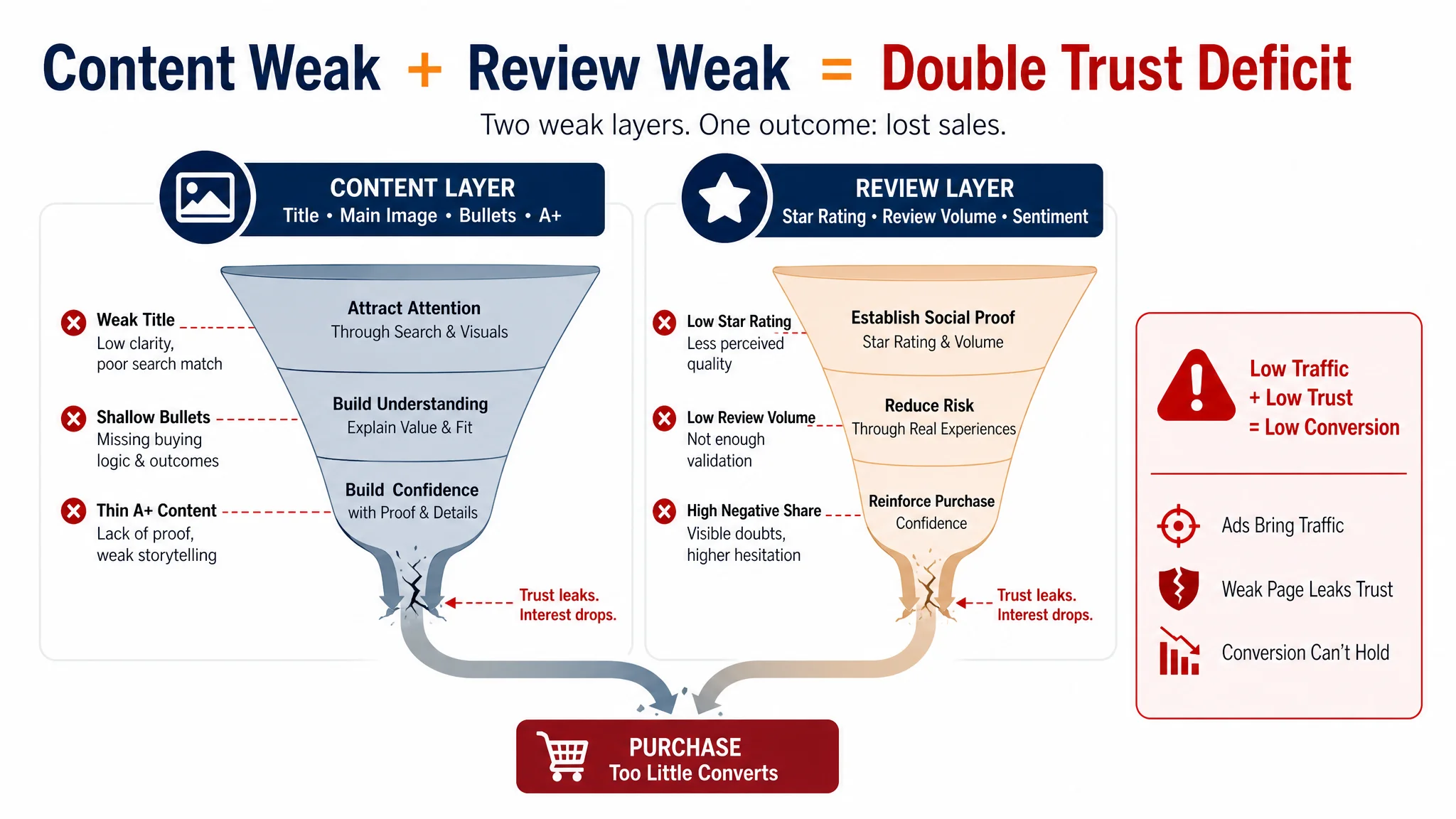
The grill-accessories case illustrates how reviews can either reinforce or undermine all your other efforts. The seller’s listing held a modest rating with very few total reviews, and a noticeable share of the most visible reviews were negative. The benchmark, on the other hand, had a significantly higher rating and a vastly larger review base, with early-page sentiment overwhelmingly positive.
From a shopper’s perspective, the comparison is stark:
- Page A: limited social proof, visible complaints, weaker visuals and A+.
- Page B: dense, positive social proof, polished content, and rich decision-support visuals.
Even if both products are priced similarly and share similar raw specs, the higher-trust page will convert more of the same traffic. For the grill seller, this meant their ad spend had to fight not only weaker content, but also a visible review deficit. DeepBI’s conclusion was that improving page conversion—through more credible visuals and clearer explanations—was a prerequisite to gradually improving review volume and sentiment over time.
Strategic Keyword Integration and Backend Optimization
Effective keyword strategy is not just about driving traffic; it's about attracting shoppers with high purchase intent. A higher CVR is the natural result of connecting your product to the most relevant customer searches. This requires thorough keyword research and strategic placement throughout your listing. High-conversion keywords should be integrated into your title, bullet points, and main description. Furthermore, populating backend search term fields with relevant, long-tail keywords that don't fit on the main page helps capture additional qualified traffic without cluttering your customer-facing copy.
In the grill case, the initial title underused the strongest, category-standard terms and overemphasized internal part codes. As a result, the listing often missed matching precisely with the highest-intent queries in the category. DeepBI’s benchmark comparison made it clear that successful competitors front-loaded widely used terms like “Flavorizer Bars,” explicit size descriptors, and recognizable grill-series names, then reserved part codes for later in the title or bullets.
Reorienting the title and bullets toward real search behavior did two things at once:
- It improved the alignment between search queries and listing content, making impressions more qualified.
- It clarified the offer to shoppers, which in turn supported higher CVR from the traffic already being driven.
This is the core of strategic keyword integration: not squeezing in as many terms as possible, but ensuring that your most important, high-intent phrases carry both SEO weight and conversion clarity.
Optimizing for Mobile Shoppers
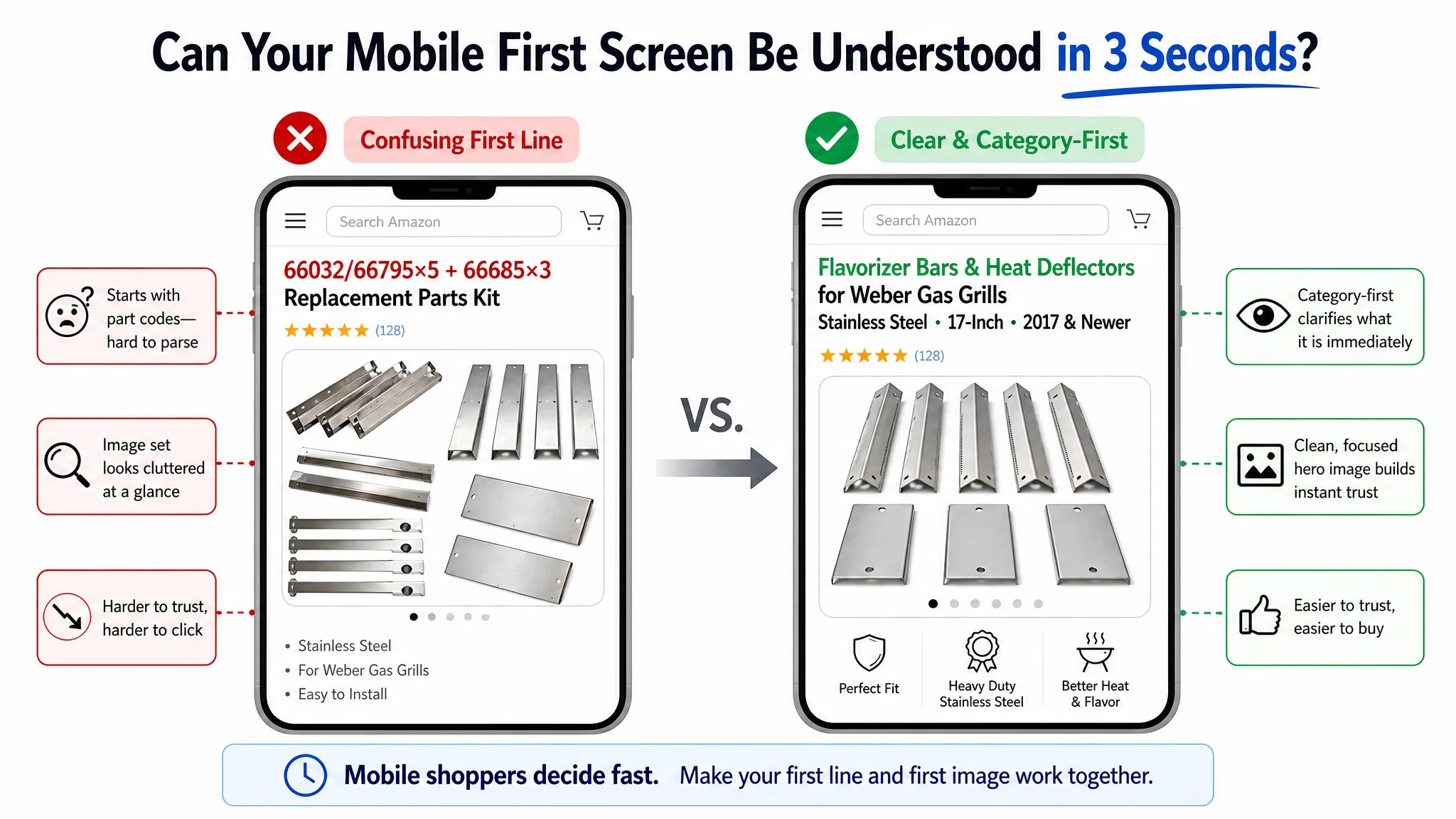
A significant portion of Amazon traffic comes from mobile devices, where shoppers scan content quickly. A mobile-first approach is essential for converting these users. This means prioritizing concise, impactful copy in your title and bullet points so the core value proposition is immediately clear on a small screen. Visuals, especially the main image, must be compelling and easy to understand at a glance. Listings that are not optimized for mobile risk a higher bounce rate and a lower CVR from this large and growing segment of buyers.
When DeepBI reviewed the grill replacement-kit listing, the mobile implications of each weakness became more obvious. A title that starts with part codes is especially punishing on a small screen, where only the first chunk of text is visible. Similarly, images that lack sharp focus on the product or that depend on small, dense infographics become ineffective when shrunk down to mobile size.
The benchmark, by contrast, led with instantly recognizable category terms and clean, high-contrast imagery that remained legible on mobile. As the grill seller’s content was reworked—titles clarified, hooks moved earlier in bullets, and visuals simplified and sharpened—the mobile experience improved alongside desktop, directly supporting better conversion from this critical traffic segment.
Leveraging DeepBI for Continuous CRO Success
Achieving sustained CVR growth requires moving beyond manual, fragmented tasks. DeepBI provides an end-to-end intelligent optimization system that connects diagnosis directly to delivery. The process begins with an automated health check that scores your listing against top competitors, identifying specific weaknesses in visuals, copy, and information hierarchy.
The grill-parts project followed this structure closely. DeepBI’s initial scoring surfaced a -22 point gap versus the benchmark, broken down across title, main image set, bullet logic, A+ depth, and review trust. This made it immediately clear that no single “tweak” would fix conversion; a coordinated rebuild of multiple layers was needed.
Instead of just providing data, the system translates these diagnostic findings into structured, executable optimization strategies. Once approved, these changes can be implemented instantly. Through its official SP-API integration, DeepBI’s One-Click Apply feature syncs optimized content to your listing in seconds, a task that could manually take over 30 minutes. This was particularly useful in the grill case, where multiple images, bullet sets, and A+ modules had to be updated together; manual execution would have made it tempting to “do it later” or only partially implement the plan.
This full-funnel approach ensures that the traffic driven by your advertising and organic efforts lands on a fully optimized page, creating a powerful feedback loop where better listings lead to more precise traffic and healthier long-term growth. For the grill seller, that meant ad traffic stopped being “lost” on a structurally weak page and started to generate more reliable conversion, even without any dramatic change in spend.
Common Pitfalls to Avoid in Amazon CRO
Effective Conversion Rate Optimization (CRO) requires avoiding common mistakes that can undermine your efforts and waste resources. By understanding these pitfalls, you can build a more resilient and data-driven optimization strategy.
Ignoring Competitor Analysis
One of the most significant errors is making listing changes based on subjective aesthetics rather than objective market data. All optimization efforts detached from real market benchmarking are an ineffective use of resources. Many sellers fall into the trap of "misaligned benchmarking"—exclusively analyzing the #1 Bestseller while ignoring crucial differences in product function, price point, or target audience. This leads to implementing changes that don't resonate with your specific customers, failing to improve your conversion rate (CVR).
The grill accessories seller suffered from a different, but related, version of this pitfall: they did not perform a structured, side-by-side comparison at all before trying to “fix” ACOS. Without seeing how far their listing trailed the category leader—on title clarity, visual professionalism, A+ richness, and review depth—they defaulted to tinkering with ads.
When DeepBI surfaced the benchmark listing as the most relevant comparator and quantified the gap (63 vs 85 out of 100), the misalignment became obvious. Many of the changes that followed—rewriting the title around compatibility and material, upgrading the main images to look truly industrial-grade, and expanding A+ into a full decision journey—came directly from studying and diverging intelligently from the benchmark, rather than guessing in the dark.
Ignoring competitor analysis doesn’t just slow you down; it almost guarantees that your listing will be solving the wrong problems.
Neglecting Mobile Experience
A large and growing percentage of Amazon shoppers browse and buy on mobile devices. A listing that looks great on a desktop monitor can be a poor experience on a smartphone, featuring unreadable text, awkwardly cropped images, and difficult-to-scan A+ Content. This friction directly impacts user engagement and can cause potential buyers to abandon your page, depressing your CVR. Optimizing for the mobile view is no longer optional; it's a fundamental requirement for capturing sales.
In the grill case, some of the original visual issues—cluttered backgrounds, small text overlays, and lack of clear focal points—were magnified on mobile. The hero image didn’t instantly communicate “high-grade replacement kit,” and some of the A+ modules relied on dense text within images that became illegible on a small screen.
DeepBI’s optimization not only upleveled the overall aesthetic; it also simplified compositions, enlarged key elements, and reordered information so that the most important messages appeared early and clearly on mobile. By treating mobile as the primary battlefield, rather than an afterthought, the team increased the chances that a time-pressed shopper could understand and trust the offer within a few quick swipes.
Static Optimization Efforts
Treating listing optimization as a one-time project rather than a continuous process is a critical mistake. The Amazon marketplace is dynamic, with competitor strategies and customer preferences constantly evolving. A "set it and forget it" approach guarantees your listing will eventually fall behind. True CRO involves creating a continuous feedback loop, using performance data like click-through rates (CTR) and CVR to inform ongoing adjustments. This transforms optimization from an occasional task into a predictable, scientific process of iterative improvement.
The grill seller’s initial pattern was typical: launch listing, run ads, occasionally adjust bids, but leave the core content largely unchanged. Over time, as ad costs rose and new competitors strengthened their pages, the original listing became structurally outdated without the team really noticing.
Once DeepBI was brought in, the process changed from “react to ACOS spikes” to “regularly score the page, monitor gaps versus the benchmark, and adjust content accordingly.” That shift turned CRO into an ongoing discipline instead of a one-off fix, reducing the risk that the listing would quietly slide back into underperformance.
The Long-Term Impact of High Conversion Rates
Optimizing your listing's conversion rate (CVR) is not just about securing immediate sales; it's a foundational strategy that creates a powerful, positive feedback loop for long-term growth. A high-performing listing sends strong signals to Amazon's ecosystem, unlocking benefits that compound over time, from improved visibility to greater advertising efficiency.
Improved Organic Rankings and Visibility
A high conversion rate is one of the most compelling signals you can send to Amazon's search algorithm. When customers who visit your page consistently make a purchase, it indicates that your product is highly relevant and satisfying for the search terms that led them there. The algorithm is designed to promote such products, which can lead to improved organic search rankings. This enhanced visibility drives more natural, non-paid traffic to your listing, creating a self-sustaining cycle of discovery and sales.
The grill-kit case underscores this dynamic indirectly. Before any content overhaul, the listing’s weaker CVR limited its ability to climb organically, forcing the seller to rely more heavily on paid traffic. As the page’s conversion capacity improved—through more persuasive visuals, clearer titles and bullets, and stronger A+—paid traffic began to convert more efficiently, and the listing was better positioned to earn favorable signals from Amazon’s algorithm.
In other words, the listing moved from being a drag on organic potential to being an asset that could credibly compete with the benchmark, rather than just paying to appear next to it.
Enhanced Ad Performance and ROI
For sellers utilizing Sponsored Products, a high-converting listing is a critical asset for maximizing advertising efficiency. Every click you pay for has a greater chance of becoming a sale, which directly lowers your Advertising Cost of Sales (ACoS). This means your ad budget works harder, generating more revenue for every dollar spent and improving your overall return on investment (ROI). By converting stable advertising data into stronger performance, you can achieve a lower Total Advertising Cost of Sales (TACoS) and increase profitability.
In the grill-parts project, this relationship was clear: before optimization, every paid click landed on a structurally weaker page and was “consumed” by underwhelming content and low trust. The seller tried to fix ACOS purely by refining campaigns, but without a strong listing, the ad engine had nothing solid to amplify.
After DeepBI guided a pivot to rebuilding the page—clarifying titles, professionalizing images, enriching A+, and tightening bullets—the same fundamental ad infrastructure started to behave differently. Traffic quality hadn’t suddenly changed; the page’s ability to convert that traffic had. As a result, ad spend became more productive, and the seller stopped viewing ads as a standalone problem and started seeing them as one part of a broader conversion ecosystem.
Sustainable Business Growth on Amazon
Ultimately, sustained conversion rate optimization builds a healthier, more resilient Amazon business. By improving organic rank and ad efficiency, you reduce your dependency on paid traffic and establish a long-term, healthy revenue flywheel. This creates a commercial feedback loop: a better listing attracts more qualified traffic, which leads to more sales and reinforces your market position. This transforms listing management from a one-off task into a dynamic process that drives sustainable growth and profitability.
The grill-accessories case illustrates this evolution in mindset. Initially, the seller treated ad spend as the main growth lever and the product page as a largely static asset. DeepBI’s diagnostic process flipped that logic: the listing itself became the central engine to upgrade, and ads were reframed as a force multiplier for a page that was now structurally closer to the category benchmark.
For other Amazon sellers, the takeaway is straightforward:
- If your ACOS is rising and your instinct is to “optimize ads harder,” first ask whether your listing actually deserves more traffic.
- Use structured, competitor-based diagnostics to see where your page is lagging—title clarity, image trust, A+ depth, or review strength.
- Treat CVR as the core health signal of your listing, not just a background metric.
When you align your efforts this way—using tools like DeepBI to connect real-world gaps to concrete optimizations—you move from reacting to symptoms to rebuilding the system that ultimately determines your Amazon success: your ability to convert visits into confident purchases.