

Introduction
Optimizing an Amazon listing can often feel like a high-stakes gamble. The traditional process is fragmented, with market diagnosis, content strategy, creative production, and final delivery handled in separate stages by different teams or tools. This disjointed workflow compels sellers to rely on subjective aesthetics and educated guesses, leading to changes that are difficult to justify with data and nearly impossible to measure for impact. The result is a cycle of wasted resources and uncertain outcomes, leaving sellers unable to determine whether a new image or revised bullet point helped or hurt performance.
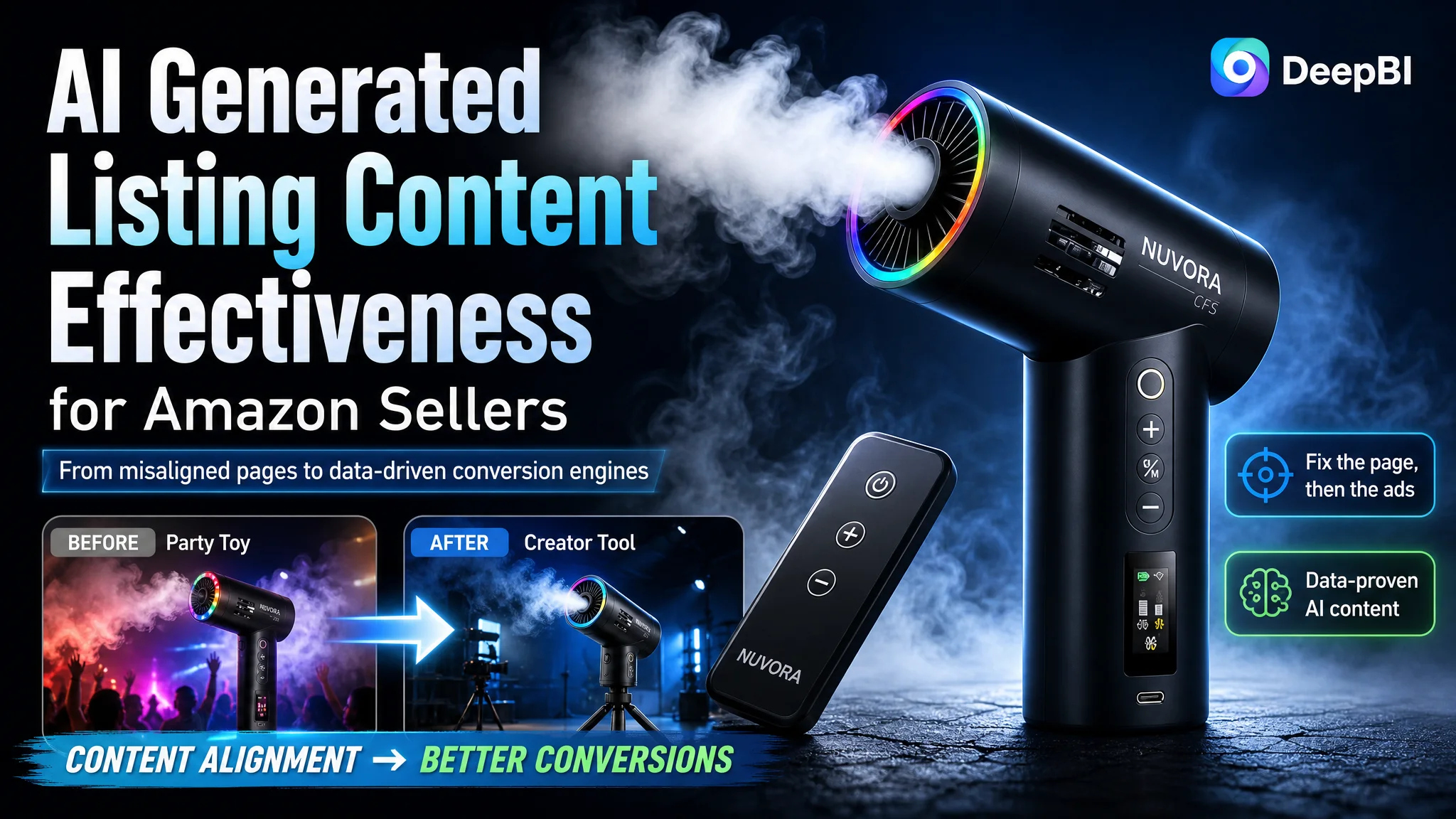
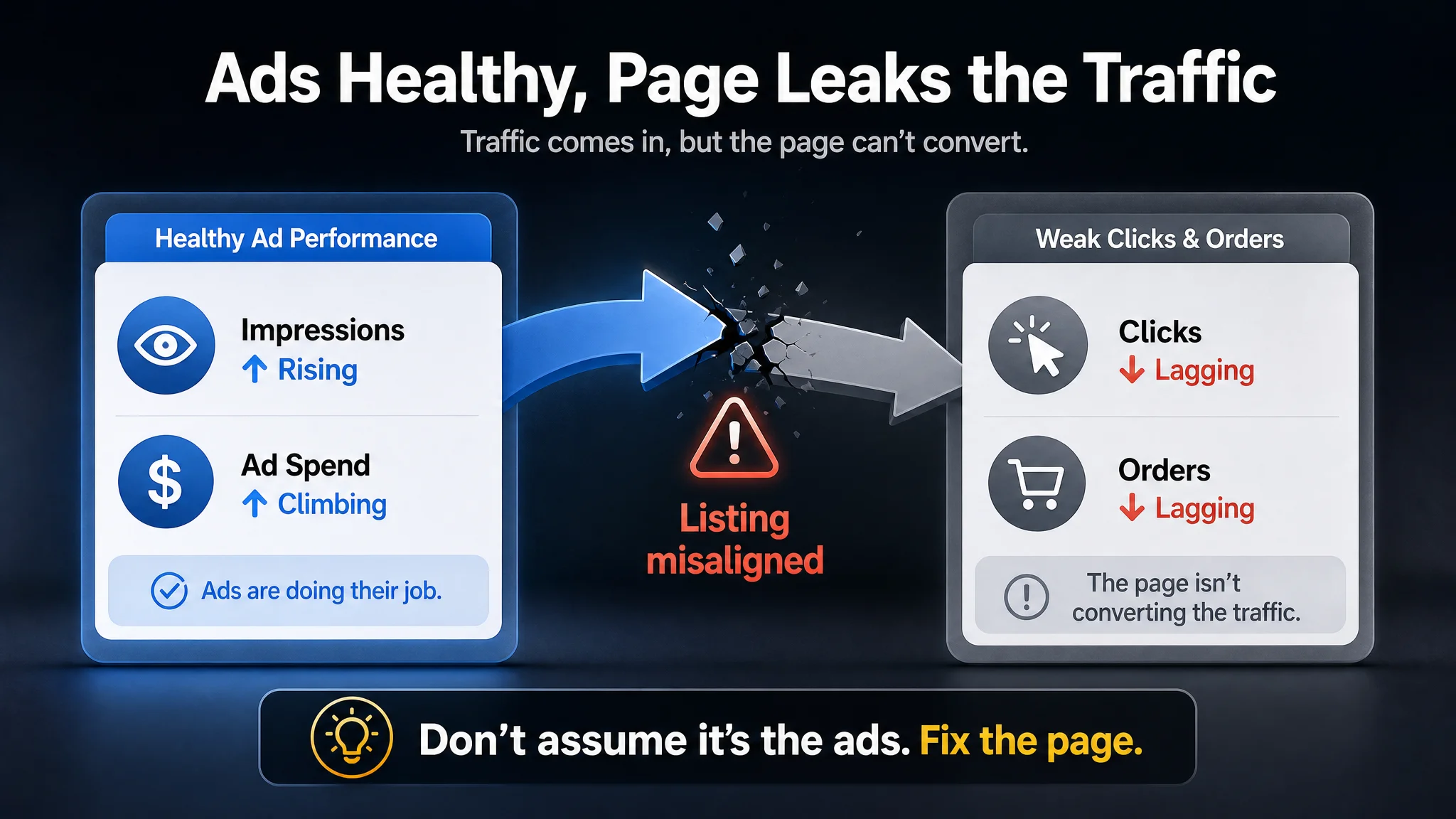
This pattern shows up very clearly in real operations. A photography accessories seller DeepBI worked with had a handheld fog machine on the German marketplace. Impressions from ads were healthy, spend was climbing, but clicks and orders lagged. Because their overall Listing score in DeepBI slightly exceeded a key competitor’s, the team assumed “the page is fine, the problem must be ads.” For weeks they cycled through keyword tweaks and bid adjustments, with little change in outcomes—classic high-stakes guesswork with no clear feedback loop tying specific listing changes to business metrics.
The core business problem with this approach is the inability to quantify the return on optimization efforts. When you cannot draw a direct line from a specific content change to its effect on key performance indicators like Click-Through Rate (CTR) and Conversion Rate (CVR), you are operating without crucial feedback. This absence of a data-driven loop is the primary reason many listing updates fail to produce meaningful growth. Without a mechanism to connect an action to a result, even the most well-intentioned modifications become shots in the dark that risk damaging a product’s momentum.
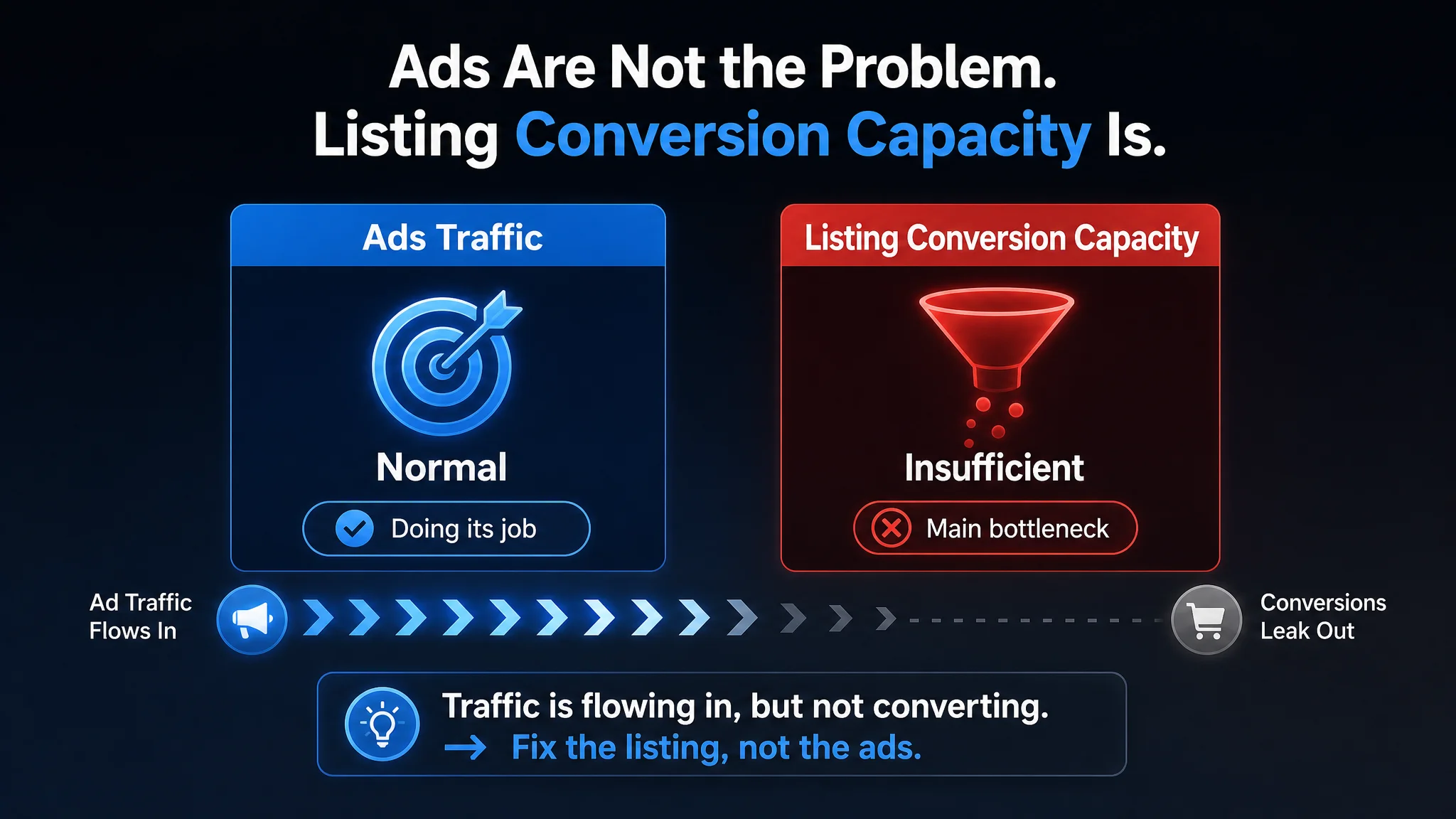
In the fog machine case, DeepBI’s side‑by‑side diagnosis against a benchmark ASIN showed that the issue was not a lack of impressions or a broken campaign structure. Ads were doing their job and bringing traffic in; the listing itself was not aligned with how the real decision‑makers—content creators and professional users—actually chose products. Title and bullets under‑served the product’s strengths, so much of the paid traffic simply leaked out without converting. The seller’s “ads problem” turned out to be a listing conversion capacity problem that had never been measured explicitly.
To break this cycle, leading sellers are adopting a new perspective: listing optimization is not a one-time task but a continuous, data-driven process. This modern approach relies on a full-funnel intelligent system that unifies the four critical stages—diagnosis, planning, production, and delivery—into a single, cohesive workflow. By connecting these previously isolated steps, optimization evolves from a series of ambiguous creative decisions into a predictable, quantifiable, and scientific path designed to produce measurable business results.
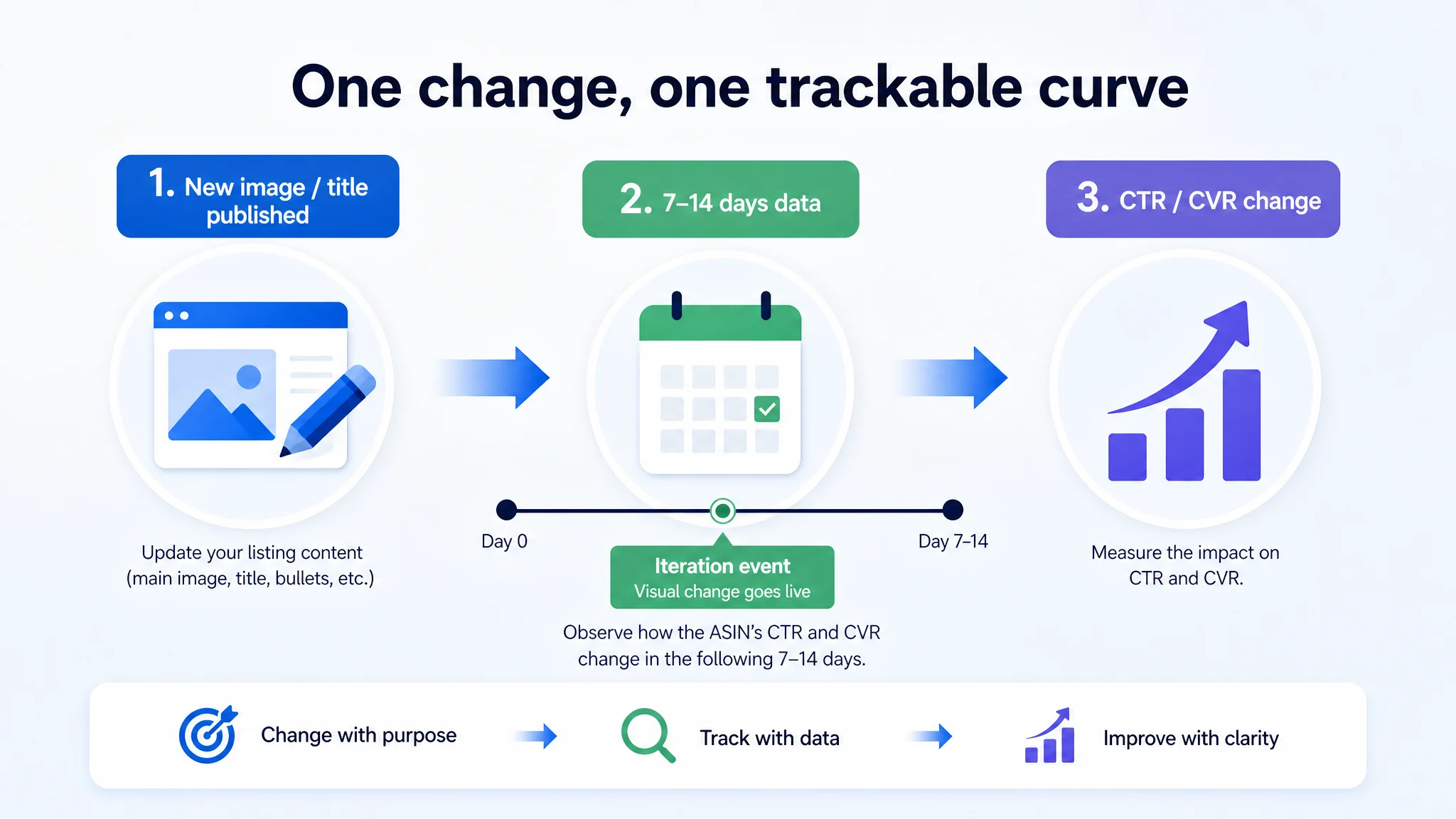
The key to this transformation is a closed data loop that connects execution to performance tracking. For instance, when a new main image is published to a listing, the system can automatically mark a "visual iteration event" in the corresponding advertising reports. This allows you to directly observe how the ASIN's CTR changes in the following 7 to 14 days, replacing subjective judgment with objective, actionable data. In the fog machine project, this type of event marking made it possible to see how the rebuilt title and bullets, once deployed, affected click and conversion behavior after weeks of ineffective ad tweaks. The goal is to ensure that every pixel change can be converted into a visible improvement in your most important metrics. This article will explore how this integrated, AI-powered approach moves beyond simple content creation to build a powerful engine for sustained growth on Amazon.
AI-Powered Tool for Powerful Listings: The Core Engine
To consistently win on Amazon, sellers need more than just a content generator; they require an end-to-end optimization engine. DeepBI provides this by integrating diagnosis, strategy, production, and delivery into a seamless workflow built exclusively for the Amazon marketplace. This system transforms the slow, fragmented process of listing updates into a rapid, data-driven cycle.
The fog machine seller’s experience is a practical illustration of why this kind of engine is necessary. Initially, they were looking for “better creatives” to support their ad campaigns, assuming that incremental changes to images might improve click‑through. When DeepBI’s Listing module ran a diagnosis against a true benchmark ASIN, the output was far more specific: despite a higher total Listing score, the seller lagged the competitor on the very dimensions that anchor search and on‑page persuasion—title and bullet points—while over‑indexing on A+ richness and main image quality. In other words, the raw creative assets were not the only issue; the way those assets were structured into a conversion story was misaligned.

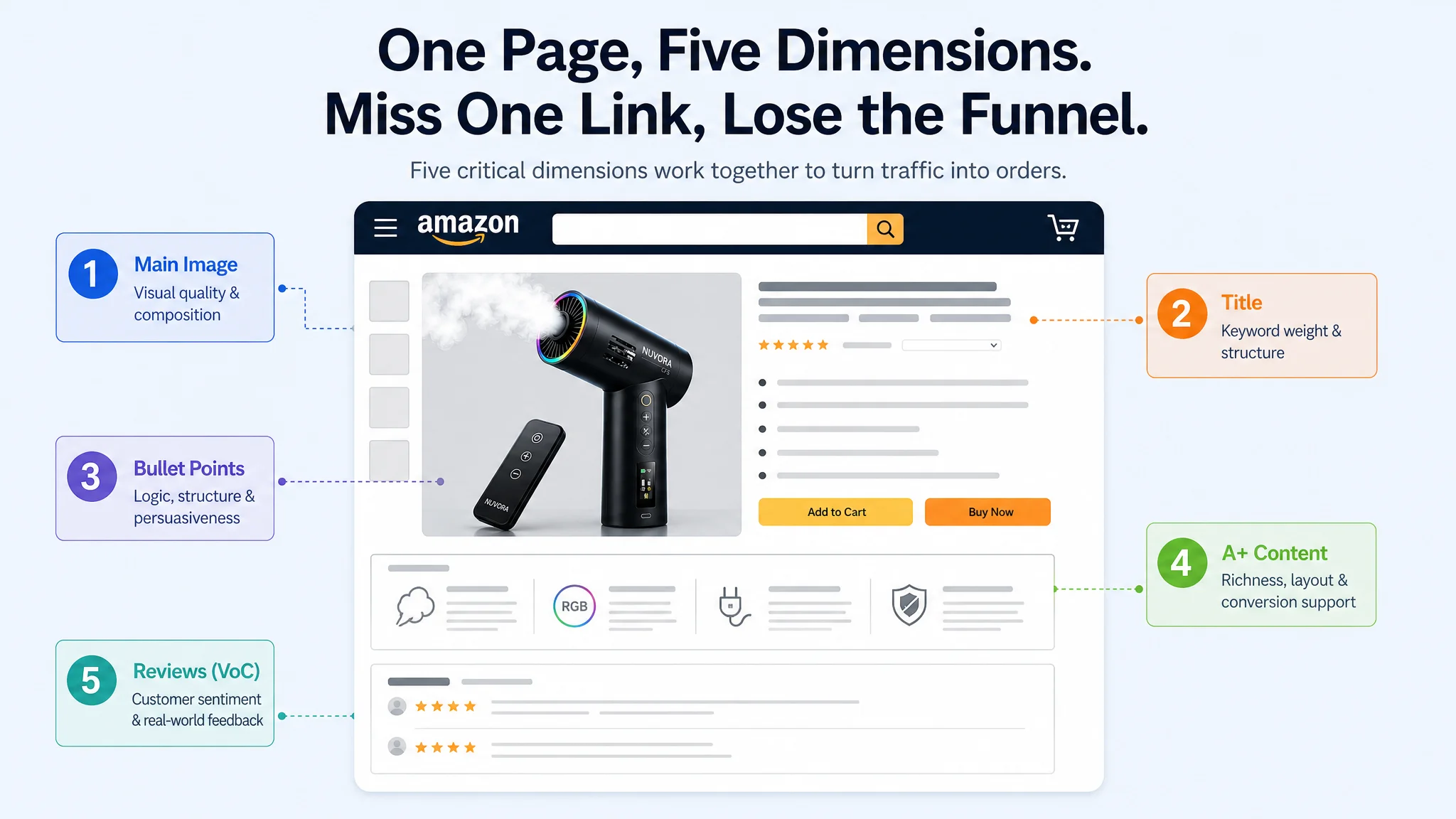
The workflow begins with intelligent diagnosis. Instead of relying on simple keyword matching, the system uses multi-dimensional semantic benchmarking to identify your true top-performing competitor, or Benchmark ASIN. It then conducts a comprehensive audit of your listing against this benchmark across five critical dimensions:
- Main image visual quality and composition
- Title keyword weight and structure
- Bullet point logic and persuasiveness
- A+ Content richness and layout
- Voice of the Customer (VoC) sentiment analysis from reviews
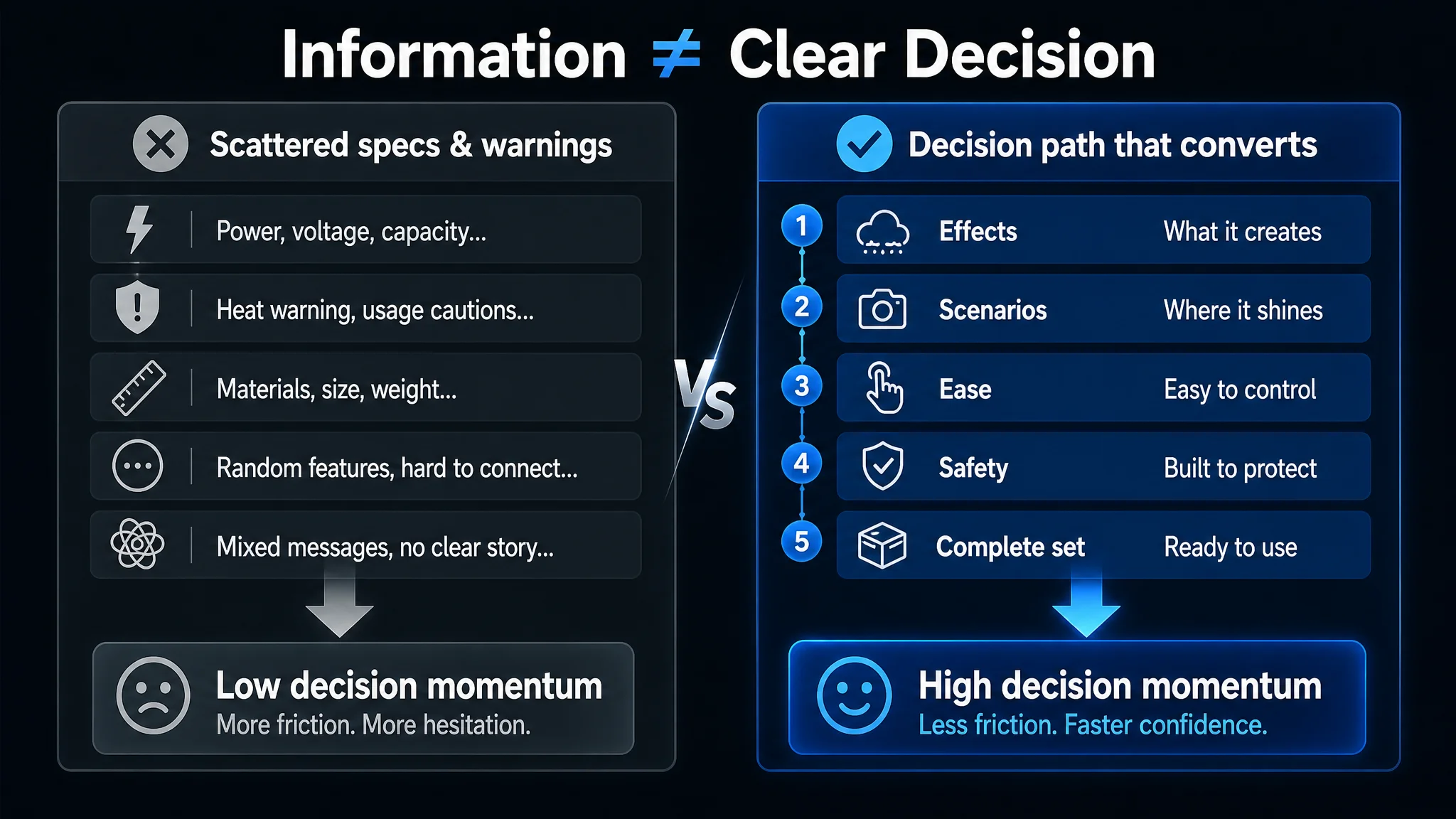
In the fog machine case, that audit revealed a subtle but important pattern: the seller “won” on main image and A+ detail page scores, and had strong ratings and rich photo/video reviews, but trailed the competitor in title and bullet scores. On the search results page, this meant the competitor framed the product more clearly for content creators and photographers. On the product page, the competitor’s bullets walked buyers through a clear decision path—effects, scenarios, ease of use, safety, completeness—while the seller’s bullets stayed closer to parameters, warnings, and scattered features. The diagnosis made visible why ad traffic felt “expensive”: it was being pushed into a page that did not fully reflect the way buyers in this niche make decisions.
This data-driven diagnosis generates a concrete optimization strategy, turning abstract goals into precise, AI-executable instructions. The AI then produces compelling titles, structured bullet points, and A+ content designed to address identified weaknesses. For the fog machine, the strategy was not “add more buzzwords”; it was to reframe the title around the most valuable roles (“photography, video, content creator” instead of centering “cosplay”), attach 40W power and multi‑mode capability to clear creative outcomes, and rebuild the bullets into a progression from professional effects, control and RGB lighting, through safety, all the way to a “ready‑to‑use complete set.”
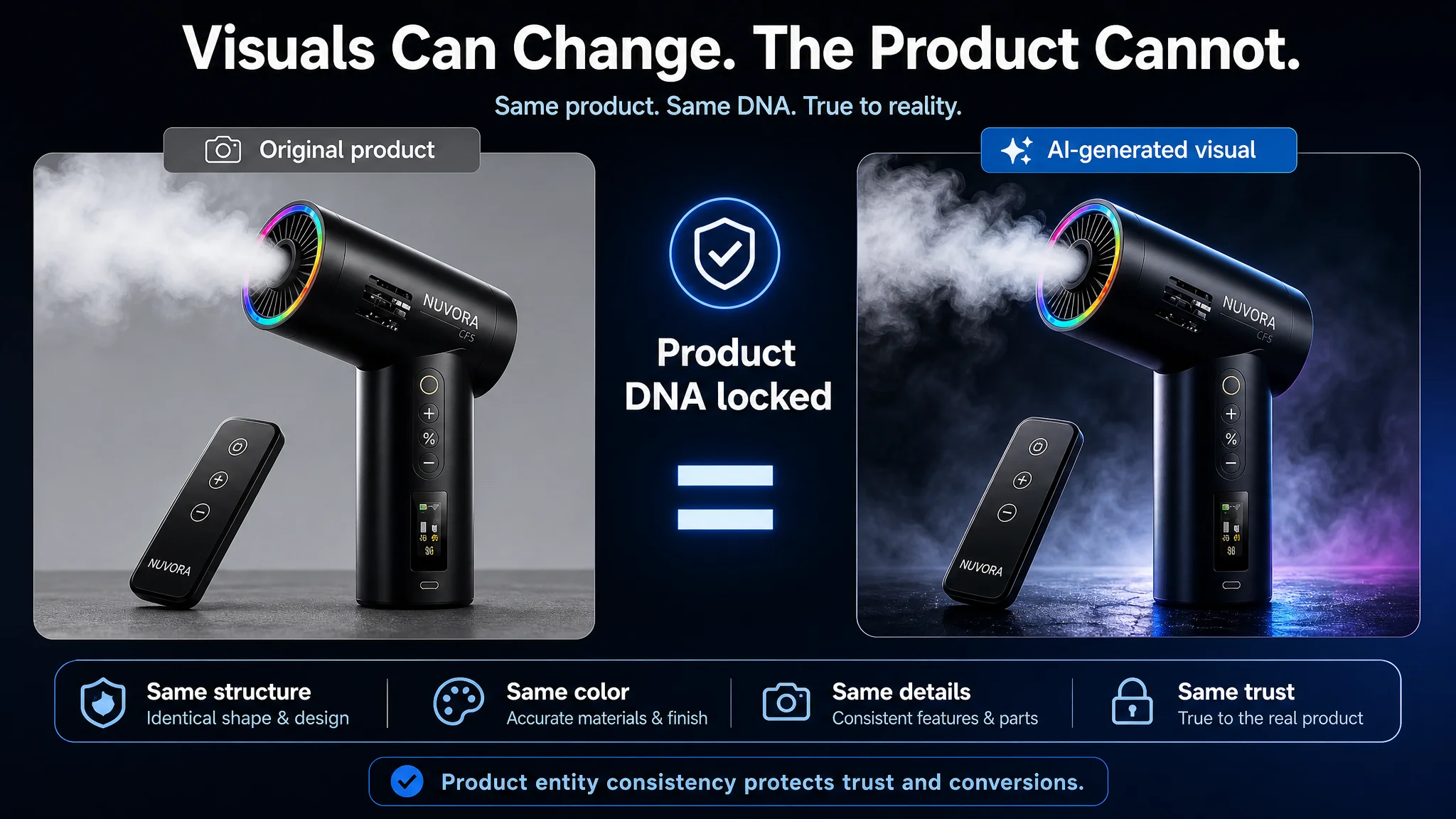
For images, the system operates as an automated visual production system, not a generic AI art tool. It establishes a "Product DNA" map to ensure the AI never alters the product's core material, color, or design. This principle of "product entity consistency" is critical for preventing image-product mismatches that lead to damaging negative reviews and returns. In the fog machine listing, DeepBI’s recommendations focused on re‑prioritizing visual modules—such as giving more visual weight to a dense‑fog 40W vs 30W comparison or a clean “exploded view” of the detachable RGB fan—without changing the product’s true look and feel. You can generate and compare multiple content versions side-by-side before making a final decision.
Once you approve the new content, the final step eliminates the operational bottleneck of manual updates. Instead of a tedious process of downloading, renaming, and uploading files one by one, DeepBI’s one-click publishing feature uses Amazon's official SP-API to sync all changes in seconds. By connecting every stage of the process, sellers have successfully shortened their entire listing update cycle from weeks to a matter of hours, accelerating their ability to adapt and outperform the competition. For the fog machine seller, this meant that once the new role‑focused title, re‑sequenced bullets, and refined A+ visuals were produced, the entire conversion story could go live quickly enough for the next wave of ads to test it—rather than losing additional weeks while manual changes crawled through internal workflows.
Amazon PPC Tool: Amplifying Content Performance through Data
Even the most compelling AI-generated listing content is incomplete until it is tested with real customer traffic. A dedicated PPC tool closes this gap, transforming advertising spend into a powerful data feedback mechanism that validates and refines your content strategy. The objective is not just to drive traffic, but to measure precisely how your listing’s title, bullet points, and A+ Content perform under real-world conditions.
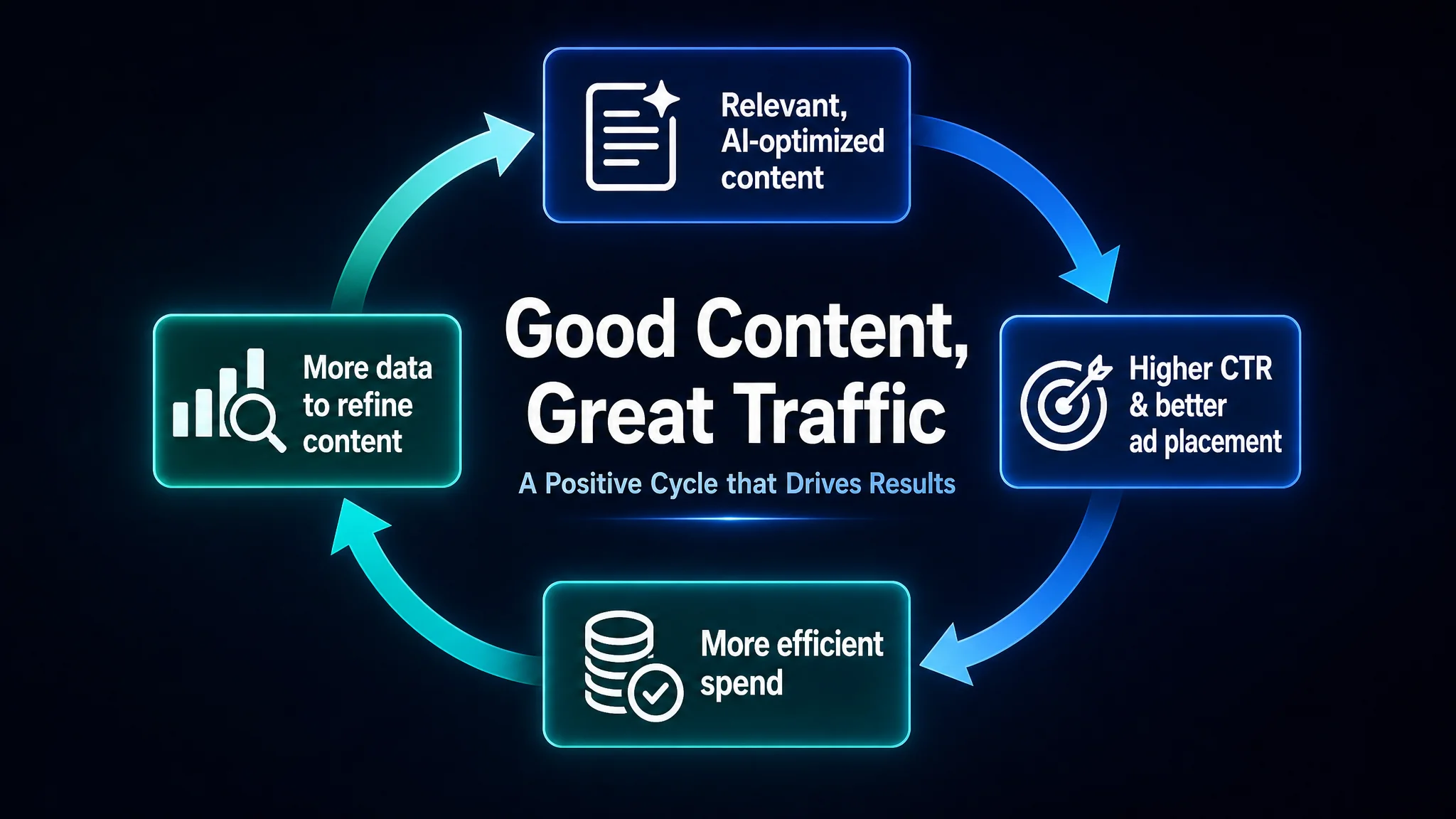
On Amazon, content quality is directly tied to advertising efficiency. The platform’s ad algorithms reward relevance; listings that are well-aligned with customer search terms earn better ad placements and higher click-through rates (CTR). When your AI-optimized content effectively integrates high-converting keywords and persuasive messaging, it naturally improves your ad quality score. This creates a positive cycle where better content leads to more effective and often less expensive advertising.
Before their listing was rebuilt, the fog machine seller’s experience looked very different. Ad reports showed impressions and spend accumulating, but CTR and subsequent orders lagging. Internally, the discussion stayed inside the ad console: new campaigns, alternative keyword sets, bid adjustments. Because the page “looked good” and carried a decent overall score, very few people questioned whether the listing itself was the primary constraint. When DeepBI’s Ads Quant module began cross‑comparing ad performance with listing diagnostics, it became clear that ads were not the bottleneck; the traffic they were buying was simply arriving at a page whose title and bullets did not speak strongly enough to photographers, videographers, and content creators.
DeepBI’s Ads Quant module is designed to quantify this relationship by creating a direct data connection between your listing content and ad performance. The system establishes a clear feedback loop by cross-validating content scores with actual business metrics like CTR and conversion rates (CVR). For instance, if ad reports show consistently low CTR despite high impressions, the tool can identify the main image as the likely weak point. Conversely, if CTR is strong but CVR is low, it signals that the A+ Content and descriptive text are failing to persuade shoppers to complete the purchase.
In the handheld fog machine case, the diagnosis landed in the second category: traffic was being acquired, but too much of it was dropping off without adding to cart. Content scoring showed the main image and A+ modules were competitive, while title and bullets underperformed against the benchmark. Ads Quant was able to connect these dots and help reclassify the “ACoS problem” as a “listing persuasion problem,” directing the optimization effort toward the page rather than endlessly pruning bids.
This process is amplified by a multi-layer traffic funnel that systematically tests which content variations perform best. The Listing module drives core content optimization, while the Ads module magnifies the results by directing targeted traffic. This synergy ensures that decisions are based on performance data, not guesswork. For example, after the fog machine seller implemented a content refresh—introducing role‑focused titles, a more logical bullet sequence, and visuals that visibly tied 40W power and 25 modes to cinematic outcomes—subsequent advertising data could be read very differently. Instead of treating every change in ACoS as a bidding issue, the seller could see how the newly aligned listing started to convert specific traffic segments more efficiently, and which search terms (e.g., photography or video shoots) now responded better because the page clearly mirrored those intents.
Many sellers see a notable reduction in their Advertising Cost of Sales (ACoS) because their ads become inherently more relevant and convert traffic more efficiently. The key insight from the fog machine project is that this improvement did not come from “smarter ads alone,” but from ads and content working together: once the listing finally deserved the traffic, ad spend stopped feeling like an endless cost and started functioning as a diagnostic and amplification tool.
This data-driven cycle—Better Listing + More Precise Traffic—is the foundation for healthier, long-term growth.
Next-Gen Ad Automation: Scaling the Impact of AI-Optimized Listings
Automated advertising tools promise efficiency, but they cannot fix a fundamental problem: a listing that does not convert. Directing ad spend toward a poorly optimized product detail page only automates a wasted budget. The true potential of ad automation is unlocked when it is fueled by high-quality, data-driven listing content that maximizes the value of every click.
Modern ad management systems operate on a simple feedback loop, analyzing performance data like click-through rates (CTR) and conversion rates (CVR) to make bidding decisions. If a campaign shows a low CTR, the system may reduce bids, assuming the ad is irrelevant. If it has a low CVR, it may conclude the traffic is not valuable. However, the root cause is often not the ad itself but the listing content that fails to engage or persuade the customer upon arrival.
This misdiagnosis is exactly what happened in the fog machine scenario before DeepBI’s intervention. Automated and manual adjustments were repeatedly applied to bids and keyword sets in an attempt to tame high ACoS. On paper, this seemed rational: the overall Listing score was slightly higher than the competitor’s, reviews were strong, and main images looked professional. From the perspective of a standard ad optimization tool, the content didn’t obviously flag as a weakness. But once DeepBI linked ad metrics to a dimension‑by‑dimension content analysis, it was clear that automation was reacting to symptoms (low CVR) while the underlying cause—title and bullet misalignment with buyer roles and decision logic—remained unaddressed.
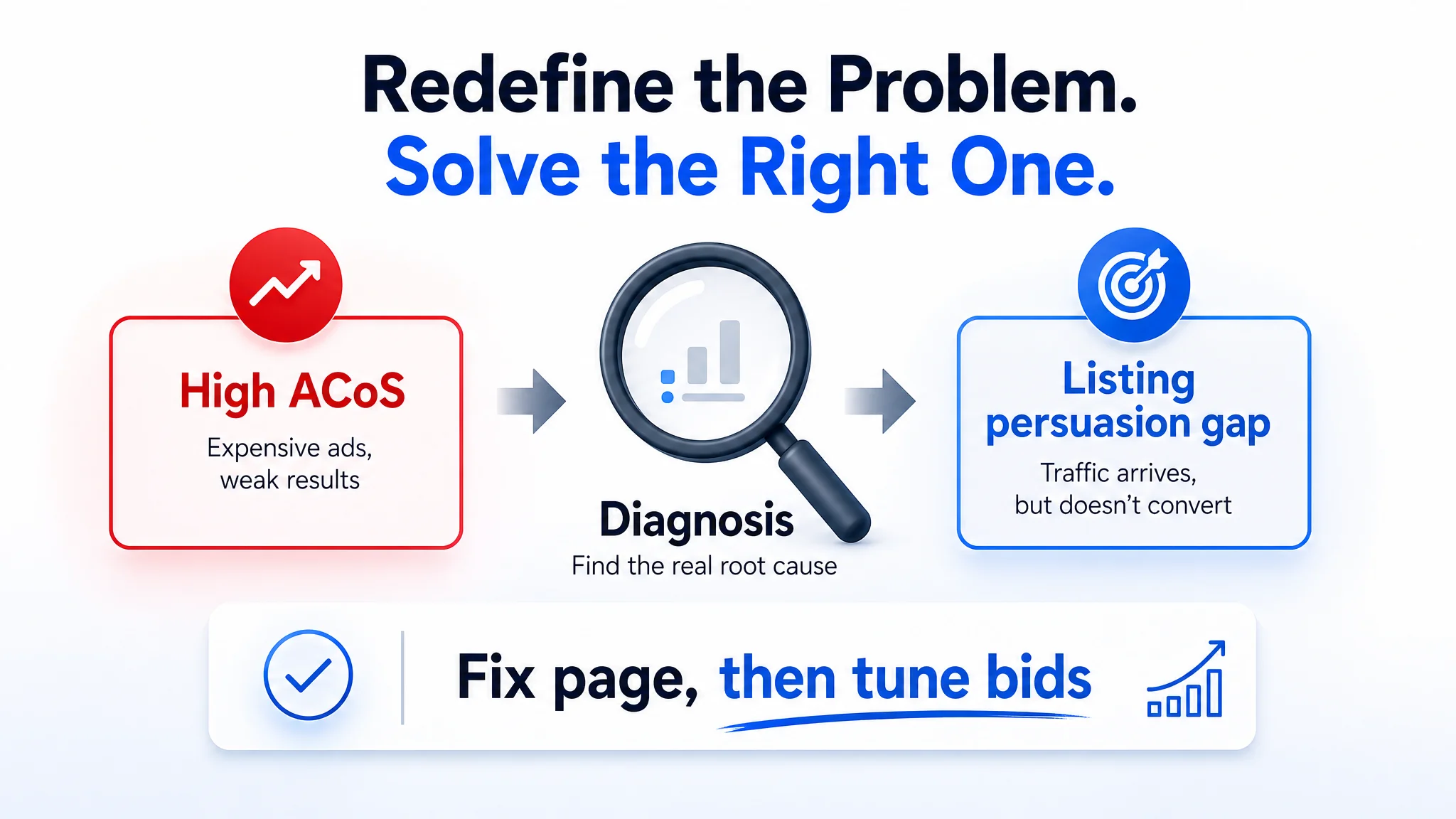
This is where an integrated content and advertising system creates a powerful virtuous cycle. DeepBI’s platform connects these two functions directly. The system uses advertising data to diagnose listing weaknesses—for example, a low CTR points to a weak main image, while a poor CVR suggests issues with A+ Content. The AI Listing module then generates optimized content to resolve these specific problems.
For the fog machine, that meant ad data helped confirm that shoppers attracted by creative‑oriented queries were not finding a page that spoke clearly to creative outcomes. The Listing module responded with a new narrative: a title centered around photography, video and content creation; bullet points that walked through professional effects, RGB lighting and control, safety, and a complete kit; and A+ visuals that shifted from generic “fog machine” aesthetics to proof‑driven images of cinematic portraits, density comparisons, and multi‑device remote control in action.
Once the new, higher-performing content is published, the impact is measured almost immediately. DeepBI’s ad automation evaluates performance based on 7-day rolling metrics. As the improved listing boosts CTR and CVR, the ad system registers these positive signals and adjusts its strategy accordingly, allocating budget more effectively to a now-proven asset. Better AI-generated content amplifies ad performance by improving relevance scores, which in turn allows next-generation automation to allocate budget more intelligently.
This end-to-end approach breaks down the traditional silos between operations. The Listing module acts as the content engine, while the ad management tool (Ads Quant) serves as the traffic and optimization engine. By ensuring the content is built to convert from the start, sellers empower their automation tools to move beyond simply managing spend and begin driving truly profitable growth. The fog machine seller’s shift—from “keep tuning campaigns” to “rebuild the conversion story, then let automation scale what works”—highlights how next‑gen ad tools reach their potential only when paired with truly optimized listings.
AI Content and Organic Growth: Closing the Loop
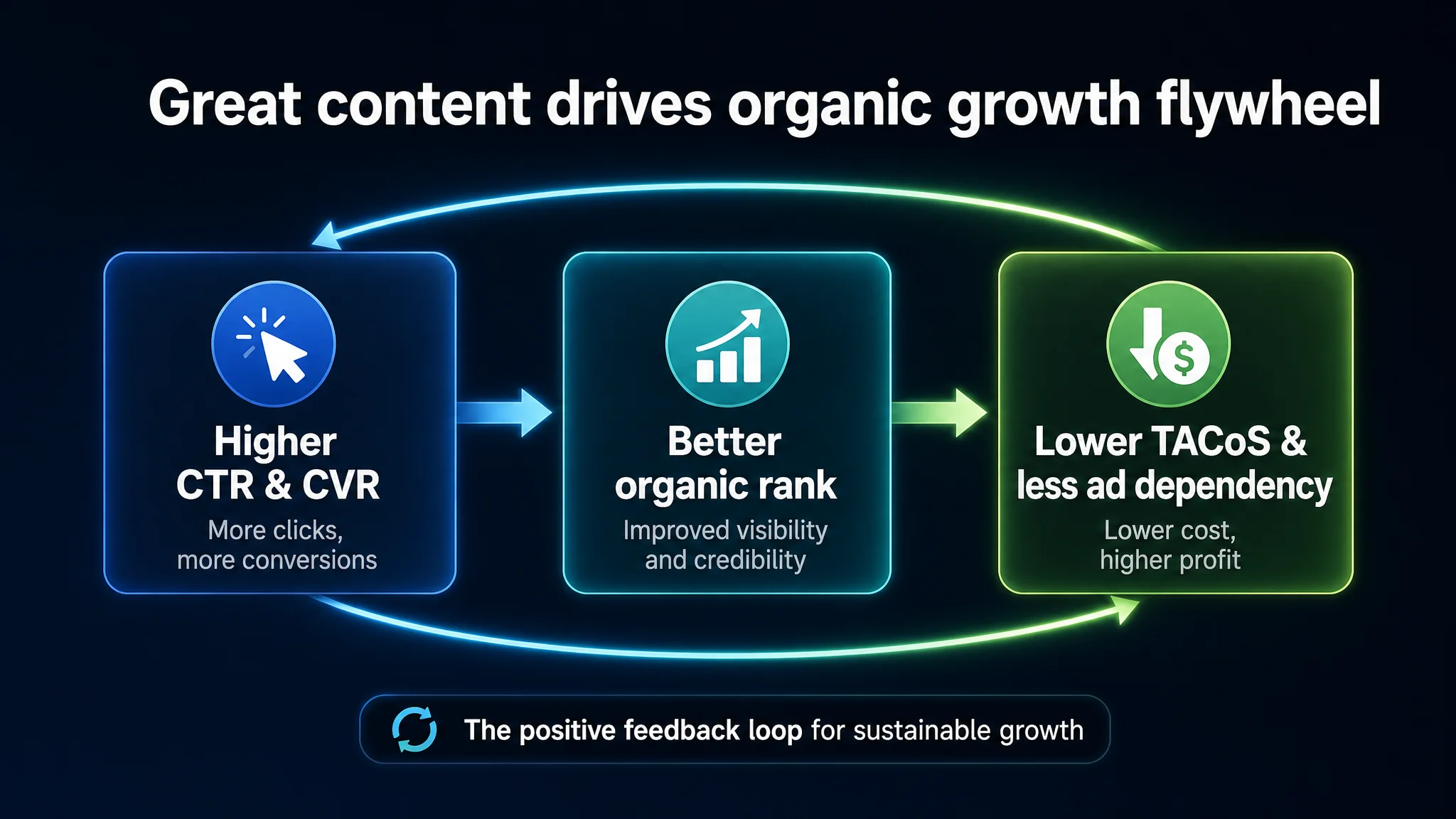
Driving sustainable growth on Amazon requires breaking the expensive cycle of over-reliance on advertising. The most effective way to achieve this is by creating a positive feedback loop where superior listing content directly fuels organic ranking improvements. This, in turn, reduces ad dependency and lowers your Total Advertising Cost of Sales (TACoS), transforming your listings from static product pages into dynamic growth assets.
The connection between content quality and organic rank is direct. Amazon's A9 algorithm rewards listings that shoppers engage with and purchase from. A listing with a high Click-Through Rate (CTR) and a strong Conversion Rate (CVR) signals relevance and customer satisfaction, prompting the algorithm to grant it better visibility in organic search results. In this context, AI-driven content generation becomes a strategic lever for growth, and visual assets evolve from mere aesthetic displays into a core commercial engine that drives clicks and conversions.
The fog machine listing shows how a misframed product page can quietly suppress this growth flywheel. Before optimization, the title leaned into generic descriptors and niche seasonal use cases like cosplay and Halloween, while the main organic growth potential actually lay with recurring professional and semi‑professional usage—photography, videography, content creation. Bullet points delivered technical parameters and warnings rather than clear creative outcomes and trust‑building messages. Even though A+ visuals were relatively rich and reviews were strong, the parts of the page most visible in search and quickly scanned by shoppers were not aligned with the highest‑value organic opportunities.
An advanced AI system closes the loop between paid advertising and organic performance. It does not just generate content; it uses real-world ad data to determine what content to create. This process establishes a clear business cycle: Better Listings + More Precise Traffic = Healthier Long-Term Growth.
This synergy works by deeply integrating with your ad reports to perform "keyword weighting" and feature analysis.
- If ad data reveals that a specific attribute, like "fast charging," is a high-conversion term for your product, the AI generation engine gives that feature weighted emphasis in the new visual and text content.
- Similarly, if data shows a product variant with a "premium fabric feel" has an outstanding conversion rate, the system can extract this visual concept and apply it with added weight to the main image generation for the entire product line.
In the fog machine case, a similar logic applied: search and ad term behavior around “photography,” “video production,” and “content creator” signaled valuable, higher‑intent demand, but the page was originally giving disproportionate space to lower‑value, occasional roles. DeepBI’s generation engine effectively reweighted these roles in both text and visuals, ensuring that the listing spoke first and most clearly to the audiences whose behavior data showed the best conversion potential.
By empowering your listings with features proven to convert through ad data, the AI ensures your content is optimized for maximum performance from day one. The resulting increase in CTR and CVR from this superior content sends strong positive signals to Amazon's algorithm, leading to improvements in organic ranking. Over time, as the fog machine listing’s story was rebuilt around creators rather than one‑off party uses, the same attention‑grabbing assets that helped ads perform better also made the page more compelling for organic visitors searching relevant terms. This establishes a long-term, healthy profit flywheel where your best-performing ad signals are converted directly into stronger organic rankings and a lower overall ad spend.
Accurate Sales Data Analysis and Predictions: The Proof Behind AI Content
One of the greatest challenges for Amazon sellers is proving that a specific content change—a new title, a revised bullet point, or an updated main image—directly caused an increase in sales. Without a clear connection, optimization remains a cycle of guesswork. Confident decision-making requires moving from ambiguity to precision, which involves isolating the impact of your content from the noise of ad spend, seasonality, and competitor actions.
Advanced analytics make this possible by treating your listing not as a static asset, but as a dynamic system with measurable inputs and outputs. The process begins with a multi-dimensional diagnosis that connects real-world performance data to specific content elements, serving as an automated market health check. For example, the system can cross-validate your business reports with its content analysis. If your data shows a consistently low Click-Through Rate (CTR), the platform can pinpoint a weakness in your main image's visual appeal. Similarly, if a high CTR is followed by a poor Conversion Rate (CVR), it can identify missing trust-building elements in your A+ Content.
In the fog machine case, DeepBI’s breakdown of the Listing into title, main image, bullets, detail page, and reviews—and its comparison with a benchmark competitor—gave the seller a structured view of which elements were actually underperforming. Instead of a vague sense that “something on the page might be off,” they could see that the gaps sat specifically in the title and bullet dimensions, despite a higher overall score. This diagnosis reframed their understanding of the problem before any changes were made.
This diagnostic power sets the stage for proving the value of AI-generated updates. When you publish new content, such as an optimized main image, the system automatically marks a "visual iteration event point" in your advertising reports. This simple but powerful feature creates a clean data timeline, allowing you to directly observe the change in the ASIN's CTR slope over the subsequent 7 to 14 days.
For the fog machine seller, similar iteration markers on the listing allowed them to separate the performance of “old story + old ads” from “new story + evolving ads.” Instead of attributing any improvement or deterioration to the ad console alone, they could look at pre‑ and post‑change segments and see how specific listing updates—like a creator‑focused title or a restructured bullet path emphasizing professional effects, RGB lighting, and safety—affected CTR and CVR. The seller could finally move from intuition (“the new page feels better”) to evidence (“this specific content change preceded a measurable shift in behavior”).
By segmenting performance data before and after this event marker, you can confidently attribute shifts in traffic and conversion to the content update itself. This transforms listing optimization from an art based on intuition into a quantifiable, scientific process. You no longer have to wonder if your changes are working; you have the data to prove it, enabling you to double down on effective strategies and systematically improve your listing's performance.
Profit Checker: Calculating the True ROI of AI Content
While metrics like click-through rate (CTR) and conversion rate (CVR) are vital indicators, the ultimate measure of a listing's success is its direct impact on your bottom line. Any optimization that deviates from real market benchmarking is an inefficient use of resources. Calculating the true return on investment for AI-generated content requires a clear-eyed view of both the costs incurred and the revenue lift achieved.
To establish a true ROI, you must first quantify the investment. Advanced AI tools can help by precisely recording the computing power consumed for each AI-generated title, bullet point, or image. This provides a tangible cost basis for your content creation efforts, moving beyond simple time savings to a concrete financial figure.
The more significant challenge is attributing sales growth directly to a specific content update. This is where a dedicated, Amazon-specific analytics engine becomes critical. When a seller applies a new image or copy through a platform like DeepBI, the system can automatically mark a "visual iteration event point" in the corresponding advertising and sales reports. This feature allows you to visually observe how an ASIN's CTR and CVR slope changes in the 7-14 days following the update, effectively isolating the impact of the new content from market noise.
In the fog machine scenario, this ability to track the financial implications of a reoriented listing was central to changing the seller’s internal narrative. Previously, ad costs felt like a black hole: spend went up, ACoS looked heavy, and the default response was to trim bids or reduce budgets. Once listing changes were tied to specific time markers and profit trends, the seller could see that the key lever was not simply “spend less or more,” but “rebuild the page so that each click—paid or organic—has a higher chance of turning into revenue.” This reframing turned content investment from a soft, design‑driven exercise into a measurable commercial decision.
This analysis is fed into DeepBI's profit-checking dashboards, which are designed as an automated market health check system for Amazon sellers. By connecting directly to your sales and advertising data, the platform correlates content changes with profit fluctuations over time. The system’s Listing Health Score is not a vanity metric; it is informed by accurate sales data, reflecting the real financial health of your product. As sellers adopt this data-driven approach, they create a powerful business loop: better listings lead to more precise traffic, which in turn fuels healthier long-term growth. Sellers who previously tried to “fix ads” in isolation—like the fog machine brand—often discover that rethinking their product page around actual buyer logic is what ultimately shifts margins in a sustainable direction.
Conclusion
The era of treating Amazon listings as static, creatively-driven assets is over. Success on the platform no longer comes from subjective guesswork or occasional updates. Instead, it is achieved by transforming listing optimization into a predictable, quantifiable scientific process—a dynamic engine for growth powered by AI and validated by real business data.
The smoke machine seller’s journey is a concrete illustration of this shift. What started as a complaint about “expensive ads” turned out, under diagnosis, to be a misaligned listing that under‑communicated to its most valuable buyers. A slightly higher total Listing score and strong reviews had masked structural weaknesses in title and bullet logic. As long as those weaknesses remained, additional campaigns or bid strategies could not fundamentally change the outcome; advertising was simply amplifying a flawed conversion story.
This evolution is built on an end-to-end intelligent system that breaks down the traditional silos between diagnosis, planning, production, and delivery. It moves beyond vague feedback like "improve texture" to provide precise, engineered instructions for generating content optimized for performance. By integrating directly with your Amazon account via SP-API, this system collapses operational timelines, reducing tasks that once took thirty minutes to mere seconds.
The true power of this approach lies in its closed-loop data validation. The AI does not just create content; it learns from it. By analyzing advertising performance, the system connects specific visual or textual elements to their direct impact on key metrics like Click-Through Rate (CTR) and Conversion Rate (CVR). When a new image is deployed, the system can automatically mark a "visual iteration event point" in ad reports, making the cause-and-effect relationship between content and performance crystal clear. This continuous feedback loop ensures the AI models evolve, becoming progressively better at generating content that drives profit.
This intelligent framework also operates within strict guardrails to protect your brand. By enforcing technical red lines like "product entity consistency" through a core "Product DNA," the AI is prevented from making alterations that misrepresent the product, thereby mitigating the risk of "product not as described" issues. It ensures every generated asset is not only effective but also authentic and compliant.
Looking ahead, the distinction between content strategy, advertising, and data analysis will continue to blur. AI is becoming the intelligent decision-making brain for sellers, ensuring every asset is optimized for its commercial purpose. Cases like the handheld fog machine show that the crucial question is no longer “How do we buy cheaper clicks?” but “Does this product page truly deserve more traffic?” By embracing a system that connects data-driven insights to automated execution, brands can move beyond simply competing and begin to secure a definitive winning edge in a dynamic marketplace.