


Key Takeaways
- Prioritize relative sales velocity, not absolute sales volume alone. Amazon organic ranking depends on how quickly and consistently your listing generates sales compared with competing ASINs targeting the same keyword. Track the gap against closely matched products, then connect improvements to BSR, CTR, CVR, and ACoS.
- Treat competitive relativity as the foundation of ranking strategy. A listing is evaluated within a competitive search environment, not in isolation. Benchmark against products with comparable functions, audiences, price positioning, and use cases so optimization decisions reflect the actual performance standard for each keyword.
- Optimize every indexed listing element that can support discovery and conversion. Review titles, bullet points, backend search terms, and structured data fields for relevant keyword coverage, clear information hierarchy, and accurate product claims. Better indexing creates qualified impressions; stronger messaging helps convert them.
- Build an automated monitoring and optimization loop. Continuously track keyword coverage, organic rankings, CTR, CVR, and emerging optimization opportunities instead of relying on occasional manual audits. When a listing change is published, connect it to subsequent performance data so teams can identify whether the primary issue is visibility, click generation, or conversion. Where supported, event-tagged reporting can link visual updates to later CTR movement, while API-based workflows reduce listing update cycle time from manual execution to seconds.
Amazon Ranking Factors: What Matters Most for Organic Visibility
Amazon organic visibility is not determined by keyword relevance alone. Ranking systems are better understood as optimizing for the likelihood that a shopper will click, convert, and complete a purchase. Relevance establishes eligibility, while marketplace performance can strengthen or weaken a listing’s position.
Relevance signals include text matches across the title, bullet points, and other listing fields, supported by well-structured product information. Performance signals show whether that relevance produces commercial results, including impressions, CTR, CVR, orders, and sales velocity. Stock availability is also a practical constraint because shoppers cannot convert when an offer is unavailable for purchase. Review quality and other trust signals may influence buyer confidence and conversion, although sellers should not treat any specific review factor or weighting as a documented Amazon ranking rule.
The central issue is competitive relativity. Amazon evaluates visibility within a marketplace where multiple listings target the same search intent. A listing with strong keywords may still lose organic placement if a competing ASIN attracts more clicks, converts more effectively, or shows stronger sales momentum. DeepBI’s benchmark approach reflects this logic by comparing a listing with carefully matched competitors rather than assessing it in isolation.
A camping chair seller illustrates why this comparison matters. On paper, the listing appeared healthy: it had an 81/100 listing score, a 4.6-star rating, more than 729 reviews, and competitive specifications including a 600-pound weight capacity and an extra-wide seat. Yet a closely matched benchmark listing scored 91/100 and consistently performed better in both click-through and conversion. Review quality was essentially comparable, so the gap did not come primarily from customer satisfaction. It came from how the two listings communicated value through their titles, main images, bullet points, and A+ content.
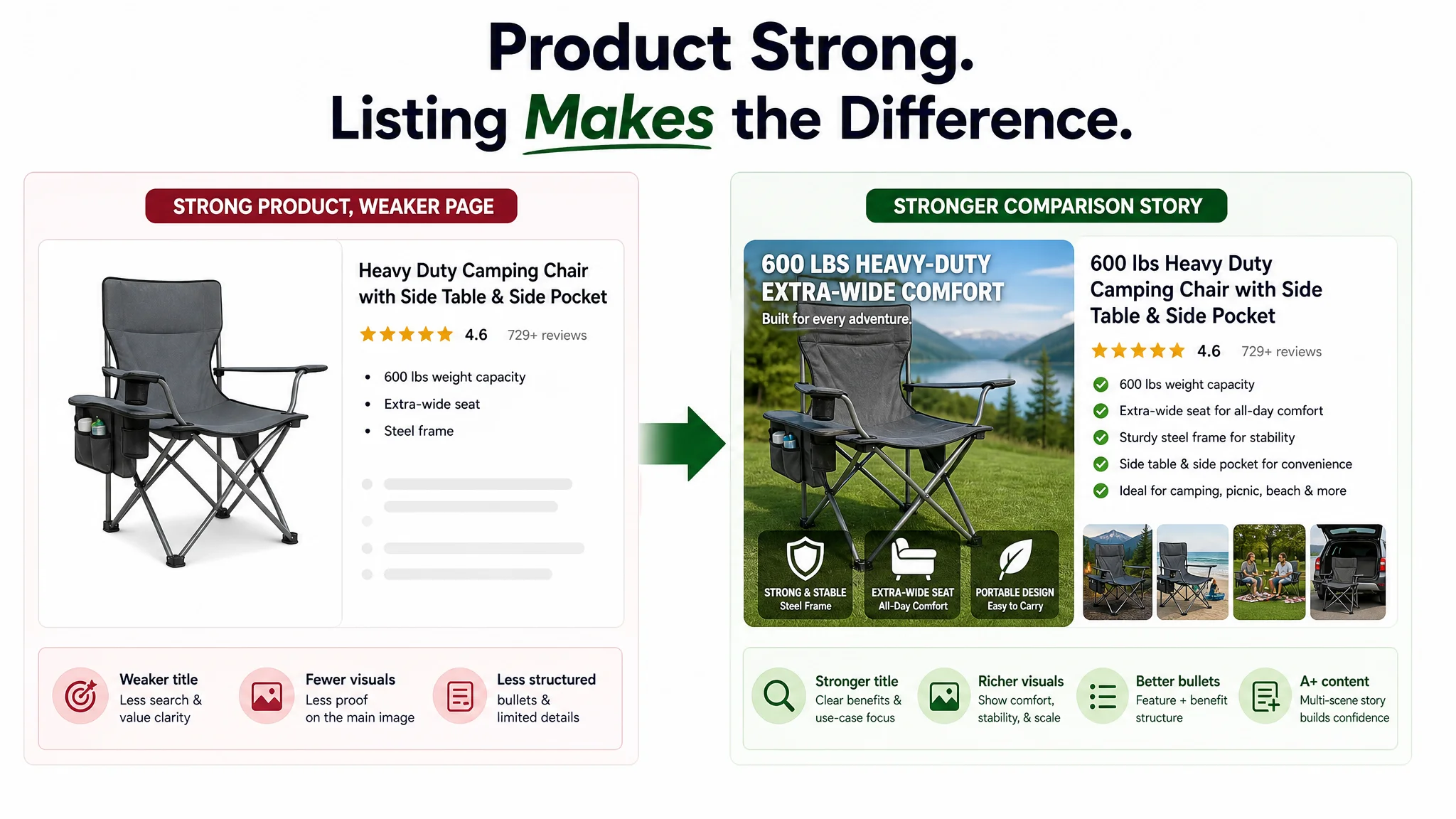
The seller’s operations team initially viewed the situation as an advertising-efficiency problem. They adjusted bids, keywords, and campaign structures because the listing fundamentals seemed “good enough.” Benchmarking showed a different constraint: the page had lower conversion capacity than the competing listing. This is why stable absolute sales do not guarantee stable rankings. If competitors improve their CTR, CVR, presentation, or sales performance while the focal listing remains unchanged, its relative position may decline.
Sustainable growth therefore requires monitoring both relevance and KPI gaps, then improving the listing’s ability to convert qualified search demand.
Understanding Amazon's A9 and A10 Algorithms
Amazon’s A9 is best understood as a purchase-oriented ranking system that balances two practical questions: Does the listing match the shopper’s search, and does the product perform commercially after receiving that traffic? Relevance helps a product appear for appropriate searches, while clicks, conversions, and related performance signals indicate whether shoppers view it as a credible purchase option. Keyword alignment alone may generate impressions, but weak CTR or CVR can limit the listing’s ability to sustain organic visibility.
A10 is commonly discussed as a broader evolution of this logic rather than a completely separate system. Under the prevailing industry model, Amazon has become more capable of interpreting shopper intent and assessing a wider context around a product. That context may include external traffic quality, seller authority, purchase history, and customer engagement signals. These factors should be treated as informed working hypotheses, not officially published ranking rules or a confirmed formula.
The distinction from Google SEO is important. Google primarily aims to satisfy informational intent with useful, high-quality search results. Amazon is more directly oriented toward purchase likelihood: whether relevant shoppers click, trust the offer, and complete an order. Listing content, images, reviews, and traffic quality therefore operate together as commercial signals that can influence CTR, CVR, and ultimately organic visibility.
The camping chair listing showed how these signals can diverge. The product had strong ratings and solid reviews, but the search-result presentation did not make its most valuable advantages immediately believable. The benchmark used family-oriented scenes, multiple-adult load proof, and clearer visual differentiation to make oversized comfort and heavy-duty stability easier to understand. The seller’s listing included relevant specifications, but relied more heavily on labels and scattered feature descriptions.
This distinction matters because a product can be relevant enough to earn impressions without being persuasive enough to earn clicks or orders. The listing did not necessarily have a discovery problem; it had a gap between eligibility and commercial performance. The durable strategy is therefore to balance relevance with performance: target searches that fit the product, then strengthen the listing experience so qualified shoppers are more likely to click and purchase.
Key Performance Indicators for Organic Ranking
Organic search visibility is not driven by a single metric. A listing becomes more competitive when it attracts relevant shoppers, converts that traffic efficiently, and sustains sales momentum relative to comparable products. The three KPI pillars are sales velocity, conversion rate, and engagement. Track them alongside exposure, clicks, orders, CTR, CVR, and BSR to distinguish a temporary fluctuation from a meaningful ranking change.
Sales Velocity: The Driving Force
Sales velocity reflects the pace and consistency of order generation. Monitor order volume and sales momentum across comparable periods, then compare the trend with genuinely similar products and the category benchmark. Similarity should account for product form, function, use case, price band, and audience; a mismatched bestseller can distort the diagnosis.
A sustained decline in orders accompanied by weaker exposure or BSR may indicate lost competitive momentum. Before assigning a cause, however, review traffic sources, promotions, inventory, reviews, and recent listing edits. Use recurring reports and trend lines instead of reacting to a single anomalous period.
The camping chair case demonstrates why sales velocity should be interpreted alongside conversion capacity. The seller continued investing in advertising to maintain traffic and sales, but organic rank did not improve in line with that spend. Competitors with similar products held stronger positions because their pages converted search demand more effectively. The issue was not simply whether the seller generated orders; it was whether the listing generated enough commercial momentum relative to the benchmark.
This makes relative performance more useful than an isolated sales total. If a competing ASIN is converting more of the same demand, increasing traffic to the weaker page may not close the ranking gap.
Conversion Rates: Turning Visitors into Buyers
CVR indicates whether incoming traffic is commercially qualified and whether the listing addresses shopper objections. Compare CVR with category and competitor benchmarks rather than a universal target. Monitor the metric before and after meaningful content changes, using each implementation timestamp as a reference point.
Engagement provides upper-funnel context: impressions, clicks, and CTR show whether the search-result presentation earns attention. Weak CTR despite adequate exposure points toward the main image, title, or offer presentation. Adequate traffic paired with weak CVR suggests reviewing detail-page content, trust signals, reviews, price, and traffic quality. Reading these indicators as a funnel provides a more reliable ranking diagnosis than optimizing any KPI in isolation.
In the camping chair example, the team initially interpreted persistent ACOS pressure and limited organic progress as evidence that bids, keywords, or campaign structure needed further adjustment. DeepBI’s scoring and benchmarking identified a different pattern: the listing was 10 points behind the benchmark overall, with gaps in the title, main images, bullet points, and A+ content, while review quality was essentially equal. The page had traffic, but its sales logic was weaker.
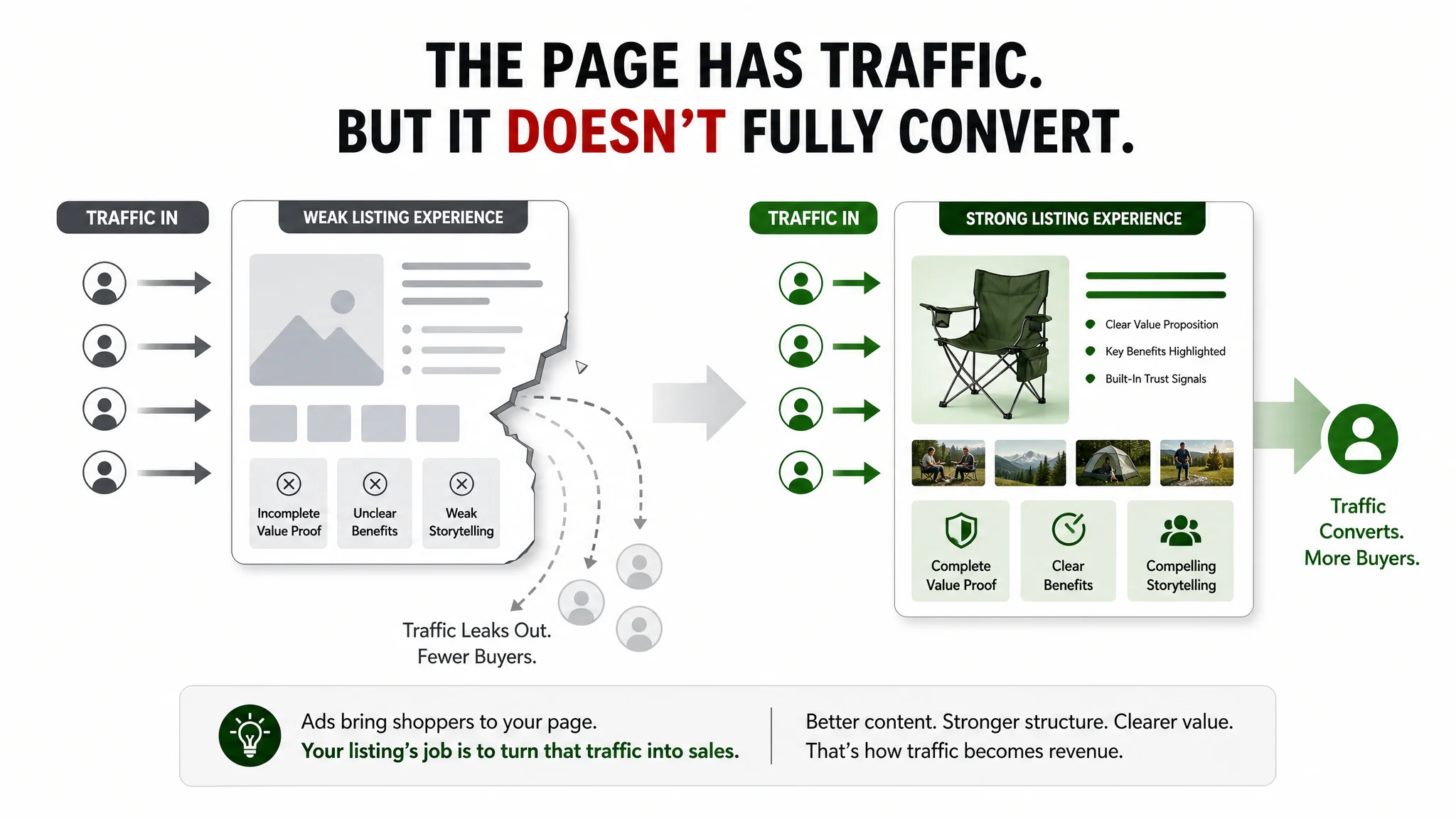
That distinction changes the optimization decision. When clicks are arriving but the page does not clearly prove stability, comfort, portability, or intended use, the problem is not necessarily traffic precision. The conversion path itself may be incomplete. Advertising can bring shoppers to the detail page, but it cannot make a fragmented page answer the buyer’s questions.
Optimizing Your Product Listing for Search Visibility
A high-performing listing must serve two systems at once: Amazon needs clear relevance signals, while shoppers need enough clarity to choose the product. When either layer is weak, impressions may not become clicks, and clicks may not become orders, affecting CTR, CVR, ACoS, and BSR.
The camping chair listing contained many of the necessary facts, including weight capacity, seat width, frame construction, side-table functionality, and portability. The problem was not a lack of information. The problem was that the information did not form a clear decision path. The benchmark made its main promises easier to recognize and connected them to specific buyers and use cases.
This is an important distinction for listing optimization: adding more content is not always the same as improving conversion. Content must be prioritized, ordered, and expressed in a way that reduces uncertainty.
Crafting Titles and Backend Keywords
Build the title around the product’s confirmed identity and strongest search intent. A practical structure is:
- Brand
- Primary keyword or product form
- Core benefit or result
- Relevant attribute, size, or use qualifier
Use market and competitor data to identify core search terms, then remove redundant modifiers instead of accumulating vocabulary. For many categories, Amazon recommends titles under 200 characters, but sellers should verify the applicable category style guide before applying that limit. Every term should remain accurate, readable, and supported by the product’s specifications.
The camping chair title contained core keywords, but DeepBI’s comparison found that its selling logic and emotional hook were weaker than the benchmark’s. The product’s oversized dimensions and comfort advantage were not elevated clearly enough, even though the chair had a 28-inch seat and was designed for heavy-duty use. A title can therefore be technically relevant while still failing to communicate why the product deserves the click.
The practical lesson is not to add exaggerated language. It is to connect the confirmed product identity with the most important purchase reason. If extra-wide comfort or heavy-duty support is central to the searcher’s decision, those attributes should be presented as part of a coherent value proposition rather than left as isolated specifications.
Use backend search terms to capture relevant synonyms, common misspellings, and keyword variations that do not fit naturally into visible copy. The total backend search-term field is limited to 250 bytes, so prioritize distinct, relevant terms rather than repeating title language or adding unrelated traffic terms. Backend keywords can improve discovery, but they cannot compensate for weak visible messaging after the shopper reaches the page.
Bullet Points and Structured Data Fields
Treat bullet points as indexed content: relevant keywords included in them can directly influence search ranking while also supporting the purchase decision. Organize each bullet around a customer concern, a factual benefit or specification, and the problem it addresses. This creates stronger keyword context than presenting isolated features.
The original camping chair bullets contained the relevant facts, but they were scattered across several points. Comfort was not presented as a central promise, the heavy-duty frame was not fully connected to buyer skepticism, and accessories were described more as parts than as practical solutions. DeepBI’s recommended structure moved from extra-wide comfort to 600-pound support, convenience, multi-scenario use, and portability.
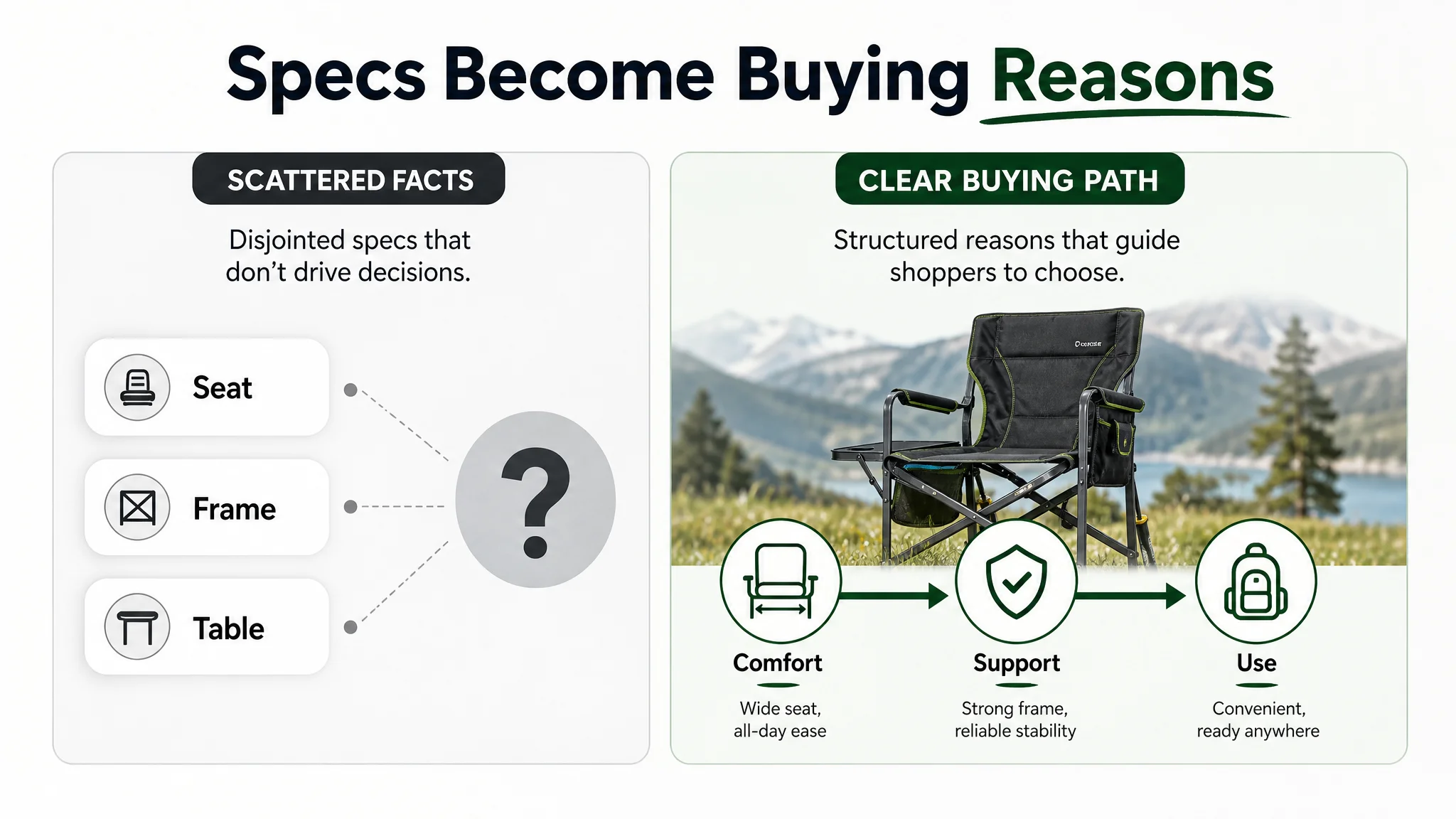
That sequence illustrates a broader principle. A bullet point should not merely state that a product has a feature. It should explain why that feature matters and provide enough factual support to make the claim credible. For example, an extra-wide seat can be connected to long-sitting comfort; a reinforced frame can address concerns about whether a foldable chair is strong enough; a side table and storage pocket can be presented through the objects and activities they support.
Complete attributes and structured data fields consistently with the visible copy. Brand information, product form, dimensions, materials, compatibility, and benefits should match confirmed product data. This alignment clarifies relevance, supports CVR, and reduces compliance risk. Evaluate listing changes against CTR, CVR, ACoS, BSR, and listing cycle time rather than judging optimization by keyword volume alone.
The Impact of Customer Reviews, Pricing, and Inventory
Organic visibility depends on more than keyword relevance. Reviews, pricing, and inventory shape the customer and sales signals that support CTR, CVR, and BSR momentum.
A large review total creates social proof, but it does not automatically outweigh stronger rating quality or more recent activity. Recent, verified review velocity may provide a more useful indication of current customer satisfaction than an older review base alone. Sellers should monitor rating distribution, review gaps against comparable products, and the trust value of high-quality image reviews. Maintaining consistency between the product entity shown in images and the physical product is equally important: visual promises that do not match the item can damage trust and trigger negative reviews, weakening CVR.
The camping chair case is a useful reminder not to over-attribute weak conversion to reviews. The listing had a 4.6-star rating and more than 729 reviews with solid, detailed feedback. DeepBI found that review quality was essentially equal to the benchmark’s, even though the benchmark had greater review volume. The larger gap appeared in the content and visual modules: title, main images, bullets, and A+ storytelling.
This does not make reviews unimportant. It means that strong reviews cannot automatically repair a listing that loses the comparison in how it presents value. If shoppers see similar ratings but find the competing page more convincing about comfort, stability, and use cases, the content architecture can still influence the final decision.
Price competitiveness also affects conversion. Rather than copying the lowest-priced offer, compare products within the same audience, price band, and value proposition. Amazon Automate Pricing can help sellers maintain rule-based price adjustments, but pricing decisions should still be assessed against CVR, margin, and ACoS. Use controlled price-sensitivity testing to observe how price changes affect clicks, conversion, order volume, and profitability before making a permanent adjustment.
Inventory creates another ranking risk. Stockouts interrupt sales velocity, reduce conversion opportunities, and may allow ranking momentum to decay. A practical risk-management target is at least 30 days of inventory cover, adjusted for lead times and demand volatility. This is not an Amazon ranking rule or a guaranteed outcome; its purpose is to reduce operational disruption while preserving consistent sales signals.
Driving External Traffic to Boost Organic Rank
- Amazon Attribution — Measurement reference for evaluating Google Ads, social media, influencer, and other controlled off-Amazon traffic sources by traffic volume, conversion quality, and resulting sales.
- DeepBI Listing Product Documentation, Consolidated Edition — Supports the principle that better Listings combined with more precise traffic create healthier long-term growth. It also frames advertising data as an optimization input rather than proof that external traffic automatically improves organic rank.
- DeepBI Listing Product Documentation, Consolidated Edition: Advertising Data and Funnel Metrics — Identifies impressions, clicks, conversions, CTR, CVR, TACoS, and ACoS as core signals for judging traffic quality and Listing performance.
- DeepBI Listing Product Documentation, Consolidated Edition: Stable Advertising Signals — Explains how high-converting search terms and product attributes can inform Listing improvements, reinforcing the need to evaluate off-Amazon traffic through conversion outcomes rather than visits alone.
- DeepBI Listing Product Documentation, Consolidated Edition: Listing Fundamentals and External Traffic Boundaries — Establishes that external traffic should supplement relevant keywords, competitive images, clear benefits, A+ content, and strong conversion performance, not replace them.
- DeepBI Listing Product Documentation, Consolidated Edition: Feedback Loop and Performance Observation — Describes the use of click and conversion distributions to compare predicted gains with actual market performance and refine optimization decisions.
External traffic and advertising can support organic growth, but they should not be used to conceal a weak conversion foundation. In the camping chair case, the seller’s initial response to high bids, persistent ACOS pressure, and limited organic improvement was to refine campaigns further. The diagnosis showed that continuing to send more traffic to the same page would likely amplify the page’s existing weaknesses.
The sequence therefore mattered. The seller first needed to improve the page’s conversion logic and visual proof, then use advertising data to refine and scale traffic against a stronger base. This approach treats advertising as a source of demand and evidence, not as a substitute for listing quality.
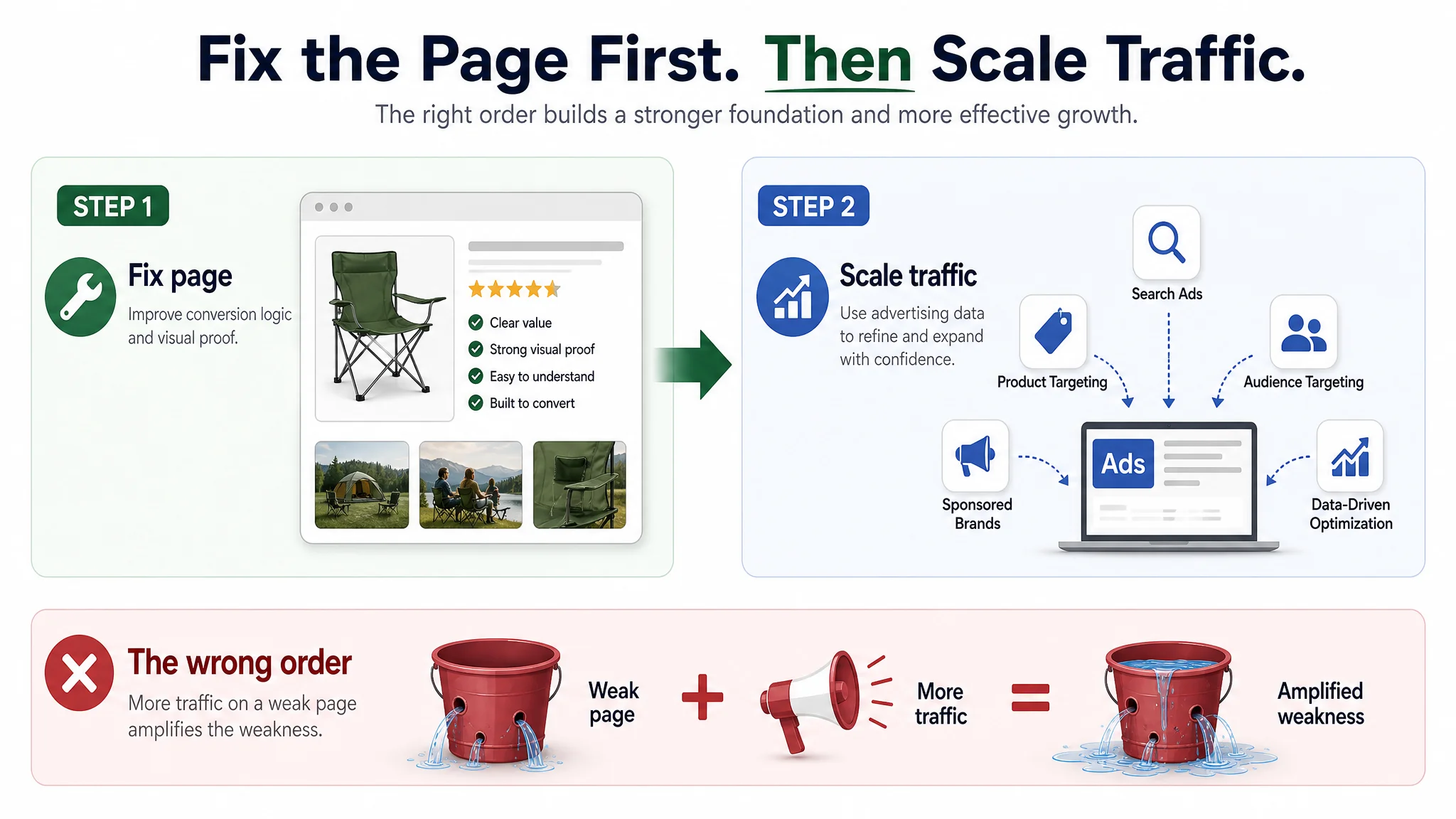
A useful operating question is not simply, “Can we buy more traffic?” It is, “Does the page deserve more traffic yet?” If the answer is no, additional clicks may increase costs without resolving the underlying gap in CTR or CVR.
Leveraging DeepBI for Automated Organic Growth
DeepBI frames organic growth as an Amazon-only operating system rather than a series of disconnected listing edits. Its workflow links performance diagnosis, prioritized action, approved deployment, and post-change measurement, enabling sellers to trace how a keyword or listing decision relates to CTR, CVR, ACoS, and BSR.
The Organic Traffic Module: Building a Natural Rank Engine
The Organic Traffic module organizes a continuous cycle:
- Monitor search visibility, organic traffic, keyword performance, and rank movement.
- Identify opportunities where impressions, clicks, conversions, or BSR indicate underused demand.
- Prioritize keyword and listing actions according to their likely effect on organic discovery and conversion.
- Apply approved changes and track subsequent organic-rank movement.
This replaces vague advice such as “improve the listing” with executable direction. DeepBI can translate an identified content gap into structured instructions covering titles, bullets, imagery, composition, information density, or feature presentation. The operating logic remains measurable: weak CTR points toward click attraction, while weak CVR points toward content, trust, or offer alignment. Each change can then be evaluated against organic rank, CTR, CVR, and listing cycle time rather than subjective impressions.
The camping chair diagnosis shows why this prioritization matters. Instead of treating every weakness as an advertising issue, DeepBI separated the listing into comparable dimensions: title, main images, bullet points, detail page/A+, and reviews. The review dimension was essentially equal to the benchmark, while the largest gaps were in the modules responsible for presenting and proving the product’s value.
That diagnosis led to specific actions rather than a generic instruction to “add more images.” The main image system was directed to prove the 600-pound capacity, make the extra-wide seat visually obvious, show dimensions in one glance, and present the side table in a realistic use context. The bullet points were reorganized into a sequence of buying reasons, while the A+ content was rebuilt around family-oriented outdoor scenarios, stability, comfort, portability, and multi-scene use.
The value of this approach is not the number of recommendations. It is the ability to connect each recommendation to a diagnosed conversion barrier.
Synergy with Advertising and Listing Optimization
Advertising data provides a causal bridge, not a substitute for organic evidence. DeepBI uses signals such as impressions, clicks, orders, CTR, CVR, TACoS, and ACoS to weight high-value search terms and distinguish a traffic problem from a conversion problem. Listing recommendations can then reflect attributes already demonstrating marketplace demand. Approved assets and edits can be applied through Amazon SP-API, with the application event establishing a reference point for later comparison. This connects advertising insight to listing action and organic-rank feedback without claiming that every ranking change results from advertising.
The camping chair case demonstrates this division of responsibility. The seller’s ads were generating traffic, but the page did not fully convert that traffic against the benchmark. DeepBI therefore did not recommend “more ad tuning” first. It prioritized the listing’s conversion logic and visual proof, then positioned advertising as a stronger growth lever after the page could better support each click.
This also explains why the relationship between advertising and organic ranking should be handled carefully. Advertising may reveal which search terms and product attributes attract valuable demand, but the resulting insight must be translated into accurate titles, persuasive bullets, credible images, and coherent A+ content. A high-converting search term can inform listing improvement; it does not guarantee an organic ranking increase by itself.
Conclusion: The Path to Sustainable Organic Visibility
Sustainable Amazon organic visibility is not created by a one-time keyword update or a single listing rewrite. It comes from continuously improving relevance, conversion, sales velocity, and operational consistency while measuring performance against meaningful competitors. Because ranking is relative, stable sales may not be enough when competing listings improve their CTR, CVR, review velocity, or availability.
The camping chair case makes this principle concrete. The product had strong ratings, solid reviews, and competitive specifications, but it still underperformed a closely matched benchmark because its page did not communicate those strengths with the same clarity. The seller initially focused on bids, keywords, and campaign structure. The deeper diagnosis found that the more important constraint was listing conversion capacity: the page did not fully prove comfort, stability, portability, and multi-scene value through its title, images, bullets, and A+ content.
The practical loop is straightforward: monitor organic rank, impressions, CTR, CVR, sales velocity, inventory, and listing signals; analyze where performance is weakening; adjust the highest-impact variables; then repeat. Each change should establish a clear measurement point, allowing sellers to distinguish genuine progress from assumptions and connect listing decisions to business outcomes such as BSR, ACoS, and listing cycle time.
- [project_0089] (evidence_cards): DeepBI connects diagnosis, planning, production, delivery, and feedback into an end-to-end optimization process.
- [project_0056] (quote_ready_sentences): DeepBI functions as an automated market health check driven by structured data and disciplined comparison.
- [project_0054] (quote_ready_sentences): Data-led diagnosis replaces uncertain, intuition-based optimization with more precise prioritization.
- DeepBI Listing Product Documentation (Combined Edition): Continuous benchmarking, targeted changes, and performance feedback support repeatable Amazon optimization.
Treat organic growth as a long-term, data-guided process, and adopt a systematic approach such as DeepBI to support continuous monitoring, learning, and improvement throughout 2025–2026.
Continuous optimization remains essential because Amazon rankings, shopper expectations, and competitive pressure keep changing. When advertising feels increasingly expensive, the next step is not always to buy more traffic. First determine whether the listing can convert the traffic it already receives—and whether it can win the comparison against the products Amazon is ranking beside it.