

Table of Contents
- The Limits of Manual Amazon Advertising Management at Scale
- How AI Changes Amazon Advertising Optimization
- The Data Foundation for Reliable Advertising Decisions
- AI-Powered Campaign Diagnosis and Performance Scoring
- From Advertising Signals to Listing and Creative Recommendations
- DeepBI’s End-to-End Solution: Scoring, Suggestions, Image Generation, and Application
- Structured Reconstruction of Titles, Bullet Points, A+ Content, and Main Images
- Building a Data-Driven Optimization Loop with Event Tracking and CTR Measurement
Why Manual Amazon Advertising Management Breaks at Scale
Manual Amazon advertising management fails to scale because decision volume grows faster than human attention. Consider a portfolio of 50 ASINs:
- 50 ASINs × 3 campaigns per product = 150 campaigns
- 150 campaigns × 20 keywords per campaign = 3,000 keyword-level decisions
Each decision may require bid review, budget allocation, search-term analysis, placement evaluation, or campaign restructuring as impressions, clicks, CVR, and ACoS change. The workload is not a one-time setup task; it is a recurring operating cycle.
As an illustrative industry estimate, manually optimizing a 50-ASIN portfolio can consume roughly 15–20 hours per week, depending on campaign complexity, reporting standards, and team processes. Even that level of effort cannot provide continuous response coverage. Human managers may not respond promptly to bid changes, evening and weekend conversion patterns, competitor pressure, or sudden shifts in CTR and CVR. The resulting bid lag can leave profitable traffic underfunded, waste spend on deteriorating terms, and push ACoS away from its target.
The scaling problem is therefore operational, not merely financial. Adding ASINs multiplies campaigns, keywords, and review points while increasing the frequency of required decisions.
AI-assisted workflows change the execution model by using advertising signals such as impressions, clicks, conversions, TACoS, and ACoS to support prioritized, repeatable optimization. In some operating environments, advertisers may reduce tactical bid-management time by more than 60%, but this is a possible outcome—not a guaranteed saving or universal benchmark.
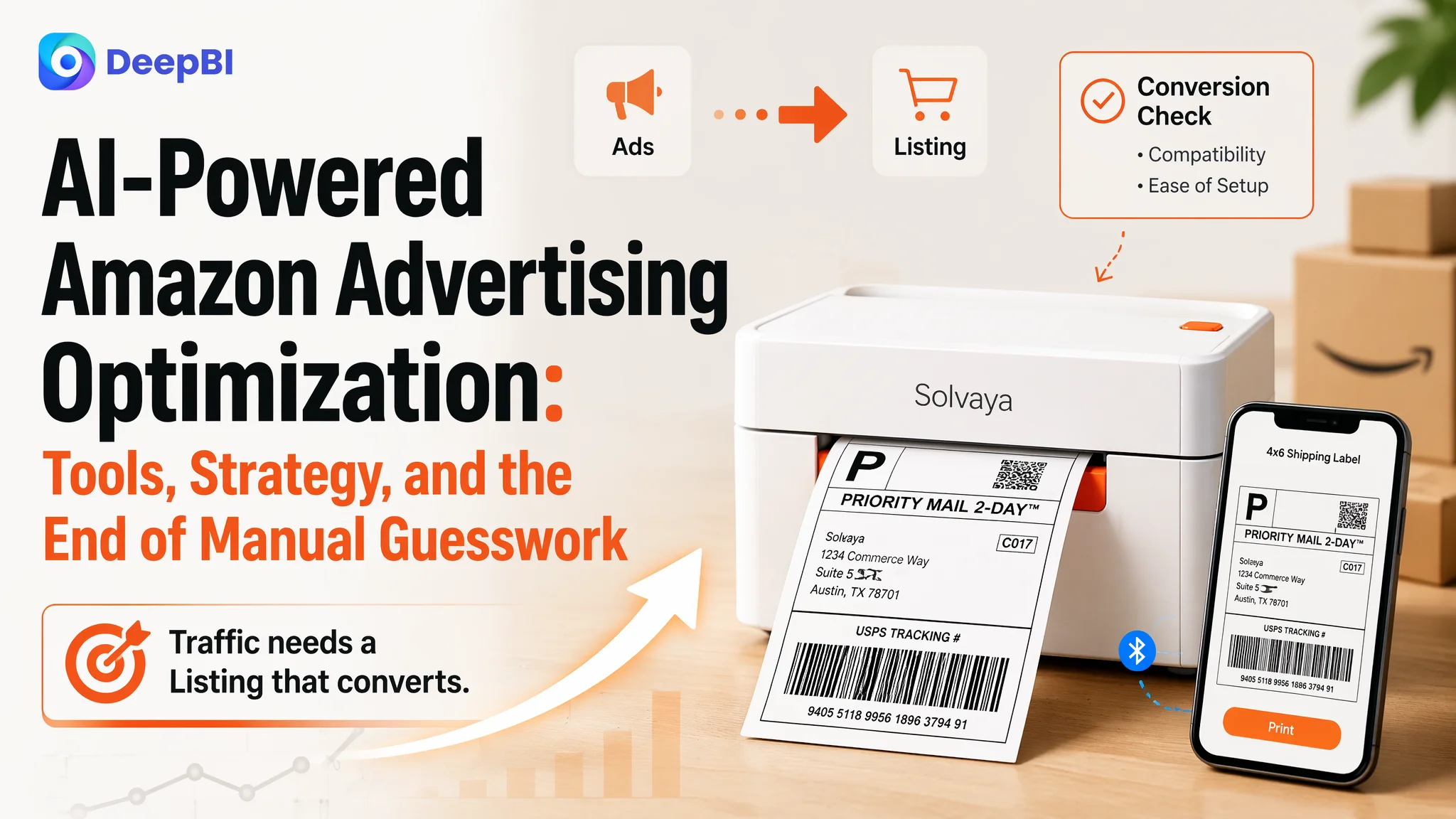
However, reducing manual advertising work does not mean every advertising problem is solved at the campaign level. A team can spend more time reviewing bids, placements, and search terms while overlooking the Listing that receives the traffic.
A thermal shipping-label printer seller illustrated this limitation. The team initially saw impressions and difficult-to-control ACoS and naturally focused on campaign structures, bids, placements, and keyword coverage. The Listing appeared reasonably strong by internal standards: its overall score was 74/100, the title scored higher than a benchmark competitor, the bullet points were slightly stronger, and the product rating was 4.5 stars. The page therefore looked “basically fine,” while advertising appeared to be the more obvious problem.
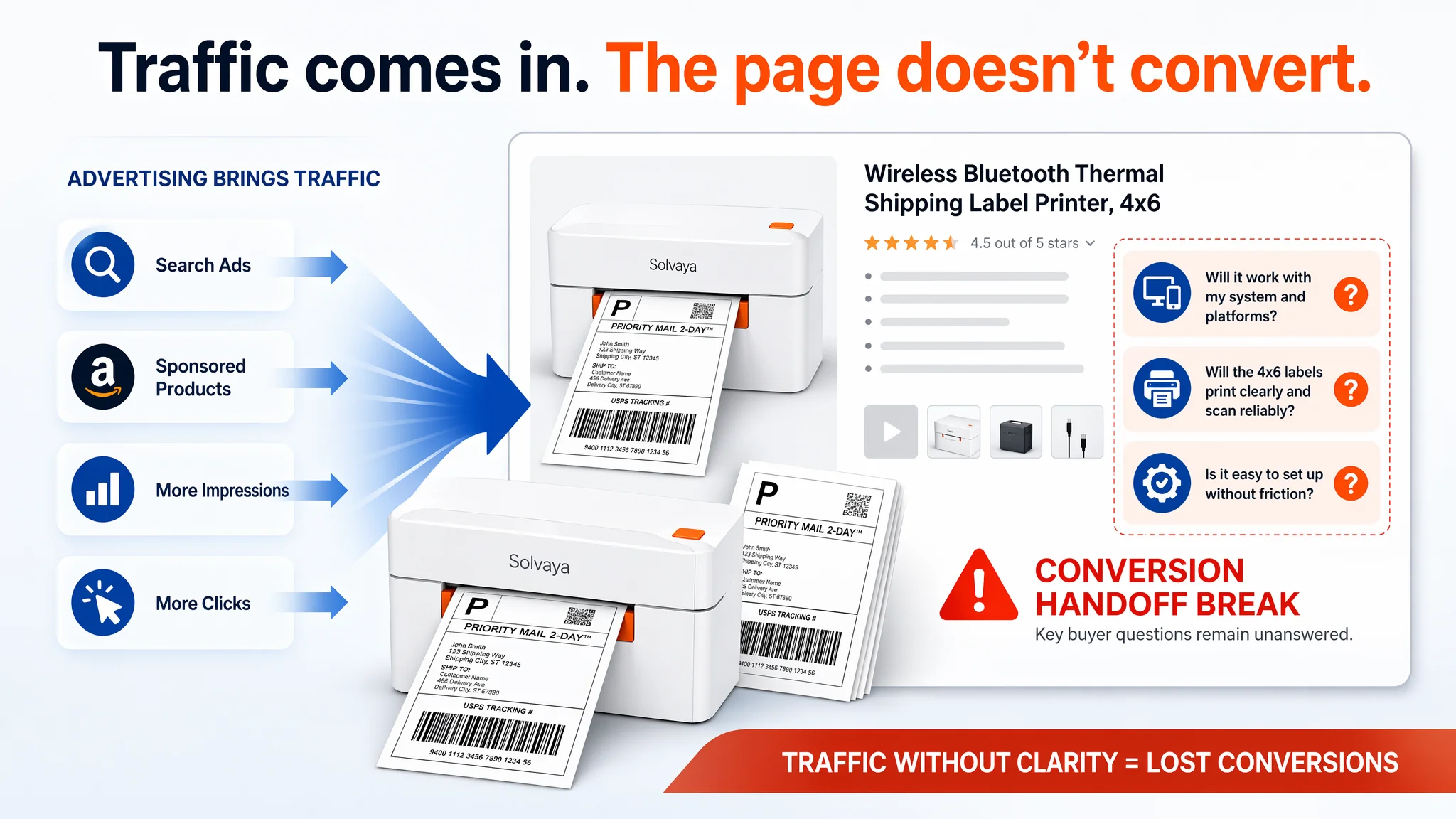
A deeper audit showed that the page was not failing because it lacked basic information. It was failing to convert that information into enough clarity and trust around the buyer’s actual decision: whether the printer could reliably handle 4x6 shipping labels, work with the buyer’s devices and platforms, and be set up without unnecessary friction. The practical lesson is that advertising scale increases the importance of Listing quality. More traffic does not compensate for a page that leaves the central buying questions unanswered.
How AI Campaign Management Actually Works on Amazon
AI campaign management is not a set-and-forget substitute for campaign strategy. It is a faster execution layer that evaluates changing signals and adjusts tactical decisions more frequently than a human team can.
A typical system processes billions of signals across impressions, clicks, conversions, time of day, placement behavior, spend, and competitor activity. It uses these inputs to optimize bids continuously instead of waiting for a weekly review or scheduled spreadsheet update. If a keyword generates clicks but loses CVR or pushes ACoS above its target, the system can reduce exposure sooner. If conversion quality improves, it can increase bids selectively. Budgets can also shift dynamically toward campaigns, placements, or ASINs showing stronger efficiency, helping protect ACoS while supporting incremental sales.
Manual optimization usually operates in batches: a marketer reviews historical performance, changes bids or budgets, and waits for the next reporting cycle. That delay can waste spend during weak periods and limit responsiveness during high-conversion windows. Continuous adjustment increases decision frequency, but it does not eliminate uncertainty or guarantee better outcomes.
DeepBI’s dynamic parameter adjustment uses a rolling seven-day window of click, conversion, spend, and ACoS data to update bids daily while maintaining explainability. The system supports execution; people still define campaign architecture, targets, portfolio priorities, strategic pivots, and oversight. AI handles repetitive tactical decisions, while human judgment determines what the campaigns are designed to achieve.
That distinction matters when advertising data is interpreted without page-level context. In the label-printer example, the seller could have continued treating difficult ACoS as evidence that bids or keywords needed more work. But the issue was not simply that the campaigns were bringing the wrong people. The Listing was not completing the buying logic after those people arrived. A system that only adjusts bids could reduce exposure to the symptom without identifying the structural weakness.
AI campaign management is therefore most useful when it helps answer two separate questions:
1. Is the campaign attracting relevant traffic?
2. Can the Listing convert that traffic once it arrives?
The first question belongs primarily to advertising analysis. The second requires a broader view of the Listing, creative assets, competitor positioning, compatibility information, and buyer friction.
Find Your Next Best Performing Keywords with AI
Traditional keyword research tools usually provide a static snapshot of estimated volume, competition, and related terms captured at a particular point in time. That snapshot can inform a launch, but it rarely reflects how search behavior, competitor positioning, and conversion signals evolve. AI turns keyword discovery into a recurring feedback loop by continuously analyzing search-term reports, advertising performance, and competing ASINs.
DeepBI applies a four-layer funnel:
- Exploration: Expand beyond obvious seed terms by examining broad search-term patterns and competitor ASIN signals.
- Screening: Filter candidates using impressions, clicks, CTR, CVR, ACoS, and relevance rather than volume alone.
- Precision: Isolate terms showing stronger conversion potential and distinguish meaningful signals from short-term noise.
- Scale: Move only a small, qualified subset into higher bids and larger budgets, while monitoring incremental spend against CVR and ACoS.
For example, an AI workflow might evaluate 2,000 search terms, identify 150 with strong conversion potential, and scale the top 30 through controlled bid and budget increases. The objective is not to promote every promising term, but to concentrate investment where the evidence is strongest while preserving room for continued testing.
Keyword discovery remains probabilistic and iterative. AI can improve the speed and breadth of qualification, but it cannot guarantee that every selected term will become profitable. The strongest terms isolated through DeepBI’s Precision layer can later support organic-ranking campaigns.
At the same time, a strong keyword does not automatically create a strong conversion path. In the label-printer case, the title already clearly identified the product type and included terms such as wireless Bluetooth, thermal shipping-label printer, 4x6 label maker, 150mm/s, 203 dpi, and system compatibility. The bullet points also communicated performance, connectivity, flexibility, and ink-free operation. These elements gave the team confidence that keyword coverage and text quality were not the main constraint.
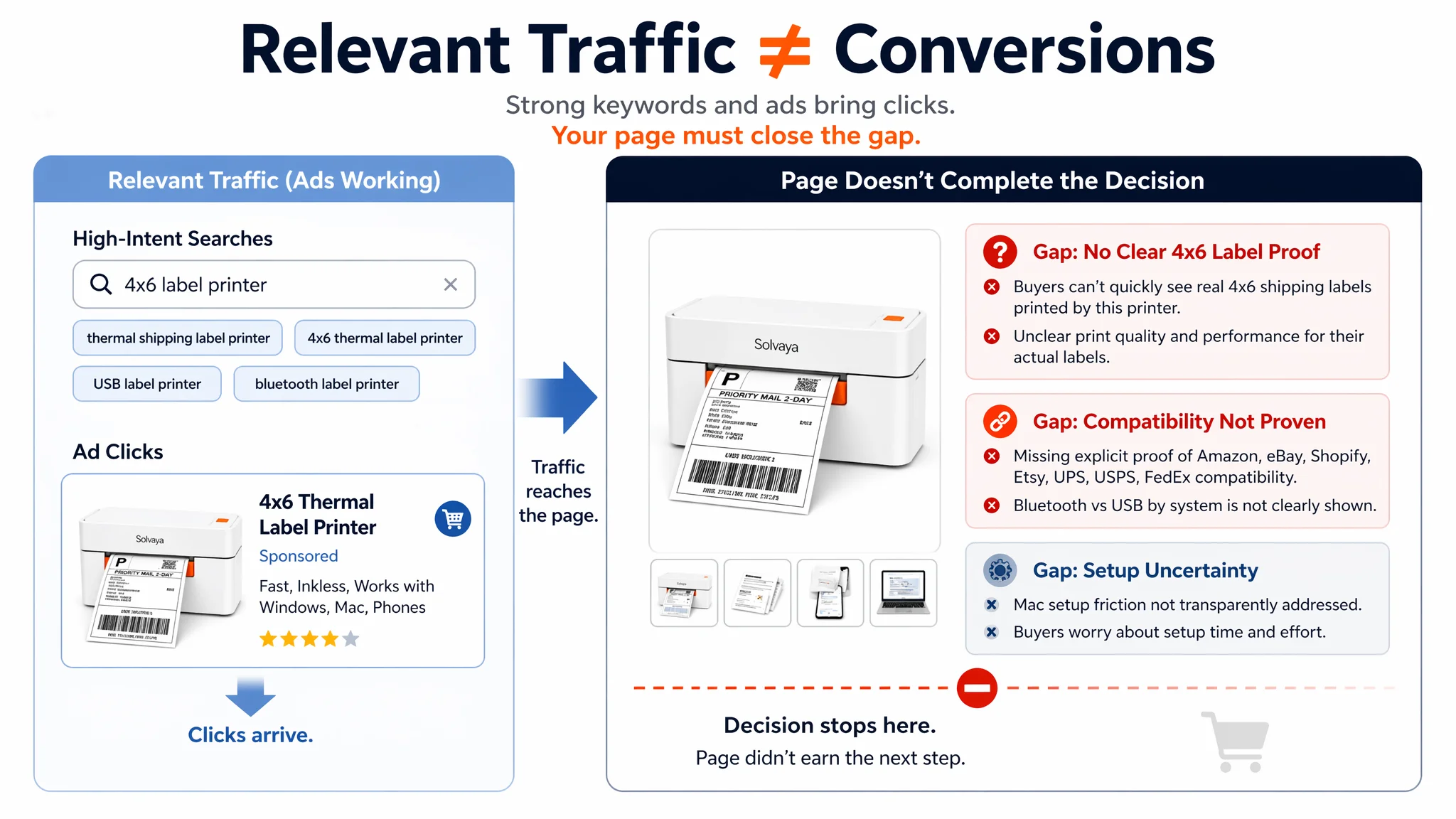
The missing piece was what happened after the click. The main image did not clearly demonstrate a crisp, scannable 4x6 shipping label, and the A+ content did not fully clarify platform compatibility, system connection paths, app setup, or Mac-related friction. This meant that even relevant traffic could arrive at a page without receiving enough proof to move forward.
The implication for keyword optimization is straightforward: search-term relevance should be evaluated together with Listing conversion capacity. If a keyword attracts the right audience but the page cannot clearly show the product’s primary use case, increasing its bid may simply buy more visits without solving the underlying problem.
Measuring AI Campaign Effectiveness: Metrics That Matter
AI campaign effectiveness cannot be judged by ACoS alone. A lower ACoS may simply reflect reduced ad spend, fewer impressions, and declining ad-attributed revenue. That indicates cost control, not necessarily profitable growth.
Use a balanced scorecard that includes:
- ACoS: How efficiently advertising converts spend into attributed sales.
- Total ad-attributed revenue: Whether efficiency gains are supporting meaningful sales volume.
- TACoS: Advertising spend as a share of total revenue, providing a broader view of how ads affect overall profitability and organic sales.
- ROAS: The revenue returned for each advertising dollar.
- Conversion-rate trends: Whether traffic quality and Listing effectiveness are improving after optimization.
Evaluate these metrics across at least 30 days before and after AI deployment, allowing for an initial learning period before drawing conclusions. A directional pattern such as ACoS moving from 41.88% to 11.15%, TACoS from 10.40% to 7.36%, and conversion rate from 0.55% to 1.93% would suggest stronger efficiency and customer response—but results vary by category, starting point, seasonality, and strategy. These figures are not universal benchmarks or guarantees.
This measurement discipline reflects advertiser priorities: 63% of advertisers in an Advertiser Perceptions survey cited efficiency as a primary AI driver. DeepBI’s dashboard tracks ACoS, TACoS, and seven-day trend lines in one view, helping teams determine whether changes improve business economics rather than merely one campaign KPI.
The label-printer example shows why conversion-rate trends need to be interpreted alongside Listing evidence. The seller saw a page with a 74/100 overall score, a title that outperformed the benchmark, stronger bullet-point scoring, and a 4.5-star rating. Those signals could easily support the conclusion that the page was healthy and that advertising efficiency was the primary issue.
But the competitive audit revealed a different structure:
- The benchmark Listing scored 85/100 overall.
- The seller’s main-image score was lower, at 23 versus 27 out of 30.
- The seller’s detail and A+ score was 17 versus 23 out of 25.
- The seller had 34 reviews compared with approximately 5,500 for the benchmark, despite having a slightly higher star rating.
These details changed the interpretation of the advertising problem. ACoS was not being evaluated in isolation anymore; it was being viewed alongside the page’s ability to create visual proof, establish trust, and resolve compatibility and setup questions. The seller’s rating was not enough to offset the much larger social-proof gap, and the page was not using its images and A+ content to compensate.
A reliable scorecard should therefore include not only advertising metrics, but also the conversion conditions that those metrics depend on. When CTR is acceptable but CVR remains weak, the next step should not automatically be another bid adjustment. It may be necessary to inspect whether the main image demonstrates the buyer’s desired outcome, whether A+ content reduces perceived risk, and whether the Listing answers the questions that distinguish one product from the alternatives on the same search-results page.
Core AI Features That Drive Real Advertising Results
AI-powered advertising optimization creates value when it coordinates several decisions instead of automating bids in isolation. The objective is to improve CTR and CVR while protecting target ACoS, controlling wasted spend, and shortening the time between performance signals and campaign action.
Automated bid management evaluates each keyword against its recent conversion history. A keyword generating conversions at an acceptable ACoS can receive stronger support, while a term consuming clicks without sufficient sales can be reduced before it erodes campaign profitability. This approach is more responsive than applying a single bid rule across an entire portfolio of ASINs.
Budget pacing adds a second layer of control. Throughout the day, the system monitors spend and performance, then reallocates available budget toward campaigns or keywords producing stronger conversion efficiency. High-performing targets are less likely to lose visibility because of premature budget depletion, while weaker destinations receive less incremental spend.
Placement optimization applies the same logic to top-of-search, product-page, and other placement modifiers. Adjustments are based on observed performance data rather than fixed assumptions, helping align exposure with placements most likely to support CVR and acceptable ACoS.
Wasted-spend prevention completes the workflow through automated negative-keyword harvesting. Search terms that attract clicks but fail to convert can be identified and excluded, reducing inefficient traffic without relying on manual report reviews.
DeepBI supports daily bid and budget adjustments using the previous seven days of Ads data, allowing recent conversion patterns to guide execution. Its automated negative-keyword harvesting further converts advertising data into continuous spend control.
Yet these features should not be interpreted as proof that every weak campaign requires more aggressive advertising controls. In the label-printer case, the team’s initial instinct was to continue tuning campaigns because the Listing appeared acceptable and orders lagged behind impressions. The diagnosis showed that the more important issue was the page’s conversion capacity.
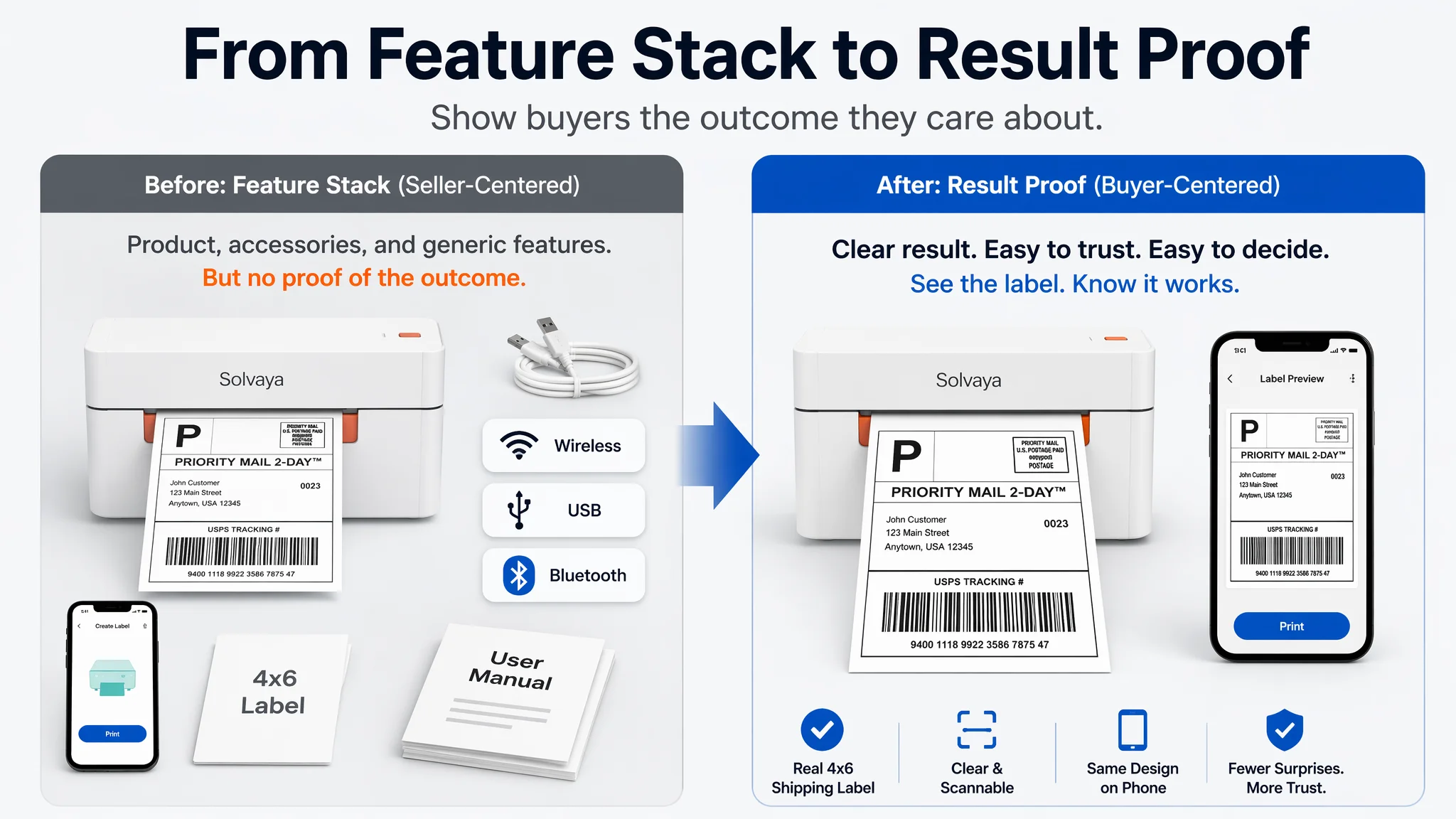
The main image showed the product, a phone, accessories, and labels containing seller-oriented terms such as “Wireless,” “USB,” and “Bluetooth.” It did not immediately show the outcome the buyer cared about: a clear, scannable 4x6 shipping label with a barcode, address, and shipping details. The A+ content described features and usage scenarios, but did not create a complete decision path around platform compatibility, system connections, app usage, or Mac setup.
In that situation, automated bid management could make execution faster, but it could not make the page prove that the product worked. Budget pacing could direct more spend toward a campaign, but it could not compensate for unclear compatibility. Negative-keyword harvesting could reduce irrelevant traffic, but it could not resolve uncertainty among relevant buyers.
This is why advertising automation should be connected to Listing diagnosis. AI can identify where traffic is coming from and how efficiently it converts, while Listing and creative analysis helps explain why relevant traffic may still fail to produce orders.
Implementing AI Campaign Management: A Step-by-Step Framework for Established Brands
AI campaign management should be introduced as a controlled operating change, not a wholesale replacement for human judgment. A phased framework preserves strategic control while creating measurable evidence.
1. Audit the current account. Establish baseline ACoS and TACoS by campaign, record CTR and CVR, and identify the largest time sinks. Separate routine bid and budget adjustments from decisions requiring strategic context, such as launches, positioning, and seasonal planning.
The audit should also examine whether the destination Listing can support additional traffic. In the label-printer case, this meant looking beyond the title and bullet points to the main-image sequence, A+ modules, review scale, compatibility details, and setup guidance. Without this broader audit, the team could easily conclude that more traffic was the only missing ingredient.
2. Run a focused pilot. Activate AI on three to five high-spend or underperforming campaigns. Retain comparable manually managed campaigns as a control group, with human oversight maintained throughout the test.
A meaningful pilot should distinguish between campaign execution problems and conversion-structure problems. If an AI-assisted campaign generates relevant visits but the Listing still leaves the main buying questions unanswered, the test should not be judged solely by bid efficiency. The page may need to be improved before additional advertising scale can be evaluated fairly.
3. Measure the pilot. Run it for at least two weeks, preferably four, then compare AI-assisted and manual campaigns side by side. Review ACoS, TACoS, CTR, CVR, spend allocation, conversion volume, and operational workload. Evaluate not only performance movement but also reliability, decision quality, and Listing cycle time where campaign changes affect creative or content workflows.
This is also the stage to compare the evidence behind the traffic and the evidence behind the Listing. A product can have technically strong copy and reasonable campaign structure while still underperforming because its visual proof is weak. The label-printer audit demonstrated this clearly: title and bullet points were not the main problem, but the main image and A+ content were not sufficiently answering the buyer’s practical questions.
4. Scale after validation. If the results support broader adoption and the workflow proves reliable, extend AI activation to the remaining portfolio in stages. DeepBI supports per-campaign activation and side-by-side performance views, making this rollout easier to control.
5. Reallocate human attention. As repetitive monitoring becomes more structured, direct the team toward product launches, creative testing, seasonal planning, and strategic portfolio decisions. AI remains an execution and analysis layer; managers still define priorities, review changes, and decide when scaling is justified.
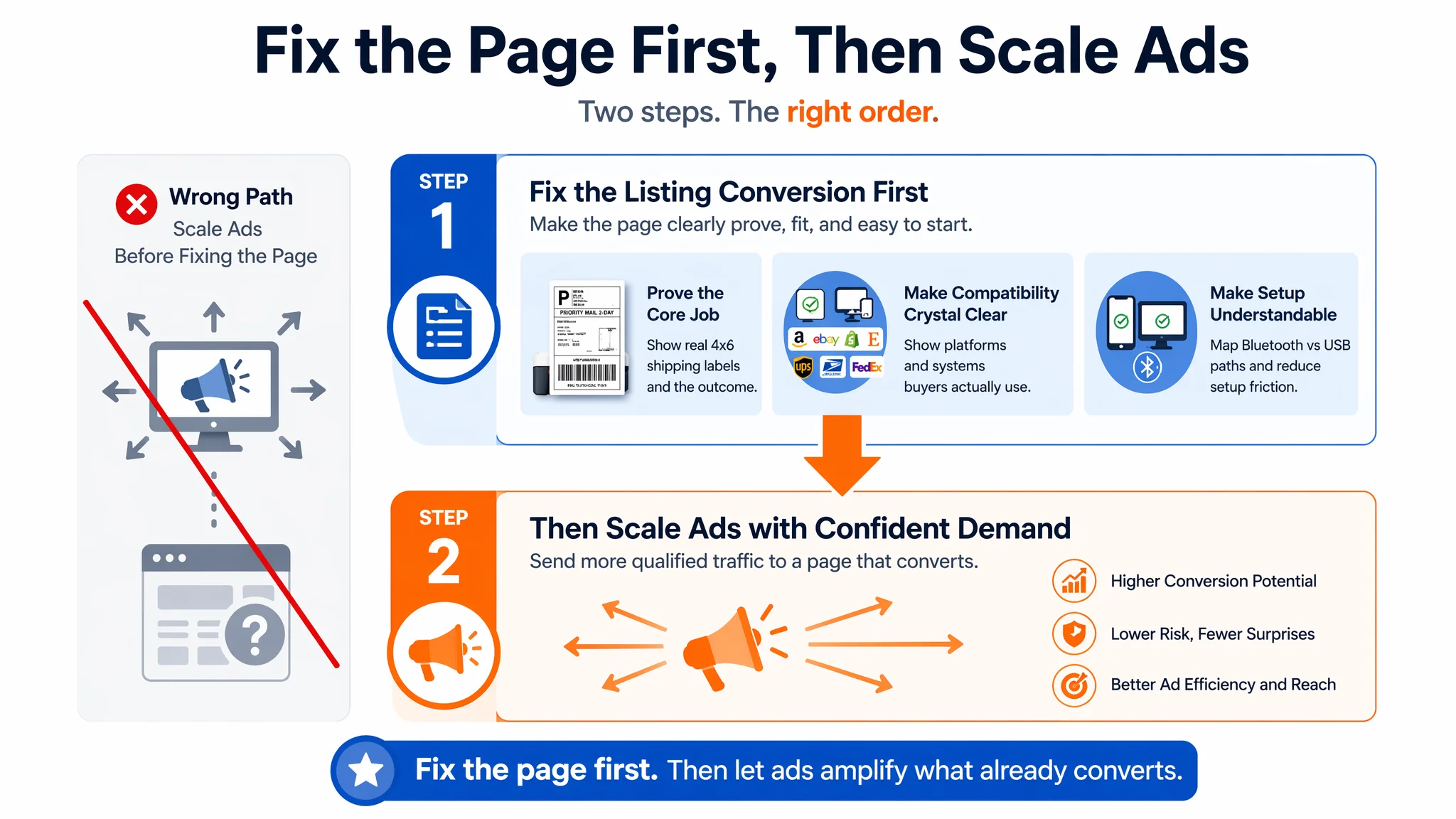
The central operating principle is sequencing. Do not use automation to scale traffic before confirming that the Listing can convert the traffic. First establish whether the page clearly proves the primary use case, clarifies compatibility, reduces setup friction, and builds sufficient trust. Then use AI to improve the efficiency and reach of the campaigns supporting that page.
How DeepBI Elevates Your Brand Performance Across the Full Funnel
AI-optimized advertising remains the core driver of DeepBI’s cross-funnel strategy. When campaigns attract more relevant, higher-converting traffic, stronger CVR can accelerate sales velocity. That momentum may support improved organic keyword rankings, generate more unpaid traffic, and potentially reduce TACoS as the ASIN relies less on paid clicks for each sale. The result is a flywheel: advertising creates demand, conversion quality strengthens relevance, and organic visibility expands the reach of subsequent investment.
The flywheel depends on sending traffic to a Listing capable of converting it. Before traffic is fully scaled, DeepBI’s Listing optimization module diagnoses weaknesses in the main image, title, bullet points, and A+ content. It also intelligently scores the main image, title, and A+ content against closely matched leading competitors. Based on those diagnosed gaps and the product’s verified attributes, DeepBI generates optimized content intended to improve CVR, with the likely impact depending on the Listing’s starting point.
The label-printer case shows how this full-funnel diagnosis works in practice. The Listing had a solid textual foundation, but its page-level decision logic was incomplete. The benchmark competitor was not simply using more information; it was answering the buyer’s questions more visibly and systematically.
The key gaps included:
- The main image did not clearly show a real 4x6 shipping label with readable barcodes and address details.
- The A+ content did not provide a strong platform-compatibility visual.
- The page lacked a clear system-and-connection matrix for iOS, Android, Windows, and Mac.
- The app workflow was not explained step by step.
- Mac-specific setup friction was not addressed visibly.
- The review-count gap was not sufficiently compensated for through professional ecosystem and trust signals.
The recommended Listing reconstruction therefore focused on making the product’s value legible before further ad scaling:
- Show the printer producing a clearly printed 4x6 shipping label.
- Connect the phone app screen to the same label outcome.
- Visualize 150mm/s speed and 203 dpi through real print-quality details.
- Explain supported label widths and use cases.
- Map Bluetooth and USB paths by operating system.
- Display relevant ecommerce and logistics platforms, including Amazon, eBay, Shopify, Etsy, UPS, USPS, and FedEx.
- Show the app workflow from download and pairing through preview and printing.
- Provide transparent Mac setup guidance.
- Use realistic work scenarios rather than generic product or accessory displays.
These changes do not replace advertising optimization. They make advertising more useful by ensuring that the page receiving the traffic can explain the product’s relevance and reduce perceived risk.
The organic layer then converts advertising evidence into a focused growth initiative. DeepBI’s Organic Traffic strategy identifies top-converting advertising keywords and supports targeted Top of Search campaigns around them. Curated terms move from the advertising funnel into organic-ranking initiatives, concentrating investment on queries already demonstrating commercial relevance. Advertising therefore remains central, while Listing improvements support stronger traffic conversion and Organic execution helps build more durable visibility. Performance can be evaluated through CTR, CVR, ACoS, BSR, and TACoS rather than subjective judgment alone.
Structured Reconstruction of Titles, Bullet Points, A+ Content, and Main Images
A structured optimization process should not assume that every Listing component needs to be rewritten. The objective is to identify where the buying logic breaks and then repair the weakest links in the sequence.
Titles and Bullet Points: Strong Information Is Not Always Strong Persuasion
Titles and bullet points remain important for discoverability, relevance, and basic product understanding. They should identify the product clearly, communicate meaningful specifications, and connect features to user benefits.
In the label-printer case, the title already established the product category and included key information such as:
- Wireless Bluetooth thermal shipping-label printer
- 4x6 label maker
- 150mm/s speed
- 203 dpi resolution
- Ink-free printing
- Windows and Mac compatibility
- Phone-app and small-business use cases
The bullet points also followed a reasonable structure by covering performance, compatibility, flexibility, and cost-related benefits. This is why the page could look stronger than the benchmark when evaluated through an internal text checklist.
However, targeted refinements could make the existing information more useful to buyers:
- Name relevant platforms explicitly, including Amazon, eBay, Shopify, Etsy, UPS, USPS, and FedEx where supported.
- Translate speed into a human-useful statement, such as up to 72 sheets of 4x6 labels per minute, where that information is verified.
- Connect 203 dpi to scan reliability and delivery accuracy rather than presenting it as an isolated specification.
- Clarify the supported label-width range and supported formats.
- Explain Bluetooth and USB paths by operating system.
- Connect ink-free operation to reduced ongoing maintenance rather than leaving it as a technical feature.
The lesson is not that text is unimportant. It is that text quality should be judged by whether it supports the buyer’s decision, not only by whether it contains keywords or sounds professional.
Main Images: Show the Buyer’s Desired Outcome
The main image has a different job from the title. It must communicate the primary use case quickly and reduce uncertainty before the buyer reads deeply.
For the label printer, the original hero image attempted to show the product body, phone, manual, USB drive, adapter, and a label containing terms such as “Wireless,” “USB,” and “Bluetooth.” The image contained information, but it did not immediately prove what the buyer actually wanted to know: whether the printer could produce a clear, reliable 4x6 shipping label.
A stronger visual sequence would begin with:
- The printer
- A clearly printed 4x6 shipping label
- Readable barcode and address details
- A phone screen showing the same label design
- Accessories kept secondary to the primary outcome
This changes the visual message from “the product includes several features” to “the product performs the job I need.”
Supporting images can then assign one decision to each frame:
- Performance proof: Show 150mm/s, 203 dpi, barcode clarity, small-text legibility, and real logistics-label output.
- Versatility and app creativity: Show shipping labels, product tags, inventory labels, and other supported formats alongside the app interface.
- System and connection map: Distinguish Bluetooth paths for supported mobile devices from USB paths for Windows and Mac, while clearly identifying limitations.
- Workload readiness: Show label holders, different label rolls or stacks, and realistic ecommerce and shipping workflows.
The purpose is not to place every feature into one image. It is to create a sequence in which each image answers a specific question.
A+ Content: Build a Decision Path
A+ content should do more than repeat product features. It should reduce the perceived risk of buying, installing, and using the product.
For the label printer, a stronger A+ structure would include:
1. Platform ecosystem and trust
A platform logo wall can visually confirm compatibility with the ecommerce and logistics tools buyers already use. This is particularly important when the Listing has a large review-count gap relative to a benchmark competitor. Professional integration signals cannot replace reviews, but they can provide additional evidence that the product belongs in the buyer’s workflow.
2. Performance confirmation
Large, clear presentation of 150mm/s and 203 dpi should be connected to visible output: sharp barcodes, readable small text, and real shipping labels. Technical specifications become more persuasive when buyers can see what they mean in use.
3. System and connection matrix
A clear matrix can show which devices connect through Bluetooth and which require USB. It should distinguish iOS, Android, Windows, and Mac paths where supported and identify limitations honestly. This reduces mismatched expectations before purchase.
4. Label size and long-term cost
The page can explain the supported width range, including 4x6 shipping labels, smaller product labels, warehouse barcodes, and file labels. “Direct thermal” becomes more meaningful when tied to the absence of ink or toner and the resulting maintenance implications.
5. Transparent app workflow
A short visual sequence can show how the buyer downloads the app, pairs the printer, selects or imports a label, previews it, and prints. This addresses the fear that setup will be complicated without relying on general claims about ease of use.
6. Mac-specific reassurance
If Mac users may encounter security prompts or setup friction, the A+ page should show where to find the relevant security settings and how to proceed. Addressing a known obstacle openly can reduce hesitation and prevent expectation gaps.
7. Scenario summary
The final section can show the printer in ecommerce, home-office, small-business, warehouse, and document-organization settings. Realistic scenarios help buyers understand how the product fits into daily work.
This structure illustrates a broader principle: A+ content is not simply an additional space for marketing language. It is a place to guide the buyer through compatibility, setup, performance, and risk.
Competitive Scoring: Compare Decision Logic, Not Surface Appearance
Competitive benchmarking should not be used to copy a competitor’s design mechanically. Its purpose is to identify where the competitor communicates a buying argument more effectively.
In the label-printer audit, the benchmark competitor had a total score of 85/100 compared with the seller’s 74/100. The seller’s title and bullets performed relatively well, but the benchmark had stronger main-image and detail/A+ scores. The gap therefore pointed away from basic keyword coverage and toward visual proof, structured explanation, and trust-building content.
A useful benchmark asks:
- Does the competitor show the primary use case more clearly?
- Does it explain compatibility faster?
- Does it make setup appear easier?
- Does it address common objections before the buyer has to search for answers?
- Does it use images and A+ content to compensate for limited review scale?
- Does its page look like a working solution rather than a collection of specifications?
These comparisons help determine whether the next optimization should focus on bids, search terms, copy, creative, or the entire conversion path.
Building a Data-Driven Optimization Loop with Event Tracking and CTR Measurement
A reliable optimization loop connects advertising signals with Listing and creative changes. It should record what changed, when it changed, which metric moved, and whether the change improved the intended business outcome.
At the advertising level, monitor:
- Impressions
- Clicks
- CTR
- Conversions
- CVR
- Spend
- ACoS
- TACoS
- Placement performance
- Search-term efficiency
- Budget utilization
At the Listing level, monitor the conditions that influence conversion:
- Main-image clarity
- Title and bullet-point relevance
- A+ content completeness
- Compatibility communication
- Setup guidance
- Review volume and rating context
- Competitive content gaps
- Primary-use-case proof
- Return or negative-review risks caused by unclear expectations
The label-printer case demonstrates why these layers need to be connected. The team initially interpreted the situation through advertising signals: impressions were arriving, orders were not keeping pace, and ACoS was difficult to control. The Listing appeared acceptable because its title, bullets, rating, and overall score did not look alarming.
The diagnostic process added a second layer of evidence. The main image did not show a clear 4x6 shipping-label result. The A+ content did not sufficiently explain platform compatibility, operating-system connections, app usage, or Mac setup. The review count was far below the benchmark, yet the page did not use its visual content to create additional trust. The result was a more complete explanation: traffic was reaching the page, but the page was consuming that traffic because it did not complete the buyer’s decision.
A data-driven loop would therefore sequence changes deliberately:
1. Establish the baseline. Record advertising metrics and document the current Listing structure.
2. Identify the conversion question. Determine what the buyer must believe before purchasing.
3. Compare the page with relevant competitors. Look for gaps in visual proof, compatibility, setup, trust, and use-case clarity.
4. Change one connected content system. For example, align the main images, bullet points, and A+ modules around the same compatibility and performance story.
5. Track the response. Review CTR, CVR, ACoS, TACoS, and conversion volume after allowing sufficient time for interpretation.
6. Separate traffic effects from page effects. A change in CVR may reflect traffic mix, Listing improvements, seasonality, or campaign adjustments.
7. Scale only after the evidence is consistent.
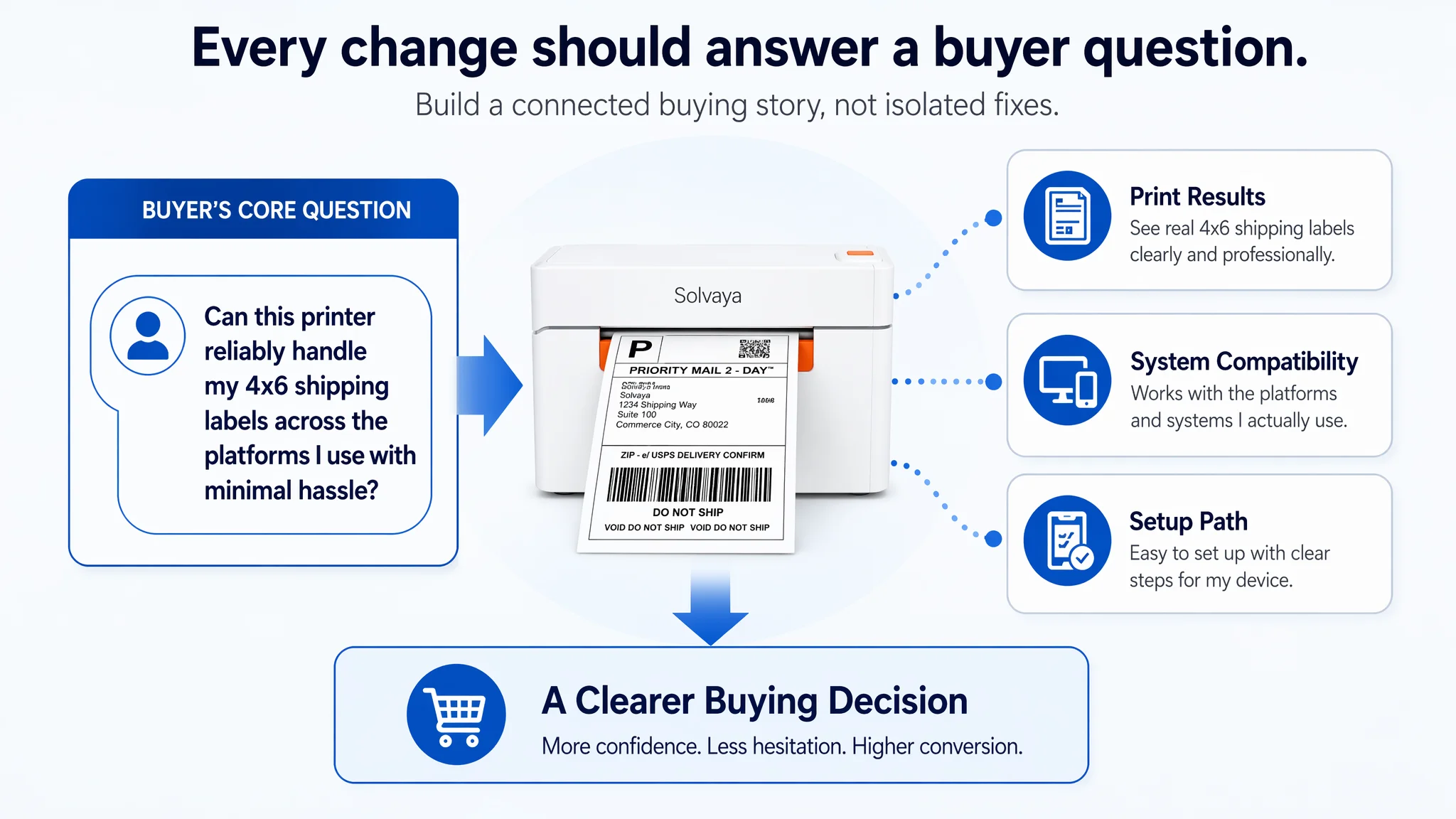
CTR and CVR should also be interpreted together. A stronger main image may improve the quality of the click and influence CTR, but the more important question is whether the page continues the same story after the click. If the search result suggests “clear 4x6 shipping labels with easy platform compatibility,” the Listing must immediately support that expectation through images, bullets, and A+ content.
The same principle applies to AI-generated recommendations. AI can identify patterns and suggest changes, but each recommendation should be tied to a buyer question and a measurable objective. For example:
- Improve the main image to make the primary use case immediately visible.
- Clarify the system and connection matrix to reduce compatibility uncertainty.
- Add an app workflow to reduce setup hesitation.
- Connect technical specifications to visible performance outcomes.
- Use realistic scenarios to help buyers imagine daily use.
This is more useful than making disconnected changes simply because a score is low. The goal is to create a coherent buying story that advertising can amplify.
Conclusion: From Tactical Firefighting to Strategic Growth
At catalog scale, manual advertising management turns growth work into tactical firefighting. A portfolio of 50 ASINs, multiple campaigns, and constantly changing keyword conditions creates more bid, budget, and search-term decisions than a team can review consistently. The result is often bid lag, missed selling windows, and avoidable pressure on ACoS. AI changes the operating model by handling repetitive execution continuously, while people oversee the system and assess whether its actions support the business objective.
Amazon’s expanding AI capabilities make adoption a practical priority, not a futuristic experiment. The strongest use of AI is not unrestricted autonomy, but controlled execution: processing performance signals, adjusting bids and budgets, and surfacing opportunities within rules defined by the brand. Humans should remain responsible for goals, campaign structure, product launches, seasonal planning, creative direction, and strategic decisions. AI is the executor, not the decision-maker.
The same principle applies to the relationship between advertising and the Listing. A thermal shipping-label printer seller initially assumed that ads were the main constraint because the page looked technically sound. The title and bullet points performed well, the rating was strong, and the Listing had a complete image set and A+ modules. Yet the competitive audit showed that the page did not clearly prove the product’s primary job, did not sufficiently explain platform and system compatibility, and did not reduce setup uncertainty. The problem was not simply that advertising failed to bring traffic. The page was not converting that traffic with enough clarity and trust.
That misdiagnosis is common because advertising metrics are easier to see and adjust than buyer hesitation. Teams can change bids, budgets, placements, and keywords within the advertising console. But when relevant traffic continues to struggle, the more important question may be whether the Listing deserves more traffic.
The next step is measured rather than dramatic. Audit current campaigns, establish baseline ACoS, TACoS, CVR, and management time, then run a controlled pilot on a defined group of campaigns while retaining a comparison group. At the same time, inspect the destination Listings for the visual and informational gaps that may be limiting conversion. Review the evidence, refine the operating rules, and expand only when the process is trustworthy.
AI can make advertising execution faster and more responsive. Data-driven Listing diagnosis can make the destination page clearer and more persuasive. Together, they allow brands to move from tactical firefighting toward a more deliberate growth system—one in which advertising amplifies a page that has already earned the opportunity to convert.