

This case comes from an Amazon seller on the Italy marketplace, promoting a Bluetooth headset for motorcycle helmets. The team was under pressure from rising ad costs and weak orders, and their first instinct was that the problem lay in Amazon ads: bids, keywords, and budgets “needing more time” to optimize. They kept tuning campaigns while assuming the product page was “basically fine”.
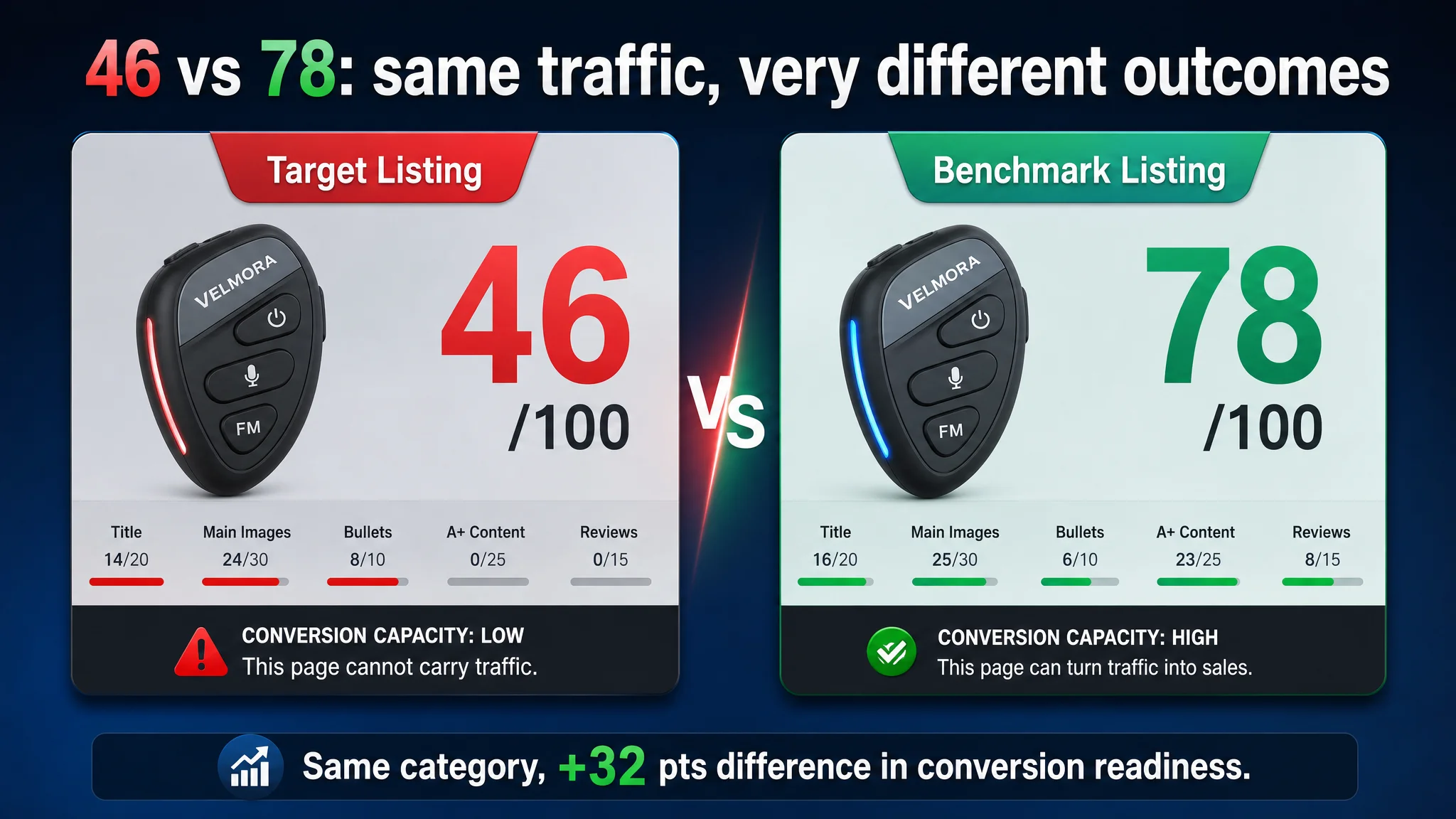
DeepBI’s Listing diagnosis told a different story. Against a directly comparable benchmark Listing in the same motorcycle-helmet headset segment, this product page scored only 46/100 versus the competitor’s 78/100. The biggest gap was not in ads or even in the hero image, but in the product page’s ability to carry the traffic: almost no A+ content, zero reviews, and a weak visual and trust structure meant the Amazon Listing simply could not convert the visits it was already getting.
Once the focus shifted from “ads are not optimized enough” to “this Amazon Listing cannot yet deserve more traffic”, the optimization direction changed. Instead of pushing more spend, DeepBI guided the seller to rebuild the Listing’s sales logic: reframe the title around real search behavior, restructure bullet points around riding pain points and safety outcomes, and redesign main images and A+ modules to make riding scenarios, audio quality, installation, and durability visually obvious. For other Amazon sellers, the takeaway is clear: if ACOS feels stuck and CTR/CVR don’t move, you may not have an advertising problem; you may have a product-page conversion problem that ads are only making more expensive.
Amazon Ads Were Not Failing. The Page Was Consuming the Traffic.
The seller was running Amazon ads on a motorcycle-helmet Bluetooth headset targeting the Italy marketplace.
Traffic was not the core issue: the category is active, and there were clear benchmark Listings with steady review volume and visible demand. What the seller saw in day-to-day operations, however, was:
- Ads bringing impressions and clicks, but orders not scaling as expected
- Rising ACOS pressure with limited room to keep raising bids
- A sense that “if we just tune keywords and bids more precisely, ACOS will come down”
In other words, they framed the problem as a pure advertising-optimization issue.
“The real problem was not that ads failed to bring traffic. It was that the page could not convert the traffic.”
DeepBI’s Listing score made the misalignment visible very quickly:
- Target Listing score: 46/100
- Benchmark Listing score: 78/100
- Gap: –32 points
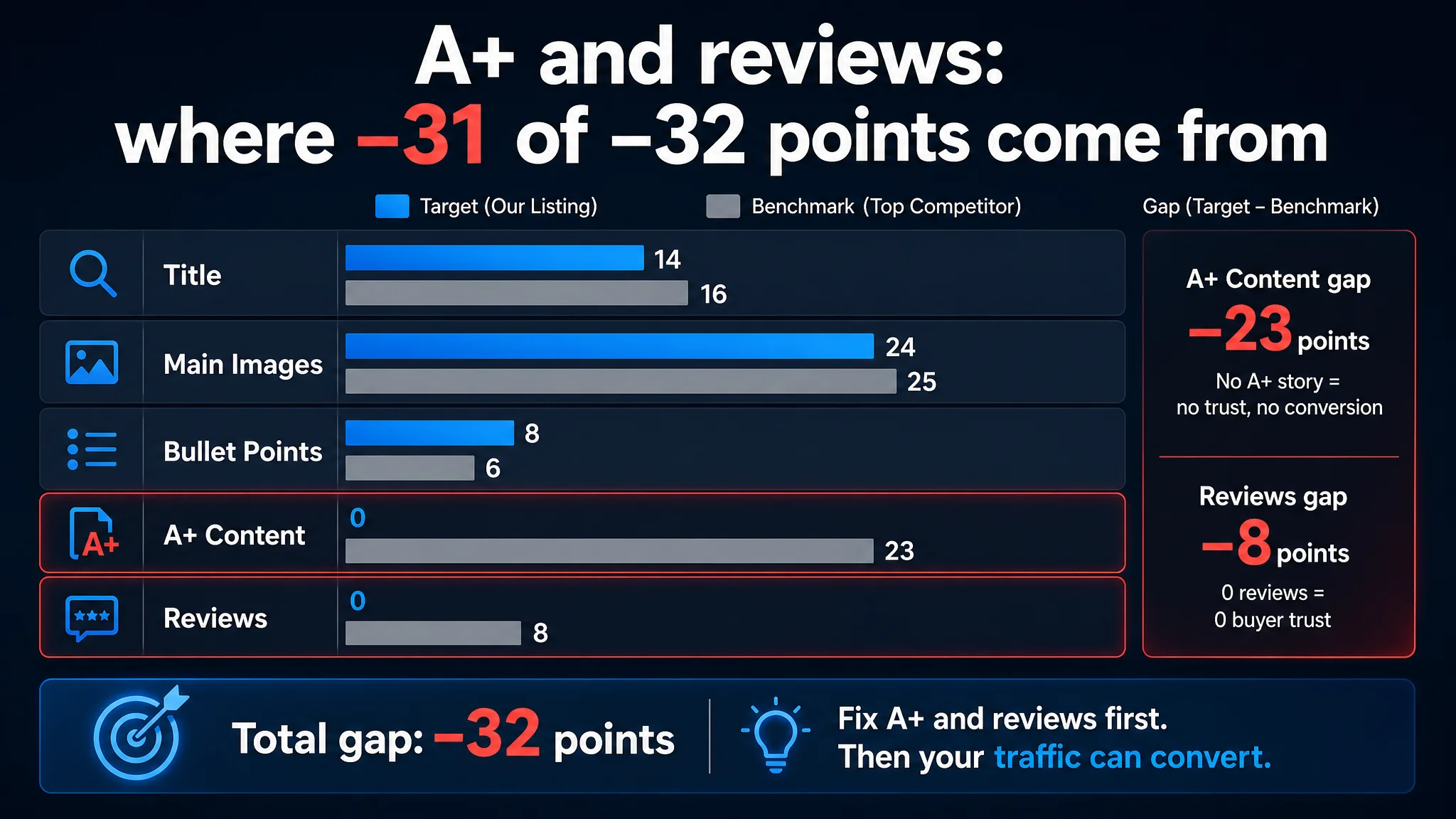
Broken down by dimension:
- Title: 14 vs. 16 (–2)
- Main image group: 24 vs. 25 (–1)
- Bullet points: 8 vs. 6 (+2)
- A+ / detail content: 0 vs. 23 (–23)
- Reviews: 0 vs. 8 (–8)
On the surface, the seller’s perception was: “Title is long and detailed, images exist, bullet points are strong. Ads should be able to drive this.”
On the data level, DeepBI’s judgment was:
- The Listing had almost no A+ story at all
- There was zero review-based trust
- Main-image and title gaps were small on paper but critical at the decision stage
- Bullet points were actually better structured than the competitor’s, but buried under a weak visual and trust framework
This meant Amazon ads were essentially pouring traffic into a page that behaved like a half-finished product detail—especially on mobile.
The Real Constraint Was Listing Conversion Capacity
At this stage, the single most important bottleneck was not keyword choice or bid levels; it was the Listing’s conversion capacity.
Title: Detailed, but Not Built Around the Search Outcome
The seller’s original title did several things “right” on a superficial checklist:
- Brand + product type were clearly stated
- Multiple technical features were present (Stereo HI-FI, AI voice control, FM radio, IPX6, etc.)
- Length was sufficient and covered many function-related terms
But compared with the benchmark, DeepBI saw three structural issues:
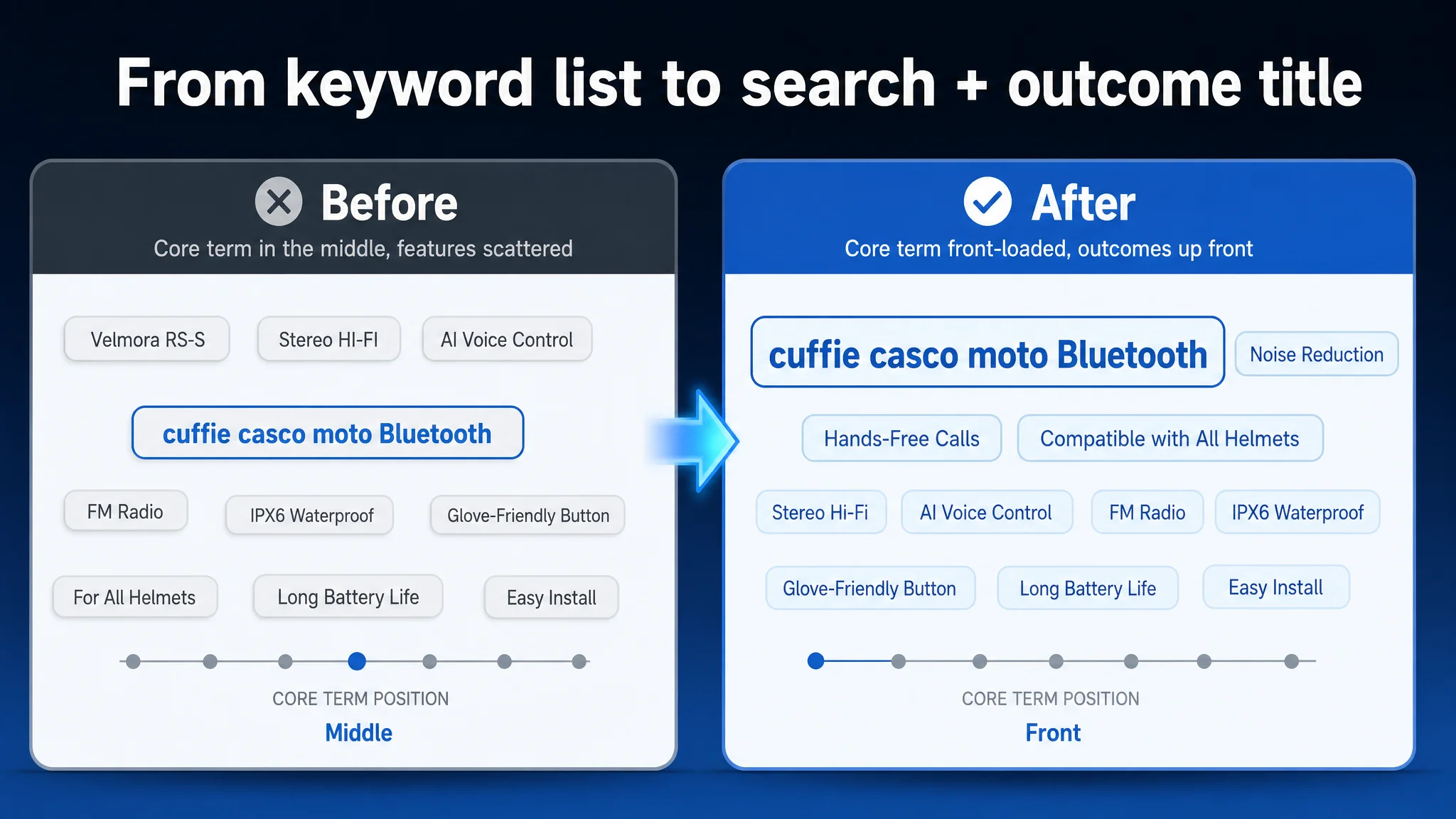
1. Core search term not front-loaded
- Benchmark: front-loaded “Casco Moto Auricolare”, immediately aligning with how buyers search on Amazon Italy
- Target: the core phrase “cuffie casco moto / auricolare moto” was scattered and not given maximum A9 weight
1. Outcome-driven phrasing missing in the most visible part
- Benchmark quickly surfaces benefits like “Automatico Risposta/Chiamata” and a clear numeric signal “1000mAh”, which translates to immediate expectations about convenience and endurance
- Target title leaned on function lists (Stereo HI-FI, AI voice, FM) but less on the outcome of using those functions while riding
1. Structure heavy, but not concise in decision logic
- The seller’s title tried to cover many features at once, but the density made buyers work harder to understand “what problem this solves for my rides”
- Benchmark concentrated fewer but more decisive elements where A9 and the human eye both pay most attention
DeepBI’s optimized direction was not “add more keywords”. It was:
- Bring “cuffie casco moto Bluetooth” and related core phrase into the front section
- Reframe the title so the first half combines: core search term + outcome signal (noise reduction, safe hands-free, compatibility)
- Keep differentiating elements (like glove-compatible button) but position them as structured, readable commas, not a keyword soup
Main Images: Not Just Aesthetics, But the Click-Decision Layer
On paper, the main-image group score gap was small (24 vs. 25).
In reality, that single point difference masked a huge decision gap:
- The seller’s current hero image included the product, packaging box, and promotional labels
- This scattered the visual focus, made the product feel less “industrial-grade”, and diluted the “rider equipment” feel
- Functional images leaned on internal structure / conceptual graphics, which have two drawbacks:
- They are harder to understand at a glance for buyers
- They flirt with Amazon’s compliance and trust boundaries when internal circuits are overly stylized or conceptual
The benchmark Listing, by contrast:
- Used a pure white background hero image with a clean, centered product, accessories aligned neatly
- Deployed scene-heavy images: headset mounted on helmets, used during actual riding, with strong light and motion cues
- Used modular tech diagrams to visualize DSP noise reduction, battery capacity, and ease of installation without showing internal circuitry
DeepBI’s judgment: the main image set was not creating a strong reason to click, nor a professional context once clicked.
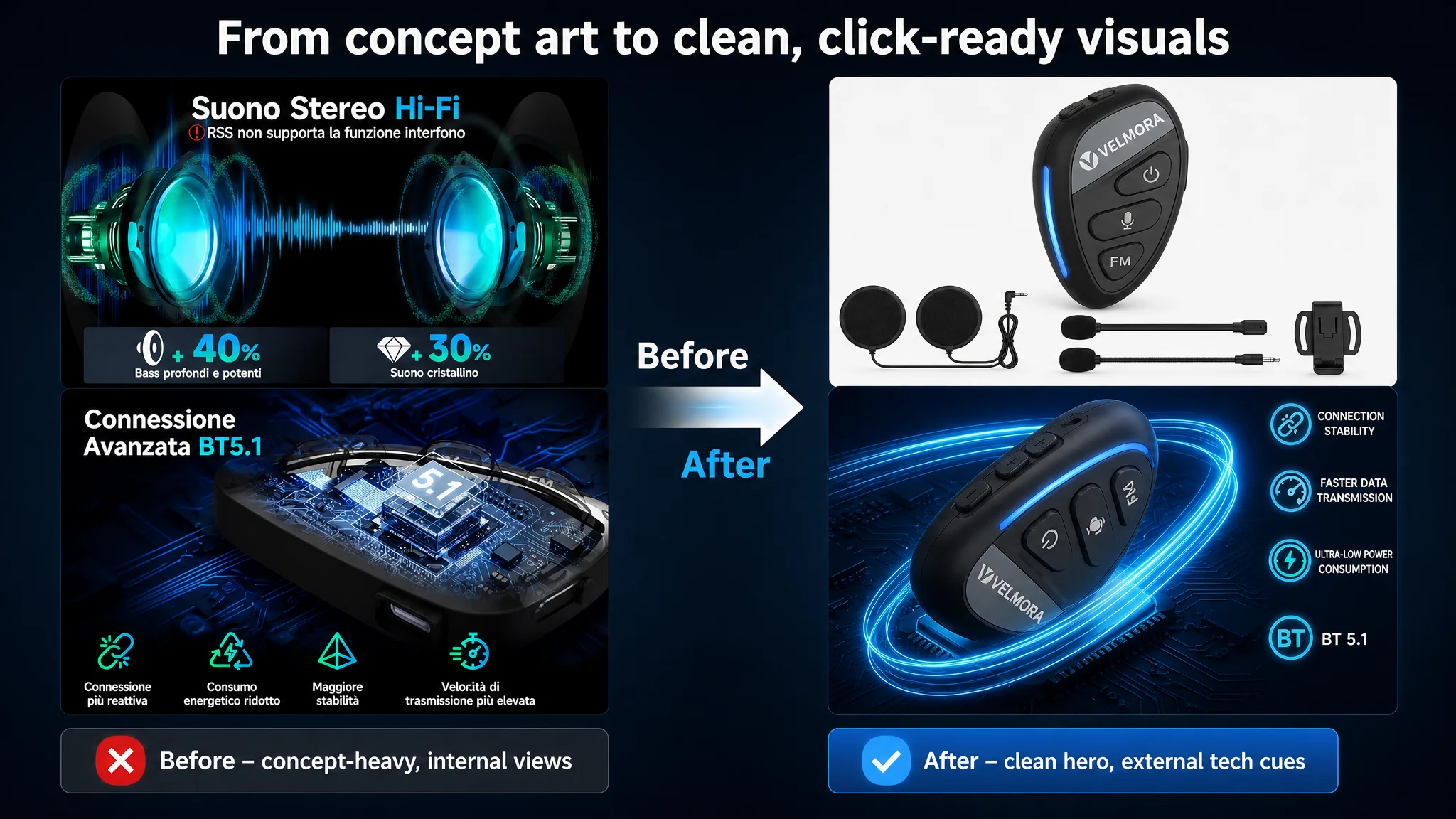
So the optimization strategy for images was not “make it prettier”; it was:
- Rebuild the first hero image into a minimalist, industrial-tech composition:
- Product centered, 45° angle, ~70% of the frame
- Pure white background
- Accessories lined up horizontally at the bottom
- No packaging box or distracting labels
- Convert concept-heavy internal-circuit visuals into external tech-expression images:
- Sound waves, concentric audio ripples, and quantified icons, instead of chip cutaways
- Inject scene images as early as possible:
- Rider on a highway at dusk with the headset clearly mounted on the helmet
- Rain / adverse-weather shots to anchor IPX6 and outdoor reliability
- A glove-wearing rider pressing a large, tactile button to visualize safe blind operation
“Advertising does not only amplify advantages. It can also amplify a page’s existing defects.”
With the hero image and early-stage visuals in this state, Amazon ads were effectively amplifying “uncertainty” instead of “confidence”.
This Product Page Did Not Lack Content. It Lacked A+ Story and Trust.
The biggest structural gap was not in the top half of the page; it was in the A+ / detail content and reviews.
A+ Content: A 23-Point Deficit That Broke the Funnel
DeepBI’s scoring showed:
- Target Listing detail/A+ score: 0/25
- Benchmark detail/A+ score: 23/25
That difference is enormous—not just in numbers but in funnel behavior.
The benchmark A+ modules formed a full decision path:
- A high-impact hero module: riders in motion (often two riders coordinating), headset visible on the helmet
- Core pain-point resolution:
- DSP/CVC noise reduction visualized with waveforms
- Voice clarity under high-speed riding
- Hard numeric reassurances:
- “1000mAh” battery capacity
- “270h standby”, “36h playback” concretely stated
- Multi-scenario adaptability:
- Motorcycling, skiing, mountain biking all visually represented
- Installation simplicity:
- Step-by-step visuals, complete accessories layout, clear “2 minutes install” type reassurance
The seller’s A+ layer, in contrast, was initially missing or extremely underdeveloped—effectively a break in the decision funnel:
- Users landing on the page saw a basic top section
- Scrolling did not reward them with strong visuals, structured explanation, or scenario anchoring
- Instead of being guided from curiosity → reassurance → action, they met a content vacuum
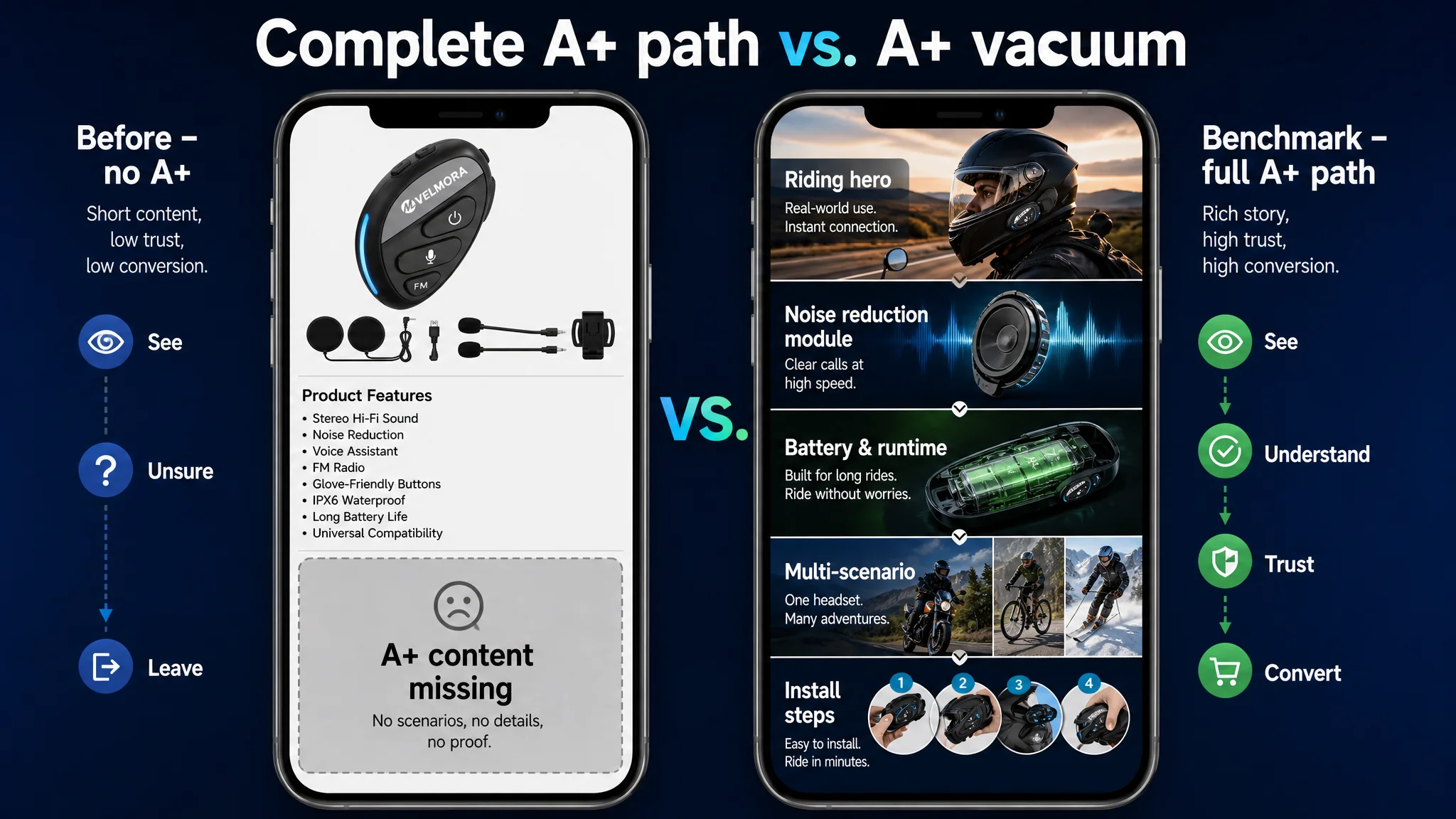
DeepBI’s recommendation was to treat A+ as the core trust layer, not an optional decoration:
- Build a new A+ head module:
- Helmet side view with headset installed
- Low-angle shot with a dusk highway background
- Strong motion and light cues signaling real riding use
- Add an audio core module:
- 40 mm driver as a central visual object
- Blue waveforms transitioning from noisy to smooth to visualize DSP effect
- Add a glove-operation module:
- Macro shot of a gloved hand pressing the raised button
- Visual ripple / response effect around the button to indicate feedback and control
- Add a multi-scenario strip:
- Skiing, forest trail riding, city commuting stacked vertically
- Each with the headset subtly marked on the helmet
- Add a battery and endurance module:
- Transparent-style view showing the internal battery pack (without altering real structure)
- Data board on the side marking runtime/standby hours
- Add an installation + full-contents module:
- Neatly laid-out accessories
- Step-by-step circles on the right showing installation sequence
In other words, rebuild the A+ into a complete buying narrative aligned with riding decisions, not just fill space.
Reviews: A Zero-Baseline Trust Problem
The review dimension was equally stark:
- Target Listing:
- 0 stars
- 0 reviews
- Benchmark Listing:
- 4.0 stars
- 62 total reviews
- 13 reviews visible on the first page
- Mixed languages (Italian, German), which helps credibility
In practical terms, this meant:
- The competitor already had a basic trust floor, even with only average star rating
- The seller’s page had no social proof at all, making the product feel unproven
With zero reviews, even a well-built A+ cannot fully compensate; but it can reduce the perceived risk of being the first buyer.
DeepBI’s conclusion: as long as reviews remain at 0, ad traffic will naturally behave more skeptically, and any ad-ACOS conversation that ignores this will remain trapped.
Bullet Points Were Better Than the Competitor’s—But No One Could Feel It
One of the more counterintuitive findings: the seller’s bullet points were actually stronger than the benchmark’s.
DeepBI’s comparative reading showed:
- Seller:
- Started from rider pain points (wind noise, poor audio, difficult operation)
- Structured bullet points as “problem → solution”
- Linked tech specs (40mm driver, Bluetooth 5.1) to user benefits (immersion, stability)
- Emphasized real-life scenarios (“long trips”, “solo riders”)
- Competitor:
- More function list and parameter oriented
- Less explicit on pain points and clear solution promises
The bullet-point score even reflected this: 8 vs. 6, with the seller slightly ahead.
So why wasn’t this translating into better conversion?
Because no one reaches the bullet points with confidence if the top of the page and A+ layer fail:
- Weak hero images + underpowered A+ mean users already doubt the product before reading
- No reviews intensify that doubt
- Bullet points, even well-structured, become a late-stage reinforcement instead of a conversion driver
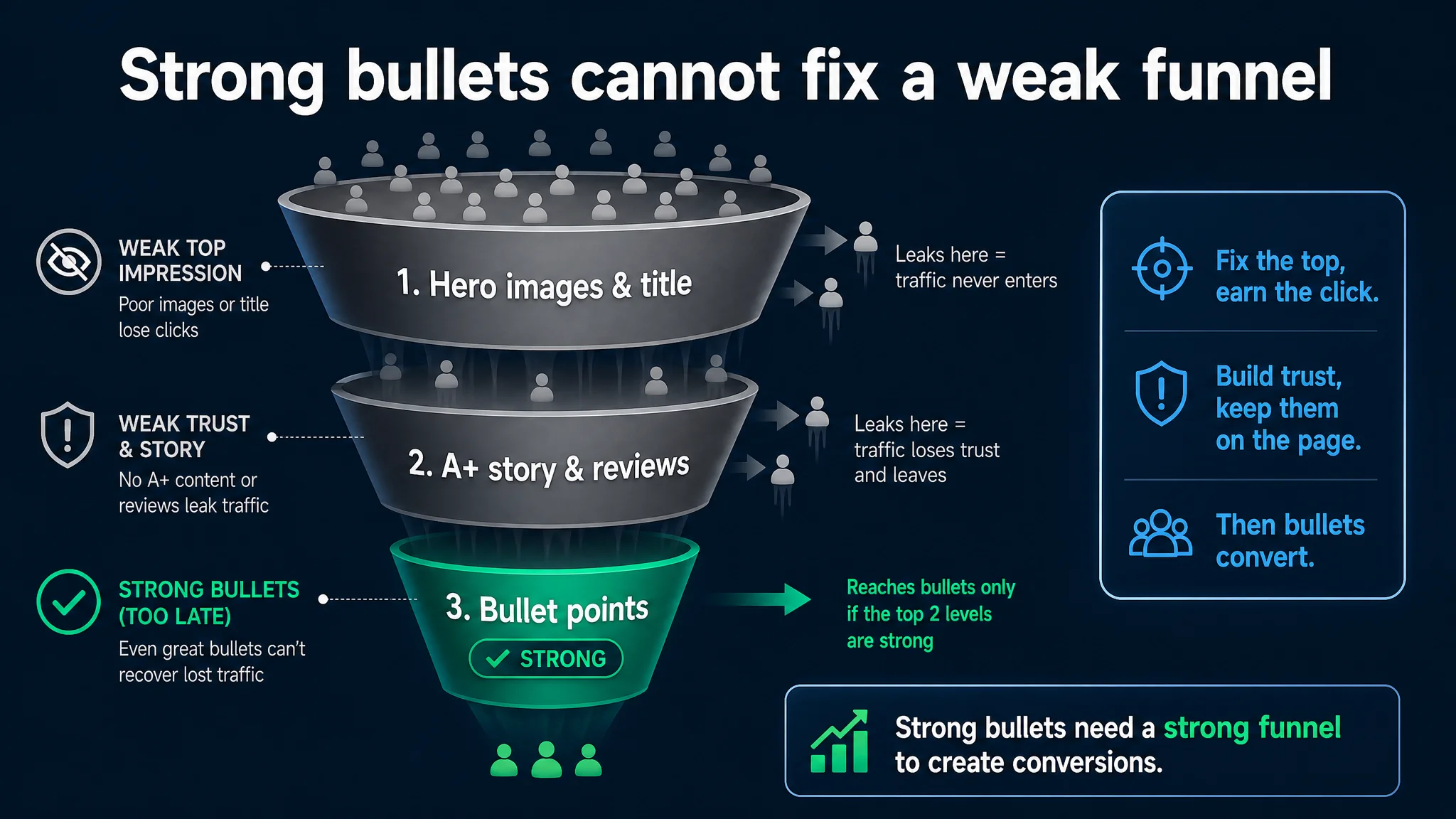
DeepBI’s decision logic here:
- Preserve the bullet-point logic and refine wording rather than overhaul it
- Integrate clear safety and expectation management:
- Highlight Bluetooth 5.1 stability, dual phone connection
- Explicitly state “[Note: Does not support intercom]” to prevent misunderstanding and reduce returns
- Align bullet naming with what riders actually prioritize:
- HI-FI Stereo & DSP noise reduction
- Ultra-thin, universal helmet compatibility
- AI voice assistant & automatic answer
- FM radio and solo-rider focus
- Bluetooth 5.1 & dual-phone pairing
This made the bullet points consistent with the visual story being rebuilt in the images and A+.
Why DeepBI Did Not Recommend “Keep Tuning Ads First”
From a business-risk perspective, DeepBI’s critical judgment was:
- Continuing to push ad optimization on this Listing, in its current state, would mostly amplify waste.
The logic:
1. The Listing’s core conversion infrastructure was incomplete
- No A+ story
- No reviews
- Main image set not aligned with riding decision logic
1. Any ad spend would be asking a half-finished page to behave like a mature product
- ACOS pressure would stay high because the page cannot justify the click cost
- Tweaking bids/keywords in this state only rearranges where the waste occurs, not whether it occurs
1. Fixing Listing conversion first creates a floor for ad efficiency
- Once the page can properly explain and visualize its value, ad traffic starts having a fair chance to convert
- Only then does tuning keywords, bids, and ad structure produce predictable improvements in ACOS and TACOS
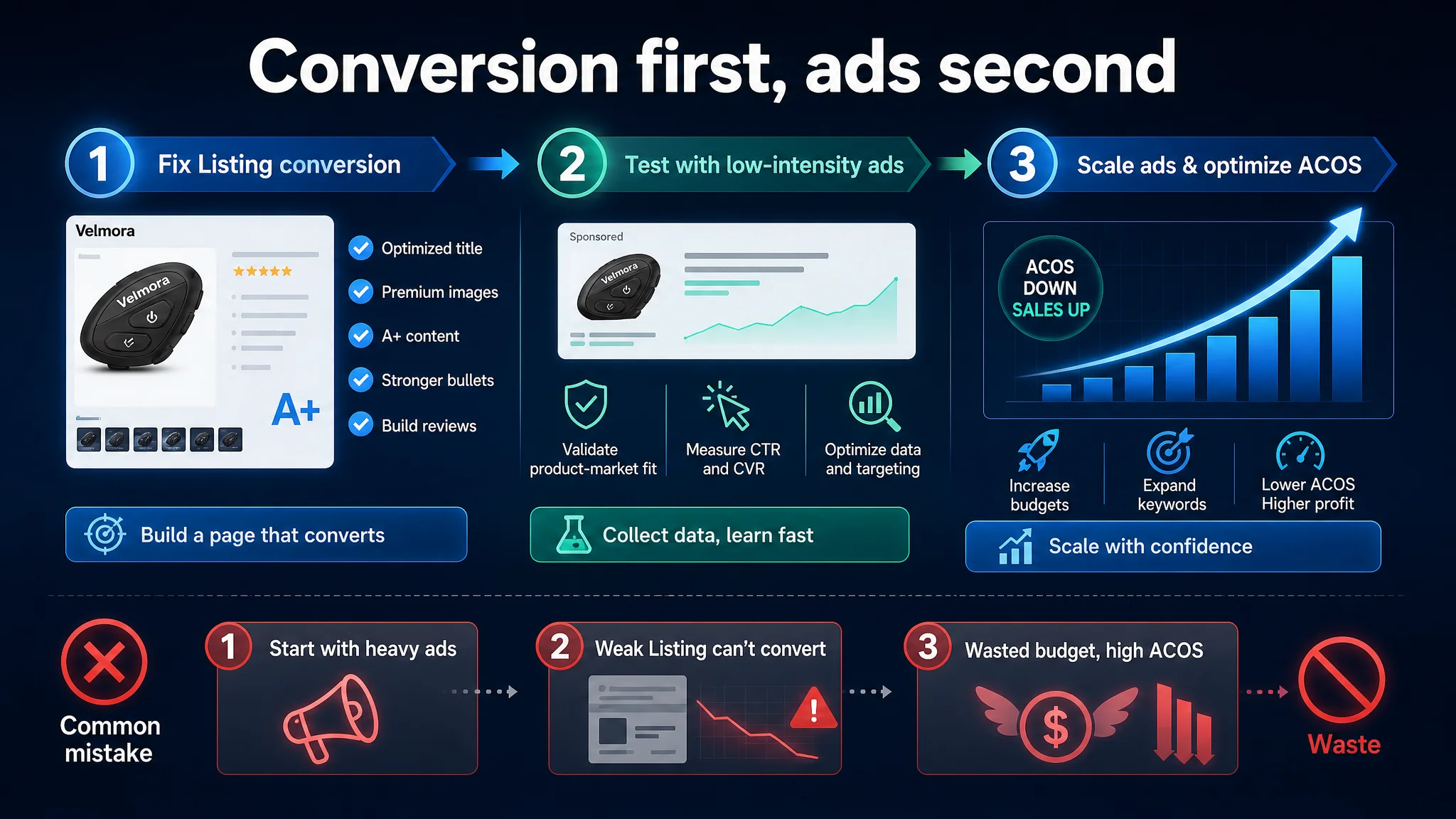
So the operational sequence DeepBI implied was:
1. Stabilize the Listing’s sales logic:
- Reframe title around Amazon Italy search patterns and outcome signals
- Rebuild main image and supporting images into a coherent visual funnel
- Construct a full A+ story for riding scenarios, audio, installation, endurance, and durability
- Clarify expectations via bullet points (including explicit “no intercom” note)
1. Use organic + low-intensity ads to test conversion:
- Watch CVR behavior before scaling spend
- Confirm that the Listing can now carry traffic effectively
1. Then re-enter serious ad optimization:
- Only when CVR stabilizes does it make commercial sense to fight for more impressions
- At that point, ACOS reductions are driven by a combination of better CTR from stronger visuals and better CVR from a complete page
How the Page’s Sales Logic Started to Recover
Without inventing specific post-change numbers, we can outline how the operating state began to change once the Listing was reframed.
The Page Became Capable of Explaining Itself
With the new visual and text structure:
- The hero and early images made it obvious:
- This is a headset designed for motorcycle helmets
- It handles noise, gloves, and weather
- It is slim and lightweight for long rides
- A+ content gave riders a step-by-step reason to trust:
- They could see themselves in the riding scenarios
- They could see how the device installs
- They could understand the 40mm driver and noise reduction visually
- They could picture longer rides without battery anxiety
This alone changed the risk profile of each click.
Ads Stopped Being Purely a Cost Center
As Listing conversion began to catch up to the traffic:
- Every ad click had a higher probability of turning into a sale
- The seller could start to see ACOS become more responsive to bid and keyword changes
- Organic behavior (e.g., brand + category searches) now had a better-performing destination page
In effect, ad traffic became useful again, instead of being a blunt instrument forcing a weak page to perform.
How the Seller’s Understanding Changed
The most important long-term change in this case was not just in visuals; it was in how the seller now thinks about Amazon operations.
Key shifts:
- From “ads should solve my sales problem” → to “ads are multipliers; if the page is weak, they multiply weakness.”
- From “we just need more reviews and time” → to “we need a page that can earn reviews in the first place.”
- From “our bullet points are good, so content is fine” → to “bullet points are only one part of a conversion system; images and A+ must carry equal weight.”
- From “title length and keyword coverage are enough” → to “title structure must reflect search logic and outcome promises, not just contain terms.”
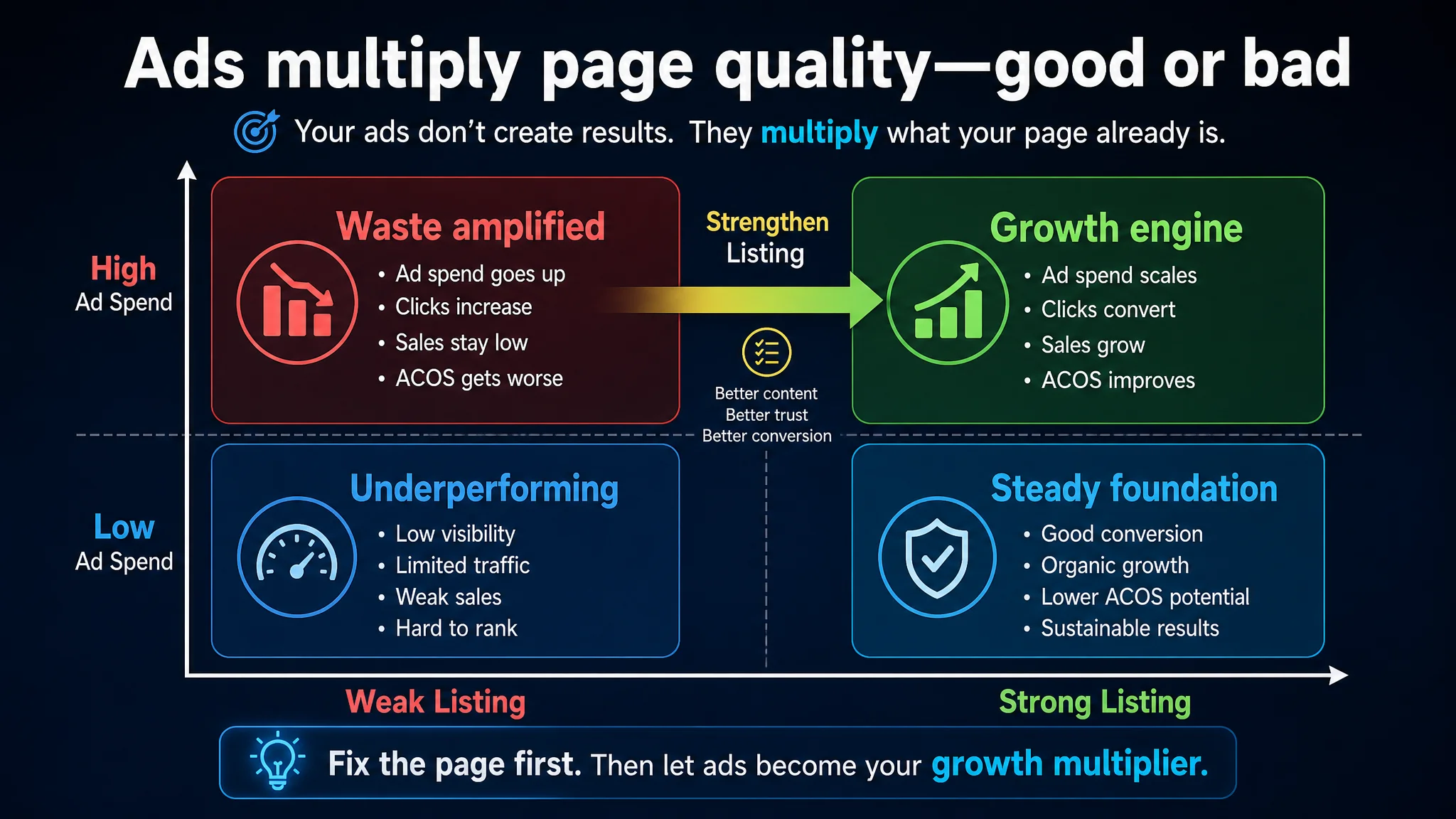
For other Amazon sellers, especially in technical or accessory categories like motorcycle headsets, this case carries a few concrete lessons:
- Do not assume ads are the root problem just because ACOS is high.
If your Listing has low A+ depth, no reviews, and underdeveloped visuals, you likely have a conversion bottleneck first.
- Listing conversion is the foundation of sustainable ad performance.
Without a page that can build trust and clarify value, even the best ad tactics will feel unstable.
- Title, main images, bullet points, and A+ must tell one coherent story.
In this case, bullet points were good on their own, but were held back by weak imagery and missing A+.
- Before scaling ads, ask: “Does this page deserve more traffic?”
If the honest answer is “not yet”, the highest ROI move is often to fix the Listing first—exactly what DeepBI’s scoring and optimization logic surfaced in this case.
In the Italy motorcycle-headset segment, the difference between a 46/100 and a 78/100 Listing score was not a subtle design nuance; it was the difference between a page that burns traffic and a page that can truly work with Amazon ads as a growth engine.