

For this Amazon seller in the outdoor solar light category on the French marketplace, the pressure was clear: traffic was not the main issue anymore, but ad efficiency was becoming harder to sustain. The team kept tuning Amazon ads—bids, budgets, keyword mixes—yet ACOS refused to move in the direction they wanted. Internally,他们越来越坚信问题出在“广告没调好”。
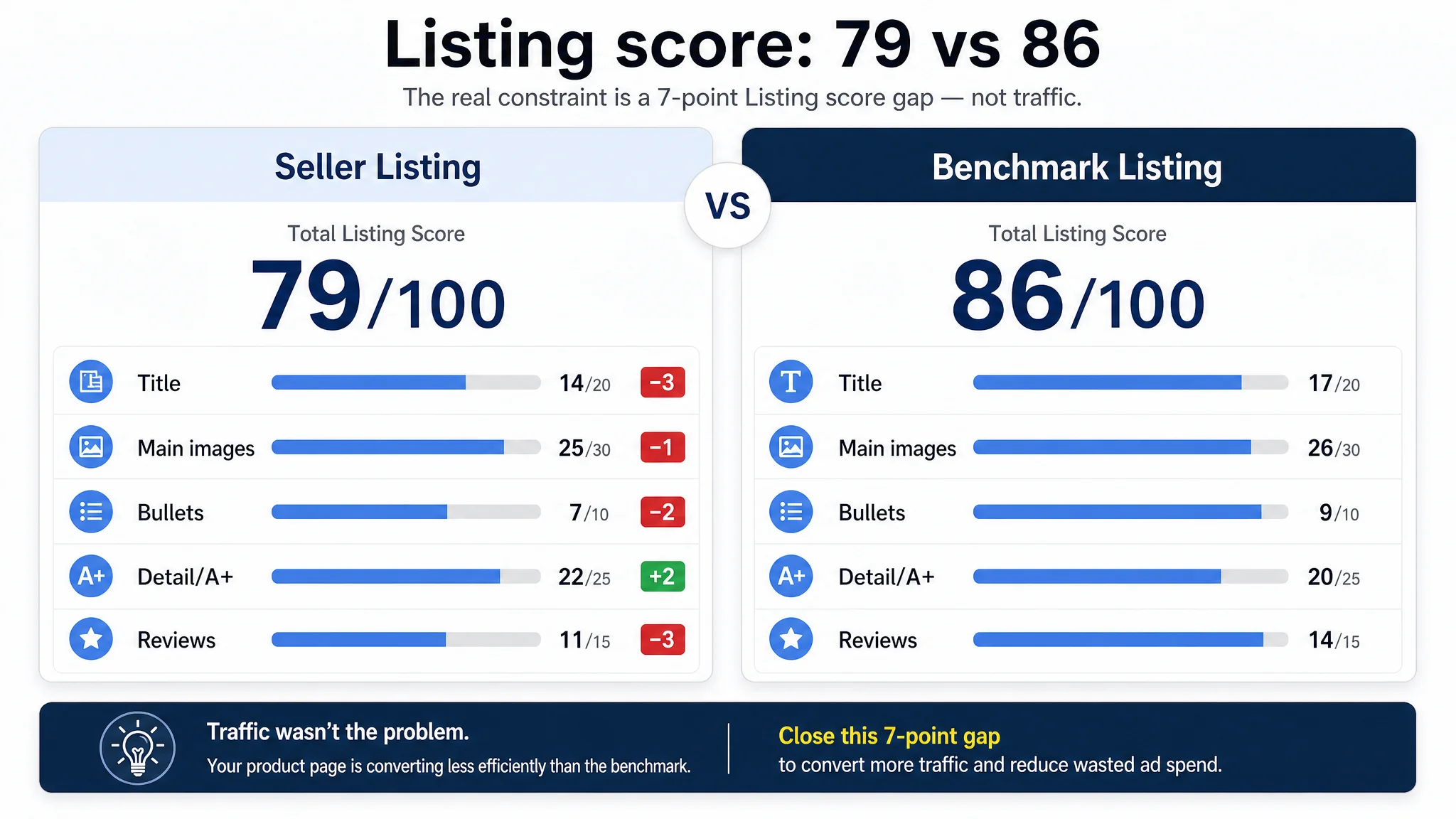
Once DeepBI ran a full Listing diagnosis against the real benchmark competitor, a different picture emerged. The product page scored 79/100 while the category-leading competitor reached 86/100. The gap did not sit in traffic volume or basic product quality; it sat in how the Amazon Listing converted that traffic—especially in the title, bullet points, main-image set, and review structure. Ads weren’t failing to bring people in. The page was failing to fully convert them once they arrived.
The optimization therefore shifted away from “keep squeezing the ads” and toward rebuilding the Listing’s sales logic: restructuring the French title to surface quantifiable value, reframing the bullets from parameter lists to buying arguments, and redesigning key images and A+ modules to tell a clear story on brightness, modes, durability, and remote control. The lesson for other Amazon sellers is not that this Listing was “bad”—it was that in a tight category, even a 7‑point Listing gap against a benchmark can quietly turn into wasted ad spend and unstable ACOS if you misdiagnose a conversion problem as an advertising problem.
The Real Constraint Was Not Traffic. It Was Listing Conversion Capacity.
From the seller’s perspective, the situation looked like a typical Amazon ads problem.
- Ads had been running for a while.
- The product had over 1,800 reviews on Amazon FR with a 4.3‑star rating—far from a “broken” product.
- Yet ad performance was under pressure; ACOS was not improving in line with all the manual tuning.
The operating assumption inside the team: “If we can just optimize keywords, bids, and campaign structure better, ACOS will come down.”
But when DeepBI put the Listing through its scoring and competitive comparison, the story changed:
- Total Listing score: 79/100
- Benchmark competitor score: 86/100
- Gap: –7 points
On the surface, –7 points does not sound catastrophic. But where those 7 points came from mattered:
- Title: –3 vs competitor
- Bullets: –2
- Main images: –1
- Reviews dimension: –3
- Detail/A+ content: +2 (the seller actually led here)
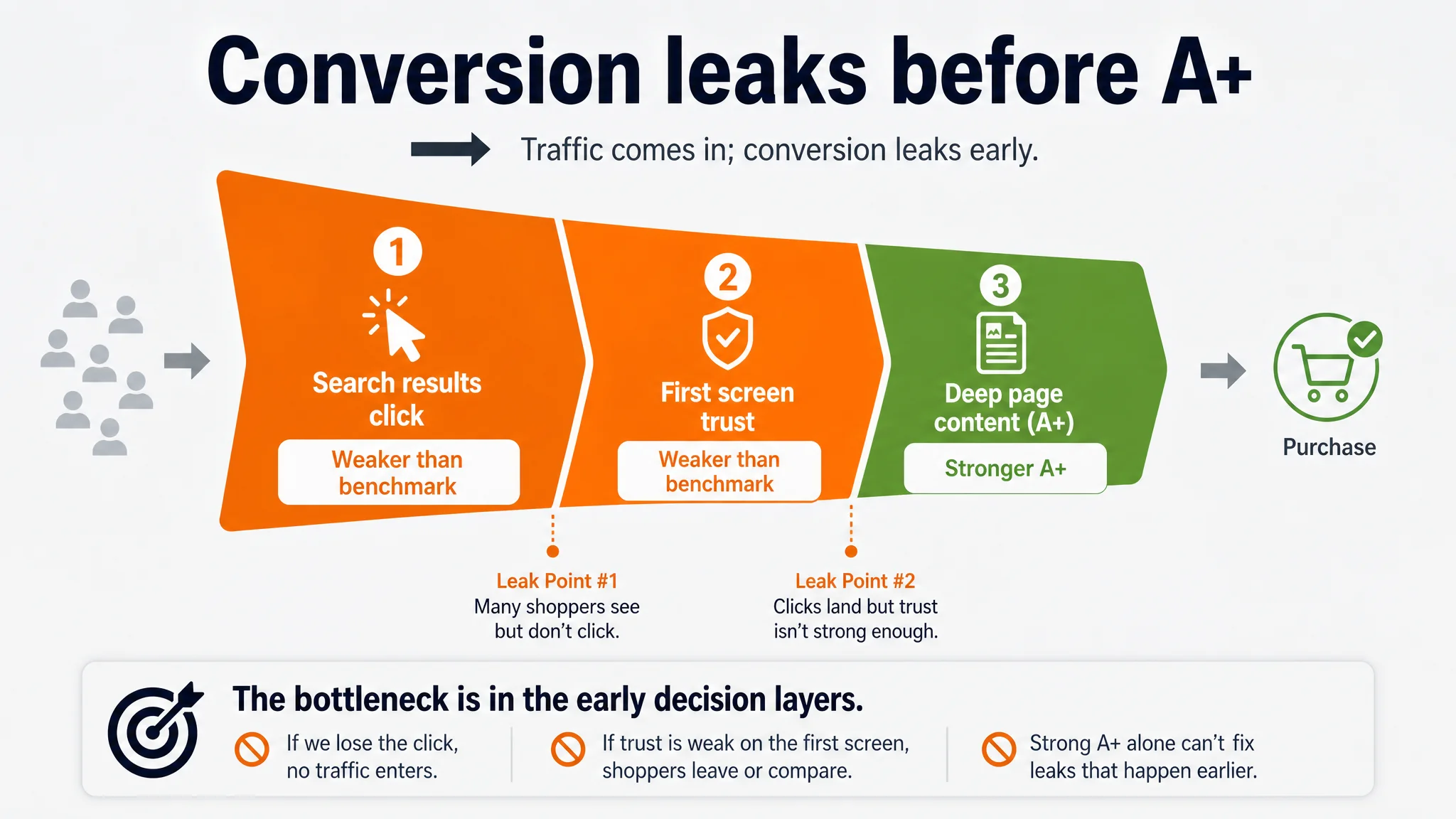
In other words, the Amazon product page was not structurally weak. It had strong A+ content. The real bottleneck sat in the first layers of decision: search results click, first scroll impression, and quick trust formation.
“The real problem was not that ads failed to bring traffic. It was that the page could not convert the traffic as efficiently as the benchmark.”
If you keep throwing ads at a page that loses the click war on the search results and lacks a sharp value story above the fold, ad spend becomes a magnifier of weaknesses instead of strengths.
How the Seller Misread the Problem
What the team believed
- High ACOS = advertising issue.
- Solution path = better keyword harvesting, negative keywords, bid adjustments, and campaign structure.
This mindset is common and, in many categories, works for a while. But it assumes:
1. The Listing already converts close to category ceiling.
2. Competitors are not significantly better in how they package value on the page.
Here, neither assumption was true.
Why traditional ad optimization stalled
Ads can only optimize who you bring in and at what price. They cannot, by themselves, fix:
- How many people click when they see your thumbnail vs a competitor.
- How many add-to-cart or buy once they land on the product page.
- How quickly they understand “what this product does better for me.”
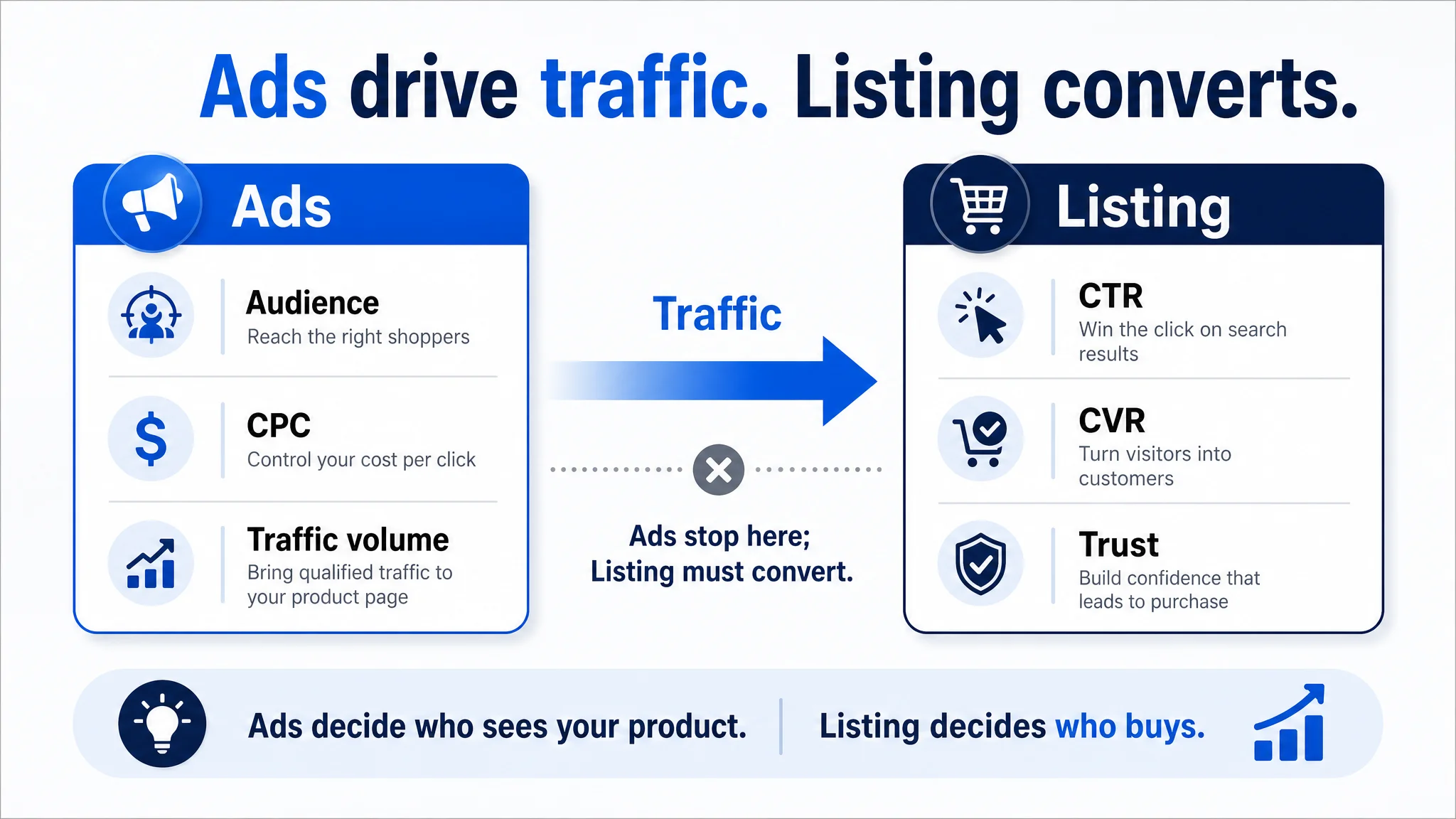
When DeepBI mapped the Listing against the competitor, it became clear that the seller’s ads were delivering traffic into a page that, compared with the category leader:
- Communicated less quantifiable value in the title.
- Built weaker first-impression trust in the main-image set.
- Used bullets that listed features rather than resolved buying doubts.
- Faced a review scale deficit that was not compensated by stronger content.
In that context, further ad optimization was just making the underlying conversion problem more expensive.
Title: Losing the Battle in the First Line
On Amazon, the title is not just for indexing. It is the first condensed piece of sales logic the shopper sees.
What the benchmark got right
The benchmark’s French title followed a mature Amazon pattern:
Brand + Core term + Quantity + Quantified specs + Key differentiator + Scenario
Concrete elements included:
- “2 Pack” upfront: instant perceived value and click magnet.
- “90 LED, 2600mAh, Pile Remplaçable”: brightness, battery capacity, and replaceable battery spelled out.
- Core keyword cluster like “Lampe Solaire Exterieur avec Télécommande” placed compactly near the front.
- Ending with “Lampe de Sécurité Mural pour Jardin”: clear use-case framing, not just generic broad keywords.
This title does three jobs at once:
1. Signals strong value per euro (2‑pack).
2. Establishes technical competence (numbers and replaceable battery).
3. Grounds the product in a specific scenario (wall-mounted security for the garden).
Where the seller’s title fell behind
The original title:
- Did not highlight quantity as a conversion lever.
- Contained only one main parameter (IP65), which is a hygiene factor in this category, not a differentiator.
- Inserted longer descriptive phrases in the middle, diluting core keyword density.
- Ended with a chain of broad, hyphenated generic terms (“Lampe-Solaire-Exterieur-Projecteur-Eclairage”), which adds little to conversion.
- Lacked a structured “brand + core term + value + parameter + scenario” order.
DeepBI’s judgment: this is a conversion gap, not a pure SEO gap.
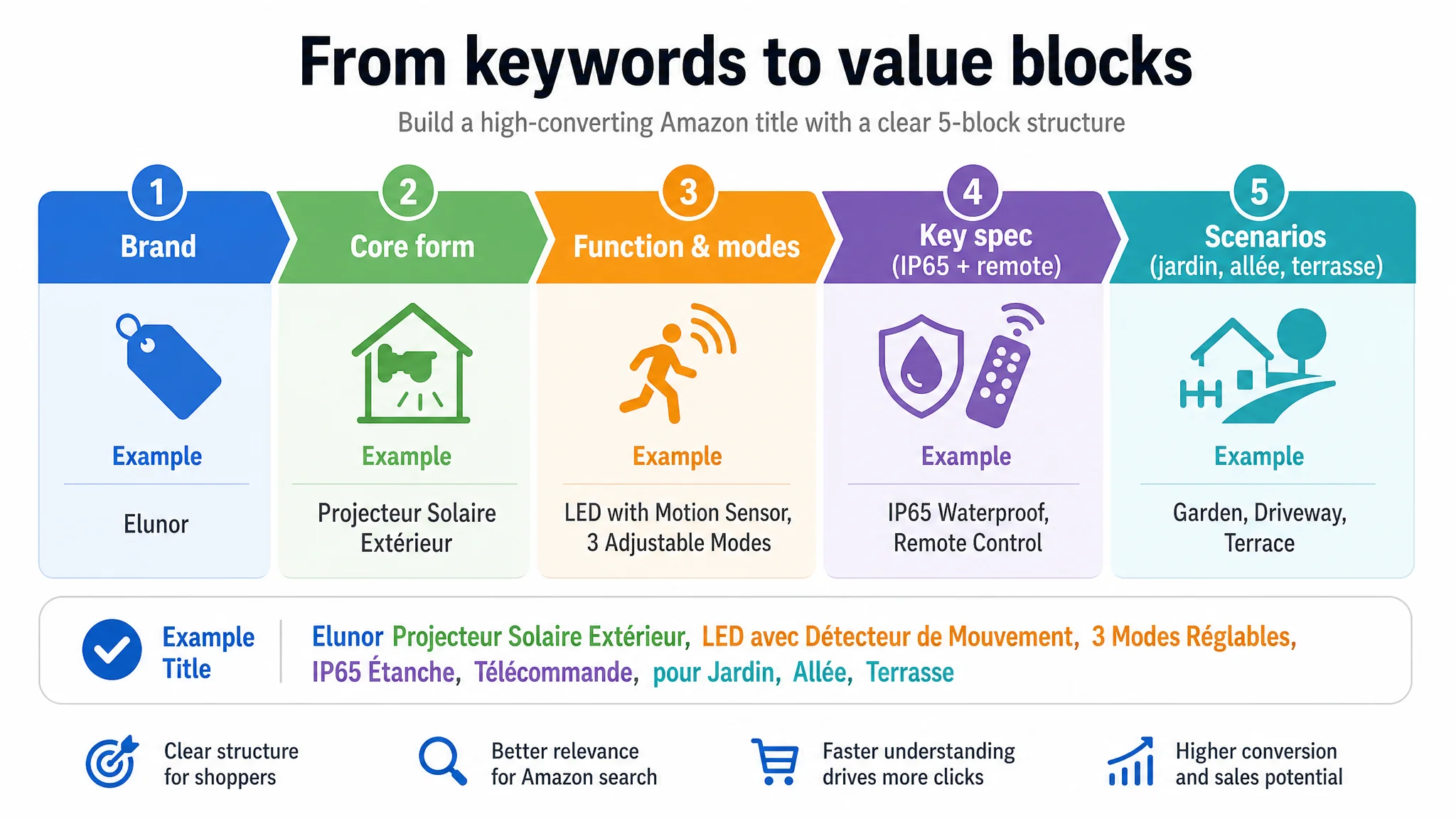
The recommended title pattern was:
Brand + Core form (“Projecteur Solaire Extérieur”) + Core function (LED with motion sensor, 3 adjustable modes) + Key spec (IP65 waterproof) + Differentiating feature (remote control) + Concrete scenarios (jardin, allée, terrasse)
This makes it easier for a shopper scanning search results to answer, in half a second: “Is this the right type of solar light, with the right functions, for my outdoor spaces?”
Main Images: Not Just Aesthetics, but Decision Architecture
The seller’s main-image set was not “bad” in isolation. The problem is relative: it was weaker than a competitor that knew how to choreograph decision logic visually.
From DeepBI’s visual analysis, several bottlenecks surfaced:
1. Hero image undermined by “cheap” composition
- The existing hero used a hand holding the remote, with the product not dominating the frame.
- This reduced perceived industrial quality and focus, compared with the competitor’s cleaner, centered product shots on a pure white background.
DeepBI’s judgment:
- Put the product at 75% of the frame, hero 45° angle, pure white background.
- Place the remote as a secondary object, proportionally smaller, no hand model, minimal distractions.
- Add a clean, dark sans-serif “Projecteur Solaire” label.
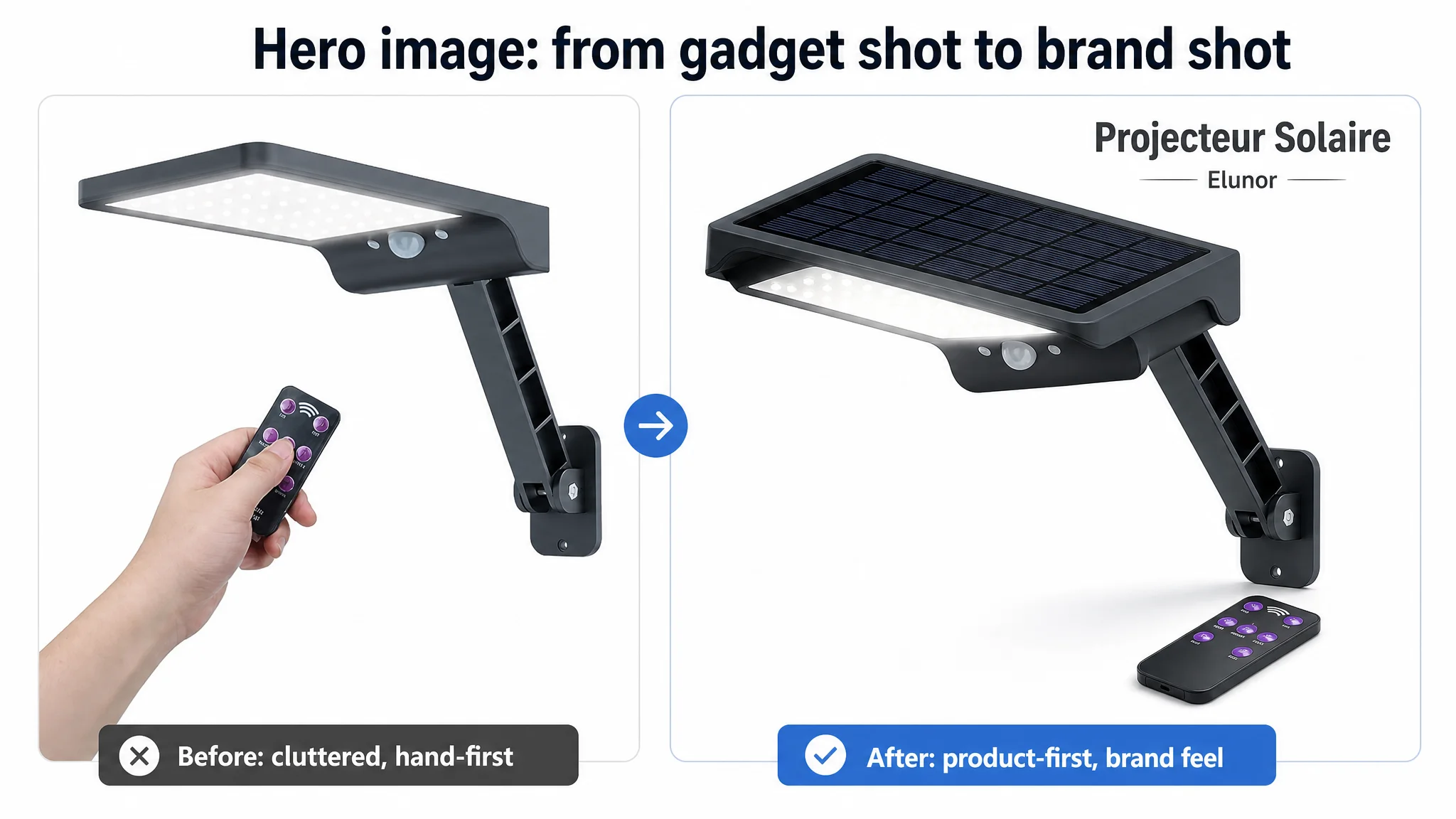
The goal was not to “beautify” but to signal solidity and professional design in the split second where shoppers decide what to click.
2. Day–night contrast underused
The category is literally about solar charging by day, lighting by night. Competitors exploited that contrast visually; the seller did not.
DeepBI recommended:
- A split day/night scene: same modern villa façade by day (charging) and at night (bright cold-white beam).
- Clear overlay of charging time vs working duration in the transition line.
This visual answers a critical hidden question: “Will this actually stay on through the night if it only charges from the sun?”
3. Durability not fully dramatized
The product was IP65, but the way this was shown lacked impact.
DeepBI’s recommendation:
- A three-segment visual: heavy rain, deep snow, and intense sun—all with the product on and performing.
- Simple, icon-based labels: waterproof, snow resistant, wind resistant, heat resistant.
The goal: make “IP65” emotionally legible in 3 seconds, not buried in text.
4. Sensor coverage too abstract
The seller mentioned “120° angle, 5m range,” but in a compressed, less spatially intuitive way. The benchmark made coverage feel real.
DeepBI suggested:
- A wide night scene: a house and garage, the light on top, a blue 120° cone with “120° / 5m” clearly annotated.
- Human silhouette walking into the cone, expressing “security zone” visually.
This shifts the perception from “some PIR sensor” to “this covers my driveway entrance; I will see who approaches.”
5. Mode explanation hidden in text
Modes are crucial, yet many pages drown them in text. The seller’s image for modes lacked contrast and structure.
DeepBI’s decision:
- Build a vertical 3‑block layout on a dark brick wall background, each block for one mode.
- Large yellow numbers (1, 2, 3), simple walking icons, clear differences in light intensity.
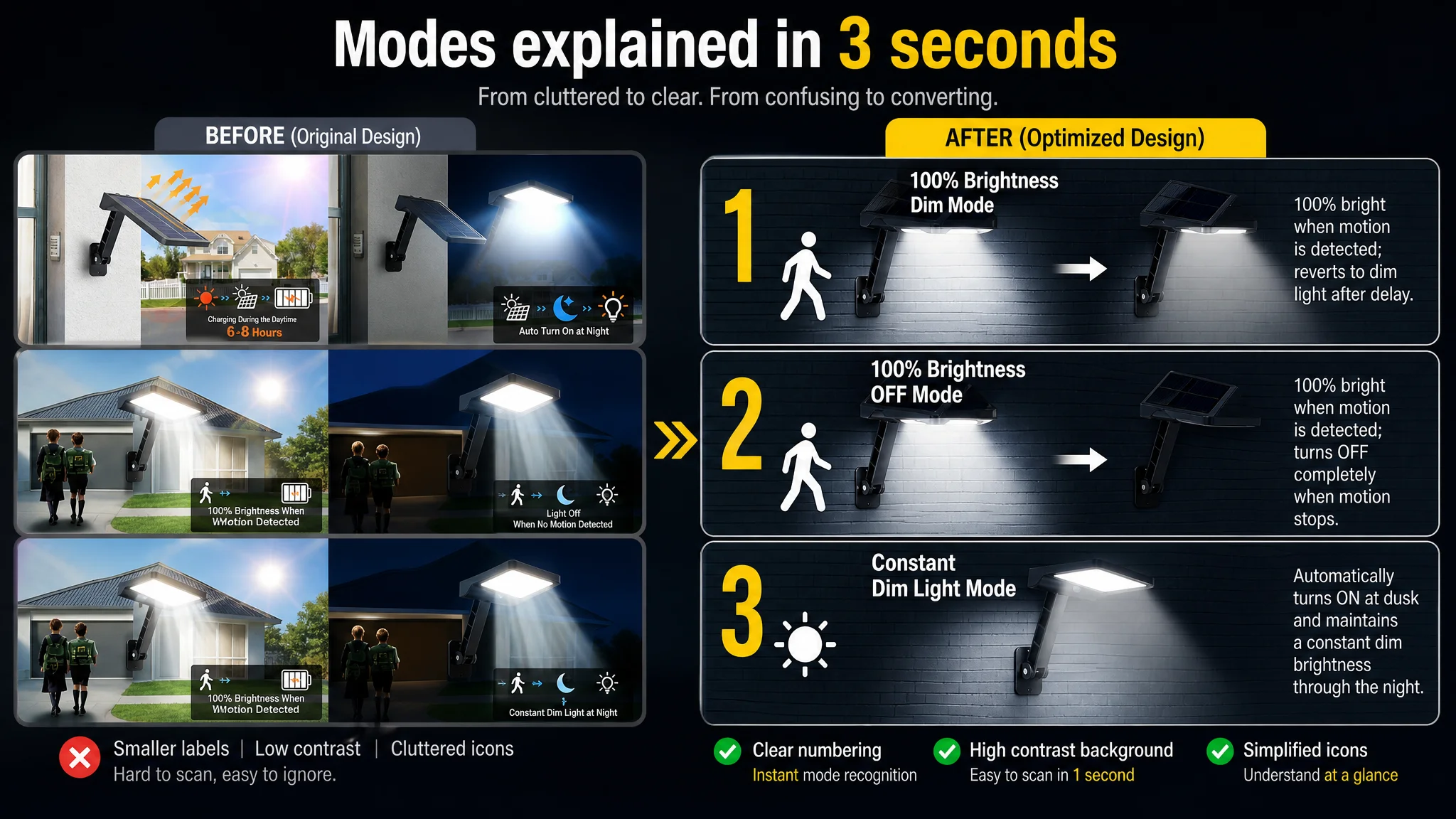
The objective: mode logic in under 3 seconds, so the shopper does not drop off because they “don’t quite get how it works.”
Detail Page and A+: Strong, but the Story Was Not Aligned With the Top
Interestingly, DeepBI found that the seller’s A+ content was already stronger than the competitor in some aspects:
- High‑quality real-life scenes in multiple locations (terrace, garden, garage, fence).
- An “installation pitfalls to avoid” module, using red/green markers to show correct vs wrong placement.
- Data overlays on real-world scenes (angles, distance, modes) that closed the information loop.
The competitor, in contrast:
- Used more rendering-heavy scenes with slightly less authenticity.
- Showed standard installation but lacked “risk warnings” that make the brand feel protective and competent.
So why was the Listing still underperforming vs the benchmark?
Because A+ is not the first line of conversion defense. DeepBI’s view:
“If the search thumbnail and above-the-fold content don’t win the click and the first 10 seconds of trust, even a great A+ will not get the traffic it deserves.”
That is why the optimization priority was:
1. Title + main-image set + bullets
2. Then incremental upgrades to A+ visuals (not a full rebuild)
A+ refinements still mattered
DeepBI proposed A+ improvements not to fix a broken base, but to push the Listing closer to category ceiling:
- A stronger opening hero: high-end villa night scene, warm interior lights, product as sharp, lit focal point.
- A clear “charging vs working” visual with orange (energy) vs deep blue (night) segments and concrete duration numbers.
- A minimal, schematic motion-sensor logic module with simplified human icons and light-intensity states.
- Separate, high-impact scenes for heavy snow and summer heat to anchor “all-weather durability.”
- A four-step installation grid with realistic hand shots and DIY clarity.
- A remote-control hero module, showing a real hand operating the remote, emphasizing convenience and safety (no ladder climbing).
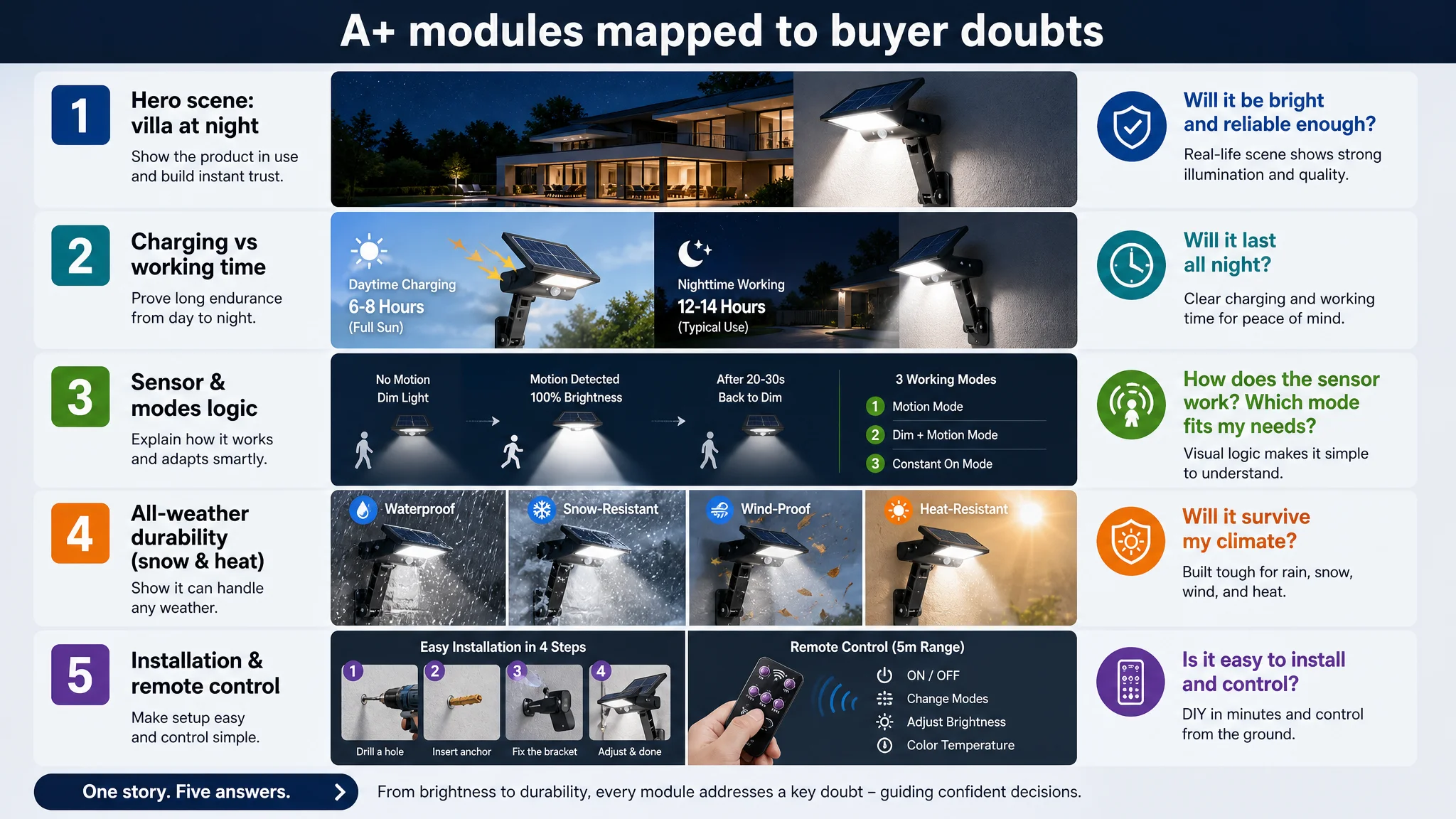
These changes do not introduce new claims. They translate existing strengths into lower decision friction for the buyer.
Bullets: From Feature Lists to Buying Arguments
At first glance, the seller already had five bullets that covered brightness, modes, control, installation, and IP rating. The issue was not coverage; it was how the narrative was structured.
DeepBI compared each bullet against the benchmark’s logic.
Bullet 1: Brightness and efficiency
- Benchmark: opens with “Super Brillant & Haute Efficacité”, immediately claims “brighter than similar lamps”, quantifies LED count and 2600mAh, and outputs a clear outcome: “can work 4–5 rainy nights.”
- Seller: more parameter-forward, less directly framed as “this solves your outdoor lighting reliability problem.”
DeepBI’s optimized bullet:
- Elevates “Éclairage Haute Efficacité & Écologique.”
- Puts the 48 double-filament LEDs and 2200mAh battery in direct relation to “up to 12 hours” of autonomy.
- Frames it as “reliable, energy-saving lighting for your garden or terrace all night.”
Effect: transforms “specs” into “night-long peace of mind.”
Bullet 2: Remote control as a real differentiator
The benchmark barely mentions anything similar; remote control is actually a competitive edge for the seller.
Original bullet under-leveraged this.
DeepBI’s version:
- Headline: “Contrôle à Distance & Confort Accru”
- Concrete scenario: manage lighting from 5m away, no need to climb a ladder.
- Clear activation instructions to reduce returns (“remove insulating sheet, hold ON 3 seconds”).
This bullet no longer just informs; it justifies why this product is easier and safer to live with than a cheaper, ladder-only alternative.
Bullet 3: Mode logic and sensor clarity
Benchmark used 4 clearly numbered modes, with an “emergency” mode that sounded serious and reassuring.
Seller’s original copy was harder to parse quickly.
DeepBI’s bullet:
- Three numbered modes with short labels (Sensor, Dim + Sensor, Constant).
- Clear explanation of the PIR sensor range (“1 à 5 mètres”) and auto shut-off during the day.
It is not about adding more text; it is about compressing understanding.
Bullet 4: Installation and scenarios
Here, the seller was already strong in installation guidance but not as explicit about height, direction, and scenario breadth.
DeepBI’s bullet:
- Emphasizes “no complex wiring.”
- Specifies optimal installation height and orientation (1.8–2.5m, facing south).
- Names typical applications: garage, porch, walkway, backyard.
Again, we move from “it can be installed” to “you will know exactly where and how, and it will work well there.”
Bullet 5: Durability and long-term value
Benchmark played the “industrial battery, 2x life, 80% replacement cost reduction” card—emotional reassurance of long-term value.
The seller had IP65 and ABS, but treated them as features.
DeepBI’s bullet:
- Puts “Étanchéité IP65 & Durabilité Tout Temps” front and center.
- Connects ABS material and weather resistance to lower replacement and maintenance costs.
This reframes durability as an asset: “buy once, worry less.”
Reviews: When Scale Matters More Than Rating
On the reviews dimension:
- Seller: 4.3 stars, 1,830+ reviews.
- Competitor: 4.4 stars, 12,700+ reviews.
Star rating difference was small. Trust gap was not.
DeepBI’s reading:
- Review volume was only ~14% of the competitor’s.
- First-page review quality lacked the clean front of “no low-star reviews” the benchmark enjoyed (seller had a 1-star review in the top 13; competitor had none ≤3 stars).
- Since the seller could not instantly change review count, the Listing itself had to work harder to compensate.
That explains why the A+ was critical: it had to carry more of the trust-building load that the competitor could partly delegate to sheer review volume.
Why DeepBI Did Not Recommend “Keep Tuning Ads First”
By the time DeepBI finished the Listing analysis, the main judgment was:
- The product is fundamentally sound.
- A+ is above competitor level.
- But the first contact layers (title, main images, bullets) are underperforming vs benchmark.
- Review quantity is structurally harder to fix in the short term.
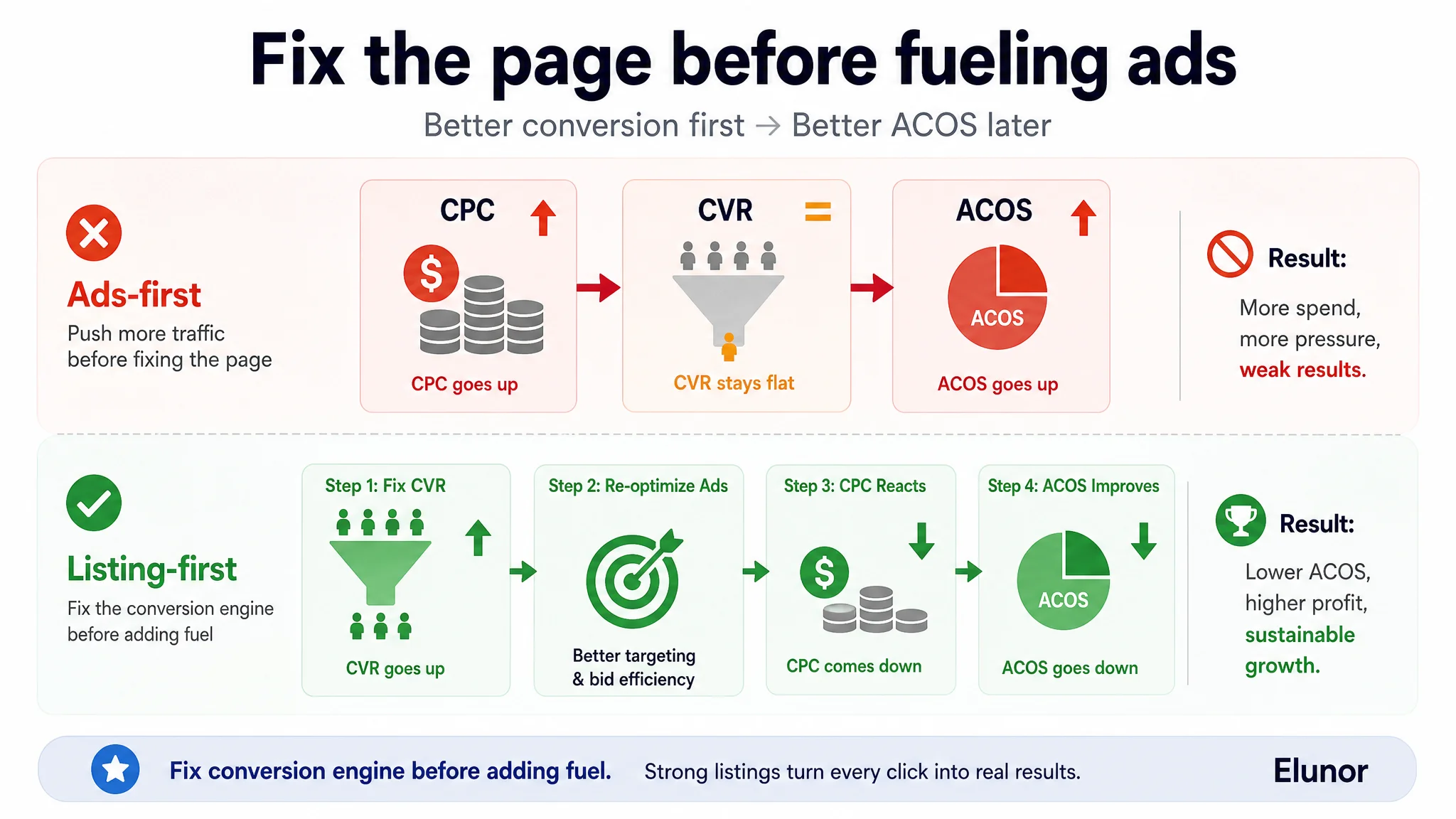
If the team had kept treating this as an advertising-only issue, the risk trajectory would have been:
- Increasing dependence on paid traffic to maintain sales volume.
- Rising TACoS as CPCs hold or rise while CVR lags behind top competitor.
- Gradual erosion of organic share as Amazon’s algorithm naturally rewards Listings with better combined CTR/CVR and stronger social proof.
DeepBI’s recommendation path:
1. Stop treating ads as the primary lever for ACOS right now.
2. Rebuild the Listing’s conversion logic first:
- Make the title competitive and conversion-oriented.
- Redesign the main-image set to match or exceed benchmark decision clarity.
- Tighten bullets into pain–solution–outcome structures.
1. Once the page can convert traffic at a closer level to the benchmark, then:
- Scale or refine ads again, with more confidence that incremental clicks will pay back.
“Advertising does not only amplify advantages. It can also amplify a page’s existing defects.”
DeepBI’s value here was not copying the competitor’s style, but reordering the seller’s operational priorities in a way that protected both ad efficiency and Listing health.
How the Page’s Sales Logic Began to Recover
After the recommendations, the expected operating shifts for this Amazon Listing were:
- Stronger search-page competitiveness:
The upgraded hero image and title were designed to win more clicks against the benchmark, or at least reduce the click gap.
- Faster trust formation above the fold:
Mode, brightness, durability, and remote control became legible in seconds through images and bullet headlines—not buried in dense text.
- More stable conversion from both organic and paid traffic:
As shoppers understood the product more quickly and clearly, fewer would bounce back to the search results to try the benchmark instead.
- Better ability to leverage existing strengths:
The already solid A+ and review base could now do their job because more traffic would stay and scroll.
Even without inventing specific performance numbers, the intended business changes were clear:
- CVR has room to recover toward category benchmark.
- ACOS becomes more responsive to ad optimization again.
- Organic ranking is better able to benefit from the improved behavior signals.
- The product page regains its role as a conversion engine, not a passive catalog entry.
What This Case Changes in the Seller’s Understanding
Before this diagnosis, the team’s mental model was:
- “If ACOS is high, fix ads.”
After going through the DeepBI analysis and restructuring:
- They now see that Listing conversion and ad efficiency are inseparable.
- They recognize that a 7‑point Listing gap vs benchmark can be the invisible reason why ad spend feels “sticky” and unresponsive.
- They understand that title, main images, bullets, A+ and reviews must work together as one sales script, not as disconnected modules.
- They have a clearer rule of thumb:
before scaling ad budgets, judge whether the page actually deserves more traffic.
For other Amazon sellers—whether in solar lights, outdoor accessories, or any other category—the takeaway is not that every problem is a Listing problem. It’s that you cannot accurately judge your ads until you know, with data, how your product page truly stacks up against the best Listing in your niche.
When you misdiagnose a conversion leak as an ads issue, you pay for it twice: once in wasted CPC, and again in the lost opportunity to build a stable, high-converting Listing that makes every click—organic or paid—worth more.