

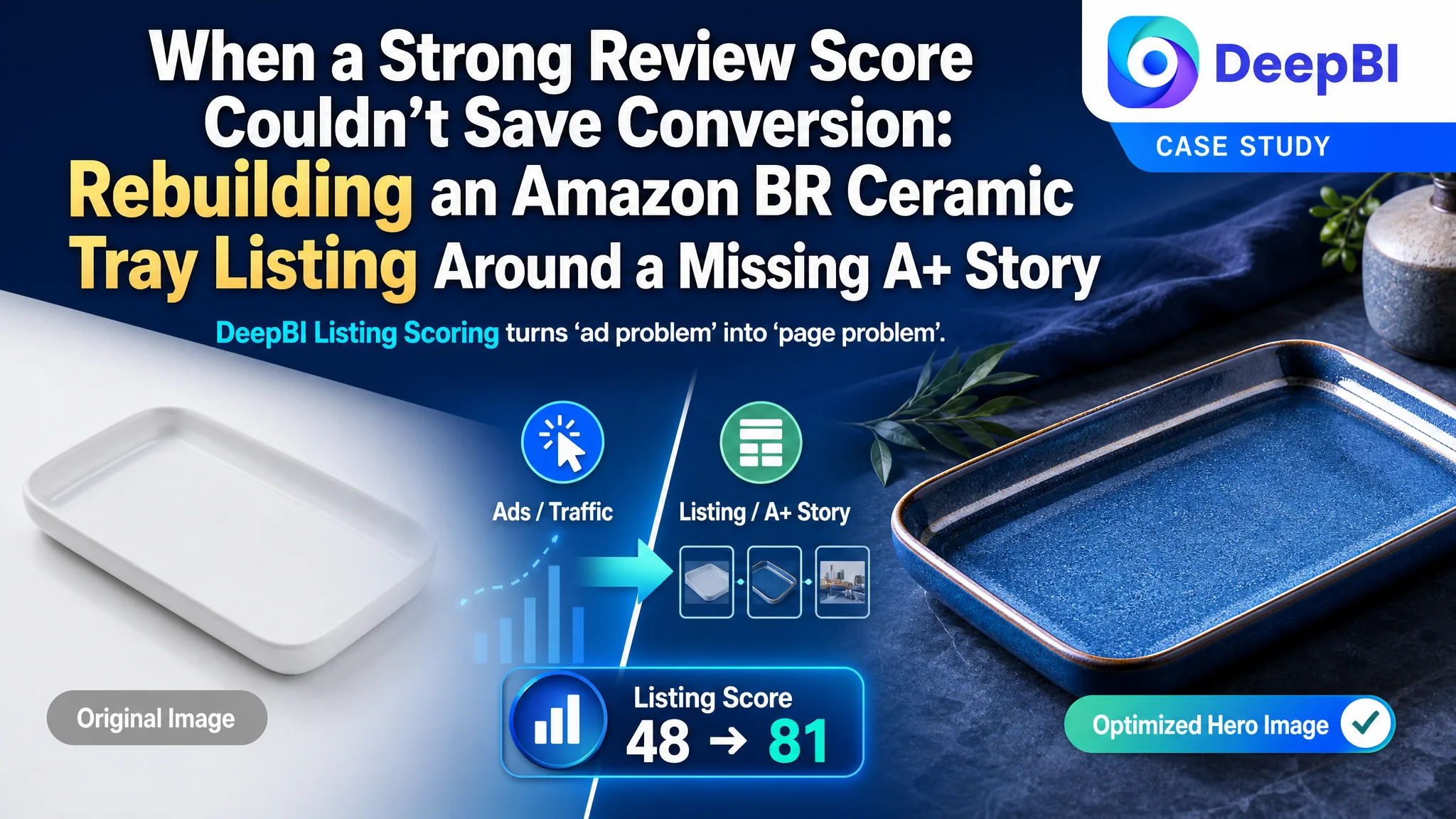
This Amazon seller on the Brazil marketplace was promoting a ceramic tray for bathroom and kitchen countertops. Advertising had already brought in steady traffic, and the product enjoyed a 4.8-star rating with more than twice the review volume of a key competitor. Yet orders lagged and ACOS refused to move down. The team’s instinct was to keep tweaking Amazon ads and keywords, assuming the problem was purely traffic and bidding.
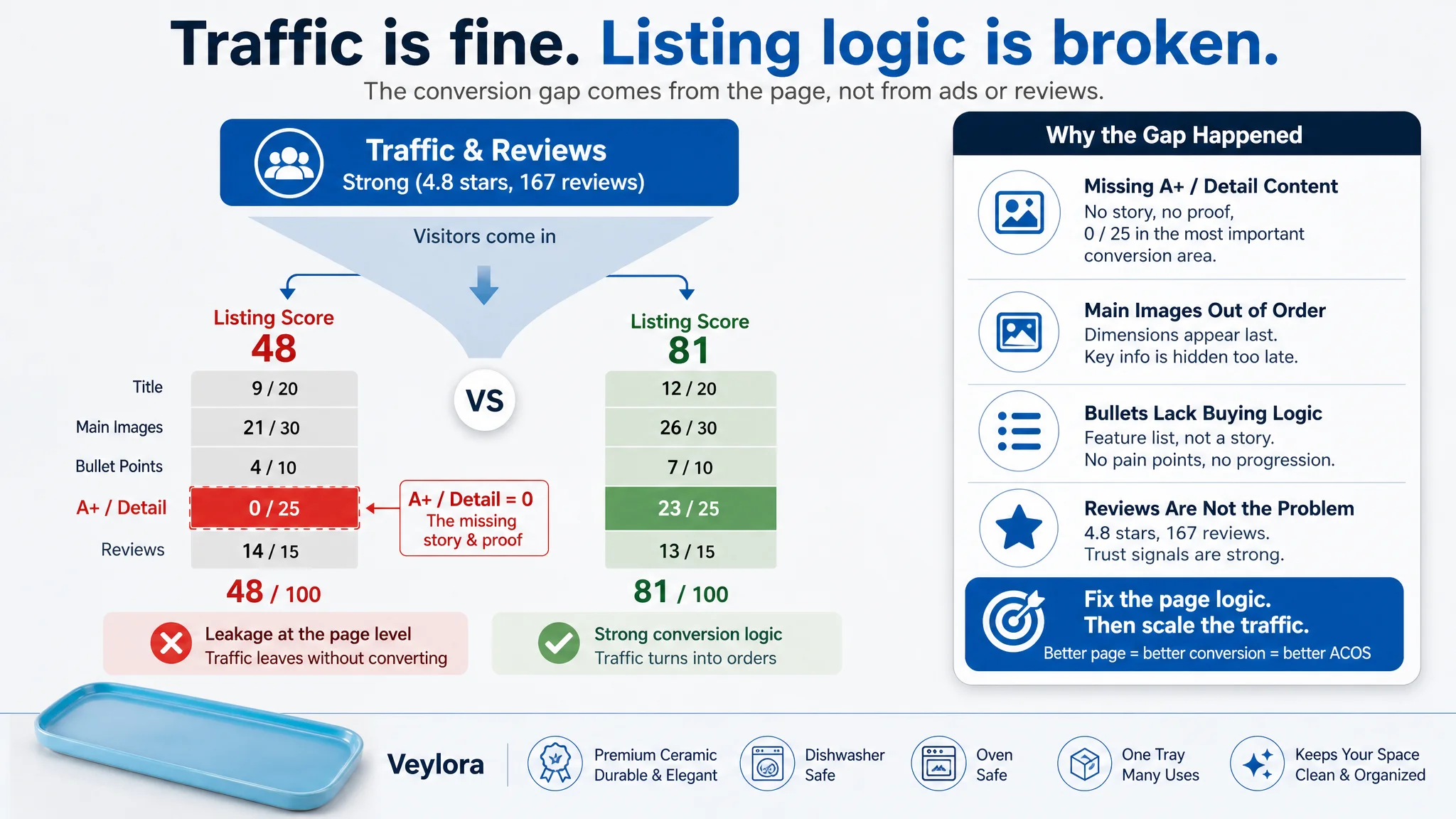
DeepBI’s Listing scoring, however, exposed a very different picture. Against a high-performing competitor in the same ceramic tray niche, the target Amazon Listing scored only 48 out of 100 versus the competitor’s 81. The gap did not come from reviews or ratings—it came from weak title structure, a low-leverage main-image set, scattered bullet points, and, most critically, a completely empty A+ / detail section. In other words, the page could not convert the traffic it already had.
The subsequent optimization therefore shifted away from “keep tuning ads” toward “rebuild the product page’s decision logic.” DeepBI guided the seller to reframe the title around real-world bathroom and countertop use, restructure the main-image sequence to surface dimensions and multi-scene usage earlier, and construct a full A+ story that connected ceramic quality, multi-use versatility, and space-saving benefits. As Listing conversion capacity started to recover, ad traffic finally had a page capable of closing the sale—an outcome many Amazon sellers can recognize as the difference between “spending more on ads” and “making existing traffic actually work.”
Amazon Ads Were Not Failing. The Page Was Consuming the Traffic.
From the seller’s perspective, the situation looked familiar: traffic was present, reviews were strong, but orders and profitability felt fragile.
- Review rating: 4.8 stars
- Review count: 167 (more than double the benchmark competitor’s 77)
- Competitor rating: 4.5 stars
On paper, trust signals from reviews were better than the benchmark. This led the team to believe the bottleneck must be on the advertising side: maybe bids were off, maybe they needed more long-tail keywords, maybe budget allocation across campaigns was wrong.
DeepBI’s Listing scoring broke that assumption quickly:
- Target Listing total score: 48 / 100
- Benchmark Listing total score: 81 / 100
- Gap: -33 points
Breakdown by dimension:
- Title: Target: 9, Benchmark: 12, Max: 20, Gap: -3
- Main Image: Target: 21, Benchmark: 26, Max: 30, Gap: -5
- Bullet Points: Target: 4, Benchmark: 7, Max: 10, Gap: -3
- Detail / A+: Target: 0, Benchmark: 23, Max: 25, Gap: -23
- Reviews: Target: 14, Benchmark: 13, Max: 15, Gap: +1
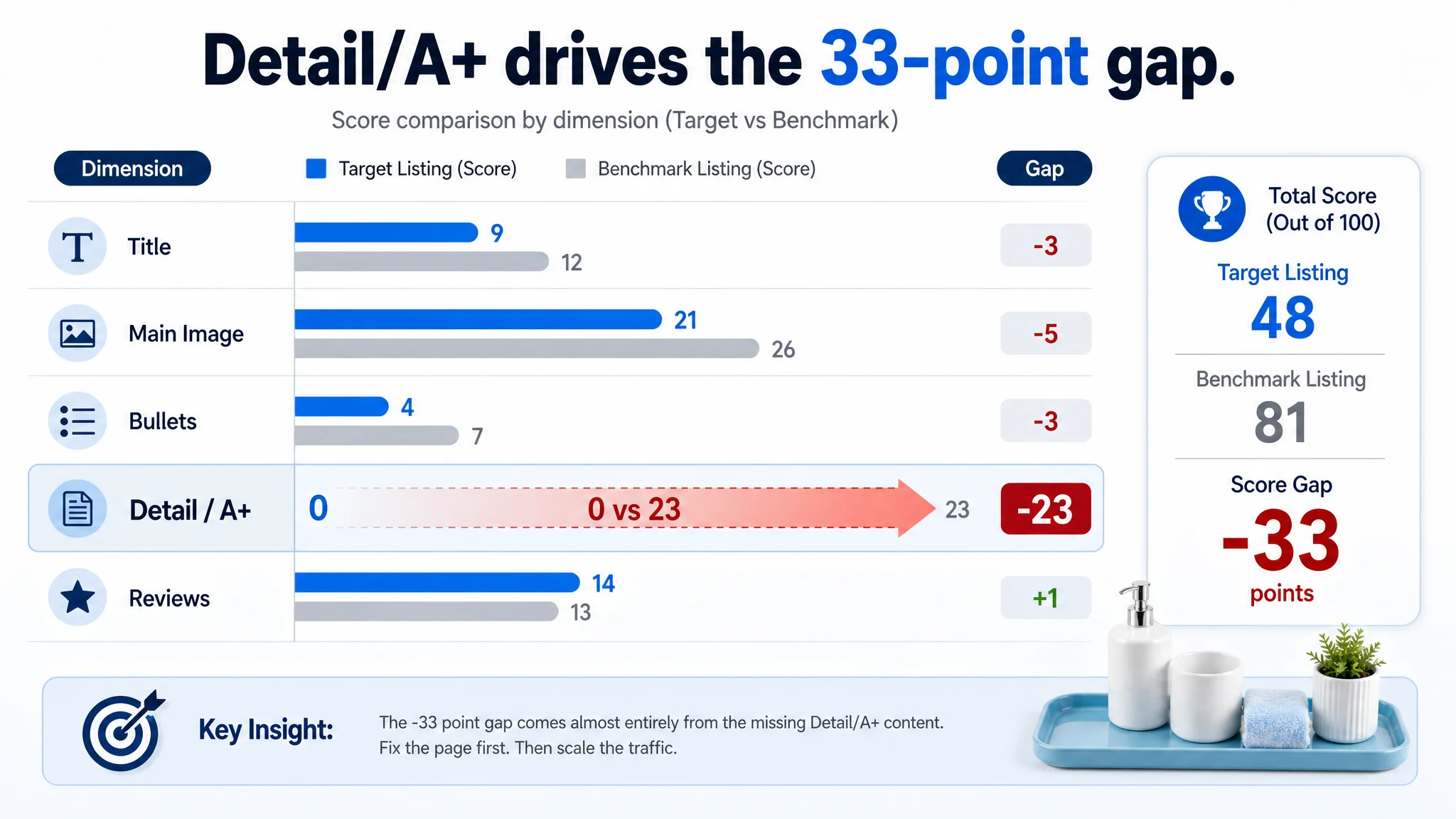
“The real problem was not that ads failed to bring traffic. It was that the page could not convert the traffic.”
The data made one thing clear: reviews were not the bottleneck; the Listing’s own sales logic was.
The Real Constraint Was Listing Conversion Capacity
DeepBI’s diagnostic compared the target Listing with a carefully selected benchmark—a competing ceramic tray Listing on Amazon Brazil that already demonstrated strong conversion and a mature page structure.
The single core problem: Listing conversion capacity was too weak to justify more paid traffic.
This weakness was concentrated in three areas:
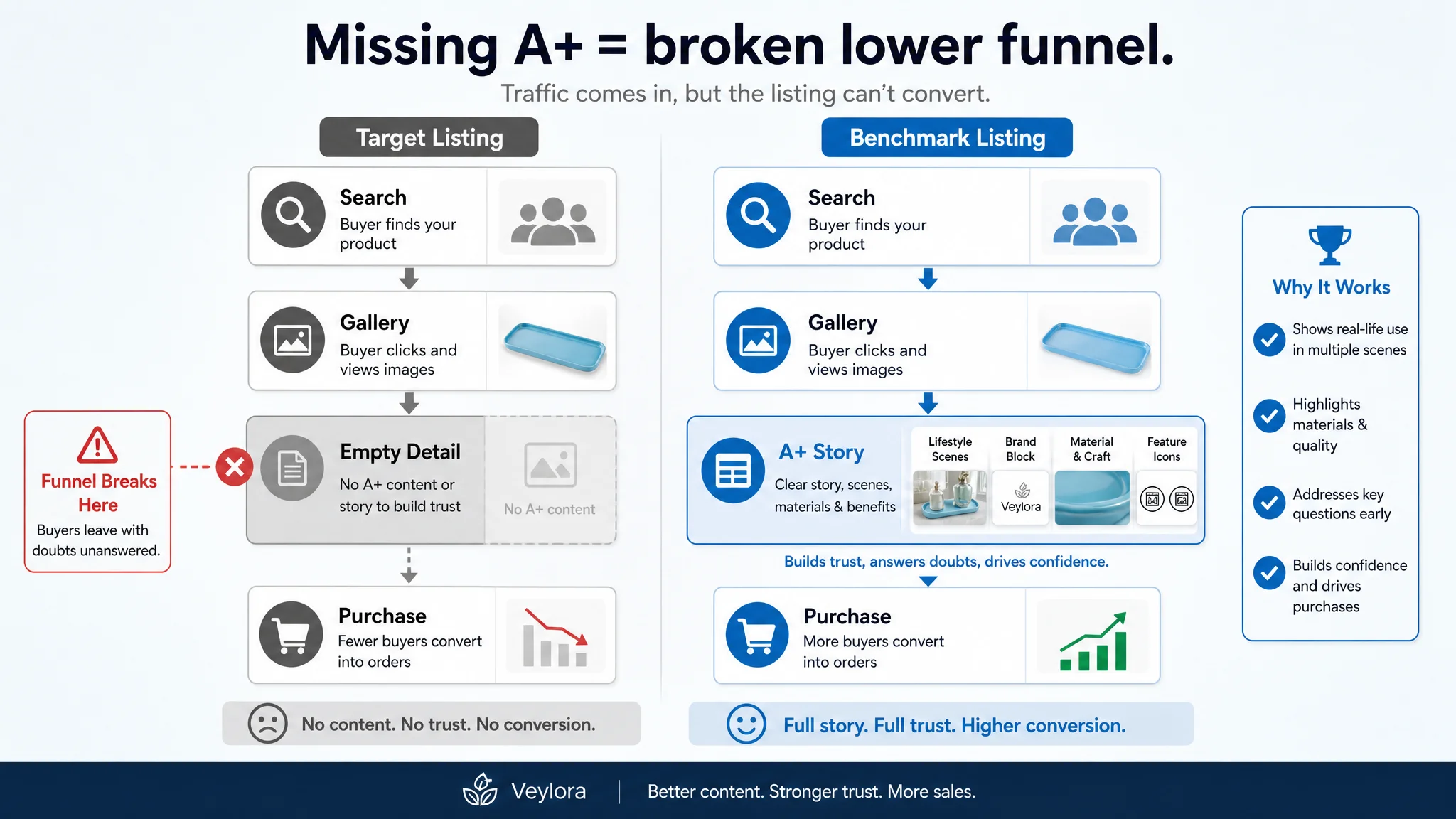
1. Zero A+ / detail content
- The target Listing had no A+ modules at all, scoring 0/25 on detail.
- The competitor built a full A+ layout with:
- Lifestyle scenes (kitchen, bathroom, vanity, dining)
- Brand identity blocks
- Single-item and set visuals
- Material and craft explainer modules
- Function icons (microwave / dishwasher compatibility)
- Multi-scene reuse narratives
For the target Listing, this meant the conversion funnel effectively broke right after the gallery. Users had to make a purchase decision with no structured story, no visual validation of “one tray, many uses,” and no explicit reinforcement of durability or appliance compatibility.
1. Main-image sequence that hid key decision information
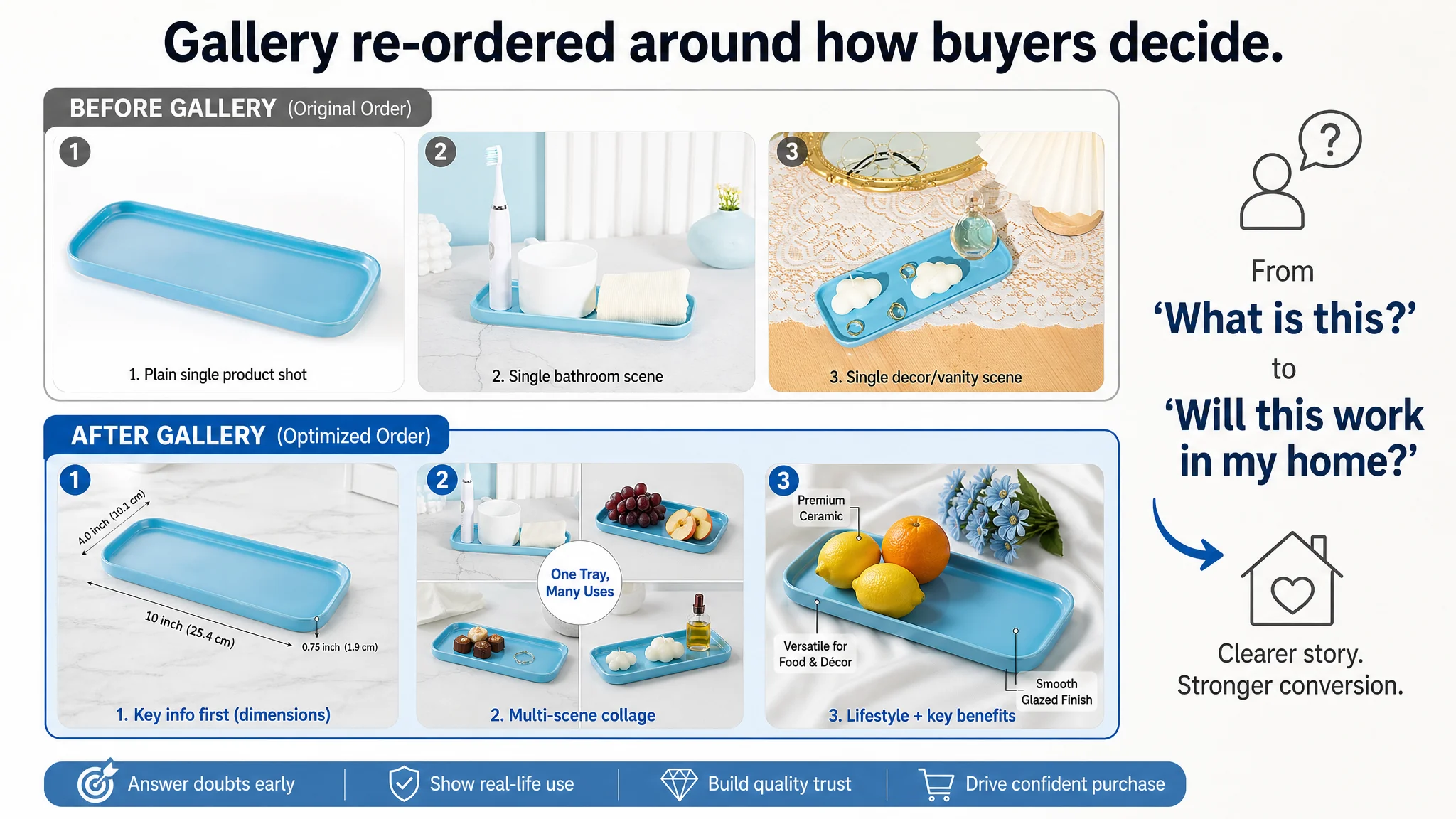
The main images existed, but they were arranged in a way that did not match how buyers decide:
- First image: a plain white-background single product shot
- No brand, no quantity, no context, no textual tag for “ceramic,” “space-saving,” or “multi-use”
- Weak thumbnail click incentive compared with the competitor’s multi-scene collage
- Dimension graphic relegated to the last slot
- Dimensions (24 x 10 cm) only appeared at Image 5
- Dimension anxiety (“Will this fit my sink or countertop?”) stayed unresolved until very late in the gallery
- Single-scene images spread out without synthesis
- One bathroom scene, one food-serving scene, one vanity scene
- No multi-scene composite to immediately communicate versatility
1. Bullet points that listed features but did not build a buying logic
- The competitor’s bullet points built a clear narrative:
- Design aesthetics → multi-scene use → core pain point (drips and mess) → material & giftability → size and pre-purchase check
- The target Listing’s bullets were essentially a flat list of functions (“can be used for X, Y, Z”) with no pain-point framing and no sense of progression toward a decision.
The result: paid and organic traffic landed on a page that did not clearly explain what the buyer would gain, how it fits their home, or why this tray is worth the price.
What the Seller Originally Misread
The seller’s misdiagnosis followed a pattern many Amazon operators will recognize:
- Symptom observed:
- ACOS pressure rising
- Orders not scaling with impressions
- Stable or increasing traffic, but CVR not keeping up
- Interpretation:
- “Ads are not efficient enough.”
- “We need better keyword selection and bid optimization.”
- “Maybe our ad creatives are not attractive enough; let’s test different ad copy.”
- Actions taken:
- Iterative adjustments on bids and budgets
- Experiments with keyword expansions
- Potential tweaks to ad-level creatives, but no structural change to the Listing’s title, main images, or content logic
Why this failed:
1. Ads can only amplify what the page already is.
Without an A+ story and a strong gallery order, more traffic simply meant more people bouncing at the same weak conversion stages.
1. Review strength masked internal page weaknesses.
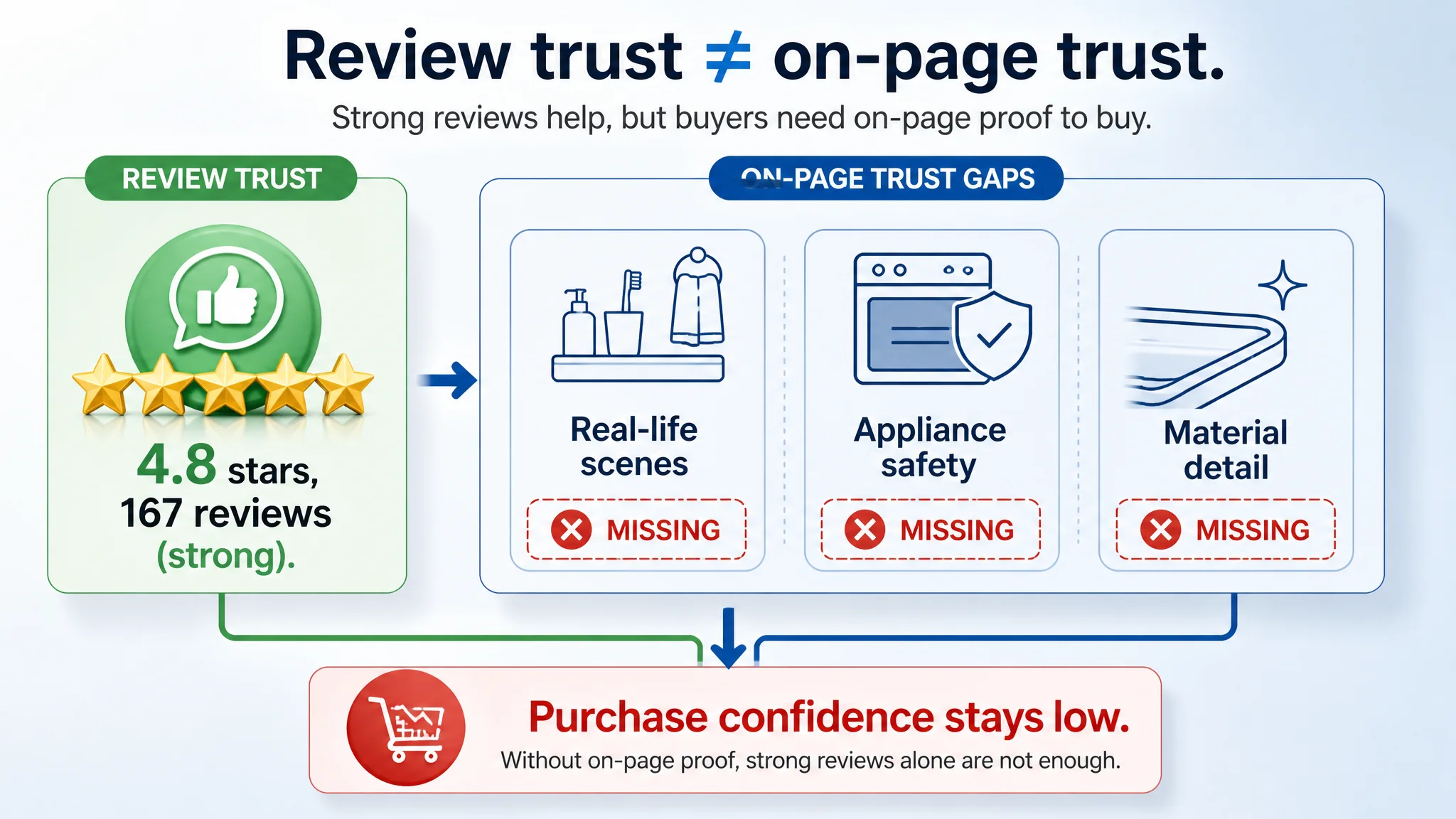
The seller saw 4.8 stars and 167 reviews and assumed “trust is not a problem.” But trust from reviews and trust built via page content are not interchangeable; the latter was underdeveloped.
1. No quantified view of where the gap really was.
Without a benchmark-based score, the team had no clear understanding that their detail/A+ dimension was at 0/25 while the competitor sat at 23/25.
This Product Page Did Not Lack Traffic. It Lacked Trust.
DeepBI’s analysis reframed the problem: this ceramic tray Listing was not suffering from a traffic shortage; it was suffering from a trust and clarity shortage on-page.
Key trust gaps:
- No evidence of real-life use
- No A+ scenes showing the tray in an actual bathroom or kitchen
- No visual demonstration of the tray catching water, organizing items, or saving space
- No appliance compatibility assurance
- The product could safely be used in dishwashers and ovens—a strong rational selling point
- This was not surfaced visually or structurally; users had to infer or never learn it
- No material and craft detail
- Blue glazed ceramic is inherently premium, but the page did not show close-ups or craft-specific imagery (glaze quality, edge finishing, base stability)
- Buyers remained uncertain about quality, durability, and finish
“Advertising does not only amplify advantages. It can also amplify a page’s existing defects.”
The highest-risk element was the empty A+ section. For a home and kitchen product that needs to prove compatibility with different surfaces and contexts, this meant the Listing had almost no visual or structural way to answer the buyer’s core questions:
- “Will this look good in my bathroom?”
- “Will it fit my narrow countertop?”
- “Can I use it for serving food as well as organizing toiletries?”
- “Will it hold up to daily washing and oven exposure?”
Ads were sending users into a page that left those doubts unresolved.
How DeepBI Identified the Root Cause
DeepBI’s Listing scoring and competitive analysis zeroed in on the detail/A+ score of 0 as the most severe bottleneck, and then layered on cross-dimension evidence:
1. Score gap concentrated in A+ / detail
- Title gap: -3
- Main image gap: -5
- Bullet gap: -3
- Detail gap: -23
This distribution indicated a structural problem in the lower funnel. Even if main images and bullets were improved, the absence of downstream proof and explanation would keep CVR suppressed.
1. Benchmark’s module-by-module A+ structure
The competitor A+ layout provided a reference for what “good” looks like in this niche:
- Full-screen lifestyle visuals for sushi, desserts, beauty storage
- Multi-scene composites linking kitchen, bathroom, vanity, dining
- Material and process modules (high-temperature firing, non-slip base)
- Appliance compatibility icons (microwave, dishwasher)
- Text tightly synchronized with each visual
1. Visual–copy mismatch on the target Listing
- The target bullets mentioned multiple scenes and uses, but there were no corresponding A+ visuals.
- The product’s dishwasher/oven safety and ceramic quality were not visually validated.
- There was no final “summary poster” pulling together style, size, and space-saving value.
Combined, this showed that the Listing was not simply “missing polish;” it lacked the core structural elements that make an Amazon product page trustworthy and persuasive for home & kitchen buyers.
Why DeepBI Did Not Keep Tuning the Ads First
Given this diagnosis, DeepBI did not recommend continued ad-level optimization as the first move.
The decision logic was:
1. Fix the conversion foundation before buying more traffic.
With detail/A+ at 0 and a -23 gap versus the benchmark, every additional click was exposure to a structurally weak page. This risked:
- Wasting ad spend on unconvertible sessions
- Depressing historical CVR, which in turn can harm organic ranking
- Creating a false impression that “this product cannot scale”
1. Address the largest score gap first for maximum return on effort.
- Main-image improvements could help CTR and early-stage engagement.
- But the biggest incremental gain in conversion potential would come from building a complete A+ story where there was currently nothing.
1. Prevent ads from amplifying the wrong outcome.
- If ads drive traffic to a incomplete story, this amplifies bounce and doubt.
- Once the page is structurally sound, ad optimizations can genuinely be tested and scaled.
In short, DeepBI prioritized Listing conversion repair before ad scaling, treating the A+ build as a non-negotiable prerequisite.
Rebuilding the Amazon Listing: From Scattered Information to a Sales Path
The Title Had Information, but Not a Decision Logic
The competitor’s title followed a mature Amazon pattern: Brand + Quantity + Core Attributes + Main Application + Supplementary Scenarios.
In contrast, the target title:
- Positioned the core keyword “bandeja de cerâmica” reasonably well
- But lacked brand, quantity, detailed attributes (color, shape), and scene clarity
DeepBI guided the seller to move toward a structure like:
“Bandeja de Cerâmica para Banheiro e Balcão de Cozinha, Bandeja Organizadora de Pia para Cosméticos, Sabonete e Perfume, Azul”
Key shifts:
- Elevated scene keywords (“banheiro”, “balcão de cozinha”) to align with buyer searches
- Introduced concrete stored items (“sabonete”, “perfume”, “cosméticos”), improving long-tail search matching
- Removed unnecessary brackets and non-standard symbols to keep the title professional and A9-friendly
This did not turn the title into an ad slogan; it aligned it with how Amazon’s search algorithm and users read.
The Main Image Was Not Just a Visual Issue. It Failed to Create a Reason to Click.
DeepBI’s judgment on the gallery was not “make it prettier,” but:
- Image 1: Stop wasting the first slot on a generic white-background product-only shot
- New role: a composite visual that communicates ceramic material, blue color, multi-function, and space-saving in one glance
- Background: subtle countertop texture instead of sterile white, to add context while staying compliant
- On-image micro labels: short phrases such as “Cerâmica,” “Multiuso,” “Economiza espaço” to answer “what do I get?” at thumbnail level
- Image 2: Move the dimension graphic to this slot
- Previous role: last image
- New role: reassure cautious buyers early by highlighting the 24 x 10 cm footprint
- Outcome: reduces “will it fit?” friction sooner in the decision process
- Image 3: Transform into a multi-scene collage
- New structure: a four-grid layout combining:
- Bathroom scene (mouthwash cup, soap, toothbrush)
- Fruit/dessert serving scene
- Vanity scene (perfume, jewelry)
- Single product shot implying kitchen or dining use
- Label each quadrant (e.g., “Banheiro,” “Mesa,” “Penteadeira,” “Cozinha”)
- Image 4: Focus the bathroom scene more tightly on organization
- Adjust composition to emphasize orderly arrangement of items on a sink counter
- Consider adding a small number of extra items already in real usage to demonstrate density and capacity
- Image 5: Use the most visually appealing multi-function scene
- Favored candidate: the fruit-platter image with a fresh, elegant background
- Role: anchor the “serving tray” storyline and link to the food-safe bullet
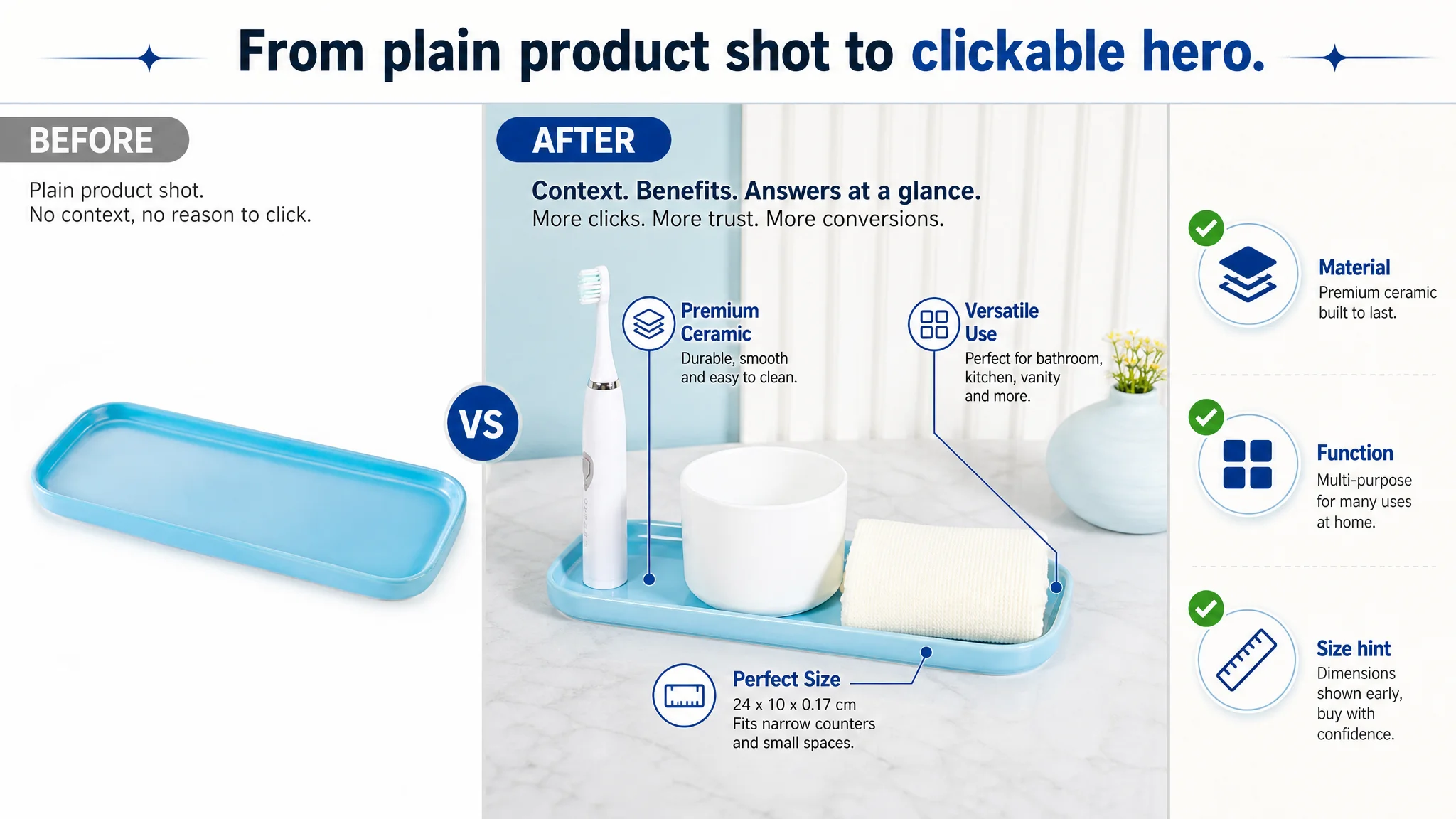
This reordering did not add new images; it restructured the existing set to match how buyers think: “Is it attractive?” → “Does it fit?” → “Where can I use it?” → “Will it actually organize my space?”
Building the A+ Story That Was Missing
The largest structural hole was the absence of any A+ content. DeepBI pushed for a seven-module A+ framework designed specifically for this Amazon BR ceramic tray:
Module 1 – Hero Food Scene
Role: Connect the main image promise to real-life use.
Content:
- High-resolution shot of the blue tray holding desserts or sushi
- Emphasis on thickness, glaze smoothness, and color depth
- Text: highlight “ceramic blue tray,” “smooth glaze,” “safe for food”
Module 2 – Multi-Scene Storage Overview
Role: Show that “one tray” solves multiple storage problems.
Content:
- Diagonal or segmented layout with:
- Bathroom sink (cups, liquid soap, shampoo)
- Vanity (brushes, jewelry, perfumes)
- Dining table or kitchen counter
- Text: reinforce “saves space” and “adapted to narrow areas”
Module 3 – Appliance Compatibility Proof
Role: Address rational objections about durability and maintenance.
Content:
- Dishwashing and oven icons
- Optional appliance context photos (tray going into dishwasher or oven, within compliance boundaries)
- Text: clearly state dishwasher-safe and oven-safe usage
Module 4 – Glaze and Finish Close-Up
Role: Dispel concerns about uneven glaze or rough edges.
Content:
- Macro shot of the blue glaze surface
- Edge close-up showing rounded, chip-resistant finish
- Text: “smooth glaze,” “easy to clean,” “pleasant to the touch”
Module 5 – Base Stability and Non-Slip Story
Role: Reassure users about stability on countertops.
Content:
- Low-angle shot of the tray base fully in contact with a flat surface
- Visual emphasis on flatness and stable contact
- Text: highlight “stable base,” “does not wobble,” and avoids scratching
Module 6 – Bathroom-Specific Scenario
Role: Normalize cross-context use (from dining to bathroom).
Content:
- Real bathroom scene with the tray holding mouthwash cups, soap, shampoo
- Style alignment with modern bathroom furniture
- Text: simple, calm wording about “organized sink” and “clean countertop”
Module 7 – Style and Size Recap Poster
Role: Summarize everything into a final decision nudge.
Content:
- Clean home interior scene featuring the tray on a countertop
- Clear dimension labels (“24 x 10 cm”) overlayed on the image
- Text: “simple and elegant design,” “fits various surfaces,” “does not occupy much space,” “sturdy ceramic”
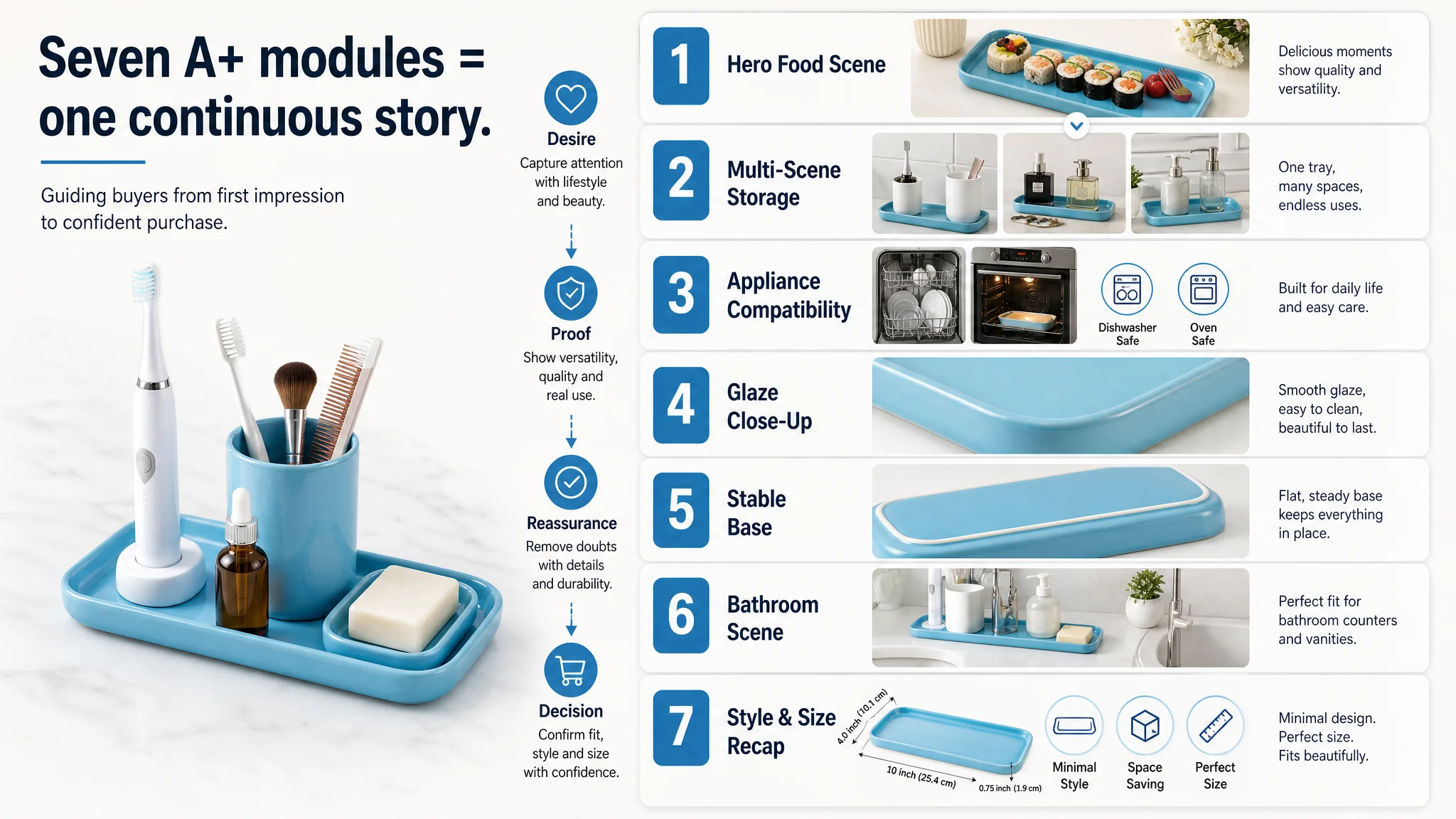
This A+ structure turned an empty detail section into a guided journey: from visual desire → functional proof → rational reassurance → final reminder.
The Bullet Points: From Flat Listing to “Pain Point → Solution” Logic
DeepBI reframed each bullet around a role in the decision process, not just another feature line.
Bullet 1 – Design and Home Fit
Old pattern: generic “design style” statement. New direction:
- Emphasize “elegant and minimalistic design”
- Tie to specific home locations: vanity, kitchen counter, bedside table, bathroom counter
- Position the tray as a decorative and organizational upgrade
Design Elegante e Minimalista: style that matches any décor, adding organization and beauty to key surfaces.
Bullet 2 – Material and Giftability
Old pattern: bare-bones material and durability mention. New direction:
- Define “cerâmica premium” and “glossy finish”
- Highlight dishwasher and oven safety
- Add gift use cases (wedding, housewarming, birthdays)
This allows the bullet to carry both functional and emotional value.
Bullet 3 – Food-Serving Versatility
Old pattern: generic food-usage mention. New direction:
- Establish “safe for food” explicitly
- Name specific uses: appetizers, sushi, desserts, snacks, tea sandwiches
- Position it as a functional piece of serveware
Bullet 4 – Organization and Anti-Mess
Old pattern: “can store items.” New direction:
- Anchor around the pain point: messy, wet countertops
- Present the tray as a “multi-use anti-mess organizer”
- Tie to capturing drips and keeping moisture off surfaces
Bullet 5 – Compact Size and Space-Saving
Old pattern: just dimensions. New direction:
- Combine the specific size (24 x 10 cm) with an explicit “space-saving” narrative
- Connect to narrow bathrooms and small kitchen counters
- Prompt buyers to verify dimensions in images
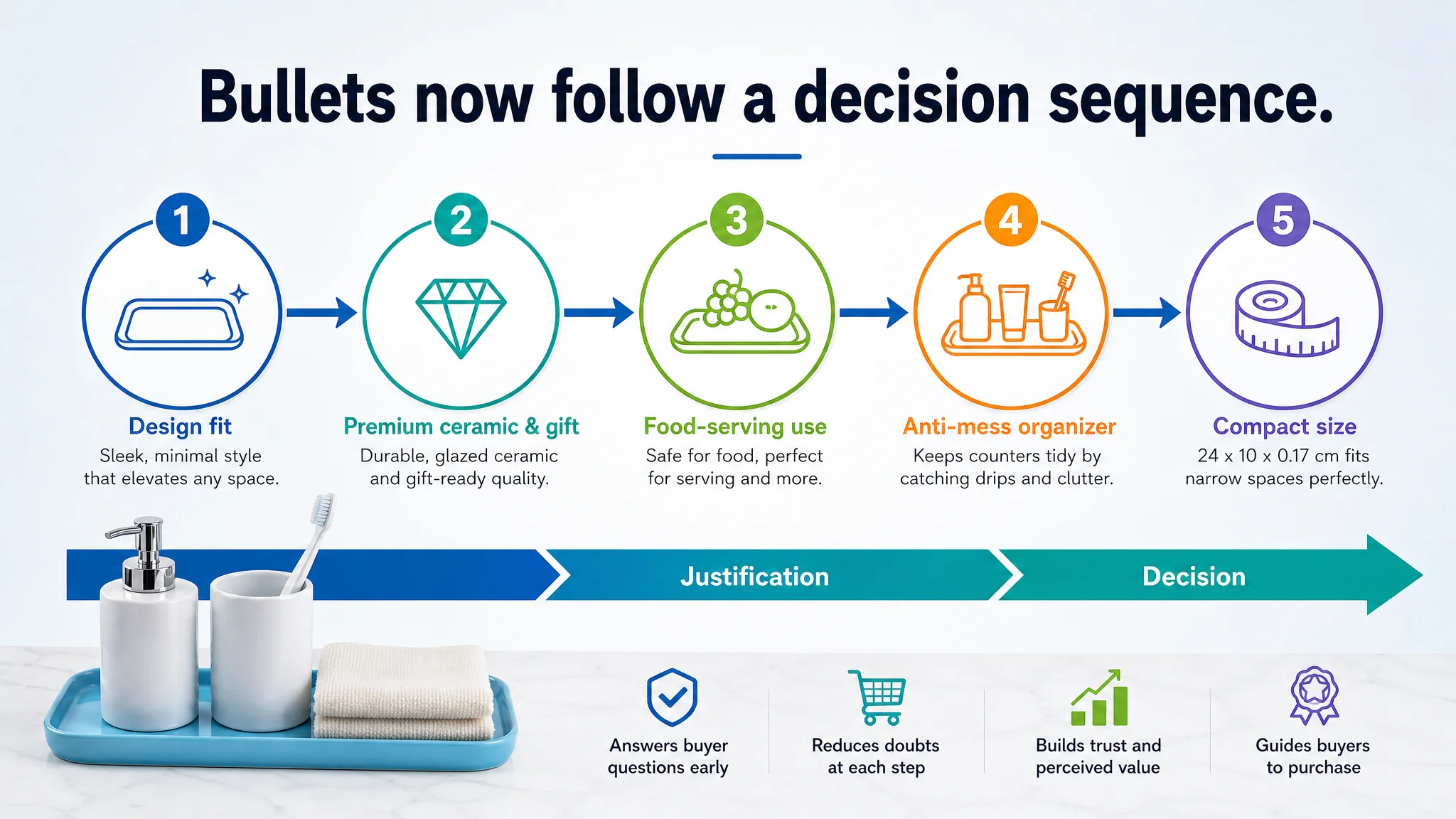
Each bullet now participates in a coherent arc: design fit → premium material & gift → food use → organization → space optimization.
How the Page’s Sales Logic Started to Recover
Once the title, images, bullets, and A+ were aligned, the Listing’s internal logic shifted:
1. From scattered features to a guided decision flow
- Thumbnail and Image 1 now answer “what is this and why should I click?”
- Image 2 and Bullet 5 resolve size and fit concerns early
- Multi-scene images and Module 2 show “one tray, many uses” visually
- Modules 3–5 remove doubts about durability, cleaning, and stability
- Module 7 and Bullet 1 close with style and space compatibility
1. From invisible advantages to visible proof
- Review strength (4.8 stars, 167 reviews) stayed as a trust anchor
- But now, the page added visual and structural evidence to match that trust
- Appliance compatibility, premium ceramic, and blue glaze quality became visible selling points
1. From ad-dependent experiments to a controllable funnel
- With a structurally sound Listing, any changes in ACOS or CVR now had a clearer interpretation
- Ad optimization regained meaning: traffic tests could be tied to a page that was capable of converting
DeepBI did not need to “invent” new features. The product’s real strengths—premium ceramic, dishwasher and oven compatibility, multi-scene functionality, and strong reviews—were already there. The problem was that the Amazon product page did not show them in a way that matched how buyers decide.
What Other Amazon Sellers Can Take from This Case
This case is not about a single ceramic tray. It exposes a broader pattern in Amazon operations:
- High reviews and strong ratings do not guarantee conversion if the page structure is weak.
The target Listing had better review metrics than its benchmark but lost badly in Listing score because the A+ and image strategy were underdeveloped.
- ACOS pressure is often a Listing problem disguised as an ads problem.
When detail/A+ scores sit at 0 and competitors are at 20+ in that dimension, continuing to pour budget into ads is more likely to magnify waste than fix performance.
- Main images and A+ content must be coordinated around decision logic, not just “more images.”
Where the dimensions appear, how multi-scene usage is shown, and how material trust is built are all part of a conversion strategy, not just cosmetic decisions.
- Listing conversion is the foundation of ad efficiency.
Once the page can convincingly answer “Will this work in my home?” and “Is this quality worth the price?”, ad optimizations finally start to reflect in sustainable CVR and more controllable ACOS.
For Amazon sellers, the key shift is conceptual: before asking whether your ads deserve more budget, ask whether your product page deserves more traffic. This ceramic tray Listing on Amazon Brazil only began to unlock its potential when the seller stopped blaming the ads and, with DeepBI’s help, rebuilt the Listing’s ability to convert both organic and paid visitors.