An Amazon seller in the US grill-accessories category came to DeepBI with a familiar frustration: ad spend was rising, but the product page for a stainless-steel flame-tamer and heat-shield kit still could not stabilize orders. The team’s first reaction was to blame Amazon ads—bids, keywords, and campaign structure—and they kept tuning campaigns in the hope that ACOS would eventually come down.
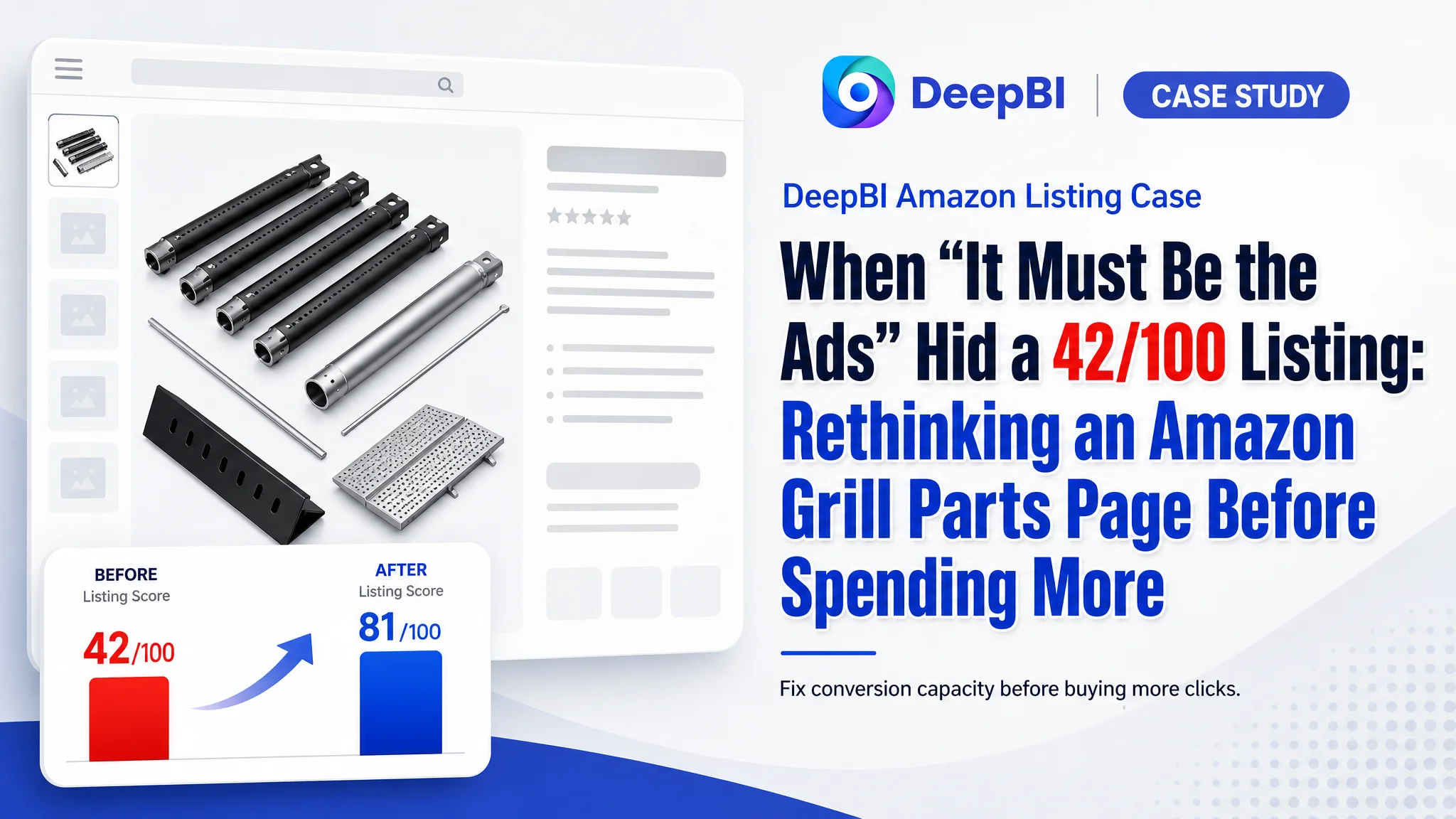
DeepBI’s Listing scoring quickly told a different story. Against a directly comparable high-performing competitor, this Listing scored 42/100 while the benchmark sat at 81/100. The ads were doing their job bringing traffic; the Amazon product page was not doing its job converting it. The gap was not in campaign settings, but in weak bullet points, a missing A+ story, and a page that looked more like a compatibility spreadsheet than a replacement-part solution.
Instead of pushing more traffic into a 42/100 page, the optimization path shifted: rebuild the Listing’s conversion capacity first—title clarity, main-image logic, bullets that speak to durability and flavor, and a full A+ layout that demonstrates fit and usage—then let ads amplify a page that can actually close. For other Amazon sellers, this case is a reminder: if your Listing cannot explain why your product deserves the click and the order, no amount of keyword refinement will fix the leak.
Amazon Ads Were Not Failing. The Page Was Consuming the Traffic.
From the seller’s point of view, the story started with cost pressure.
Their grill replacement kit (flame tamers and heat plates for popular built-in grills) sat in a competitive Amazon US category. Ad costs were climbing, and their internal dashboard kept highlighting high ACOS and unstable sales. The team’s operating instinct was clear:
- Keep refining keywords
- Tweak bids and placements
- Restructure campaigns to “unlock” hidden demand
They assumed the bottleneck sat fully inside Amazon ads.
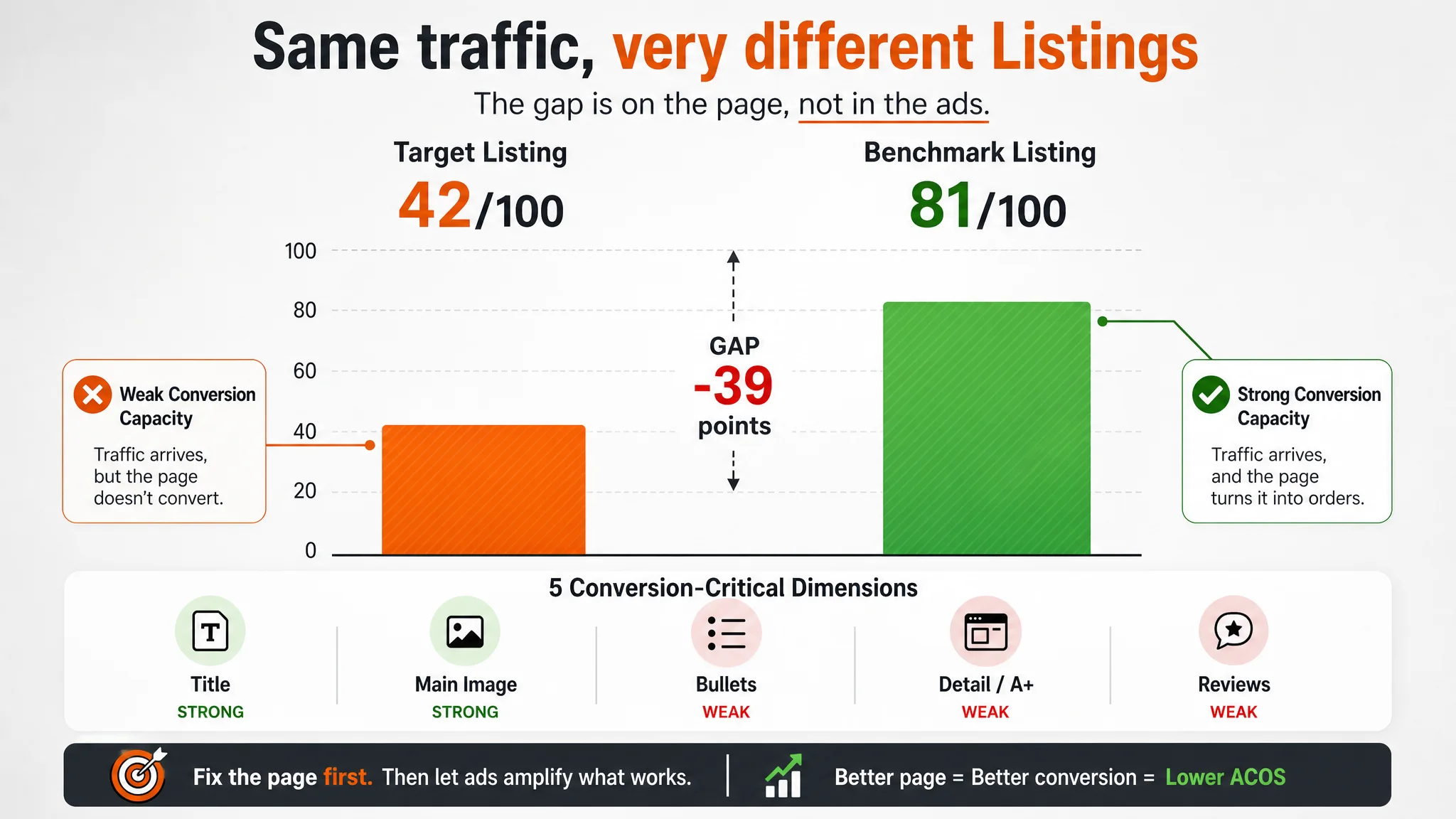
DeepBI connected the Listing into its scoring and competitive-benchmark framework. The result was blunt:
- Target Listing: 42/100
- Benchmark Listing: 81/100
- Gap: -39 points
Across five conversion-critical dimensions—title, main image, bullet points, detail page / A+ content, and reviews—the target Listing lagged on almost every axis. In other words:
“The real problem was not that ads failed to bring traffic. It was that the page could not convert the traffic.”
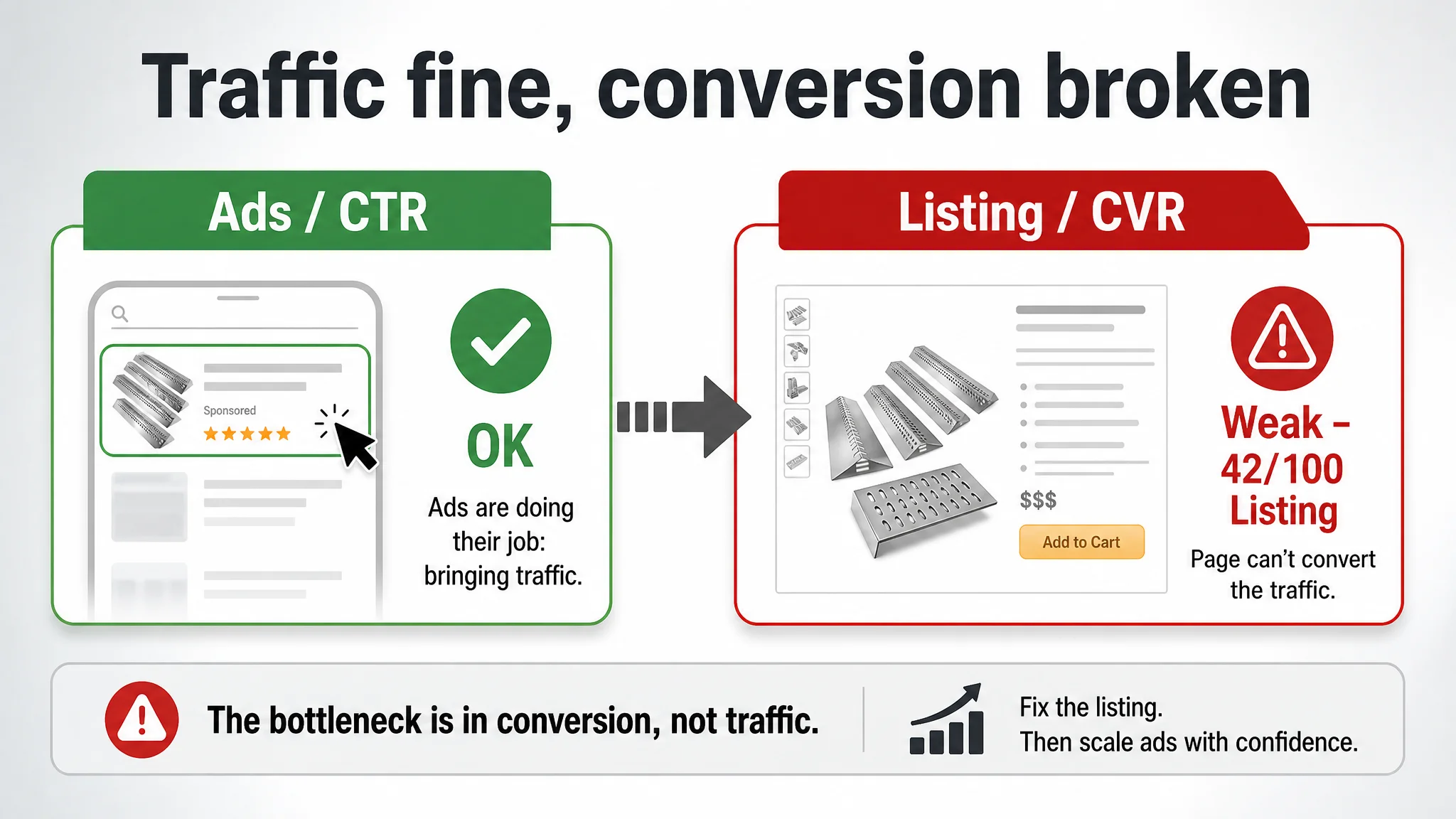
If ads were off, the numbers would show weak impressions or CTR only. Here, the structural weakness was on-page persuasion.
The Real Constraint Was Listing Conversion Capacity
When DeepBI decomposed the score, one dimension surfaced as the true constraint: detail page / A+ content.
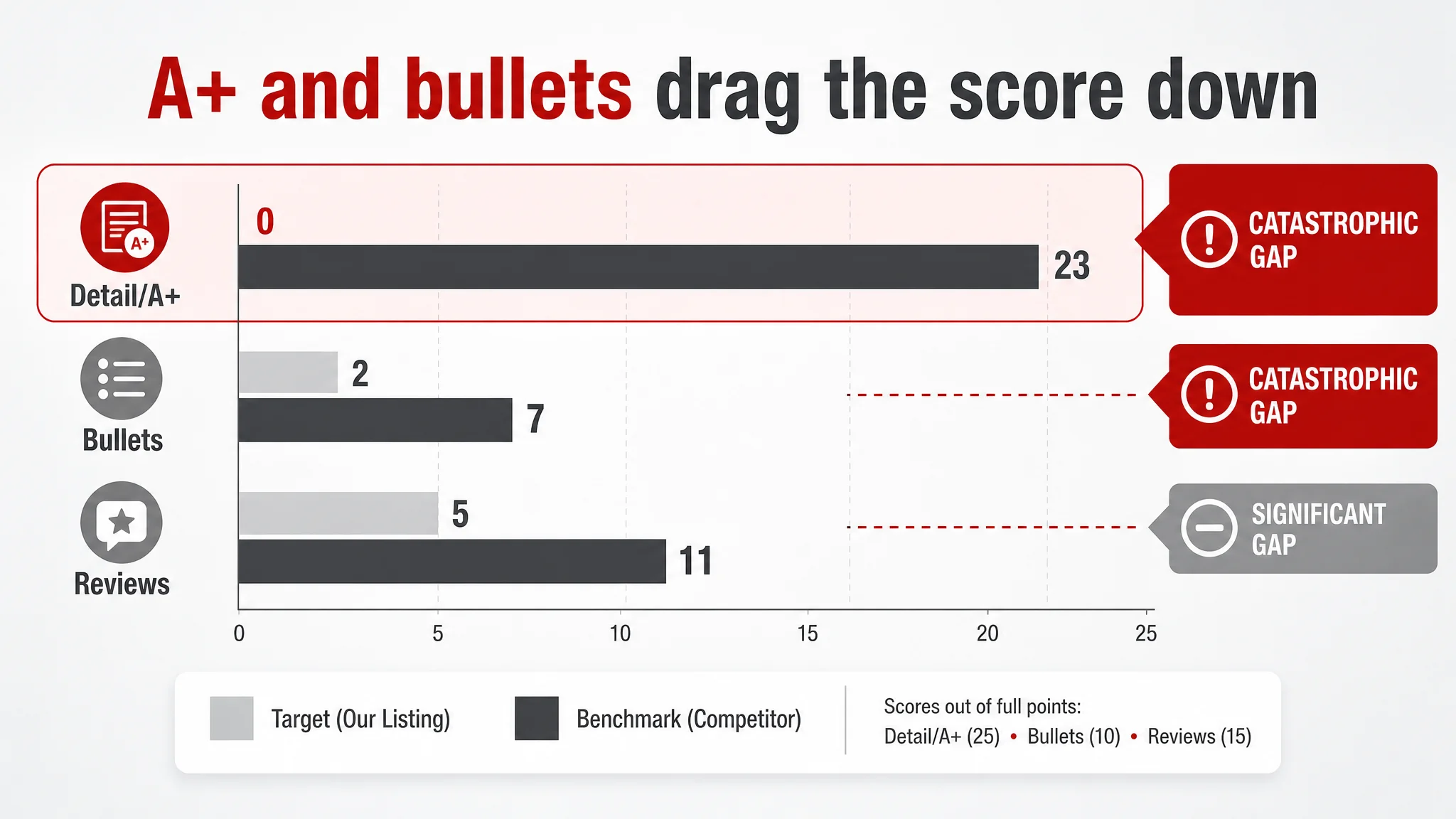
- Detail/A+ score: 0/25 vs competitor’s 23/25
- Bullet points: 2/10 vs competitor’s 7/10
- Reviews: 5/15 vs competitor’s 11/15
Title and main image were not perfect—but they were not catastrophic. The page still communicated “flame tamer / heat shield” and showed the kit reasonably. The catastrophic gap was that the Listing had no A+ content at all, and the bullet points were essentially a compatibility inventory.
In a category where buyers care deeply about:
- Will this fit my exact grill?
- Is it thick and durable enough (16GA vs thinner plates)?
- Will it improve heat distribution and flavor?
- How hard is installation and cleaning?
…the Listing stayed silent on trust and outcomes. It simply listed model numbers.
The benchmark Listing, by contrast, behaved like a conversion engine:
- Strong A+ chain from scene image to material proof, fit demonstration, cleaning, dimensions, and cooking scenarios
- Bullet points structured around durability, performance, ease of install, and flavor
- Visuals that made “16GA stainless steel” and “even heat, less flare-ups” obvious at a glance
DeepBI’s judgment: the root constraint was the Listing’s ability to convert both organic and paid traffic. Until that was repaired, further ad tuning would mostly amplify waste.
Why Traditional Amazon Ad Optimization Kept Failing
The seller’s misdiagnosis followed a pattern many Amazon sellers will recognize:
1. Symptom: ACOS high, orders unstable
2. Immediate assumption: Ad targeting or bids are wrong
3. Standard response:
- Expand or narrow keyword lists
- Adjust bids and budgets
- Split or merge campaigns
1. Outcome: Metrics fluctuate, but baseline efficiency does not fundamentally change
DeepBI matched this operational pattern against its Listing score and the competitive radar:
- The benchmark Listing had substantially richer visual and textual trust-building, yet operated in the same price and category band.
- The target Listing’s 0-point A+ indicated that the lower funnel—where doubts are resolved and commitment is formed—was effectively empty.
From a funnel perspective:
- CTR is primarily a function of search-result thumbnail (title + main image).
- CVR is the product of bullet logic, A+ storytelling, and review trust.
The target Listing’s weaknesses sat precisely in the components that drive CVR, not CTR. That’s why each round of ad changes produced only marginal, fragile improvements: DeepBI could see that traffic quality was not the dominant issue; page conversion capacity was.
This Product Page Did Not Lack Traffic. It Lacked Trust.
A title that read like a compatibility list, not a decision-making headline
On title, the numeric gap to the competitor was modest (12 vs 14 out of 20), but the qualitative difference mattered:
- Current title led with the core keyword “Flame Tamer” but then dissolved into a long, unstructured model list.
- It failed to elevate key purchase drivers: stainless steel, 16GA thickness, number of burners, and replacement nature.
The benchmark title followed a more mature Amazon title logic:
- Core keyword: “Grill Flame Tamer”
- Functional synonym: “Grill Heat Plate Shield”
- Clear mention of stainless steel, 16GA, and 5 burner
- Model references structured, not dumped
DeepBI’s recommendation: keep the core compatibility but restructure around “Bull Flame Tamer Grill Heat Plate Shield” plus material and use-case cues, then align model numbers into readable blocks. This is about making the title a decision tool, not just a search index.
A main image that showed the product, but not why it deserved the click
The main image score (23 vs 26 out of 30) showed a smaller numeric gap, but DeepBI’s visual analysis uncovered real click-value issues:
- Inconsistent perspective and crowded layout reduced perceived professionalism.
- Parameters and compatibility details were technically there but hard to parse, especially on mobile thumbnails.
- No clear “7-piece repair kit” framing, no visual emphasis on thickness or heavy-duty construction.
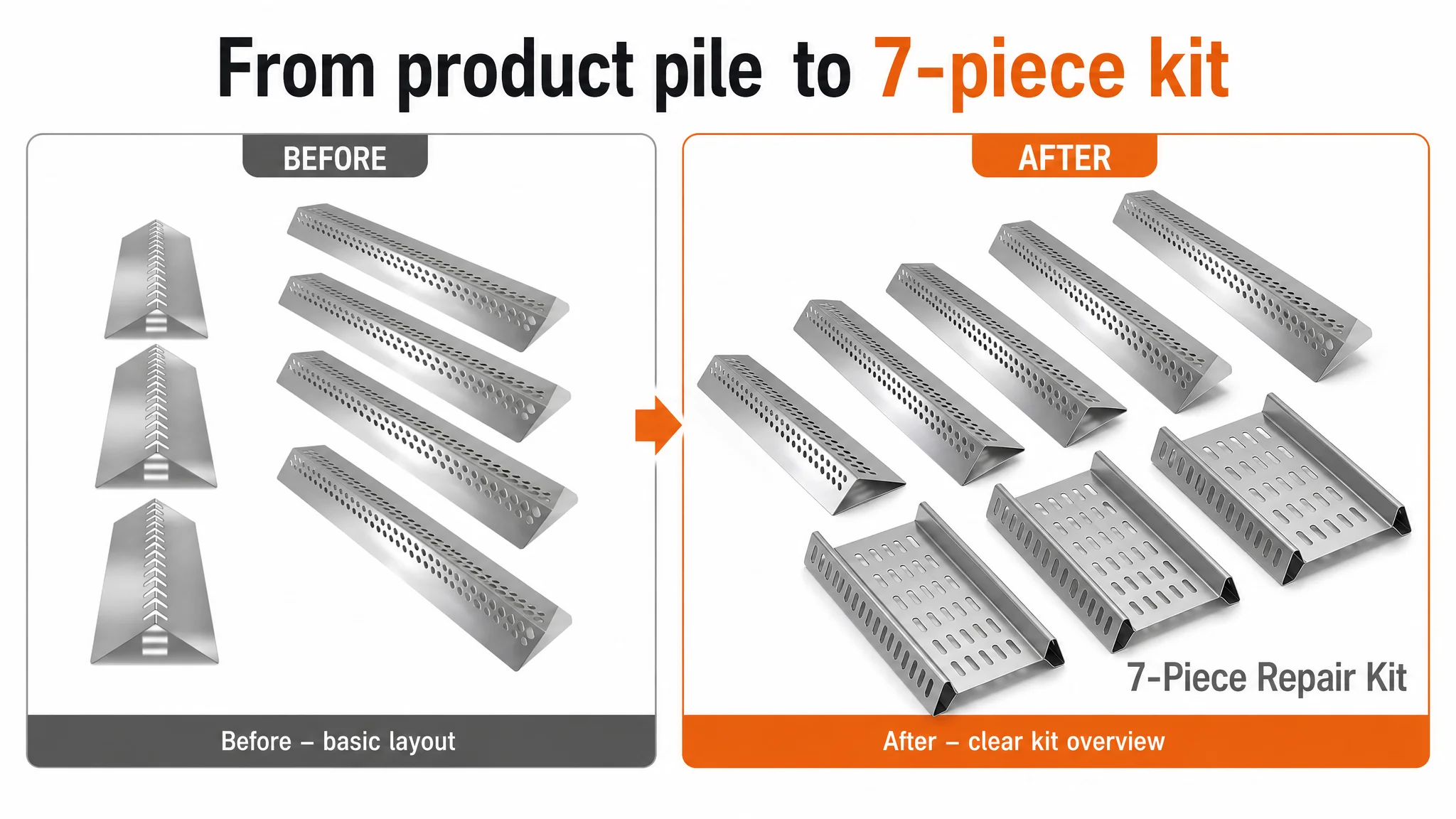
The benchmark Listing’s visual stack showed:
- Clean, modern industrial composition
- Explicit “kit” framing—what exactly the buyer is getting
- Clear, high-contrast parameter callouts
DeepBI’s guidance was concrete: standardize perspective, simplify layout, and make “7-Piece Repair Kit” and sizing visually immediate. The goal: turn the main image into a reason to click, not just a product picture.
Bullet Points Had Information, but Not a Buying Logic
Perhaps the most damaging gap was in the bullet points: 2/10 vs competitor’s 7/10.
The original bullets: data without narrative
The existing bullets:
- Focused almost entirely on compatibility lists
- Repeated model numbers across different lines
- Offered no clear structure (dimensions, material, usage, value)
- Used neutral, technical language only
To a buyer, this felt like reading a spare-parts spreadsheet. It answered “Does this fit?” but not “Why should I choose this kit?” or “What will it do for my grilling?”
The benchmark bullets: user outcome first, data second
The benchmark Listing’s bullet strategy was different:
- Each bullet anchored in a user value: durability, performance, ease of installation, flavor.
- Material and thickness (“stainless steel”, “16GA”, “thicker and heavier”) were front and center.
- Compatibility was grouped and structured, not scattered.
- Tone included outcome language: “works great”, “enjoy your barbecue”.
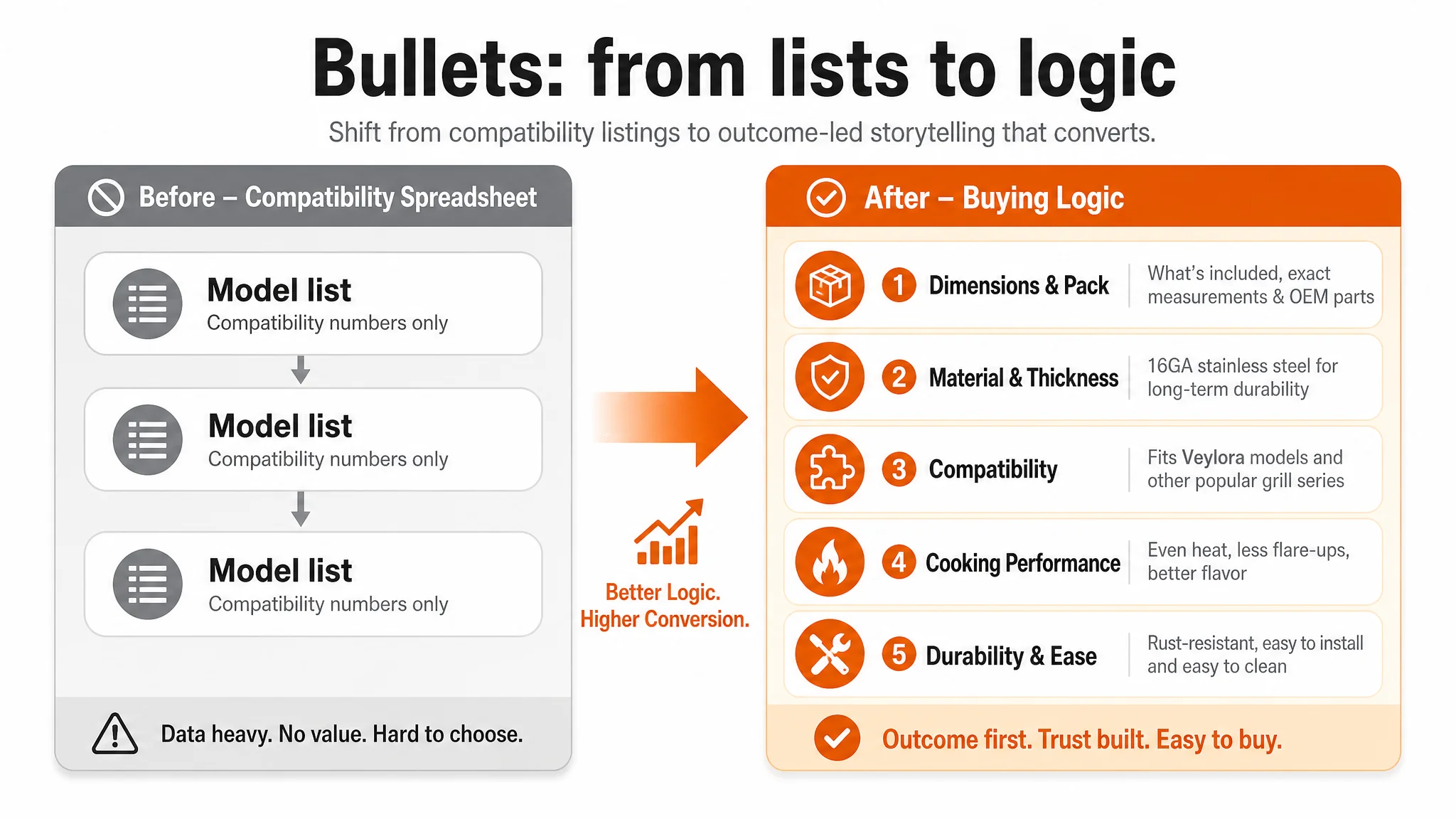
DeepBI reorganized the client’s bullet logic around a sequence:
1. Dimensions & Pack: What is included, with precise measurements and matching OEM part numbers.
2. Premium Stainless Steel: Why this material and thickness matter for durability.
3. Wide Compatibility – Bull Models: Structured, readable lists with practical notes like “needs X shields / Y tamers”.
4. Versatile Fit – Cal Flame & Lion: Cross-brand fit information with clear caution to verify configuration.
5. Enhanced Cooking Performance: How even heat distribution and flare-up control improve grilling.
6. Superior Durability: Oxidation and corrosion resistance, reducing replacement frequency.
7. Easy to Install & Clean: DIY friendliness and cleaning ease, plus a final “measure before purchasing” risk-reduction hint.
The shift was fundamental: from “Here are all the model numbers” to “Here’s what it is, why it lasts, where it fits, how it cooks, and how easy it is to live with—plus exactly where it fits.”
A Missing A+ Story Removed the Final Layer of Persuasion
In DeepBI’s scoring, the detail/A+ dimension went 0 vs 23 out of 25. That wasn’t a cosmetic issue; it was structural.
What the competitor’s A+ did that this Listing didn’t
The benchmark Listing used A+ modules as a complete conversion funnel:
- A full-width BBQ scene hero: real grill, real food, visible flames—instant emotional context.
- Material proof: macro shot with digital caliper reading “1.500 mm”, visually anchoring the 16GA thickness claim.
- Fit demonstration: overhead view of flame tamers installed in a grill body, holes and spacing clearly aligned.
- Functional explanation: visualized heat and smoke behavior—how the plates manage flare-ups and create flavor.
- Cleaning scenario: a hand wiping grease off the plate, illustrating non-stick or easy-clean surfaces.
- Dimension grid: clear imperial measurements, annotated directly on the product image.
- Use-case collage: four panels for meat, fish, fruit, vegetables, tying the part to aspirational BBQ experiences.
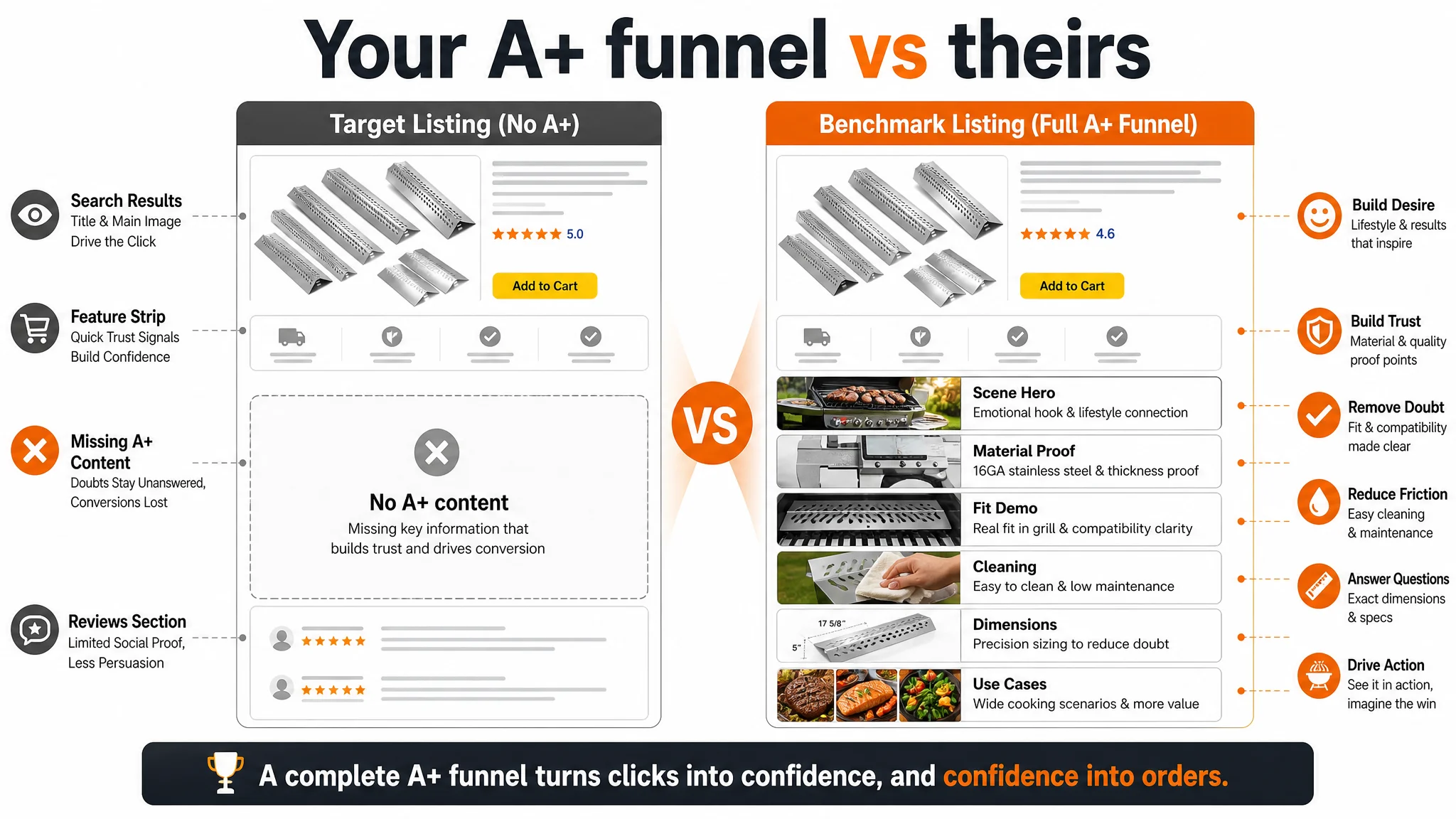
In effect, the competitor’s A+ took the buyer from “This might fit my grill” to “This will bring my grill back to life and make our BBQ nights better.”
The client’s Listing had none of this.
“Advertising does not only amplify advantages. It can also amplify a page’s existing defects.”
Without A+, every buyer question—Is it really 16GA? How does it sit in the grill? Will cleaning be painful?—was left unanswered, pushing more buyers to back out or choose a competing Listing that looked more trustworthy and complete.
Why DeepBI Did Not Keep Tuning the Ads First
Given this diagnosis, DeepBI resisted the temptation to start with ad-side fixes.
The biggest business risk: paying to expose page-level defects
With a 42/100 Listing:
- Every additional click bought through ads had a lower-than-necessary probability of converting.
- High ACOS was not just a media-efficiency problem; it was a conversion-capacity problem.
- Scaling ads at this stage would have meant locking in poor TACOS and compressing margin further.
DeepBI prioritized:
1. Rebuilding baseline conversion capacity through title, main image, bullets, and A+.
2. Using competitor behavior as a ceiling for what “good” looks like in this category.
3. Only then revisiting ad scaling with a page that deserved more traffic.
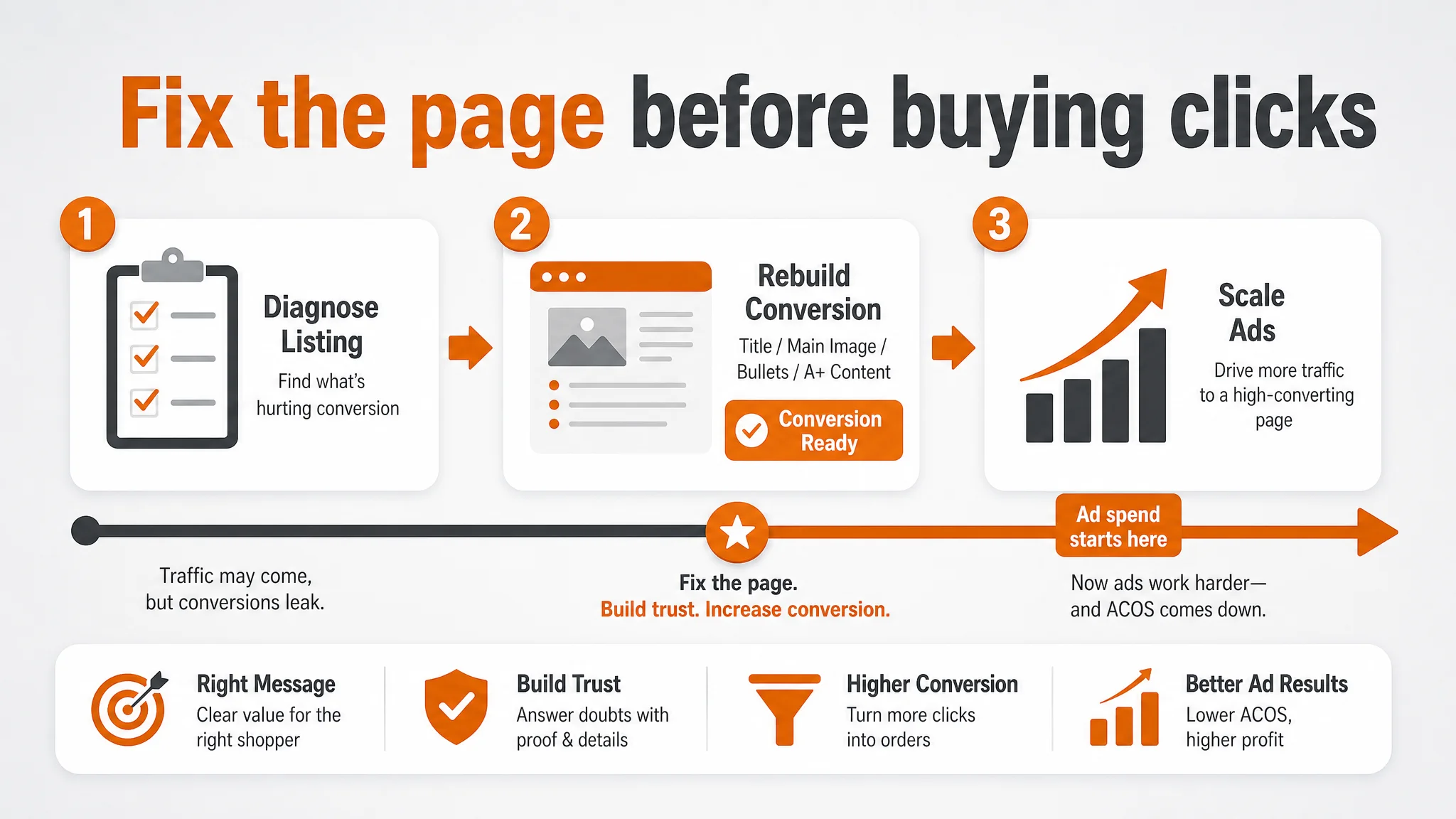
This sequence mattered. If the team had continued to iterate keywords and bids without touching the page, they would likely have concluded “this product can’t win on Amazon,” when in reality the page had never been allowed to compete on equal footing.
How the Page’s Sales Logic Started to Recover
DeepBI’s optimization path was not a random list of improvements; it was a reconstruction of the Listing’s sales logic.
1. Title: from model dump to structured promise
- Front-loaded brand context + core function: “Bull Flame Tamer Grill Heat Plate Shield”
- Inserted key synonyms: “Grill Heat Plate Shield” to capture broader search language
- Added “Stainless Steel Replacement Parts” to highlight material and role
- Reorganized model numbers into coherent blocks (Angus, Brahma, Outlaw, Cal Flame G Series, Lion Premium)
Result: a title that captured search demand while immediately signaling what it is, what it’s made of, and who it’s for.
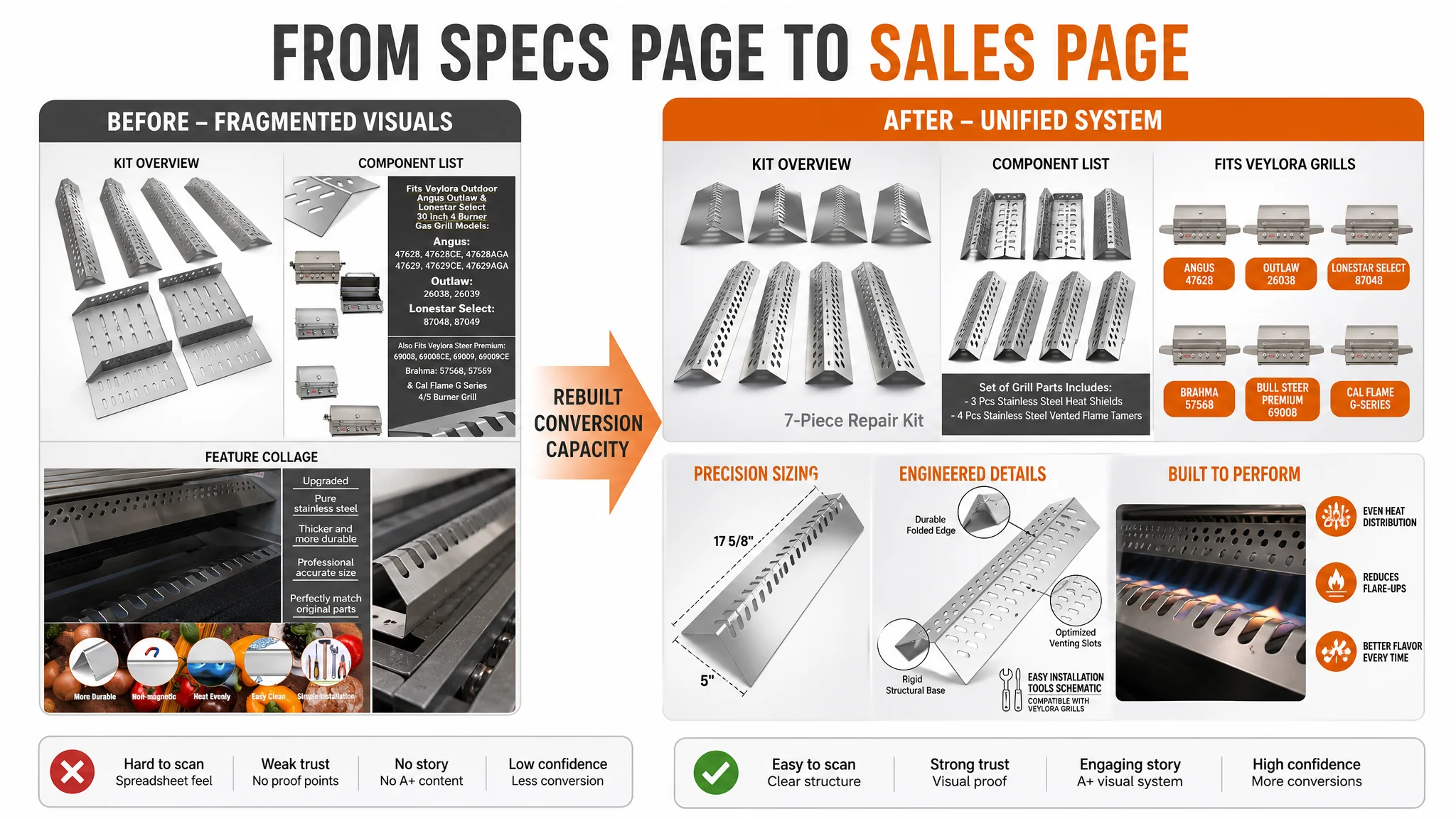
2. Main images: from busy and flat to clear and reassuring
DeepBI’s visual guidance focused on:
- Clean kit overview: 7 pieces laid out in a balanced 45° isometric view, occupying ~75% of the frame, labeled as a “7-Piece Repair Kit”.
- Precision sizing view: product centered with high-contrast dimension annotations (“17 5/8" x 5"”), framed under a “Precision Sizing” tag.
- Compatibility visual matrix: 2x3 grid of grill models with clear labels like “PERFECT FITS FOR BULL GRILLS”.
- Component breakdown: clear separation of shields vs flame tamers with a textual component list at the bottom.
- Detail callouts: zoomed circles on edges, venting, and bends to visually communicate build quality.
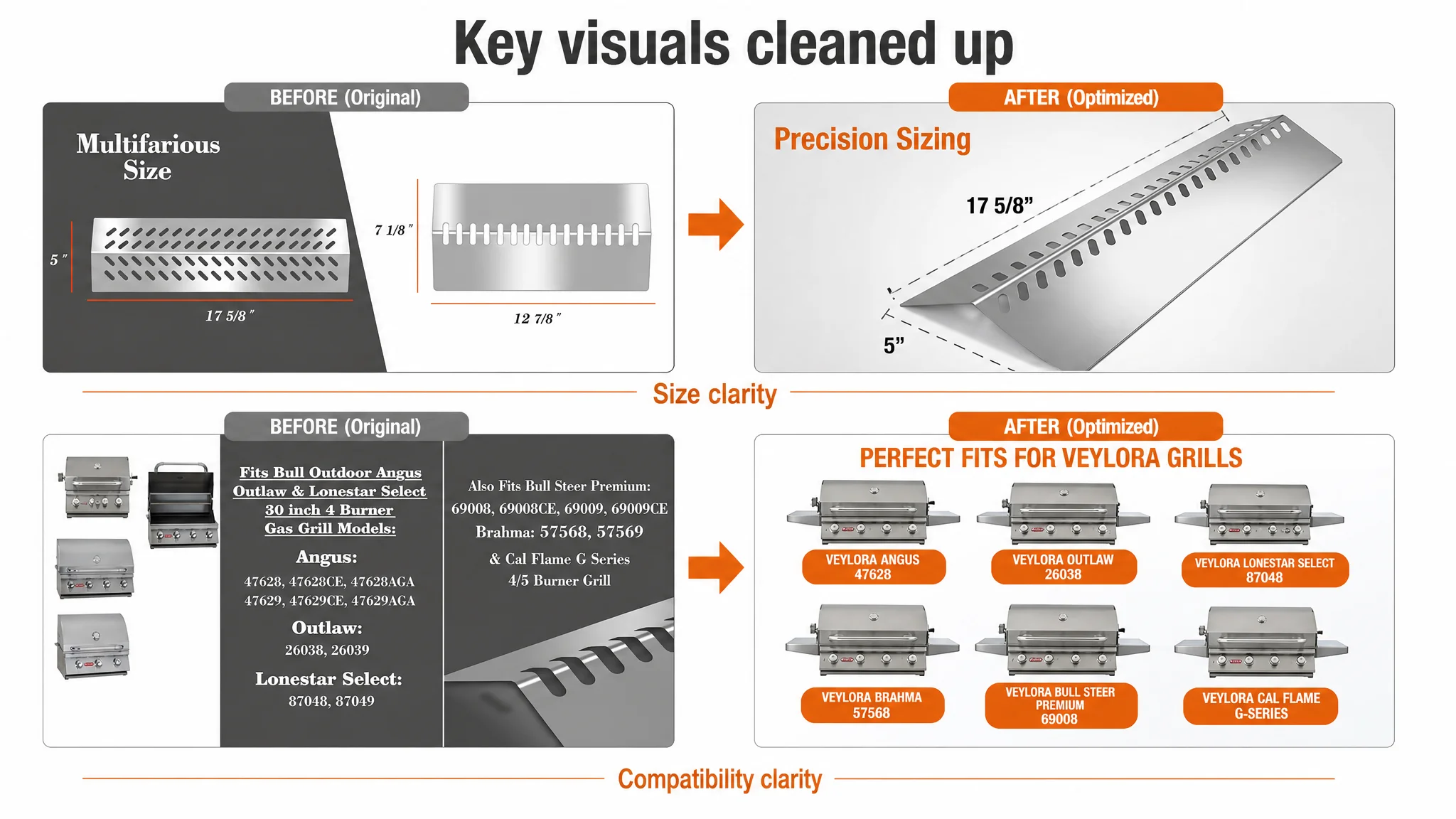
Each image got a defined job: click attraction, dimension clarity, fit reassurance, delivery clarity, and craftsmanship trust.
3. Bullet sequence: from raw data to a persuasion path
The restructured bullets created a progression:
- What’s in the box, and how it matches OEM references
- Why the material and thickness matter
- Exactly which grills and burner configurations it fits
- How it improves cooking and flavor
- How long it lasts and how often you’ll need to replace it (less often)
- How easy it is to install and maintain—and a final reminder to measure before buying
This allowed the page to answer “Should I?” and “Can I?” simultaneously.
4. A+ rebuild: turning silence into a visual trust chain
The proposed A+ modules restored the “missing middle” of the decision:
- Emotional entry: a hero BBQ scene with real food and a clear “Premium Quality Grill Replacement Parts” message.
- Material proof: digital caliper measuring the plate at 1.5 mm, visually anchoring the 16GA claim.
- Fit proof: overhead install shot showing four plates neatly aligned inside a grill body.
- Heat & flavor logic: visualized smoke and flame behavior to explain how the product actually improves grilling.
- Cleaning reassurance: action shot of wiping off grease, highlighting easy maintenance.
- Dimension diagram: clean, three-dimensional view with prominent imperial measurements.
- Lifestyle collage: meat, fish, fruit, vegetables scenes framing the product as a versatile BBQ enabler.
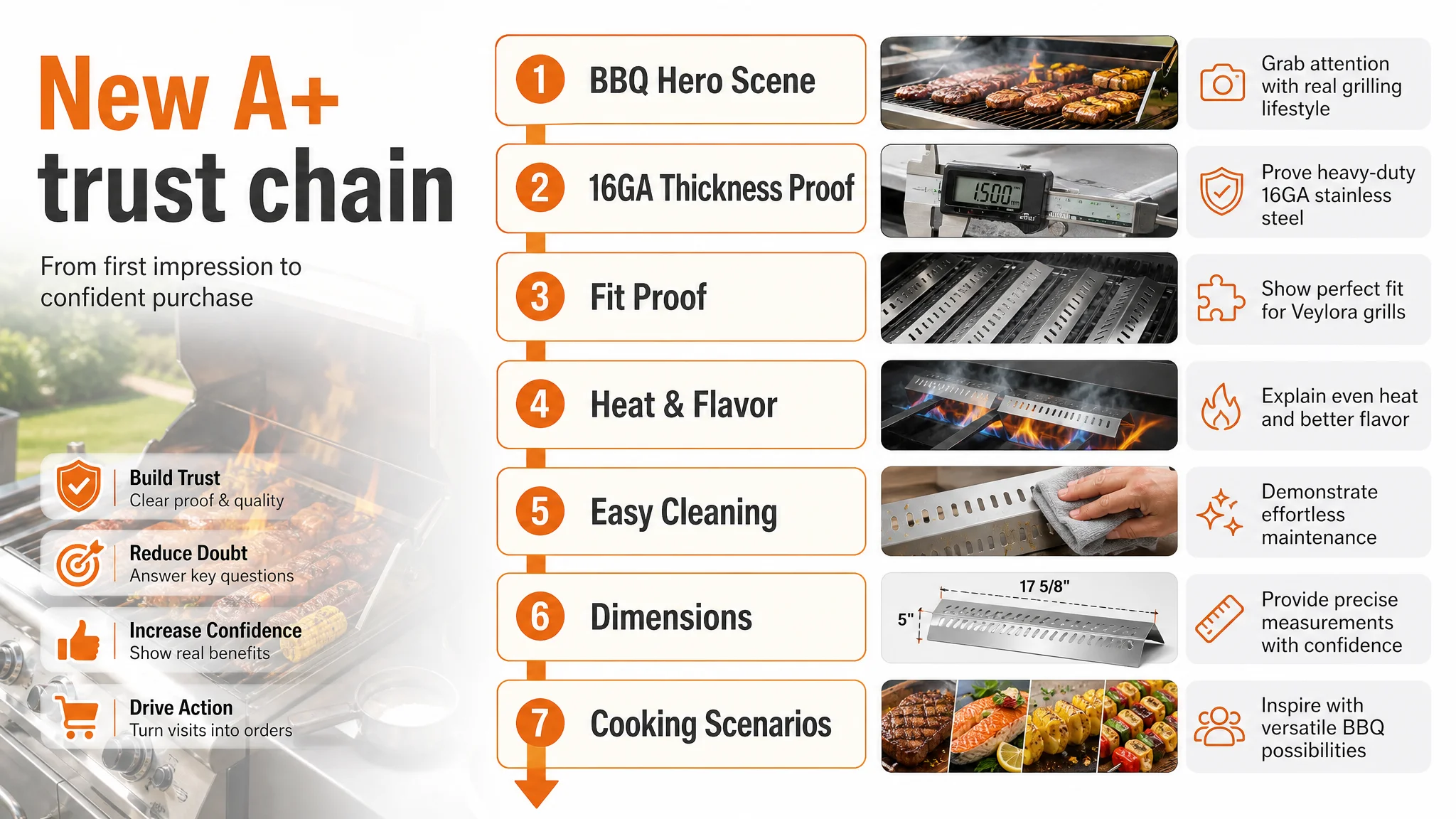
This did not just “beautify” the page; it rebuilt trust at every step of the buyer’s mental checklist.
How Ad Traffic Became Useful Again
The seller did not flip a magic switch and watch ACOS collapse overnight. But the operational state changed in a way that matters:
- The Listing moved from a 42/100 with no A+ to a structurally complete page aligned with benchmark-level storytelling.
- Each ad click now landed on a page that showed 16GA thickness, fit, and usage instead of making the buyer infer it.
- The dependence on compatibility lists as the only selling argument was reduced; the page now spoke to durability, performance, and lifestyle.
In this new context, ads could finally act as an amplifier of strengths instead of a magnifier of weaknesses. The seller gained a more controllable trajectory:
- A more defensible path to lower ACOS as CVR rises
- A realistic chance to stabilize organic ranking as the Listing’s conversion improves
- Less need to “overpay” for traffic just to keep the product visible
How the Seller’s Understanding Changed
Perhaps the most valuable outcome was not only the visual overhaul, but the shift in judgment:
- They saw that high ACOS is not always an advertising failure; it is often a Listing conversion failure.
- They learned that title, main image, bullets, and A+ are a single conversion system, not isolated fields.
- They recognized that ads cannot fix a trust gap created by missing or weak page content.
Before this engagement, their default move was:
“If performance is bad, adjust the ads.”
After working through DeepBI’s scoring and competitive diagnosis, their new mental model became:
1. Check whether the Listing deserves more traffic. 2. Fix the core conversion gaps (especially A+ and bullets). 3. Then scale ads into a page that can carry its own weight.
For other Amazon sellers, this case is a caution and a template:
- If you see rising ad costs and stagnant orders, do not assume the answer must sit inside the ad console.
- Put your Listing next to a high-performing competitor and ask: is my page as capable of building trust?
- If your A+ is empty, your bullets read like a spec sheet, and your main image does not clearly frame what the buyer gets, you likely have a conversion leak, not a traffic shortage.
DeepBI’s role in this case was not to “turn on more AI features,” but to reframe the problem: before buying more visits, make sure your Amazon product page can actually turn those visits into orders.