

An automotive-tools Amazon seller came to DeepBI with a familiar contradiction: their inner tie rod removal tool had a solid star rating and a decent volume of traffic, yet orders lagged behind a key competitor. The team’s first instinct was to blame Amazon ads—bids, keywords, campaign structure—and they had already spent weeks trying to “fix” ACOS without seeing the conversion move.
Once we put the product page into DeepBI’s Listing diagnosis, a different picture emerged. The Amazon Listing scored 73/100 versus the competitor’s 84/100. Ads were not the primary leak; the real issue was that the product page could not convert the traffic it was already receiving. The title weakened click intent, the main-image set was underpowered against a strong benchmark, and the A+ content failed to build the trust and “this will work for my vehicle” certainty that tool buyers demand.
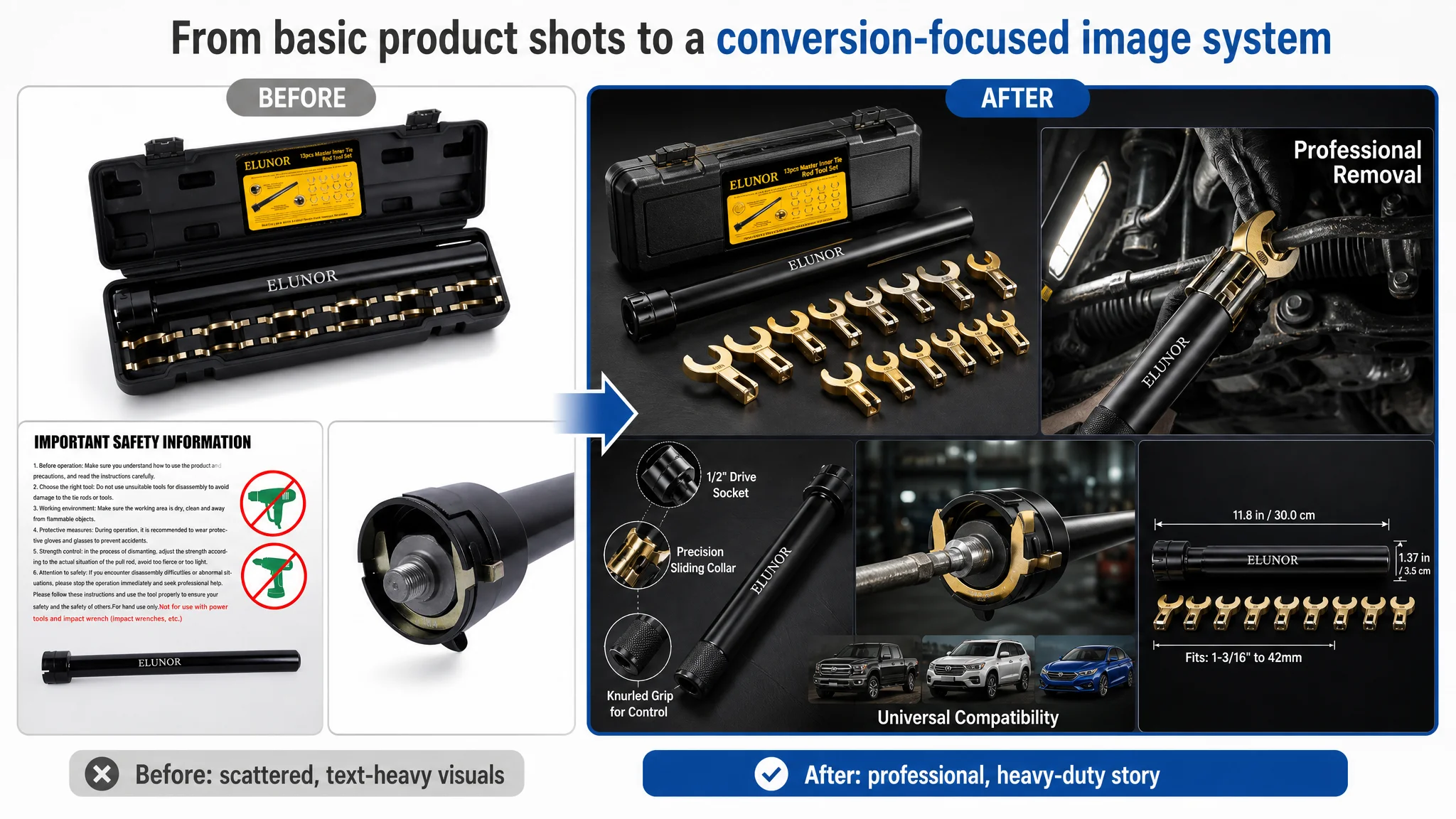
We re-centered the optimization away from ad knobs and toward listing conversion capacity: tightening the title around specs and material, re-framing bullet points around compatibility and ease of use, and reshaping main images and A+ into a coherent “professional, heavy-duty, easy-to-use” story. As the page’s sales logic improved, ad traffic stopped being wasted and the listing began to behave like a tool that deserves to rank. For many Amazon sellers, this case is a reminder: when ACOS feels “stuck”, the real bottleneck often sits on the product page, not inside the ad console.
What the Seller Saw: “Our Ratings Are Fine, So It Must Be the Ads”
This Amazon seller operates in the automotive tools category with an inner tie rod removal tool kit on the US marketplace.
On paper, the product did not look like a weak listing:
- Rating: 4.4 stars
- Reviews: 160
- Front-page negative-review share: 12.5%
- Slightly higher star rating than the main competitor (4.3 stars)
But when compared with a category-leading competitor:
- The competitor had over 1,000 reviews—about 6x the seller’s volume
- The competitor owned more visible social-proof scale and category presence
- The competitor dominated relevant search results and felt like the “default” choice
At the same time, the seller saw:
- Growing ad spend to keep exposure
- ACOS under pressure
- Orders not scaling proportionally with traffic
Their internal conclusion: “Our product is solid, ratings are okay, but ads are not optimized enough. We should keep tuning keywords and bids.”
This is where the misdiagnosis started.
“The real problem was not that ads failed to bring traffic. It was that the page could not convert the traffic.”
The Core Constraint: Listing Conversion Capacity, Not Traffic Volume
DeepBI’s Listing scoring put numbers to what the team had only felt vaguely:
- Total score
- Target listing: 73/100
- Benchmark competitor: 84/100
- Gap: –11 points
- By dimension
- Title: 12 vs 16 (–4)
- Main image set: 24 vs 25 (–1)
- Bullet points: 7 vs 7 (0)
- A+ / detail page: 19 vs 23 (–4)
- Reviews: 11 vs 13 (–2)
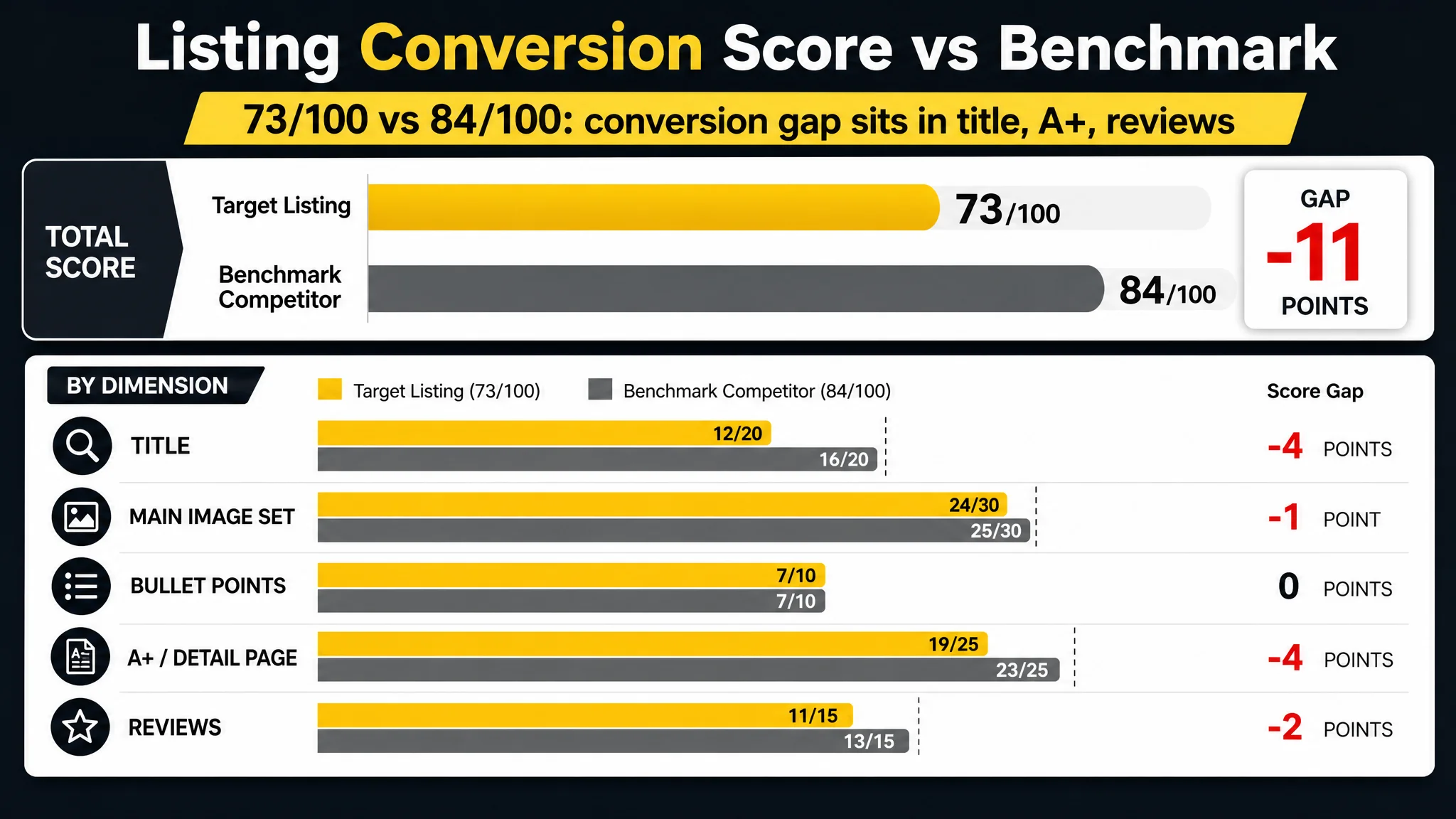
So while the star rating did not show a clear “problem”, the overall Listing conversion capacity was materially weaker, especially in three areas that directly impact CTR and CVR:
1. Title – weaker click and search logic
2. A+ / detail page – weaker trust and decision support
3. Review scale – smaller proof compared with the benchmark
In other words, the seller was trying to win a mature, tools category with a page that looked “good enough” in isolation, but clearly underpowered once you put it next to the actual benchmark the buyer sees on Amazon.
Where the Original Diagnosis Went Wrong
The seller’s internal narrative:
- “Rating is OK, complaints aren’t extreme.”
- “We already state the key functions and materials.”
- “Ads feel expensive; improving ads should fix profitability.”
Why this logic failed:
1. They treated a 4.4-star average as “job done” on page quality.
They overlooked the scale gap: 160 reviews vs 1,000+ on the competitor creates a very different trust impression for high-friction, tool purchases.
1. They described the product like a tool catalog, not like a decision engine.
The seller’s title and bullets leaned on technical terms and generic functional claims instead of directly answering the buyer’s core questions:
- “Will this fit my specific vehicle?”
- “Is it strong enough not to bend or fail under torque?”
- “Can I actually use it myself without a lift or professional shop?”
1. They tried to solve a conversion leak with ad tactics.
Ad tuning can shift who arrives at the page and at what cost. It cannot compensate for a page that fails to convincingly handle compatibility, durability, and ease-of-use concerns once the shopper lands.
As ad spend increased, the underlying Listing weakness was simply being amplified.
Title: Structurally Search-Friendly, Commercially Underpowered
On the surface, the original title did some things right: it pushed the core phrase “Inner Tie Rod Removal Tool Kit” forward, which is search-friendly.
But versus the benchmark, several conversion-critical gaps appeared:
- Weaker perceived completeness
- Competitor: explicitly calls out “13 Pcs Tie Rod Tool Kit” and “Crowfoot Adapters” in one tight construction.
- Target listing: structure makes the set feel less clearly defined and powerful at a glance.
- Missing material and durability signal
- Competitor: “Heavy-Duty Steel” in-title—an immediate trust anchor in a breakage-sensitive category.
- Target listing: material strength is not foregrounded; the buyer must dig into bullets or A+.
- Narrower applicability wording
- Seller: “for Tie Rods Remove & Install Cars” – clumsy and oddly narrow phrasing.
- Competitor: “for Vehicle” – broad, clean, and professional.
This translated into a simple business reality: even if both products appeared on the same Amazon search results page, the competitor’s title did more work in 2 seconds to:
- Signal completeness and professional-grade construction
- Convey wide compatibility
- Claim the “heavy-duty” territory that matters in automotive tools
DeepBI’s recommendation reframed the title accordingly:
Inner Tie Rod Removal Tool Kit, 13 Pcs Inner Tie Rod Tool Set with 12 Crowfoot Adapters, 1/2 Inch Drive Heavy-Duty Steel for Tie Rods Removal & Installation, Compatible with Cars and Vehicles
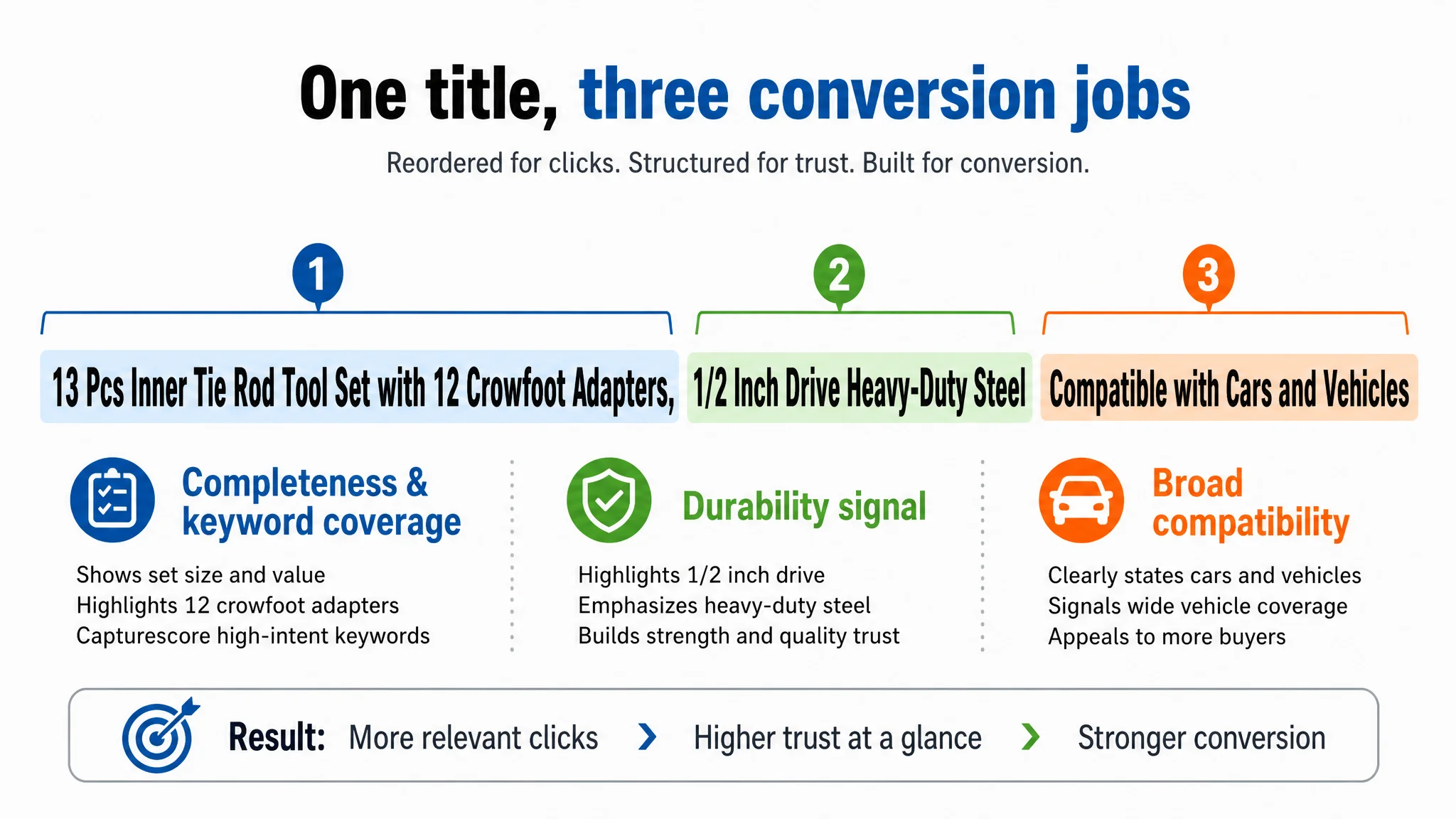
Key shifts in logic:
- Lead with set size and completeness: “13 Pcs Inner Tie Rod Tool Set with 12 Crowfoot Adapters”
- Inject explicit material strength: “Heavy-Duty Steel”
- Clean, broad compatibility phrasing: “Compatible with Cars and Vehicles”
This wasn’t a cosmetic rewrite; it was a structural repositioning of what the buyer sees first on Amazon.
Main Images: Information Exists, But the Story Isn’t Competitive
From a distance, the seller’s main images checked basic boxes:
- Product overview
- Some safety information
- Parts displayed
- Certain usage visuals
But once benchmarked, several critical weaknesses became obvious.
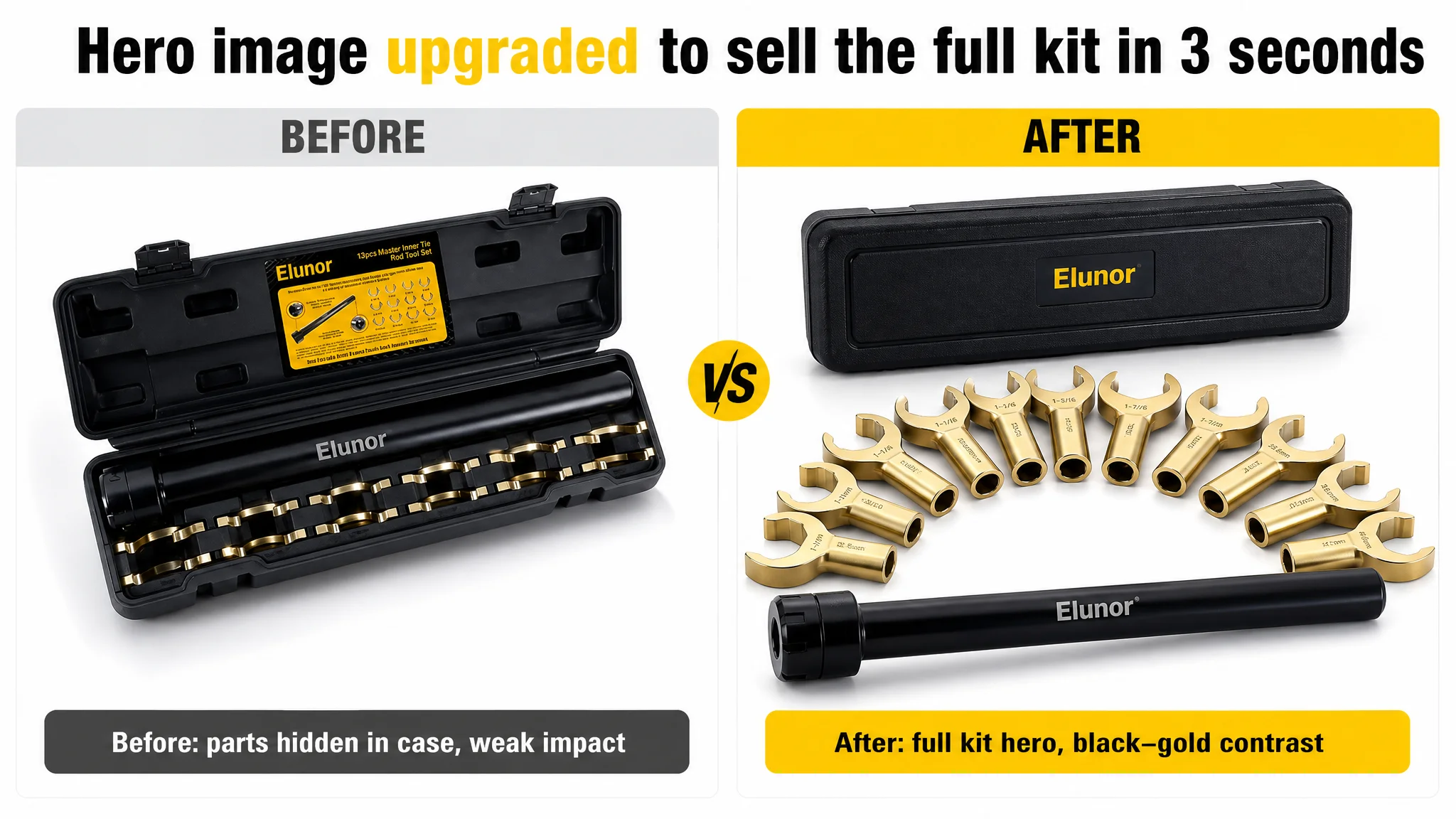
1. No compelling “hero” frame for the full kit
The competitor’s opening visual presents:
- The long drive tube
- All adapters arranged with high contrast
- A strong brand-color system (blue case + yellow labels)
It instantly communicates:
- “This is a complete, professional kit.”
- “You’re buying serious hardware, not a random tool.”
The seller’s image set:
- Shows the kit, but without a carefully orchestrated hero layout
- Does not fully exploit the black-metal + gold-adapter contrast
- Leaves part of the visual power of the set unused
DeepBI’s image logic was to redesign this first frame as a deliberate “industrial hero shot”:
- Black long-rod and gold adapters taken out of the black case, arranged in a fan layout in the center (≈70% of the frame)
- Case tilted in the background
- 45° side angle, strong light emphasizing metallic highlights
- Clean white background, high contrast
This is not about “prettier design”; it is about matching the visual decision-making bar buyers are already trained to expect in this category.
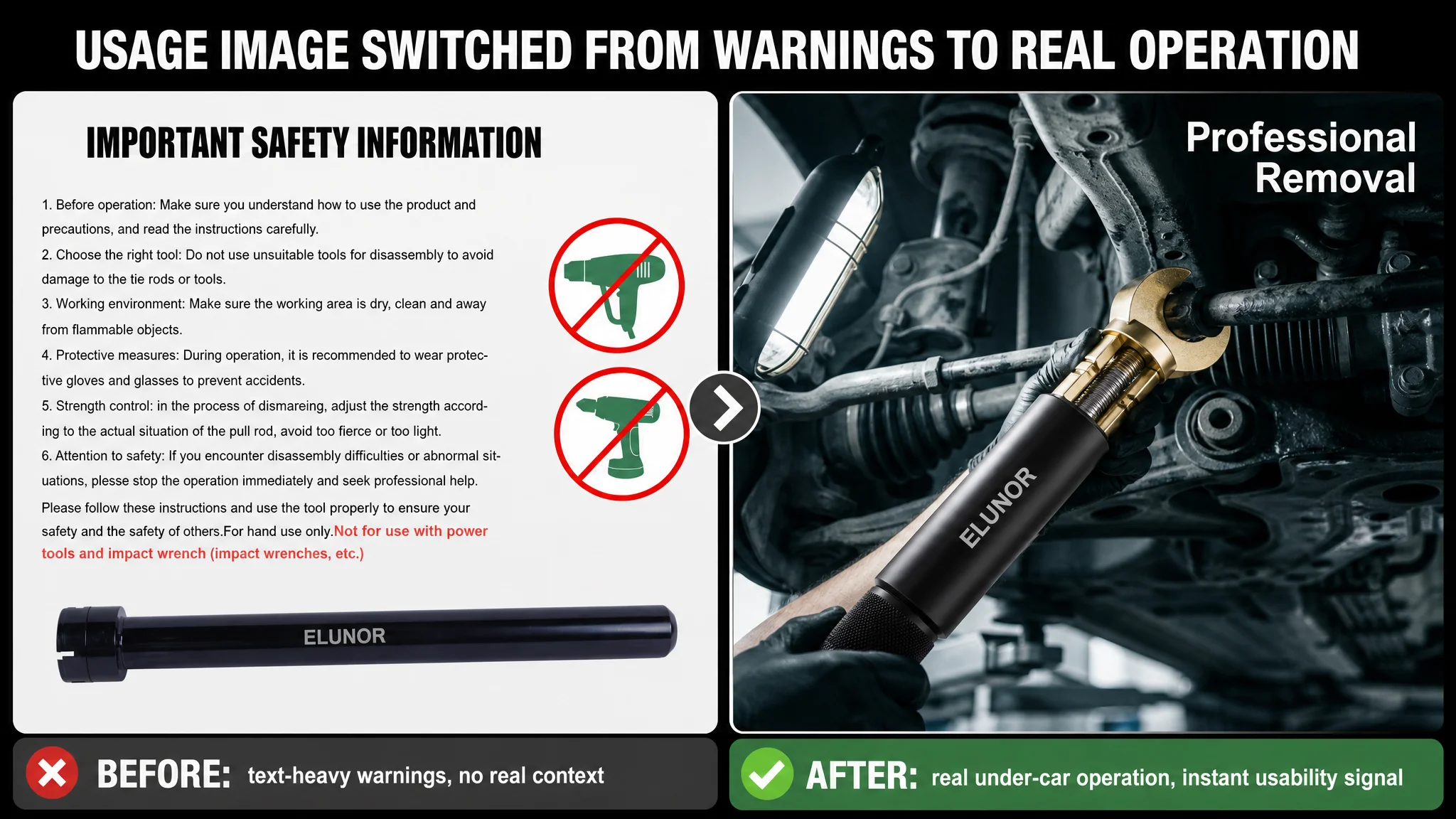
2. Safety copy instead of real usage context
One of the existing images spends valuable space on textual safety messaging in a dry style.
In a tools category, that slot is far more valuable when used to show:
- The tool locked onto a real inner tie rod in a vehicle
- True under-car context: suspension components, steering rack, realistic lighting
- A mechanic’s hand operating the tool
DeepBI’s strategy replaced “text-heavy warnings” with:
- Low-angle, under-car scene
- Drive tube and adapter engaged with the inner tie rod
- Light simulated from a mechanic’s work light
- “Professional Removal” overlay
3. Fragmented detail story vs. guided feature focus
The seller did show product details, but in a visually scattered way.
The benchmark competitor:
- Uses close-up crops and callouts to explain the sliding collar, drive interface, and grip texture in a coherent sequence.
DeepBI restructured detail images into:
- One image with the tool diagonally across the frame, surrounded by three circular close-ups:
- Drive socket
- Sliding collar slot
- Knurled handle
- Each close-up with concise functional text
- Controlled lighting and dark grey gradient background
This makes the tool’s mechanical logic visually obvious in a few seconds rather than through dense text.
4. Compatibility and specification not visualized enough
Buyers are not only asking, “Does it fit?” They are asking, “Does it fit my exact car?”
The competitor:
- Uses grid layouts and clear label overlays on adapters
- Makes the size range feel systematic and trustworthy
DeepBI’s approach:
- A dedicated overhead shot of the 12 gold adapters in a 3×4 matrix
- Dark-grey industrial background
- Each adapter labeled with size in bright yellow, legible on mobile
- Strong black–gold contrast
Here, the Listing moves from “we wrote the sizes in text” to “we visually prove you get all these specific sizes” — a different level of trust.
A+ Content: Function Listing vs. Trust and Decision Support
The A+ content is where the conversion gap really opened up.
The seller’s A+ modules:
- Product overview
- Sliding-collar mention
- Material description
- Operation steps
- Dimensions
- Some real-vehicle application collage
The benchmark’s A+:
- Brand story and global presence
- Large product hero visuals with logo emphasis
- Clear compatibility matrix
- Structure and mechanism illustrations
- Process and material triptychs
- Multiple real-mechanic usage scenes
- “Unboxing” and “box contents” visuals
- Precise dimension + real-object comparison
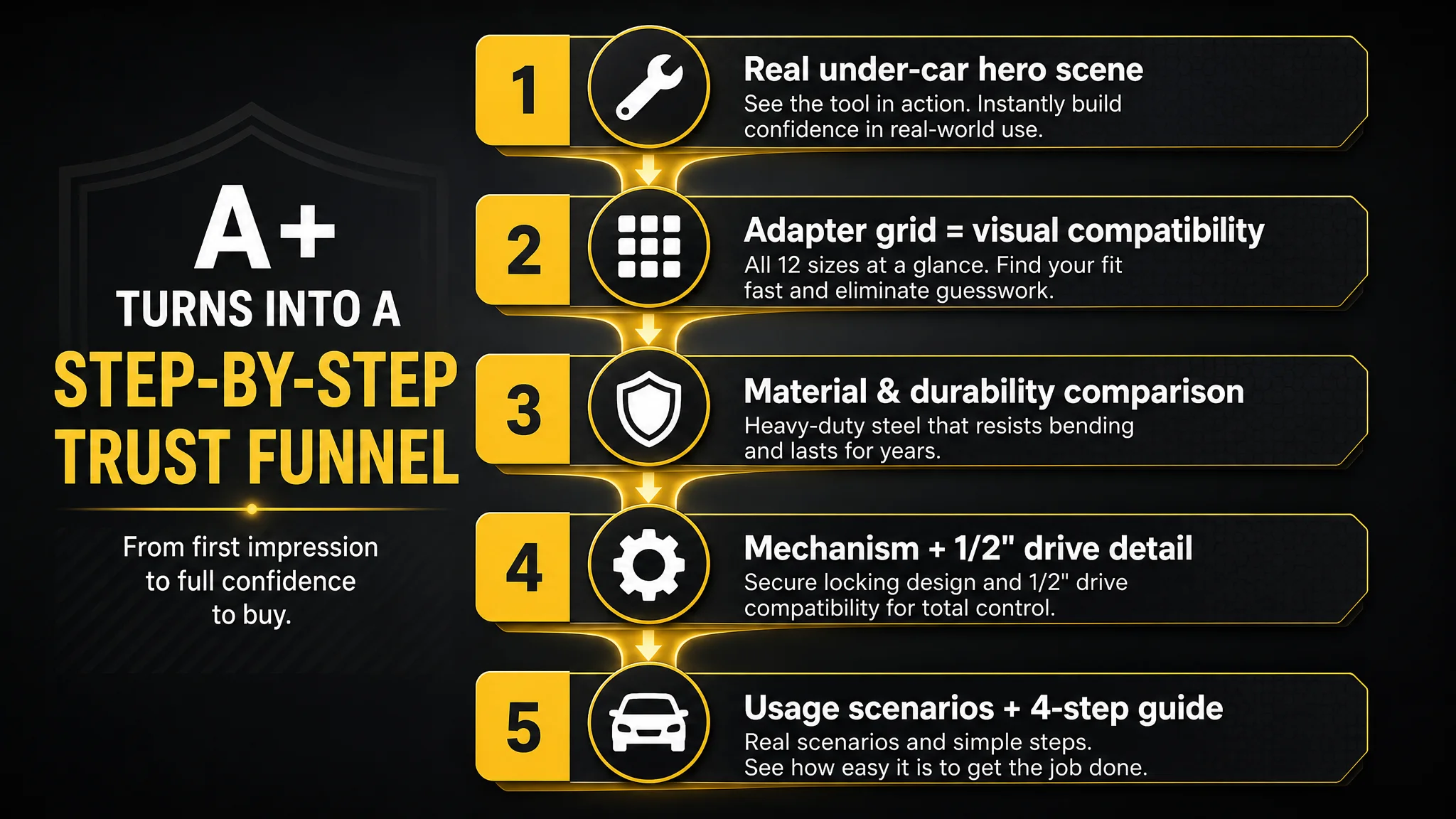
The difference is not just content volume; it’s the role the A+ plays in the buyer’s decision.
The competitor’s A+ is a full trust-building funnel. The seller’s A+ is a functional gallery.
Key A+ gaps DeepBI flagged:
1. Missing brand authority and proof of scale
- Competitor uses “10M+ users”, “200+ countries” type messaging.
- Seller has no brand-level promise, only product features.
- In a high-torque tool, lack of brand-level confidence increases purchase hesitation.
1. No clear structural explanation loop
- Competitor uses “structure diagram + macro close-ups + real-operation photos” to explain the sliding collar and drive engagement.
- Seller uses static step images, with less dynamic sense of “lock-in, torque, release”.
1. Insufficient emotional and scenario coverage
- Competitor includes “multi-technician usage”, “unboxing completeness”, “emergency repair scenarios”.
- Seller focuses on parts and steps, not on the moment when the buyer needs the tool most.
DeepBI’s recommended A+ redesign broke the page into a deliberate narrative:
- Opening module:
High-impact under-car repair scene with the tool in use under realistic lighting; first impression: “professional heavy-duty tool, real-world context.”
- Compatibility module:
Dedicated 12-adapter grid as described above; solves “will this fit my vehicle?” visually.
- Material & durability module:
Side-by-side visual:
- Left: generic tool bending or cracking (greyscale, red “X”)
- Right: thick-wall AISI 1045 medium carbon steel shaft close-up with strong edge lighting
- Copy anchors: “forged from AISI 1045 medium carbon steel”, “corrosion-resistant coating”
- Sliding collar & locking mechanism:
45° close-up showing an adapter being inserted and locked, with transparent arrows indicating the “push–rotate–lock” motion. This makes the core differentiator (no adapter drop-off under load) visually tangible.
- Drive interface detail:
Separate close-up of the 1/2" drive square hole, labeled “Compatible with All 1/2" Drive Tools”. This directly answers the professional buyer’s standard-compatibility check.
- Usage scenarios module:
Four equal frames of different vehicle types (sedan, SUV, pickup, etc.) in live workshop scenes, each with a gloved hand operating the tool. This is both trust and versatility in one stroke.
- Step-by-step operation module:
Clean 4-step grid with consistent angles, light, and background, each frame with a short title bar. The underlying logic: “even if you’re not a pro mechanic, the process is simple and controlled.”
Bullet Points: From Technical Listing to Buying Logic
The original bullet points were not “wrong,” but they were optimized for describing a tool, not for resolving buyer hesitations in order:
- Technical steel terminology (AISI 1045) appears, which is good for pros
- Control and grip aspects are scattered across several bullets
- Closing points focus on kit completeness and “professional quality”
The competitor’s bullets:
- Heavily emphasize universal fit, ease of use, and emergency value
- Close with usage guidance and realistic scenarios rather than only specs
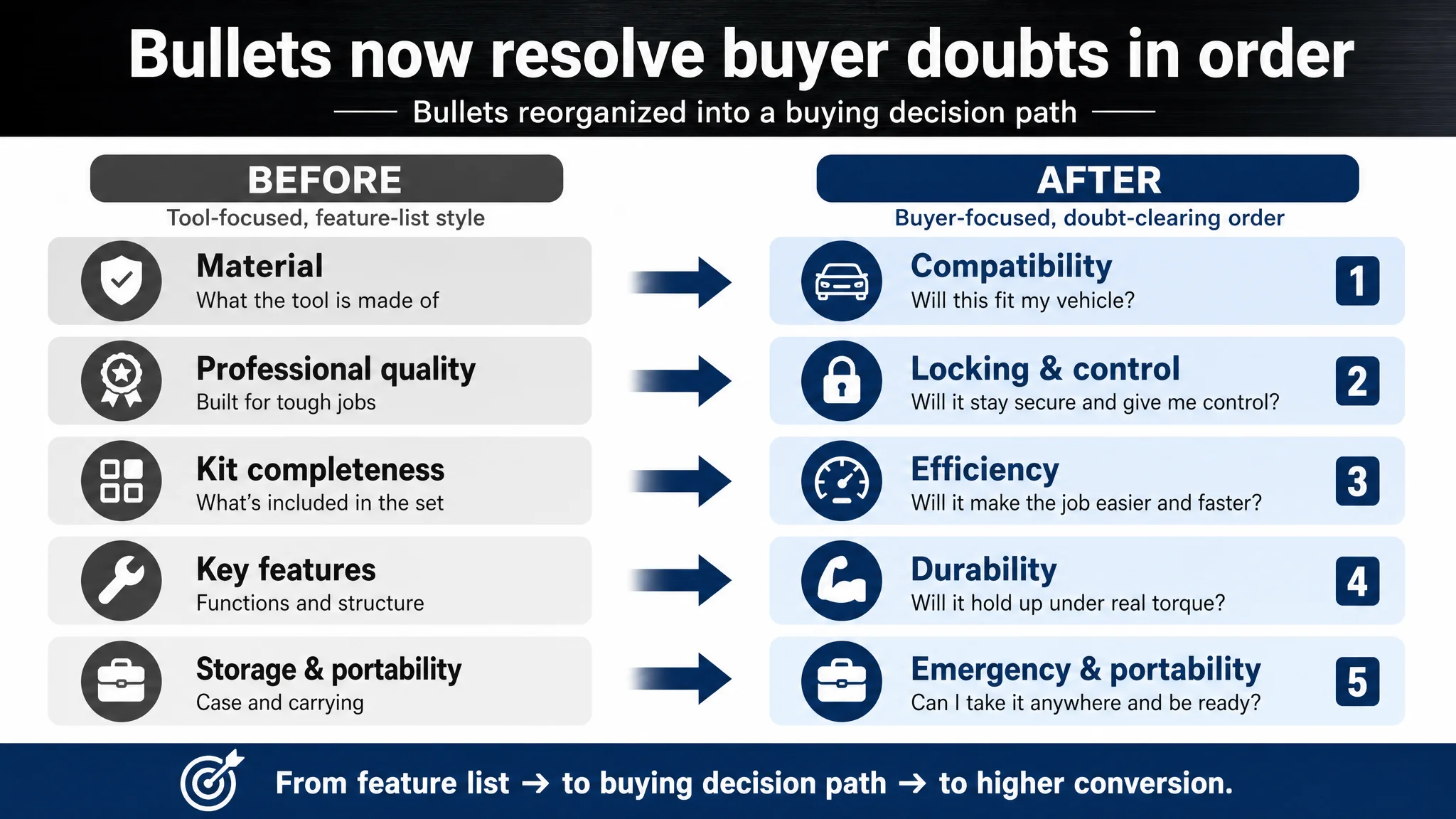
DeepBI’s bullet restructuring focused on building a coherent decision path:
1. Start with compatibility and use-case coverage
【Wide Compatibility】 Easily remove and install inner tie rods without removing the rack and pinion. Includes 12 crowfoot adapters (sizes: …). Universal fit for most domestic and imported vehicles, including cars, pickups, and SUVs.
This anchors “Yes, it fits my type of vehicle” before anything else.
1. Then address locking and control in tight spaces
【Secure Locking Mechanism】 The 1/2-inch drive tube features a flexible sliding collar that securely locks the crowfoot adapters in place. This design provides maximum leverage and precision control in tight spaces where ordinary wrenches cannot reach. (Note: Designed for manual ratchets or breaker bars; not for impact use).
Here, the design differentiator (sliding collar) is expressed not as a feature, but as a solution for tight-space access and reliable lock-in.
1. Then efficiency and user control
【Enhanced Control & Efficiency】 This 13-piece master kit is designed for high-efficiency steering maintenance. The handle features a deep knurled grip to ensure non-slip operation even with oily hands, providing total control and stability during the removal and reinstallation process.
This connects “control” directly to greasy hands and high torque—real-world conditions.
1. Then durability and professional-grade assurance
【Heavy-Duty Construction】 Forged from premium AISI 1045 medium carbon steel, this tie rod removal set offers exceptional strength and industrial-grade durability. The corrosion-resistant coating ensures long-lasting performance, making it a reliable choice for professional automotive shops and DIY enthusiasts.
This bullet reframes the steel spec as an answer to “Will this bend or break under load?”
1. Finally, emergency and portability
【Organized & Portable】 Comes in a rugged, custom-fit carrying case to keep all components neatly organized and protected. This portable professional set is easy to transport for roadside assistance or emergency vehicle repairs, ensuring you have the right tool ready at any time.
The kit becomes not just a set of parts but a ready-to-go solution for “when it fails on the road.”
This shift turns the bullets from “attributes” into a sequence of resolved objections.
Why DeepBI Did Not Recommend “Fix Ads First”
From a purely ad-operations lens, the seller could have continued:
- Adjusting match types and bids
- Rotating keyword focuses
- Batching campaigns to isolate performance signals
But DeepBI’s diagnosis made a different risk judgment:
- The listing was already underperforming vs. a benchmark on core conversion drivers (title, A+, trust signals).
- Scaling or intensifying traffic into this page would simply amplify waste.
In this context, the biggest business risk was not “missing out on traffic,” but:
- Overpaying for clicks that had a lower probability of converting than the category leader.
- Allowing the competitor to keep reinforcing its position as “default choice” while this ASIN played price and ad spend catch-up.
So the decision path was:
1. Repair the Listing sales logic first
- Make sure the page can stand next to the benchmark without losing the buyer in 5 seconds.
- Only then does each additional click have fair odds of turning into an order.
1. Then let ads re-test the new baseline
- Test whether CTR and CVR respond positively to the improved title, images, and A+.
- Use that data to recalibrate keyword coverage, bids, and budgets.
“Advertising does not only amplify advantages. It can also amplify a page’s existing defects.”
In this case, DeepBI’s judgment was that every additional dollar spent before fixing the Listing would mostly amplify the wrong outcome.
How the Page’s Sales Logic Started to Recover
After restructuring the title, bullet points, main images, and A+:
- The Listing story became coherent instead of fragmented:
- Search result: clear “13 pcs, heavy-duty, wide compatibility” value at a glance.
- First images: professional kit presentation + real under-car usage.
- A+: brand-like trust, clear fit, durability proof, and simple usage explanation.
- The page began to communicate a professional heavy-duty tool rather than just another generic kit.
- Compatibility anxiety, durability fears, and “can I actually use this myself?” doubt were addressed visually and structurally, not only through text.
Even without inventing specific numbers, we can describe the operating-state change:
- Ad traffic became more productive: the same or similar traffic began landing on a stronger page.
- Reliance on brute-force ad spend reduced: the Listing gained more inherent capacity to convert both paid and organic clicks.
- Risk of “ACOS spiral” decreased: optimization efforts could shift from “buying more traffic” to “making each session count.”
What the Seller Learned — and What Other Amazon Sellers Can Take Away
By the end of the process, the seller’s internal understanding had changed substantially:
- High rating ≠ high conversion capacity.
A 4.4-star, 160-review listing can still lose badly to a 4.3-star, 1,000+ review competitor if the overall Listing logic is weaker.
- Amazon ads cannot repair a structurally weak product page.
If the Listing loses the comparison battle at title, images, and A+, no amount of keyword tuning will sustainably fix ACOS.
- Title, main image, bullets, and A+ must form one continuous argument.
For this tool, that argument was:
- “It fits your vehicle.”
- “It will not fail under torque.”
- “You can use it confidently in tight spaces.”
- “It’s a complete, professional kit that lives in your trunk or workshop.”
- Before scaling ads, judge if the Listing deserves more traffic.
DeepBI’s scoring and benchmark comparison made that judgment clear: Listing conversion had to be addressed first.
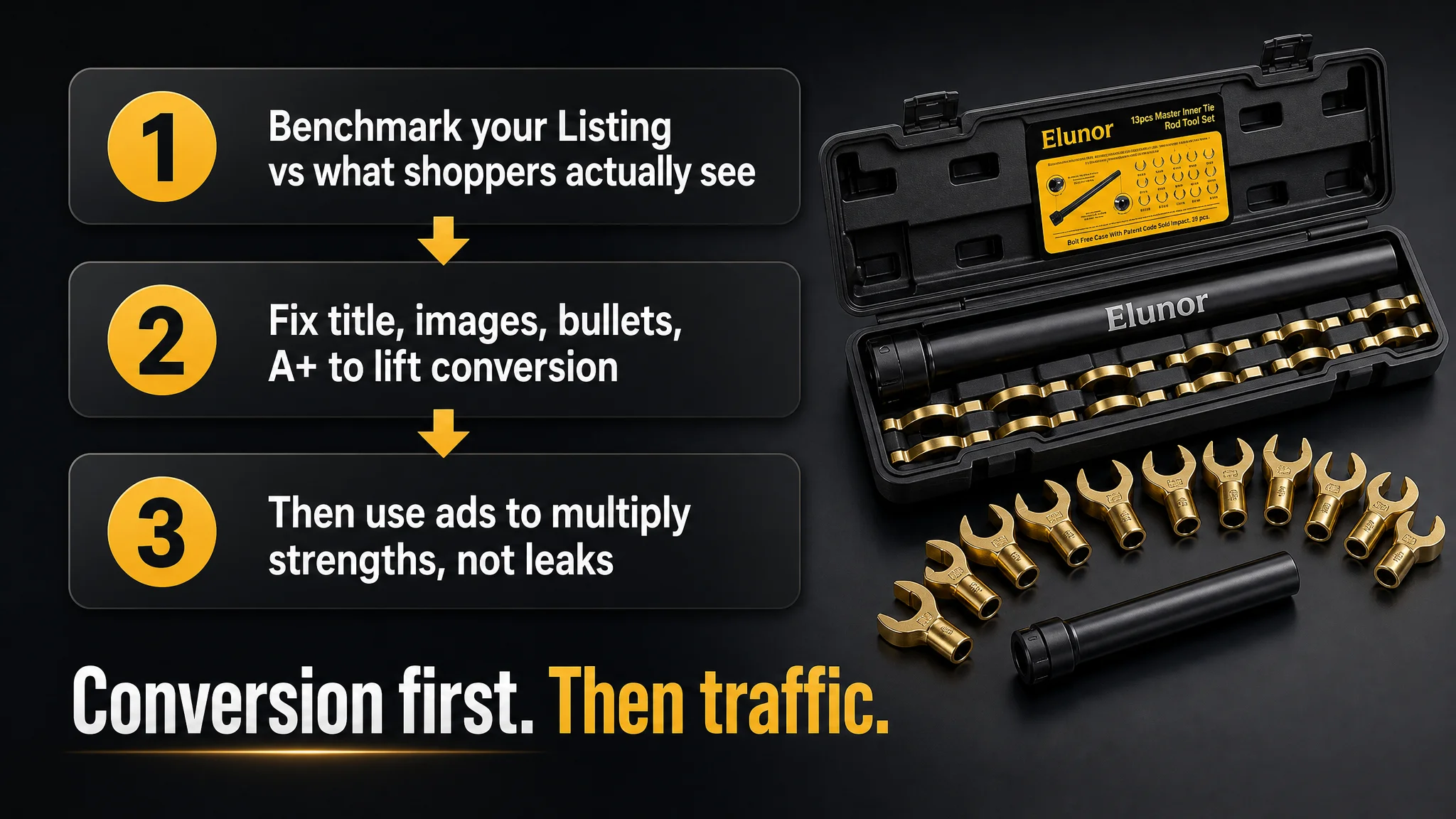
For other Amazon sellers, this case is not about inner tie rod tools. It is about the order of operations:
1. Use objective benchmarking to see where your Listing truly stands against the products your shoppers actually see.
2. Fix the product page’s ability to convert both organic and paid visitors.
3. Only then use Amazon ads as a multiplier—of strengths, not of leaks.
This seller’s turning point was not a new bid strategy; it was the decision to treat the Amazon Listing as the real engine of conversion, and ad spend as the fuel that only makes sense once the engine runs efficiently.