

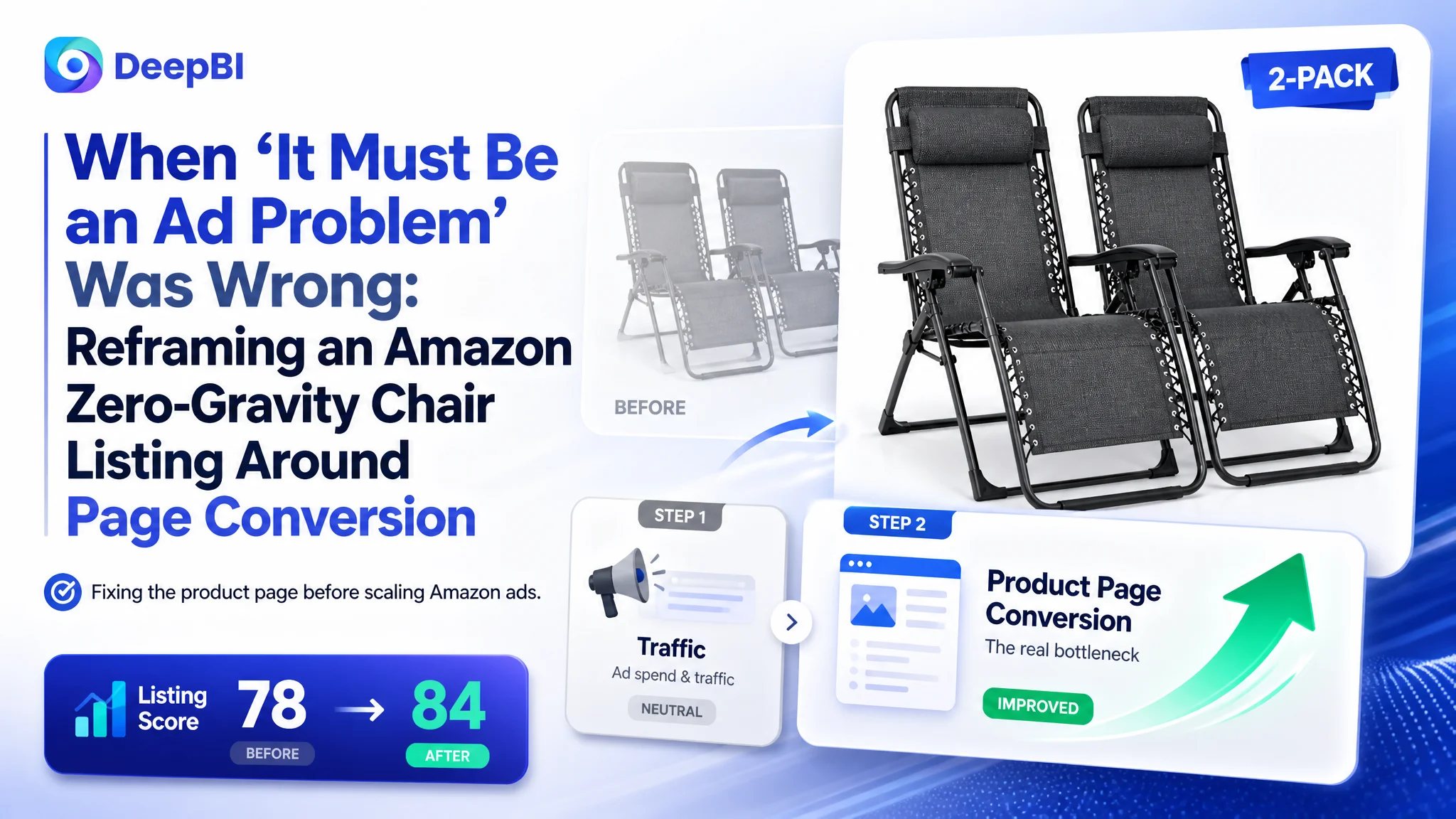
This Amazon seller in the outdoor furniture category was convinced rising ad pressure on their oversized zero-gravity chair set came from “weak ads and high bids.” ACOS was harder to control, and their instinct was to keep tweaking campaigns, keywords, and budgets. But when we placed their Listing against a strong benchmark on Amazon, a different picture emerged: traffic wasn’t the core problem — the product page was quietly consuming the traffic it already had.
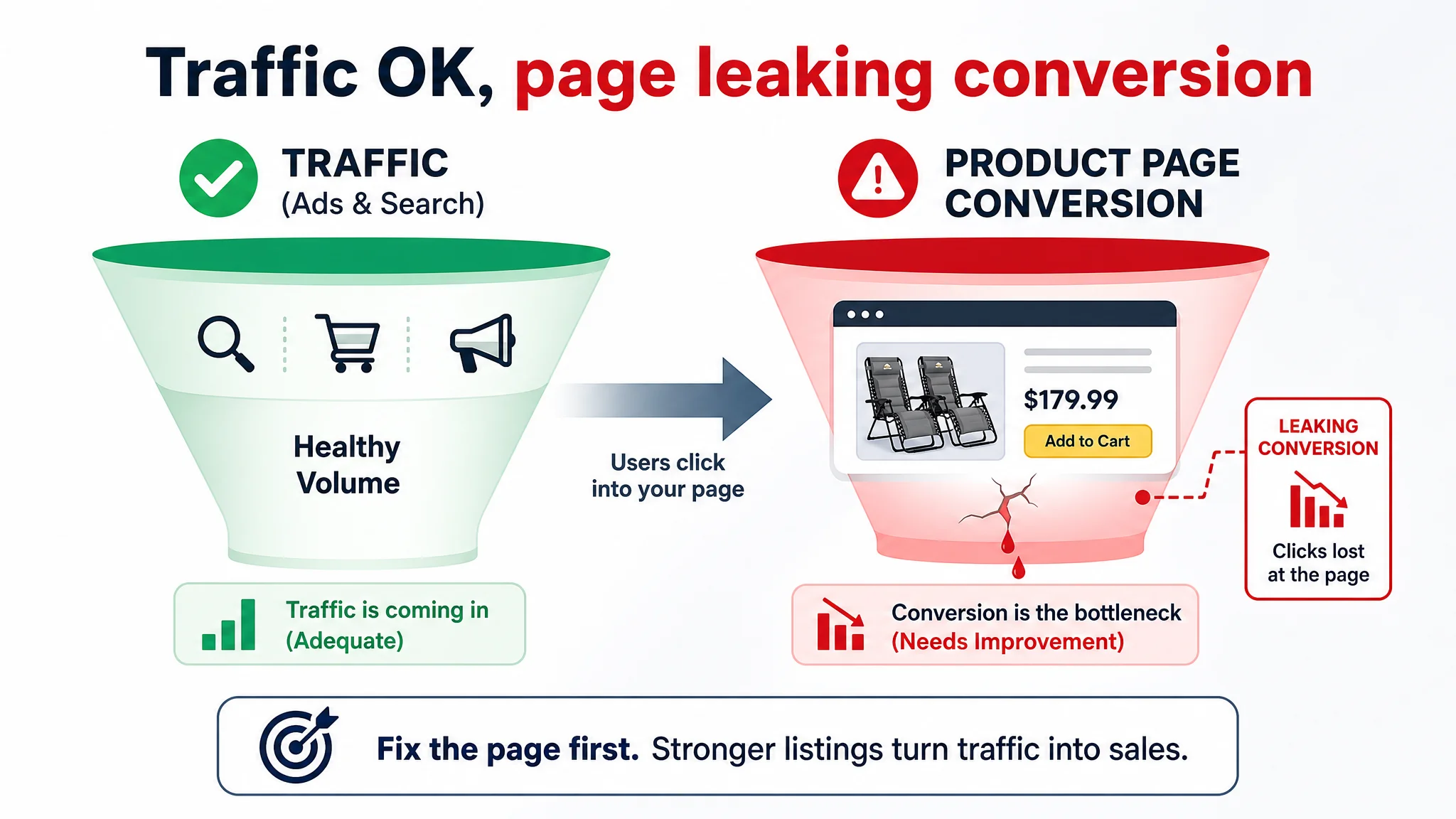
DeepBI’s Listing scoring showed that this chair set was only 6 points behind a leading competitor overall, yet the gap was concentrated in exactly the modules that decide whether a click turns into a cart: main images, title structure, bullet-point logic, and A+ storytelling. Reviews, which the seller thought they needed to “boost” with more ad spend, were actually slightly stronger than the competitor’s. Ads were being blamed for what was fundamentally a product-page conversion issue.
The optimization path therefore shifted. Instead of forcing more traffic through the same page, we rebuilt how the Amazon Listing explained and visualized the product: tightening the title around “oversized padded zero gravity chair” as the core intent, upgrading the main-image set from technical white-background shots to high-trust outdoor scenes, restructuring bullets around weight capacity, extra-wide comfort, ergonomics, safety and components, and turning a flat A+ section into a coherent visual story of “thick, stable, all-scenario comfort.”
For other Amazon sellers, this case is a reminder: when ACOS feels stuck and ad tweaks stop working, the bottleneck may not be in the campaigns. If your Listing can’t fully justify the click — even when reviews look good — ads will amplify your weaknesses instead of your strengths. The real leverage often comes from repairing the page’s decision logic first, then letting ads carry that stronger story.
What the Seller Saw on Amazon: “We’re Losing to a Slightly Better Chair”
This was a mature Amazon US Listing for an oversized, padded zero-gravity lounge chair set aimed at patios, yards, and camping. The seller’s page wasn’t a disaster: it had real reviews, a full A+ section, and a solid product. But compared with a strong benchmark Listing in the same zero-gravity chair niche, it consistently felt “second choice” on the search results page.
Internally, the team described the problem as:
- “Our competitor’s ads are stronger.”
- “Their brand name is driving conversions.”
- “We need to increase bids and improve ad creatives.”
At the same time:
- Ad costs were rising.
- It was getting harder to keep ACOS under control.
- More traffic wasn’t turning into proportional order growth.
They were caught in the classic loop: if orders don’t grow, increase ad pressure; if ACOS stays high, tweak keywords and bids again. But none of those moves change what a shopper actually sees once they click into the Amazon product page.
The Misdiagnosis: Treating a Listing Problem as an Ad Problem
From the seller’s perspective, the benchmark Listing looked “similar”:
- Same category (zero-gravity lounge chair).
- Similar price band.
- Similar review level (both around 4.3–4.4 stars).
- Both had A+ content and multiple images.
So the natural conclusion was: “We’re not losing on the page; we’re losing on traffic and brand recognition.”
DeepBI’s Listing scoring told a different story:
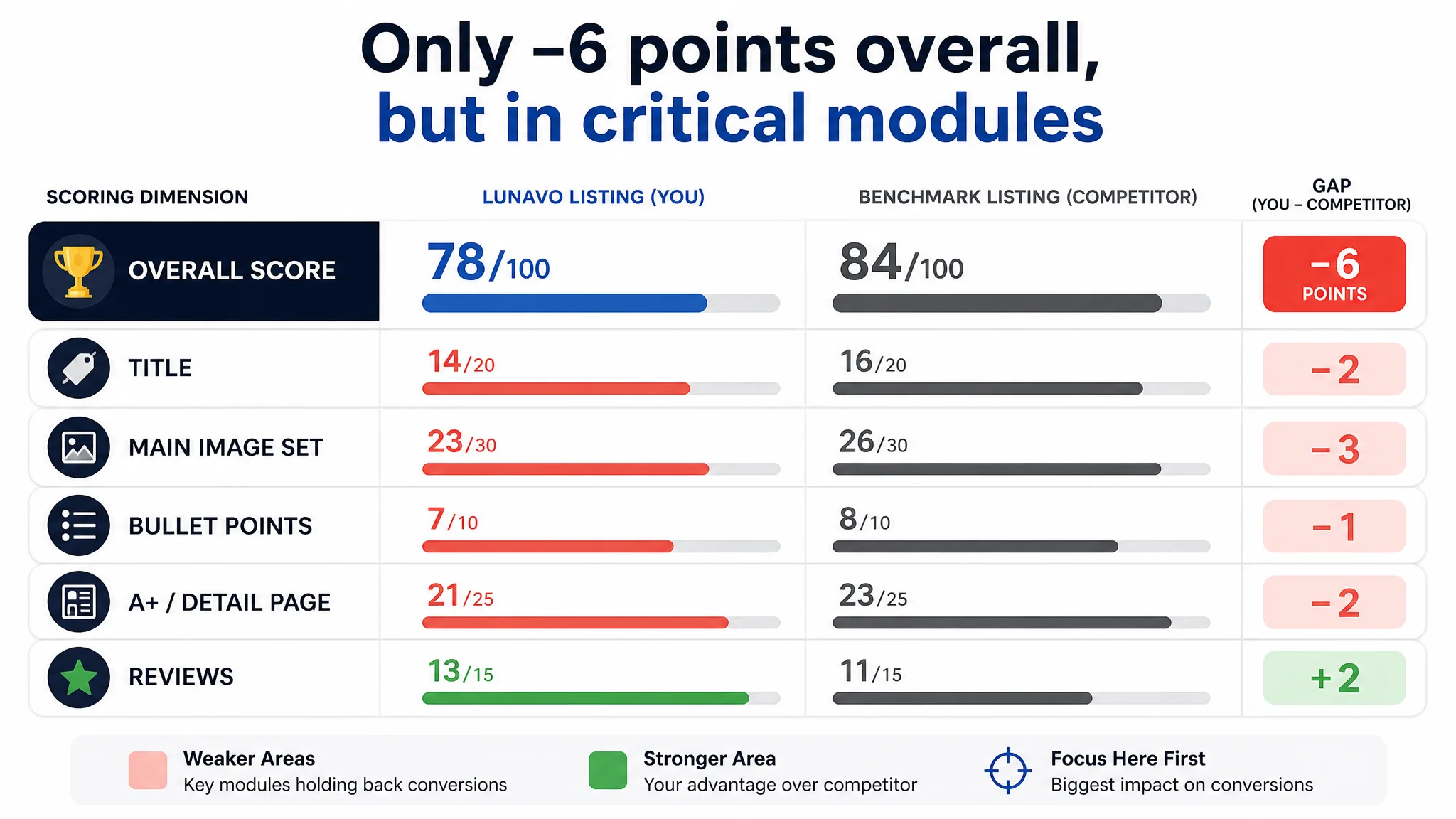
- Overall score
- Target Listing: 78/100
- Benchmark Listing: 84/100
- Gap: -6 points
- By dimension
- Title: 14 vs 16 (–2)
- Main image set: 23 vs 26 (–3)
- Bullet points: 7 vs 8 (–1)
- A+ / detail page: 21 vs 23 (–2)
- Reviews: 13 vs 11 (+2 in the seller’s favor)
The only dimension where the seller clearly “won” was reviews: more total reviews (527 vs 234), slightly higher rating (4.4 vs 4.3), and cleaner first-page review mix (0% 1-star on top page vs the competitor’s 11%).
If ads were truly the core issue, you would expect:
- Weak reviews dampening conversion, or
- A thin content structure, or
- Clear inferiority in product spec.
None of that was true. The data said:
“You have better social proof but a weaker explanation and weaker first impression.”
Advertising was being used to compensate for a Listing that wasn’t fully converting the trust it already had.
Where Traditional Amazon Ad Optimization Failed
The seller’s optimization pattern was typical:
1. See ACOS creep up.
React by tightening bids and pruning keywords.
1. See volume stall.
Add broader match terms and raise budgets to keep sales volume.
1. Notice CTR isn’t great.
Blame ad creatives, experiment with minor headline tweaks or new Sponsored Brands layouts.
What they did not systematically question was:
- Does the main image set actually deserve more clicks?
- Once shoppers land on the page, does the Listing build enough “reason to pay more” vs other chairs?
- Are we visually and textually proving the two things people buy this category for: comfort and stability?
In other words, ads were being tuned in isolation, without a clear picture of the Listing’s conversion capacity. That’s why each new round of ad tweaks had diminishing returns.
DeepBI’s First Judgment: The Real Constraint Was Listing Conversion Capacity
DeepBI’s Listing scoring framework made the core conflict clear:
- Reviews are not the problem.
- Product spec is competitive.
- The gap is in how the Listing tells the story.
The specific weaknesses:
1. Title: Information Without a Clear Decision Hook
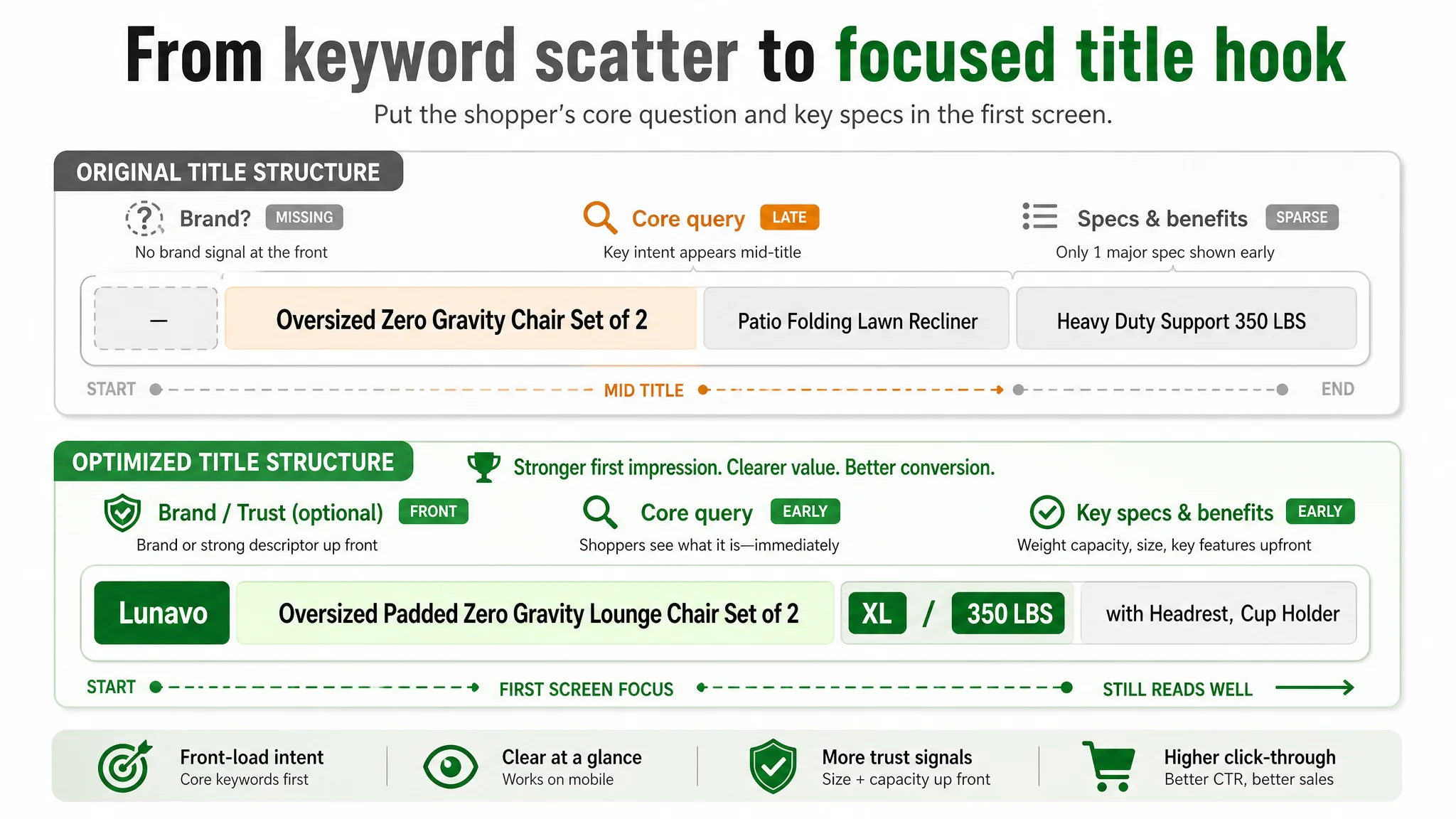
The seller’s original title followed a generic “product name + long list of descriptors” pattern.
Key issues:
- No brand anchor at the front, while the competitor led with its brand plus “Zero Gravity Chairs XL,” instantly signaling a defined product and size.
- Only one major numeric detail (weight capacity), while the benchmark stacked concrete reassurance signals early: “29IN,” “Aluminum Alloy Lock,” XL, etc.
- Core keyword placement was suboptimal:
- The seller buried “Patio” and spread keywords across “Folding Lawn Recliner” and other fringe terms.
- The benchmark hit “Zero Gravity Chairs XL / Lounge Chair” early and repeatedly, aligning with how buyers actually search.
Result: the title was not doing the job of instantly framing the product as “oversized, padded XL zero-gravity chair set” for both Amazon’s algorithm and the human eye on mobile search.
2. Main Image Set: Technical but Not Aspirational
From a distance, the seller had “enough” images. Up close, the problems were structural:
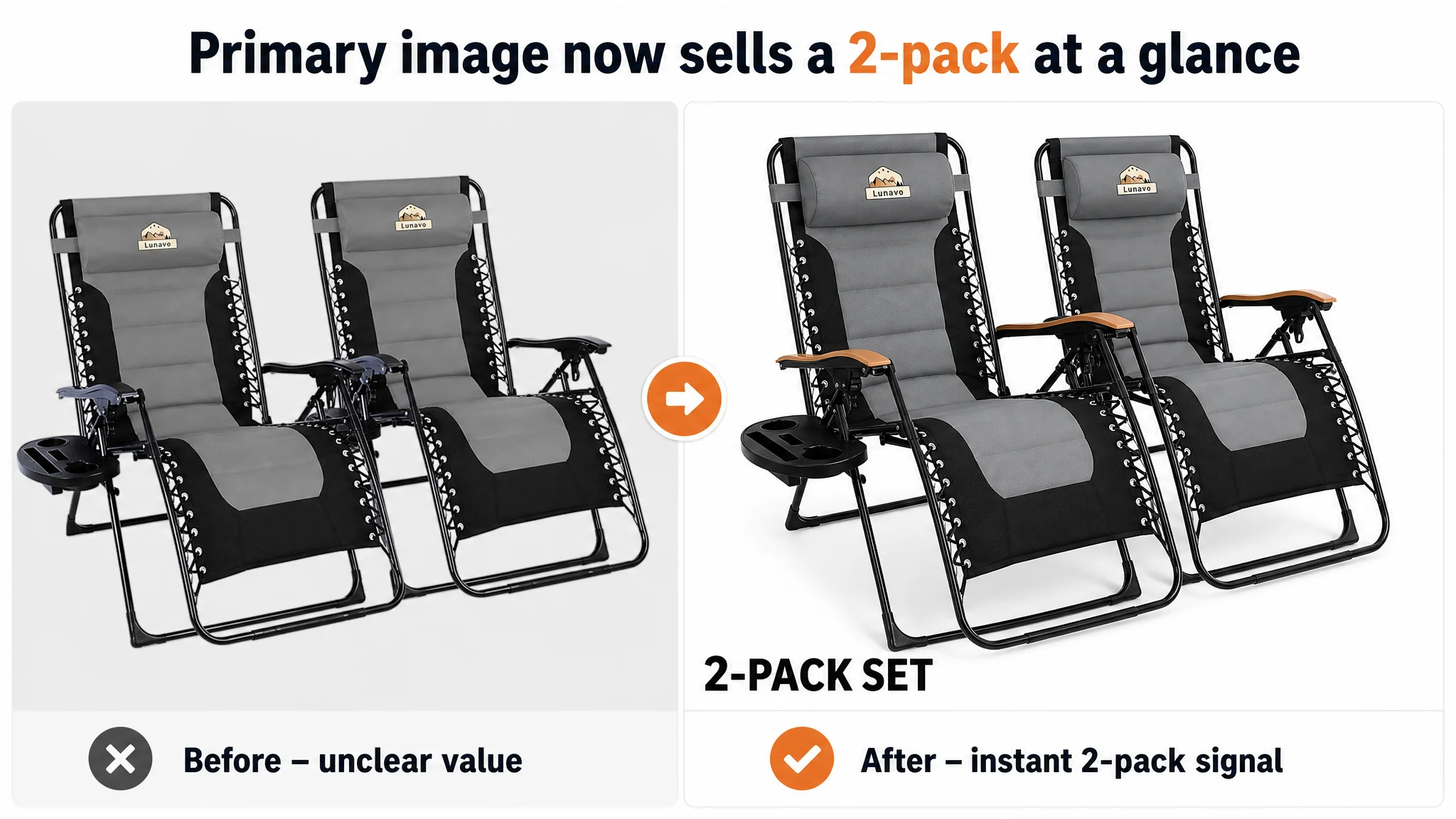
- Primary image
- White background, but visually flat and slightly grey.
- No clear emphasis on “set of 2”; the eye doesn’t immediately register the value of buying a pair.
- Overloaded with technical elements, lacking a single dominant visual focus.
- Angle and detail images
- Multiple technical graphics and text overlays.
- Heavy reliance on text to explain features instead of letting the images themselves communicate “thick padding,” “wide seating,” and “solid structure.”
Meanwhile, the benchmark used:
- Bright, clean studio shots with strong contrast.
- Real people in outdoor scenes enjoying the product.
- Simple, high-impact overlays: wide seating, weight capacity, upgraded locking mechanism.
The seller’s images signaled:
- “This is a functional, basic chair.”
The competitor’s images signaled:
- “This is a higher-tier, comfortable, stable chair for real outdoor relaxation.”
That visual framing difference alone can account for a 5–8% CTR gap, which in high-competition categories quickly compounds into ACOS pressure.
3. Bullet Points: Data Without a Buying Logic
The seller’s bullet points weren’t wrong; they were incomplete as a decision path.
- They highlighted:
- 1.5mm steel tube thickness (50% thicker than standard).
- 29" width.
- Adjustable reclining.
- Safety lock.
- Portability and usage scenes.
But they lacked:
- A strong first bullet that summarizes the “upgrade” story (comfort + durability + included accessories) the way the benchmark did.
- “Pain point → solution” language (e.g., hot/cold weather usage, ventilation, real-world comfort problems).
- A clear value-anchoring closing bullet that lists all components included.
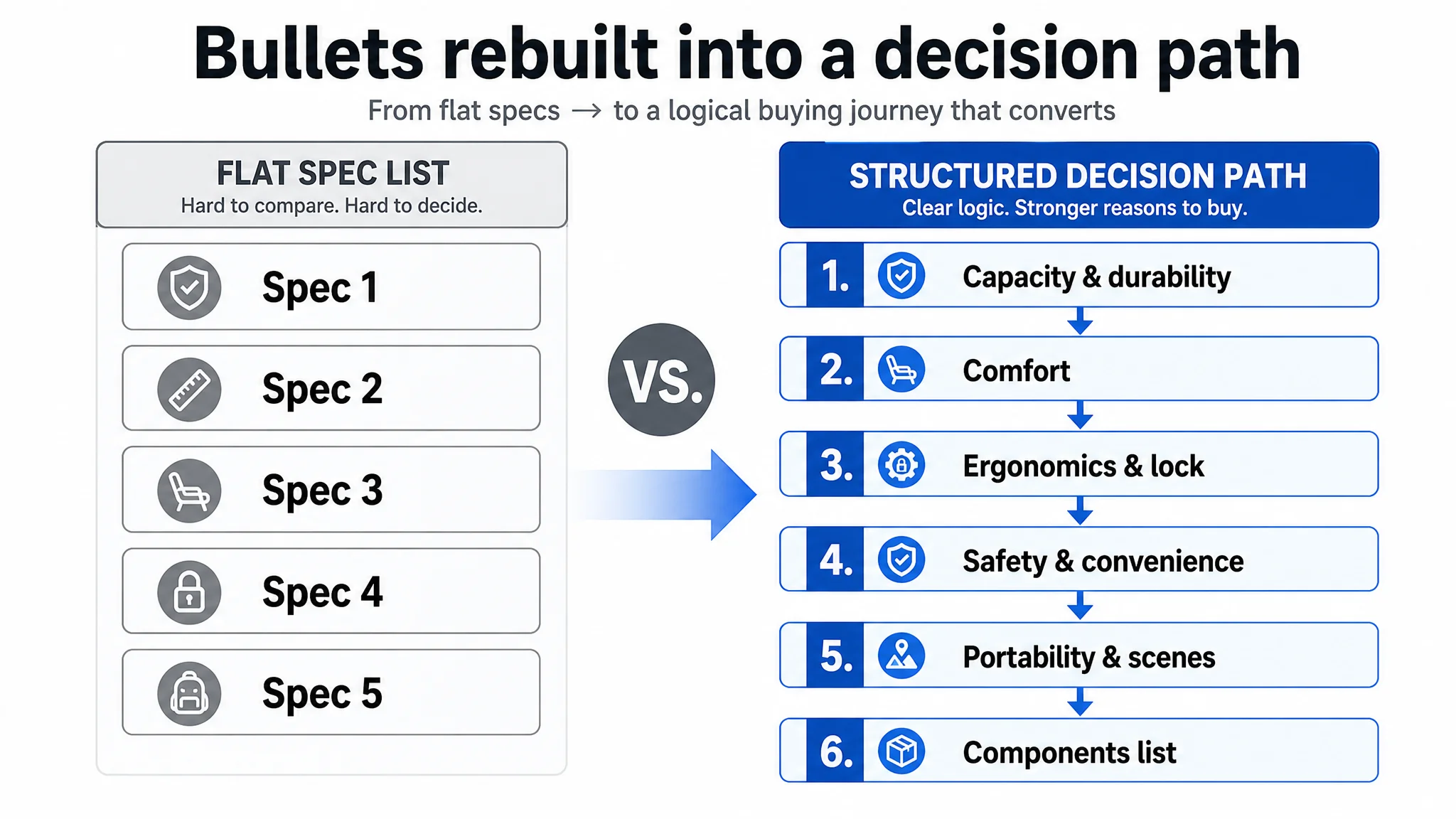
Result: their bullets read like a story of an upgraded product; the seller’s read like a spec sheet.
4. A+ / Detail Page: Features Without a Trust-Driving Narrative
On A+, both Listings had multiple modules. The difference was how those modules worked together.
The seller used:
- Scene-like renderings.
- Functional diagrams: full-support backrest, sliding headrest rail, 0–170° adjustment, side tray, S-curve ergonomics, structure breakdown, fabric detail, folding steps, multi-scene collage.
On paper, that looks thorough. But:
- The scenes were static composites without people, creating a mild sense of “catalog rendering” instead of “real life.”
- Copy was functional, not anticipatory: it stated what the chair does, but rarely framed it as answers to buyer doubts (“Is this stable?”, “Is it comfortable for bigger bodies?”, “Is it easy to adjust?”).
- High-value add-ons like side table and headrest were visually embedded as subordinate elements, not promoted as clear upgrades.
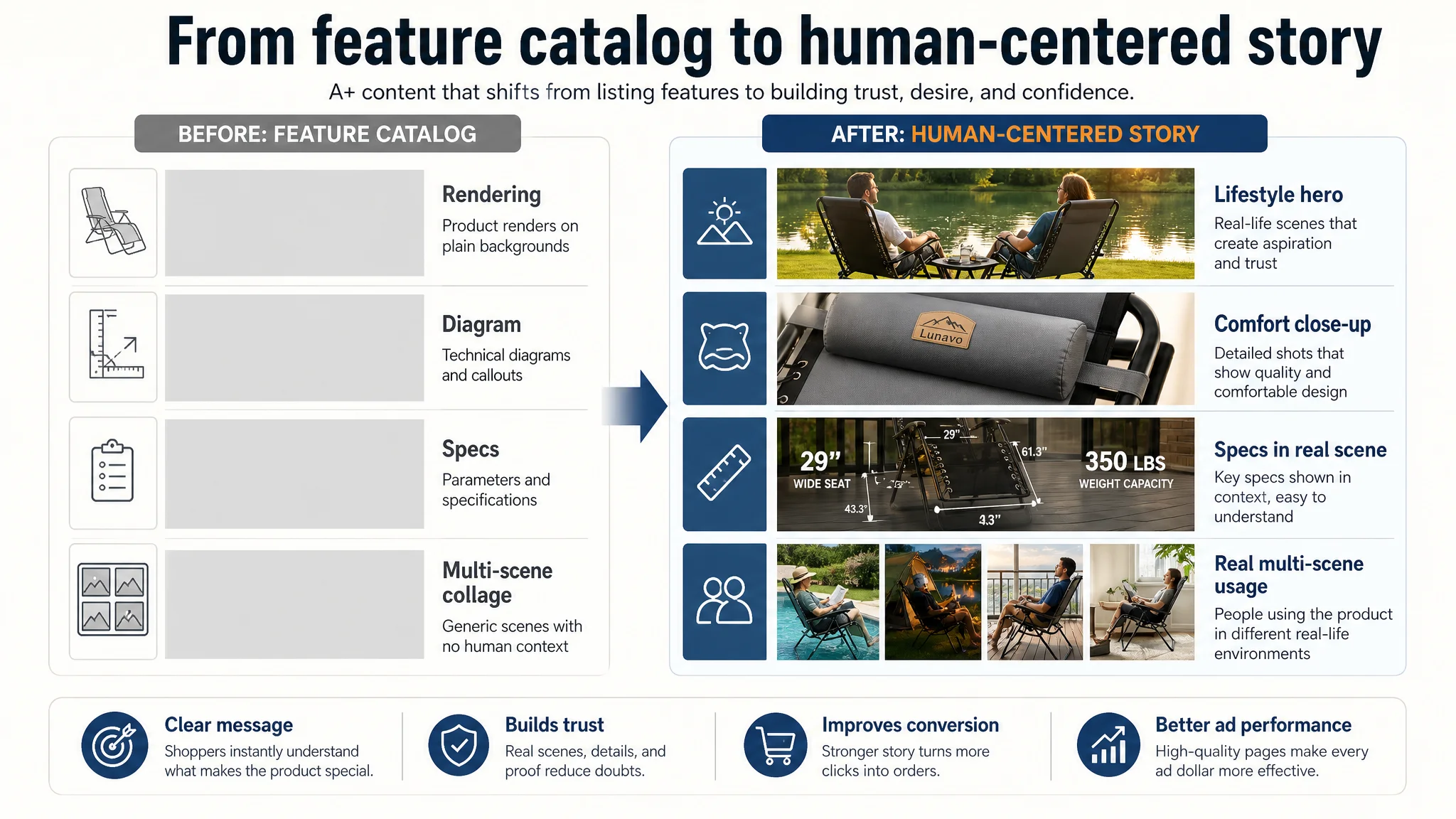
Net effect:
The seller’s A+ said “here are the features”; the benchmark’s A+ said “here is how this chair solves your day-to-day comfort problems.”
Why Listing Conversion Had to Be Fixed Before Ads
From a pure ad-ops standpoint, the seller had three options:
1. Increase spend and chase volume.
Risk: ads push more traffic into a Listing that is slightly weaker at conversion, making ACOS worse.
1. Keep tightening bids and pruning.
Risk: volume drops while the page’s fundamental conversion issues remain unchanged.
1. Rebuild the Listing’s sales logic, then scale ads selectively.
Benefit: same traffic produces more orders; ACOS and TACoS become more controllable.
DeepBI’s judgment was blunt:
“Advertising does not only amplify advantages. It can also amplify a page’s existing defects.”
With stronger reviews than the benchmark but a weaker page narrative, the highest-ROI move was to:
- Lift page conversion capacity first (title, images, bullets, A+).
- Only then consider ramping bidding and budget.
If the Listing already loses some share of shoppers to a better-framed competitor, sending more traffic simply increases the number of people who decide not to buy.
How the Optimization Was Reframed: From “Fix Ads” to “Fix the Page Story”
1. Tightening the Amazon Title Around the Real Buying Intent
Recommended direction:
Oversized Padded Zero Gravity Lounge Chair Set of 2, XL Anti Gravity Reclining Patio Chair with Headrest, Cup Holder, Support 350 LBS, Folding Recliner for Yard, Camping, Outdoor, Black
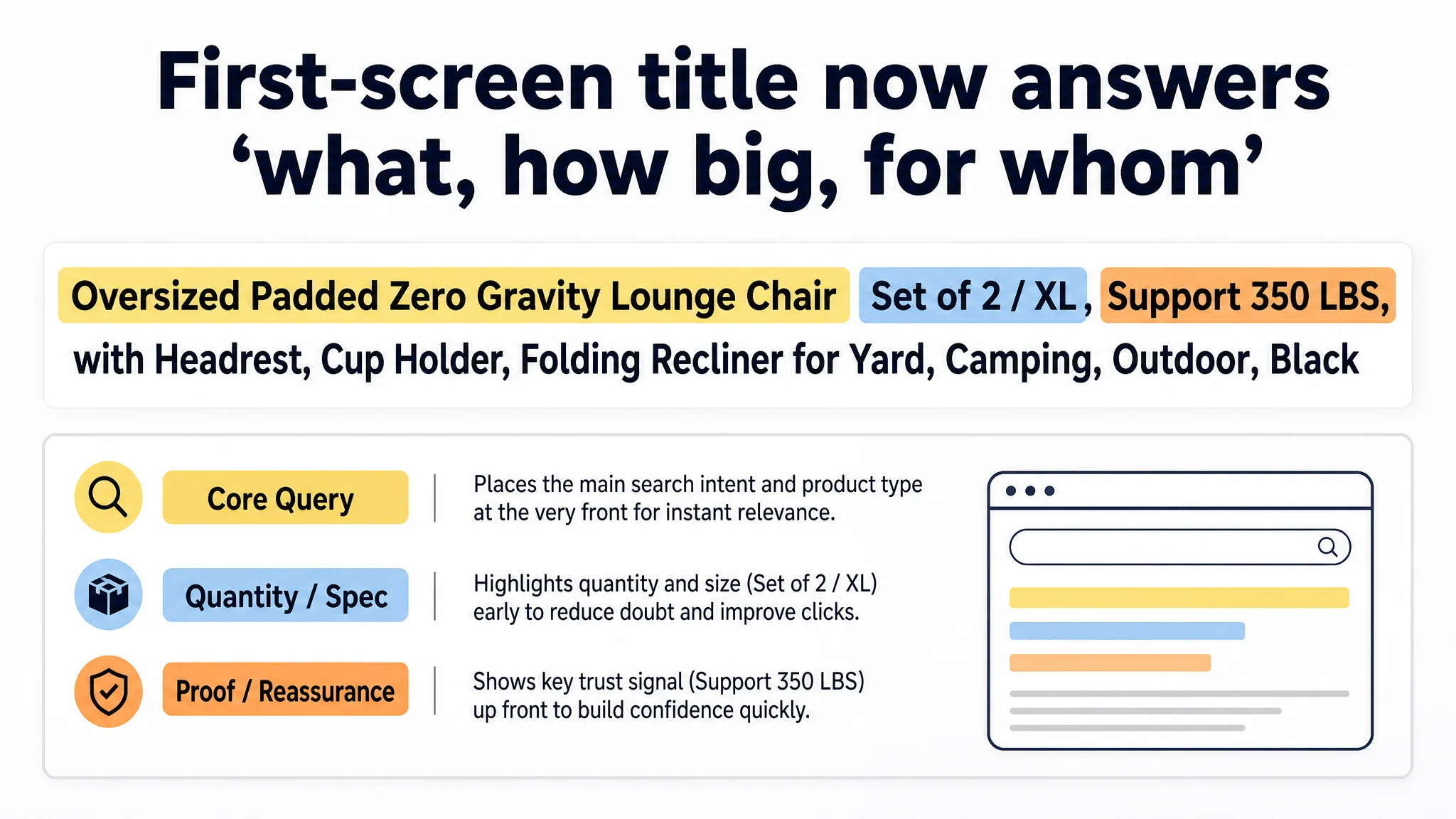
This did three things:
- Front-loaded the core query:
- “Oversized Padded Zero Gravity Lounge Chair” appears immediately, matching what high-intent buyers actually type.
- Clarified quantity and spec:
- “Set of 2,” “XL,” and “Support 350 LBS” all appear early, minimizing confusion and reinforcing value.
- Cleaned redundancy:
- Removed repeated “Foldable/Folding” wording and consolidated scene descriptors to free characters for higher-impact attributes.
Outcome in logic terms:
- Better alignment with Amazon search behavior.
- Faster comprehension on mobile search pages.
- A clearer promise of what the product is and for whom (oversized, padded, XL, 350 lbs).
2. Rebuilding the Bullet Points as a Buying Path
Each bullet was reoriented from “feature mention” to “decision support.”
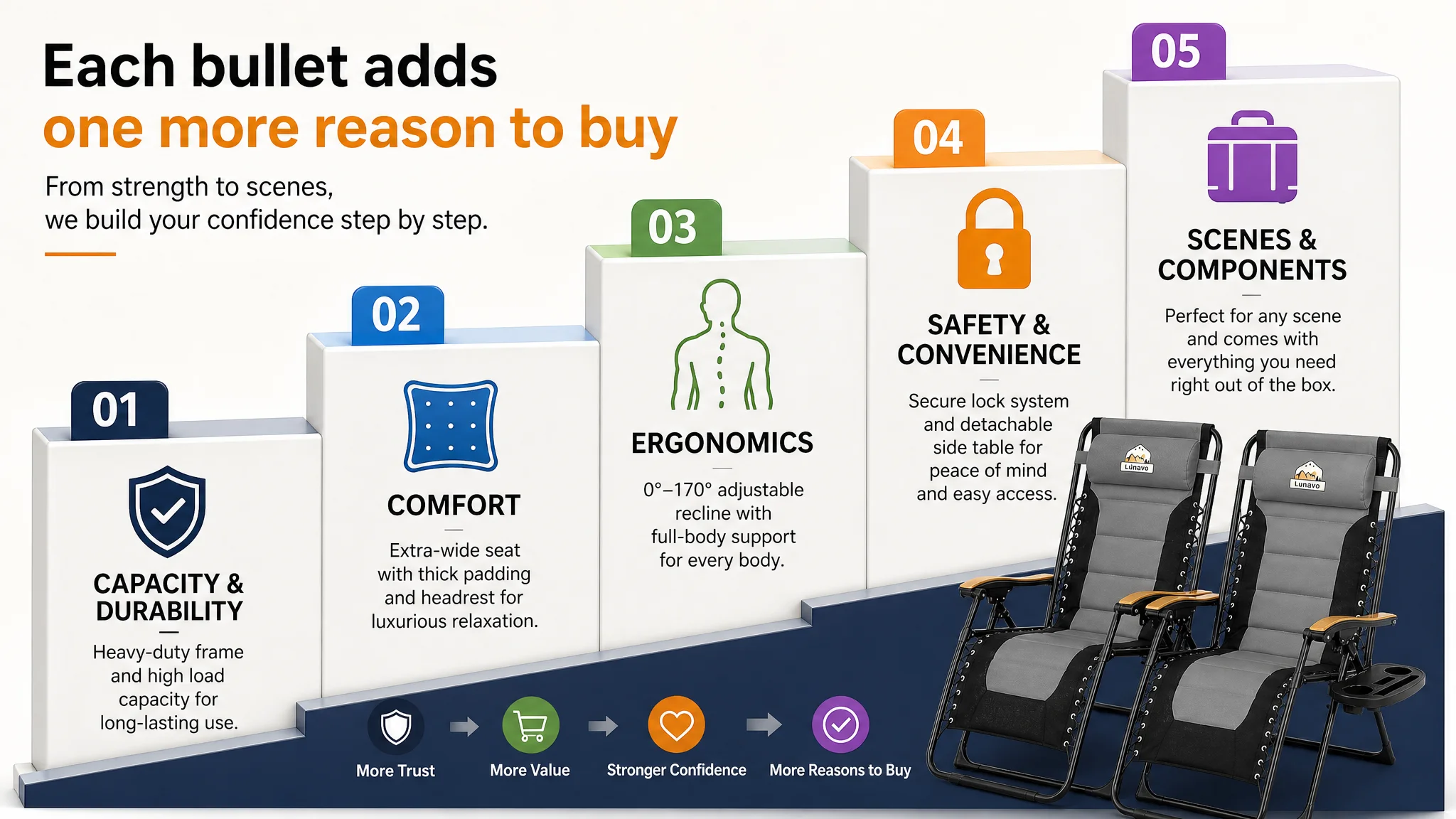
Bullet optimization text as in original article remains unchanged here.
The Main Images: From Overloaded White Backgrounds to Click-Worthy Visual Logic
DeepBI’s visual diagnosis highlighted that the current main images:
- Lacked a strong click trigger on SRP (search results page).
- Over-relied on text overlays to do the work of design.
- Underused real-life scenes and human presence.
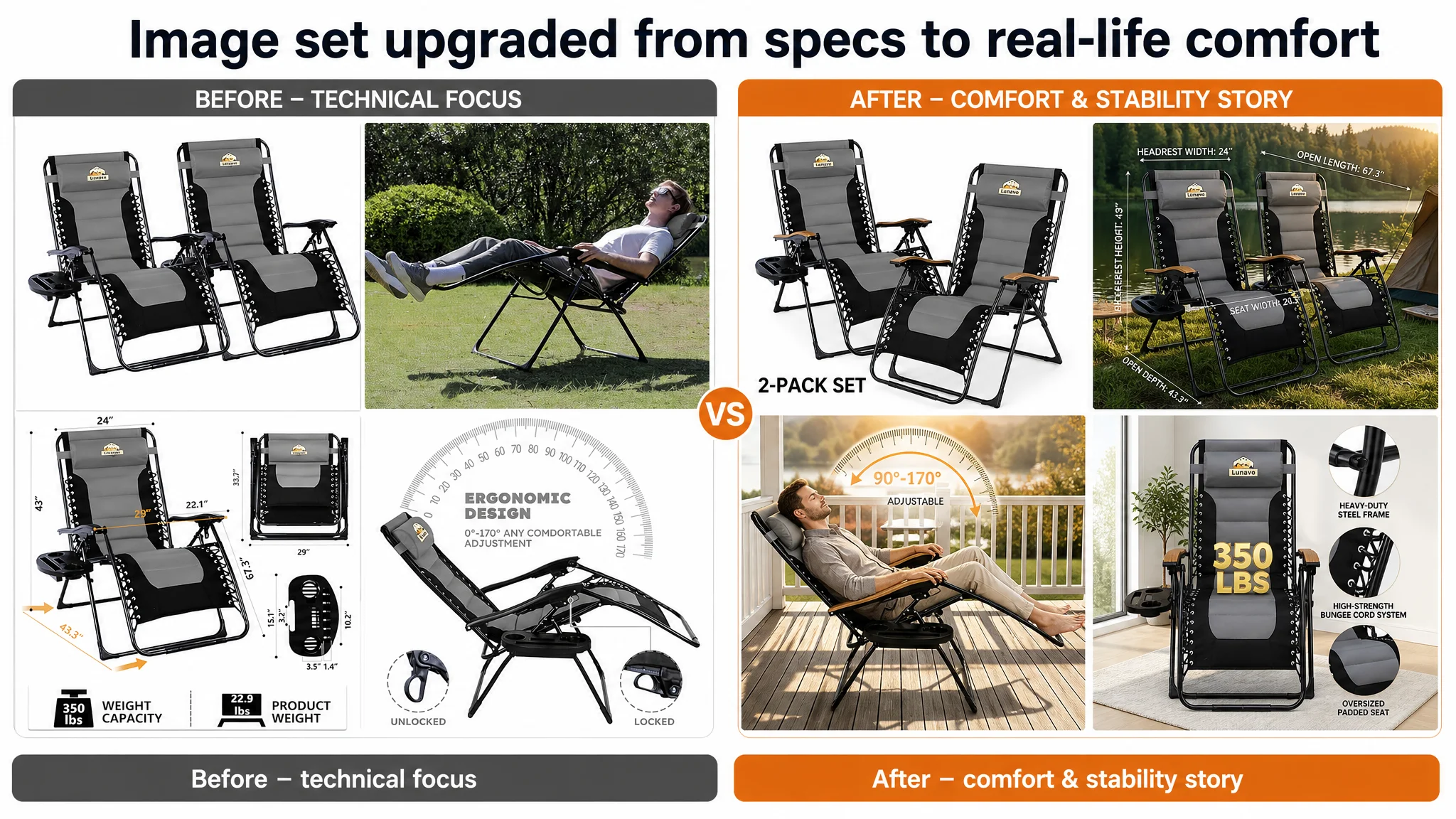
The redesigned image logic:
Primary Image: Make the “Set of 2” and Quality Instantly Obvious
Primary image description as in original article.
Supporting Images: Each One Solves a Key Doubt
Supporting images descriptions as in original article.
A+ / Detail Page: Turning Static Renderings into a Trust Story
The original A+ sections had enough modules, but they didn’t fully leverage:
- Realistic, human-centered scenes.
- Parameter clarity in a high-end context.
- Clear visual evidence of structural strength and comfort.
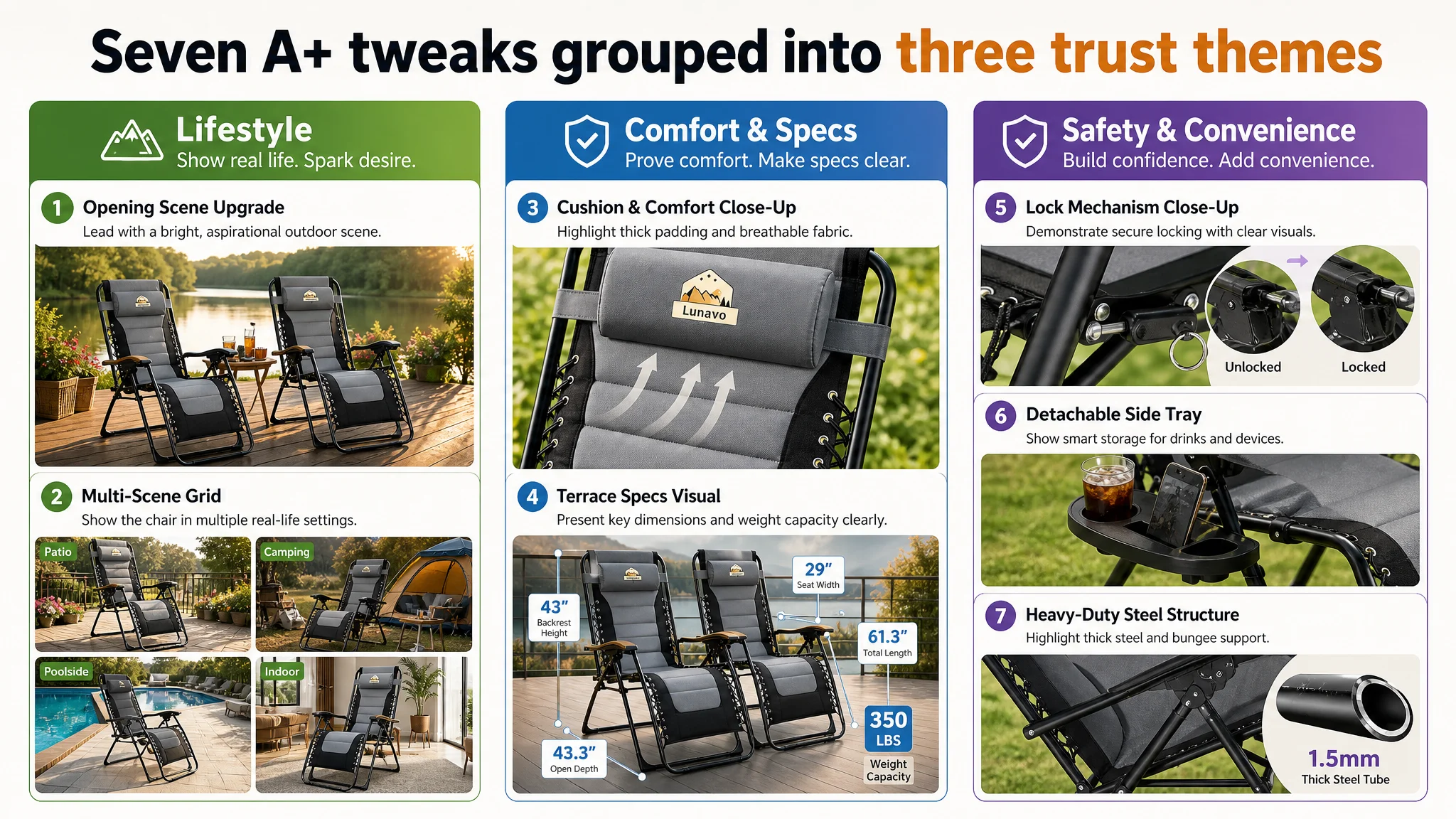
DeepBI’s page-level logic focused on seven shifts.
Seven shifts text as in original article.
How the Page’s Sales Logic Started to Recover
Once these changes are implemented, several things tend to happen—even before precise numeric lifts are measured:
- CTR begins to stabilize or climb
- The refreshed main image set makes the product stand out more in search and Sponsored Ads placements.
- Conversion rate (CVR) gains headroom
- Shoppers who click now:
- Understand the value of a 2-pack.
- See extra width and weight capacity clearly.
- Feel reassured about comfort and safety.
- Organic ranking becomes easier to defend
- Better conversion per session gives the Listing more “weight” in Amazon’s internal ranking signals.
- Advertising becomes useful again
- Each paid click now encounters:
- Clear promise in the title.
- Compelling proof in images.
- Complete logic in bullets and A+.
Instead of chasing cheaper traffic or “better ad creatives” in a vacuum, the seller has a Listing that is structurally more capable of converting both organic and paid visits.
What Changed in the Seller’s Understanding
Before:
- “Our competitor is winning because of brand and ads.”
- “We need more reviews and better ad creatives.”
- “Listing is fine; let’s tune the campaigns.”
After working through the data and page logic:
- They saw that reviews were already stronger than the competitor’s.
- The real gap was not traffic, but what the page did with that traffic.
- Weaknesses were concentrated in:
- Title focus and keyword priority.
- Main image click triggers.
- Bullet-point decision logic.
- A+ trust-building and real-life scenes.
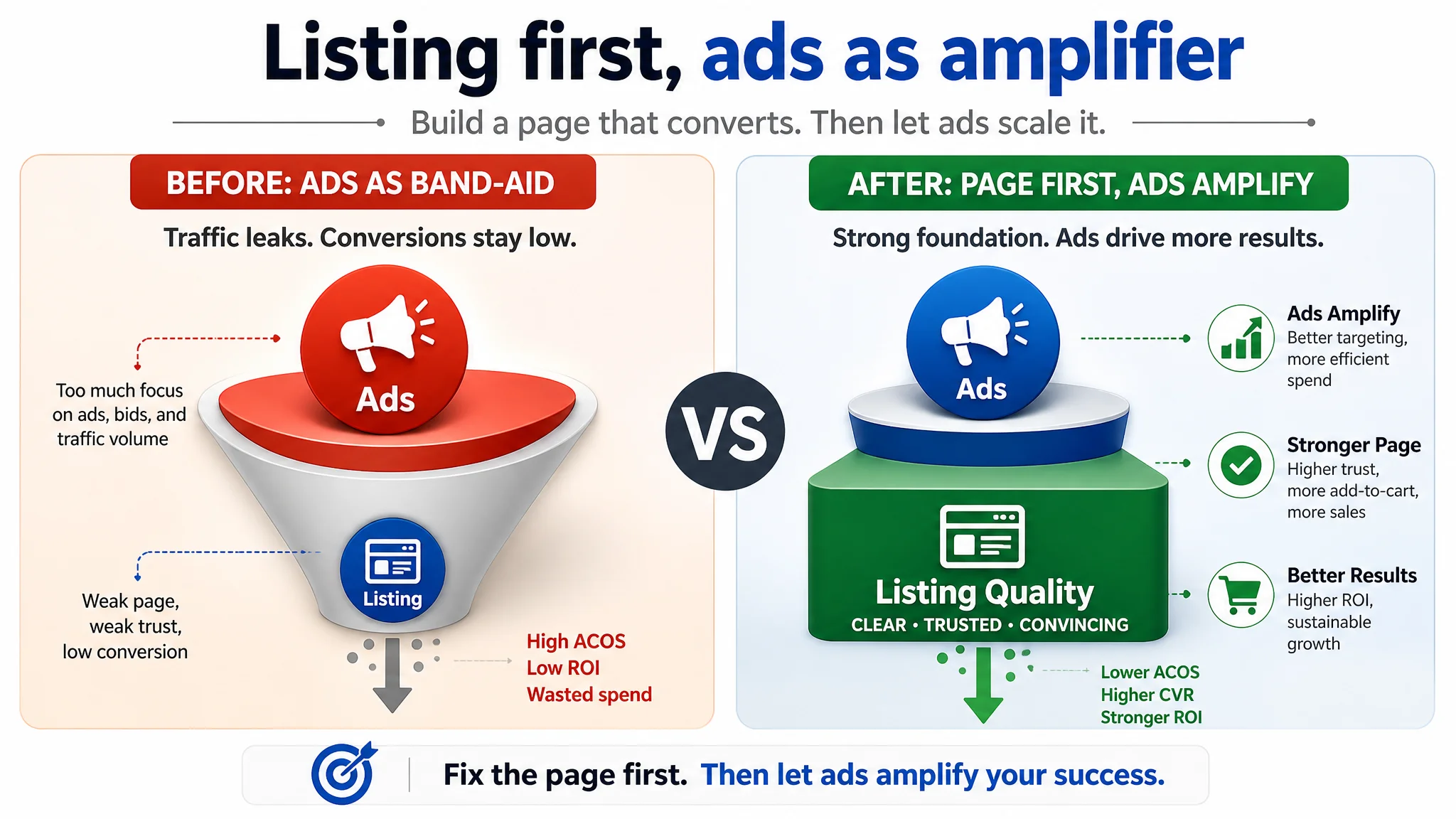
The key mindset shift:
“Ads are not a band-aid for a page that can’t fully sell. Listing quality is the foundation; ads are the amplifier.”
For Amazon sellers facing similar pressures—rising ad costs, flat orders, and the feeling that “we just need to push harder on ads”—this case suggests a different question to ask first:
- If I froze my ad setup for two weeks and only changed my Listing, would my page convert more of the existing traffic?
If the honest answer is “yes,” ad optimization is not your current bottleneck. Fix the Amazon product-page conversion logic first. Then let your ads bring people to a page that truly deserves the click.