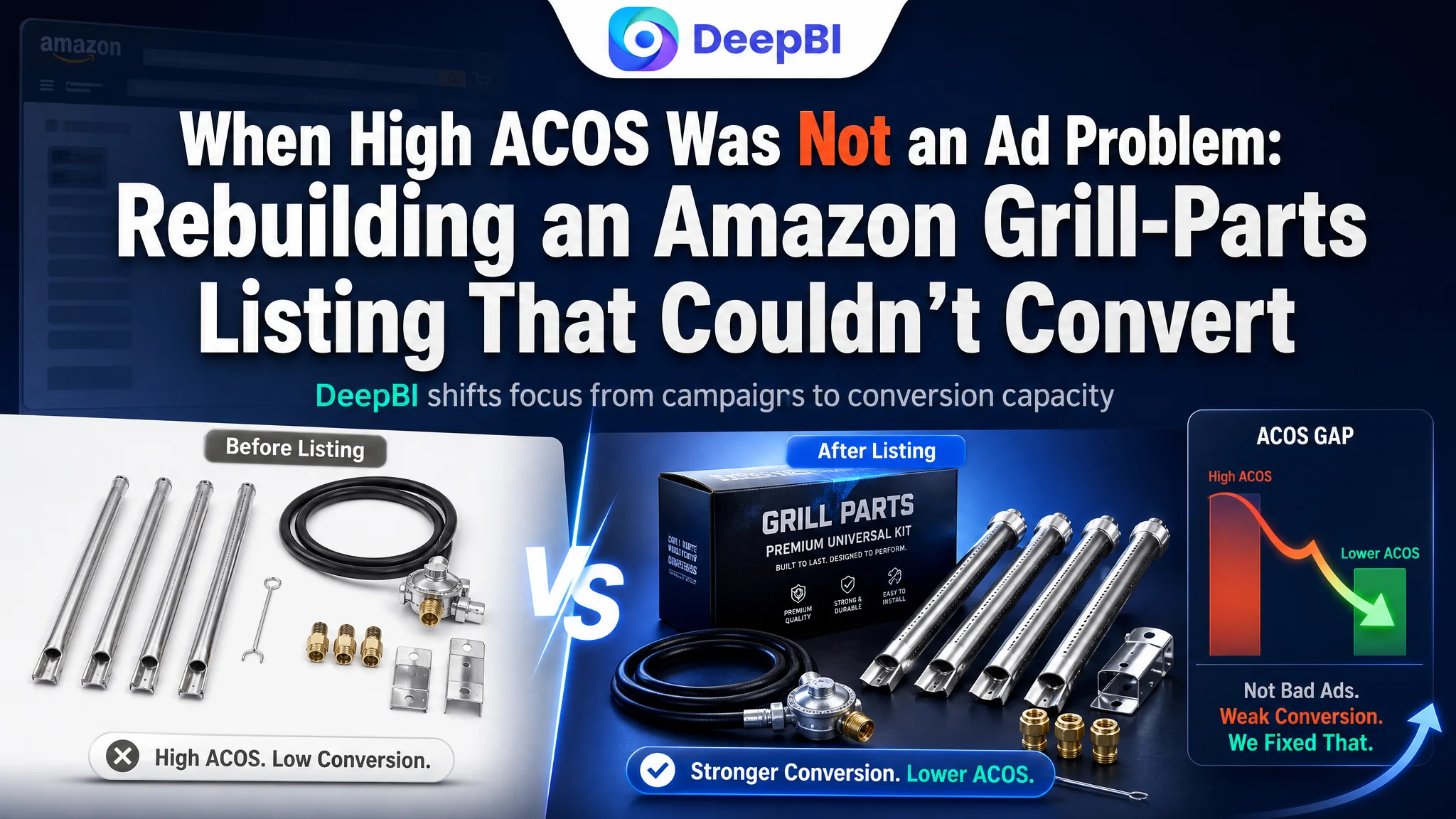
This Amazon seller in the grill-accessories category came to DeepBI with a familiar pressure: Amazon ads were getting more expensive, ACOS was hard to control, but every time they tried to “fix” the ads, nothing fundamentally changed. Their Flavorizer bars and heat-deflector replacement parts for Weber Genesis II grills were getting traffic, yet orders lagged far behind a leading competitor.
The team’s initial judgment was straightforward: “Our bids and keywords aren’t strong enough. We need better ad tuning and more reviews.” What they hadn’t fully recognized was that their Amazon Listing itself—title, main images, A+ detail page, and review base—was structurally weaker than the benchmark. Ads were driving visits into a page that could not convincingly answer, “Is this the right, durable, trustworthy replacement for my grill?”
DeepBI’s analysis reframed the issue: this was not an advertising optimization problem, but a Listing conversion-capacity problem. The diagnosis showed a 22-point score gap versus a benchmark listing, with especially large deficits in detail-page persuasion and review trust. The optimization therefore shifted away from “more bids” and into a full rebuild of the page’s sales logic: refocusing the title on search behavior, restructuring bullet points around compatibility and durability, and upgrading main images and A+ modules to build a high-trust “repair and restore” story.
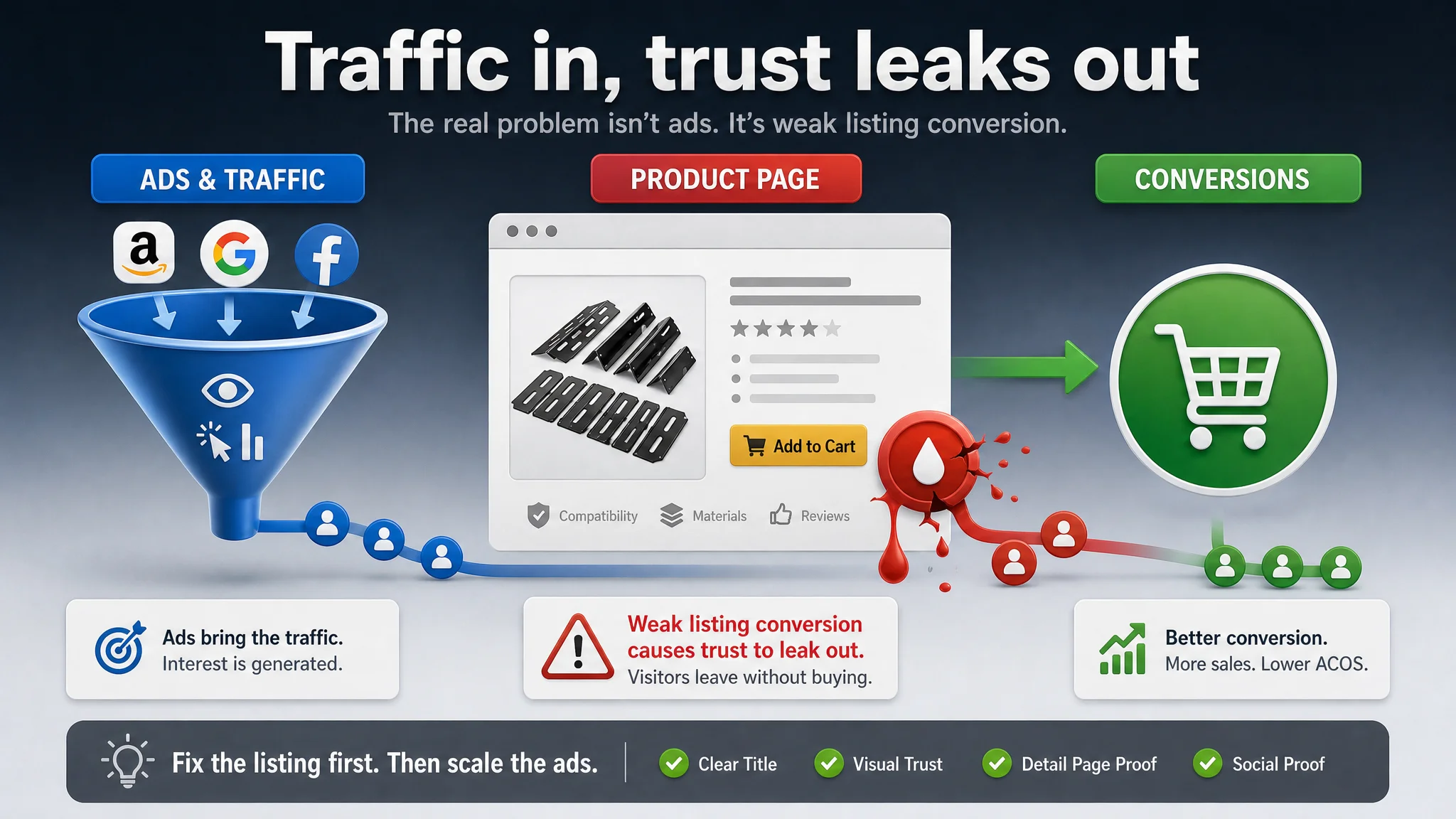
For other Amazon sellers, this case is a reminder that when ACOS refuses to fall and ads keep “underperforming”, the blockage may sit on the product page itself. Advertising can only amplify what your Listing already is—if the page cannot convert, more traffic just magnifies the leak.
Amazon Ads Were Not Failing. The Page Was Consuming the Traffic.
By the time this Amazon seller looked for help, the business pattern was clear:
- Paid traffic from Amazon ads was coming in.
- A benchmark competitor in the same grill-parts niche was converting strongly with hundreds of reviews.
- Their own Listing remained fragile, with only one review and weak page-level persuasion.
On DeepBI’s Listing scorecard, the target product page scored 65/100, while a comparable high-performing Listing in the same niche scored 87/100—a 22-point gap that could not be explained by bids alone.
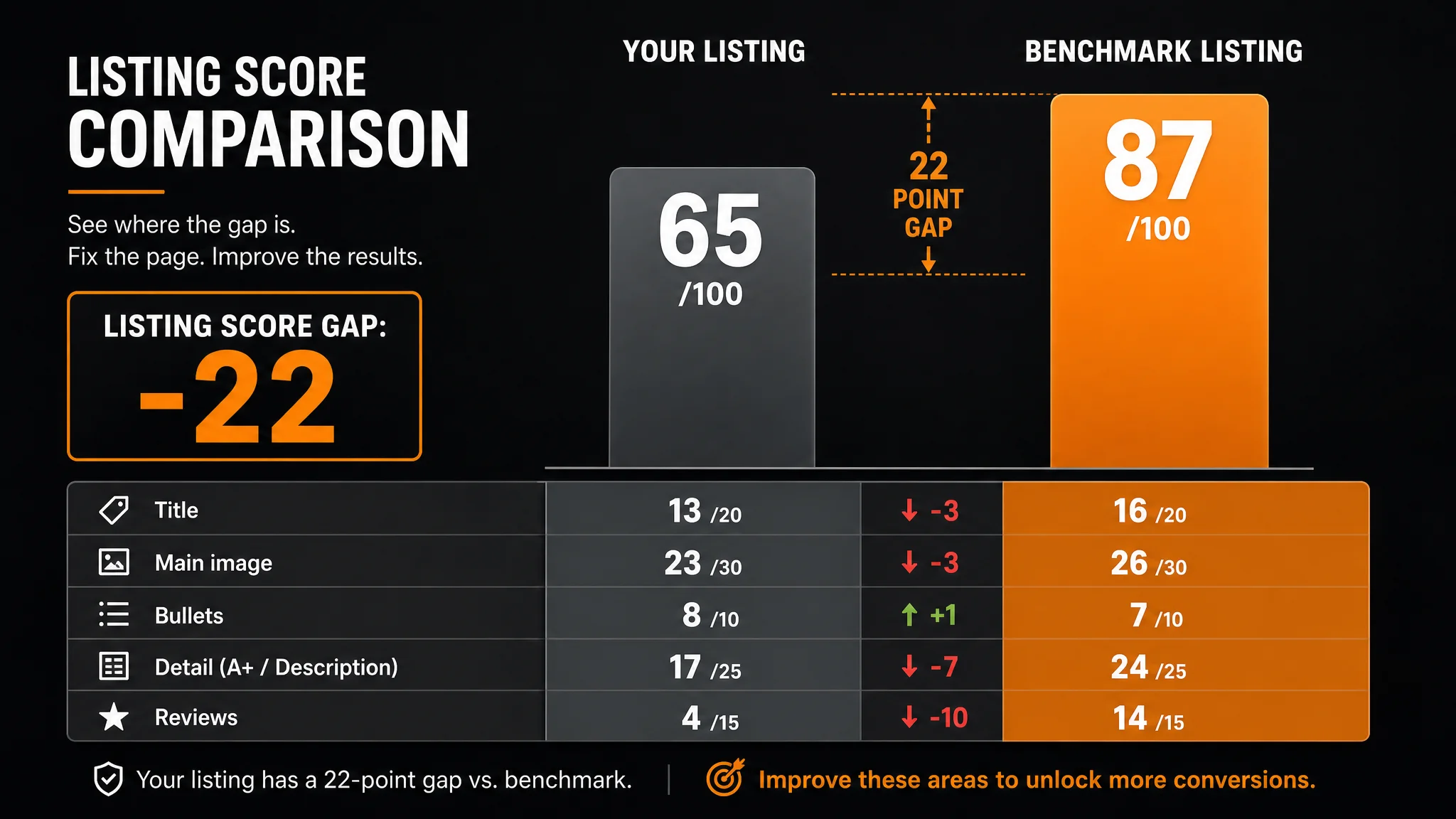
Breaking it down:
- Title: 13 vs 16
- Main image: 23 vs 26
- Bullet points: 8 vs 7 (slightly better structurally)
- Detail (A+ / description): 17 vs 24
- Reviews: 4 vs 14
The biggest weaknesses were not in ad-targetable dimensions. They were in detail-page trust and social proof, exactly where ad-driven visitors decide whether to buy.
“The real problem was not that ads failed to bring traffic. It was that the page could not convert the traffic.”
Yet internally, the seller’s operations team had been treating the symptoms as ad issues:
- “We need more granular campaigns.”
- “We need to expand keywords.”
- “We should turn up bids on high-click terms.”
In other words, they kept adding pressure at the top of the funnel without fixing the bottleneck in the middle.
The Core Constraint: Weak Listing Conversion Capacity
DeepBI’s judgment was that Listing conversion capacity—not ad setup—was the core constraint at this stage.
Several signals made this clear:
1. Title misaligned with Amazon search logic
The seller’s title led with “Porcelain-Enameled”, a material descriptor, instead of leading with the core query pattern that buyers actually type, such as:
- “Genesis II Flavorizer Bars”
- “Heat deflector replacement parts”
- “For Weber Genesis II 300 series”
The benchmark Listing did exactly that: it front-loaded “Genesis ii Flavorizer Bars Heat Deflector Replacement Parts” and stacked “for Weber Genesis II 300 / LX 300, GS4 Genesis II…” to capture the full spread of high-intent queries.
Meanwhile:
- The seller’s title:
- Included Spanish phrases, diluting core English keyword density.
- Covered fewer specific compatible models.
- Mentioned material (“Porcelain-Enameled”) early, but with weaker perceived value than “304 Stainless Steel”.
- The benchmark:
- Repeated key phrases like “Genesis II” and “for Weber”, reinforcing A9 signals.
- Ended with a strong, conversion-relevant material claim: “304 Stainless Steel”.
This meant the Listing did not just underperform in human persuasion; it also underperformed in algorithmic relevance.
1. Main images lacked trust hooks and professional framing
The main-image set relied heavily on:
- Plain white backgrounds.
- Vector-like diagrams.
- Text-heavy overlays to explain technical points.
In contrast, the benchmark used a clear, staged visual sequence:
- Material → structure → function → scene:
- Tactile product angles.
- Hands installing parts.
- Fire and heat in action.
- Stack-ups showing thickness and steel quality.
Industry benchmarks suggest that main images with clear branding, packaging, or realistic scenes can lift CTR by 7%+. Here, DeepBI judged that the seller’s main images were likely 5–8% weaker in CTR than the benchmark, purely on visual trust and clarity.
1. Detail page (A+) lacked a “trust chain”
On the detail page:
- The seller used:
- A main visual.
- A compatibility table.
- Installation diagrams.
- A nine-grid of selling points.
- A “cleaning and value” graphic with casual language.
- The benchmark built a high-trust visual evidence chain:
- Real-life grill scenes.
- “Family barbecue” imagery.
- Saltwater anti-rust tests.
- Caliper measurements of thickness.
- Before/after shots of corroded vs replaced parts.
- Non-magnetic steel demonstrations.
- Packaging shots and maintenance guides.
The benchmark was not just listing features. It was running a full user journey:
- “Open the box” → “Understand why material matters” →
- “See how much thicker this is” → “See how long it lasts” →
- “Imagine the family gathering again.”
The seller’s A+ modules, by comparison, remained functional and text-forward, with little in the way of visual proof. There was no physical test, no before/after narrative, no strong assurance of longevity beyond words like “protect your investment”.
1. Review gap turned into a trust cliff
- Seller: 5.0 stars, 1 review, no review content on the first page.
- Benchmark: 4.8 stars, 385 reviews, multiple rich text + photo/video reviews.
On Amazon, such a gap is not just a number. It is a decision accelerator. Every ad click that lands on this Listing sees:
- A page with minimal social proof.
- A competitor with hundreds of confirmations of “this fits my grill and lasts.”
Under this condition, ads inevitably look inefficient—not because the traffic is wrong, but because the page cannot carry the trust burden.
Why Traditional Ad Optimization Kept Failing
The seller’s prior optimization path focused on advertising mechanics:
- Adjusting bids.
- Expanding keyword lists.
- Testing campaign structures.
- Attempting to “buy” more visibility quickly.
But:
- The title was not fully aligned with search-intent phrasing.
- The main images were under-leveraging visual trust cues.
- The A+ was not delivering proof-based persuasion.
- Reviews were too thin to serve as a strong trust anchor.
Under these conditions:
- Raising bids only sends more traffic into a weak funnel.
- Broadening keywords increases irrelevant clicks and wasted spend.
- Campaign restructuring cannot fix an underlying conversion leak.
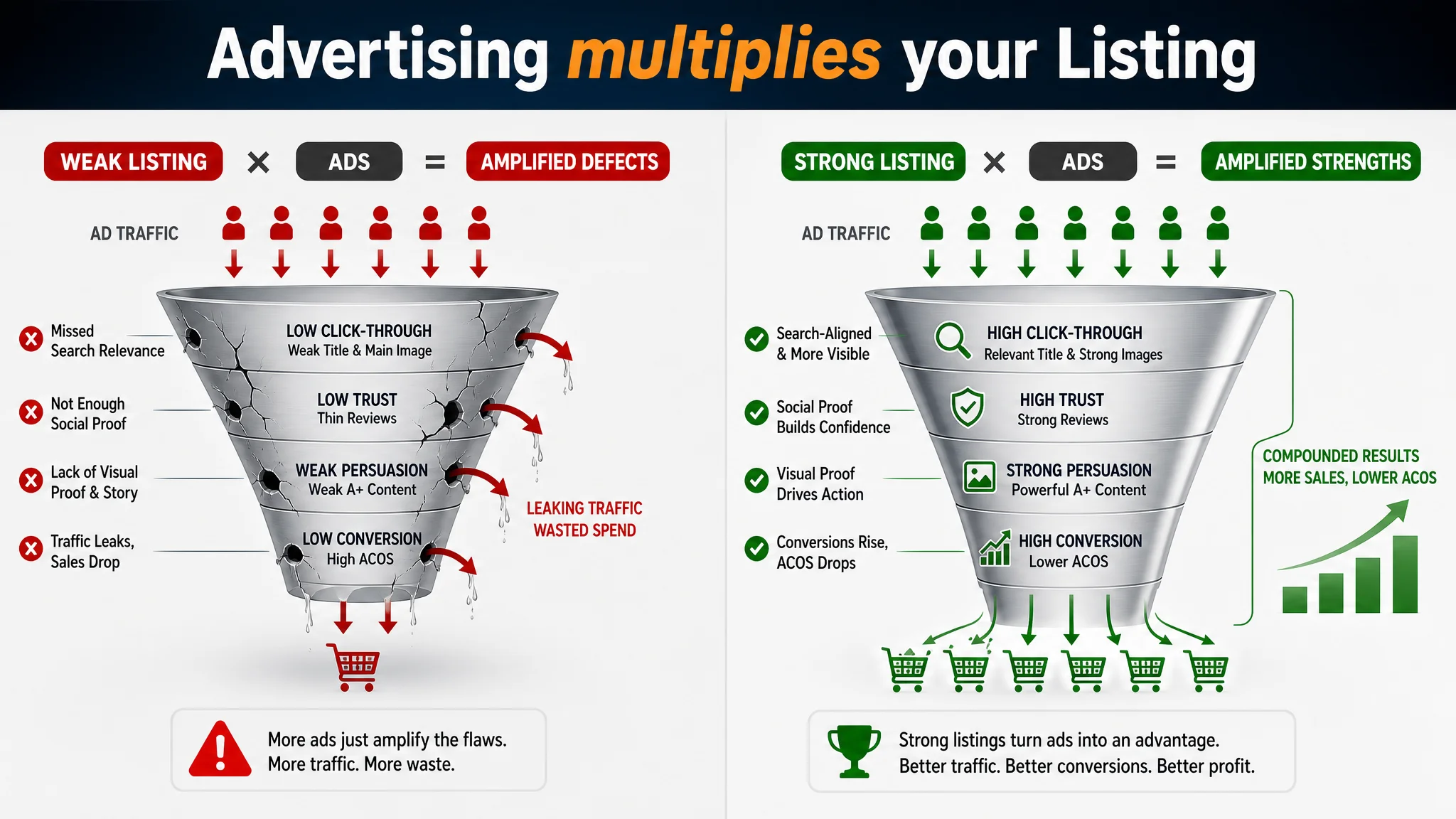
“Advertising does not only amplify advantages. It can also amplify a page’s existing defects.”
DeepBI’s judgment was that unless the Listing’s conversion foundation was reinforced, any further ad scaling would simply increase ACOS without sustainable gains.
What DeepBI Saw in the Listing Scores
The Listing score comparison was not just a diagnostic number; it was a map of where persuasion was breaking.
Title: Misaligned with Buyer Queries
The proposed optimized title from DeepBI re-centered around the actual decision logic:
Genesis 300 Flavorizer Bars and Heat Deflectors for Weber Genesis II / LX 300 Series, E-310 E-315 S-310 S-335, Porcelain-Enameled Grill Replacement Parts, 5+3 Pack, Replaces Weber 66032 66795 7623
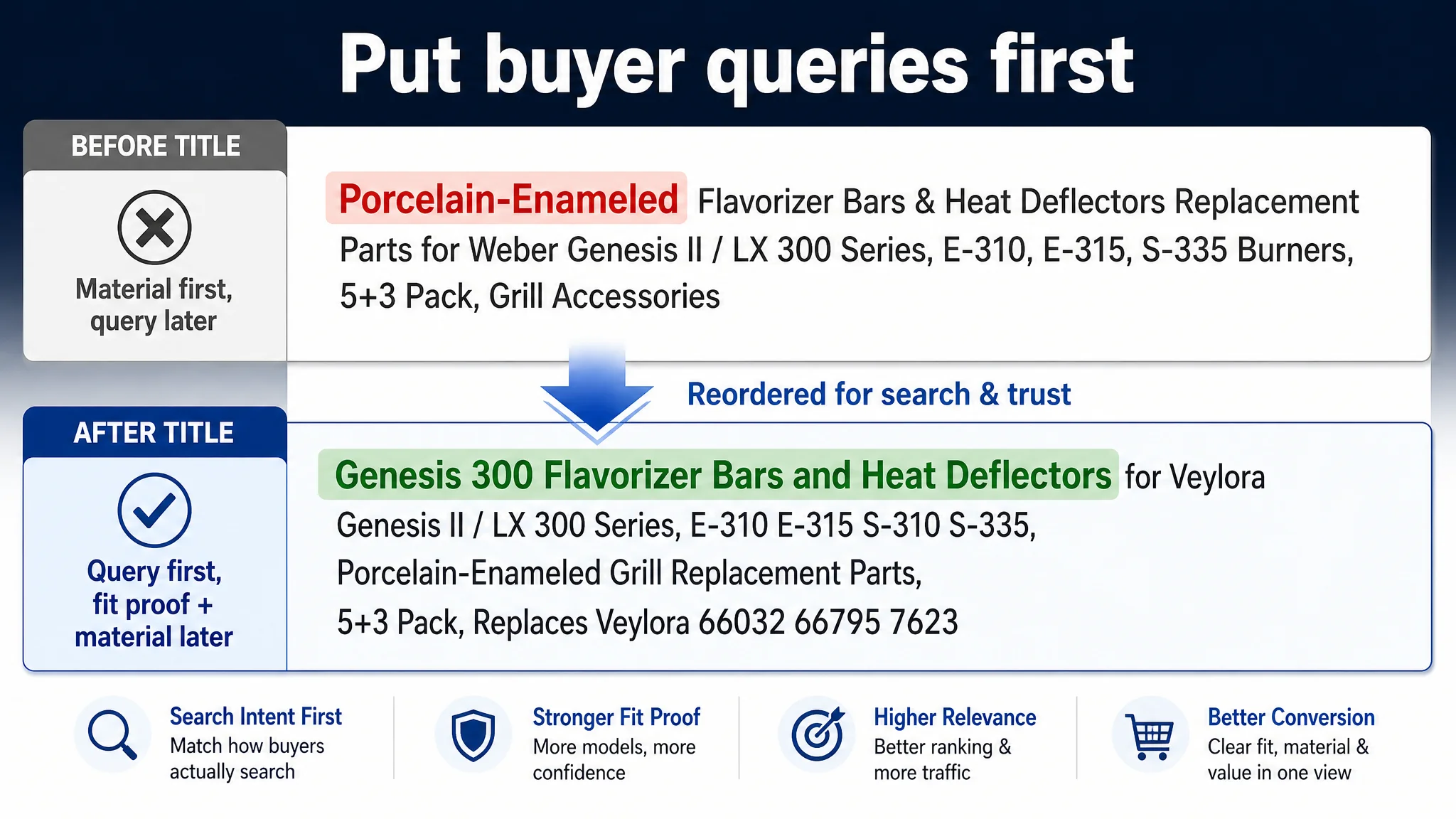
Key shifts in logic:
- Core query first: “Genesis 300 Flavorizer Bars and Heat Deflectors” moves to the front, matching how buyers search.
- Exhaustive compatibility:
- Explicitly listing Genesis II and LX 300 models (E-310, E-315, S-335, etc.).
- Maintaining OEM part numbers (66032, 66795, 7623).
- Removing non-essential Spanish from the main title and reallocating character space to more precise model coverage.
This repositioned the title as a search and trust anchor:
- Easier for A9 to interpret relevance.
- Clearer for buyers to confirm “this fits my grill” without scrolling.
Bullet Points: From Generic Feature Lists to Decision Paths
Originally, the seller’s bullet points already had some strengths:
- User perspective: compatibility, installation, maintenance.
- Scene references: smoke flavor, grilling outcomes.
- Long-term value: “protect your investment”.
But they lacked:
- Fine-grained compatibility breakdown.
- Strong, clear material positioning versus competitors.
- Explicit dimensions and kit structure clarity.
- Pre-purchase guidance to lower return risk.
DeepBI’s optimization reframed each bullet as a decision blocker remover:
1. Compatibility as the first gate
【Perfect Fit for Weber Genesis II 300 Series】 Custom designed for Weber Genesis II 300 Series (2017 and Newer), including Genesis II E-310, S-310, E-315, E-325, E-330, S-330, CE-330, E-335, and S-335. Ideal replacement for Weber parrillas and Genesis II 300 series accessories to restore your grill's peak performance.
2. Second layer: LX 300 compatibility + OEM references
【Compatibility for Genesis II LX 300 Series】 Precisely fits Genesis II LX 300 Series models such as LX S-340, LX E-340, LX CSE-315, LX CSS-315, and LX CSS-335. Replaces Weber OEM part numbers #66032, 66795, 66040, 7622, and 7623. Please ensure your model matches before ordering for a seamless, tool-free installation.
3. Material as a durability argument, not just a descriptor
【Heavy-Duty Porcelain-Enameled Steel】 Crafted from upgraded, extra-thick porcelain-enameled steel. Unlike standard replacements, our bars are designed for high-temperature durability and superior rust resistance. The porcelain coating prevents food from sticking and resists flaking, ensuring a longer service life for your barbacoa or grill.
4. A complete kit explanation
【Dimensions & 5+3 Complete Kit】 Package includes a full set of 5 Flavorizer Bars (17 1/8" L x 3" W x 2 1/8" H) and 3 Heat Deflectors (12 1/2" L x 4 1/4" W). This all-in-one maintenance kit provides everything you need to protect your burners and maintain optimal heat distribution across the entire cooking surface.
5. Function tied to flavor and flare-up control
【Enhanced Smoky Flavor & Even Heat】 These barras saborizadoras and deflectores de calor effectively shield burners from drippings, reducing flare-ups and vaporizing juices into savory smoke. Perfect for achieving that authentic asado or carne asada taste while ensuring even heating for consistent professional results.
6. Pre-purchase notice and assurance
【Important Notice & Quality Assurance】 To ensure the perfect fit, please measure the dimensions of your original parts and compare them with ours before purchasing. If you have any questions regarding compatibility or installation, our professional support team is ready to assist. Invest in quality to protect your grill's longevity.
Together, these bullet points move from “features in isolation” to “a conversion path”:
- Do I fit? → Will it last? → Do I get a complete kit? → Will it improve my cooking? → Can I trust this purchase?
This Product Page Did Not Lack Traffic. It Lacked Trust.
The central insight for this Amazon seller was that the page was not missing visitors; it was missing trust layers.
DeepBI’s diagnosis focused heavily on visual and narrative trust:
Main Image: Not Just a Visual Issue, but a Click-Reason Problem
DeepBI’s main-image recommendations were not about aesthetics. They were about giving every image a commercial role:
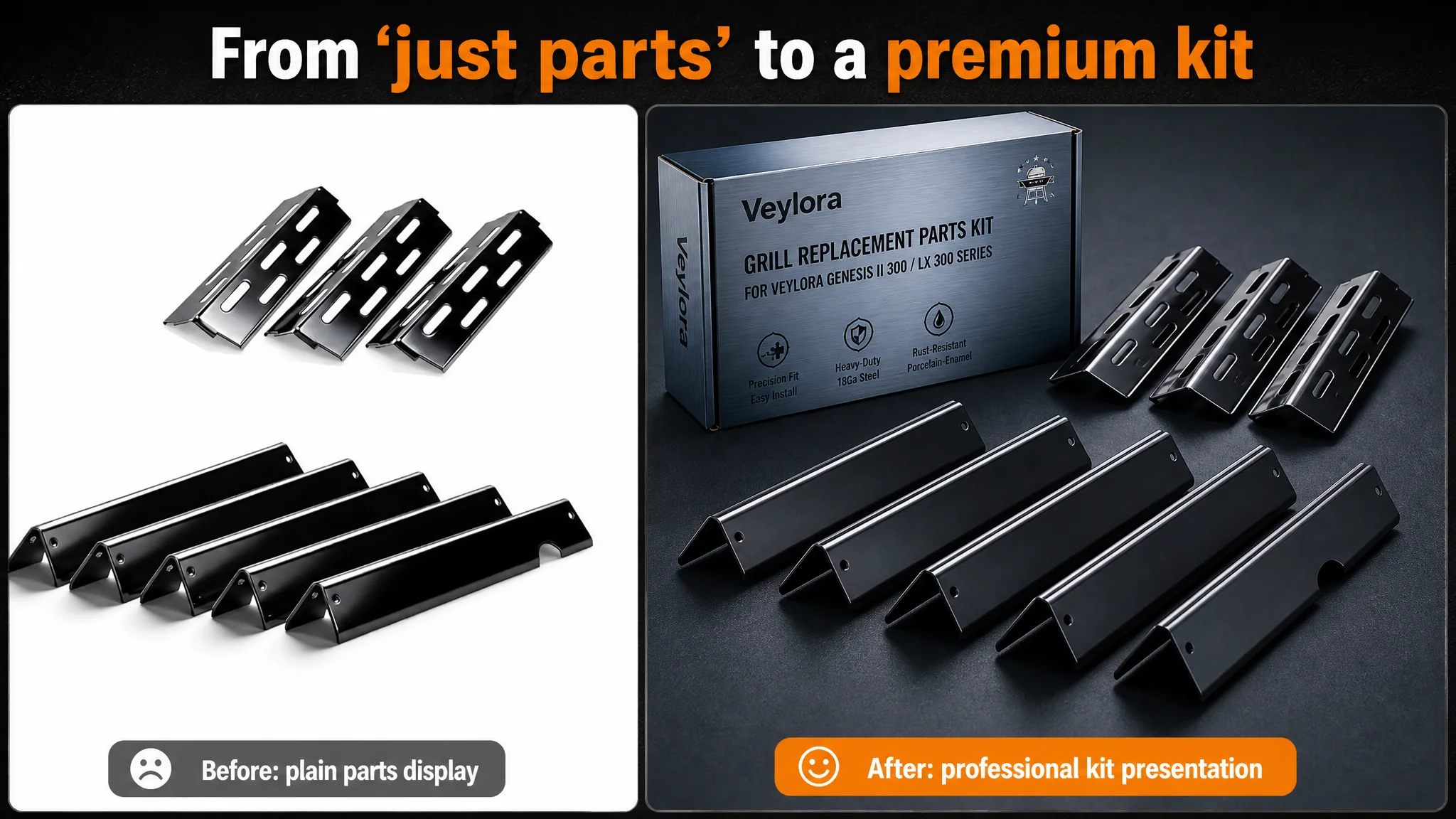
1. Primary image: professional “industrial + lifestyle” hybrid
- Product combination centered at 75% of the frame.
- 45° top-down angle for depth.
- Strong top-left lighting to create dimensionality.
- Brand packaging added for professional feel.
- Clean industrial style: cold tones, high contrast, pure white background.
→ Purpose: Maximize CTR and immediate perception of “serious, high-grade replacement parts.”
1. Dimensions image: precision and confidence
- Single bar and single deflector arranged diagonally.
- Mid-grey gradient background.
- Fine white outlines and clean, sans-serif dimension annotations (“17 1/8 inch”, “12 1/2 inch”).
→ Purpose: Answer fit questions visually, turning abstract numbers into a precise, trustworthy impression.
1. Compatibility image: visual grill matrix
- 3x3 grid of compatible grills.
- Modern outdoor patio scenes.
- Green check marks labeled “Fits Weber Genesis II 300 Series.”
→ Purpose: Let buyers spot their grill visually instead of decoding a text table.
1. Thickness image: visualizing “18Ga”
- Macro shot on the bar edge occupying 60% of the frame.
- Side hard light to emphasize thickness.
- Dark background, bright orange text “18Ga Thickness”.
→ Purpose: Turn “thicker than others” into a visible, credible claim.
1. Cleaning image: real-life interaction
- Single bar on a wood-texture surface.
- A hand wiping with a blue cloth.
- Soft, warm light and blurred garden background.
→ Purpose: Show maintenance ease, not just state it.
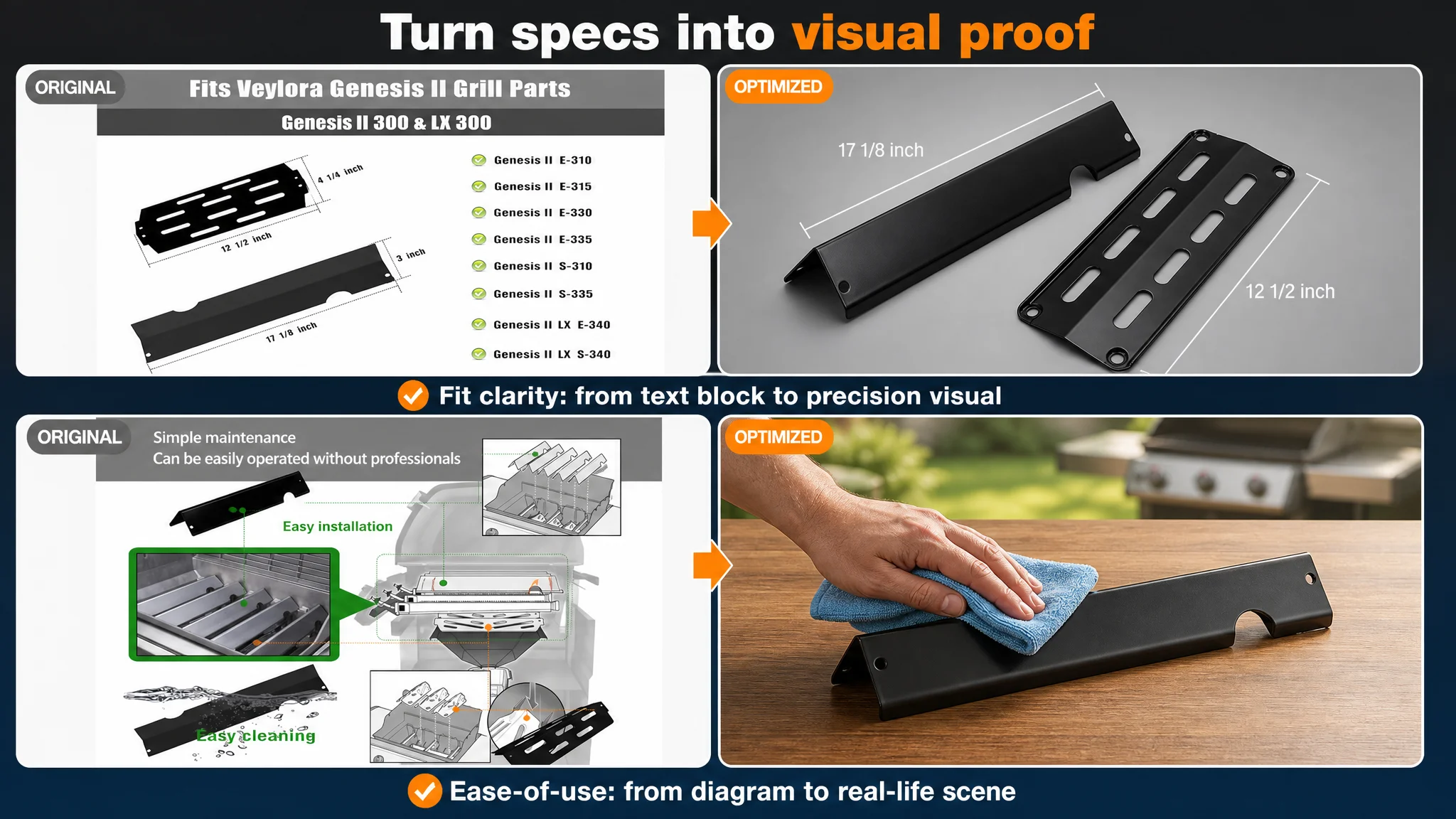
Taken together, these images create a visual logic:
- “This is a professional-grade kit” → “It fits my grill” → “It’s clearly thicker” → “It’s easy to maintain” → “It belongs in my home.”
Detail Page: From Feature List to “Repair Your Grill, Restore the Flavor”
For the A+ detail page, DeepBI’s recommendations rebuilt the narrative into a six-part story:
1. Opening scene: restore the barbecue experience
- Evening family gathering in a modern backyard.
- Grill with the product installed.
- Large heading: “REPAIR YOUR GRILL, RESTORE THE FLAVOR”.
→ The product is reframed from “cold replacement part” to “restorer of family grilling moments”.
1. Compatibility module: visual “fit / not fit”
- Left: three compatible grills with green check marks (“FITS”).
- Right: an incompatible model with a red “NOT FIT”.
→ Reduces anxiety around buying the wrong part, a known conversion killer.
1. Material proof: thickness with caliper
- Macro image showing a digital caliper measuring real thickness.
- Text: “HEAVY-DUTY 304 STAINLESS STEEL” (for the benchmark; in this case, aligned with true material constraints and positioning porcelain-enameled steel accordingly).
→ Builds objective proof around durability and material honesty.
1. Before/After: repair urgency
- Left: rusty, broken, dirty original plates (“BEFORE”).
- Right: clean, solid new ones installed (“AFTER”).
→ Instantly communicates why a buyer should not postpone replacement.
1. Function explanation: flavor mechanics diagram
- Visualizing drippings hitting the bar, vaporizing into smoke.
- Label: “Drippings Turn to Flavorful Smoke”.
→ Explains “Flavorizer” as a function, not just a branded term.
1. Cleaning and maintenance: low friction
- Real hand wiping off grease.
- Heading: “WIPE CLEAN IN SECONDS”.
→ Addresses the post-use frustration every grill owner knows.
1. Thickness comparison: “Ours vs Others”
- Side-by-side cross-sections with “OURS 18GA” vs “OTHERS 20GA”.
→ Positions the product as a serious, non-cheap option in a price-competitive category.
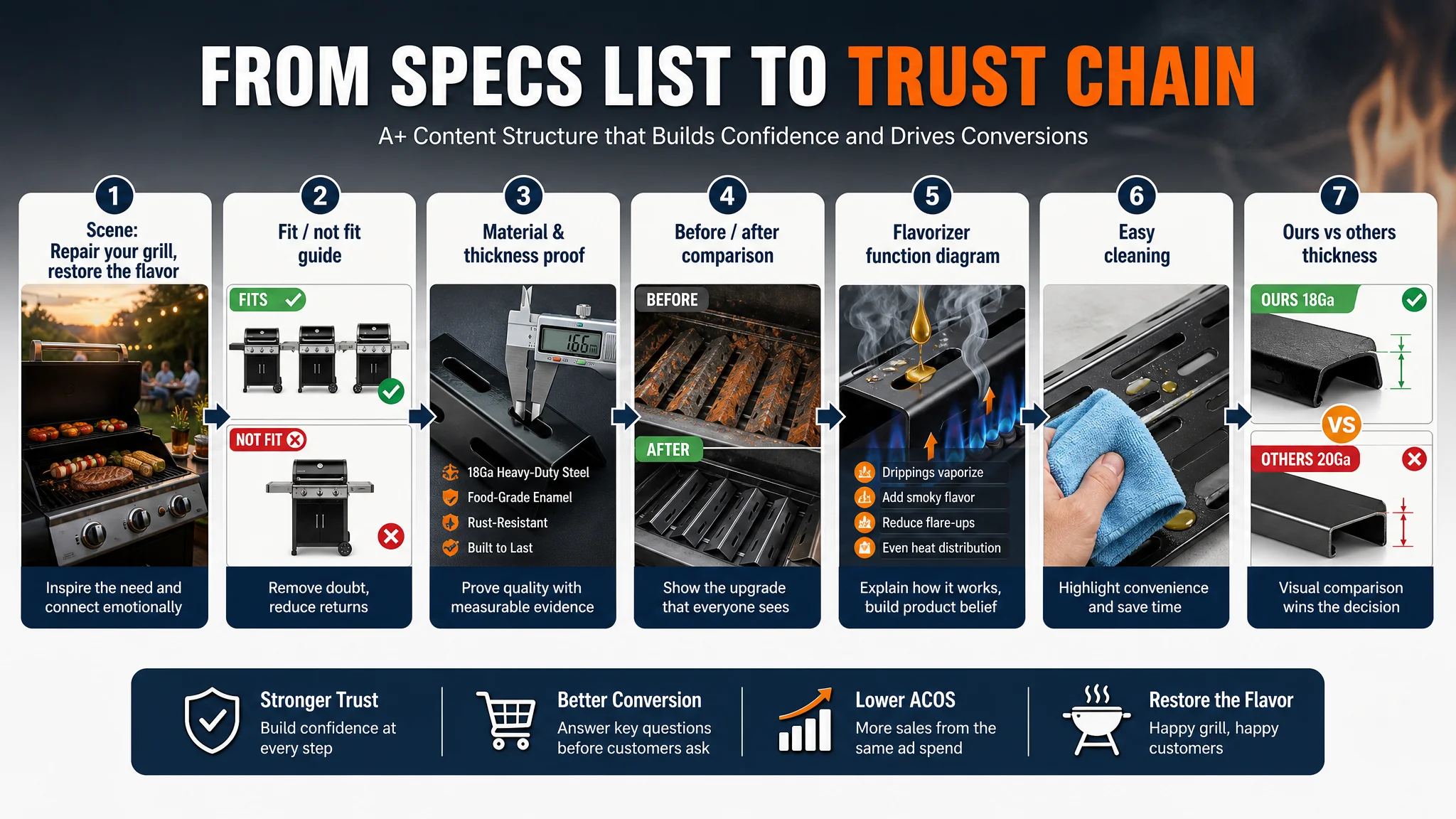
Each module is a direct answer to a specific buyer concern:
- “Will this bring my grill back?”
- “Will it fit?”
- “Will it last?”
- “Will my food really taste better?”
- “Is it a pain to clean?”
- “Am I buying cheap thin metal again?”
Why DeepBI Did Not Recommend “Fix Ads First”
From DeepBI’s perspective, the biggest business risk at this stage was not “under-optimized campaigns”. It was advertising amplifying a low-conversion Listing.
Continuing to prioritize ads would have created:
- Rising ACOS with limited improvement in CVR.
- More budget funneled into a trust-deficient page.
- A false belief that the category was “unscalable” due to ad costs, when in reality the Listing was not competitive enough.
In this context, DeepBI’s decision path was:
1. Stabilize the Listing’s ability to convert:
- Align the title with A9 and buyer language.
- Rebuild the main-image sequence for CTR and trust.
- Upgrade A+ to a proof-based persuasion chain.
- Clarify compatibility and material advantages.
1. Only then re-enter aggressive ad optimization:
- Once the page is capable of converting both organic and paid traffic, ads can be used to scale.
- At that point, ACOS improvements are structurally achievable, not just a function of short-term bid tactics.
This sequence respects a fundamental Amazon reality:
Before scaling ads, the team must judge whether the page deserves more traffic.
How the Page’s Sales Logic Started to Recover
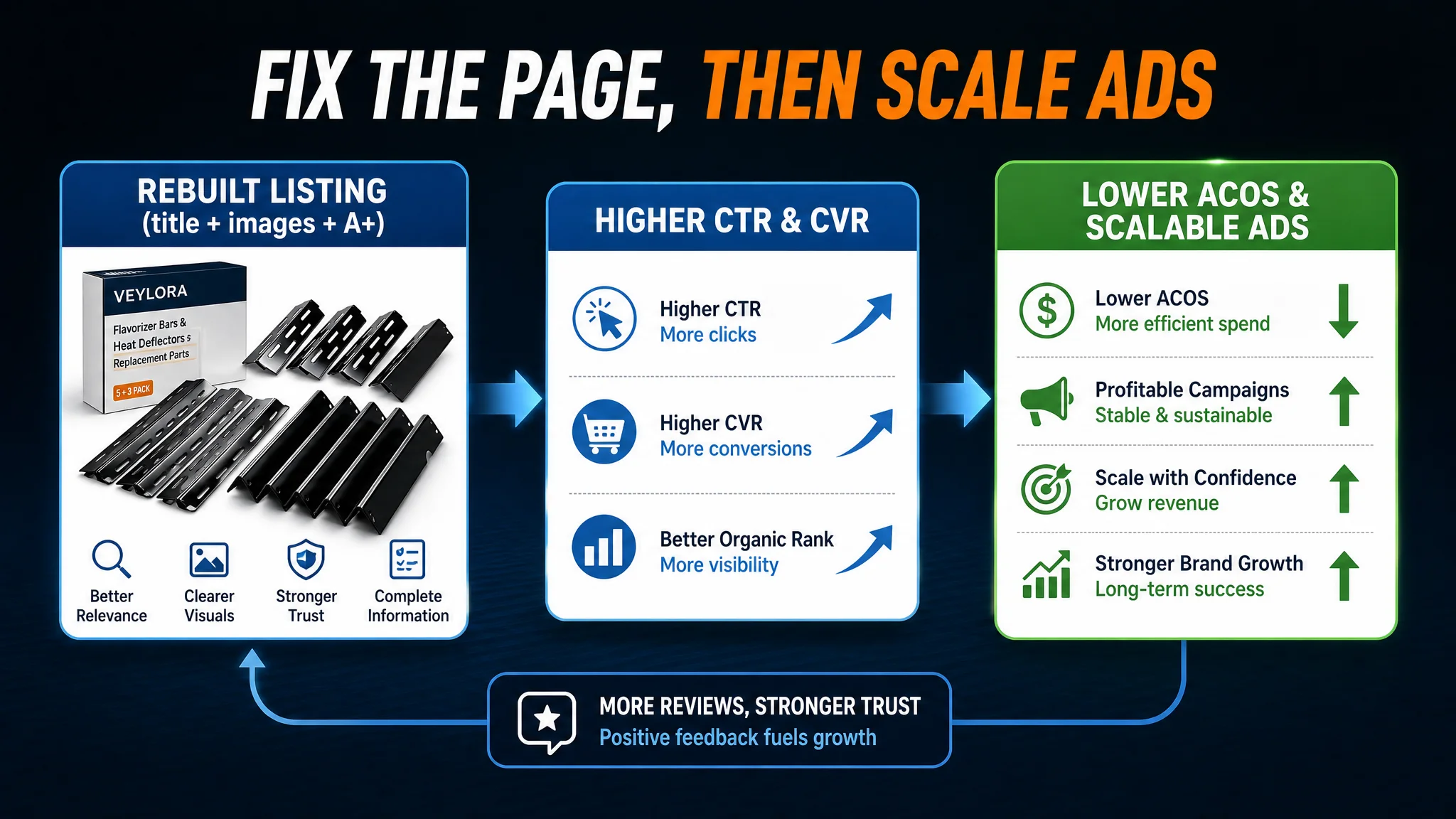
After the Listing restructuring, several changes in operating state can reasonably be expected and monitored (without inventing specific numbers):
- CTR gradually improves:
- Better main-image logic and clearer titles almost always make the Listing more clickable.
- Conversion rate begins to stabilize:
- A stronger compatibility narrative and A+ trust chain reduce “bounce due to doubt”.
- Organic share becomes healthier:
- A more relevant title and stronger engagement metrics improve organic ranking signals.
- Ad dependence softens:
- As organic conversions grow, the Listing no longer needs to rely solely on high-bid campaigns to stay visible.
- Risk of wasted ad spend declines:
- Traffic—both organic and paid—flows into a page that is capable of persuading.
More importantly, the seller’s own understanding shifted:
- From “our ads are weak” to “our Listing could not carry the traffic”.
- From “we just need more reviews” to “we need a complete trust chain: visual proof, clear compatibility, material honesty, and then reviews.”
- From “fix ads now, fix Listing later” to “fix Listing first, then let ads work.”
What Other Amazon Sellers Can Take from This Case
This case is not about grill parts alone. It exposes a pattern many Amazon sellers share:
- High ACOS is automatically blamed on ads, not on product pages.
- Teams repeatedly tune campaigns while ignoring Listing conversion fundamentals.
- Weak A+ content and minimal reviews are seen as “nice-to-have”, not as conversion infrastructure.
Key takeaways:
1. If your Listing scores lag far behind a benchmark, ads are not your primary lever.
A 22-point gap in overall Listing quality is not something bids can overcome.
1. Title, main image, bullet points, A+ and reviews form one conversion system.
They must be evaluated together, not in isolation.
1. Advertising is a multiplier, not a repair tool.
It multiplies whatever state your product page is in—strong or weak.
1. Trust must be visual, not only verbal.
Tests, measurements, before/after images, and real scenes often do more work than any single sentence.
When Amazon ad costs rise and familiar optimization tricks stop working, the question is not only “How do we tweak our campaigns?”. It is often:
“Does this Listing truly deserve the traffic we’re paying for?”
This seller’s journey—from misdiagnosing an “ad problem” to confronting a Listing conversion bottleneck—shows how DeepBI’s role is not to push more buttons, but to sharpen judgment about where the real constraint lies.