

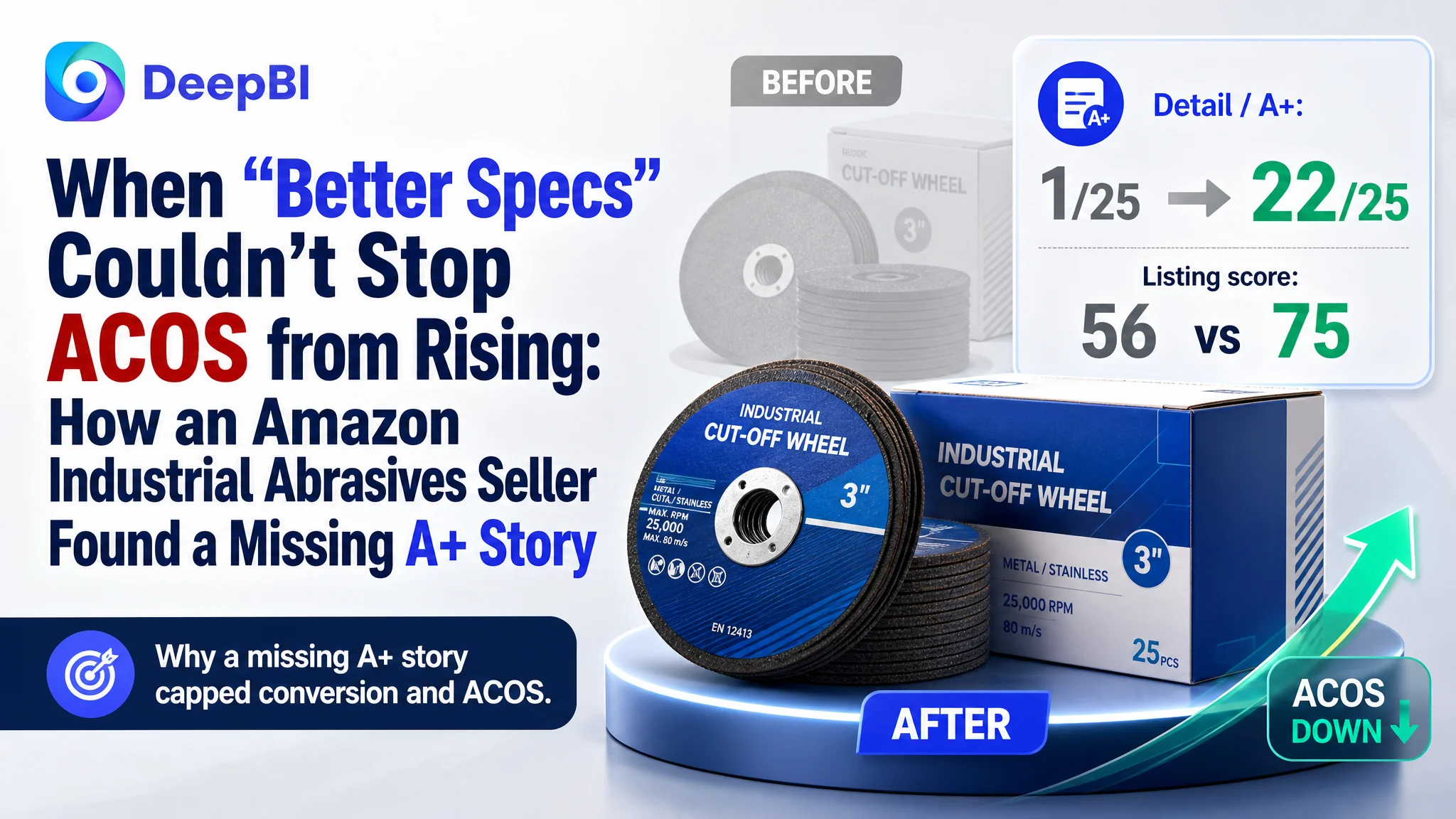
This case comes from an Amazon seller in the US industrial tools category, selling 3-inch cut-off wheels for metal and stainless steel. On paper, their Listing looked solid: detailed specifications, strong material claims (1 mm ultra-thin, 100% monocrystalline alumina), and a technically polished main-image set. Yet under Amazon ads pressure, ACOS refused to drop and conversion stayed fragile. The team’s instinct was to treat this as an advertising and keyword issue—and to keep “turning the knobs” on bids and campaigns.
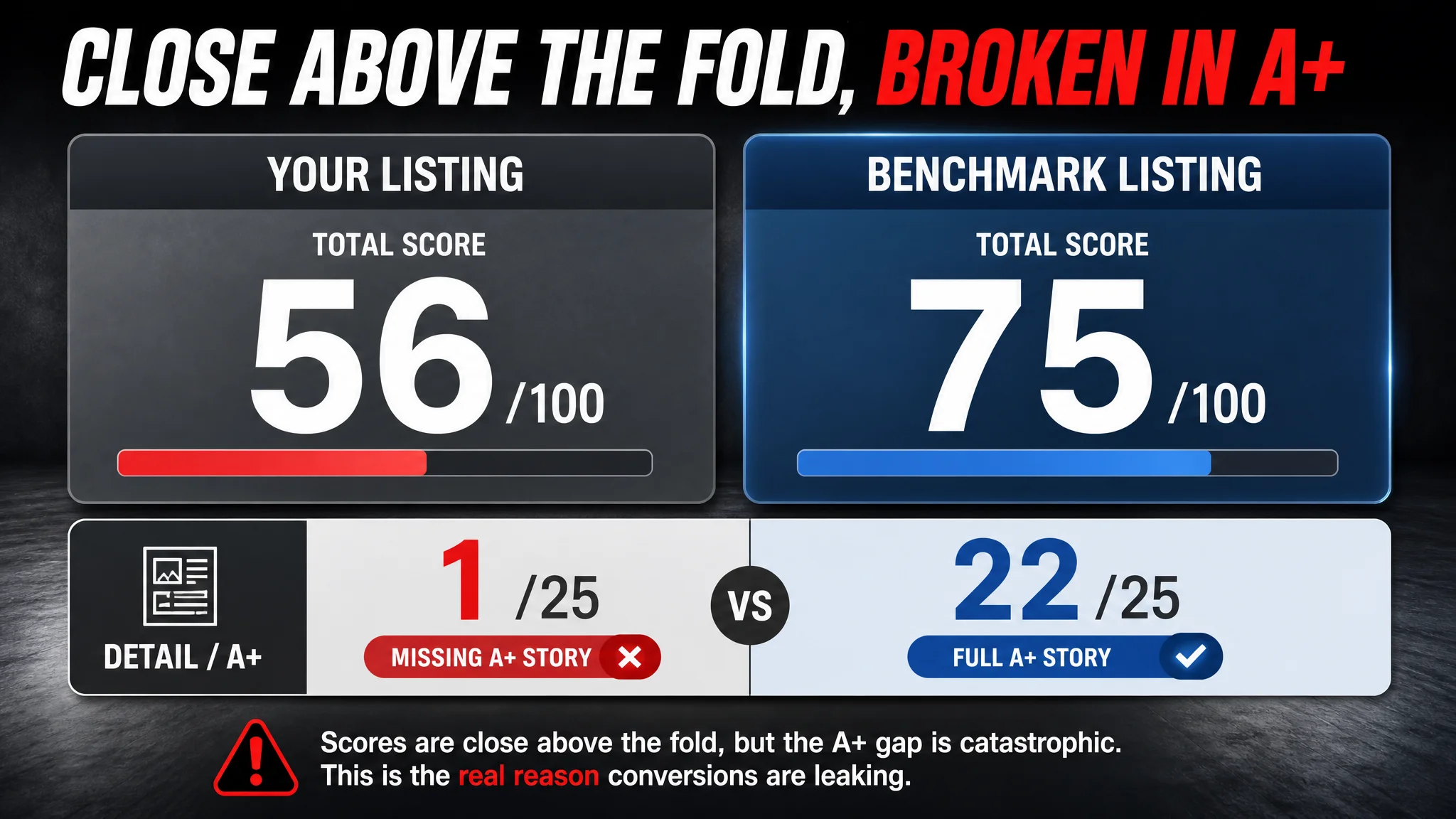
DeepBI’s diagnosis told a different story. Against a high-performing benchmark Listing in the same 3-inch cut-off wheel segment, this product scored 56/100 versus the competitor’s 75/100. The gap did not come from the title, main image, or bullets. It came almost entirely from one brutal number: 1/25 on the detail/A+ dimension, versus 22/25 for the competitor. In other words, the page that all those Amazon ad clicks landed on had almost no visual story and no structured trust path, while the benchmark Listing ran a full, well-architected A+ “sales engine.”
Once the team accepted that the core issue was not “traffic quality” but “page conversion capacity,” the optimization direction shifted. Instead of pushing even more traffic into a half-finished Listing, they rebuilt the visual and narrative spine of the Amazon product page: modern industrial main images, focused 3-inch visual emphasis, clear thickness visualization, high-trust A+ modules, and bullets restructured for professional buyers. Ads then stopped being a pure cost center and started feeding a page that could actually convert.
For other Amazon sellers—especially in technical or industrial categories—this case is a reminder: high-spec titles and “better data” in bullets do not compensate for a hollow detail page. When ACOS is stubborn and conversion unpredictable, it may not be your bids that are failing. It may be the missing story and trust structure on your Amazon Listing.
What the Seller Saw: “Our Listing Is Already More Professional”
The seller operates on Amazon US in an industrial abrasives subcategory, targeting professional metal fabricators and advanced DIY users.
From their perspective, the fundamentals were in place:
- A detailed, keyword-rich Amazon title with:
- “3 Inch” front-loaded
- “Ultra Thin,” “Resin,” “1mm,” and “100% Monocrystalline Alumina”
- Explicit tool compatibility (“Fits 3/8" Arbor Angle Grinders and Air Tools”)
- A main-image series that:
- Highlighted technical parameters
- Showcased German raw materials and crystal structure
- Presented itself as more “engineering-grade” than the benchmark
- Bullet points that:
- Started from hardness and lifespan
- Followed a “feature → benefit” logic
- Were structurally clearer than the competitor’s more scattered bullets
On a surface comparison, the seller even felt they outperformed the benchmark in technical communication. So when ACOS stayed high and volume weak, the intuitive conclusion was:
“Either our ads aren’t optimized enough, or we need more reviews.”
They saw a modest but healthy rating (4.5 stars) and assumed the main constraint was review volume and ad tuning, not Listing content.
The Original Misdiagnosis: Treating an A+ Void as an Ads Problem
Before working with DeepBI, the team’s default playbook was classic:
- Keep iterating keywords and bids
- Try different campaign structures
- Watch ACOS and search-term reports
- Blame low volume on:
- Review count (only 15 vs the competitor’s 93)
- “Category competition rising”
- “We’re a smaller pack size; maybe that’s the issue”
In other words, they framed the problem as:
- A traffic/acquisition issue (ads & ranking)
- A social proof issue (not enough reviews)
What they did not seriously question was:
- Whether the Amazon product page itself deserved more traffic
- Whether professional buyers had enough visual and structural evidence to justify choosing this Listing over a more “branded” competitor
Under pressure from rising ad costs, they continued pushing traffic to a page that felt internally “good enough,” without a clear, evidence-based view of where conversion was actually leaking.
Where DeepBI’s Scoring Broke the Assumption
When DeepBI ran the Listing through its Amazon Listing scoring and benchmark comparison, the high-level numbers were clear:
- Total score
- Target Listing: 56/100
- Benchmark Listing: 75/100
- Gap: –19 points
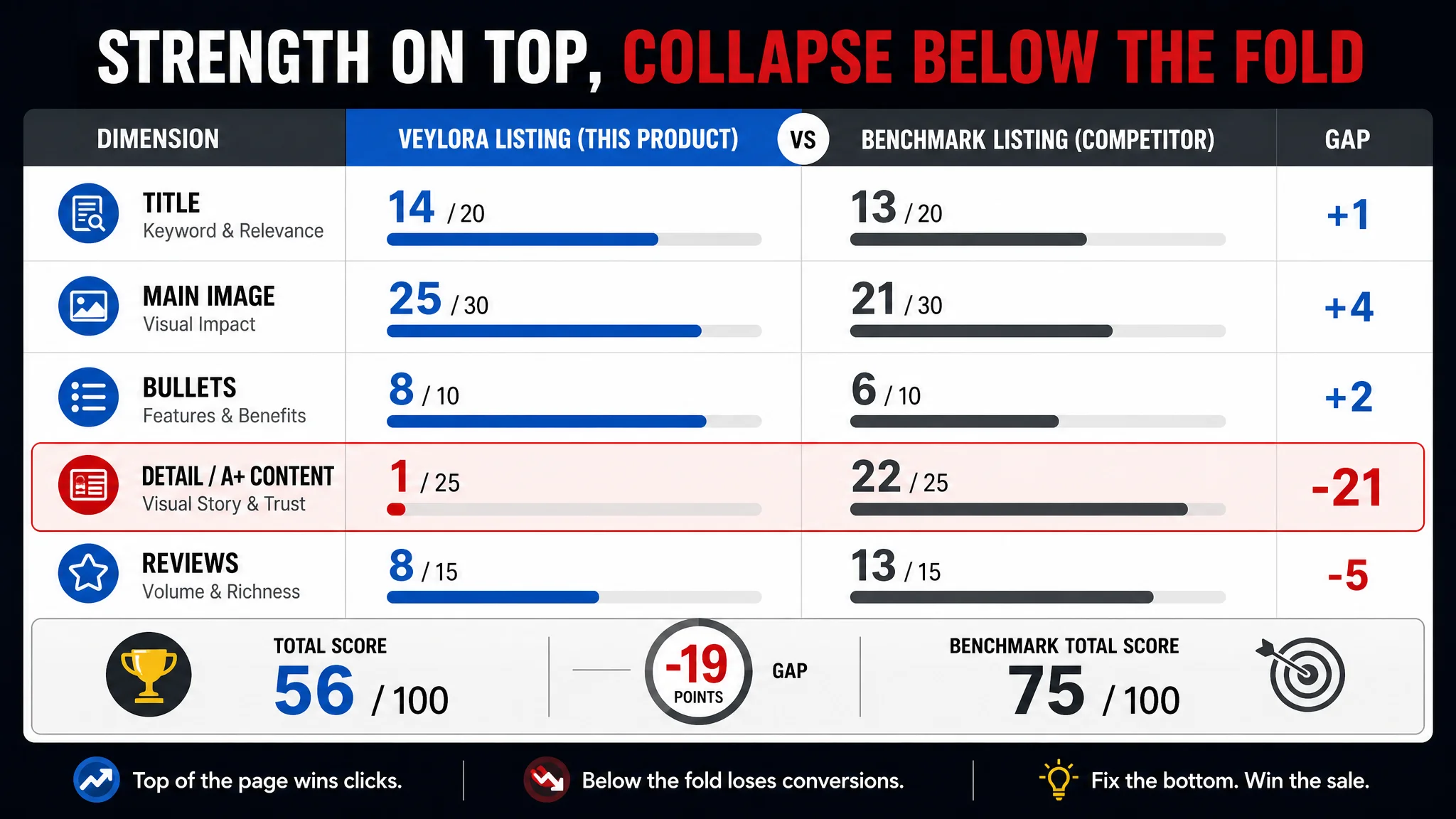
On title, main image, and bullet points, the gap was small or even in the seller’s favor:
- Title
- Seller: 14/20
- Benchmark: 13/20
- Slight advantage to the seller in keyword richness and tool compatibility.
- Main image
- Seller: 25/30
- Benchmark: 21/30
- Seller’s technical diagrams and material callouts were actually stronger for B2B trust.
- Bullet points
- Seller: 8/10
- Benchmark: 6/10
- Better logical order and feature→benefit connection.
The real shock was here:
- Detail / A+ content
- Seller: 1/25
- Benchmark: 22/25
- Gap: –21 points
- Reviews
- Seller: 8/15
- Benchmark: 13/15
- Gap: –5 points (more about scale and visual richness of reviews than basic rating)
This meant:
The Listings were relatively close above the fold, but below the fold, the benchmark ran an entire A+ story—and this seller had… essentially nothing.
What the Benchmark Did Differently on Amazon A+
DeepBI’s diagnostic agents highlighted a clear structural advantage on the competitor’s A+:
- Full-width product imagery and clear technical tables
- Visualized application scenarios:
- Tool compatibility (die grinders, cut-off tools)
- Material compatibility (metal, stainless steel, wood variants)
- A coherent narrative ladder:
- Technical specs → application fit → material compatibility → brand promise
- A consistent brand visual system:
- High-contrast industrial design
- Color-coded fox brand cues by use-case (metal vs wood)
- A simple but persistent brand story and DTC positioning
In contrast, the seller’s Amazon detail page contained:
- No real A+ images
- No visual modules
- Only sparse text snippets acting as a placeholder
The result was a trust gap:
- Professional buyers saw a technically rich title and bullets…
- …then scrolled into near emptiness where they expected visual validation and structured reassurance.
Why Amazon Ads Couldn’t Fix This Page
From DeepBI’s view of Amazon funnel data across categories, a pattern holds:
“When A+ is hollow or missing for technical products, ACOS often plateaus, regardless of how clean the ad setup is.”
In this case:
- The main image and bullets were good enough to generate clicks and add-to-cart interest.
- But professional buyers—especially those responsible for workshop tools and consumables—needed:
- A clear visual proof of thickness (1 mm)
- Reliable evidence of material compatibility
- Visual confirmation of arbor size and install fit
- A sense that this brand understands industrial use and safety
Without that, ads did what ads always do in such situations:
- They bought traffic to a page that could not fully close the sale.
- They made ACOS look like “an ads issue,” when in reality, the product page’s conversion layer was underbuilt.
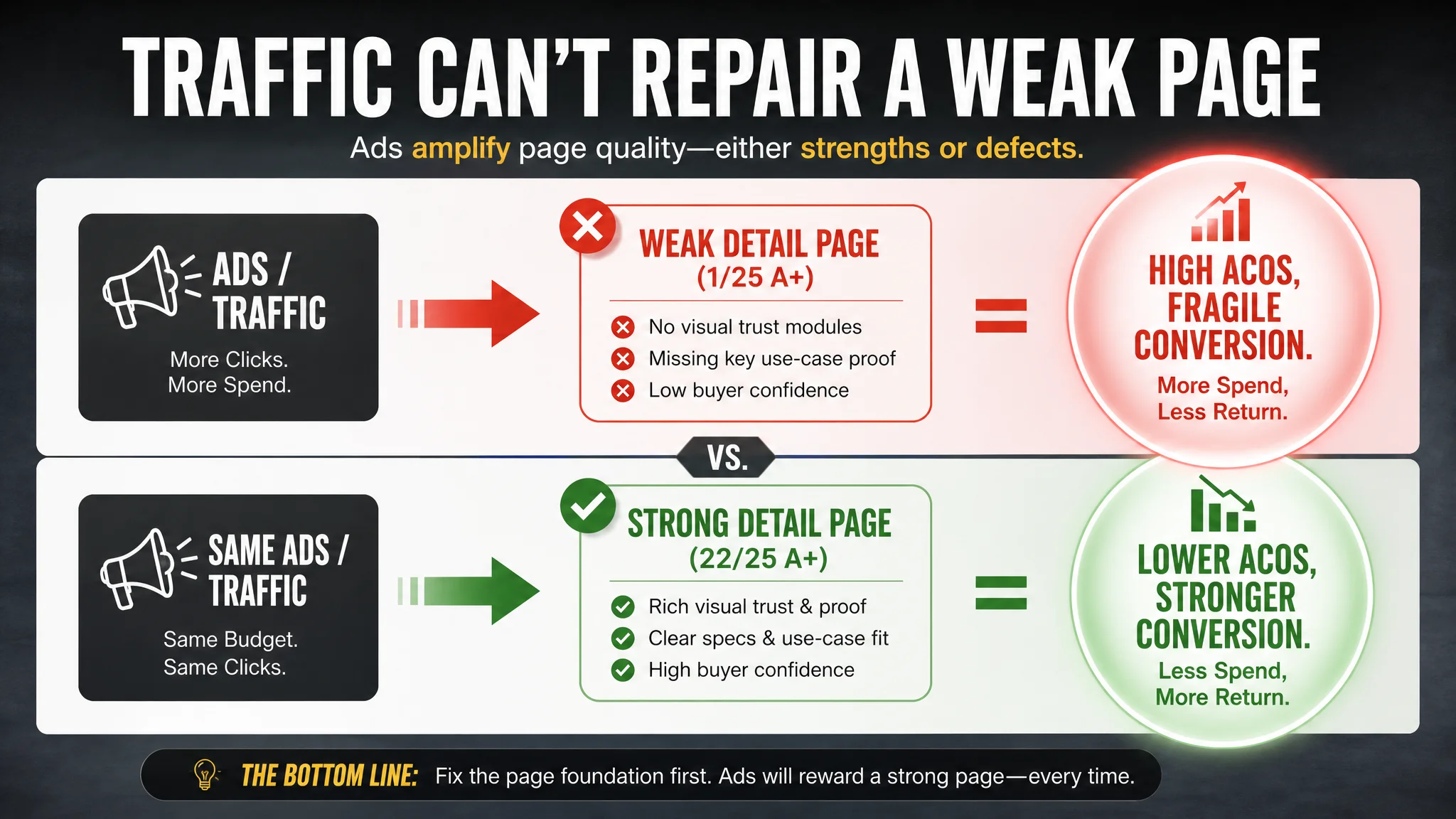
DeepBI’s core judgment:
- The primary constraint was Listing conversion capacity, not traffic volume.
- Until the Amazon product page could:
- Visually prove specs
- Show use scenarios
- Build brand trust
- …additional traffic was mostly going to be wasted.
The Real Constraint: A Missing Visual & Trust Spine on the Amazon Product Page
DeepBI framed the core problem in one sentence:
“This product page does not lack specifications. It lacks a structured, visual decision path.”
The scoring and qualitative review revealed three critical gaps.
1. A+ Visual Absence = Trust Collapse
For a technical, safety-sensitive product like cut-off wheels, lack of A+ imagery is not a cosmetic issue; it is a trust issue.
The competitor used A+ to:
- Validate specs visually (diameter, thickness, arbor size)
- Show real cut scenarios (sparks, workshop context)
- Reaffirm brand and quality consistency
The seller:
- Offered plain text instead of visual modules
- Did not visually connect “1mm ultra thin,” “monocrystalline alumina,” or “fast cut” to anything the eye could trust
- Gave professionals no “last-mile evidence” that this wheel would:
- Cut cleanly
- Fit their tools
- Survive high RPM use
2. Confused Size Focus: 3-Inch Link, Multi-Size Imagery
DeepBI’s detail-page analysis highlighted:
- Images mixing 14-inch, 4.5-inch, and 3-inch products
- For a 3-inch ASIN, this muddied the message:
- Professional buyers care deeply about precise specs.
- Any confusion (“Is this really 3 inches?”) slows or kills conversion.
The benchmark, by contrast, kept the Amazon Listing tightly focused on the 3-inch format and repeatedly reinforced that visually.
3. Unused Strength: Strong Technical Story, Poor Visualization
The seller’s textual story was actually better than the benchmark:
- Monocrystalline alumina
- Ultra-thin 1 mm kerf
- Resin bond, fast cut, long life
But none of this was translated into:
- Simple, intuitive diagrams
- Clear visual comparisons
- Accessible “thinness” cues for non-experts
DeepBI saw a classic pattern:
“The Listing had information, but not a buying logic.”
Why DeepBI Refused to “Optimize Ads First”
Under typical operational pressure, it is tempting to:
- Keep tweaking bids
- Expand or narrow keyword sets
- Add negative keywords
- Test more ad creative
DeepBI pushed back on that reflex, for a simple business reason:
“Advertising does not only amplify advantages. It also amplifies existing defects in the page.”
At this stage:
- Every extra dollar in Amazon ads was driving buyers into:
- A technically competent but visually underbuilt product page
- A detail section that looked unfinished compared to the benchmark
- That meant:
- Higher wasted clicks
- Poorer conversion on incremental traffic
- A slow erosion of the product’s ability to build organic rank
DeepBI’s decision logic:
1. Fix the page’s trust and decision structure first.
2. Then re-evaluate:
- CVR behavior
- ACOS movement
- Organic share vs ad-driven share
1. Only then consider scaling ads again.
The immediate risk they wanted to avoid:
- Letting ads “train” Amazon’s algorithm to see this Listing as low-conversion traffic, which would then:
- Increase reliance on paid traffic
- Make organic ranking recovery much harder
How the Amazon Listing Was Reframed
Instead of treating this as a “generic image upgrade,” DeepBI treated it as a reconstruction of the Listing’s entire decision logic.
Title: From Redundancy to Targeted Coverage
DeepBI recommended a revised title that:
- Removed redundancy (“20 Pack” repeated at both ends)
- Front-loaded “Cut Off Wheels” as a core keyword
- Added imperial equivalents:
- “1mm (3/64")” to match competitor search patterns
- Strengthened tool-context coverage:
- Explicit “Die Grinders” alongside angle grinders and air tools
This wasn’t about stuffing keywords. It was about matching how professionals actually search and how Amazon’s A9 indexes technical products.
Bullet Points: Aligning with Professional Buying Logic
While the seller’s bullets were already more logical than the benchmark, DeepBI sharpened them around the way pro buyers evaluate cut-off wheels:
1. Integrated spec snapshot
- Diameter, arbor, thickness, max RPM in one compact bullet
- Immediate clarity for spec-obsessed buyers
1. Material-specific use
- Stainless, alloy steels, hardened metals, cast iron, sheet metal
- Turning generic “metal” into targeted use cases
1. Safety and stability
- Explicit “fully reinforced for hand-held work”
- Linking resin bond to high-speed stability and safety
1. Material technology as a differentiator
- 100% monocrystalline alumina framed as:
- Faster material removal
- Better heat resistance
- Longer life
1. Ultra-thin kerf with machine protection
- Not just “less waste”
- Also “less load on your tool motor, fewer burrs”
1. Compatibility list as a traffic engine
- Explicitly naming major tool brands and models
- Turning compatibility into both a keyword and trust gateway
1. Use-case summary
- Automotive, fabrication, industrial tasks
- Summarizing what outcomes buyers can expect
In effect, bullets shifted from “technical correctness plus benefits” to “professional purchase checklist.”
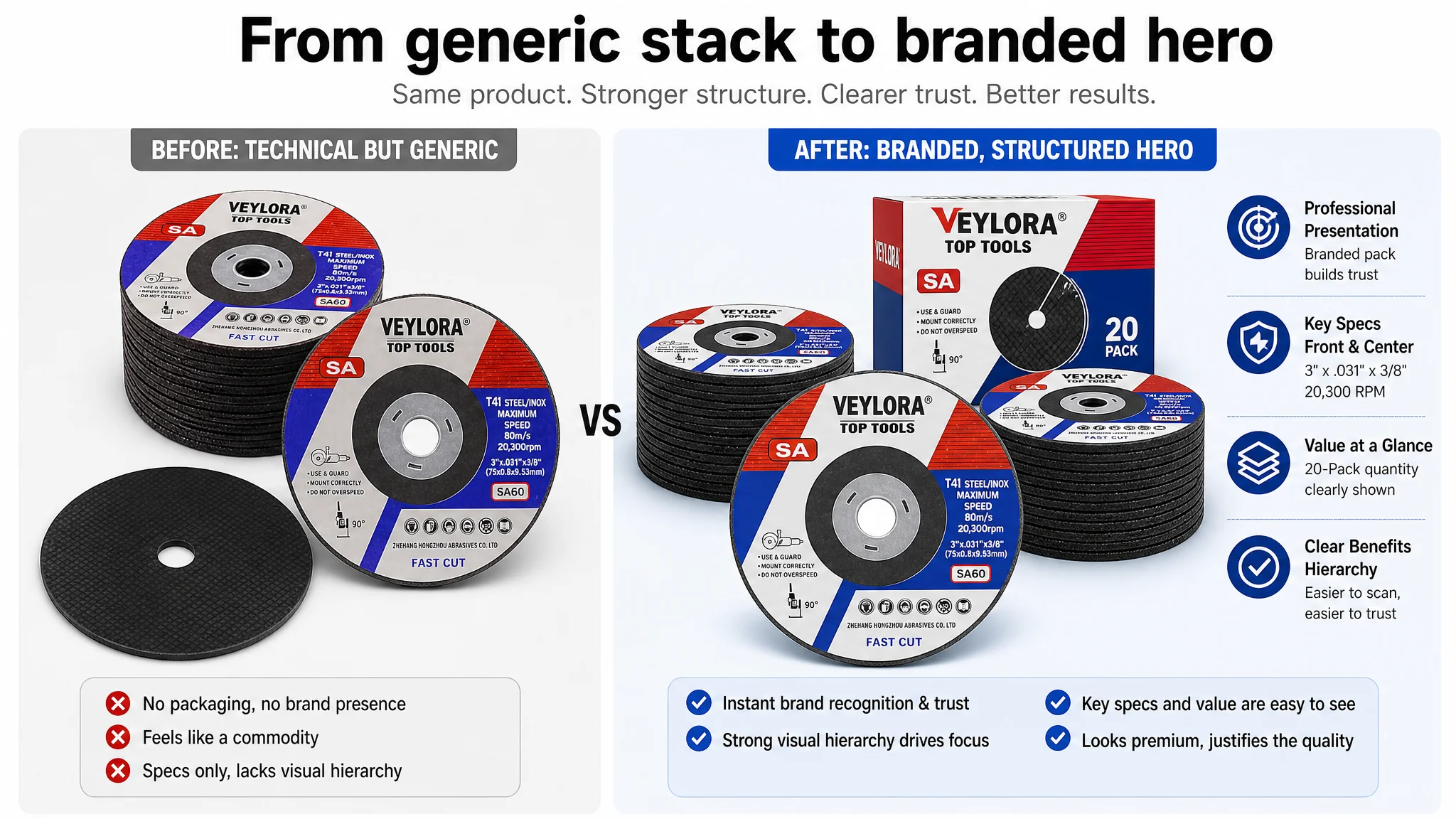
Main Image: From Technical to Visually Decisive
DeepBI did not conclude “the main image is bad.” Instead, it recognized:
- The seller’s main image set had strong technical content but:
- Weak brand presence
- Less deliberate visual hierarchy
- Less obvious “click reason” at the search results page
So recommendations focused on:
- Re-establishing a modern industrial aesthetic
- High-contrast cold backgrounds
- Strong, controlled shadows
- Centralized, clean product focus
- Creating clear visual hooks around core specs
- Centered stack shots with packaging to build brand recognition
- Single-disc close-ups with precise thickness annotations
- Scene shots of actual cutting with sparks, but:
- Structured to keep the wheel clearly visible
- With the product as “cause” and sparks as “effect,” not vice versa
- Turning complexity into readable visual matrices
- Application grids showing different materials (rebar, stainless pipe, angle steel)
- Icon-driven summaries of core benefits:
- Speed
- Durability
- Material tech (monocrystalline alumina)
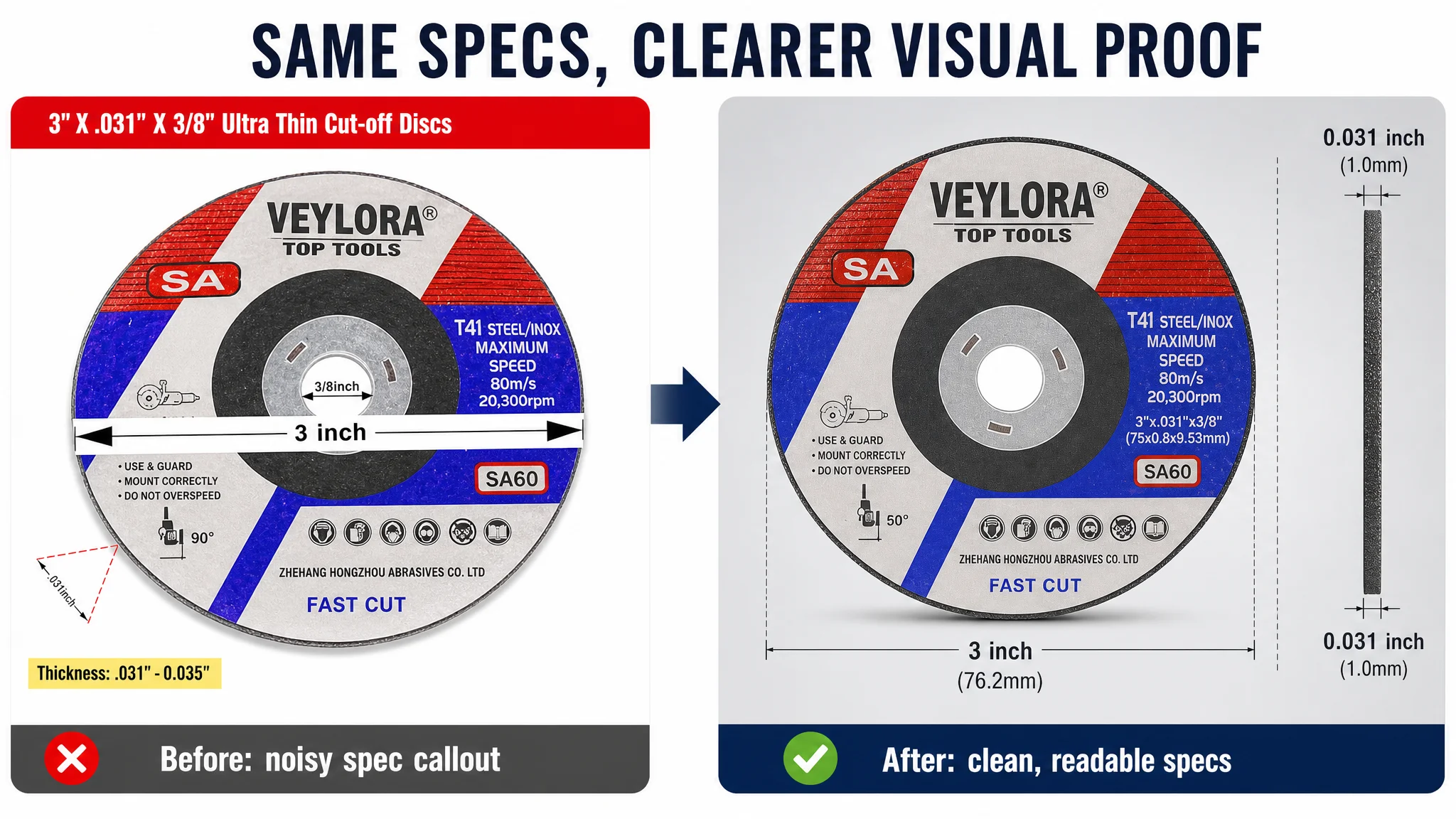
The point was not just aesthetics. It was to:
- Make the thumb-sized Amazon search thumbnail:
- Instantly legible
- Clearly different from generic discs
- Strong enough to win the click against a branded red/black competitor
A+ Detail Page: From Placeholder Text to a Full Conversion Engine
This was the central battlefield.
DeepBI’s A+ recommendations effectively rebuilt the Amazon detail page into a structured, visual conversion path:
1. Re-focusing on the 3-Inch Variant
- Dedicated imagery for:
- 3-inch diameter
- .035" (approx 1 mm) thickness
- No mixing of other sizes
- Visual emphasis on:
- Precise specs clearly labeled in the image
- Sharp, industrial brushed-metal backgrounds for context
2. Visual Proof of “Fast Cut” and “Less Kickback”
- High-quality scenes:
- 3-inch angle grinder cutting a 5 mm carbon-steel pipe
- Natural workshop lighting, strong spark trails
- Focus on:
- Dynamic impression of speed and control
- Clean cutting line
This turned textual claims (“Fast Cut,” “Less kickback”) into visual evidence.
3. Material-Compatibility Evidence
- Split scenes showing:
- Solid round steel
- Stainless square tube
- Clean, burr-minimized cut surfaces
- Clear linking of visuals to:
- “Accurate, clean cuts”
- Multi-material suitability
This directly addressed a classic buyer hesitation:
“Will it really cut stainless? Will it chip or burn?”
4. Arbor Fit and Install Confidence
- Close-up of:
- 3/8" arbor hole
- Flange detail
- High clarity on:
- Fit and finish
- Exact arbor size labeling
This tackled the anxiety of:
“Will this actually fit my tool, or will I waste time and money?”
5. Intuitive “Thinness” Demonstration
- Side-view of the disc
- 1-dollar coin as thickness comparator
- Professional, minimalistic background
Non-experts and pros alike could now “feel” what .035" actually means.
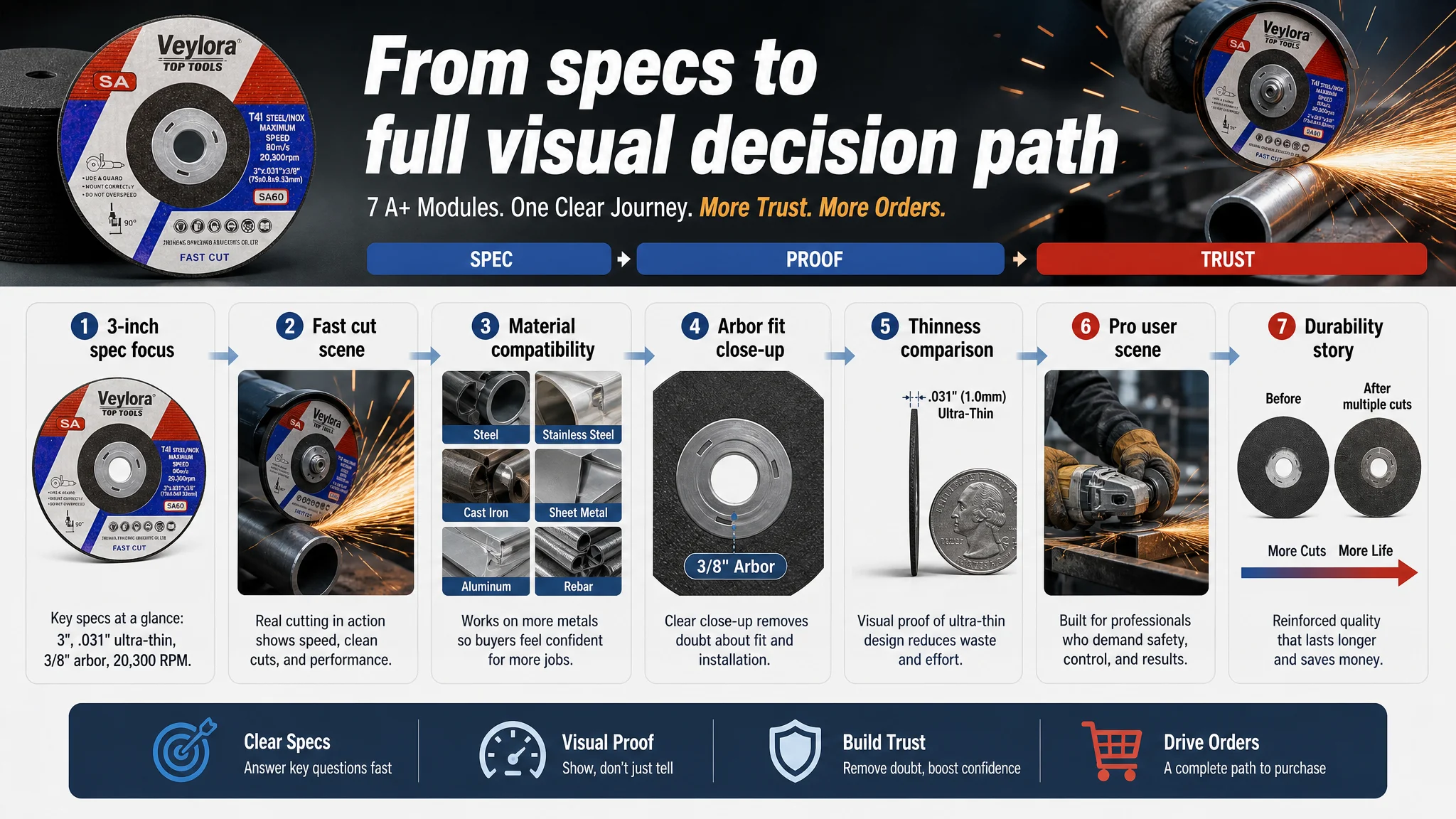
6. Professional Identity & Use Case
- Real technician:
- Proper gloves
- Professional stance
- Authentic workshop environment
This reinforced that:
- The product is built for serious, repetitive use
- It belongs in a professional toolkit, not just a hobbyist garage
7. Durability & Life Story
- Before/after comparison:
- New wheel vs. used wheel with normal wear
- Background with measurement markings
- Implicit proof of:
- “2x life”
- “Self-sharpening” behavior
While not inventing numbers, the visuals substantiated the economic logic of choosing this wheel over cheaper, shorter-life options.
What Changed Once the Listing’s Sales Logic Was Rebuilt
Because this case is focused on diagnostic logic, not a promotional success story, we won’t fabricate numbers. But several operating-level shifts did occur.
The Page Regained the Ability to Convert
After the A+ rebuild and visual restructuring:
- The Amazon product page:
- No longer relied solely on title and bullets
- Offered a full visual decision path, similar in richness to the benchmark
- Professional buyers:
- Could validate specs visually
- See thickness, arbor, material compatibility, and real usage
- Feel a coherent industrial brand presence, not just a commodity disc
The Listing was no longer in a “half-finished” state on the detail layer.
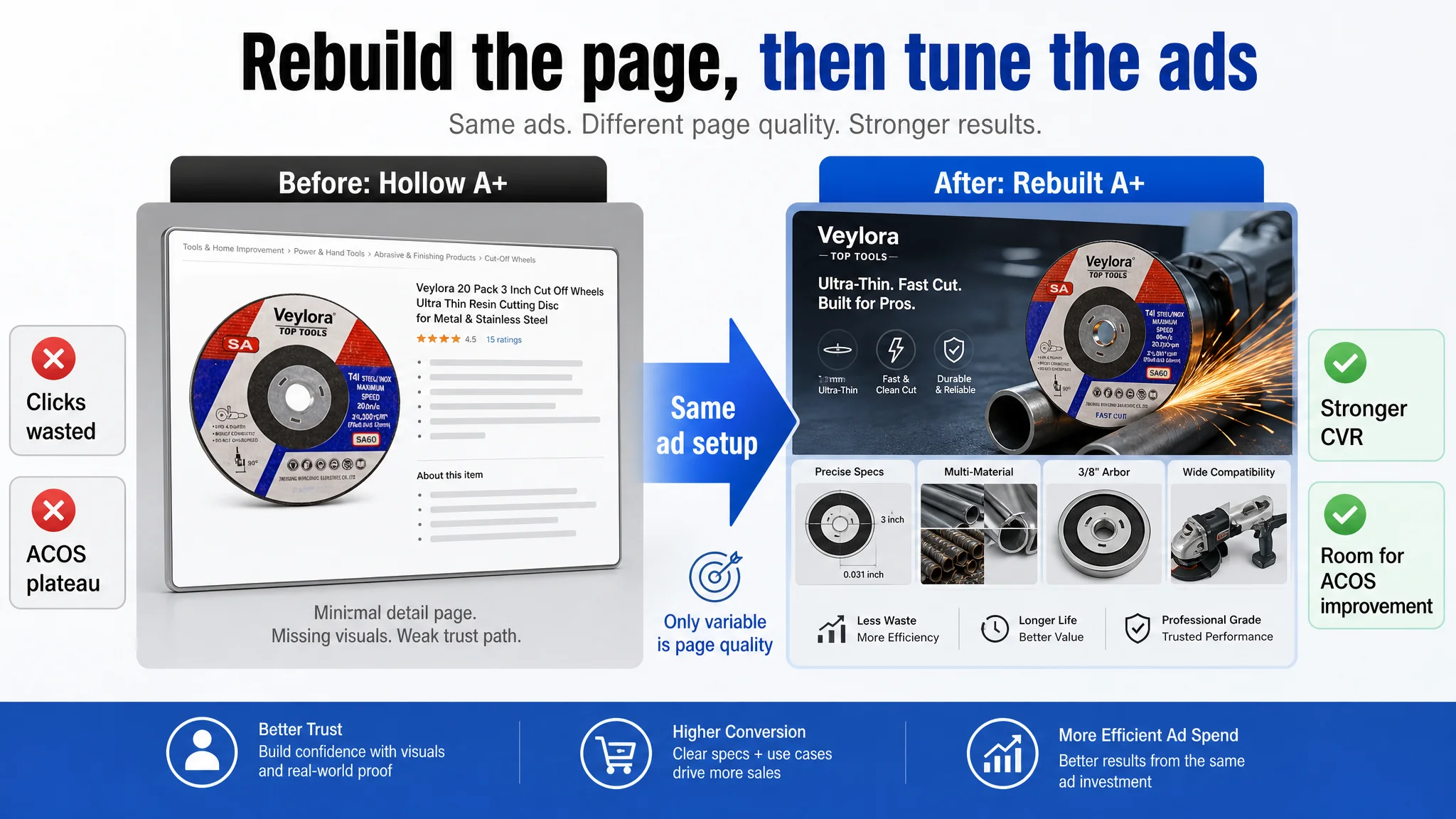
Ad Traffic Became Less Wasteful
With the same or similar ad structure:
- Each click had:
- A stronger chance of turning into an order
- Less need for repeated exposures to convince buyers
- ACOS was no longer structurally capped by a missing A+ story
- Future ad optimizations (bids, keywords, placements) now had:
- A solid conversion foundation
- A realistic chance to push ACOS down over time
The Team’s Understanding Shifted
The seller came away with a different mental model of Amazon growth:
- Ads and Listing are not two separate projects.
- Ads amplify whatever the page already is—good or bad.
- For technical products:
- Title and main image get the click.
- Bullets and A+ close the sale.
- Reviews reinforce the decision.
“Before scaling ads, we must ask: does this product page genuinely deserve more traffic?”
What Other Amazon Sellers Can Take from This Case
This case is not about one industrial abrasives Listing. It’s about a pattern many Amazon sellers face:
- You have:
- Technically stronger specs than a competitor
- Better bullets
- Decent main images
- Yet:
- ACOS is stubborn
- Conversion feels fragile
- The competitor’s page “just sells better”
Key lessons:
1. A missing or weak A+ can be the single biggest conversion leak.
Even when your title, main image, and bullets look “better than average,” a 1/25 detail score against a competitor’s 22/25 is often fatal.
1. Ads can’t compensate for a hollow decision path.
If your Amazon product page doesn’t visually prove what your text claims, extra traffic mainly raises your costs.
1. Technical categories need visual proof, not just specs.
Thickness, arbor fit, material compatibility, and durability must be made visible, not just written.
1. Professional buyers read the page differently.
They look for:
- Spec completeness
- Safety reassurance
- Fit with existing tools
- Economic life logic
Your Listing structure must reflect that.
1. Listing conversion is not “cosmetic work.”
It is the foundation that makes Amazon ads either:
- A growth engine, or
- A slow leak in your P&L.
DeepBI’s role in this case was not to “generate better images.” It was to pinpoint that, in this Amazon industrial category, the real constraint was an underdeveloped detail/A+ layer—and that no amount of ad tweaking could override that. Once the team accepted this and rebuilt the Listing around a clear visual and trust logic, their ads finally had a page worthy of the traffic they were paying for.