

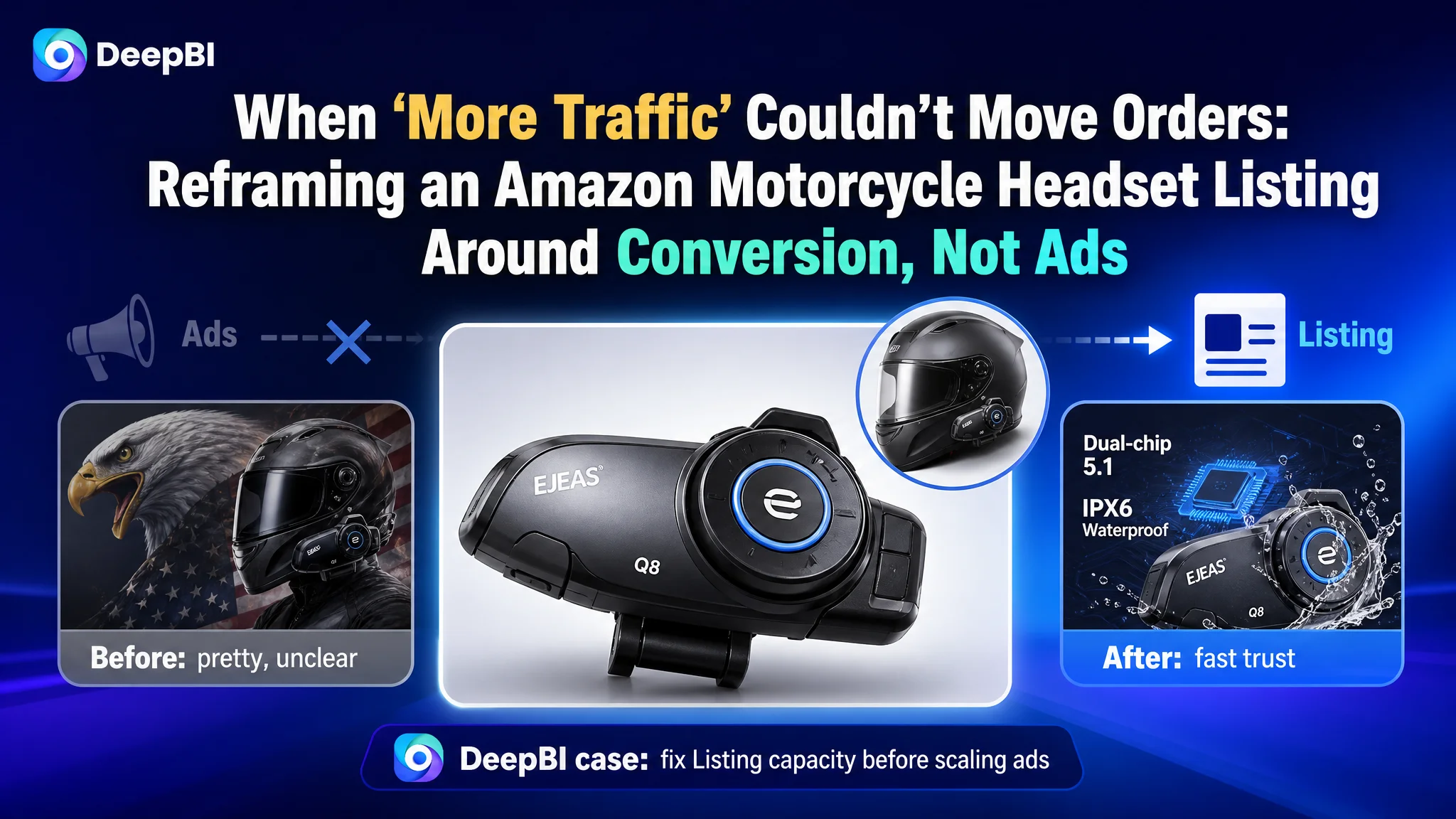
For this Amazon seller in the motorcycle-communication category, the pressure did not come from lack of traffic. Amazon ads were already driving visits to a Bluetooth helmet intercom on the German marketplace, and reviews looked solid. Yet orders lagged behind expectations and ACOS refused to improve in a stable way. The team’s first instinct was to blame ad setup and bidding, and they repeatedly tried to “fix” the campaigns.
DeepBI’s diagnosis went in a different direction. By placing the Listing side by side with a strong benchmark on Amazon, it became clear that ads were not the primary leak. The real constraint was the product-page conversion logic: a technically solid product was being presented with a weak title, underpowered bullet points, and an incomplete decision path from search result to A+ detail. In other words, ad traffic was being consumed by a page that did not fully deserve it.
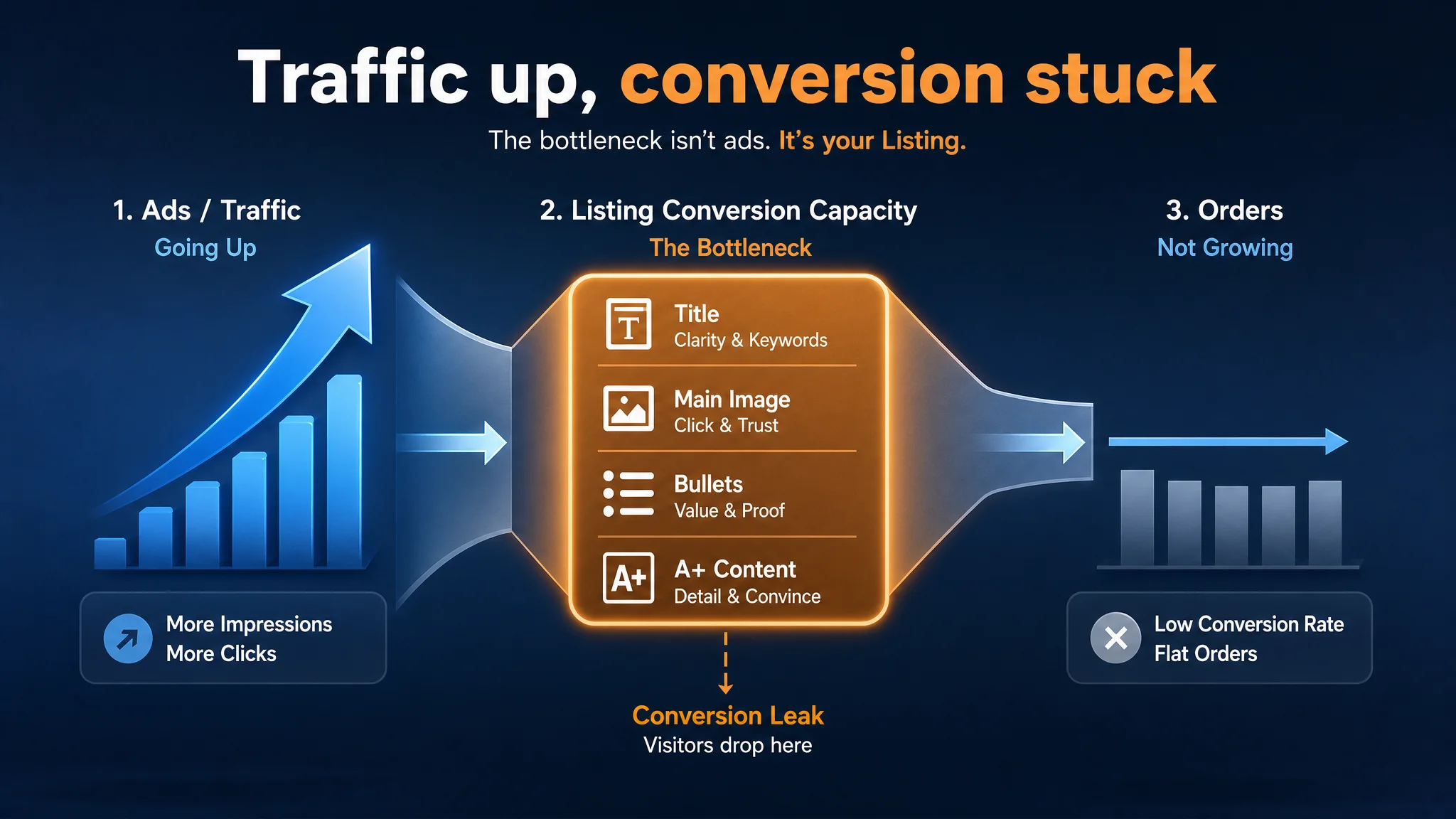
The later optimization work therefore did not start with more granular campaigns, but with the Amazon Listing itself: restructuring the title around high-weight keywords and decision-critical parameters, rebuilding bullet points to focus on outcomes and quantified promises, and tightening the visual story so that the product’s genuine advantages—1000m range, dual‑chip multitasking, strong A+ narrative—could actually show up in the first few seconds. Only after the page’s conversion capacity was repaired did ad spend start to make sense again.
For other Amazon sellers, this case is a reminder that stable ads cannot compensate for a Listing that fails to convert. When ACOS is stubborn and “more traffic” does not translate into more orders, the right move is often to audit title, main image, bullets, and A+ against real benchmark Listings—then decide whether the page, not the campaigns, is the first thing that must be rebuilt.
What the Seller Saw: Stable Traffic, Unstable Returns
This Amazon seller operates a Bluetooth motorcycle-helmet intercom on the German marketplace, a classic functional category where buyers care about:
- Connection stability at speed
- Intercom distance
- Battery life
- Waterproof reliability
- Ease of operation with gloves
From the seller’s perspective, several reassuring signals were already in place:
- Star rating: 4.4 on Amazon, slightly higher than a leading competitor’s 4.3
- Review quality: Front-page reviews with 0% visible negative feedback, versus about 20% negative on the competitor’s first page
- A+ content: Visually rich, full-width scenes, multiple modules covering technology, waterproofing, battery, Hi‑Fi audio, controls, accessories, and user stories
With this baseline, it was natural for the team to assume: “The product page is fine; our issue must be advertising—bids, targeting, budgets.”
So they continued to tweak keywords and bids, trying to squeeze ACOS down and scale traffic up.
The problem: order volume and efficiency did not respond the way classic ad-optimization playbooks would predict.
The Original Misdiagnosis: Treating ACOS as a Pure Ads Problem
The implicit operating model inside the team looked like this:
“Good reviews + good-looking A+ = page is OK. If orders don’t grow, it must be a traffic or bid issue.”
That logic led to a familiar pattern:
- Expanding keyword sets and search-term coverage
- Adjusting bids by small increments
- Testing different campaign types and placements
But there was a blind spot: no systematic comparison of the Listing against a top-performing competitor on Amazon.
Without that, the team missed where their page actually lost the buyer:
- At search-result level (title and main-image click)
- In the first seconds after landing (bullet-point and image logic)
- In the deeper decision stage (A+ and trust-building modules)
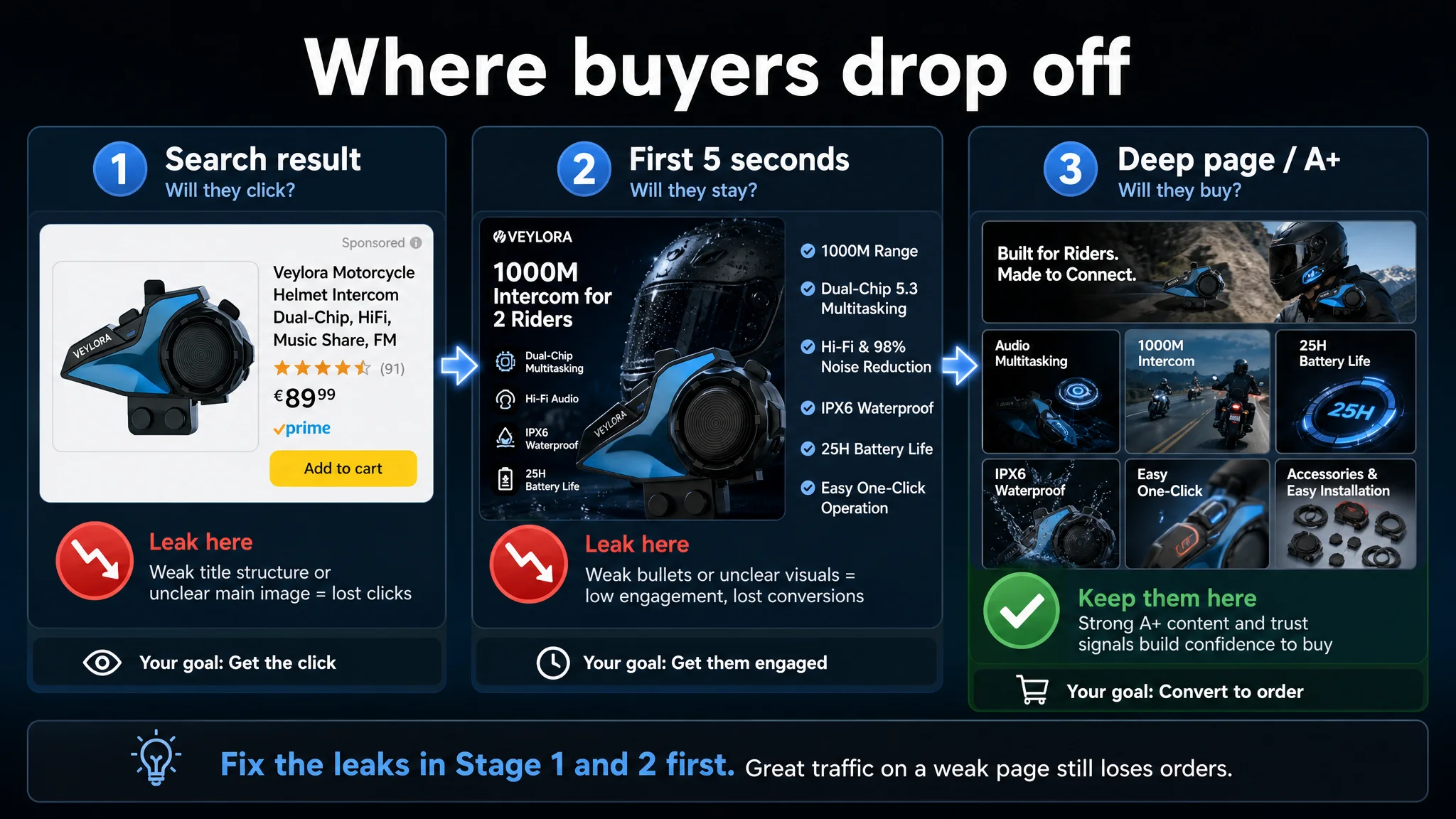
As ad spend increased, the page’s structural weaknesses stayed the same. Ads were amplifying those weaknesses rather than overcoming them.
What DeepBI’s Listing Score Exposed: A Conversion Capacity Gap
When DeepBI scored the Listing against a strong benchmark ASIN in the same motorcycle-helmet headset niche, the results were subtle but telling.
The total score looked “close” — but the wrong parts were weak
- Seller Listing total: 72 / 100
- Benchmark Listing total: 76 / 100
A 4‑point gap doesn’t sound dramatic. Many teams would glance at that and say, “We’re in the same league.”
But the breakdown told a different story:
- Title: Seller: 11, Benchmark: 14, Full Score: 20, Gap: -3
- Main Image + Image Set: Seller: 25, Benchmark: 24, Full Score: 30, Gap: +1
- Bullet Points: Seller: 4, Benchmark: 8, Full Score: 10, Gap: -4
- Detail Page / A+: Seller: 23, Benchmark: 19, Full Score: 25, Gap: +4
- Reviews: Seller: 9, Benchmark: 11, Full Score: 15, Gap: -2
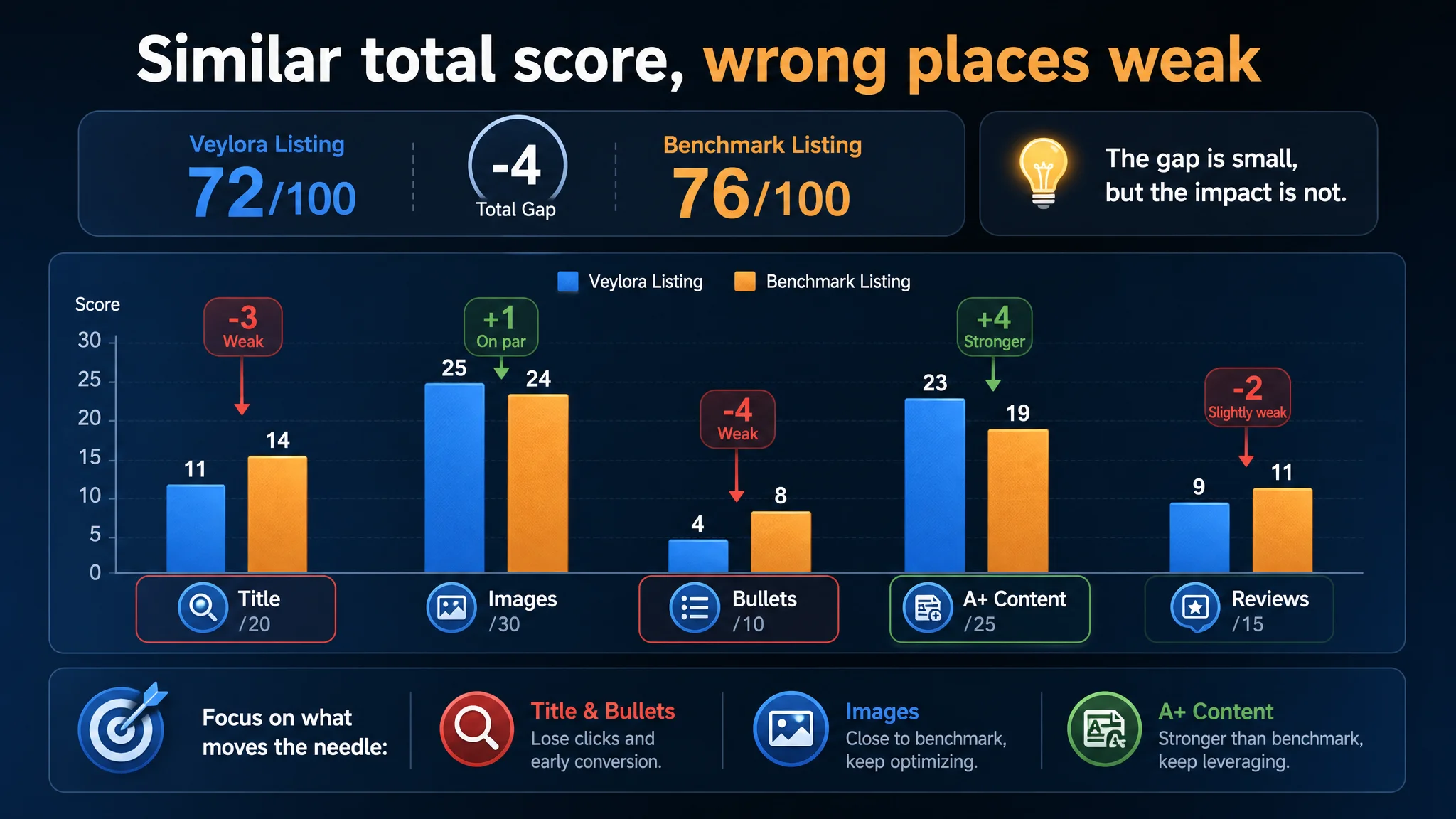
Two critical observations:
1. Search and above-the-fold decision assets (title + bullets) were clearly weaker.
2. Deep A+ content was actually stronger than the competitor.
In plain commercial terms:
The seller had built a convincing story deeper on the Amazon product page, but had not built enough power where the buyer makes the first decision— whether to click, skim, and stay.
So traffic reached the page, but the early-stage narrative could not consistently hold or convert it.
Titles and Bullet Points: Where the Page Lost the Buyer First
Title: The right keywords, but in a weak decision order
The benchmark Listing’s title had a mature structure for Amazon’s German motorcycle-helmet niche:
- Core quantity and product shape up front: “2 x Bluetooth Motorradhelm Headset”
- Technology version and feature: “Bluetooth 5.4, Dual-Chip”
- Quantified key parameters: “500m” intercom range
- Clear usage scenario: “für 2 Fahrer” (for 2 riders)
- Helmet compatibility statement
This created a tight logic:
quantity + product + key technology + hard numbers + scenario
The seller’s title, by contrast, did several things right (brand, product type, dual-chip, multitasking, Hi‑Fi, FM, AI voice) but with two strategic weaknesses:
- Core traffic keyword positioning was suboptimal.
The critical “motorrad helmet intercom” phrase was not front-loaded; it landed later in the title, losing some search-weight advantage.
- Decision-making parameters were underplayed.
There was no early, quantified promise like “1000m intercom,” “20h battery,” or “for 2 riders” in the most valuable first ~60 characters.
In a category where buyers compare multiple Listings side by side on an Amazon search page, those missing pieces cost clicks.
Bullet points: Information without a buying logic
Here the gap was even clearer:
- Seller bullets score: 4 / 10
- Benchmark bullets score: 8 / 10
The benchmark bullets followed a familiar high-conversion pattern:
- Start from core pain points and outcomes (range, battery life, durability)
- Use quantified promises (“20 hours,” “500 meters”)
- Frame each point as a solution (e.g., waterproof for outdoor rides, auto answer for safety)
The seller’s bullets:
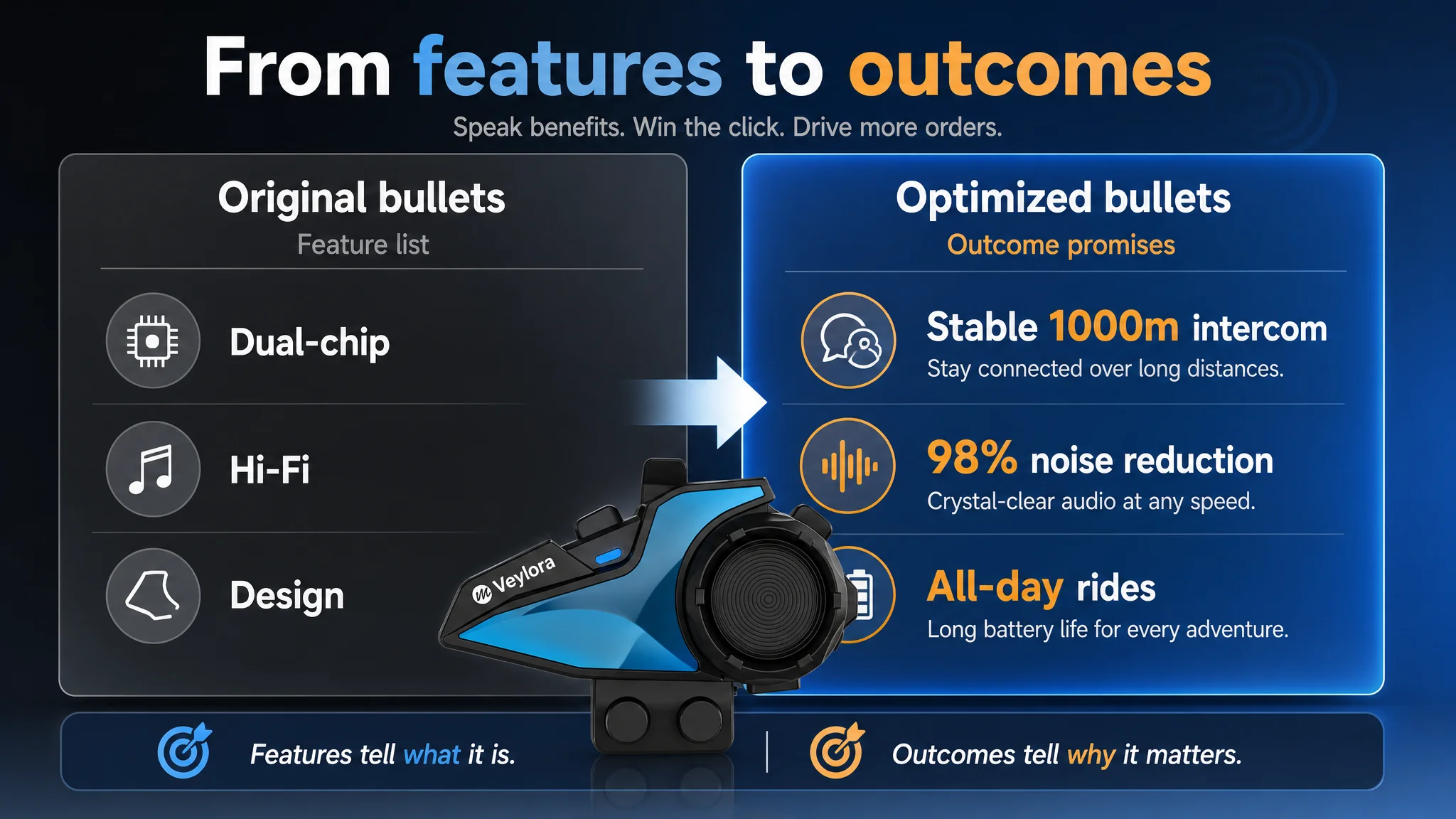
- Focused on functional features (dual chip, audio quality, easy operation, design, entertainment)
- Rarely attached hard numbers or clear before/after outcomes
- Read more like a feature catalog than a buying argument
So when a new visitor skimmed the bullets on mobile, they saw:
- What the device has
- But not clearly what the device does for them, by how much, and in which riding scenarios
This is exactly the type of gap that keeps CVR suppressed even with good reviews and decent traffic.
Visual Story: Strong A+ Depth, Missing Early-Stage Trust Hooks
On the visual side, DeepBI’s benchmarking surfaced a different kind of asymmetry.
In images, the seller did some things better than the competitor
- Rich scenes: riding in the rain, highway intercom, global user collages
- Full chain from tech → function → experience → service
- Strong A+ modules: dual-chip, IPX rating, 25h battery, Hi‑Fi audio, one-click operation, multi-layer noise reduction, FM/music, design and installation, user testimonials
The competitor, by contrast:
- Used more static product shots
- Focused mostly on basic parameters and a few core functions
- Lacked broader usage scenarios and trust-building modules (accessories, installation, social proof)
From a deep-page perspective, the seller’s Amazon A+ actually had higher commercial maturity.
But the main-image set missed key decision hooks
Where the competitor won was clarity of decision logic in the image sequence:
- A complete chain across appearance → audio → noise reduction → durability → chip → battery → voice control
- Simple, direct visualizations of core parameters (e.g., charts, chip visuals)
The seller’s images were visually impressive but less optimized for decision speed:
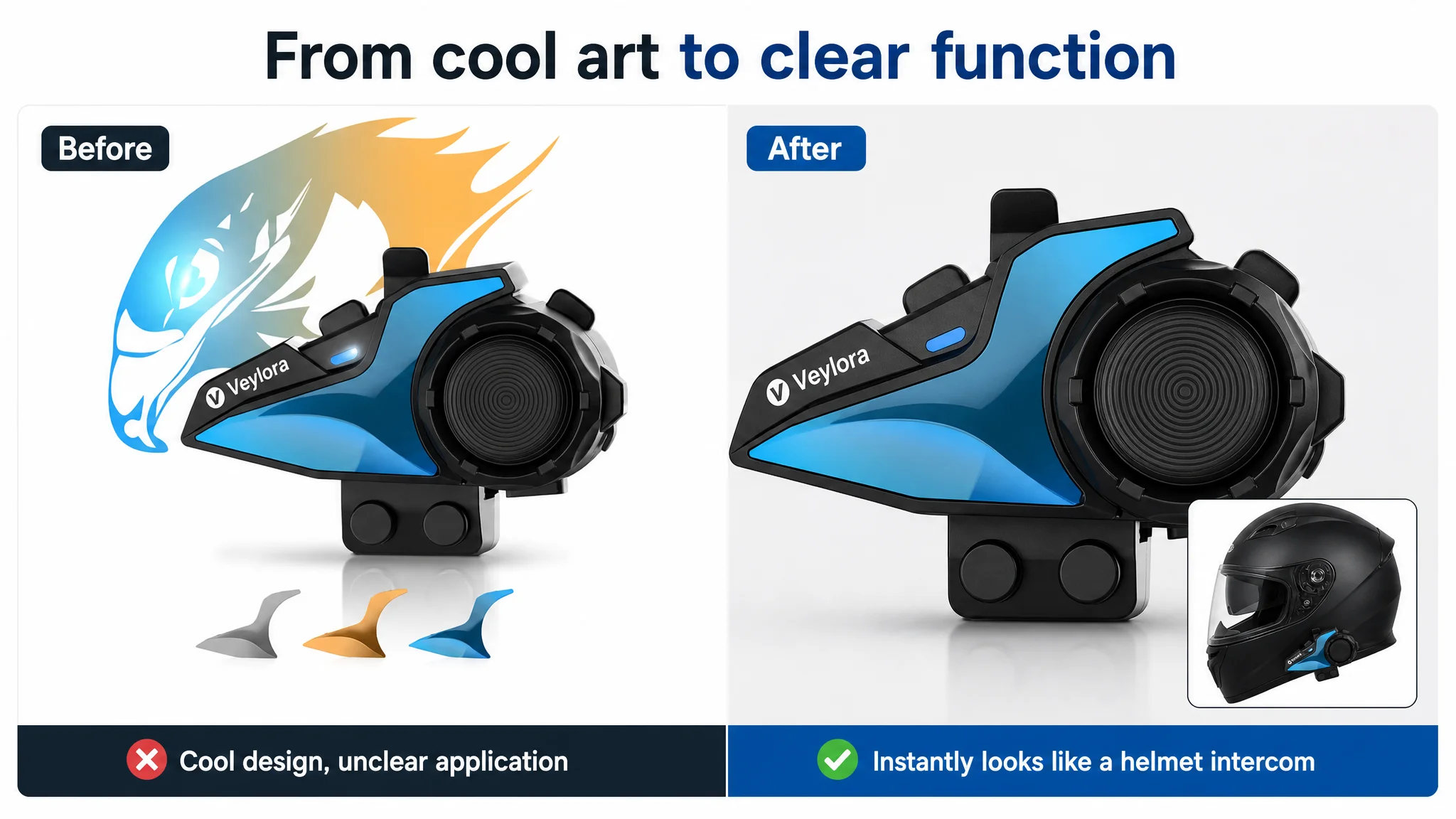
- The first main image leaned heavily on a large eagle-head motif, visually striking but partially overshadowing the actual product and lacking a clear installation view on a helmet.
- Several modules weakened essential functional proof (waterproof, battery, range) compared to what a high-risk, high-decision-cost category like motorcycle communication typically needs.
So:
The page did not lack beauty. It lacked fast, parameter-focused reasons to trust.
That difference matters when ad clicks cost money.
Why This Was a Listing Problem, Not an Ads Problem
From DeepBI’s point of view, the root issue was not keyword lists or bids. It was Listing conversion capacity.
Several signals pointed in the same direction:
- Title and bullets underperforming versus the benchmark in structure and outcome focus
- A+ content stronger, but “buried” deeper in the scroll, while early decision assets remained weaker
- Reviews solid, but review volume smaller than the competitor’s (91 vs 283), so the page could not rely solely on social proof to compensate for weaker top-of-page logic
In this context, continuing to adjust ads first would have done three things:
1. Increased the cost of learning: more money into a page with the same early-stage leaks.
2. Distorted the diagnosis: campaign changes might look like “testing,” but they would be testing ads, not the core sales message.
3. Amplified the wrong outcome: more traffic to a Listing that still failed to surface its strongest advantages (1000m range, dual-chip multitasking, robust waterproofing) in the first 3–5 seconds.
“The real problem was not that ads failed to bring traffic. It was that the page could not convert the traffic.”
So DeepBI’s judgment was to repair the Listing first, then let ads re-test a stronger page.
How the Optimization Was Reframed
1. Rebuild the title around Amazon search and decision logic
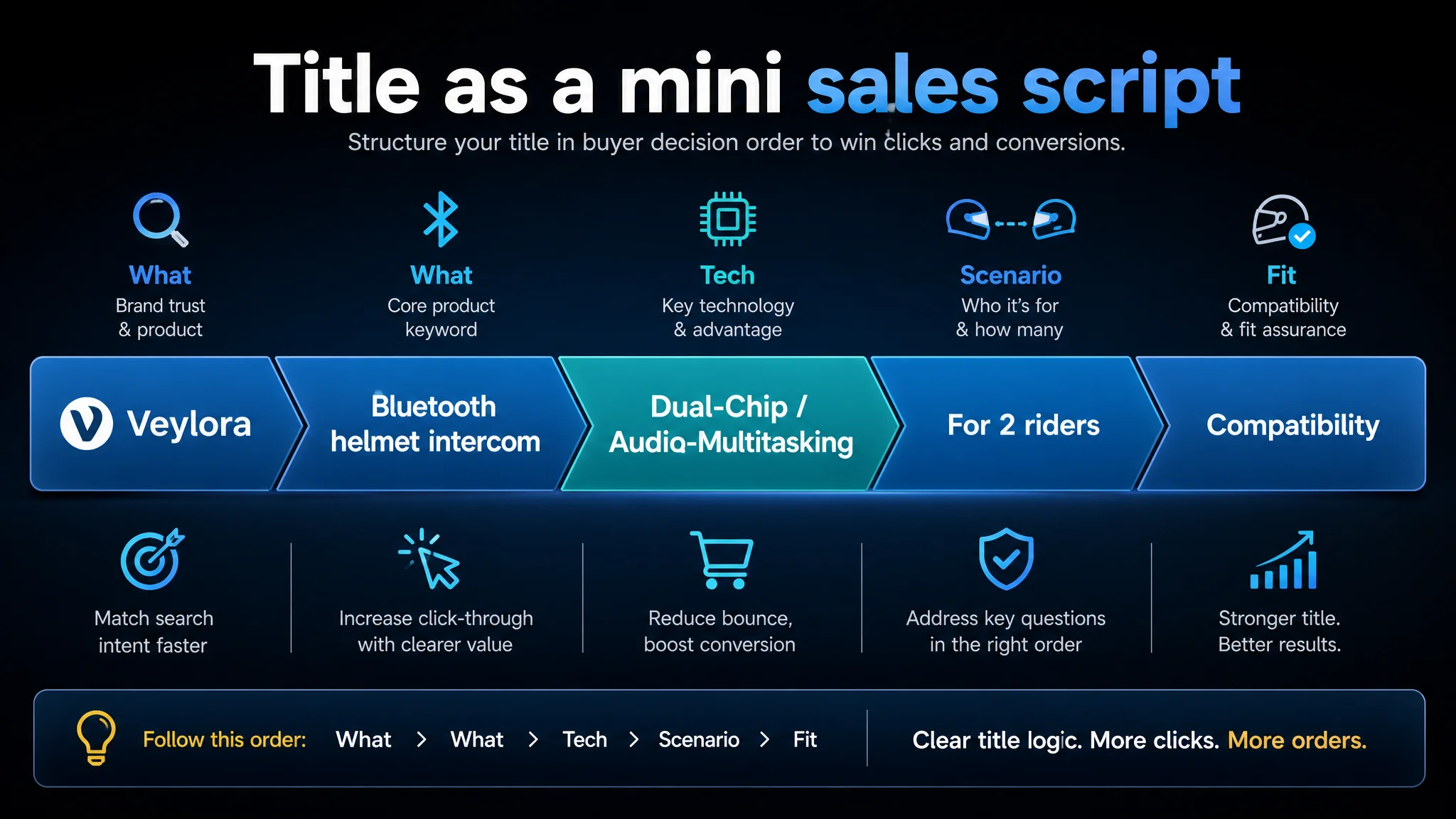
The revised title direction focused on three moves:
- Front-load high-intent search terms:
Bring “Bluetooth” and “Helm Gegensprechanlage / Motorrad Headset Intercom” into the front section of the title to capture A9 search weight and match buyer wording.
- Highlight technology and differentiation early:
Keep “Dual-Chip” and “Audio-Multitasking” visible in the first 60 characters, aligning with the category’s move toward dual-chip as a trust signal.
- Integrate key usage and compatibility signals:
Make “for 2 riders” and “compatible with all helmets” explicit, rather than leaving the number of users and helmet fit to be inferred.
Decision logic: on the search results page, before anyone scrolls the Amazon product page, the title should already answer:
- What is it?
- For whom?
- What is technically special about it?
- Does it fit my helmet and riding style?
2. Rewrite bullet points as outcome promises, not feature lists
The bullet optimization followed a clear pattern:
- Bullet 1: Dual-chip & Bluetooth version → stability and multitasking
Emphasize the ability to mix intercom, music, GPS seamlessly, with a stable high-range connection—directly addressing “connection drops at speed.”
- Bullet 2: Hi‑Fi + quantified noise reduction
Keep the seller’s own 40mm driver and 98% noise reduction advantage, add environmental realism (wind noise, road noise) and high-speed communication clarity.
- Bullet 3: Waterproof + battery → durability and long rides
Tie IP rating and battery life to long-distance and bad-weather riding scenarios instead of listing them as isolated specs.
- Bullet 4: Voice control + auto answer → safety
Fuse “one-click operation” with competitor-style “automatic call answer” and voice assistants, making “no hands off handlebars” the core safety promise.
- Bullet 5: 1000m intercom for 2 riders → social riding freedom
Explicitly contrast the seller’s 1000m ability (double the competitor’s 500m) in language, tying it to real scenarios like touring, skiing, outdoor adventures.
- Bullet 6: Music sharing + FM → emotional and social value
Turn entertainment into a riding-companion story: “no more lonely rides,” “ride in rhythm together.”
- Bullet 7: Design & compatibility → identity + practical fit
Keep the unique eagle-inspired design and interchangeable shells, add soft/hard mic support for different helmet types, and dual-phone connection.
In aggregate, this restructured the bullet section from:
“We have these features.”
into:
“We solve these riding problems, in these quantified ways, for this type of rider, in these scenarios.”
This is exactly the layer that had been missing and was suppressing CVR.
3. Tighten the main-image logic around click and trust, not just aesthetics
DeepBI’s main-image guidance was not “make it prettier,” but:
- Image 1 (primary):
Center the product, 45° angle, on a neutral gradient background, with a clear inset showing it mounted on a matte-black helmet, and a clean text tag like “Helm Gegensprechanlage.” → Goal: instant recognition of product and application at thumbnail size.
- Image 2 (chip + Bluetooth):
Use a dark, circuit-board background with glowing chip cubes labeled “Dual-Chip 5.x” to visually express “tech reliability” and multitasking power. → Goal: visualize the abstract tech claim that buyers can’t see physically.
- Image 3 (1000m distance):
A wide scenic coastal road with two bikes far apart, connected by a glowing arc labeled “1000M.” → Goal: turn a number into a spatial, intuitive promise.
- Image 4 (Hi‑Fi audio):
Product centered with dynamic blue and gold sound waves, “Hi‑Fi Stereo” label. → Goal: upgrade from decorative shapes to category-standard Hi‑Fi visual language.
- Image 5 (waterproof):
High-contrast shot with water droplets splashing off the device, labeled “IPX6 wasserdicht.” → Goal: hard proof of outdoor robustness that matches buyer risk perception.
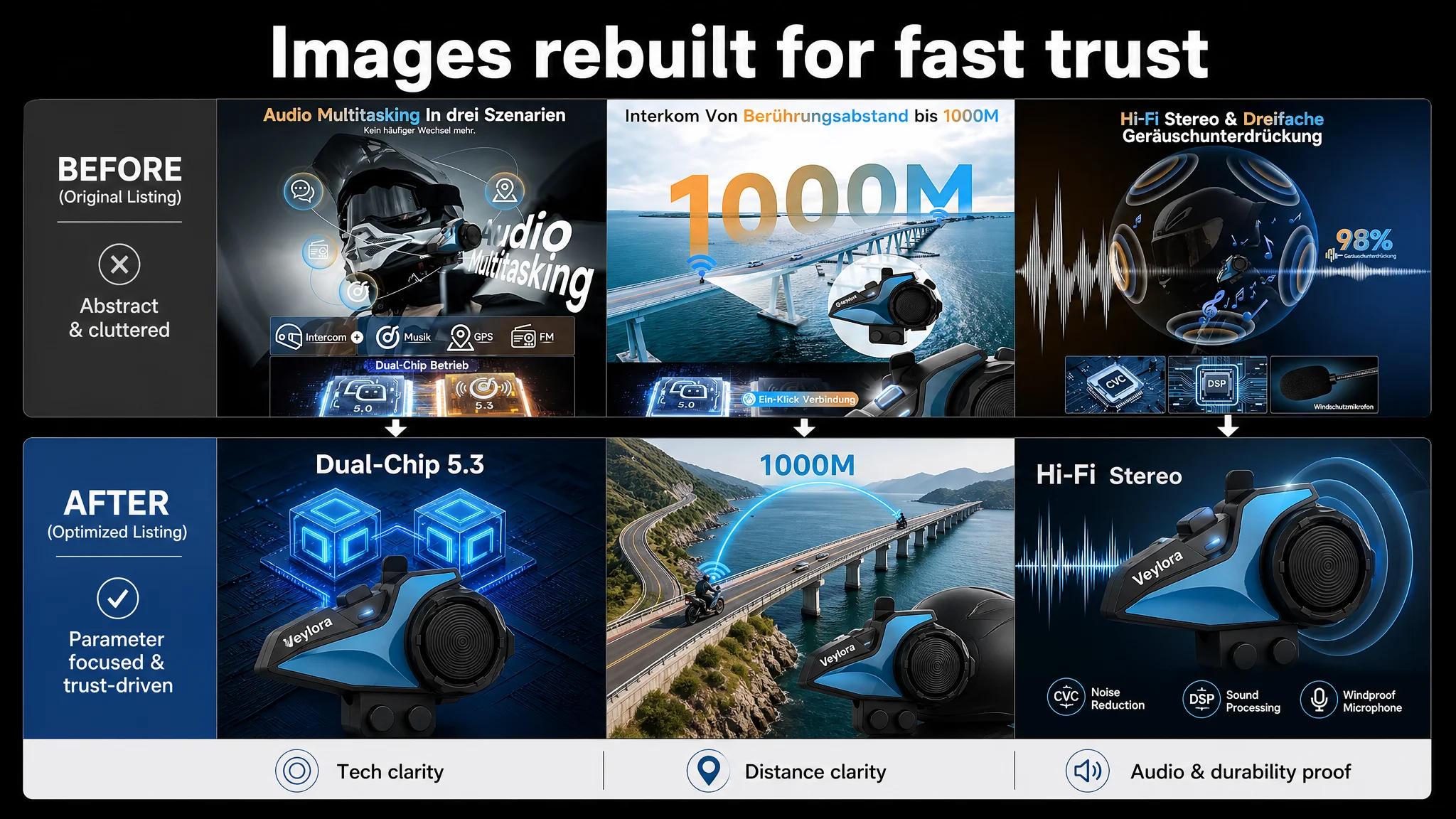
These changes didn’t alter the product itself; they changed how quickly a buyer could conclude:
- “This is clearly a helmet intercom.”
- “It’s built for distance and weather.”
- “It looks technically serious, not just ‘cool’.”
4. Use A+ to press the advantage, not to fill space
Since the seller’s A+ was already richer than the competitor’s, the task was not to “add more,” but to align modules with decision priorities:
- Lead with dual-chip multitasking in a visually tight module that shows chips + helmet + simultaneous GPS/music/intercom.
- Make 1000m range a hero scenario, with a high-mountain road and long-distance connection arc.
- Use Hi‑Fi and triple-noise-reduction modules to contrast noisy vs clean waveforms, anchored by the 40mm driver.
- Emphasize the big physical knob and glove-friendly operation in a dedicated visual, something competitors underplay.
- Showcase the eagle design and swappable shells as a lifestyle/identity element, not an afterthought.
- Clarify installation and accessories with a clean “family shot + step-by-step” module to reduce post-purchase anxiety.
This sequence turned the A+ from a visually rich collage into a structured argument:
Stable tech → long distance → clear sound → safe and easy control → personal style → low installation risk.
Which is exactly the order most riders will evaluate an unknown brand’s helmet communicator.
How the Operating State Changed
Because the case material does not include post-optimization numbers, we won’t fabricate CTR or CVR data. Instead, we focus on how the risk and controllability of the Listing changed.
After the Listing was reframed:
- The title and bullets began carrying their weight.
The early-stage content stopped relying entirely on reviews and A+ to close the sale.
- The main image and image sequence started to justify the click.
Clicks from Amazon ads were more likely to land on a page that immediately signaled range, tech, and durability—reducing the drop-off from “page view” to “consideration.”
- A+ content was no longer overcompensating for weak above-the-fold logic.
It became the second layer of persuasion, not the first place where the product finally made sense.
- Advertising became diagnosable again.
Once the Listing’s conversion logic was repaired, changes in ACOS and CVR became far more attributable to campaign decisions rather than hidden page defects.
From a business perspective, the most important shift was in understanding:
Ads are not a magic patch for a weak Listing. They magnify whatever the Listing already is— converting or non-converting.
What Other Amazon Sellers Can Take from This Case
Several lessons are broadly applicable beyond motorcycle headsets:
1. A small total Listing-score gap can hide a big structural problem.
A 4‑point difference overall (72 vs 76) masked serious weaknesses in title and bullets. Always look at where the points are lost.
1. Good reviews and strong A+ do not guarantee a healthy funnel.
If title and bullet logic are weak, you will keep paying for traffic that never sees your best arguments.
1. Benchmark Listings are not just aesthetic references; they reveal decision logic.
Compare structure: which attributes are quantified, in what order, at what depth of the page?
1. Fix conversion capacity before scaling ads.
Until the Amazon product page can reliably convert cold traffic, increasing bids or budgets is just raising your cost of learning.
1. Treat title, main image, bullets, and A+ as one system.
The seller in this case had already built a strong A+; the breakthrough was aligning the rest of the page to the same logic.
In DeepBI’s view, the real value is not in producing yet another pretty hero image, but in helping sellers see where their Amazon Listing is actually leaking—and in what order to fix those leaks so advertising finally starts working for, not against, the business.