

Many Amazon sellers in musical instruments have the same instinctive reaction: when ACOS climbs and orders feel “not proportional” to traffic, the first suspect is always advertising. This Amazon seller of a multi-effects guitar pedal was no exception. They kept tuning bids, keywords, and campaigns, assuming the problem was “ad efficiency.” But once we put their Amazon Listing against a direct benchmark in the same pedal niche, a different picture emerged: ads were doing their job; the product page was not.
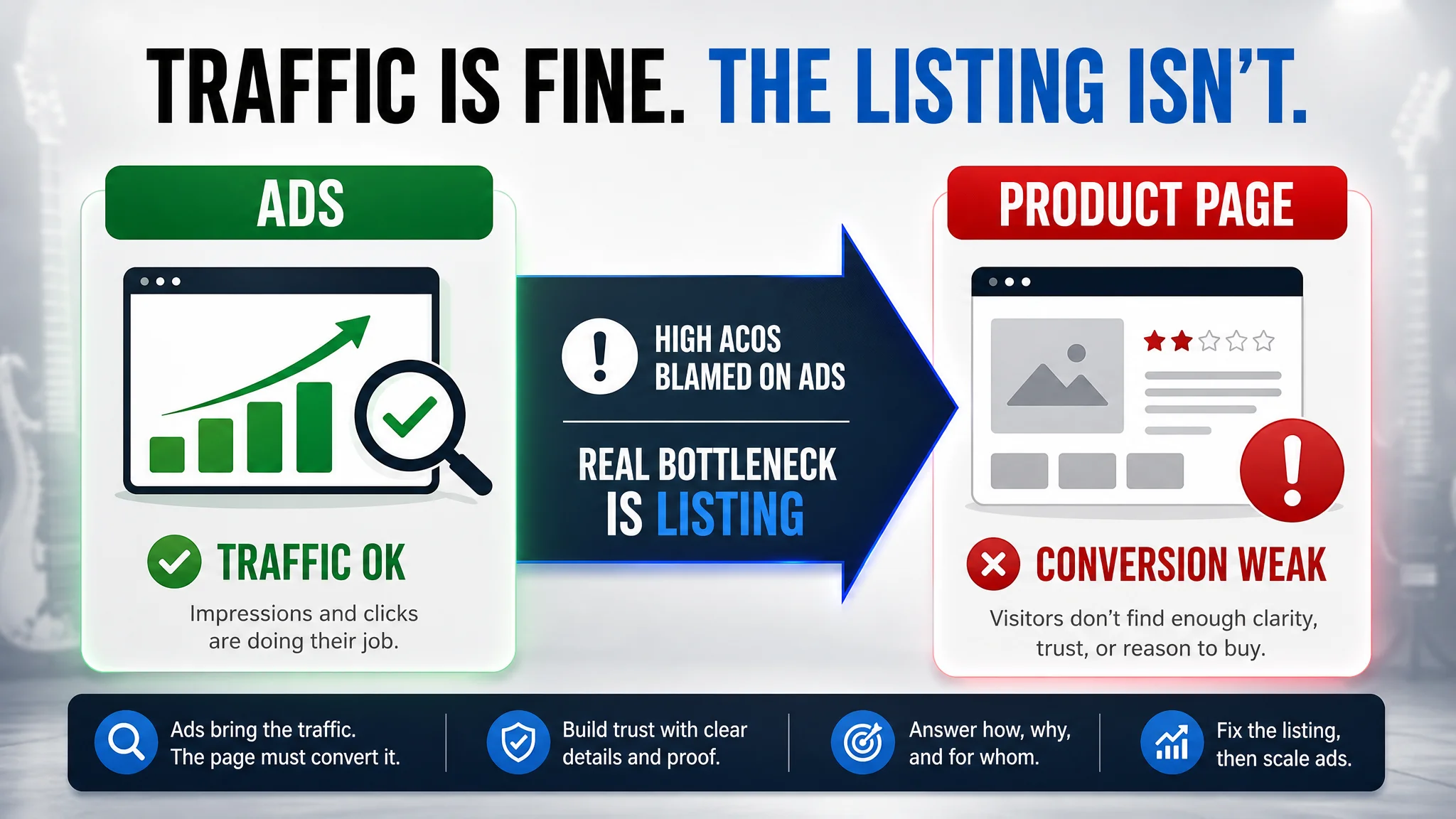
This case is about an Amazon Listing conversion problem hiding behind ad pressure. The seller believed they needed “better ads” and “more exposure,” while the real issue was that their title, main images, A+ content, and review structure were not building enough trust for a technical, decision-heavy product. DeepBI’s diagnosis showed that with a total Listing score of 74 vs. a benchmark at 81, the gap was not on traffic, but on how the page carried that traffic toward a purchase.
The later optimization did not start from campaigns. It started from page logic: reconstructing the first five images around clear functional storytelling, tightening the title around high-value search terms (Delay, Reverb, Distortion, Overdrive, IR, AMP models, Bluetooth, recording), and reworking A+ modules to visualize hardware controls, modes, and signal chain. Once the page began to explain itself like a professional tool instead of a generic “portable gadget,” ad traffic finally had somewhere credible to land.
For other Amazon sellers, especially in technical categories, this case is a reminder: if ACOS is stubborn and CVR feels weak, you may not have an advertising problem. You may have a product-page problem that ads are simply amplifying. Before pouring more budget into campaigns, ask whether your Amazon Listing actually deserves more traffic.
Amazon Ads Were Not Failing. The Page Was Consuming the Traffic.
The product is a compact multi-effects guitar pedal on Amazon US: 9 AMP models, 8 IR cabs, built-in battery, Bluetooth playback, recording support — on paper, a strong value proposition.
The seller’s operating pressure came mainly from rising ad costs:
- Traffic volume was not the core issue.
- Advertising was delivering impressions and clicks.
- But orders and ACOS were not behaving the way previous experience suggested.
Internally, the team framed this as an “ad optimization” problem: maybe keyword coverage was incomplete; maybe bids were not accurate enough; maybe campaigns needed further segmentation. They kept iterating at the campaign level, but the outcome did not fundamentally change.
DeepBI’s first step was not to touch the ads, but to quantify the Listing itself against a category benchmark — another multi-effects pedal that was clearly winning the market.
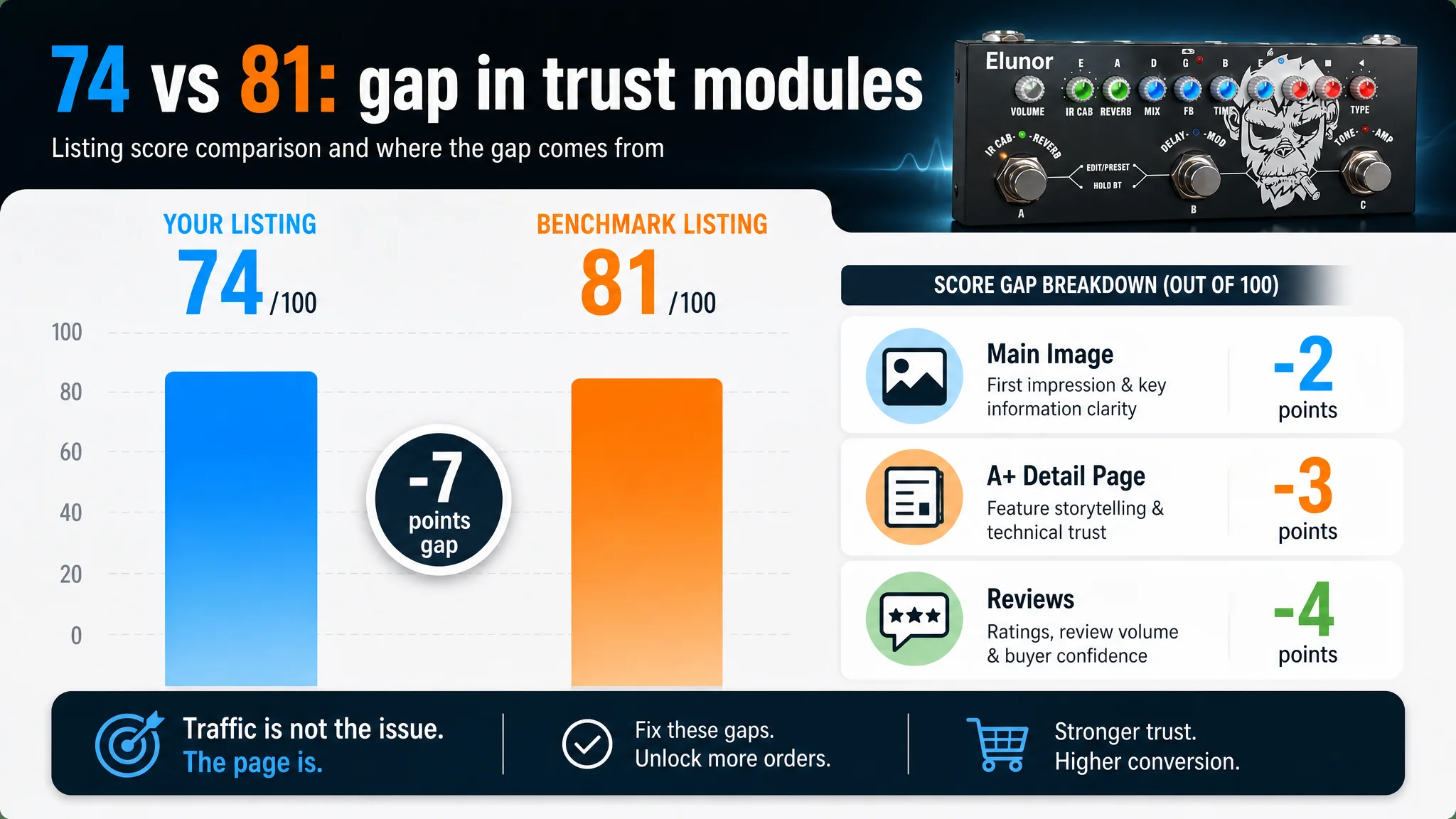
The score gap was not dramatic but meaningful:
- Target Listing total score: 74/100
- Benchmark Listing total score: 81/100
- Gap: -7 points
More importantly, the gap集中 appeared in the exact modules that decide whether technical buyers trust what they see:
- Main image: -2 points
- A+ detail page: -3 points
- Reviews: -4 points
The bullets were actually stronger than the benchmark (+3 points), which meant the problem was not “no selling points.” The problem was how those selling points were being surfaced, structured, and visualized.
“The real issue was not lack of traffic. It was that the page did not convert the traffic — especially technical, high-intent buyers.”
The Real Constraint Was Listing Conversion Capacity
When we broke down each dimension, the conversion bottleneck became very specific.
Title: Strong Information, Weak Market Logic
On the surface, the title looked “complete”:
- Core keyword “Multi Effects Guitar Pedal” was front-loaded.
- It highlighted “8 IR Cab,” Bluetooth wireless, rechargeable, portable.
Yet, compared to the benchmark title, several subtle but critical weaknesses appeared:
1. Brand structure
The benchmark followed the mature Amazon pattern: Brand → Core product → Core function → Effect types → Supporting features. The target Listing did not fully leverage this “brand + category” convention, which matters especially in technical categories where trust and recognition accumulate over time.
1. Effect keywords and IR positioning
The benchmark explicitly packed high-value long-tail terms into the title: “Delay, Reverb, Distortion, Overdrive,” plus “with IR Loading, 9 AMP Models.” These terms are not just “nice to have” — they are often the exact words buyers type into Amazon.
1. Technical precision
The benchmark spelled out “Bluetooth 5.0.” The target Listing only said “Bluetooth Wireless,” which reads less precise and slightly less professional to technical users.
In short, the title had content, but not fully aligned with how high-intent guitarists search and scan. It leaned on “rechargeable, portable” rather than on the specific sound and recording capabilities that serious users care about first.
DeepBI’s reframing: The title was not “wrong,” but it was not anchoring the product where the highest-conversion intent lives: multi-effects + AMP models + IR + core FX + recording.
This Product Page Did Not Lack Selling Points. It Lacked Trust Signals in the Right Places.
Main Images: The Wrong Story in the Right Slots
For technical hardware like a guitar pedal, the first five images are not just “visual decoration.” They are the compressed user manual that must answer three questions as fast as possible:
1. What is this device in one glance?
2. Can it replace several pieces of gear I already own?
3. Will it actually work the way I expect, without being a headache?
On the target Listing, the main images were doing several things, but not in a way that made buyers feel “this is my all-in-one tool.”
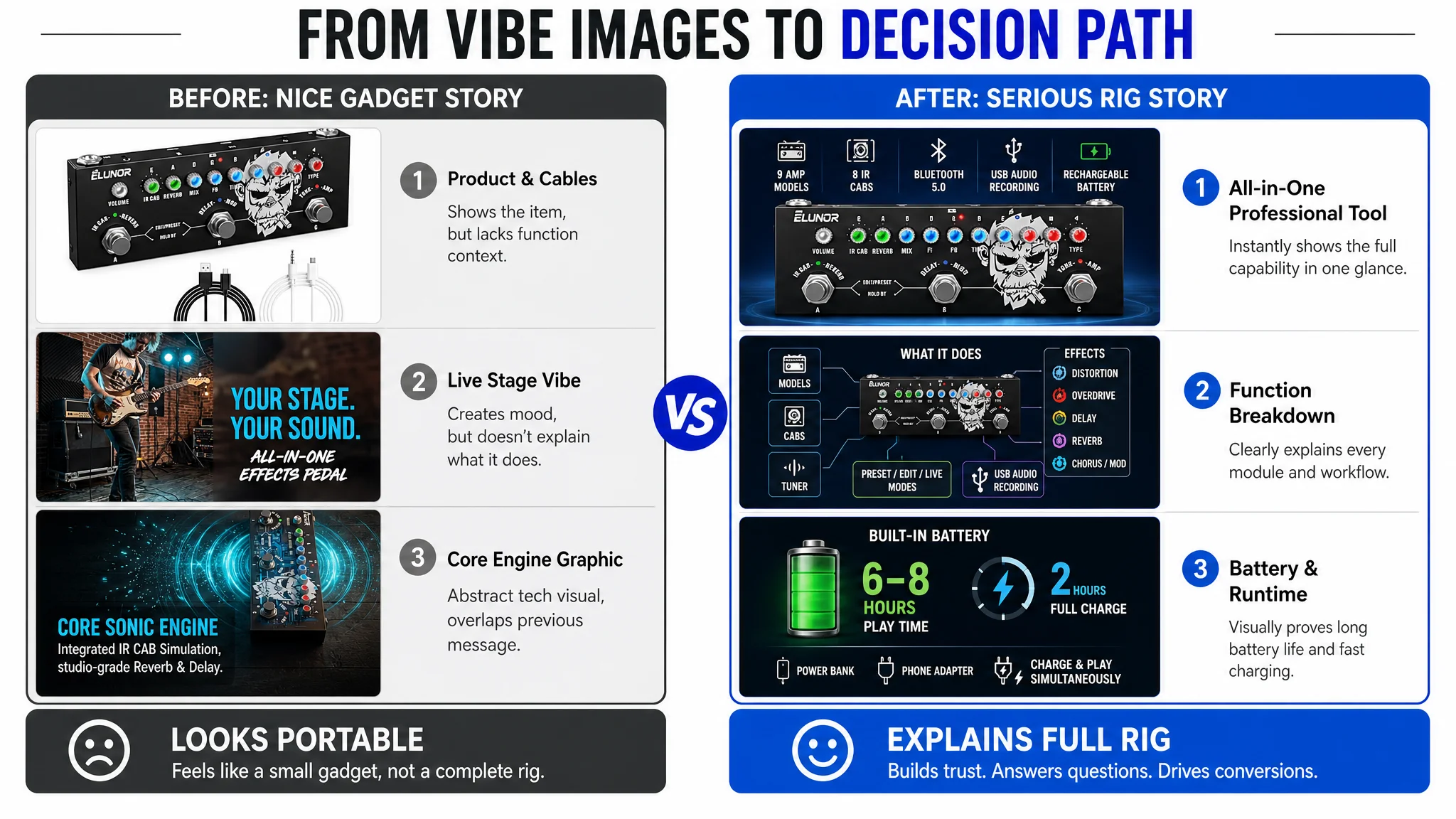
- Image 1: Showed the product and cables, but the first impression was “small portable electronic device,” not “full-featured guitar rig in a box.” There was no visual shorthand for AMP models, IR cabs, Bluetooth, or sound card capabilities.
- Image 2: A performance scene delivered a “professional vibe,” but did not answer the rational question: what exactly can this replace? What modules are built-in?
- Image 3: An abstract acoustic engine graphic with repeated wording (“IR CAB Simulation, Reverb & Delay”), overlapping the previous image rather than attacking a fresh pain point.
- Image 4: A footswitch shot with colorful backlit knobs — a nice gesture toward usability, but the text focused on “color backlit knobs” rather than the core logic of mode switching.
- Image 5: A mixed scene/information graphic where Bluetooth, headphone use, and recording were present but not sharply framed as a “silent practice & recording solution.”
The benchmark Listing, by contrast, used its images as a disciplined decision path:
- One image purely for “9 AMP Models & 8 IR CAB” — what’s inside.
- One image to visually tear down the functions and effects.
- One image to hit battery & runtime with explicit numbers.
- One image to explain live vs preset mode with hands-on interaction.
- One image to visualize the effect chain from tuner to cab.
“Advertising does not only amplify advantages. It can also amplify a page’s existing defects.”
On the target Listing, that meant ad traffic was being sent into a page where the main images did not fully clarify function, did not strongly prove runtime, and only loosely anchored practice and recording scenarios.
A+ Content: Strong Features, Weak System Story
In the A+ / detail page, the seller had already invested in multiple modules:
- Brand image
- Product close-ups
- Wireless and recording explanations
- Battery and charging
- Top-panel interface graphics
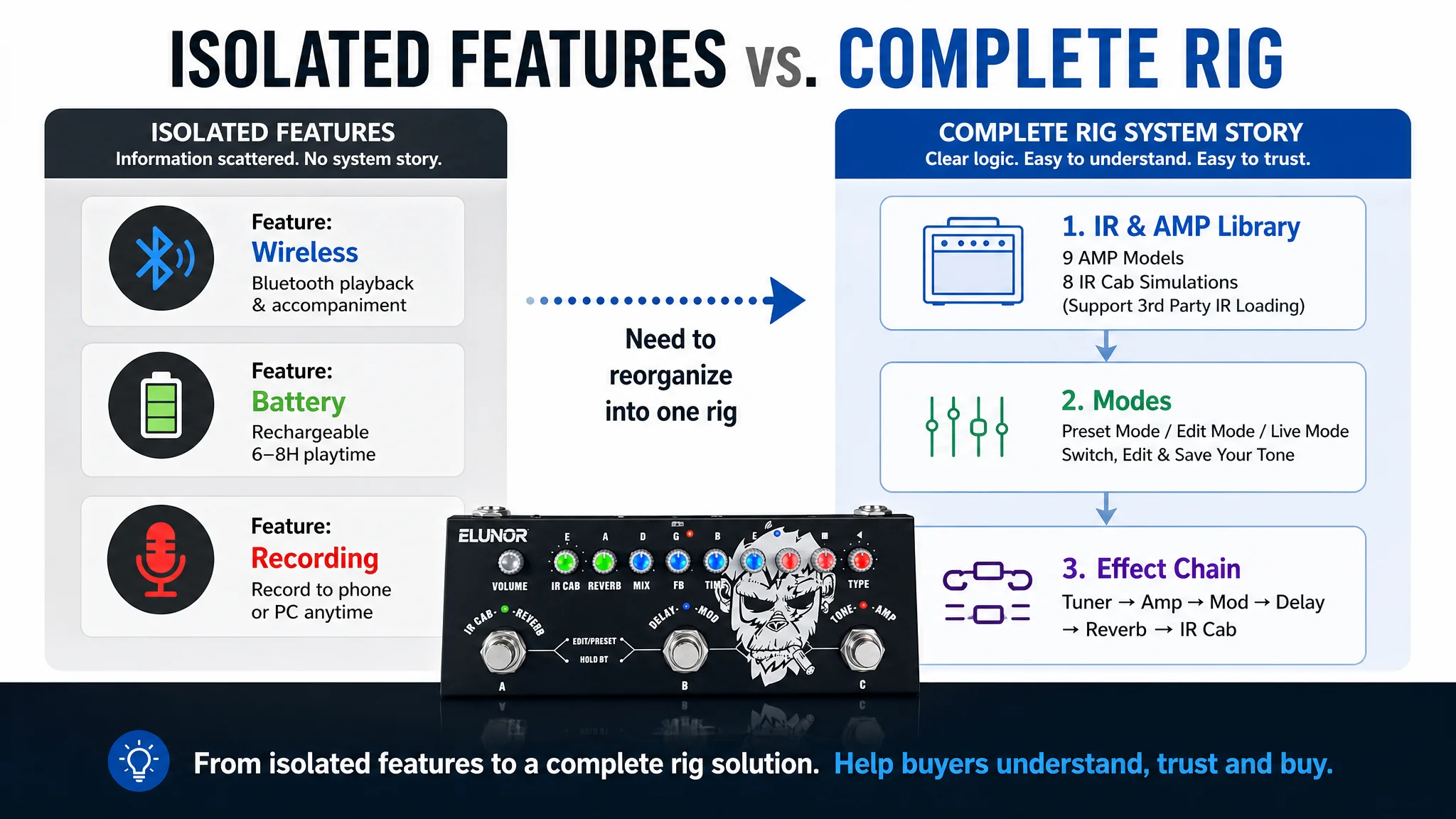
But when we compared this with the benchmark A+ layout, one major issue became obvious: the page stayed at “isolated features,” while the benchmark told a “complete system” story.
The benchmark’s A+ content:
- Prominently highlighted “8 IR CAB SIMULATIONS” and “9 PRESET PREAMPS” with clear labels.
- Showed a LIVE MODE ↔ PRESET MODE diagram, with fingers operating switches and LEDs lighting up — a direct visual answer to “How do I actually use this on stage?”
- Ended with an effect-chain visual: TUNER → AMP → MOD → DELAY → REVERB → CAB.
For advanced users, this is the ultimate reassurance: “This can be the center of my rig.”
The target Listing:
- Mentioned functions, but lacked specific IR or AMP library visuals that would convince serious users.
- Described button combinations for features, but did not visually show real-time feedback like LED changes, making the device feel potentially “menu heavy” or intimidating.
- Did not present a single, clear effect-chain diagram, leaving functions floating as separate blocks rather than one integrated system.
In a category where buyers are evaluating “Can this be my all-in-one solution?”, this missing narrative becomes a direct conversion leak.
Reviews: A Trust Gap That Ads Cannot Fix
On reviews, the numbers were very clear:
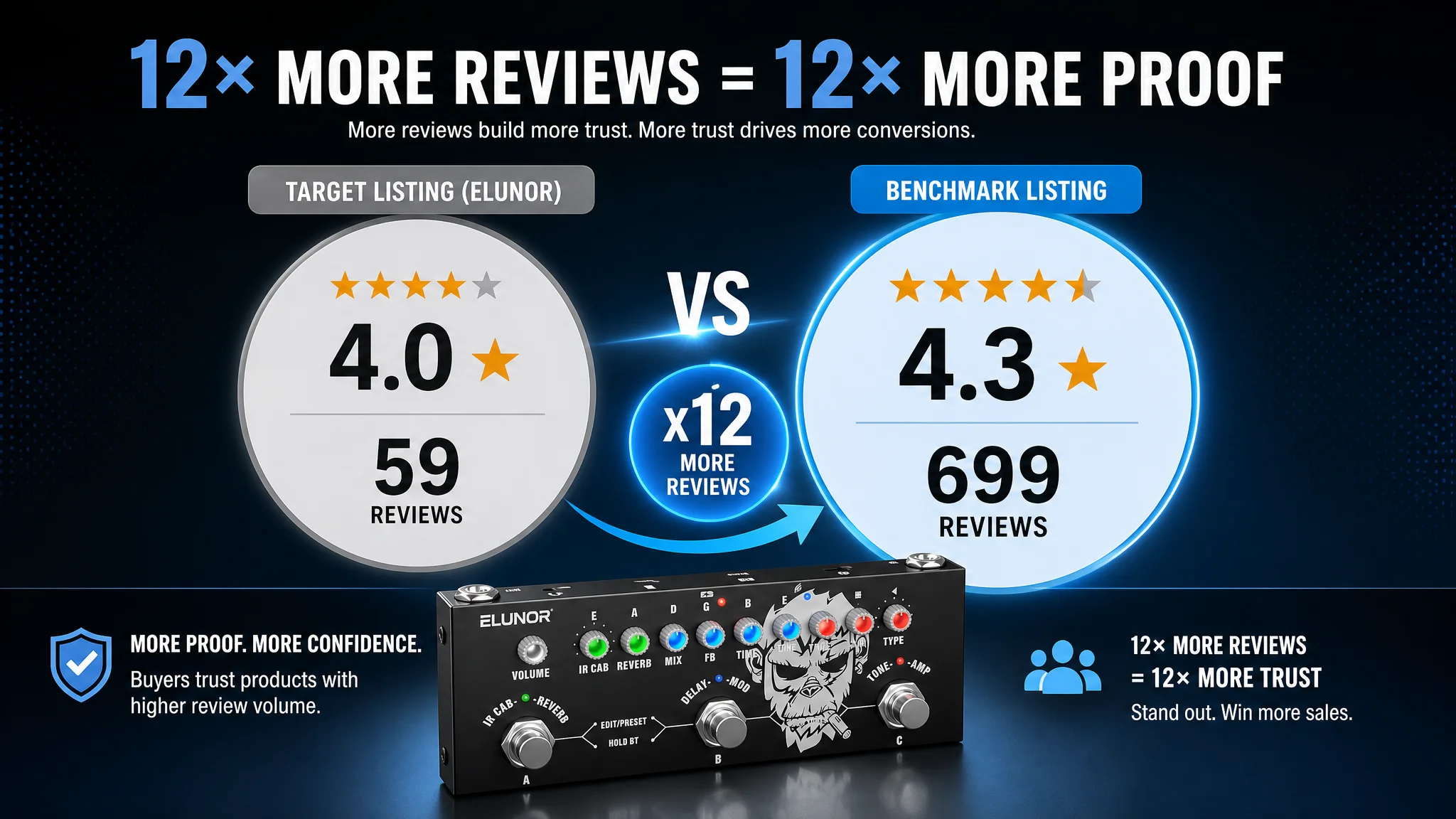
- Target Listing: 4.0 stars, 59 total reviews
- Benchmark Listing: 4.3 stars, 699 total reviews
The rating gap of 0.3 is minor. The volume gap is not:
- The benchmark had nearly 12x the review count.
For a technical product with multiple modes, IR loading, recording, and Bluetooth, review volume functions almost like a certification: “Hundreds of people with rigs like mine have already tested this.”
The target seller had some detailed reviews, but not enough scale to automatically neutralize buyer anxiety. In such a scenario, the product page has to work even harder to compensate with visual clarity and professional storytelling.
Instead, the page was relying on:
- A moderate rating
- Limited review volume
- And page content that only partially proved its professional-grade capability
Under this combination, pumping more ad traffic simply increases the number of buyers who leave without buying — and who may not come back.
Why DeepBI Did Not Keep Tuning the Ads First
From a pure ad-operations standpoint, the seller’s instinct was understandable: continuously tweak campaigns, improve keyword segmentation, expand match types, and aim for a lower ACOS.
DeepBI’s judgment was different:
- Root cause: The Listing could not fully convert mid-to-high-intent traffic, especially critical buyers who care about AMP models, IR content, modes, and recording workflows.
- Immediate risk: Every additional dollar in ads was sending more traffic into a page that did not answer core questions clearly enough. ACOS would remain uncomfortable because CVR was constrained by page logic, not bid logic.
So the decision path became:
1. Stabilize ad structure rather than chase micro-optimizations.
2. Prioritize Listing conversion capacity — especially main images and A+ content.
3. Only after the page’s sales logic improved, revisit scaling ads.
In other words, the team had to stop using ads as the primary lever and treat ads as the amplifier of an already credible, persuasive Listing.
How DeepBI Rebuilt the Page’s Sales Logic
The goal was not to “beautify” the page but to rebuild the decision path for buyers.
1. Retooling the Title Around High-Intent Search
Suggested direction for the new title:
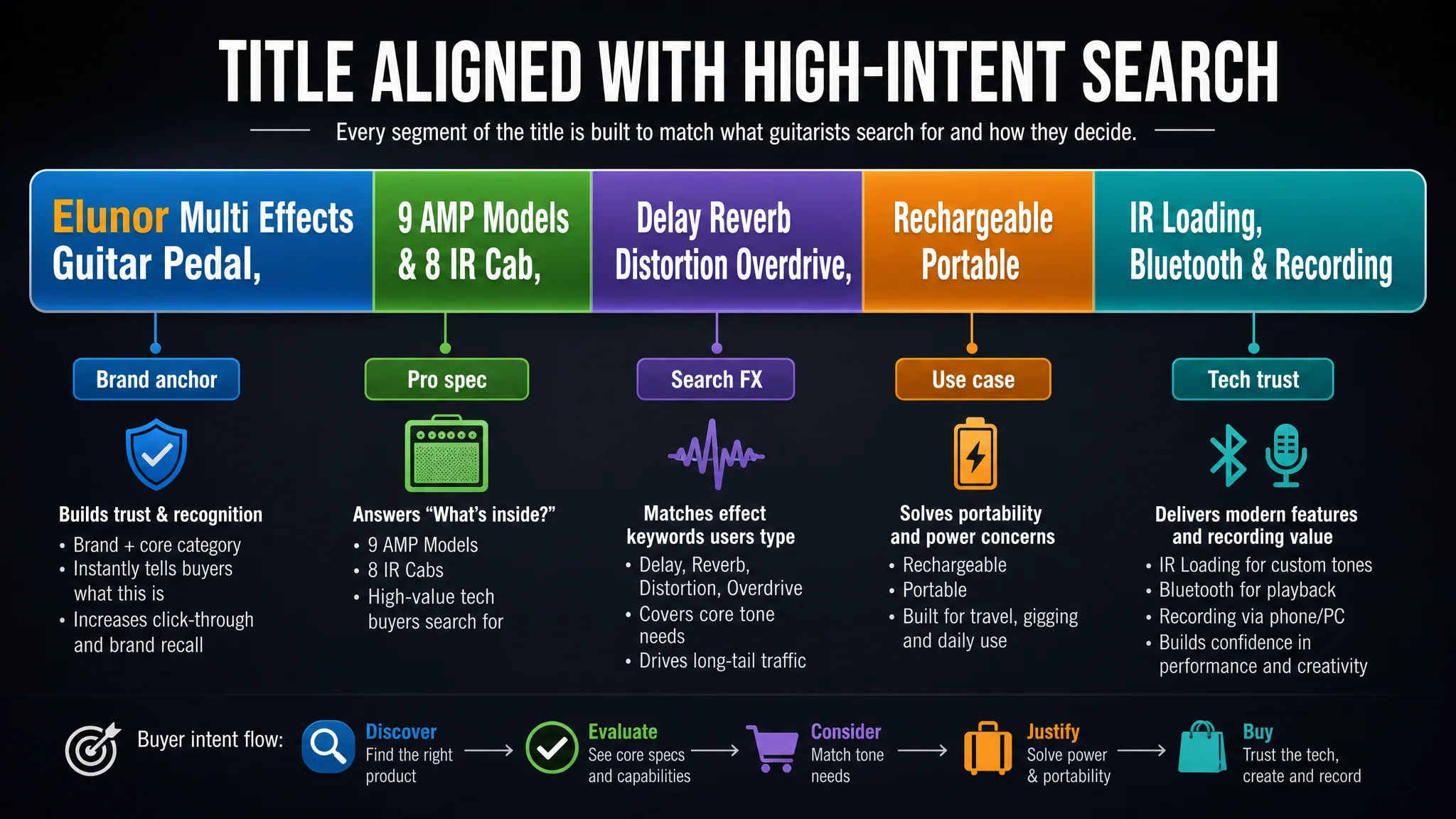
Brand Multi Effects Guitar Pedal, 9 AMP Models & 8 IR Cab, Delay Reverb Distortion Overdrive, Rechargeable Portable Guitar Effects Processor, Support 3rd Party IR Loading, Bluetooth & Recording
Logic:
- Keep the structure: Brand + Multi Effects Guitar Pedal front and center.
- Immediately follow with 9 AMP Models & 8 IR Cab — the professional backbone.
- Explicitly add Delay, Reverb, Distortion, Overdrive to tap high-weight long-tail searches.
- Highlight Recording and Bluetooth as key usage scenarios, not just accessories.
- Maintain “Rechargeable Portable” but subordinate it to sound and recording capability.
This was less about stuffing keywords and more about aligning the title with how serious guitarists search and evaluate options.
2. Reframing Bullet Points as a Persuasion Path
Originally, the target Listing’s bullets already leaned toward user scenarios and final benefits — “anytime creation,” “silent practice,” “professional tone,” “perfect travel guitar pedal.” In fact, compared to the benchmark, their bullet logic was more user-centric.
DeepBI’s adjustment was to tie that user-centric narrative back into technical credibility:
- BP #1: Combine professional tone positioning with explicit mention of the 9 AMP models & 8 IR cabs and core effects (Distortion, Overdrive, Delay, Reverb).
- BP #2: Clarify how third-party IR loading works (USB cable, software), reducing fears about complexity.
- BP #3: Spell out Preset, Edit, and Live modes, including default presets (Lead, Rhythm, Clean) and their flexibility.
- BP #4: Integrate built-in battery runtime and portability explicitly (2-hour full charge, 6–8 hours playtime) and use cases like street busking and travel.
- BP #5–6: Consolidate Bluetooth playback, PC/phone recording, silent practice with headphone output, and define the intended users from beginners to gigging players.
The key was to keep the existing “benefit-driven tone,” but re-anchor each benefit to a concrete technical or workflow claim.
Main-Image Strategy: From “Nice Gadget” to “Serious Rig”
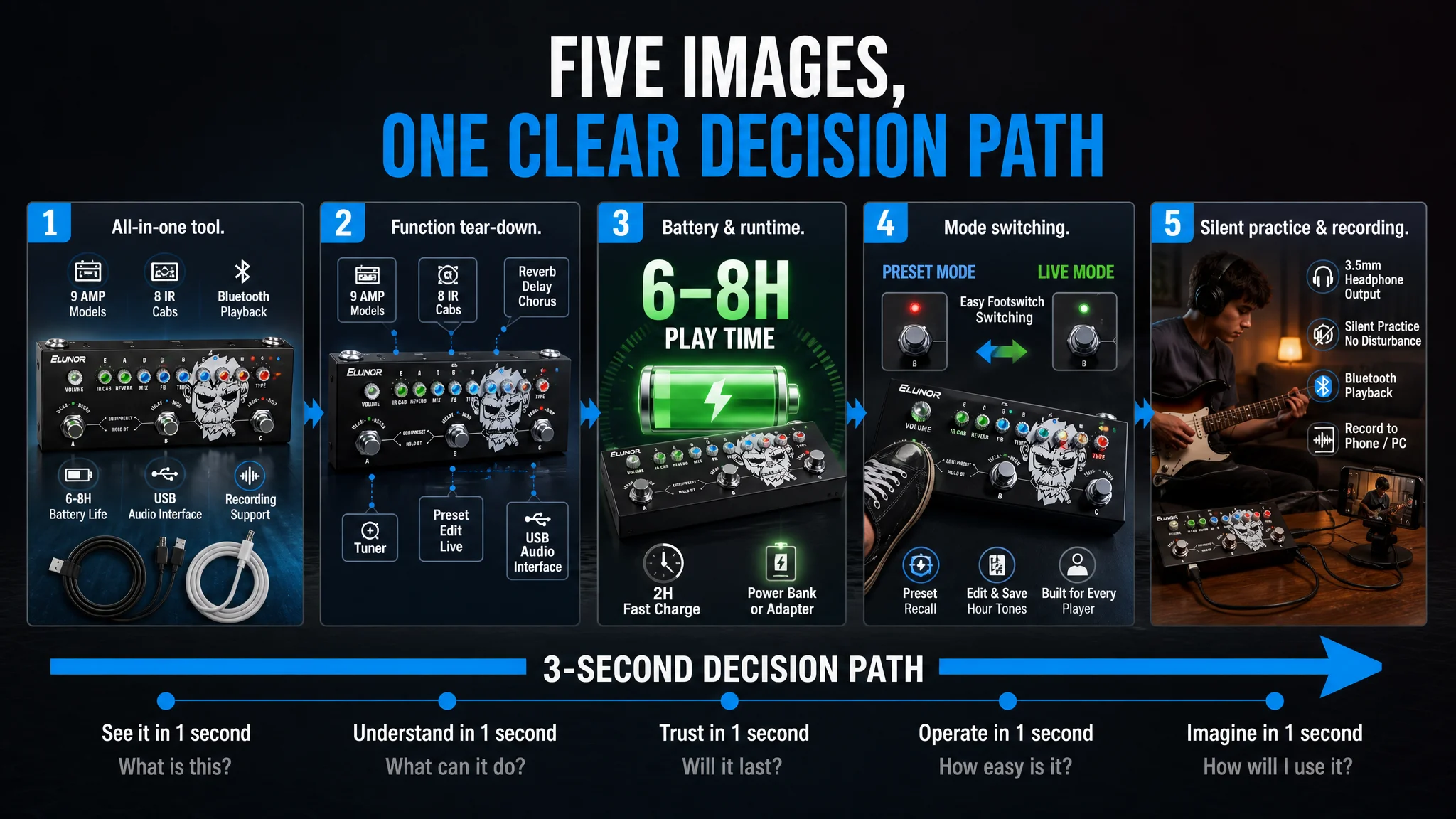
DeepBI’s main image recommendations followed a very strict narrative order.
Image 1: “All-in-One Professional Tool” First Impression
- Keep the clean product + cable shot.
- Rework background and layout.
- Add minimal, precise icons or labels to signal:
- 9 AMP models
- 8 IR cabs
- Bluetooth
- Rechargeable battery
- Goal: Make the first glance say “full-featured multi-effects unit” rather than just “small gadget.”
Image 2: Structural Function Tear-Down
- Replace the performance-focused second image with a “total-structure breakdown”:
- Label 9 AMP models
- 8 IR cabs
- Modulation effects (Reverb, Delay, Chorus)
- Tuner
- Preset/Edit/Live modes
- USB sound card role
- The question this image must answer: “What does this replace in my rig?”
Image 3: Runtime and Power Anxiety Kill Shot
- Build a dedicated battery & runtime visual:
- Emphasize built-in battery
- Clearly show “6–8 hours playtime”
- “2 hours fast charge”
- Power bank / phone adapter compatibility
- Link explicitly to travel, outdoor, and busking scenarios.
- This attacks a very specific pain point: “Will it die mid-session?”
Image 4: Mode Switching and Ease of Use
- Retain the footswitch action and colored knobs.
- Shift text focus to:
- Preset / Edit / Live modes
- Color-coded knobs and indicator lights
- Simple foot control for switching modes
- Subtly suggest suitability for different playing contexts (without over-labeling).
- The goal: remove the “this looks complicated” fear and replace it with “this is stage-ready.”
Image 5: Silent Practice & Recording Solution
- Recompose around:
- 3.5mm headphone output
- Smartphone recording
- Bluetooth playback
- Visually show:
- Headphones for silent practice
- Phone connected for recording
- Present Bluetooth as backing-track accompaniment, not just generic wireless.
- Position the product as “home practice and creation tool that doesn’t disturb others.”
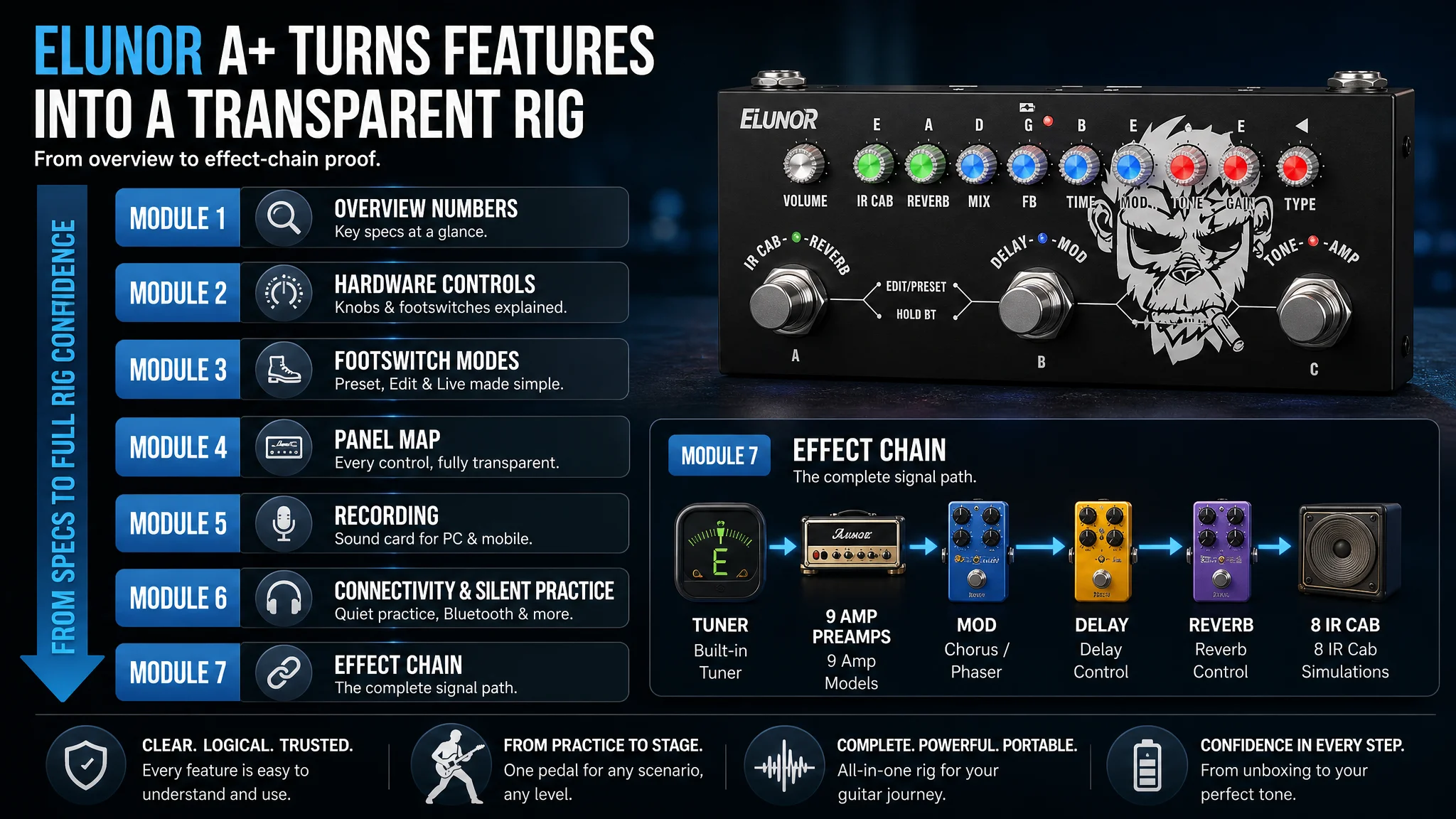
A+ Rebuild: Turning Features into a Transparent Rig
For the detail/A+ modules, DeepBI’s logic was about reordering and densifying information rather than simply adding more content.
Module 1: Overview with Hard Numbers Upfront
- Keep the high-level “all-in-one” positioning.
- Bring forward:
- 9 AMP preamps
- 8 IR cabs (with third-party loading)
- Delay/Reverb
- Tuner
- Bluetooth playback
- Recording
- Battery runtime (2-hour charge / 6–8 hours play)
- Use icon-based data to build immediate trust.
Module 2: Replace Mood Image with Hardware Control Confirmation
- Remove pure mood imagery at this critical scroll position.
- Insert a close-up of the control panel:
- Knob labeled positions for AMP and IR selection.
- Clear depiction of physical knobs, not menus.
- Objective: Answer “Is this menu-driven or knob-driven?” in one glance.
Module 3: Consolidated Footswitch & Mode Control
- Merge:
- Tuner explanation
- Bluetooth on/off
- Preset/Edit/Live switching
- Show:
- Which footswitch combinations trigger which function.
- Light feedback for each state.
- This compresses operational complexity into one efficient module.
Module 4: Full Panel Structural Diagram
- Based on top-view product imagery:
- Number and name each knob (Volume, IR Cab, Reverb, Mix, Feedback, Time, Mod, Tone, Gain, Type).
- Define the three footswitches and LEDs.
- The goal is to remove ambiguity completely:
- No hidden functions
- No guesswork
- No need to “hope” the manual is clear when the product arrives.
Module 5: Recording Scenario Clarification
- Keep the phone recording scene.
- Explicitly state:
- Recording cable is included.
- Compatible with PC and mobile.
- Functions as a guitar sound card.
- Reduce the risk of buyers assuming they need extra gear or the unit will be hard to integrate.
Module 6: Connectivity & Silent Practice
- Merge battery and top-interface information:
- 3.5mm headphone jack for silent monitoring.
- USB-C for charging, IR loading, preset editing, and recording.
- Emphasize “silent practice without disturbing others.”
Module 7: Final Effect-Chain Summary
- Create a horizontal effect-chain graphic:
- Tuner → 9 AMP preamps → MOD (Chorus/Phaser) → Delay → Reverb → 8 IR Cab.
- This is the “closing argument” for rational buyers:
- Yes, this is a complete chain.
- Yes, it can anchor your setup.
How Ad Traffic Became Useful Again
Once the Listing’s narrative and visuals were realigned with how guitarists actually decide, the business impact was not about a magical spike, but about structural risk reduction:
- The page began to better convert both organic and paid traffic.
- New visitors could more quickly understand:
- What the pedal does.
- How it fits into their rig.
- How to operate modes and IRs without confusion.
- Advertising spend stopped being primarily a “test budget” for a weak page and became a lever to scale a credible offer.
Even without inventing new numbers, the operational changes were tangible:
- ACOS had room to move down because CVR was no longer capped by basic trust issues.
- Organic orders had a stronger base, as the Listing itself now carried the story without requiring a human to explain it.
- Advertising dependency decreased, because the product page itself could justify its price and place in the category.
Most importantly, the seller’s understanding shifted:
- Amazon ads are not a universal fix.
- A technically rich product cannot be sold as a generic “nice gadget.”
- Listing quality — especially main image sequence and A+ storytelling — is the foundation for ad efficiency.
“Before scaling ads, you have to decide whether your page deserves more traffic.”
What Other Amazon Sellers Can Take from This Case
This case is not just about a guitar pedal. It is about a pattern many Amazon sellers repeat:
- Seeing high ACOS and blaming campaign structure.
- Ignoring subtle but decisive Listing gaps in:
- Main-image logic
- Technical clarity
- Mode and feature transparency
- Trust signals for advanced users
DeepBI’s role was not to “tune another ad,” but to reframe the problem:
- The Listing did not lack features.
- It lacked the right ordering, visualization, and trust-building for those features.
- Ads were merely amplifying this misalignment.
For any seller running Amazon ads today, especially in technical categories, the takeaway is clear:
- If traffic grows but orders lag, check whether your Amazon Listing truly answers how, why, and for whom your product works.
- Treat main images and A+ as compressed decision tools, not as decoration.
- Only once the page can convincingly convert both organic and ad traffic, should you ask ads to carry more weight.
DeepBI’s strength in this case was not a feature set; it was a judgment: to stop optimizing the ad lever and instead repair the conversion engine sitting on your Amazon product page.