

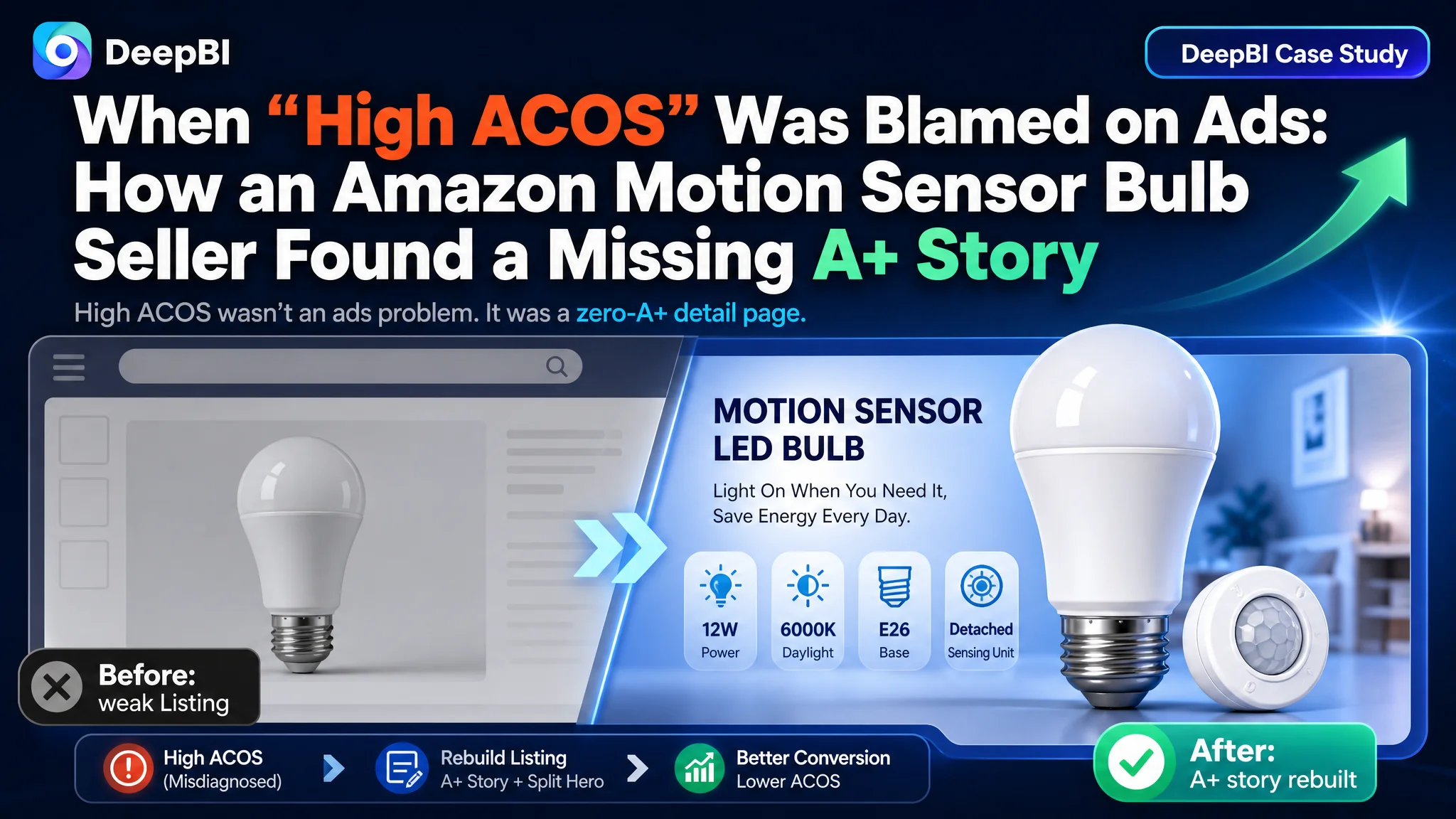
This case comes from an Amazon seller in the motion-sensor light bulb category. On paper, their product had a clear technical advantage: a detached, split-design sensor that could light up a space before the user actually walked under the bulb. Yet despite this, Amazon ads were becoming harder to control, ACOS kept rising, and the team was convinced the problem sat entirely inside campaign structure and bids.
DeepBI’s diagnosis told a different story. Against a directly comparable competitor, the Listing scored 52/100 versus 82/100, with a catastrophic 0/25 on the detail-page (A+) dimension and a weak review base. Ads were doing their job—bringing traffic—but the product page simply could not convert that traffic. The seller had been trying to “fix ACOS” with bid tweaks on top of a page that had almost no visual trust, no A+ story, and incomplete decision logic.
The optimization path was therefore reversed. Instead of continuing to tune keywords and bids, DeepBI pushed to rebuild the Amazon Listing itself: restructure the title to surface the right search terms, reframe the main image to express the split-design advantage and key specs, and, most critically, construct a full A+ detail-page narrative that explained why this detached sensor mattered and how to install and use it. Once the page began to tell a coherent, visual story, ad traffic stopped being wasted and started to behave more predictably.
For other Amazon sellers, the lesson is straightforward but uncomfortable: if your detail page scores 0 on A+ while your competitor runs a full visual narrative, no amount of “better ads” will solve your ACOS problem. Listing conversion is not a cosmetic issue; it is the infrastructure that determines whether traffic—paid or organic—can become orders.
Amazon Ads Were Not Failing. The Page Was Consuming the Traffic.
When the seller first came to DeepBI, their pressure point was Amazon ads.
Ad spend was rising. ACOS was stubborn. There was a strong sense that:
- Campaigns needed “better optimization”
- Keywords might not be precise enough
- Bids and structures needed another round of refinement
In other words, the team saw an advertising efficiency problem.
What they did not see was that the Listing itself had fallen far behind a direct category competitor:
- Total Listing score:
- Target Listing: 52/100
- Benchmark Listing: 82/100
- Gap: -30 points
- Dimension breakdown:
- Title: 14 vs 16 (gap -2)
- Main image & gallery: 25 vs 24 (slight lead, +1)
- Bullet points: 8 vs 6 (slight lead, +2)
- Detail page / A+: 0 vs 23 (gap -23)
- Reviews: 5 vs 13 (gap -8)
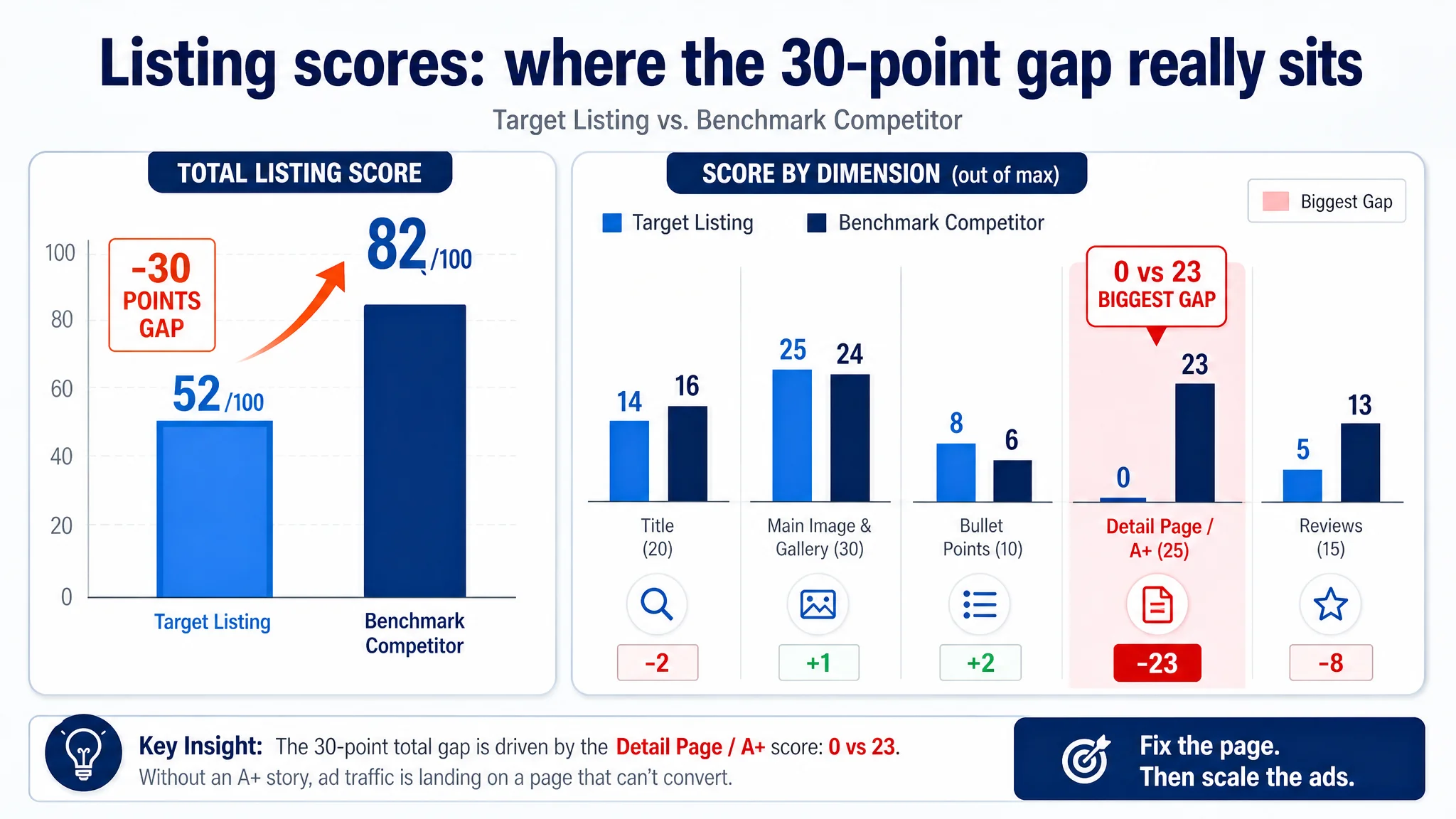
From a pure ad-ops perspective, this detail-page and review gap seldom appears on dashboards. Sponsored Products reports show clicks and spend; they do not tell you that your competitor is running a full A+ story while your page has literally no images beyond the standard gallery.
“The real problem was not that ads failed to bring traffic. It was that the page could not convert the traffic.”
DeepBI’s scoring made the asymmetry visible: the Listing was asking ads to carry a detail page that did not exist in any convincing form.
The Customer’s Original Misdiagnosis: “We Need Better Campaigns”
The seller’s first instinct was familiar to anyone running Amazon ads:
- Symptom: ACOS uncomfortably high, spend rising faster than orders
- Assumed cause: Campaign structure and keyword setup were not yet “fine-tuned”
- Response:
- Repeated bid adjustments
- New keyword pools
- Negative keyword pruning
- Occasional creative tweaks in Sponsored Brands
This mindset contained two hidden assumptions:
1. If traffic is coming, ads are doing their job; conversion issues must be minor.
2. Improving ACOS is primarily about traffic quality and bid efficiency, not about the product page.
Both assumptions collapsed under data:
- The benchmark competitor had a mature A+ with a full decision pathway.
- The target Listing had no A+ content at all, scoring 0/25 in the detail-page dimension.
- Reviews were sparse: 13 total reviews vs the competitor’s 364, and an average rating of 4.0 vs 4.3.
In this context, every new click from ads was being pushed into a page that:
- Did not visually explain the split-design advantage
- Did not clarify compatibility and installation constraints
- Did not address usage risks or answer common doubts
- Did not build emotional or safety-related motivation
Traditional ad optimization was not failing because the team lacked experience. It was failing because they were continuously feeding traffic into a structurally weak conversion path.
The Real Constraint Was Listing Conversion Capacity
When DeepBI reconstructed the Listing’s competitive position, one conclusion became unavoidable:
The primary bottleneck was not traffic volume or cost. It was the page’s ability to convert traffic.
Where the Listing actually stood
- Title: structurally acceptable, but not maximally leveraged
- Included strong phrases like “Split Design” and “No Blind Spots”
- However, core keyword “Motion Sensor Light Bulb” sat too far back
- Lacked some of the precise, numerical spec framing the competitor used (“60 watt equivalent”, “2 Pack”, multi-scene coverage)
- Main image & gallery: partially competitive, but misaligned with decision logic
- The first image was essentially a plain product-photo
- No clear on-image specs (wattage, color temperature, base type, pack size)
- The detached sensor advantage was not visually claimed in the thumbnail
- Subsequent images tried to carry too much text on mobile-unfriendly layouts
- Bullet points: surprisingly stronger than the competitor
- Clear structure: pain point → solution
- Emphasized split design, independent signal, installation guidance
- But these strengths were not echoed visually; text alone could not carry the persuasion load
- Detail page / A+: the critical failure
- The competitor ran a full A+ stack:
- Hero banner with night-time home scenes
- Icon-based feature overviews
- Motion-logic diagrams (angles, distances, delays)
- Installation and spacing visuals
- Fixture compatibility charts
- Scenario-based safety and lifestyle messaging
- The target Listing had:
- No A+ images
- No structured storytelling
- No visual explanation of how the split sensor works
From DeepBI’s scoring, the single-largest gap was clear:
Detail page score difference: 0 vs 23. This was the primary constraint.
Without an A+ story, the split-design advantage never fully entered the buyer’s mind. The page did not answer the “why this one, not the standard motion bulb?” question.
This Product Page Did Not Lack Traffic. It Lacked Trust.
To understand why ads were underperforming, it helps to look at what the benchmark competitor was doing on the A+ page.
How the competitor’s A+ built trust
The competitor’s Amazon detail page:
- Used large, high-resolution lifestyle scenes
- Houses at night with clear, safe walkways
- People moving through garages and porches
- Explained the sensor logic in a problem → mechanism → solution sequence
- Motion detection range and angle (e.g., 13 ft, 120°)
- Time delay before auto-off
- Light-sensor threshold for dusk-to-dawn behavior
- Clarified installation constraints and safety issues
- Clear warnings against using in enclosed fixtures
- Illustrations of correct and incorrect fixture types
- Hooked into emotional and safety drivers
- Copy such as “Save you when your hands are full”
- Positioning as a family-safety and home-security enhancement
By the time a buyer finished scanning that A+, they had:
- A clear mental picture of how the bulb works
- Confidence they could install it correctly
- Assurance it would save energy and protect their family
The target Listing had none of this structure.
What buyers saw on the target Listing
On the target Listing:
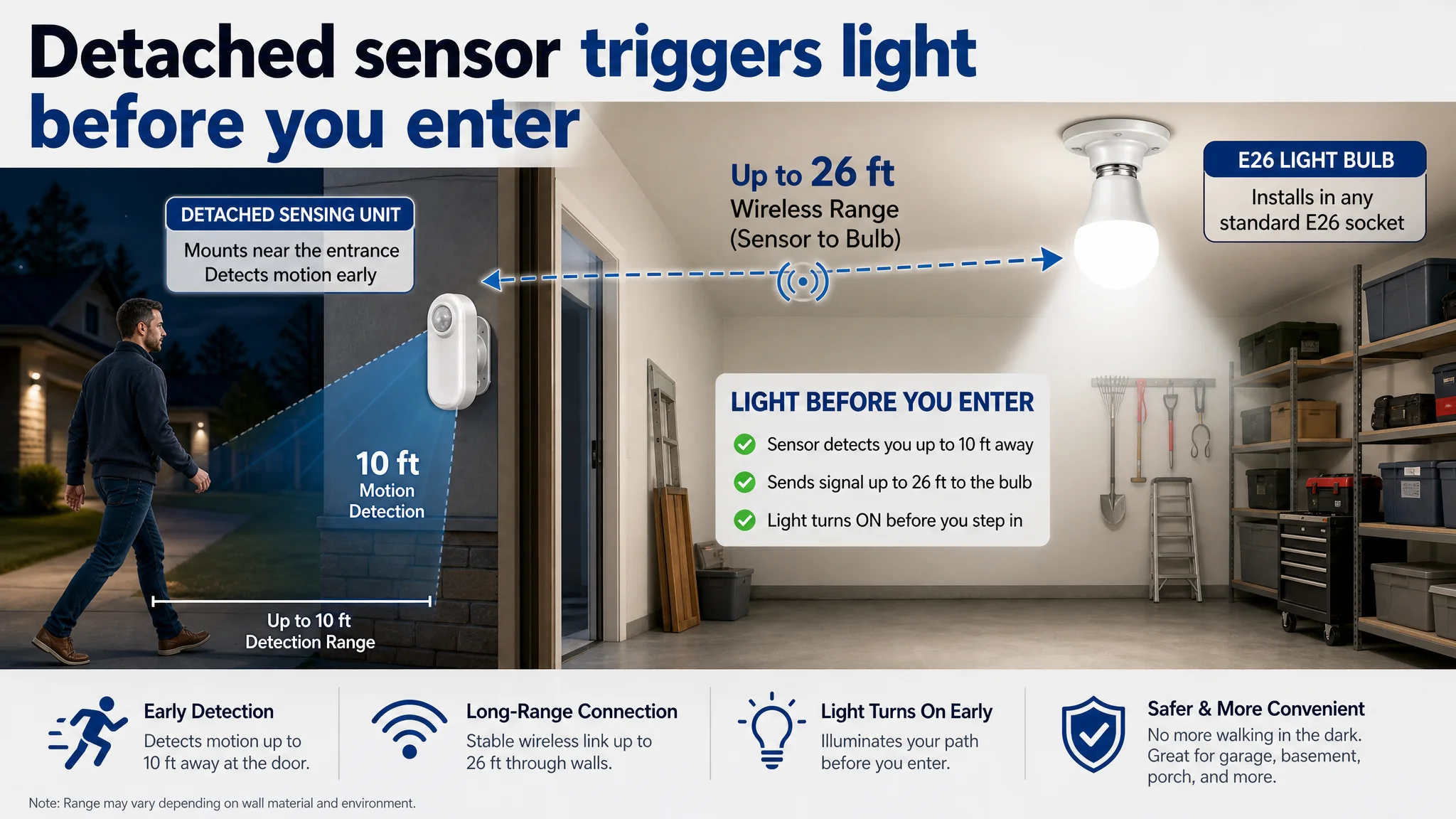
- There was no visual reinforcement that the sensor is detached and can be placed by the door while the bulb sits deeper inside.
- No illustration that:
- The sensor can detect motion at up to 10 ft
- It can signal the bulb up to roughly 25–26 ft away
- It supports through-wall triggering for “light before you enter”
- No clear statement that:
- The bulb fits any standard E26 socket
- The sensor is battery-powered (AAA) and wall-mountable
- It is compatible with enclosed fixtures, unlike most integrated motion bulbs
In absence of these confirmations, risk perception stayed high:
- “Will this actually turn on before I step into the garage?”
- “Can it work inside my enclosed fixture?”
- “Is installation complicated?”
- “Will multiple units interfere with each other?”
On Amazon, unanswered risk equals lost conversion.
Why DeepBI Did Not Keep Tuning Ads First
Given this diagnosis, DeepBI’s core judgment was simple:
Continuing to optimize ads on top of a 0/25 detail page would keep wasting budget and masking the real issue.
The reasoning:
1. Detail page gap was the single largest scoring deficit
- Title: minor gap (−2)
- Bullets: slightly better than competitor
- Main image: competitive but misaligned with core selling story
- Detail page: catastrophic gap (−23)
- Reviews: structural disadvantage not fixable in the short term
1. Ads were already supplying traffic
- The seller wasn’t struggling with impressions
- The problem was what happened after the click
1. Every incremental click carried higher marginal risk
- Each visit landed on a page that:
- Failed to showcase the split-design advantage
- Failed to address fixture compatibility and installation doubts
- Offered no A+ trust layer
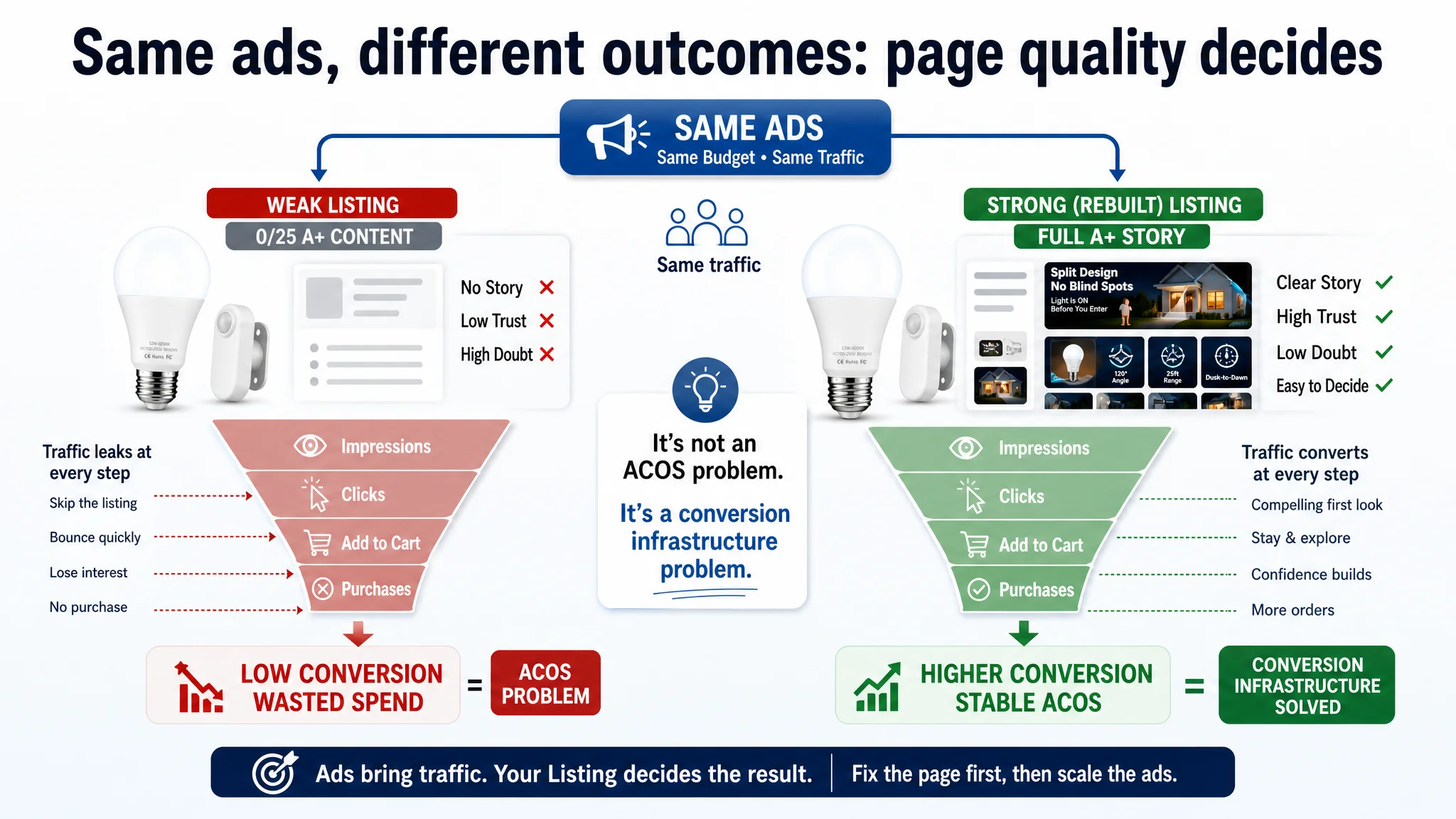
“Advertising does not only amplify advantages. It can also amplify a page’s existing defects.”
In this context, the right decision order was:
1. Fix the Listing conversion infrastructure first.
2. Then re-run ad optimization with a page that actually deserves more traffic.
Rebuilding the Decision Logic: From Title to A+
DeepBI’s recommendations were not about “making things prettier.” They were about reinstating decision logic along the entire Amazon product page.
1. Reframing the title: search logic + outcome logic
Benchmark title (simplified):
[Brand] Motion Sensor Light Bulbs Indoor Outdoor, 60 watt Equivalent, A19 E26 9W, Daylight White, Motion Sensor Light for Garage, Closet, Porch, Stairs, 2 Pack
Key strengths:
- Brand name front-loaded
- Clear “Motion Sensor Light Bulbs” in the first position
- Strong numeric framing: 60W equivalent, 9W, 5000K
- Multi-scene coverage: Garage, Closet, Porch, Stairs
- Clear pack info: 2 Pack
Recommended title for the target Listing:
Detached Motion Sensor Light Bulb, Split Design 60W Equivalent A19 E26 LED Bulb, 6000K Daylight White, Wall-Mount Sensing Unit for No Blind Spots, Motion Activated for Garage Basement Porch, 1-Pack
Why this matters:
- Core keyword front-loaded: “Detached Motion Sensor Light Bulb” immediately signals both the category and the unique split design.
- Spec completeness: 60W equivalent, A19, E26, 6000K—aligned with search behavior.
- Scene expansion: From just garage/basement to include porch, etc., matching the competitor’s breadth.
- Outcome statement: “Wall-Mount Sensing Unit for No Blind Spots” turns split design into a clear benefit.
This is not just title hygiene; it’s about ensuring ad and organic traffic land on a page whose title matches their search intent and perceived outcome.
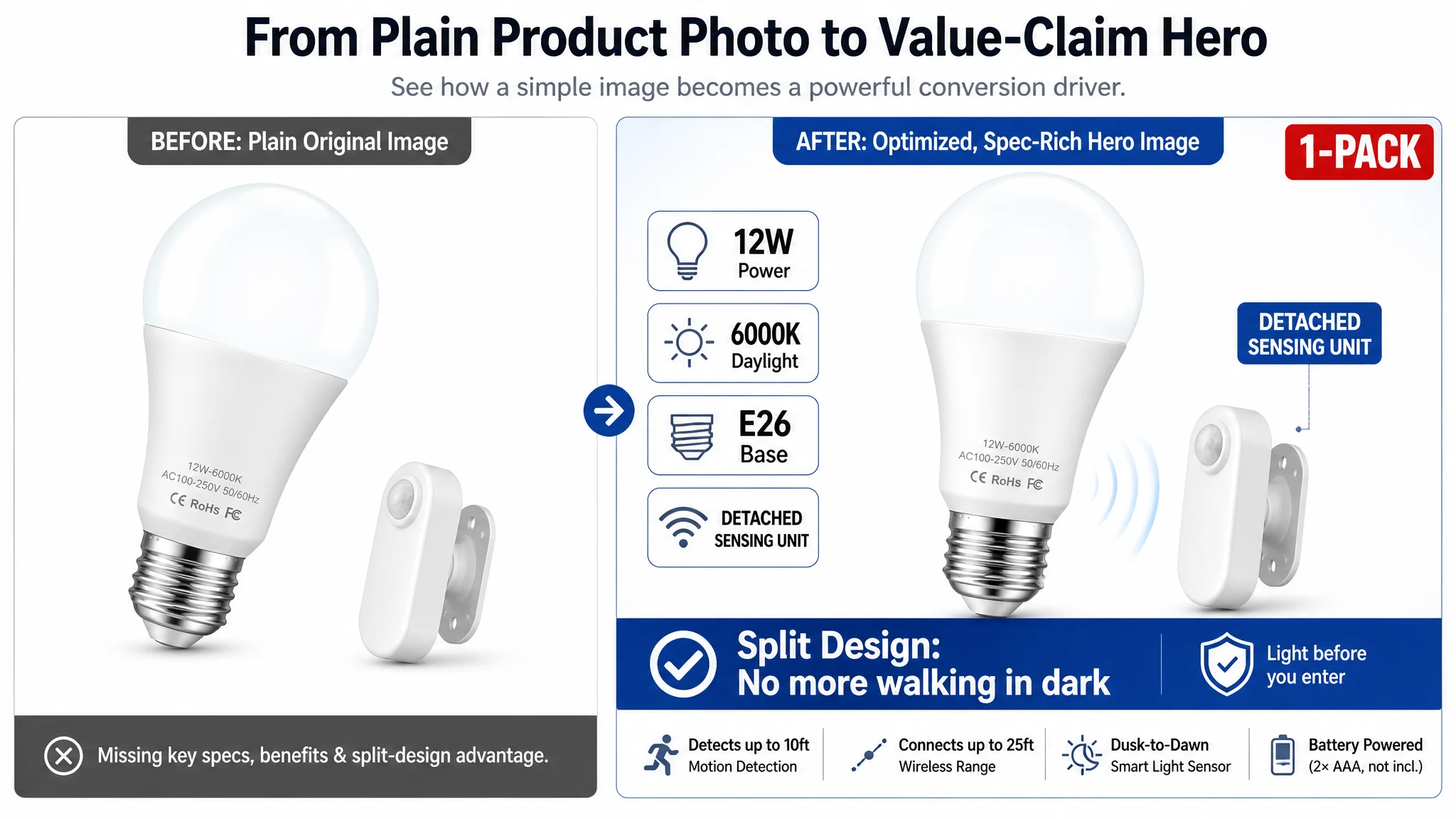
2. Rebuilding the main image: from static object to value claim
The first Amazon thumbnail is not just a picture. It’s a click trigger.
Current state:
- Pure physical appearance
- No clear indication of:
- Pack size (1-pack)
- Wattage
- Color temperature
- Base type
- Split design advantage
DeepBI’s recommendation:
- Turn the main image into “product + core parameters”:
- Clear overlay for:
- 1-Pack
- 12W / 60W equivalent
- 6000K daylight
- E26 base
- Detached sensing unit
- Explicit callout:
- “Split Design: No more walking in the dark”
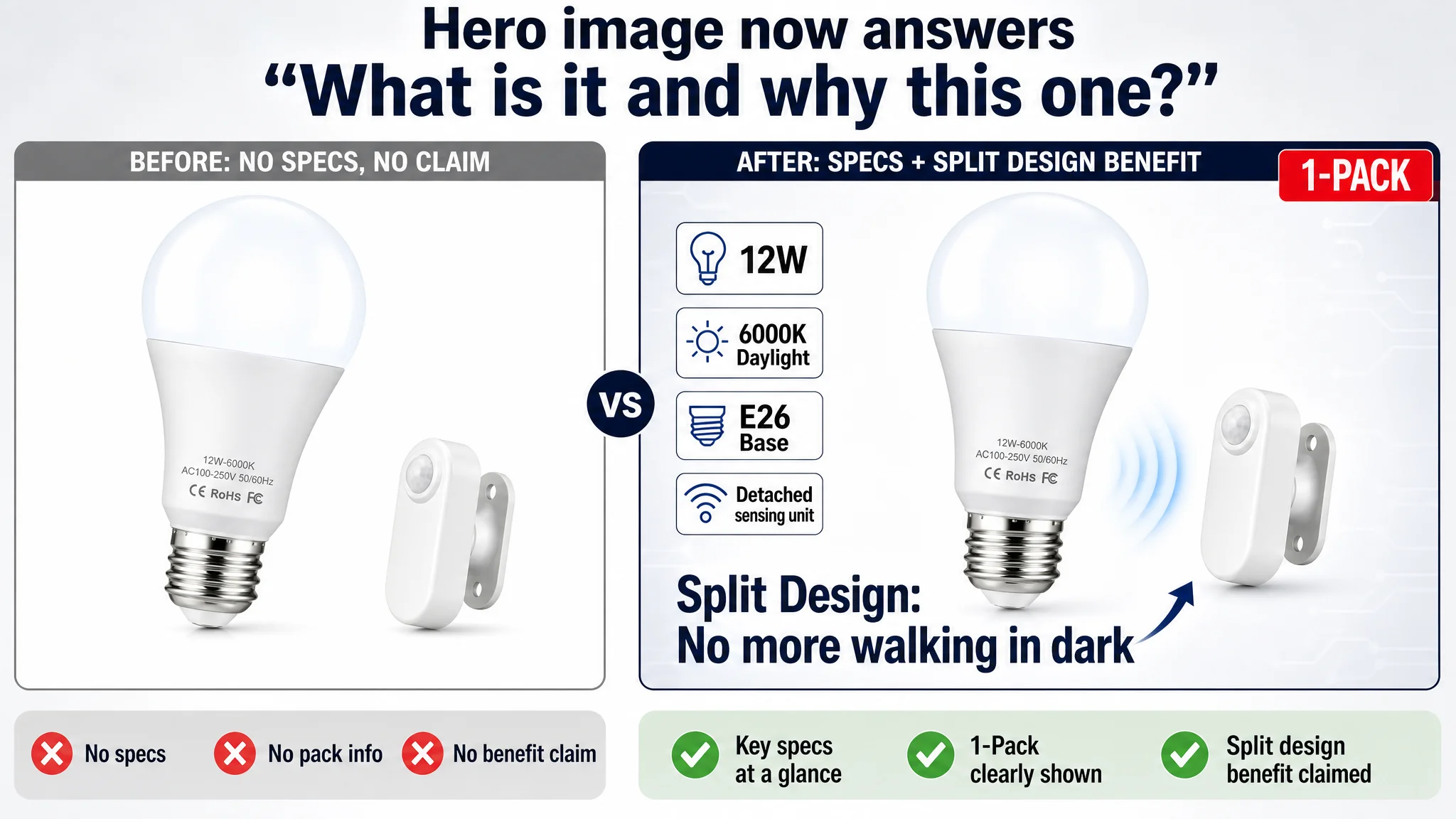
In other words, the thumbnail must answer: “Why should I click this one instead of another generic motion bulb?”
3. Rationalizing the gallery: align each image with a step in the decision path
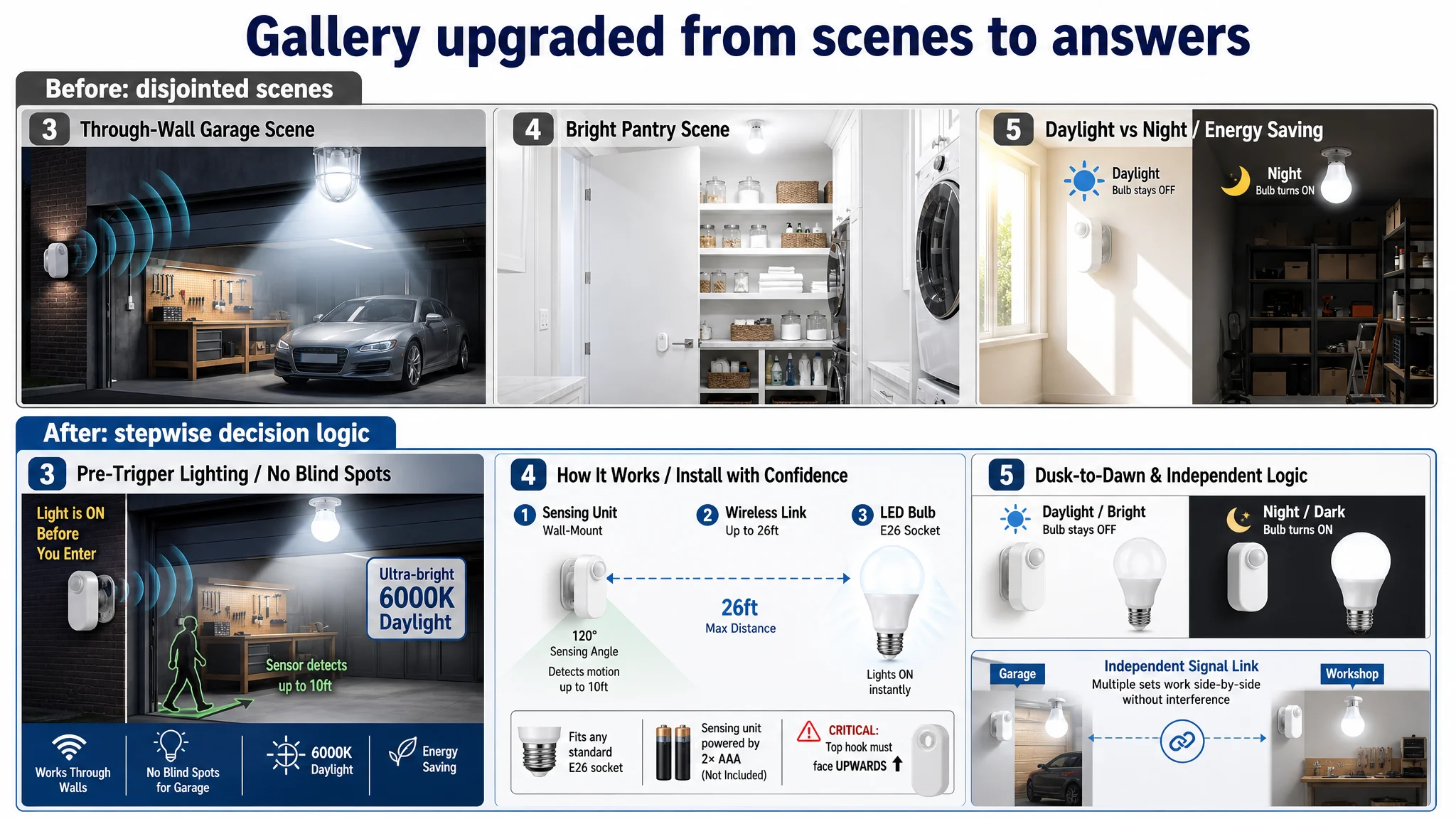
The original gallery mixed multiple concepts and heavy text, especially for mobile users. DeepBI’s path was to align each frame with a specific buyer question.
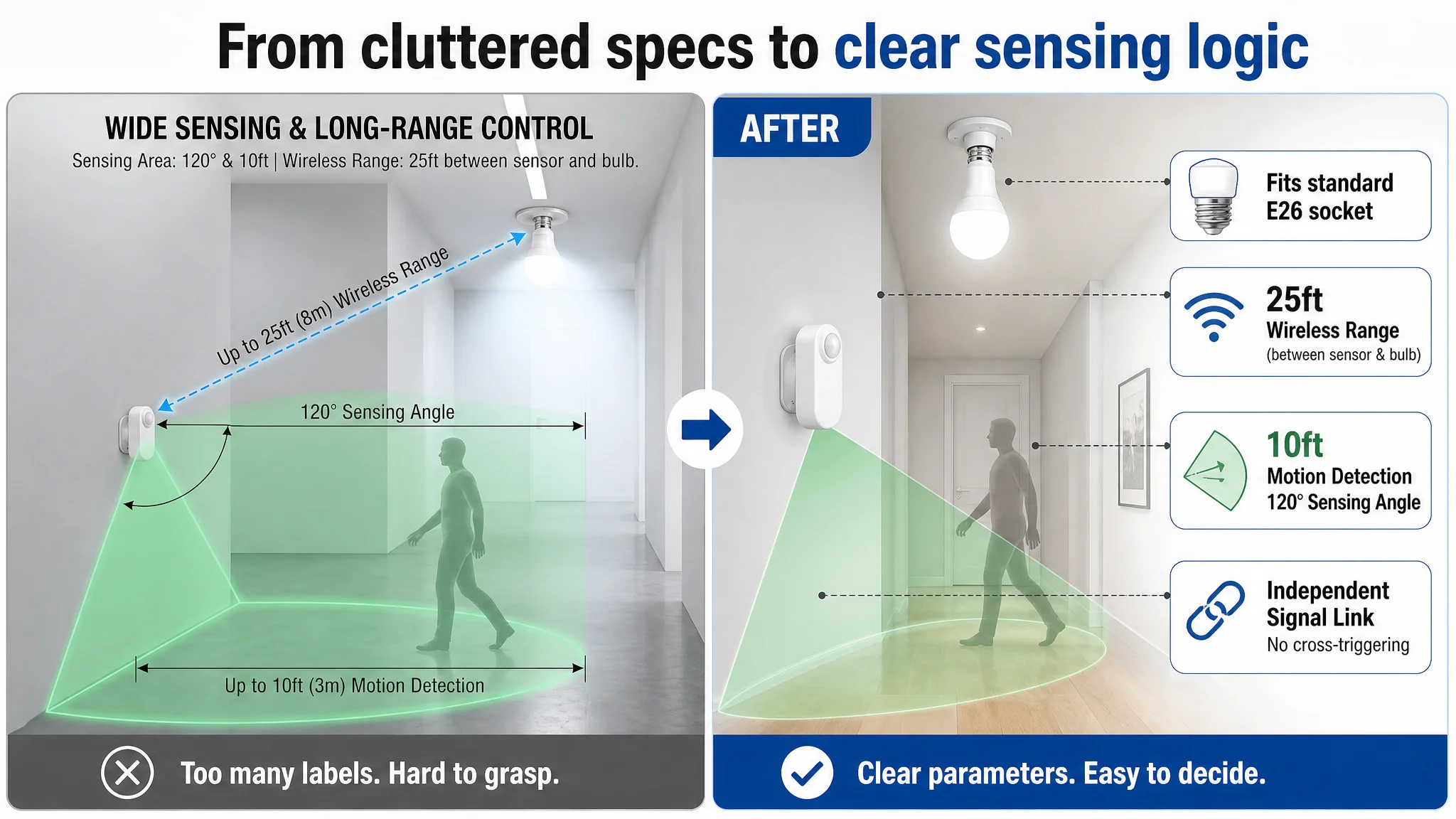
Image 2: “Can it fit my fixtures and how does the split logic work?”
- Transform into a physical compatibility + split-logic diagram:
- Show bulb dimensions
- Highlight “Fits any standard E26 socket”
- Explain:
- 120° sensing angle
- 10 ft motion detection range
- 25–26 ft max wireless distance between sensor and bulb
- Clearly show “Independent signal link: No cross-triggering”
Image 3: “Will it light before I step into the dark space?”
- Use a garage scene to demonstrate:
- Sensor outside the entrance
- Bulb inside the garage
- Visual tagline: “Light is ON before you enter. No blind spots.”
- Highlight “6000K ultra-bright daylight”
Image 4: “How exactly does this split sensor trigger the bulb?”
- Use a storeroom or hallway scene for logic explanation:
- Mark where the person is detected (distance from sensor)
- Mark bulb distance from sensor
- Show “No more walking in dark corridors”
- Clarify that each sensor controls only its paired bulb
Image 5: “Will it waste power during the day? Any critical install tips?”
- Day/night split image:
- Label: “Intelligent Dusk-to-Dawn”
- Show bulb off during daytime even with motion
- Show it on at night with motion
- Add a visible “Pro Tip” block:
- “Sensor powered by 2x AAA batteries (not included)”
- “Mount sensor with hook facing UPWARDS (↑) for best detection accuracy”
- “Not compatible with dimmers or enclosed fixtures” (or clarify the actual constraint; for this split design, the key is that the sensor is independent even if the bulb is inside a fixture)
Each image now resolves a practical doubt instead of just repeating “bright and convenient.”
Constructing the Missing A+ Story: From Zero to a Coherent Narrative
The most important change was not in the gallery. It was the shift from no A+ at all to a structured, scenario-driven detail page.
DeepBI’s A+ logic followed five core modules.
Module 1: “Why split design matters” – anchoring the pain point
Objective: Make the buyer feel the problem with traditional integrated motion bulbs.
- Visual: A large hero image showing:
- Sensor mounted near a doorway
- Bulb installed deeper inside a garage or basement
- Message:
- Traditional motion bulbs only trigger when you are directly under the lamp
- Split design allows the sensor to be placed at the entrance
- Outcome: “No more walking in the dark. Light comes on before you enter.”
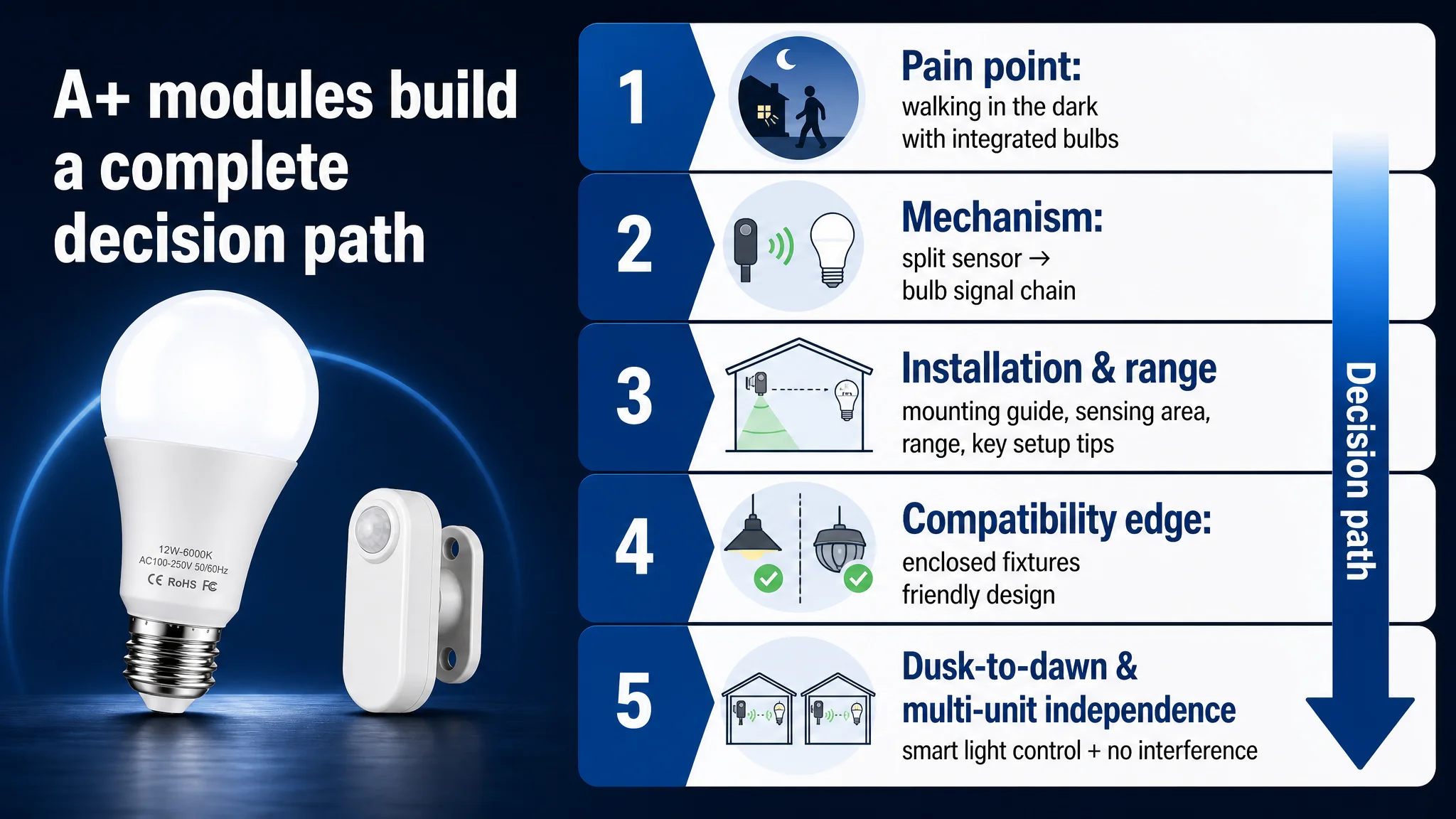
This module transforms “detached sensor” from a technical term into a felt benefit.
Module 2: “How the split system actually works” – reducing complexity anxiety
Objective: Address hidden doubts about reliability and complexity.
- Visual: Simplified signal-chain diagram
- Person walks within 10 ft of sensor
- Sensor detects motion and sends signal
- Bulb up to ~26 ft away turns on instantly
- Message:
- Clarify that it is a one-to-one pairing
- Emphasize “no blind spots” and consistent triggering
This addresses the fear that split design might be “too complex” or “unreliable.”
Module 3: “Installation and range made simple” – removing friction
Objective: Make installation feel manageable and predictable.
- Visual:
- Sensor wall-mount illustration with hook orientation (↑)
- Bulb installation into a standard E26 socket
- Clear arcs showing detection zone and max bulb distance
- Message:
- No wiring required; sensor is battery-powered (2x AAA)
- Fits any standard E26 socket
- Clear detection parameters (angle, distance, max range)
- Critical orientation tip for accurate detection
Module 4: “Compatibility advantage” – turning a competitor’s constraint into a strength
Objective: Exploit the competitor’s limitation around enclosed fixtures.
- Competitor issue:
- Integrated motion bulbs often cannot be used in enclosed fixtures
- Split design advantage:
- Sensor is outside and independent
- Bulb can sit inside more restrictive fixtures as long as it remains within range
A simple comparison visual:
- Left: integrated bulb cannot be used in enclosed fixtures (crossed-out sign)
- Right: detached sensor at entrance + bulb in enclosed fixture (check mark)
Module 5: “Light-sensor logic and multi-unit independence” – deeper trust and scalability
Objective: Clarify energy-behavior and multi-unit behavior.
- Visual:
- Two-state comparison:
- Dark + motion → bulb on
- Bright + motion → bulb off
- Two adjacent spaces (garage and workshop) each with their own sensor/bulb pair
- Message:
- Built-in light sensor (<15 lux) ensures activation only in dark environments
- Each set is uniquely paired to prevent cross-triggering
- Multiple sets can be installed in adjacent zones without interference
Bullet Points: Turning Technical Advantages Into Buying Logic
The original bullets already had a decent structure, but DeepBI pushed them towards clearer differentiation and risk reduction.
Key themes per bullet:
1. Innovative split design & range
- Contrast with traditional bulbs that require you to stand directly beneath the lamp
- Highlight up to ~26 ft sensor-to-bulb range
- Emphasize “light before you enter” as the core experience
1. Quantified brightness and energy efficiency
- 9W, 900 lm, 60W equivalent
- 6000K daylight for high visibility
- Up to ~85% energy savings; long lifespan
1. Intelligent dusk-to-dawn behavior
- Only activates in dark environments
- Prevents unnecessary daytime operation
1. Independent signal & anti-interference
- Each unit uniquely paired
- No cross-triggering across neighboring sets
1. Home-security framing
- Early-triggered light as a deterrent to intruders
- Provides peace of mind for families
1. Installation guidance and critical limitations
- E26 socket compatibility
- Sensor battery requirement (AAA)
- Hook orientation warning
- Not compatible with dimmers/enclosed fixtures as applicable
1. Support and reliability
- Clear service commitment to handle compatibility or installation questions
Importantly, these bullets now mirror and reinforce the A+ structure instead of floating as isolated text.
How the Page’s Sales Logic Started to Recover
DeepBI’s role was not to run the client’s ads, but to rebuild the conversion engine so ads could finally work as intended.
Once the Listing was reframed:
- Title spoke the right language for Amazon search and aligned with ad keywords.
- Main image created an immediate reason to click by visually claiming “split design” and core specs.
- Gallery walked the buyer through:
- Compatibility
- Through-wall logic
- Pre-trigger lighting
- Dusk-to-dawn behavior
- Installation “gotchas”
- A+ story finally:
- Anchored the pain of traditional motion bulbs
- Explained the split-design mechanism
- Clarified installation and range
- Turned enclosed-fixture limitations into a competitive angle
- Addressed energy usage and multi-unit interference fears
- Bullets tied technical parameters to safety, convenience, and security outcomes.
Even without inventing new numbers, this structural repair changed the operating reality:
- Ad traffic began to land on a page that answered the right questions in the right order.
- The page gained the ability to convert both paid and organic traffic more consistently.
- The store’s dependence on “brute-force” ad spend to hold position could finally be reduced over time.
How the Customer’s Understanding Changed
Perhaps the most durable outcome was not the visual overhaul itself, but the shift in how the seller thought about Amazon performance.
Before:
- High ACOS = ad problem
- Solution = more granular campaigns, more bid tweaks
- Listing = “good enough” as long as it had decent images and some bullets
After working with DeepBI:
- High ACOS can be a Listing conversion symptom, not just an ad-ops issue.
- A 0/25 detail-page score meant no A+ trust layer; ads were amplifying a weak page.
- Title, main image, bullets, and A+ must work as a single decision path, not isolated modules.
- Before scaling ads, the question must be:
“Does this page deserve more traffic?”
For Amazon sellers facing similar pressure—rising ad costs, stubborn ACOS, and stalled orders—the takeaway is clear:
- If your competitor runs a fully built A+ story while your Listing has none, your problem is not primarily in the ads.
- Advertising can only magnify what your product page already is—good or bad.
- The fastest way to make your ads “work again” is often to fix the product-page conversion logic first, then return to ad optimization with a solid baseline.
DeepBI’s strength in this case was not a specific feature. It was the willingness to say: “Stop tuning the ads. The page is the real bottleneck.”