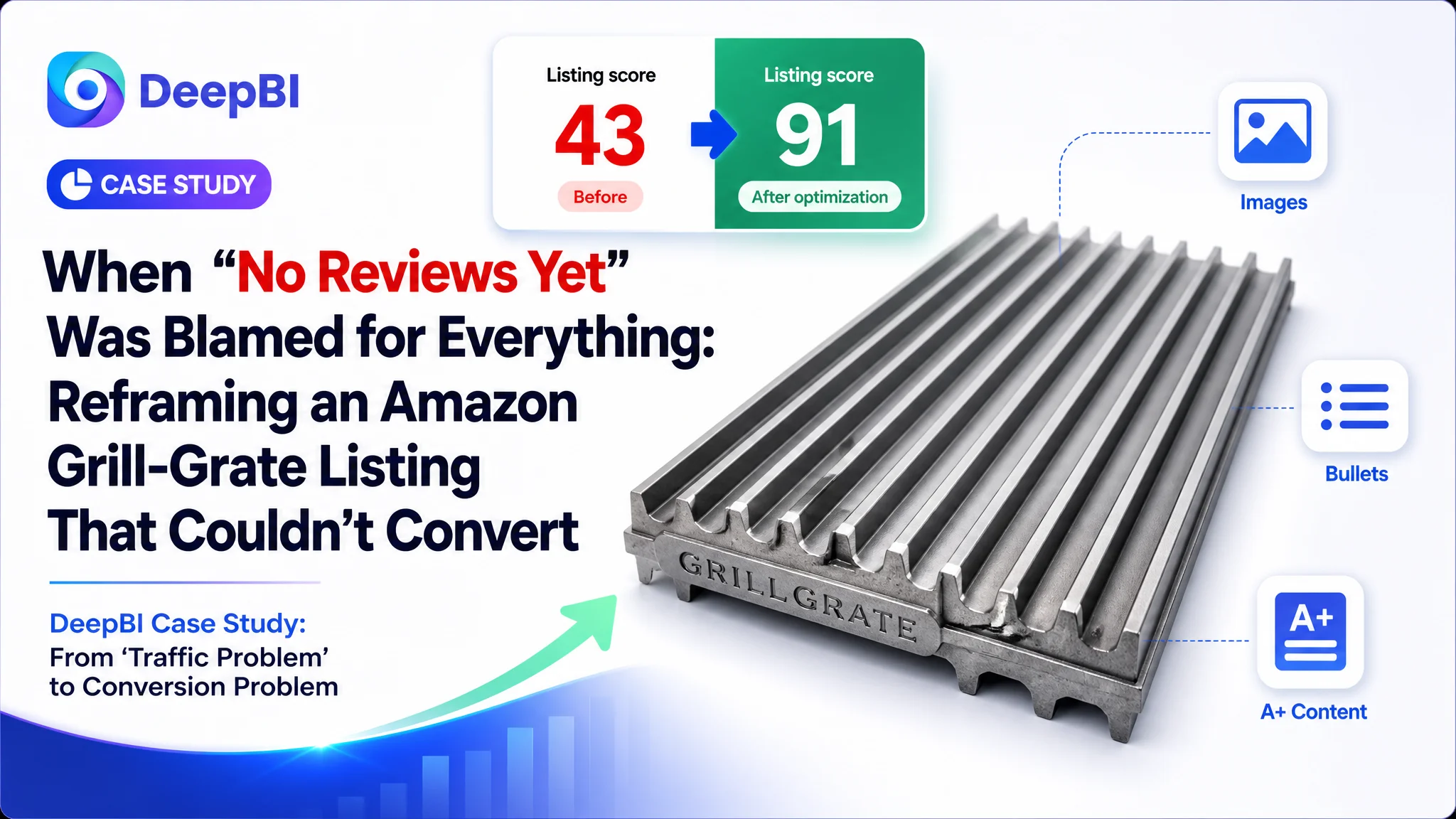
This case comes from an Amazon seller in the US barbecue accessories category. The team launched a stainless-steel replacement grill grate for a popular Weber Genesis II series and quickly felt the pressure: ad traffic was coming in, but the product page was not turning views into orders. Internally,they attributed the problem almost entirely to “no reviews yet” and “we just need more traffic.”
DeepBI’s diagnosis told a different story. When we benchmarked this Amazon Listing against a category-leading competitor, the score gap was brutal: 43 vs. 91 out of 100. The real weakness was not in the ad console; it was in the product page’s conversion capacity—especially the missing A+ content, weak sales logic in bullets, and lack of trust-building visuals. Ads were sending traffic into a page that had almost no ability to convince.
Once the team accepted that this was an Amazon Listing conversion problem, not an “ads or reviews” problem, the optimization direction changed. Instead of just pushing more clicks, work shifted to rebuilding the title structure, redesigning main and secondary images around compatibility, material, and rust-free advantages, and constructing an A+ story that answered “Will this fit?” and “Will this last?” in a visual, data-backed way. For other Amazon sellers, this case is a reminder: when ACOS is stubborn and orders lag, it is often the product page—its logic, visuals, and trust—not the campaign structure, that is quietly capping performance.
The Amazon Page Looked “Okay” — But It Couldn’t Compete
On the surface, this Amazon grill-grate Listing didn’t look broken:
- A functional white-background main image
- Basic compatibility notes in the title and bullets
- Stainless steel positioning and 7mm rod thickness mentioned somewhere in the text
From the seller’s point of view, the biggest visible gap versus the main competitor was reviews: their page had 0 reviews, the competitor had 904 reviews with a 4.7 rating. Under operational pressure, it was natural for the team to draw a quick conclusion:
“We just need more reviews and some ads to push initial sales. The rest is fine.”
So they focused on what they knew:
- Driving traffic through Amazon ads
- Hoping the first orders and reviews would “unlock” conversion
But when DeepBI ran a full Listing benchmark against a directly comparable best-selling grill-grates product, the structural problem came into focus.
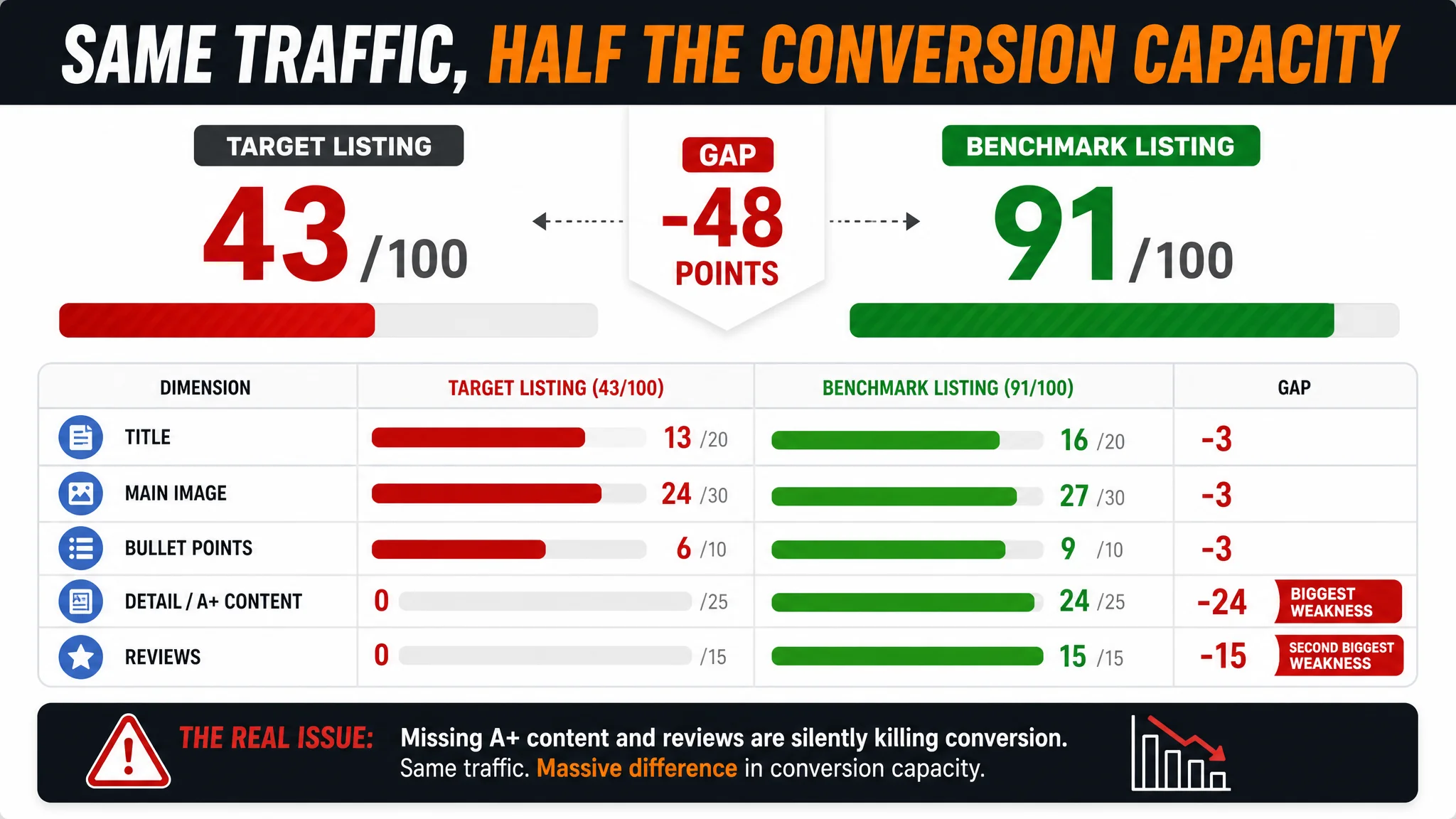
The Score Gap Exposed a Conversion-Capacity Problem
DeepBI’s Listing scoring compared five core dimensions of the Amazon product page against a strong benchmark in the same subcategory:
- Total Listing score:
- Target Listing: 43 / 100
- Benchmark Listing: 91 / 100
- Gap: –48 points
Breaking it down:
- Title: Target: 13, Benchmark: 16, Max: 20, Gap: -3
- Main Image: Target: 24, Benchmark: 27, Max: 30, Gap: -3
- Bullet Points: Target: 6, Benchmark: 9, Max: 10, Gap: -3
- Detail / A+: Target: 0, Benchmark: 24, Max: 25, Gap: -24
- Reviews: Target: 0, Benchmark: 15, Max: 15, Gap: -15
The review gap was obvious. But the real red flag was elsewhere:
- Detail / A+ content: 0 vs. 24 — the target Listing had no A+ at all
- Bullet points and main image were not “disastrous,” but clearly weaker in sales logic
- Together, this meant: even if reviews arrived later, this page lacked the structure to consistently convert paid or organic traffic
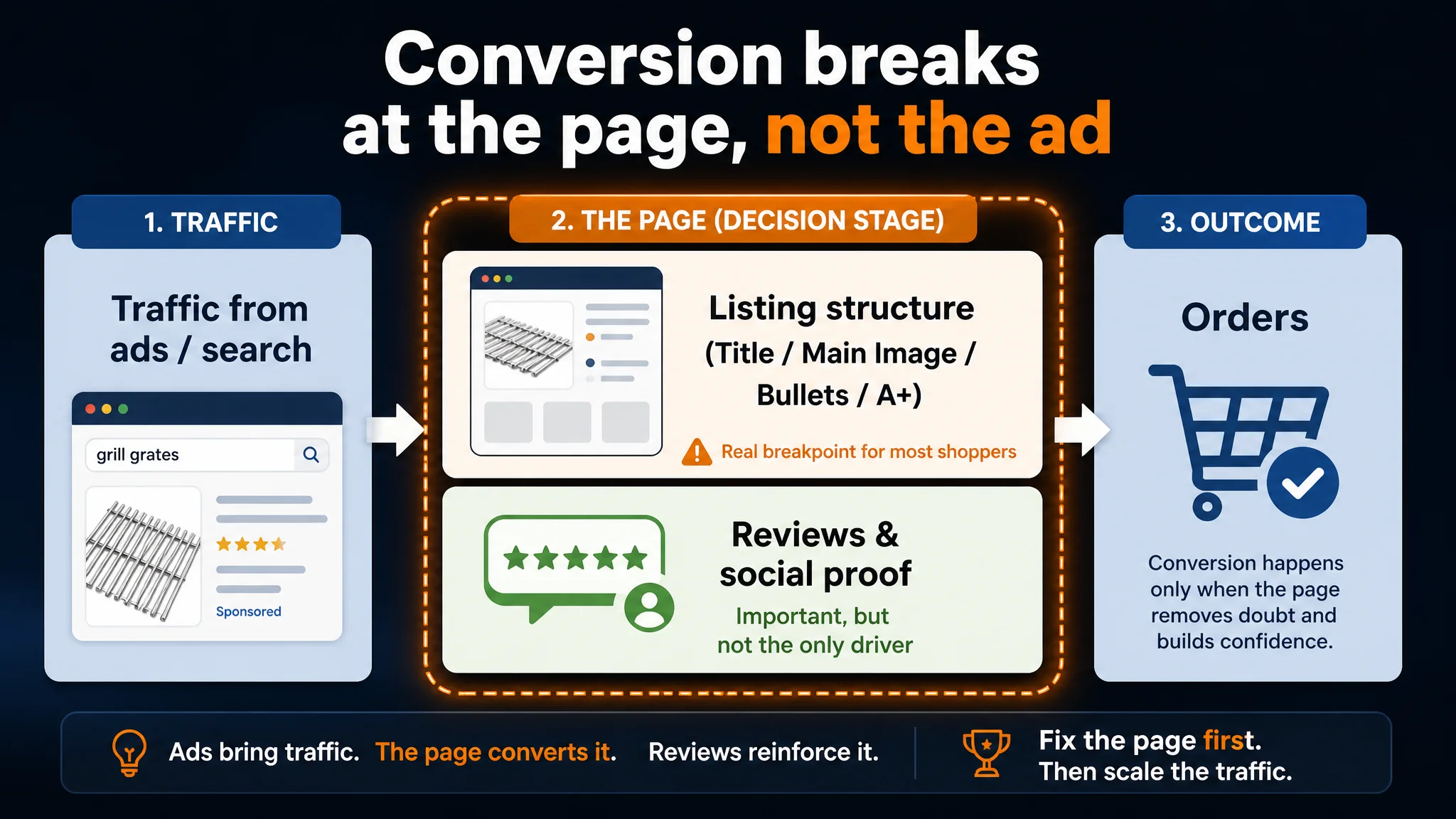
“The real problem was not that ads failed to bring traffic. It was that the page could not convert the traffic.”
The Seller’s Original Misdiagnosis: “It’s Just Reviews and Ads”
From the customer’s perspective, the logic was simple:
1. New ASINs naturally lack reviews.
2. Amazon favors listings with social proof.
3. Therefore, the primary task is buying traffic (via ads) and waiting for social proof to accumulate.
Under that assumption, the team’s operating model was:
- Continue to adjust bids and keyword structure
- Try to capture more impressions on “Weber Genesis II grill grates” and related terms
- Accept a period of high ACOS until reviews kick in
This is a common pattern: high ACOS is treated as a media problem, and Listing optimization is postponed until “later.” But in this case, “later” would never solve the core issue, because the page itself was structurally weaker than the benchmark at almost every trust and persuasion touchpoint.
Ads Were Not Failing. The Page Was Consuming the Traffic.
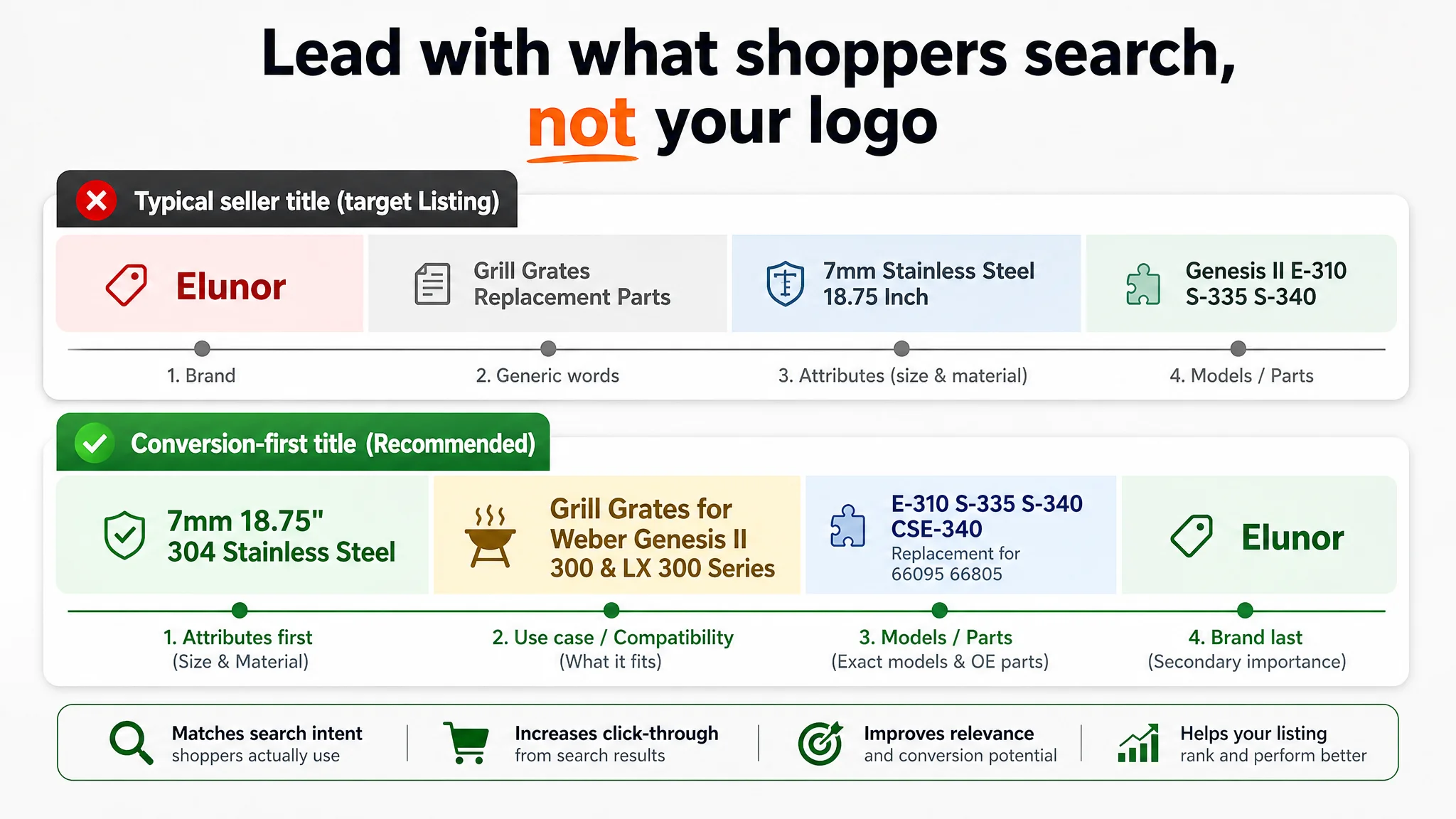
Title: Technically Correct, Commercially Underpowered
The target Listing’s title was not a disaster—but it reflected the wrong priority for Amazon search:
- The seller placed the brand name at the very beginning. For a relatively unknown brand, this consumes prime title real estate without helping search intent or click decision.
- The benchmark led with core attributes buyers actually search and filter by:
- Rod thickness (9.5MM) and length (18.75")
- Directly connected to the “Grill Grates for Weber Genesis II” phrase
- The benchmark title further integrated:
- “304 Stainless Steel” early in the string
- “GS4 Replacement Parts” and multiple explicit Weber model references with compact “E/S” and “&” formatting
The target title did mention:
- Replacement for Weber parts (66095, 66805)
- Genesis II E-310/S-335/S-340/CSE-340 compatibility
But:
- Brand-first ordering reduced early relevance signals on search results.
- “304 Stainless Steel” was not highlighted as a differentiating attribute.
- Model coverage was less compact, wasting characters that could have been used for more search patterns.
DeepBI’s judgment: title quality was not the main bottleneck, but it was part of the cumulative disadvantage. More importantly, the title alone could not compensate for the complete lack of A+ storytelling and weak visuals.
Main Images: Functional Metal vs. “Reliable Family Choice”
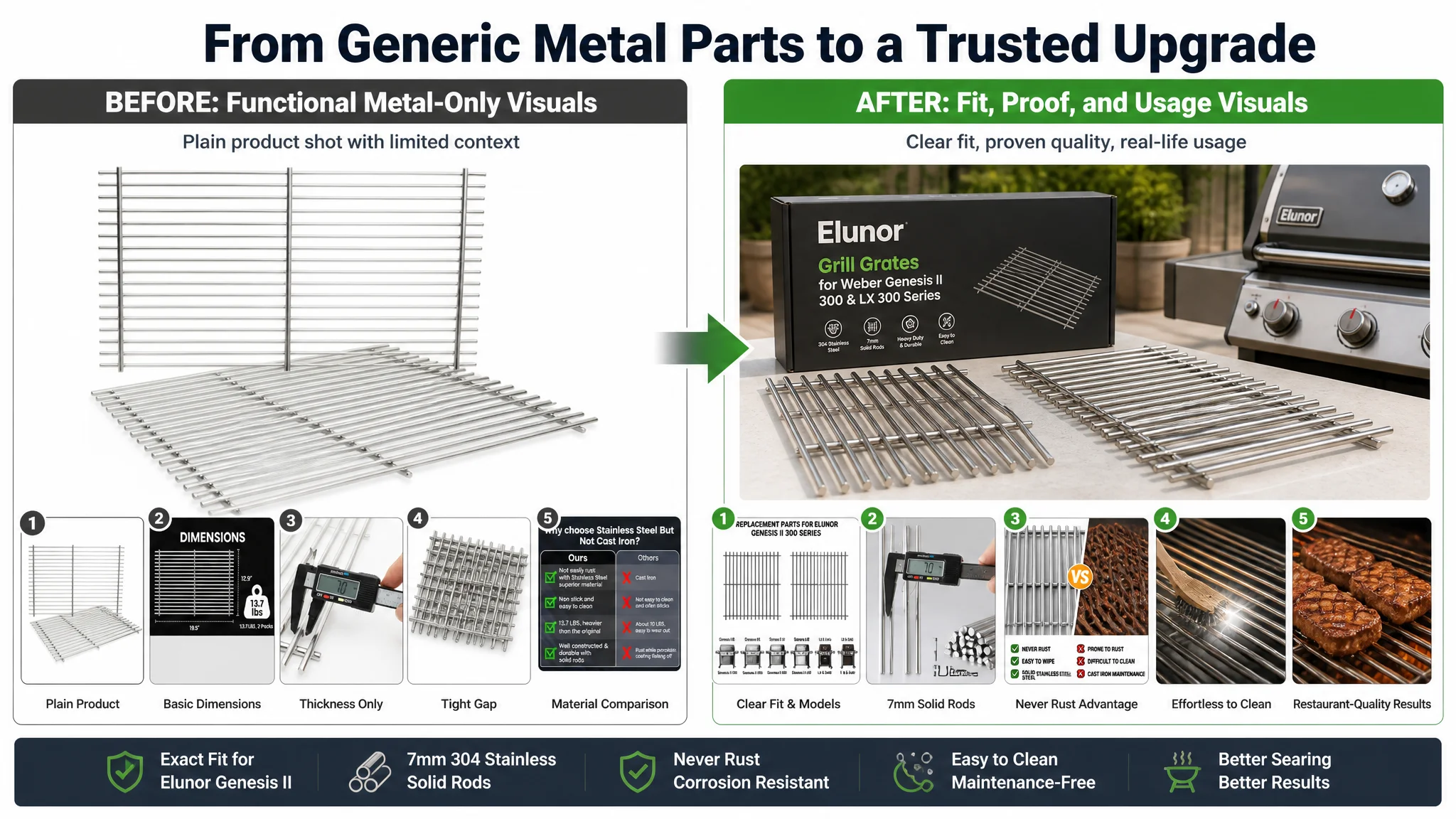
At glance, both the target and benchmark had white-background product shots. But DeepBI’s image analysis agent surfaced three commercially critical gaps:
1. No lifestyle or scenario support
- Target: static metal grids on a plain background.
- Benchmark: included scenes like a three-generation family doing an unboxing, presenting the product as a reliable family upgrade, not just metal parts.
1. No trust cues in imagery
- Target: no brand packaging, no real-use context, no visual indication of “heavy duty,” “rust-proof,” or “maintenance-free.”
- Benchmark: used images to imply “long-term, safe family choice,” reducing perceived risk.
1. Technical claims not translated into buyer benefits
- Target: focused on parameter comparisons (e.g., 7mm vs. 5mm rods) in a dry, technical style.
- Benchmark: showed benefits like “zero rust,” “maintenance-free,” or “restaurant-quality results” through visuals and copy in images.
In Amazon search results, this meant:
- The target Listing’s thumbnail read as “generic replacement part.”
- The benchmark’s visual system read as “premium, long-lasting, safe upgrade for family grilling.”
For ads, this distinction is lethal: the same paid click price buys you far less intent if the thumbnail cannot frame the product as an upgrade.
Bullet Points Had Information, but No Buying Logic
The bullet structure told the same story: data without decision logic.
How the Benchmark Used Bullet Points
The benchmark shaped bullets around a pain-point → solution → result chain:
- Connect design features (like triangular rods, precise spacing) to specific user frustrations:
- Food falling through grates
- Uneven cooking
- Difficult cleaning, rust, heavy maintenance
- Add comparative data:
- “Outlasts cast iron by 2 times”
- Close with a result image:
- “Restaurant-quality results”
- “Perfect sear marks”
The result: bullets didn’t just inform; they walked the shopper through a buying argument.
How the Target Listing Used Bullet Points
The target bullets, in contrast, were structured more like a spec sheet:
- Fitment information
- Material and thickness
- Dimensions
- Easy to clean
- Durable construction
All correct, but all stopping at feature level.
DeepBI’s comparison made the gap clear:
The target page had “enough info,” but it had weak “reason to act now.”
Suggestions focused on:
- Expanding compatibility bullets to cover more exact Weber Genesis II / LX models and related OE part numbers (mirroring the benchmark’s search coverage and buyer confidence).
- Explicitly naming “304 stainless steel” plus 7mm solid rods and binding them to outcomes: rust resistance, heat retention, and heavy-duty use.
- Turning durability and cleaning into results:
- Longer life vs. cast iron
- No seasoning required
- Professional sear marks
- Effortless clean-up
This is not cosmetic. On Amazon, bullets are often the first serious “reading moment” after a click. Weak bullet logic means your ad spend brings shoppers to a page that can’t carry them through the decision.
A+ Content Was Completely Missing — and That Was the Real Breakpoint
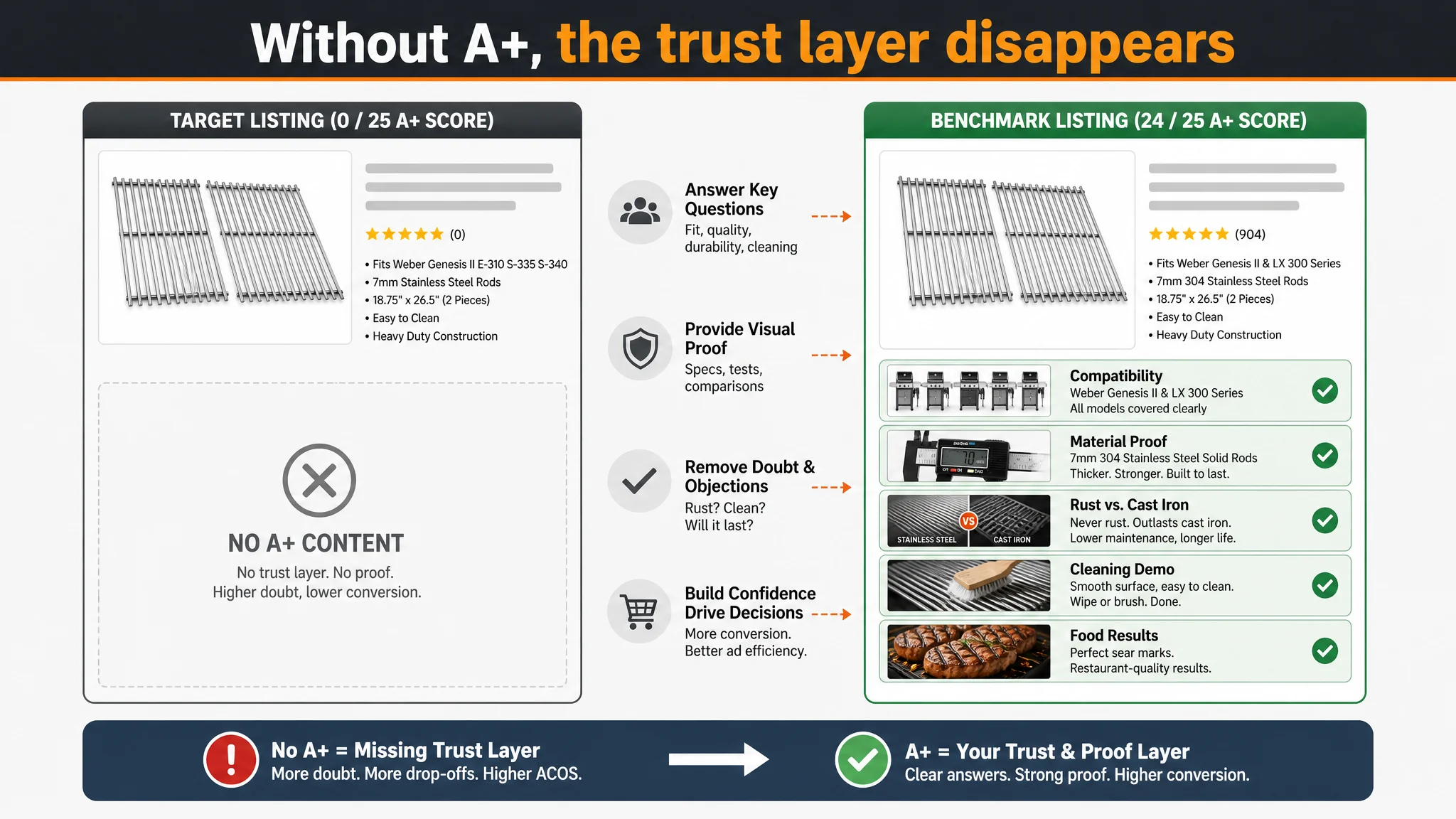
The starkest difference in DeepBI’s report was the Detail / A+ score:
- Target Listing: 0 / 25
- Benchmark Listing: 24 / 25
On the benchmark Listing, A+ content was carrying a heavy commercial load:
- Compatibility clarity: Clear visuals mapping specific Weber Genesis II and LX 300 series models to the product.
- Material and thickness proof:
- 9.5mm vs. thin rods visual comparison
- SUS304 certification shield
- Saltwater test illustrations
- Cast iron vs. stainless steel differentiation:
- “Why Choose SUS304 Instead of Cast Iron?”
- Visual before/after modules showcasing rust, chipping, and maintenance burden.
- Cleaning and maintenance demonstration:
- Simple brush-clean scenes
- “Maintenance-free” messaging
- Usage scenes:
- Grill in action with steaks, visible sear marks, and appetizing food imagery
- Family barbecue scenes building emotional value
In contrast, the target Listing had no A+ at all—no visual proof of fit, no thickness demonstration, no rust comparison, no cleaning demo, no food results.
DeepBI’s judgment:
“This product page did not lack traffic. It lacked trust.”
From a funnel perspective, this means:
- Ads and organic placements might deliver impressions and clicks.
- But once on the page, shoppers see a bare-bones standard layout with nothing beyond bullets and a basic image set.
- The most important questions—“Will it fit my exact grill?”, “Will it rust?”, “Is it really an upgrade from cast iron?”—are left to the buyer’s imagination.
When a benchmark Listing answers those questions with visual evidence and data-backed claims, the weaker Listing bleeds conversion, no matter how well ads are tuned.
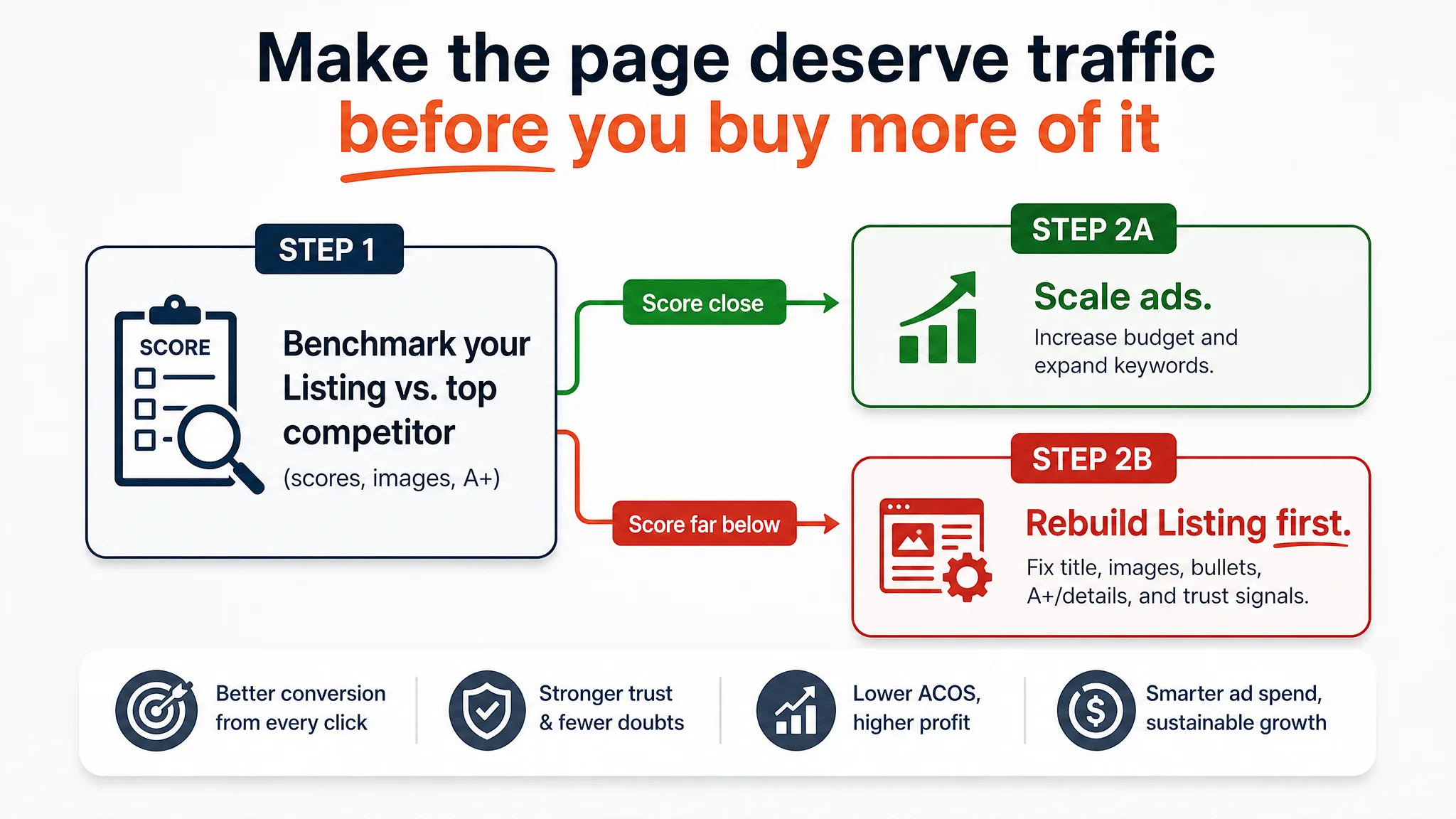
Why DeepBI Refused to “Fix Ads First”
With this score profile and visual gap, DeepBI’s recommendation was clear:
- Do not keep shifting budget and bids as the primary lever.
- Do rebuild Listing conversion capacity before scaling traffic.
The logic:
1. New reviews would not fix a missing narrative.
Even if early orders came in and reviews appeared, they would be sitting on top of a page that still:
- Didn’t visually prove fit and durability
- Didn’t clearly differentiate from cast iron
- Didn’t anchor “restaurant-quality” food results
1. Ads were amplifying a broken funnel.
Each additional dollar into ads would push more traffic into a page that loses out to a much stronger competitor Listing on the same search results—especially for high-intent Weber compatibility queries.
1. A+ and images are “conversion infrastructure.”
Until that infrastructure is in place—compatibility visuals, thickness proof, rust comparison, cleaning ease, cooking results—no amount of bid tweaking can create stable ACOS and TACOS.
DeepBI’s position was not “ads don’t matter,” but:
Before ads can work again, the page has to convert.
How the Page’s Sales Logic Was Rebuilt
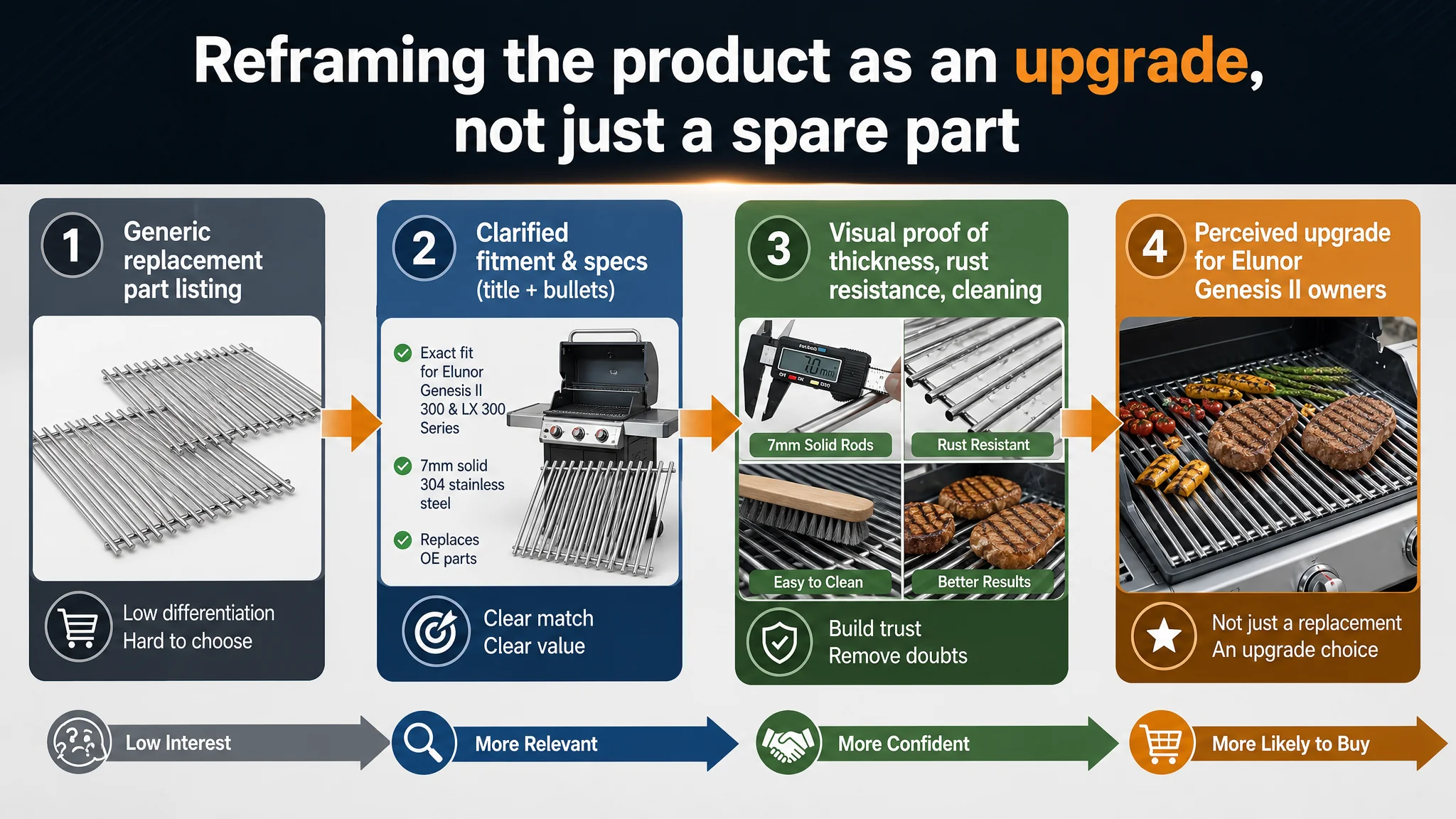
DeepBI’s optimization guidance concentrated on one central objective: turn a technical replacement part Listing into a convincing, risk-reducing upgrade narrative.
1. Reordering the Title Around Search and Outcomes
Proposed direction for the title:
- Lead with material + size + use case, not the brand:
- “7mm 18.75" 304 Stainless Steel Grill Grates for Weber Genesis II 300 & LX 300 Series…”
- Integrate Weber part numbers and GS4 clearly for search coverage.
- Use a more compact model-format (E/S combined) to free characters for valuable keywords like “replacement grill grates,” “Genesis II,” and “GS4 grill parts.”
This keeps the brand visible, but shifts the first few words to what truly drives search and click decisions in this category.
2. Turning Bullet Points into a Buying Path
The recommended bullets followed a clear structure:
- BP #1 & #2: Fitment confidence
- Detailed Weber Genesis II 300 and LX 300 model lists
- OE part numbers (66095, 66802, 66805, 84136, 7599)
- Explicit fitment for certain KitchenAid models
- BP #3: Material & specs
- “Premium 304 stainless steel”
- “7mm thick solid rods”
- Specific dimensions for single and combined grates
- BP #4: Durability & performance
- Outlasts traditional cast iron
- Resists oil splatter and warping under high heat
- Even heat distribution, no cold spots
- BP #5: Results & maintenance
- “Professional sear marks”
- Prevents small foods from falling through
- No seasoning required, easy to brush clean
This reframing connects:
- What the product is → What it does → What the buyer gets.
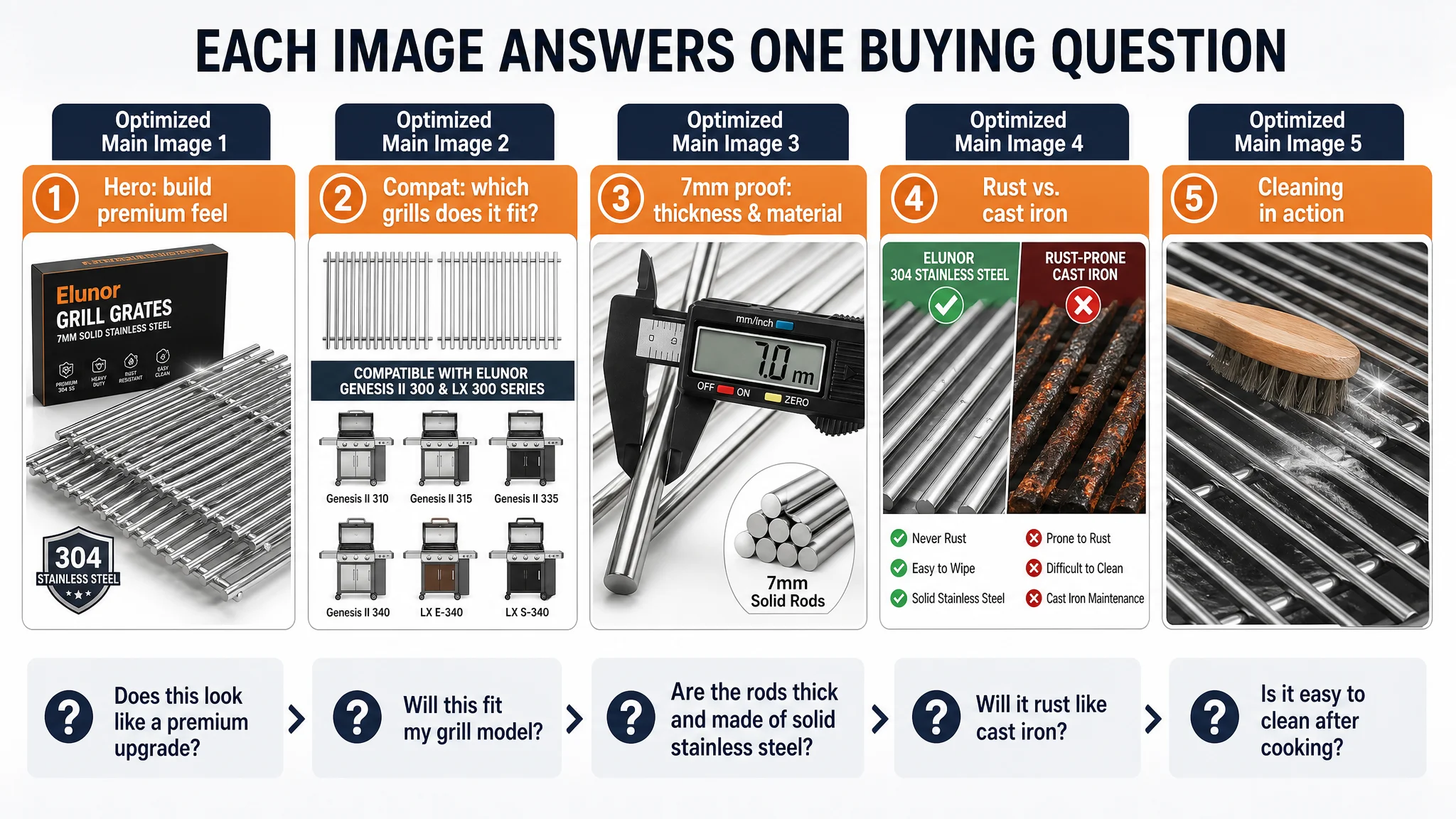
3. Recasting Main Images Around Decision Moments
Rather than “more of the same metal,” the image direction targeted specific decision nodes.
Key examples:
- Hero image (3D perspective)
- 45° overlapping view to show thickness and depth
- High-contrast lighting to emphasize solid rod construction and high-end feel
- Compatibility image
- Grid of Weber Genesis II models with clear labels under each grill illustration
- Top banner “Replacement Parts for Weber Genesis II 300 Series”
- Designed to answer “Will this fit my grill?” in three seconds
- Thickness proof image
- Hand holding digital caliper reading “7.0mm” against a grate rod
- Caption: “7mm Solid Rods”
- Translates an abstract number into a tangible performance signal
- Rust comparison image
- Stainless steel vs. rusted cast iron split-screen with “Never Rust / Easy to Wipe” vs. “Rust-prone / Hard to Clean”
- Directly attacks the core anxiety that drives many buyers away from cast iron
- Cleaning action image
- Brush gliding over the grate, leaving a clean path
- Headline: “Effortless to Clean”
- Turns “easy to clean” from a claim into a visual behavior
Each image was tied to a specific friction point identified in DeepBI’s analysis: fitment, thickness credibility, rust risk, cleaning effort, and real-world use.
4. Building A+ as the Core Trust Layer
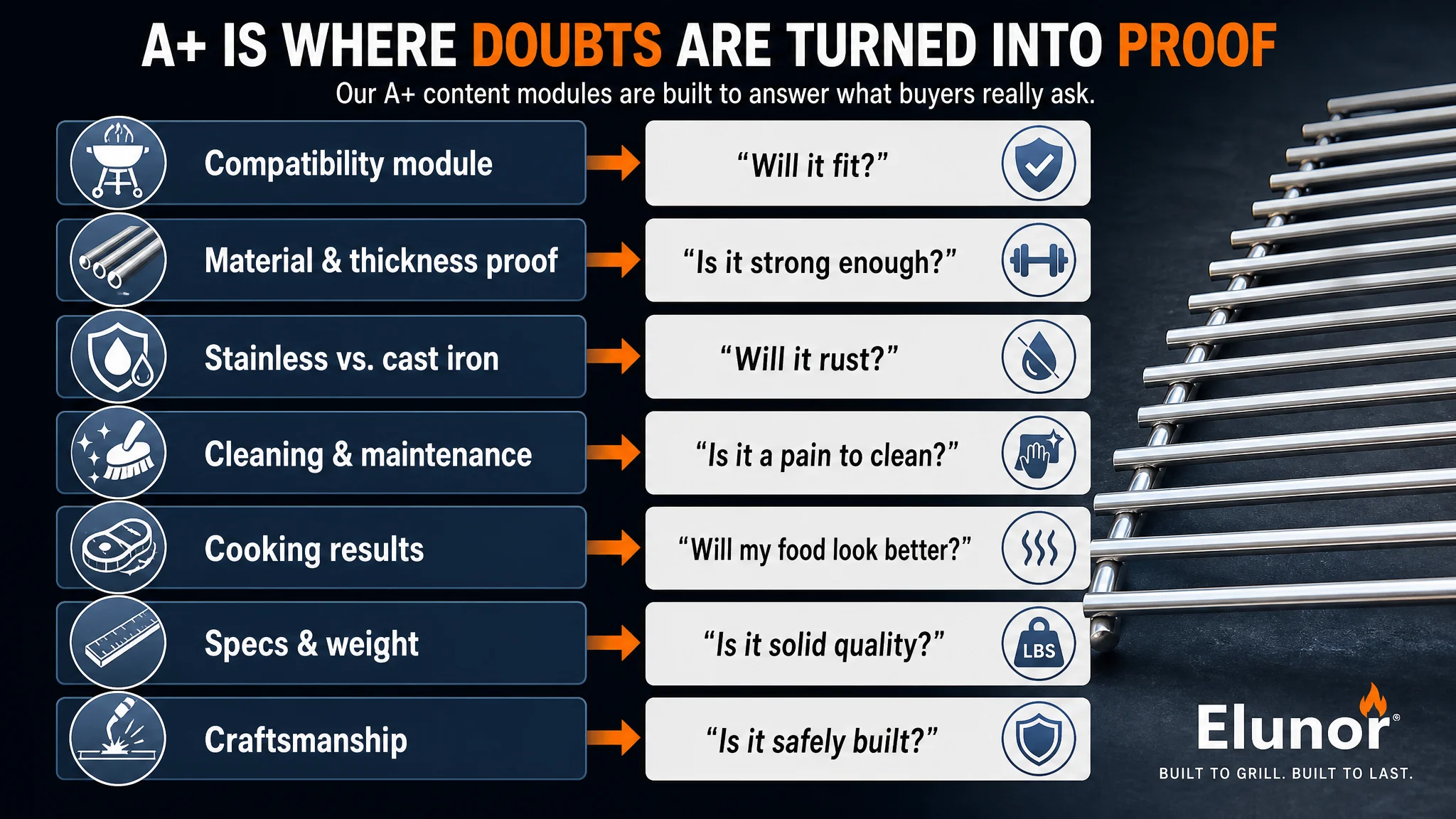
For the A+ (detail) section, DeepBI’s plan mirrored what the benchmark was already using successfully, adapted to this product’s actual specifications:
- Compatibility module
- Left: checklist of model names with green check icons
- Right: hero grill rendering with the grate partially lifted to show install position
- Material & thickness proof module
- Macro shot of a rod cross-section with caliper showing “7.0 mm”
- Lab-like lighting to create a “tested & verified” impression
- Stainless vs. cast iron conflict module
- Clean stainless grate vs. rusted cast iron visual
- Short, clear labels: “Stainless Steel” vs. “Rust-Prone Cast Iron”
- Cleaning & maintenance module
- Hand with brush showing “washed” vs. “unwashed” sections
- Emphasis on wiping, not scraping or re-seasoning
- Cooking results module
- Grates in-grill, with steak showing deep diamond grill marks and rich browning
- Warm lighting to trigger appetite and “restaurant-quality” association
- Specs & weight module
- Clear dimension arrows for 18.75" and 13.25"
- Weight icon for total lbs, addressing “heaviness = quality” perception
- Weld and craftsmanship module
- Close-up of weld points to demonstrate smooth, robust construction
- Reinforces “heavy-duty” and “no sharp edges” perception
This transformed the A+ section from non-existent to a complete trust and explanation layer that could support both organic traffic and ad-driven traffic more reliably.
How the Operating Risk and Understanding Changed
There is no invented performance data for this case. But from a business perspective, several critical shifts occurred:
1. The Team’s Mental Model of ACOS Changed
Before:
- High ACOS = “our ads and lack of reviews are the problem.”
- Default reaction: restructure campaigns, test more keywords, push budget.
After DeepBI’s diagnosis:
- High ACOS = “we are paying to expose a structurally weak Listing to a benchmark that is significantly stronger at decision stage.”
- Revised reaction:
- First, rebuild Listing conversion capacity.
- Only then push incremental traffic and budget.
2. Listing Conversion Became the Foundation, Not an Afterthought
The team began to see:
- Title, main image, bullets, and A+ are not cosmetic. They are levers that determine whether ad clicks have a chance to pay back.
- Amazon ads cannot permanently compensate for:
- Missing proof of compatibility
- Unsubstantiated material claims
- Invisible cleaning and durability benefits
3. Traffic Risk Became More Controllable
With Listing structure upgraded:
- Future ad tests would run against a page that:
- Visually confirms fit for specific Weber models
- Proves 7mm 304 stainless rods with clear imagery
- Visibly differentiates from rust-prone cast iron
- Shows cleaning ease and food results
This doesn’t guarantee instant success, but it reduces the probability that traffic is simply being wasted on avoidable, page-level doubts.
Advertising does not only amplify advantages. It can also amplify a page’s existing defects.
By treating Listing conversion as infrastructure, not decoration, the seller shifted from “spend more to hope for reviews” to “build a page that deserves more traffic, then scale ads.”
What Other Amazon Sellers Can Take Away
For Amazon sellers—especially in technical or replacement-part categories—the lessons from this grill-grate case are clear:
1. Do not treat high ACOS as purely an ads problem.
If your Listing scores far below a direct benchmark on images, bullet logic, A+, and reviews, ad tuning alone will not stabilize performance.
1. Reviews are necessary, but not sufficient.
A page without a clear, visual, and data-backed story will remain vulnerable even after social proof appears.
1. Listing elements must work together.
- Title: capture the right search patterns and core attributes up front.
- Main image set: prove fit, thickness, rust resistance, cleaning ease, and food results.
- Bullets: move from feature lists to pain-point → solution → result logic.
- A+: serve as your trust and explanation layer, not optional decoration.
1. Fix the page before you scale the ads.
Before increasing budgets or expanding keywords, ask a simple question:
- “If I were a shopper comparing my page to the top competitor on the same search result, would my page provide stronger, clearer reasons to buy?”
In this case, DeepBI’s real contribution was not a feature or a tool; it was a reframing of the business problem: from “we lack reviews and traffic” to “our Amazon product page does not yet deserve the traffic we are buying.” Once that judgment changed, the path to improving conversion—and making ad spend truly productive—became much clearer.