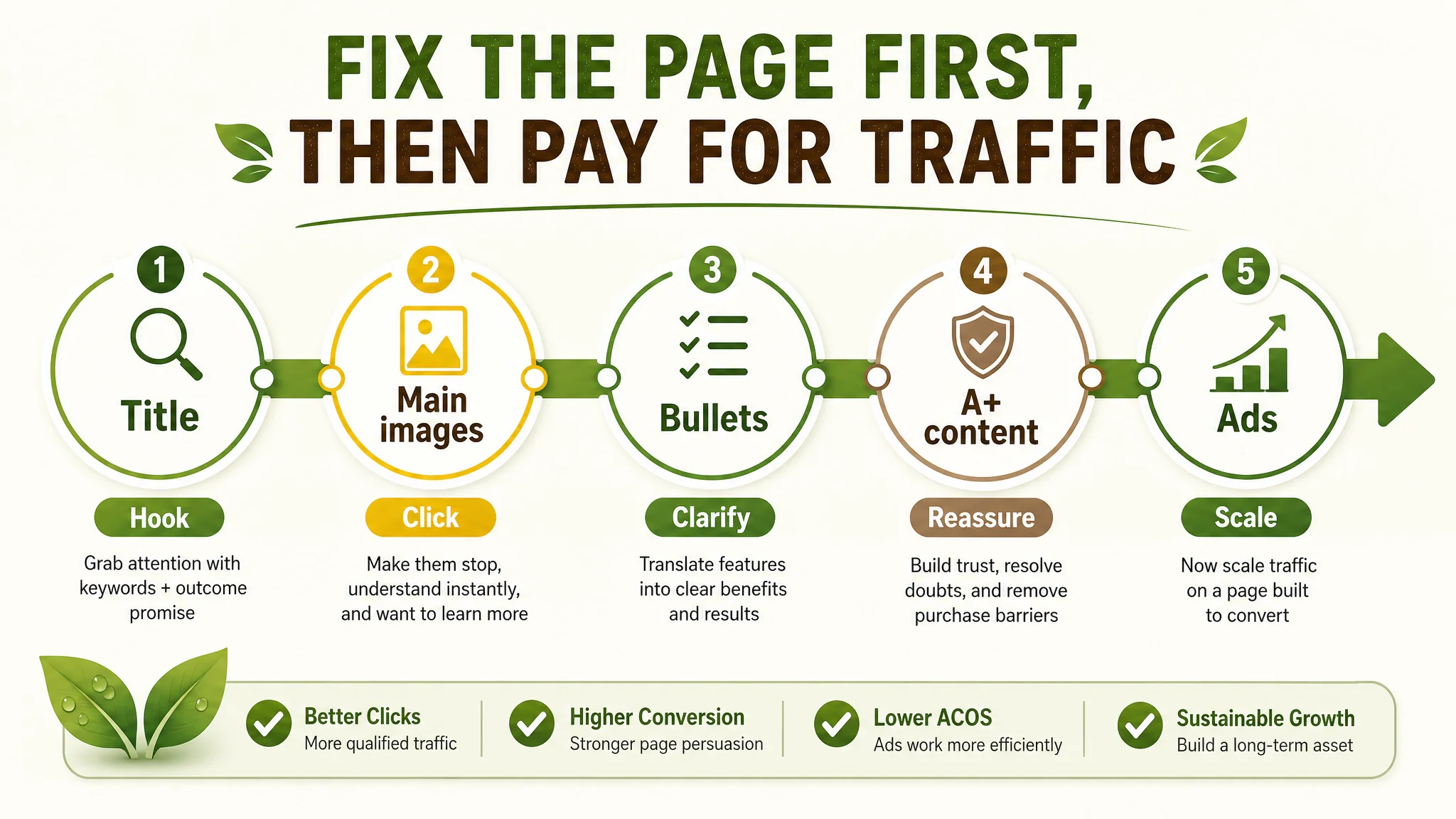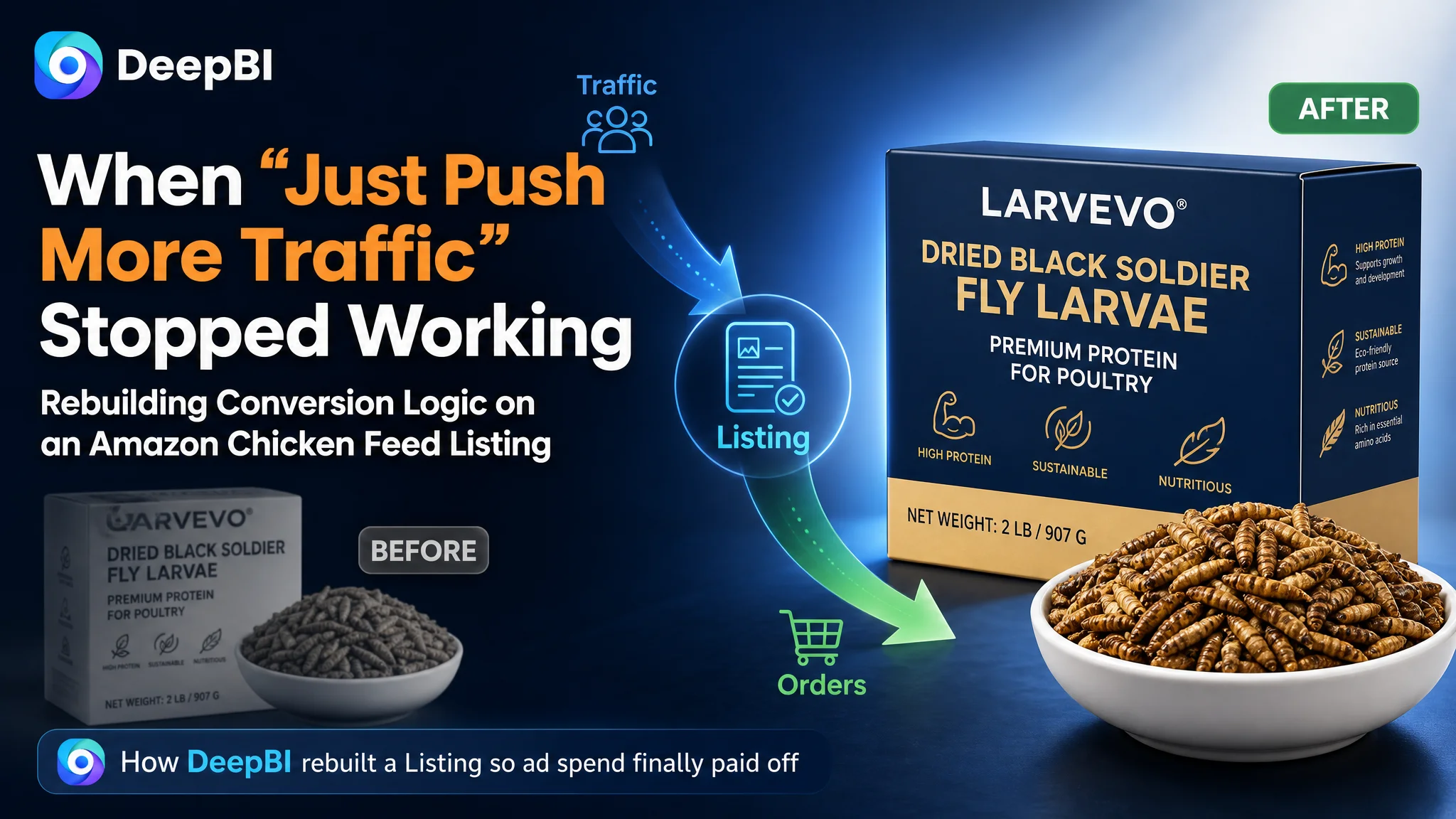
This Amazon seller in the poultry feed category had a familiar problem: ads were running, traffic was there, but the product page could not stand up against a benchmark competitor. The team’s first instinct was to keep tuning bids and keywords, hoping that more impressions would eventually turn into more orders. DeepBI’s diagnosis showed a different story: the real leak was not in the traffic source, but in how the Amazon Listing itself converted that traffic.
By benchmarking the seller’s dried black soldier fly larvae Listing against a category-leading competitor, DeepBI found that the entire decision path on the Amazon product page was weaker—from the title and main image, to bullet points, A+ content, and review structure. The seller had focused on “we have 45% protein and high calcium”; the benchmark focused on “strong eggshells, healthy growth, and trustable, clean nutrition”, and expressed this consistently across the page.
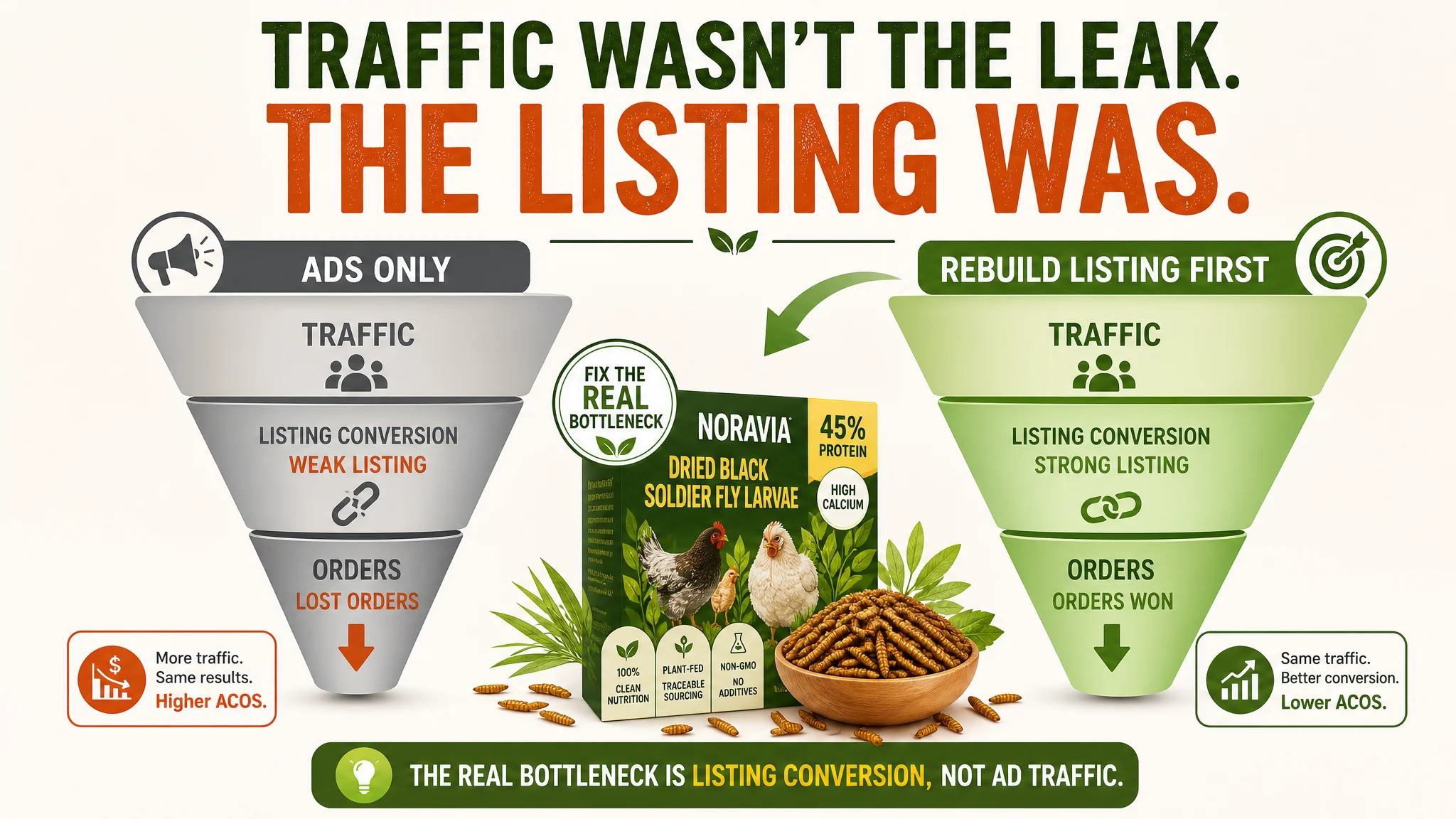
Once the problem was reframed as a Listing-conversion issue instead of an advertising problem, the optimization strategy changed completely. DeepBI prioritized rebuilding the title logic, making the main image carry real numerical and trust signals, restructuring bullet points around concrete outcomes, and reordering the A+ modules to frontload safety and results. For other Amazon sellers, the takeaway is direct: when ACOS feels stuck or ad optimizations hit a ceiling, it’s often the product page that is quietly consuming your traffic budget.
The Real Constraint Was Not Traffic. It Was Listing Conversion Capacity.
From a pure traffic standpoint, this poultry-nutrition Listing was not “starving.” The brand was running Amazon ads, had a reasonable price point, and sat in a category where buyers actively search for terms like “dried black soldier fly larvae for chickens”, “mealworm replacement”, and “high protein chicken treats.”
Yet when DeepBI benchmarked the Listing against a top competitor, the score gap was stark:
- Target Listing: 72/100
- Benchmark Listing: 90/100
- Gap: –18 points
Breaking it down by dimension:
- Title: Target: 13, Benchmark: 18, Max: 20, Gap: -5
- Main Image: Target: 24, Benchmark: 26, Max: 30, Gap: -2
- Bullet Points: Target: 6, Benchmark: 8, Max: 10, Gap: -2
- Detail / A+: Target: 21, Benchmark: 23, Max: 25, Gap: -2
- Reviews: Target: 8, Benchmark: 15, Max: 15, Gap: -7
And on the review side:
- Target: 4.4 stars, 65 reviews
- Benchmark: 4.8 stars, 1,809 reviews
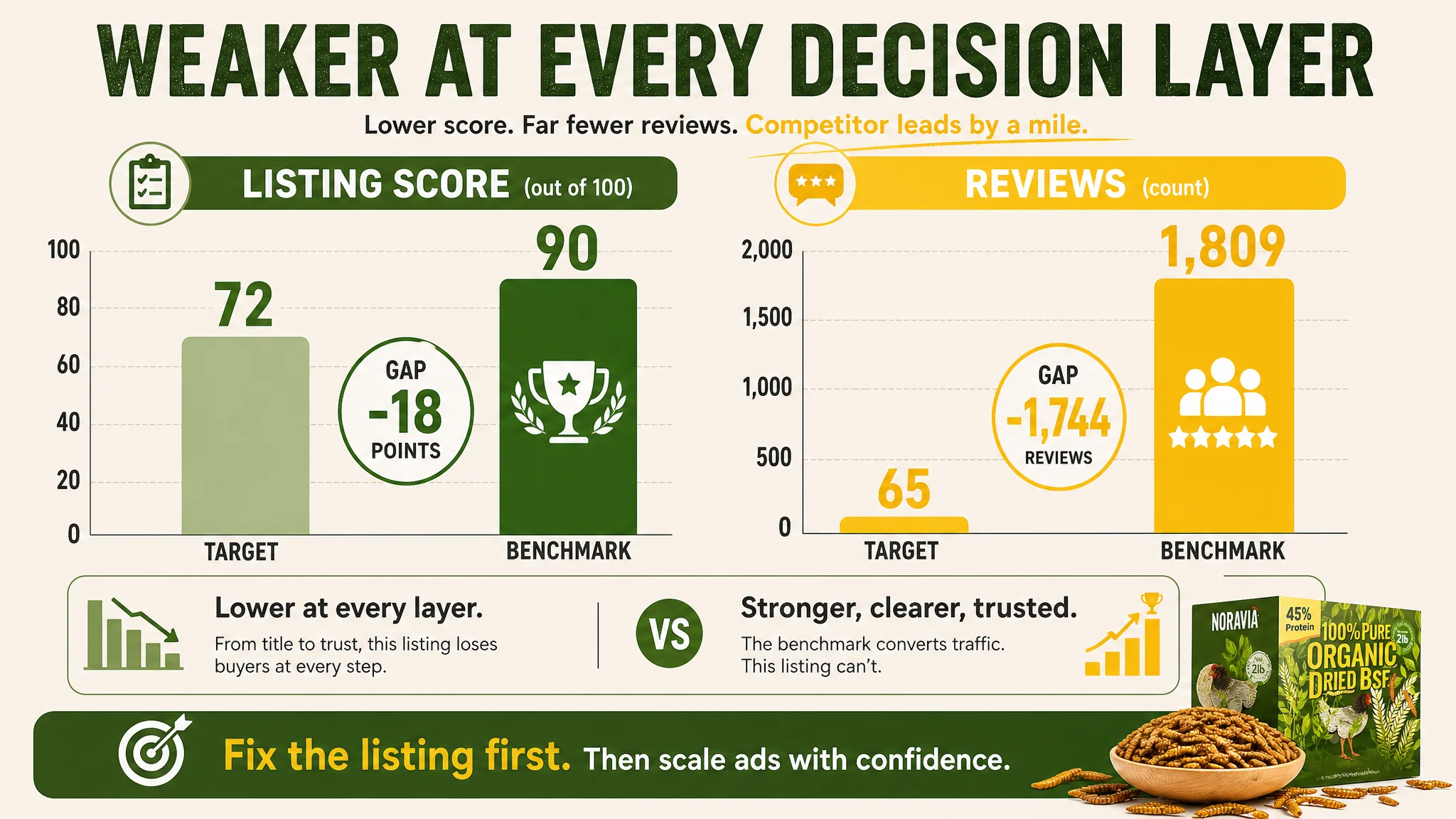
Even without exact CVR/ACOS data, this pattern is familiar to most Amazon sellers: the Listing is not obviously “bad”, but it is consistently weaker at every decision layer, while the competitor is stronger, clearer, and more trusted.
“The real problem was not that ads failed to bring traffic. It was that the page could not convert the traffic.”
If the team had kept treating this as a pure ads problem—new keywords, new bids, new campaigns—the result would have been simple: more money poured into a page that was not built to win.
The Seller’s Misdiagnosis: “We Just Need More Exposure”
From the brand’s perspective, the story initially sounded logical:
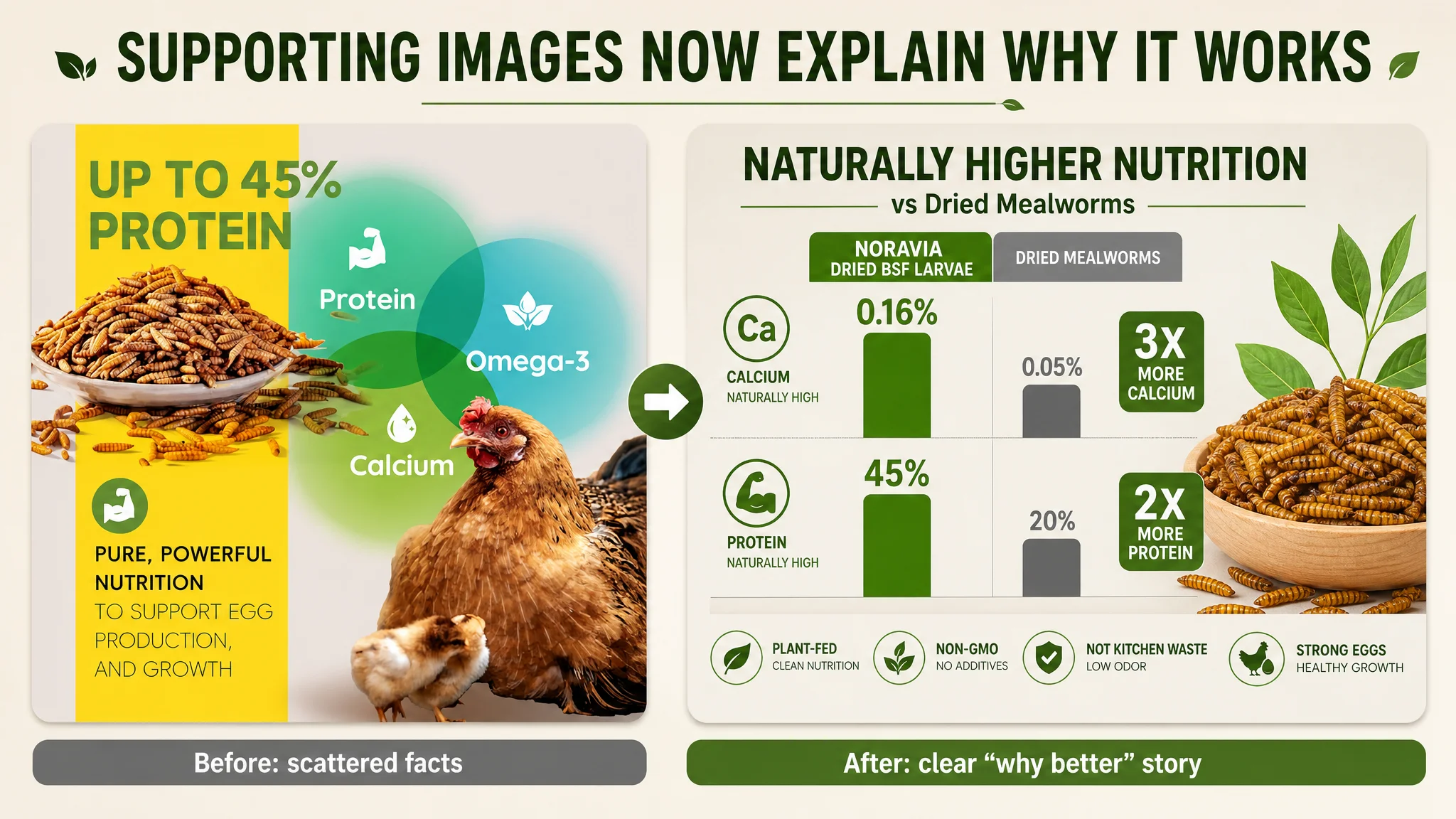
- The product itself is strong: 45% protein, naturally high calcium, plant-fed larvae, non-GMO.
- Ads can push more people to see these advantages.
- If ads are not performing, it must be a targeting or bidding issue.
So the operational focus stayed on:
- Adjusting search term coverage.
- Tweaking bids and budgets.
- Trying to “catch up” with the competitor’s exposure.
What was missing was a hard look at what buyers actually see and understand once they land on the Amazon product page:
- Do they understand why 45% protein matters?
- Do they see a reason to trust the product’s safety and origin?
- Do they connect calcium and protein to specific, visible outcomes (strong eggshells, bone health, plumage, consistent egg production)?
- Do they feel assured enough to choose this Listing over a competitor with thousands of reviews?
As long as the seller believed the core issue was insufficient visibility, the operating logic was to “feed the top of the funnel.” DeepBI had to show that the real bottleneck was in the middle and bottom of the funnel—the conversion capacity of the Listing itself.
Amazon Ads Were Not Failing. The Page Was Consuming the Traffic.
DeepBI’s Listing assessment made two things clear:
1. The competitor had much stronger page-level persuasion and trust.
2. The target Listing’s structure systematically under-leveraged its own real strengths.
Title: From “Ingredient List” to “Outcome-Driven Promise”
The benchmark’s title is a case study in how Amazon titles can do both SEO and sales:
- Starts with core keywords: “Non-GMO Dried Black Soldier Fly Larvae for Chickens”.
- Immediately introduces a high-impact numeric claim: “85X More Calcium Grubs Than Mealworms”.
- Directly ties it to outcomes: “for Strong Eggshells & Healthy Growth”.
- Broadens the audience: “Chickens, Birds, Ducks, Geese & Pets”.
The original target title leaned heavily on attributes:
- “2LB”, “45% Protein”, “High Calcium”
- “Chicken Feed”
- Plus multiple keyword repetitions and a somewhat piled-up structure.
The result:
- We see what the product is, but not why it matters.
- We see numbers, but not the consequence of those numbers.
- SEO is present, but the click impulse and buying logic are weak.
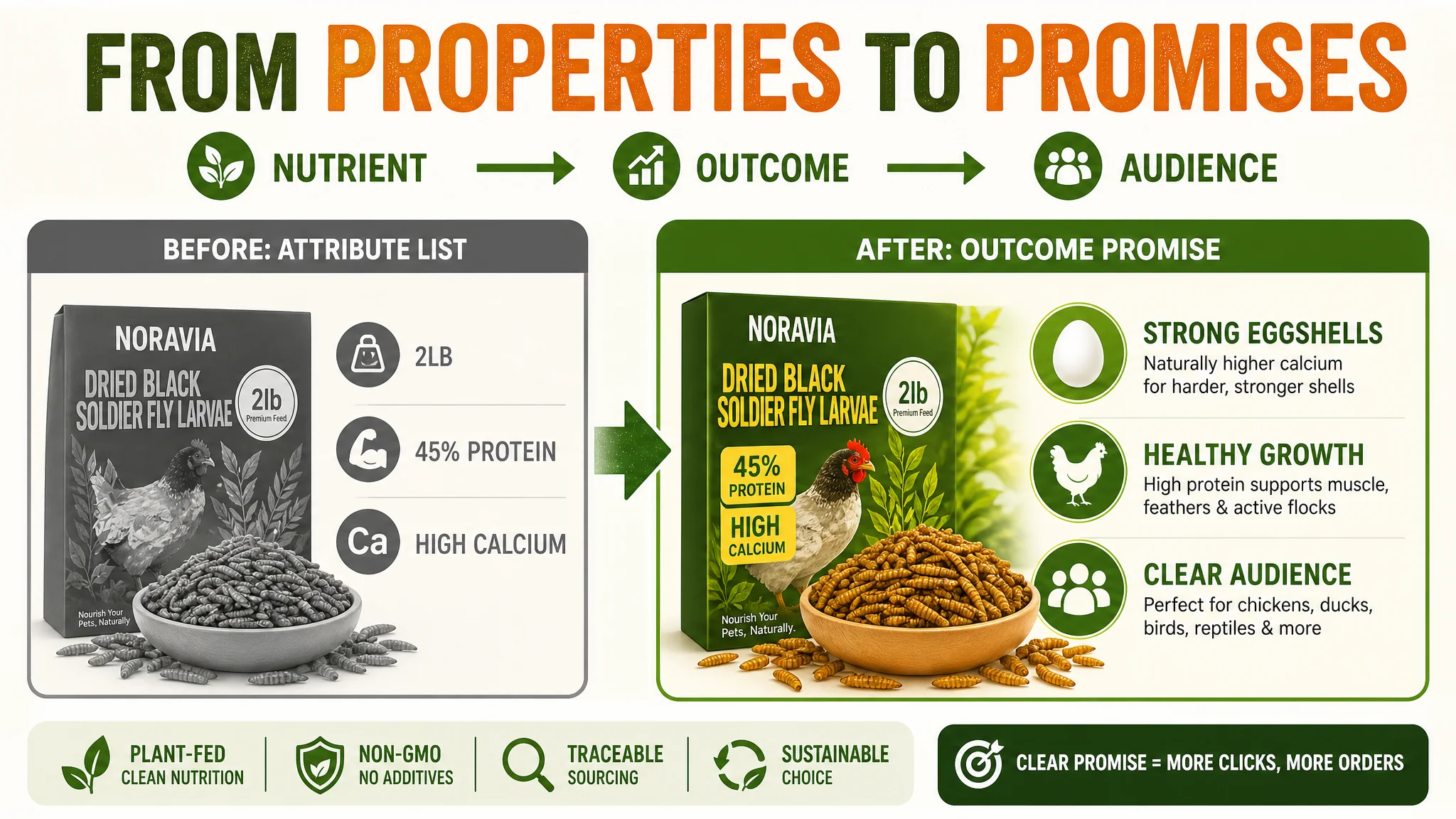
DeepBI’s suggested title direction was to keep real differentiation (2LB, 45% protein, high calcium, Dried BSF larvae) but reframe it into “nutrient → outcome → audience”:
2LB Non-GMO Dried Black Soldier Fly Larvae for Chickens, 45% Protein High Calcium Chicken Feed for Strong Eggshells & Healthy Growth, Dried BSF Larvae Treats for Laying Hens, Ducks, Birds, Reptiles
The goal was not just keyword improvement—it was to shift from “property listing” to “result promise buyers can act on.”
Main Images: Not Just Pretty, But Decisive
On Amazon, the main image and its supporting images often decide CTR before any text is read. DeepBI’s visual analysis found several issues in the target Listing:
- Information overload in the main image
- Too many elements competing for attention.
- The “45% Protein” and “High Calcium” claims were not visually dominant.
- Lack of immediate, recognizable icons (chickens, eggs, feathers) to signal who it’s for and what it does.
- Trust cues missing at thumbnail stage
- No clear “clean nutrition” seal.
- No strong visual of plant-fed, non-kitchen-waste sourcing.
- No lab, quality-control, or farm professionalism elements that high-value buyers look for in a >$20 feed/treat product.
By contrast, the benchmark:
- Makes its key numerical advantages unmissable (huge 85X calcium claim).
- Visualizes target use (chickens, flocks, natural environments).
- Uses simple structures: “Why choose us”, “Double nutrition”, “Farm scenes” that convey trust and emotional connection.
The risk for the seller was clear:
“Advertising does not only amplify advantages. It can also amplify a page’s existing defects.”
If CTR is already under pressure because the main image is not communicating a clear, high-value reason to click, pushing more ad impressions only increases the cost of each weak click.
DeepBI’s direction for the main image set was to:
- Make “45% PROTEIN” and “HIGH CALCIUM” visually dominant with large, bold numbers.
- Add clear, category-relevant icons (chicken, egg, feather) to anchor immediate understanding.
- Introduce concise trust tags like “100% CLEAN NUTRITION”, “PLANT-FED”, “NON-GMO, NO ADDITIVES”.
- Rebuild one of the secondary images as a numeric comparison against typical dried mealworms (higher calcium, higher protein), visually positioning the product as a high-performance replacement, while staying within real, stated attributes.
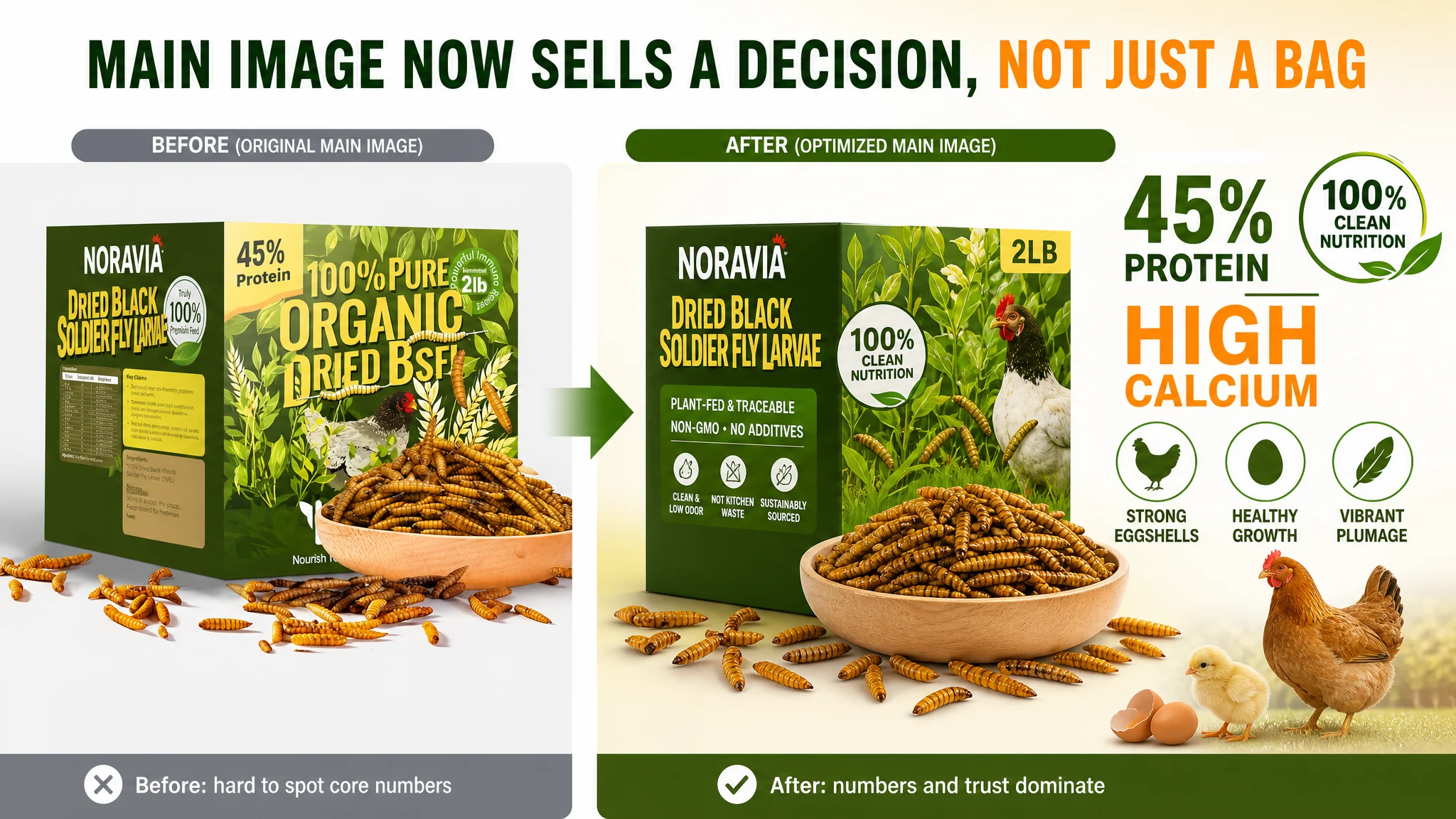
The objective was not design beauty; it was CTR and conversion logic: the images had to sell a decision, not just show a bag.
Bullet Points: From “Ingredients Listed” to “Problems Solved”
The bullet points on the target Listing were structurally sound but strategically weak:
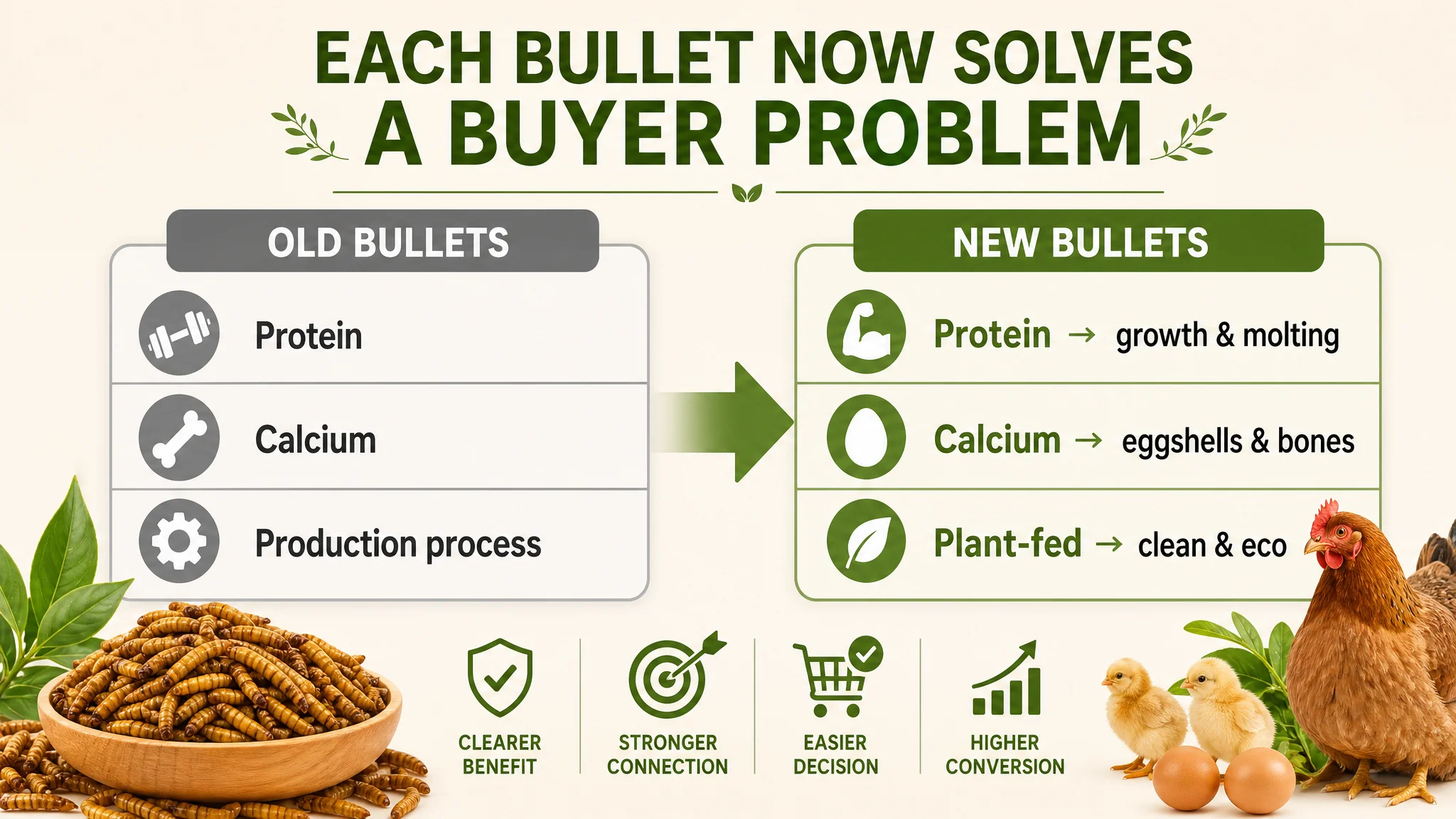
- Heavy on components (protein, calcium, production process).
- Light on explicit outcomes (eggshell hardness, bone health, molting support, plumage, consistent egg production).
- No dedicated trust / after-sales bullet to close the confidence gap.
The benchmark, however, followed a different pattern:
- Each bullet = Data or claim → specific effect → scenario.
- Numeric comparisons: “85x calcium”, “2x protein vs typical feed”.
- A clear after-sales / peace-of-mind bullet.
DeepBI’s bullet-point optimization reframed each bullet into a closed loop:
1. Premium 45% Protein for Healthy Growth
- Not just “45% protein”, but linked to muscle development, vibrant plumage during molting, and consistent egg production.
1. Superior Calcium for Stronger Eggshells
- Calcium explicitly tied to eggshell strength and long-term bone health, plus comparison to traditional dried mealworms.
1. Traceable Plant-Fed & Eco-Friendly
- Clean, plant-based spent grain, traceability, low odor, and crispy texture—turning sourcing and sustainability into both trust and sensory appeal.
1. Nutrient-Rich Whole Larvae Treat
- Whole larvae as a dense supplement: protein, fats, minerals, designed to “power” backyard flocks.
1. Versatile Protein for Multiple Species
- Clear multi-species use (chickens, ducks, wild birds, reptiles, aquarium fish) and positioning as a mealworm replacement and daily supplement.
Instead of listing what the product contains, the bullets began to answer buyer questions:
- “Will this help my hens during molting?”
- “Will eggshells improve?”
- “Is this safe and clean, or made from garbage?”
- “Can I use this for more than one animal?”
A+ Content: This Product Page Did Not Lack Information. It Lacked Trust and Decision Flow.
The original A+ layout had several strengths:
- Clear brand visuals.
- Nutritional breakdowns (protein, calcium, Omega-3).
- Explanations of plant-fed sourcing.
- Multi-species applicability.
But when compared to the benchmark, a pattern emerged:
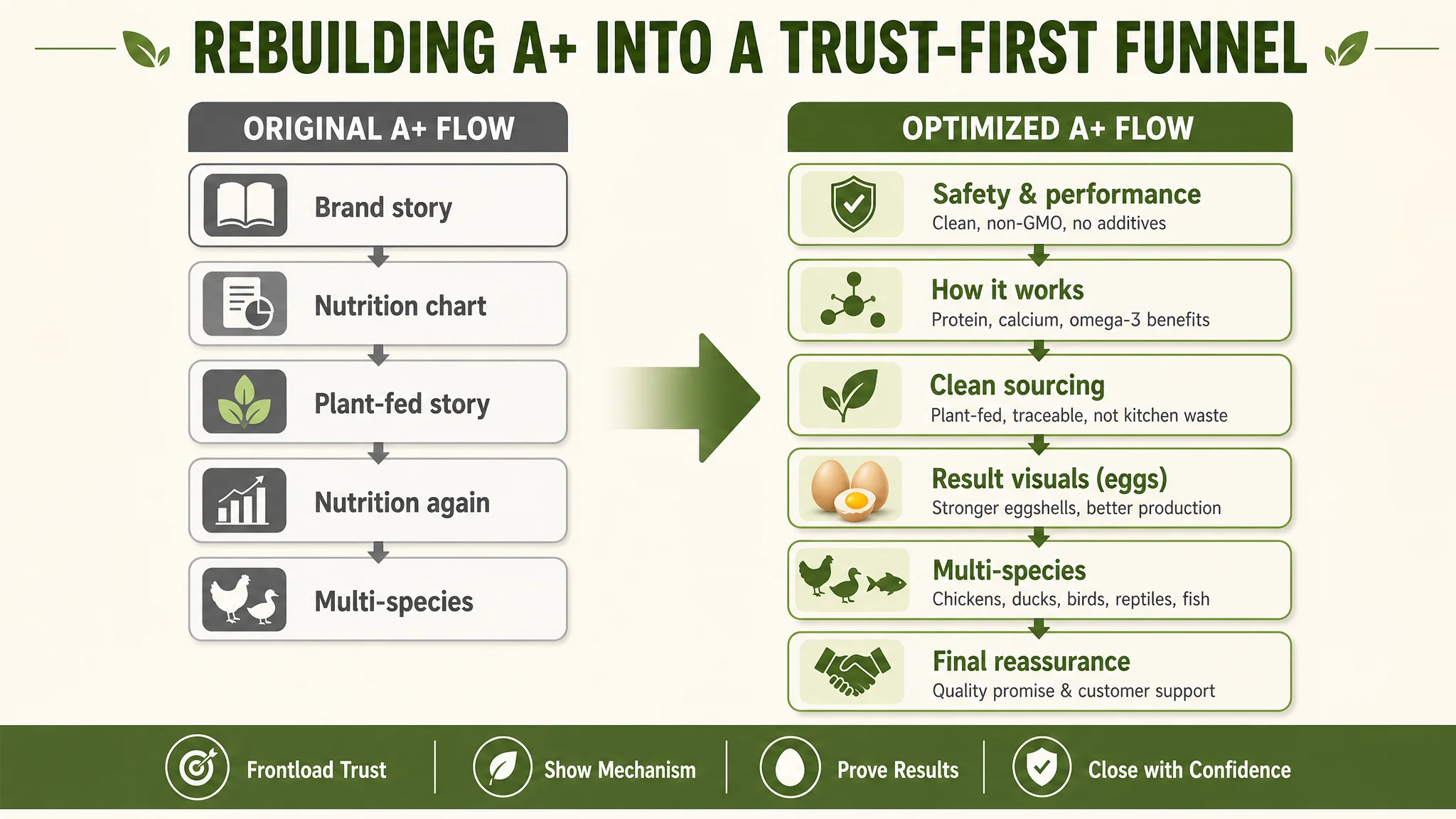
- The brand spent precious early A+ space on brand story and abstract positioning.
- Core safety and performance parameters (non-GMO, plant-fed, non-kitchen-waste, high protein, high calcium) were not frontloaded.
- Numeric values were listed, but the mechanism and result (“strong eggshells”, “consistent egg production”, “healthy flock”) were not concretely visualized.
- No structured FAQ to answer typical questions about replacement, feeding method, or role (treat vs main feed).
- No final “trust anchor” module—no last panel to give hesitant buyers a final nudge (origin reassurance, quality promise, clean sourcing re-emphasis).
The benchmark’s A+ structure followed a much clearer funnel:
1. High-impact hero with benefits.
2. Trust bar (non-GMO, lab-tested, quality seals).
3. Health benefits broken into simple modules.
4. Sustainability and brand mission.
5. Before/after or comparison visuals (e.g., egg quality).
6. Multi-species usage.
7. Real farm interaction scenes and FAQ.
DeepBI’s A+ optimization logic for the target Listing was therefore structural, not decorative:
1. Lead with Clean, Safe, High-Performance Claims
- Move key parameters and assurances to the front:
- “Up to 45% Protein”
- “Naturally High Calcium”
- “Raised on traceable plant-based spent grain, not kitchen waste”
- “Non-GMO, low odor product”
The first module after the main image should immediately answer: “Is this powerful and safe enough for my flock?”
2. Turn Numbers into Mechanisms and Results
- Convert raw nutritional data into clear consequences:
- Protein → muscle growth, molting support, active, productive hens.
- Calcium → eggshell hardness and bone strength.
- Omega-3 and minerals → resilience and overall health.
Instead of another numeric chart, build a “how it works” module that visually links these nutrients to hens, eggs, feathers, and energy.
3. Bring Safety and Source Assurance Forward
- The “plant-fed, not kitchen waste” story was originally buried and partially duplicated.
- By placing it earlier and visualizing clean larvae and production scenes, the Listing directly addresses one of the biggest mental objections: “Is this made from garbage and will it hurt my animals?”
4. Visualize Results, Not Just Inputs
- Replace a repetitive nutrition module with a result-focused panel:
- Clean, perfect eggs imagery.
- Short, tight message about supporting strong eggshells and consistent egg production.
Even without promising unrealistic outcomes, this kind of visual cue massively shortens the decision path for buyers.
5. Clarify Role and Range
- Keep the multi-species module, but make its purpose precise:
- “Versatile supplement / treat, not main feed.”
- “One bag for multiple backyard animals.”
This reduces the perceived complexity of using the product and underlines its economic value.
6. Add a Closing Reassurance
- Introduce a final panel that reinforces:
- Non-GMO.
- Clean, traceable plant-based origins.
- Consistent quality and reliable nutrition.
This “last word” is often what moves cautious buyers from “interested” to “order placed.”
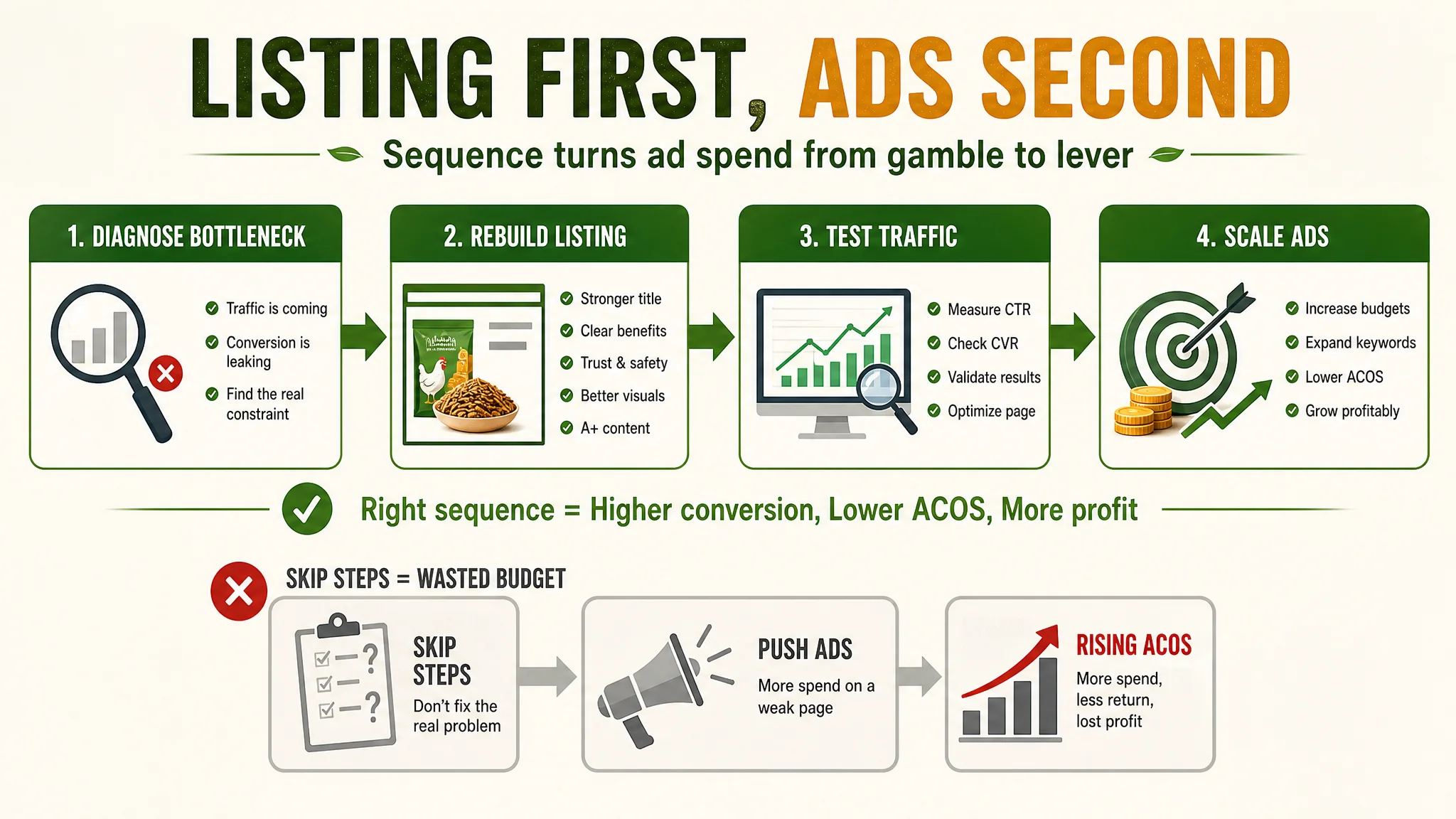
Why Fix the Listing Before Touching Ads Again
From a business perspective, this case was not about aesthetics; it was about sequence.
When DeepBI looked at the situation, the logical risks were:
- The competitor’s page scored dramatically higher and had far stronger social proof (1,800+ reviews).
- The target Listing lagged across title, images, A+, and review volume.
- Ads were already being used, meaning any extra spend would be poured into an inferior decision journey.
Under these conditions, continuing to push ads first would have caused:
- Rising ACOS with limited improvement.
- Wasted impressions on visitors who never receive a compelling reason to switch from the benchmark Listing.
- Dependence on advertising to “force” volume, instead of letting the product page pull its own weight.
DeepBI’s judgment was that:
- Listing conversion capacity was the primary bottleneck.
- Until the page could articulate value, build trust, and resolve doubts at the same level as the benchmark, using ads as the main lever would be economically irrational.
So the decision path was:
1. Rebuild the Listing’s sales logic
- Clarify title and keywords around outcomes and audiences.
- Make the main image and secondary visuals carry numeric, benefit, and trust signals.
- Restructure bullets around buyer pain points and concrete results.
- Reorder and refocus A+ modules to frontload safety, performance, and result imagery.
1. Only then, re-evaluate ads
- Once the page had a credible, structured conversion path, ad traffic could finally be tested against a page that deserves traffic.
- At that point, ACOS trends and CVR shifts would reflect real funnel improvements, not structural Listing weaknesses.
How the Page’s Sales Logic Started to Recover
This case did not rely on invented KPIs or hypothetical uplift claims. The more important changes were in operating risk and control:
- The listing went from “data-heavy but abstract” to “outcome-driven and trust-first”.
- Visuals shifted from showing “what the product is” to “what it does, for whom, and how safely”.
- The A+ content stopped pushing story and repeated nutrition, and started to answer the specific doubts that block purchase.
That shift had several practical implications:
- New traffic (both organic and paid) now lands on a page that clearly differentiates itself against mealworms and generic feeds.
- Safety and origin concerns are addressed early, reducing friction with cautious buyers who care deeply about what their animals eat.
- Multi-species positioning plus a clear “treat/supplement” role let buyers justify the purchase across more than one use case.
- Ads, once reactivated or scaled, are more likely to earn back their spend because each click meets a coherent conversion funnel.
In other words, the Listing began to regain its ability to:
- Convert both organic and paid traffic.
- Compete in a category dominated by a high-review, high-score benchmark.
- Support ad optimization instead of undermining it.
What Other Amazon Sellers Can Take From This Case
Several patterns from this poultry-feed Listing are common across categories:
1. High ACOS is often a Listing problem, not an ads problem.
If a competitor has a much stronger page and social proof, no amount of bid tuning will compensate for a weak product page.
1. Numerical advantages must be tied to visible outcomes.
“45% protein” and “high calcium” are useless if they are not directly linked to “strong eggshells”, “molting support”, “bone health”, and “consistent egg production” in the title, images, bullets, and A+.
1. Trust must be built deliberately, not assumed.
Plant-fed, non-GMO, not kitchen waste, traceable sourcing—these are powerful differentiators, but only if they are:
- Frontloaded.
- Visualized.
- Repeated at key decision moments.
1. A+ content is not a brand brochure.
Its job is to:
- Resolve doubts.
- Make mechanisms and results concrete.
- Provide a clear final reassurance that unlocks the order.
1. Sequence matters.
Fix:
- Title logic.
- Main image and core secondary visuals.
- Bullets.
- A+ structure and trust.
Then scale ads. Otherwise, you are amplifying a leak.
This is where DeepBI’s strength lies—not in changing pixels for their own sake, but in judging where the real constraint sits in the Amazon funnel and insisting on fixing that first. When Listing conversion is treated as the foundation of ads, not an afterthought, ad budgets stop being a gamble and start becoming a lever.