

An Amazon seller in the UK shower accessories category came to DeepBI convinced that their advertising had “stopped working.” ACOS was difficult to control, click traffic felt expensive, and the team’s instinct was to keep tweaking bids and keywords. Yet when we put their Amazon Listing side by side with a category-leading suction shower head holder, it became clear that this was not an ads failure—it was a product-page conversion failure.
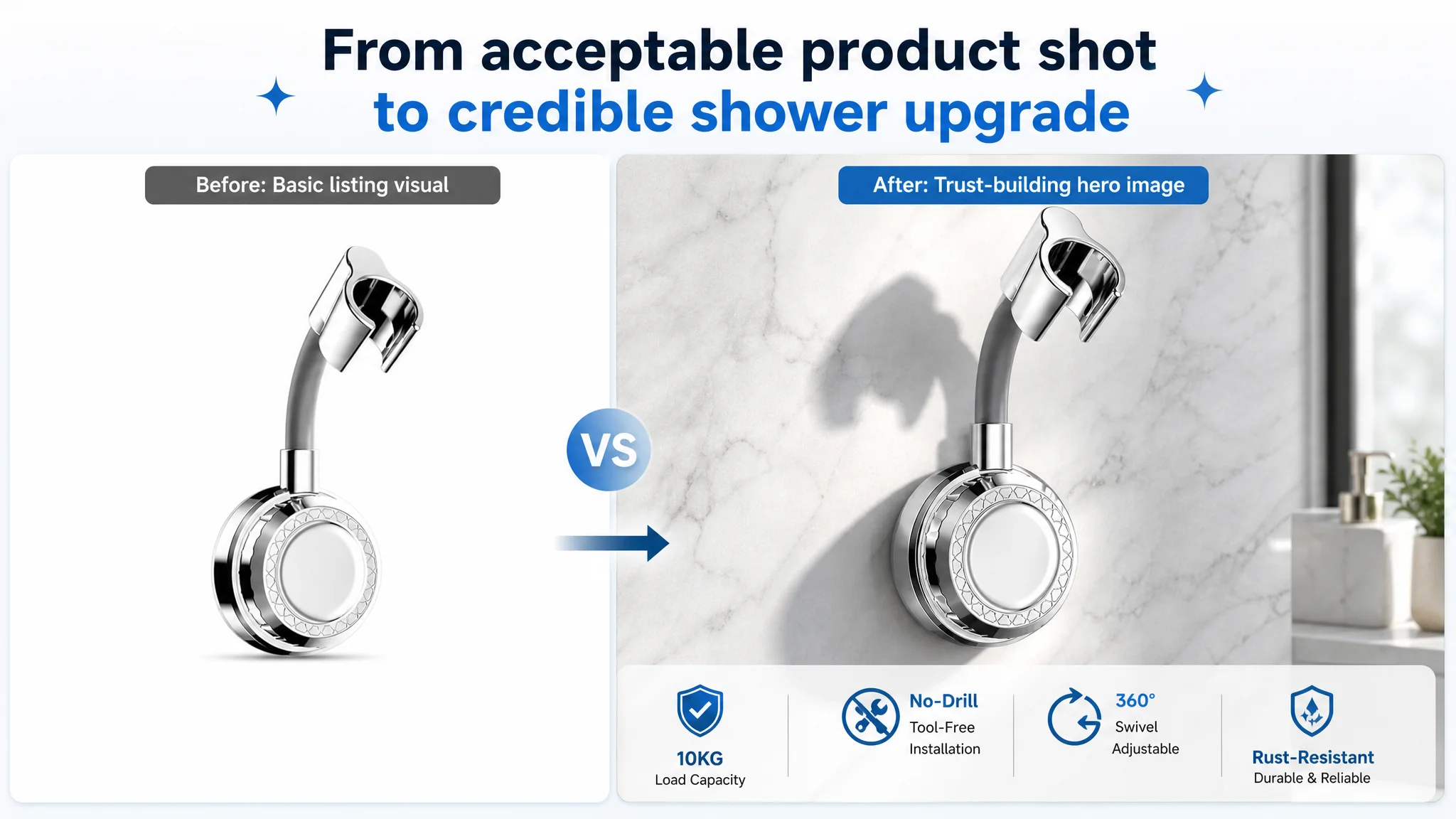
DeepBI’s Listing scoring exposed a stark gap: the target product page scored 43/100, while the benchmark Listing reached 90/100. The biggest chasm was not in keywords or bids, but in the missing A+ story, weak bullet-point logic, low review trust, and a main image set that failed to visualize the core promise: “no-drill, 10kg, secure, easy shower upgrade.” Once the team accepted that ads were amplifying a weak page, not a strong one, the optimization direction changed completely.
Instead of chasing marginal gains in Amazon ads, the focus shifted to reconstructing the page’s sales logic: a new title emphasizing 360° swivel and tool-free installation, more persuasive bullet points built around trust and quantified performance, a main-image sequence that shows 10kg load-bearing and “1-second install,” and a full A+ funnel that answers, “Will this work on my wall?” and “Will it stay up?” For other Amazon sellers, this case is a reminder: when ACOS feels uncontrollable, the root cause is often not bid strategy, but a Listing that cannot convincingly convert the traffic you’re already paying for.
Amazon Ads Were Not Failing. The Page Was Consuming the Traffic.
Before looking at any creative, DeepBI’s Listing scoring made the Amazon context brutally clear:
- Target Listing total score: 43/100
- Benchmark Listing total score: 90/100
- Gap: -47 points
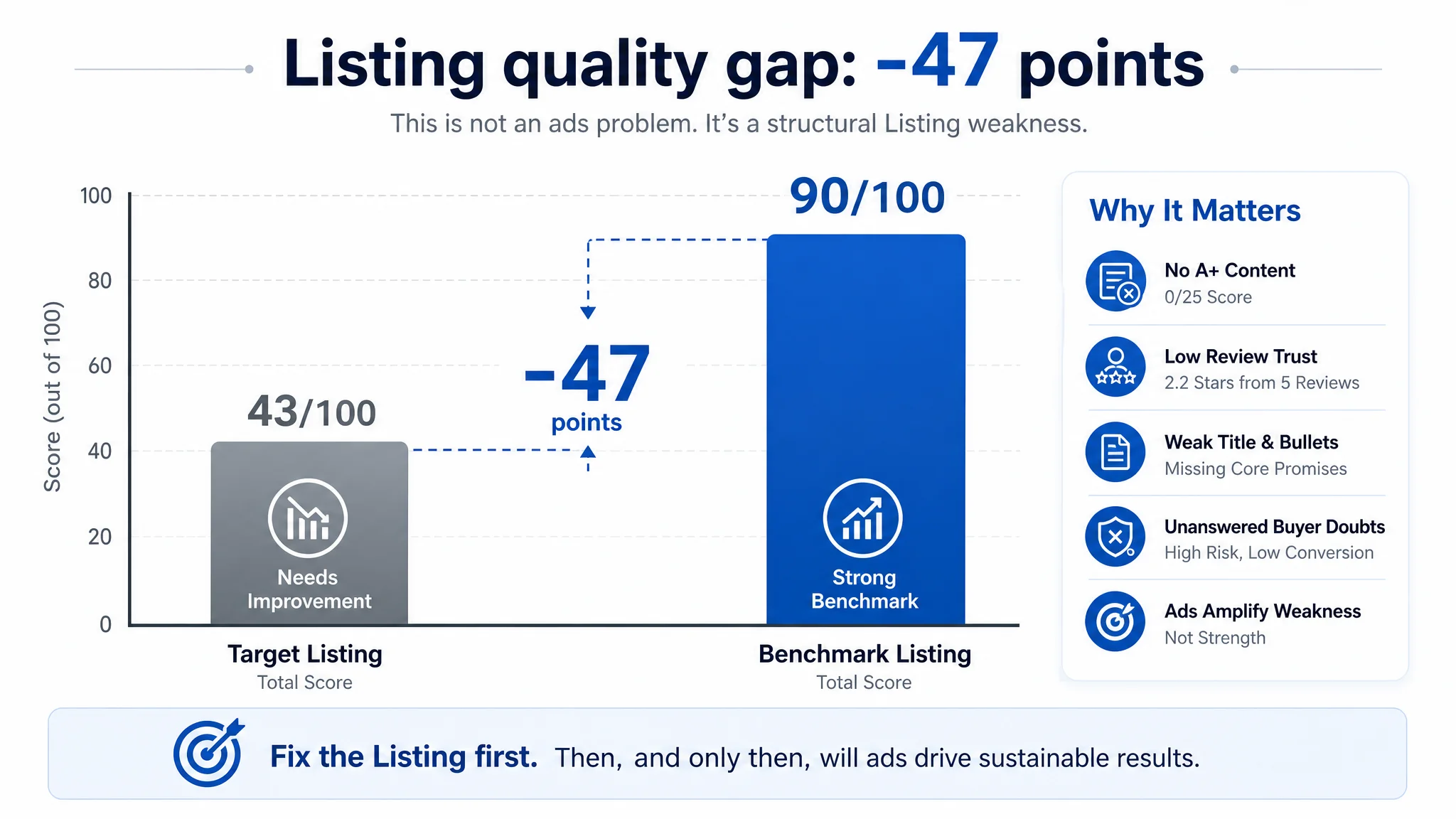
By dimension:
- Title: 11 vs 17 (gap -6)
- Main image set: 24 vs 27 (gap -3)
- Bullet points: 7 vs 9 (gap -2)
- A+ / detail page: 0 vs 24 (gap -24)
- Reviews: 1 vs 13 (gap -12)
In other words, this Amazon product page was going into paid traffic battles with:
- No A+ content at all
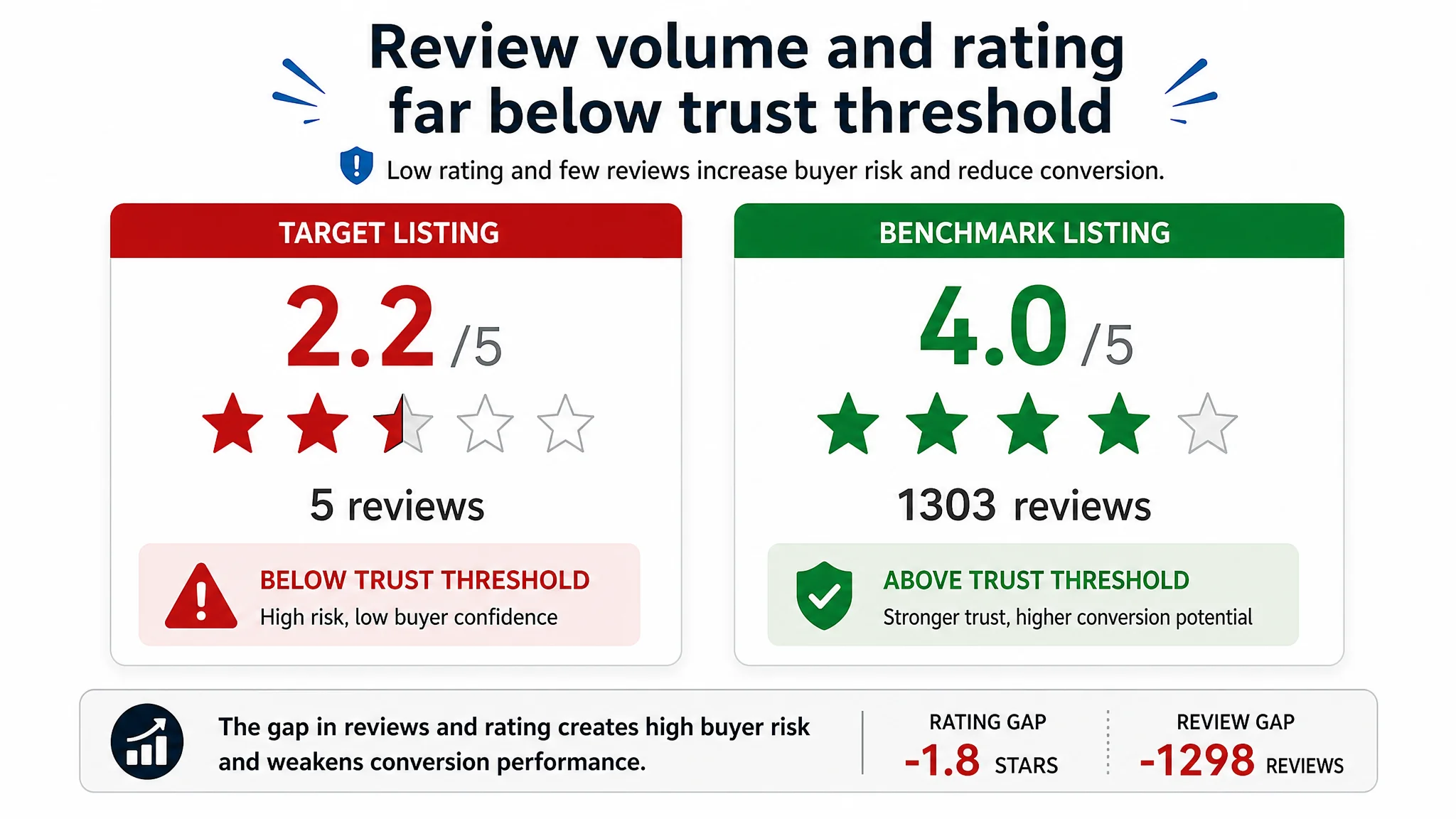
- Very low review trust (2.2 stars, 5 total reviews)
- Weakly structured title and bullets
- A main image set that looked “acceptable,” but not persuasive
“The real problem was not that ads failed to bring traffic. It was that the page could not convert the traffic.”
From an advertising perspective, every click was being sent into a page lacking:
- A clear promise above the fold
- Visual proof of 10kg load-bearing
- Visualized installation simplicity
- A trust architecture (A+ story + review volume) strong enough to offset risk
Under these conditions, continuing to tune ads would only amplify the Listing’s existing defects.
The Seller’s Original Misdiagnosis: “Our Amazon Ads Got Too Expensive”
The seller’s first interpretation was straightforward:
- ACOS rising → advertising problem
- Solution → adjust bids, refine keywords, restructure campaigns
- Review strategy → “gather more reviews over time,” no structural page change
This misdiagnosis followed a common pattern:
1. Equating high ACOS with ad weakness
The team treated ACOS as something that could be “fixed” purely via keyword tuning and bid cuts, assuming that the product page would naturally convert once “better traffic” arrived.
1. Underestimating Listing defects
Because the product type was simple (suction shower head holder), there was a belief that a basic white-background main image and functional bullets were “good enough.” A+ was seen as optional, not foundational.
1. Ignoring trust thresholds
With 2.2 stars from only 5 reviews, the Listing sat far below the healthy trust threshold (~4.2+). Yet this was treated as an inconvenience, not a conversion blocker.
The result: Advertising spend continued, but the page’s conversion capacity stayed fundamentally weak. Ads were being used to force a Listing into the market that had not yet earned a right to scale.
The Real Constraint Was Listing Conversion Capacity
DeepBI’s scoring and competitive comparison reframed the problem in one sentence:
This Listing did not lack traffic. It lacked the ability to convert traffic into orders.
Several hard constraints emerged from the data.
1. A Completely Empty A+ / Detail Area
- Target Listing A+ score: 0/25
- Benchmark Listing A+ score: 24/25
The benchmark Amazon product page had:
- A structured, multi-module A+ layout
- Visualized installation (no tools, 1-second lock)
- Compatibility diagrams (different shower heads and walls)
- Structural durability breakdowns
- Material and anti-corrosion storytelling
- Clear “where it works / where it doesn’t” guidance
The target Listing had nothing.
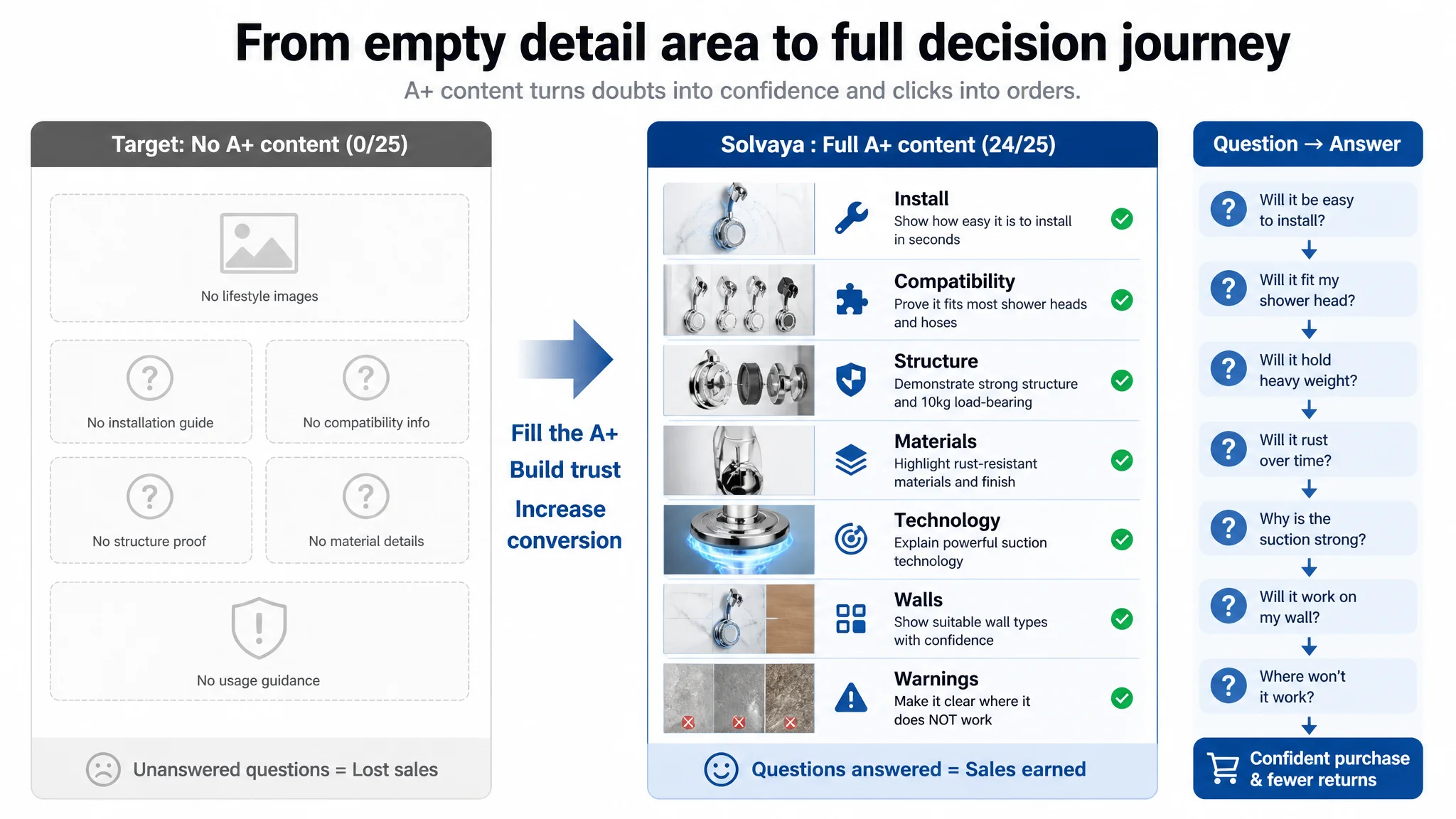
This meant:
- No visual story to justify a premium no-drill holder
- No structured way to resolve doubts like
“Will it hold my heavy shower head?” “Will it damage my tiles?” “Will it fall after a week?”
- No chance to build brand professionalism
In a category where users fear “failing suction → falling shower head → damaged tiles,” an empty A+ area is effectively a conversion killer.
2. Review Risk Beyond the Trust Threshold
- Target Listing: 2.2 stars, 5 total reviews, 33% 1-star
- Benchmark Listing: 4.0 stars, 1303 reviews, 13+ visible front-page reviews
This is not a “minor disadvantage.”
- 2.2 stars signals product risk
- 5 reviews signals lack of market proof
- 33% 1-star on the first page signals quality or fit issues
Under these conditions, every additional ad click forces buyers into a trust vs price dilemma that the Listing cannot win. Many will either bounce or choose the better-rated benchmark.
3. Weak Title Logic and Missing Core Promises
The benchmark Amazon title opens directly with outcome language:
“360° Swivel Shower Head Holder with Suction Cup | 10kg Load Capacity, Tool-Free Installation in Seconds…”
The target Listing:
- Leads with the product type rather than the core promise
- Chains information with commas, creating a loose, less-scannable structure
- Uses more basic, functional phrasing and avoids pressing on the category’s main fears (drilling, damage, instability)
On search results pages, this is not a stylistic issue; it is a click decision issue. A buyer scanning in 1–2 seconds needs to see:
- 360° swivel (comfort)
- No drilling / tool-free (safety for walls)
- Load capacity (reassurance)
- Durability (rust-resistant)
- Extra value (storage hook)
The target title did not clearly capture this combination.
This Product Page Did Not Lack Traffic. It Lacked Trust.
Once DeepBI overlaid Listing scores with competitive content, the diagnosis became obvious:
“Advertising does not only amplify advantages. It can also amplify a page’s existing defects.”
On this Amazon Listing:
- The main image was not communicating “secure, heavy-duty, no-drill” strongly enough.
- The bullets were informational, not persuasive.
- The A+ content was non-existent.
- The reviews actively signaled risk.
From the buyer’s perspective, the Listing never fully answered:
- “Will it really hold 10kg?”
- “Will it slip when the shower is running?”
- “Can I remove it without damaging the tiles?”
- “Does it work on my wall material?”
- “If it fails, is there any support?”
When those questions remain unanswered, Amazon users fall back to two behaviors:
- Default to the category leader with thousands of reviews
- Spend more time reading reviews instead of clicking Buy, often ending in non-purchase
This is where ad optimization hits a natural ceiling. You can refine targeting, but you cannot force trust where the page does not build it.
Why DeepBI Did Not Recommend “Keep Tuning the Ads First”
With a -47 point gap to the benchmark and a 0/25 A+ score, DeepBI made a clear judgment:
At this stage, the biggest business risk was continuing to pour ad spend into a Listing that could not structurally convert.
If the team had stayed on the original path—keyword tuning and bid adjustments—the likely outcomes would have been:
- Short-term ACOS fluctuations that don’t hold
- Continuous spend to maintain minimal volume
- Growing dependence on paid traffic with no organic resilience
- Increasing risk that new negative reviews (from misfit walls or unmet expectations) further depress star ratings
Instead, DeepBI recommended a different decision order:
1. Repair the Listing’s sales logic first
- Title, main image, bullets, A+
- Address trust, not just exposure
1. Stabilize conversion capacity
- So that each click has a fair chance to convert
- Particularly important given the review handicap
1. Then re-enter ad optimization
- Once the page no longer leaks most of the traffic
- So ad spend starts building both sales and review volume on a healthier base
This is not about visuals for the sake of design. It is about giving every future click a fairer conversion environment.
How the Title Was Rebuilt Around Outcomes, Not Just Object Labels
The Title Did Not Communicate the Outcome
Original weaknesses:
- Product type first, value later
- Unstructured, comma-separated chain
- Avoided spelling out critical outcomes (no drilling, 360°, tool-free)
DeepBI’s proposed Amazon title:
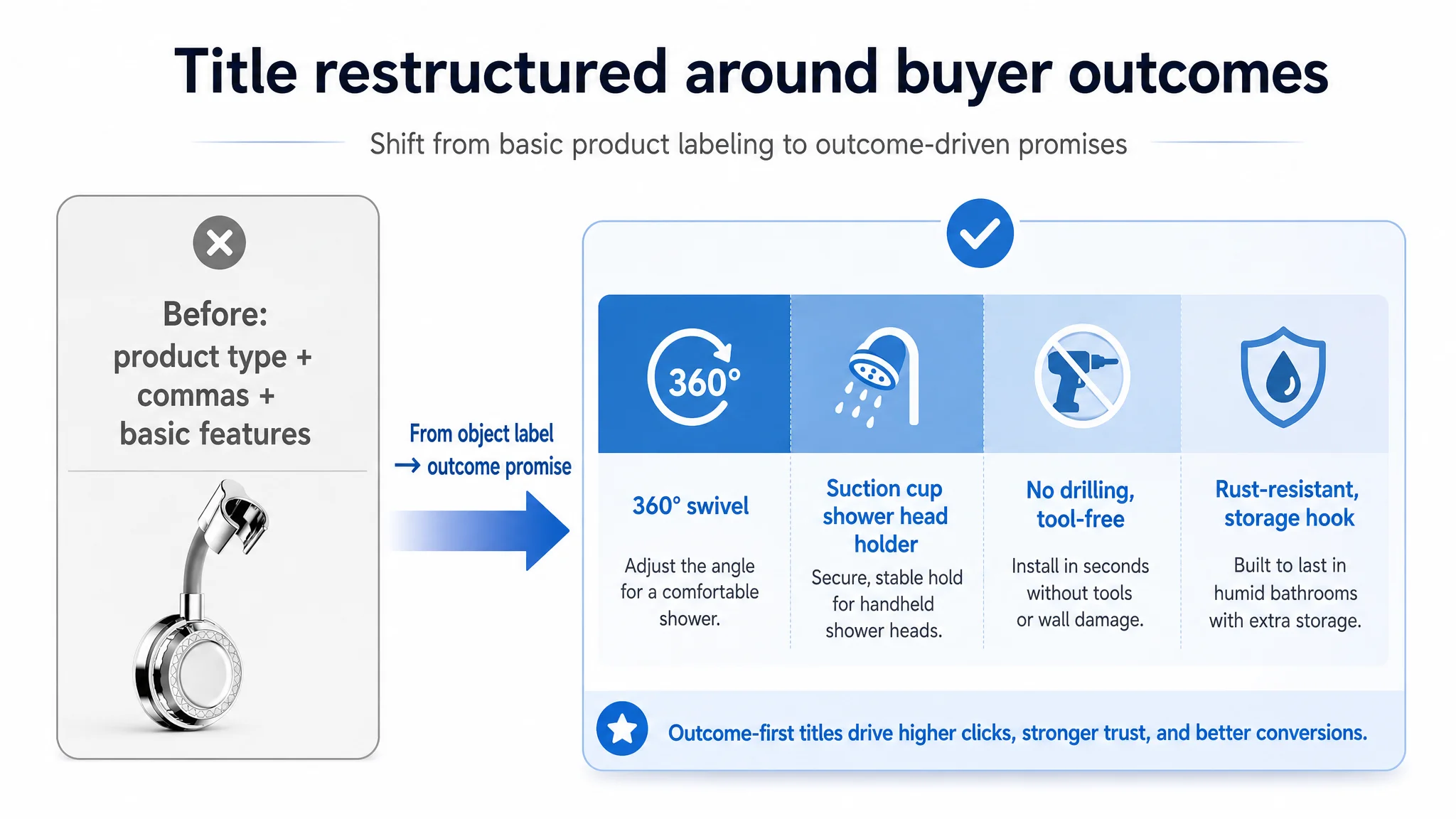
“360° Swivel Suction Cup Shower Head Holder, Adjustable Handheld Shower Mount, No Drilling Tool-Free Installation, Removable Rust-Resistant Shower Bracket with Storage Hook”
Key shifts in logic:
- Outcome-first phrasing: “360° Swivel” and “Suction Cup Shower Head Holder” upfront
- Wall safety & convenience: “No Drilling Tool-Free Installation” directly in the main phrase
- Durability: “Rust-Resistant” emphasizes long-term reliability in a wet environment
- Value add: “Storage Hook” calls out an extra function
Instead of describing “what it is,” the title now answers “what it does and why it is safe and convenient,” aligning with how buyers actually decide on Amazon.
The Bullet Points Had Information, but Not a Buying Logic
Before: Functional, Fragmented, and Underpowered
Original bullet strategy:
- Material explanation
- Feature description
- Installation steps
- Usage scenarios
- Some safety details
But missing:
- Quantified benefits (e.g., load capacity)
- Clear pain-point resolution (rental-safe, no drilling anxiety)
- Lifestyle or emotional framing (“better shower experience”)
- Assurance/after-sales closure
The effect: plenty of text, but weak decision logic.
After: A Six-Point Conversion Path
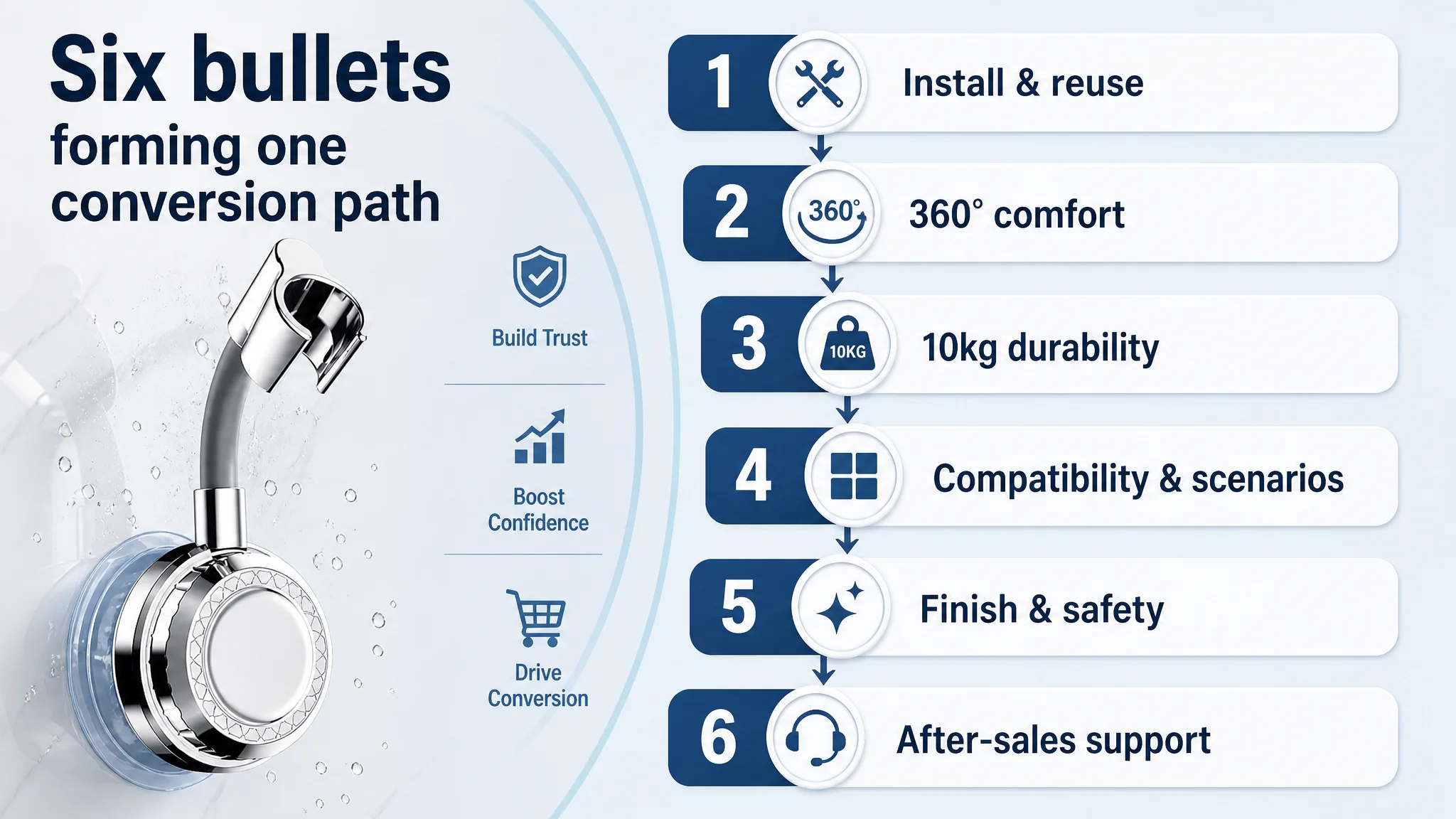
DeepBI proposed a restructured bullet framework, each serving a distinct role in the Amazon conversion funnel.
1. Quick installation & reusability
【QUICK INSTALLATION & REUSABLE】 Install instantly with our innovative no-drill suction design. Simply press onto a smooth surface and twist the switch to achieve a powerful vacuum seal. Perfect for rentals and tool-free mounting, this shower holder can be easily relocated and reused multiple times after a simple water cleaning without leaving any residue.
Logic:
- Directly addresses renters and no-drill users
- Explains mechanism (press + twist, vacuum seal)
- Highlights residue-free removal and reuse
2. 360° adjustability for personal comfort
【360° ADJUSTABLE FOR PERSONALIZED COMFORT】 Equipped with an advanced flexible joint, our holder enables precise water jet positioning at any angle. Effortlessly tilt or rotate the handheld shower head to match your stature and preferred stance, providing a tailored wellness experience for every family member.
Logic:
- Moves beyond “adjustable” into personal comfort
- Frames adjustability as a family benefit, not just a mechanical feature
3. Quantified load-bearing & durability
【UPGRADED LOAD-BEARING & DURABILITY】 Crafted from high-quality, water-resistant plastic, the upgraded suction base intensifies adhesion during use. Designed to support heavy-duty shower heads (up to 10kg) without slipping, it ensures long-term reliability even in the most humid bathroom environments.
Logic:
- Introduces 10kg as a concrete figure
- Connects material and structure to long-term reliability
- Answers “will it sag or fall?” directly
4. Universal compatibility & scenario breadth
【UNIVERSAL COMPATIBILITY & VERSATILE USE】 The universal connector is meticulously designed to fit most standard handheld shower heads and hoses on the market. Its sleek profile makes it an ideal accessory for diverse settings, including residential homes, luxury hotels, or compact RV bathrooms.
Logic:
- Reduces fear of “will it fit my shower head?”
- Expands use cases (home, hotel, RV) to justify purchase
5. Premium finish & safety details
【PREMIUM FINISH & THOUGHTFUL SAFETY】 Featuring a sleek, polished profile with no burrs, this holder prevents any accidental scratches to your hands or shower equipment. The moisture-resistant material ensures it remains rust-free and maintains its clean, stylish look for years to come.
Logic:
- Elevates appearance and safety into a single benefit
- Positions the product as both functional and visually upgrading the bathroom
6. After-sales assurance
【RELIABLE QUALITY & SATISFACTION SUPPORT】 We are dedicated to elevating your shower experience. If our shower head holder does not meet your expectations or surface requirements, we offer professional customer support and hassle-free replacements to ensure your complete peace of mind. Experience the ultimate convenience today!
Logic:
- Adds the missing “last push”
- Reduces perceived risk by signaling responsive support
Together, these bullets form a real conversion path:
Pain point → Solution → Proof → Scenarios → Style & safety → Assurance
The Main Image Was Not Just a Visual Issue. It Failed to Create a Reason to Click.
The main image sequence is where Amazon buyers decide whether to enter the Listing. DeepBI’s analysis showed that while the target images technically complied with Amazon’s white background norms, they lacked:
- Space and material context (real bathroom surfaces)
- Visible proof of heavy load-bearing
- Clear visualization of adjustability and cleaning / reuse
- A family-use or “whole-house” scenario
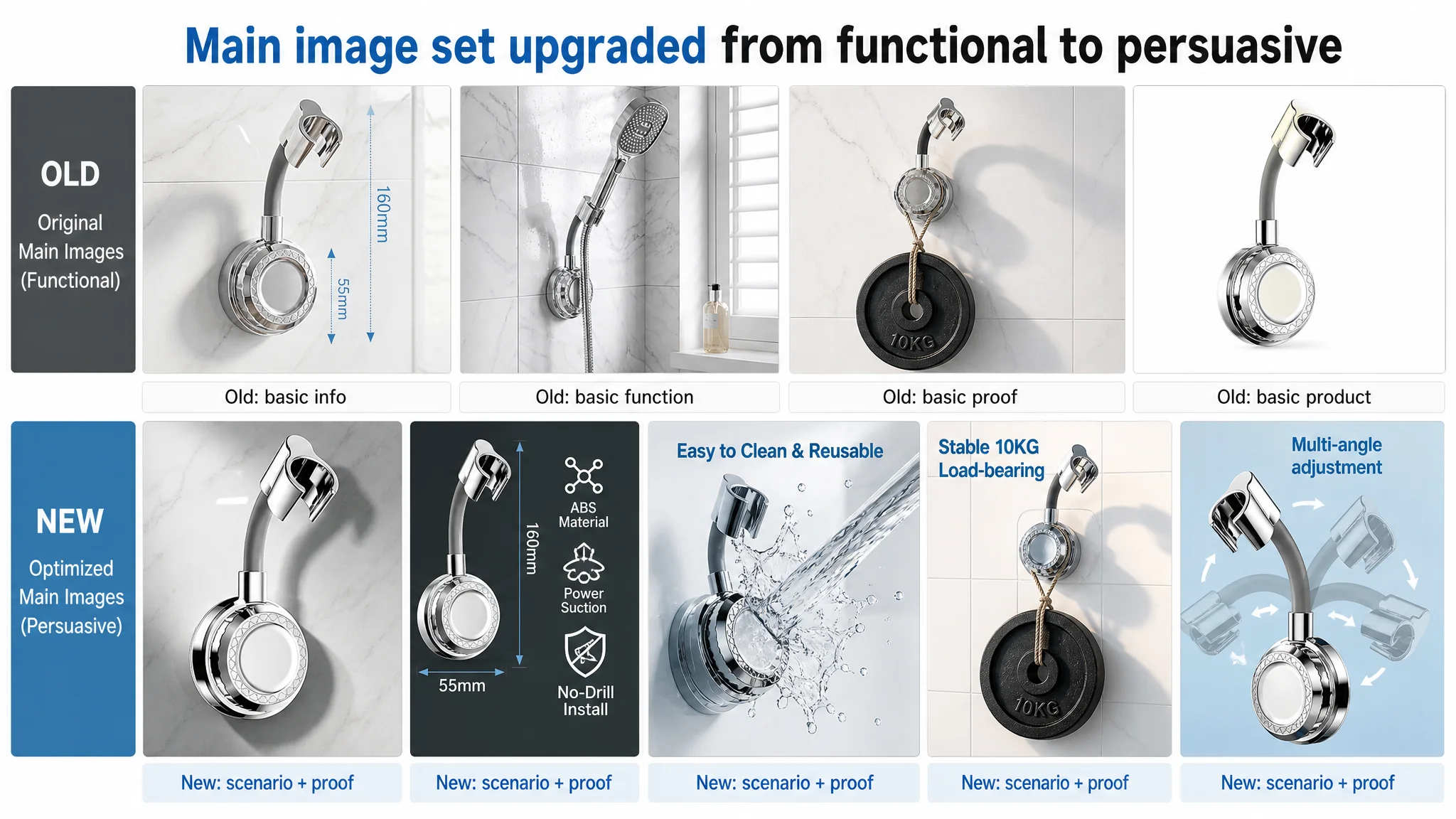
The benchmark Listing, in contrast, used stone-texture backgrounds, load demos with dumbbells, dynamic water visuals, and angle illustrations that turned abstract claims into instantly understandable visuals.
DeepBI’s optimization plan reframed each main image as a specific conversion job.
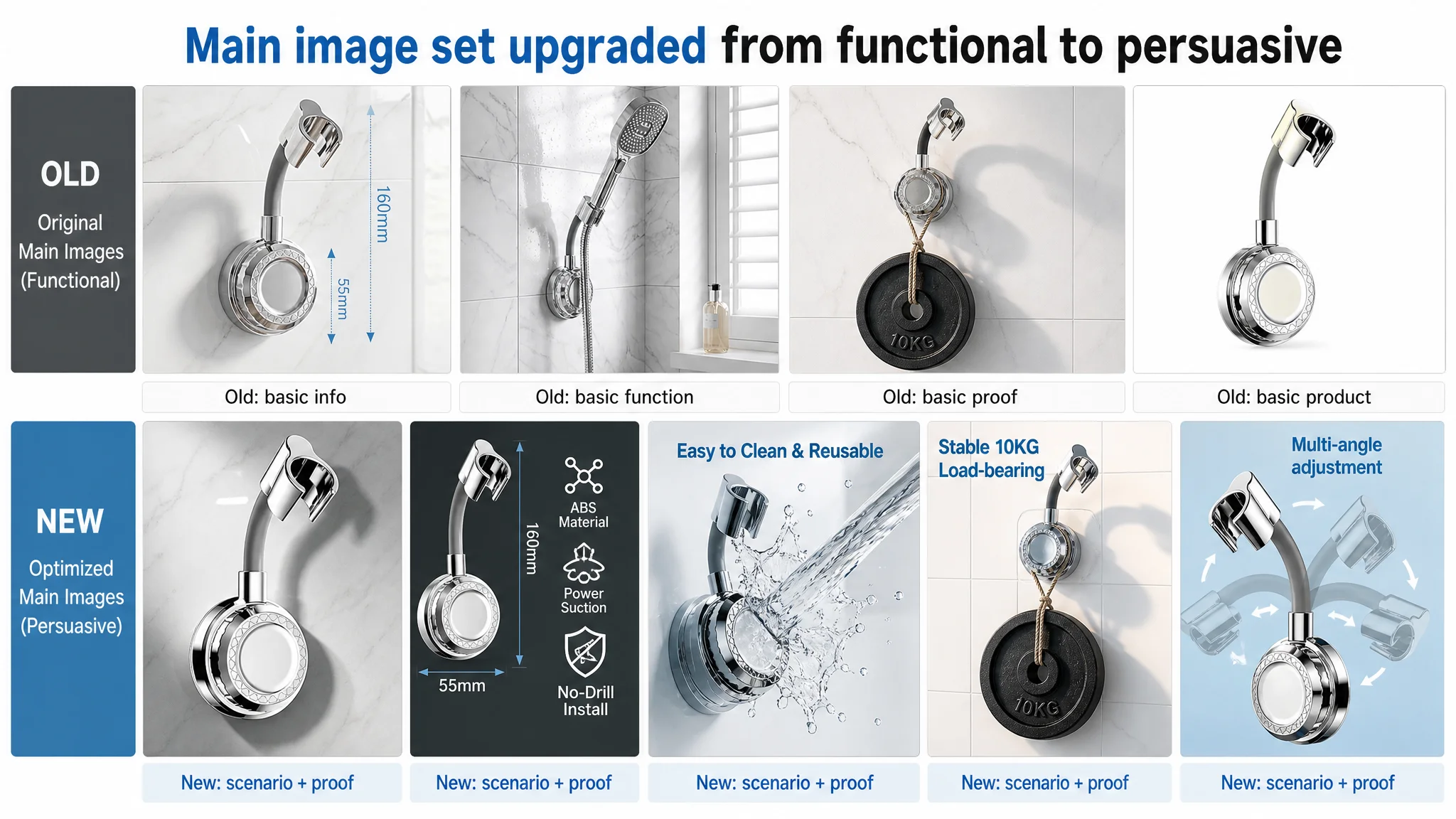
Image 1: Establish premium bath context and stability
- Product centered, ~75% of the frame
- 45° side angle, soft spotlight from above-left
- Background: light grey marble, adding real bathroom feel
- Goal: immediate trust + sense of physical presence, not a floating object on empty white
Image 2: Turn parameters into visual information
- Product on the left (40% width), front-facing
- Right side: dark grey panel with white sans-serif text showing height and base diameter
- Three small icons for “ABS material,” “strong suction,” “no drilling”
Purpose: reduce reading friction and communicate professionalism at a glance.
Image 3: Visualizing “easy to clean & reusable”
- Light background
- Product slightly tilted (~30°), low-angle view
- High-speed water-splash effect around the base
- Caption: “Easy to Clean & Reusable”
This turns “reusable after cleaning” into something the eye understands in 0.2 seconds.
Image 4: Proving 10kg load-bearing, not just claiming it
- Product upper third of the frame
- A 10kg dumbbell hanging from the holder with a white cord
- Strong side lighting casting a clear shadow
- Background: white tile wall
- Text: “Stable 10KG Load-bearing”
This connects the 10kg figure from the bullets to a visceral visual.
Image 5: Answering angle-adjustment doubts
- Product centered, 45° side view
- Multiple translucent “ghost” positions of the holder to show range
- White arcs and arrows illustrating swivel paths
- Text: “Multi-angle adjustment”
The job of this image: remove the last doubt about whether the holder can “follow” different user heights and preferred angles.
The Missing A+ Story Removed the Final Layer of Persuasion
No matter how strong the first images and bullets become, a complex, risk-sensitive category like suction bathroom hardware needs a structured A+ to:
- Reduce returns
- Filter misfit walls
- Demonstrate engineering seriousness
- Show “where it works and where it doesn’t”
DeepBI’s A+ plan followed a problem → solution → proof → boundary logic.
1. Installation convenience module
- Hero composite: hand twisting and mounting the holder
- Four icons on the side: “1-second install,” “no-drill,” “strong adhesion,” “10kg load”
Job: neutralize “install complexity” fear in the first seconds of A+ viewing.
2. Compatibility module
- Large slot close-up showing the connector
- Four smaller images of different shower head styles (round, square, black, silver) inserted
- Label: “Standard G1/2 compatible”
Job: answer “will this fit my shower head?” without requiring the customer to read spec text.
3. Structural module
- Cross-section of the support tube, showing multi-layer structure
- Labels: “outer anti-corrosion coating,” “alloy ring,” “high-toughness inner ring”
- Side-by-side comparison: ordinary holder sagging vs this holder stable
Job: counter the “it will drop after a few weeks” mental shortcut by showing engineering logic.
4. Material and anti-corrosion module
- Exploded view of layers: ABS base, anti-oxidation layer, thickened plating, polishing, chrome layer
- Side comparison: rusted ordinary holder with a red X
Job: show why this product stays visually clean and structurally sound in a wet environment.
5. Suction technology module
- 45° top-down view of the suction base
- Blue spiral lines underneath representing vacuum matrix
- Highlighted text: “72mm suction base” and “10kg max load”
Job: make “strong suction” feel like a technology, not a slogan.
6. Wall suitability module
- Right: product installed on a wall
- Left: stacked panels showing tile, wood, glass, marble, metal, each labeled
Job: help customers quickly identify if their bathroom wall is suitable, reducing pre-purchase uncertainty.
7. Risk warning module
- Six small squares showing non-suitable surfaces: cracked walls, rough concrete, patterned glass, lime walls, curved walls, wallpaper
- Clear labeling underneath each
Job: deliberately filter out misfit customers to protect long-term Listing health by reducing returns and negative reviews.
How the Page’s Sales Logic Started to Recover
Once the seller saw the full Listing comparison and DeepBI’s proposed structure, the conversation inside the team shifted.
From:
- “Our Amazon ads need better optimization”
- “Let’s test different keywords and bids”
To:
- “Our Listing is 47 points behind a direct competitor”
- “We are running ads into a page with 0 A+, 2.2 stars, and weak trust logic”
- “We need to rebuild the product-page argument before scaling traffic again”
By restructuring:
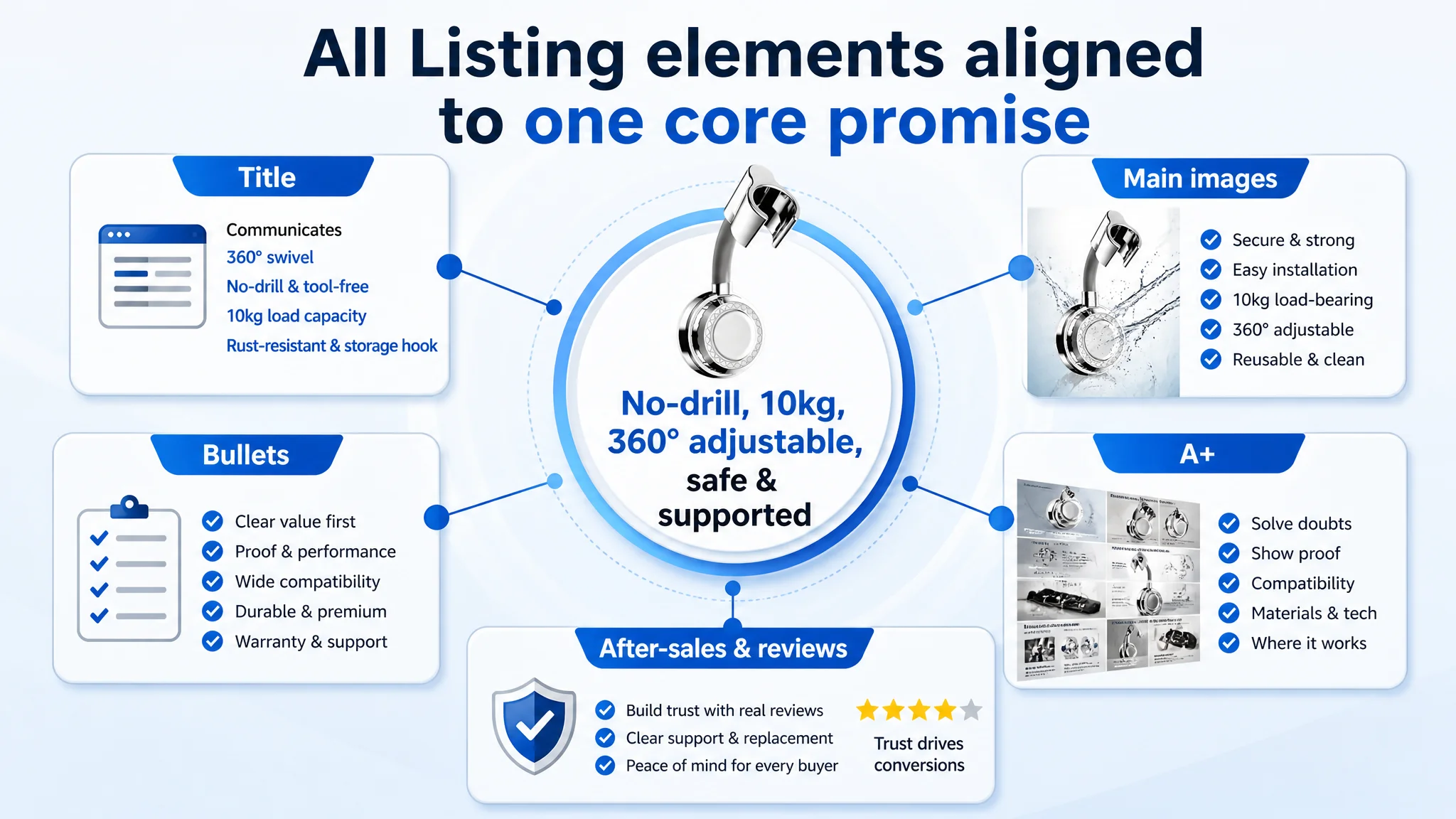
- The title to carry core promises (360° swivel, tool-free, rust-resistant, storage hook)
- The main image set to visually prove installation, load-bearing, adjustability, and reusability
- The bullet points to form a complete “value → proof → assurance” ladder
- The A+ content to answer engineering, compatibility, and risk questions
- The after-sales message to provide peace of mind
…the Listing began to regain the basic ability to justify itself to both organic and paid traffic.
While no fabricated numbers can be claimed beyond the case data, the nature of the risk changed:
- Ads no longer had to carry the entire burden of persuasion alone
- Each incoming click had more structured support to convert
- The likelihood of preventable returns and misfit installations reduced
- The path to rebuilding reviews and rating became more realistic
What Other Amazon Sellers Can Take from This Case
This shower head holder Listing is not unique. Many Amazon sellers are facing similar patterns:
- High ACOS, but the real issue is weak conversion between click and purchase
- Listing content stuck at functional description, while competitors tell full trust stories
- Overdependence on ads, because the organic side is handicapped by poor page quality
This case illustrates several judgments worth carrying into other Listings:
1. Amazon ads cannot rescue a structurally weak Listing.
If your A+ is empty, your review base is shallow, and your page does not answer core fears, ads will amplify your weaknesses as much as your strengths.
1. Listing conversion is the foundation of ad efficiency.
DeepBI’s scoring exposed that the largest gap was not in bids, but in page content (A+ and reviews). Fixing that first is often the most rational use of effort.
1. Title, main image, bullets, and A+ must form a single story.
In this case, all components were realigned around one coherent promise: “No-drill, 10kg, 360° adjustable, safe, compatible, and backed by support.”
1. Before scaling ads, ask whether the page deserves more traffic.
If your Listing is under 4 stars with few reviews and weak A+, sending more paid clicks is not optimization—it is leakage.
DeepBI’s value in this case was not providing a toolbox of features, but clarifying the core constraint: this Amazon Listing could not convert the traffic it was already paying for. Once that truth was accepted, the seller could finally stop fighting the wrong battle and start rebuilding the page so that ads, when reactivated, had a real chance to produce sustainable results.