

This case comes from an Amazon seller in the professional tools category, selling an outdoor green laser level in the US marketplace. The team was already running Amazon ads and had earned a perfect 5.0-star rating, but orders lagged behind a key competitor. Their first instinct was to blame “not enough reviews” and “ads not optimized enough,” and they kept trying to refine bids and keywords.
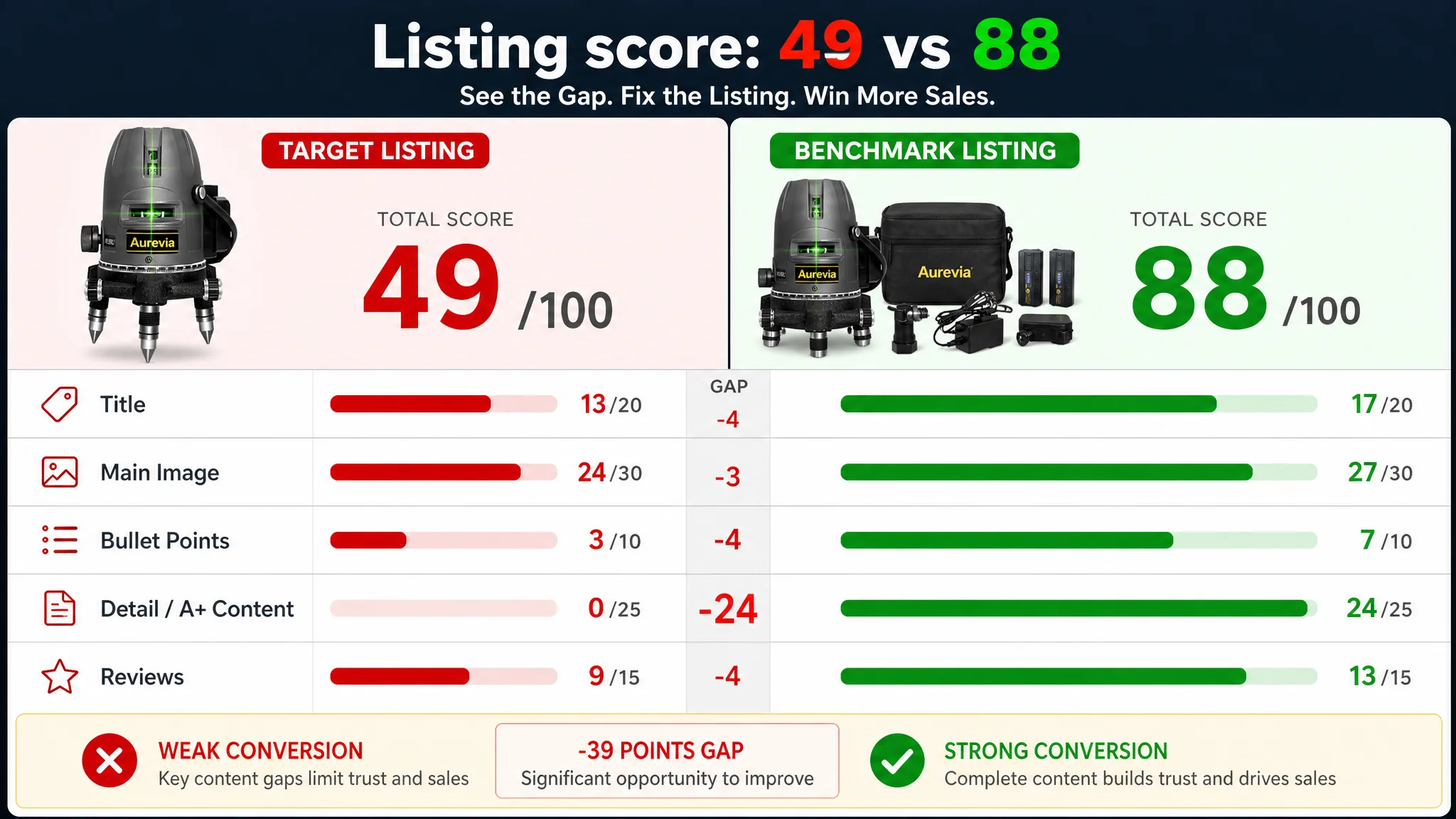
DeepBI’s diagnosis showed a different reality: compared with a benchmark Amazon Listing in the same laser-level niche, this product page scored only 49/100 versus the competitor’s 88/100. The core leak wasn’t in Amazon ads—it was in the Listing’s conversion capacity: a weak title logic, a single product-style main image, almost empty A+ content, and bullet points that listed features without building a buying path.
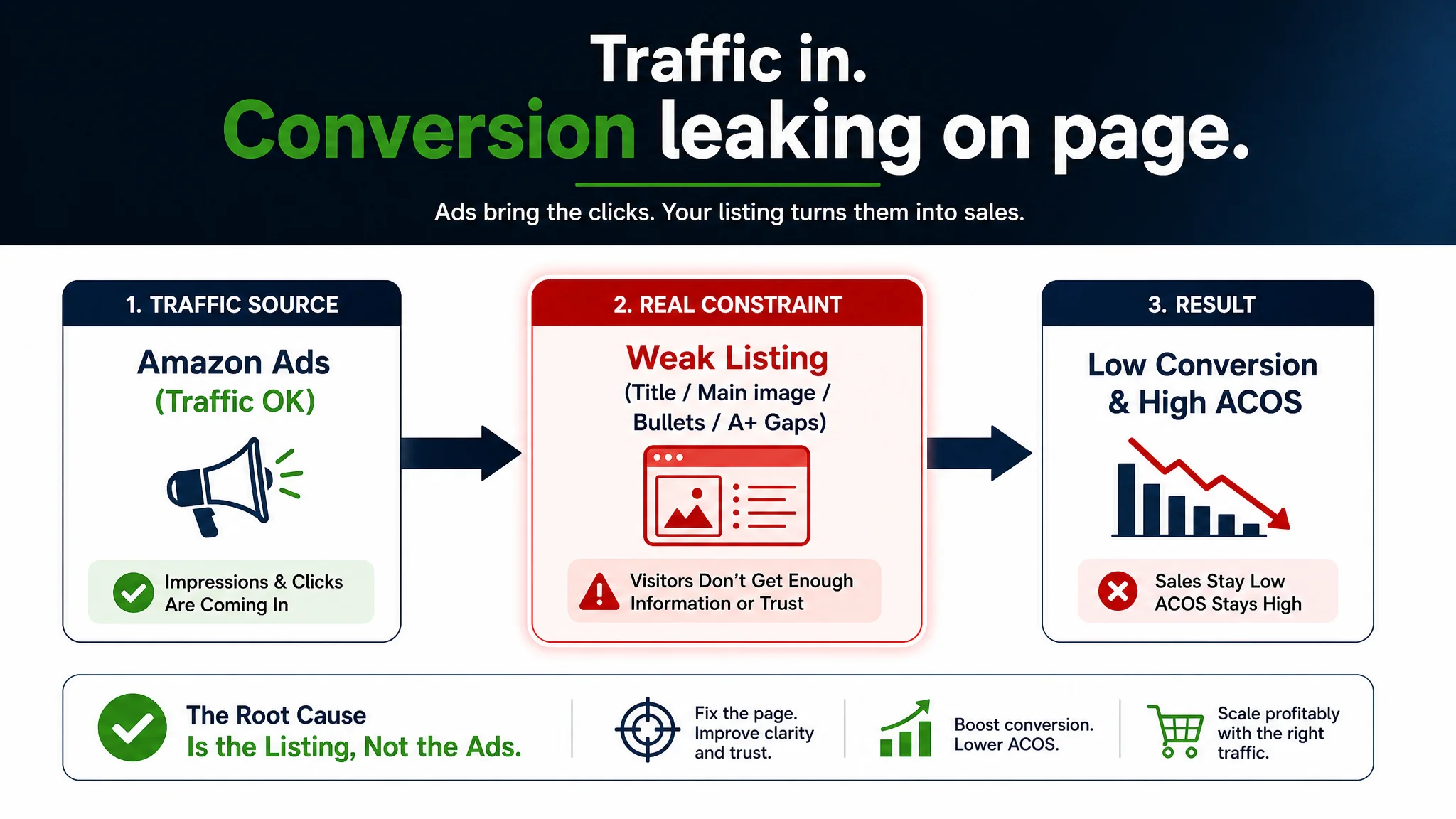
The later optimization did not start from “turning up the ads.” It started from rebuilding the Amazon product page: a restructured title, a professional “full kit” main image, bullet points tied to real jobsite pain points, and a complete A+ detail layout focused on outdoor visibility and 5-line layout efficiency. For other Amazon sellers, this case is a reminder: when ad costs go up and ACOS refuses to fall, the real bottleneck may be the Listing itself, not the campaign settings.
Amazon Ads Were Not Failing. The Page Was Consuming the Traffic.
From the seller’s perspective, the early signals were confusing.
- Stars: 5.0 rating, all front-page reviews positive
- Ads: already investing in Amazon ads, getting impressions
- Category: professional outdoor green laser level for construction and home projects
Yet traffic didn’t translate into enough orders. The team’s first judgment was classic:
“Reviews are too few, ACOS is high, ads must be the problem.”
So they tried what most Amazon sellers would do:
- Adjust bids and budgets
- Add more keywords
- Tweak campaign structures
But ad optimization was sitting on top of a Listing that could not carry professional buyers through a decision. DeepBI’s Listing scoring exposed the gap in a way that ad reports alone never would.
Total Listing score gap:
- Target Listing: 49/100
- Benchmark competitor: 88/100
- Gap: -39 points
By dimension:
- Title: -4
- Main image: -3
- Bullet points: -4
- Detail/A+ content: -24
- Reviews: -4
The biggest red flag was clear: zero A+ content vs. a fully built, professionally structured A+ detail page on the competitor.
“The real problem was not that ads failed to bring traffic. It was that the page could not convert the traffic.”
At this point, continuing to adjust ads first would only amplify the Listing’s weaknesses.
The Real Constraint Was Listing Conversion Capacity
DeepBI’s scoring and benchmark comparison made one thing explicit: this Amazon Listing did not lack traffic; it lacked a conversion-ready story.
Title: Keywords Without a Decision Logic
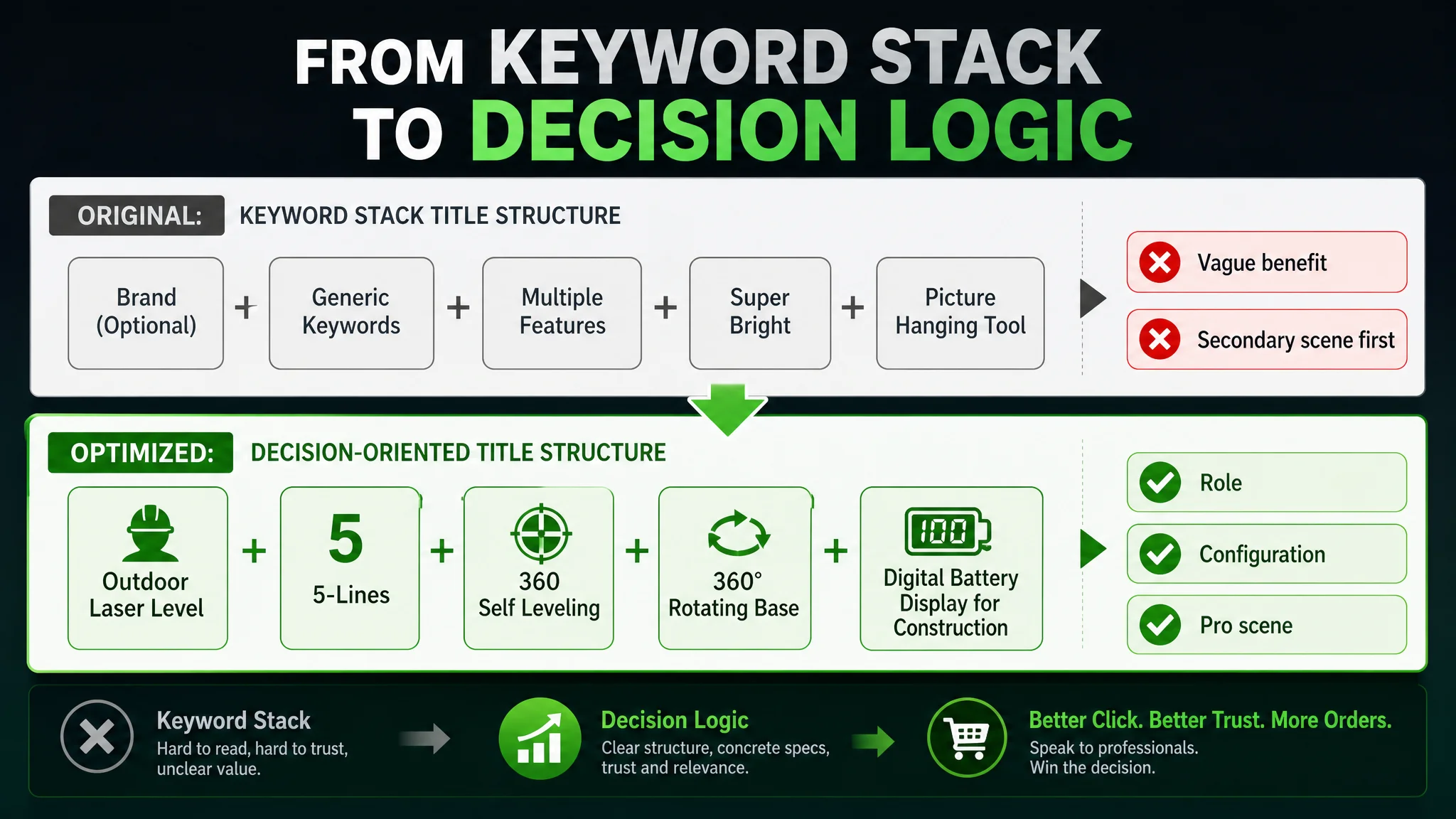
The original title was a typical keyword stack:
- No clear brand + product structure
- Core benefit expressed as a vague “Super Bright”
- Secondary scene (“Picture Hanging Tool”) dragged forward and diluted the professional positioning
- Missing concrete, trust-building spec expressions (accuracy, configuration, power system)
The benchmark competitor title, in contrast, followed a mature Amazon structure:
- Brand + “New” positioning
- Core keyword (“Outdoor Laser Level” / professional construction usage)
- Concrete spec language (“3x360 Green Laser”, “1/13" Accuracy”)
- Clear additional value (“Remote Control & Rechargeable Battery”, “for Construction”)
The result: the competitor title gave a professional buyer enough reason to click and enough precision to trust. The target title made the product look like a generic tool with unclear level of professionalism.
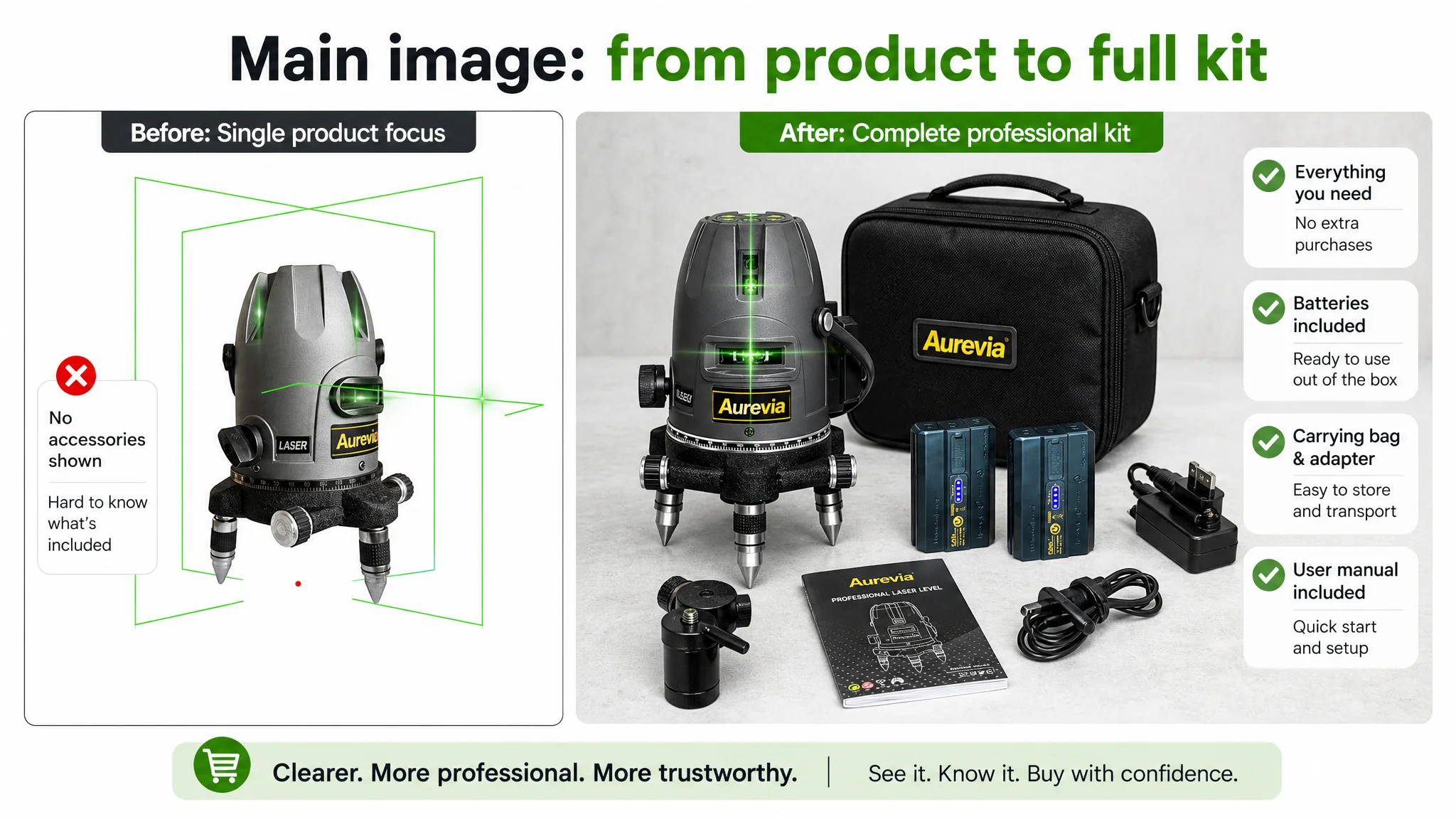
Main Image: A Product, Not a Professional Kit
On the search results page, the main image is not just a picture; it’s the first trust filter.
The target Listing’s main image:
- Single product, almost no “full kit” packaging feel
- No clear indication of everything included
- Weak professional atmosphere, background not oriented to construction or jobsite use
The benchmark:
- Full “family shot”: laser level + batteries + charger + bag + accessories neatly laid out
- Clear context that this is a complete professional kit
- Visual reinforcement of value-for-money and readiness for work
For professional buyers, especially B-side or contractor-type customers, the question is simple: “If I buy this, will I get everything I need for the job?” The target main image didn’t answer that; the competitor’s did.
Bullet Points: Information Without a Buying Path
The bullet points dimension scored 3/10 vs. 7/10 for the competitor.
The target Listing:
- Focused on generic operation and parameter descriptions
- Described features (battery, base, etc.) but didn’t convert them into efficiency, safety, or convenience outcomes
- No service commitment, no explicit warranty or support language
The benchmark:
- Started from concrete jobsite pain points (fine vertical adjustments, difficult alignments)
- Packaged battery, remote control, and brackets as solutions to time and labor problems
- Explicit 5-year warranty and lifetime technical support, directly reinforcing purchase confidence
Structurally, the competitor’s bullets followed a clear hierarchy:
- Core technical function
- Professional precision and performance
- Power and power management
- Smart modes and control logic
- Remote operation and mounting solutions
- Full-scene usage layout
- Service and warranty
- Durability and protection
The target bullets never formed such a strategy; they stayed at the “what this product is” level, not the “why this product solves your job better” level.
Detail/A+ Content: A 24-Point Deficit That Killed Trust
This was the decisive weakness.
- Target Listing A+ content: none
- Competitor A+ content: full module layout
The competitor’s A+ modules included:
- Main selling point and professional-level overview
- Fixed-point alignment and precision explanation
- Multi-scene usage: construction sites, offices, stairs, ceilings
- Self-leveling vs. manual mode comparison
- Pulse mode and outdoor visibility
- 3×360° layout switching and brightness comparison
- Battery endurance and power supply
- Accessories and installation modes
- Packaging content confirmation
Each module combined real jobsite photography and high-quality renders, with clear, visual explanations of what the tool actually achieves.
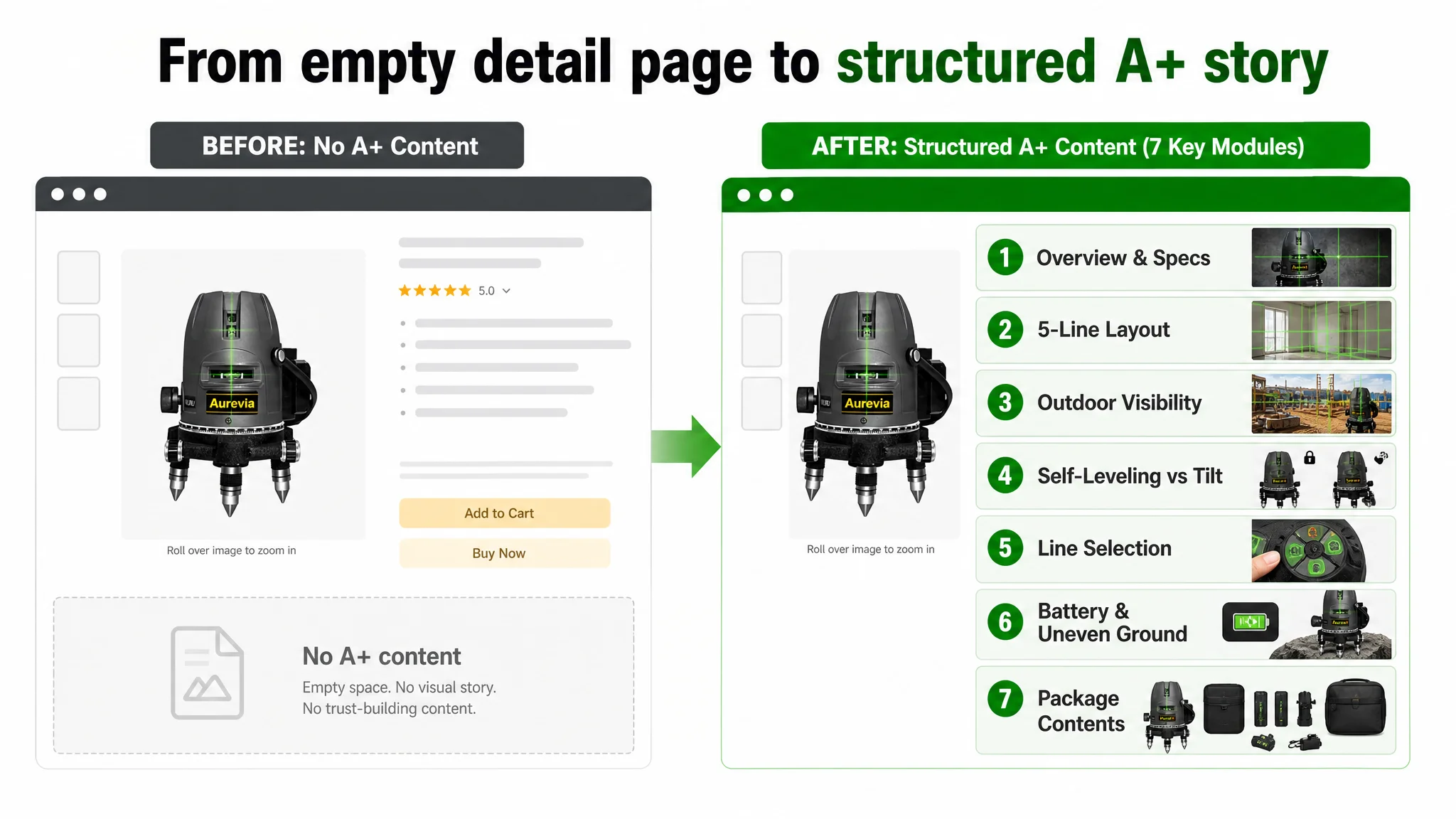
The target Listing had no structured visual storytelling at all. No A+ meant:
- No visual confirmation of real-world usage
- No comparison logic (before/after, different modes, upgraded brightness)
- No packaging clarity beyond standard text
In a professional tool category, this is more than a cosmetic gap. It means the buyer must imagine everything, instead of seeing how the product fits into their work.
Why DeepBI Did Not Keep Tuning the Ads First
From a purely ad-operations perspective, it was tempting to keep refining Amazon ads:
- Better keyword segmentation
- Different match types
- Dayparting adjustments
But DeepBI’s integrated view combining Listing scoring with typical CTR/CVR patterns led to a different decision order.
Key judgment: As long as the Listing’s detail and A+ dimension remained at 0/25 while the benchmark sat at 24/25, every incremental ad dollar would mostly fund learning that the page doesn’t convince professionals.
“Advertising does not only amplify advantages. It can also amplify a page’s existing defects.”
The biggest business risk at this stage was not lack of traffic; it was that traffic was being sent into a page that couldn’t sustain a professional-level decision. In other words:
- Even if CTR is acceptable, CVR is capped by poor content
- Even if orders come in, ACOS stays high because conversion is inefficient
- Organic ranking struggles because the Listing never builds robust conversion history
So DeepBI’s recommendation sequence was:
1. Fix Listing conversion capacity first
- Increase the Listing score gap closure vs. benchmark
- Build a proper A+ structure
- Elevate main image and bullet points into a coherent buying path
1. Only after the page shows the ability to handle traffic more efficiently, consider scaling or refining Amazon ads.
This was not about “pausing ads” entirely; it was about stopping the reflex to treat ads as the primary wrench for a conversion problem rooted in the page.
This Product Page Did Not Lack Traffic. It Lacked Trust.
Once the core constraint was clear, the optimization logic became straightforward: rebuild trust, scene by scene.
Reframing the Title Around Professional Outcomes
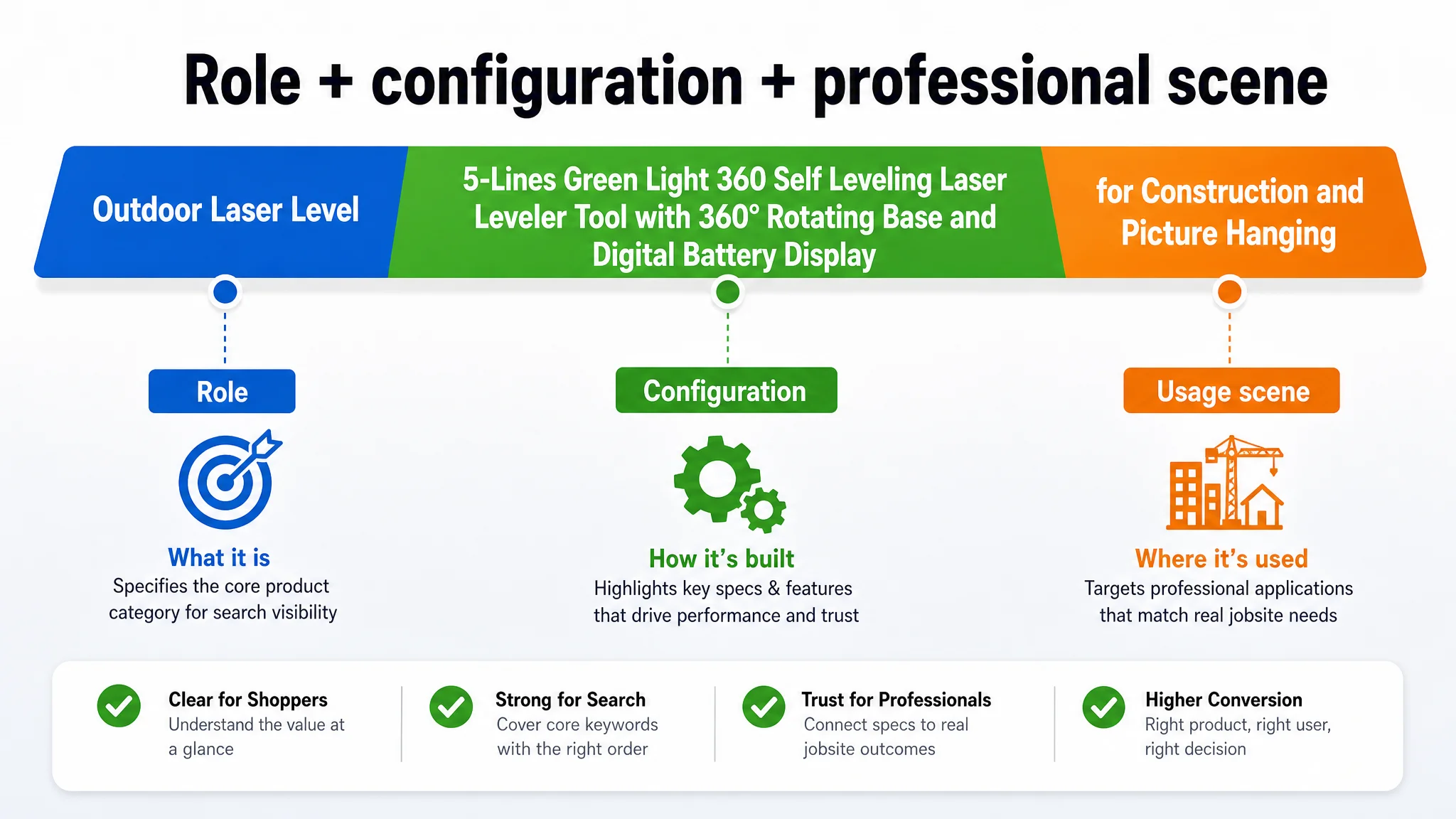
The revised title proposal:
Outdoor Laser Level, 5-Lines Green Light 360 Self Leveling Laser Leveler Tool with 360° Rotating Base and Digital Battery Display for Construction and Picture Hanging
Key changes:
- Lead with “Outdoor Laser Level” to align with Amazon search weight and professional intent
- Introduce “5-Lines,” “360 Self Leveling,” and “360° Rotating Base” as structured technical attributes
- Keep “Digital Battery Display” as a concrete, differentiating feature
- Re-anchor the primary scene in “Construction,” with “Picture Hanging” as a secondary use, not the core identity
This moves the title from “keywords + vague superlatives” to “role + configuration + professional usage.”
Turning the Main Image into a “Full Kit” Proof
Main image logic was reset around:
- A full-kit family layout: instrument, battery, power adapter, tripod adapter, cloth bag, manual
- Cleaner, professional background (studio or industrial style)
- Visible green laser lines hinting at the 5-line layout
- Clear sense that this is a complete, professional system ready out-of-box
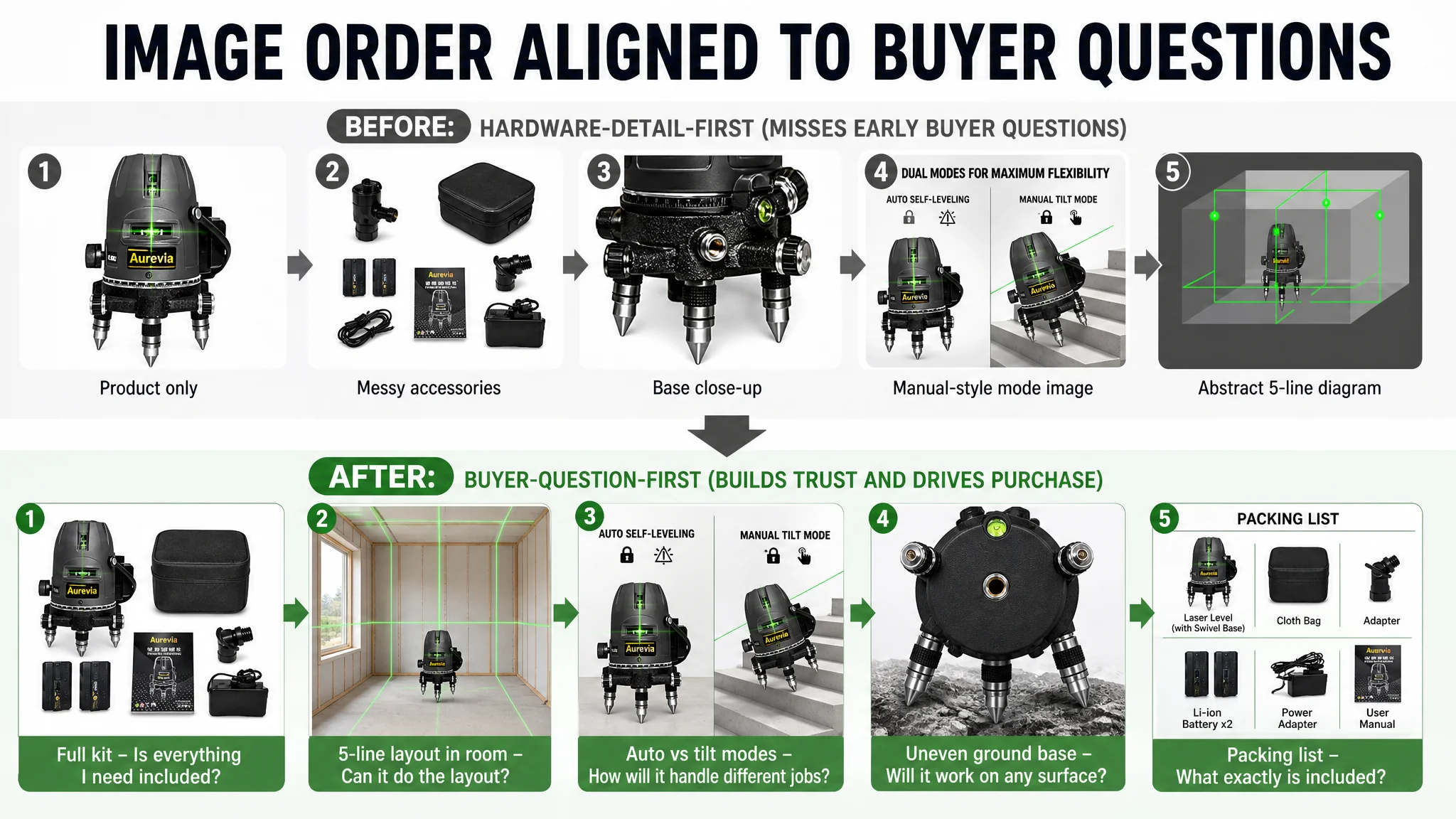
Subsequent images were reordered to support a professional buyer’s scan path:
- Early position: scene-oriented diagrams showing how the 5-line layout solves complex alignment (horizontal, vertical, 90° angles, plumb points) in real rooms
- Later position: accessory breakdown, naming each part, confirming packaging contents
This order change alone aligns the image sequence with the question sequence in the buyer’s mind:
1. “Can this tool solve my layout problem?”
2. “Is it professional enough?”
3. “Is everything I need included?”
Rewriting Bullet Points as Pain-Point → Solution Loops
Instead of isolated feature statements, bullets were restructured as small, self-contained decision blocks.
1. Micro-Adjusting Base for Accurate Alignment
- Not just “we have a rotating base.”
- Explicit explanation of manual fine-tuning: keeping the cross point fixed while vertical lines shift.
- Direct mapping to framing, partitioning, point-to-point layout.
2. 5-Line Full Layout for Multi-Scenario Use
- One horizontal, four vertical lines, plus plumb point, spelled out.
- 90° crossings on the ceiling: how they divide rooms for masonry, tiling, ceiling work.
- Clear appeal to both wall and floor applications.
3. Ultra-Bright Green Beam & Outdoor Mode
- Visibility and accuracy expressed together: ±1/9 inch at 33 ft.
- “Outdoor” button and V/H brightness adjustment translated into real-world outcomes: visible lines in strong sunlight.
4. High-Capacity Battery & Energy Efficiency
- Battery endurance linked to “long workdays,” not just mAh.
- H/V line selection framed as energy-saving and battery-life extending.
5. Self-Leveling & Manual Tilt Mode
- Pendulum logic reinterpreted as risk control: warning when out of range in auto mode.
- Manual tilt mode explicitly positioned for stairs and diagonal decoration.
6. Rugged Design & IP54 Protection
- ABS housing, IP54 rating, backlit bubble level all placed under “survive harsh job sites and dark environments.”
7. Comprehensive Package & Easy Setup
- Packaging clarity: what exactly is in the box.
- Tripod compatibility spelled out (5/8"-11 threads).
8. Professional Support & Quality Assurance
- Technical support and quality assurance included as a final trust layer, instead of a casual “ps” note.
Together, these bullets begin to answer not just “what this is,” but “how this makes my job faster, safer, and more predictable.”
Before Ads Could Work Again, the Page Had to Convert
The biggest structural deficit—A+ content—had to be addressed with a clear logical spine.
Anchoring the Detail Page Around Two High-Priority Themes
DeepBI and the seller team agreed on two top-tier priorities:
1. 5-line efficient layout
2. Outdoor high visibility
The competitor leaned heavily on the “3×360°” narrative. Instead of entering a spec fight on that exact axis, the Listing was reframed to emphasize:
- A 5-line architecture combined with a 360° rotating base
- Equally convenient layout capability for typical jobsite needs
- Clear, visual demonstration of outdoor visibility and brightness control
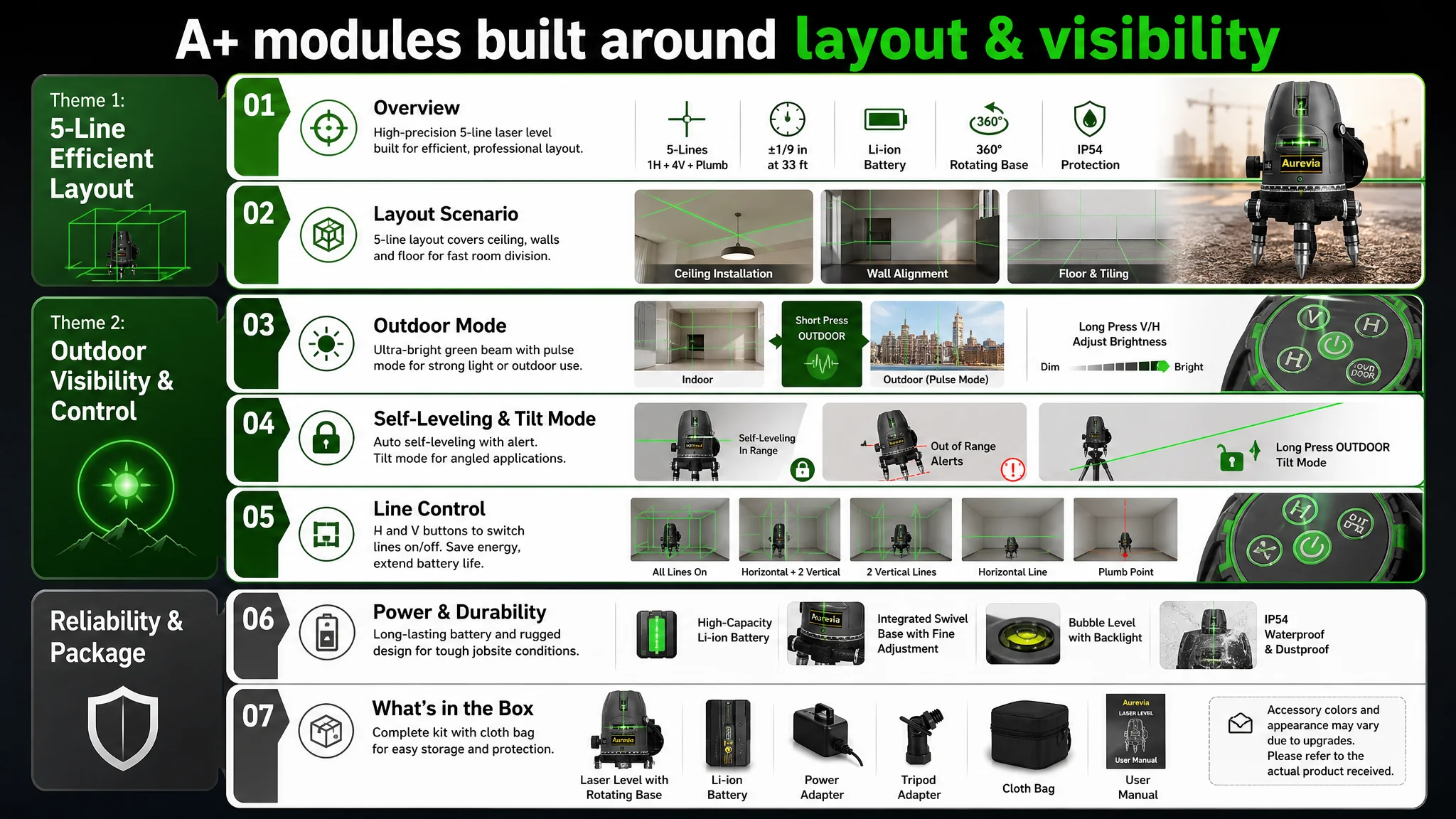
Building a Coherent A+ Module Sequence
The proposed A+ flow:
1. Module 1: Overview & Core Specs
- High-res product photo with integrated rotating base
- Icon-based spec summary: green beam, 5-line, ±1/9" at 33 ft, self-leveling, high-capacity battery, IP54
1. Module 2: 5-Line Layout Scenario
- Visual explanation of one horizontal + four vertical lines and plumb point
- Ceiling crossings, wall and floor coverage
- Direct linkage to leveling, calibration, plumb, masonry workflows
1. Module 3: Brightness & Outdoor Mode
- Side-by-side: normal vs brightness-enhanced/pulse mode in bright environments
- V/H buttons and “Outdoor” button visually explained
1. Module 4: Self-Leveling vs Manual Tilt
- Left: auto mode with precision icon and tilt warning behavior
- Right: tilt mode for stairs and angled lines, no flashing, clear warning cue
1. Module 5: Line Selection & Energy Saving
- Scene showing different line combinations (single horizontal, two vertical, four vertical)
- H/V button close-ups, explicitly linking to power saving
1. Module 6: Battery & Uneven Surfaces
- Battery focus: long standby and worktime
- Rotating base and bubble level in action on uneven ground, with backlight emphasized
1. Module 7: Package Contents
- Full family layout on a neutral podium
- Each accessory labeled
- Clear note that accessory colors may vary due to upgrades, to manage expectation
This structure does three important things:
- Reduces the mental cost for professional buyers to verify whether the tool fits their jobs
- Closes the trust gap vs. a fully built benchmark A+ page
- Aligns page content with the decision path: “Can it do the layout?” → “Will I see it outdoors?” → “Is it safe and durable?” → “What do I actually receive?”
How Ad Traffic Became Useful Again
While this case does not rely on specific post-optimization numbers, the directional change in operating state is clear.
Once the title, main image, bullets, and A+ content were realigned:
- The Listing’s conversion capacity began to recover.
Buyers who clicked through—especially those with professional use cases—had enough information and evidence to complete a purchase.
- Ads stopped being the only growth lever.
Instead of burning budget into an underbuilt page, the seller could now reasonably expect ad traffic to be monetized more efficiently.
- The risk of traffic-structure imbalance decreased.
Restoration of the Listing’s intrinsic conversion ability supports more organic orders over time, reducing overdependence on paid traffic.
- Operational decisions became more controllable.
With a Listing that properly explains its value, the seller can better interpret changes in ACOS and CVR as signals, not noise.
The most important change, however, was conceptual.
What the Seller’s Understanding Looked Like After the Case
This case shifted the seller’s mental model from:
- “ACOS is high, so the ads must be wrong”
to:
- “If the Listing cannot convert, ads will only amplify the weakness.”
Key takeaways that other Amazon sellers can apply:
1. Amazon ads cannot fix a fundamentally weak product page.
Ads deliver traffic; they do not create trust or explain value. That’s the Listing’s job.
1. Listing quality is the foundation of ad efficiency.
A title that clarifies the product’s role, a main image that proves completeness and professionalism, bullets that tie to real problems, and A+ content that demonstrates usage—these directly shape CVR.
1. Before scaling ads, ask whether the page deserves more traffic.
If A+ content is empty, if bullet points read like a manual, if the main image doesn’t show the full kit, more clicks will likely mean more wasted budget.
1. Benchmarking matters more than intuition.
The seller’s product wasn’t bad—it had 5.0 stars and positive reviews. But against a category-leading competitor, its Listing score was 49 vs. 88. Without seeing that contrast, it was easy to misdiagnose the problem.
In the end, DeepBI’s value in this case was not about “having features.” It was about correctly identifying that the core constraint was Listing conversion, not ad mechanics, and then structuring the optimization so that the product page could finally carry the business that the ads were paying to bring in.