

An Amazon seller in the photography accessories category came to DeepBI with a familiar frustration: ad spend on their handheld fog machine in the German marketplace was rising, impressions were there, but clicks and orders lagged behind expectations. On paper, the Listing looked competitive – total Listing score slightly higher than a key rival – so the team assumed the problem sat squarely in Amazon ads, not on the product page.
DeepBI’s diagnosis overturned that assumption. By putting the seller’s Listing and a benchmark competitor Listing side by side, the system surfaced a different bottleneck: the page was not speaking clearly enough to the real decision‑makers on Amazon – content creators and professional users. The title, bullet points and image logic were under‑serving the very strengths that could differentiate a more powerful device. Ads were delivering traffic, but the Listing’s conversion story was leaking it.
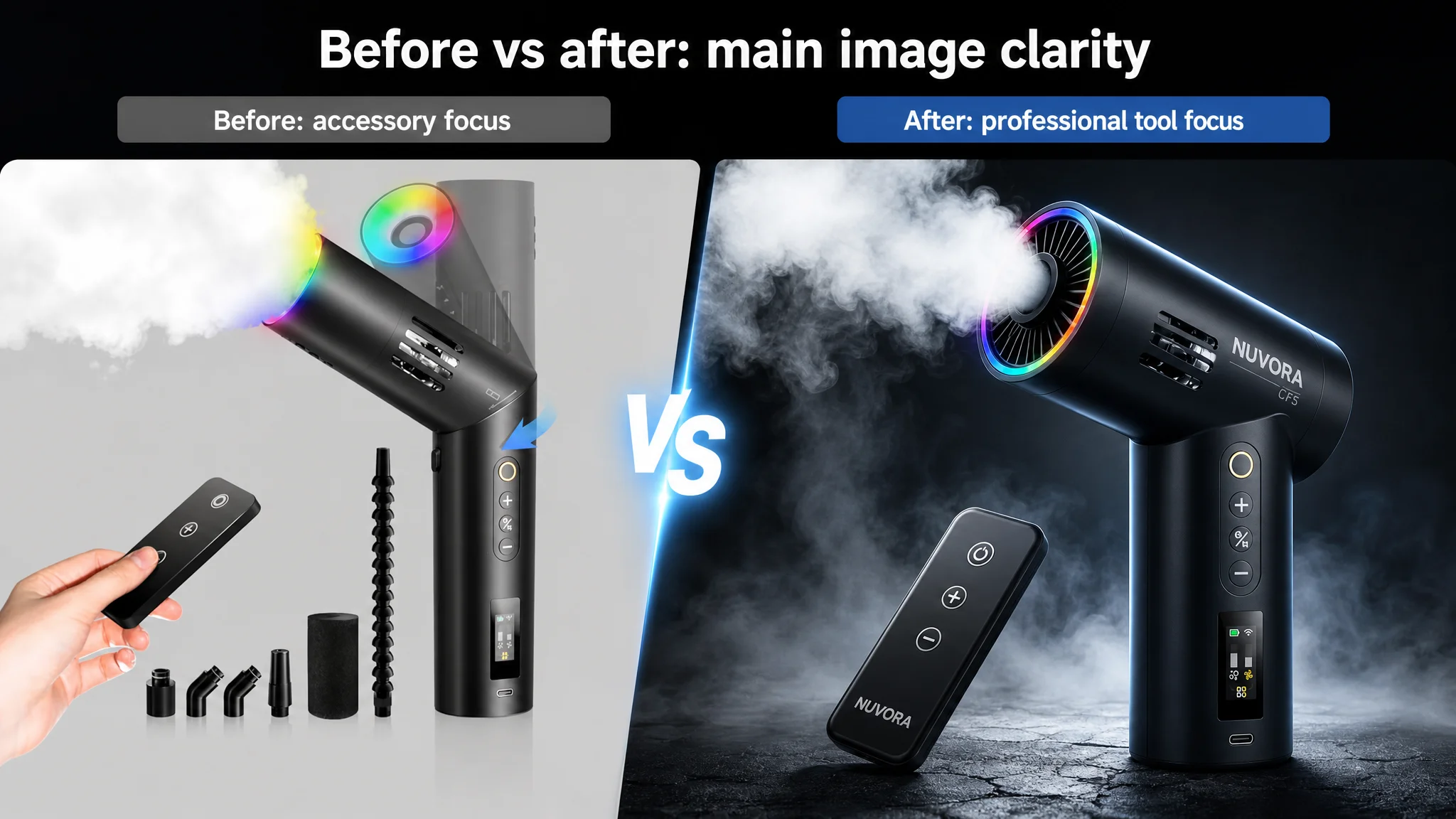
The optimization therefore shifted away from “keep tuning bids and keywords” toward a coherent Listing‑conversion rebuild: refocusing the title on search‑relevant roles (content creators, photography, video), restructuring bullet points around professional use cases and trust, and redesigning key images and A+ modules to visually bind “40W power, dense fog, RGB effects and controllability” into a professional tool narrative. For other Amazon sellers, this case is a reminder that when ads seem “inefficient”, the root cause can be a misaligned product page, not a broken campaign.
The Listing Looked “Good Enough” — But Ads Kept Feeling Expensive
On the surface, this Amazon Listing for a handheld mini fog machine in the DE marketplace did not look like a weak page:
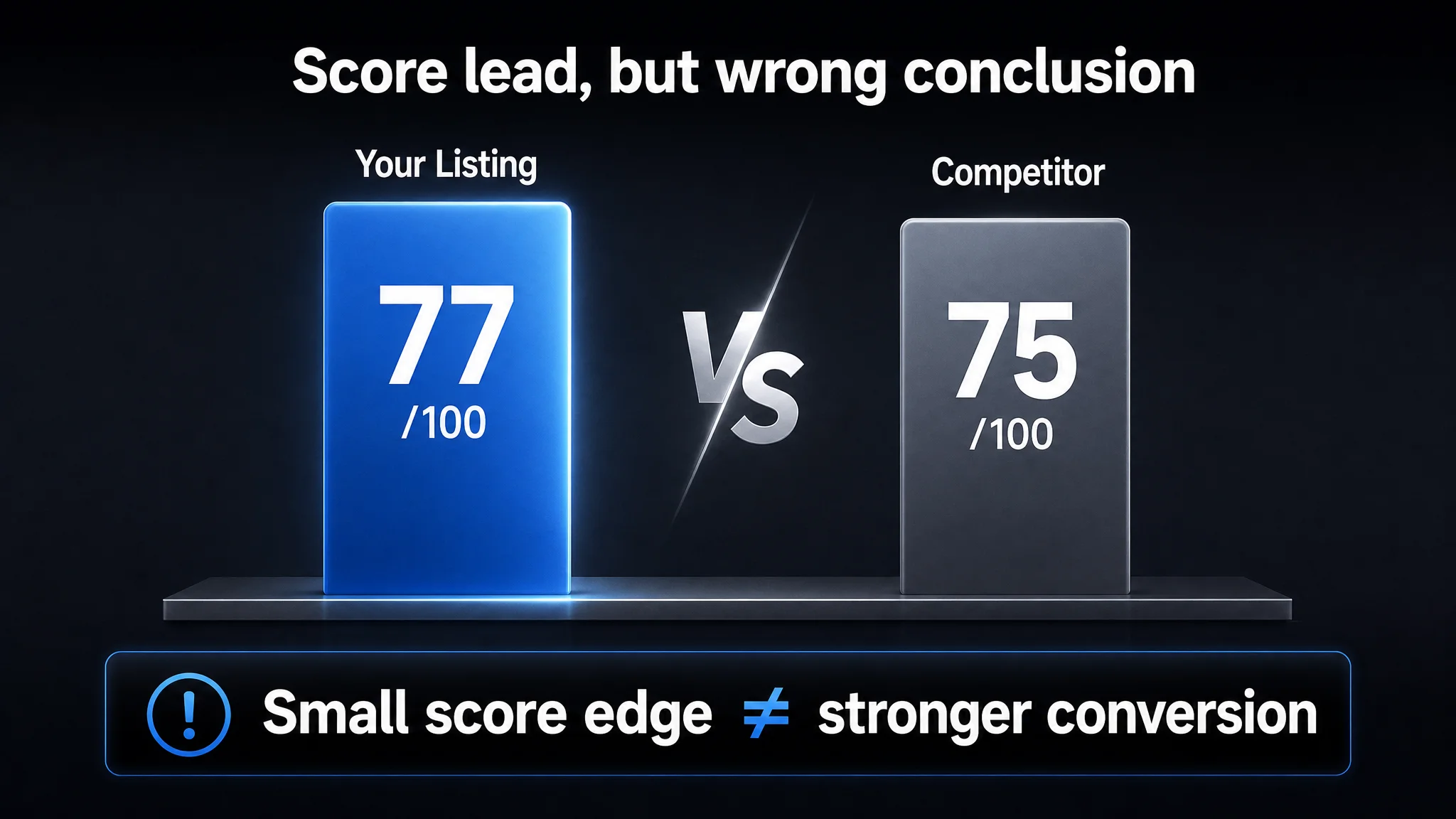
- Overall Listing score: 77/100
- Benchmark competitor Listing: 75/100
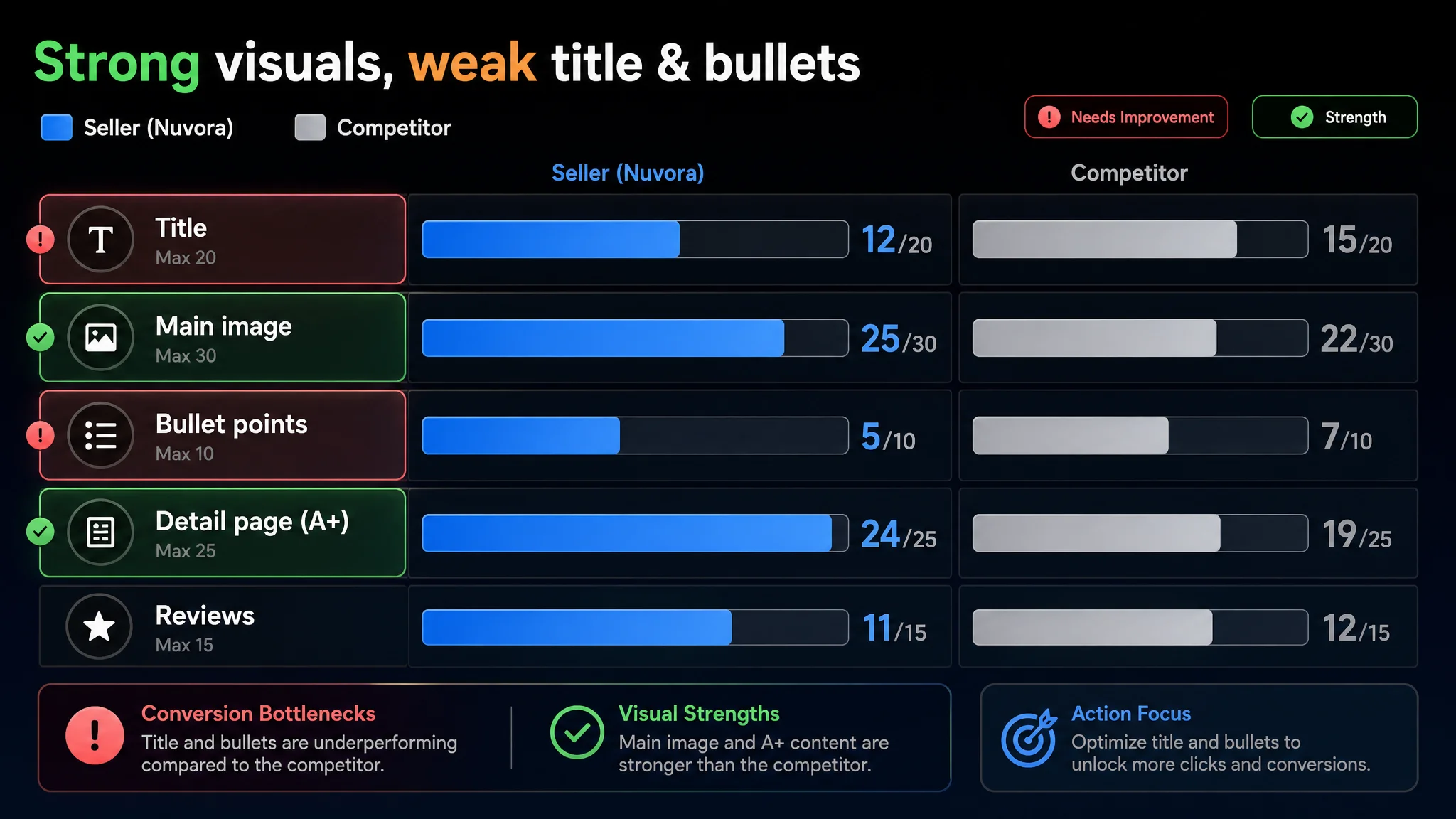
Headline numbers suggested a slight edge. Main image and detail page modules even outperformed the competitor in DeepBI’s scoring:
- Main image: seller 25 vs competitor 22 (out of 30)
- Detail page (A+): seller 24 vs competitor 19 (out of 25)
Customer feedback was also healthy:
- Rating: 4.4 stars vs competitor’s 4.2
- Review count: 265 vs competitor’s 517 (smaller base, but strong quality and rich photo/video reviews)
From the seller’s point of view, this created a powerful bias: “Our page scores higher, rating is better, so the Listing is fine. If ACOS is high, the problem must be ads – maybe we need better keywords, more campaigns, or different bids.”
This is exactly where the misdiagnosis started.
“The real problem was not that ads failed to bring traffic. It was that the page could not convert the traffic as effectively as it should.”
DeepBI’s analysis showed that despite a higher aggregate score, the conversion‑critical parts of the Listing were not aligned with how Amazon buyers in this niche actually make decisions.
Amazon Ads Were Not Failing. The Page Was Consuming the Traffic.
Once DeepBI decomposed the score by dimension, a different picture emerged:
- Title: Seller: 12, Competitor: 15, Max: 20, Gap vs Competitor: -3
- Main image: Seller: 25, Competitor: 22, Max: 30, Gap vs Competitor: +3
- Bullet points: Seller: 5, Competitor: 7, Max: 10, Gap vs Competitor: -2
- Detail page: Seller: 24, Competitor: 19, Max: 25, Gap vs Competitor: +5
- Reviews: Seller: 11, Competitor: 12, Max: 15, Gap vs Competitor: -1
The Listing “won” in main image and A+ richness, but lagged precisely where search and page persuasion begin: the title and bullet points.
This created a subtle but serious business risk:
- On the search results page, the title was not framing the product as strongly as the competitor’s.
- On the product page, the bullet points didn’t build a clear decision path from professional effect → ease of use → safety → completeness of the set.
The result: ad traffic was being pushed into a page that was not optimized around the core buying logic of its best audiences. From an ACOS perspective, this looks like an “ads problem”; in conversion logic, it is a Listing conversion capacity problem.
The Title Didn’t Lose on Keywords. It Lost on Decision Roles.
The competitor led with a role and concrete modes
DeepBI’s title comparison showed a simple but decisive difference.
The competitor title structure was roughly:
- Brand + model first
- Core device type and power
- Explicit “5‑in‑1 modes” (Portrait, Cinematic Mist, Dry‑Ice effect, etc.)
- Clear audience and scenarios: photography, video, outdoor, content creators
This does three things simultaneously on Amazon:
1. Maximizes search relevance by putting brand and product type up front.
2. Communicates outcome and variety with “5‑in‑1” and named modes.
3. Names the buyer identity (“content creator”), aligning with how many users actually search.
The seller’s title stayed at the level of form and basic specs
The original seller title followed a more traditional pattern:
- Brand and model
- “Mini fog machine / handheld / 40W / portable”
- Some scenarios, but with “cosplay” positioned more prominently than “content creator”
The core issues DeepBI highlighted:
- The keyword field was “acceptable”, but did not prioritize the user role with the highest search volume and monetization potential (content creators and video/photo production).
- The 40W power advantage (stronger than the competitor’s 30W) was present, but it was not embedded in a value narrative; it appeared as just another number.
- No explicit mention of “modes” or creative effects in the title – the device looked like “a fog machine” rather than a “multi‑mode creative effect tool”.
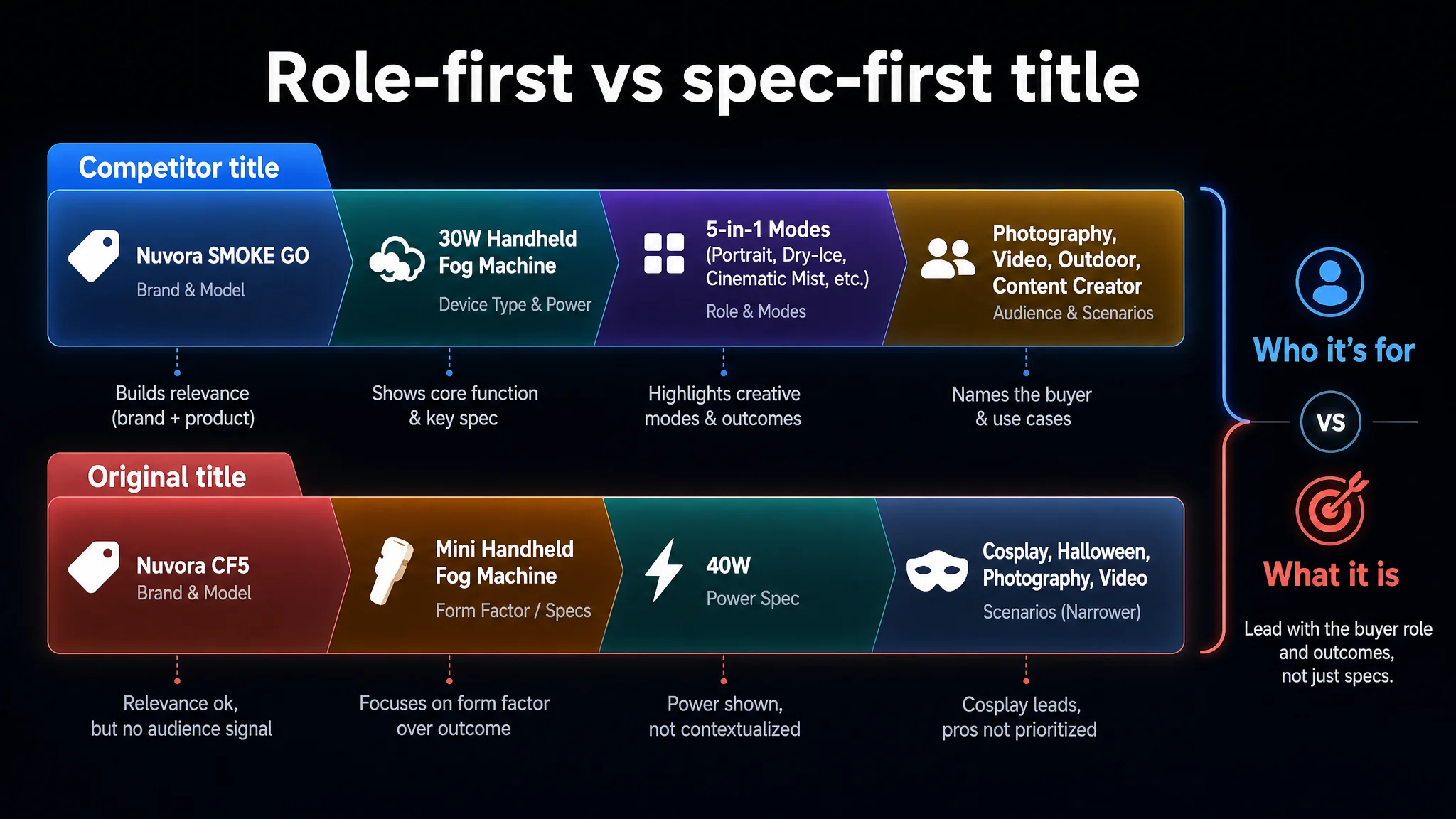
Reframing the title: from “hardware label” to “tool for creators”
DeepBI’s optimization direction therefore was not “add more keywords”; it was:
- Move “Mini Nebelmaschine” and “Handheld” forward to reinforce relevance in German Amazon search.
- Explicitly highlight 40W power and USB battery as differentiating performance attributes.
- Introduce “Fotografie, Videoproduktion, Content Creator” as primary use tags.
- Keep seasonal and niche uses (“Halloween, Cosplay”) but not as the central identity.
This reframing is key for Amazon sellers: the title is not only for A9; it is the first line of the conversion story for the right buyers. If the wrong role owns the title, ads will keep paying for the wrong impression.
Bullet Points Had Information, but Not a Buying Logic
The bullet point comparison revealed an even clearer gap in decision logic.
The competitor led with effects, scenarios and trust
The benchmark Listing structured its bullets as:
1. Professional special effects & scenarios – explicit modes and use cases (portrait, cinematic mist, YouTube, TikTok, film production).
2. Portability & runtime – tank size, rechargeable battery, long-duration fog.
3. Easy remote control – wireless control, no warm‑up time.
4. Safety + suitable for pros and beginners – materials, built‑in safeguards, user range.
5. Complete set – ready to use out of the box – clear package list and “start immediately” message.
Every bullet combined:
- A named benefit (effect, portability, remote control, safety, completeness).
- A concrete support (modes, minutes, materials).
- A decision layer (who it is for, what problem it removes).
The seller led with parameters and warnings
By contrast, the seller’s original bullet order was:
- Power and runtime parameters.
- Adjustable angle and ease of operation.
- Fan speed and light functions.
- Temperature control and safety.
- Remote control and usage warnings.
From a buyer’s reading path:
- The first bullet is technical, not aspirational.
- Safety is treated as a standalone technical note, not as reassurance for both pros and beginners.
- The last bullet ends on operation instructions and warnings, which cool down the purchase momentum instead of closing with “ready‑to‑use set value”.
“The bullet points had information, but not a buying logic.”
DeepBI’s conclusion: the Listing did not lack data; it lacked a structured persuasion story tuned to Amazon’s page‑reading behavior.
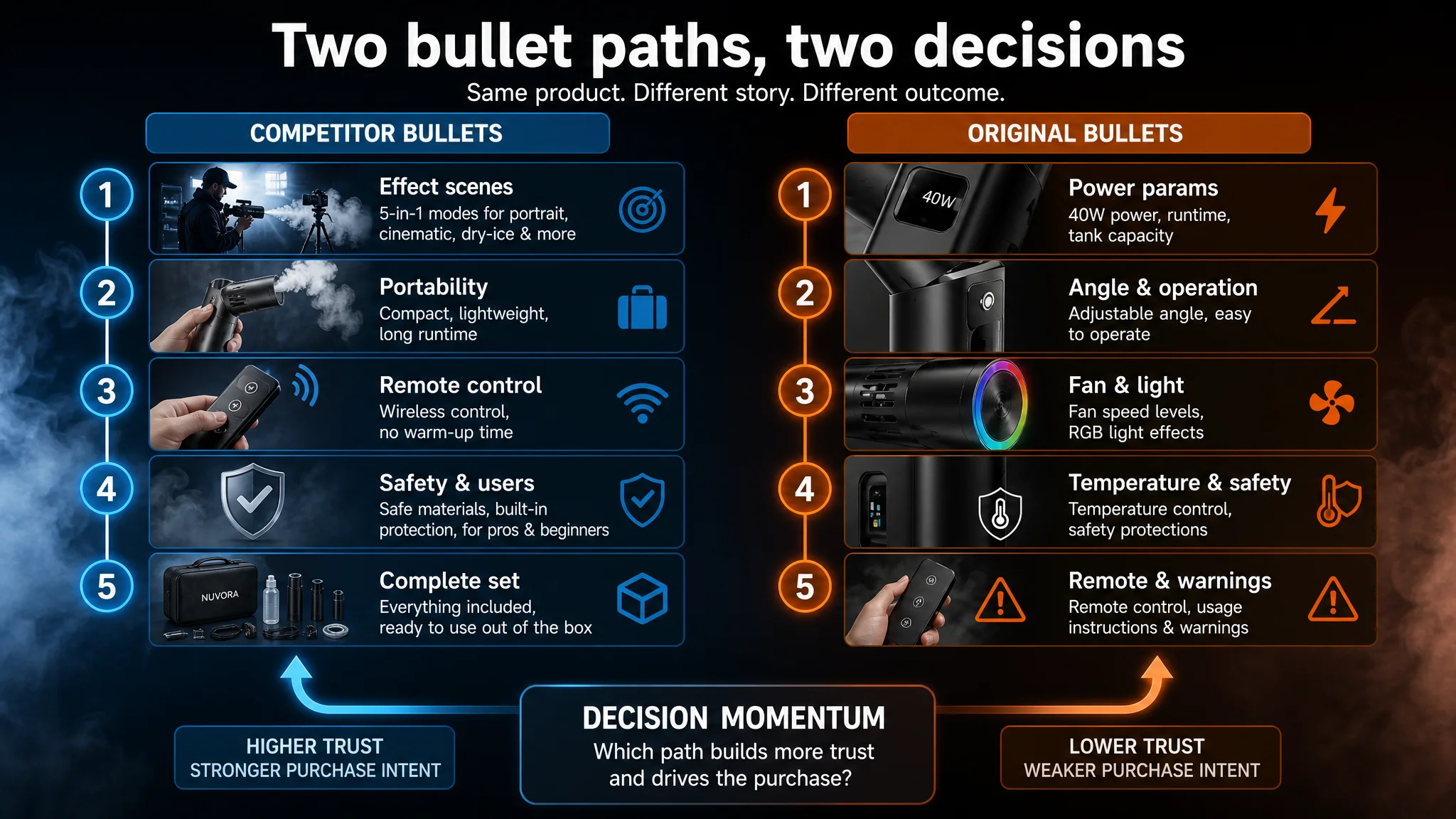
Rebuilding the bullet path around professional use
The optimization focus was to reorder and rewrite bullets into a clear path:
1. Professional special effects & 40W power
Lead with outcome: dense fog, coverage up to 93 m², continuous 5‑minute output, framed explicitly for film production, YouTube, TikTok and creative shoots.
1. 60° adjustable design & flexibility
Elevate the rotating body as a distinctive advantage: precise smoke direction without extra tubes, flexible operation in tight spaces, supporting unique angles.
1. RGB lighting & Tyndall effect
Present RGB and the Tyndall effect as a standalone creative boost for cosplay, artistic photography and dramatic scenes.
1. Intelligent safety & premium quality
Link aerospace‑grade heat‑resistant materials and smart dry‑burn protection directly to peace of mind for both professionals and beginners.
1. Wireless remote & residue‑free fluid
Merge remote control range with “no residue, safe for portrait and food photography”, while keeping charging recommendations concise.
1. Complete set – ready to use
Add a clear package list and emphasize “start immediately with your creative projects” to lower decision friction.
The shift was not about “longer copy”; it was about aligning each bullet with a specific concern in the buyer’s head: effect, control, aesthetics, safety, convenience, completeness.
This Product Page Did Not Lack Content. It Lacked Focused Trust for the Right Audience.
On A+, the seller’s page was in many ways richer than the competitor’s:
- High‑contrast black‑and‑white hero visuals with dynamic fog.
- Clear parameter visuals (40W, 25 modes, 60°).
- Multiple scenario images across professional photography, video, weddings, Halloween, etc.
- Trust elements: design award, lab imagery, global testimonials including professional users.
- Explicit safety and environmental claims: plant‑based fog fluid, no residue, non‑flammable, preheat instructions.
The competitor’s A+ relied more on:
- Basic spec visuals.
- General application scenarios.
- Simple operation steps and FAQ.
- Less emphasis on authority and safety detail.
From a conversion infrastructure standpoint, the seller’s A+ was already strong. So why did DeepBI still consider Listing conversion the constraint?
Because the visual story was not consistently anchored on the core behavioral promise: “This is a professional, strong, easy‑to‑control tool for creators, not just another party fogger.”
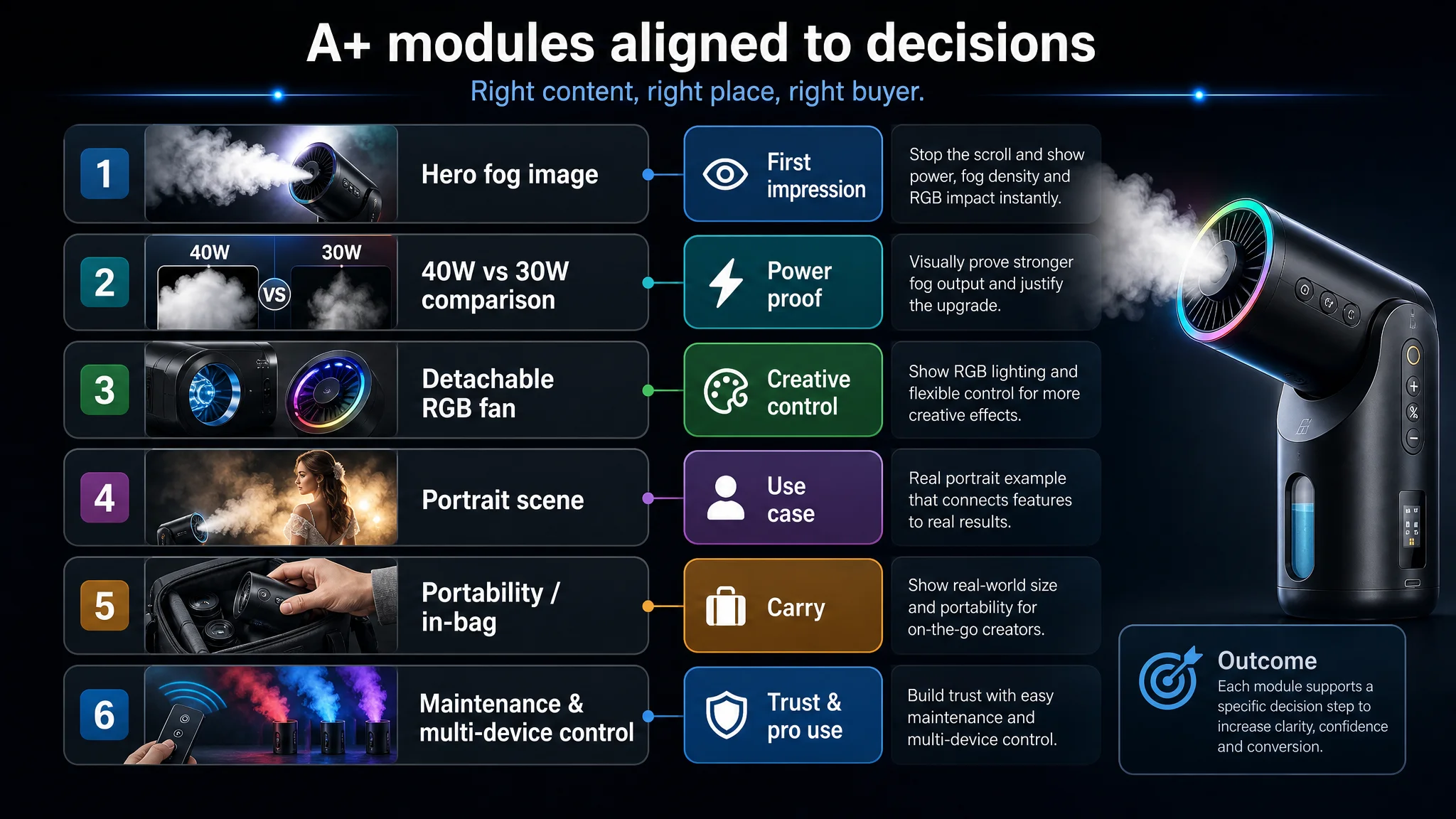
DeepBI’s A+ recommendations: compress noise, magnify decisive signals
The optimization suggestions were not to add more modules, but to re‑prioritize what each image does in the decision sequence:
- Hero image: a single, text‑free black background shot with dense white fog and a sharp industrial silhouette, to create an immediate professional impression.
- Power and density comparison: a direct 40W vs 30W fog‑density visual, turning an abstract number into a visible advantage.
- Detachable RGB fan: a clean “exploded view” visual showing magnetic RGB attachment, emphasizing modularity and creative control.
- Portrait scene: cinematic wedding portrait with backlit fog to show not only the fog, but how it shapes light and atmosphere.
- Portability: a hand holding the device inside a professional camera bag, with a familiar “15 cm” marker instead of vague percentage claims.
- Maintenance: a simple, three‑step oil‑filling macro shot to remove first‑use anxiety and reduce misuse‑driven returns.
- Multi‑device remote control: a scene with a remote in the foreground and three devices emitting different colored fog in the background, visually proving cluster control for large sets.
All of these point to a single judgment: the page had to show, not just say, that this fog machine belongs in a professional tool kit.
Why DeepBI Did Not Recommend “Fix Ads First”
From a pure advertising perspective, the seller’s instinct was understandable: keep adjusting bids, test more creatives, maybe build new campaigns. But DeepBI’s business judgment was different.
The biggest risk was amplifying a misaligned story
If the Listing:
- Under‑addresses content creators in the title,
- Leads with technical specs instead of professional outcomes,
- Buries its differentiation (40W, 25 modes, RGB effects, rotating body) in scattered visuals,
- Ends bullet points with warnings instead of “ready to shoot” confidence,
then any additional ad spend would:
“Amplify the wrong page outcome, not unlock the page’s real conversion capacity.”
DeepBI’s logic sequence was:
1. Title and bullets are the first contact for both organic and ad traffic.
If they misframe the product, all traffic types suffer.
1. Main image and A+ already hold enough raw material to outperform the benchmark – but they are not fully aligned around the core value story.
1. Reviews are strong but fewer; each visitor is therefore more dependent on page content to build trust, not just social proof volume.
Given this, the highest‑leverage move was to repair the Listing’s decision logic first, then allow both organic ranking and ad traffic to benefit from a more coherent conversion path.
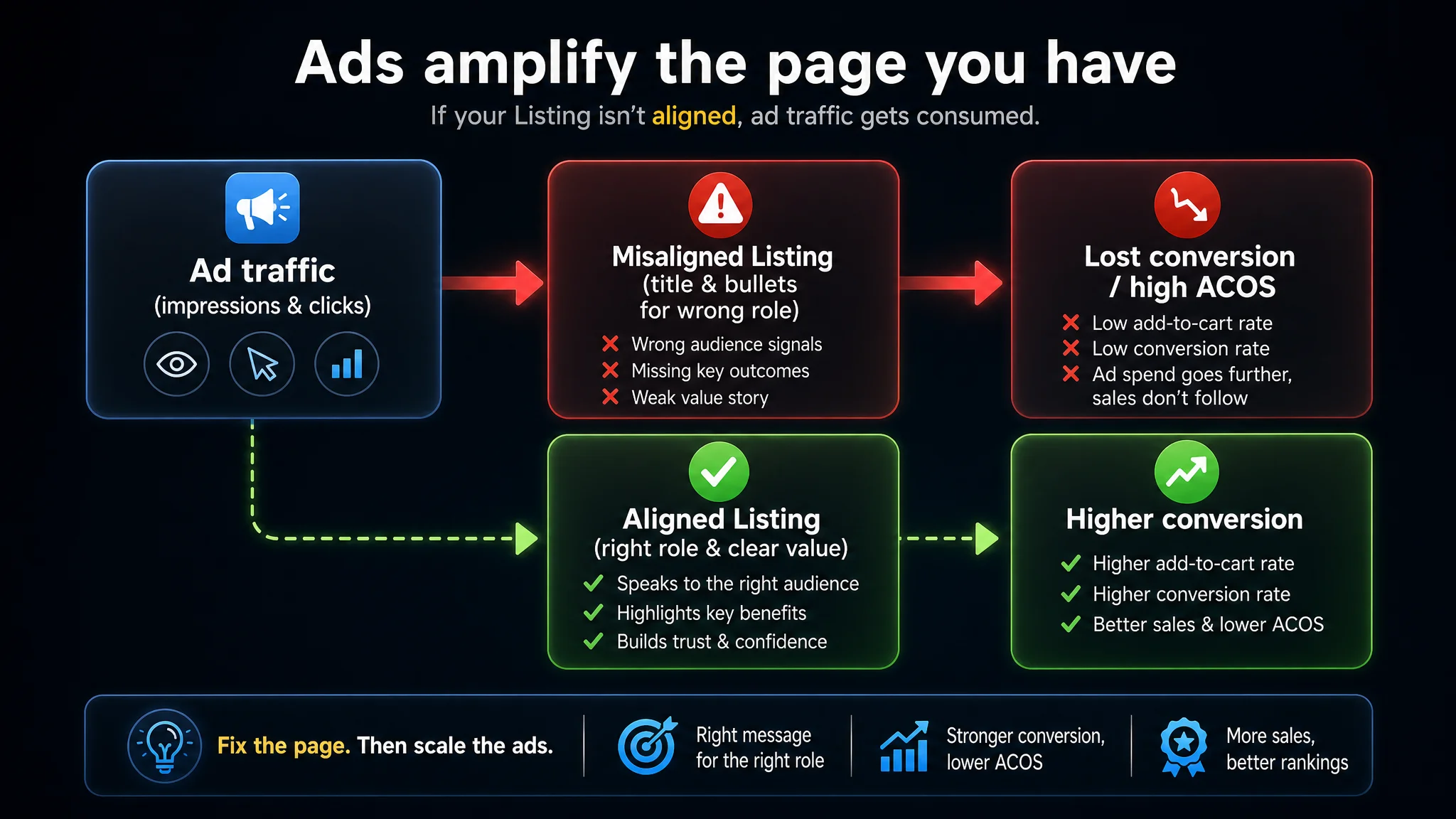
How the Page’s Sales Logic Started to Recover
After the diagnosis, the seller’s optimization roadmap shifted in a few concrete ways:
1. Repositioning from “cosplay fogger” to “creator tool”
- Title and bullets were reoriented toward photography, video production, content creators and modern platforms (YouTube, TikTok).
- Seasonal and niche uses (Halloween, cosplay) were retained but demoted from primary identity to supplemental scenarios.
This aligned the product with higher‑value, recurring‑use buyers instead of primarily occasional event users.
2. Making 40W and 25 modes visibly matter
- Image and A+ modules began to bind “40W” directly to visible fog density.
- Mode variety was visually attached to differentiated scenes (portrait, cyberpunk, food photography, magic shows), not just mentioned as a number.
This shifted the conversation from “it’s stronger and has more modes” to “it visibly creates more cinematic, controllable results.”
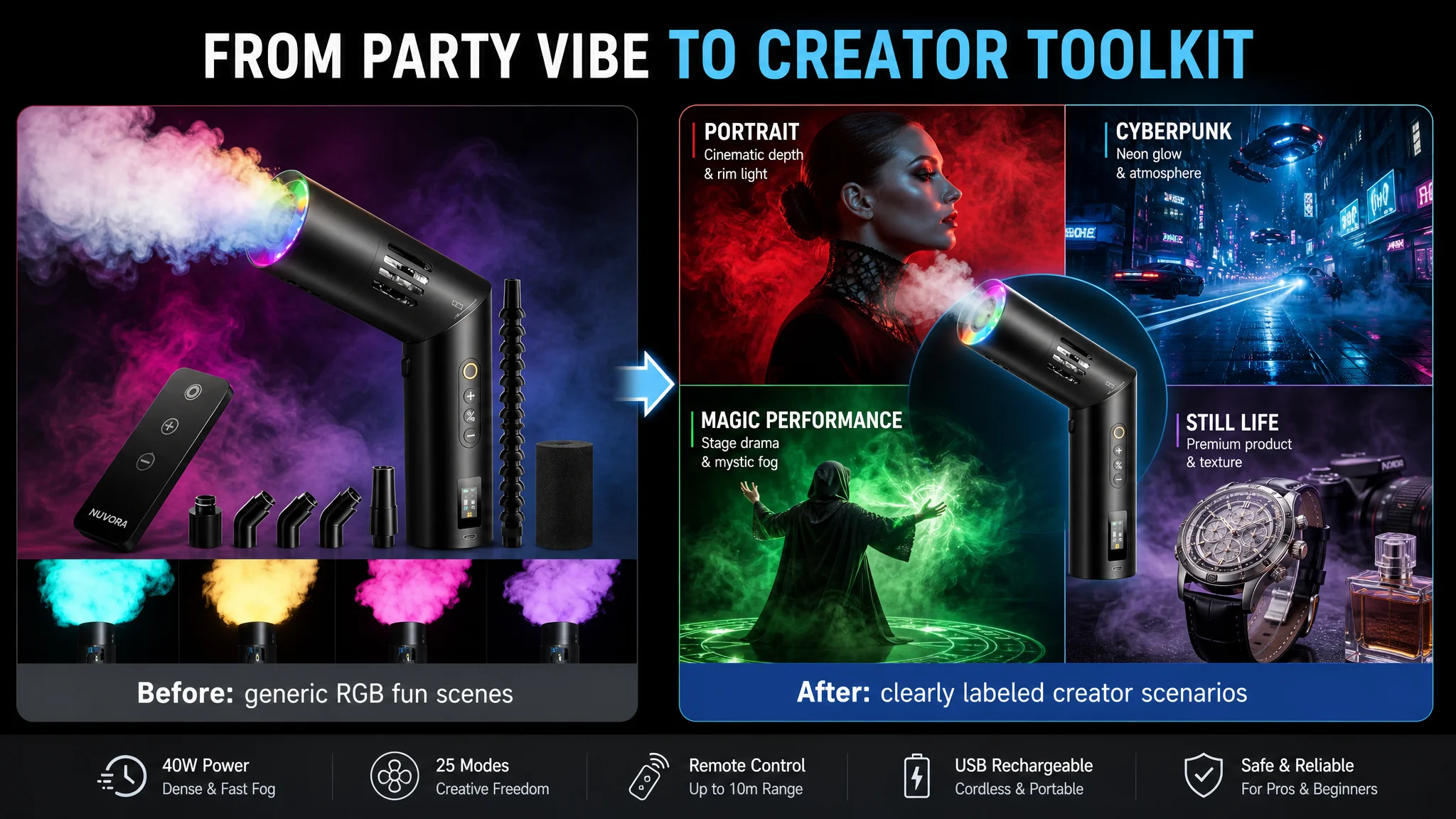
3. Turning RGB and the Tyndall effect into a core selling lever
- RGB lighting was repositioned from a side note to a central bullet.
- Visuals and copy explicitly showcased the Tyndall effect, making the device look like a light‑sculpting tool rather than a gadget.
For professional and semi‑professional buyers, this is the kind of detail that justifies price and encourages repeat use.
4. Building trust for pros and beginners together
- Safety statements were compressed and reframed under “Intelligent safety & premium quality”.
- The same bullet addressed material quality, temperature control and user type coverage, making it clear that beginners can safely attempt professional setups.
This reduced hesitation from first‑time buyers who might otherwise fear complex operation or damage.
5. Reducing decision friction with a clear “complete set” message
- A dedicated bullet and visual clarified exactly what comes in the package.
- “Sofort einsatzbereit” (“ready to use immediately”) became part of the closing message.
For Amazon buyers scanning multiple Listings, this clarity can be decisive in both cart adds and reduced pre‑purchase questioning.
How Ad Traffic Became Useful Again
Once the Listing’s conversion story was rebuilt, the seller’s ad strategy could stand on a different foundation:
- Search terms targeting “content creator / photography / video” now landed on a page that mirrored those roles in the title and bullets, improving perceived relevance.
- Ad creatives (search thumbnails, Sponsored Brands, etc.) could lean into the new main‑image logic: industrial aesthetics, dense fog visuals, power vs competitor framing.
- A+ content began to support ads by making the promised advantages (professional effects, multi‑device control, safety, portability) immediately credible once visitors scrolled.
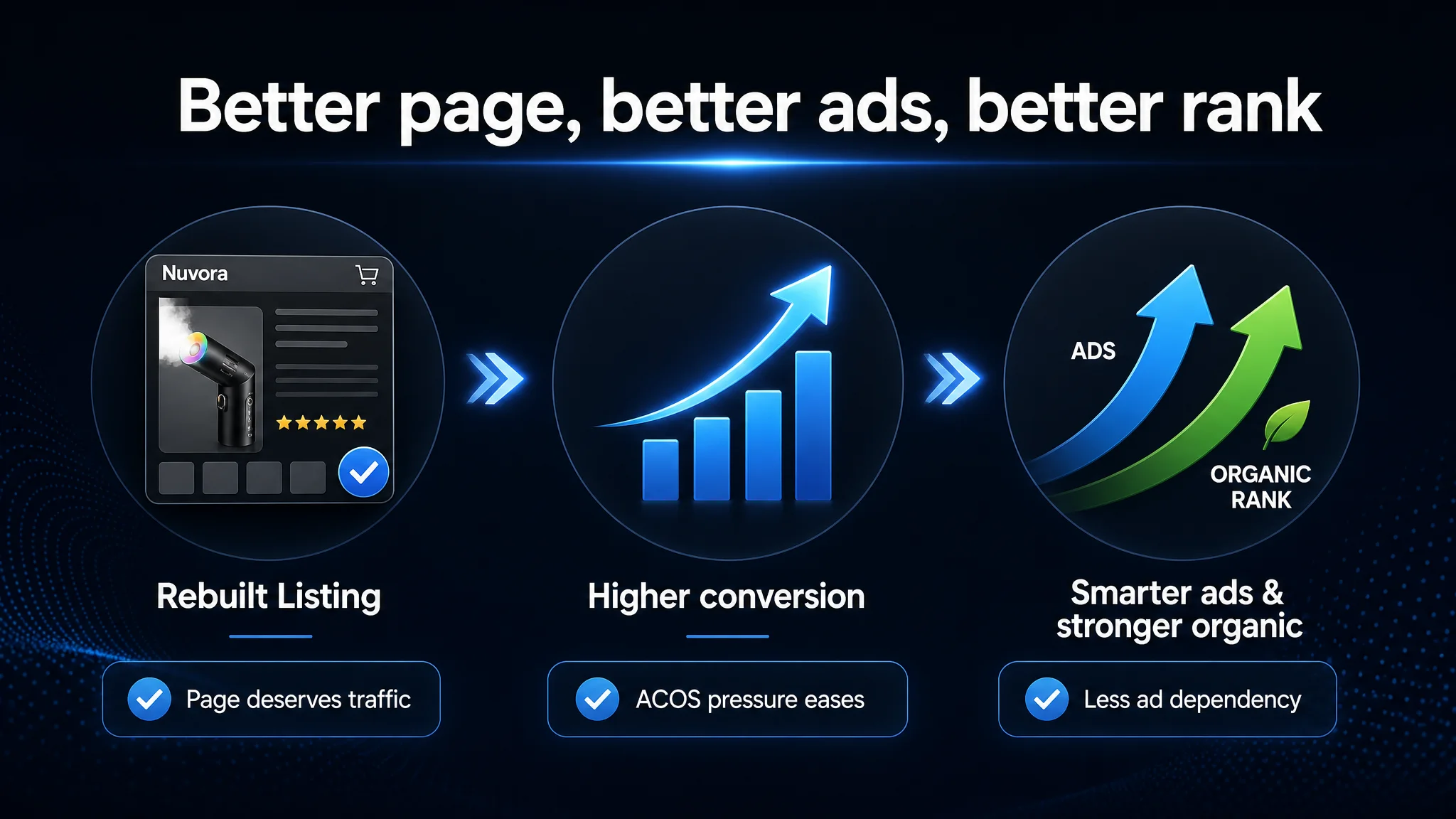
Instead of trying to “fix ACOS” purely inside the ad console, the seller now had a Listing that deserved more traffic. That changed the nature of optimization:
- ACOS pressure could be managed not only by bid cuts or negative keywords, but by better conversion.
- Organic keywords related to professional use and content creation had a stronger chance of sticking, since page content now matched intent.
- The store’s overall dependency on aggressive ads could gradually decline as the Listing’s organic conversion capacity improved.
What the Customer’s Understanding Ultimately Changed
By the end of this case, the seller’s view of their Amazon business problem had shifted in several important ways:
- High ACOS was not purely an advertising issue; it was a symptom of a Listing that under‑communicated to its best buyers.
- Listing quality is not a generic “design” issue – it is a structured conversion asset that must align title, main image, bullets and A+ around a clear decision path.
- Advertising does not only amplify advantages. It can also amplify a page’s existing defects. Scaling spend on a misaligned Listing is a fast way to burn budget without building durable ranking power.
- Before scaling ads, the team now asks a different question:
“Does this product page truly deserve more traffic?”
For other Amazon sellers, especially in technical or creative categories, this case should resonate:
- A higher total Listing score than a competitor does not guarantee conversion superiority if the weak points are in your title and bullet logic.
- A rich A+ is only as strong as its alignment with the core buyer identity and use cases you want to own.
- When traffic grows but orders don’t follow, check whether your page is framed around the right audience and outcomes before assuming your ad strategy is broken.
DeepBI’s role here was not to “add features” to a Listing, but to reframe the business problem: from an advertising optimization problem to a Listing conversion capacity problem. Once that judgment changed, the path toward a more controllable Amazon operation became much clearer.