

An Amazon seller in the US fitness category came to DeepBI with a familiar headache: traffic from Amazon ads was not turning into enough orders for their Halloween-themed water kettlebell. On paper, they had a fun concept, a complete set of images, and a reasonable price. The team’s instinct was to blame ads—bids, keywords, campaign structure—and to keep “turning the knobs” on Sponsored Products.
Once we put their Listing into DeepBI’s scoring and benchmarking system, a different picture emerged. Against a directly comparable Amazon competitor, the seller’s product page scored 66/100 versus 71/100. The main image set and bullet points were actually stronger than the competitor’s, but the title, A+ detail content, and especially review section lagged. The Listing was not clearly positioning its core value in search results and was failing to build enough trust once shoppers arrived.
The later optimization did not start with another round of ad tweaks. It focused on making the Amazon product page itself more convincing: restructuring the title around “water kettlebell + travel/portable” scenarios, tightening the A+ story around safety and portability, and sharpening the visual decision chain with more professional, water-focused imagery. For Amazon sellers, this case is a reminder that when ads feel “inefficient,” the real constraint is often Listing conversion capacity, not campaign settings.
The Problem the Seller Thought They Had
The customer is an Amazon seller in the fitness accessories space, selling a pumpkin-themed, water-filled soft kettlebell aimed at home and travel workouts.
From their perspective:
- The product idea made sense: soft, water-filled, safer than iron, seasonally differentiated with a Halloween aesthetic.
- The image stack was richer than many peers: 8 images covering lifestyle scenes, specs, and usage.
- They had begun to invest in Amazon ads to drive traffic.
Yet orders remained unstable, ACOS felt hard to control, and ad spend didn’t “pay back” as expected.
Internally, the diagnosis was straightforward: “Ads are not optimized enough. We probably need better keywords, more precise bids, and more creative testing.”
So the team kept pressing on the advertising side while leaving the Listing logic largely untouched.
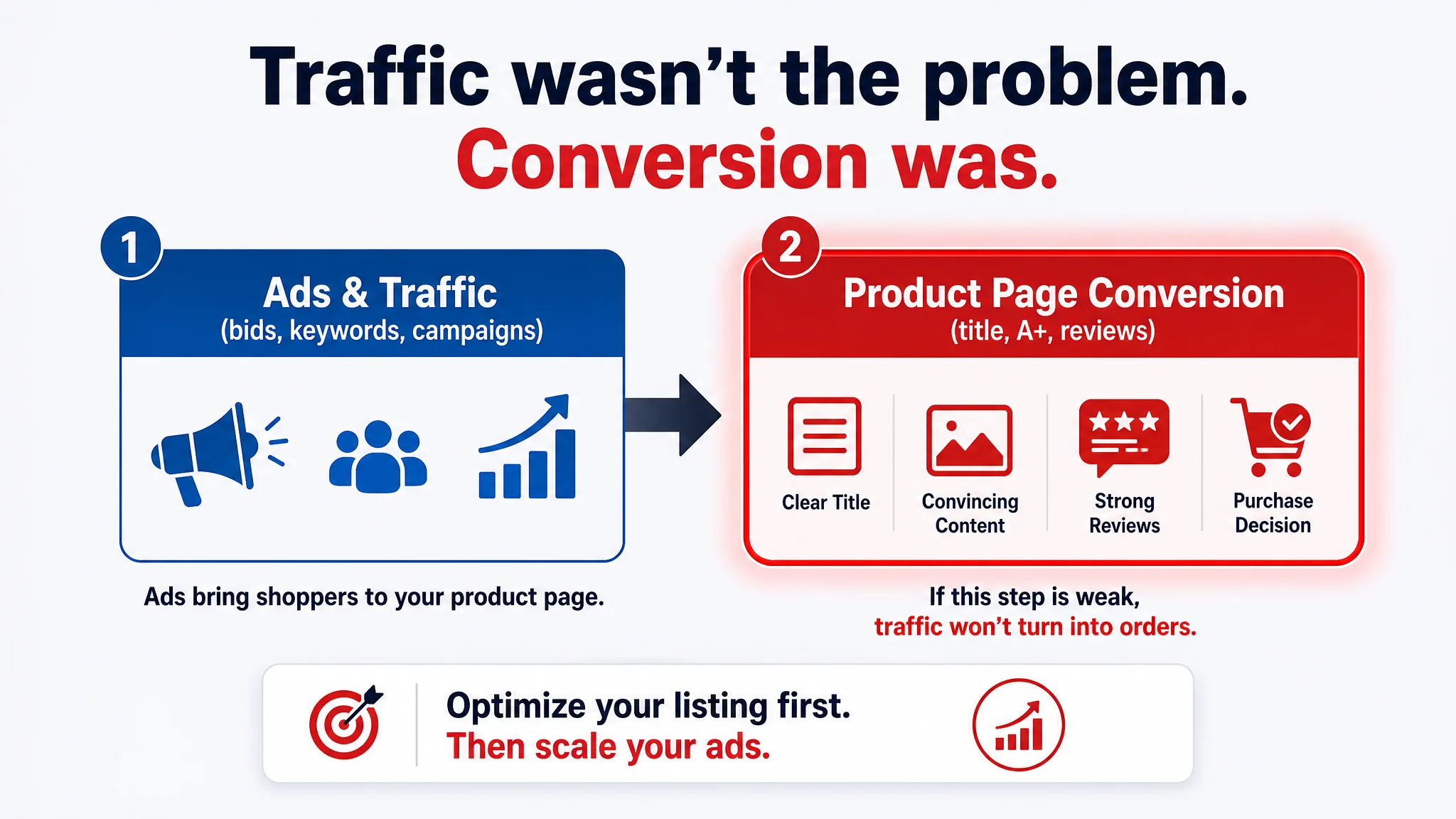
“The real problem was not that ads failed to bring traffic. It was that the page could not convert the traffic.”
What the Data Actually Showed
When DeepBI benchmarked the Listing against a directly comparable water kettlebell on Amazon, the scoring breakdown was revealing:
- Total score:
- Target Listing: 66/100
- Benchmark competitor: 71/100
- By dimension:
- Title: 12 vs 15 (out of 20) — behind
- Main images: 25 vs 23 (out of 30) — slightly ahead
- Bullet points: 8 vs 4 (out of 10) — comfortably ahead
- Detail/A+ content: 17 vs 18 (out of 25) — slightly behind
- Reviews: 4 vs 11 (out of 15) — far behind
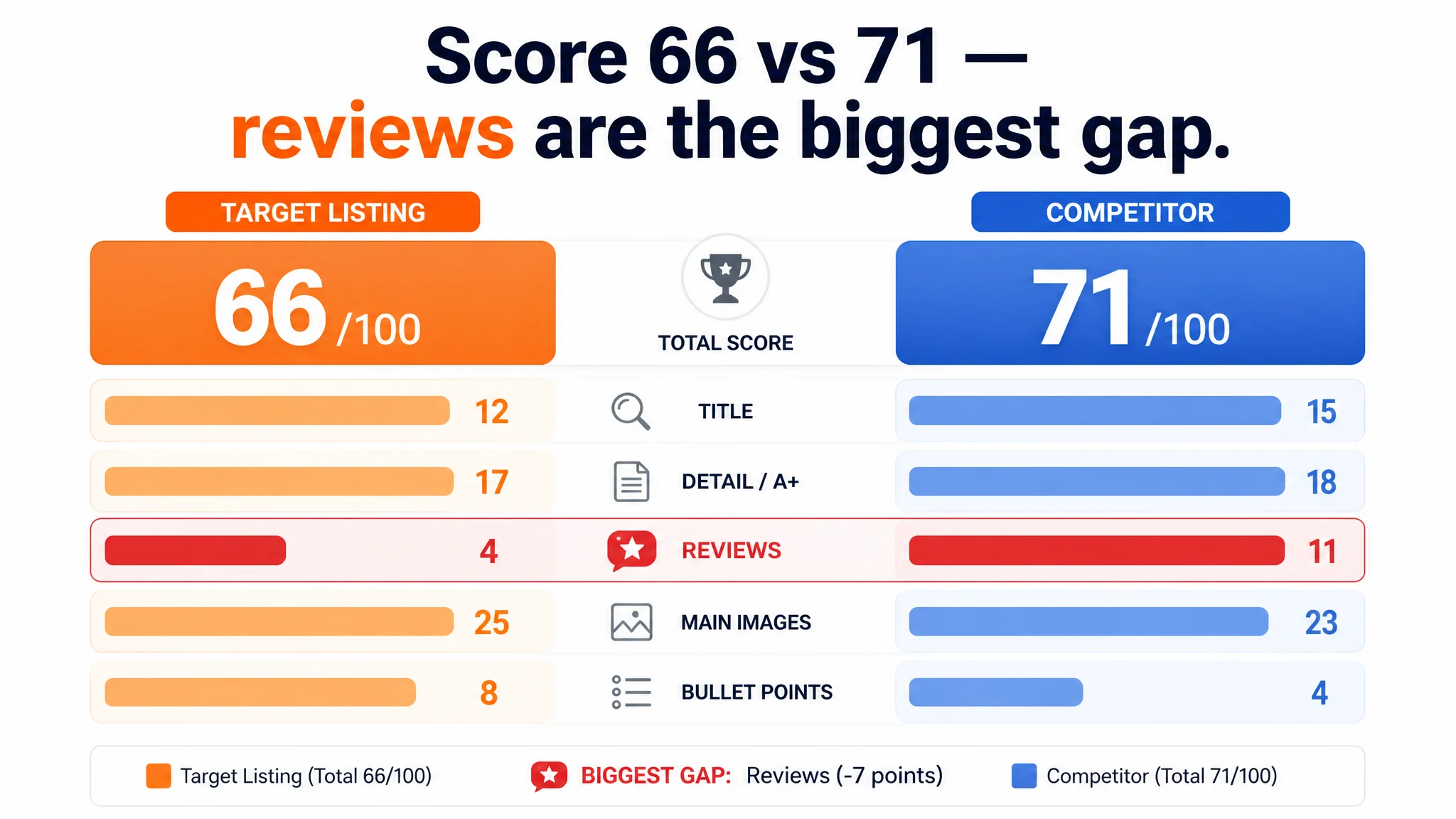
This is a classic Amazon trap: the areas the seller kept obsessing over (images, bullet copy) were not the real bottleneck.
Where the Listing Was Truly Weak
1. Title: Search entry and decision framing were underpowered
The competitor’s Amazon title did a few critical things right:
- Lead with product type and scenario:
“Travel Adjustable Soft Kettlebell… Water Filled Weights for Fitness Exercise” → Clear category and core use case in the first phrase.
- Pack multiple weights in one phrase:
“7/10/15 lbs” → Maximized keyword coverage for different weight searches and signaled versatility.
- Follow a tight logic chain:
Product type → weight → use → portability → synonyms → training outcome.
- End with an emotional hook:
“Core Training Fun” → Subtle but important—turning a tool into an enjoyable experience.
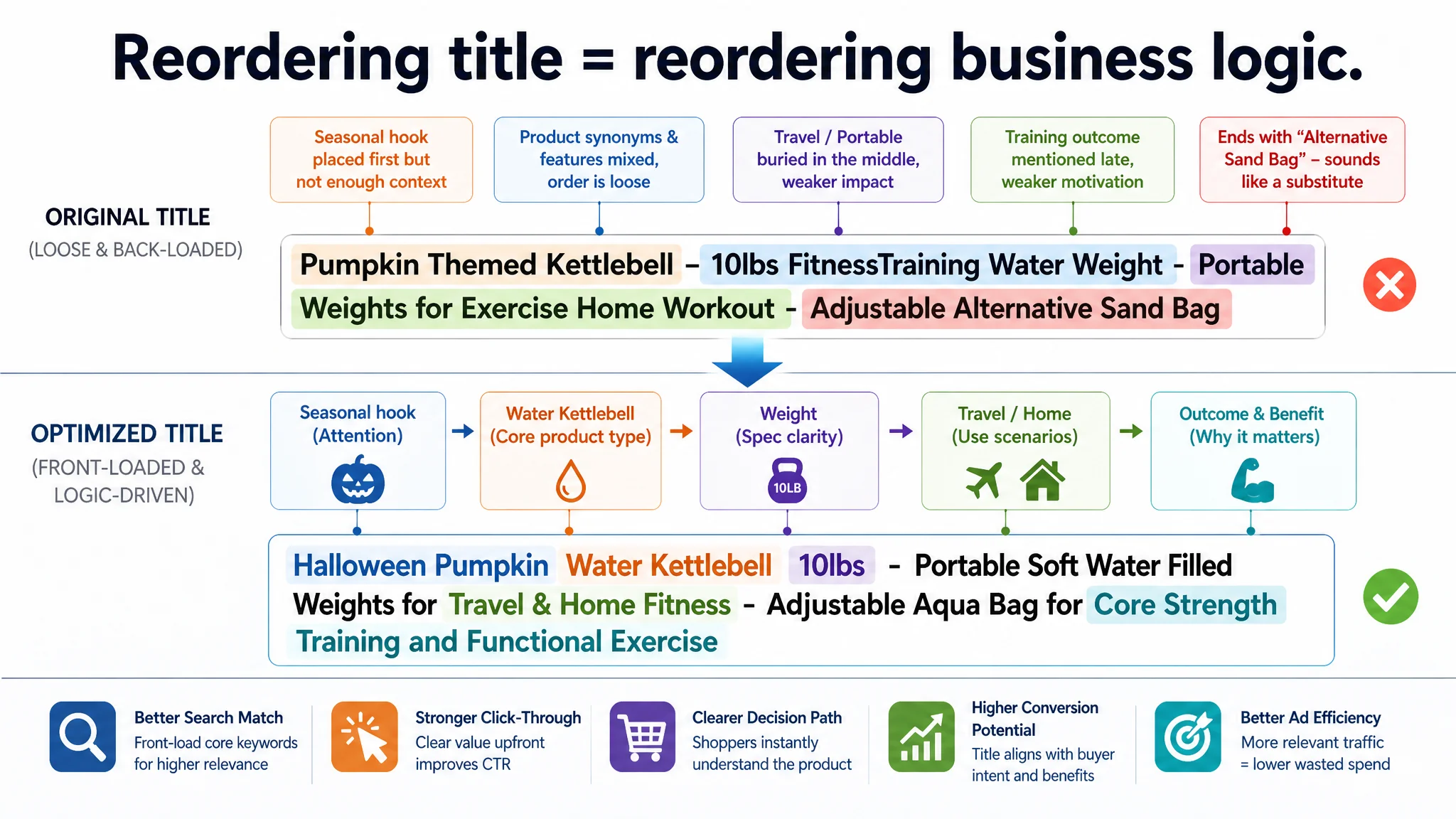
By contrast, the target Listing’s title:
- Mixed product synonyms and functional descriptors in a looser order.
- Ended on “Adjustable Alternative Sand Bag” — a utilitarian, substitute-like phrase that did not create desire.
- Underplayed key scenario terms like travel, portable, and water kettlebell early in the title, weakening both search coverage and click incentive.
On Amazon, this title weakness limits not just keyword ranking potential but also thumbnail-level click decisions. Ads were buying impressions on a title that didn’t clearly answer: “What is this? Why should I click this one?”
2. Detail / A+ content: Trust and specificity were missing
Structurally, both Listing and competitor had similar A+ layouts:
- Main hero image
- Multiple detail close-ups
- Scenario images with text
- A six-panel exercise demonstration grid
But content-wise:
- The competitor:
- Explicitly called out “safety anti-collision,” “easy weight adjustment,” “soft material to prevent injury”.
- Used language like “Stand out from the crowd” and “as stylish as it is effective” to build a lifestyle and light premium positioning.
- The target Listing:
- Relied on a broad, generic line: “Complete your daily fitness plan!”
- Did not clearly spell out how this specific product solves specific home fitness worries.
The result: the A+ section wasn’t functioning as a real decision engine. Traffic coming from ads hit a page that felt conceptually interesting but not fully convincing.
3. Reviews: The most fragile part of the funnel
Review metrics:
- Target:
- 3.9 stars
- 7 total reviews
- 42.9% of visible reviews at 3 stars or below
- No prominent photo/video reviews
- Competitor:
- 4.0 stars
- 36 total reviews
- 25.0% negative reviews
- Presence of image/video reviews
So the target Listing was facing a double penalty:
- Low volume → weak social proof
- High negative ratio → high perceived risk
This combination severely undermines the last step of conversion, especially in a relatively niche, newer product form like water-filled soft kettlebells.
Why Traditional Ad Optimization Didn’t Move the Needle
From DeepBI’s perspective, two things were happening simultaneously:
- The seller was increasing their paid traffic exposure.
- That traffic was hitting a page whose conversion capacity was capped by title clarity, A+ story strength, and review trust.
In this condition:
- Lowering bids or changing match types only shuffles traffic around; it doesn’t change the product page’s ability to turn visits into orders.
- Any temporary ACOS “improvement” achieved purely through bid management is fragile. Once bids or budgets are raised again, the same structural conversion problems reappear.
Advertising does not only amplify advantages. It also amplifies whatever weaknesses are already on the page.
DeepBI’s judgment in this case: this Listing did not have a traffic problem; it had a conversion logic problem. Fixing ads first would continue to waste budget on an under-optimized page.
The Real Constraint: Listing Conversion Capacity
We defined one central constraint:
The Amazon Listing could not consistently convert the traffic it was already receiving because the decision path from search result to purchase was incomplete.
Breaking that down by funnel stage:
At the search result level: The title didn’t carry its weight
- “Water kettlebell” and “portable/travel” attributes were not front-loaded strongly enough.
- The ending “Adjustable Alternative Sand Bag” framed the product as a substitute rather than a compelling category in its own right.
- Missing or underweighted scenario keywords limited exposure to shoppers explicitly searching for travel-friendly weights, soft water weights, or home-safe kettlebells.
DeepBI’s optimization direction was therefore not just “rewrite title,” but:
- Reorder: Bring product type + key differentiator (“Water Kettlebell”) upfront.
- Insert core scenarios: Travel, home fitness, portability.
- Anchor with a clear emotional and functional outcome: Core strength training, functional exercise, seasonal uniqueness.
Hence the proposed direction:
Halloween Pumpkin Water Kettlebell 10lbs - Portable Soft Water Filled Weights for Travel & Home Fitness - Adjustable Aqua Bag for Core Strength Training and Functional Exercise
Business logic behind this:
- Keep the seasonal differentiation (“Halloween Pumpkin”) as a hook.
- Promote “Water Kettlebell” and portability to primary positions for algorithm and shopper clarity.
- Highlight 10 lbs adjustable weight as an edge against a competitor capped at 7 lbs.
- Frame the tool as enabling broader “core strength” and “functional exercise” — translating features into outcomes.
On the bullets: Good logic that needed sharper framing
Unlike many Amazon cases, this seller’s bullet points were already stronger than the competitor’s:
- They opened with holiday context and emotional resonance, rather than dry specs.
- They clearly built a contrast with traditional metal dumbbells as unsafe and inconvenient.
- They emphasized home comfort, safety, and cost/space advantages.
DeepBI’s role here was not to overturn the structure but to tighten the “pain point → solution → outcome” chain with more explicit, scannable headers:
1. UNIQUE HALLOWEEN DESIGN & 10LBS ADJUSTABLE WEIGHT
→ Make seasonal design and weight advantage unmistakable in the first bullet.
1. DURABLE, SOFT & TRAVEL-FRIENDLY
→ Anchor durability and comfort, but tie them explicitly to being collapsible and 0.57 lbs when empty.
1. MAXIMUM SAFETY FOR HOME WORKOUTS
→ Connect soft material, floor protection, and kid/pet safety into a single, vivid home scenario.
1. SPACE-SAVING SANDBAG ALTERNATIVE
→ Position as a modern replacement for traditional sandbags/iron weights; highlight full-body use and zero-storage stress.
1. VERSATILE TRAINING FOR EVERYONE
→ List specific exercises (squats, lunges, yoga, Pilates) to expand beyond “beginners” and catch more search variants.
This was less about “adding copy” and more about making each bullet a mini decision module, with bolded titles and concrete scenes.
On the main images: Strong overall, but missing a “water identity”
The score difference (25 vs 23) already showed that the seller’s main image set was not the fundamental weakness.
Key strengths:
- More images (8 vs 6)
- Good coverage of:
- Lifestyle scenes (streetwear, outdoor training)
- Specs and multi-scene usage
- A modern, lifestyle-forward vibe attractive to 25–35-year-old women — likely a core target segment.
However, DeepBI’s multi-modal analysis pointed to a precise gap:
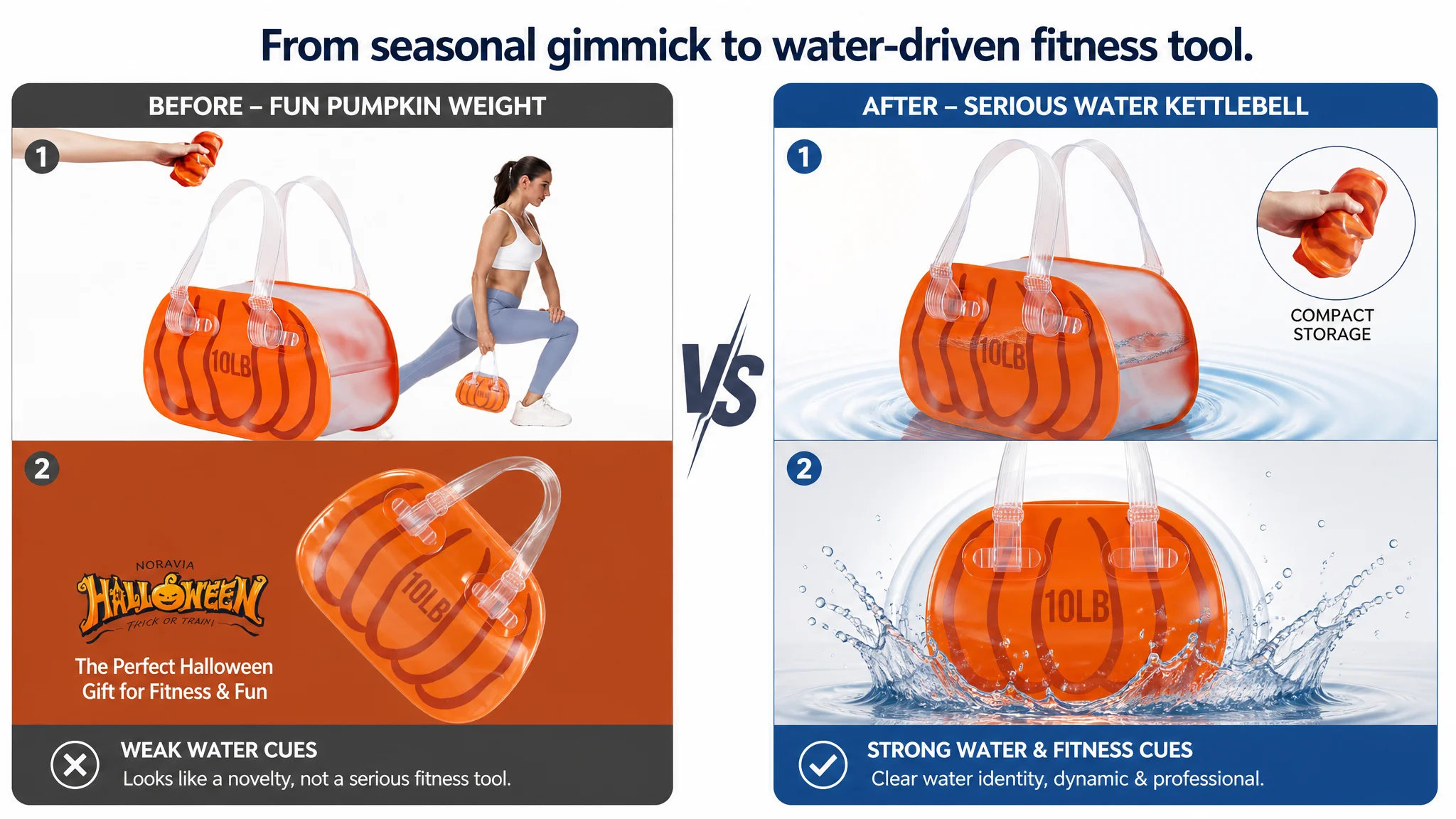
- The “water” nature of the product was not visually obvious enough.
While the competitor used dynamic water splash visuals and transparent water details to make “water-filled, dynamic weight” instantly clear, this Listing’s images:
- Communicated Halloween theme and soft structure.
- Showed folded/portable states.
- But did not give a direct visual confirmation of water filling, dynamic fluid movement, or leak-resistant construction.
In other words, the Listing visually sold a fun pumpkin weight, not a serious water-based training tool.
So the optimization didn’t aim to completely redo a good system; it aimed to inject a sharper water identity and professional fitness tone into the existing structure:
- Shift from “promo poster” style to minimalist professional fitness style as the base.
- Add water ripple overlays and realistic splash effects in key images to lock in the “water kettlebell” mental category.
- Strengthen industrial-feel spec visuals (clean lines, careful parameter overlays) to counteract any “toy-like” perception from the pumpkin theme.
This Product Page Did Not Lack Traffic. It Lacked Trust.
Once shoppers reached the product page, three questions dominated:
1. Is this thing real and safe?
→ Weak review volume and a 3.9 rating with high negative ratio undermined safety claims.
1. Is it practical for my home/travel situation?
→ The A+ content didn’t fully spell out portability, collapsing, or floor protection in a visual way.
1. Will I actually use it for more than one exercise?
→ The exercise grid was present, but not fully leveraged as a “tutorial plus versatility proof.”
DeepBI’s detail page recommendations focused on building a visual decision chain around three themes:
- Safe for home use
- Extremely portable
- Professionally guided
Make the product line and context feel professional
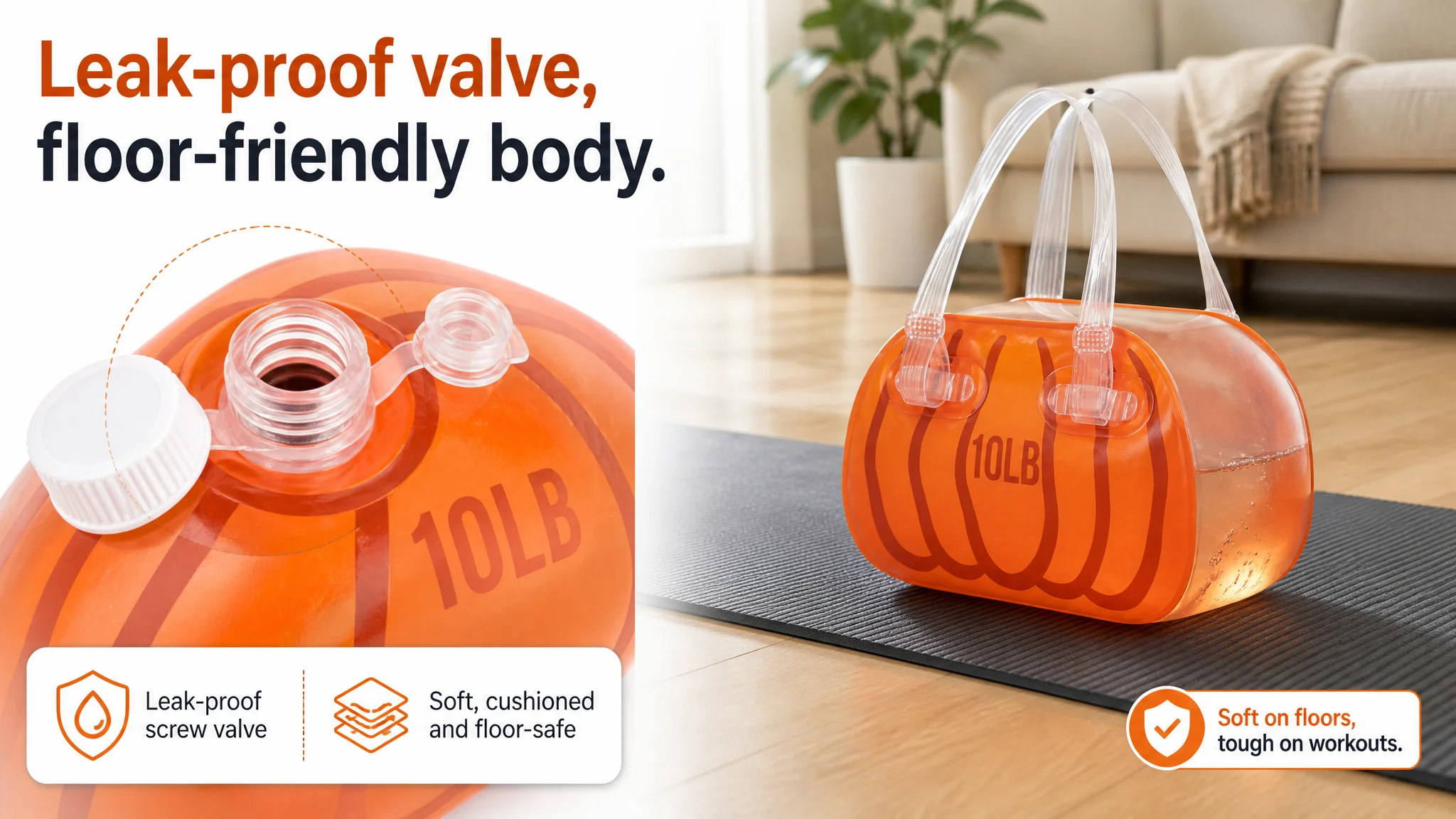
- Hero A+ image: Show multiple water kettlebell sizes (e.g., 3 kg and 7 lb variants) lined up in a bright, real gym environment.
- Purpose: Anchor the product in a real gym context rather than just seasonal decor.
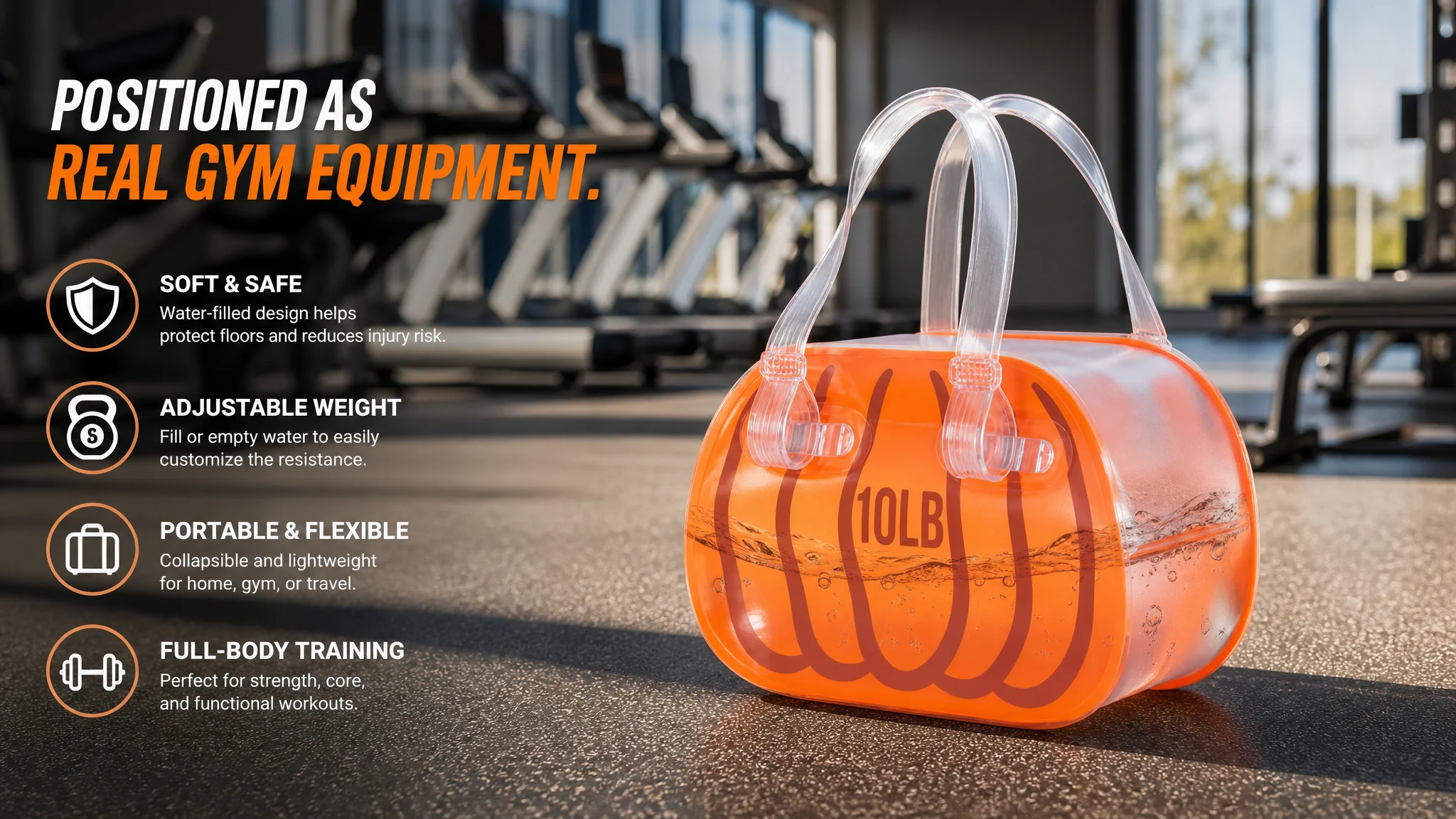
Directly confront the biggest hidden fear: leakage
- Macro shot of the water fill valve, with:
- Clear view of sealing rings and cap structure.
- Clean, white background.
- Purpose: Answer the silent question: “Will this leak in my suitcase or living room?” without needing a paragraph of text.
Turn handling and safety into visible proof
- Handle close-up: Side-lit to show every anti-slip ridge.
- Home protection scene:
- Product sitting on a yoga mat in a cozy living room.
- Emphasis on soft material resting safely on the floor.
- Purpose: Make “safe for floors and families” a visual memory, not just a claim in text.
Make portability tangible
- Folded kettlebell placed inside an open suitcase corner.
- Natural household light, subtle travel context (e.g., suitcase on wood floor).
- Purpose: Translate “can be folded” from an abstract feature into a recognizable, everyday scenario.
Use motion and water dynamics as a unique differentiator
- Image showing the internal water sloshing dynamically when tilted.
- Clean white background.
- Backlighting to highlight fluid movement.
- Purpose: Explain visually why water-based dynamic loading is different from static iron weight — and why that matters for core stability training.
Provide real training guidance
- 3x2 grid of six core exercises:
- Full-body shots with standard form.
- Consistent gym background.
- Purpose:
- Reduce the friction of “I don’t know how to use this.”
- Support the claim of “versatile training for everyone” with proof.
Why DeepBI Did Not Recommend “Fix Ads First”
Given the scoring and structural findings, DeepBI’s judgment was:
- Biggest business risk:
Ads were feeding a Listing that did not yet deserve higher traffic. Every extra dollar in ad spend had a diminishing return because the page’s conversion ceiling was too low.
- Priority path:
1. Repair the search-to-click bridge (title clarity and promise).
2. Strengthen the click-to-trust bridge (A+ story and water/safety visuals).
3. Only then scale or refine ads with confidence that CVR has room to improve.
If the team had continued treating this as an “ad tuning” problem:
- ACOS pressure would likely have remained high.
- Any short-term improvements from bid changes would be unstable.
- Organic performance would stay fragile because the core product page was not competitive enough against a 71/100 benchmark.
Instead, focusing on the Listing first:
- Increases the baseline conversion from every source of traffic (organic + paid).
- Makes future ad spend more predictable: clicks land on a page with a clear, trust-building narrative.
- Reduces the risk that negative reviews and weak A+ content drag down long-term organic rank and profitability.
What Changed in the Seller’s Understanding
After working through this case, the seller’s internal view of their Amazon operation changed along several axes:
- From “ads-first” to “Listing-first” thinking
They saw that ad problems could not be fully solved at the campaign level when the product page itself was underperforming in key dimensions like title and trust.
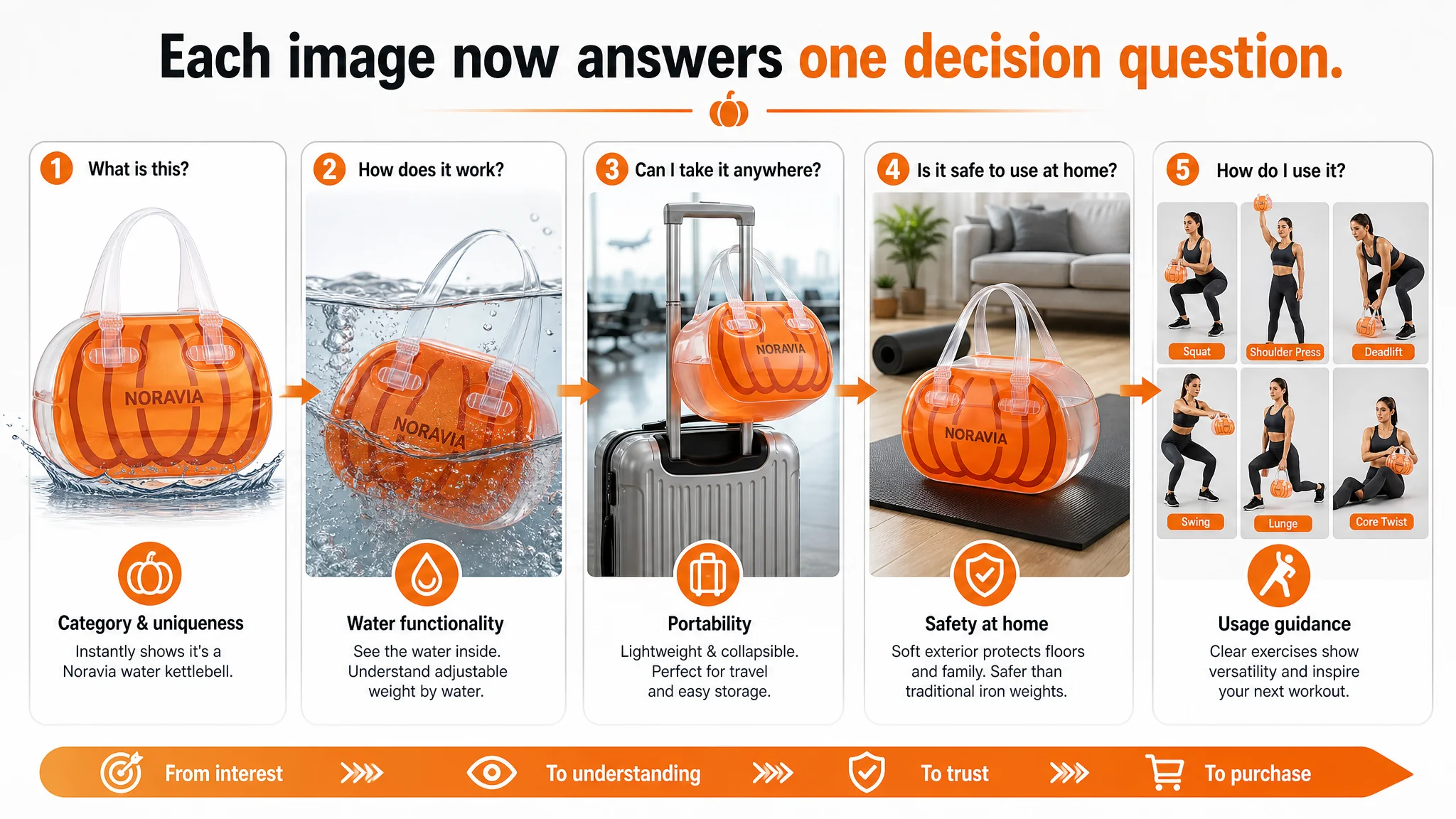
- From “images as decoration” to “images as logic”
Instead of just adding more lifestyle shots, they began to treat each image as a defined step in a decision chain:
- Establish category and uniqueness.
- Prove water functionality.
- Prove portability.
- Prove safety.
- Teach usage.
- From “fun seasonal gimmick” to “serious fitness tool with seasonal twist”
The pumpkin theme became a differentiator layered on top of a professional, safety- and portability-led story—not the entire story.
- From vague conversion issues to quantified Listing constraints
Seeing scores like 4/15 in reviews versus a competitor’s 11/15 made it clear that review trust was a structural weakness, not a random fluctuation.
Takeaways for Other Amazon Sellers
Several broader lessons from this Amazon water kettlebell case apply across categories:
1. High ACOS is not always an “ads problem.”
If your Amazon Listing’s title, A+ content, and reviews are weaker than benchmark competitors, ad tuning alone cannot fix conversion.
1. A strong image set can still hide a missing “identity hook.”
Here, the main images were richer than the competitor’s, but they underplayed the “water” and “dynamic core training” identity. Traffic saw a fun pumpkin weight before it saw a serious water kettlebell.
1. Title order is business logic, not just SEO.
Bringing product type + key differentiator to the front and anchoring with clear scenarios (“travel,” “home fitness”) is crucial for both search algorithms and human click decisions.
1. A+ content must answer specific fears and visualize benefits.
Generic motivational lines cannot replace concrete visuals about valve design, handle grip, floor safety, and real-world portability.
1. Reviews are part of the conversion architecture.
Low volume and high negative ratios are not “just numbers.” They heavily shape how every other module (title, images, bullets) is interpreted.
1. Ads amplify whatever is already on your page.
Before scaling budgets, ask: “If my conversion rate stayed the same, would more traffic actually help—or just burn cash?”
DeepBI’s value in this case was not about generating more pictures or more copy. It was about making a clear judgment: this Amazon Listing had to rebuild its conversion logic first. Only then would Amazon ads become a true growth lever instead of a cost center.
For sellers facing slow order growth despite solid traffic, this case is a reminder to look first at whether your Amazon product page is truly ready to convert the traffic you’re already paying for.