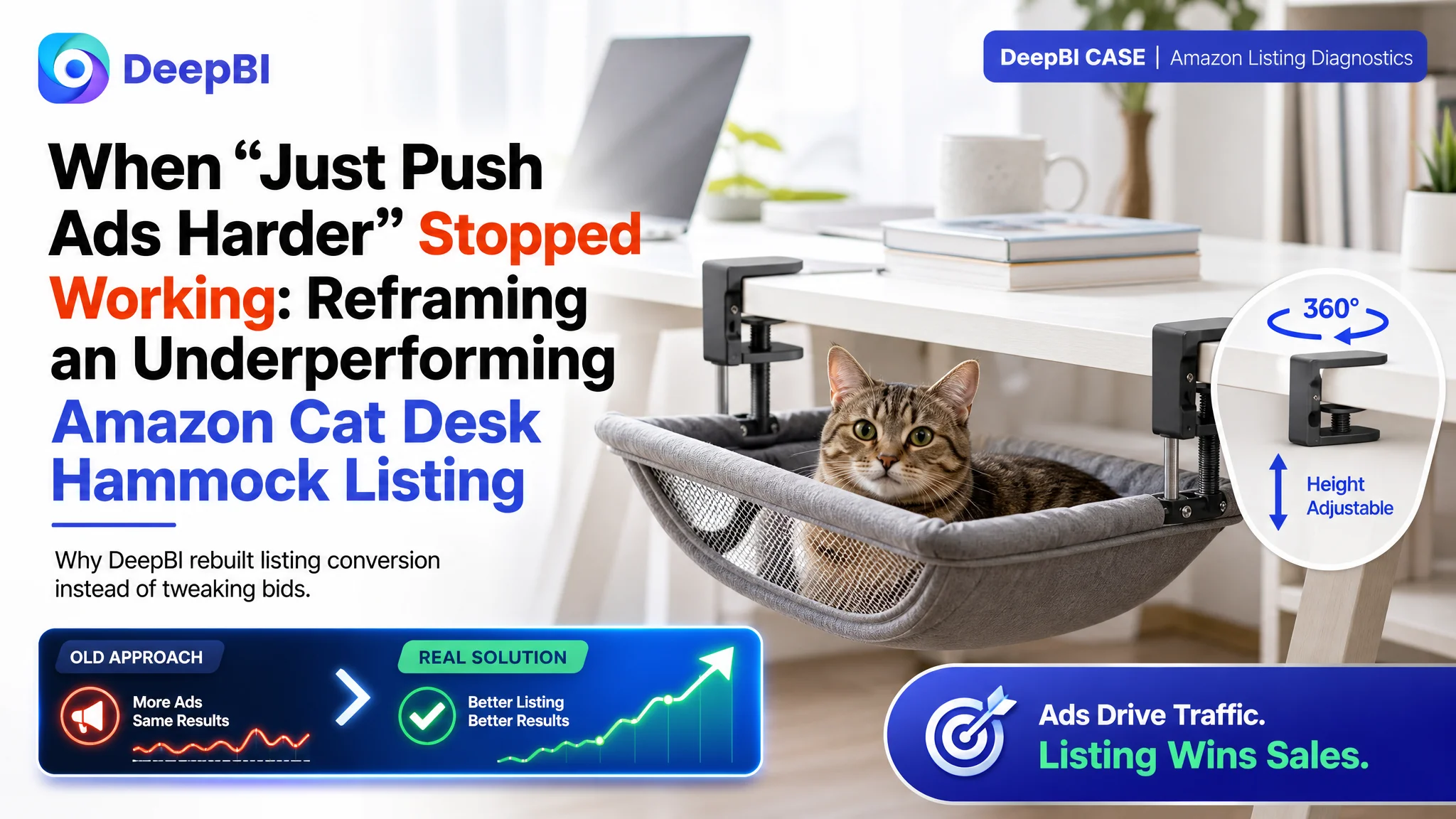
This case comes from an Amazon seller in the pet-furniture category, selling a clamp-on cat desk hammock on the US marketplace. The team had been seeing rising advertising pressure: traffic was coming in, but orders lagged behind expectations, and every attempt to “fix the ads” felt less and less effective. Internally, the conclusion was familiar—bids weren’t high enough, search terms weren’t broad enough, and reviews needed to grow before conversion could improve.
When DeepBI took a cold look at the Amazon Listing, the picture was very different. Against a directly comparable cat desk bed competitor, the product page only scored 49/100 versus 86/100. The biggest gap wasn’t in the main image or title; it was a complete absence of A+ content and a weak decision logic on the page. Ads were not the main problem. The product page simply could not carry the traffic the seller was paying for.
The later optimization therefore did not start with campaign restructuring. It started with rebuilding Amazon Listing conversion capacity: a rewritten title built around real search behavior, bullets that move from “object description” to “problem–solution,” a main image set that visualizes rotation, stability, and fit, and an A+ story that walks office users from “cat interrupts work” to “stable, safe, easy-to-clean workspace companion.” Other Amazon sellers can recognize themselves here: when ACOS feels “stuck,” the constraint is often not in the ads panel, but in a page that fails to earn the click and close the sale.
The Amazon Seller’s First Judgment: “Our Ads and Reviews Are Too Weak”
On the surface, this pet brand’s situation looked typical for a newer Amazon Listing:
- A niche but growing product: a clamp-on cat hammock that attaches to desks.
- Amazon ads already running to drive visibility.
- Early reviews: 5.0 stars, but only 2 total ratings.
- Conversion lagging behind category expectations.
Inside the team, the diagnosis sounded reasonable:
- “We need more reviews to compete.”
- “We should expand keywords and raise bids.”
- “Our images could be prettier; the page itself is fine.”
Because the Listing looked “normal” at a glance and there were no obvious design disasters, the seller instinctively treated this as:
- A traffic/ads problem (not enough qualified visitors).
- A social proof problem (too few reviews).
- A minor visual/aesthetic problem.
So budget and attention stayed inside Amazon ads, while the product page itself was left largely untouched.
“The real problem was not that ads failed to bring traffic. It was that the page could not convert the traffic.”
What DeepBI Saw First: A 49 vs 86 Listing Score
DeepBI’s first step was to position this Listing against a directly comparable Amazon cat desk bed that was already performing well in the US marketplace.
The quantitative gap was stark:
- Target Listing total score: 49/100
- Benchmark Listing total score: 86/100
- Gap: –37 points
Breaking it down by dimension:
- Title: Target Listing: 12, Benchmark Listing: 17, Full Score: 20, Gap: -5
- Main Image Set: Target Listing: 24, Benchmark Listing: 26, Full Score: 30, Gap: -2
- Bullet Points: Target Listing: 7, Benchmark Listing: 8, Full Score: 10, Gap: -1
- Detail / A+: Target Listing: 0, Benchmark Listing: 24, Full Score: 25, Gap: -24
- Reviews: Target Listing: 6, Benchmark Listing: 11, Full Score: 15, Gap: -5
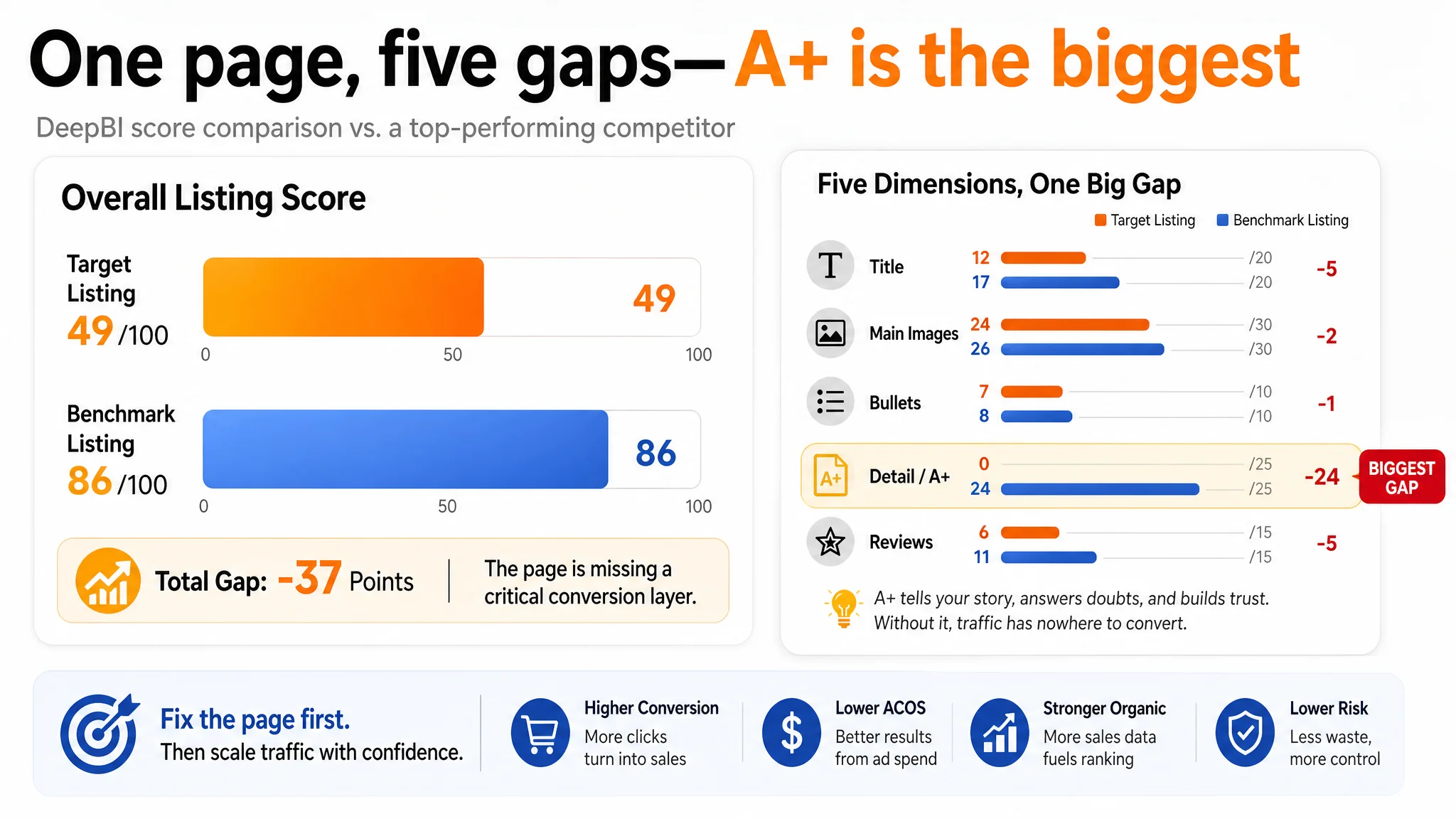
The main image and bullet gaps were noticeable but not fatal. The real structural issue was:
- Detail/A+ score = 0 vs 24.
The competitor had a fully built A+ funnel; this Listing had nothing.
From a business standpoint, this meant:
- Ads were continuously feeding traffic into a page with no deeper sales narrative, no visual trust-building, and no structured explanation of the product’s unique value.
- The Listing was not just weaker than the competitor; it was missing an entire conversion layer.
At that point, it was clear: optimizing ads alone could not change the outcome.
Why Traditional Amazon Ad Optimization Stalled Out
Before DeepBI’s involvement, the seller had already tried the playbook most Amazon operators know:
- Adjust bids, add more long-tail keywords.
- Test different match types.
- Allocate more budget to better-performing campaigns.
But each time, they hit the same wall:
- ACOS stubbornly high or volatile.
- Any volume gains from ads did not translate into sustained organic ranking improvements.
- Conversion rate on traffic from ads did not materially improve.
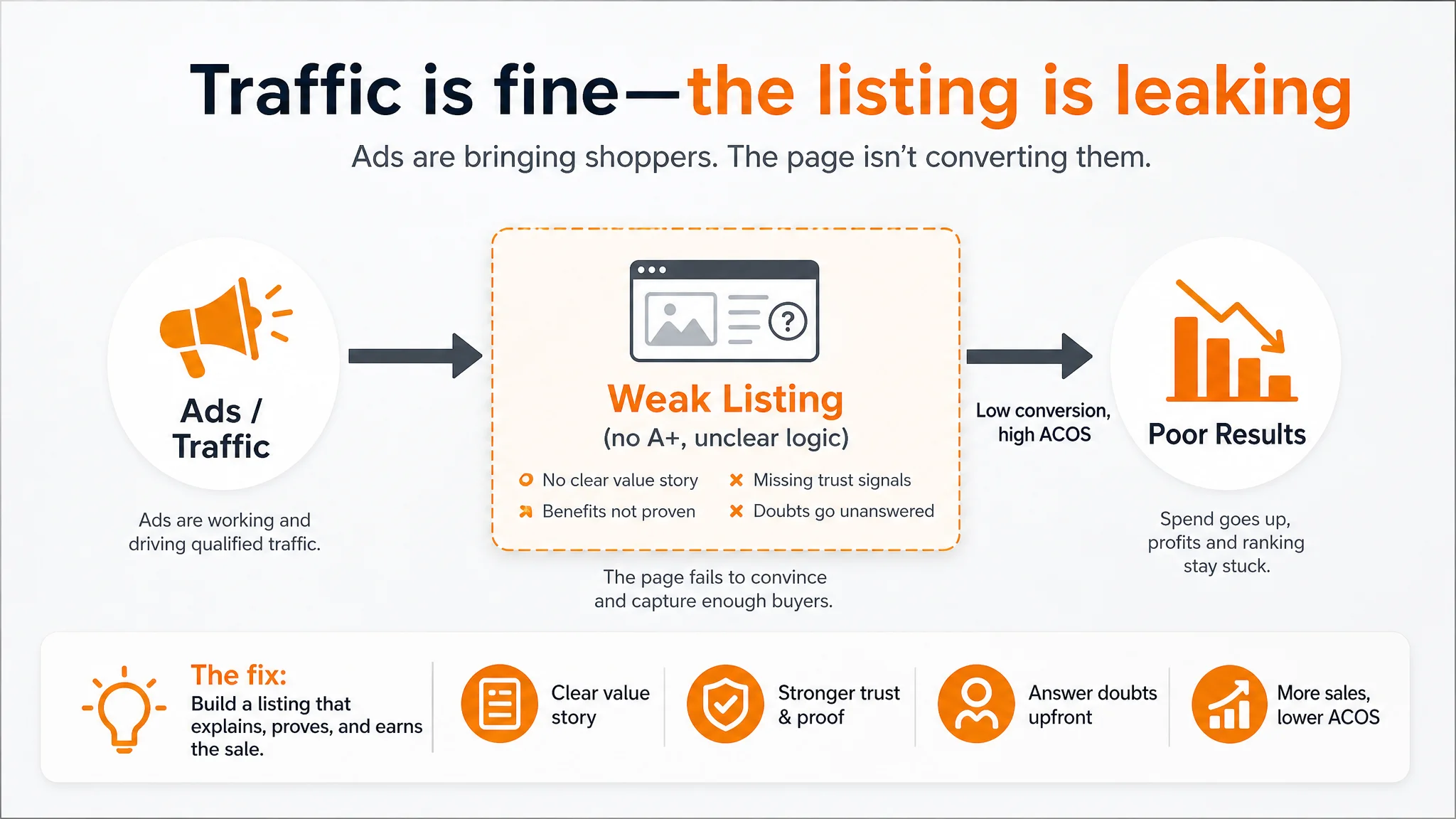
DeepBI’s view was that the ad system was doing its job: delivering traffic that broadly matched the category. The failure was that this traffic encountered a page that:
- Did not clearly frame a core pain point (cat interrupting work).
- Did not visually prove key functions (rotation, stability, fit to desk types).
- Did not build trust (no A+ content, thin review base).
- Did not answer pre-purchase doubts (desk compatibility, weight capacity, cleaning).
In other words, ads were:
“Advertising does not only amplify advantages. It can also amplify a page’s existing defects.”
By continuously pushing more users into an under-explained product page, the seller was paying to magnify the Listing’s weaknesses.
The Real Constraint: Listing Conversion Capacity, Not Traffic Volume
Once the scoring and competitor comparison were in place, the core constraint was clear:
**This Amazon Listing did not lack traffic. It lacked a clear, convincing buying logic.**
DeepBI’s diagnosis centered on four linked issues.
1. The title did not match how shoppers actually search
The existing title technically contained the right core phrase:
- “Cat Hammock Bed” was present and the product was described as “Desk-Mounted.”
But three structural issues limited its effectiveness:
- Keyword phrasing misaligned with search behavior.
“Desk-Mounted” is descriptive but less search-friendly than “Desk Cat Bed” or “Desk Cat Hammock”, which users more commonly type.
- Scattered selling points.
Features like “No-Drill Install” and “Washable Pad” appeared, but not in a tight, prioritized structure. The competitor grouped and front-loaded a distinctive function—“360° Rotation & Adjustable Mount”—creating an immediate click reason.
- Weak information density.
The competitor’s title brought in:
- “On/Under” (usage flexibility),
- “Up to 50 lbs” (explicit capacity),
- “Dual-Sided Reversible” (added value),
- clear scene terms like “Office Desks and Game Tables.”
The target title lacked this blend of numeric, scenario, and differentiating language.
DeepBI’s recommended direction:
“Desk Cat Hammock Bed, 360° Rotation Clamp-On Pet Perch for Home Office & Gaming Desks, No-Drill Space-Saving Cat Bed, 16.5" Round Supports 50 lbs, Includes Soft Washable Pad”
This refocuses the title around:
- Search intent: “Desk Cat Hammock Bed” up front.
- Signature function: 360° rotation and clamp-on mount.
- Scenarios: home office and gaming desks.
- Decisive parameters: size, 50 lbs capacity, no-drill install, washable pad.
2. The main images showed the product, but not the decision logic
Visually, the target Listing wasn’t ugly. But compared to the benchmark, it lacked the conversion storyline that images need to carry on Amazon:
- The competitor used:
- Before/After imagery to dramatize cluttered vs. organized desks.
- Compatibility and exclusion visuals to prevent mismatched expectations.
- Exploded or annotated views to explain mechanical structure and adjustments.
- Washing-machine scenes to address cleaning and maintenance.
The target Listing’s images stayed at the level of:
- Product on desk.
- Basic angle shots.
- Some material close-ups.
What was missing was:
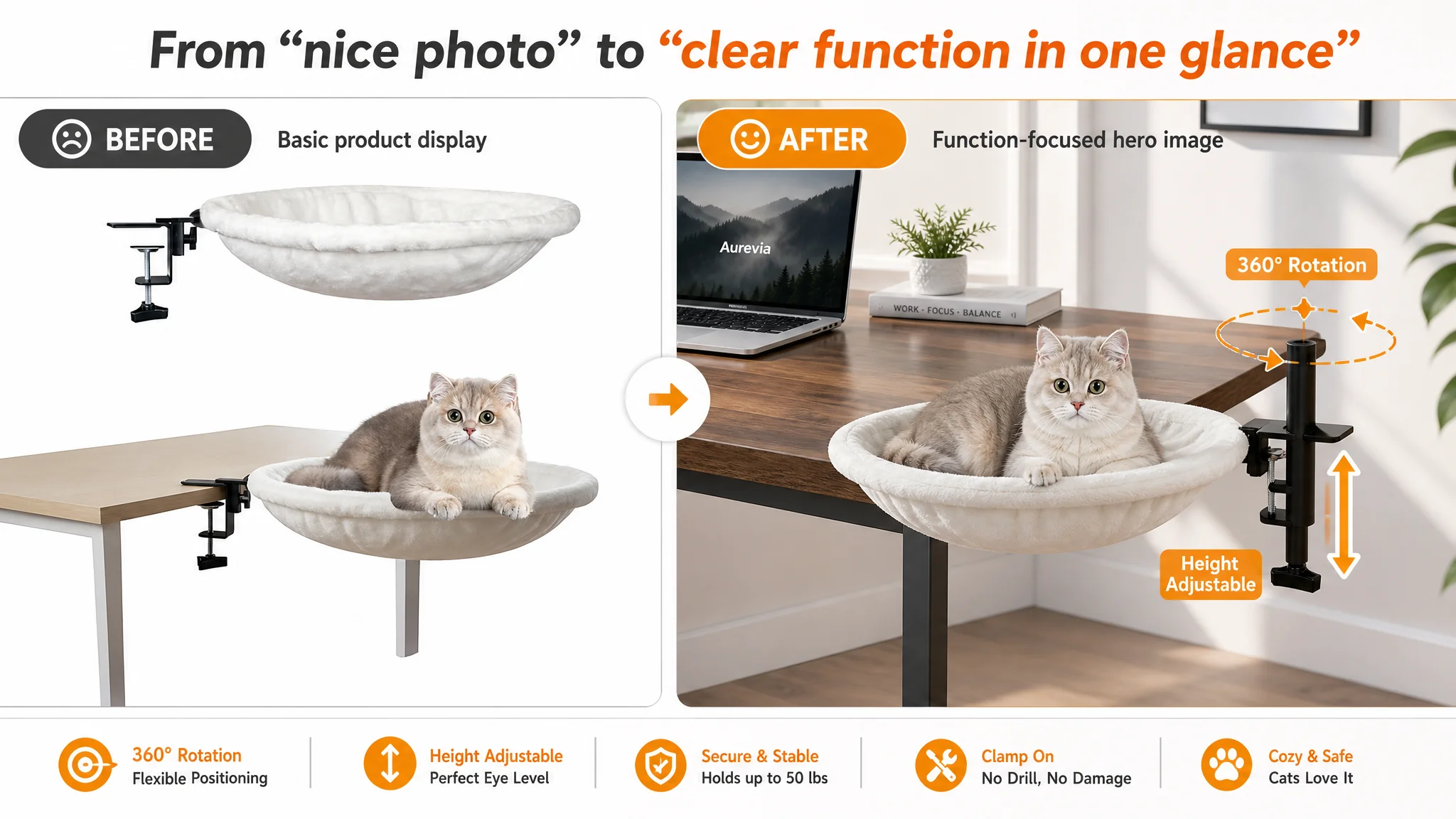
- Clear visual proof of 360° rotation and height adjustment.
- Graphic emphasis on 50 lb weight capacity and jump-proof stability.
- Visual explanation of desk thickness compatibility and incompatible desk types.
- A storyline that starts from “cat distracting work” and ends with “calm, organized workspace with cat nearby.”
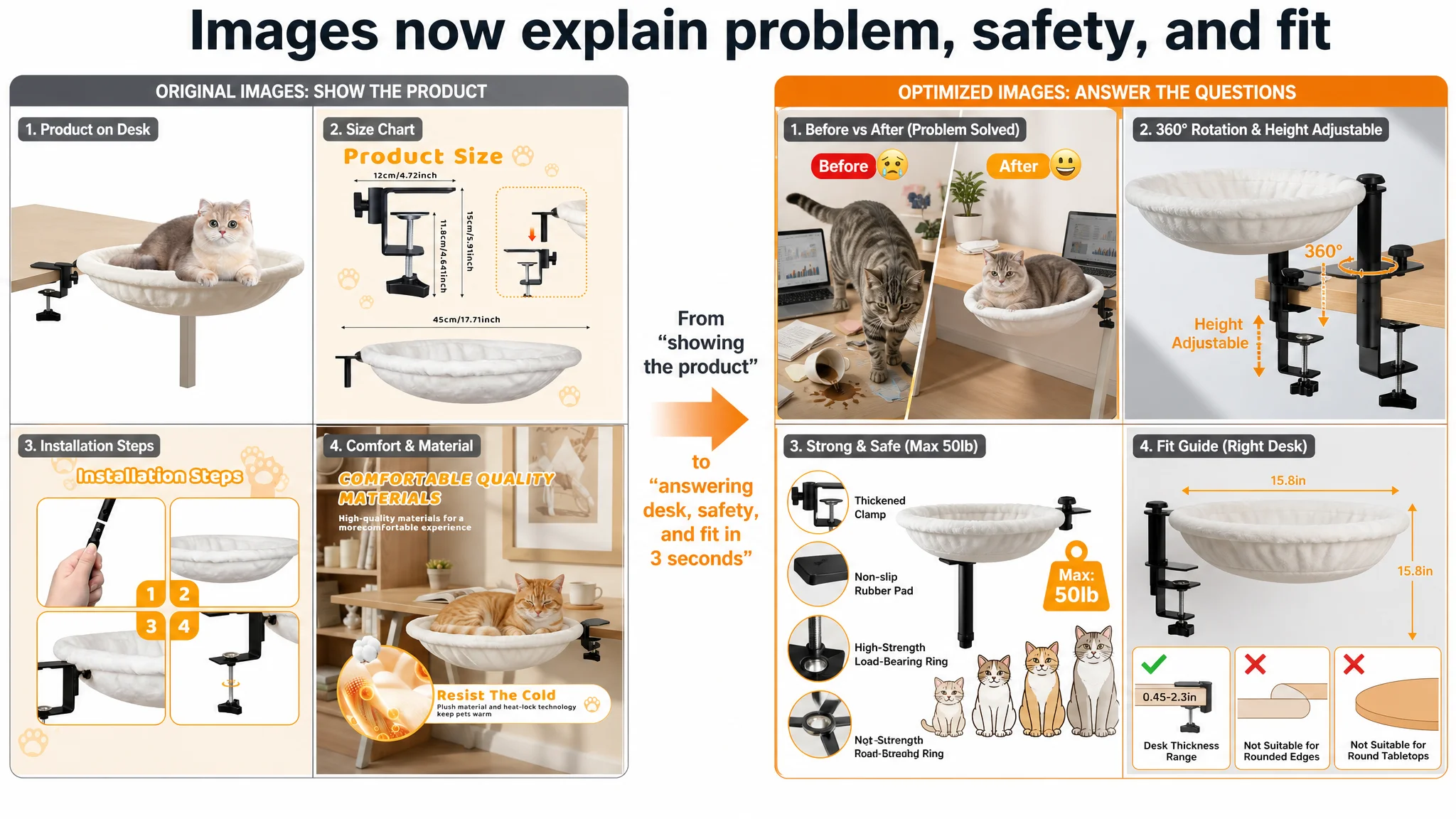
This difference is why DeepBI’s image guidance focused less on aesthetics and more on decision logic:
- Main image re-anchored in a clean, modern home office, with:
- 360° rotation highlighted via circular arrows.
- Height adjustment indicated with vertical arrows.
- A second key image with Before/After split: cat on messy keyboard vs. cat in hammock at desk edge.
- Structure images with:
- Highlighted clamps, padded contact points, and “Max: 50lb” icon.
- Cat silhouettes of different sizes to make “safe for big cats” concrete.
- Fit/compatibility image:
- Clear width/height dimensions.
- Visual callouts for desk thickness range.
- Red “X” over curved/round edges.
The objective: let a shopper understand, without reading every line of text, what the product does, where it fits, and why it is safe.
3. Bullet points informed, but did not persuade
On paper, the bullet structure looked reasonable:
- Space saving.
- Easy installation.
- Durability and easy cleaning.
- Comfort.
- Usage scenarios.
The benchmark Listing, however, used bullets to step through a buying argument:
- Bullet 1: Target the core emotional and functional pain—distractions while working—and promise “distraction-free bonding.”
- Bullet 2: Present concrete technical capabilities with dimensions and movement (360° rotation, adjustable height).
- Bullet 3: All-season versatility and hygiene (two replaceable cushions).
- Bullet 4: Strong capacity (up to 60 lbs) with rock-solid stability.
- Bullet 5: Simple installation plus clear compatibility notes.
DeepBI reframed the bullets for the seller around four roles:
1. Pain point and solution
Lead with “distraction-free bonding & workspace efficiency,” making it explicit that the hammock stops the cat walking across the keyboard while keeping companionship.
1. Differentiated function
Highlight customizable angle and secure C-clamp grip, positioning the product as adjustable, not fixed, and emphasizing no-drill, desk-safe mounting.
1. Trust and safety
Stress “rock-solid stability for cats up to 50 lbs” and “jump-proof” performance so even big-cat owners feel confident.
1. Comfort and hygiene
Describe the 16.5-inch plush faux fur bed and machine-washable cover to show comfort and easy maintenance.
1. Installation clarity
“Quick no-drill setup & universal fit,” with compatibility notes to reduce returns caused by mismatched desks.
The shift was from “listing features” to “building a buying logic” bullet by bullet.
4. The A+ section was a total void
This was the most critical gap.
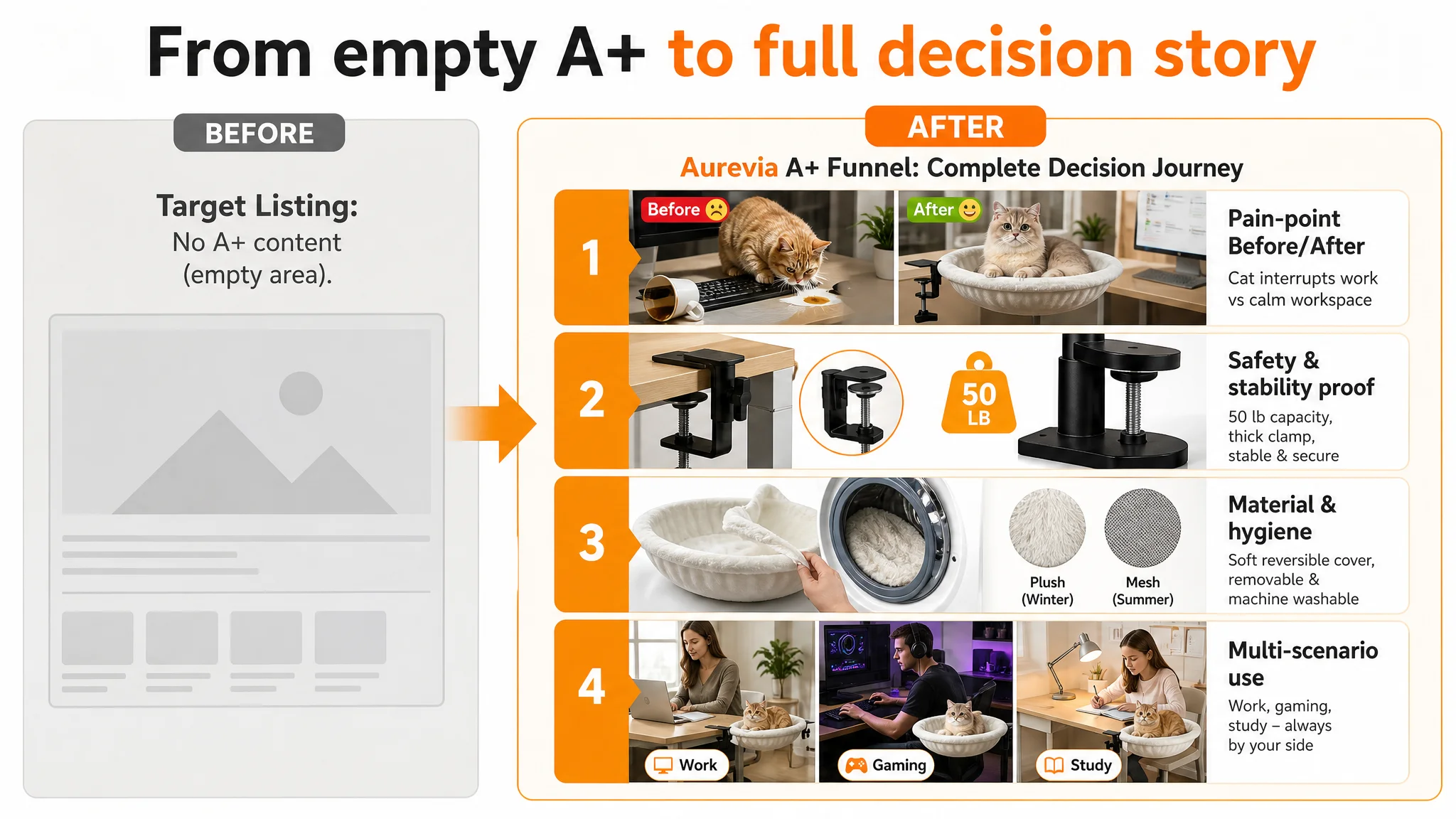
- Benchmark Listing: Rich A+ content, including:
- Before/After disruption vs. harmony scenes.
- Dynamic visuals of 360° rotation and height adjustment.
- Weight capacity validation (50 lbs) with structural detail.
- All-season fabric explanation and washing scenes.
- Multiple scenarios (gaming, working, studying) showing real use.
- Target Listing: No A+ content at all.
For a category that:
- Involves pets’ safety (fall risk, instability concerns).
- Affects a valuable workspace (expensive desks, electronics).
- Depends on emotional resonance (owner–cat bonding, home-office atmosphere).
…having no A+ meant giving up the only part of the page that can tell a full story.
Why DeepBI Did Not Recommend “Fix the Ads First”
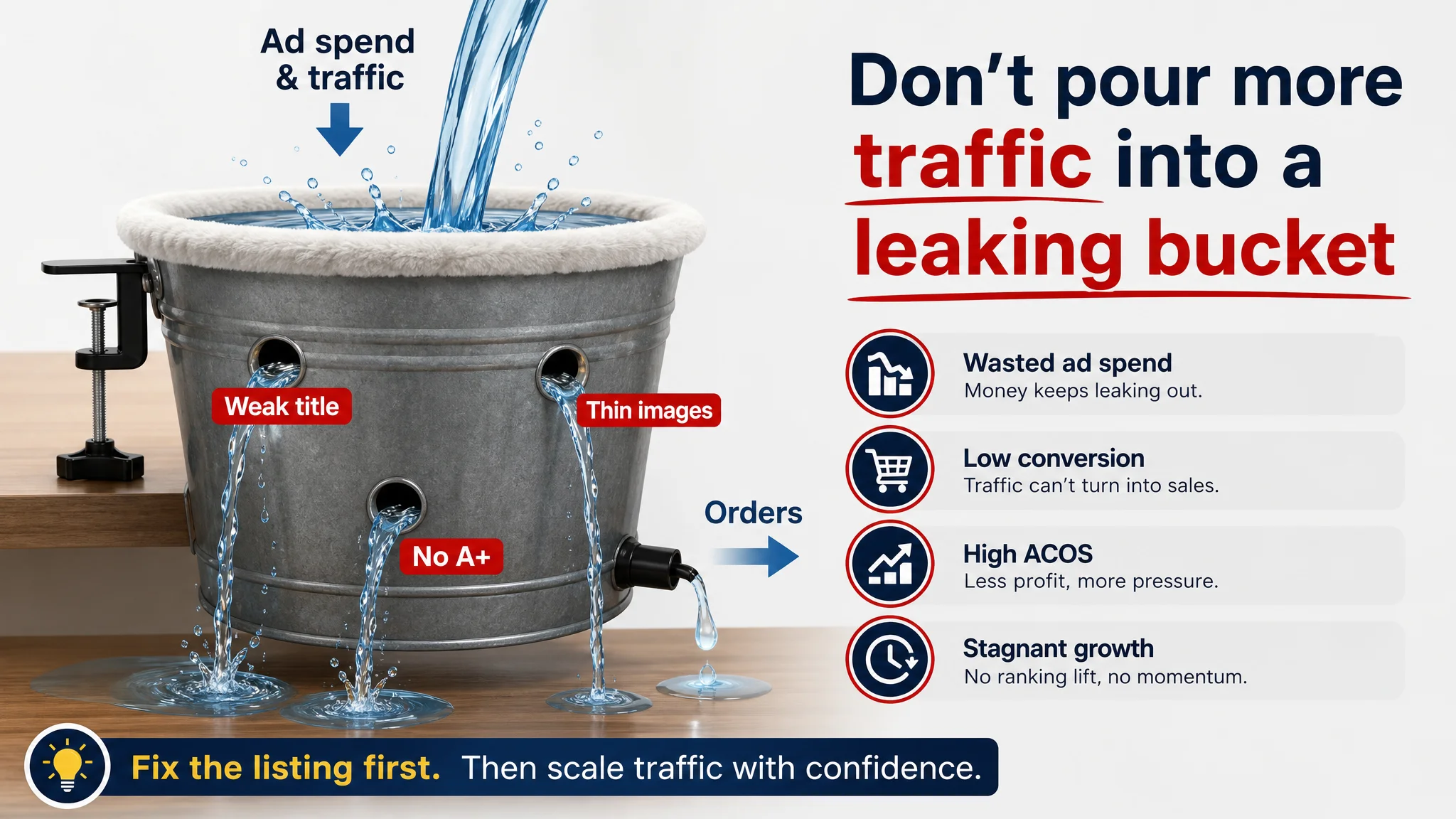
From a purely operational perspective, it would have been easy to start by retuning campaigns. But DeepBI’s judgment was that this would be:
- Commercially inefficient: Every extra click would hit the same under-explained, low-trust page.
- Risky for the ASIN’s future: Persistently poor conversion on paid traffic increases the likelihood of weak organic positioning and a long-term dependence on ads.
- A distraction from the real bottleneck: Listing conversion capacity was clearly the limiting factor; until that improved, ads would remain an expensive band-aid.
So the recommended decision path was:
1. Rebuild the Listing’s conversion logic first.
2. Then reopen ad scaling, once the page could convert more of the traffic it received.
This is the opposite of what many Amazon sellers instinctively do, but in this case it aligned with the data: you do not pour more water into a leaking bucket.
How the Product Page’s Sales Logic Was Reconstructed
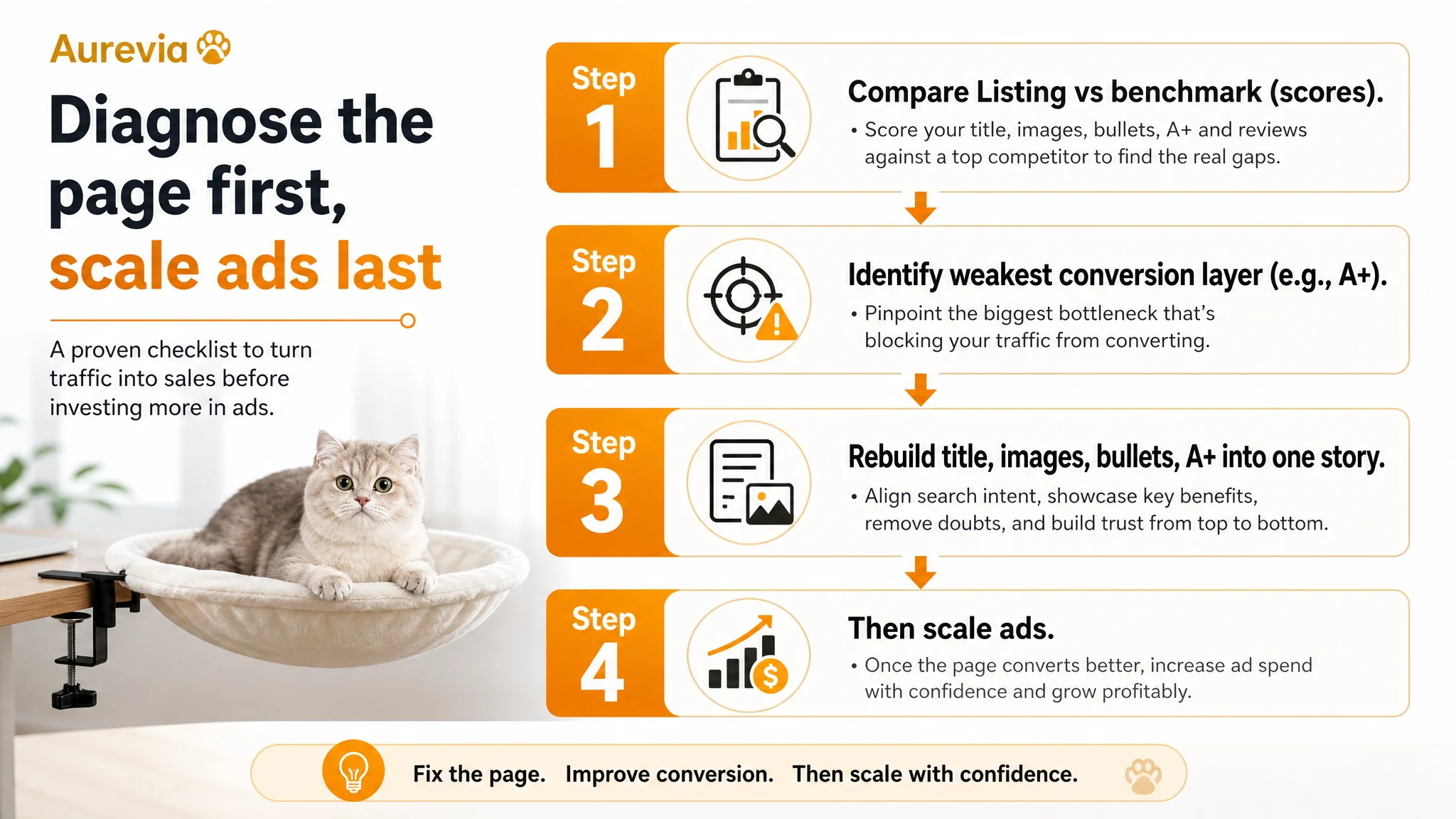
DeepBI’s guidance for the Listing followed a simple but strict funnel:
1. Capture attention in search results (title + main image).
2. Clarify the problem and core value quickly (first bullet + second image).
3. Prove safety, stability, and fit (subsequent images + bullets).
4. Close doubts and deepen trust (A+ story).
Main images: from “nice product shots” to “visual decision engine”
The reimagined main image set was designed to answer four buyer questions visually:
1. What problem does this solve for my workspace?
- Before/After image showing:
- Left: cat on cluttered laptop, spilled coffee, stressed owner.
- Right: same desk, cat resting in hammock at edge, owner focused and relaxed.
1. Is it stable and safe for my cat?
- Close-up of clamp and support rod with:
- “Max: 50lb” badge.
- Highlighted thickened clamp, anti-slip pads, reinforced load-bearing ring.
- Multiple cat sizes illustrated.
1. Will it fit my desk and layout?
- Fit diagram:
- Overall dimensions (e.g., 15.8" width/height).
- Desk thickness range (e.g., 0.45–2.3").
- Clear “X” marks on curved edges and round tables.
1. How does it rotate and adjust?
- 360° arrow around the bed.
- Vertical arrows for height range.
- Callouts for adjustable platform angle (hex key adjustment).
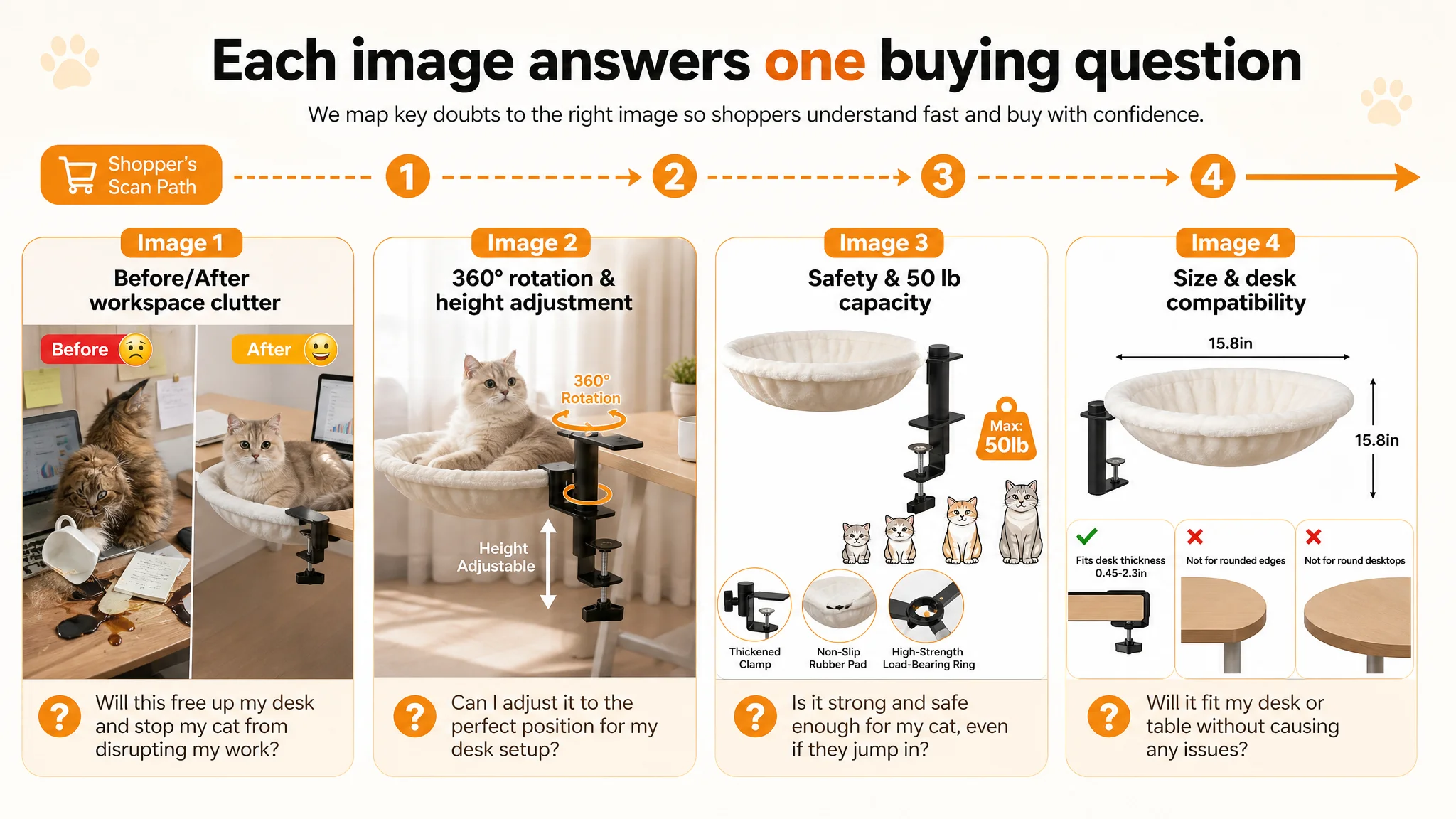
The goal was that a shopper, scanning images in a few seconds, could mentally answer:
- “Will this stop my cat interfering with my work?”
- “Is it safe and strong enough for my cat?”
- “Will it fit my desk?”
- “Can I adjust it to get it out of my way when needed?”
A+ content: from zero to a full decision narrative
DeepBI’s A+ guidance focused on four modules, each tied to a specific category need.
1. Pain-point resonance: “From disrupted work to calm companionship”
- Split scene:
- Left: cat on keyboard, coffee spilled, frustrated owner.
- Right: cat relaxed in hammock at desk edge, tidy workspace, focused owner.
- Copy direction: “Work without losing your cat’s company” — linking emotional need (bonding) with functional need (focus).
2. Safety and stability proof
- Close-up industrial-style imagery of:
- Steel clamp and support bar.
- Pressure point where bed meets support.
- Overlaid details:
- “Supports up to 50 lbs” with a weight icon.
- 16" diameter and height labeled.
- Purpose: reduce anxiety about falls, wobbling, or hardware failure.
3. Material and hygiene reassurance
- Three-frame layout:
- Main: fabric being placed into a washing machine.
- Side frames: plush texture close-up and mesh-like breathable surface.
- Copy focus:
- All-day comfort.
- Easy maintenance, machine washable.
- Outcome: address concerns about pet hair, odor, and summer heat.
4. Multi-scenario flexibility
- Montage of:
- Home office work scene.
- Gaming setup.
- Family reading/study desk.
- Visual emphasis on 360° rotation to move the bed out of the way when needed.
- Message: one product works across different desk setups and daily routines.
With these modules, the page moved from “just a product” to “a workspace solution for cat owners.”
What Changed Once the Page Started to Convert
Because this case focused on diagnosis and structural optimization rather than a long period of tracking, the post-optimization story is more about operating state than exact numbers.
After the Listing was rebuilt around a coherent sales logic:
- Paid traffic became more valuable.
The same ad clicks now landed on a page that:
- Connected with a clear pain point.
- Demonstrated safety and compatibility.
- Answered hygiene and maintenance concerns.
This improved the likelihood that each click turned into a sale.
- ACOS had a path to move down.
With a stronger conversion rate, every dollar of ad spend could generate more orders, creating room to either:
- Hold spend and improve profitability, or
- Maintain ACOS while scaling volume.
- Organic traffic had a foundation to grow.
As the Listing’s ability to convert improved:
- Amazon had more sales data to work with on relevant keywords.
- The ASIN became less dependent on aggressive ad spend to appear in front of shoppers.
- Operational risk decreased.
The seller was no longer trapped in a cycle of:
- Increasing ad budgets into an underperforming page.
- Blaming ads for what was fundamentally a listing issue.
Instead, they had a better understanding of where to act first when conversion stalls.
Most importantly, the seller’s mental model changed:
- From: “We need better ads and more reviews.”
- To: “Our Listing must earn the right to receive more traffic.”
What Other Amazon Sellers Can Take From This Case
This cat desk hammock is a small, niche product. But the pattern behind it is common across Amazon:
- Ads become harder to optimize.
- ACOS feels stuck.
- Teams default to tweaks in bids, keywords, and budgets.
- The product page is assumed to be “good enough” because it looks decent.
What DeepBI’s diagnosis showed in this case is:
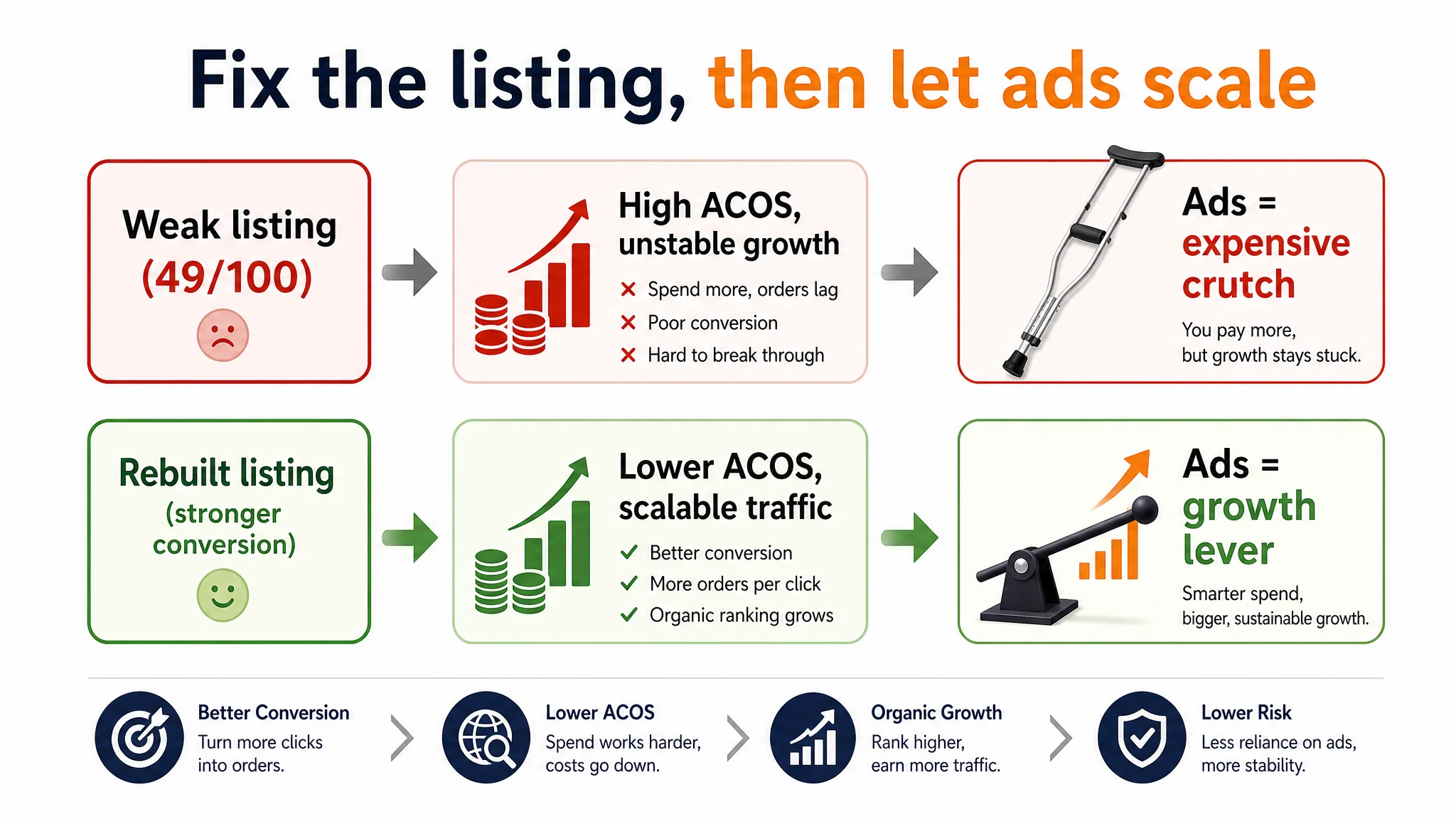
1. High or unstable ACOS is often a Listing problem in disguise.
Ads can deliver the right traffic, but if the product page doesn’t:
- Nail the primary pain point,
- Show clear benefits and proof,
- Build trust through visuals and A+ content,
then traffic will not convert reliably.
1. Title, main image, bullets, and A+ must form a single story.
The benchmark Listing won not because of one magic element, but because:
- The title matched search behavior and framed a clear benefit.
- Images visualized function and safety.
- Bullets walked through a buying logic.
- A+ connected all of it into a human, relatable narrative.
1. Before scaling ads, judge whether the page deserves more traffic.
A simple competitor-based scoring revealed a –37 point gap, anchored by a missing A+ and weak sales logic. Without addressing that, more spend would only magnify the weakness.
1. Advertising efficiency is built on page-level conversion capacity.
Once the Listing’s ability to convert improved, ads regained their role as a growth lever rather than an expensive crutch.
For Amazon sellers, the lesson is less about cat furniture and more about diagnosis: whenever you feel “we’ve tried everything in ads,” it is worth asking whether the true constraint sits on the product page. DeepBI’s value in this case was not about adding another knob in ad optimization; it was about seeing that the bucket was leaking and insisting on fixing it before pouring in more water.