

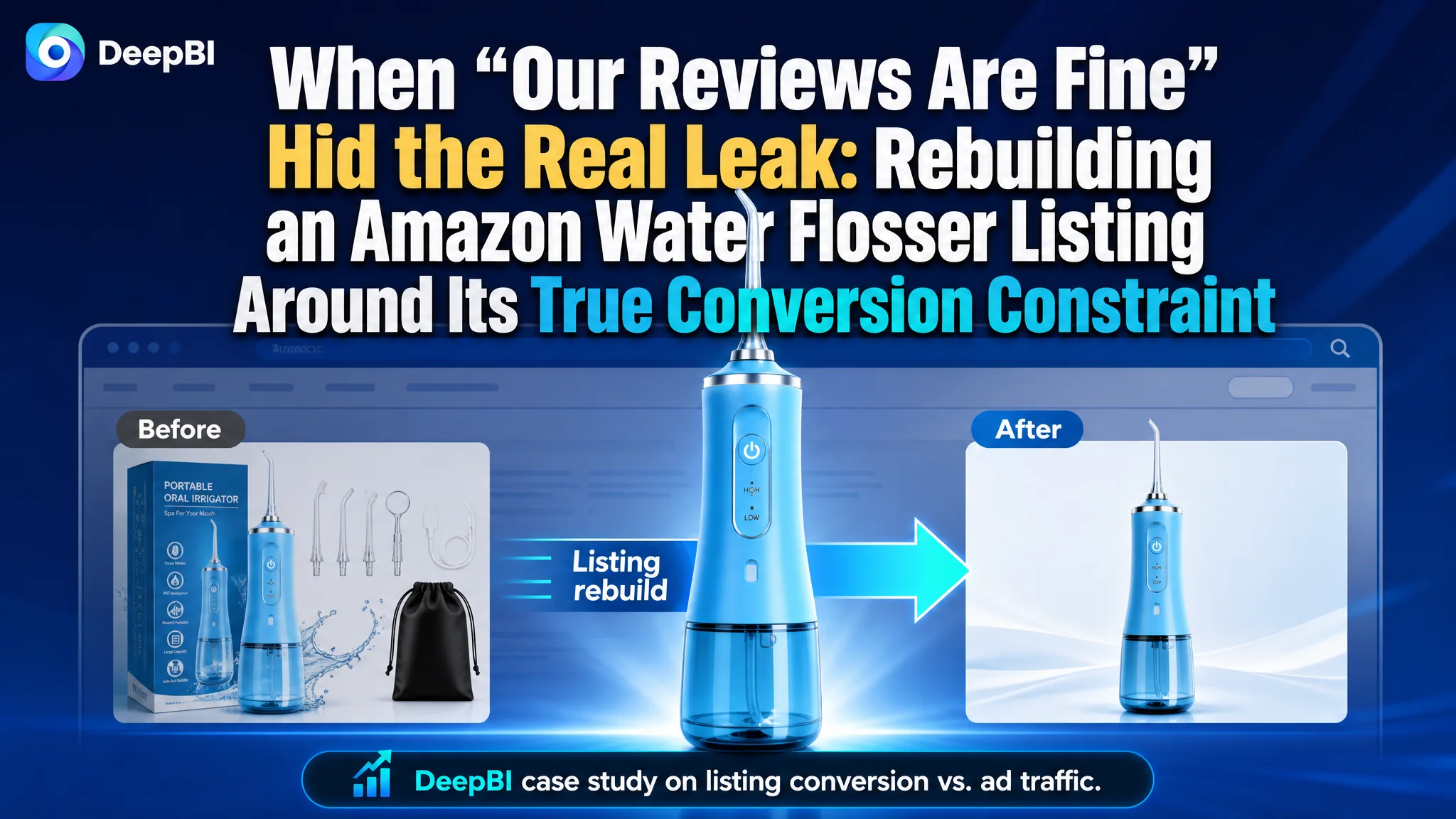
This case comes from an Amazon seller in the portable oral‑care category. On the surface, nothing looked disastrous: the product is a mini portable water flosser with a solid 4.5‑star rating, no visible review crisis, and a differentiated “Sterilization mode” that competitors do not have. Yet against a directly comparable benchmark listing in the same Amazon category, traffic was not converting as expected, and advertising spend was becoming harder to justify.
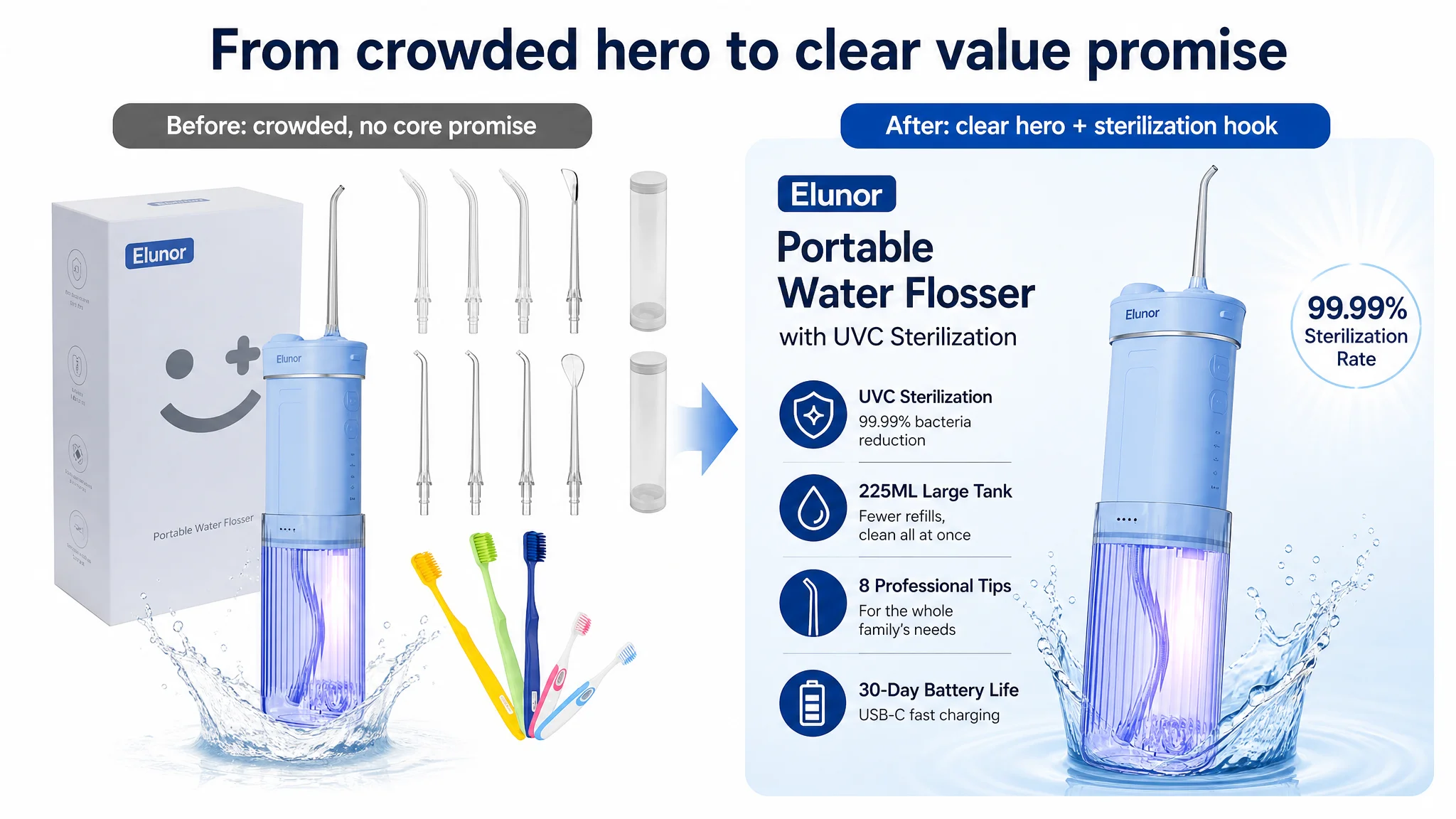
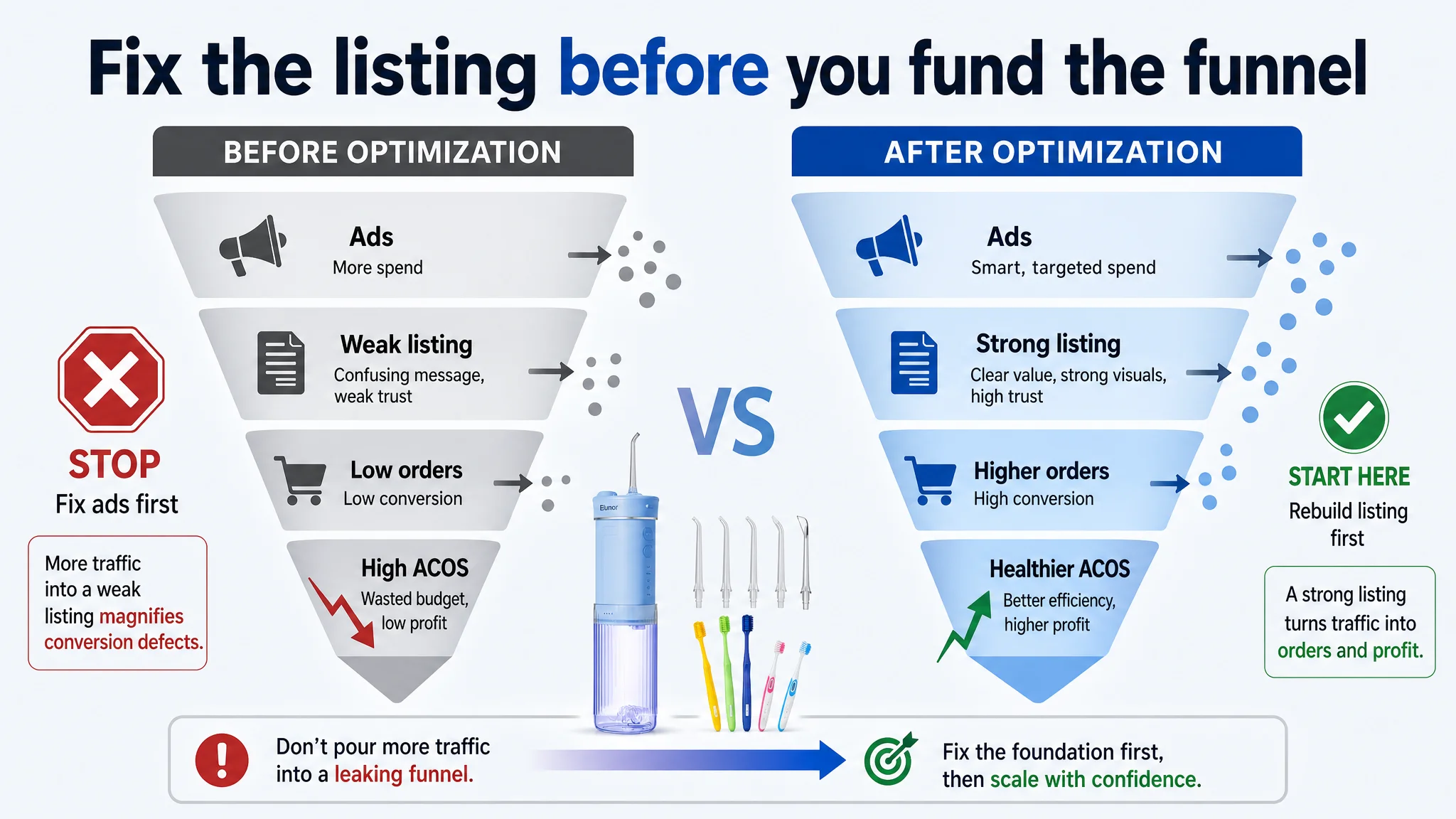
The seller initially believed the main problem lay in advertising and “insufficient reviews.” With only 22 reviews against a competitor with over 1,500, the team’s instinct was to push for more reviews and keep tweaking Amazon ads to pull in additional traffic. DeepBI’s diagnosis went in a different direction: if ads were already buying visits but the page could not convert, then adding more traffic would only magnify the listing’s weaknesses. The real constraint was not exposure; it was the listing’s ability to turn that exposure into orders.
By scoring and benchmarking the Amazon Listing—title, main images, bullet points, A+ content, and reviews—DeepBI surfaced a clear pattern: the product page was under‑performing on conversion logic, not on star rating. The later optimization therefore centered on rebuilding the title’s keyword and value communication, reshaping the main image set around “portable + larger 225ML tank + Sterilization mode,” and reconstructing bullets and A+ modules into a coherent, family‑use, trust‑driven narrative. For other Amazon sellers, the lesson is sharp: when ACOS feels stubborn and ads stop “working,” the problem may sit in your listing’s sales story, not in your campaign structure.
The Real Constraint: Listing Conversion Capacity, Not Ad Traffic
DeepBI’s scoring put the target Amazon Listing at 75/100, versus 88/100 for a key benchmark in the same category.
Breaking that down:
- Title: 14 vs. 18 (out of 20)
- Main images: 26 vs. 24 (out of 30)
- Bullet points: 7 vs. 9 (out of 10)
- A+ / detail content: 19 vs. 24 (out of 25)
- Reviews: 9 vs. 13 (out of 15)
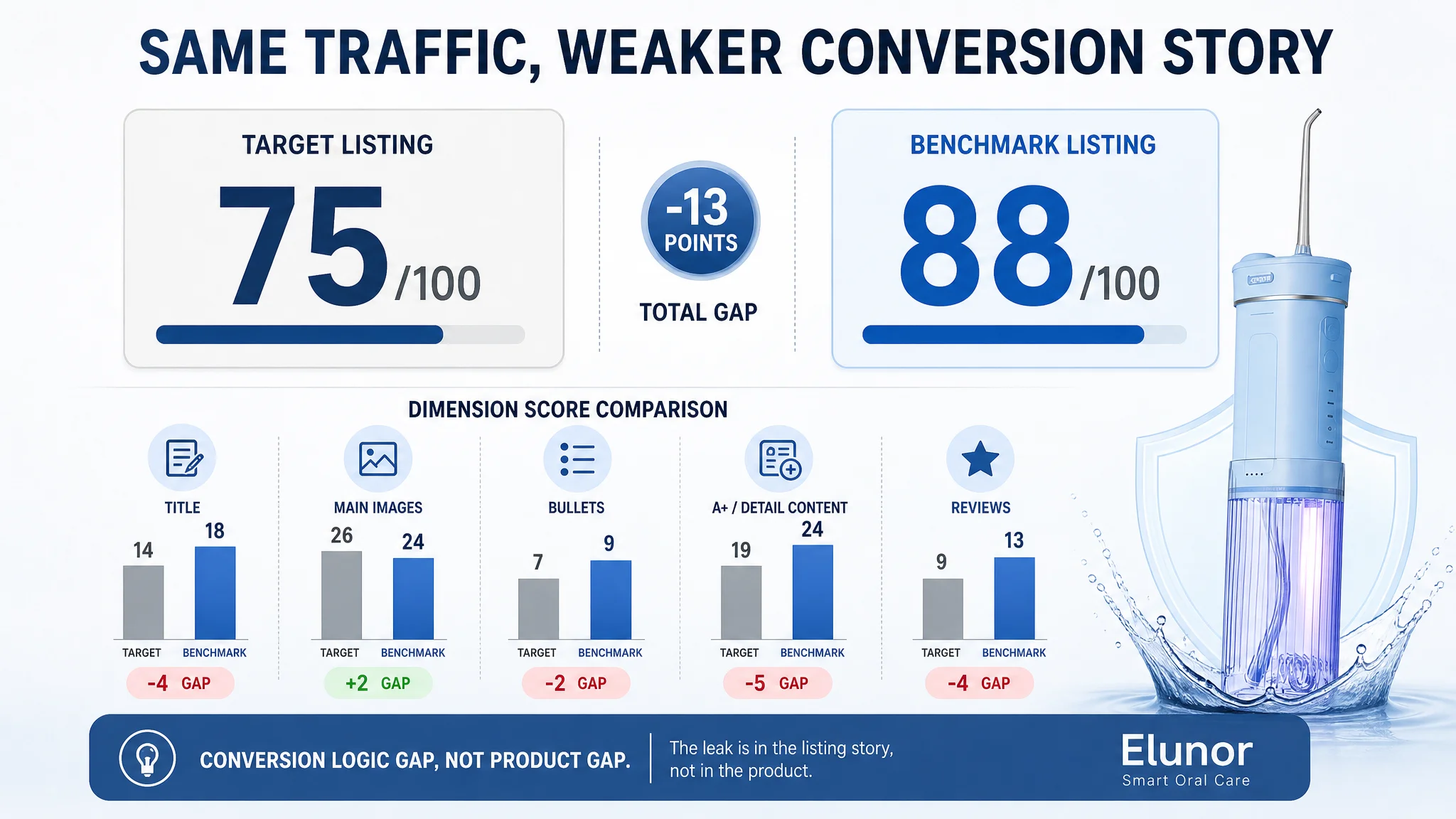
The score gap was not in product quality; it was in how the page built the case to buy.
The product actually held several objective advantages over the benchmark:
- Larger 225ML water tank vs. competitor’s 180ML
- A unique Sterilization mode integrated into the flosser
- 8 nozzles vs. the competitor’s 6
- A healthy 4.5★ rating, even slightly higher than the benchmark’s 4.4★
Yet the listing still lagged meaningfully in overall score. That is the core contradiction: a technically competitive product whose Amazon page was not equipped to convert the traffic it was already getting.
“The real problem was not that ads failed to bring traffic. It was that the page could not convert the traffic.”
As a result, any push on Amazon ads simply poured more visitors into a page that was not telling a strong enough story.
The Seller’s Original Misdiagnosis: “We Just Need More Reviews and Better Ads”
From the seller’s perspective, the competitive picture looked simple:
- The competitor had over 1,500 reviews.
- Their own listing had just 22 reviews, even if all were 4★ and above.
- Ads were driving clicks, but orders were not rising in step.
So the internal narrative became:
1. “Our ratings are fine; we just lack volume.”
2. “If we get more reviews and optimize keywords/bids, ACOS will improve.”
3. “The page is acceptable—let’s push traffic first.”
That logic kept the team focused on:
- Expanding keywords and scaling ads
- Trying to tweak campaign bids and structures
- Considering review programs as the primary lever for trust
What went unchallenged was a deeper question: Does the product page actually deserve more traffic right now? Or is it under‑equipped, so every additional click becomes more wasted spend?
DeepBI’s role here was not to suggest “more optimization actions,” but to reframe the diagnosis: before debating ad structure, first confirm whether the listing’s conversion infrastructure (title, main images, bullets, A+ trust path) can carry the weight of paid and organic traffic.
Amazon Ads Were Not Failing. The Page Was Consuming the Traffic.
When DeepBI benchmarked the listing against a high‑performing competitor on Amazon, a clear pattern emerged across the content chain.
Title: Keywords Were Present, but the Buying Logic Was Misordered
The competitor’s title followed a mature Amazon structure:
Brand + Core product term + Core features (with numbers) + Use case / audience
For example, it put its brand name first, then “Water Flosser,” then specific selling points such as “5 Modes,” “Telescopic Water Tank,” “IPX7 Waterproof,” and then usage scenarios like “Teeth Cleaning, Gums, Orthodontic, Braces.”
The target listing did the opposite:
- It placed “225ML” and “Long-Lasting Endurance” early
- It pushed “Water Flosser” away from the front, weakening search‑weight for the core term
- It had fewer specific, numeric selling points visible at a glance
So despite having powerful attributes (225ML, 8 tips, IPX7, long battery life), the title did not:
- Fully leverage high‑value keywords at the front
- Turn core advantages into click‑worthy, search‑aligned wording
DeepBI’s judgment: in Amazon search results, this structure risked losing both search relevance and click motivation, even if the content was technically accurate.
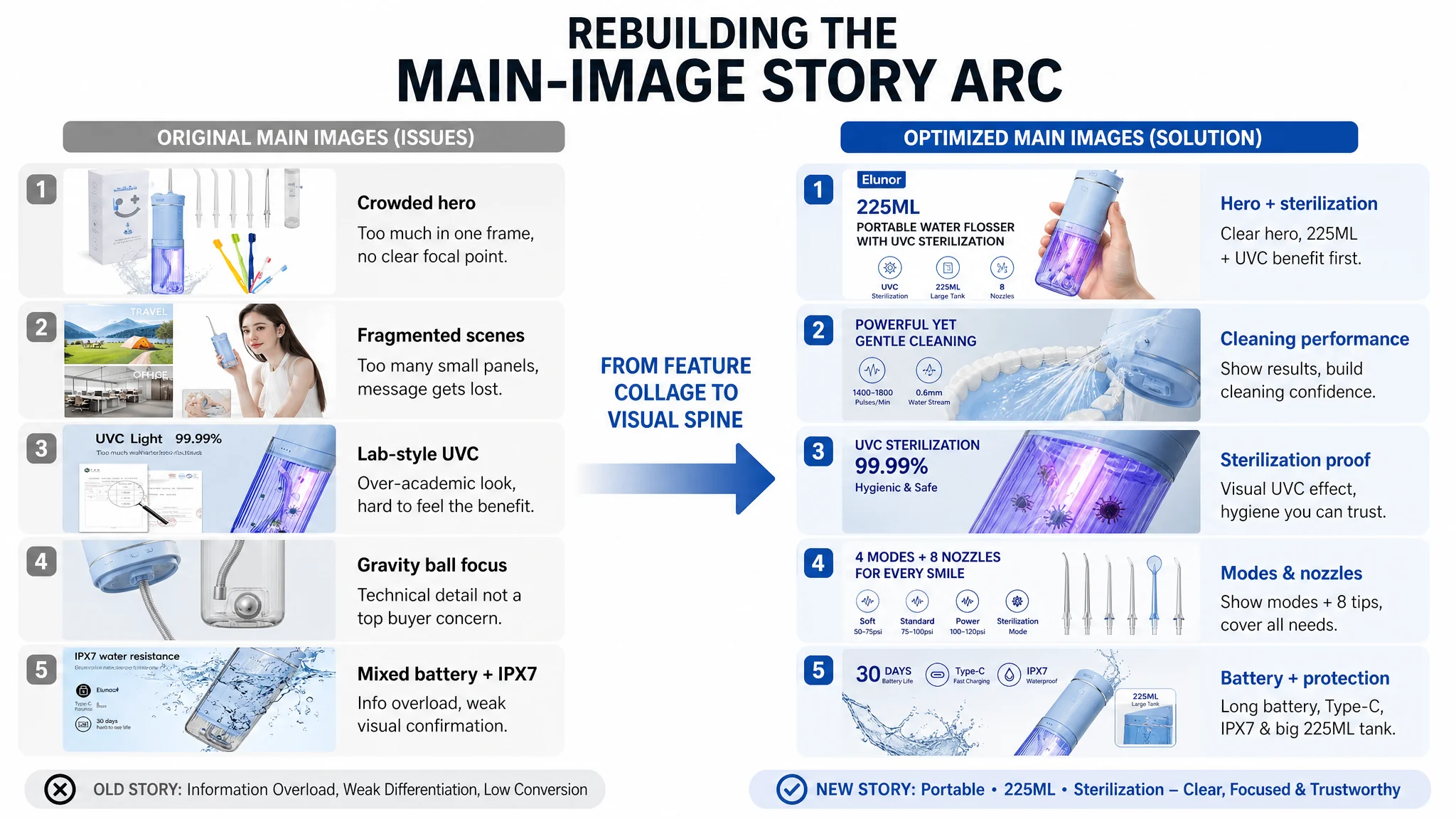
Main Images: No Clear Visual Hook, and Differentiation Was Invisible
On the surface, the main image set did not look “worse” than the competitor’s. In fact, the target listing scored slightly higher on the main‑image dimension (26 vs. 24). But the effective conversion logic was weaker.
Key issues:
- First image overload.
The first image tried to show everything at once: box, toothbrush, multiple nozzles, cases, water splashes, two brush caps, the main unit. There was no dominant focal point. The benefit of “portable yet 225ML large tank” was not visually stated at all.
- Second image fragmentation.
The second image used a six‑panel collage to show office, travel, home, phone comparison, nozzle storage, hand‑held use. Each element was too small; no single scene landed a strong message. It failed to clearly deliver: “This is truly compact, and still has a larger 225ML tank.”
- Over‑academic UVC image.
The UVC sterilization image was heavy on text and lab‑style reporting, underplaying the buyer’s actual concern: “Will this keep my oral care hygienic and prevent secondary contamination?”
- Gravity ball over‑prioritized.
A full image was dedicated to the gravity ball water‑pickup principle—technical, but not among the top five buying questions most Amazon shoppers hold for a travel water flosser (cleaning performance, suitability for sensitive gums/braces, hygiene, battery life, waterproof durability).
In contrast, the benchmark listing used its image sequence more strategically:
- Image 1: clean white‑background hero, product in hand, branded pouch—instant recognition of portability and brand quality.
- Subsequent images: each frame carried a distinct, standalone selling point—modes, nozzles, water tank, battery, waterproof rating, usage scenes.
DeepBI’s assessment: this product did not lack real advantages; it lacked a dominant visual promise. Ads were buying impressions and clicks for a listing that failed to state, visually and simply, why it was the better choice.
Bullet Points: Information Without a Buying Path
The bullet point comparison revealed the same pattern: data existed, but structured persuasion did not.
The benchmark listing built a clear narrative:
1. Start from use scenarios (travel, commuting) and portability
2. Move to pressure modes, differentiated by user group (children, sensitive gums, first‑time users, orthodontic care)
3. Then cover battery life and charging convenience
4. Then innovative water tank and nozzle storage
5. Finally, waterproof durability and usage contexts
Each bullet linked features to specific users and outcomes—less plaque, fewer cavities, easier braces care, more convenience.
The target listing’s bullets, by contrast:
- Opened with mode descriptions and parameters, not scenarios
- Used more generic expressions, rarely anchoring to a persona (e.g., “for sensitive gums,” “for orthodontic users”)
- Listed selling points in a more parallel, isolated manner instead of forming a progressive argument
DeepBI judged that this structure made the page read like a feature sheet, not a buying path. It answered “what” the product is, but not “why it matters, for whom, and in what situations.”
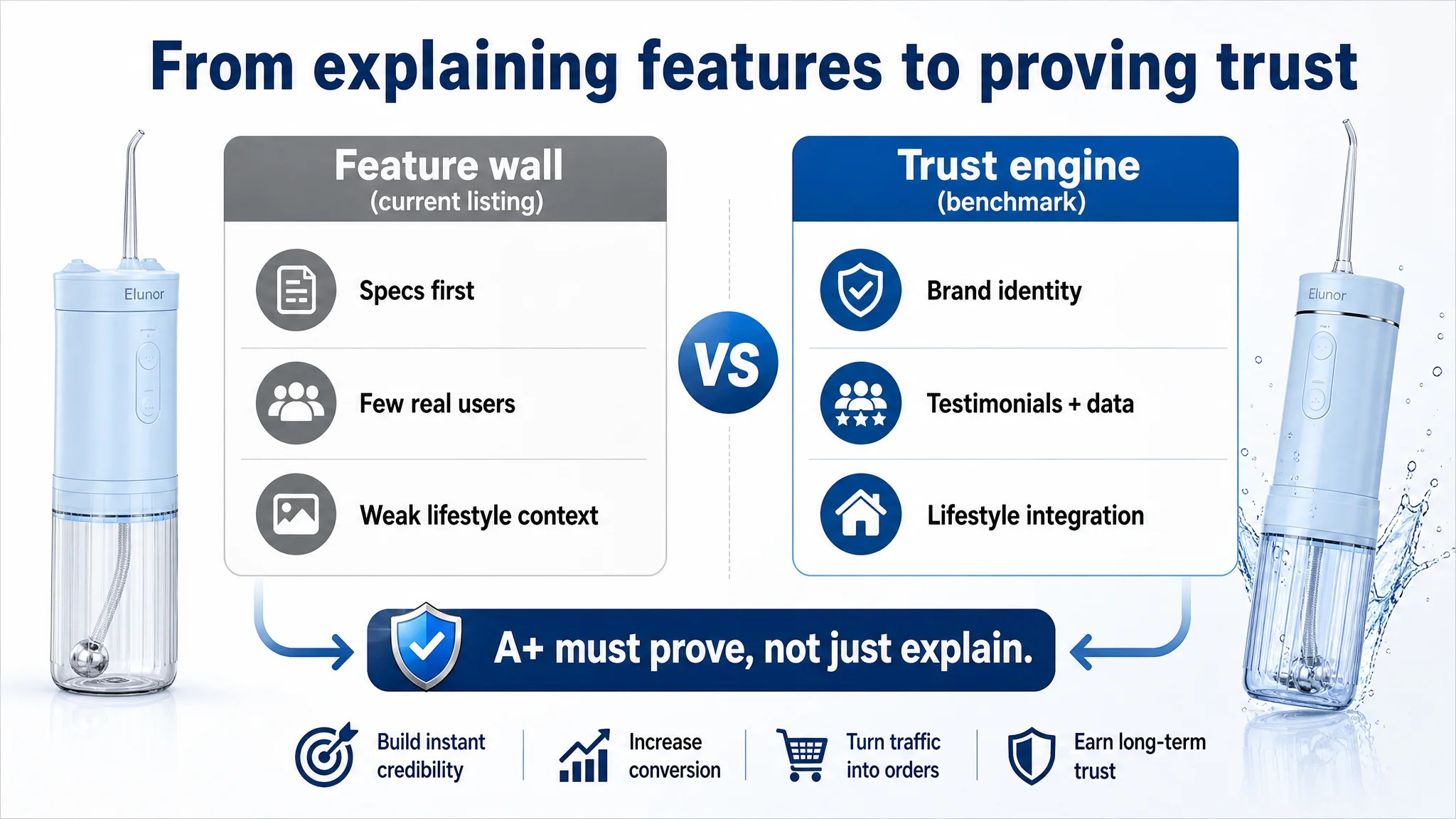
A+ Content: The Competitor Had a Trust Engine; This Listing Had a Feature Wall
The A+ / detail modules exposed the largest gap: 19 vs. 24 (out of 25).
The target listing’s A+:
- Family scene + accessory overview
- Doctor certification + plaque / pulse / pressure diagrams
- Dual protection technology
- Battery life and portability
- Step‑by‑step usage diagram
The benchmark’s A+ went much further:
- Strong brand visual consistency with high‑quality lifestyle imagery
- Real people using the product in varied scenes
- Precise module sequence: water pressure modes, nozzle differentiation, IPX7 waterproof proof points, 30‑day battery, hidden nozzle compartment, step‑by‑step guide
- Six real customer testimonials embedded into A+
- Quantified trust data (e.g., “97% users satisfied,” “972,000+ global users”)
- Multiple FAQ and lifestyle modules to answer objections and project daily integration
In other words, the competitor had built a “trust engine” combining:
1. Brand identity
2. Social proof (reviews, testimonials, data)
3. Rich lifestyle context
The target listing had mostly built a feature wall. It explained but did not prove. It lacked real user voices, quantification of satisfaction, and lifestyle integration to make the flosser feel like a natural part of daily life.
For paid traffic, this difference is decisive: when an Amazon shopper scrolls down from the buy box, they are not just reading; they are deciding whether to believe.
“Advertising does not only amplify advantages. It can also amplify a page’s existing defects.”
Reviews: Healthy Rating, Weak Social Proof Scale
Review diagnostics tell a nuanced story:
- Target listing: 4.5★, 22 reviews, 0% visible negative on the first page
- Benchmark: 4.4★, 1,546 reviews, first‑page negative rate around 8%
On pure rating health, the target listing is stronger. But in Amazon buyer psychology, a gap of this magnitude in review count changes the trust equation:
- 22 reviews suggest a newer, less‑proven product
- 1,500+ reviews suggest a well‑tested, widely used solution
DeepBI’s judgment: the seller did not have a rating problem; they had a scale and proof problem. But pushing review volume alone, without fixing the page’s story, would not solve the conversion leak. Reviews support the narrative already present on the page; they rarely compensate for a weak narrative.
Why DeepBI Refused to “Fix Ads First”
Once the scoring and competitive gaps were clear, the difficult decision was what not to prioritize.
DeepBI’s view:
1. If the listing cannot convert, scaling ads is financially dangerous.
Each additional click has a lower probability of producing an order, driving ACOS up and eroding margin.
1. The core product advantages are not leveraged yet.
- 225ML vs. 180ML tank
- Sterilization mode
- 8 nozzles vs. 6
- Long battery life + IPX7 waterproof
Until these are clearly positioned, it is premature to ask ads to bring more visitors.
1. The main bottleneck is the listing’s sales logic, not keyword coverage.
Title, main image set, bullets, and A+ score were all below the benchmark in their ability to build trust and communicate differentiated value.
So the priority became:
- First, rebuild the listing’s conversion capability.
- Then, let ads and organic traffic work on a more capable page.
Reframing the Page: From Feature Sheet to Trusted Travel Oral‑Care Solution
DeepBI’s optimization path focused on re‑engineering the listing’s narrative, not just beautifying assets.
1. Title: Put the Product Where Shoppers and the Algorithm Expect It
Suggested direction:
Portable Water Flosser Mini Cordless Oral Irrigator: 225ML Travel Water Dental Floss with 8 Tips, IPX7 Waterproof for Teeth Cleaning, Braces, Implants and Gum Care, Long Battery Life (Blue)
Key shifts:
- Lead with “Portable Water Flosser” to maximize search relevance
- Keep “Oral Irrigator,” “Teeth Cleaning,” “Gum Care” and use scenarios (braces, implants) inside the title
- Highlight 225ML, 8 tips, IPX7, and Long Battery Life in a structured, readable way
This does two things at once:
- Respects Amazon’s keyword logic for discoverability
- Communicates the product’s professional, travel‑ready positioning in a single glance
2. Main Images: Make “Portable + 225ML + Sterilization” the Visual Spine
DeepBI’s analysis led to a re‑prioritization of what each image must achieve.
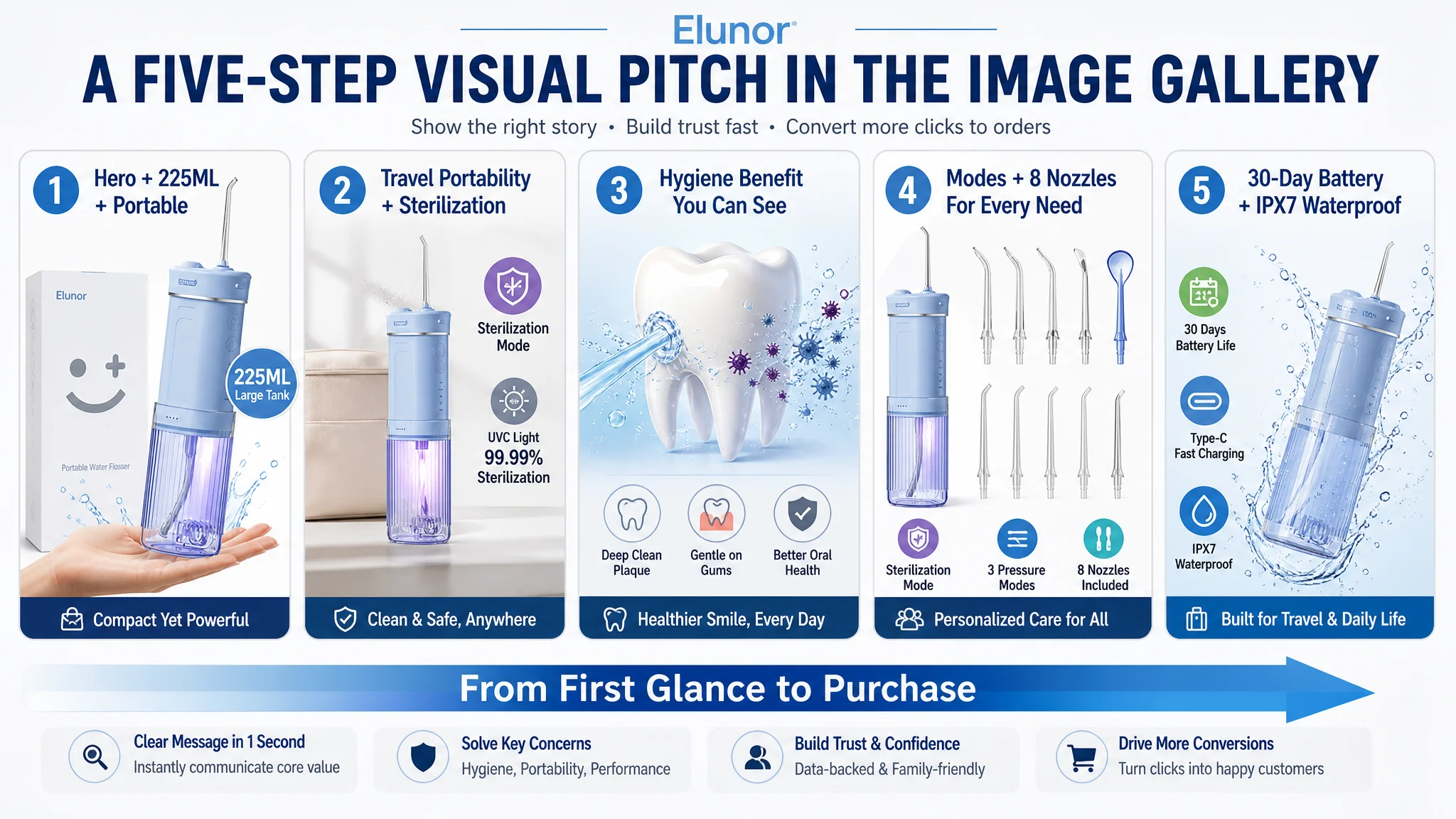
Image 1: Hero + Differentiated Promise
- Center the main unit as the unmistakable visual focal point
- Arrange all accessories around it in an orderly, balanced composition
- Overlay concise, high‑contrast text calling out:
- “225ML Large Water Tank”
- “Portable Design”
This locks in the idea: “Unlike other travel flossers, this one is compact and still carries more water.”
Image 2: Lifestyle Portability + Hygiene Advantage
- Replace the 6‑panel collage with 1–2 strong scenes:
- In a stylish toiletry bag
- In a hand, next to a phone, to communicate size
- Add the Sterilization mode as a visible, distinct text hook
- Tie portability and hygiene together to craft “professional travel oral care, anywhere”
Image 3: Hygiene in Buyer Language, Not Lab Language
- Keep the UVC sterilization logic but refocus the message:
- “Strong sterilization, avoids secondary contamination, protects oral health”
- Use visual devices like a magnifying glass around “99.99%” sterilization to make the benefit instantly digestible
- Support with a reduced, focused lab snippet as evidence, not the main visual element
Image 4: Modes and Family Coverage, Not Gravity Ball
- De‑prioritize the gravity ball explanation
- Use this frame to clearly list:
- 4 modes: Sterilization, Soft (50–75psi), Standard (75–100psi), Power (100–120psi)
- Explicit mapping to user types: sensitive gums, daily users, deep clean, orthodontic care
- Visually display all 8 nozzles with icons/mini diagrams for each oral scenario—daily cleaning, periodontal pockets, braces, tongue cleaning
Image 5: Battery, Waterproof, and “One Fill, One Full Clean”
- Split the frame visually:
- Top: long battery life (calendar or travel timeline, Type‑C charging detail, “30 days on a single charge”)
- Bottom: IPX7 waterproof with an in‑shower usage scene (real water splash, not just a submerged product)
- Add a succinct statement that 225ML is enough for one full‑mouth cleaning, using a clear visual indicator (tank level vs. recommended mouth rinse volume)
The result: a main‑image sequence that tells a cohesive story before the shopper reads any bullet points.
Bullet Points: From Parallel Features to Audience‑Linked Benefits
DeepBI’s approach to bullet optimization was to bind each feature to a user, a scenario, and a result.
Examples:
1. Ultra‑Portable & Fashionable Design
Focus on compactness, detachable tank, and carry options (handbag, backpack, office). Explicitly call out business trips, office, camping as life scenarios.
1. 4 Advanced Modes with Sterilization Technology
Name each mode and pressure band; map them to personas:
- Soft: sensitive gums, first‑time users
- Standard: daily routines
- Power: deep cleaning and orthodontic care
- Sterilization: hygiene for shared family use and tip care
1. Scientific Dental Care & Certified Safety
Connect the micro‑waterfall system to gentle yet deep cleaning and gum protection. Tie this directly to FDA/FCC/CE/PSE certifications and food‑grade materials.
1. 30‑Day Long Battery Life for Travel
Make the “one month per charge” claim explicit; emphasize stress‑free travel (no constant hunting for outlets).
1. IPX7 Waterproof & Easy Maintenance
Combine in‑shower usability with easy cleaning via a detachable tank to prevent residue build‑up.
1. 4 Specialized 360° Rotating Nozzles
Define each nozzle’s role and outcome: tartar reduction, braces cleaning, periodontal pocket care, fresher breath.
This structure upgrades bullets from “feature labels” to a step‑by‑step persuasion path that answers: “Will this work for my life, my mouth, and my family?”
A+ Content: Turning the Detail Page into a Trusted, Professional Solution
On A+, DeepBI’s judgment was that the current modules had enough material, but the order and positioning wasted the listing’s most powerful strengths.
Key restructuring decisions:
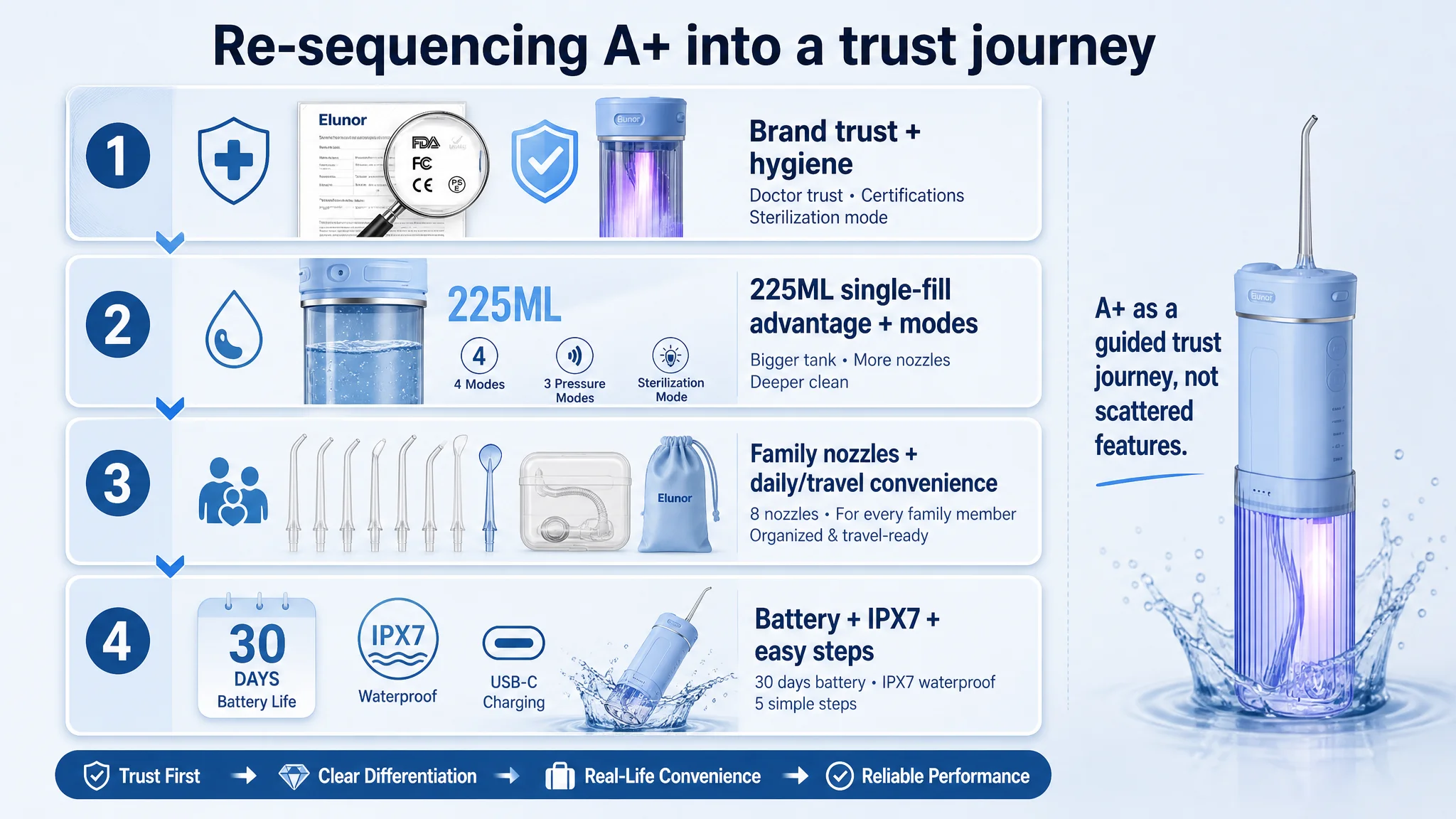
Put Brand Trust and Hygiene Up Front
- Move the doctor + certifications module to the front.
- Integrate certification icons (FDA, FCC, CE, PSE, ROHS) directly with the product image.
- Introduce Sterilization mode here as “certified‑level hygiene,” laying a foundation of professional trust.
Make “225ML, One Fill, Full Clean” the Central Differentiator
- Create a dominant module focusing on the 225ML tank, explicitly comparing it to the typical 180ML travel standard (without naming the competitor).
- Use language and visuals like “Single‑Fill, Full‑Mouth Clean” to directly resolve the buyer’s fear of frequent refilling in a compact device.
Merge Cleaning Technology and Pressure Logic
- Combine the micro‑waterfall system, high‑frequency pulses, and pressure modes into one “scientific cleaning” module.
- Reiterate the orthodontic nozzle and family‑coverage angle to convert raw specs into a professional oral‑care solution.
Consolidate Battery, Waterproof, and Travel Security
- Build a strengthened travel module:
- 30‑day battery life with a visual calendar
- IPX7 waterproof body
- USB‑C charging flexibility
- Optionally integrate TSA‑friendly mention here, rather than isolating it.
Elevate Accessories and “Whole Family” Logic
- Move the accessory/family scene module up, and re‑focus it on:
- 8 nozzles vs. typical 6
- Family usage (parents, kids, brace wearers)
- High value for households with diverse oral‑care needs
Simplify Steps and Highlight Ease of Use + Hygiene
- Streamline the step‑by‑step module to emphasize:
- Easy detachable tank and wide‑mouth refilling
- Simple Sterilization mode activation
- Integrated tip storage to keep nozzles clean when traveling
Instead of a scattered feature explanation, the result is an A+ flow that:
1. Establishes professional trust and hygiene
2. Establishes clear differentiation (225ML, 8 nozzles, sterilization)
3. Shows practical daily and travel convenience
4. Proves family‑wide suitability
What Changed for the Seller: From Ad Dependence to Conversion Awareness
After this reframing, the listing did not magically gain thousands of reviews overnight, nor did DeepBI claim any instant breakthrough. The real shift was in operating posture and risk profile:
- Listing conversion capacity improved.
The page began to express its true advantages in a way that Amazon shoppers could quickly understand and trust.
- Ad traffic became more meaningful.
When campaigns directed clicks to the page, those visits had a higher chance of becoming orders rather than wasted spend.
- Reliance on “more traffic” weakened.
The team’s mindset moved from “we need more ads” to “we need the page to convert the traffic we already have.”
- Risk of amplifying defects decreased.
With a more coherent title, stronger visual hooks, and a structured A+ trust story, ads were no longer primarily amplifying confusion or vague positioning.
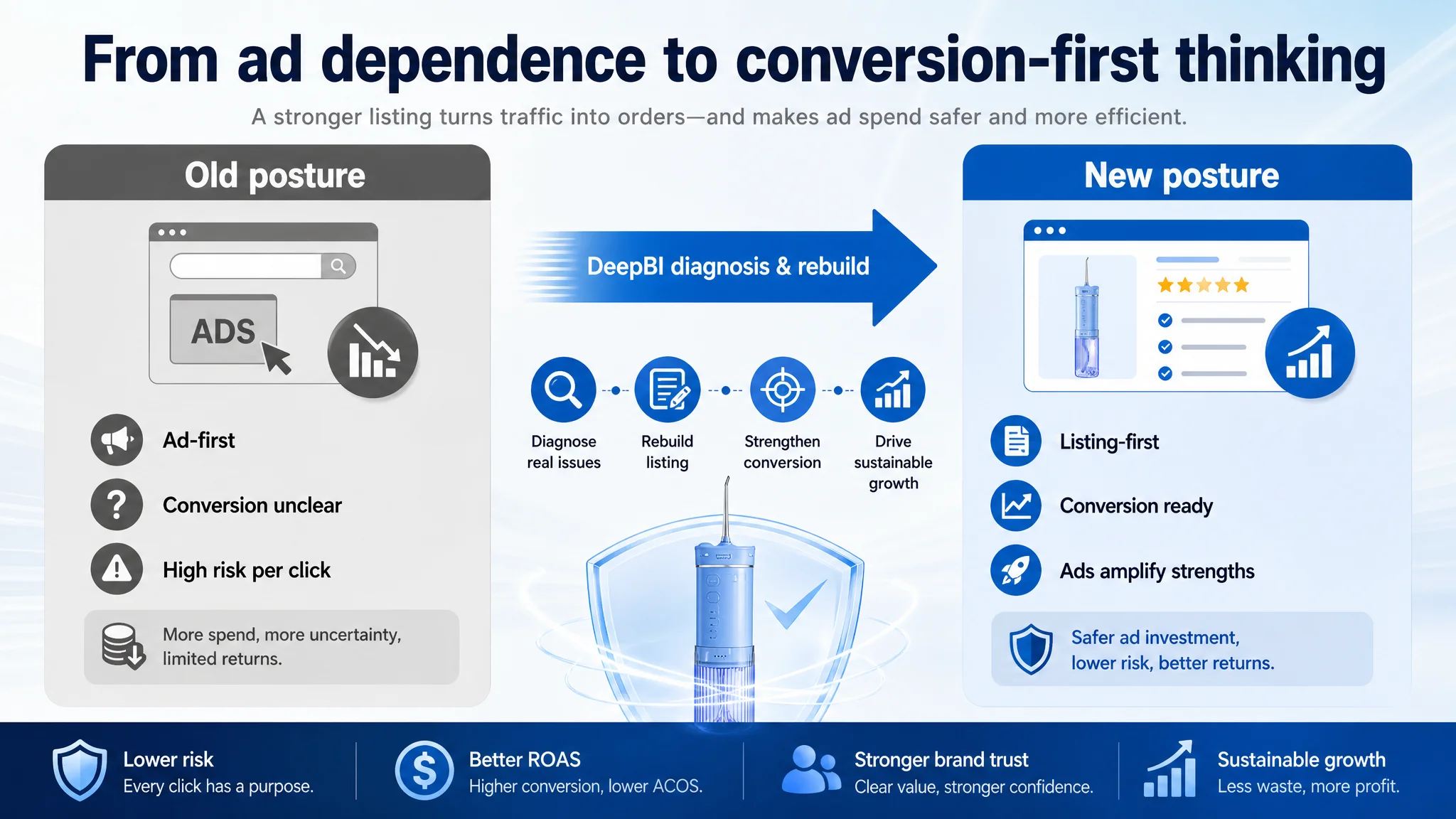
Most importantly, the seller’s understanding shifted:
- Amazon ads cannot repair a page that fails to persuade.
- A 4.5‑star rating is not enough if the detail page under‑communicates core differentiators.
- Title, main image, bullets, and A+ must work together as an integrated sales funnel, especially when competing against reviews‑rich incumbents.
For Amazon sellers reading this, the takeaway is direct: when ACOS refuses to drop and order growth stalls despite traffic, pause before launching the next campaign tweak. Ask whether your Amazon Listing, as it stands today, truly deserves more traffic—or whether, like in this water flosser case, the first job is to rebuild the page so that every click has a fair chance to become a customer.